Author Archive

Quantitative Easing and the Left's Relationship to the Rich and to Large Corporations

The Left spends a lot of time railing against the rich and large corporations.  But in practice, they seem hell-bent on lining the pockets of exactly these groups.  Today the ECB announces a one trillion plus euro government buyback of public and private securities.

Between Japan, the US, and now Europe, the world's central banks are printing money like crazy to inflate securities values around the world -- debt securities directly by buying them but indirectly a lot of the money spills over into stocks as well.  This has been a huge windfall for people whose income mostly comes from capital gains (i.e. rich people) and institutions that have access to bond and equity markets (i.e. large corporations).  You can see the effects in the skyrocketing income inequality numbers over the last 6 years.  On the other end, as a small business person, you sure can't see any difference in my access or cost of capital.  It is still just as impossible to get a cash flow loan as it always was.

The Miracle of Gas Prices

I have written before about how amazing it is that gasoline can be delivered to your car so cheaply.  The investments, the technological complexity, the distances covered, the molecular-level processing necessary, the density of retail distributions establishments -- they are all simply staggering.

I hate to steal this in full from Mark Perry, who has an awesome blog, but he has a list of the price per gallon of other liquids you buy.  Think about the complexity of, say, orange juice as opposed to gasoline.

Product Cost Per Gallon
HP Printer Ink $4,500
Nyquil $107.52
Premium Vodka $76.80
Honey $46.72
Hair Gel $44.80
Pancake Syrup $32.26
Red Bull $28.00
Windex $23.81
Real Lemon Juice $22.91
Soy Sauce $22.66
Chicken Noodle Soup $21.25
Mouthwash $19.65
Tide Laundry Detergent $18.18
Dawn Dish Detergent $17.92
Craft Beer $17.78
Mustard $17.41
Mayonnaise $17.02
409 Cleaner $16.64
Ranch Dressing $16.00
Half and Half Cream $15.87
Shampoo $15.36
Spaghetti Sauce $14.59
Ketchup $13.95
Vegetable Oil $13.44
Orange Juice $11.69
V-8 $10.37
Tomato Juice $9.47
Juicy Juice $8.83
Cranberry Juice $7.94
Soy Milk $6.66
Gatorade $6.53
Apple Juice $6.00
Iced Tea $5.89
Ammonia $4.10
Milk $4.00
Pepsi $3.71
Vinegar $3.07
Sparkling Water $2.94
Gasoline $2.05

Want to Increase Infrastructure Money for Highways Immediately by 31%? Stop Diverting Highway Money to Transit

This DOT table, pointed out to me by Randal O'Toole, shows that money spent on highways could be increased immediately by over 30% if highway money was not diverted to transit and other uses.  About 13% of state gas tax revenues meant for highways are diverted to non-highway transit projects (e.g. light rail boondoggles).  Another 9.4% are diverted to general funds, and may not be applied to transportation projects at all.   The same table shows that if all state MVD receipts were used to support investments for cars rather than transit and general spending, money available for roads would increase 45% from those funds.

Transit projects should be supported by their own riders.  This will never happen, because they are so egregiously expensive per passenger-mile that no one would ride them if their trip were not subsidized by the rest of us**.  And I am exhausted with having folks argue that highways are "subsidized" because they require tax money beyond the gas taxes (which are essentially a user fee) when these extra tax monies for highways would be largely unneeded if the highway funds were used for highways.  The diversion to general funds is particularly troubling, since sleazy government officials are obviously trying to piggy-back off the popularity of highway infrastructure investment to generate a slush fund for activities taxpayers are less likely to support.

And please do not tell me that as a highway driver, investments in transit are doing me a favor by getting cars off the road.  Transit investments are so expensive per passenger mile that the same money spent getting a few cars off the road via transit would substantially increase road and highway capacities.  A dollar of highway investment carries at least an order of magnitude more passenger miles than a dollar of transit spending.

** I am always amazed that supporters of such transit projects call light rail projects "sustainable".  Forget for a minute that they seldom use less energy per passenger mile than driving.   Think about all the resources that go into them.  This at first seems like a hard problem -- how do we account for all the resources that go into transit vs. go into driving.  But then we realize it is actually easy, because we have a simple tool for valuing resource inputs:  price.  Prices are a great miracle.  They provide us with a sort of weighted average of the value and scarcity of the resources (both hard, like titanium, and soft, like labor and innovation) that go into a product.  So if light rail costs 10x or more per passenger mile than driving, as it often does, this means that it uses ten times the value of resource inputs as driving.  This is sustainable?  I do not think that word means what you think it means.

Good God, is There No Indignity Too Trivial For Government Officials to Regulate?

The Business Secretary of the UK is desperately worried that when travelling to other countries, Brits will encounter a different selection of Netflix programming from what they are used to at home.  This trivial issue seems to demand a whole new regulatory and copyright regime:

Vince Cable will risk a clash with the film and music industries on Tuesday by calling for the creation of a single EU market for digital services such as Netflix.

The Business Secretary will say in a speech in Brussels that such services should offer the same content in all EU member states, for services paid for in one country to be available in the same form in all countries and for pricing offers to be replicated across the continent.

At present Netflix and Spotify, which operates a subscription streaming service for music, offers different catalogues at different prices depending on where the customer is located.

Harmonising such services across the EU would require copyright holders to change the way they license their material, which is currently carefully segmented for different geographic markets to maximise sales

Whenever Euro-regulators suggest harmonization across countries, they always assume that harmonization will lead to everyone adopting whatever the lowest current rate and broadest service offering that  exists in any one country.  But why?  That pretty much never happens.  It is at least as likely that anyone getting harmonized will get worse service at a higher price.

What's Going on Here

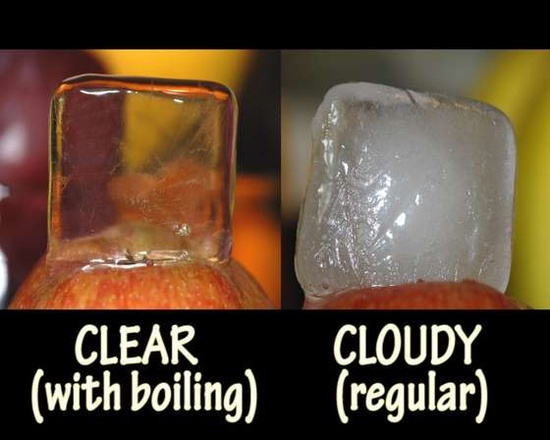
Anyone want to explain this?  It was sent in one of those emails that sort of go around.

http://1.bp.blogspot.com/-nTsYA2CjxEY/UTHUm65l1TI/AAAAAAAAEvc/99q4byX0znM/s1600/24.jpg
Water straight from the tap becomes cloudy when frozen.
To make ice cubes crystal clear, allow a kettle of boiled water to cool slightly
and use this to fill your ice cube trays.

I know that crystal growth is path dependent.  Is this just the water equivalent of annealing in metal and glass?

Update:  Long-time reader Travis says that boiling the water drives all the trapped air out, making the cubes clear.  Jeez, I so wanted this to be some wonky crystal formation answer

My Obama Inauguration Column, Six Years Ago Today

It is hard to remember, or even believe today, the absolute hysteria that accompanied Obama's nomination.  Even folks who should have known better were sucked in.  I seemed to be the only surly one that day who found the adulation, the near Imperial coronation, sickening.  Here is an excerpt.  I stand by it six years later:

Folks are excited about Obama because, in essence, they don't know what he stands for, and thus can read into him anything they want.  Not since the breathless coverage of Geraldo Rivera opening Al Capone's vault has there been so much attention to something where we had no idea of what was inside.  My bet is that the result with Obama will be the same as with the vault.

There is some sort of weird mass self-hypnosis going on, made even odder by the fact that a lot of people seem to know they are hypnotized, at least at some level.  I keep getting shushed as I make fun of friends' cult behavior watching the proceedings today, as if by jiggling someone's elbow too hard I might break the spell.  Never have I seen, in my lifetime, so much emotion invested in a politician we know nothing about.   I guess I am just missing some gene that makes the rest of humanity receptive to this kind of stuff, but just for a minute snap your fingers in front of your face and say "do I really expect a fundamentally different approach from a politician who won his spurs in .... Chicago?  Do I really think the ultimate political outsider is going to be the guy who bested everyone at their own game in the Chicago political machine?"

Well, the spell will probably take a while to break in the press, if it ever does -- Time Magazine is currently considering whether it would be possible to put Obama on the cover of all 52 issues this year -- but thoughtful people already on day 1 should have evidence that things are the same as they ever were, just with better PR.   For God sakes, as his first expenditure of political capital, Obama is pushing for a trillion dollar government spending bill that is basically one big pork-fest that might make even Ted Stevens blush, a hodge-podge of every wish-list of leftish lobbyists that has been building up for eight years.  I will be suitably thrilled if the Obama administration renounces some of the creeping executive power grabs of the last 16 years, but he has been oddly silent about this.  It seems that creeping executive power is a lot more worrisome when someone else is in power.

It has been suggested by some that today is less a cultish corronation but a big victory party in the battle against racism.  Well, I am certainly willing to accept it on those terms.  I have been arguing for years that it is time to declare victory on the worst aspects of race and gender discrimination, and move on to problems of interest to all races (like individual freedom or giving kids options to escape crappy public schools).   Unfortunately, I fear that too many folks in power are dependent on the race/gender/class wars continuing, so you and I may think we are declaring victory, but those with power over our lives have not.

The 2014 Temperature Record No One Is Talking About

Depending on what temperature data set you look at **, or on your trust in various manual adjustments in these data sets ***, 2014 may have beaten the previous world temperature record by 0.02C.  Interestingly, the 0.02C rise over the prior record set four years ago would imply (using only these two data points which warmists seem to want to focus on) a temperature increase of 0.5C per century, a few tenths below my prediction but an order of magnitude below the alarmists' predictions for future trends.

Anyway, whether there was an absolute record or not, there was almost certainly a different temperature record set -- the highest divergence to date in the modern measured temperatures from what the computer models predicted.  The temperature increase for the past 5 years was a full 0.17C less than predicted, the largest gap yet for the models in forward-prediction mode (as opposed to when they are used to backcast history).


** There are four or five or more data sets, depending on how you count them.   There are 2 major satellite data sets and 2-3 ground based data sets.  The GISS ground data set generally gives the largest warming trends, while the satellite data sets give the least, but all show some warming over the last 30 or so years (though most of this warming was before 1999).

*** The data sets are all full of manual adjustments of various sorts.  All of these are necessary.  For surface stations, the measurement points move and change technology.  For the satellites, orbits and instruments shift over time.  The worrisome feature of all these adjustments is that they are large as compared to the underlying warming signal being measured, so small changes in the adjustments can lead to large changes in the apparent trend.  Skeptics often charge that the proprietors of land data sets are aggressive about including adjustments that increase the apparent trend but reluctant to add similar adjustments (eg for urban heat islands) that might reduce the trend.  As a result, most of the manual adjustments increase the trend.  There is actually little warming trend in the raw data, and it only shows up after the adjustments.  It may be total coincidence, but the database run by the most ardent warmist is the GISS and it has the highest trend.   The database run by the most skeptical is the UAH satellite database and it shows the smallest trend.  Hmm.

Surprise! Greek Problems Were Not Solved By Kicking the Can Down the Road

Greece is looking like it's falling apart again.  Or perhaps more accurately: Greece continues to fall apart and the lipstick Europe put on the pig a few years ago is wearing off and people are noticing again.

I warned about this less than a year ago:

Kevin Drum quotes Hugo Dixon on the Greek recovery:

Greece is undergoing an astonishing financial rebound. Two years ago, the country looked like it was set for a messy default and exit from the euro. Now it is on the verge of returning to the bond market with the issue of 2 billion euros of five-year paper.

There are still political risks, and the real economy is only now starting to turn. But the financial recovery is impressive. The 10-year bond yield, which hit 30 percent after the debt restructuring of two years ago, is now 6.2 percent....The changed mood in the markets is mainly down to external factors: the European Central Bank’s promise to “do whatever it takes” to save the euro two years ago; and the more recent end of investors’ love affair with emerging markets, meaning the liquidity sloshing around the global economy has been hunting for bargains in other places such as Greece.

That said, the centre-right government of Antonis Samaras has surprised observers at home and abroad by its ability to continue with the fiscal and structural reforms started by his predecessors. The most important successes have been reform of the labour market, which has restored Greece’s competiveness, and the achievement last year of a “primary” budgetary surplus before interest payments.

Color me suspicious.  Both the media and investors fall for this kind of thing all the time -- the dead cat bounce masquerading as a structural improvement.  I hope like hell Greece has gotten its act together, but I would not bet my own money on it.

In that same article, I expressed myself skeptical that the Greeks had done anything long-term meaningful in their labor markets.  They "reformed" their labor markets in the same way the Obama administration "reformed" the VA -- a lot of impressive statements about the need for change, a few press releases and a few promised but forgotten reforms.  At the time, the Left wanted desperately to believe that countries could continue to take on near-infinite amounts of debt with no consequences, and so desperately wanted to believe Greece was OK.

I have said it for four years:  There are only two choices here:  1.  The rest of Europe essentially pays off Greek debt for it or 2.  Greece leaves the Euro.  And since it is likely Greece will get itself into the same hole again some time in the future if #1 is pursued, there is really only leaving the Euro.  The latter will be a mess, with rampant inflation in Greece and destruction savings, but essentially the savings have already been destroyed by irresponsible government borrowing and bank bail-ins.  At least the falling value of Greek currency would make it an attractive place at for tourism if not investment and Greece could start rebuilding its economy on some sort of foundation.  Instead of bailing out banks and Greek officials, Germany should let it all fall apart and spend its money on helping Greece to pick up the pieces.

By letting Greece join the Euro, the Germans essentially let their irresponsible country cousins use their American Express Platinum card, and the Greeks went on a bender with the card.   The Germans can't keep paying the bill -- at some point you have to take the card away.

This is a GOOD Sign for the United States

Thomas Friedman, and many others, think it is a sign of America's decline and some sort of failure of government will that other countries are building super-massive showcase infrastructure projects while we are not.  They would take this chart as a sign of decline:

20150114_sky

I disagree.  This is a sign of growing maturity on the part of the United States.  Many of these super-tall building projects make little economic sense, but are completed to validate the prestige of emerging nations, like teenage boys comparing penis sizes.  Grown men are beyond that behavior, just as are grown-up nations.  I discussed this in the context of rail a while back at Forbes.  In that case, it seems everyone thinks the US is behind in rail, because it does not have sexy bullet trains.  But in fact we have a far more developed freight network than any other country, and shift of transport to rail makes a much larger positive economic and environmental impact for cargo than for rail.  It comes down to what you care about -- prestige or actual performance.   Again choosing performance over prestige is a sign of maturity.**

The US had a phase just like China's, when we were emerging as a world economic and political power, and had a first generation of successful business pioneers who were unsure how to put their stamp on the world.  So they competed at building tall buildings.   Many of the tallest were not even private efforts.  The Empire State Building was a crony enterprise from start to finish, and ended up sitting empty for years.  The World Trade Center project (WTC) was a complete government boondoggle, built by a public agency at the behest of the Rockefeller family, who wanted to protect its investments in lower Manhattan.  That building also sat nearly empty for years.   By the way, the Ken Burns New York documentary series added a special extra episode at the end after 9/11 on the history of the WTC and really digs in to the awful crony and bureaucratic history of that project.  Though Burns likely did not think of it that way, it could as easily be a documentary of public choice theory.  His coverage earlier in that series of Robert Moses (featuring a lot of Robert Caro) is also excellent.

** I have always wondered if you could take this model further, and predict that once-great nations in decline (at least in decline relative to their earlier position) might not re-engage with such prestige projects, much like an aging male seeking out the young second wife and buying a Porche.

Update:  Here is part of what I wrote on US vs. European and Japanese railroading, which I think is an absolutely awesome example of where the triumphalists like Friedman go wrong:

In particular, both Friedman and Epstein think we need to build more high speed passenger trains.  This is exactly the kind of gauzy non-fact-based wishful thinking that makes me extremely pleased that these folks do not have the dictatorial powers they long for.   High speed rail is a terrible investment, a black hole for pouring away money, that has little net impact on efficiency or pollution.   But rail is a powerful example because it demonstrates exactly how this bias for high-profile triumphal projects causes people to miss the obvious.

Which is this:  The US rail system, unlike nearly every other system in the world, was built (mostly) by private individuals with private capital.  It is operated privately, and runs without taxpayer subsidies.    And, it is by farthe greatest rail system in the world.  It has by far the cheapest rates in the world (1/2 of China’s, 1/8 of Germany’s).  But here is the real key:  it is almost all freight.

As a percentage, far more freight moves in the US by rail (vs. truck) than almost any other country in the world.  Europe and Japan are not even close.  Specifically, about 40% of US freight moves by rail, vs. just 10% or so in Europe and less than 5% in Japan.   As a result, far more of European and Japanese freight jams up the highways in trucks than in the United States.  For example, the percentage of freight that hits the roads in Japan is nearly double that of the US.

You see, passenger rail is sexy and pretty and visible.  You can build grand stations and entertain visiting dignitaries on your high-speed trains.  This is why statist governments have invested so much in passenger rail — not to be more efficient, but to awe their citizens and foreign observers.

But there is little efficiency improvement in moving passengers by rail vs. other modes.   Most of the energy consumed goes into hauling not the passengers themselves, but the weight of increasingly plush rail cars.  Trains have to be really, really full all the time to make for a net energy savings for high-speed rail vs. cars or even planes, and they seldom are full.  I had a lovely trip on the high speed rail last summer between London and Paris and back through the Chunnel — especially nice because my son and I had the rail car entirely to ourselves both ways.

The real rail efficiency comes from moving freight.  As compared to passenger rail, more of the total energy budget is used moving the actual freight rather than the cars themselves.  Freight is far more efficient to move by rail than by road, but only the US moves a substantial amount of its freight by rail.    One reason for this is that freight and high-speed passenger traffic have a variety of problems sharing the same rails, so systems that are optimized for one tend to struggle serving the other.

Freight is boring and un-sexy.  Its not a government function in the US.  So intellectuals tend to ignore it, even though it is the far more important, from and energy and environmental standpoint, portion of transport to put on the rails.  In fact, the US would actually probably have even a higher rail modal percentage if the US government had not enforced a regulatory regime (until the Staggers Act) that favored trucks over rail.   If the government really had been asleep the last century, we would be further along.

California Drought Update -- Not Even Close to Worst Drought Ever

There is little trend evidence anywhere that climate is getting -- pick the world -- weirder, more extreme, out of whack, whatever.  In particular, name any severe weather category you can imagine, and actual data in trend charts likely will not show any recent trend.

The reasons the average person on the street will swear you are a crazy denier for pointing such a thing out to them is that the media bombards them with news of nearly every 2+ sigma weather event, calling most of these relatively normal episodes as "the worst ever".

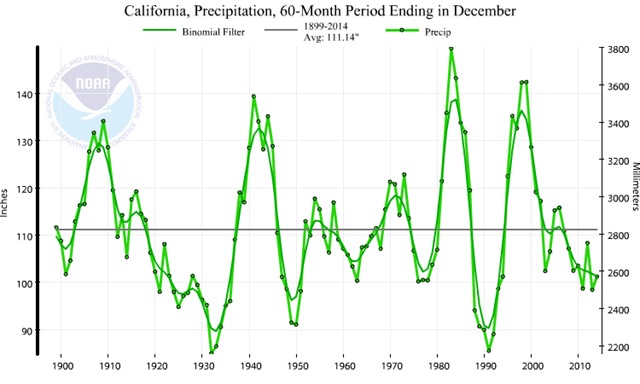
A great example is the California drought.  Here is the rolling average 5-year precipitation chart for California.  Find the worst drought "ever".

multigraph3

I know no one trusts anyone else's data in public debates, but you can make these charts yourself at the NOAA site, just go here:  http://www.ncdc.noaa.gov/cag/.  The one record set was that 2013 had the lowest measured CA precipitation in the last century plus, so that was indeed a record bad year, but droughts are typically made up of multiple years of below average precipitation and by that measure the recent CA drought is the fourth or fifth worst.

By the way, Paul Homewood points out something that even surprised me and I try not to be susceptible to the mindless media bad news stampeded:  California rainfall this year was close to normal.  And, as you can see, there is pretty much no trend over the last century plus in California rainfall:

multigraph1


As discussed previously, let's add the proviso that rainfall is not necessarily the best metric of drought.  The Palmer drought index looks at moisture in soil and takes into account other factors like temperature and evaporation, and by that metric this CA drought is closer to the worst of the century, though certainly not what one would call unprecedented.  Also, there is a worsening trend in the Palmer data.

multigraph_palmer


Update:  By the way, the fact that two measures of drought give us two different answers on the relative severity of the drought and on the trend in droughts is typical.   It makes a mockery of the pretense to certainty on these topics in the media.  Fortunately, I am not so invested in the whole thing that I can't include data that doesn't support my thesis.

Keynesian Moving Target on What Constitutes Austerity

The other day I said I was confused by what exactly creates Keynesian stimulus, and in reverse, what constitutes austerity.  I had thought that it was deficit spending that creates the stimulus, but then sometimes it seems to just be spending and in the case of the Kevin Drum post I was discussing, he says it is not the level of spending but only the first derivative of per capita real government spending (with no reference to whether it is debt or tax funded) that matters.

I figured that I was just confused because I had not formally studied economics past my undergrad years, but apparently practicing economists are also confused.  Here is Scott Sumner:

What is the proper measure of austerity?  The textbooks talk about deficits.  But most of the Keynesian bloggers focus on government purchases.  So which is it?  And if it’s purchases, why did these same bloggers claim that austerity would result from big tax increases in the US in 2013, and a big tax increase in Japan in 2014?  And why does the measure chosen (ex post) usually seem to be the one that best supports their argument in that particular case?

As a postscript, I will add that every climate skeptic can totally empathize with this Sumner concern:

A number of Keynesian bloggers have recently expressed dismay that the rest of us don’t buy their model.  Maybe it would help if they’d stop ignoring our criticisms of their model, and respond to our complaints.

Great Moments in Bad Economic Policy

This article on bad bipartisan energy laws and regulations from Master Resource brought back some old memories of the 1970s.

Folks who are at all economically literate understand the role that government price controls (specifically price caps) had on gasoline shortages in the 1970s.  When there was a supply shock via the Arab oil embargo, prices were not allowed to rise to match supply and demand.  As in the case of all such price control situations, shortages and queuing resulted.

It is too bad in a way that most folks today can't really remember the gas lines of 1973 and again in 1978.  It was my job in 1978 as the new driver in the family to go wait in line for gas for all the family cars.  I wasted hours and hours sitting in gas lines. I wonder if anyone has every computed the economic value of the time lost to Americans sitting in gas lines because politicians did not want the price to rise by 20 cents.

A number of my friends who knew my dad was an Exxon executive were surprised at my waiting in lines, and wondered why we didn't get some sort of secret access to gas.  But my family waited in lines like everything else.

Well, almost like everyone else.  Because of my dad's position, we did have a bit of information most people did not have, at least in the first shock of 1973.  It was not a secret, it was just totally unreported in the media.  The key was the knowledge of a piece of Congressional legislation called the Emergency Petroleum Allocation Act of 1973.  It had an enormous impact on exacerbating the urban gas lines, but either out of a general ignorance or else a media/academic desire not to make government regulation look bad, it is as unknown today as it was unreported in 1973.

What the law did was this -- it mandated that oil companies distribute gasoline geographically in the US in the same proportion that it was sold in the prior year.  So if they sold x% in area Y last year before the embargo, x% must be distributed to area Y this year after the embargo.  I can't remember the exact concern, but Congress had some fear that oil companies would somehow respond to price signals in a way that caused gasoline allocations to hose someone somewhere.

Anyway, the effect was devastating, probably even worse than the effect of price controls.  The reason was that while Congress forced gasoline supply distribution patterns to remain the same as the prior year (in classic directive 10-289 style), demand patterns had changed a lot.  Specifically, with the fear that gas might not be available over the road and looming economic problems, people cancelled their summer long-distance driving trips.

Everyone stayed home and didn't drive the Interstates cross-country.  So there was little demand for gas at the stations that served these routes.  But by law, oil companies had to keep delivering gasoline to these typically rural stations.  So as urban drivers fumed sitting in gas lines for hours and hours, many rural locations were awash in gas.  Populist Congressmen berated oil companies in the press for the urban gas shortages and lines, all while it was their stupid, ill-considered laws that created a lot of the problem.

So this was the fact that should have been public, but was not: That instead of sitting in urban gas lines for four hours, one could drive 30 minutes into the countryside and find it much easier.  Which is what we did, a number of times.

By the way, it was about this time that I read Hedrick Smith's great book "The Russians."  It was, for the time, a nearly unique look at the life of ordinary Russians under Soviet communism.  I wish the book were still in print (I would love to see one of the free market think tanks do a reissue, at least on Kindle).  Anyway, about 80% of the book seemed to be about how individual Russians dealt with constant shortages and ubiquitous queuing.  It seemed that a lot of the innovation in the general populace was channeled into just these concerns.  What a waste.  Dealing with the 1970s gas lines and shortages is about the closest I have ever come to the life described in that book.

California Fighting Our Horrible Shortage of Laws

I reported a while back about the apparent (from all the media angst over "gridlock") horrendous shortage of laws.  Well the California legislature is stepping in to the breach, passing over 900 new laws over the last year.  Our company is steadily exiting California because we have no desire to learn to comply with 900 new laws a year, but obviously many of you are simply begging to be legislated and regulated more so you are welcome to rush into the breach.

Wow, Who Could Have Predicted This?

Full-time employment in one fast-food survey drops over last several years from 50% of workers to less than 2%.

This is the conclusion I draw from my survey in December of 136 fast-food restaurants (franchisees) that employed close to 3,500 workers. Before 2014 about half the employees were “full time” as defined by ObamaCare; that is, they worked 30 hours or more a week. The potential cost to the employers of providing mandated health insurance to their full-time staff would have been about $7 million a year. But by the time the employers took advantage of all their legal options they were able to reduce their cost to less than 1% of that amount.

The first step was to make all hourly workers part time. That may seem easy to do, but in the fast-food business it’s not uncommon that employees fail to show up for work. Other employees are asked to work additional hours to prevent the restaurant from shutting down. By the end of 2014, 58 employees had crossed the line to full-time status and were eligible for mandated health insurance in 2015.

My 2012 article about the end of full-time work in the retail service sector.  The follow-up at Forbes was here.

$400 Million Dollars in Public Money for a Building Used 30 Hours a Year

I love to watch the NFL but that organization and its team owners are some of the worst cronies in the country.  A huge portion of their teams' increase in net worth over the last 30 years has come from public funding of its stadiums.  These NFL stadiums are used by their teams for 8 regular season games and at most 2 pre-season games a year, or for a total of about 30 hours a year.  Taxpayers are being forced to buy buildings with a 0.3% occupancy.

St. Louis is the next to propose a taxpayer fleecing, proposing to spend $400 million before they have even paid off the enclosed stadium they built 20 years ago.  What a farce.

Years and years ago I described this as an awful sort of prisoner's dilemma game.  If governments colluded in a promise not to subsidize teams, we would still have NFL teams in roughly the same cities but without the billions of dollars in taxpayer money having been passed on to 32 billionaires.

The Big Government Trap: Does Stimulus Require Government Spending to Continuously Rise?

There has been a lot of back and forth over the last few years about "austerity".  I have wondered how government spending levels over the last few years that dwarf any peacetime levels in history could be called "austerity", but that is exactly what folks like Paul Krugman have been doing.   Apparently, the new theory is that the level of spending is irrelevant to stimulus, and only the first derivative matters.  In other words, high spending is not stimulative unless it is also increasing year by year.   Kevin Drum provides an explanation of this position:

Austerity is all about the trajectory of government spending, and this is what it looks like. You can argue about whether flat spending represents austerity, but a sustained decline counts in anyone's book. The story here is simple: for a little while, in 2009 and 2010, stimulus spending partially offset state and local cuts, but by the end of 2010 the stimulus had run its course. From then on, the drop in government expenditures was steady and significant. It was also unprecedented. If you run this chart back for 50 years you'll never see anything like it. In all previous recessions and their aftermaths, government spending rose.

blog_total_govt_expenditures_per_capita_inflation

So, by this theory of stimulus, the fact that we spent substantially more money in 2010-2014 than in pre-recession years (and are still spending more money) turns out not to be stimulative.  The only way government can stimulate the economy is to increase year-over-year per capital real spending every single year.

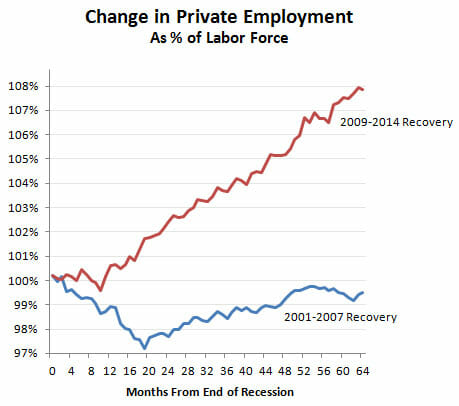
I will leave macro theory (of which I am increasingly skeptical) to the Phd's.  In this case however, Drum's narrative is undermined by his own chart he published a few weeks ago:

blog_private_employment_2001_vs_2010

In his recent austerity article quoted above, he describes a sluggish recovery with a step-change in 2014 only after "austerity" ends.  But his chart from a few weeks earlier shows a steady recovery from 2010-2014, right through his "austerity" period.  In fact, during the Bush recovery he derides, we actually did do exactly what he thinks is stimulative, ie increase government spending per capita steadily year by year.  How do we know this?  From another Drum chart, this one from last year.  I changed the colors (described in this article) and compared his two charts:

click to enlarge


By Drum's austerity theory, the Bush spending was stimulative but the Obama spending was austerity.  But the chart on the right sure makes it look like the Obama recovery is stronger than the Bush recovery.


A better explanation of the data is that a recession driven by the highly-leveraged mis-allocation of too much capital to home real estate was made worse in 2008-2009 by a massive increase in government spending, which is almost by definition a further mis-allocation of capital (government is taking money from where the private sector thinks it should be invested and moves it to where politicians think it should be spent).  The economy has recovered as that increase in government spending has been unwound.

Naomi Oreskes and Post-Modern Science

Post-modernism is many things and its exact meaning is subject to argument, but I think most would agree that it explicitly rejects things like formalism and realism in favor of socially constructed narratives.  In that sense, what I mean by "post-modern science" is not necessarily a rejection of scientific evidence, but a prioritization where support for the favored narrative is more important than the details of scientific evidence.  We have seen this for quite a while in climate science, where alarmists, when they talk among themselves, discuss how it is more important for them to support the narrative (catastrophic global warming and, tied with this, an increasing strain of anti-capitalism ala Naomi Klein) than to be true to the facts all the time.  As a result, many climate scientists would argue (and have) that accurately expressing the uncertainties in their analysis or documenting counter-veiling evidence is wrong, because it dilutes the narrative.

I think this is the context in which Naomi Oreskes' recent NY Times article should be read.  It is telling she uses the issue of secondhand tobacco smoke as an example, because that is one of the best examples I can think of when we let the narrative and our preferred social policy (e.g. banning smoking) to trump the actual scientific evidence.  The work used to justify second hand smoke bans is some of the worst science I can think of, and this is what she is holding up as the example she wants to emulate in climate.  I have had arguments on second hand smoke where I point out the weakness and in some cases the absurdity of the evidence.  When cornered, defenders of bans will say, "well, its something we should do anyway."  That is post-modern science -- narrative over rigid adherence to facts.

I have written before on post-modern science here and here.

If you want post-modern science in a nutshell, think of the term "fake but accurate".  It is one of the most post-modern phrases I can imagine.  It means that certain data, or an analysis, or experiment was somehow wrong or corrupted or failed typical standards of scientific rigor, but was none-the-less "accurate".  How can that be?  Because accuracy is not defined as logical conformance to observations.  It has been redefined as "consistent with the narrative."  She actually argues that our standard of evidence should be reduced for things we already "know".  But know do we "know" it if we have not checked the evidence?  Because for Oreskes, and probably for an unfortunately large portion of modern academia, we "know" things because they are part of the narrative constructed by these self-same academic elites.

Low Oil Prices and Prosperity

I continue to see reports about how bad falling oil prices are for the economy -- most recently some layoffs in the steel industry were blamed on the looming drop (or crash) in oil drilling and exploration driven by substantially lower prices.

I find this exasperating, a classic seen-and-unseen type failure whose description goes back at least to the mid-19th century and Bastiat and essentially constituted most of Hazlitt's one lesson on economics.  Yes, very visibly, relatively high-paid steel and oil workers are going to lose their jobs.  They will have less money to spend.  The oil industry will have less capital spending.

But the world will pay over a trillion dollars less this year for oil than it did last year (if current prices hold).  That is a huge amount of money that can be spent on or invested in something else.  Instead of just getting oil with those trillion dollars, we will still have our oil and a trillion dollars left over to spend.   We may never know exactly who benefits, but those benefits are definitely there, somewhere.  Just because they cannot be seen or portrayed in short visual anecdotes on the network news does not mean they don't exist.

Ugh, this is just beyond frustrating.  I would have bet that at least with oil people would have understood the unseen benefit, since we get so much media reportage and general angst when gas prices go up that people would be thrilled at their going down.  But I guess not.

I explained in simple terms why the world, mathematically, HAS to be better off with lower oil prices here.

Before Michael Brown, Ferguson Police Did This

I had forgotten about this story and am surprised the media did not make this connection more often during the Michael Brown brouhaha:

Michael Daly at The Daily Beast has the flabbergasting story of Henry Davis, who was picked up by cops “for an outstanding warrant that proved to actually be for another man of the same surname, but a different middle name and Social Security number,” then beaten by several officers at the station. What happened next was truly surreal: while denying that Davis had been seriously hurt at all, though a CAT scan found he had suffered a concussion and a contemporaneous photo shows him bleeding heavily, four police officers sought to have him charged for property damage for getting blood on their uniforms. ...

The kicker: the police department was that of Ferguson, Missouri.

My Contributions to Social Science

It occurred to me that I have reached important insights into human behavior that it would be negligent of me to withhold from the world, so here they are:

The Cheerleader Effect:  The cheerleader effect describes a human perception issue where pictures of any woman in a group are often considered more attractive than a picture of that woman alone (this may apply to men as well, but I have always heard it referred to women).  Apparently women exploit this effect by posting pictures on dating sites that show them in groups of their friends rather than alone.  Anyway, I have developed two corollaries:

  • Polo Shirt Effect:  Polo shirts in a store appear more desirable when grouped with other similar shirts in an array of colors than when presented alone.  This effect is strong enough to trump the paradox of choice, where offering consumers more choices can tend to flummox them and cause them to buy less.  I believe arrays of multi-hued polo shirts presented together increase purchases of these shirts.
  • Christmas Tree Effect:  We almost never buy ornaments for our tree.  95% are individually ugly, but meaningful, constructions by our kids over the years.  The rest are what remain after breakage of some commercial ornaments we bought 20 years ago on deep discount in the after-Christmas sales.  But a tree constructed of these ornaments is beautiful.  So ornaments look far better when massed on a tree than they look individually.

Towards A Theory of Pedestrian Behavior:  One of the things I enjoy is urban running -- ie running through the streets of cities.  When we travel, this is one of my favorite ways to see cities, and it also helps me run further because I do not get bored.  But trying to run through sometimes crowded pedestrian areas can be frustrating, since one is trying to move faster than the crowd and the crowd typically does not expect a runner coming up behind them on the sidewalk.  As a result of many such runs, I have developed two laws of pedestrian behavior:

  1. Groups of pedestrians will expand to fill the width of the space allotted.  If the width changes, groups of pedestrians will respond very quickly and expand their group spacing to fill that width.  While this behavior is almost certainly natural, it is almost impossible to distinguish a group walking naturally from one purposefully trying to block passage by a faster pedestrian.  Corollary:  Groups too small to fill the width of a passage or sidewalk will weave.
  2. Groups of pedestrians, everything else being equal, will choose to pause and congregate at the bottleneck in any sidewalk, thus constricting an already narrow passage.  DisneyWorld is a great location for spotting this behavior.  Corollary:  A disproportionate number of people will choose to stop right at the exit door from an jetway when exiting an aircraft.


Explaining the Financial Crisis: Government Creation of a Financial Investment Mono-culture

Arnold Kling on the recent financial crisis:

1. The facts are that one can just as easily blame the financial crash on an attempted tightening of regulation. That is, in the process of trying to rein in bank risk-taking by adopting risk-based capital regulations, regulators gave preference to highly-rated mortgage-backed securities, which in turn led to the manufacturing of such securities out of sub-prime loans.

2. The global imbalances that many of us thought were a bigger risk factor than the housing bubble did not in fact blow up the way that we thought that they would. The housing bubble blew up instead.

What he is referring to is a redefinition by governments in the Basel accords of how capital levels at banks should be calculated when determining capital sufficiency.  I will oversimplify here, but basically it categorized some assets as "safe" and some as "risky".  Those that were risky had their value cut in half for purposes of capital calculations, while those that were "safe" had their value counted at 100%.  So if a bank invested a million dollars in safe assets, that would count as a million dollar towards its capital requirements, but would count only $500,000 towards those requirements if it were invested in risky assets.  As a result, a bank that needed a billion dollars in capital would need a billion of safe assets or two billion of risky assets.

Well, this obviously created a strong incentive for banks to invest in assets deemed by the government as "safe".  Which of course was the whole point -- if we are going to have taxpayer-backed deposit insurance and bank bailouts, the prices of that is getting into banks' shorts about the risks they are taking with their investments.  This is the attempted tightening of regulation to which Kling refers.  Regulators were trying for tougher, not weaker standards.

But any libertarian could tell you the problem that is coming here -- the regulatory effort was substituting the risk judgement of thousands or millions of people (individual bank and financial investors) for the risk judgement of a few regulators.  There is no guarantee, in fact no reason to believe, the judgement of these regulators is any better than the judgement of the banks.  Their incentives might be different, but there is also not any guarantee the regulators' incentives are better (the notion they are driven by the "public good" is a cozy myth that never actually occurs in reality).

Anyway, what assets did the regulators choose as "safe"?  Again, we will simplify, but basically sovereign debt and mortgages (including the least risky tranches of mortgage-backed debt).  So you are a bank president in this new regime.  You only have enough capital to meet government requirements if you get 100% credit for your investments, so it must be invested in "safe" assets.  What do you tell your investment staff?  You tell them to go invest the money in the "safe" asset that has the highest return.

And for most banks, this was mortgage-backed securities.  So, using the word Brad DeLong applied to deregulation, there was an "orgy" of buying of mortgage-backed securities.  There was simply enormous demand.  You hear stories about fraud and people cooking up all kinds of crazy mortgage products and trying to shove as many people as possible into mortgages, and here is one reason -- banks needed these things.  For the average investor, most of us stayed out.   In the 1980's, mortgage-backed securities were a pretty good investment for individuals looking for a bit more yield, but these changing regulations meant that banks needed these things, so the prices got bid up (and thus yields bid down) until they only made sense for the financial institutions that had to have them.

It was like suddenly passing a law saying that the only food people on government assistance could buy with their food stamps was oranges and orange derivatives (e.g. orange juice).  Grocery stores would instantly be out of oranges and orange juice.  People around the world would be scrambling to find ways to get more oranges to market.  Fortunes would be made by clever people who could find more oranges.  Fraud would likely occur as people watered down their orange derivatives or slipped in some Tang.  Those of us not on government assistance would stay away from oranges and eat other things, since oranges were now incredibly expensive and would only be bought at their current prices by folks forced to do so.  Eventually, things would settle down as everyone who could do so started to grow oranges. And all would be fine again, that is until there was a bad freeze and the orange crop failed.

Government regulation -- completely well-intentioned -- had created a mono-culture.  The diversity of investment choices that might be present when every bank was making its own asset risk decisions was replaced by a regime where just a few regulators picked and chose the assets.  And like any biological mono-culture, the ecosystem might be stronger for a while if those choices were good ones, but it made the whole system vulnerable to anything that might undermine mortgages.  When the housing market got sick (and as Kling says government regulation had some blame there as well), the system was suddenly incredibly vulnerable because it was over-invested in this one type of asset.  The US banking industry was a mono-culture through which a new disease ravaged the population.

Postscript:  So with this experience in hand, banks moved out of mortage-backed securities and into the last "safe" asset, sovereign debt.  And again, bank presidents told their folks to get the best possible yield in "safe" assets.  So banks loaded up on sovereign debt, in particular increasing the demand for higher-yield debt from places like, say, Greece.  Which helps to explain why the market still keeps buying up PIIGS debt when any rational person would consider these countries close to default.  So these countries continue their deficit spending without any market check, because financial institutions keep buying this stuff because it is all they can buy.  Which is where we are today, with a new monoculture of government debt, which government officials swear is the last "safe" asset.  Stay tuned....

Postscript #2:  Every failure and crisis does not have to be due to fraud and/or gross negligence.  Certainly we had fraud and gross negligence, both by private and public parties.  But I am reminded of a quote which I use all the time but to this day I still do not know if it is real.  In the great mini-series "From the Earth to the Moon", the actor playing astronaut Frank Borman says to a Congressional investigation, vis a vis the fatal Apollo 1 fire, that it was "a failure of imagination."  Engineers hadn't even considered the possibility of this kind of failure on the ground.

In the same way, for all the regulatory and private foibles associated with the 2008/9 financial crisis, there was also a failure of imagination.  There were people who thought housing was a bubble.  There were people who thought financial institutions were taking too much risk.  There were people who thought mortgage lending standards were too lax.  But with few exceptions, nobody from progressive Marxists to libertarian anarcho-capitalists, from regulators to bank risk managers, really believed there was substantial risk in the AAA tranches of mortgage securities.  Hopefully we know better now but I doubt it.

Update#1:  The LA Times attributes "failure of imagination" as a real quote from Borman.  Good, I love that quote.  When I was an engineer investigating actual failures of various sorts (in an oil refinery), the vast majority were human errors in procedure or the result of doing things unsafely that we really knew in advance to be unsafe.  But the biggest fire we had when I was there was truly a failure of imagination.  I won't go into it, but it resulted from a metallurgical failure that in turn resulted form a set of conditions that we never dreamed could have existed.

By the way, this is really off topic, but the current state of tort law has really killed quality safety discussion in companies of just this sort of thing.  Every company should be asking itself all the time, "is this unsafe?"  or "under what conditions might this be unsafe" or "what might happen if..."   Unfortunately, honest discussions of possible safety issues often end up as plaintiff's evidence in trials.  The attorney will say "the company KNEW it was unsafe and didn't do anything about it", often distorting what are honest and healthy internal discussions on safety that we should want occurring into evidence of evil malfeasance.  So companies now show employees videos like one I remember called, I kid you not, "don't write it down."
I Believe the Trend Was Caused by All the Things I Believed Before I Investigated the Trend

This is so common that there ought to be a name for it (perhaps there is and I just don't know it):  Writer does a story or study on some trend, in this case the downfall of the enclosed shopping mall.  In each case, the writer discovers that such malls died because of ... all the things the writer already holds dear.  If the writer hates American consumerism, then the fall of such malls is a backlash against American consumerism.

It is interesting to note that all of the ideas quoted are demand-side explanations, e.g. why might consumers stop going to large enclosed malls.  And certainly I find the newer outdoor malls more congenial personally, but this can't be the only explanation.  Here in north Phoenix, I can see the dying enclosed Paradise Valley Mall out my window, but just a few miles away is the Scottsdale Fashion Square, a traditional mall that appears to be going great guns.  Ditto the Galleria in Houston.  Perhaps part of the answer is that enclosed malls were simply overbuilt and that people are willing to drive a bit to get to the best enclosed mall in town rather than a smaller version closer to their home (certainly Mall of America made a big bet on that effect).

But it also strikes me there are supply side considerations.  The mall out my window is a huge waste of space, surrounded by parking lots the size of a small county.  And it's just retail.  Modern outdoor malls allow developers to mix shopping, living, and office space in what looks to my eye to be a much denser development.  All these malls have stores on the ground floor with condos and offices up above.  To my not-real-estate-trained eye, this would seem to increase the potential rents in a given piece of land and provide some synergies among the local businesses (e.g. office workers and residents eat and shop in the mall shops).  In some sense it is a re-imagining of the downtown urban space in a suburban context.  This is ironic because it is something urban planners have been trying to force for decades and here comes the free market to do it on its own.

People also like going to newer facilities.  Just ask hotel owners.  If owners do not totally refresh a hotel every 20 years or so, people stop visiting and rates fall.  The same is true of gas stations and convenience stores.  When I worked at Exxon briefly, they said they budgeted to totally rebuild a gas station every 20 years.  So it is not impossible there is a big supply-side explanation here -- if people are reluctant to go to establishments over 20 years old, then visitation of enclosed malls should be collapsing right about now, 20 years after they stopped being built.  A shift in developer preferences could be a large element driving this behavior.  I don't insist that the supply side and real estate incentives are the only explanation, but I think they are a part of it.

Geeky Reflections -- Simulated Annealing

When I was an undergrad, my interest was in interfacing microcomputers with mechanical devices.  Most of what we did would be labelled "robotics" today, or at least proto-robotics (e.g. ripping the ultrasonic rangefinder out of a Polaroid camera, putting it on a stepper motor, and trying to paint a radar image of the room on a computer screen).

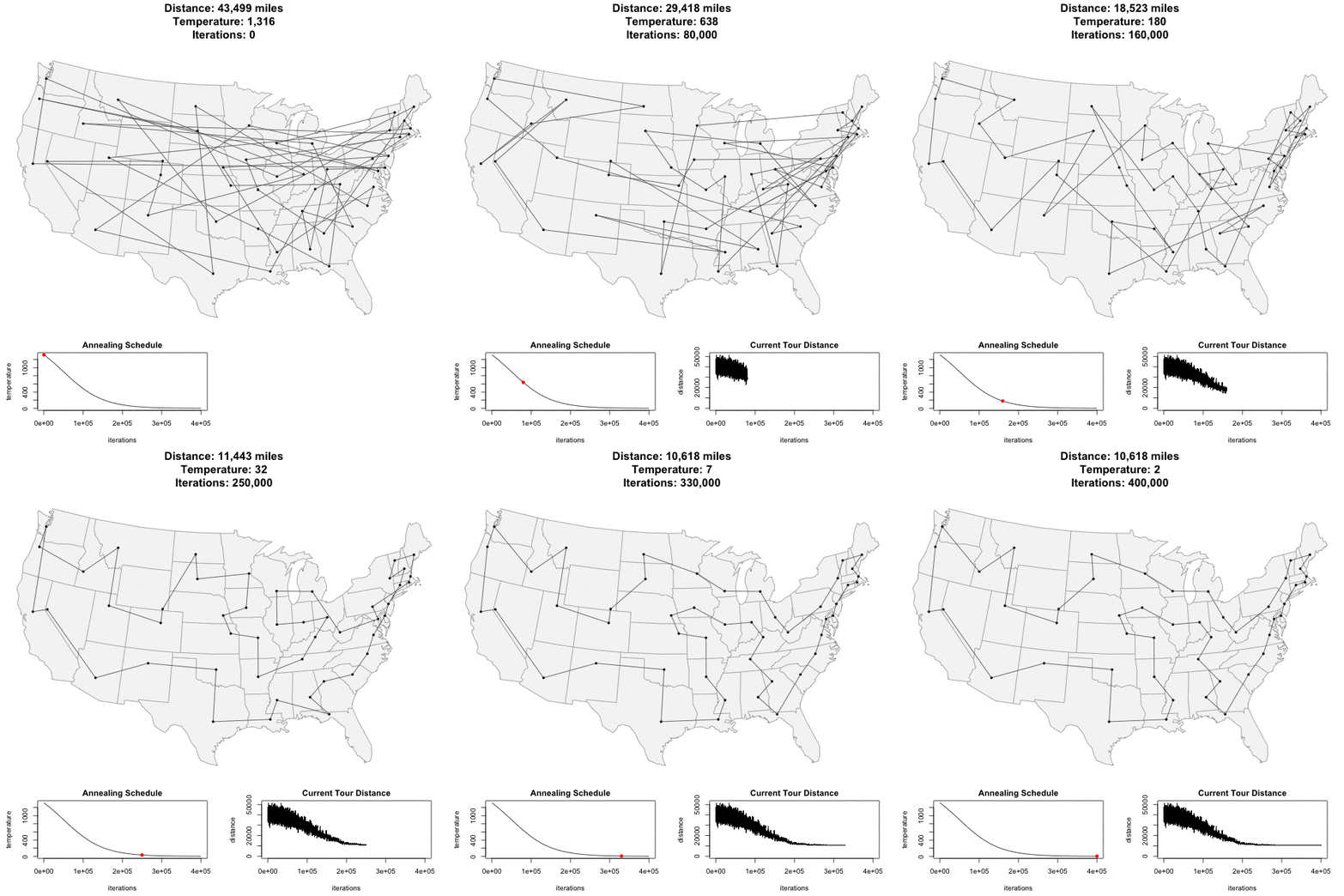
In doing this, we were playing around with S-100 bus computers (PC's were a bit in the future at that point) and I got interested in brute force approaches to solving the traveling salesman problem.  The way this is done is to establish some random points in x,y space and then connect them with a random path and measure the length of that path.  The initial random path is obviously going to be a terrible solution.  So you have the computer randomly flip flop two segments, and then you see if the resulting total distance is reduced.  If it is, then you keep the change and try another.

This will lead to a much shorter path, but often will not lead to the optimally shortest path.  The reason is that the result can get stuck in a local minimum that is not the optimum.  Essentially, to break out of this, you have to allow the solution to get worse first before it can get better.

The approach I was playing with was called simulated annealing.  Everything I said above is the same in this approach, but sometimes you let the program accept flip-flopped segments that yield a worse (ie longer) rather than better path.  The allowed amount worse is governed by a "temperature" that is slowly lowered.  Initially, at high temperatures, the solution can jump into most any solution, better or worse.  But as the "temperature" is lowered, the allowed amount of jumping into worse solutions is reduced.  Essentially, the system is much, much more likely than the previous approach to settle closer to the actual optimum.  This is roughly an analog of how annealing works in metals.  The code is ridiculously simple.   I don't remember it being much more than 100 lines in Pascal.

Anyway, if you lived through the above without falling asleep, the payoff is this site.  After 30 years of pretty much never thinking about simulated annealing again, I found Todd Schneider's blog which has a great visual overview of solving the travelling salesman problem with simulated annealing.  If you really want to visually see it work, go to the customizable examples at the bottom and set the iterations per map draw for about 100.  Then watch.  It really does look a bit like a large excited molecule slowly cooling.  Here is an example below but check out his site.

0e1ca854cbc30f33abc46108f2ba38f2.640x640x42

Thanks for the Support of My Writing

Thanks mostly to y'all, my short story String Theory still sits in the top 25 (well, it is at exactly 25) of the Amazon Kindle science fiction and short story rankings.  One notch above John Scalzi, and just two notches below David Brin.  And one of the only entries at the top of the list that does not have a guy with ripped abs or two vampires making out on the cover.  Pretty cool.

And The Highest-Paid US Government Employee is....

...Probably Nick Saban, coach of the University of Alabama football team at around $7 million a year.  But Jim Harbaugh, recently hired by the University of Michigan for a $5 million base salary, apparently has incentives that can take that up to $9 million a year.

Apologists will argue that this is all OK and shouldn't worry taxpayers at all because these guys are paid out of the college athletic budget which is generated from sports revenue rather than taxes.  Hmm.  Any state parks agency probably generates millions or tens of millions each year in user fees.  Should we be OK with the state employee who runs those agencies making $5 million because it comes out of user fees rather than taxes?  Money is fungible.  $5 million more spent on a football coach is $5 million less that can fund other University services.

(PS - in the US Today ranking of college football coach salaries, 19 of 20 are at public institutions).