Rare Earths Are Rare in the US Only Because We Choose To Export Environmental Challenges
As has been said by many commentators, rare earths are not particularly rare. Via source, here is an estimate of their abundance in the Earth's surface:
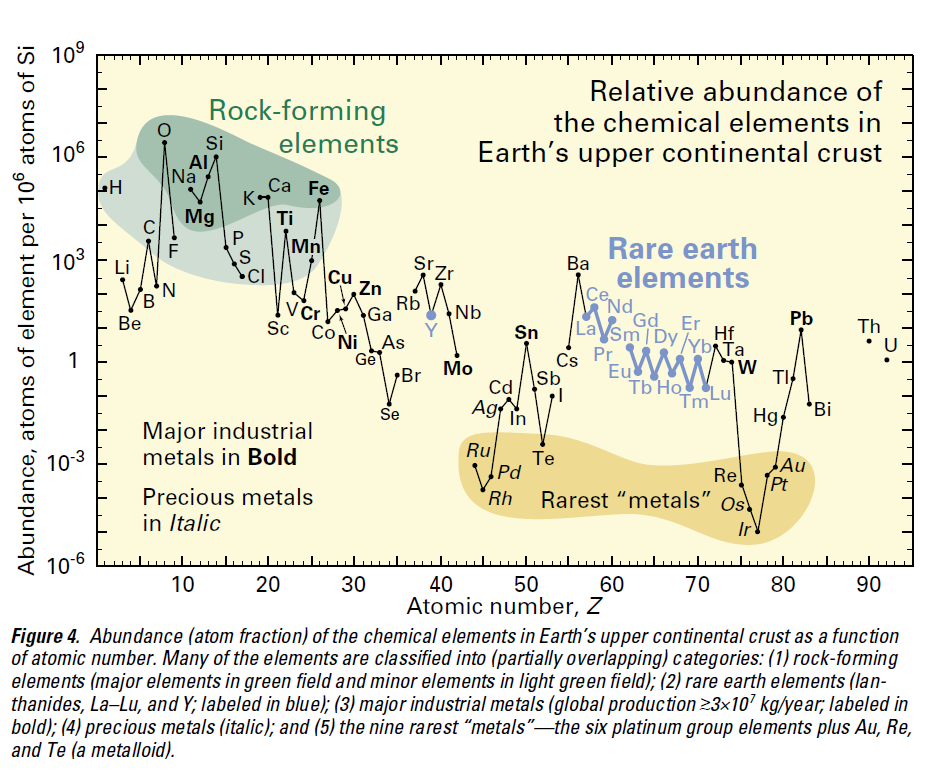
Note by the way the Y-axis is logarithmic so small changes in vertical position can mean a factor of 10 or more difference in concentration. But the rare earths are not unreasonably far off fairly common industrial metals like lead, nickel, copper, and molybdenum and well more common than gold, silver, and mercury.
I am not a geologist but my gut feel is that there are plenty of rare earths in the US. The problem is that the process of mining and concentrating the minerals is ecologically relatively expensive -- often large strip mines are involved with a lot of tailings and waste and sometimes dangerous chemicals used in the concentration process. By the time some of these materials starting coming in demand, most companies had written off the US as a viable place to even look -- why bother exploring if you are never going to be permitted to produce anything. Thus much of the world's production has been outsourced to countries like China and poor nations in Africa (or the worst of all worlds -- Chinese mines in Africa) that don't necessarily give a sh*t about the environment.
From an environmental standpoint, this is actually a terrible situation. The US has more wealth and a fair amount of will to take environmentally sensible approaches, so exporting the nasty stuff is not a great long-term solution. California by the way is the worst about this, intent on kicking out everything from coal-fired electricity generation to oil refining from the state but happy to buy the products of these industries from less environmentally-sensitive areas.
Resonates with a point I have been making about EVs: if the chinese are indeed underpricing their exports through subsidies, and rare earths are rare or costly here... shouldn't we do our utmost to exploit their low prices and buy everyone we can get our hands on?
You should understand that the "mine spoils and tailings" (to say nothing of coal ash) needed to RE-process for rare earths are already available in the billions of tons. I worked on a project planned by one of our largest mining firms to do exactly that some 25 years ago - a project that "environmentalists" managed to kill (with great glee) in the permitting stage.
Given a few years and a willing government this problem will vanish. Of course, that's IF we have a few years.
Yes, rare earths are relatively common ... but they are not that common in concentrations that are economically viable.
A company has to not just find a viable deposit, they also have to document it enough to get investors to support them, they have to complete federal and state permitting, they have to get at least passive acceptance from the community, and then they have to set it up and get other companies to buy their product.
If you are familiar with metals mining in the US, which I am, you'll notice that specialized metal mine projects have very difficult time getting investors, even once they are permitted. Examples of mines focused on in demand uncommon metals that can't get investors include Mt Hope Molybedenum mine and Gibellini Vanadium (and uranium as a secondary product) - I mention these because I am familiar with them; I'm sure there are others.
On the other end of the scale, there are large copper mines that know they have these metals and many others in their process stream, but they haven't found ways to economically removes them - some of this is due to market demand, some cost, and some changing markets.
For example, in the 1980's Kennecott Copper in Utah produced 48 different metals; today they produce 18.
And of course, this is all before various levels of politics came into play. In Southern Nevada, there were two promising rare earth exploration projects... until 2023 when Biden overlaid them with a national monument that just happened to shut down their future. Some say the locations and the size of the monument have a strangely high level of correlation. Other examples of local restriction and opposition can be found if you look around.
It's not easy for a coal or gold mine to get going, and they are simple and widely understood compared to rare earths!
Yes, California will gladly import product produced with poor environmental practices, just as long as it has the proper label stating that the State of California has determined that it may cause cancer.