Archive for November 2025

Housing Affordability -- Where Everyone Is Wrong

There is one simple answer to why housing costs rise faster than inflation and incomes -- restricted supply mated with subsidized demand.   In many locales the supply of housing is restricted by the government (rent control, growth limits, expensive and time-consuming permitting, etc) and in every part of the country housing is subsidized by the government (mortgage loan guarantees, tax deductibility of mortgage interest, section 8 housing vouchers, etc).  The net result HAS to be rising rents and home prices.

I bring this up because we are in the insane situation that both the Left and Right are proposing to attack housing affordability by.... subsidizing demand and restricting supply.  Trump's idea is to extend government mortgage guarantees to 50-year mortgages.  All this is likely to do is increase the prices of houses to absorb the new lending limits.  We saw this in another sector -- college tuition -- where there is hugely subsidized demand and increased student loan limits led to almost one for one increases in tuition.

The Left -- from LA to NY -- is advocating for the same thing it always advocates for: rent control.  Rent control is a boon for current renters who have their rents locked in at unreasonably low rates but is a disaster for new entrants to the rental market because the construction of new rental properties drops significantly with rent control (actually the supply can go negative as current rentals are converted to owned units).  Rental rates are nominally kept in check but homelessness soars.  In addition, rent control has the under-appreciated harm of reducing labor mobility, as one cannot afford to move out of a rent-controlled unit to seek better employment.

The Middle Class is Shrinking -- And That's a Good Thing

An important goal of Marxist thought is the proletarianization of the middle class -- to convince great numbers of people in the office worker and shopkeeper classes that they are not beneficiaries of a rising tide of success but are no better than coal shovelers in a boiler room, victims of capitalist oppression that need to join the revolution. It is impossible to view the recent mayoral election in NYC as anything but a sign of their success.  People in NYC wail about how dehumanizing it is to sit in an office for 8 hours a day.

Socialists have been brilliantly successful at creating bad outcomes via institutions they control or policies they promote, and then blaming those bad outcomes on capitalism.  Probably the most brilliant success has been the shittification of higher education.  Socialist-controlled universities create sky-high expectations for their degrees, and reinforce these expectations with rampant grade inflation that makes every student feel like a success -- even when they do almost no work.  Academics on the Left route students into degrees and classes with absolutely no economic value (e.g. Paraguayan Feminist Poetry) and then dump them into the world -- after loading them down with $250,000 or more of debt -- with no possible path to reaching the promised expectations or even paying off the debt.  And when all this inevitably fails, the academic apparatchiks who live high on tuition money are quick to blame the failure on "capitalism."  And since these schools no longer teach students much about reasoned engagement with difficult and complex ideas -- and in fact encourage emotional reasoning, virtue-signaling, and just wailing in anger on TikTok over logical argument -- voters respond that "yeah, it must be capitalism's fault."

Anyway, in the context of all the turgid articles about the shrinking of the middle class and the failures of capitalism for the middle class, consider this which is all in 2024 $ (source):
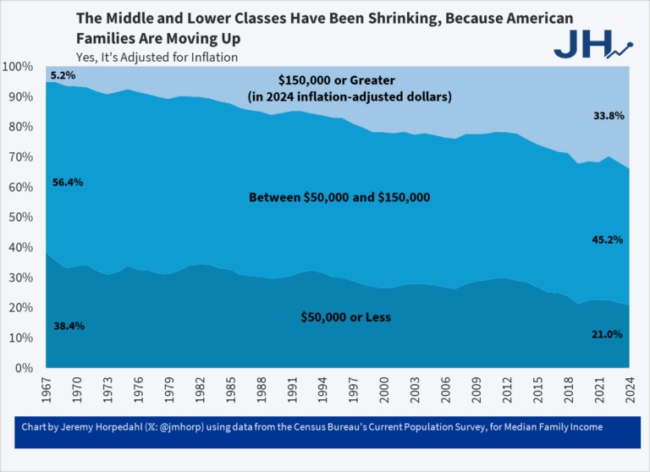
Yes the middle class is shrinking -- because people in it are becoming richer.  They are not (on average, certainly there are individuals who go up and down) getting poorer because the poorest band on this chart is shrinking even faster than the middle class.  This is an enormous freaking victory for most everyone, but yet we are electing radical communists to tear down capitalism.  Incredible.

Postscript:  About a dozen years ago when my son was looking at colleges, like many parents I sat in a number of college admissions department presentations about the school.  All these presentations were remarkably similar -- my kids and I started calling them the "how we are unique in the exact same ways every other school is unique" speeches.

But another thing I noticed quickly was all the encouragement of students that if they go to their school, they will all go out and change the world the moment they graduate.  I guess it is good to be encouraging but this is a ridiculous expectation.  Except for perhaps a half dozen kids a year across the whole country, no one changes the world at 22 with an expensive degree and little life experience.  I have great respect for my son but at 22 he was happy to get a job with a beer company managing complex pricing lists and evaluating channel profitability.  It was work that was of value to the company but it was certainly not changing the world.  But he gained some great experience with data analysis, how to work in an organization, how to manage his time, etc. that were building blocks for better jobs or perhaps a future entrepreneurial excursion.  He learned what he was interested in doing, which focused his future learning plan.

For myself, I eventually helped shape a new industry but I didn't even get started on that path until my forties.  I had the opportunity to get fairly useful degrees at two renowned schools (Princeton engineer, Harvard MBA), but what I learned there was like 5%, at most, of the knowledge I used to eventually be successful.

Perhaps I am just old now and every older generation thinks this same thing, but haven't you noticed that many 22-year-olds that enter an organization today in an entry-level position seem to think they are in charge?  I have been asked to speak to young people about school and careers and one of the things I tell them is that at 22 they are not going to be advising presidents, they are going to be updating pricing lists.  And that is OK.  Deliver value to the company and learn from it what you can.  I think a lot of young people would be happier and in a better position to manage their learning and career if someone had just told them "your entry-level job is probably going to suck -- do a good job and work for something better."
Rare Earths Are Rare in the US Only Because We Choose To Export Environmental Challenges

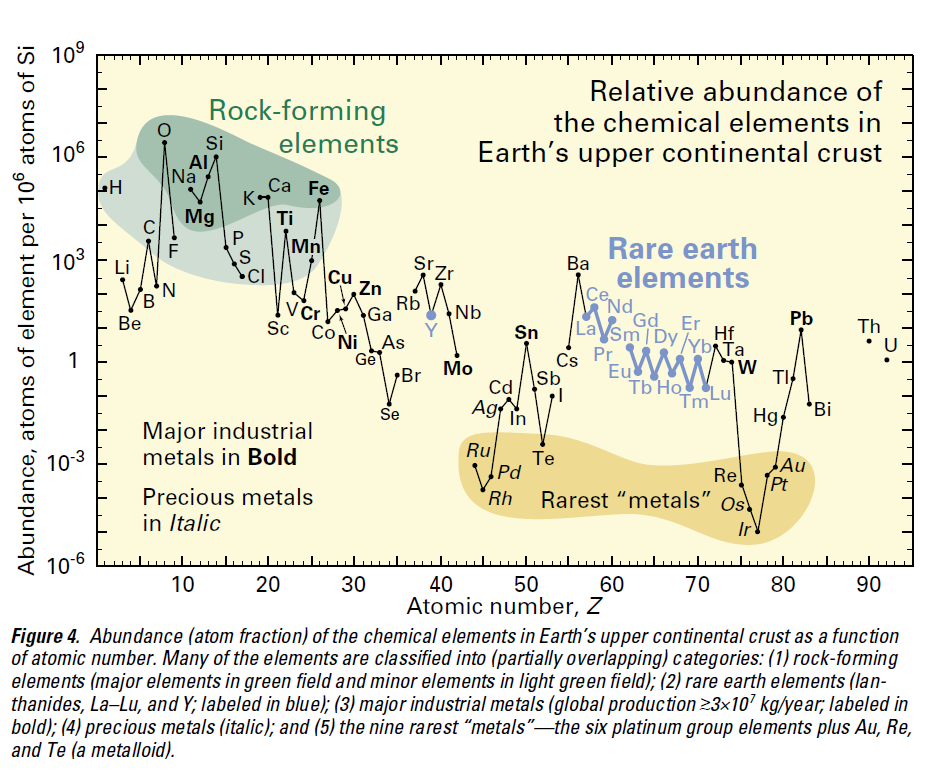
As has been said by many commentators, rare earths are not particularly rare.  Via source, here is an estimate of their abundance in the Earth's surface:

Note by the way the Y-axis is logarithmic so small changes in vertical position can mean a factor of 10 or more difference in concentration.  But the rare earths are not unreasonably far off fairly common industrial metals like lead, nickel, copper, and molybdenum and well more common than gold, silver, and mercury.

I am not a geologist but my gut feel is that there are plenty of rare earths in the US.  The problem is that the process of mining and concentrating the minerals is ecologically relatively expensive -- often large strip mines are involved with a lot of tailings and waste and sometimes dangerous chemicals used in the concentration process.  By the time some of these materials starting coming in demand, most companies had written off the US as a viable place to even look -- why bother exploring if you are never going to be permitted to produce anything.  Thus much of the world's production has been outsourced to countries like China and poor nations in Africa (or the worst of all worlds -- Chinese mines in Africa) that don't necessarily give a sh*t about the environment.

From an environmental standpoint, this is actually a terrible situation.  The US has more wealth and a fair amount of will to take environmentally sensible approaches, so exporting the nasty stuff is not a great long-term solution.  California by the way is the worst about this, intent on kicking out everything from coal-fired electricity generation to oil refining from the state but happy to buy the products of these industries from less environmentally-sensitive areas.

Breaking New Ground for This Blog: Kamala Harris Was Right (at Least Once)

I really thought I would never post this, as I think Kamala Harris is in the dictionary next to "extreme Peter Principle," but she was right when she said that her loss to Trump was the closest Presidential loss this century, at least when looking at the popular vote.  John Hinderaker tries to argue otherwise:

I suppose Harris was referring to the irrelevant “popular vote,” but her claim isn’t true there, either. By far the closest of the seven elections in terms of popular vote was 2000, where the margin was only around 500,000 votes. By that yardstick, the 2024 election was a distant second, with Trump’s margin over Harris being around 2,300,000 votes.

Sorry, but the year 2000 is not in this century.  It was the last year of the last century.  Yes, I know this has already been litigated around Y2K in the court of public opinion and my side mostly lost because we just pissed everyone off who wanted to celebrate a round number, but that does not mean I am wrong.

When you were born, you started out as age 0.  After one month you were age 1/12 a year.  At your first birthday you were one year old.  On your hundredth birthday you have lived exactly a century.  People analogize the calendar to this, but they are wrong.

The reason is that there was no year 0 on our calendar.  The first day after BC times (or BCE if you are up on modern academic jargon) was January 1 of the year 1.  That means that the post-BCE world was not one year old until January 1 in the year 2.   The era turned one but we call it year 2.   The first decade did not end until December 31 in the year 10, and January 1, 11 was the beginning of the next decade.  The first century did not end until December 31 in the year 100 and the second century began on January 1, 101.  In the same way, this century (and millennium) began January 1, 2001 (queue:  Also Sprach Zarathustra).

Now, I am pretty sure this was NOT Harris's reasoning but I really, really hope she adopts it because I would love to see her try to explain it in an interview.