Archive for July 2025

What If The Hand Loom Weavers Were Children of the Nobility?

Gato Malo had a piece the other day that fit in with some of my recent thinking on AI and changes in the workforce.  Most of hispost is about how the market values and pays for labor, and I mostly skimmed it because this way of thinking about value is as natural as breathing to me**.

But it was something he wrote near the end of the article that caught my attention (the lack of caps is gato's long-time style)

over the next 5 years, doctors, lawyers, engineers, accountants, and money managers are all going to come into crosshairs and see industries and payscales demolished. there will be a fearsome rear guard fight from guild systems (the bar, medical boards, CPA association etc) but it’s doomed to fail as they are just more unions trying to keep wages too high and prevent progress and increased access. taking humans out of medicine and breaking the cost spiral is the only possible way for the west to survive the already arriving wave of unfunded entitlement, and in the end, needs must will out and fiscal reality will trump guild control.

this is actually going to be amazing for consumers, a drop in price and expansion of availability in professional services that will rival the gains of the industrial revolution. once, making a pair of shoes consumed so many skilled resources as to cost months of wages. a good shirt was so valuable that people willed them to their children. now shirts are so cheap as to constitute less than an hour of most people’s labor. but the cost of “healthcare” has not worked like this despite being a technology product. law and accounting-services remain domains priced like rare gems.

they are about to be disrupted.

many are lamenting this forthcoming employment apocalypse for the over-educated, but we really should not. it will be amazing for the consumer and just like the tractor and the plow and the combine it will allow all manner of new and better innovation increasing standards of living through productivity gains as resources free up and move to profitable application.

A couple of weeks ago, for our anniversary, my wife took me to a very nice restaurant in a 5-star resort somewhere around Newport Beach in CA.  At the table of 8 next to us were apparently several generations and branches of a single family who talked fairly loudly and included several people who mentioned Yale two or three or twenty times during the evening.  It was a small random sample from the closest thing the US has to a governing nobility, the Ivy-League-educated elite.  And much of the discussion through the evening seemed to focus on the family's fears of AI and its threats to their children's future job prospects.

I agree with Gato that AI has a huge potential to disrupt current work patterns, in the same way that the industrial revolution did.   The 19th century disruptions were severe, and many people suffered as their experience and skill set no longer matched the new economy.  But eventually everyone, from the poorest to the rich, were better off for letting the industrial revolution run its course.

But in the 19th century, the disrupted were essentially powerless.  What happens this time around, though, when the disrupted are the ruling elite themselves?  These potentially disrupted professions include lawyers and doctors who already have shown themselves very willing to organize to block innovation, squash competition, and protect their high pay. Just look at the history of the attempts by Congress to reduce Medicare reimbursements to doctors.  And that was minor compared to the potential AI disruption.  Let me give you another example of the powerful resisting a technological change that should have disrupted their businesses.

When TV first was being rolled out, the industry coalesced around a network of local broadcast stations, many of whom became affiliates of a network like NBC or CBS.  Why this model?  Mainly it was driven by technology -- the farthest a TV signal could reasonably be broadcast was about 50-75 miles.  Thus everyone by necessity got their TV through three or four TV stations in their metropolitan area, each its own small business.

Now fast forward to today.  There are multiple ways to broadcast a TV signal nationwide -- there are several satellite options and many streaming internet approaches.  So now when we watch DirecTV or Youtube TV, we just watch the national NBC or ABC feed, right?  Nope.  Federal law requires that whatever service you use MUST serve up NBC, for example, via the local affiliate.  That is why your streaming TV service harasses you when you travel, because it is worried about violating the law by showing you the Phoenix CBS affiliate when you are staying overnight in Atlanta (gasp).

This is hugely costly.  In order to be able to provide NBC among its stations, Youtube TV must gather the feeds from 235 different stations.  In the Internet streaming era this is costly but in the satellite era it was insane.  DirecTV, with its limited bandwidth, had to simultaneously broadcast 235 stations, most showing identical content, just to legally provide you with NBC.  So why this crazy, expensive, insane effort?  I am sure you have guessed -- pound for pound local TV stations are among the most powerful lobbyists in the country.  First, they have money and a massive incentive to defend their local geographic monopoly -- Car dealers and alcohol distributors are much the same, which is why every potential innovation is resisted in those markets.  But TV stations have one extra card to play -- nearly every Congressman in the House likely depends on the three or four TV stations in one major metropolitan area for a huge part of their publicity and coverage.  No politician is going to screw with that.  At the end of the day, local stations did not get disrupted, they actually became more valuable with this government-enforced distribution of their product.

This is a small example of the fight that is coming in AI.  Congressmen will couch their arguments in fear-charged terminology as if their real fear is some Terminator-like AI apocalypse.  But the real concern will be from the influential elite who are being disrupted.  What would have happed to the Industrial Revolution if the hand-loom weavers were the children of the nobility?  Would the government have allowed the revolution to proceed?   We are about to find out.


** footnote: The only thing I would add to Gato's discussion of labor and value is that I think a lot of our conversations are hamstrung by the multiple meanings of "value" and "worth".  Gato correctly makes the point that one's own self-worth and how one values his or her own labor has nothing to do with how the market pays for one's labor.  But the reverse is true too -- how the market pays for your labor should not necessarily have any bearing on how one values oneself or one's labor.    I saw a beautiful production by the ABT of the ballet Giselle last night.  Most of the ballerinas in the show don't get paid as much as a good plumber, but their labor is worthy and beautiful and -- despite the low pay -- many professional ballerinas love their (often short) life as a dancer.  Most professional athletes before perhaps 1960 were the same, doing the thing they loved and finding fulfillment in excellence even when the market did not see fit to pay them much for what they did.
Welcome to the Tesla Earnings Presenta... Squirrel!

Several years ago I was pretty active in the online community that was deeply skeptical of Tesla.  When I backed away from blogging for several years, the Tesla fanboi community immediately decided that I was scared off by Tesla's success, as measured by a stock price that went through the roof for several years.  I still get DM's on X from time to time taunting me for all sorts of past heresies, when in fact I was just exhausted with blogging, and remained certain that Tesla stock had become a sort of Bitcoin-equivalent, without any underlying value except for a community belief that it had value.

In fact, I was so embarrassed about my past criticism of Tesla that one of my first posts back here was... a criticism of Tesla.

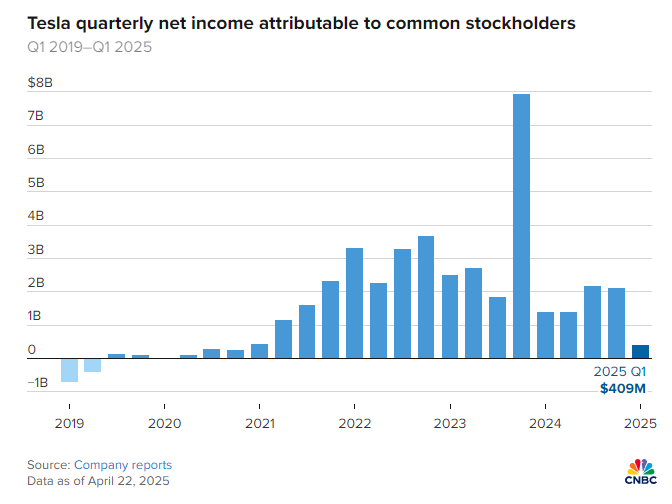
I was distracted a month or two ago when Tesla first quarter financials came out, but they are worth looking at because they were a disaster (of course, for anyone who knows the history of Tesla stock fandom, the stock price was up the next day after the release).  But I want to get into it now because it is pretty stunning.

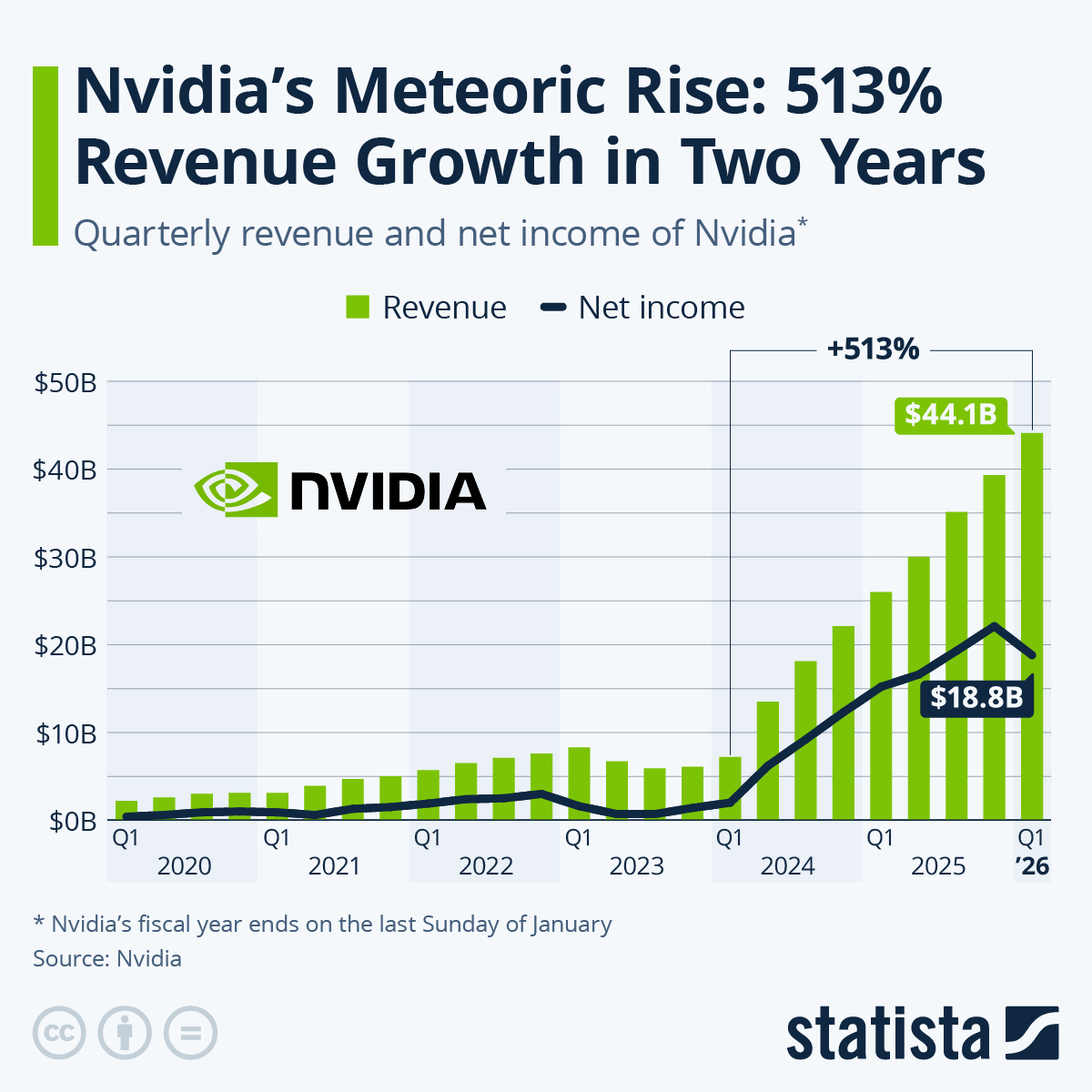
Before I get to the earnings number, note that Tesla stock closed today with a trailing PE ratio of 174.  This sort of PE (except in turnaround situations) is only granted to astronomically-high-growth companies.  For comparison, AI darling and the superstar growth stock of the last year or so Nvidia, has a PE just under 53.  To justify a 53, Nvidia has demonstrated this sort of revenue and earnings growth the last several years:

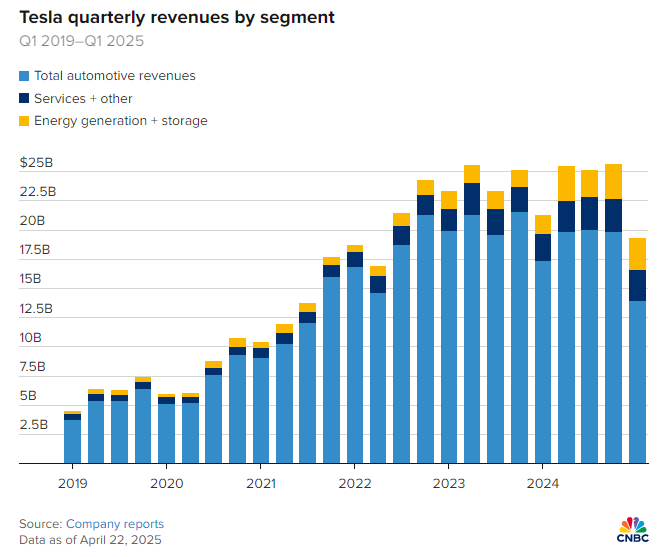
So, one would expect Tesla to have demonstrated something even more spectacular to justify a PE of 174.  Drumroll please:

Tesla has 13 quarters, or over 3 years, of essentially zero revenue growth and an even longer period of zero net income growth.  Freaking General Motors has seen more revenue growth over the same period and they have a PE south of 8.  A PE of 8 seems about right for Tesla as a car company, meaning it is 20x overvalued.  This would lead to a value of $50 billion vs. its approximate $1 trillion market cap.

So what is driving the other $950 billion in market cap?  Whatever this $950 billion business is -- and we know it is not cars -- it constitutes the 10th largest company in America.  So here is the answer for you ... squirrel!

Tesla and Musk are very very very good at getting their fanbase to buy into the fact that they are more than whatever the company actually is at the moment (ie anything but a US automaker with an 8 PE).  We are a solar company... until Solar City crashed and burned.  We are a solar roof company ... until that business was shown to be all flim flam and no substance.  We are a battery change innovator  ... until that was shown to be a stunt.  We are an electric truck company ... until they never made more than the prototype.  We are a battery storage company .. until that growth stalled.  We are a leader in the huge Chinese market... until we weren't.  We are the leader in full self driving ... until, after selling the product for years, we still have never delivered to those who bought it.  One squirrel after another.

Today, it is the same game with only the exact future promise changing.  Every chance they get today, Tesla and its supporters will tell you that they are not a car company.  Go to Seeking Alpha and look at the Tesla buy recommendations, they say things like this:

  • Tesla's current valuation isn't justified by traditional metrics, but its potential as an AI, robotics, and energy company is unmatched.
  • The robotaxi and autonomous vehicle market could drive Tesla's valuation to $900B alone, thanks to its vertically integrated stack and cost advantages.
  • Optimus robotics and other moonshot projects could add $300B+ in value, with further upside from energy, insurance, and software businesses.

And this:

  • Tesla's valuation is now primarily driven by its robotaxi and humanoid robotics ambitions, not near-term automotive delivery growth/decline.
  • Despite recent deliveries disappointment and renewed political fallout with Trump, investor sentiment has remained remarkably robust.
  • The market is starting to price in significant operating income potential from robotaxi deployment, with a medium-term outlook in the next five years.
  • Tesla investors are starting to take its AI ambitions (robotics and autonomy) very seriously, suggesting automotive hiccups could become less market-moving going ahead.

As I am writing this, enjoying the latest movie snark from the fabulous Critical Drinker on my iPad, I even got an ad for this crazy Tesla-pump video with the same basic message.

So apparently buyers and holders of this stock believe that Tesla's robotaxi business and AI/robotics business is worth at least $950 billion  (as a comparison Uber is worth less than $200 billion).  So let's think about that.

I am a frequent user of Waymo driverless taxis and have been in a number of friends' Teslas (totally white-knuckle nervous) in whatever passes for self-driving in Tesla models.  And they do not even compare.  Waymo is top to bottom a superior, better thought out product and way more reliable in its driving.  We have hundreds of these things on our streets around my house in Phoenix such that I cannot even drive to the grocery store without one driving through the same roads and intersections.  Yesterday I saw them stopped 3-wide at a nearby intersection.  And I have never seen a Waymo -- whether  I am inside it or driving next to it -- do anything that makes me nervous.  They are incredibly well-driven and safe vehicles (not to mention always clean and comfortable).  I have seen them navigate situations, like left-turns in complicated intersections, that might confuse me as a driver. Tesla continues to double down on Musk's early mistake of eschewing Lidar (Musk claiming good AI can work with cameras only) and I am convinced Tesla is thus in a technology dead end.  Part of the proof of this is that Tesla has actually been selling full-self driving for years and years and still have not delivered that product to the people who paid for it.

But forget all that for now, and assume I know nothing about self-driving (partially true) and nothing about AI (totally true).  Tesla made hay in its early growth phases by competing on technology and particularly electronics and automation with auto companies who are not really leaders in this stuff.  I had a Mercedes for a while and those Germans build a nice car but damn their electronics such as their entertainment system always suck.  I remember someone lauding the US military for being capable and the response to that was that the US military only appears capable and advanced because it competes with other militaries.  Same for Tesla cars -- they brought fresh technology into an industry that is basically the special needs kid of innovation and software.

Now, though, consider Robotaxis and AI.  With Robotaxis Tesla is competing with Google.  In AI it is competing with Microsoft, Google, and Meta.  Musk has made formidable investments in that space, but he is no longer running up the score against Appalachia State but has to take on the first teams of Alabama, Georgia, and Texas.  Not impossible, but $950 billion is a ridiculous valuation to put on what to date is simply arm-waying and talk, particularly given how much of past Tesla talk and arm-waving has turned out to be total bullsh*t.

It has got to be a bad idea to invest in a 22-year old company on the proposition that 95% of their value is in new things you haven't really seen yet.  This sort of shift almost never happens, and tends to be the equivalent of a company like Gamestop trying to keep investors excited in a no-growth low-margin business by announcing they are really a bitcoin company. A tiny tiny few companies have pulled this off -- I think of Amazon with cloud computing eclipsing their retail business.  But even in this case the shift was something that was only really recognized and drove valuations after Amazon made it real.

Postscript:  "But SpaceX" is not an adequate retort.  I love SpaceX, and give Musk a lot of credit for being the founder and visionary behind it.  But SpaceX just performs in its original business, without all the shifting promises and BS.  And for every SpaceX, I can say "But SolarCity" of another Musk business that ended up in the toilet after tons of hype.

Warning:  Please don't take this as a recommendation to go short Tesla.  I am sometimes short Tesla and I can assure you that Tesla fanbois can keep the stock overvalued much longer than you can endure the pain.  Always short with caution.  Remember, Tesla stock is up over 25% since the day in April that it announced the terrible results above.  If you had reasonably shorted the stock during the abysmal last earnings call you would be getting margin calls.

Update:  I forgot to link the source for the Tesla earnings charts.  It is here.

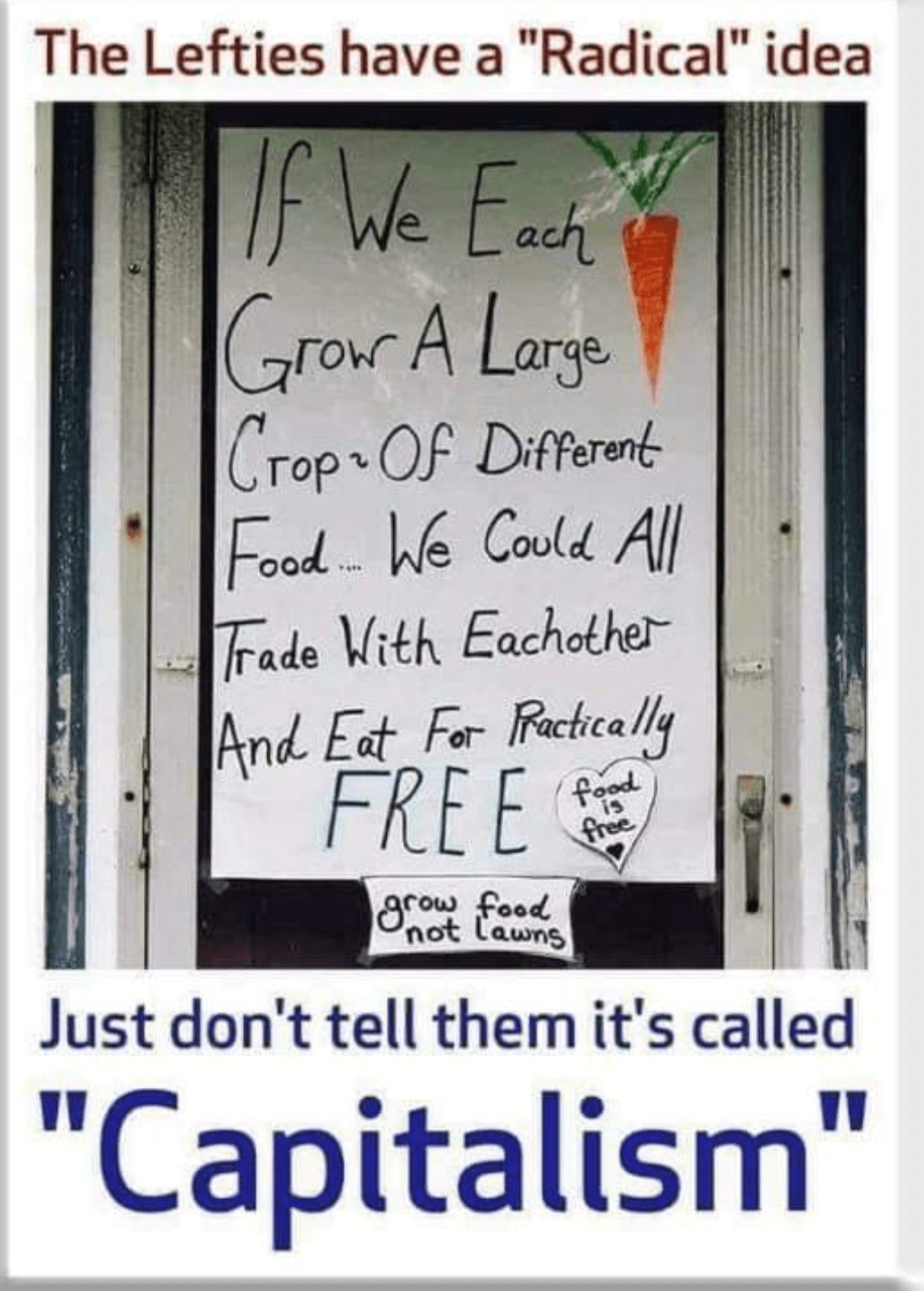
Capitalism Needs A Better Marketing Team

When I see stuff like this taken seriously, I know it is time to replace capitalism's marketing team

In the first part of this post I will discuss why this quote misses the heart of capitalism, and then I will come back to why this represents a level of historical ignorance that only a modern $200,000 college education could achieve.

The core of capitalism is cooperation

Virtually every task that human beings need to perform both to survive and to thrive (which I define as making one's life more fulfilling) requires both cooperation and coordination.  For the smallest of survival tasks, like say a 5 person group stalking a mammoth, it is possible to imagine that cooperation can occur entirely among peers using direct communication.

At some point it does not take long for this loose cooperation approach to get complicated.  Did everyone make their own spear?  Did it make any sense for the best hunters to waste their time chiseling spearheads, or could there be one expert?  If there is an expert, what share of the food would he get?  What if everyone wanted to be the spear maker?  What about that guy who always had some excuse not to go on the hunt with the team, should he still get food?  If the lazy guy (called a free rider in economics) got food, why would anyone face the dangers of hunting?

One can see all these problems in the history of the communes formed in the 1960s and 1970s in the US.  These communes were formed under a theory of pure cooperation, where the group would share all the labor as well as the product of the labor.  Most of these communes broke down because participants had not realized just how much freaking work subsistence farming entailed and the group broke apart in rancor over the free rider problem (if you are getting a share of the food anyway, why work?).

As the goods or services produced get more complicated than subsistence hunting or farming  -- ie if one wants things like vaccines or iphones -- then the cooperation problem gets harder because it requires the cooperation of people who may never even meet face-to-face or be able to communicate with the whole group to coordinate actions.  How do those of us in the Eastern Mediterranean felling giant cedar trees know how much wood the folks on the Upper Nile need, and when?  Such coordination is easy in a hunting team of four people, who know each other and their skills and can divvy up roles in an attack by just talking to each other directly.  But it becomes exponentially harder as the production task gets more complex.

These problems of coordination and cooperation have been solved throughout history just two ways:  By voluntary action driven by prices and profit or by bosses (called chief, king, premier, Caeser, fuhrer, etc) using force.

Emergent behavior in a boss-free society is for people to voluntarily trade their products or labor to others for what they need  -- this is the simple core of what we call capitalism.  This is not a system imposed on people, but the natural state into which free people evolve.  The hunting party gladly trades part of the catch to the best spear-maker whose efforts make them more successful and increase the time they can focus on hunting. Folks who can't or won't hunt must find other ways to be valuable to the group to get a share of the food.  Some inevitably innovate, discovering new food sources or hunting approaches.  As production and transactions get more complex, people move from barter to money, with prices for goods and services single-handedly performing the coordination function in a completely distributed and emergent manner (see I Pencil).

Capitalism is the only approach in all of history to solving the cooperation and coordination problem without the use or threat of force (though beware than many have availed themselves of force while still inaccurately calling it capitalism -- another example of poor brand control by the marketers of capitalism).  Capitalism is the un-system, the default emergent behavior of rational self-interested humans allowed to transact freely.  Every other system is founded on force under the auspices of a Boss.  It does not matter how the boss was selected (or self-selected) or if they work through some council or bureaucracy, the Boss is ultimately forcing the cooperation and performing the coordination.  He (and it has almost always been a he) decides who is making the spears, who is going on the hunting party, and who gets how much of the catch.  If you don't want to be the spear maker, tough sh*t you probably aren't getting any food.

And you may soon find that the boss gets a special triple helping of all the food and that any female who denies the boss her sexual favors will soon see their family starving.  Feudal, fascist, royal, and communist bosses all shared in common that they were exponentially wealthier than their citizens and in most cases effectively the wealthiest person in their country with the most and best of everything.  Capitalist countries tend to be the exception, with elected leaders at best making upper middle class salaries (at least from legitimate public sources).

As production gets more complex, the boss model gets worse and worse because it not just hard, but impossible for any central authority to solve the coordination problem  On the funny end of this is the Soviet Union producing in one year, say, a million pencil erasers but only 100 pencils.  On the horrible and tediously repetitious side of this is the tens of millions of people who died in Mao's Great Leap Forward.  Happy-clappy modern Ivy League socialists will argue that this is just socialism done wrong, that well-intentioned people would never end up with this sort of outcome.  But it never works out that way.  In part because the folks leading these Marxist efforts are not as well-intentioned as they pretend, but even more so because super nice people who create a system where leaders have power over life and death (as must be the case in a socialist economy) are eventually displaced by the Hitlers and Stalins and Maos and Pol Pots.  Ho Chi Minh seemed to begin as a smart, well-intentioned guy, but Lê Duẩn who took power from him was a brutal dictator who impoverished the Vietnamese people.

Unfortunately, over time, even nominally capitalist countries like the United States seem to devolve to the force end of the scale**. As markets become larger and more complicated, helpful rules emerge for the markets and transactions -- being emergent does not necessarily mean it is without structure.  However, when these rules get adopted or coopted by governments, the rules can be modified in a messy political process to create abuses and corruption.  More and more force enters the equation, eg we will arrest you if try to sell your wine out of state or try to build too many housing units on your plot of land.  A surprising number of the defects in capitalism often cited by its detractors result from these flawed government rules, and not from capitalism itself.  Michael Moore's "Capitalism A Love Story" turns out to be almost 100% an indictment of government interventions in the market to favor certain cronies, rather than of true free markets (yet more poor brand control for those marketers of capitalism).

So if one wants pure cooperation in a voluntary system without the use of force, capitalism is the one and only choice.  But what about all this stuff about competition?  Through sh*tty marketing, capitalism is often portrayed as fundamentally about competition rather than cooperation, and occasionally competition is even fetishized by certain defenders of capitalism who seem about a half step away from Spencerian social Darwinism.   The role of competition in markets is not to cull the weak -- in fact, Ricardo showed 200 years ago that with free markets, even the weakest producers still can contribute to the group's well-being.  The reason that competition exists, and the benefits that flow from competition, are based on the fact that almost all resources (land, iron ore, oil, and most importantly human time) are scarce.

Back to our hunting example, the obsidian from spear points might be extremely expensive for a tribe, requiring a lot of trade goods sent to far away tribes.  So imagine that there is one person who uses twice as much obsidian to make a spear point than another person,  Everyone in the group is better off if the spear-making job goes to the more productive person.  The wasteful guy needs to go find something else to do.  And that is the heart of competition right there -- achieving efficiency in a way that makes everyone richer.  By the way, I can easily picture this same situation in the Boss-force model where the wasteful spear-maker is the Boss's brother (or other crony) and keeps the job to the detriment of the whole tribe but increased wealth for the Boss's family.  Only the use of government force in markets allows this sort of crony outcome.

Historical Ignorance of Fetishizing Primitive Societies

A few thoughts about the realism of fantasy quoted above, because this is already too long

  • The subsistence food production likely employed by any of the societies the author above is pining for is WAY more work than any modern American could imagine
  • These societies were POOR, which is why unproductive members were frequently left to die.  It was a poverty so extreme it is almost beyond our modern Western imagining.
  • Life would have been horribly uncomfortable -- no heating, no cooling, constant fleas and lice, slow travel
  • Life would have been intellectually impoverished.  You would never have experienced any land, any people, any climate more than a few hundred miles (at most!) from your birthplace.  There were no writers or artists or intellectuals because everyone who could work had to work.
  • Life would have been short.  The smallest cut could get infected and kill you.  You would be a ready host for any virus or bacteria that came along.  You would watch many or most of your kids die young.

There is no happy, cooperative, simple, small-scale life that also has leisure time, iphones, blogging jobs, or vaccines.  Capitalism is the exception in history, because it is the only way we have become rich and long-lived.  Most intellectual advancement is all traceable to capitalism -- the Renaissance occurred when it did due to proto forms of capitalism that created wealth in private hands that allowed for people to be, say, full-time painters.   Remember that the "victims" or losers in capitalist competition, the 10th percentile poorest people in the US, are still well-off enough to be counted among the very rich  in many countries outside the first world.

I will end with this meme:


**Postscript:  There is a parallel to this in communist countries, as countries like China and Vietnam exited from communist impoverishment to some economic improvement by allowing more openness to markets and private profit.

Sub-Prime Auto Loans: The Next Financial Crisis?

Yes, I know.  A meltdown in subprime auto loans has been predicted almost every year of the past decade.   I am not an economist or stock analyst, so take all this with a shaker of salt, but here is the new factor that I don't think is being discussed much in the context of subprime auto loans:  the end of student loan forgiveness:

The U.S. Department of Education announced it will restart interest accrual for student-loan borrowers in the Saving on Valuable Education (SAVE) plan, starting from Aug. 1, according to a July 9 Education Department (ED) statement....

According to the ED, 42.7 million borrowers currently owe $1.6 trillion in student debt.

“Only 38 percent of borrowers are in repayment and current on their student loans,” the ED said in April.

“Most of the remaining borrowers are either delinquent on their payments, in an interest-free forbearance, or in an interest-free deferment. A small percentage of borrowers are in a six-month grace period or in-school.”

The SAVE plan only includes 7.7 million of these borrowers, about 1/3 of delinquent borrowers, but its termination demonstrates this Administration's commitment to end forbearance for delinquent borrowers.  Over the last 6 months many other student loan borrowers have been taken off of variouis deferral agreements and asked to pay what they owe.

The reason this is relevant to auto loans is this:  there is a large overlap between households with student loans, particularly those with non-performing student loans, and those with sub-prime auto loans.  Borrowers delinquent to both a bank for auto loans and to the US government for their student loans will quickly learn that only one of these lenders has the legal power to force their debt to the top of the debt repayment stack.

I am not a financial analyst so I am not sure who would be most hurt by this -- certainly I would not want to be long the equity tranches of securitized auto loans.  There are banks such as Ally Financial that have a large percentage of their income in auto loans, including sub-prime,  And there are situations like Carvana, which is complicated right now.  On the positive side Carvana** stock is way up, likely in anticipation of rising used car sales and prices due to Trump tariffs.  On the negative side they are a huge sub-prime auto lender (short-sellers argue that their car sales business is just a loss-leader for their auto lending business).

**Postscript:  Carvana is one of those battlefield stocks where super-bulls and super-bears (the later now including Hindenburg Research and Chanos) duke it out constantly.  I will mostly stay away as I have already been sucked for years and years into the mother of all battlefield stocks (Tesla).  But I will say on Carvana that there may be an interesting pattern emerging.  Several years ago the founding family the Garcias sold billions in stock at the top, right before it crashed 99%.  Now that the stock has climbed back to those old highs again, the Garcias are selling billions more.  It is normal for founders to sell more than they buy to diversify their holdings, but their timing as historically been spectacular.

My Annual Letter to Princeton Giving -- Exhausted with the New Scholasticism

In what has become something of an annual tradition, here is this year's response to Princeton's annual giving request

My short answer is that I am not interested in donating to the University. 

What follows is the longer answer.  I probably should have found a previous year’s version of this letter that was better organized and sent that again, but lacking access to my files here are a few thoughts.

When I was at Princeton, the University used to reject the idea that it was a “trade school” whose sole mission was to teach future professionals the details of their craft.  Instead, the University insisted its mission was to create better citizens – and I bought into that when I was there in the 80’s.  But I no longer believe this is true.   I don’t see many graduates of any Ivy League school participating in our polity in a reasoned and mature manner or bringing to bear a sophisticated understanding of history, economics, and political theory to public discourse.  Heck, in many cases I don’t even see them acting like adults.

I suppose it will be easy to write this off to being more of the same from supporters of the current US President, except that I am not a supporter of the current Administration and have been sending these same concerns in letters to both the current and former Princeton presidents.

A partial list of these concerns include:

  • Reduction of standards in admissions, grading, and even the seriousness and rigor of the academic material itself. To some extent the meta problem is the complete collapse of K-12 education (and more narrowly K-5 education) but rather than highlight and push back against falling levels of preparation, Princeton has joined the parade to mediocrity and lowered its own standards to paper over the problem.
  • Hostility to certain races and ethnic groups that became so bad it caused me to quit participating in Princeton recruiting in 2017 because I could no longer look qualified Asian candidates in the eye and tell them honestly they had a chance
  • Lack of intellectual diversity in the faculty and administration. I find it astonishing that a university – which is primarily an institution of ideas – would focus primarily on diversity of skin pigment and reproductive plumbing rather than diversity of ideas. Universities like Princeton refuse to admit that a diversity of ideas and political outlooks/assumptions might even be important.  Such a monoculture is never healthy.
  • Rewarding virtue signaling over rational debate combined with a rejection of reason in favor of some sort of emotional calculus. Not only has the university developed a monoculture, but it is one based on a post-modern, anti-enlightenment, anti-rational philosophy that ironically rejects almost every principle on which modern universities were founded.  It is almost like a return to medieval scholasticism, where students are taught to torture facts into defined narratives and dogmas.
  • Emphasis on promoting activism over other paths to living a productive life, an emphasis that starts in the admissions process
  • Releasing graduates with no comprehensive understanding of history or economics but with fabulous AI- and consultant-polished application essays and theses based on personal lived experience. Why are schools training students to wallow in their own experience when their mission is supposed to be (or used to be) about broadening knowledge and awareness – exactly the opposite?   Is this education or mental health therapy? The one thing I did NOT need Princeton for was to contextualize how much it sucked to be a 16-year-old academically focused student at my high school.
  • Making all the personal political, with 100% litmus test scores necessary to avoid exclusion. I remember at Princeton we had a table of 8-12 shifting members (“creatively called ‘the table’”) who ate together every day for two years.  The group had everything from Christian Conservatives to Marxists and we argued about everything, but we have all been friends for life. 
  • Lack of any sane control on administrative spending, which has caused costs to skyrocket. I know that due to the generosity of Princeton alumni, these costs are manageable, but just because the school can afford this administrative bloat does not mean that it should.  I would never donate to a charity where more than half the money goes to administrative overhead.

All this ignores more recent issues with which I am less familiar, such as the horrifying return of overt antisemitism and student use of AI to thwart both learning objectives and the honor code.  Princeton’s response to both of these seem puzzlingly slow, but I have lost some of my connections on campus and don’t want to speak from ignorance.

When I graduated from Princeton in the 1980s, I would have gladly hired any 10 random people in my class for a corporate startup (if I had such a thing at the time).  After 2003, when I did own my own large company of about 1600 employees, I would never have hired an Ivy League grad.  Many of my managers had no degree at all (up to my COO and director of HR) and if we needed a college grad we would look for a scrappy young community college student long before someone from the Ivy League, even without considering the difference in price.  As a minimum, the local kid was less likely to hold a sit-in in my office.

I would love someday to support higher education again and would happily fund any institution that was demonstrably taking a shot at even some of these issues.

The CBS Settlement With Trump Means Almost Nothing

Republicans are doing a victory dance in the aftermath of CBS's settling Trump's lawsuit over CBS's editing of their Kamala Harris interview.

I ran a public hospitality business with over 10 million visitors a year, so it is almost inevitable that we would get sued from time to time.  At this point I can't remember the exact numbers but we probably had 10 serious suits in 20 years, all of which were over some injury sustained in a public campground or marina we operated.  You know how many of these I honestly believe we had any liability whatsoever?  0%.  You know how many of these we (or rather the insurance company) settled?  100%.  There are many reasons a company might settle a case in which they feel they have no guilt, but two are:  1)  Lawyers and litigation are expensive -- it costs $500-$2000 just to get an attorney to pick up the phone for the first time; and 2) unlike criminal juries, who I think are pretty fair, civil juries cannot be counted on to give a fair verdict.  In particular, faced with a sympathetic injured plaintiff and a faceless company covered by an insurance policy, certain juries will give an award to the plaintiff almost no matter what the cause and effect.  If you think of it as a "bad outcomes award" rather than a "liability award," you can get closer to the thinking of some juries.  Not all juries mind you, but enough to scare companies from going to trial.

I will give you an example from years and years ago in LA County.  A little girl drowned swimming in a lake we operated and her family sued us for failure to warn of the danger.  The frustrating part was that there was no way to photograph the location of her tragic death without getting the "no swimming" sign in the frame.  Faced with this evidence, the complaint was soon amended to say the girl drowned wading in the lake, not swimming, and that the sign said nothing about wading.   This seems crazy, but our lawyers were adamant that we did not want to try this case in LA County with the sympathetic grieving parents of a little Hispanic girl.  So the insurance company settled for something like $2 million.

I would urge you to consider the CBS settlement in this context.  Because they have these same problems, plus one more.  The cost of litigation would be high, easily in the millions for this kind of case even if they win (there is no loser pays in the US).  And just as Trump often drew juries from hostile pools for some of his civil cases, one could easily imagine the MAGA mirror image in a CBS trial.

But as I said, CBS had one more problem -- Trump is their regulator via multiple agencies.  Not only does he have substantial influence at the FCC, which heavily regulates broadcast TV, but also at the SEC, FTC, and Justice Department who could easily wreck the current buyout and restructuring being undertaken by CBS's parent company.  There are billions of dollars at stake in those deals, and I am positive in this context the lawyers told CBS management to give Trump his $16 million gratuity and move on.

There is a lot that is wrong here on both sides.  CBS was absolutely abdicating its responsibility to help the country understand its candidates for President, and the hiding of Harris's unreadiness for office is of a piece with the same work CBS did in hiding Biden's deteriorating condition.  But their video editing wasn't strictly illegal and really is not much different from what 60 minutes has been doing legally for decades, though usually the editing is the other way around to create a gotcha for some corporate executive.

But given his position as regulator in chief of CBS, this private lawsuit is just wrong, wrong, wrong.  If something was illegal, fine, send in the FCC or FTC (or FEC).   But trying to extract a personal financial settlement over a charge of dubious legal merit from a company he is regulating is barely different from a protection racket or even solicitation of bribery.

update:  this has some interesting backstory.  Don't tell me it does not look like bribery.  Apparently even the participants were worried about it looking like bribery:

The bribery issues arose because Redstone is in desperate need of cash since inheriting the Paramount media empire from her late father, the media mogul Sumner Redstone and the settlement of the lawsuit is inextricably tied to the deal getting completed since Trump’s regulators must approve the merger.

Since Redstone would receive around $2 billion once the deal is done, any sizable payment could be seen as a bribe to get the Federal Communications Commission’s green light.

The (slightly more) ethical approach was to drop the suit the moment he took and hand it off as an investigation to his regulatory agencies.