Posts tagged ‘prices’

I AM Doing Good

I accidentally watched a few minutes of a morning show today, something I try really hard to avoid.  Matt whats-his-name was interviewing Richard Branson, and they were talking about the importance of corporations "doing good".  Once startups get going, Branson said, they need to start doing good for people, meaning I guess that they buy carbon offsets or something.

Guess what?  If my startup is succesful, I am already doing good.  I can't make a dime unless I create value for people net of what they pay me.  Every customer walks away from our interaction better off, or they would not have voluntarily elected to trade with me (and if they are not better off, I will never see them again and I will find lots of nasty stuff chasing future customers away on the Internet.)  I am tired of this notion that a succesful business person's value can only be judged by what he or she does with their money and time outside of business.  I understand the frustration with a few Wall Street and GE-type executives who are living like fat ticks on their connections with government, but most of us only are succesful if we do something useful.

This, from Carpe Diem, is along the same lines.  He looks at an editorial from the DC paper about the entry of Walmart, which says among other things

Despite the peacocking by Gray and others after the agreement was signed, the District is receiving mostly crumbs. Walmart has committed to providing $21 million in charitable donations over the next seven years, an average of $3 million a year. That's a pittance."

Walmart does not have to do squat for the community beyond its core business, because selling  a broad range of goods conviniently and at really low prices is enough. Or if it is not enough, they will not make money.  The promise of $21 million to some boondoggle controlled by a  few politician's friends is just a distraction, I wish they had not done it, but I understand that this is essentially a bribe to the officials of the DC banana republic to let them do business.

Postscript:  I have no problem with doing charitable work outside of work.  Both my company and I do, by choice, though unlike Richard Branson I don't need to have a crew of paid PR agents making sure everyone knows it.

Wow

Holly Fretwell of PERC discusses the huge leap in agricultural yields since WWII

Not only does this mean that we have have billions of people on Earth and not starve, but it also has freed up labor for more productive and value-enhancing activities.

As an aside, remember this chart when global warming alarmists argue the the warming trend of the last 50 years is reducing crop yields.  (If the linked article seems simply bizarre given the chart above, realize the NYT is saying that crop yields are down from what they might have been.  This is the same kind of faulty logic that was used by Obama to credit his stimulus with job gains when in fact the economy was losing jobs.  They posit some unproveable hypothetical, and then say reality diverged from that hypothetical because of whatever factor they are trying to push, whether it be CO2 or stimulus).

The problem with food prices is not production, its the fact that we take such a huge percentage of our food grains and, by government dictat, convert them to automotive fuel.

Generally Freedom-Loving Australia Turned Totalitarian By Climate Alarmists

This is really sad to see in what is supposed to be a liberal democracy:

Now that the carbon tax has passed through [Australian] federal parliament, the government’s clean-up brigade is getting into the swing by trying to erase any dissent against the jobs-destroying legislation.

On cue comes the Australian Competition and Consumer Commission, which this week issued warnings to businesses that they will face whopping fines of up to $1.1m if they blame the carbon tax for price rises.

It says it has been “directed by the Australian government to undertake a compliance and enforcement role in relation to claims made about the impact of a carbon price.”

...

There will be 23 carbon cops roaming the streets doing snap audits of businesses that “choose to link your price increases to a carbon price”.

Instead, the ACCC suggests you tell customers you’ve raised prices because “the overall cost of running (your) business has increased”.

Update:  Obama loves the Aussie carbon tax

Addressing the press in Australia, where legislators passed a carbon tax earlier this month, Obama praised Prime Minister Julia Gillard for pursuing “a bold strategy” to trim industrial emissions that most scientists say are contributing to global warming.

The True Cost of the Education Bubble

I hinted at it in my last post, but have addressed it in more depth in my column this week at Forbes.  A brief excerpt:

The theme from all these failures is distorted signals and corrupted communication.  People, no matter how savvy, cannot possibly research every nook and cranny of the economy before making an investment.  They make decisions, therefore, based on signals – prices, interest rates, perceived risks, and the profit history of other similar investments.  If these signals are artificially altered or corrupted, bad decisions that destroy wealth and growth will result.

Which brings me back to education.    I will tell you something almost every business owner knows:  We business owners may whine from time to time that banks won’t lend us money, but what really is in short support are great people.  Nothing has more long-term impact on an economy than amount and types of skills that are sought by future workers.  That is why everyone accepts as a truism that education is critical to economic health.

Unfortunately, there is good evidence that our education policies have already done long-term harm.   The signals we send to kids making their higher education plans have disconnected them from reality in a number of fundamental ways, causing them to make bad decisions for themselves and the broader economy.

Examples follow.  Read it all.

Are Private Entities Solely To Blame For Making Money Off Structural Problems Created by the Government?

Paul Krugman had this sideswipe comment the other day:

This isn't the only case where news organizations consistently report as truth something that didn't happen, while failing to report what did. Another one that comes to mind is the California electricity crisis of 2001-2002. As some readers may recall, that crisis was caused by market manipulation -- and that's not a hypothesis, Enron traders were caught on tape telling plants to shut down to create artificial shortages. Yet "news analyses" published after the whole thing was revealed would often tell readers that excessive environmental regulation and Nimbyism caused the crisis, with nary a mention of the deliberate creation of shortages.

And as you'll notice, in both cases the imaginary history just happened to be one more comfortable to status quo interests.

I find it hilarious that Krugman is talking about imaginary history, since he plays the same game so often.  In fact, the disconnect between many of Krugman's current political writings and his historical economic work are often jaw-dropping.  Even the differences in Krugman's opinion on the same topic when a Republican vs. a Democrat is in the White House can be amazing.

But I wanted to address the California utility issue.  Certainly Krugman is right, as far as he goes, in that Enron made a lot of money in the California electricity crisis creating some short-term artificial shortages.  But what he leaves out of his brief comment were the structural rules the government had put in place that made Enron's actions possible.  Enron's profits in the California electricity crisis could never have been made in a free market.

I am not an expert on the whole regulatory environment in which these events occurred, but there were three key regulatory facts that need to be understood:

1.  California, due to the NIMBY and environmental concerns Krugman mentions in passing, want lots of electricity but do not want the electricity production near them.  So they have exported the production to other states, and, more importantly, California utilities did not control the production of the electricity they needed.  Thus a lot of California power, and all of its marginal demand, is satisfied by local utilities buying out of state power.  As we will see next, Krugman is really putting up a straw man here, as this is simply background, the least important of the three government factors that drove the problem.

2.  California deregulated wholesale utility prices, but not retail prices.  The point of price deregulation is that suppliers and consumers can make better decisions because the information they get via prices is not distorted by government mandates.   But price deregulation only makes sense if the ultimate consumers have prices that float with the market.  But California consumers still had fixed prices.  There were no changes to pricing signals to consumers that might cause them to conserve more when electricity was particularly short.

So, only wholesale customers saw their prices paid increase when electricity supplies ran short.  This mainly applied to large California utilities that bought power they needed from out of state.   Theoretically, when prices spiked, they could cut back their demand.  This is more awkward for them than consumers, but could be done either with pre-determined shut down priorities or rolling brown-outs.  At some point, one would assume the cost of power would be higher than the cost of service disruptions, but...

3.  California utilities were effectively required by regulation to try to serve all demand.  Right or wrong, they felt they were in a position that if power were available, they had to buy it no matter what the cost.

So step in Enron.  Seeing this mess, they found they could corner the market at a few peak demand times and sell Calfornia power for a gazillion dollars a Kw.   I would not personally have been proud to make money that way, but Enron jumped right in.

I have no problem giving Enron grief for the way they make money, but one has to ask themselves, why the hell were California utilities buying power no matter what the price, and why was it that when electricity was so dear, it was illegal to communicate this to end users via prices (as we do with any other product or commodity).  The story here is a lot more complicated than Enron.

Update: Finem Respice took a more sophisticated look at this same issue a while back in a broader post about trying to close an open system.

On the retail side, just as California was patting itself on the back for "deregulating" in 1996 (via a bill that Pete Wilson created with complexities and exceptions for e.g., San Diego that make the special interest game in Washington look tame by comparison), it froze, just after reducing, retail electricity rates for five years. Add to this the fact that California had long depended on supplies from, e.g., the Northwest, which, for years, enjoyed a hydroelectric power generation surplus. As the surplus vanished with droughts and increased demand in the Pacific Northwest, so did the supply buffer California was so used to, and that it leaned on most heavily over the years to avoid building new generating capacity (new capacity being the bane of the progressively green environmental utopian-paradise that was (is) California energy politics). All this conspired to spike rates. Who is surprised?

It is somewhat unfortunate that Enron's shrewd manipulation of California's badly flawed and outright schizophrenic market scheme was so flagrant, and that unrelated accounting scandals at the company permitted the story to become one of deregulation evils and free market greed rather than the core issue: the political spinelessness exhibited by California officials and their ongoing attempt to insulate voters from anything resembling market prices for electricity

More Corporate Welfare, in the Form of a Currency War

From the Hill, the ghost of Hawley-Smoot returns

 The Senate voted Monday to advance legislation pressuring the Chinese government to stop undervaluing its currency, a practice most economists agree is giving the country an unfair trade advantage and is costing the U.S. jobs.

The Senate voted 79-19 to end debate on a motion to proceed to the bill, the Currency Exchange Rate Oversight Reform Act of 2011. While the vote does not mean the bill has passed, the strong show of support suggests it could well be approved in the upper chamber by the week’s end. Passage through the House is less clear, however, and GOP leaders have given no indication they will move forward with it.

Senate Democratic leadership, responsible for bringing the legislation to the Senate floor, heralded it as a way to create jobs and right a long-standing trade imbalance with China.

“China is by far the biggest exploiter of predatory currency practices,” Sen. Charles Schumer (D-N.Y.) said Monday. “[T]hese currency policies artificially raise the price of U.S. exports and suppress the price of imports into the United States, undermining the economic health of American manufacturers and their ability to compete at home and around the globe.”

This is a great example of how a group, in this case the Democratic Party, can say they are against corporate welfare, but in fact be 100% behind it simply by changing the terms used.

Look at the sentence in bold.  Another way to write this would be "we want a law to help a few visible and influential manufacturers who most compete with China, but hurts consumers (ie every single American) and every business that uses imported raw materials.

Protectionism like this is corporate welfare for a few large manufacturers.  I find it amazing the reporter can say that "most economists agree" an undervalued Chinese currency is costing us jobs.  My sense is that most economists don't agree with this statement.  All this law will do is unilaterally increase consumer prices and raw material costs, and I know few economists who think this is stimulative.

A cheap yuan is a direct subsidy of American consumers by the Chinese, and I am not sure why we shouldn't let it continue as long as they are dumb enough to keep doing it.

Owning Solyndra

Kevin Drum makes a pleas for liberals to, in effect, rally around Solyndra and be proud of the investment.  I am sure Republicans would give the same advice to liberals.  I want to look at a few of his arguments.

First, for libertarians like myself, the argument that Republicans did it too, or the Republicans started it, are a non-starter.  In particular, I actually thought the Obama Administration's attempt to blame Bush for Solyndra was an Onion article, since its almost a caricature of this administrations refusal to take responsibility for anything.  Unlike Republicans, I don't see this so much as an Obama failure as a government failure, and I don't really care if it is of the red or blue flavor.

Second, the fact that private investors put their own money into it is irrelevant.  Private investors poured money into Pets.com too.  Obama was pouring my money into Solyndra, and yes the fact that it is my money makes a difference.

Further, private investors put their money into Solyndra years before the taxpayer did.  It may well have been that they had a reasonable expectation at that time of investment returns.  That is their problem.  Our problem is that by the time Obama put our money into the company, it was pretty clear to everyone in the industry that Solyndra was going nowhere.

Drum and his source, Dave Roberts, attempt to argue that the drop in silicon prices and addition of low-cost solar capacity in China didn't occur until months after Obama's decision to fund Solyndra.  But that is a tortured argument.  In point of fact, everyone in the industry saw this coming - after all, the capacity Roberts describes as coming online in June was under construction months and years before that, and was known to be coming by everyone in the industry.  When I was in a global manufacturing business, we kept up with everyone's plans for capacity additions -- I can't even imagine waking up one day and saying, "huh, a bunch of capacity just opened in China."  (by the way, it is pretty typical of liberals to see prices as a given, rather than as a part of a feedback system where high prices lead to actions that might well lower prices over time).

This timeline is therefore pretty disingenuous

March 2009: The same credit committee approves the strengthened loan application. The deal passes on to DOE’s credit review board. Career staff (not political appointees) within the DOE issue a conditional commitment setting out terms for a guarantee.

June 2009: As more silicon production facilities come online while demand for PV wavers due to the economic slowdown, silicon prices start to drop. Meanwhile, the Chinese begin rapidly scaling domestic manufacturing and set a path toward dramatic, unforeseen cost reductions in PV. Between June of 2009 and August of 2011, PV prices drop more than 50%.

I am sure that this is wildly logical to a journalism major, but someone in business would laugh off the implication that what happened in June was wholly unforeseeable in March.  Want more proof?  The loan guarantee itself is proof.   Years earlier, the company attracted a billion dollars of private capital.  Now it takes a government guarantee to get capital?  And you think nothing had changed with the insider's perception of the opportunity?

A good analogy might be if I invested in Greek bonds today.  And then in 3 months the Greek government defaults and I lose all my money.  I suppose I could craft a timeline that said the default did not happen until months after my investment, but could anyone living right now say that I really had no reason on September 16, 2011 to expect a Greek default?

The real howler in the article is this one:

There was no scandal in the loan process, and there's nothing unusual about having a certain fraction of speculative programs like this fail. It's all part of the way the free market works.

First, I agree there is no scandal here if one defines scandal as something out of the norm.  Republicans want to count political coup on Democrats so they want to say this is fraudulent.  But fraudulent implies that we could find honorable technocrats who could have avoided this problem.  We can't.  This kind of failure is fundamental and inseparable from the act of government trying to pick winners, and would exist no matter what people were in place.

Second, calling this "the way free markets work" is obscene.   Free markets don't use force on investors to make them put money into certain investments.

But more importantly, government loan guarantees go only to those companies who the free market has chosen NOT to fund.  If the free market was willing to toss another half billion into Solyndra, its owners would not have been burning a path back and forth to Washington.  So by definition, every single government loan guarantee in this program is to a company or a technology that the free market, knowledgeable investors, and industry insiders have rejected as a bad investment.  For the program to work, one has to believe that Obama, Chu, and some career energy department bureaucrats have a better understanding of commercializing technologies than do private investors (who are investing with their own money) and industry experts.

Postscript:  I have to also comment on this from the timeline:

February 2011: Due to a liquidity crisis, investors provide $75 million to help restructure the loan guarantee. The DOE rightly assumed it was better to give Solyndra a fighting chance rather than liquidate the company – which was a going concern – for market value, which would have guaranteed significant losses.

The author glosses over it, but this is the $75 million I discussed the other day that dropped the US out of the senior position and guaranteed that the taxpayer would lose everything rather than only a portion of the investment

The notion of giving it more time was absurd.  Even closed with everyone laid off the company is burning a million a week in cash.  How much was it burning when open? And if it was totally clear at this point that the market had fundamentally shifted and the company could not compete, what the hell was the time going to help?  Maybe they were hoping to win the Publishers Clearing House Sweepstakes?  I suppose it could have been to give them time to try to sell the company, but there is no evidence any such discussions were taking place.

In fact, it is pretty clear that the US Government got played with that $75 million investment.  Any private lender who had allowed someone else to grab the senior position for a trivial investment in a company on the express train to chapter 7 would be fired immediately.

And if you want fraud, you might look at Solyndra's summer asset sales.  All the company's assets of any liquidity and value were sold over the summer to Argonaut, who also happens to be the owner of the majority state AND the company who invested $75 million in return for the senior position.  Depending on the sale price for this self-dealing, one could argue that the time the $75 million bought was merely the time needed to loot the company of any valuable assets before it went bankrupt.

Postscript #2:  I have written before about how much expertise about business tends to be claimed by liberal journalists and places like Think Progress.  I had a funny thought trying to imagine the Think Progress business school and what it would teach.  Might be a parody I need to write sometime.

One-Program Proof Technocratic Government Does Not Work

Ethanol continues to be one of the dumbest, most costly programs ever engaged in by the Federal government

"Today, about 40 percent of all U.S. corn -- that's 15 percent of global corn production or 5 percent of all global grain -- is diverted into the corn ethanol scam in order to produce the energy equivalent of about 0.6 percent of global oil needs.
Corn prices, now close to $7 per bushel, have more than doubled over the past two years (see chart above). And recent harsh weather, including floods in the Midwest and drought in the South, will likely mean a subpar U.S. corn harvest. That, in turn, will mean yet higher prices for corn, which will translate into higher prices for meat, milk, eggs, cheese and other commodities.
Environmental damage:  check
Fails to meets its goals (of reducing fossil fuel use): check
Raises food prices:  check
Raises gas prices: check
Highly regressive costs that hurt the poor most:  check
Benefits accrue to very a small group of the politically connected:  check

WTF? This is What They Mean by Oil and Gas Subsidies?

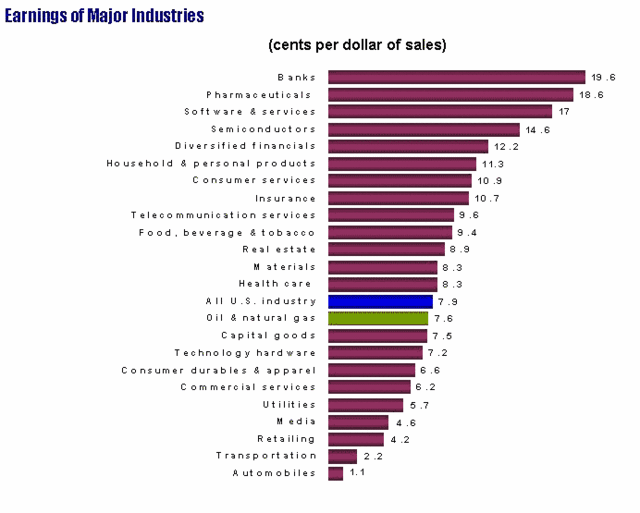
When the Left has talked about oil and gas subsidies, I have generally nodded my head and agreed that any such things should be eliminated, just as they should be eliminated for all industries.   They have in the past thrown out huge numbers for such subsidies that seemed high, but I have not really questioned them.  But then I see this chart at Kevin Drum's site

Seriously, nearly half the "subsidy" number is the ability of a company to use LIFO accounting on inventory for their taxes?  Since the proposition is to eliminate these only for oil and gas, what is the logic that somehow LIFO accounting is wrong in Oil and Gas but OK in every other industry?   In fact, at least the first two largest items are both accounting rules that apply to all manufacturing industry.  So, rather than advocating for the elimination of special status for oil and gas, as I thought the argument was, they are in fact arguing that oil and gas going forward be treated in a unique and special way by the tax code, separate from every other manufacturing industry.

In fact, many of these are merely changes to the amortization and depreciation rate for up-front investments.  Typically, politicians of both parties have advocated for the current rules to encourage investment.  Now I suppose we are fine-tuning the rules, so that we encourage investment in the tax code in everything but oil and gas.  I will say this does seem to be consistent with Obama Administration jobs policy, which has been to try to stimulate businesses that are going nowhere and hold back the one business (oil and gas drilling) that is actually trying to grow.  I am fine with stopping the use of the tax code to try to channel private investment in politician-preferred directions.  But changing the decision rule from "using the tax code to encourage all manufacturing investment" to "using the tax code to encourage investment only in the industries we are personally sympathetic to" is just making the interventionism worse.

This is really weak.  Not to mention flawed.  Unless I am missing something, a change from LIFO to FIFO or some other inventory valuation rules will create a one-time change in income (and thus taxes) when the change is made.  LIFO only creates sustained reductions in taxable income, and thus taxes, if your raw materials prices are consistently rising (it actually increases taxes vs. FIFO if input prices are falling).  Given that oil and gas prices are volatile, its hard to see how this does much except extract a one-time tax payment from oil companies at the changeover.

By the way, I am pretty sure I would be all for ending government spending on "ultra-deepwater and unconventional natural gas and other petroleum research," though ironically this is exactly the kind of basic research the Left loves the government to perform.

Using Computer Models To Launder Certainty

For a while, I have criticized the practice both in climate and economics of using computer models to increase our apparent certainty about natural phenomenon.   We take shaky assumptions and guesstimates of certain constants and natural variables and plug them into computer models that produce projections with triple-decimal precision.   We then treat the output with a reverence that does not match the quality of the inputs.

I have had trouble explaining this sort of knowledge laundering and finding precisely the right words to explain it.  But this week I have been presented with an excellent example from climate science, courtesy of Roger Pielke, Sr.  This is an excerpt from a recent study trying to figure out if a high climate sensitivity to CO2 can be reconciled with the lack of ocean warming over the last 10 years (bold added).

“Observations of the sea water temperature show that the upper ocean has not warmed since 2003. This is remarkable as it is expected the ocean would store that the lion’s share of the extra heat retained by the Earth due to the increased concentrations of greenhouse gases. The observation that the upper 700 meter of the world ocean have not warmed for the last eight years gives rise to two fundamental questions:

  1. What is the probability that the upper ocean does not warm for eight years as greenhouse gas concentrations continue to rise?
  2. As the heat has not been not stored in the upper ocean over the last eight years, where did it go instead?

These question cannot be answered using observations alone, as the available time series are too short and the data not accurate enough. We therefore used climate model output generated in the ESSENCE project, a collaboration of KNMI and Utrecht University that generated 17 simulations of the climate with the ECHAM5/MPI-OM model to sample the natural variability of the climate system. When compared to the available observations, the model describes the ocean temperature rise and variability well.”

Pielke goes on to deconstruct the study, but just compare the two bolded statements.  First, that there is not sufficiently extensive and accurate observational data to test a hypothesis.  BUT, then we will create a model, and this model is validated against this same observational data.  Then the model is used to draw all kinds of conclusions about the problem being studied.

This is the clearest, simplest example of certainty laundering I have ever seen.  If there is not sufficient data to draw conclusions about how a system operates, then how can there be enough data to validate a computer model which, in code, just embodies a series of hypotheses about how a system operates?

A model is no different than a hypothesis embodied in code.   If I have a hypothesis that the average width of neckties in this year's Armani collection drives stock market prices, creating a computer program that predicts stock market prices falling as ties get thinner does nothing to increase my certainty of this hypothesis  (though it may be enough to get me media attention).  The model is merely a software implementation of my original hypothesis.  In fact, the model likely has to embody even more unproven assumptions than my hypothesis, because in addition to assuming a causal relationship, it also has to be programmed with specific values for this correlation.

This is not just a climate problem.  The White House studies on the effects of the stimulus were absolutely identical.  They had a hypothesis that government deficit spending would increase total economic activity.  After they spent the money, how did they claim success?  Did they measure changes to economic activity through observational data?  No, they had a model that was programmed with the hypothesis that government spending increased job creation, ran the model, and pulled a number out that said, surprise, the stimulus created millions of jobs (despite falling employment).  And the press reported it like it was a real number.

Restraint of Trade

Private actors are often accused of collusion to restrain trade and decrease competition, and certainly there are a number of examples of this in history.  However, all such private arrangements are usually doomed, in part because the incentive for certain parties to cheat are high in such arrangements.  And the parties to such agreements have no control over new or outside competitors entering the fray.

The only stable restraints of trade and competition are therefore enforced by the government, who can use police and prisons to enforce such rules.  That is why successful businesses who are tired of fighting off upstart competitors run to the government for help.

But the government does not like competition with its own services (e.g. Federal bans on intracity mail delivery competition). Here is a good example:

"Drivers attending the Indiana State Fair or a major sporting event downtown may sometimes opt to grab a parking spot in someone's yard rather than pay higher prices in a parking lot, but some city officials think people who provide parking spots should get a permit first. City leaders are proposing that residents pay a $75 fee (per event) if they want to turn their yards into parking lots."

Does anyone think there is a burning safety issue here?  The goal is to kill competition with publicly operated parking garages.  My guess is that someone figured out the average revenue of a private home offering front lawn parking, added $5, and made that the registration fee.

Ethanol: Single Best Argument Against Technocratic Paternalism

The progressive argument for a larger state has, for over a hundred years, rested in part on the premise that smart people at the top in government can better optimize the allocation of resources and make better investment choices.

This premise always has been ludicrous.  Government officials have neither the information nor incentives to perform this function, and lacking such, decisions always get made based on political rather than economic or other objective functions.

Ethanol is such a great example, it will almost be a shame when its mandates and subsidies are repealed.  As a reminder, corn-based ethanol production get the trifecta of state sponsorship -- mandates for its use, subsidies for its protections, and stiff tariffs to prevent lower-cost imports.

The result is a classic government fail.  The economic subsidies benefit only a small number of the politically connected, while hurting the great mass of humanity, even outside the US, through higher food and fuel prices.  Because ethanol takes as much fuel to produce as it provides, it does nothing to change the amount of fossil fuels we use.  And as a result, it does nothing to affect CO2 production and in fact has a number of environmentally negative effects, particularly in land and water use.

I am reminded of all this by these staggering figures, via Carpe Diem

"U.S. ethanol refiners are consuming more domestic corn than livestock and poultry farmers for the first time, underscoring how a government-supported biofuels industry has contributed to surging grain demand.

The U.S. Department of Agriculture estimated that in the year to August 31 ethanol producers will have consumed 5.05 billion bushels of corn, or more than 40% of last year’s harvest. Animal feed and residual demand accounted for 5 billion bushels."

As Mark Perry shows in his blog, US ethanol policy has also pushed corn prices up from $2 a bushel in 2007 to over $8 today.

The Next Step Past "Unexpected"

What does a statist government do when attaching "unexpected" to all negative economic numbers does not provide the necessary political cover?

Argentina’s government has filed criminal charges against the managers of an economic consulting firm, escalating its persecution of independent economists.

…The government is charging MyS Consultores with “publishing false information about inflation data” to benefit themselves and their clients. The criminal complaint alleges that MyS’s data also lead to speculative behavior in Argentina’s bond market.

…Consumer prices rose 9.7% in May from a year ago, according to the national statistics agency, Indec. But virtually all economists say annual inflation surpasses 20%—one of the world’s highest rates—angering government officials who dismiss inflation as a problem.

…So far this year, the Secretariat has fined at least nine economic research firms 500,000 pesos ($122,000) each. This week, the Secretariat also slapped a second fine on Orlando J Ferreres & Asociados.

“They fine us for saying how much prices have risen,” Mr. Ferreres, director of his eponymous firm, said. “They could seek criminal charges against all of us. We don’t know how far they’re willing to go.”

Mr. Ferreres said the legal actions are part of a strategy to prevent independent economists from publishing potentially negative information during an election year…

Government officials say they hoped the fines would deter economists from “deceiving” the public into making poor financial decisions by publishing inflation estimates that differ considerably from Indec’s consumer price index.

It is sad to see how far Argentina has fallen.  In the past it has been one of my favorite countries in the world to visit.

Chutzpah Award -- "Decoupling" Revenues from Actually Having to Deliver Services

I read this article three times to see if it made any sense, and it still does not, except as an incredibly ballsy attempt by a member in good standing of the corporate state to get more revenues out of its customers by government fiat.

A major shift in business is occurring at Arizona Public Service Co. and other regulated utilities in the state.

APS, Southwest Gas and other utilities are beginning to ask regulators to "decouple" their prices from the volume of their sales, which proponents said will encourage conservation.

If approved by the five-member Arizona Corporation Commission, decoupling would allow APS to collect a certain amount of revenue per customer regardless of how much energy was sold.

It would wipe out utilities' incentive to sell more power and be akin to a fast-food restaurant paying loyal customers to go on a diet.

Wow, what a fabulous business concept!   It's obviously a holdover from some horrible past wherein we pay for services based on, you know, actually getting those services.  End the tyranny of giving consumers something in return for their money!  In the modern corporate state, everyone knows a corporation earns revenue in proportion to how much influence it has with the government, and how much that government can be cajoled to let the company take by fiat from consumers.  Silly old me, actually charging people in my business for camping when they actually camp.  I should have been running to the government to get them to let me charge everyone in the country whether they camp or not.  By all means, let's let McDonald's decouple taking your money from actually giving you a Big Mac in return.

Seriously, beyond the fact that this concept is obscene, it makes zero sense even against its stated goal of conservation.   They are basically talking about shifting the consumer's marginal cost for electricity to zero.  How in the hell is that going to spur conservation?  Charge me the same amount each month for gas whether I drive or not, and that is going to cause me to drive less??

Apparently, in the weird mental world of utilities, conservation only results form utility subsidies of  efficient appliances.  So the big benefit here is utilities can somehow better afford their subsidies for more efficient appliances.  Left unexplained is why anyone would want to buy even a subsidized such device once their marginal cost for electricity goes to zero.  This is such a typical government-think, assigning much more value to government intervention and choice of winners in balancing supply and demand than they do to the operation of markets and prices.

Here is an idea -- just freaking stop subsidizing this stuff.  See, problem solved.   We now no longer need a new pricing model.  Either a conservation makes sense for the end user to invest in or it doesn't.  Here is an example they cite

An example of how APS promotes efficiency is found at the 250-student Metropolitan Arts Institute in Phoenix, which replaced $23,000 in lights last year. APS contributed $20,000 to the project.

The school said it saves about $2,000 a month in energy costs with the new lights and recovered its costs for the project in two months.

The new lights use less energy and produce less heat, reducing the air-conditioning needed.

Why the hell is our utility using my money to subsidize this particular institution?  If the numbers are right, the investment, without a subsidy has a 12-month payback.   Very respectable.  So why does this even need to be subsidized in the first place? Why is my money needed to give the Arts Institute a 1.5 month payback instead of a 12-month payback?

This is a total ripoff.  I can't possibly believe they are even considering giving this to these guys.

Licensing Has Nothing to Do With Consumer Protection

Yeah, I know, this is volume one hundred and something in a series, but it is such a crystal clear example of government licensing working primarily to protect incumbent competitors in an industry I have to share it.

Suppose you’re the owner of a taxicab company in a largish metropolitan area. One day you notice some taxis tooling around town—and they’re not yours. They belong to an upstart competitor. His cars are newer, his drivers are nicer, and his fares are lower. Pretty soon your profits start shrinking. What are you going to do about it?

You have a couple of choices. Option A: Invest a lot of money in new vehicles, customer-service training for your drivers, GPS systems to map faster routes and so on. A lot of expense. A lot of effort.

So you go for Option B: Invest a little money in a few politicians, who adopt a medallion law: Only licensed operators with city-issued taxi medallions may operate cabs. The oldest cab companies get first dibs on the medallions, at the lowest rates. Only a few medallions are left over for the new guy, and he can’t afford them anyway. Bingo—your competition problem is solved. The customers might not like it, but what are they going to do—walk?

Apparently this is exactly what is happening in DC

Now it’s the District of Columbia’s turn. Four members of the D.C. City Council have introduced a bill that would create a medallion system for the nation’s capital. Medallion prices would start at $250 for the most established taxi companies and, for the newer entrants, run as high as $10,000. At least initially. As time wore on, it’s likely that the price of a medallion would go up for everyone. That’s what has happened in places such as New York, where a government permission slip to drive a cab costs about $600,000. In Boston, which initially capped medallions at 1,525 in the 1930s—and more than a half-century later had added only 250 more—a medallion will cost you $400,000.

At present the District has more than 10,000 licensed taxi drivers; the proposed legislation would establish only 4,000 medallions. Needless to say, such artificially imposed scarcity also drives up prices. A study by Natwar Gandhi, the District’s chief financial officer, found that fares in cities with medallion systems are 25 percent higher than in cities with open taxi markets.

By the way, for extra points, here is a lawsuit right out of Atlas Shrugged

That story has played out in many cities across the United States, with sometimes amusing variations. A decade or so ago, Minneapolis (population 300,000-plus) allowed a grand total of 343 taxis to operate until Luis Paucar, an immigrant, filed suit. The city council decided to allow another 45 cabs. Then the existing cab companies sued, using the creative legal theory that they had a constitutional right not to face competition. (They lost.)

Medicare and Social Security Trustee Reports

Here is some analysis of these reports. A few things I found interesting

  • I have always understood the "trust funds" for these programs were a crock, that we had spent the money in these funds years ago.  But the accounting fiction is important for a reason I did not know - when the trust fund is used up from an accounting standpoint  (vs. a cash standpoint, where it is not only already used up but never existed) in 2036 or whenever, statutory authority for spending is capped at annual tax collections, which at that point will be way, way below programmed spending levels.
  • Medicare alone is projected to grow to 6% of GDP.  wow.
  • The reality of Obamacare's promises of cost reductions is starting to appear, as already these supposed cost reductions are being discounted by folks who have accountability for getting the numbers right.

One thing to note -- Social Security actually has some shot at being repaired, because benefits are a fixed, predictable amount (as long as your actuarial tables are right).  Medicare and Medicaid are far harder, because the benefits are open ended, and every recent "fix" has tended to shift incentives to encourage rather than discourage more spending.  Note, for an example, the political pressure to eliminate the part D donut hole that actually is there to provide incentives to camp drug spending and prices.

Good News, I Hope

I have to take this with a grain of salt, because it is coming from GE, the current American poster-child for rent-seeking, particularly in attempting to be a magnet for green energy subsidies.   But since the statement can be seen as under-cutting the subsidy argument, I have to take it more seriously:

Solar power may be cheaper than electricity generated by fossil fuels and nuclear reactors within three to five years because of innovations, said Mark M. Little, the global research director for General Electric Co.

“If we can get solar at 15 cents a kilowatt-hour or lower, which I’m hopeful that we will do, you’re going to have a lot of people that are going to want to have solar at home,” Little said yesterday in an interview in Bloomberg’s Washington office.

....GE, based in Fairfield, Connecticut, announced in April that it had boosted the efficiency of thin-film solar panels to a record 12.8 percent....The cost of solar cells, the main component in standard panels, has fallen 21 percent so far this year, and the cost of solar power is now about the same as the rate utilities charge for conventional power in the sunniest parts of California, Italy and Turkey.

I am all for that.  I have always had faith that solar would make sense someday, and that we would be ranking out cheap solar conversion surfaces like carpet out of Dalton, Georgia, but every time I have priced it to date on my house, even with huge government subsidies, it has not made sense.    In Europe, it requires 50-60 cent feed in tariffs (basically a subsidy in the form of above-market electricity prices paid by the utility for solar-sourced electricity) to get solar capacity installed, so 15-cents would be great and is approaching the cost of electricity in some high cost areas.

Here in Phoenix, FirstSolar does a ton of thin film.  I have always had mixed feelings about FirstSolar.  On the one hand, they live off subsidies and would basically not be in business if it were not for huge European subsidies of various forms.  On the other, though, they have been one of the few solar companies that actively have talked for years of a development path to a cost position that does not require subsidies.

Oil and Speculators

My new column is up at Forbes, and discusses the absurdity of blaming sustained higher oil and gas prices on speculators.

Is there a crime in the current oil prices?  Yes, but it’s not one of speculation.  Prices are a form of communication.  Higher prices tell consumers to use less oil, and producers to go find more.  The real crime today is that while the signal is flashing today to oil companies to go find more crude, the Obama administration has bent over backwards to make such efforts all but impossible.  In fact, the Obama Administration desperately tried and failed to increase oil and gas prices via cap and trade last year.  President Obama is not really against higher oil prices, he just wants them driven higher by the state, not by the markets.

The Silly Oil Speculation Meme

Apparently, the leftish-progressive talking point du jour is that oil speculators  (and wouldn't you know it, those apparently include new libertarian uber-villains the Koch brothers) are artificially raising prices above what a "natural" market clearing price would be.

I have always presumed this to be possible for short periods of time - probably hours, perhaps days.  But if, for any longer period of time, market prices (I am talking here about prices for current oil and immediate delivery, not futures prices) stay above the market clearing price one would normally expect from current supply and demand, then oil has to be building up somewhere.  People would be bending over backwards to sell oil into the market, and customers would be using less.

If futures speculation has somehow unanaturally driven up current prices, where is the oil building up?  I understand the price can go up for future oil, because in futures the inventory is just paper.  But the argument is that futures trading is driving up current oil prices.  When the Hunt brothers tried to corner the silver market, they had to buy and buy and keep buying to sop up the inventory.

Sure, some folks may be storing oil on speculation (and by the way most oil companies are inventorying oil and gasoline this time of year in the annual build up between heating oil season and summer driving season) -- but storing physical oil is really expensive.  And the total capacity to do so incrementally is trivial compared to world daily demand.  A few tanker loads sitting offshore is not going to mean squat (total world crude inventory is something like 350 million barrels at any one time, so adding a million barrels into storage only increases inventory by 0.3% or about.   Another way to look at it is that storing a million barrels of oil represents about 17 minutes of daily demand.   If the price is really being held above the market clearing price, then we are talking about the necessity of buying millions of barrels of oil each and every day and storing them, and to keep doing so day after day after day to keep the price up.  And then once you stop, the price is just going to crash before you can sell it because of the very fact that word got out you are selling it.

I dealt with this in a lot more depth here.  I want to repost it in full.  It's a bit dated (different prices) but still relevant.  Note in particular the irony of my friends point #5 -- this was a real view held by many on the progressive Left.  Ironic, huh?

I had an odd and slightly depressing conversation with a friend the other night.  He is quite intelligent and well-educated, and in business is probably substantially more successful, at least financially, than I.

Somehow we got in a discussion of oil markets, and he seemed to find my position suggesting that oil prices are generally set by supply and demand laughable, so much so he eventually gave up with me as one might give up and change the subject on someone who insists the Apollo moon landings were faked. I found the conversation odd, like having a discussion with a fellow
chemistry PHD and suddenly having them start defending the phlogiston
theory of combustion. His core position, as best I could follow, was this:

  1. Limitations on supply in the US, specifically limitations on new oil field development and refinery construction, are engineered by oil companies attempting to keep prices high.
  2. Oil prices are set at the whim of oil traders in London and New York, who are controlled by US oil companies.  The natural price of oil today should be $30 or $40, but oil traders keep it up at $60.  While players upstream and downstream may have limited market shares, these traders act as a choke point that controls the whole market.  All commodity markets are manipulated, or at least manipulatable, in this manner
  3. Oil supply and demand is nearly perfectly inelastic.
  4. If there really was a supply and demand reason for oil prices to shoot up to $60, then why aren’t we seeing any shortages?
  5. Oil prices only rise when Texas Republicans are in office.  They will fall back to $30 as soon as there is a Democratic president.  On the day oil executives were called to testify in front of the Democratic Congress recently, oil prices fell from $60 to $45 on that day, and then went right back up.

Ignoring the Laws of Economics (Price caps and floors)

While everyone (mostly) knows that we are suspending disbelief when the James Bond villain seems to be violating the laws of physics, there is a large cadre of folks that do believe that our economic overlords can suspend the laws of supply and demand.   As it turns out, these laws cannot be suspended, but they can certainly be ignored.  Individuals who ignore supply and demand in their investment and economic decision making are generally called "bankrupt," at least eventually, so we don’t always hear their stories (the Hunt brothers attempt to corner the silver market is probably the best example I can think of).  However, the US government has provided us with countless examples of actions that ignore economic reality.

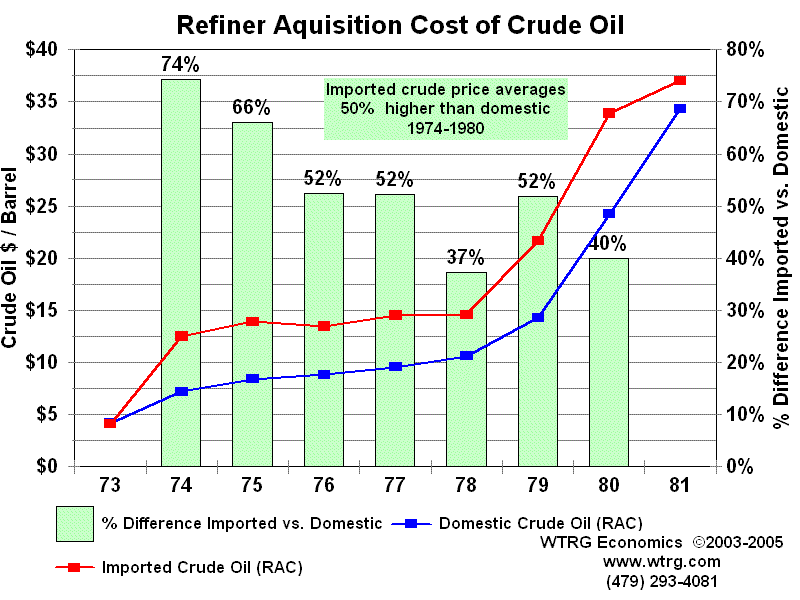
The most typical example is in placing price caps.  The most visible example was probably the 1970′s era caps on oil, gasoline, and natural gas prices and later "windfall profit" taxes.  The result was gasoline lines and outright shortages.  With prices suppressed below the market clearing price, demand was higher and supply was lower than they would be in balance.

The my friend raised is different, one where price floors are imposed by industry participants or the government or more likely both working in concert.   The crux of my argument was not that government would shy away from protecting an industry by limiting supply, because they do this all the time. The real problem with the example at hand is that, by the laws of supply and demand, a price floor above the market clearing price should yield a supply glut.  As it turns out, supply guts associated with cartel actions to keep prices high tend to require significant, very visible, and often expensive actions to mitigate.  Consider two examples:

Realtors and their trade group have worked for years to maintain a tight cartel, demanding a 6% or higher agency fee that appears to be increasingly above the market clearing price.  The result of maintaining this price floor has been a huge glut of real estate agents.  The US is swimming in agents.  In an attempt to manage this supply down, realtors have convinced most state governments to institute onerous licensing requirements, with arcane tests written and administered by… the realtor’s trade group.  The tests are hard not because realtors really need to know this stuff, but because they are trying to keep the supply down.   And still the supply is in glut.  Outsiders who try to discount or sell their own home without a realtor (ie, bring even more cheap capacity into the system) are punished ruthlessly with blackballs.  I have moved many times and have had realtors show me over 300 houses — and you know how many For Sale By Owner homes I have been shown?  Zero.  A HUGE amount of effort is expended by the real estate industry to try to keep supply in check, a supply glut caused by holding rates artificially high.

A second example of price floors is in agriculture.  The US Government, for whatever political reasons, maintains price floors in a number of crops.  The result, of course, has been a supply glut in these commodities.  Sopping up this supply glut costs the US taxpayer billions.  In some cases the government pays to keep fields fallow, in others the government buys up extra commodities and either stores them (cheese) or gives them away overseas.  In cases like sugar, the government puts up huge tarriff barriers to imports, otherwise the market would be glutted with overseas suppliers attracted by the artificially high prices.  In fact, most of the current subsidy programs for ethanol, which makes almost zero environmental or energy policy sense, can be thought of as another government program to sop up excess farm commodity supply so the price floor can be maintained.

I guess my point from these examples is not that producers haven’t tried to impose price floors above the market clearing price, because they have.  And it is not even that these floors are not sustainable, because they can be if the government steps in to help with their coercive power and our tax money to back them.  My point is, though, that the laws of supply and demand are not suspended in these cases.  Price floors above the market clearing price lead to supply gluts, which require very extensive, highly visible, and often expensive efforts to manage.  As we turn now to oil markets, we’ll try to see if there is evidence of such actions taking place.

The reasons behind US oil production and refining capacity constraints

As to his first point, that oil companies are conspiring with the government to artificially limit oil production and refining capacity, this certainly would not be unprecedented in industry, as discussed above.  However, any historical study of these issues in the oil industry would make it really hard to reach this conclusion here.  There is a pretty clear documented record of oil companies pushing to explore more areas (ANWR, offshore) that are kept off-limits due to environmental pressures.  While we have trouble imagining the last 30 years without Alaskan oil, the US oil companies had to beg Congress to let them build the pipeline, and the issue was touch and go for a number of years.  The same story holds in refining, where environmental pressure and NIMBY concerns have prevented any new refinery construction since the 1970′s (though after years and years, we may be close in Arizona).  I know people are willing to credit oil companies with just about unlimited levels of Machiavellianism, but it would truly be a PR coup of unprecedented proportions to have maintained such a strong public stance to allow more capacity in the US while at the same time working in the back room for just the opposite.

The real reason this assertion is not credible is that capacity limitations in the US have very clearly worked against the interests of US oil companies.  In production, US companies produce on much better terms from domestic fields than they do when negotiating with totalitarian regimes overseas, and they don’t have to deal with instability issues (e.g. kidnapping in Nigeria) and expropriation concerns.  In refining, US companies have seen their market shares in refined products fall since the 1970s.  This is because when we stopped allowing refinery construction in this country, producing countries like Saudi Arabia went on a building boom.  Today, instead of importing our gasoline as crude to be refined in US refineries, we import gas directly from foreign refineries.  If the government is secretly helping oil companies maintain a refining capacity shortage in this country, someone forgot to tell them they need to raise import duties to keep foreign suppliers from taking their place.

What Oil Traders can and cannot do

As to the power of traders, I certainly believe that if the traders could move oil prices for sustained periods as much as 50% above or below the market clearing price, they would do so if it profited them.  I also think that speculative actions, and even speculative bubbles, can push commodity prices to short-term extremes that are difficult to explain by market fundamentals.  Futures contracts and options, with their built in leverage, allow even smaller players to take market-moving positions.  The question on the table, though, is whether oil traders can maintain oil prices 50% over the market clearing prices for years at a time.  I think not.

What is often forgotten is that companies like Exxon and Shell control something like 4-5% each of world production (and that number is over-stated, since much of their production is as operator for state-owned oil companies who have the real control over production rates).  As a point of comparison, this is roughly the same market Toshiba has in the US computer market and well below Acer’s.  As a result, there is not one player, or even several working in tandem, who hold any real power in crude markets.  Unless one posits, as my friend does, that NY and London traders somehow sit astride a choke point in the world markets.

But here is the real problem with saying that these traders have kept oil prices 50% above the market clearing price for the last 2-3 years:  What do they do with the supply glut?  We know from economics, as well as the historic examples reviewed above, that price floors above the clearing price should result in a supply glut.  Where is all the oil?

Return to the example of when the Hunt’s tried to corner the silver market.  Over six months, they managed to drive the price from the single digits to almost $50 an ounce.  Leverage in futures markets allowed them to control a huge chunk of the available world supply.  But to profit from it (beyond a paper profit) the Hunts either had to take delivery (which they were financially unable to do, as they were already operating form leveraged positions) or find a buyer who accepted $50 as the new "right" price for silver, which they could not.  No one wanted to buy at $50, particularly from the Hunts, since they knew the moment the Hunt’s started selling, the price would crash.  As new supplies poured onto the market at the higher prices, the only way the Hunt’s could keep the price up was to pour hundreds of millions of dollars in to buy up this excess supply.  Eventually, of course, they went bankrupt.  But remember the takeaway:  They only could maintain the artificially higher commodity price as long as they kept buying excess capacity, a leveraged Ponzi game that eventually collapsed.

So how do oil traders’ supposedly pull off this feat of keeping oil prices elevated about the market clearing price?  Well, there is only one way:  It has to be stored, either in tanks or in the ground.  The option of storing the extra supplies in tanks is absurd, especially over a period of years – after all, at its peak, $60 of silver would sit on the tip of my finger, but $60 of oil won’t fit in the trunk of my car.  The world oil storage capacity is orders of magnitude too low.  So the only real option is to store it in the ground, ie don’t allow it to get produced.

How do traders pull this off?  I have no idea.  Despite people’s image, the oil producer’s market is incredibly fragmented.  The biggest companies in the world have less than 5%, and it rapidly steps down from there. It is actually even more fragmented than that, because most oil production is co-owned by royalty holders who get a percentage of the production.  These royalty holders are a very fragmented and independent group, and will complain at the first sign of their operator not producing fast and hard enough when prices are high.  To keep the extra oil off the market, you would have to send signals to a LOT of people.  And it has to be a strong and clear signal, because price is already sending the opposite signal.  The main purpose of price is in its communication value — a $60 price tells producers a lot about what and how much oil should be produced (and by the way tells consumers how careful to be with its use).  To override this signal, with thousands of producers, to achieve exactly the opposite effect being signaled with price, without a single person breaking the pack, is impossible.  Remember our examples and the economics – a sustained effort to keep prices substantially above market clearing prices has to result in visible and extensive efforts to manage excess supply.

Also, the other point that is often forgotten is that private exchanges can only survive when both Sellers AND buyers perceive them to be fair.  Buyers are quickly going to find alternatives to exchanges that are perceived to allow sellers to manipulate oil prices 50% above the market price for years at a time.  Remember, we think of oil sellers as Machiavellian, but oil buyers are big boys too, and are not unsophisticated dupes.  In fact, it was the private silver exchanges, in response to just such pressure, that changed their exchange rules to stop the Hunt family from continuing to try to corner the market.  They knew they needed to maintain the perception of fairness for both sellers and buyers.

Supply and Demand Elasticity

From here, the discussion started becoming, if possible, less grounded in economic reality.  In response to the supply/demand matching issues I raised, he asserted that oil demand and supply are nearly perfectly inelastic.  Well, if both supply and demand are unaffected by price, then I would certainly accept that oil is a very, very different kind of commodity.  But in fact, neither assertion is true, as shown by example here and here. In particular, supply is quite elastic.  As I have written before, there is a very wide range of investments one can make even in an old existing field to stimulate production as prices rise.  And many, many operators are doing so, as evidenced by rig counts, sales at oil field services companies, and even by spam investment pitches arriving in my in box.

I found the statement "if oil prices really belong this high, why have we not seen any shortages" to be particularly depressing.  Can anyone who sat in at least one lecture in economics 101 answer this query?  Of course, the answer is, that we have not seen shortages precisely because prices have risen, fulfilling their supply-demand matching utility, and in the process demonstrating that both supply and demand curves for oil do indeed have a slope.  In fact, shortages (e.g. gas lines or gas stations without gas at all) are typically a result of government-induced breakdowns of the pricing mechanism.  In the 1970′s, oil price controls combined with silly government interventions (such as gas distribution rules**) resulted in awful shortages and long gas lines.  More recently, fear of "price-gouging" legislation in the Katrina aftermath prevented prices from rising as much as they needed to, leading to shortages and inefficient distribution.

Manipulating Oil Prices for Political Benefit

As to manipulating oil or gas prices timed with political events (say an election or Congressional hearings), well, that is a challenge that comes up all the time.  It is possible nearly always to make this claim because there is nearly always a political event going on, so natural volatility in oil markets can always be tied to some concurrent "event."  In this specific case, the drop from $60 to $35 just for a Congressional hearing is not even coincidence, it is urban legend.  No such drop has occurred since prices hit 60, though prices did drop briefly to 50.  (I am no expert, but in this case the pricing pattern seen is fairly common for a commodity that has seen a runup, and then experiences some see-sawing as prices find their level.)

This does not mean that Congressional hearings did not have a hand in helping to drive oil price futures.  Futures traders are constantly checking a variety of tarot cards, and indications of government regulatory activity or legislation is certainly part of it.  While I guess traders purposely driving down oil prices ahead of the hearing to make oil companies look better is one possible explanation;  a more plausible one (short of coincidence, since Congress has hearings on oil and energy about every other month) is that traders might have been anticipating some regulatory outcome in advance of the hearing, that became more less likely once the hearings actually occurred.  *Shrug*  Readers are welcome to make large short bets in advance of future Congressional energy hearings if they really think the former is what is occurring.

As to a relationship between oil prices and the occupant of the White House, that is just political hubris.  As we can see, real oil prices rose during Nixon, fell during Ford, rose during Carter, fell precipitously during Reagan, were flat end to end for Bush 1 (though with a rise in the middle) and flat end to end for Clinton.  I can’t see a pattern.

If Oil Companies Arbitrarily Set Prices, Why Aren’t They Making More Money?

A couple of final thoughts.  First, in these heady days of "windfall" profits, Exxon-Mobil is making a profit margin of about 9% – 10% of sales, which is a pretty average to low industrial profit margin.  So if they really have the power to manipulate oil prices at whim, why aren’t they making more money?  In fact, for the two decades from 1983 to 2002, real oil prices languished at levels that put many smaller oil operators out of business and led to years of layoffs and down sizings at oil companies.  Profit margins even for the larges players was 6-8% of sales, below the average for industrial companies.  In fact, here is the profitability, as a percent of sales, for Exxon-Mobil over the last 5 years:

2006:  10.5%

2005:  9.7%

2004:  8.5%

2003:  8.5%

2002:  5.4%

2001:  7.1%

Before 2001, going back to the early 80′s, Exxon’s profits were a dog.  Over the last five years, the best five years they have had in decades, their return on average assets has been 14.58%, which is probably less than most public utility commissions allow their regulated utilities.  So who had their hand on the pricing throttle through those years, because they sure weren’t doing a very good job!  But if you really want to take these profits away (and in the process nuke all the investment incentives in the industry) you could get yourself a 15 to 20 cent decrease in gas prices.  Don’t spend it all in one place.

** One of the odder and forgotten pieces of legislation during and after the 1972 oil embargo was the law that divided the country into zones (I don’t remember how, by counties perhaps).  It then said that an oil company had to deliver the same proportion of gas to each zone as it did in the prior year  (yes, someone clearly took this right out of directive 10-289).  It seemed that every Representative somehow suspected that oil companies in some other district would mysteriously be hoarding gas to their district’s detriment.  Whatever the reason, the law ignored the fact that use patterns were always changing, but were particularly different during this shortage.  Everyone canceled plans for that long-distance drive to Yellowstone.  The rural interstate gas stations saw demand fall way off.  However, the law forced oil companies to send just as much gas to these stations (proportionally) as they had the prior year.  The result was that rural interstates were awash in gas, while cities had run dry.  Thanks again Congress.

Gas Prices

I find it sort of hilarious that it is Conservatives that are demagoguing gas prices and Liberals who are trying to explain that they really are not that high.  Yet another example of the Coke and Pepsi parties swapping political positions based on whose team is in the White House.

But I thought this graph was interesting, and supports a point I have made for years (Via Flowing Data)

I have worked in oil fields drilling miles below the surface and on offshore platforms in mile-deep water.  I have seen the Alaska pipeline under construction and worked in a 400 thousand barrel a day refinery.  And I can say with confidence that no other product on this list even is in the same order of magnitude as gasoline in terms of the capital investment, effort, and technology that does into delivering a gallon of gas.  The ability to deliver gas for even $4.00 a gallon is almost unbelievable.   Yet no other industry on this list or any other list gets 1/100th the grief oil companies do for being rapacious, greedy, and detrimental to society.

Free Market Health Care: The Road Not Taken

My column is up at Forbes, and is the fourth in a series on Obamacare.  An excerpt:

Its amazing to me how many ways supporters of government health care can find to rationalize the bad incentives of third-party payers systems.  Take, for example, the prevelance today of numerous, costly tests that appear to be unnecessary.  Obamacare supporters would say that this is the profit motive of doctors trying to get extra income, and therefore a free market failure.   I would point the finger at other causes (e.g. defensive medicine), but the motivation does not matter.   Let’s suppose the volume of tests is truly due to doctors looking for extra revenue, like an expensive restaurant that always is pushing their desserts.  In a free economy, most of us just say no to the expensive dessert.  But the medical field is like a big prix fixe menu — the dessert is already paid for, so sure, we will got ahead and take it whether we are hungry or not.

It should be no surprise that while US consumer prices have risen 53% since 1992, health care prices have risen at nearly double that rate, by 98%.  Recognize that this is not inevitable.  This inflation is not something unique to medical care — it is something unique to how we pay for medical care.

Contrast this inflation rate for health care with price increases in cosmetic surgery, which unlike other care is typically paid out of pocket and is not covered by third party payer systems.  Over the same period, prices for cosmetic surgery rose just 21%, half the general rate of inflation and just over one fifth the overall health care rate of inflation.

This is why I call free market health care the road not traveled.  There are many ways we could have helped the poor secure basic health coverage (e.g. through vouchers) without destroying the entire industry with third-party payer systems.  Part of the problem in the public discourse is that few people alive today can even remember a free market in health care, so its impossible for some even to imagine.

Update: Coincidently, Mark Perry has a post that addresses just the issue I do in my article, that is the positive effects of high-deductible health insurance and out of pocket health expenditures on pricing transparency and reduced costs.  The high deductible health plans at GM seem to be having a positive effect on the health care market.  A shame they will probably be illegal under Obamacare.  Of course, since GM is owned by the government, it can get any special rules that it wants, unlike the rest of us.  But that his how things work in the corporate state.

Things People Believe That Make No Sense

You often hear people say that one of the main reasons for health care inflation is the cost of all the new technology.  But can you name any other industries that compete in free markets where technology introductions have caused inflation rates to run at double the general rate of inflation?  In fact, don't we generally associate the introduction of technology with reduced costs and increased productivity?

Compare a McDonald's kitchen today with one thirty years ago -- there is a ton of technology in there.  Does anyone think that given the price-sensitive markets McDonald's competes in, this technology was introduced to increase prices?

Or look at medical fields like cosmetic surgery or laser eye surgery.  Both these fields have seen substantial introductions of new technology, but have seen inflation rates not only below the general health care inflation rate but below the CPI, meaning they have seen declining real prices for decades.

The difference is not technology, but the pricing and incentive system.  Cosmetic surgery and laser eye surgery are exceptions in the health care field -- they are generally paid out of pocket rather than by third parties (Overall, third party payers pay about 88% of all health care bills in the US).

The problem with health care is not technology -- the problem is that people don't shop for care with their own money.

Postscript:   Thinking some more after I wrote this, I can think of one other industry where introduction of technology has coincided with price inflation well above the CPI -- education.  It is interesting, but not surprising to me, that this is the other industry, along with health care, most dominated by third party payer systems and public subsidies of consumers.

Health Care Fail

For the last three weeks, I have been writing about the informationincentive, and rent-seeking issues that will doom Obamacare -- for example, how its impossible for a centralized board to set prices, and why a complete end to individual shopping will doom us to both rising prices and increasing frivolous demand.

I really didn't have to bother, though, because it is unnecessary to hypothesize -- we can just look at Massachusetts, which embarked on a proto-Obamacare several years ago.  John Calfee has a great column in the WSJ today.  Some excerpts

  • On costs

Massachusetts reformers deferred cost control to the vague prospect of a "Round 2" of reform—much as congressional Democrats did a year ago when they passed ObamaCare. Meanwhile, economists John Cogan, Glenn Hubbard and Daniel Kessler reported in the Forum for Health Economics & Policy (2010) that insurance premiums for individuals (alone or in employer-sponsored group plans) increased 6% to 7% beyond what they would have without the reform. For small employers, the increases are about 14% beyond those in the rest of the nation. Four years after reform, Massachusetts still has the highest insurance premiums in the nation, and the gap is getting wider.

In 2010, insurance firms announced premium increases of 10% to 30% in the individual and small-group market. Gov. Patrick, on the verge of a tough re-election race, had the state insurance commissioner deny the higher rates.

  • On frivolous demand

But the number of emergency room visits, which everyone expected to drop once people had to purchase insurance, is still going up. Surveys show roughly half the visits are unnecessary. Surveys also indicate that finding a primary care physician is becoming more difficult.

  • On the end game of a centralized price-control regime

Last month Round 2 arrived. Gov. Patrick introduced a bill that will impose de facto price controls on everyone from solo primary care doctors to prestigious academic hospital systems. An 18-member board will decide how and how much providers should be paid, and the bill gives regulators the power to force private insurers to accept these fiats. Some 30 states experimented with such rate-setting in the 1970s and '80s. Except for Maryland, all of them—including Massachusetts—deregulated in the 1990s because costs rose even as quality and choice declined

  • On politicization of decision-making

Insurance firms protested that they increased premiums because they had to deal with entrenched providers, especially hospitals, most notably the academic giants of Boston and Cambridge. Then the state prepared to introduce highly intrusive price controls over those providers—only to discover that this would provoke formidable political opposition while encountering myriad practical difficulties

To the last point, what happens to prices when providers know that a) consumers aren't shopping any more; b) consumers will take the service at any price, because they aren't paying; and c) insurance companies have to pay the bill, not matter how high, based on government rules.  Of course prices go up, because the entire price-discovery mechanism has been eliminated by government fiat.  Then the government has to step in with a doomed-to-failure price-setting plan.  In the end, those with political connections get the prices they want, and those who do not get throttled to make up the difference.

The Looming Failure of Obamacare, Part 2: Incentives

My new column, second in a series, is up at Forbes.  It is the second of a three-part series, and looks at incentives issues with Obamacare.  A few excerpts:

In the late 1960s, as part of the Great Society program, the US government constructed huge government housing complexes, with the goal of guaranteeing that everyone, no matter how poor, would have access to housing.  By the turn of the century, most of these complexes had succumbed to the wrecking ball  -- the era of large public housing complexes was over.

Why?  Well, there were a lot of reasons the program failed, but a big one was faulty incentives.  By getting free housing, recipients had no "skin in the game," no ownership, no financial participation in their housing.  As a result, many treated their taxpayer-funded abodes with contempt.  Why not?  They weren't paying for it.  And if the property was in good shape at the end of the lease, they didn't get any extra money.

I often compare Obamacare to the great failed public housing projects by warning folks that government health care is going to be much worse.    With the housing projects, we taxpayers paid large sums of money but only a few actually had to live in the horrible government apartments -- at least most of us were able to keep our own homes.  With Obamacare, it is going to cost us even more money, and we are all going to have to move, figuratively, into the projects.

If we are all forced to have the same, low deductible, first-dollar health plans, what incentive is one going to have to stay out of the health care system, even for something minor?

I also talk about the incentive for drug development

Look around the world today -- not one country with a government health care system pays drug reimbursement rates at a level that provides any incentive for new drug development.  In fact, almost all of the world's health care R&D is paid for by Americans.  What happens when politicians, trying to close an exploding health care spending hole in the Federal budget, do exactly what every other country in the world has done and use their power to drive drug prices down to marginal cost?

In fact, to be confident that there will continue to be health care innovation in the future at all, one has to believe that the US Government will act completely differenlty in running its government health care system than does every other government in the world, despite the fact it will have the incentives to behave identically to all of them.  Is this a bet you feel good about?

Awesome Idea for Making Fannie and Freddie Go Away

I am in the process of completing a home mortgage.  The process has become awful again, not as bad as it was in the early 90's but harder and more frustrating than in the mid-2000's.  There is one set of rules, and if one's situation does not fit those rules, good freaking luck.  Right now, for example, getting a home mortgage when one is self-employed, even in a pretty large business with a decade of history, is really hard.

So I like this proposal

At the moment there is nobody doing conforming mortgages except Fannie and Freddie. Indeed there is almost nobody doing mortgages of any kind except Fannie and Freddie. If the free market wants the business they can have it. (They just don't want it at this sort of interest rate spread - and I don't blame them.)

All the government need to do is tell Frannie to raise their price a little each quarter. Currently they charge 20-25bps for guaranteeing mortgages. (The free market won't take credit risk at that price.) So it is entirely open to the FHFA (and hence the Treasury) to tell Fannie and Freddie to raise their prices by 5bps. The government will get paid better for the risk they are taking (and what free market ideologue will disagree with that) and the private sector can compete if they want to.

I doubt the free market will. But then in a quarter or two Frannie can raise their pricing by another 5 bps. And a quarter or two later Frannie can raise by another 5bps.

At some stage you will get to a level where the private sector chooses to compete. Frannie should not set its price competitively though. In another quarter they should raise the price another 5bps. And in another quarter they should raise again.

By the way, this is a classic example of not learning from your last mistake.  That spread is absurdly low.  I wouldn't guarantee my best friend's loan for 20bp.  Would you take on the default risk of a $100,000 mortgage for $200 a year?