Marketing Marxism
On my first read I found this Substack post from Michael Magoon, "How a Generation of Young Women Moved Left after 2010—And Why" both fascinating and off-putting. Fascinating because he has crafted a pretty believable theory why Western women -- the free-est, most liberated, most educated, and richest women with the most personal agency in the history of the planet -- have been radicalized towards the Left and particularly to Marxism.
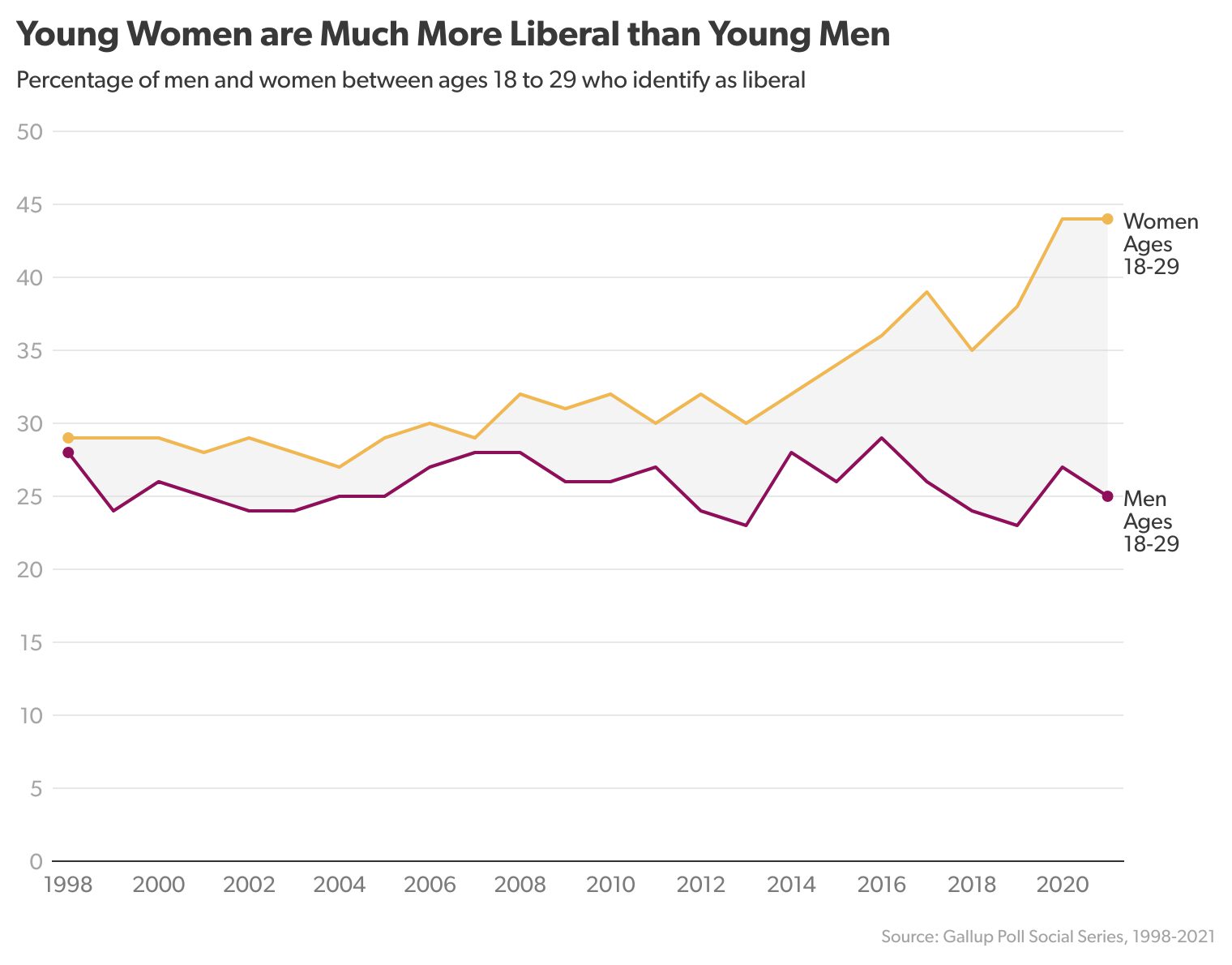
There are a lot of parts to his theory and he shares a good bit of data, but the theory boils down to certain psychological traits amplified via social media. The article is worth a read -- I think it is firewalled but can be accessed with a free registration.
But, as I mentioned, it was also off-putting, for a couple of reasons. First, I don't really like robbing individuals of their agency by talking about them in groups, and besides I know a number of young females who don't match these descriptions at all.
More importantly, though, the whole thing felt to me on first read like an ammunition dump for future ad hominem attacks -- eg we don't have to take what you say seriously because you are just another neurotic female. And really, there is not much need for ad hominem attacks on Left anyway when you see gays for Gaza marching in the streets -- you know right away they are intellectually bankrupt without having to do a Meyers-Briggs on them. Yes, I realize this somewhat puts me out of touch with the world. After all, the woke/Marxists causing chaos on the Left all absolutely argue via ad hominem attacks on the group (eg you are white/male/cis/American/Christian/Jewish so you are inherently evil and we don't have to respond to you). As an aside, I always found it ironic that Progressives have so much vitriol for white supremacists when in fact white supremacists are the one other prominent group that shares the Progressive intersectional assumption that an induvial is defined first and foremost by their race and other hard-coded personal traits, rather than their beliefs, arguments, or actions. The white supremacists share the same fundamental intersection assumption, they just root for a different team.
But I had occasion to think about this article again the other day thanks to the new Mayor of New York City Zohran Mamdani when he promised New Yorkers he would "replace the frigidity of rugged individualism with the warmth of collectivism.”
My first reaction was what the actual f*ck? Who could have the benefit of learning from the 20th century and say any such thing? Was this the warmth of Nazi book-burning bonfires, or of the Soviet Siberian Gulags, or maybe of the tropical Cambodian killing fields? I and many other greeted this slogan as laugh-out-loud ridiculous. Give me rugged individualism all the way.
But I had to think again. This guy got elected out of nowhere, with a resume that included not much more than grad school struggle sessions, so let's assume he is a good marketer. And then it hit me -- the "warmth of collectivism" is absolutely a precision-crafted slogan for the demographic described in the article above. If we think of that article as political market research, and if it were correct, then this is exactly the slogan a politician would offer. Here are a few selected bits from the piece:
Social incentives further amplify vulnerability. Women tend to have higher levels what psychologist call Agreeable. That is women are more likely than other demographic groups to be:
- more socially attuned,
- more sensitive to peer approval, and
- more likely to conform to perceived moral consensus within their networks.
Unlike Neuroticism, which declines with age, Agreebleness increases. In tightly connected social environments—especially digital ones—ideological alignment becomes a prerequisite for social belonging.
Post-Modern Left-of-Center ideologies offer a ready-made moral identity that signals compassion, awareness, and virtue. Adoption of that identity is rewarded socially, while deviation carries reputational risk. For individuals already sensitive to social threat, the cost of dissent can feel existential rather than merely intellectual.
further
Modern progressive ideology is articulated in terms that resonate strongly with traditionally feminine moral intuitions: care, safety, inclusion, protection, and emotional validation [ed-- the warmth of collectivism]. These values are not inventions of ideology; they reflect real differences in moral emphasis that have been documented across sexes. When an ideology elevates these values to absolute status and frames disagreement as harm, it becomes especially compelling to those already oriented toward preventing suffering and maintaining social harmony.
Taken together, these factors help explain why young white unmarried women are not merely participating in Post-Modern Left-of-Center movements but often occupying their emotional core.
He explains why this can still occur despite women being more empowered and materially secure than ever in history:
In a world where material constraints have loosened but meaning has thinned, vulnerability is no longer defined by poverty or exclusion. It is defined by exposure:
- exposure to threat narratives,
- social pressure, and
- moral systems that convert personal distress into political certainty.
This vulnerability does not predetermine radicalization, but it makes it far more likely when the surrounding environment consistently rewards emotional alignment over skepticism and moral intensity over restraint.
Those of us aware of the disaster that socialism always wrecks on populations see Mamdani selling an obviously failed prescription. But looked at in the context above, it makes more sense that he is not selling policy, he is selling inclusion and belonging and approval and threat-protection -- essentially the same as a cult with -- come to think of it --the same mass death waiting somewhere at the end.
It really is very cult-like behavior. The one time a cult tried to recruit me, mostly through attention from the girls, I was way too ornery to join. I like being an individual. But, I can see how the “we’ll provide everything and everything will be free” appeals to the collectivists. Good article. I’d really like to see more articles that really try to do a best-effort attempt at understanding the thought processes of these people. I really don’t understand the self-deception.
On the plus side, there is this incomprehensible (at least to me) beginnig of a trend towards hard-libertarianism and even anarchocapitalism in Silicon Valley of all places.
And the Javier Milei experiment in Argentina has been fascinating to watch. He's halfway through his first term and going strong, but now he's entering the phase where a lot of leaders get arrogant and full of themselves. I really hope he pulls through, but I also keep in mind that South American has a long history of liberty-teasing us.
It's the feelz, man, the vibes.
How do young men cope with neurotic airheads? Avoid them? Marry intelligent Asian girls?
Its a shame you dont have a wider audience.
I think the young female drift to socialism stems from several factors such as :
1- My perception is that girls in general are more conformists and "compassionate" than boys who are far more rebellious ( in good way).
2- partially our school system, When I went to school in the 1960-1970's, I dont recall much if any political activism from the teachers. It wasnt until I got to college that I saw any professor that was a leftists. Every individual naturally gravitates to professions and careers that they have the aptitude for and left leaning individuals naturally gravitate to public / government jobs, with teachers now almost exclusive leftists. Even in most every small solid "red" counties, the teachers are very left leaning. So to some extent the school system is partially to blame.
3 - Sadly, as parts of the world abandons left leaning policies, the leftist in the US seem to be the last to cling to discredited economic and social policies. (note that most european countries have dropped the transgender push while it is still strongly embraced by the left in the US
FWIW, the upswing since 2014 correlates very neatly with the republican crusade to drastically restrict women's healthcare choices.
Orwell identified this in 1984 (written in 1948):
"It was always the women, and above all the young ones, who were the most bigoted adherents of the Party, the swallowers of slogans, the amateur spies and nosers-out of unorthodoxy."
I think they just being part of a group
An article I saw on another blog is the swing by young women to hard progressive is worldwide, not just an american change in political philosophy
FWIW, the upswing since 2014 correlates very neatly with the republican crusade to drastically restrict women's healthcare choices.
By "women's healthcare choices" I assume you mean abortion. That foundational institution against which those evil republicans have mounted a "crusade." In the spirit of inflammatory language, someone with a differing ideological outlook might describe the Roe v. Wade decision as "a liberal jihad to drastically encourage the killing of babies."
"In the spirit of inflammatory language, someone with a differing ideological outlook might ..."
https://usafacts.org/articles/which-states-have-the-highest-maternal-mortality-rates/
People of different ideological outlook frequently make statements very much at odds with objective reality, and have no problem blathering on about their freedom to do unto others while showing no respect for anyone else's rights.
Socialism works at tiny scales. Families, Tribes, etc. It has an attraction and many people see it as a working system. They want to belong and are willing to sacrifice some things for "the greater good". The Israeli kibbutzim were willing to plant crops instead of using their skills... for a while.
At some point, the real world intervenes, and the commune, kibbutz, tribe breaks down.
The Right says: 'You want Socialism? Go ahead, just leave us out'.
The Left says: "We want everyone to live in our Socialist paradise. You have no choice".
on Marxism, from E.O. Wilson: "Wonderful theory, wrong species."