Archive for January 2026

Immigration -- A Pox on Both Your Houses

It is almost impossible to have a discussion on immigration with either Republicans or Democrats because the conversation quickly devolves into a pointless blame game, eg "how can you defend x when other defenders of x have done so many things wrong" where x = something like "the virtues of immigration" or "consistent enforcement of current immigration laws."   Well, I can give you the definitive answer to this blame game -- it is both their faults.

Before getting into it, a bit of history. 

In my lifetime, IMO the country has never allowed enough legal immigration.  The reasons are complicated but I used to say simplistically that Republicans wanted immigrants to work but not vote (appreciating their economic contribution but fearful of their political impact) while Democrats wanted immigrants to vote but not work (assuming the immigrants would support Democrats but bowing to pressure from unions fearful of employment and wage competition from immigrants).  Bernie Sanders, who is as Left as they come, was opposed immigration for years for exactly these wage competition concerns.

The problem was that the legal immigration level was really too low to support our economic growth, and thus there were always opportunities and relative prosperity for immigrants even when they did not enter legally.   From time to time Congress would be forced to act, generally giving amnesties every so often to immigrants already here and fairly well integrated into the economy.  Immigrants from certain countries were restricted (sometimes for bad reasons, but sometimes for good reasons (eg immigrants from low-trust societies that had dominant clan or tribal relationships -- think Sicily in the early 1900s).  And a good number of immigrants were rejected or deported, often for criminal ties and it is useful to note that until 10 years ago there was pretty solid bipartisan support for doing so.

Beyond the ideological and policy changes over the last 10 years I will describe below, a couple of other changes have been happening that make the immigration problem worse.  First, Presidents have largely given up on the hard work of taking policy choices to Congress and now manage issues like immigration through Presidential decree.  In this environment no engagement with the other side is necessary, which is entirely against the original design of our country.  People get frustrated that Congress does not move fast enough on contentious issues, but in fact that was never the intention.  If the country is divided 51-49 on some issue and the Congress is divided 51-49 and the President was elected 51-49, it should not be possible to stampede an extreme solution to the issue through executive action, but that is the growing approach we have seen over 20 years (at least).

The second changing factor is one of polarization.  The country has any number of times been severely polarized around certain issues, but seldom has it been polarized around ALL issues.  This is largely a result, in my observation, of the knee-jerk partisan behavior we see today.  For example, I wrote the other day that I don't think there is any way to reasonably explain the Left's embrace of Islam, which in its current manifestation tends to be hostile to many of the Left's other values such as secularity, empowerment of women, and sexual tolerance, except as a tit for tat opposition to Conservative post-9/11 criticisms of Islam.  So when one side says that we need less immigration, the other side says we want to take immigration to infinity, and the other side then says we want it negative.

A pox on Republicans, and in particular Trump.

If I had to teach American history thematically, rather than chronologically, one of the top five themes that made the US the nation it is today has to be immigration.  It is impossible to understate the net positive impact of immigration in our history, both in aggregate as well as the many great individuals.  And for our growth and greatness to continue, we need more immigration.  Every economist I have seen present over the last several years (including to such crazy left-wing groups like the board of the California Chamber of Commerce) has said that the economic growth rates we have experienced in the past and wish to see in the future are impossible without substantial increased immigration (I know there is some argument that reduced immigration will lead to re-entry of US citizens into the workforce, which will certainly happen in some small way but not enough to sustain growth and besides, the exit of citizens from the workforce likely has more to do with entitlements than immigration).  Remember that fertility levels in the US have fallen well below replacement levels, which means our native population will begin to shrink with the passing of us baby boomers.

And this is not even to consider the desire we should have to continue to import the best and most talented people into our country.  For decades, other countries have lamented their "brain drain" to the United States as being such an obvious advantage to the US.  Their best and brightest would take a job in the US and never come back.  Their brightest kids would go to US colleges and come to love the country so much they wanted to stay.  It is hard to come up with any parallel case in modern history -- we have lots of examples of talented people running away from certain countries, but I can think of only one where so many talented people ran towards a country.  And insanely, Trump wants to end that because some small percentage are vocal and irritating.   His plan to fight China is to keep their students out of the country.  My plan to fight China would be to take 100,000 of their top kids into our universities every year and offer automatic green cards to the top half of these on graduation.  Skim a million of their best youth off over a generation.

Perhaps driven by years of his private zero-sum deal-making (e.g either the lenders retain more out of bankruptcy or Trump does), Trump brings a really harmful zero-sum thinking to both trade policy and immigration law.  He sees each new immigrant as taking a job from a US citizen, just as he sees each import as reducing US output by the same amount.  This is incredibly narrow thinking that is not born out in theory or in 200 years of practice.  New people and sources of supply allow the US to shift people and capital to more productive pursuits, while accessing the whole world of talent via immigration and trade spurs new ideas and technologies.  This zero-sum thinking is ironic to see in a Republican, because traditionally most Progressive-Left-Marxist economics are founded on zero-sum thinking.  Specifically, trade protectionism and immigration restrictions as a means to protect US jobs has always been the Left's policy position, yet another reason I find Trump to be more Left than Right in much of his economic policy.

Whatever the background, Trump and his MAGA followers cheered the news in 2025 that the US had achieved negative net immigration, a policy I consider entirely equivalent to net-zero climate policy and just as destructive to economic growth.  Traditional Conservatives may try to argue that, well, he is only fixing the worst features of Biden-era immigration policy. But in fact he goes much further than this, blaming immigration of all sorts as a net harm and infecting his followers with an unhealthy mythology about the evils of immigration.  Worse, the over-wrought language about immigration, even calling it an invasion, is being used to justify extreme enforcement tactics up to and including the use of the military for regular policing, something that has always been an anathema in this country.  The tactics have become provocative and dangerous --perhaps even purposefully so -- and Trump really hit a new low by cutting a deal to send the deportees he liked the least to the horrible prisons of El Salvador, which I once called Trump's Constitution-free zone.  Precedents last forever, and frankly I don't care how bad a criminal immigrant is, nothing justifies escalating enforcement to such terrible levels.

A pox on Democrats, and particularly Progressives.

Had the Left set out in 2020 to do everything they could to turn the central third of the political spectrum against immigration, they could not have done a better job.  They actively encouraged people to pour through the deserts of Mexico creating a series of humanitarian crises while at the same time overwhelming the country's ability to humanely receive and integrate them.  They tossed out historic vetting of immigrants with problematic backgrounds.  In the midst of a housing crisis in many cities, they took over whole hotels and housing projects and filled them with these recently arrived immigrants, handing them taxpayer money to live on (necessary because while blue cities tolerated or encouraged their presence, they did not allow them to work).  If you wanted to try to piss off the middle band of Americans who are not hard-core Left or Right, one couldn't do much better than the picture of unvetted immigrants who are effectively exempted from current immigration law living in government funded housing (that many Americans were struggling to afford) and receiving generous government assistance.

And then there is the issue of criminality.  Contrary to mythology on the Right, neither immigrants in general nor illegal immigrants in particular have historically (at least prior to 2020 and maybe still) had higher crime rates than native born Americans.  In fact, much of the data I have seen tends to show them committing fewer crimes.  This does not, by the way, come as a surprise to me from living in Arizona.  These folks were coming here to work and seek prosperity, and nothing would get them tossed out of the American dream faster than encountering the law.  Years ago, I once only slightly tongue in cheek observed that the best way to spot an illegal immigrant in Phoenix was to find the only car actually driving the speed limit.

There was a pretty bipartisan left-right consensus that -- even if we all disagree on the correct level of immigration -- immigrants without permanent residency that commit crimes get sent back via a fairly speedy process.   This is the deal with Joe Sixpack, who is skeptical of immigration but largely accepts it as long as the criminals are stopped at the gates or sent home.  But this consensus got interrupted by the sanctuary city movement.

I will admit that at first, the sanctuary city idea sounded OK to me.  For years I used to rail at our former Sheriff Joe Arpaio (lol just search this site for his name) who used to do crazy stuff like descend on a local business, zip-tie everyone with brown skin, and release them only when some panicked family member brought proof of their legal residency.  Having seen my city actively harassing peaceful, productive people who were in violation of immigration laws (only), I thought at first that sanctuary city meant that the city would allow their illegal immigrants to live in peace.

But it turns out this was not exactly what sanctuary city means in practice.  Phoenix was something of an outlier on this and most cities never had their police actively searching out immigration violations among peaceful, law-abiding residents.  The only time city police really got involved with immigration was when they arrested someone for a crime (eg robbery or assault) and it turned out the person was not a legal immigrant.  Thus the main actual impact of sanctuary city status is that the city does not turn over criminals for deportation, breaking the old deal with Joe Sixpack.  And it has had the additional effect that every high profile, make-the-national-news story about the Left fighting a deportation in the streets or in the courts usually involves a criminal for whom few in the middle are going to have sympathy.  My hard-working and friendly yard guy was deported 9 months ago without a peep of support, but the Left is seen on the news rallying for Venezuelan gang leaders.  The optics are terrible.

Some suggestions (none of which is likely to happen)

  • In the short term, back off in Minneapolis.  It is dangerous there and both sides are to blame for being purposely provocative, though I must admit that Waltz and the rest of the Minnesota government has done what I thought was impossible -- they are being even more outrageous than Trump, purposefully painting targets on law enforcement officers and encouraging their citizens to get into dangerous confrontations.  The Feds are going to have to make the first move to de-escalate -- F*ck saving face, and its only like 1% of the country anyway.  Even Patton had to back off and try again later a few times.
  • In the short term, I would love to see the Feds and sanctuary cities negotiating local agreements to avoid the Minnesota chaos.  The Feds could agree that if the city cooperates on immigrants who have committed crimes on an agreed list, they will not take enforcement actions against others in the city.  In other words, the Feds agree that if the city will hand over their violent and repeat offenders, the Feds will leave the day laborers at the Home Depot alone.  Then if the city still objects, the Feds can publicly proclaim that they only wanted to deport criminals and the city wanted to keep them.  The PR battle they are losing now could go the other way.
  • Longer-term, Congress has to act.  Yes, given that the Senate will remain close to 50-50 for years to come, some sort of compromise will have to happen but this is what is supposed to happen on issues where the citizenry is equally divided.   My guess is that in such a compromise Republicans will have to accept some sort of amnesty and higher immigration limits while Democrats would have to accept greater enforcement activity, more vetting, limits on certain government assistance to immigrants and perhaps more voter ID requirements.  I know this is possible because similar deals have happened in the past.  I am not optimistic as the moderates in the Senate like Krysten Sinema and Jeff Flake have all been driven out and such a compromise can only come with Presidential leadership and its not going to happen here.  More than wanting their stuff, partisans will demand the other guys don't get their stuff.  I would see the Right screaming against anything with amnesty regardless of what they get in return and the Left screaming about voter ID.

Update:  about an hour after I hit publish, the Trump Administration began signaling that looks very close to the first two suggestions above.  We shall see, though this Administration tends to stick to a policy position about as long as a 5-year-old who has mainlined 3 Hershey Bars stays on task.
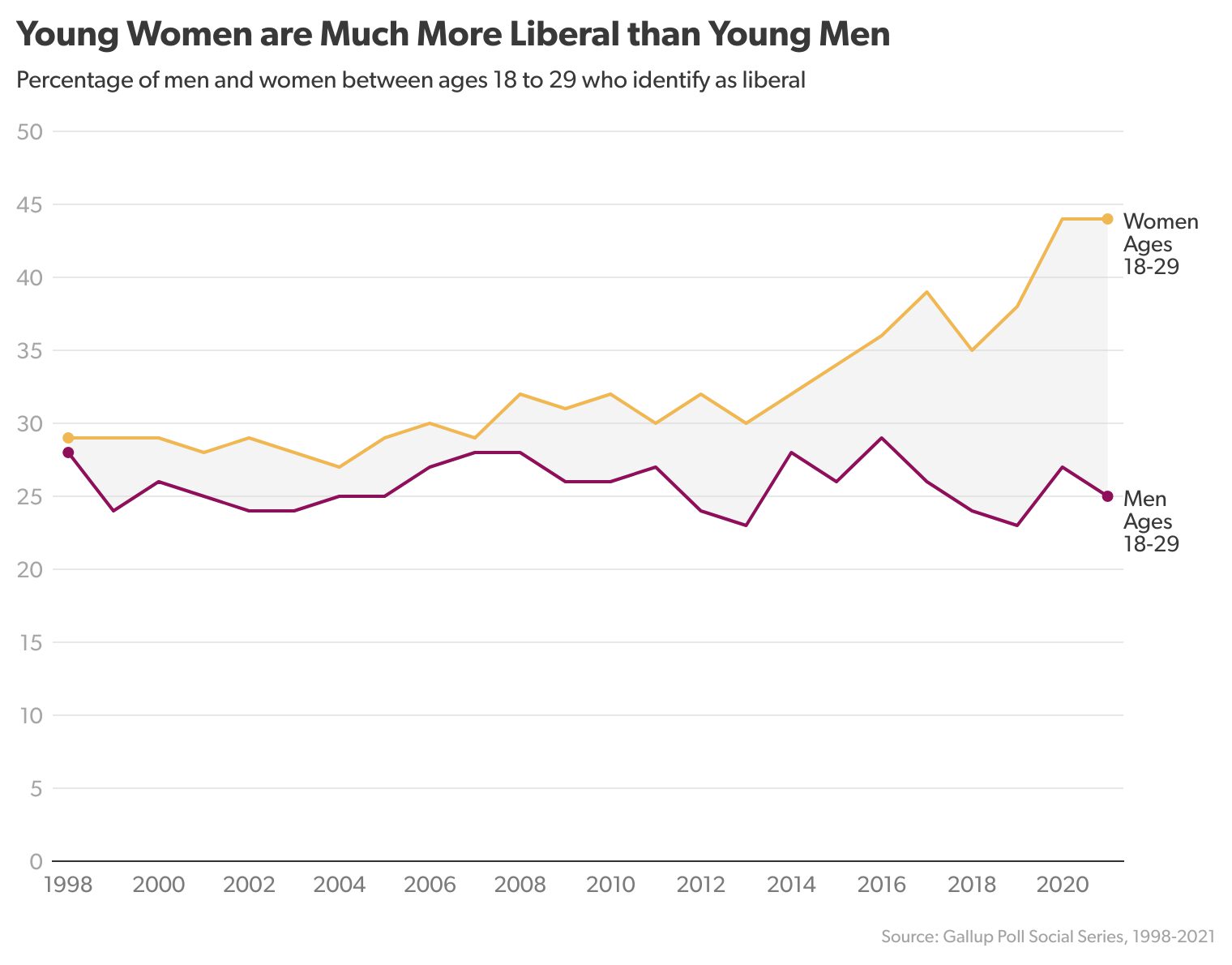
Marketing Marxism

On my first read I found this Substack post from Michael Magoon, "How a Generation of Young Women Moved Left after 2010—And Why" both fascinating and off-putting.  Fascinating because he has crafted a pretty believable theory why Western women -- the free-est, most liberated, most educated, and richest women with the most personal agency in the history of the planet -- have been radicalized towards the Left and particularly to Marxism.

There are a lot of parts to his theory and he shares a good bit of data, but the theory boils down to certain psychological traits amplified via social media.  The article is worth a read -- I think it is firewalled but can be accessed with a free registration.

But, as I mentioned, it was also off-putting, for a couple of reasons.  First, I don't really like robbing individuals of their agency by talking about them in groups, and besides I know a number of young females who don't match these descriptions at all.

More importantly, though, the whole thing felt to me on first read like an ammunition dump for future ad hominem attacks -- eg we don't have to take what you say seriously because you are just another neurotic female.  And really, there is not much need for ad hominem attacks on Left anyway when you see gays for Gaza marching in the streets -- you know right away they are intellectually bankrupt without having to do a Meyers-Briggs on them.  Yes, I realize this somewhat puts me out of touch with the world. After all, the woke/Marxists causing chaos on the Left all absolutely argue via ad hominem attacks on the group (eg you are white/male/cis/American/Christian/Jewish so you are inherently evil and we don't have to respond to you).  As an aside, I always found it ironic that Progressives have so much vitriol for white supremacists when in fact white supremacists are the one other prominent group that shares the Progressive intersectional assumption that an induvial is defined first and foremost by their race and other hard-coded personal traits, rather than their beliefs, arguments, or actions.  The white supremacists share the same fundamental intersection assumption, they just root for a different team.

But I had occasion to think about this article again the other day thanks to the new Mayor of New York City Zohran Mamdani when he promised New Yorkers he would "replace the frigidity of rugged individualism with the warmth of collectivism.”

My first reaction was what the actual f*ck?  Who could have the benefit of learning from the 20th century and say any such thing?  Was this the warmth of Nazi book-burning bonfires, or of the Soviet Siberian Gulags, or maybe of the tropical Cambodian killing fields?  I and many other greeted this slogan as laugh-out-loud ridiculous.  Give me rugged individualism all the way.

But I had to think again.  This guy got elected out of nowhere, with a resume that included not much more than grad school struggle sessions, so let's assume he is a good marketer.  And then it hit me -- the "warmth of collectivism" is absolutely a precision-crafted slogan for the demographic described in the article above.  If we think of that article as political market research, and if it were correct, then this is exactly the slogan a politician would offer.  Here are a few selected bits from the piece:

Social incentives further amplify vulnerability. Women tend to have higher levels what psychologist call Agreeable. That is women are more likely than other demographic groups to be:

  • more socially attuned,
  • more sensitive to peer approval, and
  • more likely to conform to perceived moral consensus within their networks.

Unlike Neuroticism, which declines with age, Agreebleness increases. In tightly connected social environments—especially digital ones—ideological alignment becomes a prerequisite for social belonging.

Post-Modern Left-of-Center ideologies offer a ready-made moral identity that signals compassion, awareness, and virtue. Adoption of that identity is rewarded socially, while deviation carries reputational risk. For individuals already sensitive to social threat, the cost of dissent can feel existential rather than merely intellectual.

further

Modern progressive ideology is articulated in terms that resonate strongly with traditionally feminine moral intuitions: care, safety, inclusion, protection, and emotional validation [ed-- the warmth of collectivism]. These values are not inventions of ideology; they reflect real differences in moral emphasis that have been documented across sexes. When an ideology elevates these values to absolute status and frames disagreement as harm, it becomes especially compelling to those already oriented toward preventing suffering and maintaining social harmony.

Taken together, these factors help explain why young white unmarried women are not merely participating in Post-Modern Left-of-Center movements but often occupying their emotional core.

He explains why this can still occur despite women being more empowered and materially secure than ever in history:

In a world where material constraints have loosened but meaning has thinned, vulnerability is no longer defined by poverty or exclusion. It is defined by exposure:

  • exposure to threat narratives,
  • social pressure, and
  • moral systems that convert personal distress into political certainty.

This vulnerability does not predetermine radicalization, but it makes it far more likely when the surrounding environment consistently rewards emotional alignment over skepticism and moral intensity over restraint.

Those of us aware of the disaster that socialism always wrecks on populations see Mamdani selling an obviously failed prescription.  But looked at in the context above, it makes more sense that he is not selling policy, he is selling inclusion and belonging and approval and threat-protection -- essentially the same as a cult with -- come to think of it --the same mass death waiting somewhere at the end.

The Left's Infatuation With Islam

I have never considered myself of the Left but like most libertarians I have made common cause with the Left on many issues.  in the past five or ten years the Left has gone of the rails on a number of issues, but none more than its attitude towards Islam.  Islam, as currently practiced in much of the world, is simply awful on any number of issues important to the Left -- treatment of women, respect for sexual heterodoxy, treatment of religious and ethnic minorities, authoritarianism, strongly patriarchal family organization -- all of it makes the things the Left marches in the street against here look moderate in comparison.  Readers know I am no fan of Trump but is there any dimension we criticize him on that Hamas or Iran or Gaza aren't substantially worse on?  Do current Republicans in the US or the Iranian state look more like the Handmaids Tale?

And yet the western Left has a love affair with Islam as currently practiced, with perhaps the weirdest example being the Gays for Gaza protestors last year.  By the way, I keep using the term "as currently practiced" because I am exhausted with retorts to criticisms of Islam that are something like "well, that is not true Islam"  (a strangely parallel statement to "that was not real socialism".)   I am not an expert on Islam and usually neither are the people using this argument, but it does not matter.  Islam as practiced in places like Gaza means treating women as one step above chattel and throwing gays off buildings.  Whatever the true nature of Christianity, none of us would have liked it much in the 13th century when it was leading Crusades and Inquisitions.

To this end I thought this X post from Tahmineh Dehbozorgi was a useful framework for trying to understand this odd hookup:

Islam, in Western progressive discourse, has been racialized. It is treated not as a belief system or a political ideology, but as a stand-in for race or ethnicity. Criticizing Islam is framed as an attack on “brown people,” Arabs, or “the Middle East,” as if Islam were a skin color rather than a doctrine.

This confusion is rooted in historical illiteracy. Western liberal media routinely collapses entire civilizations into a single stereotype: “all Middle Easterners are Arabs,” “all Arabs are Muslim,” and “all Muslims are a monolithic, oppressed identity group by white European colonizers.” Iranians disappear entirely in this framework. Their language, history, and culture—Persian, not Arab; ancient, not colonial; distinct, not interchangeable—are erased.

By treating Islam as a racial identity rather than an ideology, Western media strips millions of people of their ability to reject it. Iranian protesters become unintelligible. Their rebellion cannot be processed without breaking the rule that Islam must not be criticized. So instead of listening to Iranians, the media speaks over them—or ignores them entirely.

I can confirm from reading a couple of books on Persian/Iranian history and having had a number of Persian/Iranian friends that this is absolutely no better way to really tick off an Iranian than to call them an Arab.  Iran is a great example of why the Left is so befuddling on this issue.  There were a number of good reasons to have wanted the Shah gone in the late seventies, starting with his tendency to jail and execute critics.  But one of the most important causes for the Islamic revolution there was the Shah's granting of full civil rights and education opportunities to women, which really drove the hardcore Muslims crazy and created a lot of the anger that fed the Revolution.  In a sense, then, by defending the Iranian state the Left is defending a revolution meant explicitly to enslave women.

Postscript:  While I think the above is a pretty good take on the philosophical underpinnings of the Left's support for radical Islam, I have my own theory of how this got started.  I think it started in the aftermath of 9/11 when Republicans were particularly hawkish on countering what they saw as Islamic threats, particularly after we started a couple of wars in Afghanistan and Iraq.   In what is a fairly typical historical pattern, the Left reflexively started to support Islam where Republicans were perceived to be against it.  And as often does, a desire to stop a bad war and reach peace morphed into rooting for the other side.

Is It Science Denial.... Or Authority Denial?

In an otherwise moderately engaging NY Times article about the dual lives (Physicist and Rock Star) of Brian Cox, the author drops in this sentence as a universal truth:

In an era when science denial and disinformation are common...

The increasingly common elite/Leftist charge of science denial really aggravates me.  At best, it is a modern elitist virtue signaling tic, thrown into text in the same way a Catholic might genuflect.  At its worst, it is used as a totalitarian cudgel to attempt to silence differing scientific and/or political opinions.

Certainly flat earthers, 9/11 truthers, and moon landing deniers exist and have always existed.  It took a long time in the 19th and 20th century for average Americans to swallow Darwin, and almost as long for even hard-core geologists in the 20th century to accept plate tectonics.  But my contention is that most of the current behavior that elicits cries of science denialism are in fact skeptical not of science itself but of the authorities in academia and government who attempt to mandate scientific truth by fiat and who use the mantle of science to enhance their power.  In many cases that skepticism runs too far, for example following RFK Jr over his autism cliff, but this metastasizing of distrust began not with luddite tendencies of the hoi polloi but with the shameful actions of the "elite."

It is impossible to discuss this topic without digging into the government reactions to COVID19, but even before March of 2020 the government and academia where working hard to undermine their own creditability on scientific topics.  For example,

  • Anyone as old as I will have seen over the decades at least five different, often contradictory sets of government nutrition guidance.  And I have never met anyone who makes a living or serious hobby out of nutrition who agrees with any of these.
  • Without delving into the details of the climate debate, many thinking people are turned off by the catastrophic one-upmanship and overt partisanship of what should be sober scientific researchers and the absurd certainty in ascribing individual weather events to small changes in a chaotic climate system.
  • Even before 2020, academia had a severe replication crisis, where university press releases exaggerate actual study findings and where even those more modest results frequently fail to be replicated by other researchers.

But all of this was just a warmup act for COVID, when government officials and leading academics gave Americans every reason to distrust what they say about science.  What we have seen is not a backlash against science per se, it is a backlash against authority and the authorities who tried to use the goodwill created by the scientific revolution to protect their power and shield their blundering actions from criticism.  Sometimes this skepticism manifests itself in unproductive ways (e.g. avoiding measles vaccines) -- but this skepticism was 100% created by the authoritarian and dishonest behaviors of government officials and academics under COVID.  For example:

  • Authorities enforced actions, particularly masking and quarantines, that were the exact opposite of what had been recommended by the vast majority of scientific study prior to the pandemic.  It is interesting to hypothesize why they might have done this (I have put my hypothesis in the postscript below) but the most meta studies of these topics came to the conclusion that masking and quarantines were net counter-productive.
  • Authorities made up rules such as the 6-foot distancing rule that they later admitted were utterly without basis but which at the time they insisted was "science".
  • When they came under fire for some of their rules, authorities worked with academics to quickly generate some of the worst-structured studies in medical history to "prove" they were right
  • It is increasingly clear that authorities covered up the likely origins of COVID19 as an accidental leak from gain-of-function research at the Wuhan lab.  In the process, many social media accounts were suppressed for even suggesting what turned out to be the likely correct origins.  The fact that Dr Fauci appears to have been covering up the fact the he signed off on much of the funding, laundered through the EcoHealth Alliance, the resulted in the development of COVID19 makes the story even uglier.
  • State and local governments suppressed certain hypothesized treatments (e.g. chloroquine) before any real work could be done to evaluate them merely because other politicians they did not like (ie Donald Trump) seemed enthusiastic about them.  I am not sure these treatments ever would turn out to have merit, but in a fast-moving pandemic it is insane to cut off treatment avenues without evidence
  • In perhaps the most damaging failure of them all, the efficacy of the rapidly-developed vaccines was greatly overstated while side effects data (which I still believe were small and limited in number) were suppressed.    The COVID vaccines were sold as if they were more like polio vaccines (99% effectiveness) when in fact they were more like flu shots (40-55%).   In many cases they still allowed transmission and infection but acted as a palliative before-the-fact, reducing severity  and greatly reducing risk of death particularly in older patients.  Inevitably, people noticed that the shots did less than promised.  My belief is that this undermined faith in all vaccines.  If you put Mariah Carey's movie Glitter in a top 10 all-time movie list, once people watch it they are going to lose faith in the rest of the list even if every other choice is solid. At the same time, a lot of the potential data on vaccine side-effects was being suppressed.  The stated reason was that officials feared that if people saw data that there were bad reactions, however few, they would hesitate to take the shot.  This is typical government thinking that flies in the face of reality.  Everyone heard anecdotes of people getting side effects, so the side effects were no secret. With the data suppressed, some jumped to the conclusion that there must be something scandalous lurking in the numbers and there was no transparent data source that demonstrated how common or uncommon the anecdotal bad reactions were.

When I have said these things in the past, people have responded that "well, what we understood about the virus was altering day by day -- it is not unreasonable to expect mistakes to be made."  Yes, and a hard no.  Yes, it was perfectly reasonable to think that as knowledge grew, understanding might change.  But no, this is zero excuse for the behaviors displayed by authorities during COVID.  There was no modesty at all -- every one of their pronouncements and diktats were issued with smug certainty.  People who disagreed were silenced and punished.  And over time, nothing changed from authorities as we learned more.  As governments do all the time, once they took a position they never moved off of it no matter what the evidence.  The same people who insisted that the virus came from those wacky Chinese eating bats still insist the same thing today.   It is December of 2025 and I still have a operating contract with LA County that requires all of our employees to be vaccinated against COVID every 6 months.

A few parting thoughts:

  • "Science" is not whatever a government official with a science-adjacent job title says it is.  For any given area of study, most honest individual scientists will tell you that even they are not sure what the science "says".  Scientific knowledge comes only after an initial hypothesis has been replicated or pummeled many many times.  There is no gatekeeper that declares when it is settled and if there were such a gatekeeper it sure as hell should not be the government
  • Of late the charge of "science denial" tends to be a one-way political attack from the Left aimed at the Right (or at least the not-Left).  But most of the folks issuing this attack have their own set of beliefs that fly in the face of the mass of academic research.  Whether concerning the effect of minimum wage laws on employment or proper treatment of juvenile gender confusion, the Left is just as likely as RFK Jr -- with his vaccine autism fears -- to latch onto niche outlier studies that support their political preferences.  There is nothing necessarily wrong with being an outlier against the masses on the other side of a scientific issue -- most scientists who are famous enough that you know their names are famous because they did exactly this -- but you need to understand you are an outlier and be able to explain why that position is compelling for reasons beyond political convenience.
  • Modesty and skepticism are always required when discussing scientific findings.  Science not infrequently goes down blind alleys, with years-long adherence to concepts like phlogiston and Lamarckian evolution and decades-long fights for acceptance of theories we now hold dear like plate tectonics or a comet killing the dinosaurs.
  • The government funds a lot of science, and while this seems like a better way to spend money than a lot of the other BS that gets funded, it is not without its dangers.  Funding can easily get politicized.  For example, breast cancer for years received way more money per cancer death than the other top deadly cancers because it was a way for politicians to show solidarity with women's groups. AIDs research was grossly underfunded in early years because Conservatives thought gay sex was icky.  Current protests against RFK's changing research grant priorities simply prove my point -- if masses of funding can shift priority based on one guy getting a new job, then putting all our research eggs into the government basket makes no sense.
  • A much better way to respond to someone you think is way off base scientifically is not to call that person a science denier but to ask a simple question, "what's your evidence?"   For years when I was more active in the climate debate, I got called a climate denier (to which I would always snarkily answer that I do not deny there is a climate).  But to my statement that I thought the negative impacts of CO2 emissions were overstated, if I was asked "what's your evidence" I guarantee I could begin a thoughtful discussion. As the holder of a heterogenous opinion on this scientific topic I knew I needed to be prepared to state my case and my evidence.

Postscript -- Why did Fauci and Company go all in for masks and lockdowns when all the prior scientific work and planning advised against them?

This is actually a question I seldom see discussed.  Critics of Fauci will simply say he was a bad person, but that is seldom a good explanation. It will come as little surprise to folks who have read my work in the past that I believe we can understand this question by analyzing incentives.

The body of public health research prior to 2020, on balance, held that public masking (and large scale lockdowns, btw) were not effective and generally not recommended (at least once the outbreak is past a very small group). But within weeks of the start of the pandemic in 2020, government agencies like the CDC threw out all this history and decided to mandate masks.  Masks were mandated for people outdoors, even when we knew from the start that transmission risks outdoors were nil.   Officials even mandated masks for children, who have lower death rates from COVID than the flu and despite a lot of clear research about the importance of facial expressions in childhood development and socialization.   So why?

Incentives of the CDC

One needs to remember that the officials of government agencies like the CDC are not active scientists, they are government bureaucrats.  They may have had a degree in science at one time and still receive some scientific journals, but so do I.  Dr. Fauci has seen about the same number of patients over the last 40 years as Dr. Biden.  These are government officials that think like government officials and have the incentives of government officials.  They have climbed the ladder to the top of a government agency not by doing brilliant research work but by winning a hundred small and large political knife-fights.

I will take the CDC as an example but the following could apply to any related agency.  Remember that the CDC has been around for decades, consuming billions of dollars of years of tax money.  And as far as the average American is concerned, the CDC has never done much (at least visibly) in their lifetimes as we never have had any sort of public health emergency when the CDC had to roll into action in an emergency (AIDS might be an exception but it was a much slower-burning pandemic and the CDC did not cover themselves in glory with that one anyway).

If you think this unfair, consider that the CDC itself has recognized this problem.  For years they have been trying to expand their mandate to things like gun control and racism, trying to argue that these constitute public health emergencies and thus require their active participation.  The CDC has for years been actively looking for a publicly-visible role (as opposed to research coordination and planning and preparation and such) that would increase their recognition, prestige, and budget.

So that is the backdrop -- an agency trying to defend and expand its relevance.  And boom - finally! - there is a public health emergency where the CDC can roll into action.  They see this new and potentially scary respiratory virus, they check their plans on the shelf, and those plans basically say -- there is nothing much to be done, at least in the near term.  Ugh!  How are we going to justify our existence?  Tellingly, by the way, these agencies and folks like Fauci did follow a lot of the prior science in the opening weeks -- for example they discouraged mask wearing.  Later Fauci justified his flip flop by claiming he meant the statement as a way to protect mask supply for health care workers, but I actually think that was a lie.  His initial statements on masks were correct, but government agencies decided they did not like the signal of impotence this was sending.

There was actually plenty these agencies should have been doing, but none of those things looked like immediate things to make the public feel safer.  Agencies should have been:

  1. Trying to catalog COVID behavior and characteristics
  2. Developing tests
  3. Identifying and testing treatment protocols
  4. Slashing regulations vis a vis tests and other treatments so they could be approved faster
  5. Developing a vaccine

If we score these things, #1 was sort of done though with a lot of exaggerated messaging (ie they communicated a lot of stuff that was mostly BS, like long covid or heart risk to young athletes).  #2 the CDC and FDA totally screwed up.  #3 barely happened, with promising treatments politicized and ignored.  #4 totally did not happen, no one even tried.  #5 went fabulously, but was an executive project met with mostly skepticism from agencies like the CDC.

Instead, the CDC and other agencies decided they had to do something that seemed like it was immediately affecting safety, so it reversed both years of research and several weeks of their own messaging and came down hard for masks and lockdowns.   And, given the nature of government incentives, they had to stick with it right up to today, because an admission today that these NPI aren't needed risks having all their activity in 2020 questioned.  And besides, Fauci got himself sanctified and received multi-million dollar awards for insisting on masks and quarantines (and being seen as a foil to Trump), so why would he possibly reconsider?

Incentives for Government Officials Elsewhere

Pretty much all of the above also applies to the incentives of state and local government officials.  Our elected officials of both parties have been working to have the average American think of them as super-dad.  Got a problem?  Don't spend too much time trying to solve it yourself because it's the government's job to do so.  Against this background, the option to do nothing, at least nothing with immediate and dramatic apparent potency, did not exist.  We have to do "something."

It might have been possible for some officials to resist this temptation of action for action's sake, except for a second incentive.  Once one prominent official required masks and lockdowns, the media began creating pressure on all other government officials.  New York has locked down, why haven't you?  Does New York care more than you?  We had a cascade, where each official who adopted these NPI added to the pressure on all the others to do so.  Further, as this NPI became the standard government intervention, the media began to blame deaths in states with fewer interventions on that state's leaders.  Florida had far fewer COVID deaths, particularly given their age demographics, than New York but for the media the NY leaders were angels and the Florida ones were butchers.  For a brief time terrible rushed "studies" were created to prove that these interventions were working, generally by the dishonest tactic of cherry-picking a state with NPI mandates that was not in its seasonal disease peak and comparing it to another state without NPI mandates that was in the heart of its seasonal peak.

And then the whole thing got polarized around party affiliation and any last vestige of scientific thinking got thrown to the curb.   Take Chloroquine as a possible treatment protocol.  Personally, I have not seen much evidence in its favor but early last year we did not know yet one way or another and there were some reasons to think it might be promising.  And then Donald Trump mentioned it.  After that we had the spectacle of the Michigan Governor banning this treatment absolutely without evidence solely because Trump had touted it on pretty limited evidence.  What a freaking mess.  In addition to giving us all a really beautiful view of the hypocrisy of politicians, it also added another great lie to the standard list.  To "The check is in the mail" and "I will respect you in the morning" is now added "We are following the science."

Incentives for the Public

I won't dwell on this too long, but one thing COVID has made clear to me is that a LOT of people are looking for the world to provide them with drama and meaning.  The degree to which many folks (mostly all well-off white professionals and their families) seem to have enthusiastically embraced COVID restrictions and been reluctant to give them up has just been an amazing eye-opener for me.  Maybe I am crazy, but I get the sense that a lot of folks of a certain age miss the COVID days.

Donald Mamdani Trump

The WSJ reports:

President Trump said he will ban large investors from buying single-family homes, the administration’s first significant move to address the country’s severe housing shortage.

“I am immediately taking steps to ban large institutional investors from buying more single-family homes, and I will be calling on Congress to codify it. People live in homes, not corporations,” Trump said in a social-media post Wednesday.

I tell folks all the time that Trump is not a freaking free-marketeer.  This is yet more evidence.  His proposal is right out of the failed Progressive-Socialist playbook on housing.  Some quick thoughts:

  • Except where the houses have been converted to overnight rentals (think Airbnb or VRBO), people still live in these institutionally owned houses.  This is not withdrawing housing stock from the market, it is merely shifting it from individual purchase to rentals.  And there are arguments for there being more not less rental houses -- particularly when interest rates are high and/or housing prices are flat, houses limit mobility by locking a family to a fixed position, limiting the ability to seek out better employment in other cities
  • There is something to be said for renting from an institution, rather than an individual owner, as these landlords have better systems, large support and maintenance staffs, and often better legal compliance.  Because living in certain neighborhood boundaries is required to attend the best public schools, this allows families who could not afford to buy a house in that neighborhood to be able to live there.  It also opens suburban living to young couples who have not yet saved a down payment.
  • According to the WSJ, these institutions own 2-3% of the housing stock at most.  Hard to imagine that this tail is wagging the dog.  This is a typical populist grandstanding proposal with zero ability to address the intended issue, but a lot of emotional resonance with swing voters.
  • Real housing prices were likely flat to slightly down in 2025, so if there is a current "affordability" crisis it has more to do with higher mortgage rates than housing prices per se.  Rents have increased faster than inflation the last several years, but its hard to figure how removing rental units from the market based on this order will do anything to lower rents.
  • No one was complaining about institutional buyers back in 2008 when the market was awash in unsold houses and institutions began soaking up this excess capacity and providing much needed liquidity to the market.
  • I will confess the endless calls and texts to my cell phone from these yahoos trying to buy my house does piss me off, but not enough to ban their business model
  • Fiddling with ownership rules will not do anything for housing affordability.  The reason prices are rising is that there is not enough housing being built and has little or nothing to do with who owns the homes.  Many cities have myriad restrictions on home construction -- from outright limitations on new building permits to growth boundaries to onerous permitting rules -- while at the same time we subsidize demand through government mortgage insurance and the most lenient mortgages in the Western world (the bank can only take your house, not your other property if you default).  There remains much local support for housing restrictions -- you can think of many cities as a cartel of homeowners protecting their monopoly through restrictions on adding competing supply.
  • There are two financial reasons people want to own rather than rent houses (beyond an array of emotional ones)
    1. Mortgage interest is deductible on taxes, rent is not.  Why not equalize these, either by ending the deductibility of mortgage interest, or since that is likely a political non-starter, by making rent payments deductible?
    2. Historically home equity has been a good investment for many, with real home prices doubling over the past 50 or so years.  Over this same period, someone with a 90% Loan-to-Value (LTV) would have seen a 10x increase on their 10% equity portion.  As discussed above, this is mainly due to subsidizing demand and restricting supply.  However, this only works when housing prices grow faster than inflation, which is what people are now complaining about.  You can't have both -- either house prices rise faster than inflation and are a great investment or they don't and are more affordable but not a very good investment.
  • There is no way the President should have the power to mandate this.  Republicans are really, really going to regret these precedents when the next socialist-Democrat is in office and mandates something like national rent control.