I will preface this post by saying I know exactly zero about AI companies and what they are working on. But I wonder if they are working on the right thing.
First, a digression. Anyone who is more than a casual user of Microsoft Word understands that there are fundamental bugs in the core of the program that have existed since almost the very first version and have never been fixed in almost 30 years. Two that come immediately to mind are the difficulty in getting images to stay where you put them and the absolutely terrible structured outlining (eg section II-B-iv-2-a). The former is so bad you can find a zillion memes on it. The latter is so bad that Word Perfect still survives focused on lawyers who write a lot of documents with hierarchical bulleting.
Everyone knows these problems exist. Presumably they are fixable with some amount of effort. But they are not fixed. Instead, release after new release in Word trumpets new niche functionality without ever focusing on the core functionality. I can't remember ever using a feature of Word that was added since 2005, and maybe earlier, but yet adding those new features is what consumes all the development time.
My fear is that AI companies are doing the same thing. New features and capabilities of the major AI models are impressive. But at their core, at least for researching and writing, they still have the critical, fatal flaw of hallucinations. Almost every day we can watch some law firm get reprimanded by a judge for submitting briefs that include fake, made-up, hallucinated cases.
I don't care how capable and human sounding these ai models are, if they are inserting reputation-destroying hallucinations in a firm's output, or writing in an identifiable AI style, they are worse than useless. And companies that say "Oh, we don't use AI" are fooling themselves because even the best and brightest kids that they are hiring have become habituated to using AI to finish research and writing assignments. A young woman I know who manages case teams for one of the big strategic consultants (I won't give the name but think McKinsey, BCG, Baine, etc) says that a huge part of her job as engagement manager is to stop AI-generated slop with obvious errors and recognizable AI writing style from getting to the client. Her case team keeps handing her things that at best are obviously AI prose and at worst contain errors. Interestingly, she checks all this stuff not because she was assigned to do it, but because she grew up on the AI/non-AI temporal border and sees the risks. I have a bet online where I believe one of these firms is going to be caught up in a public scandal and lawsuit in 2026 for turning in ai-generated client presentations while billing that client 7 figures a month (imagine the explosion when a CEO finds out they were paying $1 million a month for the output of a few ChatGPT prompts).
The problem is actually bad enough that I briefly considered starting a new firm whose sole job was to independently review, fact-check, and edit all of a firm's output to help them identify hallucinations and AI tells. You could probably go hire 100 of the older generation of Washington Post layoffs right now who have actual reporting, editing, and fact checking experience (avoid the younger ones who grew up in the journalism as advocacy era). Go out and sell your services to law firms and consultants and such. Gotta be a business there. Right now I am too newly retired to pursue it but I will leave the idea to you guys. You're welcome.
Obviously, nothing about what I describe above sounds like the employment apocalypse everyone is expecting. You are simply not going to see the promised productivity gains until AI cleans up its house and in my mind that would include transparency about hallucinations -- what are the rates, what have they done to fix them in this version, are the rates going down, etc.
I am a bourbon and cocktail guy, not a wine guy. When folks are tasting wine and saying they can taste grass and strawberries and chocolate, I am saying "I think that's a red one." Never-the-less some new friends who know a lot about wine hosted us a while back on a trip to Napa to do some wine-tasting. I will say that I left somewhat confused.
The incident that set me to thinking started at a gorgeous winery called Bond, part of the Harlan family series of vineyards. I had never heard of Bond or Harlan, which generated approximately the same reaction from wine-lovers as, say, telling my daughter I can't name any Taylor Swift songs. Anyway, we had a tasting there, which I understand was something of a coup in in itself. At the tasting we tried 5 different cabernets from 5 different parts of the valley. It was actually cool, they had a jar of the soil each wine's grape was grown in next to the bottles and there were very dramatic differences. I found this infinitely more enlightening than being told the word "terroir" over and over.
They did a couple of things that I have come to learn make for the best high-end vineyard tasting experience. First, the whole thing was quiet and private for just our group. And secondly, in addition to opening up all their current vintage wines (all cabernet sauvignon) for tasting, they pulled a few 2013 versions of the same wine from the library -- "library" being wine-speak for inventory of older stuff. 2013 was apparently a very good year for them and this was by far the oldest stuff we had been offered anywhere.
I had always been told that you can't drink cabs right away. They have to age in the bottle for 10 or 15 or more years to really be their best. I had never experienced that for myself but drinking the 2013 version next to the 2023 version was eye-opening to me. TL;DR it makes a big difference that even I could readily taste.
By the way, if you have any scientific bent, good luck asking any of these tasting room types what -- chemically -- happens in the aging process once in the bottle. I am more used to bourbons that really do not continue to age once they are out of the barrel and into glass bottles (aging for bourbons requires molecular exchange with the wood in addition to evaporation from porous barrels and even changes to the weather). So I was curious how wines age in the bottle. But I asked wine folks about what happens in the bottle -- do long chain molecules break down, do molecules combine, do some chemicals vaporize and leave solution -- and all I could ever get was new-agey stuff about ... something or other. Something happens to the tannins -- I could probably look it up.
But this is where I hit my conceptual wall I am still struggling with. To understand this you need to know that the current vintage bottles of cab at this winery go for $800 a bottle -- that is for the 2023 version. The problem is that I don't really buy $800 bottles of wine. I don't actually buy $800 bottles of bourbon (see footnote below). But I knew that people fight to get even a few bottles on allocation from this winery at this price. So I thought about buying something because a) it was really a lovely tasting and buying a bottle or two seemed good manners and b) it might be fun to have a special bottle tucked away for a special occasion, maybe for the birth of our first grandchild or the night before I get put up against the wall come the revolution.
Outside the tasting, though, I searched on my phone for the 2013 Bond Pluribus we had tried. I learned that this was considered a very good wine and scored a 100 from wine critic Robert Parker, which is apparently a good thing. This very highly regarded and more fully aged 2013 vintage was going for $600 in several places. $600 aged 10 years vs $800 new -- I was confused.
My wine friends did not even blink when I said this. Their reaction was "well, that wine was probably originally sold for $200 and $600 is a pretty big markup." But that makes zero sense to me -- the original sales price should be irrelevant. The 2013 is known to be one of their very best years and likely a better year than 2023. But more importantly it had already been aged for 10 years in the bottle. By any possible wine drinker metric, the 2013 had way more value than the 2023. We all agreed the 2013 tasted way better, at least today, than the 2023. But it was $200 cheaper. Another way to think about that is that if I have to store the 2023 for at least 10 years for it to really be drinkable, that means the future value at 8% discount rate of my $800 I pay today is $1,727 in 10 years. Why buy a young bottle today if I can buy an aged bottle from a really good vintage for cheaper?
I had a professor at HBS who taught investing -- I am sorry, I have forgotten his name but he was quasi-famous. He would put crazy arbitrage opportunities on the board, and we would all argue about why they existed and how money could be made from them. He would end all such discussions with the same phrase, "either this is a real opportunity or there is something you don't understand." I am willing to believe there is something I don't understand and am open to commenters educating me. I can think of a few possible explanations:
The online offer is counterfeit, like a fake Hermes bag (I don't think so, I ended up ordering a bottle from a very reputable store and it appears quite real).
People don't trust the provenance of wine sold by third parties -- what if it has not been stored well? Maybe they left it in a hot car trunk for a month?
People are buying lottery tickets -- just as a Pokémon card collector might buy a huge box of unopened card packs hoping to score a super-rare card, perhaps people are willing to pay more for wines at great vineyards in hopes that one will be that wine or vintage people talk about for decades.
With bourbon, people pay a premium to put together collections of all the different runs of a particular brand. Do people do this in wine, try to collect all the years of a certain label?
Perhaps wine people are the ultimate marshmallow test kings, actually expressing a preference for 10-years deferred gratification.
Maybe it gives wine people an excuse to keep buying wine because none of what they already own is ready to drink yet
Footnote on Bourbon:
I have various types of bourbon tucked away all around my house, but I don't think I have ever paid $800 for anything. And it is certainly possible to do so. The most famous, the 23-year Pappy Van Winkle usually goes for $4000-$5000 a bottle on the secondary market. I saw a special bottle of Eagle Rare going for $10,000 a 2-ounce pour in a Nashville bar. Woof.
I have been lucky enough to try Pappy and other very rare bourbons on someone else's dime. And my general conclusion is that they are not worth it. My wife and I did a very special trip to Buffalo Trace several years ago and somehow scored a tour and tasting from the CEO of Sazerac. So even my wife, who hates bourbon, knows that Pappy and Weller start out in the same barrel. I signed a Pappy/Weller barrel that my wife hammered the cork into -- it should be available for my funeral. Anyway, the main difference is Pappy stays in the barrel longer -- which is NOT always a good thing in bourbon IMO -- and it has a higher proof, about 20 points higher on ABV proof (10 points higher on ABV),
So my wife ran a blind test last weekend with a friend and I between Weller 12 and Pappy (18?) Anyway, my friend could not tell the difference and I could tell only because I knew Pappy had a higher ABV and I could taste the burn from the greater alcohol content. Had we diluted the Pappy down to Weller level, not sure I could tell the difference.
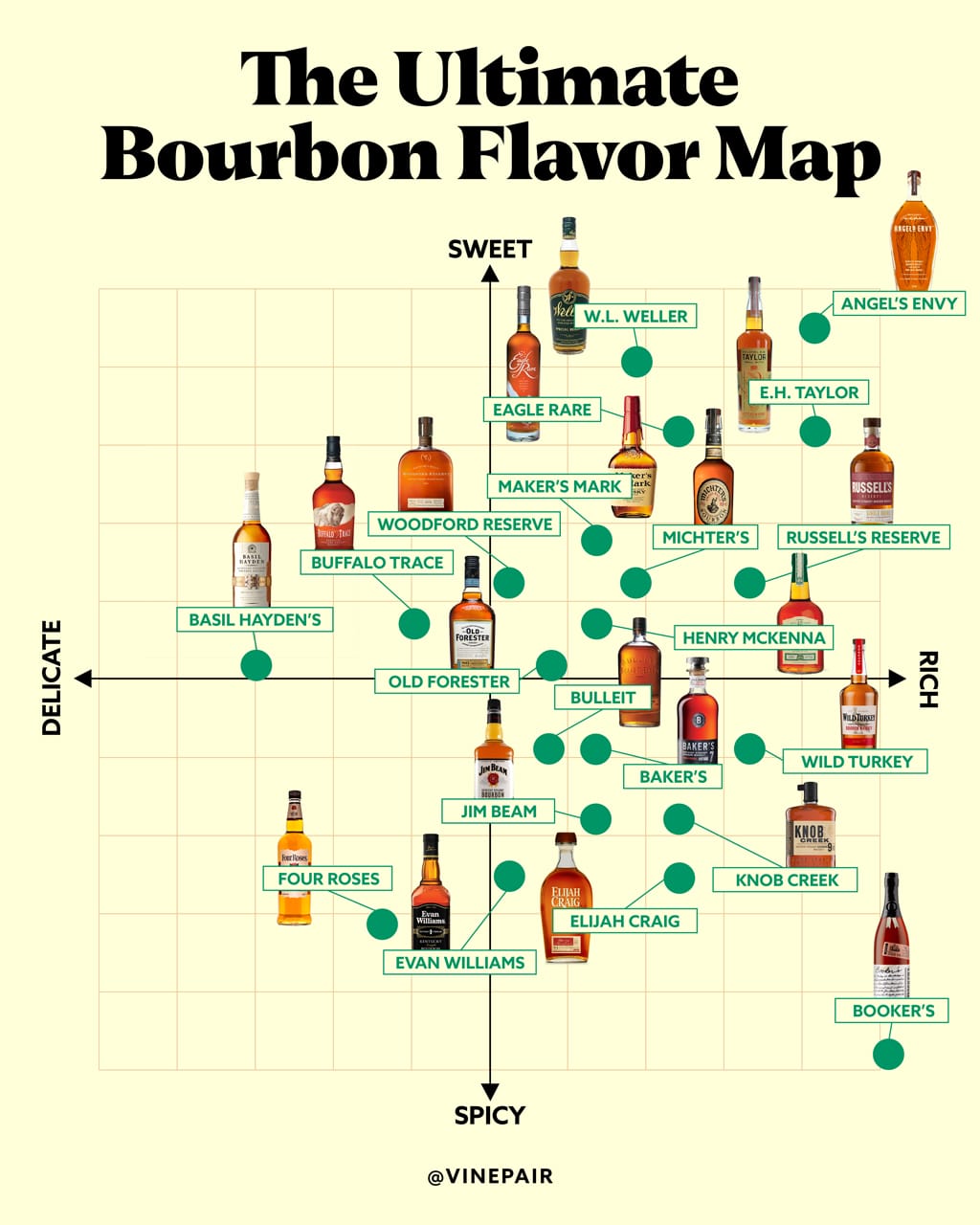
I find almost any bourbon quite drinkable. If you like your Angel's Envy or Woodford or Knob Creek or Makers Mark -- great, and I am more than happy to share them with you. If you want a recommendation, however, here are my go-to's:
Everyday bourbon, $55 at Total Wine -- Colonel EH Taylor Small Batch. Seriously if you told me that this was the only one I could drink the rest of my life, I would be fine
Pricier bourbon, $150-ish on secondary market -- Weller 12. Probably my favorite of all bourbons and much more affordable recently (several years ago it was going for $400)
Special variations of these, like the EH Taylor Single Barrel and the Weller CYPB are great and fun to compare to the base models. If you like these, you will probably like the other Buffalo Trace offerings like Eagle Rare and Blanton's as well. Blanton's definitely has the best bottle, looks great on the shelf, and everyone loves the little horse. If you are in a bar and see a nearly empty bottle of Blanton's, finishing it off in any good bar should score you the horse.
From these selections you can guess I hang out a lot in the upper left right of this map but I still enjoy things all over the spectrum.
Note: Watch for a podcast coming out soon. I am working on an outline I have tentatively called "the birth and death of a small business" covering issues across the range of small business life.
This should not have to be explained, but the Constitutional intent of the Supreme Court was not to solve social / economic / military problems -- that is the role of Congress. It's role was not to properly execute and administer these laws -- that is the role of the President's and the Cabinet departments he overseas. The Supreme Court has the important but narrow role to judge whether the law is being followed. Sometimes this requires judgement of complicated legal cases that touch on grey areas or contradictions in the law. Sometimes this is to rule on the legality of a piece of legislation itself, to judge whether it conforms to the ultimate law embodied in the US Constitution.
Unfortunately there is a growing populist theory that the Supreme Court's job is not to strictly follow the law but to act as a sort of legislature of last resort, to impose new law when Congress is deadlocked on an issue or to override "Bad" law, with "bad" defined based on the speaker's preferences.
While this theory has mainly been propounded by the Progressive Left, it increasingly is used by whatever party that occupies the White House to expand the power of the President vs other branches of government. Depending on your party, it is either totally legal for the President to unilaterally cancel all student loans but illegal to unilaterally create new tariffs -- or vice versa. Unfortunately, even the Supreme Court Justices themselves seem susceptible to this. To their credit only Barrett, Gorsuch, and Roberts were on the same side of both cases in the Supreme Court. All the six other justices switched sides -- I am sure entirely coincidently -- siding with the President in each case that most closely matched their party affiliation against the President that did not.
One would think, given how many times Trump has won of late at the Supreme Court, that he would try to reinforce their legitimacy. Sure he has lost some, but after all, if it were not for the Supreme Court overruling any number of lower court challenges and injunctions against him, most of his agenda would be totally stalled.
"The Supreme Court's ruling on tariffs is deeply disappointing, and I'm ashamed of certain members of the Court, absolutely ashamed, for not having the courage to do what's right for our country," Trump told reporters on Friday. Those "certain members," it became clear, were Justices Neil Gorsuch and Amy Coney Barrett, who had the temerity to vote against Trump even though he appointed them to the Court.
Here is Trump reinforcing the heart of the growing misconception about the role of the Supreme Court. Their job is NOT to do what is right for our country. Their job is to judge cases against the standard of the law. The law used as a yardstick may be awesome or it may be deeply flawed, but it is not the Supreme Court's job in that case to fix it. Of course, Trump cannot stop himself from ridiculous name-calling, even of (or especially of) his potential allies:
"The Supreme Court's ruling on tariffs is deeply disappointing, and I'm ashamed of certain members of the Court, absolutely ashamed, for not having the courage to do what's right for our country," Trump told reporters on Friday. Those "certain members," it became clear, were Justices Neil Gorsuch and Amy Coney Barrett, who had the temerity to vote against Trump even though he appointed them to the Court.
Apparently he believes the justices ruled against him because:
" Gorsuch and Barrett "may think they're being politically correct," he averred, but "they're very unpatriotic and disloyal to our Constitution." He suggested they were "swayed by foreign interests and a political movement that is far smaller than people would ever think."
Although the Americans who oppose Trump's agenda represent "a small movement," he said, they are "obnoxious, ignorant and loud," and "I think certain justices are afraid of that. They don't want to do the right thing. They're afraid of it."
Jacob Sullum argues that for Trump, it is all about loyalty and nothing else:
Thomas, Alito, and Kavanaugh did not agree with this particular application of the major questions doctrine. In Trump's view, that shows "their strength and wisdom and love of our country." By contrast, Gorsuch and Barrett (and presumably Roberts too) turned out to be "very unpatriotic and disloyal to our Constitution."
Those assessments have nothing to do with the merits of the justices' legal reasoning. They hinge entirely on whether the justices ultimately took Trump's side. Because Trump equates love of country with love of him, he sees any ruling against him as "unpatriotic." And because he recognizes no distinction between respecting the law and respecting him, he thinks justices are "disloyal to our Constitution" when they disagree with him.
I will not go back into my arguments about why tariffs were both a bad idea and illegally imposed. That is all here. I do have a couple of additional thoughts though:
It is absurd to call this decision unpatriotic. At some level, legal decisions should always be neutral and have little to do with patriotic feelings -- patriotism is for Congress and Presidents. But ironically, even given that, this is perhaps the most patriotic decision by the Supreme Court in recent memory. A key part of the freaking Declaration of Independence is about the arbitrary imposition of tariffs. Remember the Boston Tea Party? "[the King] has combined with others to subject us to a jurisdiction foreign to our constitution, and unacknowledged by our laws; giving his Assent to their Acts of pretended Legislation:...For cutting off our Trade with all parts of the world [and] For imposing Taxes on us without our Consent." How can there be anything more patriotic than restoring the original intent of the Declaration of Independence. Basically, the Supreme Court just threw Trump's tea in the water. God bless America.
Trump had every opportunity to impose tariffs through an entirely Constitutional avenue, ie via Congress. He did not even try. I am not sure it even occurred to Mr. "art of the deal" to try. And this is one issue (it pains me to admit) where there might have been the possibility of bipartisan agreement -- after all, Democrats have been the main supporters of tariffs over the last several decades. Bernie Sanders in particular is a huge tariff hawk. Of course instead Trump as taken the approach of mocking the Congress, even to the extent that we saw the Attorney General using childish insults against the ranking minority member of the her own key oversight committee in Congress.
Congressional gridlock on national issues that are narrowly split is a feature, not a bug. Jamming through radical agendas based on a 51-49 popular vote or legislative body advantage can be tremendously damaging -- just look at Minnesota where the Progressive Left has slammed through a quite radical agenda based on a one vote margin in their legislative chamber. There is too much impatience on this stuff -- eventually issues ripen and there tends to be a preference cascade in one direction or the other and progress is made in the legislature. End-running this process via the Executive or even worse the Supreme Court is guaranteed to make things worse.
Kudos to Gorsuch, who I have not always agreed with, but with whom I am 100% on board with on this statement from the decision:
For those who think it important for the Nation to impose more tariffs, I understand that today’s decision will be disappointing. All I can offer them is that most major decisions affecting the rights and responsibilities of the American people (including the duty to pay taxes and tariffs) are funneled through the legislative process for a reason. Yes, legislating can be hard and take time. And, yes, it can be tempting to bypass Congress when some pressing problem arises. But the deliberative nature of the legislative process was the whole point of its design. Through that process, the Nation can tap the combined wisdom of the people’s elected representatives, not just that of one faction or man. There, deliberation tempers impulse, and compromise hammers disagreements into workable solutions. And because laws must earn such broad support to survive the legislative process, they tend to endure, allowing ordinary people to plan their lives in ways they cannot when the rules shift from day to day. In all, the legislative process helps ensure each of us has a stake in the laws that govern us and in the Nation’s future. For some today, the weight of those virtues is apparent. For others, it may not seem so obvious. But if history is any guide, the tables will turn and the day will come when those disappointed by today’s result will appreciate the legislative process for the bulwark of liberty it is.
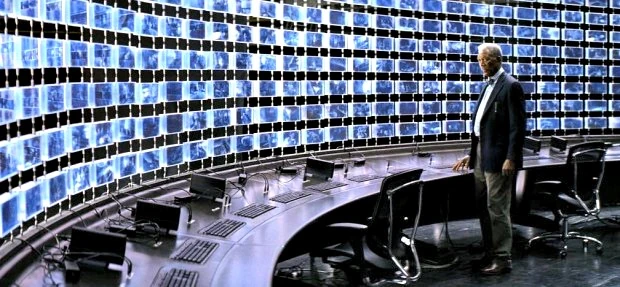
During the Superbowl there was an amazing Rorschach test masquerading as a feel-good Ring doorbell commercial. For those who missed it, find it here. Essentially it touts a new service where neighborhood networks of Ring doorbell cameras can combine with Amazon AI to find a lost dog based on an uploaded photo. Half the population reacted, "isn't that wonderful" and the other half of viewers, of whom I am one, reacted "that's freaking scary." The network of camera feeds in the commercial looks very similar to Batman's (admitted even by him) dystopian cell phone surveillance array in the Dark Knight.
This is exactly the sort of wedge strategy that our public and private control freaks use to normalize dystopian systems and technologies. You don't sell surveillance out of the gate with a system that tracks down a person in the neighborhood behind on taxes or child support. No, you sell it as a system to find that adorable lost dog (notice not even generic pets or certainly not cats because dogs are the new children for this generation**). They can fight all the backlash by saying, "Oh come on, who can be against finding lost dogs?" Then, months or years later, the terms and conditions have morphed and broader search capabilities are enabled without the user even knowing (I own a Ring doorbell and I guarantee I never knew this feature was turned on by default or even existed). When it really gets scary, they are not even going to tell you about it.
I do not believe this is just a marketing mistake -- Ring appears to have adopted neighborhood surveillance as their core business model. I have had a Ring doorbell for years and in its basic form of sending doorbell chimes to your phone and allowing you to see who is at the door and even talk to them remotely, it is a nice product. I have always liked it. But over the years I have noticed Amazon/Ring slowly morphing the app from just a doorbell / security tool into a neighborhood surveillance network. If you have the app, you can see that most of the functionality is now about messaging and notifications shared around the neighborhood, generally dominated by local Karen's putting up panicky posts about someone they saw they thought was creepy. In the main menu of the app, the very first option after a link to the dashboard is called "neighbors." This is the neighborhood watch group on steroids.
As a libertarian, what do I have against private neighborhood voluntary surveillance networks? Nothing, but this is neither voluntary nor private. As for voluntary, this functionality was added on an opt-out basis with zero notification, at least until this commercial came out. But what about privacy?
Well, I spent more time in the app yesterday than I probably had cumulatively over 5+ years. The first thing I did was turn off this advertised feature. From the main menu (the three bars in the upper left) you need to choose control center (not settings) and then scroll way down to "search party" (that is what they call it, to evoke maybe a bunch of guys with St Bernards looking for a lost hiker) and turn it off.
So while I was in the app I started trying to see if there was a way to block Amazon from sharing all this with the government or other third parties. There is an intriguing option in the control center labelled public safety which says it controls public safety agency notification settings -- maybe one can block sharing with the government? Nope. Turns out this option is just to change what police and other agencies can post to your neighborhood feed.
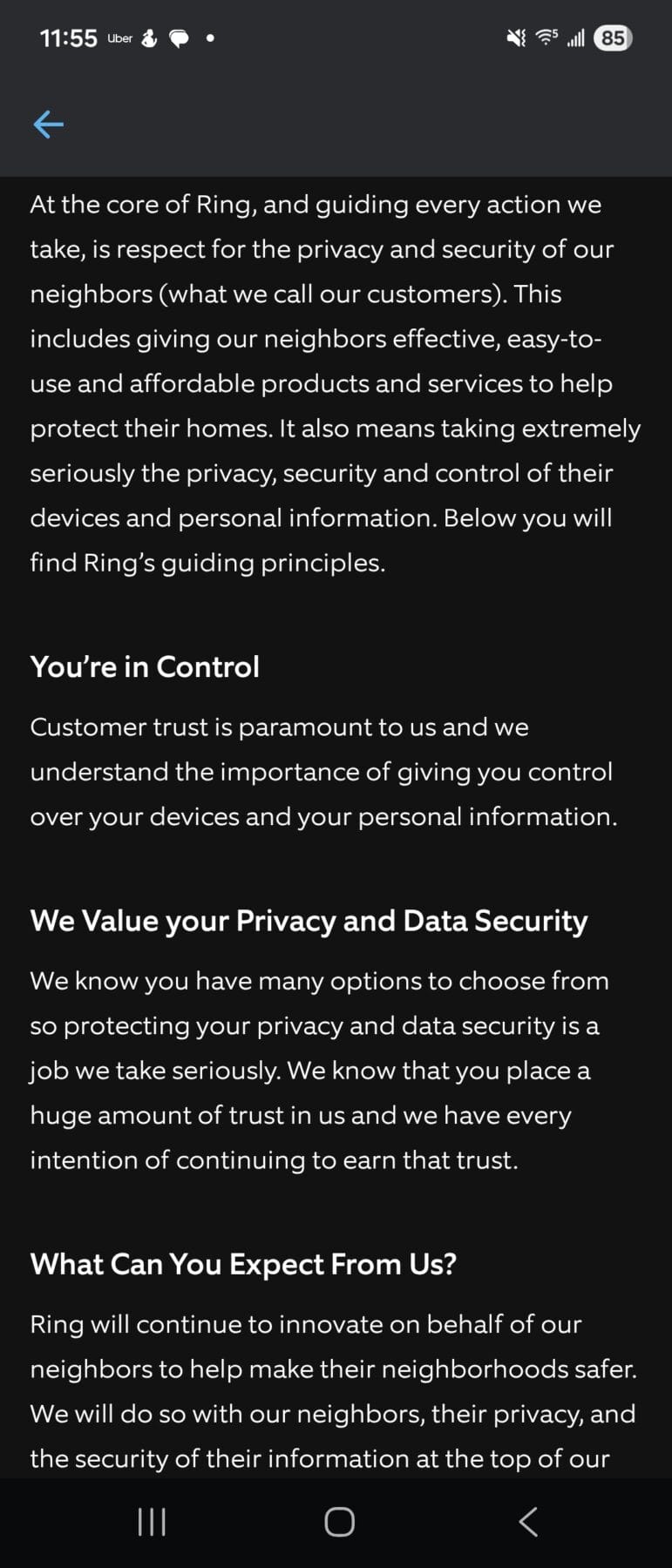
In the same control center there is a privacy tab. I clicked on that, but there are no settings. Only a promise to be really really nice and make our privacy their highest priority but no specific commitments on data privacy. Also note the use of "neighbors" over and over. It is as if they are trying to establish some right to collective privacy (whatever the f*ck that is) instead of individual privacy.
But it does say that I am in complete control so maybe there is a data sharing option somewhere else. Further down we finally get to the "data management" option. It says "Request a copy of your data, manage third-part access, or delete your data." There we go! Here is the screen you get:
This is the whole screen. Notice anything? As promised, you can download your personal data, I guess just to see what the CIA is looking at. You can delete your data, at the cost of bricking your products. But there is no actual option to manage 3rd party data access. It is promised in the privacy statement, it is promised in the menu header, but it does not exist. After an hour on their site and in the app, I still don't know who has access to my doorbell camera image.
**footnote: The other day in Orange County CA I was doing my 4 mile walk through some neighborhoods and I passed 4 young (at least relative to me) women pushing strollers. When I looked, all 4 strollers had dogs in them, not children. Some time ago someone said (sorry I can't give credit, can't remember) "dogs are the new children, plants are the new dogs." I didn't really understand that until recently but I believe it. I can't remember an airline flight I have been on that had more babies in the cabin than dogs.