Just the other day I was making the point that reimporting pharmaceuticals from other countries where they are sold cheaper is not any sort of long-term solution to bringing down US drug costs. Sure, it's frustrating that the US pays almost all of the fixed cost of drug development while other countries get these drugs closer to marginal cost. But there is no solution to this that has everyone paying marginal cost -- unless, that is, we are willing to give up on all future drug development by sending the signal that these costs can no longer be recovered in market pricing. All drug reimportation will do is raise the overseas cost of pharmaceuticals and hurt millions of poorer people.
I always find it ironic that drug reimportation is a favorite solution of many liberals, who are absolutely offended at paying higher costs in the US than what is paid in other countries. Well, welcome to being rich. You may think you are safely not-rich when you are advocating various soak-the-rich tax policies, but on an international scale, even many of America's bottom quartile would be considered well-off in poorer nations. Compared to the US, even countries like France are substantially less wealthy.
Anyway, this was all brought to mind by this useful analysis of re-importation by Megan McArdle, though in this case it is in the context of textbook prices.
My son is in Freshman econ 101, and so I have been posting him some supply and demand curve examples. Here is one for health care. The question at hand: Does government regulation including Obamacare increase access to health care? Certainly it increases access to health care insurance, but does it increase access to actual doctors? We will look at three major interventions.
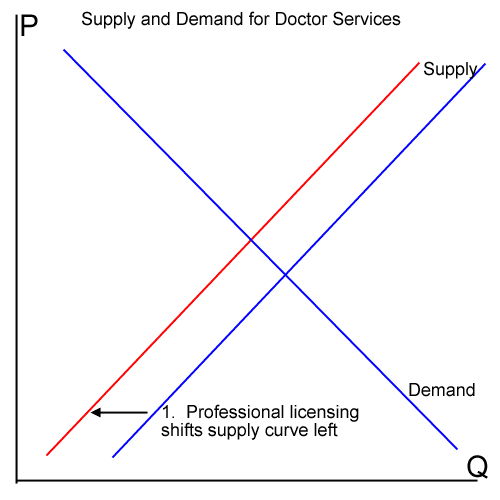
The first and oldest is the imposition of strong, time-consuming, and costly professional licensing requirements for doctors. At this point we are not arguing whether this is a good or bad thing, just portraying its inevitable effects on the supply and demand for doctors.
I don't think this requires much discussion. For any given price for doctor services, the quantity of doctor hours available is certainly going to increase as the barriers to entry to the profession are raised.
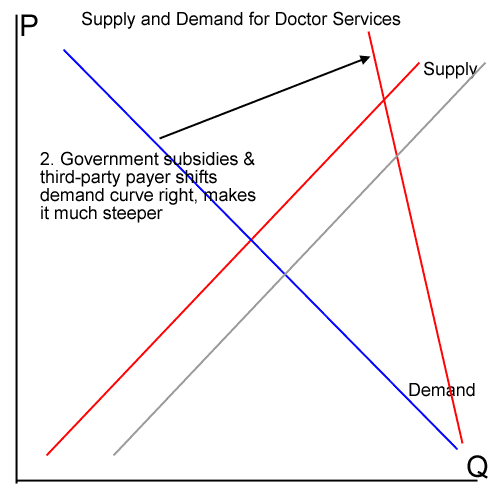
The second intervention is actually a set of interventions, the range of interventions that have encouraged single-payer low-deductible health insurance and have provided subsidies for this insurance. These interventions include historic tax preferences for employer-paid employee health insurance, Medicare, Medicaid, the subsidies in Obamacare as well as the rules in Obamacare that discourage high-deductible policies and require that everyone buy insurance rather than pay as they go. The result is a shift in the demand curve to the right, along with a shift to a more vertical demand curve (meaning people are more price-insensitive, since a third-party is paying).
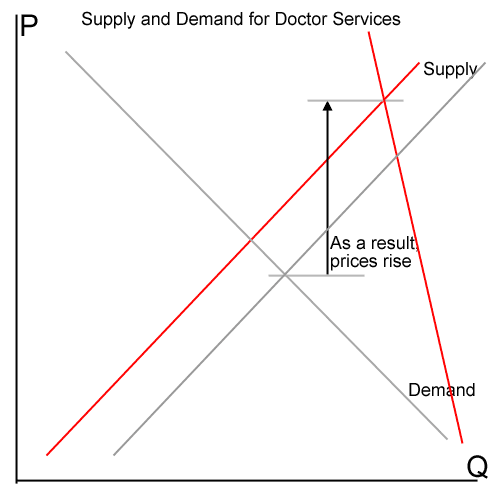
The result is a substantial rise in prices, as we have seen over the last 30 years as health care prices have risen far faster than inflation
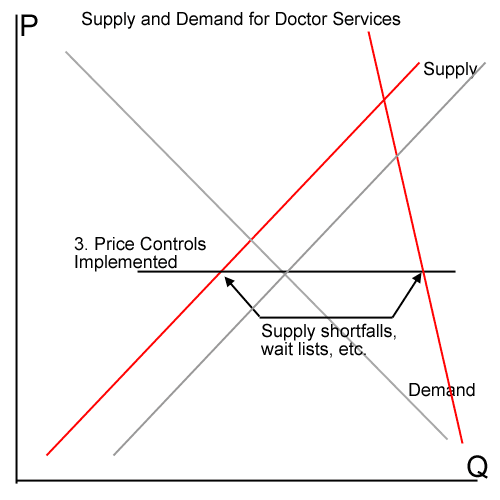
As the government pays more and more of the health care bills, this price rise leads to unsustainably high spending levels, so the government institutes price controls. Medicare has price controls (the famous "doc fix" is related to these) and Obamacare promises many more. This leads to huge doctor shortages, queues, waiting lists, etc. Exactly what we see in other state-run health care systems, The graph below posits a price cap that forces prices back to the free market rate.
So, is this better access to health care?
I know that Obamacare proponents claim that top-down government operation is going to reap all kinds of savings, thus shifting the supply curve to the right. Since this has pretty much never happened in the whole history of government operations, I discount the claim. When pressed for specifics, the ideas typically boil down to price or demand controls. Price controls we discussed. Demand controls are of the sort like "you can't get a transplant if you are over 70" or "we won't approve cancer treatments that only promise a year more life."
Most of these do not affect the chart above, since it is for doctor services and most of these cost control ideas are usually doctor intensive - more doctor time to have fewer tests, operations, drugs. But even if we expanded the viewpoint to be for all health care, it is yet to be demonstrated that the American public will even accept these restrictions. The very first one out of the box, a proposal to have fewer mamographies for women under a certain age, was abandoned in a firestorm of opposition from women's groups. In all likelihood, there will be some mish-mash of demand restrictions, determined less by science and by who (users and providers) have the best lobbying organizations.
I don't know if this is a result of the severity of the drought being overblown or of the continued improvement of farming technology, or a bit of both. Here is the recent data on 2012:
"As anticipated, lower projected production for both corn and soybeans was reported this month," said AFBF economist Todd Davis. "It will be some time before the long-term effects of the 2012 drought are fully played out. But it appears likely that continued strong worldwide demand for corn and soybeans will lead to higher projected prices."
USDA forecast corn production at 10.7 billion bushels. The average yield for corn was forecast at 122.8 bushels per acre this year, down slightly from the August prediction. Once harvest is complete, if the average corn yield comes in at 122.8 bushels per acre, it would be the smallest average yield since 2003.
I am glad I don't deal day to day with grain yield numbers, because every source I checked seems to be 3-5% off the other sources for historic numbers. There must be some definitional issues I don't understand with acres vs. net acres. But taking 2012 equal to to 2003, which is the worst-case way to interpret the above statement, we get this chart:
So, down 15-20% from the last several years, which is not good, but a number that still would be nearly an all-time high until about 2000. Even at this lower number, US yields will be more than twice the corn yield per acre in the rest of the world. Disasters are relative, I suppose, but this is a long way from the 1930's.
As I have written before, the problem with Social Security is not a mismatch of taxes and benefits - it's simply that 40 years of Congresses have spent the premiums, and now they no longer exist to pay benefits.
The problem with Medicare is actually more difficult. By these numbers, Medicare taxes are not even a third of what they need to be to pay for actual benefits. There are only two solutions that don't involve running up Federal debt: 1) Triple Medicare taxes. or 2) Cut back benefits and/or eligibility by 2/3.
Interestingly, neither party is suggesting either of these solutions, which makes all the light and noise from the Conventions totally meaningless on this issue. The Left's notion that cost control will close the gap is sheer fantasy -- already Medicare is getting an effective cross-subsidy from non-Medicare customers and price controls have gone about as far as they can. In fact, the cost mismatch above is understated as many Medicare costs (e.g. buildings, revenue collection) are actually not charged to the program but to other agencies. The Right's pitch that small cuts around the edges that Grandma won't notice at all will balance the budget are equally a fantasy.
Believe it or not, I have come around to the solution that we need to raise the Medicare tax. I would like to privatize the whole thing, and in particular see a reintroduction of individual shopping and out-of-pocket expenditure to the system. But in the interim we have to acknowledge that there is no way substantial changes to Medicare benefits or delivery is going to happen. The program remains incredibly popular, though one reason for this is that it is priced wrong. I am sure Aston-Martin sports cars would be staggeringly popular if sold for a third of their true cost. In my mind, there is nothing more dangerous to an economy than an artificially incorrect price, and Medicare prices are WAY off. We need to raise taxes to match the current benefits package, and THEN let's talk about reforming the program.
Over the last 50 years, real per capital health care spending has increased substantially. Certainly there are multiple reasons for this, but the most obvious one is seldom ever mentioned -- that the US has seen huge increases in personal wealth over this period, and unsurprisingly people choose to spend a lot of this extra wealth on their own health and life expectancy. In an age where consumerism is often derided as shallow and trivial, what could be more sensible than spending money on more and better life?
Many have pointed to the increased technological intensity of health care to explain rising costs. I suppose this could be true, though in almost every other industry in modern times, increased technological intensity has reduced rather than increased costs.
One issue that does not get enough attention is the prosaic act of shopping. I spend my own money, and I care about price. I spend someone else's money, I don't give a rip. Josh Cothran did a visualization of who is spending health care money. Just look at the 1960 and 2012 charts, and pay particular attention to the orange "out-of-pocket" number. Another way to rewrite these charts is to say consumers care about prices for spending in the orange band only.
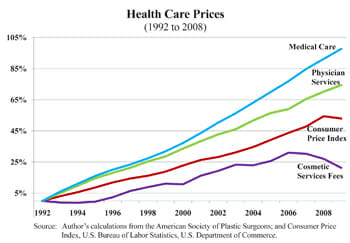
Update: Health care cost inflation. Note cosmetic surgery, a field with significant increases in technological intensity over the last few decades, but for which almost all costs are out-of-pocket
Fortunately I am not vain, so that I can still post this terrible picture of myself. I am proudly holding the government-mandated flow restrictor I just removed from my most recent shower head purchase. I don't buy any shower head until I make sure it has a removable restrictor.
The Federal laws restricting shower head flows have got to be among the dumbest on the books. Some thoughts:
Water is not equally scarce everywhere. So why is everyone required to conserve? Why is the ideal flow rate the same in Seattle as in Phoenix?
Government policy for over a century has been to promote subsidized water prices that don't reflect its true scarcity (particularly to farmers). Then, having guaranteed overuse via its pricing actions, the government then implements silly laws like this to try to offset the harm from its meddling in prices.
We have a lawn in Phoenix that needs constant watering and a pool that evaporates so fast in the summer one can almost see the water level dropping. But the state's priority is to knock of a few gallons of water use from my shower.
With the low flow shower heads, it takes me three times longer to get the soap and shampoo off of me than with a full-flow head. So we cut the water rate by half, but extend shower times by three. And this helps, how? And don't even get me started on low-flow toilets
The last three hotel rooms I have stayed in have had double shower heads, to make up the lost flow from wimpy government-approved single heads. This process of cutting back on how much a single head can flow and then adding extra heads is incredibly dumb and wasteful.
I suspect this is all secret revenge from some English expat that wanted US showers to be as bad as those in Britain.
...when they ban short-selling. As a response to economic problems, banning short selling is roughly equivalent to banning criticism of the government during a political crisis. Or perhaps more accurately, its like trying to improve poll results by not polling people with negative opinions. Short-selling has utility for the actual traders involved because it helps them achieve whatever financial or risk-management goals they might have. Short-selling has utility for the rest of us because it allows the full range of opinions to be expressed about the value of a particular company or asset. Nothing in a market economy is worse than having prices that have no meaning.
Turns out the guy who gasses up a school bus has a green job.
When Bureau of Labor Statistics Acting Commissioner John Galvin balked on what qualifies as a green job under the agency definition, Issa responded, “Just answer the question.”
“Does someone who sweeps the floor at a company that makes solar panels -- is that a green job?” Issa asked.
“Yes,” replied Galvin, who also acknowledged that a bike-repair shop clerk, a hybrid-bus driver, any school bus driver and “the guy who puts gas in a school bus” are all defined as green jobs.
He also acknowledged that an oil lobbyist, if his work is related to environmental issues, would also have a green job.
It gets better. Apparently, when I worked at the Exxon refinery in Baytown, TX, I had a green job:
The Bureau of Labor Statistics states a green job is either: a business that produces goods or provide services that benefit the environment or conserve natural resources, or a job in which a worker's duties involve making their establishment's production processes more environmentally friendly or use fewer natural resources
I have never encountered an industrial engineering job anywhere that was not concerned with having their processes use fewer natural resources.
I would argue the greenest of jobs are held by oil and other commodity speculators and traders. They ensure that prices at all times accurately match our current understanding of the scarcity of each resource. Without these accurate pricing signals, all efforts to properly invest to use more or fewer of these materials would be impossible. Just look at the "success" of investments like Solyndra that were made irregardless of these market pricing signals.
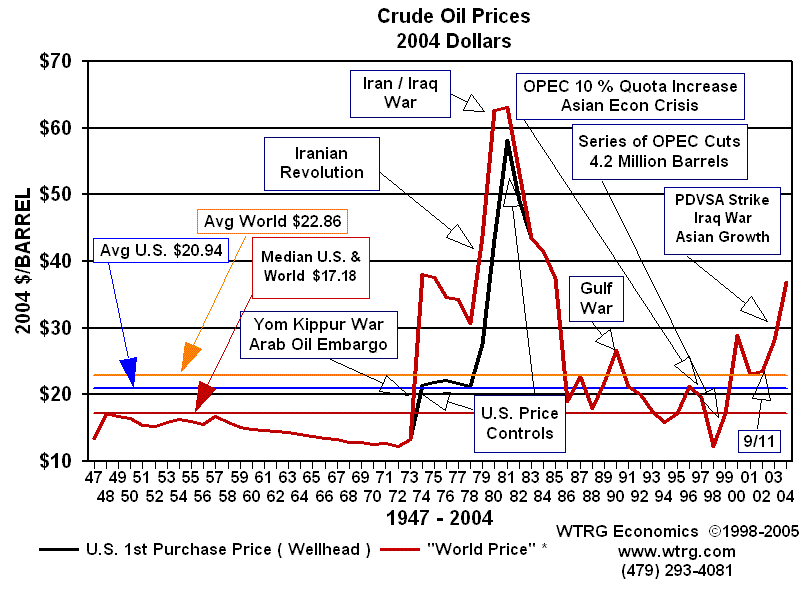
There is nothing surprising or unpredictable about the current oil boom, except perhaps how far it has gotten in the face of an Administration that has done virtually everything it can to stop it (thank god there is oil and gas under private land). Your humble scribe, neither an economist nor an expert in oil markets, wrote way back in 2005:
Everything old is new again. Back in the late 70′s, all the talk was about the world running out of oil. Everywhere you looked, "experts" were predicting that we would run out of oil. Many had us running out of oil in 1985, while the most optimistic didn’t have us running out of oil until the turn of the century. Prices at the time had spiked to about $65 a barrel (in 2004 dollars), about where they are today. Of course, it turned out that the laws of supply and demand had not been repealed, and after Reagan removed oil price controls and goofy laws like the windfall profits tax, demand and supply came back in balance, and prices actually returned to their historical norms....
Supply and demand work to close resource gaps. In fact, it has never not worked. The Cassandras of the world have predicted over the centuries that we would run out of thousands of different things. Everything from farmland to wood to tungsten have at one time or another been close to exhaustion. And you know what, these soothsayers of doom are 0-for-4153 in their predictions. ...
The vagaries of reserve accounting are very difficult for outsiders to understand. I am not an expert, but one thing I have come to understand is that reserve numbers are not like measuring the water level in a tank. There is a lot more oil in the ground than can ever be recovered, and just what percentage can be recovered depends on how much you are willing to do (and spend) to get it out. Some oil will come out under its own pressure. The next bit has to be pumped out. The next bit has to be forced out with water injection. The next bit may come out with steam or CO2 flooding. In other words, how much oil you think will be recoverable from a field, ie the reserves, depends on how much you are willing to invest, which in turn depends on prices. Over time, you will find that certain fields will have very different reserves numbers at $70 barrel oil than at $25....
All the oil doomsayers tend to define the problem as follows: Oil production from current fields using current methods and technologies will peak soon. Well, OK, but that sure defines the problem kind of narrowly. The last time oil prices were at this level ($65 in 2004 dollars), most of the oil companies and any number of startups were gearing up to start production in a variety of new technologies. I know that when I was working for Exxon in the early 80′s, they had a huge project in the works for recovering oil from oil shales and sands. Once prices when back in the tank, these projects were mothballed, but there is no reason why they won’t get restarted if oil prices stay high.
Postscript: I really need to find new topics to blog about. The adjacent article in 2005 included this, a frequent topic on this site. I had not idea I was writing about this so long ago:
When health care is paid for by public funds, politicians only need to argue that some behavior affects health, and therefore increases the state’s health care costs, to justify regulating the crap out of that behavior. Already, states have essentially nationalized the cigarette industry based on this argument.
There is only one reason to be concerned that fundraiser attendees might record the session -- because one knows the candidate is giving tailored and mutually contradictory messages to different groups. Obama has a different speech, I suppose, for the 1% than he does for the 99%. Which is no big surprise, since it is a practice as old as modern campaigning* and one I am sure both parties engage in. But it is probably a larger issue for Obama -- when so much of a politician's campaign style rests on demonizing certain groups, groups that are also large campaign contributors, it must be a tricky business tailoring his message.
* footnote: I leave this in a footnote because I don't want to be seen as breaking Godwin's law by bringing up the Nazis, but its almost impossible to talk about modern campaigning techniques in the age of mass media without mentioning them. They pioneered many of the techniques used by about everyone nowadays. One thing they did was to create focused messages for different groups -- tailors or farmers or city people or industrial workers or Catholics or whoever. They were incredibly cynical in how they did this, even by modern standards, and didn't really care what the message was, and so ended up with wildly contradictory promises, e.g. promising farmers higher prices for their produce and promising urban laborers lower food prices.
Most of you likely remember the state settlements with tobacco companies. The settlements were set up to pay states a percentage of future tobacco company earnings and sales. But just like a profligate homeowner borrowing against his paper equity in his home after housing prices increased, governments wanted to spend the money NOW, not over 20 years. So they borrowed against future settlement payments. Except that now, given lower smoking rates (incentives work) the settlement payments are less than they were forecast, and states must find a way to make up the difference and pay their creditors.
The tobacco settlement has created funky incentives for state governments form the very beginning. Formerly adversaries, the settlement effectively made large tobacco companies partners with state governments, and states have had substantial incentives to promote the business of large tobacco companies and sit on their rivals
Big tobacco was supposed to come under harsh punishment for decades of deception when it acceded to a tort settlement seven years ago. Philip Morris, R.J.Reynolds, Lorillard and Brown & Williamson agreed to pay 46 states $206 billion over 25 years. This was their punishment for burying evidence of cigarettes' health risks.
But the much-maligned tobacco giants have subtly and shrewdly turned their penance into a windfall. Using that tort settlement, the big brands have hampered tiny cut-rate rivals and raised prices with near impunity. Since the case was settled, the big four have nearly doubled wholesale cigarette prices from a national average of $1.25 a pack (not counting excise taxes) in 1998 to $2.10 now. And they have a potent partner in this scheme: state governments, which have become addicted to tort-settlement payments, now running at $6 billion a year. A key feature of the Big Tobacco-and-state-government cartel: rules that levy tort-settlement costs on upstart cigarette companies, companies that were not even in existence when the tort was being committed.
The government has found over time that it is able to sell higher taxes to the voters on certain items if they can portray those items as representing some socially unwanted behavior. These are often called "sin" taxes. The justification for the tax in its beginning is as much about behavior control as revenue generation. Taxes on cigarettes, alcoholic beverages and even gasoline and plastic grocery bags have all been justified in part by the logic that higher taxes will reduce consumption.
However, a funny thing happens on the way to the treasury. Over time, government becomes dependent on the revenue from these taxes. The government begins to suffer when the taxes have their original effect — ie reducing consumption — because then tax revenues drop. The government ultimately finds itself in the odd position of resisting consumption drops or restructuring the tax so it no longer incentivizes reduced consumption so that it can protect its tax revenue collections.
It is amazing the number of goofy ideas folks have generated to try to substitute for prices in matching supply and demand. And none of them ever work. David Zetland has a good example in the world of water, where politicians are willing to jump through just about any hoop to avoid matching water supply and demand via prices.
I am exhausted with folks who have never tried to shop for health care telling me that it can't be done, despite the fact that I do it all the time and achieve substantial savings. This is a meme developped and maintained solely to support government power by declaring that there is a market failure in the pricing mechanics in the health care industry that can only be solved through regulation and price controls. I wrote in response
I agree that the pricing in health care is often arbitrary and capricious. Of course some suppliers are going to try to soak third party payers. But I don't think simply changing the payer (from private to public) or having a government bureaucracy set prices for millions of line items is the solution. My diagnosis is that health care lacks the one thing we have for most every other product or service: shopping.
Now, you try to head off this argument with a few folks who claim shopping is impossible in health care. But that is absurd. There is a large and growing community of us who have real health insurance, rather than pre-paid medical plans, which means we have high deductibles. We pay all of our regular expenses out of pocket, and maintain health insurance for large, unpredictable, potentially bankrupting expenses.
I must admit that shopping for health care seemed odd and a bit intimidating at first, having lived for years in the world of gold-plated, pay-for-everything corporate health care accounts. But it really is not that hard. I have consistently knocked down the cost of everything from x-rays for my kids' fractures to colonoscopies by a half to two-thirds. I am now used to doctors and providers having that second price book under the counter they go to if they know you don't have a third-party payer they can soak. We always research and ask for generics. We think twice before accepting the need for an expensive test, like a MRI, and price shop it if we have to have one. I push back on my dentist who tries to x-ray my teeth every few months. I have many friends that saved a ton of money on oncology treatments by just doing a little shopping.
I am exhausted with academics and writers who have never tried to shop for health care telling me it is impossible. Many of us do it, and there are more and more resources out there for us. Sure, there are certain things I am not going to have the time or ability to price shop -- if I am lying on my back having a heart attack, my wife (hopefully) is not going to check rates at the hospitals. But it is a fraud to extrapolate from this minority of health care situations to all health care expenditures.
The other argument is used is that at the beginning of a health care interaction we may not know exactly what care is needed. So what? The same is true of auto repair, but I don't blithely allow the repairs to proceed at any cost just because I didn't know up front what the diagnosis would be. I get an estimate when each new problem is found, and I have on several occasions interrupted a car repair, told them their price was too high on certain repairs, and went elsewhere for the repair or deferred it entirely.
Let's suppose there is some sort of market failure for 10-20% of health care charges where price shopping is impossible. Then let's discuss government regulatory approaches for those situations. But for the other 80-90%, we should be structuring a health care system where consumers provide the price regulation, as they do in nearly every other industry, by shopping.
As a note, some people are exhausted by the idea of shopping. My first response is, so what? Get over it. We are not going to take over a whole industry just to free you from a bit of hassle. The second response is that research shows that only a small percentage of buyers need to be price shoppers to enforce price discipline. I generally trust that Amazon has low prices and don't always check them, because I know there are much, much more rabid people who do care and do check.
Over time, I have found physicians who are both sympathetic and cooperative with this approach and actively help us minimize the cost of our care. Its just amazing -- somehow we accept this image as a doctor being above all this cost stuff, in fact with considerations of price and cost being corrupting to their mission of keeping us healthy. Imagine a car mechanic that took that attitude -- "I'm the expert here and you will pay whatever it costs to do what I say you need to do." Would you fire the mechanic and find a better and cheaper one, or would you suggest that what we really need is a massive new government bureaucracy to set prices for every imaginable repair a car might need.
Sometimes I suspect much of the support for government health care is from people who see shopping and taking responsibility for their own care as too much of a hassle.
This is terrific, if true. My fear, of course, is they are getting subsidized through a back door somewhere, but if they really think they can make subsidy-free solar work financially, that's awesome:
Two German solar energy developers are planning to build photovoltaic plants in southern Spain that will earn a return without government subsidies.
Wuerth Solar GmbH & Co. intends to build a 287-megawatt plant in the Murcia area for 277 million euros ($363 million), according to the regional authority. Gehrlicher Solar AG said it plans to develop a 250-megawatt solar park in the Extremadura region for about 250 million euros.
The projects, about three times larger than any European solar plant, may be the first that don’t rely on feed-in tariffs and compete with wholesale power prices. All plants in the region so far depend on fixed premium rates for solar power, which can be several times higher than wholesale prices.
Spain suspended the tariffs on Jan. 27 as part of government austerity measures, threatening the survival of the industry. Tariffs for large-scale solar were set at 121 euros per megawatt-hour. Developers now look to build plants without this support, helped by falling equipment prices.
It would be impossible to trace all the ways taxpayer money ends up in the coffers of solar manufacturers like First Solar. Most of First Solar's money has been made selling panels in Germany to solar plants that, by law, can rape electricity customers with prices 10-15x higher than the market price for electricity. First Solar also benefits more directly from direct subsidies, loan guarantees, "retraining" subsidies and even government Ex-Im Bank loans to sell panels to itself. While First Solar vehemently denies it is a subsidy whore, it is telling that when Germany began to cut its solar feed-in tariffs, First Solar's stock price fell from over $300 to around $20. Just watch day to day trading of First Solar stock, it does not move on news about its efficiency or productivity, it moves on rumors of changes in government subsidies.
Let's look at one subsidy. In 2010, the Obama administration gave First Solar a subsidy of $16.3 million, ostensibly to help open a new plant in Ohio. But it is interesting that this private company, which apparently could only raise the $16.3 million it needed by taking it by force from taxpayers, had plenty of money to pay its CEO. In the 13 months leading up to its $16.3 million taken from taxpayers, First Solar paid its new CEO $29.85 million!
Rob Gillette, the ousted CEO of First Solar Inc., earned more than $32 million in compensation from the struggling company for his two years of service, according to a regulatory filing Wednesday.
Gillette came to First Solar from Phoenix-based Honeywell Aerospace in October 2009 and was fired by the Tempe-based solar company's board of directors in October 2011....
Most of his compensation came in the three months of 2009 that he worked, when his total compensation, including salary, bonus, stock and options awards and other perks, reached $16.55 million. In 2010 his total compensation was $13.3 million, and last year he earned $2.46 million, which consisted of $763,000 in base salary and a $1.7 million severance.
Yep, they can't scrape up $16.3 million of their own money for a factory but they can find $30 million to give to an unproven CEO they eventually had to ride out on a rail.
By the way, I don't know Mr. Gillette, but I was once an executive at Honeywell Aerospace for several years. I can tell you that it's a great place to find an executive who is focused on process to manage large complex organizations in a relatively stable business where manufacturing, logistics, and schmoozing large buyers is important. It is a terrible, awful place to seek an executive for a fast growing business that needs to rapidly shift business strategies and where grinding through the process gets the wrong answer 12 months too late.
Another solar company which received $2.1 billion in loan guarantees from the Obama Administration has gone bankrupt. The good news is that it has not spent much of that taxpayer money, and its bankruptcy is probably due more to the bankruptcy of its German parent, which in turn is likely related to the huge cuts Germany has made in its feed-in tariff subsidies.
The big asset possessed by Solar Trust is the Blythe solar project, a planned 1000MW facility that apparently has all of its permitting in place. The Blythe facility was originally going to be a solar-thermal facility, with adjustable mirrors focusing the sun on a central boiler that would in turn power turbines. This plan was scrapped last year in favor of a more traditional PV technology, and I know local company First Solar has been hoping to save itself by getting the panel deal (First Solar also has been hammered by the loss of German subsidies).
If we take the cost of this planned 1000MW facility as the stated $2.8 billion (of which 2.1 billion would be guaranteed by US taxpayers), we see the basic problem with solar. A new 1000MW natural gas powered electric plant costs no more than about $1 billion. It produces electricity 24 hours a day. This solar plant, to be the largest in the world, would produce 1000 MW for only a few hours of the day. That area of desert gets about 7 peak sun hours per day (the best in the country) so that on a 24 hour basis it only produces 292 MW average. This gives it a total capital cost per 1000 MW of $9.6 billion, making it approximately 10 times costlier than the natural gas plant to build. Of course, the solar plant has no fuel costs over time, but solar is never able to close the gap over time, particularly with current very low natural gas prices.
Update:Apparently the $2.8 billion was just for the initial 484 MW so you can double all the solar costs in the analysis above, making the plant about 20x costlier than a natural gas plant.
My Forbes article is up for this week, and discusses 10 reasons why legislation frequently fails. A buffet of Austrian economics, Bastiat, and public choice theory that I wrote for the high school economics class I teach each year.
Here is an example:
3. Overriding Price Signals
The importance of prices is frequently underestimated. Prices are the primary means by which literally billions of people (most of whom will never meet or even know of each others' existence) coordinate their actions, without any top-down planning. With rising oil prices, for example, consumers around the world are telling oil companies: "Go find more!"
For a business person, prices (of raw materials, labor, their products, and competitive products) are his or her primary navigation system, like the compass of an explorer or the GPS of a ship. And just as disaster could well result from corrupting the readings of the explorer's compass while he is trekking across the Amazon, so too economic damage can result from government overriding price signals in the market. Messing with the pricing mechanisms of markets turns the economy into a hall of mirrors that is almost impossible to navigate. For example:
In the best case, corrupting market prices tends to result in gluts or shortages of individual products. For example, price floors on labor (minimum wages) have created a huge glut of young and unskilled workers unable to find work. On the other side, in the 1970s, caps on oil prices resulted in huge shortages in the US and those famous lines at gas stations. These shortages and gas lines were repeated several times in the 1970's, but never have returned since the price caps were phased out.
In the worst case, overriding market price mechanisms can create enormous problems for the entire economy. For example, it is quite likely that the artificially low interest rates promoted by the Federal Reserve over the last decade and higher housing prices driven by a myriad of US laws, organizations, and tax subsidies helped to drive the recent housing and financial bubble and subsequent crash. Many will counter that it was the exuberance of private bankers that drove the bubble, but many bankers were like ship captains who drove their ships onto the rocks because their GPS signal had been altered
Last week I was in Albuquerque several hours early for my meeting in Santa Fe. Several years ago I had written about the Railrunner passenger rail line that operates from south of Albuquerque north to Santa Fe. Our Arizona Republic had written a relentlessly positive article about the line, focusing on how much the people who rode on it loved it. Given that the picture they included in the article showed a young woman riding in a nearly empty car, I suspected that while the trains themselves might be nice for riders, the service probably wasn't a very good deal for taxpayers.
Of course, as is typical, the Republic article had absolutely no information on costs or revenues, as for some reason the media has adopted an attitude that such things don't matter for rail projects -- all that matters is finding a few people to interview who "like it." So I attempted to run some numbers based on some guesses from other similar rail lines, and made an educated guess that it had revenues of about $1.8 million and operating costs of at least $20 million, excluding capital charges. I got a lot of grief for making up numbers -- surely it could not be that bad. Hang on for a few paragraphs, because we are going to see that its actually worse.
Anyway, I was in Albuquerque and thought I would ride the train to Santa Fe. I had meetings at some government offices there, and it turns out that the government officials who spent the state's money on this project were careful to make sure the train stopped outside of their own workplaces. I posited in my original article that every rider's trip was about 90% subsidized by New Mexico taxpayers, so I might as well get my subsidy.
Well, it turned out I missed my chance. Apparently, trains do not run during much of the day, and all I saw between 9:30AM and 4:00 PM was trains just parked on the tracks. I thought maybe it was a holiday thing because it was President's Day but their web site said it was a regular schedule. I caught the shot below of one of the trains sitting at the Santa Fe station.
Anyway, I got interested in checking back on the line to see how it was doing. I actually respected them somewhat for not running mid-day trains that would lose money, but my guess is that only running a few trains a day made the initial capital costs of the line unsustainable. After all, high fixed cost projects like rail require that one run the hell out of them to cover the original capital costs.
As it turns out, I no longer have to guess at revenues and expenses, they now seem to have crept into the public domain. Here is a recent article from the Albuquerque Journal. Initially, my eye was attracted to an excerpt that said the line was $4 million in the black. Wow! Let's read more
New Mexico Rail Runner Express officials said Wednesday the railroad will receive an additional $4.8 million in federal funding this year that puts the operating budget more than $4 million in the black.
The injection of new money boosts Rail Runner’s revenues this year to $28 million, well in excess of expected operating costs of $23.6 million, said Terry Doyle, transportation director of the Mid Region Council of Governments, which oversees Rail Runner.
OK, I am not sure why the Feds are putting up money to cover the operating costs of local rail lines in New Mexico, but still, this seems encouraging. This implies that even without the Fed money, the line was withing $800,000 of breaking even, which would make it impressive indeed among passenger rail lines. But wait, I read further down:
The announcement comes as state lawmakers debate a measure that would require counties with access to the Belen-to-Santa Fe passenger railroad to pay for any deficit in Rail Runner’s operations with local taxes. Currently, almost half its revenues, $13 million, comes from local sales taxes.
Oops, looking worse. Now it looks like taxes are covering over half the rail's costs. But this implies that perhaps $10 million might be coming from users, right? Nope, keep reading all the way down to paragraph 11
The Rail Runner collects about $3.2 million a year in fares and has an annual operating budget of about $23.6 million. That does not include about $41.7 million a year in debt service on the bonds — a figure that include eventual balloon payments.
So it turns out that I was actually pretty close, particularly since my guess was four years ago and they have had some ridership increases and fare increases since.
At the end of the day, riders are paying $3.2 million of the total $65.3 million annual cost. Again, I repeat my reaction from four years ago to hearing that riders really loved the train. Of course they do -- taxpayers (read: non-riders) are subsidizing 95.1% of the service they get. I wonder if they paid the full cost of the train ride -- ie if their ticket prices were increased 20x -- how they would feel about the service?
Of course, the Railrunner folks are right on the case. They have just raised prices, which "could" generate $600,000 in extra revenue, assuming there is no loss in ridership from the fare increases (meaning assuming the laws of supply and demand do no operate correctly). If this fare increase is as successful as planned, they will have boldly reduced the public subsidy to just 94.2% of the cost of each trip.
By the way, it is interesting to note in this Wikipedia article (Wikipedia articles on government rail projects generally read like press releases) that ridership on this line dropped by over half when the service went from free to paid (ie when the government subsidy dropped from 100% to 95%). The line carries around 2000 round-trip passengers (ie number of boarding divided by two) a day. It is simply incredible that a state can directly lavish $60 million a year in taxpayer money on just 2000 mostly middle class citizens. That equates to a subsidy of $30,000 per rider per year, enough to buy every daily round trip rider a new Prius and the gas to run it every single year.
Postscript:This person seems to get it. One thing I had not realized, the trip from Albuquerque to Santa Fe that I did in my rental car in 60 minutes takes 90 minutes by "high-speed rail".
Yesterday, Congress agreed to extend the payroll tax reductions for another period of time. I have been thinking about this for a while, and I am slowly coming to the conclusion these taxes should be raised. I am still thinking this through so I welcome feedback.
I don't think I have to convince regular readers of this site that I am against government-run and mandated-for-all retirement funds (income via Social Security, medical via Medicare). But if we are going to have such programs, and maintain the pretense that they are insurance programs and not welfare/transfer programs, then the "premiums" we are forced to pay should reflect true costs.
I don't think Medicare premiums are covering anywhere near the actuarial-expected costs of one's future medical care. And while Social Security rates may be set correctly if trust funds were truly held securely, the fact of the matter is that past Social Security premiums that were paid to support future benefits have all been spent by a corrupt Congress. Rates are going to have to be raised to replace this theft.
I don't like raising taxes. I wish these two programs would go away or else be restructured drastically. If they exist, though, there is nothing more dangerous than an incorrect price. Prices help consumers make price-value tradeoffs -- the Keanu Reeves lifetime DVD collection may be a deal at $6.99 but not at $99.99. So charging the wrong prices for these programs not only royally screws up the government's finances, but it also misleads Americans about the value of these programs in comparison to what they pay for them.
I have said for quite a while that despite all the hand-waving about efficiency and electronic records and other BS (efficiency from owner of the Post Office?) the only two cost reduction tools that state-run health care have are 1) Price Controls and 2) Rationing. This has become clear yet again in California. Allocation of scarce resource by bureaucratic fiat has NEVER worked, not only leading to mis-allocations but generally reducing the size of the pie to be allocated in the process. The only solution is returning health care to a world (that most every other product and service is in) where consumers have the incentive to shop and make price-value tradeoffs for themselves using prices set by the free operations of supply and demand.
This could have also been labelled as from the files of "anti-trust is not about consumers." Apparently, a mapmaker in France has successfully sued and won damages from Google for unfair competition, ie from providing Google Maps for free.
Just as in the Microsoft anti-trust case and just about every anti-trust case in history, companies who brought the suit are really trying to stop an up-start competitor from trashing their business model, but they have to couch this true concern in mumbled words about the consumer. Specifically, they raise that ever-popular boogeyman of jacking up prices once the monopoly is secured. The next time this happens, of course, will be the first time. Its a myth. For example, in Google's case, left unsaid is how they would jack up their prices when at least two other companies (Bing, Mapquest) also provide mapping services online for free.
Food activists on the Left often point to the use of High Fructose Corn Syrup (HFCS) as one of those failures of capitalism, where rapacious capitalists make money serving an inferior product. But HFCS resulted from a scramble by food and beverage companies to find some reasonable alternative to sugar as the government has driven up sugar prices through a crazy tariff system that benefits just a tiny handful of Americans, and costs everyone else money
For the last 10 years or so, HFCS-42 has actually traded at a price higher than the world market price for sugur, but lower than the US price for sugar. There is a lot complexity to prices, but this seems to imply that HFCS would not be nearly as attractive a substitute for sugar if US sugar tariffs did not exist (not to mention subsidies of corn which support HFCS). This can also be seen in the fact that HFCS has not been used nearly so often as a sugar substitute in markets outside of the US, even by the same manufacturers (like Coke) that pioneered its use in the US.
President Obama used a lot of his state of the union address again teeing up what sounded to me like a new round of protectionism. Protectionism is the worst form of crony capitalism, generally benefiting a handful of producers and their employee to the detriment of 300 million US consumers and any number of companies that use the protected product as an input.
But the portion that really floored me was Obama’s taking credit for the increase in US oil and gas production over the last several years. It is certainly true that, against all predictions of peak oil, new technologies have helped drive a surge in US hydrocarbon production. Combined with a recession-driven drop in demand, America’s oil imports as a percentage of its total use has dropped to 45.6%, the lowest level in over 15 years.
This surge in energy production is a fabulous reminder of how markets work. For years I have written that the peak oil folks were missing something fundamental by performing an overly static analysis. They looked at current “proven” reserves of oil and gas and projected forward how many years it would take for these to run out. But oil and gas reserve numbers only make sense in the context of a particular set of technologies and pricing levels. As hydrocarbons run short, rising prices tend to spur both innovation and new, more expensive exploration activity. Oil and gas companies are once again proving Julian Simon’s addage that the only true scarcity is human brain power, and they should be given a lot of credit for the recent production boom.
The one person who deserves no credit for this boom is Barack Obama....
The 5-year old transcripts of Federal Reserve Board meetings . Bernanke & Geithner basically yawn at concerns raised about housing prices and mortgages.
Let's be clear. Unlike most of those who are likely commenting on this, I do NOT blame these folks for being wrong about the direction of the incredibly complex economy, and how one or two factors might influence the whole. My sense has always been that it is impossible to be consistently right.
What I do criticize is the hubris of making major top-down Federal policy decisions that require that these folks be consistently right. It's simply madness, and I am exhausted with the continuing reaction of both the media and most politicians that if we only had the right folks making these decisions, all would be well. The reality is that these decisions are impossible to make, and will virtually always lead to gross mis-allocations of capital and resources in the economy that lead to recessions.
Update: Here is one example
JUNE 28-29: In summarizing Fed officials’ views, Bernanke notes how it’s getting more and more difficult to make forecasts, describing the economic situation as “exceptionally complicated.†Since housing is particularly hard to project, Bernanke calls it “an important risk and one that should lead us to be cautious in our policy decisions.â€
So, this seems like an admirable statement of humility. Given these remarks, the group did nothing, right? Of course not ... they raised interest rates a quarter of a point.