Posts tagged ‘US’

We Just Don't Have Enough Taxes

I propose a survey.  We will ask 500 CEO's of large company's and 500 small business owners just one question

1.  Do you agree/disagree with the following statement:  In order to make my business more competitive in international markets, the federal government needs to raise taxes and expand its scope

How many out of the 1000 would answer "Agree?"  Well, at least the number won't be zero, as long as you ask the NY Times:

"¦the taxes collected last year by federal, state and local governments in the
United States amounted to 28.2 percent of gross domestic product. That
rate was one of the lowest among wealthy countries - about five
percentage points of GDP lower than Canada's, and more than eight
points lower than New Zealand's. "¦the meager tax take leaves the United
States ill prepared to compete. From universal health insurance to
decent unemployment insurance, other rich nations provide their
citizens benefits that the U.S. government simply cannot afford.
"¦revenue will prove too low to face the challenges ahead.

I love the part about unemployment insurance particularly -- other countries are more competitive than we are because they pay their citizens more not to work.  Huh?  Daniel Mitchel responds:

The editorial conveniently forgets to explain, though, how America is
less competitive because of supposedly inadequate taxation. Is it that
our per capita GDP is lower than our higher-taxed neighbors in Europe?
No, America's per capita GDP is considerably higher. Is it that our disposable income is lower? It turns out that Americans enjoy a huge advantage in this measure. Is our economy not keeping pace? Interesting thought, but America's been out-performing Europe for a long time. Could higher rates of unemployment be a sign of American weakness? Nice theory, but the data show better job numbers in the United States.

I also would point out the general direction of net immigration, which has always been towards the US from nearly every country in the world rather than the other direction.

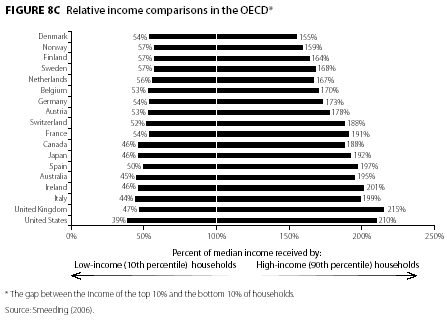
The favorite argument du jour for more taxes is that the US has more income inequality than other countries.  Well, that is sort of true.  Our rich are richer than theirs.  But are our poor poorer?  In fact, as I posted here, the data (from a liberal think tank) shows that they are not.   The poor in European countries have a higher percentage of a lower median wage.  When you normalize European income distribution numbers to percentages of the US median wage, you can see our poor do at least as well as those in Europe, while our middle class and rich do better.

Study2

The US poor still trail countries like Switzerland, but that is because of very different immigration realities.  The US numbers for the bottom quartile are weighed down by tens of millions of recent immigrants (both legal and not) whereas those of Switzerland and Norway are not.  If you left out recent immigrants, my guess is that the US poor would be the richest in the world.

The Patented NY Times Sneer

Yesterday, I talked about my fondness for private conservation projects.  Today, the NY Times makes it clear that they are not so fond of private conservation.  In an article about environmentalist-triggered death of logging in the west, the Times observes that many rich folks are taking up the opportunity to buy large tracts of western forests for second homes and ranches.

William P. Foley II pointed to the mountain. Owns it, mostly. A timber
company began logging in view of his front yard a few years back. He
thought they were cutting too much, so he bought the land.

Mr. Foley belongs to a new wave of investors and landowners across the
West who are snapping up open spaces as private playgrounds on the
borders of national parks and national forests.

Cool, a win-win -- conservation without use of tax funds or government coersion.  But instead of being thrilled, the Times adopts their patented sneering tone they use with anything having to do with wealth.

The rise of a new landed gentry in the West is partly another
expression of gilded age economics in America; the super-wealthy elite
wades ashore where it will.

Hmm, I would have thought it an example of how increases in wealth in the US has always driven higher environmental standards and more conservation.  The NY Times tries to portray this as something like turning national parks into sprawling suburbs, lamenting the "increase in density," but this is just a joke and a product of a bunch of New Yorkers who have never really spent time in Montana.  There is zero danger of any kind of urbanization here, and their very story belies this fact when it talks about 640 acre lot sizes. 

The real problem for them seems to be one of access, and they lament that these new owners tend to put up no trespassing signs rather than allowing public access as private loggers used to.  But in so arguing, the Times is trying to have it both ways.  Eliminating recreation access from western lands is a HUGE priority for environmentalists.  In fact, though many in America don't know it, within a few decades it may be impossible to drive into national parks like Yellowstone and Yosemite.  I know and work with the management of the National Parks, and many of their leaders do not consider their job finished until they get all the visitors out of the parks.  So throwing up no trespassing signs to recreators is exactly what environmentalists want on these lands.  What they don't like, because many are openly socialist, is private ownership of these lands.  They know that increasingly, because they have gotten so good at filing lawsuits and forcing public lands officials to do their bidding, that public ownership means, effectively, ownership by the environmental groups. 

Al Gore and the Peace Prize

Several readers have asked for my comment.  This is what I posted over at Climate Skeptic:

This
morning I was all fired up to write something petty, like "Al Gore now
has made the same contributions to peace as have previous winners
Yassir Arafat and Henry Kissinger."  Later, I considered a long and
drawn out post on the inaccuracies of "An Inconvinient Truth", but I
really have already done that in long form here and in short form here.
In truth, the Peace prize process has for years been about a group of
leftish statists making a statement, and often it has been about
tweaking the US, rather than a dispassionate analysis of true
contributions to peace made with the benefit of some historic distance
(as is done with the scientific prizes).  Further, most folks I argue
with don't really care about the specific inacuracies in Gore's movie,
their response typically being something in the "fake but accurate"
line of reasoning.

So instead I will say what I told a reader by email a few hours
ago.  I tend to be optimistic about the world, and believe that we are
approaching a high water mark (so to speak) for the climate
catastrophists, where we will look back and see their influence peak
and start unwinding under the presure of science and the reality of the
enormous cost to abate CO2.  Gore's Peace prize, in the same year as
his Oscar and that global warming music festival no one can even
remember the name of 3 months later, feels to me like it may be that
high water mark.   The Peace Prize certainly was the high water mark
for Jimmy Carter's credibility, not to mention that of Henry Kissinger
and a myriad of others.  Think of it this way -- if the guys who made
the peace prize decisions were investors, and you knew what they were
investing in, you would sell short.  Seriously, just look at the
group.  Well, they just invested in Al Gore.

Update:  One thing many commenters have not pointed
out is that Al Gore is really manuevering the US and China and India
(and the rest of the developping world) into a position that, if he has
his way, conflict is going to occur over who gets to grow and develop,
and who does not.  CO2 catastrophism has the ablility to be the single
most destabalizing issue of the 21st century. This is peace?

Money Laying on the Sidewalk

For years I had some kind of corporate health plan.  When I started my own business, I bought a Blue Cross plan that roughly mirrored the corporate health plan I used to have -- very low deductible, lots of coverage.  And it had very high premiums. 

So I finally got serious and went out and did something 99% of Americans never do or never have to do:  I went out and really researched my health care options.  And what I found was that to raise our family's deductible from $500 a year to $2000 a year would save me over $3000 a year in premiums.  In fact, if I switched plans, I would get just as high of a maximum payout and I would get a better gaurantee on future pricing and a commitment never to drop my coverage from a large, well-rated insurance company.

There's an old joke about an economist and another fellow walking down the street.  There was a $10 bill laying on the ground, but the economist just walked right past it.  The other fellow said "what are you doing, you just passed up $10."  And the economist replied "It can't be a real $10 bill, because in an efficient market someone would have already picked it up."

That was my reaction to my health care options.  I asked my broker, "you mean that if I increase my deductible $1500 I can save $3000 a year?  Even in a worst case year I am better off, and in a healthy year I am MUCH better off."  He replied "Yep."  I asked, "But why doesn't everyone do this?"  He just shrugged.  As my Harvard investment management professor used to say, as he wrote up a market situation on the chalkboard to begin each class, either this is an opportunity, of there is something we don't understand.  As I have gained more experience with my new health plan, I have become convinced it is the former.

McQ over at Q&O
has a great post on insurance vs. insulation.  I won't quote it all, but it is well worth your read.  Towards the end, he quotes John Stoessel on my particular conundrum:

But people are so conditioned to expect others to pay their medical
bills that they hate high deductibles: They feel ripped off if they
must pay a thousand dollars before the insurance company starts paying.

But high deductibles may be the key to lowering costs and putting you in charge of your health care.

I am absolutely convinced that the best possible step for US health care is to expose more users to the market and price-value trade offs, while providing high-deductible insurance that shelters people from bankrupting unusual events.  More here, here, and here.

A Thought On Defending the Right of Commerce

From the Associated Press:

The U.S. Supreme Court declined Monday to hear a challenge to
Alabama's ban on the sale of sex toys, ending a nine-year legal battle
and sending a warning to store owners to clean off their shelves.

An adult-store owner had asked the justices to throw out the law as
an unconstitutional intrusion into the privacy of the bedroom. But the
Supreme Court declined to hear the appeal, leaving intact a lower court
ruling that upheld the law.

Sherri Williams, owner of Pleasures stores in Huntsville and
Decatur, said she was disappointed, but plans to sue again on First
Amendment free speech grounds.

"My motto has been they are going to have to pry this vibrator from my cold, dead hand. I refuse to give up," she said.

The appeals court made this distinction:

Williams had asked the Supreme Court to review a decision by the
11th U.S. Circuit Court of Appeals that found Alabama's law was not
affected by a U.S. Supreme Court decision knocking down Texas' sodomy
law.

The
Texas sodomy law involved private conduct, while the Alabama law
regulated commercial activity, the appeals court judges said. Public
morality was an insufficient government interest in the Texas case but
was sufficient in the Alabama case, they said.

Now, I don't in any way shape or form see any differences between "private conduct" and "commerce."  How in the hell can sexual decisions between consenting adults be any different, legally, than commercial transactions between consenting adults.  It is a distinction that socialists have been succesful in introducing in the US, and to which many now cling.

The interesting part is to consider the folks who are fighting the sex toy ban.  My wild guess, which may be off the mark, is that this is not a bunch of Christian conservative Republicans.  My guess is that these folks are probably a bit left of center, and further, that many of them accept and support the notion that the government has every right to regulate dirty old commerce, but no right to regulate one's "private life."  Well, maybe now it will be clearer, at least to some, how dangerous this distinction is.   As a parting note, it has been two years now since we saw the irony of left-leaning members of the Supreme Court overrule state laws allowing medical marijuana use based on the commerce clause.

But No One Shops for Health Care

For a while, I have been trying to highlight that the real problem with health care is that consumers who receive the service do not have any incentive to shop for the best price or to make trade offs on marginal procedures based on price.  The only people who have any incentive to shop are 1) people without insurance and 2) people with high deductibles (like me).  Politicians are trying to eliminate the former group, even if they don't want insurance, and programs like Romney's in Massachusetts actually ban high deductible insurance.

Now, Obama is worried about anti-trust:

The consequences of lax enforcement for consumers are clear. Take
health care, for example. There have been over 400 health care mergers
in the last 10 years. The American Medical Association reports that 95%
of insurance markets in the United States are now highly concentrated
and the number of insurers has fallen by just under 20% since 2000.
These changes were supposed to make the industry more efficient, but
instead premiums have skyrocketed, increasing over 87 percent over the
past six years. As president, I will direct my administration to
reinvigorate antitrust enforcement. It will step up review of merger
activity and take effective action to stop or restructure those mergers
that are likely to harm consumer welfare, while quickly clearing those
that do not.

How can these mergers harm consumers when consumers don't shop for the service and don't care about price in the first place?  Candidates like Obama and Clinton are threatening to create single payer systems that use monopsony power combined presumably with the coercive power of government to hammer suppliers.  Is it any wonder that they are joining together to try to gain some sort of bargaining position for themselves?  In the context of what Obama wants to do with health care buying, this can be thought of more as unionizing than merging.

By the way, does anyone else note the irony of Obama, who wants to create a single supplier for health care (the US Government) lamenting concentration in the health care field?

When Did We Start to Fear Speech?

I feel like it is time for one of those unpopular libertarian rants that piss everyone off.   As with the last time this issue came up, I just don't understand what we fear so much letting Iranian dictator Amadinejad speak on American soil.  I am absolutely all for letting people put themselves on the record in the clearest possible way.  McQ over at Q&O is a smart guy I often agree with, but his core assumption seems to be that an invitation from Columbia University somehow confers some legitimacy on an otherwise egregious world leader.  How?  I am not sure the Columbia name even confers much legitimacy on its faculty.  The only thing the decision communicates to me is that Columbia, the university that didn't allow presentation of the Mohammad cartoons and that allows speakers to be manhandled off the stage, is deeply confused about speech issues on campus.

Information is always useful.  Would I have allowed Hitler to speak in the US in the 1930's?  Hell yes!  I wish he had gone on a 20-city speaking tour.  Hitler couldn't help but telegraph his true intentions every time he spoke.  Hell, he wrote it all down in a book if people would have paid attention.  But what if he didn't?  What if he convinced all America he was peaceful?  Even then it would have been useful.  Intelligent media (if there are any left) could then compare and contrast what he said at home vs. what he said in the US, much like a few folks do with Muslim clerics, comparing their English and Arabic speeches.  Further, folks would have immediately seen Hitler was lying in September of 1939, and, knowing Americans, they would have been more pissed off at him for being lied to.  Further, it would be fabulous to have quotes form Mussolini, touring eastern US cities, praising the New Deal and the NRA, much of which was modeled on his program in Italy.

What about, as Roger Simon asks:

I have a question for the Columbia crowd, since Holocaust deniers are
welcome, would you allow a speaker in favor of a return to black
slavery? I hope not. Well, that's how I feel about Holocaust deniers.

Absolutely I would.  If there was a prominent person who advocated the return to black slavery, I would want that person on the record in public.  I would love to listen to see what kind of supporters he thought he had, and, perhaps more importantly, to see who reacted favorably to him.   You have to pull these guys up into the sunlight and show the world how distasteful they are.

Update:

During the 1930s, "one of the things we really lacked in this country
was sufficient contact with Nazis to realize what they are up to," said
Harvey Silverglate, a prominent civil rights attorney who has sharply
criticized higher education for failing to support free speech on
campus. The notion "that you're going to take really awful people and
not listen to them is really suicidal for any society."

Killing Entrepeneurship

Regulation is a frequent topic on this blog, and one of the points I try to make over and over is that most supposedly pro-consumer regulation is in fact put in place to protect incumbents from competition and new entrants.   It's worth repeating this Milton Friedman quote:

The justification offered is always the same: to protect the consumer. However, the reason
is demonstrated by observing who lobbies at the state legislature for
the imposition or strengthening of licensure. The lobbyists are
invariably representatives of the occupation in question rather than of
the customers. True enough, plumbers presumably know better than anyone
else what their customers need to be protected against. However, it is
hard to regard altruistic concern for their customers as the primary
motive behind their determined efforts to get legal power to decide who
may be a plumber.

Apparently, the NY Times has discovered the phenomenon, and argues that it is accelerating under the Bush administration.  I have no evidence to refute this claim, though I note that the NY Times offers no evidence in support of it either.

Never-the-less, it certainly is a feature of most governments to try to protect politically powerful businesses against competitors, foreign and domestic.  Basically, the entire German and French economy is built on this practice, which is why the top corporations in these countries in 1960 are still the top companies today, whereas the list has completely turned over in the US.  Our economy thrives because of entrepreneurship.  New entrants replace senescent competitors, or at least keep the pressure on them so they stay sharp and focused.

This is an enormous issue in my business.  My industry is characterized by about 4-5 larger companies that operate many recreation facilities, of which we are one, and hundreds or perhaps thousands of individual operators.  Over the last five years, the US and state governments have passes a myriad of rules and regulations that are making it virtually impossible for smaller companies to compete.  I don't know if these are being suggested by any of the larger players (they certainly aren't coming from me) but these regulations are serving the purpose of strangling smaller competitors and making it nearly impossible for new entrants to compete.

Signal to Noise Ratio in Measurement

Over at Climate Skeptic, I discuss Anthony Watt's preliminary findings as to the quality of measurement in the surface temperature installations that are used to measure global warming.  If we call global warming "the signal", then the signal is currently thought to have been about 0.6C over the last century.  However, Watt has good reason to estimate that 85% of the US Historical Climate Network has installation biases that create errors from 1-5C,or about 2-8 times the signal.  And these are not random biases that cancel out, but tend to all bias the numbers higher, leading to systematic over-estimation of temperature increases.

Signal to Noise Ratio in Measurement

Over at Climate Skeptic, I discuss Anthony Watt's preliminary findings as to the quality of measurement in the surface temperature installations that are used to measure global warming.  If we call global warming "the signal", then the signal is currently thought to have been about 0.6C over the last century.  However, Watt has good reason to estimate that 85% of the US Historical Climate Network has installation biases that create errors from 1-5C,or about 2-8 times the signal.  And these are not random biases that cancel out, but tend to all bias the numbers higher, leading to systematic over-estimation of temperature increases.

Does the US Matter?

After NASA was forced to restate its US temperature data downward, James Hansen argued that the US doesn't matter.  After it was observed that long-term temperature measurement is flawed in South America and Africa, James Hansen agreed and argued that South America and Africa don't matter.  Since oceans cover 75% of the globe and we have no long-term temperature record for these oceans or for Antarctica, I ask the question at Climate Skeptic:  What does matter?

Drug Prohibition Doing Nothing To Affect Teen Use

One of the arguments for banning adult legal access to drugs like marijuana (and even allergy medications) is that it helps to prevent abuse of these drugs by underage kids.  This would be nice to test in a true control group setting, but we really don't have the opportunity under current laws to do so.  But we can work by proxy.  We can compare drugs that are illicit for everyone, like marijuana, to drugs that are legal for adults but not for minors, like tobacco. 

If drug warriors are correct, teenage tobacco use should be much higher than use of other illicit drugs.  This is particularly true because the proxy is an imperfect one, since the tobacco is a far less intimidating drug to try than, say, heroin.  However, it turns out not to be the case.  The new figures our out from our friendly US Government drug warriors, and it turns out that tobacco use is barely higher among teens than illicit drug use.

For example, the study shows that past month tobacco use among kids 12-17 was 12.9% in 2006, while past month illicit drug use in the same group was 9.8% (tables G.16 and G.7).  That's lower, but certainly not decisively so.  Both of these use numbers have fallen since 2002 at about the same rate.

Even more interesting are the figures for the number of kids 12-17 who had initiated use of certain substances in the past year (table G.26).  In that year, 2.45 million had initiated cigarette use, but 2.79 million had initiated illicit drug use.  Further, when asked if certain substances carried "great risk" in trying to purchase them, 68.7% of underage cigarette smokers said yes (table G.25).   This response was 10 or more points higher than that of teenage occasional users marijuana, cocaine, or even heroin.  In short, teenagers are saying it is more difficult and/or riskier to support cigarette use than it is to support a weekly marijuana, cocaine, or heroin habit -- exactly the opposite of the drug warriors' argument for prohibition  (but consistent with the libertarian argument that bringing these drug sales above ground will make underage purchase more visible and easier to combat).

HT: Hit and Run for the link

Speaking of Technocrats...

Apparently leading technocrat and Mussolini-style-economic-dictator Robert Reich is at it again, arguing the path to freedom requires more government coercion.  Ronald Bailey reminds us that Reich was the one who advocated the US adopt Japanese MITI-style economic management, just before the American economy took off for 25 years and Japan's spiraled into stagnation.  Now, he is arguing that capitalism is the enemy of democracy:

As Freedom House points out the number of countries that qualify as free rose from just 44 in 1972 to 89 in 2005,
even as capitalism expanded around the globe. It has been hypothesized
that as incomes increase in a country (rise of a middle class), the
demand for democratic governance becomes irresistible. This seems to
have been the pattern in South Korea, Chile, and Taiwan. Will the same
thing happen in China? As a negative leading indicator---whatever Reich
predicts, the opposite occurs-don't be surprised if China becomes a
democracy in the next decade.

US Finally Fulfills Treaty Obligations, Maybe

After more than a decade, the US may finally allow Mexican truckers on US highways, something we actually agreed to in NAFTA:

The 9th Circuit Court of Appeals in San Francisco late on
Friday denied an emergency petition sought by the Teamsters
union, the Sierra Club and consumer group Public Citizen to
halt the start of a one-year pilot program that was approved by
Congress after years of legal and political wrangling.

I guess I can understand the Teamsters attempt to have the government shield them from competition -- that has practically become a national sport.  And I presume that the Sierra Club has some environmental concerns with Mexican trucks, though that seems flimsy given trucks must meet US environmental requirements and my guess is that Mexican trucks are at least as fuel efficient as US trucks.   But how can a nominal consumer group possibly justify this action?  Blocking competition in any part of the economy can only increase prices and reduce choices for consumers, particularly in an area like trucking that has almost no impact on the safety of the products actually being shipped.   I wish I could say this was some strange exception, but  consumer groups have for years backed protectionist efforts that do nothing but hurt consumers.

Via Cafe Hayek

Isn't This A Measurement Problem?

I often see the stat that US manufacturing employment has shrunk substantially over the last 50 or so years, usually accompanied by much wailing from the left (yes, the same people who criticized manufacturing work as dehumanizing 40 years ago).

The WaPo, via Hit and Run, says that US manufacturing output is at an all time high, and that the only way to reconcile these two is with technology and productivity.  Which is certainly part of the story, and its refreshing to see someone telling this story and not trying to cast the manufacturing numbers as a reason to slam the borders closed against imports.

But isn't there also a measurement problem here?  Eighty years ago, if a Ford Motor factory needed the windows cleaned, a Ford employee did it.  If it needed the parking lot striped, Ford workers did it.  When it needed the bathrooms cleaned at night, Ford janitors did it.  Today, the same Ford factory needs its windows and bathrooms cleaned, but an outside service contractor likely does the work.  In the economic statistics, haven't these workers migrated from "manufacturing" to "service" without anything real on the ground changing?

Why the NASA Temperture Adjustments Matter

NASA's GISS was recently forced to restate its historical temperature database for the US when Steve McIntyre (climate gadfly) found discontinuities in the data that seemed to imply a processing error.  Which indeed turned out to be the case (store here).

The importance of this is NOT the actual change to the measurements, though it was substantial.  The importance, which the media reporting on this has entirely missed, is it highlights why NASA and other government-funded climate scientists have got to release their detailed methodologies and software for scrutiny.  The adjustments they are making to historical temperatures are often larger(!) than the measured historical warming (here, here, here) so the adjustment methodology is critical. 

This post from Steve McIntyre really shows how hard government-funded climate scientists like James Hansen are working to avoid scientific scrutiny.  Note the contortions and detective work McIntyre and his readers must go through to try to back into what NASA and Hansen are actually doing.  Read in this context, you should be offended by this article.  Here is an excerpt (don't worry if you can't follow the particular discussion, just get a sense of how hard NASA is making it to replicate their adjustment process):

If I average the data so adjusted, I get the NASA-combined version
up to rounding of 0.05 deg C. Why these particular values are chosen is
a mystery to say the least. Version 1 runs on average a little warmer
than version 0 where they diverge ( and they are identical after 1980).
So why version 0 is adjusted down more than version 1 is hard to figure
out.

Why is version 2 adjusted down prior to 1990 and not after? Again
it's hard to figure out. I'm wondering whether there isn't another
problem in splicing versions as with the USHCN data. One big version of
Hansen's data was put together for Hansen and Lebedeff 1987 and the
next publication was Hansen et al 1999 - maybe different versions got
involved. But that's just a guess. It could be almost anything....It would be interesting to check their source code and see how they get this adjustment, that's for sure.

A basic tenant of science is that you publish enough information such that others can replicate your work.  Hansen and NASA are not doing this, which is all the more insane given that we as taxpayers pay for their work.

Hansen cites the fact that Phil Jones gets somewhat similar results as
evidence of the validity of his calculations. In fairness to Hansen,
while they have not archived code, they have archived enough data
versions to at least get a foothold on what they are doing. In
contrast, Phil Jones at CRU maintains lockdown anti-terrorist security
on his data versions and has even refused FOI requests for his data.
None of these sorts of analyses are possible on CRU data, which may or
may not have problems of its own.

Poverty Ain't What it Used to Be

The Heritage Foundation has an interesting study out on the population that lives below the poverty line.  While we typically get lots of headlines like "A million more people in poverty,"  the real headline should be "Poverty ain't what it used to be."  Create a mental image for yourself about poverty then read the first part of the article.

I won't repeat the studies points -- you can read them at the link or you have probably seen the study already linked around the blogosphere (e.g. Captains Quarters, Cato-at-Liberty, Reason, Maggie's Farm).  Reading the descriptions, its clear that most of our visual images and assumptions about US "poverty" don't line up well with this list.   This is by design.  Progressives who want more transfer payments and more government interventionism work hard to create a stark mental image of poverty through anecdotes, and then try to apply that mental image to a much larger population based on a very different definition of poverty than in this mental image. 

However, this approach may be set to backfire.  By defining poverty broadly to try to pump up the numbers, they are at risk of people losing sympathy for the poor.  I can see the progressive reaction now -- they are going to say (correctly) that buried in these numbers are a hard core of people who are really destitute.  And they are correct.  But they only have themselves to blame for burying these folks in a larger group whose lives don't match our mental picture of poverty.  And the poverty numbers aren't the only place where this approach is taken. 

I am sure you have heard the commercials that say something like one in six kids in America are hungry.  It's a crock.  There are at most perhaps 2-3 million people in this country who are really destitute.  The Census department found that only 6% of the people below the poverty line, about 2 million people, reported they sometimes did not have enough food to eat.  Sure, that sucks.  Which is why I volunteer with my kids at the local food bank.  But it's way, way short of the numbers activists try to use to justify huge new government programs and transfers.

Other thoughts

One issue not discussed, but covered in other studies, is the transience of people in the bottom quintile of income.  Most of us imagine the same people in poverty survey after survey, and again that is probably true for the hard core of 2-3 million.  But many of the rest move out of poverty over time.  In particular, we have had a huge influx of immigrants (legal and illegal) over the last several decades.  These folks are all counted in the poverty numbers.  Many immigrants arrive below the poverty line, and then work their way out of it. 

In a related post, Brad DeLong looks at what life was like even for the well off in 1900, and one can easily come to the conclusion that being poor today might be better than well off in 1900.  I made a similar point in this post, when I compared the life of the very rich in 1850 to the middle class today.  All of this is empirical proof that wealth is not zero-sum, as assumed by progressives, but is created and expends.  My post of the zero-sum wealth fallacy is here.

I've made the point for a long time that our poor are better off than the middle class in most countries of the world.  This living space comparison is an example - our poor typically have more living space in their homes than the middle class in Europe, or the well-to-do in many other countries.  But there is always that issue of income inequality that is raised, to which I typically answer "so what?"  If the poor are better off in the US, does it matter if the rich are really, really better off?  Note sometime the language that is always used in income inequality discussions.  You will hear folks talking about the "share of total income" as if income is a spring bubbling up in the desert, spewing a fixed amount of wealth, and the rich are the piggy folks up front getting more than their fair share of this limited resource. 

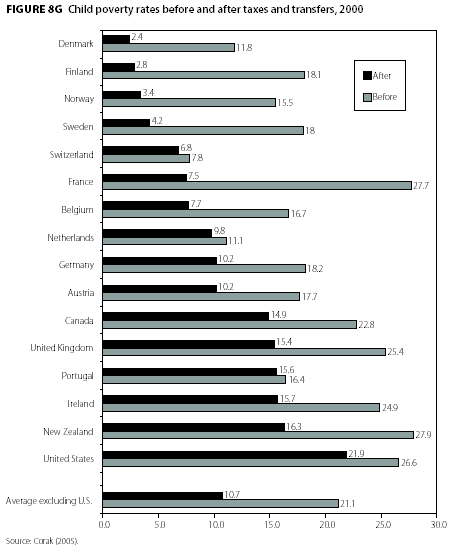
Leftish studies love to show how the US economic model is so much more heartless than those wonderful Europeans.   Below is a typical chart they use, and it will bring us full circle to our original point about measuring poverty.

Study1

Wow, those heartless damn Americans!  Letting those children suffer.  But wait, we talked earlier about definitions of poverty - how do they define poverty here?  It turns out that poverty is defined as income 50% or less of the median income in that country.  Yes, you heard that right -- the standard for poverty changes country to country.  So the US has the worst results here because in large part, since it has the highest median income of any country in this survey, it has been given the highest poverty line.  Of COURSE we will have higher poverty numbers if you give us a higher poverty bar.  The honest way to do this study would be to set an absolute poverty line and apply it to each country on a purchasing power parity basis.  But of course, the progressives would not like the results of such an honest study.

BUT, someone in this study made a mistake -- they should lose their socialist decoder card for this.  Because in a fit of honesty, they actually restated one of their charts on a relatively fair basis.  Here is the original income equality chart:
Study3

You get the point, the US sucks as always -- our poor are the poorest.  But are they?  Again, the standard in each line is the median income of that country, so it is a changing standard in each case.  But what if we restated it all to a common dollar amount.  This is where the progressives fell into a fit of honesty.  They restated this chart so that every bar is a percentage of the US median income.

Study2

Now we see the real story - except for Norway and Switzerland, our poorest folks are about on par with those in other western countries, and this is WITHOUT the crushing burden of welfare state regulation and taxation.  Further, the poor in the US are much more mobile than those in other country -- the ranks of our poor will have turned over much more than any of these other countries in 10 years.  Finally, my bet is that if you did this chart without recent immigrants, the US poor would best most every country in Europe in terms of income -- US has a lot of immigration and it is disproportionately poor vs. immigration into other European countries (note that most poverty numbers include illegal immigrants, but most official immigration numbers do not include illegal immigrants).

So, if our poor are doing just as well, then I leave it as an exercise to give any rational reason why the fact that our rich are doing much better matters one damn bit.

You Gotta Love NPR

You have to love NPR.  On Friday, I was on a lunchtime errand and heard the begging on Science Friday.  Apparently it was inventors week, and the intro promised the next hour might "change the life" of aspiring inventors in the audience who are struggling with getting patents and monetizing their inventions.

Then, after this intro, the show spent the next half hour interviewing an professor at MIT who specializes in non-profit development of low-tech solutions to 3rd world problems.  LOL.  The woman was certainly interesting, but had about zero to offer on the topic at hand.  I guees NPR just couldn't actually bring itself to talk about monetizing inventions in the good old capitalist US without first spending a good hunk of the show on selfless innovation to solve third-world environmental issues.

Trade Imbalance

Don Boudreaux responds to UAW President Ron Gettelfinger's complaint that the US has a trade imbalance in autos with South Korea:

Well, duh - that's an
inevitable consequence of specialization...

General Motors, Ford, and Chrysler each have huge trade imbalances --
to be precise, huge and growing trade deficits -- with their workers:
these companies buy far more from their workers than their workers buy
from them.  Perhaps auto makers should hire workers only on the
condition that the trade in each case is "balanced": each and every
worker must agree to spend his or her entire salary on products made by
the auto maker.  For example, a G.M. worker whose total compensation in
2007 is $60,000 must spend $60,000 on G.M. products in 2007.  Any
worker who fails to do so will be fired because of the resulting
imbalance.

Update:  Sorry, forgot the link.  Added it.

Cities and Global Warming

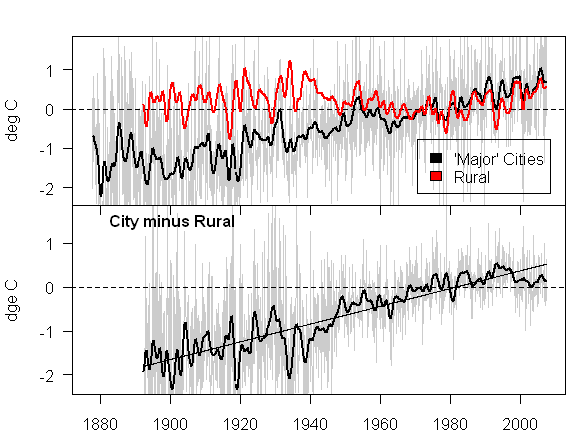
OK, I lied.  I have one more post I want to make on global warming now that Steve McIntyre's site is back up.  I suspect I tend to bury the lede in my warming posts, because I try to be really careful to set up the conclusion in a fact-based way.  However, for this post, I will try a different approach.  Steven McIntyre has reshuffled the data in a study on urbanization and temperature that is relied on by the last IPCC report to get this chart for US Temperature data.
Peters27

Conclusion?  For this particular set of US temperature data, all the 20th century warming was observed in urban areas, and none was observed in rural areas less affected by urban heat islands, asphalt, cars, air conditioning, etc.

If it can be generalized, this is an amazing conclusion -- it would imply that the sum of US measured warming over the last century could be almost 100% attributed to urban heat islands (a different and more localized effect than CO2 greenhouse gas warming).  Perhaps more importantly, outside of the US nearly all of the historical temperature measurement is in urban areas -- no one has 100 year temperature records for the Chinese countryside.  However much this effect might be over-stating US temperature increases, it would probably be even more pronounced in measurements in other parts of the word.

OK, so how did he get this chart?  Did he cherry-pick the data?  First, a bit of background.

The 2003 Peterson study on urban effects on temperature was adopted as a key study for the last IPCC climate report.  In that report, Peterson concluded:

Contrary to generally accepted wisdom, no statistically significant
impact of urbanization could be found in annual temperatures.

This study (which runs counter to both common sense and the preponderance of past studies) was latched onto by the IPCC to allow them to ignore urban heat island effects on historical temperatures and claim that most all past warming in the last half-century was due to CO2.  Peterson's methodology was to take a list of several hundred US temperature stations (how he picked these is unclear, they are a mix of USHCN and non-USHCN sites) and divide them between "urban" and "rural" using various inputs, including satellite photos of night lights.  Then he compared the temperature changes over the last century for the two groups, and declared them substantially identical.

However, McIntyre found a number of problems with his analysis.  First, looking at Peterson's data set, he saw that the raw temperature measurement did show an urbanization effect of about 0.7C over the last century, a very large number.  It turns out that Peterson never showed these raw numbers in his study, only the numbers after he applied layers of "corrections" to them, many of which appear to McIntyre to be statistically dubious.  I discussed the weakness of this whole "adjustment" issue here.

Further, though, McIntyre found obviously rural sites lurking in the urban data, and vice versa, such that Peterson was really comparing a mixed bag with a mixed bag.  For example, Snoqualmie Falls showed as urban -- I have been to Snoqualmie Falls several times, and while it is fairly close to Seattle, it is not urban.  So McIntyre did a simple sort.  He took from Peterson's urban data set only large cities, which he defined as having a major league sports franchise  (yes, a bit arbitrary, but not bad).  He then compared this narrower urban data set from Peterson against Peterson's rural set and got the chart above.  The chart is entirely from Peterson's data set, with no cherry-picking except to clean up the urban list.

Postscript:  Please don't get carried away.  Satellite measurement of the troposphere, which are fairly immune to these urbanization effects, show the world has been warming, though far less than the amount shown in surface temperature databases.

Update: To reinforce the point about global sites, Brazil apparently only has six (6) sites in the worldwide database.  That is about 1/200 of the number of sites in the continental US, which has about the same land area.  And of those six, McIntyre compares urban vs. rural sites.  Guess what he finds?  And, as a follow up from the postscript, while satellites show the Northern Hemisphere is warming, it shows that the Southern Hemisphere is not.

A Temperature Adjustment Example

I won't go back into all the details, but I have posted before about just how large the manual adjustments to temperature numbers are (the "noise") as compared to the magnitude of measured warming (the "signal").  This issue of manual temperature corrections is the real reason the NASA temperature restatements are important (not the absolute value of the restatement).

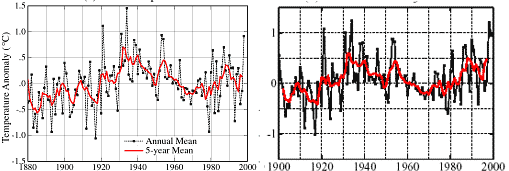
Here is a quick visual example.  Both charts below are from James Hansen and the GISS and are for the US only.  Both use basically the same temperature measurement network (the USHCN).  The one on the left was Hansen's version of US temperatures in 1999.  The one on the right he published in 2001.
Hansen_1999_v_2001

The picture at the right is substantially different  than the one on the left.  Just look at 1932 and 1998.  Between the first and second chart, none of the underlying temperature measurements changed.  What changed  were the adjustments to the underlying measurements applied by the NOAA and by the GISS.  For some reason, temperatures after 1980 have been raised and temperatures in the middle of the century were lowered.

For scientists to apply a negative temperature adjustment to measurements, as they did for the early 1930's, it means they think there was some warming bias in 1932 that does not exist today.  When scientists raise current temperatures, they are saying there is some kind of cooling bias that exists today that did not exist in the 1930's.  Both of these adjustments are basically implying the same thing:  That temperature measurement was more biased upwards, say by asphalt and urbanization and poor sitings, in 1932 than they are today.  Does this make any freaking sense at all?

Of course, there may be some other bias at work here that I don't know about.  But I and everyone else in the world are forced to guess because the NOAA and the GISS insist on keeping their adjustment software and details a secret, and continue to resist outside review.

Read much more about this from Steve McIntyre.

Some Final Thoughts on The NASA Temperature Restatement

I got a lot of traffic this weekend from folks interested in the US historical temperature restatement at NASA-GISS.  I wanted to share to final thoughts and also respond to a post at RealClimate.org (the #1 web cheerleader for catastrophic man-made global warming theory).

  1. This restatement does not mean that the folks at GISS are necessarily wrong when they say the world has been warming over the last 20 years.  We know from the independent source of satellite measurements that the Northern Hemisphere has been warming (though not so much in the Southern Hemisphere).  However, surface temperature measurements, particularly as "corrected" and aggregated at the GISS, have always been much higher than the satellite readings.  (GISS vs Satellite)  This incident may start to give us an insight into how to bring those two sources into agreement. 
  2. For years, Hansen's group at GISS, as well as other leading climate scientists such as Mann and Briffa (creators of historical temperature reconstructions) have flaunted the rules of science by holding the details of their methodologies and algorithm's secret, making full scrutiny impossible.  The best possible outcome of this incident will be if new pressure is brought to bear on these scientists to stop saying "trust me" and open their work to their peers for review.  This is particularly important for activities such as Hansen's temperature data base at GISS.  While measurement of temperature would seem straight forward, in actual fact the signal to noise ration is really low.  Upward "adjustments" and fudge factors added by Hansen to the actual readings dwarf measured temperature increases, such that, for example, most reported warming in the US is actually from these adjustments, not measured increases.
  3. In a week when Newsweek chose to argue that climate skeptics need to shut up, this incident actually proves why two sides are needed for a quality scientific debate.  Hansen and his folks missed this Y2K bug because, as a man-made global warming cheerleader, he expected to see temperatures going up rapidly so he did not think to question the data.  Mr. Hansen is world-famous, is a friend of luminaries like Al Gore, gets grants in quarter million dollar chunks from various global warming believers.  All his outlook and his incentives made him want the higher temperatures to be true.  It took other people with different hypotheses about climate to see the recent temperature jump for what it was: An error.

The general response at RealClimate.org has been:  Nothing to see here, move along.

Among other incorrect stories going around are that the mistake was due
to a Y2K bug or that this had something to do with photographing
weather stations. Again, simply false.

I really, really don't think it matters exactly how the bug was found, except to the extent that RealClimate.org would like to rewrite history and convince everyone this was just a normal adjustment made by the GISS themselves rather than a mistake found by an outsider.  However, just for the record, the GISS, at least for now until they clean up history a bit, admits the bug was spotted by Steven McIntyre.  Whatever the bug turned out to be, McIntyre initially spotted it as a discontinuity that seemed to exist in GISS data around the year 2000.  He therefore hypothesized it was a Y2K bug, but he didn't know for sure because Hansen and the GISS keep all their code as a state secret.  And McIntyre himself says he became aware of the discontinuity during a series of posts that started from a picture of a weather station at Anthony Watts blog.  I know because I was part of the discussion, talking to these folks online in real time.  Here is McIntyre explaining it himself.

In sum, the post on RealClimate says:

Sum total of this change? A couple of hundredths of degrees in the US
rankings and no change in anything that could be considered
climatically important (specifically long term trends).

A bit of background - surface temperature readings have read higher than satellite readings of the troposphere, when the science of greenhouse gases says the opposite should be true.  Global warming hawks like Hansen and the GISS have pounded on the satellite numbers, investigating them 8 ways to Sunday, and have on a number of occasions trumpeted upward corrections to satellite numbers that are far smaller than these downward corrections to surface numbers. 

But yes, IF this is the the only mistake in the data, then this is a mostly correct statement from RealClimate.org..  However, here is my perspective:

  • If a mistake of this magnitude can be found by outsiders without access to Hansen's algorithm's or computer code just by inspection of the resulting data, then what would we find if we could actually inspect the code?  And this Y2K bug is by no means the only problem.  I have pointed out several myself, including adjustments for urbanization and station siting that make no sense, and averaging in rather than dropping bad measurement locations
  • If we know significant problems exist in the US temperature monitoring network, what would we find looking at China? Or Africa?  Or South America.  In the US and a few parts of Europe, we actually have a few temperature measurement points that were rural in 1900 and rural today.  But not one was measuring rural temps in these other continents 100 years ago.  All we have are temperature measurements in urban locations where we can only guess at how to adjust for the urbanization.  The problem in these locations, and why I say this is a low signal to noise ratio measurement, is that small percentage changes in our guesses for how much the urbanization correction should be make enormous changes (even to changing the sign) of historic temperature change measurements.

Here are my recommendations:

  1. NOAA and GISS both need to release their detailed algorithms and computer software code for adjusting and aggregating USHCN and global temperature data.  Period.  There can be no argument.  Folks at RealClimate.org who believe that all is well should be begging for this to happen to shut up the skeptics.  The only possible reason for not releasing this scientific information that was created by government employees with taxpayer money is if there is something to hide.
  2. The NOAA and GISS need to acknowledge that their assumptions of station quality in the USHCN network are too high, and that they need to incorporate actual documented station condition (as done at SurfaceStations.org) in their temperature aggregations and corrections.  In some cases, stations like Tucson need to just be thrown out of the USHCN.  Once the US is done, a similar effort needs to be undertaken on a global scale, and the effort needs to include people whose incentives and outlook are not driven by making temperatures read as high as possible.
  3. This is the easiest of all.  Someone needs to do empirical work (not simulated, not on the computer, but with real instruments) understanding how various temperature station placements affect measurements.  For example, how do the readings of an instrument in an open rural field compare to an identical instrument surrounded by asphalt a few miles away?  These results can be used for step #2 above.  This is cheap, simple research a couple of graduate students could do, but climatologists all seem focused on building computer models rather than actually doing science.
  4. Similar to #3, someone needs to do a definitive urban heat island study, to find out how much temperature readings are affected by urban heat, again to help correct in #2.  Again, I want real research here, with identical instruments placed in various locations and various radii from an urban center  (not goofy proxys like temperature vs. wind speed -- that's some scientist who wants to get a result without ever leaving his computer terminal).  Most studies have shown the number to be large, but a couple of recent studies show smaller effects, though now these studies are under attack not just for sloppiness but outright fabrication.  This can't be that hard to study, if people were willing to actually go into the field and take measurements.  The problem is everyone is trying to do this study with available data rather than by gathering new data.

Postscript:  The RealClimate post says:

However, there is clearly a latent and deeply felt wish in some sectors for the whole problem of global warming to be reduced to a statistical quirk or a mistake.

If catastrophic man-made global warming theory is correct, then man faces a tremendous lose-lose.  Either shut down growth, send us back to the 19th century, making us all substantially poorer and locking a billion people in Asia into poverty they are on the verge of escaping, or face catastrophic and devastating changes in the planet's weather.

Now take two people.  One in his heart really wants this theory not to be true, and hopes we don't have to face this horrible lose-lose tradeoff.  The other has a deeply felt wish that this theory is true, and hopes man does face this horrible future.  Which person do you like better?  And recognize, RealClimate is holding up the latter as the only moral man. 

Update:  Don't miss Steven McIntyre's take from the whole thing.  And McIntyre responds to Hansen here.

Letter to Newsweek

Editors-

Oh, the delicious irony.

As a skeptic of catastrophic man-made global warming, I was disturbed to see that Newsweek in its August 13, 2007 issue (The Truth About Denial)
had equated me with a Holocaust denier.  There are so many interesting
scientific issues involved in climate change that it was flabbergasting
to me that Newsweek would waste time on an extended ad hominem
attack against one side in a scientific debate.  I was particularly
amazed that Newsweek would accuse the side of the debate that is
outspent 1000:1 with being tainted by money.  This is roughly
equivalent to arguing that Mike Gravel's spending is corrupting the
2008 presidential election.

However, fate does indeed have a sense of humor.  Skeptics' efforts of the sort Newsweek derided just this week
forced NASA-Goddard (GISS) to revise downward recent US temperature
numbers due to a programming mistake that went unidentified for
years, in part because NASA's taxpayer-paid researchers refuse to
release their temperature adjustment and aggregation methodology to the
public for scrutiny.  The problem was found by a chain of events that
began with amateur volunteers and led ultimately to Steven McIntyre (he
of the Michael Mann hockey stick debunking) calling foul.

The particular irony is that the person who is in charge of this
database, and is responsible for the decision not to allow scientific
scrutiny of his methodologies, is none other than James Hansen, who
Newsweek held up as the shining example of scientific objectivity in
its article.  Newsweek should have been demanding that taxpayer-funded
institutions like NASA should be opening their research to full review,
but instead Newsweek chose to argue that Mr. Hansen should be shielded
from scrutiny.

Warren Meyer

Breaking News: Recent US Temperature Numbers Revised Downwards Today

This is really big news, and a fabulous example of why two-way scientific discourse is still valuable, in the same week that both Newsweek and Al Gore tried to make the case that climate skeptics were counter-productive and evil. 

Climate scientist Michael Mann (famous for the hockey stick chart) once made the statement that  the 1990's were the
warmest decade in a millennia and that "there is a 95 to 99% certainty
that 1998 was the hottest year in the last one thousand years." (By
the way, Mann now denies he ever made this claim, though you can watch him say
these exact words in the CBC documentary Global
Warming:  Doomsday Called Off
).

Well, it turns out, according to the NASA GISS database, that 1998 was not even the hottest year of the last century.  This is because many temperatures from recent decades that appeared to show substantial warming have been revised downwards.  Here is how that happened (if you want to skip the story, make sure to look at the numbers at the bottom).

One of the most cited and used historical surface temperature databases is that of NASA/Goddard's GISS.  This is not some weird skeptics site.  It is considered one of the premier world temperature data bases, and it is maintained by anthropogenic global warming true believers.  It has consistently shown more warming than any other data base, and is thus a favorite source for folks like Al Gore.  These GISS readings in the US rely mainly on the US Historical Climate Network (USHCN) which is a network of about 1000 weather stations taking temperatures, a number of which have been in place for over 100 years.

Frequent readers will know that I have been a participant in an effort led by Anthony Watts at SurfaceStations.org to photo-document these temperature stations as an aid to scientists in evaluating the measurement quality of each station.  The effort has been eye-opening, as it has uncovered many very poor instrument sitings that would bias temperature measurements upwards, as I found in Tucson and Watts has documented numerous times on his blog.

One photo on Watt's blog got people talking - a station in MN with a huge jump in temperature about the same time some air conditioning units were installed nearby.   Others disagreed, and argued that such a jump could not be from the air conditioners, since a lot of the jump happened with winter temperatures when the AC was dormant.  Steve McIntyre, the Canadian statistician who helped to expose massive holes in Michael Mann's hockey stick methodology, looked into it.  After some poking around, he began to suspect that the GISS data base had a year 2000 bug in one of their data adjustments.

One of the interesting aspects of these temperature data bases is that they do not just use the raw temperature measurements from each station.  Both the NOAA (which maintains the USHCN stations) and the GISS apply many layers of adjustments, which I discussed here.  One of the purposes of Watt's project is to help educate climate scientists that many of the adjustments they make to the data back in the office does not necessarily represent the true condition of the temperature stations.  In particular, GISS adjustments imply instrument sitings are in more natural settings than they were in say 1905, an outrageous assumption on its face that is totally in conflict to the condition of the stations in Watt's data base.  Basically, surface temperature measurements have a low signal to noise ratio, and climate scientists have been overly casual about how they try to tease out the signal.

Anyway, McIntyre suspected that one of these adjustments had a bug, and had had this bug for years.  Unfortunately, it was hard to prove.  Why?  Well, that highlights one of the great travesties of climate science.  Government scientists using taxpayer money to develop the GISS temperature data base at taxpayer expense refuse to publicly release their temperature adjustment algorithms or software (In much the same way Michael Mann refused to release the details for scrutiny of his methodology behind the hockey stick).  Using the data, though, McIntyre made a compelling case that the GISS data base had systematic discontinuities that bore all the hallmarks of a software bug.

Today, the GISS admitted that McIntyre was correct, and has started to republish its data with the bug fixed.  And the numbers are changing a lot.  Before today, GISS would have said 1998 was the hottest year on record (Mann, remember, said with up to 99% certainty it was the hottest year in 1000 years) and that 2006 was the second hottest.  Well, no more.  Here are the new rankings for the 10 hottest years in the US, starting with #1:

1934, 1998, 1921, 2006, 1931, 1999, 1953, 1990, 1938, 1939

Three of the top 10 are in the last decade.  Four of the top ten are in the 1930's, before either the IPCC or the GISS really think man had any discernible impact on temperatures.  Here is the chart for all the years in the data base:
New_giss

There are a number of things we need to remember:

  • This is not the end but the beginning of the total reexamination that needs to occur of the USHCN and GISS data bases.  The poor correction for site location and urbanization are still huge issues that bias recent numbers upwards.  The GISS also has issues with how it aggregates multiple stations, apparently averaging known good stations with bad stations a process that by no means eliminates biases.  As a first step, we must demand that NOAA and GISS release their methodology and computer algorithms to the general public for detailed scrutiny by other scientists.
  • The GISS today makes it clear that these adjustments only affect US data and do not change any of their conclusions about worldwide data.  But consider this:  For all of its faults, the US has the most robust historical climate network in the world.  If we have these problems, what would we find in the data from, say, China?  And the US and parts of Europe are the only major parts of the world that actually have 100 years of data at rural locations.  No one was measuring temperature reliably in rural China or Paraguay or the Congo in 1900.  That means much of the world is relying on urban temperature measurement points that have substantial biases from urban heat.
  • All of these necessary revisions to surface temperatures will likely not make warming trends go away completely.  What it may do is bring the warming down to match the much lower satellite measured warming numbers we have, and will make current warming look more like past natural warming trends (e.g. early in this century) rather than a catastrophe created by man.  In my global warming book, I argue that future man-made warming probably will exist, but will be more like a half to one degree over the coming decades than the media-hyped numbers that are ten times higher.

So how is this possible?  How can the global warming numbers used in critical policy decisions and scientific models be so wrong with so basic of an error?  And how can this error have gone undetected for the better part of a decade?  The answer to the latter question is because the global warming  and climate community resist scrutiny.  This weeks Newsweek article and statements by Al Gore are basically aimed at suppressing any scientific criticism or challenge to global warming research.  That is why NASA can keep its temperature algorithms secret, with no outside complaint, something that would cause howls of protest in any other area of scientific inquiry.

As to the first question, I will leave the explanation to Mr. McIntyre:

While acolytes may call these guys "professionals", the process of
data adjustment is really a matter of statistics and even accounting.
In these fields, Hansen and Mann are not "professionals" - Mann
admitted this to the NAS panel explaining that he was "not a
statistician". As someone who has read their works closely, I do not
regard any of these people as "professional". Much of their reluctance
to provide source code for their methodology arises, in my opinion,
because the methods are essentially trivial and they derive a certain
satisfaction out of making things appear more complicated than they
are, a little like the Wizard of Oz. And like the Wizard of Oz, they
are not necessarily bad men, just not very good wizards.

For more, please see my Guide to Anthropogenic Global Warming or, if you have less time, my 60-second argument for why one should be skeptical of catastrophic man-made global warming theory.

Update:
Nothing new, just thinking about this more, I cannot get over the irony that in the same week Newsweek makes the case that climate science is settled and there is no room for skepticism, skeptics discover a gaping hole and error in the global warming numbers.

Update #2:  I know people get upset when we criticize scientists.  I get a lot of "they are not biased, they just made a mistake."  Fine.  But I have zero sympathy for a group of scientists who refuse to let other scientists review their methodology, and then find that they have been making a dumb methodology mistake for years that has corrupted the data of nearly every climate study in the last decade.

Update #3:  I labeled this "breaking news," but don't expect to see it in the NY Times anytime soon.  We all know this is one of those asymmetric story lines, where if the opposite had occurred (ie things found to be even worse/warmer than thought) it would be on the front page immediately, but a lowered threat will never make the news.

Oh, and by he way.  This is GOOD news.  Though many won't treat it that way.  I understand this point fairly well because, in a somewhat parallel situation, I seem to be the last anti-war guy who treats progress in Iraq as good news.

Update #4: I should have mentioned that the hero of the Newsweek story is catastrophic man-made global warming cheerleader James Hansen, who runs the GISS and is most responsible for the database in question as well as the GISS policy not to release its temperature aggregation and adjustment methodologies.  From IBD, via CNN Money:

Newsweek portrays James Hansen, director of NASA's Goddard Institute for Space Studies, as untainted by corporate bribery.

Hansen
was once profiled on CBS' "60 Minutes" as the "world's leading
researcher on global warming." Not mentioned by Newsweek was that
Hansen had acted as a consultant to Al Gore's slide-show presentations
on global warming, that he had endorsed John Kerry for president, and
had received a $250,000 grant from the foundation headed by Teresa
Heinz Kerry.

Update #5: My letter to the editor at Newsweek.  For those worried that this is some weird skeptic's fevered dream, Hansen and company kind of sort of recognize the error in the first paragraph under background here.  Their US temperature chart with what appears is the revised data is here.

Update #6: Several posts are calling this a "scandal."  It is not a scandal.  It is a mistake from which we should draw two lessons:

  1. We always need to have people of opposing opinions looking at a problem.  Man-made global warming hawks expected to see a lot of warming after the year 2000, so they never questioned the numbers.  It took folks with different hypotheses about climate to see the jump in the numbers for what it was - a programming error.
  2. Climate scientists are going to have to get over their need to hold their adjustments, formulas, algorithms and software secret.  It's just not how science is done.  James Hansen saying "trust me, the numbers are right, I don't need to tell you how I got them" reminds me of the mathematician Fermat saying he had a proof of his last theorem, but it wouldn't fit in the margin.  How many man-hours of genius mathematicians was wasted because Fermat refused to show his proof (which was most likely wrong, given how the theorem was eventually proved).

Final Update:  Some parting thoughts, and recommendations, here.

Wherein I Answer Lou Dobbs and Suspect He Is A Chinese Agent

It is always dangerous to argue with the insane, but I am actually willing to answer Lou Dobbs question:

And what I can't quite figure out amongst these geniuses who are
so-called free traders is, why do they think that about a 35 percent to
40 percent undervaluation of the Chinese yuan to the dollar is free
trade? Why do they think 25 percent duties in tariffs on American
products entering China is free trade?

I will leave aside the question of how he or anybody else knows the yuan is undervalued by this much.  I will accept his premise on the basis that we know the Chinese government spends money to keep the yuan lower than it might be otherwise.  Here is my answer:

Yes, it is not perfectly free trade.  But we let it continue because the freaking Chinese government, its consumers, and its taxpayers are subsidizing Americans.  The Chinese government is making all of its consumers pay higher prices and higher taxes just so American consumers can have lower prices.  Napoleon advised that one never should interrupt an enemy when he is making a mistake -- after all, this same strategy managed to earn Japan a decade and a half long recession.  Our correct response is not tariffs, it is to say, "gee, thanks."  This is for the Chinese people to stop, not our government. 

Why is China doing this?  Because it government is using monetary policy to help out a few favored exporters who have political influence at the expense of all of their consumers and exporters.  And Lou Dobbs wants the US to respond exactly the same way, to punish our consumers to favor some of our favored politically-connected exporters so the Chinese consumers can have lower prices.  Great plan.  Is Lou Dobbs an Chinese agent?