Posts tagged ‘US’

Storm Frequency

I already discussed Newsweek's happy little ad hominem attack on climate skeptics here.  However, as promised, I wanted to talk about the actual, you know, science for a bit, starting from the Newsweek author's throwaway statement that she felt required no
proof, "The frequency of Atlantic hurricanes has already doubled in the
last century."

This is really a very interesting topic, much more interesting than following $10,000 of skeptics' money around in a global warming industry spending billions on research.  One would think the answer to this hurricane question is simple.  Can we just look up the numbers?  Well, let's start there.  Total number of Atlantic hurricanes form the HURDAT data base, first and last half of the last century:

1905-1955 = 366
1956-2006 = 458

First, you can see nothing like a doubling.  This is an increase of 25%.  So already, we see that in an effort to discredit skeptics for fooling America about the facts, Newsweek threw out a whopper that absolutely no one in climate science, warming skeptic or true believer, would agree with.

But let's go further, because there is much more to the story.  Because 25% is a lot, and could be damning in and of itself.  But there are problems with this data.  If you think about storm tracking technology in 1905 vs. 2005, you might see the problem.  To make it really clear, I want to talk about tornadoes for a moment.

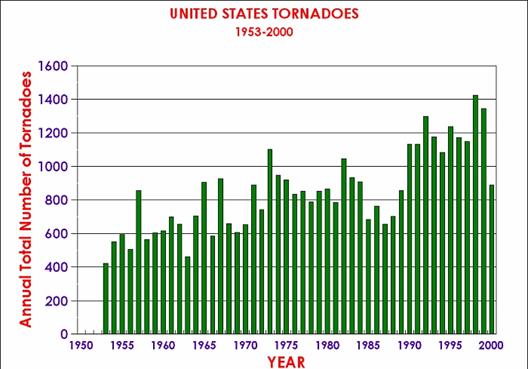
In An Inconvenient Truth, Al Gore and company said that global warming was increasing the number of tornadoes in the US.  He claimed 2004 was the highest year ever for tornadoes in the US.  In his PowerPoint slide deck (on which the movie was based) he sometimes uses this chart (form the NOAA):

Whoa, that's scary.  Any moron can see there is a trend there.  Its like a silver bullet against skeptics or something.  But wait.  Hasn't tornado detection technology changed over the last 50 years?  Today, we have doppler radar, so we can detect even smaller size 1 tornadoes, even if no one on the ground actually spots them (which happens fairly often).  But how did they measure smaller tornadoes in 1955 if no one spotted them?  Answer:  They didn't.  In effect, this graph is measuring apples and oranges.  It is measuring all the tornadoes we spotted by human eye in 1955 with all the tornadoes we spotted with doppler radar in 2000.   The NOAA tries to make this problem clear on their web site.

With increased national doppler
radar coverage, increasing population, and greater attention to tornado
reporting, there has been an increase in the number of tornado reports over the
past several decades. This can create a misleading appearance of an increasing
trend in tornado frequency. To better understand the true variability and trend
in tornado frequency in the US, the total number of strong to violent tornadoes
(F3 to F5 category on the Fujita scale) can be analyzed. These are the
tornadoes that would have likely been reported even during the decades before
Dopplar radar use became widespread and practices resulted in increasing
tornado reports. The bar chart below indicates there has been little trend in
the strongest tornadoes over the past 55 years.

So itt turns out there is a decent way to correct for this.  We don't think that folks in 1955 were missing many of the larger class 3-5 tornadoes, so comparing 1955 and 2000 data for these larger tornadoes should be more apples to apples (via NOAA).

Well, that certainly is different (note 2004 in particular, given the movie claim).  No upward trend at all when you get the data right.  I wonder if Al Gore knows this?  I am sure he is anxious to set the record straight.

OK, back to hurricanes.  Generally, whether in 1905 or 2005, we know if a hurricane hits land in the US.  However, what about all the hurricanes that don't hit land or hit land in some undeveloped area?  Might it be that we can detect these better in 2006 with satellites than we could in 1905?  Just like the tornadoes?

Well, one metric we have is US landfall.  Here is that graph  (data form the National Weather Service -- I have just extrapolated the current decade based on the first several years).

Not much of a trend there, though the current decade is high, in part due to the fact that it does not incorporate the light 2006 season nor the light-so-far 2007 season.  The second half of the 20th century is actually lower than the first half, and certainly not "twice as large".  But again, this is only a proxy.  There may be reasons more storms are formed but don't make landfall (though I would argue most Americans only care about the latter).

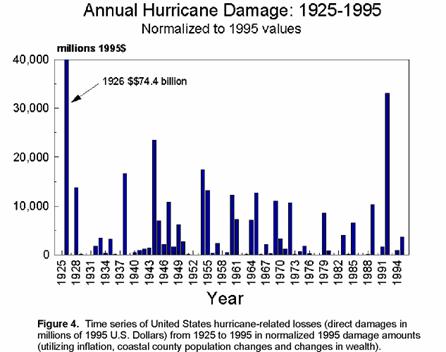
But what about hurricane damages?  Everyone knows that the dollar damages from hurricanes is way up.  Well, yes.  But the amount of valuable real estate on the United State's coast is also way up.  Roger Pielke and Chris Landsea (you gotta love a guy studying hurricane strikes named Landsea) took a shot at correcting hurricane damages for inflation and the increased real estate value on the coasts.  This is what they got:

Anyway, back to our very first data, several scientists are trying to correct the data for missing storms, particularly in earlier periods.  There is an active debate here about corrections I won't get into, but suffice it to say the difference between the first half of the 20th century to the latter half in terms of Atlantic hurricane formations is probably either none or perhaps a percentage increase in the single digits (but nowhere near 100% increase as reported by Newsweek).

Debate continues, because there was a spike in hurricanes from 1995-2005 over the previous 20 years.  Is this anomalous, or is it similar to the spike that occurred in the thirties and forties?  No one is sure, but isn't this a lot more interesting than figuring out how the least funded side of a debate gets their money?  And by the way, congratulations again to MSM fact-checkers.

My layman's guide to skepticism of catastrophic man-made global warming is here.  A shorter, 60-second version of the best climate skeptic's arguments is here.

Update:  If the author bothered to have a source for her statement, it would probably be Holland and Webster, a recent study that pretty much everyone disagrees with and many think was sloppy.  And even they didn't say activity had doubled.  Note the only way to get a doubling is to cherry-pick a low decade in the first half of the century and a high decade in the last half of the century and compare just those two decades -- you can see this in third paragraph of the Scientific American article.  This study bears all the hallmarks -- cherry picking data, ignoring scientific consensus, massaging results to fit an agenda -- that the Newsweek authors were accusing skeptics of.

Update #2:  The best metric for hurricane activity is not strikes or numbers but accumulated cyclonic energy.  Here is the ACE trend, as measured by Florida State.  As you can see, no upward trend.

6a00e54eeb9dc1883400e553bfddf188338

I Was Teenage Warming-Denying Werewolf

Update:  My post on breaking news about downward revisions to US temperature numbers is here.

Well, I finally read Newsweek's long ad hominem attack on climate skeptics in the recent issue.  It is basically yet another take on the global-warming-skeptics-are-all-funded-by-Exxon meme.  The authors breathlessly "follow the money to show how certain scientists have taken as much as $10,000 (gasp) from fossil-fuel related companies to publish skeptical work.  Further, despite years of hand-wringing about using emotionally charged words like "terrorist" in their news articles, Newsweek happily latches onto "denier" as a label for skeptics, a word chosen to parallel the term "Holocaust denier" -- nope, no emotional content there.

I'm not even going to get into it again, except to make the same observation I have made in the past:  Arguing that the global warming debate is "tainted" by money from skeptics is like saying the 2008 presidential election is tainted by Mike Gravel's spending.  Money from skeptics is so trivial, by orders of magnitude, compared to spending by catastrophic warming believers that it is absolutely amazing folks like Newsweek could feel so threatened by it.  In my Layman's Guide To Man-Made Global Warming Skepticism, I estimated skeptics were being outspent 1000:1.  I have no way to check his figures, but Senator Inhofe's office estimated skeptics were being outspent $50 billion to 19 million, which is about the same order of magnitude as my estimate.

Given this skew in spending, and the fact that most of the major media accepts catastrophic man-made  global warming as a given, this was incredible:

Look for the next round of debate to center on what Americans are
willing to pay and do to stave off the worst of global warming. So far
the answer seems to be, not much. The NEWSWEEK Poll finds less than half in favor of requiring high-mileage cars or energy-efficient appliances and buildings....

Although the figure is less than in earlier polls, A new NEWSWEEK Poll finds that the influence of the denial machine remains strong.39
percent of those asked say there is "a lot of disagreement among
climate scientists" on the basic question of whether the planet is
warming; 42 percent say there is a lot of disagreement that human
activities are a major cause of global warming. Only 46 percent say the
greenhouse effect is being felt today.

It has to be the "denial machine" at fault, right?  I can't possibly be because Americans think for themselves, or that they tend to reject micro-managing government regulations.  The author sounds so much like an exasperated parent "I kept telling my kids what's good for them and they just don't listen."

Yes, I could easily turn the tables here, and talk about the financial incentives in academia for producing headlines-grabbing results, or discuss the political motivations behind Marxist groups who have latched onto man-made global warming for their own ends.  But this does not really solve the interesting science questions, and ignores the fact that many catastrophic climate change believers are well meaning and thoughtful, just as many skeptics are.  The article did not even take the opportunity to thoughtfully discuss the range of skeptic's positions.  Some reject warming entirely, while others, like myself, recognize the impact man can have on climate, but see man's impact being well below catastrophic levels (explained here in 60 seconds).  Anyway, I don't have the energy to fisk it piece by piece, but Noel Sheppard does.

For those of you who are interested, I have a follow-up post on the science itself, which is so much more interesting that this garbage.  I use as a starting point the Newsweek author's throwaway statement that she felt required no proof, "The frequency of Atlantic hurricanes has already doubled in the last century."  (Hint:  the answer turns out to be closer to +5% than +100%)

Democrats and Republicans United In Grabbing Power

This weekend, the Democrats in Congress passed legislation legalizing the Administration's previous grab for new wiretapping powers.  Further proving that the minority party in the US government does not really object to power grabs, they just get in a huff that the other party thought of it first.  Other examples of such behavior include the Patriot act, currently supported by Republicans and opposed by many Democrats, but most of whose provisions were originally proposed by Bill Clinton and opposed by a Republican Congress  (opposition led by John Ashcroft!)

I really don't want the president, of either party, listening to my phone calls without a warrant, and that answer does not change if I am talking  to my friends in Arizona or my friends in London.

John Scalzi has a great post reacting to the line in the article above where Democrats vow to, at some time in the future, "fix" the flaws in the law they just passed.

They wouldn't have to "fix" it if they hadn't have passed it.
Once again I am entirely flummoxed how it is that the Democrats, faced
with the president more chronically unpopular than Nixon, and so
politically weakened that the GOP candidates for president can barely
bring themselves to acknowledge that he exists, yet manage to get played by the man again and again.

If the Democrats honestly did not feel this version of the bill
should have been passed, they shouldn't have passed it. I don't see why
this is terribly complicated. And don't tell me that at least it has a
six-month "sunset" clause; all it means at this point is that in six
months, the Democrats are going to allow themselves to get played once
more, and this time they'll have given Bush the talking point of "well,
they passed it before."

My only objection to this statement is the implication the this is just a matter of the Democrats getting played.  I actually think it's exactly what the Democrats want -- they want to retain a reputation for caring about government intrusiveness without actually reducing government powers (just like Republicans want a reputation for reducing economic regulations without actually doing do when they were in power).  After all, the Dems expect to control the administration in 2 years, and they really don't want to take away any of the President's toys before that time.

Arizona: Saving Northerner's Lives Since 1912

New study results, via Tyler Cowen:

We estimate the effect of extreme weather on life expectancy in the US. ... However, the
increase in mortality following extreme heat appears entirely driven by
temporal displacement, while the increase in mortality following
extreme cold is long lasting. The aggregate effect of cold on mortality
is quantitatively large. We estimate that the number of annual deaths
attributable to cold temperature is 27,940 or 1.3% of total deaths in
the US. This effect is even larger in low income areas. Because the
U.S. population has been moving from cold Northeastern states to the
warmer Southwestern states, our findings have implications for
understanding the causes of long-term increases in life expectancy. We
calculate that every year, 5,400 deaths are delayed by changes in
exposure to cold temperature induced by mobility.
These longevity gains
associated with long term trends in geographical mobility account for
8%-15% of the total gains in life expectancy experienced by the US
population over the past 30 years
. Thus mobility is an important but
previously overlooked determinant of increased longevity in the United
States. We also find that the probability of moving to a state that has
fewer days of extreme cold is higher for the age groups that are
predicted to benefit more in terms of lower mortality compared to the
age groups that are predicted to benefit less.

Your welcome, America. 

Time to Switch From Meese's to Gipper's

From Daniel Griswold at Cato:

One sure sign of a hyperinflation is that the central bank must
issue new currency notes in ever higher denominations so that people
won't have to carry bags or wheelbarrows of money around to make
everyday purchases. Sure enough, the government of Zimbabwe is now
wrestling with that very question. According to the FT story:

The launch yesterday of a new large-denomination bank
note of Z$200,000"”worth [US$13] at the official exchange rate and
[US$1.30] at the more realistic parallel rate"”underlines the disarray.
The central bank had wanted to issue a Z$500,000 note, but a bank
official said this was vetoed by the finance ministry because senior
staff thought such a large denomination would have reinforced an
impression that inflation was out of control.

At a 13,000 percent rate, that cat is probably already out of the bag.

What a mess.  Explanation of the post title here.

Steve McIntyre Comments on Historical Temperature Adjustments

Steve McIntyre, the statistician than called into question much of the methodology behind the Mann Hockey Stick chart, has some observations on adjustments to US temperature records I discussed here and here.

Eli Rabett and Tamino have both advocated faith-based climate
science in respect to USHCN and GISS adjustments. They say that the
climate "professionals" know what they're doing; yes, there are
problems with siting and many sites do not meet even minimal compliance
standards, but, just as Mann's "professional" software was able to
extract a climate signal from the North American tree ring data, so
Hansen's software is able to "fix" the defects in the surface sites.
"Faith-based" because they do not believe that Hansen has any
obligation to provide anything other than a cursory description of his
software or, for that matter, the software itself. But if they are
working with data that includes known bad data, then critical
examination of the adjustment software becomes integral to the
integrity of the record - as there is obviously little integrity in
much of the raw data.

While acolytes may call these guys "professionals", the process of
data adjustment is really a matter of statistics and even accounting.
In these fields, Hansen and Mann are not "professionals" - Mann
admitted this to the NAS panel explaining that he was "not a
statistician". As someone who has read their works closely, I do not
regard any of these people as "professional". Much of their reluctance
to provide source code for their methodology arises, in my opinion,
because the methods are essentially trivial and they derive a certain
satisfaction out of making things appear more complicated than they
are, a little like the Wizard of Oz. And like the Wizard of Oz, they
are not necessarily bad men, just not very good wizards.

He goes on to investigate a specific example the "professionals" use
as a positive example, demonstrating they appear to have a Y2K error in
their algorithm.   This is difficult to do, because like Mann, government scientists maintaining a government temperature data base taken from government sites paid for with taxpayer funds refuse to release their methodology or algorithms for inspection.

In the case cited, the "professionals" also make adjustments that imply the site has
decreasing urbanization over the last 100 years, something I am not
sure one can say about any site in the US except perhaps for a few
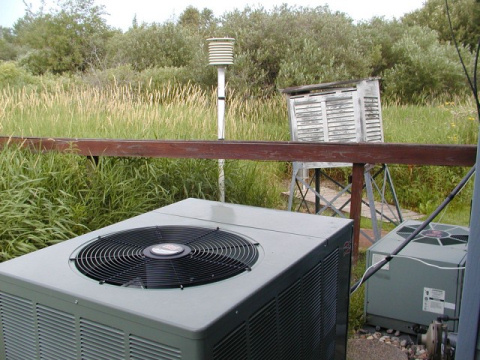
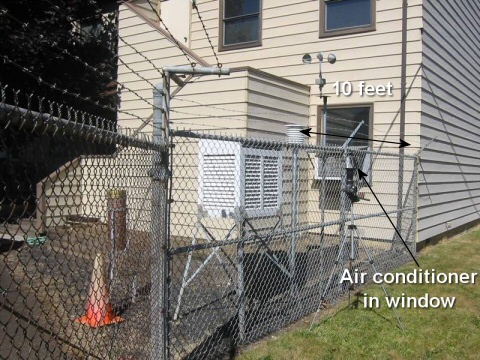
Colorado ghost towns.  The "experts" also fail to take the basic step of actually analyzing the site itself which, if visited, would reveal recently installed air conditioning unites venting hot air on the temperature instrument.   

A rebuttal, arguing that poor siting of temperature instruments is OK and does not affect the results is here.  I find rebuttals of this sort really distressing.  I studied physics for a while, before switching to engineering, and really small procedural mistakes in measurement could easily invalidate one's results.  I find it amazing that climate scientists seek to excuse massive mistakes in measurement.  I'm sorry, but in no other branch of science are results considered "settled" when the experimental noise is greater than the signal.  I would really, really, just for once, love to see a anthropogenic global warming promoter say "well, I don't think the siting will change the results, but you are right, we really need to go back and take another pass at correcting historical temperatures based on more detailed analysis of the individual sites."

State Run Medicine: Bureaucrat Salaries Trump Patients

Italian Daniele Capezzone writes in the WSJ($):

This situation is especially dire in Italy. The
government has capped spending on pharmaceuticals at 13% of total
health-care expenditures while letting expenses for infrastructure and
staff skyrocket. From 2001 to 2005, general health expenses in Italy
grew by 31% while expenditure on medicines increased a mere 1.7%.
Italian patients might well have been better off if the reverse was the
case, but the state bureaucrats who make these decisions refuse to
acknowledge the benefits of advanced drugs....

Part of the problem is that regional authorities
manage most of Italy's health-care spending. A strike by health-care
personnel has an immediate impact on the region, but the consequences
of cutting the budget for medicines are only felt in the long term and
distributed across the nation. Hence, local authorities continue to
focus on personnel and infrastructure in an age when medical research
has become the most efficient way to improve public health.

Gee, government officials more concerned about raising government salaries than performance?  Couldn't possibly happen in the US, could it?  This is classic government management -- freeze or reduce expenses that actually provide customer service, and raise administrative costs and salaries many times faster than inflation.  This is exactly what has happened in public schools, as infrastructure and teaching aid investments have been deferred in favor of raising salaries and adding untold number of vice-principals and administrators to every school.

But the government is focused on the long-term while greedy old for-profits are short-term focused.  Right?

Unfortunately, most of today's cutting-edge research is conducted
outside Europe, which was once a pioneer in this field. About 78% of
global biotechnology research funds are spent in the U.S., compared to
just 16% in Europe. Americans therefore have better access to modern
drugs. One result is that in the U.S., the annual death rate from
cancer is 196 per 100,000 people, compared to 235 in Britain, 244 in
France, 270 in Italy and 273 in Germany.

Update:  Ronald Bailey points out that drug re importation is just a way to impose drug price controls in the US, effectively applying the most aggressive price-control regime for each drug worldwide to US prices.  Right now, drug companies tolerate price controls set as much as 2/3 under US prices or more because they can still make money at the margin, because the marginal cost of drug production is so much lower than the total cost with R&D, etc. included.  However, they cannot survive at these prices applied to US demand.  Remember, drug companies have profits margins averaging in the 18-20% range.  Perhaps you might argue they should only be making 10%, but that only gives you room for an imposed 10% price cut, not the huge cuts politicians would like.  And you would get that only at tremendous costs in terms of lost freedoms and demolished incentives for new drug development.

Stop Right There or I Will Shoot Myself!

Via the Washington Post:

It has become a Capitol Hill ritual: A few senators, always including the New York Democrat Charles E. Schumer, introduce a bill to punish China
if its leaders do not raise the value of the nation's currency. Photos
are taken, news releases are issued, but nothing really happens.

This
year, the atmosphere on the Hill is markedly different. Powerful
senators from both sides of the aisle, Schumer among them, are pushing
two bills that threaten retaliatory action if China does not budge. For
the first time, the idea is gaining broad support. The bills are moving
swiftly through the Senate, and many analysts expect one will pass.

If the bill's authors are successful, the effect at a minimum will be to raise consumer prices in the United States and lower them for Chinese citizens.  So we are going to "punish" China by making our own citizens pay higher prices.  How does this make any sense?  Also, in the process, let's make sure we reduce the capacity of China to buy US government debt, which to this point has been reducing the cost of the Federal budget deficit.

Tyler Cowen argues this is the best we can expect -- the worst is a substantial debalization in the Chinese economy... and ours.  I wrote much more on continuing to allow the Chinese government to subsidize American consumers here.

More Thoughts on Historic Temperature Adjustments

A few posts back, I showed how nearly 85% of the reported warming in the US over the last century is actually due to adjustments and added fudge-factors by scientists rather than actual measured higher temperatures.  I want to discuss some further analysis Steve McIntyre has done on these adjustments, but first I want to offer a brief analogy.

Let's say you had two compasses to help you find north, but the compasses are reading incorrectly.  After some investigation, you find that one of the compasses is located next to a strong magnet, which you have good reason to believe is strongly biasing that compass's readings.  In response, would you

  1. Average the results of the two compasses and use this mean to guide you, or
  2. Ignore the output of the poorly sited compass and rely solely on the other unbiased compass?

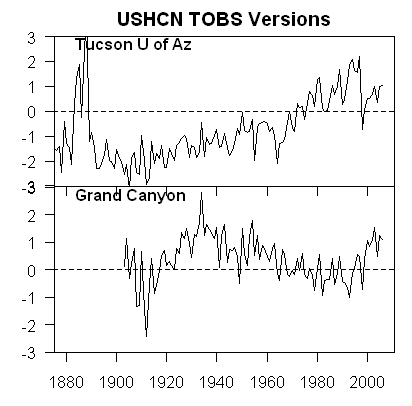
Most of us would quite rationally choose #2.  However, Steve McIntyre shows us a situation involving two temperature stations in the USHCN network in which government researchers apparently have gone with solution #1.  Here is the situation:

He compares the USHCN station at the Grand Canyon (which appears to be a good rural setting) with the Tucson USHCN station I documented here, located in a parking lot in the center of a rapidly growing million person city.   Unsurprisingly, the Tucson data shows lots of warming and the Grand Canyon data shows none.  So how might you correct Tucson and the Grand Canyon data, assuming they should be seeing about the same amount of warming?  Would you
average them, effectively adjusting the two temperature readings
towards each other, or would you assume the Grand Canyon data is cleaner
with fewer biases and adjust Tucson only?   Is there anyone who would not choose the second option, as with the compasses?

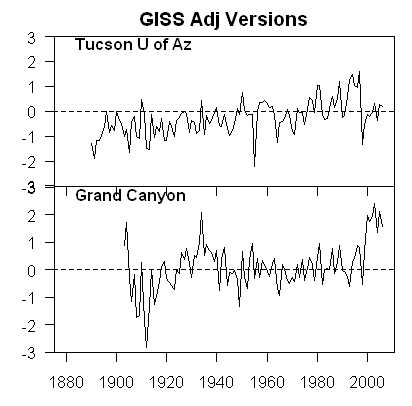
The GISS data set, created by the Goddard Center of NASA, takes the USHCN data set and somehow uses nearby stations to correct for anomalous stations.  I say somehow, because, incredibly, these government scientists, whose research is funded by taxpayers and is being used to make major policy decisions, refuse to release their algorithms or methodology details publicly.  They keep it all secret!  Their adjustments are a big black box that none of us are allowed to look into  (and remember, these adjustments account for the vast majority of reported warming in the last century).

We can, however, reverse engineer some of these adjustments, and McIntyre does.  What he finds is that the GISS appears to be averaging the good and bad compass, rather than throwing out or adjusting only the biased reading.  You can see this below.  First, here are the USHCN data for these two stations with only the Time of Observation adjustment made (more on what these adjustments are in this article).
Grand_12

As I said above, no real surprise - little warming out in undeveloped nature, lots of warming in a large and rapidly growing modern city.  Now, here is the same data after the GISS has adjusted it:

Grand_15

You can see that Tucson has been adjusted down a degree or two, but Grand Canyon has been adjusted up a degree or two (with the earlier mid-century spike adjusted down).  OK, so it makes sense that Tucson has been adjusted down, though there is a very good argument to be made that it should be been adjusted down more, say by at least 3 degrees**.  But why does the Grand Canyon need to be adjusted up by about a degree and a half?  What is biasing it colder by 1.5 degrees, which is a lot?  The answer:  Nothing.  The explanation:  Obviously, the GISS is doing some sort of averaging, which is bringing the Grand Canyon and Tucson from each end closer to a mean. 

This is clearly wrong, like averaging the two compasses.  You don't average a measurement known to be of good quality with one known to be biased.  The Grand Canyon should be held about the same, and Tucson adjusted down even more toward it, or else thrown out.  Lets look at two cases.  In one, we will use the GISS approach to combine these two stations-- this adds 1.5 degrees to GC and subtracts 1.5 degrees from Tucson.  In the second, we will take an approach that applies all the adjustment to just the biases (Tucson station) -- this would add 0 degrees to GC and subtract 3 degrees from Tucson.  The first approach, used by the GISS, results in a mean warming in these two stations that is 1.5 degrees higher than the more logical second approach.  No wonder the GISS produces the highest historical global warming estimates of any source!  Steve McIntyre has much more.

** I got to three degrees by applying all of the adjustments for GC and Tucson to Tucson.  Here is another way to get to about this amount.   We know from studies that urban heat islands can add 8-10 degrees to nighttime urban temperatures over surrounding undeveloped land.  Assuming no daytime effect, which is conservative, we might conclude that 8-10 degrees at night adds about 3 degrees to the entire 24-hour average.

Postscript: Steve McIntyre comments (bold added):

These adjustments are supposed to adjust for station moves - the
procedure is described in Karl and Williams 1988 [check], but, like so
many climate recipes, is a complicated statistical procedure that is
not based on statistical procedures known off the island.
(That's not
to say that the procedures are necessarily wrong, just that the
properties of the procedure are not known to statistical civilization.
)
When I see this particular outcome of the Karl methodology, my
impression is that, net of the pea moving under the thimble, the Grand
Canyon values are being blended up and the Tucson values are being
blended down. So that while the methodology purports to adjust for
station moves, I'm not convinced that the methodology can successfully
estimate ex post the impact of numerous station moves and my guess is
that it ends up constructing a kind of blended average.

LOL.  McIntyre, by the way, is the same gentleman who helped call foul on the Mann hockey stick for bad statistical procedure.

More Subsidy Insanity

Over a decade ago, the German government adopted the goal of reducing the country's CO2 emissions back to 1990 levels as part of the Kyoto process.  That's why its incredible to me that after spending billions on various goofy and questionable conservation and alternative energy programs, someone has finally thought to maybe stop massively subsidizing coal production.

For decades, German lawmakers have propped up the industry,
unwilling to risk massive layoffs and reluctant to eliminate a reliable
energy source as gas and oil supplies become scarcer.

But after spending more than $200 billion in subsidies since the
1960s, the federal government this year decided that the practice had
become unaffordable. The 2018 sunset for the hard-coal industry was set.

Economists and free-market lawmakers have long decried the subsidies
as handouts to the politically influential coal industry and powerful
trade unions. This year, for instance, Deutsche Steinkohle AG, the
owner of the remaining eight mines, will receive more in government
subsidies ($3.3 billion) than it will from selling coal ($2.9 billion).

With just 32,000 miners left, that's the equivalent of more than $100,000 in annual subsidies per worker.

I don't know what is more incredible -- $100,000 per worker or the fact that subsidies actually are larger than revenue from coal sales.  In effect, the government is subsidizing more than half of coal's production costs.

Sometimes we in the US forget just how insane the economy in Europe can be.  I remember doing a consulting project for the French national railroad, the SNCF.   It turned out the SNCF, for it's 100,000 freight cars had ... 125,000 freight car maintenance workers.  The headcount number was so insane I had to check it three times to make sure it was right.  I commented at the time that they could assign one car repair worker full time to each freight car, and have him ride around with that car full time, and still cut staffing by 20%.

Ex Post Facto Guilt

You gotta love those vaunted MSM fact-checkers.  I mean, I am all for criticizing George Bush, but this seems to be going a bit too far  (Guardian via Q&O):

Ministers insisted that British secret agents would only be allowed to
pass intelligence to the CIA to help it capture Osama bin Laden if the
agency promised he would not be tortured, it has emerged.

MI6 believed it was close to finding the al-Qaida leader in
Afghanistan in 1998, and again the next year. The plan was for MI6 to
hand the CIA vital information about Bin Laden. Ministers including
Robin Cook, the then foreign secretary, gave their approval on
condition that the CIA gave assurances he would be treated humanely.
The plot is revealed in a 75-page report by parliament's intelligence
and security committee on rendition, the practice of flying detainees
to places where they may be tortured.

The report criticises the Bush administration's approval of practices
which would be illegal if carried out by British agents. It shows that
in 1998, the year Bin Laden was indicted in the US, Britain insisted
that the policy of treating prisoners humanely should include him. But
the CIA never gave the assurances.

LOL.  It seems like Bush has been president forever, but I am pretty sure that Hillary's husband was in the White House until early 2001.

Government Health Care and Efficiency

I am always absolutely amazed when advocates of some form of national or single-payer health care argue that such a system would be more efficient.  For example, Kevin Drum argued:

A few days ago, during an email exchange with a
friend, I mentioned that I don't usually tout cost savings as a big
argument in favor of universal healthcare. It's true that a national
healthcare plan would almost certainly save money compared to our
current Rube Goldberg system, but I suspect the savings would be
modest. Rather, the real advantages of national healthcare are related
to things like access (getting everyone covered), efficiency (cutting down on useless -- or even deliberately counterproductive -- administrative bureaucracies), choice
(allowing people to choose and keep a family doctor instead of being
jerked around everytime their employer decides to switch health
providers), and social justice (providing decent, hassle-free healthcare for the poor).

I don't think any of these are true.  For example, let's take access.  Yes, everyone in a universal health care system would have a piece of paper that says they have health care, and the left seems really focused on that piece of paper.  But that paper has about as much value as my piece of paper that says I own a hundred shares of Enron.  Because someone has to redeem that piece of paper and actually provide the care, and there is the rub, is it not?  Canadian David Gratzer writes (vis Q&O):

My book's thesis was simple: to contain rising
costs, government-run health-care systems invariably restrict the
health-care supply. Thus, at a time when Canada's population was aging
and needed more care, not less, cost-crunching bureaucrats had reduced
the size of medical school classes, shuttered hospitals, and capped
physician fees, resulting in hundreds of thousands of patients waiting
for needed treatment"”patients who suffered and, in some cases, died
from the delays....

Nor were the problems I identified unique to
Canada"”they characterized all government-run health-care systems.
Consider the recent British controversy over a cancer patient who tried
to get an appointment with a specialist, only to have it canceled"”48
times. More than 1 million Britons must wait for some type of care,
with 200,000 in line for longer than six months. A while back, I toured
a public hospital in Washington, D.C., with Tim Evans, a senior fellow
at the Centre for the New Europe. The hospital was dark and dingy, but
Evans observed that it was cleaner than anything in his native England.
In France, the supply of doctors is so limited that during an August
2003 heat wave"”when many doctors were on vacation and hospitals were
stretched beyond capacity"”15,000 elderly citizens died. Across Europe,
state-of-the-art drugs aren't available. And so on.

I had forgotten about the heat wave.  Could you imagine backwards old America having 15,000 people die when the temperature got into the 90's?

As to efficiency, which Drum defines as "cutting down on useless -- or even deliberately counterproductive -- administrative bureaucracies," does anyone really ascribe these characteristics to the government?  Really?  Even European health care bureaucrats would not agree with this statement:

This privatizing trend is reaching Europe, too.
Britain's government-run health care dates back to the 1940s. Yet the
Labour Party"”which originally created the National Health Service and
used to bristle at the suggestion of private medicine, dismissing it as
"Americanization""”now openly favors privatization. Sir William Wells, a
senior British health official, recently said: "The big trouble with a
state monopoly is that it builds in massive inefficiencies and
inward-looking culture."

I won't get much into the last two, except to say that we actually have a ton of health care choice in the US today, far more than any other country.  And even if we did not, what does doctor choice mean if the best people are driven away from being doctors, as they are in socialized medicine.  And social justice?  Well, the poor get care in the US, the key is the "hassle-free" in his statement.  Would you immediately assume that a government-run service is going to involve less hassle than a private service?  Have you renewed your drivers license lately?  It may well be that the poorest 10% have such an awful health care experience that they will see things better.  But almost assuredly the other 90% are going to be worse off.

Remember this -- Universal health care is NOT a system in which the majority of us who are satisfied with our care can keep our current system, while the poor get a better one.  It is a system where all of us are thrown out of our current system and given the same care the poor get.  It is roughly equivalent to a Great Society housing program in which not just the homeless get housing, but everyone in the country are forced to give up their current house and live in public housing.

Postscript:  There is great improvement to be had in the health care system.  It revolves, though, around making the payer for health care the same person who receives the service, as it is for every other product and service we buy in this country.  We already have too much single-payer.  We need multi-payer.  I won't go there today, but I explained here.

Another Thought:
A huge pillar of the women's movement was that the government should not make decisions for a woman and her body (e.g. by banning abortion).   All well and good.  But I have never understood how this was consistent with support, say, for the FDA, which tells women exactly what they can and can't put in their body.  And now women's groups are all for universal health care, where government will make all the medical decisions about what procedures one can and can't have, and when.  Consistency please?

An Interesting Source of Man-Made Global Warming

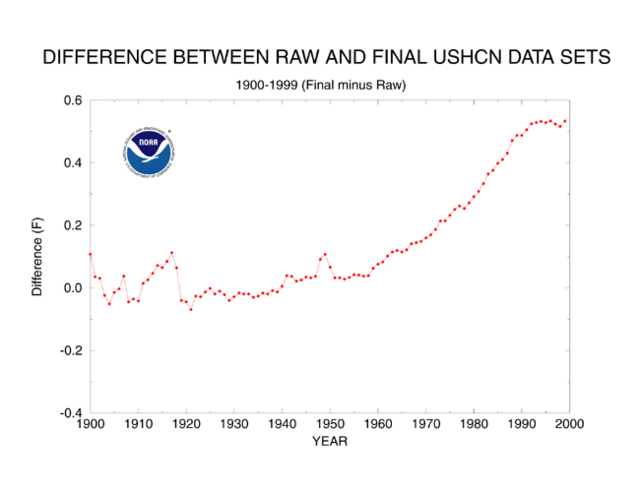
The US Historical Climate Network (USHCN) reports about a 0.6C temperature increase in the lower 48 states since about 1940.  There are two steps to reporting these historic temperature numbers.  First, actual measurements are taken.  Second, adjustments are made after the fact by scientists to the data.  Would you like to guess how much of the 0.6C temperature rise is from actual measured temperature increases and how much is due to adjustments of various levels of arbitrariness?  Here it is, for the period from 1940 to present in the US:

Actual Measured Temperature Increase: 0.1C
Adjustments and Fudge Factors: 0.5C
Total Reported Warming: 0.6C

Yes, that is correct.  Nearly all the reported warming in the USHCN data base, which is used for nearly all global warming studies and models, is from human-added fudge factors, guesstimates, and corrections.

I know what you are thinking - this is some weird skeptic's urban legend.  Well, actually it comes right from the NOAA web page which describes how they maintain the USHCN data set.  Below is the key chart from that site showing the sum of all the plug factors and corrections they add to the raw USHCN measurements:
Ushcn_corrections
I hope you can see this significance.  Before we get into whether these measurements are right or wrong or accurate or guesses, it is very useful to understand that almost all the reported warming in the US over the last 70 years is attributable to the plug figures and corrections a few government scientists add to the data in the back room.  It kind of reduces one's confidence, does it not, in the basic conclusion about catastrophic warming? 

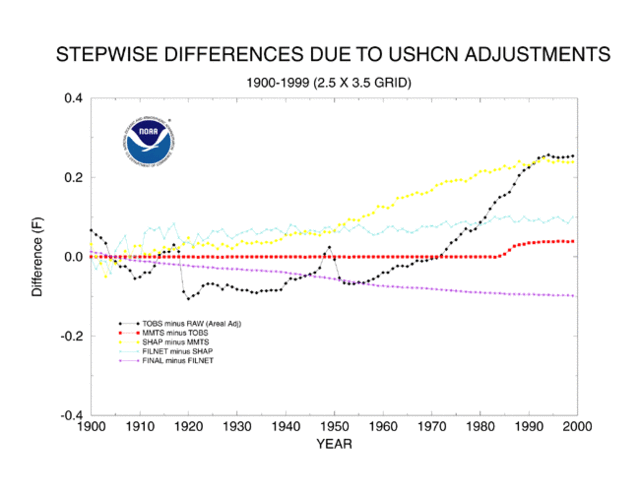
Anyway, lets look at the specific adjustments.  The lines in the chart below should add to the overall adjustment line in the chart above.
Ushcn_corrections2

  • Black line is a time of observation adjustment, adding about 0.3C since 1940
  • Light Blue line is a missing data adjustment that does not affect the data much since 1940
  • Red line is an adjustment for measurement technologies, adding about 0.05C since 1940
  • Yellow line is station location quality adjustment, adding about 0.2C since 1940
  • Purple line is an urban heat island adjustment, subtracting about 0.05C since 1950.

Let's take each of these in turn.  The time of observation adjustment is defined as follows:

The Time of Observation Bias (TOB) arises when the 24-hour daily
summary period at a station begins and ends at an hour other than local
midnight. When the summary period ends at an hour other than midnight,
monthly mean temperatures exhibit a systematic bias relative to the
local midnight standard

0.3C seems absurdly high for this adjustment, but I can't prove it.  However, if I understand the problem, a month might be picking up a few extra hours from the next month and losing a few hours to the previous month.  How is a few hour time shift really biasing a 720+ hour month by so large a number? I will look to see if I can find a study digging into this. 

I will skip over the missing data and measurement technology adjustments, since they are small.

The other two adjustments are fascinating.  The yellow line says that siting has improved on USHCN sites such that, since 1900, their locations average 0.2C cooler due to being near more grass and less asphalt today than in 1900. 

During this time, many sites were relocated from city locations to
airports and from roof tops to grassy areas. This often resulted in
cooler readings than were observed at the previous sites.

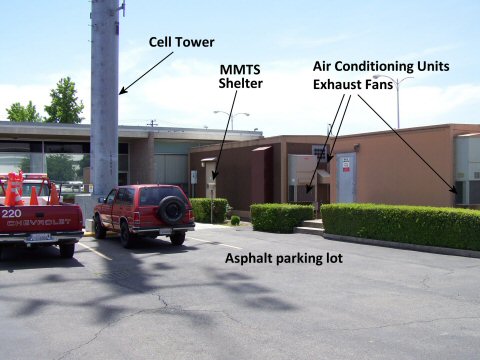
OK, without a bit of data, does that make a lick of sense?  Siting today in our modern world has GOT to be worse than it was in 1900 or even 1940.  In particular, the very short cable length of the newer MMTS sensors that are standard for USHCN temperature measurement guarantee that readings today are going to be close to buildings and paving.  Now, go to SurfaceStations.org and look at pictures of actual installations, or look at the couple of installations in the Phoenix area I have taken pictures of here.  Do these look more grassy and natural than measurement sites were likely to be in 1900?  Or go to Anthony Watts blog and scroll down his posts on horrible USHCN sites.

The fact is that not only is NOAA getting this correction wrong, but it probably has the SIGN wrong.  The NOAA has never conducted the site by site survey that we discussed above.  Their statement that locations are improving is basically a leap of faith, rather than a fact-based conclusion.  In fact, NOAA scientists who believe that global warming is a problem tend to overlay this bias on the correction process.  Note the quote above -- temperatures that don't increase as they expect are treated as an error to be corrected, rather than a measurement that disputes their hypothesis.

Finally, lets look the urban heat island adjustment.  The NOAA is claiming that the sum total of urban heat island effects on its network since 1900 is just 0.1C, and less than 0.05C since 1940.  We're are talking about the difference between a rural America with horses and dirt roads and a modern urban society with asphalt and air conditioning and cars.  This rediculously small adjustment reflects two biases among anthropogenic global warming advocates:  1)  That urban heat island effects are negligible and 2) That the USHCN network is all rural.  Both are absurd.  Study after study has show urban heat island effects as high as 6-10 degrees.  Just watch you local news if you live in a city --  you will see actual temperatures and forecasts lower by several degrees in the outlying areas than in the center of town.  As to the locations all being rural, you just have to go to surfacestations.org and see where these stations are.  Many of these sites might have been rural in 1940, but they have been engulfed by cities and towns since.

To illustrate both these points, lets take the case of the Tucson site I visited.  In 1900, Tucson was a dusty one-horse town (Arizona was not even a state yet).  In 1940, it was still pretty small.  Today, it is a city of over one million people and the USHCN station is dead in the center of town, located right on an asphalt parking lot.  The adjustment NOAA makes for all these changes?  Less than one degree.  I don't think this is fraud, but it is willful blindness.

So, let's play around with numbers.  Let's say that instead of a 0.2C site quality adjustment we instead used a -0.1C adjustment, which is still probably generous.  Let's assume that instead of a -0.05C urban adjustment we instead used -0.2C.  The resulting total adjustment from 1940 to date would be +0.05 and the total measurement temperature increase in the US would fall from 0.6C to 0.15C.  And this is without even changing the very large time of observation adjustment, and is using some pretty conservative assumptions on my part.  Wow!  This would put US warming more in the range of what satellite data would imply, and would make it virtually negligible. It means that the full amount of reported US warming may well be within the error bars for the measurement network and the correction factors.

While anthropogenic global warming enthusiasts are quick to analyze the reliability of any temperature measurement that shows lower global warming numbers (e.g. satellite), they have historically resisted calls to face up to the poor quality of surface temperature measurement and the arbitrariness of current surface temperature correction factors.  As the NOAA tellingly states:

The U.S. Historical Climatology Network (USHCN, Karl et al. 1990)
is a high-quality moderate sized data set of monthly averaged maximum,
minimum, and mean temperature and total monthly precipitation developed
to assist in the detection of regional climate change. The USHCN is
comprised of 1221 high-quality stations from the U.S. Cooperative
Observing Network within the 48 contiguous United States.

Does it sound defensive to anyone else when they use "high-quality" in both of the first two sentences?  Does anyone think this is high qualityOr this?  Or this?  Its time to better understand what this network as well as its limitations.

My 60-second climate skepticism argument is here.  The much longer paper explaining the breath of skeptic's issues with catastrophic man-made global warming is available for free here.

PS- This analysis focuses only on the US.  However, is there anyone out there who thinks that measurement in China and India and Russia and Africa is less bad?

UpdateThis pdf has an overview of urban heat islands, including this analysis showing the magnitude of the Phoenix nighttime UHI as well as the fact that this UHI has grown substantially over the last 30 years.

Uhi1

Update2: Steve McIntyre looks at temperature adjustments for a couple of California Stations.  In one case he finds a station that has not moves for over one hundred years getting an adjustment that implies a urban heat island reduction over the past 100 years.

Air Conditioning Is Causing Global Warming

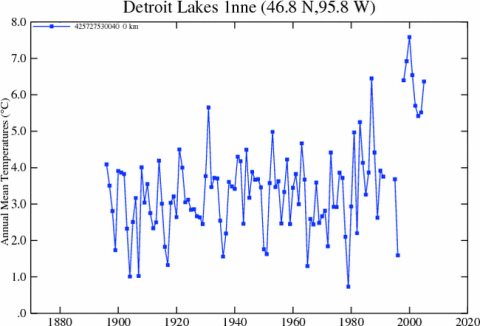
Yep, I admit it, air conditioning may indeed be causing us to measure higher temperatures.  Here is the historic temperature plot of Detroit Lake, MN, one of the thousand or so measurement points in the data base that is used to compute historical warming in the US.
Detroit_lakes_gissplot

Look at that jump in the last 10 years.  It must be global warming!  Can't possibly be due to these air conditioning units installed around 2000 and venting hot gas on the temperature instrument (in that round louvered thing on the post).
Detroit_lakes_ushcn_2

More from Anthony Watts, who is leading the effort to document all these stations. You too can help.  The odds are you live less than an hour from one of these stations -- take your camera and add it to the data base.  Its fun!

Incredibly, the global warming community still argues that documenting the quality of the installations used in the official global warming numbers is unnecessary.  More air conditioners blowing on official temperature measurements hereWorst temperature installation found to date here, "coincidently" at the site with the highest measured 20th century warming.

Contributing to Science

I got to make a real contribution to science this weekend, and I will explain below how you can too.  First, some background.

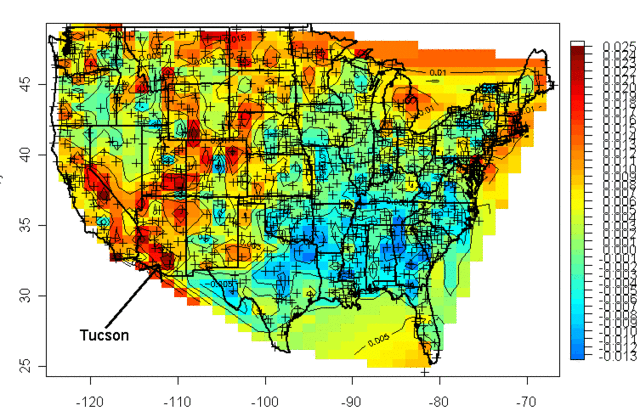
A while back, Steve McIntyre was playing around with graphing temperature data form the US Historical Climate Network (USHCN).  This is the data that is used in most global warming studies and initializes most climate models.  Every climate station is not in this data base - in fact, only about 20 per state are in the data base, with locations supposedly selected in rural areas less subject to biases over time from urban development (urban areas are hotter, due to pavement and energy use, for reasons unrelated to the greenhouse effect).  The crosses below on the map show each station.

He showed this graph, of the USHCN data for temperature change since 1900 (data corrected for time of day of measurement).  Redder shows measured temperatures have increased since 1900, bluer means they have decreased.
Usgrid80

He mentioned that Tucson was the number one warming site -- you can see it in the deepest red.  My first thought was, "wow, that is right next door to me."   My second thought was "how can Tucson, with a million people, count as rural?"   Scientists who study global warming apply all kinds of computer and statistical tricks to this data, supposedly to weed out measurement biases and problems.  However, a number of folks have been arguing that scientists really need to evaluate biases site by site.  Anthony Watts has taken this idea and created SurfaceStations.org, a site dedicated to surveying and photographing these official USHCN stations.

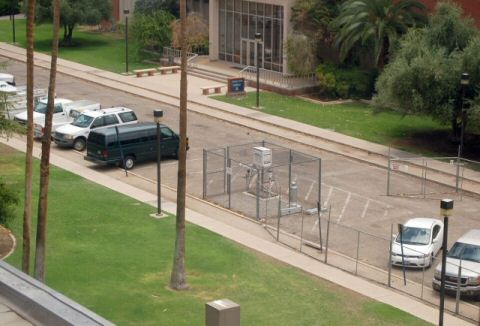
So, with his guidance, I went down to Tucson to see for myself.  My full report is here, but this is what I found:
Tucson1

The measurement station is in the middle of an asphalt parking lot!  This is against all best practices, and even a layman can see how that would bias measurements high.  Watts finds other problems with the installation from my pictures that I missed, and comments here that it is the worst station he has seen yet.  That, by the way, is the great part about this exercise.  Amateurs like me don't need to be able to judge the installation, they just need to take good pictures that the experts can use to analyze problems.

As a final note on Tucson, during the time period between 1950 and today, when Tucson saw most of this measured temperature increase, the population of Tucson increased from under 200,000 to over 1,000,000.  That's a lot of extra urban heat, in addition to the local effects of this parking lot.

The way that scientists test for anomalies without actually visiting or looking at the sites is to do some statistical checks against other nearby sites.  Two such sites are Mesa and Wickenburg.  Mesa immediately set off alarm bells for me.  Mesa is a suburb of Phoenix, and is often listed among the fastest growing cities in the country.  Sure enough, the Mesa temperature measurements were discontinued in the late 1980's, but surely were biased upwards by urban growth up to that time.

So, I then went to visit Wickenburg.  Though is has been growing of late, Wickenburg would still be considered by most to be a small town.  So perhaps the Wickenburg measurement is without bias?  Well, here is the site:

Wickenburg_facing_sw

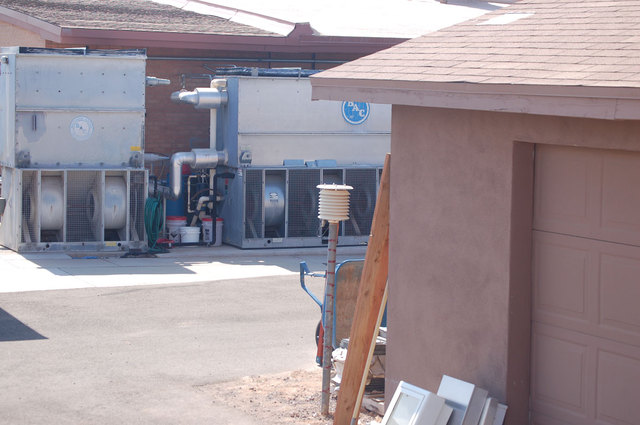
That white coffee can looking thing on a pole in the center is the temperature instrument.  Again, we have it surrounded by a sea of black asphalt, but we also have two building walls that reflect heat onto the instrument.  Specs for the USHCN say that instruments should be installed in an open area away from buildings and on natural ground.  Oops.  Oh, and by the way, lets look the other direction...

Wickenburg_facing_se

What are those silver things just behind the unit?  They are the cooling fans for the building's AC.  Basically, all the heat from the building removed by the AC gets dumped out about 25 feet from this temperature measurement.

Remember, these are the few select stations being used to determine how much global warming the US is experiencing.  Pretty scary.  Another example is here.

Believe it or not, for all the work and money spent on global warming, this is something that no one had done -- actually go document these sites to check their quality and potential biases.  And you too can have the satisfaction of contributing to science.  All you need is a camera (a GPS of some sort is also helpful).  I wrote a post with instructions on how to find temperature stations near you and how to document them for science here.

For those interested, my paper on the skeptics' arguments against catastrophic man-made global warming is here.  If that is too long, the 60-second climate skeptic pitch is here.

Chapter 8: Kyoto and Policy Alternatives (Skeptics Guide to Global Warming)

The table of contents for the rest of this paper, . 4A Layman's Guide to Anthropogenic Global Warming (AGW) is here Free pdf of this Climate Skepticism paper is here and print version is sold at cost here

Kyoto Treaty

In the mid-1990's, a number of western nations crafted a CO2-reduction
treated named Kyoto for the city in which the key conference was held.
The treaty called for signatory nations to roll back their CO2 emissions to
below 1990 levels by a target date of 2012.  Japan, Russia, and many
European nations signed the treaty; the United States did not.  In fact,
the pact was ratified by 141 nations, but only calls for CO2 limits in 35 of
these (so the other 106 were really going out on a limb signing it).
China, India, Brazil and most of the third world are exempt from its limits.

We will discuss the costs and benefits of CO2 reduction a bit later.
However, it is instructive to look at why Kyoto was crafted the way it was, and
why the United States refused to sign, even when Al Gore was vice-president.

The most obvious flaw is that the entire developing world, including China,
SE Asia, and India, are exempt. These countries account for 80% of the world's
population and the great majority of growth in CO2 emissions over the next few
decades, and they are not even included. If you doubt this at all, just look at
what the economic recovery in China over the past months has done to oil
prices. China's growth in
hydrocarbon consumption will skyrocket over the coming years
, and China is
predicted to have higher CO2 production than the United States by 2009.

The second major flaw with the treaty is that European nations cleverly
crafted the treaty so that the targets were relatively easy for them to make,
and very difficult for the United States to meet.  Rather than freezing
emissions at current levels at the time of the treaty, or limiting carbon
emission growth rates, the treaty called for emissions to be rolled back to
below 1990 levels. Why 1990? Well, a couple of important things have happened
since 1990, including:

a. European (and Japanese) economic growth has stagnated since 1990, while
the US economy has grown like crazy. By setting the target date back to 1990,
rather than just starting from day the treaty was signed, the treaty
effectively called for a roll-back of economic growth in the US that other
major world economies did not enjoy.

b. In 1990, Germany was reunified, and Germany inherited a whole country
full of polluting inefficient factories from the old Soviet days. Most of the
dirty and inefficient Soviet-era factories have been closed since 1990, giving
Germany an instant one-time leg up in meeting the treaty targets, but only if
the date was set back to 1990, rather than starting at the time of treaty
signing.

c. Since 1990, the British have had a similar effect from the closing of a
number of old dirty Midlands coal mines and switching fuels from very dirty
coal burned inefficiently to more modern gas and oil furnaces and nuclear
power.

d. Since 1990, the Russians have an even greater such effect, given low
economic growth and the closure of thousands of atrociously inefficient
communist-era industries.

It is flabbergasting that US representatives could allow the US to get so
thoroughly out-manuevered in these negotiations. Does anyone in the US really
want to roll back the economic gains of the nineties, while giving the rest of
the world a free pass? Anyway, as a result of these flaws, and again having
little to do with the global warming argument itself, the Senate
voted 95-0 in 1997 not to sign or ratify the treaty unless these flaws (which
still exist in the treaty) were fixed
.  Then-Vice-President Al Gore
agreed that the treaty should not be signed without modifications, which were
never made and which Europeans were never going to make.

By the way, enough time has elapsed that we have data on the
progress of various countries in meeting these targets.  And if you leave
out various accounting games with offsets of dubious value, most all the
European nations, despite all the advantages described above, are still missing
their targets.  The political will simply does not exist to hamstring
their economies to the extent necessary to roll back CO2 growth.  Actual
growth rates for CO2 emissions have been (source UN):


United States

Europea Union

1990-1995

6.4%

-2.2%

1996-2000

10.1%

2.2%

2001-2004

2.1%

4.5%

You can see that the Europeans positioned themselves well in
the 1990's to make their targets.  Realize that as the treaty was negotiated,
they already had a good idea of these numbers for 1990-1995 and even a few
years beyond.  They knew that by selecting a 1990 baseline, they were
already on target to meet the goals and the US would be far behind.
Again, realize that the 1990-2000 EU performance on CO2 production had nothing
to do with post-Kyoto regulatory responses and everything to do with the
economic fundamentals we outlined above that would have existed with or without
the treaty.

Since 2000, however, it has been a different story.
European emissions have increased as their economies have recovered, at the
same time the US experienced a post-9/11 slowdown.

By the way, the US is generally the great Satan in AGW
circles because its per capita CO2 production is the highest in the
world.  But this is in part because our economic output per capita is
close to the highest in the world.  The US is about in
the middle of the pack in efficiency
, though behind many European countries
which have much higher fuel taxes and heavier nuclear investments.

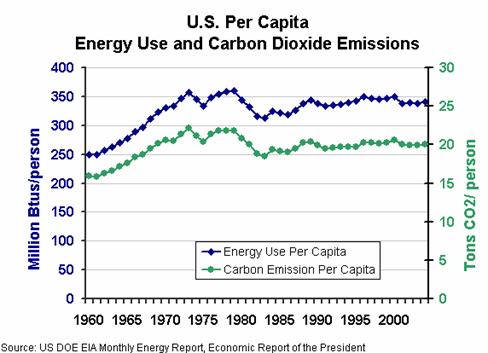
As an interesting side note, the US per capita CO2
emissions, as show below, have actually been flat to down since the early
1970's.  To the extent that Europe is doing better at CO2 reduction than
the US, it may actually be more of an artifact of their declining populations
vs. America's continued growth.

Finally, if you get really tired of the US-bashing, you can
take some comfort that though the US is the #1 per capita producer of CO2, of
which we are uncertain is even harmful, we have done a fabulous job reducing
many other pollutants we are much more certain are harmful.  For example,
the US has much lower SO2
production
than most European nations and the
water quality is better
.  One could argue that the US has spent its
abatement dollars on things that really matter.

Cost of the
Solutions vs. the Benefits:  Why Warmer but Richer may be Better than
Colder and Poorer

If you get beyond the hard core of near religious believers in the massive
warming scenarios, the average global warming supporter would answer this paper
by saying: "Yes there is a lot of uncertainty, but though the doomsday
warming scenarios via runaway positive feedback in the climate can't be proven,
they are so bad that we need to cut back on CO2 production just to be on the
safe side."

This would be a perfectly reasonable approach if cutting back on CO2
production was nearly cost-free.  But it is not.  The burning of
hydrocarbons that create CO2 is an entrenched part of our lives and our
economies. Forty years ago we might have had an easier time of it, as we were
on a path to dramatically cut back on CO2 production via what is still the only
viable technology to massively replace fossil fuel consumption -- nuclear
power.  Ironically, it was environmentalists that shut down this effort,
and power industries around the world replaced capacity that would have gone
nuclear mostly with coal, the worst fossil fuel in terms of CO2 production (per
BTU of power, Nuclear and hydrogen produce no CO2, natural gas produces some,
gasoline produces more, and coal produces the most).

Just halting CO2 production at current levels (not even rolling it back)
would knock several points off of world economic growth.  Every point of
economic growth you knock off guarantees you that you will get more poverty,
more disease, more early death.  If you could, politically, even make such
a freeze stick, you would lock China and India, nearly 2 billion people, into
continued poverty just when they were about to escape it.  You would in
the process make the world less secure, because growing wealth is always the
best way to maintain peace.  Right now, China can become wealthier from
peaceful internal growth than it can from trying to loot its neighbors.
But in a zero sum world created by a CO2 freeze, countries like China would
have much more incentive to create trouble outside its borders.  This
tradeoff is often referred to as a cooler but poorer world vs. a richer but
warmer world.  Its not at all clear which is better.
 

What impact, warming?

We've already discussed just how much the popular media has overblown the
effect of warming.  Sea levels may rise, but only by 15 inches in one
hundred years, and even that based on arguably over-inflated IPCC models.
There is no evidence that weather patterns will be more severe, or that
diseases will spread, or that species will be threatened by warming.  And,
since most of the warming has been and will be concentrated in winter and
nights, we will see rising temperatures more in a narrowing of temperature
variability rather than a drastic increase in summer high temperatures.
Growing seasons, in turn, will be longer and deaths from cold, which tend to
outnumber heat-related deaths, will decline. 

What impact, Intervention?

While the Kyoto treaty was a massively-flawed document, with current
technologies a Kyoto type cap and trade approach is about the only way we have
available to slow or halt CO2 emissions.  And, unlike the impact of
warming on the world, the impact of such a intervention is very well understood
by the world's economists and seldom in fact disputed by global warming
advocates.  Capping world CO2 production would by definition cap world
economic growth at the rate of energy efficiency growth, a number at least two
points below projected real economic growth.  In addition, investment
would shift from microprocessors and consumer products and new drug research
and even other types of pollution control to energy. The effects of two points
or more lower economic growth over 50-100 years can be devastating:

  • Remember the power of compounded growth rates we discussed earlier.  A world real economic growth rate of 4% yields income fifty times higher in a hundred years.  A world real economic growth rate two points lower yields income only 7 times higher in 100 years.  So a two point reduction in growth rates reduces incomes in 100 years by a factor of seven!  This is enormous.  It means, literally, that on average everyone in a cooler world would make 1/7 what they would make in a warmer world.
  • Currently, there are perhaps a billion people, mostly in Asia, poised to exit millennia of subsistence poverty and reach the middle class.  Global warming intervention will likely consign these folks to continued poverty.  Does anyone remember that old ethics problem, the one about having a button that every time you pushed it, you got a thousand dollars but someone in China died.  Global warming intervention strikes me as a similar issue - intellectuals in the west
         feel better about man being in harmony with the Earth but a billion Asians get locked into poverty.
  • Lower world economic growth will in turn considerably
    shorten the lives of billions of the world's poor
  • A poorer
    world is more vulnerable to natural disasters
    .  While AGW
    advocates worry (needlessly) about hurricanes and tornados in a warmer
    world, what we can be certain of is that these storms will be more devastating and kill more people in a poorer world than a richer one.
  • The unprecedented progress the world is experiencing in
    slowing birth rates, due entirely to rising wealth, will likely be
    reversed.  A cooler world will not only be poorer, but likely more populous as well.  It will also be a hungrier world, particularly if
    a cooler world does indeed result in lower food production than a warmer
    world
  • A transformation to a prosperous middle class in Asia will
    make the world a much safer and more stable place, particularly vs. a cooler world with a billion Asian poor people who know that their march to progress was halted by western meddling.
  • A cooler world would ironically likely be an
    environmentally messier world.  While anti-growth folks blame all
    environmental messes on progress, the fact is that environmental impact is
         a sort of inverted parabola when plotted against growth.  Early
    industrial growth tends to pollute things up, but further growth and
    wealth provides the resources and technology to clean things up.  The
         US was a cleaner place in 1970 than in 1900, and a cleaner place today
    than in 1970.  Stopping or drastically slowing worldwide growth would
    lock much of the developing world, countries like Brazil and China and
    Indonesia, into the top end of the parabola.  Is Brazil, for example, more likely to burn up its rain forest if it is poor or rich?

The Commons Blog
links to this
study
by Indur Goklany on just this topic:

If global warming is real and its effects will one
day be as devastating as some believe is likely, then greater economic growth
would, by increasing greenhouse gas (GHG) emissions, sooner or later lead to
greater damages from climate change. On the other hand, by increasing wealth,
technological development and human capital, economic growth would broadly
increase human well-being, and society's capacity to reduce climate change
damages via adaptation or mitigation. Hence, the conundrum: at what point in
the future would the benefits of a richer and more technologically advanced
world be canceled out by the costs of a warmer world?

Indur Goklany attempted to shed light on this
conundrum in a recent paper presented at the 25th Annual North American
Conference of the US Association for Energy Economics, in Denver (Sept. 21,
2005). His paper "” "Is a
richer-but-warmer world better than poorer-but-cooler worlds?"
"” which can
be found here,
draws upon the results of a series of UK Government-sponsored studies which
employed the IPCC's emissions scenarios to project future climate change
between 1990 and 2100 and its global impacts on various climate-sensitive
determinants of human and environmental well-being (such as malaria, hunger,
water shortage, coastal flooding, and habitat loss). The results indicate that
notwithstanding climate change, through much of this century, human well-being
is likely to be highest in the richest-but-warmest world and lower in
poorer-but-cooler worlds. With respect to environmental well-being, matters may
be best under the former world for some critical environmental indicators through
2085-2100, but not necessarily for others.

This conclusion casts doubt on a key premise
implicit in all calls to take actions now that would go beyond "no-regret"
policies in order to reduce GHG emissions in the near term, namely, a
richer-but-warmer world will, before too long, necessarily be worse for the
globe than a poorer-but-cooler world. But the above analysis suggests this is
unlikely to happen, at least until after the 2085-2100 period.

Policy Alternatives

Above, we looked at the effect of a cap and trade scheme, which would have
about the same effect as some type of carbon tax.  This is the best
possible approach, if an interventionist approach is taken.  Any other is
worse.

The primary other alternative bandied about by scientists is some type of
alternative energy Manhattan project.  This can only be a disaster.
Many scientists are technocratic
fascists at heart
, and are convinced that if only they could run the
economy or some part of it, instead of relying on this messy bottom-up
spontaneous order we call the marketplace, things, well, would be better.
The problem is that scientists, no
matter how smart they are, miss with their bets
because the economy, and
thus the lowest cost approach to less CO2 production, is too complicated for
anyone to understand or manage.  And even if the scientists stumbled on
the right approaches, the political process would just screw the solution
up.  Probably the number one alternative energy program in the US is
ethanol subsidies, which are scientifically insane since ethanol
actually increases rather than reduces fossil fuel consumption
.
Political subsidies almost always lead to investments tailored just to capture
the subsidy, that do little to solve the underlying problem.  In Arizona,
we have thousands of cars with subsidized conversions to engines that burn
multiple fuels but never burn anything but gasoline.  In California, there
are hundreds of massive windmills that never turn, having already served their
purpose to capture a subsidy.  In California, the state bent over
backwards to encourage electric cars, but in fact a different technology, the
hybrid, has taken off.

Besides, when has this government led technology revolution approach ever
worked?  I would say twice - once for the Atomic bomb and the second time
to get to the moon.  And what did either get us?  The first got us
something I am not sure we even should want, with very little carryover into
the civilian world.  The second got us a big scientific dead end, and
probably set back our space efforts by getting us to the moon 30 years or so
before we were really ready to do something about it or follow up the efforts.

If we must intervene to limit CO2, we should jack up the price of fossil
fuels with taxes, or institute a cap and trade scheme which will result in
about the same price increase, and the market through millions of individual
efforts will find the lowest cost net way to reach whatever energy consumption
level you want with the least possible cost.  (The only real current
alternative that is rapidly deploy-able to reduce CO2 emissions anyway is nuclear
power
, which could be a solution but was killed by...the very people now
wailing about global warming.)

The table of contents for the rest of this paper, . 4A Layman's Guide to Anthropogenic Global Warming (AGW) is here Free pdf of this Climate Skepticism paper is here and print version is sold at cost here

The open comment thread for this paper can be found here. 
Chapter 9: Rebuttals by Man-made Global Warming Supporters (Skeptics Guide to Global Warming)

The table of contents for the rest of this paper, . 4A Layman's Guide to Anthropogenic Global Warming (AGW) is here Free pdf of this Climate Skepticism paper is here and print version is sold at cost here

As stated in the introduction, the purpose of this paper has
not been to provide a balanced portrayal of Anthropogenic Global Warming (AGW) theory; its purpose instead is to
provide a comprehensive overview of skeptic's concerns with AGW theory.
However, the issues raised here are not necessarily new, and AGW supporters
have attempted to address many of them. 

The New
Scientist
, a fairly strong and reliable voice for advocacy of anthropogenic
global warming theory, recently published its response to what it calls 26
myths about global warming, many of these "myths" being correlated loosely with
skeptics concerns about AGW theory as outlined in this paper.  Walking
through their points seems a reasonable way to entertain a rebuttal to the
skeptic's position.  Each of these has a link to the New Scientist article
in question.  I have tried to summarize the position with a quote, shown
in italics.  My response to each then follows.

Before I get into these 20 myths, note that many of the key
skeptic's questions are neatly avoided.   While the magazine gives
itself certain softball questions, it does not attempt to take on skeptics
questions such as:

  • Isn't warming from CO2 a diminishing return, such that each 10ppm of CO2
    has less warming effect than the last 10 ppm?
  • Isn't warming from CO2 asymptotic, such that total warming from CO2 is
    capped?
  • Isn't 2/3 or more of the future warming in IPCC forecasts due to
    positive feedback effects that tend to be rare in stable systems and that even
    the IPCC admits are poorly understood?
  • Aren't there a lot of problems with ground-based temperature measurements?
  • Aren't the historical proxies for temperature diverging from
    measurements, such that the IPCC actually dropped many of the recent proxy
    measurements to hide this result?

There are many others, but we can get at them tangentially
through dealing with the 20 "myths" below

Human
CO2 emissions are too tiny to matter

So what's going on? It is true that human
emissions of CO2 are small compared with natural sources. But the
fact that CO2 levels have remained steady until very recently shows
that natural emissions are usually balanced by natural absorptions. Now
slightly more CO2 must be entering the atmosphere than is being
soaked up by carbon "sinks".

Though I do know that some skeptics will claim that man can't be changing
world CO2 levels, I don't believe I even tried to make that claim in this paper.

The more salient point in
asking whether human CO2 emissions are too tiny to matter is to ask whether the
change in composition of the atmosphere of 0.009% by human activities is
substantial enough to affect world climate in any important way, particularly
when the portion being increased, CO2, is a relatively weak greenhouse gas vs.
other portions.

We
can't do anything about climate change

It is true that the action taken
so far, such as the Kyoto Protocol, will only have a marginal effect. The
protocol's authors have always described it as a first step. But even before it
came into effect in 2005, the protocol has triggered some profound thinking
among governments, corporations and citizens about their carbon footprint and
how to reduce it. Industrialized countries such as the UK are planning for
emissions reductions of 60% or more by mid-century.

This is a bit of a straw man.  Certainly to the extent
that man is causing climate change, men with enough will can do something about
it.  The question is whether the costs justify the avoided change "“ this
is a question that I have addressed sufficiently and won't revisit here.
However, I would like to comment on this:

We may find that once the
process has begun, the world loses its addiction to carbon fuels surprisingly quickly.
Natural scientists fear "tipping points" in the climate system. But there are
also tipping points in social, economic and political systems. Once under way,
things can happen fast"¦

This is a statement to which I both agree and disagree.  I am a technological
optimist, and so generally accept that world-changing technologies will
continue to spring from man's mind, and that the introduction of these changes
can be fast and their impact dramatic.  The only reason that I am a tad
skeptical about this statement is that the vast majority of strong AGW
adherents are technology pessimists, so it would be uncharacteristic for them
to take such a position.  Absent unimagined new technologies, change of
the type AGW supporters are hoping for is actually not a positive
feedback process as implied in this statement. Why is it that climate
scientists see so many positive feedback processes, when these are actually so
rare? In fact, most investment decisions, for example investments to reduce CO2
emissions, follow a diminishing return relationship.  Early investors
capture the low-hanging fruit, while each successive wave of investment offers
a lower return (here, in CO2 reduction) for each incremental dollar invested.

The
'hockey stick' graph has been proven wrong

Most researchers would agree that while the
original hockey stick can "“ and has "“ been improved in a number of ways, it was
not far off the mark. Most later temperature reconstructions fall within the
error bars of the original hockey stick. Some show far more variability leading
up to the 20th century than the hockey stick, but none suggest that
it has been warmer at any time in the past 1000 years than in the last part of
the 20th century.

No one statement by AGW supporters would do more to build my confidence in
their findings than to actually have someone say "the Mann hockey stick was a
deeply flawed analysis, and we have taken great pains to make sure the flaws identified
in Mann are not present in other historical reconstructions."  However,
when I see the statement above, I am left to wonder if any of the flaws in Mann
have actually been corrected in other works, or if systematic errors still
exist.  Since AGW supporters refuse to acknowledge flaws in Mann, it is
almost certain that these flaws still exist in the other analyses (therefore
making it unsurprising that new analyses show roughly the same results).
Remember that Mann was replaced by Biffra as lead author of this section of the
Fourth IPCC report, and it was Biffra who dropped 20-30 years of recent data
from his historical reconstruction when it did not show the result that he
wanted it to.

Chaotic
systems are not predictable

Getting reasonably accurate
predictions is a matter of choosing the right timescale: days in the case of
weather, decades in the case of climate.

Climate scientists sometimes
refer to the effects of chaos as intrinsic or unforced variability: the
unpredictable changes that arise from the dynamic interactions between the
oceans and atmosphere rather than being a result of "forcings" such
as changes in solar irradiance or greenhouse gases.

The crucial point is that
unforced variability occurs within a relatively narrow range. It is constrained
by the major factors influencing climate: it might make some winters bit a
warmer, for instance, but it cannot make winters warmer than summers

There are systems people who would both agree and disagree
with this statement.  The real study of chaotic systems is barely older
than the study of global warming, and most mathematicians would say that the
issue of long-term predictability of macro trends in chaotic systems is not
settled science.

However, one issue the statement overlooks is that even if
chaotic systems have some long-term order, at least when "viewed from a
distance," this does not mean that the drivers of those long-term trends can be
discerned by those of us standing in the chaos.  So while it may be
theoretically possible to predict long-scale climate changes, it may still be
impossible to discern the true drivers of these climate systems amidst the
chaos, making the long-term prediction problem moot.

Remember, no one has a thermometer that provides two readings "“ temperature
due to "natural" causes and temperature due to man-made forcings. 
The only argument one can make outside of a laboratory is to try to correlate
temperature changes to certain other variables, like CO2 level.  But in a
chaotic system, when thousands of variables may matter, and there are all kinds
of cross-dependencies between variables, definitively showing direct
correlation, much less causation, is very hard, possibly impossible. 
Remember, outside lab experiments, climate scientists main argument that CO2 is
causing current warming is "We have checked everything else it possibly could
be, and it wasn't those things, so it must be CO2."  In a chaotic system,
such a statement borders on hubris.

We
can't trust computer models of climate

Climate is average weather, and it can vary unpredictably
only within the limits set by major influences like the Sun and levels of
greenhouse gases in the atmosphere. We might not be able to say whether it will
rain at noon in a week's time, but we can be confident that the summers will be
hotter than winters for as long as the Earth's axis remains tilted.

The validity of models can be tested against
climate history. If they can predict the past (which the best models are pretty
good at) they are probably on the right track for predicting the future "“ and
indeed have successfully done so.

I hope that if you have learned anything from this paper, you already know
how to refute the statement above.  Climate models match history because
they have been tuned and tweaked and overridden to do so.  The fact that
they then can reproduce history is meaningless.  Even more, you should run
away quickly from anyone who makes this statement, because they are either
ignorant of what they are talking about or they are trying to sell you the
Brooklyn Bridge.

Finally, the claim is sometimes
made that if computer models were any good, people would be using them to
predict the stock market. Well, they are!

A lot of trading in the
financial markets is already carried out by computers. Many base their
decisions on fairly simple algorithms designed to exploit tiny profit margins,
but others rely on more sophisticated long-term models.

Sorry, but this is a facile and ignorant mis-interpretation of what
financial models are doing.  Yes, people are running long-term financial
models as part of a trading strategy, but these models feed into very
short-term trading decisions.  If you looked at the output from these long-term
models, you would see that they are changing constantly as new data flows
in.  There is an old joke about two campers who see a bear growling at
them.  One of them starts putting his tennis shoes on.  The other one
says to him "Why are you putting your shoes on?  You can't outrun that
bear."   His friend replied "I don't have to outrun the bear.  I
just have to outrun you."  Traders' long-term models work the same.
They don't actually expect them to be right, they just want them to be better,
based on current conditions, than other traders' models, then they can make
money.

They
predicted global cooling in the 1970s

Indeed they did"¦. However, Schneider soon
realised he had overestimated the cooling effect of aerosol pollution and
underestimated the effect of CO2, meaning warming was more likely
than cooling in the long run"¦.

The calls for action to prevent further
human-induced global warming, by contrast, are based on an enormous body of
research by thousands of scientists over more than a century that has been
subjected to intense "“ and sometimes ferocious "“ scrutiny. According to the
latest IPCC report, it is more than
90% certain that the world is already warming as a result of human activity

We have already dealt with aerosols, and unlike many skeptics I have not
really held the 1970's global cooling panic against the climate
community.  The last paragraph is just circular.  Saying the IPCC is
90% sure does not answer the arguments about what skeptics feel the IPCC is
ignoring.

It's
been far warmer in the past, what's the big deal?

First of all, it is worth bearing in mind that
any data on global temperatures before about 150 years ago is an estimate, a
reconstruction based on second-hand evidence such as ice cores and isotopic
ratios. The evidence becomes sparser the further back we look, and its
interpretation often involves a set of assumptions. In other words, a fair
amount of guesswork.

This is hilarious.  What happened to their confidence in Mann and
1000-year temperature reconstructions just a few myths back?  But to
continue, the answer is basically yes, but:

The important question is what
is causing the current, rapid warming? We cannot dismiss it as natural
variation just because the planet has been warmer at various times in the past.
Many studies suggest it can only be explained by taking into account human
activity.

Nor does the fact that it has
been warmer in the past mean that future warming is nothing to worry about. The
sea level has been tens of metres higher during past warm periods, enough to
submerge most major cities around the world.

Here is why it matters "“ beyond the laboratory evidence of the greenhouse
effect, which tells us merely that there is an affect and not how strong it is,
the main evidence cited by AGW supporters for current warming being man-made is
to try to show that current warming is somehow unprecedented, and therefore
unlikely to be natural.  So it is odd here that AGW supporters simply
shrug their shoulders here and say that it is not important that current
warming be unprecedented.

It's
too cold where I live - warming will be great

This does not sound too bad, and for many people
it won't be. Wealthy individuals and countries will be able to adapt to most
short-term changes, whether it means buying an air conditioner or switching to
crops better suited to the changing climate. Rainfall will fall in
mid-latitudes but rise in high latitudes, and initially agricultural yields
will probably.  Some regions will suffer, though. Africa could be hardest
hit, with yields predicted to halve in some countries as early as 2020.

As global temperature climbs to 3°C above
present levels - which is likely
to happen
before the end of this century if greenhouse emissions continue
unabated - the consequences will become increasingly severe. More than a third
of species face extinction
. Agricultural yields will start to fall in many
parts of the world. Millions of people will be at risk from coastal flooding.
Heatwaves, droughts, floods and wildfires will take an ever greater toll.

I hope readers will accept that I am not exaggerating or constructing straw
men when I talk about the dire predictions by AGW supporters.  There is
nothing here that we have not dealt with earlier, except perhaps the
rainfall.  Of late, AGW supporters seem to have shifted to rainfall
(rather than sea level rise) as their lead scary topic.  Note, however,
that even the IPCC admits that it and all of its modelers really do not
understand (even a little bit) the effect of global warming on rainfall and
drought.  Logic says that with more water evaporated, while global warming
may cause now local draughts, overall rainfall should increase.  I would
bet any amount of money that lower economic growth due to aggressive CO2 abatement
will have a far more deleterious effect on worldwide agricultural yields than
global warming.

Global
warming is down to the Sun, not humans

So what role, if any, have solar fluctuations
had in recent temperature changes? While we can work out how Earth's orbit has
changed going back many millions of years, we have no first-hand record of the
changes in solar output associated with sunspots before the 20th century.

It is true that sunspot records go back to the
17th century, but sunspots actually block the Sun's radiation. It is
the smaller bright spots (faculae) that increase the Sun's output and these
were not recorded until more recently. The correlation between sunspots and
bright faculae is not perfect, so estimates of solar activity based on sunspot
records may be out by as much as 30%.

The other method of working out past solar
activity is to measure levels of carbon-14 and beryllium-10 in tree rings and
ice cores. These isotopes are formed when cosmic rays hit the atmosphere, and
higher sunspot activity is associated with increases in the solar wind that
deflect more galactic cosmic rays away from Earth. Yet again, though, the
correlation is not perfect. What is more, recent evidence suggests that the
deposition of beryllium-10 can
be affected by climate changes
, making it even less reliable as a measure
of past solar activity.

This is again a pretty hilarious statement.  One could easily argue
that temperature and CO2 proxies have at least as much
uncertainty.  One wonders why AGW advocates do not seem as concerned about
the errors in the proxies they hold dear.  But anyway, to continue:

But even if solar forcing in the past was more
important than this estimate suggests, as some scientists think, there is no
correlation between solar activity and the strong warming during the past 40
years. Claims that this is the case have not stood up to scrutiny (pdf document).

Direct measurements of solar output since 1978
show a steady rise and fall over the 11-year sunspot cycle, but no upwards or downward trend .

Similarly, there is no trend in direct
measurements of the Sun's ultraviolet output and in cosmic rays. So for the
period for which we have direct, reliable records, the Earth has warmed
dramatically even though there has been no corresponding rise in any kind of
solar activity.

This is another you-study-my-study pissing match.  I am happy to admit
that our knowledge of the sun's changing impact on climate is poor, and that it
is hard to separate out this one effect in a chaotic system.  I refuse to
fall into the same scientific hubris as AGW supporters.  However, those
who think the sun has some contribution to warming are buttressed by the
knowledge that they are working with the main driver of climate, rather than a
secondary variable.

It's
all down to cosmic rays

There is no convincing evidence
that cosmic rays are a major factor determining cloud cover. The ionising of
air by cosmic rays will impart an electric charge to aerosols, which in theory
could encourage them to clump together to form particles large enough for cloud
droplets to form around, called "cloud condensation nuclei".

But cloud physicists say it has
yet to be shown that such clumping occurs. And even if it does, it seems
far-fetched to expect any great effect on the amount of clouds in the atmosphere.
Most of the atmosphere, even relatively clean marine air, has plenty of cloud
condensation nuclei already.

A series of attempts by
Svensmark to show an effect have come unstuck. Initially, Svensmark claimed
there was a correlation between cosmic ray intensity and satellite measurements
of total cloud cover since the 1980s "“ yet a correlation does not prove cause
and effect. It could equally well reflect changes in solar irradiance, which
inversely correlate with cosmic ray intensity.

I am starting to notice a trend here of making statements about competing
that could be applied equally well to AGW theory.  And what about all
those points they made above, reminding us over and over that CO2 greenhouse
theory works in the lab.  Now the lab is not good enough?

However, I would accept that the cosmic ray theory is pretty undeveloped and
not acceptably proven.  It has had a number of fits and starts.  Just
like CO2 greenhouse theory, the cosmic ray effect on climate can be reproduced
in the lab, but it is really hard to parse out its effects in the chaotic
climate.

CO2
isn't the most important greenhouse gas

At some of these overlaps, the
atmosphere already absorbs 100% of radiation, meaning that adding more
greenhouse gases cannot increase absorption at these specific frequencies. For
other frequencies, only a small proportion is currently absorbed, so higher
levels of greenhouse gases do make a difference.

This means that when it comes to
the greenhouse effect, two plus two does not equal four.

Wow!  An AGW supporter actually said this in public.  This is to
our point that there is a diminishing return from incremental CO2 in the
atmosphere.  Of course, they say this in the context of trying to show why
water isn't as important as it might seem, but still, it's there

But the overall quantities of these other gases
are tiny. Even allowing for the relative strength of the effects, CO2
is still responsible for two-thirds
of the additional warming
caused by all the greenhouse gases emitted as a
result of human activity.

Water vapour will play a huge role in the
centuries to come, though. Climate models, backed by satellite
measurements
, suggest that the amount of water vapour in the upper
troposphere (about 5 to 10 kilometres up) will double by the end of this
century as temperatures rise.

This will result in roughly twice as much
warming than if water vapour remained constant. Changes in clouds could lead to
even greater amplification of the warming or reduce it "“ there is great uncertainty
about this. What is certain is that, in the jargon of climate science, water
vapour is a feedback, but not a forcing.

Again, I am not getting into this, we covered it plenty in the paper.
When they say "CO2 is still responsible for two-thirds of the additional
warming" (and remember this is an output of their models, not any other
analysis)  what they really mean is that "our models that were programmed
to have CO2 drive the climate show that CO2 drives the climate."
Note that in a three paragraph answer about the effect of water vapor as
a climate feedback, only three words "“ "or reduce it" "“ acknowledge that it
might actually have a negative feedback effect, despite the fact that even the
IPCC includes cloud cover as a negative feedback.  They just don't want to
admit a negative feedback might even exist.

The
lower atmosphere is cooling, not warming

One study in Science
revealed errors in the way satellite data had been collected and interpreted.
For instance, the orbit of satellites gradually slows, which has to be taken
into account because it affects the time of day at which temperature recording
are taken. This problem was always recognised, but the corrections were given
the wrong sign (negative instead positive and vice versa).

A second study, also
in Science
, looked at the weather balloon data. Measurements of the air
temperature during the day can be skewed if the instruments are heated by
sunlight. Over the years the makers of weather balloons had come up with better
methods of preventing or correcting for this effect, but because no one had
taken these improvements into account, the more accurate measurements appeared
to show daytime temperatures getting cooler.

The corrected temperature records show that
tropospheric temperatures are indeed rising at roughly the same rate as surface
temperatures. Or, as a 2006 report by the US Climate Change Science Program (pdf) puts
it: "For recent decades, all current atmospheric data sets now show
global-average warming that is similar to the surface warming." This one
appears settled.

There is still some ambiguity in the tropics,
where most measurements show the surface warming faster than the upper
troposphere, whereas the models predict faster warming of the atmosphere.
However, this is a minor discrepancy compared with cooling of the entire
troposphere and could just be due to the errors of margin inherent in both the
observations and the models.

First, observe absolutely ruthless efforts to apply corrections and
adjustments to any measurement that does not fit their theory, while blithely
accepting the surface temperature measurements that we showed can be really
unreliable.  Given the choice of focusing on managing satellite
temperatures up or surface temperature down, you can see which they
chose.   Second, note that this is another narrow one study
conclusion.  AGW supporters frequently cite single studies (conducted by
AGW supporters) that overturn skeptics arguments as having "settled" the
issue.  There are still many reasons to think that troposphere temperature
increases are less than surface increases.  Finally, even temperature
increases that were the same between the surface and the troposphere would be a
real problem for AGW theory.  The authors here act like this
surface-troposphere issue is a minor deal, but in fact if AGW theory is right,
the troposphere has to warm more, because that is where the extra heat
is being absorbed.  This is not at all settled. 

Antarctica
is getting cooler, not warmer, disproving global warming

It is clear that the Antarctic Peninsula, which juts
out from the mainland of Antarctica towards South America, has warmed
significantly. The continent's interior was thought to have warmed too, but in
2002 a new analysis of
records
from 1966 to 2000 concluded that it has cooled overall"¦.

Climate models do not predict an evenly spread
warming of the whole planet: changes in wind patterns and ocean currents can
change the distribution of heat, leading to some parts warming much faster than
average, while others cool at first.

Agreed

The
oceans are cooling

Now the authors of the 2006 study have submitted a
correction (pdf format)
. It turns out that a fault in the software on some
of the floats led to some temperature measurements being associated with the
wrong depth.

Meanwhile, work by other teams suggests that the
past warmth of the oceans has been overestimated. The problem was due to
expendable sensors that are thrown overboard and take measurements as they
sink.

I never had heard the claim that the oceans were cooling, so it does not
surprise me that they are not.  However, it is again interesting the
amount of due diligence that AGW supporter put in to the correction of any
temperature measurement the might refute global warming, while blithely
accepting the atrocious condition and biases in ground-based temperature
measurement because, well, because these instruments are telling the story they
want to hear.

The
cooling after 1940 shows CO2 does not cause warming

The mid-century cooling appears to have been
largely due to a high concentration of sulphate aerosols in the atmosphere,
emitted by industrial activities and volcanic
eruptions
. Sulphate aerosols have a cooling effect on the climate because
they scatter light from the Sun, reflecting its
energy back out into space
.

The rise in sulphate aerosols was largely due to
the increase in industrial activities at the end of the second world war. In
addition, the large eruption of Mount Agung in 1963 produced aerosols which cooled the
lower atmosphere by about 0.5°C
, while solar activity levelled off after
increasing at the beginning of the century

I think I was pretty fair in discussing the aerosol cooling hypothesis in
this paper, though many would disagree with the above statement's certainty.

Climate models that take into account only
natural factors, such as solar activity and volcanic eruptions, do not
reproduce 20th century temperatures very well. If, however, the models include
human emissions, including greenhouse gases and aerosols, they accurately reproduce
the 1940 to 1970 dip in temperatures.

I hope readers who have made it this far can supply the refutation of this
point:  Wrong, wrong, wrong.  Climate models initially matched
history poorly.  Today they match well because they have been tweaked and
adjusted and forced to match.  They match because they are programmed to
match.  And, as we discussed, they match only because they make
ridiculously low assumptions for natural forcings, and assume all natural
forcings causing temperatures to rise in the first half of the century
magically reversed in 1950, though there is no good evidence for it. 

It
was warmer during the Medieval period, with vineyards in England

In the southern hemisphere, the picture is even
more mixed, with evidence of both warm and cool periods around this time. The
Medieval Warm Period may have been partly a regional phenomenon, with the
extremes reflecting a redistribution of heat around the planet rather than a
big overall rise in the average global temperature.

What is clear, both from the temperature
reconstructions and from independent evidence "“ such as the extent of the
recent melting of mountain glaciers "“ is that the planet has been warmer in the
past few decades than at any time during the medieval period. In fact, the
world may not have been so warm for 6000 or even 125,000 years (see Climate myths: It has been warmer in the past,
what's the big deal?
).

What really matters, though, is not how warm it
is now, but how warm it is going to get in the future. Even the temperature
reconstructions that show the greatest variations in the past 1000 years suggest
up until the 1980s, average temperature changes remained within a narrow band
spanning 1ºC at most. Now we are climbing out of that band, and the latest IPCC report (pdf format) predicts a further rise of
0.5ºC by 2030 and a whopping 6.4ºC by 2100 in the worst case scenario.

We have covered this pretty well in this paper, so again I won't go back
into it, except to highlight a couple of things we can learn from this
statement.  First, note the hubris again "“ it is warmer today than in the
last 125,000 years.  I sure wish there was a way to bet on this "“ I would
have only a one in 125,000 chance of being wrong in betting against this
statement.  Second, note the use of the worst case scenarios.  For
2100, we don't get the best case or even the average case, we get the worst
case.  Can you name another branch of science where people do this?
Can you imagine, say, a group out to measure the speed of light.  They are
going to get some middle figure with an error band of some range.
Wouldn't you expect them to day that they found the speed of light to be
so-and-so, plus or minus an error of such-and-such size?  If they were
climate scientists, they would instead announce that they have found the speed
of light could be as large as Z, that being the highest possible figure in
their error band.

We
are simply recovering from the Little Ice Age

Yet while there is some evidence of cold
intervals in parts of the southern hemisphere during this time, they do not appear to
coincide
with those in the northern hemisphere. Such findings suggest the Little
Ice Age may have been more of a regional phenomenon than a global one.

Solar radiation was probably lower at times
during this period, especially during a dip in solar activity called the
Maunder minimum around 1700, but models and temperature reconstructions suggest
this would have reduced average global temperatures by 0.4ºC at most.

The larger falls in temperature in Europe and
North American may have been due to changes in atmospheric circulation over the
North Atlantic, or in the Gulf Stream, or both, reducing heat transport from
the tropics (see Climate
change sceptics lose vital argument
).

The warming after the so-called Little Ice Age
may reflect both an increase in solar activity and a redistribution of heat
around the planet. In particular, the increase in global temperature in the
first half of the 20th century may have been largely due to an increase
in solar activity. The continued warming in recent decades, however, cannot be
explained by increases in solar radiation alone

Remember the graphs we showed earlier "“ the arctic proxies look like the
current warming is a straight linear increase from the 1700s to today.  In
fact, in the IPCC spaghetti graph showing all those historic reconstructions,
they all show a natural warming from the 18th and 19th
century through the 20th.  Again, AGW supporters really need to
explain why they are so confident that this natural warming trend stopped in
1945 or so, exactly and coincidently at the exact same moment that man-made
forcings caused the world to continue to warm, coincidently at about the same
rate it was warming naturally earlier in the century.

Warming
will cause an ice age in Europe

Few scientists think there will
be a rapid shutdown of circulation. Most ocean models predict no more than a
slowdown, probably towards the end of the century. This could slow or even
reverse some of the warming due to human emissions of greenhouse gases, which
might even be welcome in an overheated Europe, but the continent is not likely
to get colder than it is at present.

A slowdown in circulation would
affect many parts of the world by disrupting global rainfall patterns. But
these effects will be insignificant compared with the much greater changes
global warming will cause

I already mentioned that this had been refuted pretty well

Ice
cores show CO2 increases lag behind temperature rises, disproving
the link to global warming

It takes about 5000 years for an
ice age to end and, after the initial 800 year lag, temperature and CO2
concentrations in the atmosphere rise together for a further 4200 years.

What seems to have happened at
the end of the recent ice ages is that some factor "“ most probably orbital
changes "“ caused a rise in temperature. This led to an increase in CO2,
resulting in further warming that caused more CO2 to be released and
so on: a positive feedback that amplified a small change in temperature. At
some point, the shrinking of the ice sheets further amplified the warming.

Models suggest that rising
greenhouse gases, including CO2, explains about 40% of the warming
as the ice ages ended. The figure is uncertain because it depends on how the
extent of ice coverage changed over time, and there is no way to pin this down
precisely.

I was extremely happy to see that they at least tried to
address the issue I raised, ie is it really realistic to have a process
dominated by positive feedback, and if so, why doesn't it run away.  Their
answer:

Finally, if higher temperatures lead
to more CO2 and more CO2 leads to higher temperatures,
why doesn't this positive feedback lead to a runaway greenhouse effect? There
are various limiting factors that kick in, the most important being that
infrared radiation emitted by Earth increases exponentially with temperature,
so as long as some infrared can escape from the atmosphere, at some point heat
loss catches up with heat retention.

Which might make sense EXCEPT that they are claiming that
today's temperature and level of CO2 are higher than these historical levels,
so we are already higher than the level where they claim "heat loss catches up
with heat retention."  So either their answer is right, and there is a
strong compensating process which is not built into their models, or they are
wrong and they still need to explain what keeps a positive feedback dominated
process from running away.

Ice
cores show CO2 rising as temperatures fell

There are some mismatches though. Besides lags
at the end of ice ages, cores taken from the ice overlying the famous
lake below Vostok
in Antarctica seemed to show that about 120,000 years
ago, the temperature plummeted sharply while CO2 levels remained high
for many thousands of years
.

The question is whether this is real or just a
reflection of the problems with working out the age of the trapped air and with
deuterium as a temperature indicator. Many researchers are working on ways to
independently date the air and the ice, and to improve temperature
reconstructions based on relative deuterium content. One involves working out
what is called the deuterium excess by comparing the relative amounts of
deuterium and oxygen-18 in the ice.

The deuterium excess reflects the temperature at
the sea surface where the water that later fell as snow evaporated, rather than
the surface temperature where the snow fell. It helps to reveal whether
variations in the relative deuterium content of the ice are a result of water
coming from a different source region rather than changes in local temperature.

In 2001, researchers used the deuterium excess to correct for some of the
problems
with the temperature record of the Vostok ice core. Their results produce
a much closer fit between temperature and CO2 levels and reduces the
mismatch around 120,000 years ago to a few thousand years.

I did not really raise this issue, as even the most enthusiastic AGW
supporter does not tend to claim that CO2 drives all historic temperature
changes.  However, again, note the pattern "“ any historic data that does
not fit with AGW data typically is scrutinized and "corrected." 
Articles discussing flaws in methodology in gathering such data are quickly published.
Contrast this with the difficulty scientists have in questioning any data that
supports AGW theory.  As we saw earlier, the New Scientist still can't
bring itself to utter the words "the Mann hockey stick was flawed."
Neither could the IPCC, they just sort of dropped it, or buried it in the midst
of 12 others, without even saying why the analysis that was the centerpiece of
their last report was strangely missing.

Mars
and Pluto are warming too

The Sun's energy output has not increased since
direct measurements began in 1978. If increased solar output really was
responsible, we should be seeing warming on all the planets and their moons,
not just Mars and Pluto.

Our solar system has eight planets, three dwarf
planets and quite a few moons with at least a rudimentary atmosphere, and thus
a climate of sorts. Their climates will be affected by local factors such as
orbital variations, changes in reflectance (albedo) and even volcanic
eruptions, so it would not be surprising if several planets and moons turn out
to be warming at any one time.

I agree we have a lot to learn about this, and nothing at all is
settled.  However, we now have evidence from at least 5 other terrestrial bodies
that are warming at the same time the Earth is warming.  Why do AGW
supporters resist at least investigating further?

Many
leading scientists question climate change

Climate change sceptics sometimes claim that
many leading scientists question climate change. Well, it all depends on what
you mean by "many" and "leading". For instance, in April
2006, 60 "leading scientists" signed a letter urging Canada's
new prime minister to review his country's commitment to the Kyoto protocol.

This appears to be the biggest recent list of
sceptics. Yet many, if not most, of the 60 signatories are not actively engaged
in studying climate change: some are not scientists at all and at least 15 are
retired.

Compare that with the dozens of statements on
climate change from various scientific organisations around the world
representing tens of thousands of scientists, the consensus position
represented by the IPCC reports and the 11,000 signatories to a petition condemning the Bush administration's
stance on climate science.

I have carefully avoided the game of dueling scientific numbers.  As to
the claim that the skeptic list "are not actively engaged in studying
climate change: some are not scientists at all and at least 15 are retired"
I
would be thrilled if AGW supporters held to this standard in making their own
numbers.  But, they manage to abandon this standard by the next paragraph,
when they claim the pro-AGW numbers, like the 11,000, are open to the same
criticism (since there are only 500-600 true climate scientists in the world,
vs. physicist, meteorologists, etc). 

It's
all a conspiracy

Now that there is a consensus, those whose
findings challenge the orthodoxy are always going have a tougher time
convincing their peers, as in any field of science. For this reason, there will
inevitably be pressure on scientists who challenge the consensus. But findings
or ideas that clash with the idea of human-induced global warming have not been
suppressed or ignored "“ far from it.

Journalists do have an interest in promoting
themselves (and their books), while their employers want to boost their
audience and sell advertising. Publicity helps with all these aims, but you get
far more publicity by challenging the mainstream view than by promoting it.
Which helps explain why so many sections of the media continue to publish or
broadcast the claims of deniers, regardless of their merit.

The notion of a "conspiracy" of course, is a useful straw man, implying
devious villains in the SPECTRE conference room planning the overthrow of the
world.   I won't argue the point again, except to encourage you to
watch the news with a critical eye, and decide for yourself.  However, just
to get you started, ask yourself if these events are signs of healthy, unbiased
science:

· A
group of AGW supporters are trying to get the British government to use force
to block the publication of a skeptical movie (the Global Warming Swindle)

· AGW
supporters in California have included skeptical scientists such as MIT's Dr.
Richard Lindzen as defendants in a law suit, asking that damages be paid by
people and companies whose public speech doesn't conform to AGW theory

· Many
AGW skeptics have been unable to get scientists who have published publicly
funded research to reveal their data and methodology for critique.
Freedom of Information Act (FOIA) requests have become a necessary tool of
climate skeptics.

· When
a group began photographing temperature measurement points to document the
shortcomings in historical surface temperature measurements, the NOAA pulled
the locations of its measurement stations off the Internet so that these US
citizens could no longer take pictures of and critique US government
installations.

· Scientists
who question AGW theory are equated by AGW supporters with Holocaust deniers.

Hurricane
Katrina was caused by global warming

More data is needed settle the issue. Some are
looking to natural records of past
hurricane activity
in stalagmites, lake deposits and coral rubble. Others
are re-analysing existing databases. In February 2007, one such re-analysis
concluded that over the past two decades, hurricane intensity has increased
in the Atlantic but not in other parts of the world
(pdf format).

Yet another complicating factor is that changes
in climate can also change the paths that tropical cyclones tend to take,
determining whether they remain over oceans or strike land.

What every one agrees on is that over the past
few decades there has been a huge rise in the number of people being killed or
injured by hurricanes, and in damage to infrastructure, and this trend looks
set to continue. The main reason for this, however, is that more and more
people are living and building in hurricane zones.

Most of these three paragraphs is entirely correct "“ there is no evidence
that hurricane numbers or intensity are effected by global warming, and if they
are, whether they are increased or decreased.  However, Hurricane Katrina
was most certainly NOT caused by global warming.  Why can't they just say
that?   It may have been made stronger or weaker.  Its course
may have been altered.   But it was not created by warming.  By
the way, the year after Katrina saw a much smaller than average Atlantic
hurricane season.

Higher
CO2 levels will boost plant growth and food production

But it is extremely difficult to generalise
about the overall impact on plant growth. Numerous groups around the world have
been conducting experiments in which plots of land
are supplied with enhanced CO2, while comparable nearby plots remain
at normal levels.

While these experiments typically have found
initial elevations in the rate of plant growth, these have tended to level off
within a few years. In most cases this has been found to be the result of some
other limiting factor, such as the availability of nitrogen or water.

So the answer is yes, but there is a diminishing return at some point.
Isn't that the same as can be said for the CO2 greenhouse effect?

Predicting the world's overall changes in food
production in response to elevated CO2 is virtually impossible.
Global production is expected to rise until the increase in local average
temperatures exceeds 3°C, but then start to fall. In tropical and dry regions
increases of just 1 to 2°C are expected to lead to falls in production. In
marginal lands where water is the greatest constraint, which includes much of
the developing world but also regions such as the western US, the losses may
greatly exceed the gains.

Have you noticed yet that things that might hurt the AGW-interventionist's
case always seem "impossible to predict" while the climate is well within our
prediction capabilities?

As for food crops, the factors are more complex.
The crops most widely used in the world for food in many cases depend on
particular combinations of soil type, climate, moisture, weather patterns and
the infrastructure of equipment, experience and distribution systems. If the
climate warms so much that crops no longer thrive in their traditional settings,
farming of some crops may be able to shift to adjacent areas, but others may
not. Rich farmers and countries will be able to adapt more easily than poorer
ones.

I love the rich-poor language.  The leftish New Scientist simply can't
help itself.  But I will accept this statement, and go further:  This
is the reason that aggressive actions to reduce CO2 that reduce economic
growth, particularly in the developing world, may not make sense.  To the
extent that some climate change will occur no matter what, or is already
programmed by our past actions, then a richer world can deal with it better
than a poorer one.

Polar
bear numbers are increasing

Yet recently there have been
claims that polar bear populations are increasing. So what's going on? There
are thought to be between 20,000 and 25,000 polar bears in 19 population groups
around the Arctic. While polar bear numbers are increasing in two of these
populations, two others are definitely in decline. We don't really know how the
rest of the populations are faring, so the truth is that no one can say for
sure how overall numbers are changing.

Again, I love this.  We can know the global temperature
increase over a century to a tenth of a degree but it is impossible to count
polar bears.

A comprehensive review (pdf) by the US Fish and Wildlife Service
concluded that shrinking sea ice is the primary cause for the decline seen in
these populations, and it recently proposed listing
polar bears as threatened (pdf)
under the Endangered Species Act. The
International Conservation Union projects the bears' numbers will drop by 30% by 2050
(pdf)
due to continued loss of Arctic sea ice.

Note that down 30% (which coming from an environmental
advocacy ground has got to be considered the most extreme possible estimate) is
not "extinct."  The article fails to address at all the issue that polar
bears have survived through eras when Arctic sea ice melted completely in the
summers.  And there are many reasons for threats to polar bear numbers "“
most experts would say that hunting and threats to habitat are much more
important factors than global temperatures.

The table of contents for the rest of this paper, . 4A Layman's Guide to Anthropogenic Global Warming (AGW) is here Free pdf of this Climate Skepticism paper is here and print version is sold at cost here

The open comment thread for this paper can be found here. 
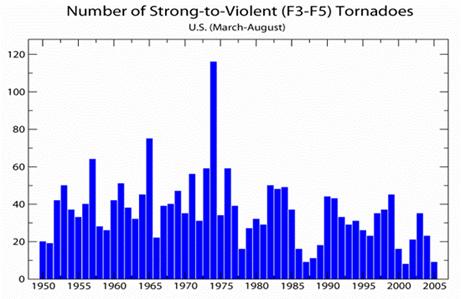
Chapter 9: Rebuttals by Man-made Global Warming Supporters (Skeptics Guide to Global Warming)

The table of contents for the rest of this paper, . 4A Layman's Guide to Anthropogenic Global Warming (AGW) is here Free pdf of this Climate Skepticism paper is here and print version is sold at cost here

As stated in the introduction, the purpose of this paper has
not been to provide a balanced portrayal of Anthropogenic Global Warming (AGW) theory; its purpose instead is to
provide a comprehensive overview of skeptic's concerns with AGW theory.
However, the issues raised here are not necessarily new, and AGW supporters
have attempted to address many of them. 

The New
Scientist
, a fairly strong and reliable voice for advocacy of anthropogenic
global warming theory, recently published its response to what it calls 26
myths about global warming, many of these "myths" being correlated loosely with
skeptics concerns about AGW theory as outlined in this paper.  Walking
through their points seems a reasonable way to entertain a rebuttal to the
skeptic's position.  Each of these has a link to the New Scientist article
in question.  I have tried to summarize the position with a quote, shown
in italics.  My response to each then follows.

Before I get into these 20 myths, note that many of the key
skeptic's questions are neatly avoided.   While the magazine gives
itself certain softball questions, it does not attempt to take on skeptics
questions such as:

  • Isn't warming from CO2 a diminishing return, such that each 10ppm of CO2
    has less warming effect than the last 10 ppm?
  • Isn't warming from CO2 asymptotic, such that total warming from CO2 is
    capped?
  • Isn't 2/3 or more of the future warming in IPCC forecasts due to
    positive feedback effects that tend to be rare in stable systems and that even
    the IPCC admits are poorly understood?
  • Aren't there a lot of problems with ground-based temperature measurements?
  • Aren't the historical proxies for temperature diverging from
    measurements, such that the IPCC actually dropped many of the recent proxy
    measurements to hide this result?

There are many others, but we can get at them tangentially
through dealing with the 20 "myths" below

Human
CO2 emissions are too tiny to matter

So what's going on? It is true that human
emissions of CO2 are small compared with natural sources. But the
fact that CO2 levels have remained steady until very recently shows
that natural emissions are usually balanced by natural absorptions. Now
slightly more CO2 must be entering the atmosphere than is being
soaked up by carbon "sinks".

Though I do know that some skeptics will claim that man can't be changing
world CO2 levels, I don't believe I even tried to make that claim in this paper.

The more salient point in
asking whether human CO2 emissions are too tiny to matter is to ask whether the
change in composition of the atmosphere of 0.009% by human activities is
substantial enough to affect world climate in any important way, particularly
when the portion being increased, CO2, is a relatively weak greenhouse gas vs.
other portions.

We
can't do anything about climate change

It is true that the action taken
so far, such as the Kyoto Protocol, will only have a marginal effect. The
protocol's authors have always described it as a first step. But even before it
came into effect in 2005, the protocol has triggered some profound thinking
among governments, corporations and citizens about their carbon footprint and
how to reduce it. Industrialized countries such as the UK are planning for
emissions reductions of 60% or more by mid-century.

This is a bit of a straw man.  Certainly to the extent
that man is causing climate change, men with enough will can do something about
it.  The question is whether the costs justify the avoided change "“ this
is a question that I have addressed sufficiently and won't revisit here.
However, I would like to comment on this:

We may find that once the
process has begun, the world loses its addiction to carbon fuels surprisingly quickly.
Natural scientists fear "tipping points" in the climate system. But there are
also tipping points in social, economic and political systems. Once under way,
things can happen fast"¦

This is a statement to which I both agree and disagree.  I am a technological
optimist, and so generally accept that world-changing technologies will
continue to spring from man's mind, and that the introduction of these changes
can be fast and their impact dramatic.  The only reason that I am a tad
skeptical about this statement is that the vast majority of strong AGW
adherents are technology pessimists, so it would be uncharacteristic for them
to take such a position.  Absent unimagined new technologies, change of
the type AGW supporters are hoping for is actually not a positive
feedback process as implied in this statement. Why is it that climate
scientists see so many positive feedback processes, when these are actually so
rare? In fact, most investment decisions, for example investments to reduce CO2
emissions, follow a diminishing return relationship.  Early investors
capture the low-hanging fruit, while each successive wave of investment offers
a lower return (here, in CO2 reduction) for each incremental dollar invested.

The
'hockey stick' graph has been proven wrong

Most researchers would agree that while the
original hockey stick can "“ and has "“ been improved in a number of ways, it was
not far off the mark. Most later temperature reconstructions fall within the
error bars of the original hockey stick. Some show far more variability leading
up to the 20th century than the hockey stick, but none suggest that
it has been warmer at any time in the past 1000 years than in the last part of
the 20th century.

No one statement by AGW supporters would do more to build my confidence in
their findings than to actually have someone say "the Mann hockey stick was a
deeply flawed analysis, and we have taken great pains to make sure the flaws identified
in Mann are not present in other historical reconstructions."  However,
when I see the statement above, I am left to wonder if any of the flaws in Mann
have actually been corrected in other works, or if systematic errors still
exist.  Since AGW supporters refuse to acknowledge flaws in Mann, it is
almost certain that these flaws still exist in the other analyses (therefore
making it unsurprising that new analyses show roughly the same results).
Remember that Mann was replaced by Biffra as lead author of this section of the
Fourth IPCC report, and it was Biffra who dropped 20-30 years of recent data
from his historical reconstruction when it did not show the result that he
wanted it to.

Chaotic
systems are not predictable

Getting reasonably accurate
predictions is a matter of choosing the right timescale: days in the case of
weather, decades in the case of climate.

Climate scientists sometimes
refer to the effects of chaos as intrinsic or unforced variability: the
unpredictable changes that arise from the dynamic interactions between the
oceans and atmosphere rather than being a result of "forcings" such
as changes in solar irradiance or greenhouse gases.

The crucial point is that
unforced variability occurs within a relatively narrow range. It is constrained
by the major factors influencing climate: it might make some winters bit a
warmer, for instance, but it cannot make winters warmer than summers

There are systems people who would both agree and disagree
with this statement.  The real study of chaotic systems is barely older
than the study of global warming, and most mathematicians would say that the
issue of long-term predictability of macro trends in chaotic systems is not
settled science.

However, one issue the statement overlooks is that even if
chaotic systems have some long-term order, at least when "viewed from a
distance," this does not mean that the drivers of those long-term trends can be
discerned by those of us standing in the chaos.  So while it may be
theoretically possible to predict long-scale climate changes, it may still be
impossible to discern the true drivers of these climate systems amidst the
chaos, making the long-term prediction problem moot.

Remember, no one has a thermometer that provides two readings "“ temperature
due to "natural" causes and temperature due to man-made forcings. 
The only argument one can make outside of a laboratory is to try to correlate
temperature changes to certain other variables, like CO2 level.  But in a
chaotic system, when thousands of variables may matter, and there are all kinds
of cross-dependencies between variables, definitively showing direct
correlation, much less causation, is very hard, possibly impossible. 
Remember, outside lab experiments, climate scientists main argument that CO2 is
causing current warming is "We have checked everything else it possibly could
be, and it wasn't those things, so it must be CO2."  In a chaotic system,
such a statement borders on hubris.

We
can't trust computer models of climate

Climate is average weather, and it can vary unpredictably
only within the limits set by major influences like the Sun and levels of
greenhouse gases in the atmosphere. We might not be able to say whether it will
rain at noon in a week's time, but we can be confident that the summers will be
hotter than winters for as long as the Earth's axis remains tilted.

The validity of models can be tested against
climate history. If they can predict the past (which the best models are pretty
good at) they are probably on the right track for predicting the future "“ and
indeed have successfully done so.

I hope that if you have learned anything from this paper, you already know
how to refute the statement above.  Climate models match history because
they have been tuned and tweaked and overridden to do so.  The fact that
they then can reproduce history is meaningless.  Even more, you should run
away quickly from anyone who makes this statement, because they are either
ignorant of what they are talking about or they are trying to sell you the
Brooklyn Bridge.

Finally, the claim is sometimes
made that if computer models were any good, people would be using them to
predict the stock market. Well, they are!

A lot of trading in the
financial markets is already carried out by computers. Many base their
decisions on fairly simple algorithms designed to exploit tiny profit margins,
but others rely on more sophisticated long-term models.

Sorry, but this is a facile and ignorant mis-interpretation of what
financial models are doing.  Yes, people are running long-term financial
models as part of a trading strategy, but these models feed into very
short-term trading decisions.  If you looked at the output from these long-term
models, you would see that they are changing constantly as new data flows
in.  There is an old joke about two campers who see a bear growling at
them.  One of them starts putting his tennis shoes on.  The other one
says to him "Why are you putting your shoes on?  You can't outrun that
bear."   His friend replied "I don't have to outrun the bear.  I
just have to outrun you."  Traders' long-term models work the same.
They don't actually expect them to be right, they just want them to be better,
based on current conditions, than other traders' models, then they can make
money.

They
predicted global cooling in the 1970s

Indeed they did"¦. However, Schneider soon
realised he had overestimated the cooling effect of aerosol pollution and
underestimated the effect of CO2, meaning warming was more likely
than cooling in the long run"¦.

The calls for action to prevent further
human-induced global warming, by contrast, are based on an enormous body of
research by thousands of scientists over more than a century that has been
subjected to intense "“ and sometimes ferocious "“ scrutiny. According to the
latest IPCC report, it is more than
90% certain that the world is already warming as a result of human activity

We have already dealt with aerosols, and unlike many skeptics I have not
really held the 1970's global cooling panic against the climate
community.  The last paragraph is just circular.  Saying the IPCC is
90% sure does not answer the arguments about what skeptics feel the IPCC is
ignoring.

It's
been far warmer in the past, what's the big deal?

First of all, it is worth bearing in mind that
any data on global temperatures before about 150 years ago is an estimate, a
reconstruction based on second-hand evidence such as ice cores and isotopic
ratios. The evidence becomes sparser the further back we look, and its
interpretation often involves a set of assumptions. In other words, a fair
amount of guesswork.

This is hilarious.  What happened to their confidence in Mann and
1000-year temperature reconstructions just a few myths back?  But to
continue, the answer is basically yes, but:

The important question is what
is causing the current, rapid warming? We cannot dismiss it as natural
variation just because the planet has been warmer at various times in the past.
Many studies suggest it can only be explained by taking into account human
activity.

Nor does the fact that it has
been warmer in the past mean that future warming is nothing to worry about. The
sea level has been tens of metres higher during past warm periods, enough to
submerge most major cities around the world.

Here is why it matters "“ beyond the laboratory evidence of the greenhouse
effect, which tells us merely that there is an affect and not how strong it is,
the main evidence cited by AGW supporters for current warming being man-made is
to try to show that current warming is somehow unprecedented, and therefore
unlikely to be natural.  So it is odd here that AGW supporters simply
shrug their shoulders here and say that it is not important that current
warming be unprecedented.

It's
too cold where I live - warming will be great

This does not sound too bad, and for many people
it won't be. Wealthy individuals and countries will be able to adapt to most
short-term changes, whether it means buying an air conditioner or switching to
crops better suited to the changing climate. Rainfall will fall in
mid-latitudes but rise in high latitudes, and initially agricultural yields
will probably.  Some regions will suffer, though. Africa could be hardest
hit, with yields predicted to halve in some countries as early as 2020.

As global temperature climbs to 3°C above
present levels - which is likely
to happen
before the end of this century if greenhouse emissions continue
unabated - the consequences will become increasingly severe. More than a third
of species face extinction
. Agricultural yields will start to fall in many
parts of the world. Millions of people will be at risk from coastal flooding.
Heatwaves, droughts, floods and wildfires will take an ever greater toll.

I hope readers will accept that I am not exaggerating or constructing straw
men when I talk about the dire predictions by AGW supporters.  There is
nothing here that we have not dealt with earlier, except perhaps the
rainfall.  Of late, AGW supporters seem to have shifted to rainfall
(rather than sea level rise) as their lead scary topic.  Note, however,
that even the IPCC admits that it and all of its modelers really do not
understand (even a little bit) the effect of global warming on rainfall and
drought.  Logic says that with more water evaporated, while global warming
may cause now local draughts, overall rainfall should increase.  I would
bet any amount of money that lower economic growth due to aggressive CO2 abatement
will have a far more deleterious effect on worldwide agricultural yields than
global warming.

Global
warming is down to the Sun, not humans

So what role, if any, have solar fluctuations
had in recent temperature changes? While we can work out how Earth's orbit has
changed going back many millions of years, we have no first-hand record of the
changes in solar output associated with sunspots before the 20th century.

It is true that sunspot records go back to the
17th century, but sunspots actually block the Sun's radiation. It is
the smaller bright spots (faculae) that increase the Sun's output and these
were not recorded until more recently. The correlation between sunspots and
bright faculae is not perfect, so estimates of solar activity based on sunspot
records may be out by as much as 30%.

The other method of working out past solar
activity is to measure levels of carbon-14 and beryllium-10 in tree rings and
ice cores. These isotopes are formed when cosmic rays hit the atmosphere, and
higher sunspot activity is associated with increases in the solar wind that
deflect more galactic cosmic rays away from Earth. Yet again, though, the
correlation is not perfect. What is more, recent evidence suggests that the
deposition of beryllium-10 can
be affected by climate changes
, making it even less reliable as a measure
of past solar activity.

This is again a pretty hilarious statement.  One could easily argue
that temperature and CO2 proxies have at least as much
uncertainty.  One wonders why AGW advocates do not seem as concerned about
the errors in the proxies they hold dear.  But anyway, to continue:

But even if solar forcing in the past was more
important than this estimate suggests, as some scientists think, there is no
correlation between solar activity and the strong warming during the past 40
years. Claims that this is the case have not stood up to scrutiny (pdf document).

Direct measurements of solar output since 1978
show a steady rise and fall over the 11-year sunspot cycle, but no upwards or downward trend .

Similarly, there is no trend in direct
measurements of the Sun's ultraviolet output and in cosmic rays. So for the
period for which we have direct, reliable records, the Earth has warmed
dramatically even though there has been no corresponding rise in any kind of
solar activity.

This is another you-study-my-study pissing match.  I am happy to admit
that our knowledge of the sun's changing impact on climate is poor, and that it
is hard to separate out this one effect in a chaotic system.  I refuse to
fall into the same scientific hubris as AGW supporters.  However, those
who think the sun has some contribution to warming are buttressed by the
knowledge that they are working with the main driver of climate, rather than a
secondary variable.

It's
all down to cosmic rays

There is no convincing evidence
that cosmic rays are a major factor determining cloud cover. The ionising of
air by cosmic rays will impart an electric charge to aerosols, which in theory
could encourage them to clump together to form particles large enough for cloud
droplets to form around, called "cloud condensation nuclei".

But cloud physicists say it has
yet to be shown that such clumping occurs. And even if it does, it seems
far-fetched to expect any great effect on the amount of clouds in the atmosphere.
Most of the atmosphere, even relatively clean marine air, has plenty of cloud
condensation nuclei already.

A series of attempts by
Svensmark to show an effect have come unstuck. Initially, Svensmark claimed
there was a correlation between cosmic ray intensity and satellite measurements
of total cloud cover since the 1980s "“ yet a correlation does not prove cause
and effect. It could equally well reflect changes in solar irradiance, which
inversely correlate with cosmic ray intensity.

I am starting to notice a trend here of making statements about competing
that could be applied equally well to AGW theory.  And what about all
those points they made above, reminding us over and over that CO2 greenhouse
theory works in the lab.  Now the lab is not good enough?

However, I would accept that the cosmic ray theory is pretty undeveloped and
not acceptably proven.  It has had a number of fits and starts.  Just
like CO2 greenhouse theory, the cosmic ray effect on climate can be reproduced
in the lab, but it is really hard to parse out its effects in the chaotic
climate.

CO2
isn't the most important greenhouse gas

At some of these overlaps, the
atmosphere already absorbs 100% of radiation, meaning that adding more
greenhouse gases cannot increase absorption at these specific frequencies. For
other frequencies, only a small proportion is currently absorbed, so higher
levels of greenhouse gases do make a difference.

This means that when it comes to
the greenhouse effect, two plus two does not equal four.

Wow!  An AGW supporter actually said this in public.  This is to
our point that there is a diminishing return from incremental CO2 in the
atmosphere.  Of course, they say this in the context of trying to show why
water isn't as important as it might seem, but still, it's there

But the overall quantities of these other gases
are tiny. Even allowing for the relative strength of the effects, CO2
is still responsible for two-thirds
of the additional warming
caused by all the greenhouse gases emitted as a
result of human activity.

Water vapour will play a huge role in the
centuries to come, though. Climate models, backed by satellite
measurements
, suggest that the amount of water vapour in the upper
troposphere (about 5 to 10 kilometres up) will double by the end of this
century as temperatures rise.

This will result in roughly twice as much
warming than if water vapour remained constant. Changes in clouds could lead to
even greater amplification of the warming or reduce it "“ there is great uncertainty
about this. What is certain is that, in the jargon of climate science, water
vapour is a feedback, but not a forcing.

Again, I am not getting into this, we covered it plenty in the paper.
When they say "CO2 is still responsible for two-thirds of the additional
warming" (and remember this is an output of their models, not any other
analysis)  what they really mean is that "our models that were programmed
to have CO2 drive the climate show that CO2 drives the climate."
Note that in a three paragraph answer about the effect of water vapor as
a climate feedback, only three words "“ "or reduce it" "“ acknowledge that it
might actually have a negative feedback effect, despite the fact that even the
IPCC includes cloud cover as a negative feedback.  They just don't want to
admit a negative feedback might even exist.

The
lower atmosphere is cooling, not warming

One study in Science
revealed errors in the way satellite data had been collected and interpreted.
For instance, the orbit of satellites gradually slows, which has to be taken
into account because it affects the time of day at which temperature recording
are taken. This problem was always recognised, but the corrections were given
the wrong sign (negative instead positive and vice versa).

A second study, also
in Science
, looked at the weather balloon data. Measurements of the air
temperature during the day can be skewed if the instruments are heated by
sunlight. Over the years the makers of weather balloons had come up with better
methods of preventing or correcting for this effect, but because no one had
taken these improvements into account, the more accurate measurements appeared
to show daytime temperatures getting cooler.

The corrected temperature records show that
tropospheric temperatures are indeed rising at roughly the same rate as surface
temperatures. Or, as a 2006 report by the US Climate Change Science Program (pdf) puts
it: "For recent decades, all current atmospheric data sets now show
global-average warming that is similar to the surface warming." This one
appears settled.

There is still some ambiguity in the tropics,
where most measurements show the surface warming faster than the upper
troposphere, whereas the models predict faster warming of the atmosphere.
However, this is a minor discrepancy compared with cooling of the entire
troposphere and could just be due to the errors of margin inherent in both the
observations and the models.

First, observe absolutely ruthless efforts to apply corrections and
adjustments to any measurement that does not fit their theory, while blithely
accepting the surface temperature measurements that we showed can be really
unreliable.  Given the choice of focusing on managing satellite
temperatures up or surface temperature down, you can see which they
chose.   Second, note that this is another narrow one study
conclusion.  AGW supporters frequently cite single studies (conducted by
AGW supporters) that overturn skeptics arguments as having "settled" the
issue.  There are still many reasons to think that troposphere temperature
increases are less than surface increases.  Finally, even temperature
increases that were the same between the surface and the troposphere would be a
real problem for AGW theory.  The authors here act like this
surface-troposphere issue is a minor deal, but in fact if AGW theory is right,
the troposphere has to warm more, because that is where the extra heat
is being absorbed.  This is not at all settled. 

Antarctica
is getting cooler, not warmer, disproving global warming

It is clear that the Antarctic Peninsula, which juts
out from the mainland of Antarctica towards South America, has warmed
significantly. The continent's interior was thought to have warmed too, but in
2002 a new analysis of
records
from 1966 to 2000 concluded that it has cooled overall"¦.

Climate models do not predict an evenly spread
warming of the whole planet: changes in wind patterns and ocean currents can
change the distribution of heat, leading to some parts warming much faster than
average, while others cool at first.

Agreed

The
oceans are cooling

Now the authors of the 2006 study have submitted a
correction (pdf format)
. It turns out that a fault in the software on some
of the floats led to some temperature measurements being associated with the
wrong depth.

Meanwhile, work by other teams suggests that the
past warmth of the oceans has been overestimated. The problem was due to
expendable sensors that are thrown overboard and take measurements as they
sink.

I never had heard the claim that the oceans were cooling, so it does not
surprise me that they are not.  However, it is again interesting the
amount of due diligence that AGW supporter put in to the correction of any
temperature measurement the might refute global warming, while blithely
accepting the atrocious condition and biases in ground-based temperature
measurement because, well, because these instruments are telling the story they
want to hear.

The
cooling after 1940 shows CO2 does not cause warming

The mid-century cooling appears to have been
largely due to a high concentration of sulphate aerosols in the atmosphere,
emitted by industrial activities and volcanic
eruptions
. Sulphate aerosols have a cooling effect on the climate because
they scatter light from the Sun, reflecting its
energy back out into space
.

The rise in sulphate aerosols was largely due to
the increase in industrial activities at the end of the second world war. In
addition, the large eruption of Mount Agung in 1963 produced aerosols which cooled the
lower atmosphere by about 0.5°C
, while solar activity levelled off after
increasing at the beginning of the century

I think I was pretty fair in discussing the aerosol cooling hypothesis in
this paper, though many would disagree with the above statement's certainty.

Climate models that take into account only
natural factors, such as solar activity and volcanic eruptions, do not
reproduce 20th century temperatures very well. If, however, the models include
human emissions, including greenhouse gases and aerosols, they accurately reproduce
the 1940 to 1970 dip in temperatures.

I hope readers who have made it this far can supply the refutation of this
point:  Wrong, wrong, wrong.  Climate models initially matched
history poorly.  Today they match well because they have been tweaked and
adjusted and forced to match.  They match because they are programmed to
match.  And, as we discussed, they match only because they make
ridiculously low assumptions for natural forcings, and assume all natural
forcings causing temperatures to rise in the first half of the century
magically reversed in 1950, though there is no good evidence for it. 

It
was warmer during the Medieval period, with vineyards in England

In the southern hemisphere, the picture is even
more mixed, with evidence of both warm and cool periods around this time. The
Medieval Warm Period may have been partly a regional phenomenon, with the
extremes reflecting a redistribution of heat around the planet rather than a
big overall rise in the average global temperature.

What is clear, both from the temperature
reconstructions and from independent evidence "“ such as the extent of the
recent melting of mountain glaciers "“ is that the planet has been warmer in the
past few decades than at any time during the medieval period. In fact, the
world may not have been so warm for 6000 or even 125,000 years (see Climate myths: It has been warmer in the past,
what's the big deal?
).

What really matters, though, is not how warm it
is now, but how warm it is going to get in the future. Even the temperature
reconstructions that show the greatest variations in the past 1000 years suggest
up until the 1980s, average temperature changes remained within a narrow band
spanning 1ºC at most. Now we are climbing out of that band, and the latest IPCC report (pdf format) predicts a further rise of
0.5ºC by 2030 and a whopping 6.4ºC by 2100 in the worst case scenario.

We have covered this pretty well in this paper, so again I won't go back
into it, except to highlight a couple of things we can learn from this
statement.  First, note the hubris again "“ it is warmer today than in the
last 125,000 years.  I sure wish there was a way to bet on this "“ I would
have only a one in 125,000 chance of being wrong in betting against this
statement.  Second, note the use of the worst case scenarios.  For
2100, we don't get the best case or even the average case, we get the worst
case.  Can you name another branch of science where people do this?
Can you imagine, say, a group out to measure the speed of light.  They are
going to get some middle figure with an error band of some range.
Wouldn't you expect them to day that they found the speed of light to be
so-and-so, plus or minus an error of such-and-such size?  If they were
climate scientists, they would instead announce that they have found the speed
of light could be as large as Z, that being the highest possible figure in
their error band.

We
are simply recovering from the Little Ice Age

Yet while there is some evidence of cold
intervals in parts of the southern hemisphere during this time, they do not appear to
coincide
with those in the northern hemisphere. Such findings suggest the Little
Ice Age may have been more of a regional phenomenon than a global one.

Solar radiation was probably lower at times
during this period, especially during a dip in solar activity called the
Maunder minimum around 1700, but models and temperature reconstructions suggest
this would have reduced average global temperatures by 0.4ºC at most.

The larger falls in temperature in Europe and
North American may have been due to changes in atmospheric circulation over the
North Atlantic, or in the Gulf Stream, or both, reducing heat transport from
the tropics (see Climate
change sceptics lose vital argument
).

The warming after the so-called Little Ice Age
may reflect both an increase in solar activity and a redistribution of heat
around the planet. In particular, the increase in global temperature in the
first half of the 20th century may have been largely due to an increase
in solar activity. The continued warming in recent decades, however, cannot be
explained by increases in solar radiation alone

Remember the graphs we showed earlier "“ the arctic proxies look like the
current warming is a straight linear increase from the 1700s to today.  In
fact, in the IPCC spaghetti graph showing all those historic reconstructions,
they all show a natural warming from the 18th and 19th
century through the 20th.  Again, AGW supporters really need to
explain why they are so confident that this natural warming trend stopped in
1945 or so, exactly and coincidently at the exact same moment that man-made
forcings caused the world to continue to warm, coincidently at about the same
rate it was warming naturally earlier in the century.

Warming
will cause an ice age in Europe

Few scientists think there will
be a rapid shutdown of circulation. Most ocean models predict no more than a
slowdown, probably towards the end of the century. This could slow or even
reverse some of the warming due to human emissions of greenhouse gases, which
might even be welcome in an overheated Europe, but the continent is not likely
to get colder than it is at present.

A slowdown in circulation would
affect many parts of the world by disrupting global rainfall patterns. But
these effects will be insignificant compared with the much greater changes
global warming will cause

I already mentioned that this had been refuted pretty well

Ice
cores show CO2 increases lag behind temperature rises, disproving
the link to global warming

It takes about 5000 years for an
ice age to end and, after the initial 800 year lag, temperature and CO2
concentrations in the atmosphere rise together for a further 4200 years.

What seems to have happened at
the end of the recent ice ages is that some factor "“ most probably orbital
changes "“ caused a rise in temperature. This led to an increase in CO2,
resulting in further warming that caused more CO2 to be released and
so on: a positive feedback that amplified a small change in temperature. At
some point, the shrinking of the ice sheets further amplified the warming.

Models suggest that rising
greenhouse gases, including CO2, explains about 40% of the warming
as the ice ages ended. The figure is uncertain because it depends on how the
extent of ice coverage changed over time, and there is no way to pin this down
precisely.

I was extremely happy to see that they at least tried to
address the issue I raised, ie is it really realistic to have a process
dominated by positive feedback, and if so, why doesn't it run away.  Their
answer:

Finally, if higher temperatures lead
to more CO2 and more CO2 leads to higher temperatures,
why doesn't this positive feedback lead to a runaway greenhouse effect? There
are various limiting factors that kick in, the most important being that
infrared radiation emitted by Earth increases exponentially with temperature,
so as long as some infrared can escape from the atmosphere, at some point heat
loss catches up with heat retention.

Which might make sense EXCEPT that they are claiming that
today's temperature and level of CO2 are higher than these historical levels,
so we are already higher than the level where they claim "heat loss catches up
with heat retention."  So either their answer is right, and there is a
strong compensating process which is not built into their models, or they are
wrong and they still need to explain what keeps a positive feedback dominated
process from running away.

Ice
cores show CO2 rising as temperatures fell

There are some mismatches though. Besides lags
at the end of ice ages, cores taken from the ice overlying the famous
lake below Vostok
in Antarctica seemed to show that about 120,000 years
ago, the temperature plummeted sharply while CO2 levels remained high
for many thousands of years
.

The question is whether this is real or just a
reflection of the problems with working out the age of the trapped air and with
deuterium as a temperature indicator. Many researchers are working on ways to
independently date the air and the ice, and to improve temperature
reconstructions based on relative deuterium content. One involves working out
what is called the deuterium excess by comparing the relative amounts of
deuterium and oxygen-18 in the ice.

The deuterium excess reflects the temperature at
the sea surface where the water that later fell as snow evaporated, rather than
the surface temperature where the snow fell. It helps to reveal whether
variations in the relative deuterium content of the ice are a result of water
coming from a different source region rather than changes in local temperature.

In 2001, researchers used the deuterium excess to correct for some of the
problems
with the temperature record of the Vostok ice core. Their results produce
a much closer fit between temperature and CO2 levels and reduces the
mismatch around 120,000 years ago to a few thousand years.

I did not really raise this issue, as even the most enthusiastic AGW
supporter does not tend to claim that CO2 drives all historic temperature
changes.  However, again, note the pattern "“ any historic data that does
not fit with AGW data typically is scrutinized and "corrected." 
Articles discussing flaws in methodology in gathering such data are quickly published.
Contrast this with the difficulty scientists have in questioning any data that
supports AGW theory.  As we saw earlier, the New Scientist still can't
bring itself to utter the words "the Mann hockey stick was flawed."
Neither could the IPCC, they just sort of dropped it, or buried it in the midst
of 12 others, without even saying why the analysis that was the centerpiece of
their last report was strangely missing.

Mars
and Pluto are warming too

The Sun's energy output has not increased since
direct measurements began in 1978. If increased solar output really was
responsible, we should be seeing warming on all the planets and their moons,
not just Mars and Pluto.

Our solar system has eight planets, three dwarf
planets and quite a few moons with at least a rudimentary atmosphere, and thus
a climate of sorts. Their climates will be affected by local factors such as
orbital variations, changes in reflectance (albedo) and even volcanic
eruptions, so it would not be surprising if several planets and moons turn out
to be warming at any one time.

I agree we have a lot to learn about this, and nothing at all is
settled.  However, we now have evidence from at least 5 other terrestrial bodies
that are warming at the same time the Earth is warming.  Why do AGW
supporters resist at least investigating further?

Many
leading scientists question climate change

Climate change sceptics sometimes claim that
many leading scientists question climate change. Well, it all depends on what
you mean by "many" and "leading". For instance, in April
2006, 60 "leading scientists" signed a letter urging Canada's
new prime minister to review his country's commitment to the Kyoto protocol.

This appears to be the biggest recent list of
sceptics. Yet many, if not most, of the 60 signatories are not actively engaged
in studying climate change: some are not scientists at all and at least 15 are
retired.

Compare that with the dozens of statements on
climate change from various scientific organisations around the world
representing tens of thousands of scientists, the consensus position
represented by the IPCC reports and the 11,000 signatories to a petition condemning the Bush administration's
stance on climate science.

I have carefully avoided the game of dueling scientific numbers.  As to
the claim that the skeptic list "are not actively engaged in studying
climate change: some are not scientists at all and at least 15 are retired"
I
would be thrilled if AGW supporters held to this standard in making their own
numbers.  But, they manage to abandon this standard by the next paragraph,
when they claim the pro-AGW numbers, like the 11,000, are open to the same
criticism (since there are only 500-600 true climate scientists in the world,
vs. physicist, meteorologists, etc). 

It's
all a conspiracy

Now that there is a consensus, those whose
findings challenge the orthodoxy are always going have a tougher time
convincing their peers, as in any field of science. For this reason, there will
inevitably be pressure on scientists who challenge the consensus. But findings
or ideas that clash with the idea of human-induced global warming have not been
suppressed or ignored "“ far from it.

Journalists do have an interest in promoting
themselves (and their books), while their employers want to boost their
audience and sell advertising. Publicity helps with all these aims, but you get
far more publicity by challenging the mainstream view than by promoting it.
Which helps explain why so many sections of the media continue to publish or
broadcast the claims of deniers, regardless of their merit.

The notion of a "conspiracy" of course, is a useful straw man, implying
devious villains in the SPECTRE conference room planning the overthrow of the
world.   I won't argue the point again, except to encourage you to
watch the news with a critical eye, and decide for yourself.  However, just
to get you started, ask yourself if these events are signs of healthy, unbiased
science:

· A
group of AGW supporters are trying to get the British government to use force
to block the publication of a skeptical movie (the Global Warming Swindle)

· AGW
supporters in California have included skeptical scientists such as MIT's Dr.
Richard Lindzen as defendants in a law suit, asking that damages be paid by
people and companies whose public speech doesn't conform to AGW theory

· Many
AGW skeptics have been unable to get scientists who have published publicly
funded research to reveal their data and methodology for critique.
Freedom of Information Act (FOIA) requests have become a necessary tool of
climate skeptics.

· When
a group began photographing temperature measurement points to document the
shortcomings in historical surface temperature measurements, the NOAA pulled
the locations of its measurement stations off the Internet so that these US
citizens could no longer take pictures of and critique US government
installations.

· Scientists
who question AGW theory are equated by AGW supporters with Holocaust deniers.

Hurricane
Katrina was caused by global warming

More data is needed settle the issue. Some are
looking to natural records of past
hurricane activity
in stalagmites, lake deposits and coral rubble. Others
are re-analysing existing databases. In February 2007, one such re-analysis
concluded that over the past two decades, hurricane intensity has increased
in the Atlantic but not in other parts of the world
(pdf format).

Yet another complicating factor is that changes
in climate can also change the paths that tropical cyclones tend to take,
determining whether they remain over oceans or strike land.

What every one agrees on is that over the past
few decades there has been a huge rise in the number of people being killed or
injured by hurricanes, and in damage to infrastructure, and this trend looks
set to continue. The main reason for this, however, is that more and more
people are living and building in hurricane zones.

Most of these three paragraphs is entirely correct "“ there is no evidence
that hurricane numbers or intensity are effected by global warming, and if they
are, whether they are increased or decreased.  However, Hurricane Katrina
was most certainly NOT caused by global warming.  Why can't they just say
that?   It may have been made stronger or weaker.  Its course
may have been altered.   But it was not created by warming.  By
the way, the year after Katrina saw a much smaller than average Atlantic
hurricane season.

Higher
CO2 levels will boost plant growth and food production

But it is extremely difficult to generalise
about the overall impact on plant growth. Numerous groups around the world have
been conducting experiments in which plots of land
are supplied with enhanced CO2, while comparable nearby plots remain
at normal levels.

While these experiments typically have found
initial elevations in the rate of plant growth, these have tended to level off
within a few years. In most cases this has been found to be the result of some
other limiting factor, such as the availability of nitrogen or water.

So the answer is yes, but there is a diminishing return at some point.
Isn't that the same as can be said for the CO2 greenhouse effect?

Predicting the world's overall changes in food
production in response to elevated CO2 is virtually impossible.
Global production is expected to rise until the increase in local average
temperatures exceeds 3°C, but then start to fall. In tropical and dry regions
increases of just 1 to 2°C are expected to lead to falls in production. In
marginal lands where water is the greatest constraint, which includes much of
the developing world but also regions such as the western US, the losses may
greatly exceed the gains.

Have you noticed yet that things that might hurt the AGW-interventionist's
case always seem "impossible to predict" while the climate is well within our
prediction capabilities?

As for food crops, the factors are more complex.
The crops most widely used in the world for food in many cases depend on
particular combinations of soil type, climate, moisture, weather patterns and
the infrastructure of equipment, experience and distribution systems. If the
climate warms so much that crops no longer thrive in their traditional settings,
farming of some crops may be able to shift to adjacent areas, but others may
not. Rich farmers and countries will be able to adapt more easily than poorer
ones.

I love the rich-poor language.  The leftish New Scientist simply can't
help itself.  But I will accept this statement, and go further:  This
is the reason that aggressive actions to reduce CO2 that reduce economic
growth, particularly in the developing world, may not make sense.  To the
extent that some climate change will occur no matter what, or is already
programmed by our past actions, then a richer world can deal with it better
than a poorer one.

Polar
bear numbers are increasing

Yet recently there have been
claims that polar bear populations are increasing. So what's going on? There
are thought to be between 20,000 and 25,000 polar bears in 19 population groups
around the Arctic. While polar bear numbers are increasing in two of these
populations, two others are definitely in decline. We don't really know how the
rest of the populations are faring, so the truth is that no one can say for
sure how overall numbers are changing.

Again, I love this.  We can know the global temperature
increase over a century to a tenth of a degree but it is impossible to count
polar bears.

A comprehensive review (pdf) by the US Fish and Wildlife Service
concluded that shrinking sea ice is the primary cause for the decline seen in
these populations, and it recently proposed listing
polar bears as threatened (pdf)
under the Endangered Species Act. The
International Conservation Union projects the bears' numbers will drop by 30% by 2050
(pdf)
due to continued loss of Arctic sea ice.

Note that down 30% (which coming from an environmental
advocacy ground has got to be considered the most extreme possible estimate) is
not "extinct."  The article fails to address at all the issue that polar
bears have survived through eras when Arctic sea ice melted completely in the
summers.  And there are many reasons for threats to polar bear numbers "“
most experts would say that hunting and threats to habitat are much more
important factors than global temperatures.

The table of contents for the rest of this paper, . 4A Layman's Guide to Anthropogenic Global Warming (AGW) is here Free pdf of this Climate Skepticism paper is here and print version is sold at cost here

The open comment thread for this paper can be found here. 
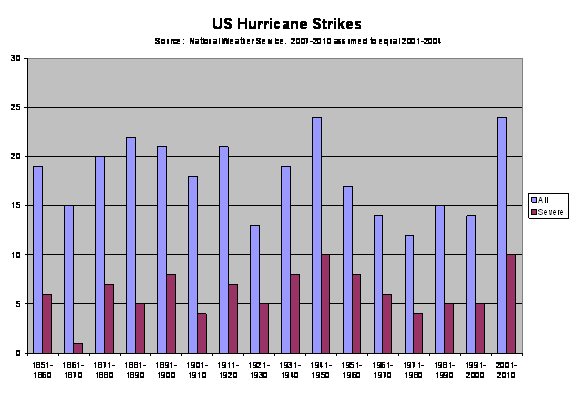
The Great Boom

Let me try something out on readers.  It strikes me that we are in the midst of what we may look back on as one of the great global economic booms of all time.  Here's my logic:  In the US, let's say that on average our labor is operating with a management and technology factor of "10." As management practices advance, and manufacturing and support technologies are developed, we might move this up to "11" [insert Spinal Tap joke].  We then enjoy the productivity upgrade of going from 10 to 11.  However, as the world invests in places like China and India, we see labor that has plugged along at "1" get brought up quickly towards "10."  What a huge change!  Two billion people with exponentially rising labor productivity -- what an enormous increase in wealth!

I think too many people look at the growth of China through the lens of low labor costs, and assume that as the wages in China begin to rise, the boom will be over.  But the source of wealth creation in China is not taking advantage of low wages, it is raising productivity.  The boom will continue as long as productivity increases by leaps and bounds; rising wages are just a sign that Chinese workers are getting a share of this productivity increase.

Where's The Symmetry?

I am sitting in the airport now about to fly back to Phoenix.  I generally fly America West / US Airways, because they have a hub in Phoenix and doing so maximizes my chance both of getting non-stop flights as well as accumulating a meaningful frequent flier balance with a singe airline.

After way too many round trips, I have the following observation:  I am much more likely to get an elite upgrade returning home than on the outbound leg.   I have seen this effect both flying the hub airline out of Phoenix and previously flying United out of Denver.   Now, as a hub city, Phoenix has a disproportionate number of US Airways elite members, just as Denver has a disproportionate number of United elite members.  So competing with a lot of other elite members for limited upgrade seats is understandable out of Phoenix, but shouldn't it be symmetric coming back?  I have three theories:

  • Observer error, though I will say I have a fairly large number of observation points to many different cities from two different hub cities
  • I am flying when the Elite's like to fly outbound, but I tend to take unpopular flights back.  Possible.  Most business travelers tend to fly outbound in the morning on the first flight, but they may all come back different times of day depending on their business.  This is one potential asymmetry.
  • The airlines give preference on upgrades to through passengers.  I have never heard this, but it might explain it.  Outbound from a hub, many of the people on my flight are on the second flight, having just changed planes.  Going home, towards a hub, everyone is in the same boat as me, on their first leg.  I don't think the airlines differentiate, but this is the only other asymmetry I can come up with.

Senate Passes Massive Farm-Subsidy Bill

Though it is nominally called an "energy" bill, the Senate just passed the largest farm-subsidy bill in history:

The legislation would require ethanol production for motor fuels to
grow to at least 36 billion gallons a year by 2022, a sevenfold
increase over the amount of ethanol processed last year. It also calls
for boosting auto fuel economy to a fleet average of 35 miles per
gallon by 2020, a 40 percent increase over current requirements for
cars, SUVs, vans and pickup trucks.

The evidence is absolutely unequivocal that corn-based ethanol doesn't reduce net energy use, since it takes at least as much energy to grow and produce as it provides.  It is even worse as environmental policy, since it almost certainly increases total pollution and CO2 production, particularly as ethanol is produced with Midwestern coal-powered electricity.   In addition, it is going to cause marginal lands and open space to be brought into corn production, reversing a 70-year trend in the US towards increases in wilderness and forested land.  It is going to increase fuel costs to no real purpose.  This is dumb, dumb, dumb.  So stupid that I can't even get the energy to criticize the new CAFE standards.  If they really wanted to meet their goals, a carbon tax would have been cheaper and more effective, but that would have taken political guts.

Signal to Noise Ratio, Part 2

Anthony Watts and Steven McIntyre make an interesting observation, using an example temperature measurement point in the US and Global Historical Climate Network (the network that most historic global warming estimates are made from).

Over time, temperature measurement points, even those nominally in the same town, tend to change.  The measurement technology changes (from bulbs to electronics) the location can move across town, and towns with their heat islands can encroach.  As a result, scientists try to make guesstimate corrections to the historical data to take these events into account. 

Taking just one example measurement point, at Petaluma CA, Watts and McIntyre show how two different adjustment approaches by scientists at this location change the historic warming measured by over 1.5 degrees C.  Note that this "noise" is more than twice the value of the estimated "signal" -- the estimated 0.6 degrees C global warming over the last century.

More on signal to noise ratios in global warming measurement.

Does this Make Sense?

I am just finishing up my paper "A Skeptical Layman's Guide to Anthropogenic Global Warming," and one thing I encounter a lot with sources and websites that are strong supporters of Anthropogenic Global Warming (AGW) theory is that they will often say such-and-such argument by skeptics was just disproved by so-and-so. 

For example, skeptics often argue that historical temperature records do not correct enough for the effects of urbanization on long-term measurement points.  The IPCC, in fact, has taken the position that what is called the urban heat island effect is trivial, and does not account for much or any of measured warming over the last 100 years.  To this end, one of the pro-AGW sites (either RealClimate.org or the New Scientist, I can't remember which) said that "Parker in 2006 has disproved the urban heat island effect."

Now, if you were going to set out to do such a thing, how would you do it?  The logical way, to me, would be to draw a line from the center of the city to the rural areas surrounding it, and take a bunch of identical thermometers and have people record temperatures every couple of miles along this line.  Then you could draw a graph of temperature vs. nearness to the city center, and see what you would find.

Is that what Parker did?  Uh, no.  I turn it over to Steve McIntyre, one of the two men who helped highlight all the problems with the Mann hockey stick several years ago.

If you are not a climate scientist (or a realclimate reader), you
would almost certainly believe, from your own experience, that cities
are warmer than the surrounding countryside - the "urban heat island".
From that, it's easy to conclude that as cities become bigger and as
towns become cities and villages become towns, that there is a
widespread impact on urban records from changes in landscape, which
have to be considered before you can back out what portion is due to
increased GHG.

One of the main IPCC creeds is that the urban heat island effect has
a negligible impact on large-scale averages such as CRU or GISS. The
obvious way of proving this would seem to be taking measurements on an
urban transect and showing that there is no urban heat island. Of
course, Jones and his associates can't do that because such transects
always show a substantial urban heat island. So they have to resort to
indirect methods to provide evidence of "things unseen", such as Jones
et al 1990, which we've discussed in the past.

The newest entry in the theological literature is Parker (2004, 2006),
who, once again, does not show the absence of an urban heat island by
direct measurements, but purports to show the absence of an effect on
large-scale averages by showing that the temperature trends on calm
days is comparable to that on windy days. My first reaction to this,
and I'm sure that others had the same reaction was: well, so what? Why
would anyone interpret that as evidence one way or the other on UHI?

He goes on to take the study apart in detail, but I think most of you can see that the methodology makes absolutely zero sense unless one is desperately trying to toe the party line and win points with AGW supporters by finding some fig leaf to cover up this urban heat island problem.  By the way, plenty of people have performed the analysis the logical way we discussed first, and have shown huge heat island effects:

Uhi(Click for a larger view)

The bottom axis by the way is a "sky-view" metric I had not seen before, but is a measurement of urban topology.  Effectively the more urbanized and the more tall buildings around you that create a canyon effect, the lower the sky view fraction.  Note that no one gets a number for the Urban Heat Island effect less than 1 degree C, and many hover around 6 degrees (delta temperature from urban location to surrounding rural countryside).  Just a bit higher than the 0.2C assumed by the IPCC.  Why would they assume such a low number in the face of strong evidence?  Because assuming a higher number would reduce historical warming numbers, silly.

Oh, and the IPCC argues that the measurement points it uses around the world are all rural locations so urban heat island corrections are irrelevant.  Below are some sample photos of USHCN sites, which are these supposedly rural sites that are used in the official historical warming numbers.  By the way, these US sites are probably better than what you would find anywhere else in the world. (All pictures from surfacesations.org)  As always, you can click for a larger view.

Marysville_issues1 

Forestgrove

Tahoe_city3

Petaluma_east

You can help with the effort of documenting all the US Historical Climate Network (USHCN) stations.  See my post here -- I have already done two and its fun!

I Must Have Everyone's Verbal Response

This policy at Antioch College, which apparently will soon close its doors due to low enrollment, sounds like the speech I get when I sit in an exit row:

  • Consent is required each and every time there is sexual activity.
  • All parties must have a clear and accurate understanding of the sexual activity.
  • The person(s) who initiate(s) the sexual activity is responsible for asking for consent.
  • The person(s) who are asked are responsible for verbally responding.
  • Each new level of sexual activity requires consent.
  • Use
    of agreed upon forms of communication such as gestures or safe words is
    acceptable, but must be discussed and verbally agreed to by all parties
    before sexual activity occurs.
  • Consent is required
    regardless of the parties' relationship, prior sexual history, or
    current activity (e.g. grinding on the dance floor is not consent for
    further sexual activity).
  • At any and all times when consent is withdrawn or not verbally agreed to, the sexual activity must stop immediately.
  • Silence is not consent.
  • Body movements and non-verbal responses such as moans are not consent.
  • A person can not give consent while sleeping.
  • All
    parties must have unimpaired judgement (examples that may cause
    impairment include but are not limited to alcohol, drugs, mental health
    conditions, physical health conditions).
  • All parties must use safer sex practices.
  • All
    parties must disclose personal risk factors and any known STIs.
    Individuals are responsible for maintaining awareness of their sexual
    health.

I don't know much about Antioch, despite the fact that I think my mother and father-in-law both attended (are there more than one?).  I will observe that for a private institution nowadays with decent name recognition, it really takes some effort to drive away all the students.  Today, good-but-not-Ivy-League schools like Rice and Vanderbilt get nearly as many great applicants as Ivy League schools did when I attended.  The US is virtually swamped with top-notch kids looking for a private university with a good rep.

Wither Supply and Demand, In Favor of the Oil Trading Cabal?

I had an odd and slightly depressing conversation with a friend the other night.  He is quite intelligent and well-educated, and in business is probably substantially more successful, at least financially, than I.

Somehow we got in a discussion of oil markets, and he seemed to find my position suggesting that oil prices are generally set by supply and demand laughable, so much so he eventually gave up with me as one might give up and change the subject on someone who insists the Apollo moon landings were faked. I found the conversation odd, like having a discussion with a fellow
chemistry PHD and suddenly having them start defending the phlogiston
theory of combustion. His core position, as best I could follow, was this:

  1. Limitations on supply in the US, specifically limitations on new oil field development and refinery construction, are engineered by oil companies attempting to keep prices high.
  2. Oil prices are set at the whim of oil traders in London and New York, who are controlled by US oil companies.  The natural price of oil today should be $30 or $40, but oil traders keep it up at $60.  While players upstream and downstream may have limited market shares, these traders act as a choke point that controls the whole market.  All commodity markets are manipulated, or at least manipulatable, in this manner
  3. Oil supply and demand is nearly perfectly inelastic. 
  4. If there really was a supply and demand reason for oil prices to shoot up to $60, then why aren't we seeing any shortages?
  5. Oil prices only rise when Texas Republicans are in office.  They will fall back to $30 as soon as there is a Democratic president.  On the day oil executives were called to testify in front of the Democratic Congress recently, oil prices fell from $60 to $45 on that day, and then went right back up.

Ignoring the Laws of Economics (Price caps and floors)

While everyone (mostly) knows that we are suspending disbelief when the James Bond villain seems to be violating the laws of physics, there is a large cadre of folks that do believe that our economic overlords can suspend the laws of supply and demand.   As it turns out, these laws cannot be suspended, but they can certainly be ignored.  Individuals who ignore supply and demand in their investment and economic decision making are generally called "bankrupt," at least eventually, so we don't always hear their stories (the Hunt brothers attempt to corner the silver market is probably the best example I can think of).  However, the US government has provided us with countless examples of actions that ignore economic reality.

The most typical example is in placing price caps.  The most visible example was probably the 1970's era caps on oil, gasoline, and natural gas prices and later "windfall profit" taxes.  The result was gasoline lines and outright shortages.  With prices suppressed below the market clearing price, demand was higher and supply was lower than they would be in balance. 

The my friend raised is different, one where price floors are imposed by industry participants or the government or more likely both working in concert.   The crux of my argument was not that government would shy away from protecting an industry by limiting supply, because they do this all the time. The real problem with the example at hand is that, by the laws of supply and demand, a price floor above the market clearing price should yield a supply glut.  As it turns out, supply guts associated with cartel actions to keep prices high tend to require significant, very visible, and often expensive actions to mitigate.  Consider two examples:

Realtors and their trade group have worked for years to maintain a tight cartel, demanding a 6% or higher agency fee that appears to be increasingly above the market clearing price.  The result of maintaining this price floor has been a huge glut of real estate agents.  The US is swimming in agents.  In an attempt to manage this supply down, realtors have convinced most state governments to institute onerous licensing requirements, with arcane tests written and administered by... the realtor's trade group.  The tests are hard not because realtors really need to know this stuff, but because they are trying to keep the supply down.   And still the supply is in glut.  Outsiders who try to discount or sell their own home without a realtor (ie, bring even more cheap capacity into the system) are punished ruthlessly with blackballs.  I have moved many times and have had realtors show me over 300 houses -- and you know how many For Sale By Owner homes I have been shown?  Zero.  A HUGE amount of effort is expended by the real estate industry to try to keep supply in check, a supply glut caused by holding rates artificially high. 

A second example of price floors is in agriculture.  The US Government, for whatever political reasons, maintains price floors in a number of crops.  The result, of course, has been a supply glut in these commodities.  Sopping up this supply glut costs the US taxpayer billions.  In some cases the government pays to keep fields fallow, in others the government buys up extra commodities and either stores them (cheese) or gives them away overseas.  In cases like sugar, the government puts up huge tarriff barriers to imports, otherwise the market would be glutted with overseas suppliers attracted by the artificially high prices.  In fact, most of the current subsidy programs for ethanol, which makes almost zero environmental or energy policy sense, can be thought of as another government program to sop up excess farm commodity supply so the price floor can be maintained.

I guess my point from these examples is not that producers haven't tried to impose price floors above the market clearing price, because they have.  And it is not even that these floors are not sustainable, because they can be if the government steps in to help with their coercive power and our tax money to back them.  My point is, though, that the laws of supply and demand are not suspended in these cases.  Price floors above the market clearing price lead to supply gluts, which require very extensive, highly visible, and often expensive efforts to manage.  As we turn now to oil markets, we'll try to see if there is evidence of such actions taking place.

The reasons behind US oil production and refining capacity constraints

As to his first point, that oil companies are conspiring with the government to artificially limit oil production and refining capacity, this certainly would not be unprecedented in industry, as discussed above.  However, any historical study of these issues in the oil industry would make it really hard to reach this conclusion here.  There is a pretty clear documented record of oil companies pushing to explore more areas (ANWR, offshore) that are kept off-limits due to environmental pressures.  While we have trouble imagining the last 30 years without Alaskan oil, the US oil companies had to beg Congress to let them build the pipeline, and the issue was touch and go for a number of years.  The same story holds in refining, where environmental pressure and NIMBY concerns have prevented any new refinery construction since the 1970's (though after years and years, we may be close in Arizona).  I know people are willing to credit oil companies with just about unlimited levels of Machiavellianism, but it would truly be a PR coup of unprecedented proportions to have maintained such a strong public stance to allow more capacity in the US while at the same time working in the back room for just the opposite.

The real reason this assertion is not credible is that capacity limitations in the US have very clearly worked against the interests of US oil companies.  In production, US companies produce on much better terms from domestic fields than they do when negotiating with totalitarian regimes overseas, and they don't have to deal with instability issues (e.g. kidnapping in Nigeria) and expropriation concerns.  In refining, US companies have seen their market shares in refined products fall since the 1970s.  This is because when we stopped allowing refinery construction in this country, producing countries like Saudi Arabia went on a building boom.  Today, instead of importing our gasoline as crude to be refined in US refineries, we import gas directly from foreign refineries.  If the government is secretly helping oil companies maintain a refining capacity shortage in this country, someone forgot to tell them they need to raise import duties to keep foreign suppliers from taking their place. 

What Oil Traders can and cannot do

As to the power of traders, I certainly believe that if the traders could move oil prices for sustained periods as much as 50% above or below the market clearing price, they would do so if it profited them.  I also think that speculative actions, and even speculative bubbles, can push commodity prices to short-term extremes that are difficult to explain by market fundamentals.  Futures contracts and options, with their built in leverage, allow even smaller players to take market-moving positions.  The question on the table, though, is whether oil traders can maintain oil prices 50% over the market clearing prices for years at a time.  I think not.

What is often forgotten is that companies like Exxon and Shell control something like 4-5% each of world production (and that number is over-stated, since much of their production is as operator for state-owned oil companies who have the real control over production rates).  As a point of comparison, this is roughly the same market Toshiba has in the US computer market and well below Acer's.  As a result, there is not one player, or even several working in tandem, who hold any real power in crude markets.  Unless one posits, as my friend does, that NY and London traders somehow sit astride a choke point in the world markets.

But here is the real problem with saying that these traders have kept oil prices 50% above the market clearing price for the last 2-3 years:  What do they do with the supply glut?  We know from economics, as well as the historic examples reviewed above, that price floors above the clearing price should result in a supply glut.  Where is all the oil?

Return to the example of when the Hunt's tried to corner the silver market.  Over six months, they managed to drive the price from the single digits to almost $50 an ounce.  Leverage in futures markets allowed them to control a huge chunk of the available world supply.  But to profit from it (beyond a paper profit) the Hunts either had to take delivery (which they were financially unable to do, as they were already operating form leveraged positions) or find a buyer who accepted $50 as the new "right" price for silver, which they could not.  No one wanted to buy at $50, particularly from the Hunts, since they knew the moment the Hunt's started selling, the price would crash.  As new supplies poured onto the market at the higher prices, the only way the Hunt's could keep the price up was to pour hundreds of millions of dollars in to buy up this excess supply.  Eventually, of course, they went bankrupt.  But remember the takeaway:  They only could maintain the artificially higher commodity price as long as they kept buying excess capacity, a leveraged Ponzi game that eventually collapsed.

So how do oil traders' supposedly pull off this feat of keeping oil prices elevated about the market clearing price?  Well, there is only one way:  It has to be stored, either in tanks or in the ground.  The option of storing the extra supplies in tanks is absurd, especially over a period of years - after all, at its peak, $60 of silver would sit on the tip of my finger, but $60 of oil won't fit in the trunk of my car.  The world oil storage capacity is orders of magnitude too low.  So the only real option is to store it in the ground, ie don't allow it to get produced. 

How do traders pull this off?  I have no idea.  Despite people's image, the oil producer's market is incredibly fragmented.  The biggest companies in the world have less than 5%, and it rapidly steps down from there. It is actually even more fragmented than that, because most oil production is co-owned by royalty holders who get a percentage of the production.  These royalty holders are a very fragmented and independent group, and will complain at the first sign of their operator not producing fast and hard enough when prices are high.  To keep the extra oil off the market, you would have to send signals to a LOT of people.  And it has to be a strong and clear signal, because price is already sending the opposite signal.  The main purpose of price is in its communication value -- a $60 price tells producers a lot about what and how much oil should be produced (and by the way tells consumers how careful to be with its use).  To override this signal, with thousands of producers, to achieve exactly the opposite effect being signaled with price, without a single person breaking the pack, is impossible.  Remember our examples and the economics - a sustained effort to keep prices substantially above market clearing prices has to result in visible and extensive efforts to manage excess supply.

Also, the other point that is often forgotten is that private exchanges can only survive when both Sellers AND buyers perceive them to be fair.  Buyers are quickly going to find alternatives to exchanges that are perceived to allow sellers to manipulate oil prices 50% above the market price for years at a time.  Remember, we think of oil sellers as Machiavellian, but oil buyers are big boys too, and are not unsophisticated dupes.  In fact, it was the private silver exchanges, in response to just such pressure, that changed their exchange rules to stop the Hunt family from continuing to try to corner the market.  They knew they needed to maintain the perception of fairness for both sellers and buyers.

Supply and Demand Elasticity

From here, the discussion started becoming, if possible, less grounded in economic reality.  In response to the supply/demand matching issues I raised, he asserted that oil demand and supply are nearly perfectly inelastic.  Well, if both supply and demand are unaffected by price, then I would certainly accept that oil is a very, very different kind of commodity.  But in fact, neither assertion is true, as shown by example here and here.  In particular, supply is quite elastic.  As I have written before, there is a very wide range of investments one can make even in an old existing field to stimulate production as prices rise.  And many, many operators are doing so, as evidenced by rig counts, sales at oil field services companies, and even by spam investment pitches arriving in my in box.

I found the statement "if oil prices really belong this high, why have we not seen any shortages" to be particularly depressing.  Can anyone who sat in at least one lecture in economics 101 answer this query?  Of course, the answer is, that we have not seen shortages precisely because prices have risen, fulfilling their supply-demand matching utility, and in the process demonstrating that both supply and demand curves for oil do indeed have a slope.  In fact, shortages (e.g. gas lines or gas stations without gas at all) are typically a result of government-induced breakdowns of the pricing mechanism.  In the 1970's, oil price controls combined with silly government interventions (such as gas distribution rules**) resulted in awful shortages and long gas lines.  More recently, fear of "price-gouging" legislation in the Katrina aftermath prevented prices from rising as much as they needed to, leading to shortages and inefficient distribution.

Manipulating Oil Prices for Political Benefit

As to manipulating oil or gas prices timed with political events (say an election or Congressional hearings), well, that is a challenge that comes up all the time.  It is possible nearly always to make this claim because there is nearly always a political event going on, so natural volatility in oil markets can always be tied to some concurrent "event."  In this specific case, the drop from $60 to $35 just for a Congressional hearing is not even coincidence, it is urban legend.  No such drop has occurred since prices hit 60, though prices did drop briefly to 50.  (I am no expert, but in this case the pricing pattern seen is fairly common for a commodity that has seen a runup, and then experiences some see-sawing as prices find their level.)

This does not mean that Congressional hearings did not have a hand in helping to drive oil price futures.  Futures traders are constantly checking a variety of tarot cards, and indications of government regulatory activity or legislation is certainly part of it.  While I guess traders purposely driving down oil prices ahead of the hearing to make oil companies look better is one possible explanation;  a more plausible one (short of coincidence, since Congress has hearings on oil and energy about every other month) is that traders might have been anticipating some regulatory outcome in advance of the hearing, that became more less likely once the hearings actually occurred.  *Shrug*  Readers are welcome to make large short bets in advance of future Congressional energy hearings if they really think the former is what is occurring. 

As to a relationship between oil prices and the occupant of the White House, that is just political hubris.  As we can see, real oil prices rose during Nixon, fell during Ford, rose during Carter, fell precipitously during Reagan, were flat end to end for Bush 1 (though with a rise in the middle) and flat end to end for Clinton.  I can't see a pattern.

If Oil Companies Arbitrarily Set Prices, Why Aren't They Making More Money?

A couple of final thoughts.  First, in these heady days of "windfall" profits, Exxon-Mobil is making a profit margin of about 9% - 10% of sales, which is a pretty average to low industrial profit margin.  So if they really have the power to manipulate oil prices at whim, why aren't they making more money?  In fact, for the two decades from 1983 to 2002, real oil prices languished at levels that put many smaller oil operators out of business and led to years of layoffs and down sizings at oil companies.  Profit margins even for the larges players was 6-8% of sales, below the average for industrial companies.  In fact, here is the profitability, as a percent of sales, for Exxon-Mobil over the last 5 years:

2006:  10.5%

2005:  9.7%

2004:  8.5%

2003:  8.5%

2002:  5.4%

2001:  7.1%

Before 2001, going back to the early 80's, Exxon's profits were a dog.  Over the last five years, the best five years they have had in decades, their return on average assets has been 14.58%, which is probably less than most public utility commissions allow their regulated utilities.  So who had their hand on the pricing throttle through those years, because they sure weren't doing a very good job!  But if you really want to take these profits away (and in the process nuke all the investment incentives in the industry) you could get yourself a 15 to 20 cent decrease in gas prices.  Don't spend it all in one place.

** One of the odder and forgotten pieces of legislation during and after the 1972 oil embargo was the law that divided the country into zones (I don't remember how, by counties perhaps).  It then said that an oil company had to deliver the same proportion of gas to each zone as it did in the prior year  (yes, someone clearly took this right out of directive 10-289).  It seemed that every Representative somehow suspected that oil companies in some other district would mysteriously be hoarding gas to their district's detriment.  Whatever the reason, the law ignored the fact that use patterns were always changing, but were particularly different during this shortage.  Everyone canceled plans for that long-distance drive to Yellowstone.  The rural interstate gas stations saw demand fall way off.  However, the law forced oil companies to send just as much gas to these stations (proportionally) as they had the prior year.  The result was that rural interstates were awash in gas, while cities had run dry.  Thanks again Congress.