More Great Headlines
The great headline writers all seem to have moved to the sports page:
Wang provides lift for Yankees' staff
H/T to Fire Joe Morgan
Dispatches from District 48
The great headline writers all seem to have moved to the sports page:
Wang provides lift for Yankees' staff
H/T to Fire Joe Morgan
Regulators can always declare a merger to be monopolistic -- they just have to define the market narrow enough. For example, if the FCC and FTC are considering calling satellite radio a separate market from terrestrial radio as an excuse to stop the Sirius-XM merger. The NAB, the trade group fro terrestrial radio, has been going ape trying to block the merger, knowing that the two together will cause its stations to bleed listeners to satellite even faster than in the past. Hilariously, though, the NAB is having to twist itself into pretzels as it goes to Defcon 1 trying to stop the merger by ... arguing that satellite radio is a separate market from terrestrial radio and thus the merger is monopolistic. Begging the question, then, why they are working so hard to block it, particularly after the FCC has allowed huge consolidation and merger activity among NAB members.
Now, history is repeating itself yet again, as the FTC threatens to block the Whole Foods - Wild Oats merger because... it claims organic food grocery stores are a separate market from other grocery stores. Uh, right. Extra points, as in satellite radio, for claiming consumers will be irreparably harmed by a merger in a "market" that did not even exist 2 decades ago.
Since many advocates of anthropomorphic global warming theory have declared the twenty-year-old science to be "settled," then there must not be very much controversy or disagreement in the peer review reader comments to the UN's Fourth IPCC report. Except, no one seems willing to publicize these comments. Even US government organizations paid for by taxpayers. Steve McIntyre is again having to resort to filing FOIA's to get the details of climate research.
Update: It appears that Congress is taking a similar approach to climate research when it comes to openness about earmarks.
Well, it's my first airline flight of the summer, and, as usual, I have forgotten how awful it is to fly between Memorial Day and Labor Day. And it is not just the crowds. I hate to sound overly misanthropic, but summer is when all the folks who have never been on an airplane show up at the security station right in front of me. It is amazing how long a family of four who has no clue how airport security works can hold up an X-ray line. Of course, this being the vacation season government employees, capacity actually was lower today (fewer X-ray lines open) to meet the higher demand.
Update: Perfect weather in Phoenix and at my destination in Denver. So of course we have a 2-hour air traffic hold.
Well, thanks a hell of a lot, mainstream media, for doing such a good job of delivering the facts. QandO, in discussing the issues behind my earlier post on testing for mad-cow disease (BSE) helpfully includes this link to the EU's BSE testing site (the home of the testing program supposedly so much more enlightened than ours):
No method will detect BSE early in the infection. BSE has an average incubation period of 4-6 years. Therefore the EU testing programmes are targeted at animals over 30 months. The PrPres has not been detected in bovine brain or other nervous tissue very early in the disease and infectivity has not been shown either. In experimental infection where very high doses were administered, infectivity has been found in the ileum, part of the intestine. This has not been detected in natural infections.
Robert Fulton, via QandO, supplies the one other missing fact: Most US cows are slaughtered as two-year-olds. So they can't have BSE, because you can't have a five-year incubation disease in a 2-year-old animal. And further, even if the animal has latent BSE infection, which has never been shown to harm humans, it can't be detected by current technology! Even those superior Euros only test at 30 months. This is an issue for aging dairy cows sent to slaughter, not for most of the US beef supply.
Well, those facts certainly would have been good to know, though in reading at least 20 mad cow articles in the MSM over the years, I have never seen it mentioned. And it certainly hasn't been mentioned in the current testing brouhaha.
I stand by my statement that private companies should be allowed to compete on full testing if they wish. Hell, most of the stuff that is labeled "organic" and sells at a premium price is probably no safer than normal stuff, but companies are welcome to try to profit from the public's perceived need for organic stuff.
Assuming this is the reason behind the administration's decision to test only 1%, for which they have been chastised for years, it is yet another example of Bush's ham-handedness on communication. Why not change the policy from "1% of all steers" to "100% of all beef from cattle over 36 months old." The latter would not represent much more testing, but would sure calm people a lot more than the other statement.
As a baseball fan, you may have heard something about Bill James, Billy Beane, and/or Sabremetrics, but were afraid all the math was too difficult. Well, you too can use simple numbers to out-manage most major league skippers. For today's introduction, you only need one simple table of numbers:
| RE 99-02 | 0 | 1 | 2 |
| Empty | 0.555 | 0.297 | 0.117 |
| 1st | 0.953 | 0.573 | 0.251 |
| 2nd | 1.189 | 0.725 | 0.344 |
| 3rd | 1.482 | 0.983 | 0.387 |
| 1st_2nd | 1.573 | 0.971 | 0.466 |
| 1st_3rd | 1.904 | 1.243 | 0.538 |
| 2nd_3rd | 2.052 | 1.467 | 0.634 |
| Loaded | 2.417 | 1.65 | 0.815 |
These are the run expectancy numbers, compiled from data in the 1999-2002 baseball season. Here is how to read the table: With a runner on 2nd (row three) and two outs (column three) a team on average can expect to score .344 runs the rest of that inning.
So, to test your understanding, how much does a leadoff double increase a team's chance of scoring? Well, the base run expectancy at the beginning of an inning is .555 runs. After a leadoff double, you are in the square for man on second, still no outs, which has a run expectancy of 1.189. On average, then, a leadoff double increases the scoring expectations for the inning by 0.634 runs, which is a lot. So here are a few simple sabremetric type conclusions you can reach just from this data:
Exercise: You have two hitters. Assume they always lead off an inning. One hits .300 with all singles. The other hits .258 but a third of his hits are doubles, the rest singles. Which is more valuable (assuming they walk and strikeout at the same rate)
Of late, it certainly appears that many colleges have invented a new right: The right not be be offended. Many college speech codes still are alive and well, and the broadest of them ban any speech that any particular listener "finds offensive" (this example at Brandeis University carries especially sweet irony). As I have written a zillion times, bans on hate speech are usually the leading edge of attempts to apply fairly comprehensive speech controls.
So Kudos to MIddlebury's President Ronald D. Liebowitz, as quoted at FIRE, who makes what should be an obvious point, that there is no crime in speech that makes you uncomfortable. Speech one disagrees with needs to be answered with more speech.
But greater diversity means change, and change on college campuses
is almost always difficult. Few 18 to 22 year olds are skilled in
inviting or tolerating perspectives that are vastly different from than
their own. Frankly, the same goes for 30-, 40-, and
50-something-year-old academics. Even though a campus may become more
diverse in terms of the numbers of underrepresented groups present, the
level of engagement can still be inconsequential if those representing
different viewpoints are not encouraged and supported to express them.
If an institution is not prepared to make space, figuratively speaking,
for previously excluded groups, and support their presence on campus,
its diversity efforts cannot succeed. And if the wariness about
discomfort is stronger than the desire to hear different viewpoints
because engaging difference is uncomfortable, then the quest for
diversity is hollow no matter what the demographic statistics on a
campus reflect.In order for the pursuit of diversity to be intellectually
defensible and valuable to those seeking a first-rate education at
places like Middlebury, it needs to result in deliberation. It cannot
simply facilitate the exchange of one orthodoxy or point of view for
another. The best liberal arts education requires all voices, those of
the old order as much as those of the new, and even those in between,
to be subjected to the critical analysis that is supposed to make the
academy a distinctive institution in society.
Lots more good stuff in the speech.
Anthony Watts is offering an opportunity to help out climate science and participate in something of a climate scavenger hunt. What is considered the most "trustworthy" temperature history of the US comes from a series of temperature measurement points called the US Historical Climate Network (USHCN). There are perhaps 20-25 such measurement points in each state, usually in smaller towns and more remote spots. Some of these stations are well-located, while others are not - having been encroached by urban heat islands of growing towns or having been placed carelessly (see here and here for examples of inexcusably bad installations that are currently part of the US historical temperature record).
Historically, climate scientists have applied statistical corrections to try to take into account these biasing effects. Unfortunately, these statistical methods are blind to installation quality. Watt is trying to correct that, by creating a photo database of these installations, with comments by reviewers about the installation and potential local biases.
He has created an online database at surfacestations.org, which he explains here. Your faithful blogger Coyote actually contributed one of the early entries, and it was fun -- a lot like geocaching but with more of a sense of accomplishment, because it was contributing to science.
So why is it a scavenger hunt? Well, my son had a double header in Prescott, AZ, which I saw was near the Prescott USHCN station. Here is what I began with, from the official listing:
PRESCOTT (34.57°N, 112.44°W; 1586 m)
That looks easy -- latitude and longitude. Well, I stuck it in Google maps and found this. Turns out on satellite view that there is nothing there. So I then asked around to the state climatologist's office - do you know the address of this station. Nope. So I zoomed out a bit, and started doing some local business searches in Google maps around the original Lat/Long. I was looking for government property - fire stations, ranger stations, airports, etc. These are typically the location of such stations. The municipal water treatment plant to the east looked good. So we drove by, and found it in about ten minutes and took our pictures. My entry is here.
Not only was it fun, but this is important work. In trying to find some stations in several states, I actually called the offices of the local state climatologist (most states have one). I have yet to find one that had any idea where these installations were beyond the lat-long points in the data base. If we are going to make trillion dollar political choices based on the output of this network, it is probably a good idea to understand it better.
Paraphrasing a famous saying, if you are not busy improving your home, it is busy falling apart. So my wife and I, though our usual consensus building process** have decided to redo my daughter's room. My wife offers me this bargain: Honey, if you get all the furniture out of the way, and put down plastic, and do all the taping, I will paint the room. Does anyone else sense that this is similar to saying "honey, if you marinate everything and chop everything in advance and do all the cleanup, I will cook dinner?"
Anyway, I took the deal, knowing that in fact my only real alternative to the offered bargain was the implied "or you could just do it all yourself."
** Marital consensus process:
Wife: What is you first priority for our next home project
me: I'd like to finally build that hobby room and studio
w: I think we need to fix up our daughter's bedroom
me: Or maybe we could fix up the patio
w: I think we need to fix up our daughter's bedroom
me: uh, okay, let's do the bedroom
From Fred Thompson, via Insty:
But he received his biggest applause for blasting the bipartisan plan
for immigration reform, which he called unworkable. "We are a nation of
compassion, a nation of immigrants," he said. "But this is our home . .
. and we get to decide who comes into our home."
Isn't this an essentially socialist view of property, that the whole country is essentially owned by all of us collectively and it is our government's responsibility to administer access to this community property?
I am just completing a course on the history of Rome from the Teaching Company (whose products have been universally excellent in my experience). One of the interesting things that contributed substantially to Rome's strength, at least through the BC years, was their flexibility and success in absorbing many different peoples into the state. They actually had various grades of citizenship, including such things as Latin Rights where certain peoples could get access to some aspects of citizenship (e.g. ability to conduct commerce and access to the judicial system) while being denied others (e.g. voting).
Can't we figure out something similar? Shouldn't it be possible to allow fairly open access to being present and conducting commerce in this country, while still having much tougher and tighter standards for voting and getting government handouts? The taxes immigrants pay easily cover things like emergency services and extra load on the courts, but fall short of covering extra welfare and education.
Unfortunately, the debate seems to be dominated either by Lou Dobbs racists who see Mexicans as spreading leprosy or by Marxists who see poor immigrants as a wedge to push socialism. The problem is again traceable to a President who tries to lead on divisive issues without trying to clearly communicate a moral high ground. For example, I would have first tried to establish one simple principle that has the virtue of being consistent with most of America's history:
"The US should allow easy access to our country for immigrants, but immigrants should expect that immigration involves financial risks which they, not current Americans, will need to bear. Over time, they will have access to full citizenship but the bar for such rights will be set high."
OK, it needs to be shorter and pithier, but you get the idea. Reagan was fabulous at this, and Clinton was pretty good in his own way. Bush sucks at it.
TJIC finished putting in his own cabinetry, and it looks awesome. Clearly, this is the guy my wife thought she was marrying.
I have completed my draft version 0.9 of a Skeptical Layman's Guide to Anthropogenic Global Warming. I am still editing it a bit before I publish it, but if you would like a pre-release copy, just send me an email.
Those who support a strong regulatory state argue that only the government has the power and the incentives to make sure products are safe. Anarcho-capitalists like myself argue that where consumers demand high-quality or assurances of safety, the market will provide it as competitors, always alert for ways to differentiate themselves, will seek out ways to create a brand around safety or security (see Volvo, for example). If those competitors gain market share, then others will have to emulate them.
The Bush Administration has, at least for mad cow disease, chosen to take the worst of both of these worlds, resisting calls for the government to test more than 1% of the beef while actually barring private firms from competing on the basis of better testing.
The Bush administration said Tuesday it will fight to keep meatpackers from testing all their animals for mad cow disease.
The
Agriculture Department tests less than 1 percent of slaughtered cows
for the disease, which can be fatal to humans who eat tainted beef.But Kansas-based Creekstone Farms Premium Beef wants to test all of its cows.
Larger
meat companies feared that move because, if Creekstone tested its meat
and advertised it as safe, they might have to perform the expensive
test, too.
Basically, Creekstone's competitors are asking to be protected from having to respond to innovation by their competitors. Their response is roughly equivalent to Barnes and Noble saying in 1998, "Amazon should be banned from selling books on the internet because if they do so, we may have to bear the cost of doing the same." No shit. Deal with it.
Again, regulation is being used to protect companies from the cost of full competition.
But maybe not the way you think.
Via Anthony Watts,  Oregon State Climatologist George Taylor sends in a picture of one of the official temperature measuring sites that feed into the databases that are used to track global temperature.
Here is the official temperature plot from "rural" Forest Grove. Note the "global warming" that really takes effect around 1984.

Of course, this change might (just call me a holocaust-denying skeptic) be due instead to the fact that the adjacent building installed an air conditioner about 1984 that vented hot air on the thermometer. If you have never seen one, the vented white box on about 4 foot legs and the small white cylinder on the metal pole next to it are the weather station station.
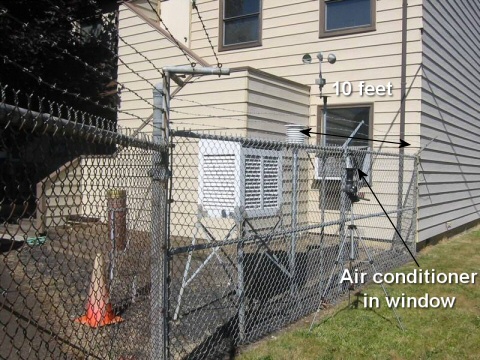
Of course, setting the measurement station on a pad of hot asphalt and next to a reflective building are also best practices for getting a thermometer to read high. The aptly name Mr. Watts has been running a great series on temperature measurement issues in his blog - just keep scrolling.
Update: Andrew Watts found the location on Google maps when I could not, probably because I was looking for a semi-rural area outside of town. But apparently, this is one of the fastest growing communities in Oregon, and, like with many measurement spots over the last 100 years, a hotter urban environment has enveloped the measurement point. The location is on the left, and I zoomed straight out on the right, so the location is still in the center.


In 1900, this thermometer was measuring the temperature of miles and miles of pasture. Today, it is measuring the temperature of acres of asphalt in the middle of a growing city.
Jim Goodridge, via Anthony Watts, has a 102 year temperature change plot for California. These temperatures are without all the black-box corrections made by climate scientists - just straight out is the temperature going up or down. Check out the map of California. Skeptics often argue that some of the global warming we measure may actually just be the urban heating effect from asphalt and concrete and buildings and machinery impinging on measurement sites. See if you can see the pattern.
I am writing a paper on climate models, and an important part of that discussion is on positive feedback (most climate models get large changes in future climate through the liberal use of positive feedback assumptions). I was looking around the Internet for a nice pithy explanation of positive feedback. This one on Wikipedia was fine, until I got wacked in the face with the last line (emphasis added)
The end result of a positive feedback is often amplifying
and "explosive." That is, a small perturbation will result in big
changes. This feedback, in turn, will drive the system even further
away from its own original setpoint, thus amplifying the original perturbation signal, and eventually become explosive because the amplification often grows exponentially
( with the first order positive feedback), or even hyperbolically (with
the second order positive feedback). An intuitive example is "the rich
get richer, and the poor get poorer."
Wow, intuitive? How can a statement that is wrong in at least two major ways be intuitive? First, the poor generally do not get poorer. In fact, the poor in the United States are in many ways better off than the richest men of the mid-nineteenth century (particular example linked is for the middle class, but many of the same arguments hold for the poor), and better off than the middle class of many nations. Second, while it might be arguable that there is a positive feedback loop that helps the rich get richer, no such loop is even possible with the very poorest. Without going into too much detail, the simplest explanation is that with income you can't go below zero. What people really mean by this statement is that the poor get poorer relative to the rich, rather than on an absolute scale. Which of course has little to do with positive feedback. By the way, the rest of the article is equally bizarre, giving more examples of social phenomena that are only weakly linked to positive feedback (Internet echo chamber effect?) rather than physical processes. It looks like a physics article written by a politics major.
Here are some alternative non-socialist examples of positive feedback from the physical world that actually have the virtue of being true: Nuclear fission, some exothermic chemical reactions, and acoustic feedback. In actuality, since positive feedback reactions are so explosive and unstable, they are very uncommon in nature, which is part of the argument against how climate models are constructed.
If you don't know the connection between climate models and positive feedback, see here.
I suppose this is going to be one of those nutty libertarian rants that help explain why libertarians do so poorly at the polls, but I am not really very comfortable with Ward Churchill's potential firing from University of Colorado. I can't think of very many things Mr. Churchill has said that I agree with, but I still have this crazy idea about defending speech regardless of the content of the speech.
And it is hard for me to escape the sense that Mr. Churchill may lose his tenured position at a state-run institution over the content of his speech. Yeah, I know, its nominally about his academic credentials. But don't you think everyone is winking at each other about this? Yes, Mr. Churchill is an academic fraud, but he was a fraud when UC hired him and tenured him as well, and they should have known it.
Over a couple of decades, every major university in the country rushed to build, practically from scratch, racial and ethnic and gender studies programs and departments. Had every university raced at the same time to build any discipline, talent would run short and in the hiring race, some under-qualified people would be hired. Let's suppose that every university decided at the same time they needed a climate department, there just would not be enough qualified climate scientists to fill out every position. The rush to build ethnic studies programs was similar but in fact a bit worse. Because while some people actually do have climate-related degrees, no one until recently had an ethnic studies degree. What professional qualifications should a school look for? And, in fact, in the rush to build ethnic studies programs, a lot of people of very dubious qualifications were given tenure, often based more on ethnic credibility and political activism than any academic qualifications. Hell, Cal State Long Beach hired a paranoid schizophrenic who had served prison time for beating and torturing two women as the head of their Black Studies department. And universities like UC patted themselves on their politically correct backs for these hirings.
I could go out tomorrow and find twenty tenured professors of ethnic/racial/gender studies in state universities whose academic credentials are at least as bad as Churchill's and whom no one would dare fire. This has nothing to do with Churchill's academic work or its quality. UC is getting exactly what it expected when it tenured him. This is about an attempt to fire a tenured professor for the content of his speech, speech that has embarrassed and put pressure on the university, and I can't support that.
I am still underwater here completing a few projects, but Brink Lindsey is blogging on the most recent study claiming that income growth and the American Dream are somehow dead for the average American.
Seriously folks, if I had a betting market that would allow you to bet on either income mobility in the US or in France, which would you take? Seriously? Given that the US has higher economic growth, orders of magnitude lower barriers to entrepreneurship, and no history of bright-line class distinctions that carry down through history, as France does, where would you bet?
Well, actually, there is such a betting market, and it is called immigration. Guess which way it is running for the most talented people for whom income mobility would pay the greatest benefits? Have you heard the stories of the brilliant young technology minds moving from the US to France to start their new business? Yeah, neither have I.
And don't make the mistake that "Oh, this is fine for smart college educated kids, but how about for poor people?" Congress is currently tying itself into knots over the problem of about 12 million poorer people for whom America was such an economic attraction that they were willing to break the law to come here. Which, coincidently, also goes a long way to explaining why US median income always seems stagnant in studies over the last 30 years. It is because tens of millions of poor immigrants have come in at the bottom, bringing down the mean and median at the same time most individuals are climbing. It is for this reason that the average individual can be doing better and better at the same time the mean is flat or even going down.
Postscript: I was emailing back and forth with Brink and he made a great point, which you should look for him to embellish on his blog tomorrow, which I would summarize this way -- No number of dollars in 1970 would buy a laptop computer
loaded with a real-time strategy game that you can play with 64 of your
friends over the Internet or on which you could store a few thousands CD-quality (CD, what's a CD?) songs.
Brink Lindsey reminds me it is the anniversary of the release of the original Star Wars. I happened to be staying in Century Plaza in LA with my family on the day the movie was release, though I had never heard of it. It was actually a pretty low-budget movie, and was only released on a few screens. I got dumped off by my family, who was going shopping, in some theater near UCLA and Century City I can't even remember the name of. Anyway, I and about 20 other people were in the theater that first day, partly I guess because it was daytime and mid-week. It is the first and only movie I stayed and watched a second time. I know this makes me a geek, but it really was a transcendent experience for me, though sadly an experienced unmatched in any of the follow-on movies.
Being one of an extremely small cadre to have seen the first one on opening day (really by accident) I felt compelled to see all the others on opening day, a cycle I completed successfully.
I would argue that for its time, against expectations of its day, the opening 30 seconds after the words stop scrolling may be the most amazing and powerful opening of a film ever (starts at about 2:00 into the clip below). And don't miss that fine exhibition of Stormtrooper shooting at about 4:31. Enjoy it again:
And don't miss how Star Wars should have ended. Priceless:
And if you are not Star Wars'd out, try the Stormtrooper Training Video:
TJIC, who really is a terrific up and coming libertarian-ish blogger, writes:
But in the short term, I'd like to thank the three B-list bloggers
who have so kindly linked to this humble Z-list blog multiple times:
B-list? I guess I will accept that, as long as I can be in the same category as one of my favorite actresses, queen of the B-movies Sybil Danning. I am also consoled that just after Sports Illustrated called Mark O'Meara the "king of the B's", he proceeded to win two majors in the same year.
All these years of writing about climate change, and I always have claimed that I was not in the pay of any interested industry groups. Well, I guess I lied. It appears "Big Recreation" is lobbying against greenhouse gas controls.
Sen. James Inhofe (R-Okla.), Ranking Member of the Environment and Public Works Committee, said:
"The
recreation industry's true threats come not from climate change --
which has always changed and will always change -- but from the
so-called global warming "˜solutions' being proposed by government
policymakers. Misguided efforts to "˜solve' global warming threaten to
damage the travel and recreation industry and consequently threaten the
American dream."
This is probably true, though the ski resort guys don't agree.
For those who don't know, several years ago I quit both boneheaded Fortune 50 life and boneheaded startup life to run my own recreation business, where I am trying to push a vision of, and make a little money from, privatization of public recreation. I am actually fairly well insulated from gas price shocks, though by accident rather than thought-out-in-advance strategy. We have mainly taken over government recreation facilities where the customer base is local weekend traffic (rather than say cross-the-country-to-see-old-faithful travelers). This is really by accident, because these facilities took less investment than the big national attractions. As it turns out, when gas prices go up, we actually do a bit better, because people still want to camp and use their RV, but they do it 100 miles from home rather than 1000.
By the way, I am working on a skeptics primer to anthropogenic global warming, which is why blogging has been light. If you'd be willing to read and comment on a pre-release version, email me and I will put you on the list for a pdf which will be coming in a week or so. In the mean time, some of my previous work is here
Via Hit and Run, this is some of the worst science I have seen in a while, and it really makes you wonder about what other schlock gets published (as long as the findings support politically correct principles)
A study in Preventive Medicine
finds that a smoking ban in Bowling Green, Ohio, was followed by a 47
percent drop in hospital admissions for coronary heart disease.
According to the researchers, "The findings of this study suggest that
clean indoor air ordinances lead to a reduction in hospital admissions
for coronary heart disease, thus reducing health care costs"....A look at the raw hospital-admission numbers for Bowling Green, as reported by Michael Siegel, may help resolve this mystery:
1999: 35
2000: 24
2001: 24
2002: 36
2003: 22
2004: 26Although
the smoking ban took effect in March 2002, Siegel notes, the
researchers treat that year's admissions as if they all occurred before
the ban
That's hilarious. What responsible researcher would look at that data set, with a March 2002 start date for the program, and be able to come to a conclusion that a smoking ban had any effect at all. I'm not sure I even fault the "researchers" -- they are obviously trying to flog their point of view with BS data and must be happy they found a sucker to publish them. But Preventative Medicine should be ashamed.
Via TJIC and Mark Perry come this excellent observation:
State unemployment rates for April were released last week by the
BLS, and there are now 18 states that have set historical record-low
jobless rates in the last yearHere are the 18 states with historical record-low jobless rates"¦
"¦California: 4.7% in November 2006
"¦Arizona: 3.9% in March 2007
"¦New Mexico: 3.5% in February 2007
"¦Texas: 4.2% in April 2007"¦
I wonder where our economy would be without those 15 million Mexican immigrants. Negative unemployment?
Score another one for personal responsibility: 29-year old St. Louis
Cardinals pitcher Josh Hancock killed himself in April when he drove --
faster than the speed limit, drunk, on a cell phone, and not wearing a
seat belt -- into a tow truck stopped on the side of a road. Obviously,
we ought to blame... everyone except Josh Hancock for this. Three and a
half weeks after the accident, his father has filed suit
in St. Louis against: the restaurant where Hancock was drinking, the
manager of the restaurant, the tow truck driver, the towing company,
and (!) the driver of the stalled vehicle that the tow truck was
assisting, for having the temerity to get his car stuck on the side of
the road.So far, he hasn't sued the Cardinals or Major League Baseball, but, while praising the team, his lawyer pointedly refused to rule out suing them.
Note: Lots of updates at the bottom
We have all heard that the US is backward vs. our much more enlightened bretheren in Europe on income inequality. The general argument is that US is somehow a worse place because out income inequality is higher than in most European countries.
My reaction has always been, so what? Why should I care about how well I am doing vs. the richest folks. Shouldn't I care more how I am doing on an absolute scale? And in fact, on an absolute scale, our poor are doing better than everyone else's poor, and better than many nation's middle classes. I thought this analysis of poverty was interesting: It is the number of people (per million) in a county living on less than $11 per day (lower number and rank is better)
Per Capita Population Under $11 per Day
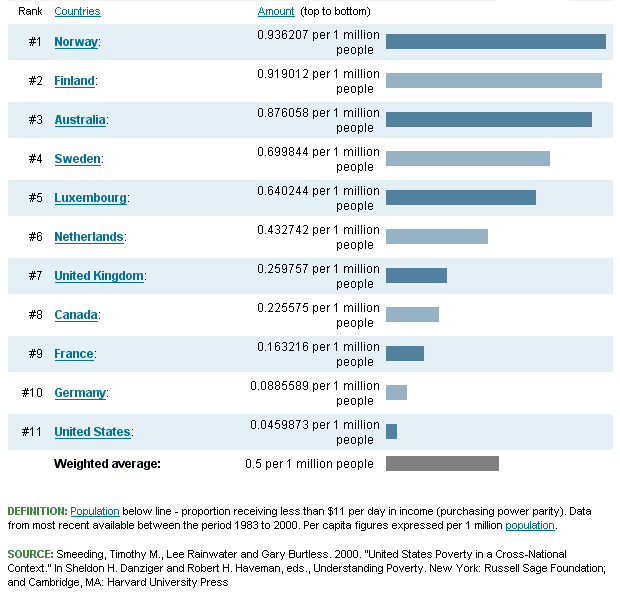
So, nations of Europe, how is that welfare state working out for you? Socialist paradise Norway is 20 times worse! How long will your poor be happy being told that, well, yes, the poor in the US are better off than you are, but you should feel better, because our rich in Europe are doing much worse than the rich in the US.
PS- Stats from NationMaster.com, a database of country by country statistics of all sorts. Cool site, which also has a state by state counterpart.
Update: Now that I have had time to poke around, I cannot find this data in the sources quoted, so it must be considered potentially suspect. The sources quoted actually try to make the point that US lags Europe in fighting poverty, so the conclusion of the chart above is not even consistent with the sources. (my guess is the data comes from the Luxemburg Income Study). However, it is interesting that this source material makes the same mistake I am trying to correct for here: That is, it defines poverty as a percentage of the median income in the particular country, rather than an absolute value, such that a country can have poor who are better off but still fail on the metric. You can see that here, where US has high poverty as on a "percent of median income" definition, but since we have the highest incomes in the world, it effectively gives the US the highest poverty bar to clear.
Here is what I am looking for: Ideally, I would like to find a comparison of the median income say of the bottom quintile of each country, compared in absolute dollars on a PPP basis across countries. I would like to see the number both before and after government transfer payments. Europe, in their welfare economies, do better on poverty metrics when government transfer payments are included (and I am almost sure the chart above is before government transfer payments). However, I would argue that for the long term health of the economy, you would like to see how the poor are doing before these payments. Ultimately, and I will borrow a bit of environmentalist language here, this is going to be the most sustainable economy, where the poor gain wealth on their own, not from the welfare system. In fact, the welfare state, and this was my original point, actually suppresses self-earned income of much of the poor by eliminating the incentive to work. That is why I still think the chart at the top may be correct.
Update #2: One other difference between the US and European nations is that we are much more open on immigration (yes, it may be illegal, but we pretty much still allow it). These immigrants, legal or not, are counted in our economic and poverty stats. If we assume there are about 15 million mostly poor illegal immigrants, plus millions of other quasi-legal immigrants, plus millions more who got amnesty in the 1980's, these immigrants add at least a fast five percentage points to any poverty metric the US is measured on.
I have been surfing tonight, and it seems there are a ton of studies showing that US poverty is growing for some reason. Duh. Tens of millions of absolutely poor people, mainly from south of the border, have come to the US over the last several decades. It is no secret all these immigrants are poor -- that is why they are coming here, to find something better for themselves. Of course we have had a surge in poverty - we have been importing it like crazy! I happen to be pro-immigration, but I am fed up with these studies that try to pin the blame on growing poverty in the US on government transfer payment policy. It's the immigration, stupid! Several studies particularly lament the fact that childhood poverty is rising in the US. Can anyone think of a way this might be correlated to tens of millions of strongly Catholic Mexican immigrants, each and every one committed to large families?