Um, Whatever

James Hansen, NASA climate scientist and lead singer in the climate apocalypse choir, responded to his  temperature data revisions a week ago:

What we have here is a case of dogged contrarians who
present results in ways intended to deceive the public into believing
that the changes have greater significance than reality. They aim to
make a mountain out of a mole hill. I believe that these people are not
stupid, instead they seek to create a brouhaha and muddy the waters in
the climate change story. They seem to know exactly what they are doing
and believe they can get away with it, because the public does not have
the time, inclination, and training to discern what is a significant
change with regard to the global warming issue.

The proclamations of the contrarians are a deceit

Um, whatever.  Remember, this is the man who had large errors in his data set, used by nearly every climate scientist in the world, for years, and which were only recently discovered by Steven McIntyre (whom Hansen refuses to even name in his letter).  These errors persisted for years because Mr. Hansen refuses to allow the software and algorithms he uses to "correct" and adjust the data to be scrutinized by anyone else.  He keeps critical methodologies that are paid for by we taxpayers a secret.  But it is his critics who are deceitful? 

In particular, he is bent out of shape that critics' first presented the new data as a revised ranking of the hottest years rather than as a revised line graph.  But it was Hansen and his folks who made a big deal in the press that 1998 was the hottest year in history.  It was he that originally went for this sound byte rather than the more meaningful and data-rich graph when communicating with the press.  But then he calls foul when his critics mimic his actions?  (Oh, and by the way, I showed it both ways).

Hansen has completely ignored the important lessons from this experience, while focusing like a laser on the trivial.  I explained in detail why this event mattered, and it was not mainly because of the new numbers.  In short, finding this mistake was pure accident -- it was a bit like inferring that the furniture in a house is uncomfortable solely by watching the posture of visitors leaving the house.  That's quite an deductive achievement, but how much more would you learn if the homeowners would actually let you in the house to inspect the furniture.  Maybe its ugly too.

So why does Hansen feel he should be able to shield himself from scrutiny and keep the details of his database adjustments and aggregation methodology a secret?  Because he thinks he is the king.    Just read his letter:

The contrarians will be remembered as court jesters. There is no point
to joust with court jesters. "¦ Court jesters serve as a distraction, a
distraction from usufruct. Usufruct is the matter that the captains
wish to deny, the matter that they do not want their children to know
about.

Why do we allow this kind of secrecy and spurning of scrutiny in science?  Is it tolerated in any other discipline?

Steve McIntyre has his response here.  McIntyre still has my favorite comment ever about Hansen and his gang:

While acolytes may call these guys "professionals", the process of
data adjustment is really a matter of statistics and even accounting.
In these fields, Hansen and Mann are not "professionals" - Mann
admitted this to the NAS panel explaining that he was "not a
statistician". As someone who has read their works closely, I do not
regard any of these people as "professional". Much of their reluctance
to provide source code for their methodology arises, in my opinion,
because the methods are essentially trivial and they derive a certain
satisfaction out of making things appear more complicated than they
are, a little like the Wizard of Oz. And like the Wizard of Oz, they
are not necessarily bad men, just not very good wizards.

Update:  If you have a minute, read Hansen's letter, and then ask yourself:  Does this sound like what I would expect of scientific discourse?  Does he sound more like a politician or a scientist?

Vista Still Sucks, But I Actually Found A Mac I Kindof Liked

Now, I won't argue that Vista will someday not suck - after all, give an infinite number of monkeys $30 billion a year in cash flow and they'll code Shakespeare.  Or whatever.  But I have to agree with this post by Glenn Reynolds that Vista is still not ready for prime time.  Now, I wrote this same conclusion over a half year ago, but incredibly, no updates of any seriousness have been issued.  It is still the mess it was then, and Moore's Law has yet to catch up to make the average machine run it acceptably  (particularly with laptops).   When I set up the dual boot back to XP on my kid's laptop, I did not make the XP partition large enough because my kids absolutely refuse to install anything on the Vista partition, which they use only because that is where MS Office is installed. 

Am I a lone wolf on this issue?  Oh my God, am I a Vista denier! Well, check out this announcement from Microsoft reported by ZDNet on June 28:

Microsoft is simplifying the processes via which its PC-maker
partners will be able to provide "downgrade" rights from Windows Vista
to Windows XP for their customers.

Microsoft will implement the first of the policy changes for its
Gold Certified (top-tier) OEM partners within the next couple of weeks.
The company will streamline downgrade-rights policies and procedures
for the broader channel somewhat later, said John Ball, general manager
of Microsoft's U.S. Systems Group....

Microsoft is working on ways to allow the rest of the channel to
take advantage of these simplified downgrade procedures, but is still
in the midst of hashing out the details, Ball said. He didn't have a
timetable for when Microsoft will make its more liberal
downgrade-rights policies available to the rest of its PC partners.

I am not sure this is the sign of a healthy product line when your top customers are demanding easier ability to go back to the old version.

As a side note, I have never, ever liked Macs.  First, I never wanted to be one of "the rest of us" and I enjoy tweaking and upgrading too much to be a fan of Macs.  Also, I thought their historic resistance to some obvious improvements, like the two-button mouse, was just stupid.  All that being said, I will admit that I really like the new iMac I bought my wife.  It is perfect for her, and it is gorgeous.  The keyboard is not great for speed-typing but it looks really cool and my wife is fine with that.  The iMac did a great job with the tough stuff - it immediately recognized the PC's on my network and was able to trade files with them (something our Vista laptop still balks at from time to time) and it set up a network printer on the first try.  And, for perhaps the first time ever on a Mac, I didn't feel like the things was wallowing in first gear when compared to my desktop PC.

What is Normal?

I have said for years it is hard to know what is "normal" in a chaotic climate system that has everything from 1 year to 10 year to 10,000
year cycles, when we have only been observing it for 30 years.  It's a bit
like exploring around Nebraska and deciding that you know the full
extent of geologic variance. Craig Limesand makes a similar point here.

Aerogels look cool

Q&O links a cool article from the London Times on aerogels, apparently the least dense substance manufactured by man.  They are apparently great insulators and can be apparently be tweaked to be selectively permeable or absorbent of various substances, making them useful for filtering applications.  And they are being used in tennis rackets  (I have a theory that tennis and golf equipment manufacturers are to new materials what pornography is to new digital distribution mechanisms -- they seem to always be early adopters). 

Postscript: Of course we get this same article about material X every five years ago in the press, so it is OK to be skeptical.  But the picture is still wicked cool.

You Gotta Love NPR

You have to love NPR.  On Friday, I was on a lunchtime errand and heard the begging on Science Friday.  Apparently it was inventors week, and the intro promised the next hour might "change the life" of aspiring inventors in the audience who are struggling with getting patents and monetizing their inventions.

Then, after this intro, the show spent the next half hour interviewing an professor at MIT who specializes in non-profit development of low-tech solutions to 3rd world problems.  LOL.  The woman was certainly interesting, but had about zero to offer on the topic at hand.  I guees NPR just couldn't actually bring itself to talk about monetizing inventions in the good old capitalist US without first spending a good hunk of the show on selfless innovation to solve third-world environmental issues.

The Next State AG Boondoggle

Chris Horner reports that the next mass-state-AG-tort, modeled after their fairly succesful efforts against tobacco companies, will be against oil companies over global warming:

A little birdie recently chirped about some
usual-suspect state attorneys general preparing a litigation strategy
document for/with environmental pressure groups, providing a roadmap
for cooperatively replicating the tobacco litigation of a decade ago in
the "global warming" context, substituting that projected catastrophe
for cancer and "big energy" for tobacco companies.

The point of
such exercise would not be to litigate the matter to conclusion "” ever
more challenging what with forced corrections of the temperature
record, recent exposure of the woeful reliability of our own world's
most reliable surface measuring network, and of course no global
warming in a decade (or, we now know, since 1900 for that matter) "” but
to extract massive settlements from the energy industry to further fund
the trial lawyers, greens and the greens' pet projects. Just imagine
the anti-energy campaign that this model would yield! And at no cost,
really, except to anyone who uses energy and/or invests in these sleepy
"granny stocks". Oh, and the economy.

He goes on to include a copy of the memo making the rounds of the AG offices.   This will certainly be a circus, and generally an expensive time-waster that will just serve to line the pockets of tort lawyers and the politically connected.  If things turn out like the tobacco settlement, the oil companies may jump on board early, since the tobacco settlement has turned into a state-enforced oligopoly for the major tobacco companies.  On the bright side, this might be an opportunity to subpoena the details of a bunch of climate work that is currently kept secret.

Tune Every Heart and Every Voice

We're number one, again.


              Tiger, tiger, tiger
              Sis, sis, sis,
              Boom, boom, boom, ah!
              Princeton! Princeton! Princeton!

Hold off on the Funeral for Special Relativity

Harvard physicist LuboÅ¡ Motl throws some cold water on recent claims to have broken the speed of light.  He argues:

Two years ago or so, Robert Helling
explained what these experiments are all about. As far as I can say,
there is nothing new about Nimtz's findings or observations and not
much interesting about them either. He's been doing the very same
things for decades.

He builds a setup in which the maximum
of a wave moves faster than light (although you need amplifiers to find
where the maximum is at the end). That's of course possible. In fact,
it's very easy. You can make such things with normal classical
electromagnetic waves as long as you have a layer of material where
they exponentially drop. In analogy with Schrödinger's equation, you
may realize that tunneling can be very fast.

However,
microscopically, no signal or information is moving superluminally and
nothing is violated about special relativity whatsoever because all
these waves perfectly satisfy Maxwell's equations where the speed of
light is safely bounded. Nimtz must know that, I think, so his behavior
seems dishonest to me.

Sample Environmental Requirements

Often businesses complain about ridiculously tedious environmental regulation and paperwork, and they don't seem to get much sympathy.  The usual opposing response is just to say "oh, you guys just are mad that you can't dump dioxin in the river any more."

But I am here to tell you -- many of the requirements are really, really detailed, time-consuming, and of questionable value.  To demonstrate this, I am going to let you into my life for a minute.  Among the many recreation facilities we operate (my business described here), we run a small pair of marinas on Blue Mesa Lake in Colorado.  At these marinas we rent boats, have a fuel dock, and do some light boat maintenance for customers.  We are renting the facility from the government (specifically the National Park Service), and as our landlord they provided all the facilities.

When we inherited the facilities from the previous tenant, they were in awful condition.  We have had to spend a lot of money brining the government's facilities up to standard, removing years of hazardous waste, etc.  Our reward was to get audited by the EPA and the NPS.  For those of you who are interested in what environmental regulation looks like to a small business, you may view a pdf of our audit results.  You can't possibly read everything, but skim through the findings to get the general idea.  And as you are reading, note that this is a GOOD audit -- we were actually commended in Washington for the work we had done cleaning up the place.  And still this work list remains.  Remember also while reading this that I don't run a chemical plant or a steel mill, this is a small marina on a lake.

For those who don't want to scoll through all 52 items, here is one, chosen at random:

Audit Finding:
Each container of hazardous chemicals in the workplace was not labeled, tagged, or marked with the following information:
- Identity of the hazardous chemical(s) contained therein; and
- Appropriate hazard warnings.

For example:

  • A white plastic bucket was observed with no label in the flammable cabinet at the maintenance yard;
  • Three unlabeled 55-gallon drums were observed at the maintenance yard, one of which had a sign of leakage;
  • An unlabeled plastic white bottle was observed on one of the blue drums at the maintenance yard;
  • A red flammable container was observed next to the flammable cabinet at the maintenance yard. The cap was not on. It was noted that the container was partially full with water;
  • Two red and one blue unlabeled drums were stored at the back of the maintenance yard. The blue drum had signs of leakage;
  • The carbon dioxide cylinder in use at Pappy's Restaurant had a worn label;
  • Two unlabeled spray bottles were observed in Pappy's Restaurant washing room;
  • An unlabeled bucket was observed in Pappy's Restaurant washing room under a shelf on which detergents are stored;
  • Unlabeled partially full buckets were observed in Pappy's Restaurant washing room;
  • An unlabeled spray bottle was observed in the maintenance room for the showers at Elk Creek; and
  • An spray bottle that contained purple liquid was observed in the shower maintenance room at Lake Fork.  The bottle had a worn label.

Update:  From the looks of this fish, maybe we are putting something odd in the lake!

Update:  Here is another good one:

Audit Finding:
Concessioner staff had not submitted an ozone-depleting substance (ODS)-containing equipment registration form and fee with the State of Colorado.

Good old Colorado.  Colorado is one of the states I have to have a special license to sell eggs

Here is a quick contest -- I will send a free  copy of my book (my global warming book or my novel BMOC) to the first reader who can email me with a link to the correct Colorado web page with information and/or forms for the ODS-containing equipment registration.  I can't find it.

Update 2:  I can be a man and admit when another man has bested me.  So I must admit that though it is my environmental audit, TJIC has a much better post on it than I have.  Maybe because he seems to have read more of it than I have.

Balanced on the Knife Edge

OK, obviously I am not going to be able to stop posting on climate.  TigerHawk has a nice article on the global cooling panic from the April
28, 1975 issue of Newsweek
. 
However, rather than highlight the fact that climatologists have
reversed themselves on cooling vs. warming, because that sometimes
happens in science, I want to highlight what they described as the
effects of global cooling: 

They begin
by noting the slight drop in over-all temperature that produces large numbers
of pressure centers in the upper atmosphere. These break up the smooth flow of westerly winds over temperate
areas. The stagnant air produced in this
way causes an increase in extremes of local weather such as droughts, floods,
extended dry spells, long freezes, delayed monsoons and even local temperature
increases "“ all of which have a direct impact on food supplies.

So
cooling will cause more droughts, floods, extreme weather, and even
local temperature increases.  And we have been told constantly that
warming
will
cause more droughts, floods, extreme weather, and even local
temperature decreases.  So does this mean that we are currently
balanced on the knife edge of the perfect climate, and any change
cooler or warmer will make it worse?  Or could it be that the
weather-disaster-hype-machine has a defined playbook and these are its
elements?

Trade Imbalance

Don Boudreaux responds to UAW President Ron Gettelfinger's complaint that the US has a trade imbalance in autos with South Korea:

Well, duh - that's an
inevitable consequence of specialization...

General Motors, Ford, and Chrysler each have huge trade imbalances --
to be precise, huge and growing trade deficits -- with their workers:
these companies buy far more from their workers than their workers buy
from them.  Perhaps auto makers should hire workers only on the
condition that the trade in each case is "balanced": each and every
worker must agree to spend his or her entire salary on products made by
the auto maker.  For example, a G.M. worker whose total compensation in
2007 is $60,000 must spend $60,000 on G.M. products in 2007.  Any
worker who fails to do so will be fired because of the resulting
imbalance.

Update:  Sorry, forgot the link.  Added it.

Cities and Global Warming

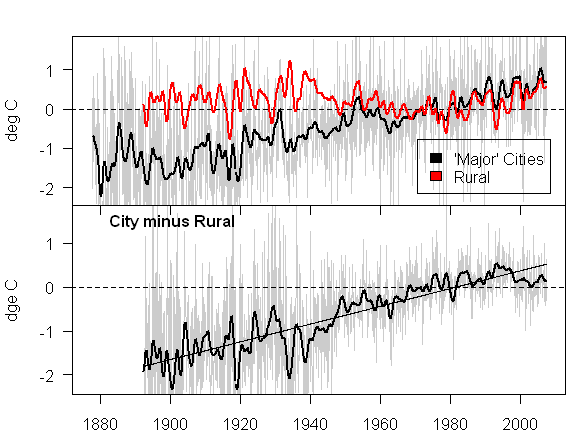
OK, I lied.  I have one more post I want to make on global warming now that Steve McIntyre's site is back up.  I suspect I tend to bury the lede in my warming posts, because I try to be really careful to set up the conclusion in a fact-based way.  However, for this post, I will try a different approach.  Steven McIntyre has reshuffled the data in a study on urbanization and temperature that is relied on by the last IPCC report to get this chart for US Temperature data.
Peters27

Conclusion?  For this particular set of US temperature data, all the 20th century warming was observed in urban areas, and none was observed in rural areas less affected by urban heat islands, asphalt, cars, air conditioning, etc.

If it can be generalized, this is an amazing conclusion -- it would imply that the sum of US measured warming over the last century could be almost 100% attributed to urban heat islands (a different and more localized effect than CO2 greenhouse gas warming).  Perhaps more importantly, outside of the US nearly all of the historical temperature measurement is in urban areas -- no one has 100 year temperature records for the Chinese countryside.  However much this effect might be over-stating US temperature increases, it would probably be even more pronounced in measurements in other parts of the word.

OK, so how did he get this chart?  Did he cherry-pick the data?  First, a bit of background.

The 2003 Peterson study on urban effects on temperature was adopted as a key study for the last IPCC climate report.  In that report, Peterson concluded:

Contrary to generally accepted wisdom, no statistically significant
impact of urbanization could be found in annual temperatures.

This study (which runs counter to both common sense and the preponderance of past studies) was latched onto by the IPCC to allow them to ignore urban heat island effects on historical temperatures and claim that most all past warming in the last half-century was due to CO2.  Peterson's methodology was to take a list of several hundred US temperature stations (how he picked these is unclear, they are a mix of USHCN and non-USHCN sites) and divide them between "urban" and "rural" using various inputs, including satellite photos of night lights.  Then he compared the temperature changes over the last century for the two groups, and declared them substantially identical.

However, McIntyre found a number of problems with his analysis.  First, looking at Peterson's data set, he saw that the raw temperature measurement did show an urbanization effect of about 0.7C over the last century, a very large number.  It turns out that Peterson never showed these raw numbers in his study, only the numbers after he applied layers of "corrections" to them, many of which appear to McIntyre to be statistically dubious.  I discussed the weakness of this whole "adjustment" issue here.

Further, though, McIntyre found obviously rural sites lurking in the urban data, and vice versa, such that Peterson was really comparing a mixed bag with a mixed bag.  For example, Snoqualmie Falls showed as urban -- I have been to Snoqualmie Falls several times, and while it is fairly close to Seattle, it is not urban.  So McIntyre did a simple sort.  He took from Peterson's urban data set only large cities, which he defined as having a major league sports franchise  (yes, a bit arbitrary, but not bad).  He then compared this narrower urban data set from Peterson against Peterson's rural set and got the chart above.  The chart is entirely from Peterson's data set, with no cherry-picking except to clean up the urban list.

Postscript:  Please don't get carried away.  Satellite measurement of the troposphere, which are fairly immune to these urbanization effects, show the world has been warming, though far less than the amount shown in surface temperature databases.

Update: To reinforce the point about global sites, Brazil apparently only has six (6) sites in the worldwide database.  That is about 1/200 of the number of sites in the continental US, which has about the same land area.  And of those six, McIntyre compares urban vs. rural sites.  Guess what he finds?  And, as a follow up from the postscript, while satellites show the Northern Hemisphere is warming, it shows that the Southern Hemisphere is not.

Done with Climate for a While (I think)

Sorry for the slew of climate-related posts.  I really don't want to turn this into a climate blog, but over the last 6 or 7 days I have been getting tons of climate-related traffic from a number of links.  I am going back to working on the next version of my climate book, and will try to put most of my material there and get this blog back to finance and economics topics.

Of course if something comes up....

Save the World -- Stop Recycling

My wife and I had our familiar recycling argument this weekend (Wife:  You need to put that stuff in the recycling;  Me:  Recycling makes zero sense for anything except scrap steel and aluminum, all the rest is just a liturgy of belief we perform for the church of the environment, where labor costs are assumed to be zero).

Anyway, thinking about it more, I have had a revelation.  If we define our biggest environmental problem as CO2 production,shouldn't we stop recycling of plastic and paper?  In the first case, we are burying hydrocarbons unburned, putting the carbon back underground.  Each bottle not recycled represent a few more hydrocarbon molecules that must be dedicated to plastics rather than fuel.  In the case of paper, if we don't recycle then we are using trees to sequester CO2 and bury it back in the ground as paper and cardboard.  Once trees hit their maturity, their growth slows and therefore the rate they sequester CO2 slows.  At this point, we need to be cutting more down, not less, and burying them in the ground, either as logs or paper or whatever.  Just growing forests is not enough, because old trees fall over and rot and give up their carbon as CO2.  We have to bury them.   Right?

Yeah, I know it's silly, but is it any more silly than this:

In the last few months, bottled water "” generally
considered a benign, even beneficial, product "” has been increasingly
portrayed as an environmental villain by city leaders, activist groups
and the media. The argument centers not on water, but oil. It takes 1.5
million barrels a year just to make the plastic water bottles Americans
use, according to the Earth Policy Institute in Washington, plus
countless barrels to transport it from as far as Fiji and refrigerate
it. ...

Dave Byers, 65, from Silver Spring,
Md., discussed the issue with his wife, Pat, on the steps of the
Metropolitan Museum of Art on a 90-degree Saturday. "I think it should
be banned, actually," he said of bottled water.

If you care about the environment, I say buy more bottled water, and throw the bottle away.  You too can sequester some carbon.

Denier vs. Skeptic

We all know why Newsweek and many others (like Kevin Drum) choose to use the term "denier" for those of us who are skeptical of catastrophic anthropogenic global warming:  These media folks, who are hesitant to use the word "terrorist" because of its emotional content, want to imply that we skeptics are somehow similar to Holocaust deniers.

But beyond just the issues of false emotional content, the word denier is incorrect as applied to most skeptics, including myself, and helps man-made warming hawks avoid a difficult argument.  I try to be careful to say that I am a skeptic of "catastrophic man-made (or anthropogenic) global warming theory." 

  • So, does that mean I think the world is not warming?  In fact, the evidence is pretty clear that it is warming (though perhaps not by as much as shown in current surface temperature databases).
  • So does this mean that I think that human activities are not causing some warming?  In fact, I do think man-made CO2 is causing some, but not all the current 20th century warming trend.  I also think that man's land use  (urbanization, irrigated agriculture, etc) has effects on climate.

Where I really get skeptical is the next proposition -- that man's burning of fossil fuels is going to cause warming in the next century that will carry catastrophic impacts, and that these negative effects will justify massive current spending and government interventions (that will have their own negative consequences in terms of lost economic growth, increased poverty, and reduction in freedoms). 

Strong supporters of catastrophic man-made global warming theory do not usually want to argue this last point.  It is much easier to argue points 1 and 2, because the science is pretty good that the earth has warmed (though the magnitude is in question) and that CO2 greenhouse effect does cause warming (though the magnitude is in question).  That is why skeptics are called deniers.  It is in effect a straw man that allows greenhouse supporters to stay on 1 and 2 without getting into the real meat of the question.

Here is a quick example to prove my point.  Follow me for three paragraphs, then ask yourself if you have ever heard any of this in the media or on any RealClimate-type site's FAQ.

Anthropogenic global warming hawks admit that the warming solely from the CO2 greenhouse effect will likely NOT rise to catastrophic levels.  So how do they get such big, scary forecasts?  The answer is positive feedback.

Almost every process you can think of in nature operates by negative
feedback, meaning that an input to a system is damped.  Roll a ball, and eventually friction and wind resistance
bring
it to a stop.    Positive feedback means that an input to the system is multiplied and increased.  Negative feedback is a ball in the bottom of a bowl, always returning to the center; positive feedback is a ball perched precariously at the top of a
mountain that will run faster and faster downhill with a tiny push. Positive feedback
breeds instability, and processes that operate by positive feedback are
dangerous, and usually end up in extreme states -- these processes tend
to
"run away" like the ball rolling down the hill.  Nuclear fission, for
example, is a positive feedback process. 

Current catastrophic man-made global warming theory asserts that our climate is dominated
by positive feedback.  The last UN IPCC report posits that a small increase in
temperature from CO2 is multiplied 2,3,4 times or more by positive
feedbacks like humidity and ice albedo.   So a modest degree or degree and a half of warming from the greenhouse effect becomes a scary five or eight degrees of warming in the next century once any number of hypothesized positive feedbacks are applied.  Add to this exaggerated, sometimes over-the-top visions of possible negative consequences, and that is how global warming hawks justify massive government action.

OK, that is a very brief description of what I consider a sophisticated reason to be skeptical:  Most catastrophic warming forecasts depend on positive feedback loops, feedbacks for which we have little or no evidence and which don't tend to dominate in other stable systems.  So how many times have you seen this issue discussed?  Zero?  Yeah, its so much easier just to call us deniers.

If you are interested, here is slightly longer version of my skeptic's point of view.  Here is my much longer version.  Here is the specific chapter that discusses feedback loops.  Here is Roy Spencer discussing problems with studies trying to measure these feedbacks.

Postscript:  By the way, it is in this context that the discussions about restating temperatures and problems with historical surface temperature measurements are important.  Exaggerated historical warming numbers leave more room to posit positive feedback loops.  Lower historical numbers, or evidence past warming is driven by non-man-made sources (e.g. solar activity), leave less room to justify positive feedback loops.

Update:  RealClimate has posted their six steps to explain catastrophic warming from CO2.  Seems have buried the feedback issue.  Note that forcings mentioned here include feedbacks, they are not from CO2 alone but from CO2 + positive feedback.  Strange they didn't mention this.

Thompson Memo Slapdown

I am way, way late in posting this, but there was good news several weeks ago when a judged slapped down federal prosecutors in the KPMG case for essentially following the Thompson Memo and dismissed all charges in the case.  Here was the initial confrontation the judge had with prosecutors over a year ago, which explains key provisions of the Thompson memo:

Those steps were extraordinary in their attempt to
pressure corporate executives: They include waiving attorney-client
privilege to give investigators access to internal documents and
cutting off accused employees from legal and other forms of support. In
short, the Thompson memo said that companies under investigation are
expected to surrender any right against self-incrimination and cut
their accused employees adrift.

In one sense, the memo's guidelines are just that --
internal guidelines for prosecutors. But as a practical matter, only a
rare CEO will risk the death sentence that a corporate indictment
represents. So "cooperation" as defined by Justice is hardly optional.
It was on this point that Judge Kaplan took Assistant U.S. Attorney
Justin Weddle to task last week. When Judge Kaplan questioned the
fairness of pressuring companies to throw their employees overboard,
Mr. Weddle replied that companies are "free to say, 'We're not going to
cooperate.'"

"That's lame," the judge retorted. He then asked Mr.
Weddle "what legitimate purpose" was served by insisting that companies
cut their former employees off from legal support. Companies under
investigation, Judge Kaplan noted, ought to be free to decide whether
to support their employees or former employees without Justice's "thumb
on the scale."

Mr. Weddle replied that paying the legal fees of
former employees charged with crimes amounted to protecting
"wrongdoers." This prompted the judge to remind the young prosecutor
that the accused are still innocent until proven guilty. He also
reminded Mr. Weddle that the Constitution's Sixth Amendment guarantees
the right to counsel. And for good measure, if the government is
confident in its case, it shouldn't be afraid to allow "wrongdoers"
access to an adequate defense.

And this is from his decision to drop all charges:

Just as prosecutors used KPMG to coerce interviews with KPMG personnel
that the government could not coerce directly, they used KPMG to strip
any of its employees who were indicted of means of defending themselves
that KPMG otherwise would have provided to them. Their actions were not
justified by any legitimate governmental interest. Their deliberate
interference with the defendants' rights was outrageous and shocking in
the constitutional sense
because it was fundamentally at odds with two of our most basic
constitutional values "“ the right to counsel and the right to fair
criminal proceedings. But the Court does not rest on this finding
alone. It would reach the same conclusion even if the conduct reflected
only deliberate indifference to the defendants' constitutional rights
as opposed to an unjustified intention to injure them.

Tom Kirkendall has more analysis

A Temperature Adjustment Example

I won't go back into all the details, but I have posted before about just how large the manual adjustments to temperature numbers are (the "noise") as compared to the magnitude of measured warming (the "signal").  This issue of manual temperature corrections is the real reason the NASA temperature restatements are important (not the absolute value of the restatement).

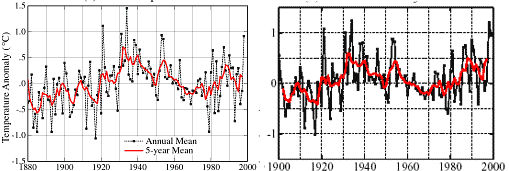
Here is a quick visual example.  Both charts below are from James Hansen and the GISS and are for the US only.  Both use basically the same temperature measurement network (the USHCN).  The one on the left was Hansen's version of US temperatures in 1999.  The one on the right he published in 2001.
Hansen_1999_v_2001

The picture at the right is substantially different  than the one on the left.  Just look at 1932 and 1998.  Between the first and second chart, none of the underlying temperature measurements changed.  What changed  were the adjustments to the underlying measurements applied by the NOAA and by the GISS.  For some reason, temperatures after 1980 have been raised and temperatures in the middle of the century were lowered.

For scientists to apply a negative temperature adjustment to measurements, as they did for the early 1930's, it means they think there was some warming bias in 1932 that does not exist today.  When scientists raise current temperatures, they are saying there is some kind of cooling bias that exists today that did not exist in the 1930's.  Both of these adjustments are basically implying the same thing:  That temperature measurement was more biased upwards, say by asphalt and urbanization and poor sitings, in 1932 than they are today.  Does this make any freaking sense at all?

Of course, there may be some other bias at work here that I don't know about.  But I and everyone else in the world are forced to guess because the NOAA and the GISS insist on keeping their adjustment software and details a secret, and continue to resist outside review.

Read much more about this from Steve McIntyre.

I Am Almost This Bad With Names

Some Final Thoughts on The NASA Temperature Restatement

I got a lot of traffic this weekend from folks interested in the US historical temperature restatement at NASA-GISS.  I wanted to share to final thoughts and also respond to a post at RealClimate.org (the #1 web cheerleader for catastrophic man-made global warming theory).

  1. This restatement does not mean that the folks at GISS are necessarily wrong when they say the world has been warming over the last 20 years.  We know from the independent source of satellite measurements that the Northern Hemisphere has been warming (though not so much in the Southern Hemisphere).  However, surface temperature measurements, particularly as "corrected" and aggregated at the GISS, have always been much higher than the satellite readings.  (GISS vs Satellite)  This incident may start to give us an insight into how to bring those two sources into agreement. 
  2. For years, Hansen's group at GISS, as well as other leading climate scientists such as Mann and Briffa (creators of historical temperature reconstructions) have flaunted the rules of science by holding the details of their methodologies and algorithm's secret, making full scrutiny impossible.  The best possible outcome of this incident will be if new pressure is brought to bear on these scientists to stop saying "trust me" and open their work to their peers for review.  This is particularly important for activities such as Hansen's temperature data base at GISS.  While measurement of temperature would seem straight forward, in actual fact the signal to noise ration is really low.  Upward "adjustments" and fudge factors added by Hansen to the actual readings dwarf measured temperature increases, such that, for example, most reported warming in the US is actually from these adjustments, not measured increases.
  3. In a week when Newsweek chose to argue that climate skeptics need to shut up, this incident actually proves why two sides are needed for a quality scientific debate.  Hansen and his folks missed this Y2K bug because, as a man-made global warming cheerleader, he expected to see temperatures going up rapidly so he did not think to question the data.  Mr. Hansen is world-famous, is a friend of luminaries like Al Gore, gets grants in quarter million dollar chunks from various global warming believers.  All his outlook and his incentives made him want the higher temperatures to be true.  It took other people with different hypotheses about climate to see the recent temperature jump for what it was: An error.

The general response at RealClimate.org has been:  Nothing to see here, move along.

Among other incorrect stories going around are that the mistake was due
to a Y2K bug or that this had something to do with photographing
weather stations. Again, simply false.

I really, really don't think it matters exactly how the bug was found, except to the extent that RealClimate.org would like to rewrite history and convince everyone this was just a normal adjustment made by the GISS themselves rather than a mistake found by an outsider.  However, just for the record, the GISS, at least for now until they clean up history a bit, admits the bug was spotted by Steven McIntyre.  Whatever the bug turned out to be, McIntyre initially spotted it as a discontinuity that seemed to exist in GISS data around the year 2000.  He therefore hypothesized it was a Y2K bug, but he didn't know for sure because Hansen and the GISS keep all their code as a state secret.  And McIntyre himself says he became aware of the discontinuity during a series of posts that started from a picture of a weather station at Anthony Watts blog.  I know because I was part of the discussion, talking to these folks online in real time.  Here is McIntyre explaining it himself.

In sum, the post on RealClimate says:

Sum total of this change? A couple of hundredths of degrees in the US
rankings and no change in anything that could be considered
climatically important (specifically long term trends).

A bit of background - surface temperature readings have read higher than satellite readings of the troposphere, when the science of greenhouse gases says the opposite should be true.  Global warming hawks like Hansen and the GISS have pounded on the satellite numbers, investigating them 8 ways to Sunday, and have on a number of occasions trumpeted upward corrections to satellite numbers that are far smaller than these downward corrections to surface numbers. 

But yes, IF this is the the only mistake in the data, then this is a mostly correct statement from RealClimate.org..  However, here is my perspective:

  • If a mistake of this magnitude can be found by outsiders without access to Hansen's algorithm's or computer code just by inspection of the resulting data, then what would we find if we could actually inspect the code?  And this Y2K bug is by no means the only problem.  I have pointed out several myself, including adjustments for urbanization and station siting that make no sense, and averaging in rather than dropping bad measurement locations
  • If we know significant problems exist in the US temperature monitoring network, what would we find looking at China? Or Africa?  Or South America.  In the US and a few parts of Europe, we actually have a few temperature measurement points that were rural in 1900 and rural today.  But not one was measuring rural temps in these other continents 100 years ago.  All we have are temperature measurements in urban locations where we can only guess at how to adjust for the urbanization.  The problem in these locations, and why I say this is a low signal to noise ratio measurement, is that small percentage changes in our guesses for how much the urbanization correction should be make enormous changes (even to changing the sign) of historic temperature change measurements.

Here are my recommendations:

  1. NOAA and GISS both need to release their detailed algorithms and computer software code for adjusting and aggregating USHCN and global temperature data.  Period.  There can be no argument.  Folks at RealClimate.org who believe that all is well should be begging for this to happen to shut up the skeptics.  The only possible reason for not releasing this scientific information that was created by government employees with taxpayer money is if there is something to hide.
  2. The NOAA and GISS need to acknowledge that their assumptions of station quality in the USHCN network are too high, and that they need to incorporate actual documented station condition (as done at SurfaceStations.org) in their temperature aggregations and corrections.  In some cases, stations like Tucson need to just be thrown out of the USHCN.  Once the US is done, a similar effort needs to be undertaken on a global scale, and the effort needs to include people whose incentives and outlook are not driven by making temperatures read as high as possible.
  3. This is the easiest of all.  Someone needs to do empirical work (not simulated, not on the computer, but with real instruments) understanding how various temperature station placements affect measurements.  For example, how do the readings of an instrument in an open rural field compare to an identical instrument surrounded by asphalt a few miles away?  These results can be used for step #2 above.  This is cheap, simple research a couple of graduate students could do, but climatologists all seem focused on building computer models rather than actually doing science.
  4. Similar to #3, someone needs to do a definitive urban heat island study, to find out how much temperature readings are affected by urban heat, again to help correct in #2.  Again, I want real research here, with identical instruments placed in various locations and various radii from an urban center  (not goofy proxys like temperature vs. wind speed -- that's some scientist who wants to get a result without ever leaving his computer terminal).  Most studies have shown the number to be large, but a couple of recent studies show smaller effects, though now these studies are under attack not just for sloppiness but outright fabrication.  This can't be that hard to study, if people were willing to actually go into the field and take measurements.  The problem is everyone is trying to do this study with available data rather than by gathering new data.

Postscript:  The RealClimate post says:

However, there is clearly a latent and deeply felt wish in some sectors for the whole problem of global warming to be reduced to a statistical quirk or a mistake.

If catastrophic man-made global warming theory is correct, then man faces a tremendous lose-lose.  Either shut down growth, send us back to the 19th century, making us all substantially poorer and locking a billion people in Asia into poverty they are on the verge of escaping, or face catastrophic and devastating changes in the planet's weather.

Now take two people.  One in his heart really wants this theory not to be true, and hopes we don't have to face this horrible lose-lose tradeoff.  The other has a deeply felt wish that this theory is true, and hopes man does face this horrible future.  Which person do you like better?  And recognize, RealClimate is holding up the latter as the only moral man. 

Update:  Don't miss Steven McIntyre's take from the whole thing.  And McIntyre responds to Hansen here.

Another Arizona Water Ariticle With No Mention of Price

Well, the Arizona Republic has done it again.  It has published yet another first-section front page water article (this makes about 50 in a row) discussing ways to make demand match supply without once discussing price.  This time, the reporting centers on a new online water supply and demand simulation model (here) introduced by Arizona State University.  With the model, the public gets to play dictator, implementing all kinds of policies and restrictions on individual consumers to see what effect these command and control steps have on water supply and demand.  And it is almost anti-climactic when I tell you that price does not enter in any way into the model. 

I probably don't have to remind readers that Phoenix has some of the cheapest water in the country, with prices less than half what they are in, say, water-logged Seattle.  Don't you think that might have a little to do with why supply and demand don't match?

Let's say there are about a 1000 key raw materials we use in modern society -- oil, natural gas, iron ore, uranium, bauxite, titanium, gold, silver, etc.  Of these, how do we match supply and demand?  Well, for 999 of the 1000, we use this thingie called the price mechanism.  The exception is water.  And it is incredible to me that not one but dozens of articles could be written by our newspaper about matching water supply and demand and not one of them could mention price, the mechanism we use to match supply and demand for 99.9% of commodities.  Remember when Hillary suggested a while back we need a special academy for government workers?  This is what they would teach -- that all problems can only be solved by government command and control.  As I wrote before:

In their general pandering and populism, politicians are afraid to
raise water prices, fearing the decision would be criticized.  So, they
keep prices artificially low, knowing that this low price is causing
reservoirs and aquifers to be pumped faster than their replacement
rate.  Then, as the reservoirs go dry, the politicians blame us, the
consumers, for being too profligate with water and call for ... wait
for it ... more power for themselves, the ones whose spinelessness is
the root cause of the problem, to allocate and ration water and
development

The Most Important College Football Poll of the Year

The most important college football poll of the year is out, and the top five are as follows  (rank, team, #1 votes record so far, total points):

1. USC (45)  0-0 1,481
2. LSU (4)  0-0 1,372
3. Florida (9)  0-0 1,278
4. Texas 0-0 1,231
5. Michigan (2)  0-0 1,218

The rest of the list is here.

Many of you might notice that all of these teams have a record of 0-0.  So you might ask, "Coyote, are you crazy, why did you call this the most important poll of the year?"  Well, since I answered that last year, I will go back a year ago and quote myself:

In theory, voters in the college football polls each week come up
with their current ranking of teams, which in theory could be very
different from how they ranked things the previous week.  In practice,
however, voters start with their rankings of the previous week and then
make adjustments up and down for individual teams based on that week's
game results....

In effect, the college football rankings are a bit like a tennis ladder. Each
week, losers drop down 3-8 spots and all the winners and no-plays move up to
fill in the vacated spots. Sometimes a team will leapfrog another, but that is
rare and it is extremely rare to leapfrog more than 1 or 2 spots. In this sense, the
initial football poll is the most critical, since only those in the top 10-15
have any chance of moving up the ladder to #1.

In
effect, the pre-season poll is the baseline off which all future polls
start.  I haven't done the research, but you could probably refine my
statement in the previous paragraph to a set of rules such as:

  • A three-loss team can never win the championship
  • A two-loss team can win but only if they start in the top 5 of the pre-season poll
  • A one-loss team can win but only if they start in the top 15
  • An undefeated team can win even if they were left out of the
    initial top 25, but only if they play in a major conference.  A minor
    conference team, even undefeated, will not ever end up #1 unless they
    started the season in the top 25.

Again, the numbers in these rules may not be exactly right, but I
think they are directionally correct.  This is what I call my theory of
College Football Calvinism (the religion, not the cartoon character)
since one's ultimate fate is in large part pre-ordained by the polls
even before the season is born.  So, if your alma mater has any shot at
the title, you should hope your AD is out there in the summer lobbying
the writers like hell to up their pre-season poll standings. Every spot
you gain in the pre-season poll is one you don't have to win on the
playing field.

Computer Models In Complex Systems

Apparently, there are some dangers with getting too confident about your computer modeling of complex systems:

Computers don't always work.

That was the lesson so far this month for many so-called quant hedge
funds, whose trading is dictated by complex computer programs.

The markets' volatility of the past few weeks has taken a toll on
many widely known funds for sophisticated investors, notably a
once-highflying hedge fund at Wall Street's Goldman Sachs Group Inc.

Global Alpha, Goldman's widely known internal hedge fund, is now
down about 16% for the year after a choppy July, when its performance
fell about 8%, according to people briefed on the matter.

This kind of reminds me of another kind of computer modeling of complex systems.

Why I Don't Host This Blog on My Own Servers...

...Because there might come a slow news day in August when Tigerhawk, Hot Air, Pajamas Media, Reddit, the Free Republic, Ace of Spades, and many others all link to the same post at the same time.  In which case my servers here in the office and the poor hamster who powers them by running on his little wheel would be a smoking hole in the ground.

A Thought on Blogging Relevance

You know you are not one of the blogging big boys when you dig into your referral logs to find the source of a bump in traffic and discover it is from a link buried inside a comment thread at a larger blogger.  No one here but us minnows.

Letter to Newsweek

Editors-

Oh, the delicious irony.

As a skeptic of catastrophic man-made global warming, I was disturbed to see that Newsweek in its August 13, 2007 issue (The Truth About Denial)
had equated me with a Holocaust denier.  There are so many interesting
scientific issues involved in climate change that it was flabbergasting
to me that Newsweek would waste time on an extended ad hominem
attack against one side in a scientific debate.  I was particularly
amazed that Newsweek would accuse the side of the debate that is
outspent 1000:1 with being tainted by money.  This is roughly
equivalent to arguing that Mike Gravel's spending is corrupting the
2008 presidential election.

However, fate does indeed have a sense of humor.  Skeptics' efforts of the sort Newsweek derided just this week
forced NASA-Goddard (GISS) to revise downward recent US temperature
numbers due to a programming mistake that went unidentified for
years, in part because NASA's taxpayer-paid researchers refuse to
release their temperature adjustment and aggregation methodology to the
public for scrutiny.  The problem was found by a chain of events that
began with amateur volunteers and led ultimately to Steven McIntyre (he
of the Michael Mann hockey stick debunking) calling foul.

The particular irony is that the person who is in charge of this
database, and is responsible for the decision not to allow scientific
scrutiny of his methodologies, is none other than James Hansen, who
Newsweek held up as the shining example of scientific objectivity in
its article.  Newsweek should have been demanding that taxpayer-funded
institutions like NASA should be opening their research to full review,
but instead Newsweek chose to argue that Mr. Hansen should be shielded
from scrutiny.

Warren Meyer