A Down Payment is the Best Protection

I am a little behind on this, but Megan McArdle had this from Joe Wiesentahl, on the importance of loan down payments to prevent fraud and foreclosure:

The author, Michael Richardson, owned a Colorado mortgage company that was busted by HUD for processing too much fraudulent paperwork.  This caused him to discover that unbeknownst to him his employees were (on their own) engaging in mortgage fraud, prompting him to write this book and try to warn the industry.

This alone is interesting -- that even on the small-time level, there was an information problem (bosses not knowing what the underlings were doing) -- and the book is rich with details about the nuts and bolts of mortgage fraud.

But beyond that, one point he makes clear -- and remember, this is before 2005, so before the crash and before conservatives blamed government intervention in the housing market for the crash -- is that the FHA's subsidization of $0-down loans made it all possible.

If you make someone pay 10% or 20% of a house's cost upfront, then there's no way you can alter the paperwork enough to make an ineligible buyer buy a house for an inflated price. But once you drop that requirement, everything goes. You can sell any house to any buyer for any price as long as you put in the effort to falsify documents and go through the cumbersome legwork.

Will It Have A Bar?

Via Matt Welch, from the USA Today:

The measure contains funding for a new destroyer and 10 C-17 cargo planes that the Pentagon did not ask for. It also includes hundreds of smaller earmarks for projects of special interest to individual lawmakers, among them $25 million for a World War II museum in New Orleans and $20 million for the Edward M. Kennedy Institute for the United States Senate in Boston, a kind of think tank dedicated to the legacy of the late senator.

Maybe its not as bad as it sounds.  Maybe its just a driving school.

From The Copenhagen Climate Change Treaty

The treaty draft is really hard to read, as it has all kinds of alternate language in brackets.  However, a few folks have already started reviewing the treaty, and what they are finding is less of a climate treaty and more of a blueprint for world socialism.  One example, via Anthony Watt, from page 122 of the draft:

17. [[Developed [and developing] countries] [Developed and developing country Parties] [All Parties] [shall] [should]:]
(a) Compensate for damage to the LDCs' economy and also compensate for lost opportunities, resources, lives, land and dignity, as many will become environmental refugees;

(b) Africa, in the context of environmental justice, should be equitably compensated for environmental, social and economic losses arising from the implementation of response measures.

Compensating for "lost opportunities?" Isn't that number just whatever they want it to be? And don't get me started on lost "dignity."

Capitalism: A Real Not Sarcastic Love Story

Sure, we all know that a series of carefully edited anecdotes on film constitute better evidence than comprehensive data and statistics, but Mark Perry soldiers on and does what he can anyway to rebut Michael Moore's new movie.  He has lots of good charts, but his summary is:

the evidence clearly demonstrates that along with capitalism and greater economic freedoms come: a) higher per-capita incomes, b) higher incomes for the poorest 10%, c) greater life expectancy, d) less corruption, e) cleaner environments, and f) greater political rights and civil liberties. Not a bad record for a system that Michael Moore portrays as evil, and says did "nothing for him."

I am always amazed at these attempts to portray countries like Cuba as superior to the US for the common man.  One only has to look at immigration patterns (and even better some measure of desired immigration intent, since our ridiculously restrictive immigration laws keep so many people out of this country) to see the common man's preferences.   Moore and his pears are like a man who looks at a river running from north to south and then arguing that the land in the south must be higher.

Just as an aside, there have probably been thousands of states in world history.   Of all those thousands of states and regimes from history, including the hundreds that exist today, there are probably only 15-20 that would have  social, economic, and political systems that would allow a man born to modest circumstances to make a fortune through criticism of the government and the social elite.

Why My Business Has Ceased Investing

This post at Dr. Helen's site is dead on.  She posts a number of comments from Don Surber's site, starting with this one:

Commenter Sean says:

Businesses aren't hiring because no one knows what in the hell our economic system is going to look like 5 years, or even 5 months, from now.

Will "Cap and Trade" get implemented as the Democrats hope?

How much of an upheaval will "Healthcare Reform" end up being?

Is the administration and Congress done overhauling regulation of the Financial Industry?

No prudent investor is going to bet their money (i.e., invest in growth) when it is conceivable that the government is going to radically alter how 50% of this nation's economy functions.

This is exactly where I am right now.   The business I own has been growing at about 10% a year for the last five years.  In each of the last 3 years, we have invested an average of a half million dollars in new facilities.  In the past five years I have added over a hundred new positions in the company.

This year we will add ZERO.

It is not for lack of opportunity.  Because we are on the low-cost end of recreation, we have had a record year.  And because I am in the business of privatizing public recreation, my phone has been ringing off the hook.  All over the country, desperate public recreation authorities are calling me to say that they are out of money, their parks are about to shut down, and can I do something to keep them open.

To the extent we find opportunities to grow with limited investment, we are pursuing those.  But I just cannot put up any more capital in this environment.  If I make an investment, how much will the government let me keep?  How much are taxes going up (because they certainly are going up)?   Inflation simply must be around the corner given the monetary policy this country is pursuing -- so will my business be able to raise prices fast enough to keep up with inflation in my inputs?

The legislative risks we face are tremendous.   My two highest costs are labor (50% of revenues) and fuel and electricity (about 10% of revenues).  Thus, nearly 2/3 of my costs are going to be increased by the current health care bill and cap-and-trade bill.  The only question is how much.   If forced to guess, I would estimate that my labor costs are going up 8% and my fuel costs by 20%,which when you compute these by their percentage shares, says that my costs will likely increase by at least 6% of revenues.  My current profit margin before tax is between 6 and 8 percent of revenues.  I may be able to raise prices fast enough to cover this, or I may not.  In a business with thin profit margins, there just isn't much, uh, margin for uncertainty.

And none of this takes into account the proposed new paperwork load that will likely make my business less enjoyable to run (example of current mess).  From having to track and report our company's greenhouse gas emissions to keep track of the health insurance choices made by every employee, it is sure to be ridiculously burdensome.

So I am going to wait it out for a while.

The CRA and the Mortgage Meltdown

There always have been good, logical reasons to discuss the Community Reinvestment Act (CRA) as one contributor to the mortgage meltdown last year.  After all, the act is effectively a prod to banks to lend to people who would not normally meet their lending criteria, and to do so on terms (e.g. no money down) they might not usually offer.

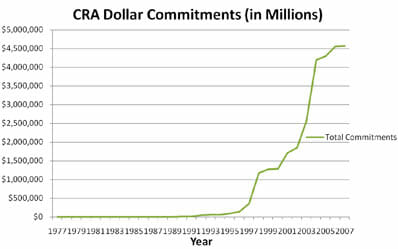
The usual response from supporters is that the numbers are too small to matter.  I tended to agree with this -- until I saw this graph, from Peter Schweizer via Carpe Diem.

chart_398x249

Unfortunately he does not have a source or methodology, so I have to retain some skepticism, but if true these numbers are far from trivial.  He writes:

According to the National Community Reinvestment Coalition, in the first 20 years of the act, up to 1997, commitments totaled approximately $200 billion. But from 1997 to 2007, commitments exploded to more than $4.2 trillion. (Keep in mind this is more than four times the size of the current health bill being debated in Congress.) The burdens on individual banks can be enormous. Washington Mutual, for example, pledged $1 trillion in mortgages to those with credit histories that "fall outside typical credit, income or debt constraints," and was awarded the 2003 CRA Community Impact Award for its Community Access program. Four years later it was taken over by the Office of Thrift Supervision.

This effort was backed by a parallel effort at Fannie Mae and Freddie Mac to buy up these loans:

Beginning in 1992, Congress pushed Fannie Mae and Freddie Mac to increase their purchases of mortgages going to low and moderate income borrowers. For 1996, the Department of Housing and Urban Development (HUD) gave Fannie and Freddie an explicit target "” 42% of their mortgage financing had to go to borrowers with income below the median in their area. The target increased to 50% in 2000 and 52% in 2005.

For 1996, HUD required that 12% of all mortgage purchases by Fannie and Freddie be "special affordable" loans, typically to borrowers with income less than 60% of their area's median income. That number was increased to 20% in 2000 and 22% in 2005. The 2008 goal was to be 28%. Between 2000 and 2005, Fannie and Freddie met those goals every year, funding hundreds of  billions of dollars worth of loans, many of them subprime and adjustable-rate loans, and made to borrowers who bought houses with less than 10% down.

Fannie and Freddie also purchased hundreds of billions of subprime securities for their own portfolios to make money and to help satisfy HUD affordable housing goals. Fannie and Freddie were important contributors to the demand for subprime
securities.

Obama has a personal history with this effort, actually suing banks who would not provide the sub-prime lending that he later, as President, blamed them for undertaking

Obama's battle against banks has a long history. In 1994, freshly out of Harvard Law School, he joined two other attorneys in filing a lawsuit against Citibank, the giant mortgage lender. In Selma S. Buycks-Roberson v. Citibank, the plaintiffs claimed that although they had ostensibly been denied home loans "because of delinquent credit obligations and adverse credit," the real culprit was institutional racism. The suit alleged that Citibank had violated the Equal Credit Opportunity Act, the Fair Housing Act and, for good measure, the 13th Constitutional Amendment, which abolished slavery. The bank denied the charge, but after four years of legal wrangling and mounting legal bills, elected to settle. According to court documents, the three plaintiffs received a total of $60,000. Their lawyers received $950,000.

Now, Congress and Obama want to strengthen the CRA -- talk about not learning from mistakes.

Now comes Rep. Eddie Bernice Johnson, D-Texas, and 50 other co-sponsors (all Democrats) of H.R. 1479 the "Community Reinvestment Modernization Act of 2009," who want to expand the CRA to include not just banks but also credit unions, insurance companies and mortgage lenders. Congressman Barney Frank, chairman of the House Financial Services Committee, has supported the idea in the past. The SEIU and ACORN, along with a host of other activist groups, are also behind the effort.

President Obama has been a staunch supporter of the CRA throughout his public life. And his recently announced financial reforms would make the law even more onerous and guarantee an explosion in irresponsible lending. Obama wants to take enforcement of the CRA away from the Federal Reserve, the FDIC and other financial regulators who at least try to weigh bank safety and soundness when enforcing the law, and turn it over to a newly created Consumer Financial Protection Agency (CFPA). This agency's core concerns would not be safety and soundness but, in the words of the Obama administration, "promoting access to financial services," which is really code for forcing banks to lend to those who would not ordinarily qualify. Compliance would no longer be done by bank examiners but by what the administration calls "a group of examiners specially trained and certified in community development" (otherwise called community activists). The administration says, in its literature about the reforms, that "rigorous application of the Community Reinvestment should be a core function of the CFPA."

Looks like there may be jobs available after all for all those folks who got fired from ACORN.

It's Apparently Racist to Creat Jobs in Minority Neighborhoods

I remember the fuss a number of years ago that a disproportionate number of heavily polluting industrial plants were in poorer neighborhoods.  I suppose it is no surprise that companies look to site plants where there are large labor forces and cheap land, which probably means that they are not going to buy of large swaths of Grosse Pointe for their new auto plant.  But there also seemed to be some chicken and egg here - residential land around industrial tracts probably attract residents who can't afford to live somewhere else.

Anyway, I had never realized just how destructive public policy had become in response to this "problem," nor how much our current climate czar had to do with it:

Case in point is "Climate Czar" Carol Browner, former EPA chief under Bill Clinton and ghostwriter of Al Gore's apocalyptic book Earth in the Balance. In the late 1990s, Browner championed the effort to apply Title VII U.S. civil rights law to plant permitting, arguing that locating industrial facilities in majority black cities "disproportionately impacted" minorities and was there "environmental racism."The policy provoked outrage among those black elected officials across the country who believe it's a good thing to have jobs available in minority areas.

Some of those officials were in Michigan, where Browner's green allies tried to use EPA rules to shut down electric power facilities and auto plants. At the time, Browner had already bagged the pelts of two major facilities in Louisiana -- a plastics plant and nuclear fuel facility -- that would have brought hundreds of jobs to minorities.

As can be expected, African-American politicians who were told it was racist to locate jobs in their communities were not amused:

Horrified by this threat to jobs within poor communities, Detroit mayor Dennis Archer led the primarily Democratic U.S. Conference of Mayors to scrap "green redlining" -- so called because the EPA actually drew circles around plants located in minority areas that would encourage lawsuits. The mayors were joined by a rainbow coalition of groups from the National Association of Black County Officials to Republican pols like L.A.'s Richard Riordan and Michigan Rep. Joe Knollenberg.

Addressing the Black Chamber of Commerce's annual meeting, then-U.S. Chamber president Thomas Donahue said: "I'm trying to think of a policy that would be more effective in driving away entrepreneurs and jobs from economically disadvantaged areas -- and I can't do it."

Apparently, the whole to-do was BS anyway

Mastio's News investigation further uncovered that Browner's EPA had suppressed documents finding that there was not a corporate conspiracy to locate polluting industries in black areas (in fact, they are mostly in white areas), and the bipartisan outrage eventually led to a Congressional vote blocking the EPA rule.

Make Sure You Don't Catch More than The Limit...

...because the US Fish and Wildlife service has a SWAT team and is not afraid to use it.   Yet another heavily armed government team making sure our nation does not teeter over the brink of anarchy.  Because if everyone were allowed to freely import orchids, our civil society would come to an end.  Fortunately at least one such miscreant was thrown in jail for a well-deserved two years for having the gall not to fill out his import paperwork correctly on otherwise legal orchids.  Thank god Fish and Game had a SWAT team -- who knows what kind of violence 66-year-old orchid terrorists are capable of.   I sure hope I filled out my clock importation paperwork correctly.

Phoenix Climate Presentation, November 10 at 7PM

I have given a number of presentations on climate change around the country and have taken the skeptic side in a number of debates, but I have never done anything in my home city of Phoenix.

Therefore, I will be making a presentation in Phoenix on November 10 at 7PM in the auditorium of the Phoenix Country Day School, on 40th Street just north of Camelback.  Admission is free.  My presentation is about an hour and I will have an additional hour for questions, criticism, and rebuttals from the audience.

I will be posting more detail later, but the presentation will include background on global warming theory, a discussion of why climate models are likely exaggerating future warming, and an evaluation of various policy alternatives.  The presentation will be heavy on science and data, but is meant to be accessible without a science background.  I will post more details of the agenda as we get closer to the event.

I am taking something of a risk with this presentation.  I am paying for the auditorium and promotion myself -- I am not doing this under the auspices of any group.  However, I would like to get good attendance, in part because I would like the media representatives attending to see the local community demonstrating interest in at least giving the skeptic side of the debate a hearing.  If you are a member of a group that might like to attend, please email me directly at the email link at the top of this page and I can help get more information and updates to your group.

Finally, I have created a mailing list for folks who would like more information about this presentation - just click on the link below.  All I need is your name and email address.

I Plead the Third

I consider winning the Olympics for one's town to be roughly equivalent to army choosing to quarter itself in my house.  So I am pleased that this particular financial locust will go someplace else to pig out.  I am happy to watch it occur in some exotic locale to which I do not pay taxes.

I am reluctant to pile on Obama, though he certainly would have claimed credit had Chicago won.  I will say that the US managed to win an Olympic bid during even the Carter administration, though because the Montreal Olympics were such a financial disaster, LA really didn't have any competition when it was bidding in 1978.  One other city expressed interest that year - Tehran.  What a disaster that would have been.

Please don't tell me the LA Olympics "made money."  The city of LA and state of California subsidized the games in all kinds of ways that never hit the income statement of the organizing committee, starting with police and congestion costs.  Only in comparison to the financial disaster that was Montreal could the LA Olympics be called a financial success.

Favorite Live Album

One person's version of the Top 100 live albums.  My favorite, Seconds Out by Genesis, is not on the list.

I know this choice is semi-blasphemy for other old Genesis fans, as this was in the early days after Peter Gabriel left and Phil Collins had just taken over as lead singer.   I like a lot of the old Gabriel-era work, but for me this was the band at its peak, still playing all of its original prog-rock work but with a little more polish and less, uh, wackiness with Collins out front rather than Gabriel.   The band was at that inflection point before it slid downhill from rich, complex, challenging music to polished but thin and mediocre pop songs  (roughly the same transition we have had to watch Springsteen go through), a transition that is certainly related to Gabriel's departure.

Update: By the way, the purpose of this post was not to try to establish some musical moral high ground.  In looking back on the post, I fell in the trap of snobbily turning my nose up at certain works.  Shouldn't have done that.   I don't grok Bob Dillon and get irritated with those who look down their nose at me for that, and I try to avoid doing the same.  So I will say it is perfectly OK if you don't "get" early Genesis and prog rock.  In fact, it probably makes you normal.  70's prog rock can be, frankly, inaccessible for those who did not grow up on it.

However, if you like old Yes, Jethro Tull, ELP and the like and haven't ever heard Seconds Out or some of the albums it is based on (Trick of the Tail, Wind and Wuthering, Lamb Lies Down on Broadway) it might reward you to check it out.

Follow the Incentives

I often tell people that in failing organizations like the government or GM, most of the folks who are "part of the problem" aren't bad people, they just have bad incentives.  I have to remind myself this all the time when dealing with government bureaucrats who are making it impossible for our company to make progress in some area.  These folks did not grow up imagining a life in which they block all growth and innovation, they simply found themselves in organizations  which provide strong incentives to act in this way.  Such consequences may be unintended, but they certainly aren't unexpected when one studies incentives.

To this end, the incentives in the new Baucus health care bill do not look good.  Here is one example:

Because Baucus and the Dems apparently can't be bothered to post the bill online, the Washington Examiner had to get a copy the old fashioned way.  When they did, here is what they found on pages 80-81, "hidden amid a lot of similar legislative mumbo-jumbo":

"Beginning in 2015, payment would be reduced by five percent if an aggregation of the physician's resource use is at or above the 90th percentile of national utilization."  Translated into plain English, it means that in any year in which a particular doctor's average per-patient Medicare costs are in the top 10 percent in the nation, the feds will cut the doctor's payments by 5 percent.
[...]

This provision makes no account for the results of care, its quality or even its efficiency.  It just says that if a doctor authorizes expensive care, no matter how successfully, the government will punish him by scrimping on what already is a low reimbursement rate for treating Medicare patients. The incentive, therefore, is for the doctor always to provide less care for his patients for fear of having his payments docked. And because no doctor will know who falls in the top 10 percent until year's end, or what total average costs will break the 10 percent threshold, the pressure will be intense to withhold care, and withhold care again, and then withhold it some more.  Or at least to prescribe cheaper care, no matter how much less effective, in order to avoid the penalties.

The result can't be anything but an incentive for doctors to provide less care to those who need it most, and, when they get tired of getting their pay cut for doing their job, leaving the medical profession altogether.  The article goes on to point out that nothing is done in the bill about the worst incentive to increase medical costs doctors face, the threat of unreasonable tort actions that causes doctors to order ever test and procedure imaginable to combat future second-guessing in front of a jury.

Regulation Gone Mad

I am importing a fairly expensive art clock from Germany.  It hit Fedex in Memphis yesterday, then apparently hit a snag.  The US government demands that certain data on imported clocks be submitted to them before it can clear customs.  Fedex had to pay someone for about half an hour of work (to track me down, interview me on the phone, and submit the paperwork) so that this critical data could be submitted to the Feds:

CLOCK-WORKSHEET2

I kid you not.  This would be one of the dumbest things I have seen from the government had it not been for the egg licenses I have to hold.  This data was probably critical for some program pushed through by a Senator to protect some business in his district that does not even exist any more.  I wonder if anyone in the government even remembers why this data is so vital (seriously, per question 11, how many wind-up clocks are coming through customs nowadays).  Probably part of a program to protect America's essential capacity to manufacture clock movements over 12mm in thickness.

More Lame Economic Analysis

Kevin Drum and the left think falling savings rates are all ... wait for it you are going to be shocked with surprise ... Reagan's fault.  OK, you are not surprised, since in left-world everything that is not Bush's fault is either Reagan's, Wal-mart's or Exxon's.

SavingRateAug2009

Paul Krugman looks at this chart of the personal savings rate in the United States and concludes that Reaganomics is the most likely reason that it fell off a cliff....

But I'd point to two other things that Krugman mentions: financial deregulation and stagnant median wages.  Those seem like much more likely villains to me.  Starting in the late 70s, middle class wages flattened out, which meant there was only one way for most people to support the increasing prosperity they had long been accustomed to: borrowing.  At the same time, financial deregulation unleashed an industry that marketed itself ever more aggressively on all fronts: credit cards, debit cards, payday loans, day trading, funky home mortgage loans, and more.  It was a match made in hell: a culture that suddenly glorified debt; an easy money policy from the Fed that made it available; a predatory financial industry that promoted it; and middle-class workers who dived in to the deep end without ever quite knowing why they were doing it.So, yeah, Reagan did it.  Sort of.  But he had plenty of help.

This is a great variation of the classic "I know what caused bad trend X -- everything I was against before I learned about bad trend X."  The following was my response in the comments:

  1. The chart on the left starts out at 8%. Drum picked a recession peak as his starting point, a clever trick, but it appears that when Bush 1 left office the number was still about 8%. The largest fall seems to be in the Clinton years. For which, by the way, I don't "blame" Clinton any more than Reagan, certainly not without any real evidence or understanding of the mechanism involved.
  2. Drum's "consumers are all stupid pawns of electronics retailers and credit card companies" wears thin at some point.   It's funny how everyone thinks this is true... of everyone else, but not himself.
  3. Let me posit an alternative. The 1980s and 1990s saw huge percentage increases in asset values, both equities and homes. This began just about at the time the savings rate dipped. I would posit that consumers, in their mental calculation of savings, included paper gains on these assets. These paper gains are not, to my knowledge, included in savings rate numbers (you can be sure that is true because, if they were, savings rates would have dropped in late 2008). Thus consumers saved less money from their paycheck (which is measured, so it showed a drop in savings rate) while they considered themselves still to be saving as much or more as previously, because they were counting paper profits on assets as savings.  The big decreases coincide with the 80's bull market, the 90's bull market / internet bubble, and this decades housing bubble.

My explanation in number three will look even better if we see an increase in savings rate over the coming years as consumer expectations about asset value changes are made less exuberant by the recent burst bubble.  A fascinating chart would be to plot savings rate against some measure of consumer expectations of future asset price increases.  I bet they would correlate pretty well.

Doubling Down .. For What?

OK, I am finally going to break under the pressure.  I have resisted posting on Roman Polanski's extradition.  Like many, I shook my head in amazement at all the Hollywood apologia for a man who drugged, raped and sodomized a 13-year old girl.  But I expected it to mostly blow over.  I figured a few Hollywood stars would make a pro forma statement to cement their sophistication credentials, then move on, in the same way they buy a Prius to establish their environmental bona fides and then hop on their G5 to fly to Gstaad.

But I am just amazed at how many folks seem willing to double down on their defense of Polanski, as illustrated by Anne Applebaum's refusal to concede the facts.  Is this really the the right spot to choose to draw the line in the sand and battle bourgeois moralizing or religious fundamentalism?   Heck, I probably support the legalization of more personal behaviors and practices than most liberals, and even I see Polanski's behavior as on the very wrong side of a pretty bright moral line.

This is like watching Lee stubbornly keep trying to attack Union positions on the third day at Gettysburg or Burnside throwing his men against the near impregnable Southern position at Fredericksburg.  You just want to go to them and say "guys, this is terrible ground to fight a battle.  Retire from here and go find a better spot."

Update: Freaking incredible, via Patrick at Popehat, is this:

Some of the [television and film] industry's most prominent women said they believe Polanski, who faces a sentence as low as probation and as high as 16 months in prison for pleading guilty to having sex with a minor, should be freed. "My personal thoughts are let the guy go," said Peg Yorkin, founder of the Feminist Majority Foundation [owner of Ms. Magazine]. "It's bad a person was raped. But that was so many years ago. The guy has been through so much in his life. It's crazy to arrest him now. Let it go. The government could spend its money on other things."

Patrick points out that Ms. Yorkin did not always have so casual and comfortable attitude about rape.

Update #2: By the way, the similarities between this episode and one written by Mario Puzo in the Godfather 10 years earlier are striking to me.  Obviously Polanski wasn't the model for the producer Woltz, but someone real probably was.

Banning Dissent, Even in Science

I am constantly amazed at the totalitarianism of the global warming community and their absolute intolerance of dissent.  One suspects that a reason more people are skeptical of alarmist predictions is that they know enough about human behavior to distrust someone who claims to be correct but refuses to respond to or even allow questions or replication.

Anthony Watt has a good example from the world of polar bears:

Exile for non-believers (PDF, press release)

Mitchell Taylor is a world's leading polar bear expert. He has studied a greater number of polar bear populations than anyone else. He has caught more polar bears than anyone else.

He was going to attend the 2009 meeting of the Polar Bear Specialist Group (PBSG). The name sounds technical, doesn't it? Unfortunately, in one of his papers, he wrote this somewhat self-evident, yet detailed, balanced, and carefully worded description of the polar bears' situation:

"The concern that polar bears will decline if the climate continues to warm is valid. However, the assertion that polar bears will become extinct unless immediate measures are taken to curb greenhouse gas emissions is irrational because it is inconsistent with the long-term persistence of polar bears through previous periods of warming and cooling; and because the IPCC climate model predictions 50 and 100 years into the future do not suggest a future with insufficient sea ice to support polar bears as a viable species."

What was the answer? He wasn't allowed to participate. Here is Mr Andrew Derocher's letter:

Hi Mitch,

The world is a political place and for polar bears, more so now than ever before. I have no problem with dissenting views as long as they are supportable by logic, scientific reasoning, and the literature.

I do believe, as do many PBSG members, that for the sake of polar bear conservation, views that run counter to human induced climate change are extremely unhelpful. In this vein, your positions and statements in the Manhattan Declaration, the Frontier Institute, and the Science and Public Policy Institute are inconsistent with positions taken by the PBSG.

I too was not surprised by the members not endorsing an invitation. Nothing I heard had to do with your science on harvesting or your research on polar bears - it was the positions you've taken on global warming that brought opposition.

Time will tell who is correct but the scientific literature is not on the side of those arguing against human induced climate change. I look forward to having someone else chair the PBSG.

Best regards,
Andy (Derocher)

If you are not familiar with Taylor's positions that are alluded to, as I understand it they include:  1) The fact that most polar bear populations have been rising rather than falling over the last decades and 2) polar bears have survived interglacial periods in which we believe all sea ice disappeared.

Most of y'all know I have a parallel blog on climate over at Climate Skeptic.  I get accused of being "anti-science" all the time, I suppose for pursuing scientific evidence where it takes me rather than accepting the scientific "consensus" that I am told I should shut up and accept.

One response I often make to this accusation is the to compare the comment policy of leading skeptic and alarmist climate sites.  Which seem more "anti-science" to you?  Here is part of my blog's comment policy:

I have never tried to moderate my comments (except for spam, which is why you might have  a comment with embedded links held for moderation "” I am looking to filter people selling male enhancement products, not people who disagree with me.)  In fact, I relish buffoons who disagree with me when they make an ass of themselves - after all, as Napoleon said, never interrupt an enemy when he is making a mistake.  And besides, I think it makes a nice contrast with a number of leading climate alarmist sites that do not accept comments or are Stalinist in purging dissent from them.

Leading sites that are skeptical or at least are willing to ask questions of the climate orthodoxy like Watt's Up with That or Climate Audit have similar policies - their comment threads are full of people with strongly opposing opinions to the site's authors.

Now check out a comment policy from an alarmist site:

Climate "skepticism" is not a morally defensible position. The debate is over, and it's been over for quite some time, especially on this blog.

We will delete comments which deny the absolutely overwhelming scientific consensus on climate change, just as we would delete comments which questioned the reality of the Holocaust or the equal mental capacities and worth of human beings of different ethnic groups. Such "debates" are merely the morally indefensible trying to cover itself in the cloth of intellectual tolerance.

So, if you're a climate skeptic, you may be well-intentioned and you're certainly welcome to your opinion, but we're not interested.

The leading alarmist site, Real Climate, founded and run by people the media portrays as leaders in climate science, such as James Hansen, routinely purge all dissent from posts and comments.  For example, Anthony Watt wrote this after Steve McIntyre found huge problems in a recent version of a hockey stick temperature recontruction:

Realclimate.org continues deleting the ongoing river of comments posted on their threads ( Note: Any of you who find that your posts to those sites are being rejected {as usual without any explanation} can keep a copy of the post, and post it at http://rcrejects.wordpress.com if you want

I find that amazing -- someone is maintaining a blog populated with everything the "leading scientists" at Real Climate purge.  Check the stuff out there, this is not foul-mouthed mindless rants, but real scientific challenges that are being deleted.

One of the dirty secrets of climate science is that the so called "settled" science of global warming is often never challenged or replicated as we expect science should be.  When someone claims to have produced cold fusion, if they want their work to be accepted it is their obligation to publish their data and methodology for others to try to replicated.  In climate, this seldom happens.  Members of a small community all replicate and review each others' results, and claim this to be sufficient for "consensus."  When outsiders or mavericks attempt to test or replicate the results, they are stonewalled.

Here is my favorite quote to illustrate the whole mindset, and should make any reasonable person nervous who understands that Congress is on the verge of committing trillions of dollars of our money to certain courses of action based on the science.  It is from Phil Jones, who put together one of the first global temperature metrics at the Hadley Center, to Warwick Hughes, an Australian scientist who had some questions about the data and was having trouble replicating some of Jones' results.  Jones wrote, in response to Hughes request for data (data which underlies much of the early IPCC reports and so is the basis for a lot of public policy discussion):

"We have 25 years or so invested in the work. Why should I make the data available to you, when your aim is to try and find something wrong with it?"

UPDATE: Here is a great example of the way it should be done -- Steve McIntyre posts Keith Briffa's response in full, invites other responses:

In spite of suffering a serious illness (which I understand to be a kidney problem), Keith Briffa has taken the time to comment on the Yamal situation. The comment should be read by interested readers. If Briffa or any of his associates wishes to post a thread here without any editorial control on my part, they are welcome to do so.
News Flash: People Being Tortured Sometimes Confess to Anything to Stop the Torture

It is pretty amazing to me that 500 years after the Spanish Inquisition it is somehow a revelation that people who are being tortured will say about anything to make the torture (or the threats thereof) stop:

On Friday the government declassified an opinion in which U.S. District Judge Colleen Kollar-Kotelly ordered the release of a Kuwaiti held at Guantanamo since 2002, saying he was imprisoned based on coerced confessions that even his interrogators did not believe. Fouad Al Rabiah, a 50-year-old aviation engineer and father of four, was captured as he tried to leave Afghanistan in December 2001. He said he came to Afghanistan that October to help refugees, an explanation the judge found credible....

Later four Guantanamo inmates made several implausible accusations against Al Rabiah"”claiming, among other things, that the engineer, who had worked at Kuwait Airlines for 20 years, suddenly became a leader of the fight against U.S. forces in Tora Bora. Kollar-Kotelly noted that the charges were either inconsistent or demonstrably false. The Pentagon eventually stopped relying on these wild claims to justify Al Rabiah's detention, but by then interrogators had used the charges, along with sleep deprivation and threats of rendition to countries where he would be tortured or killed, to extract confessions from him. In the end, the interrogators concluded that Al Rabiah was making up a story to please them. "Incredibly," Kollar-Kotelly wrote, "these are the confessions that the government has asked the Court to accept as truthful in this case."

I have argued for years that indefinite detention of anyone, citizen or not, is an affront to the principles on which this country was founded.  Just to make my position entirely clear, I am willing to risk letting 40 dangerous people go free (assuming we can't actually prosecute them) to avoid having one person detained wrongly.  If you think this is naive or wrong, then you need to ask yourself what you think about our entire legal system, which is predicated on a similar presumption, that we would prefer some guilty or dangerous people go free rather than tilt the system such that innocent people rot in jail.

Other posts from this topic here and here

Here Is A Great Issue for "Progressives." Somehow I Doubt They Will Run With It

From Daniel Griswold in the Washington Times:

President Obama and the other Group of 20 leaders delivered their obligatory warning against protectionism at last week's summit in Pittsburgh. But at home the U.S. president continues to conduct his own trade war, not only against imports from China and other developing countries, but against the most vulnerable of American consumers.

America's highest remaining trade barriers are aimed at products mostly grown and made by poor people abroad and disproportionately consumed by poor people at home. While industrial goods and luxury products typically enter under low or zero tariffs, the U.S. government imposes duties of 30 percent or more on food and lower-end clothing and shoes - staple goods that loom large in the budgets of poor families....

The tariff the president imposed on Chinese tires earlier this month was heavily biased against low-income American families. The affected tires typically cost $50 to $60 each, as compared with the unaffected tires that sell for $200 each. The result of the tariff will be an increase in lower-end tire prices of 20 percent to 30 percent. Low-income families struggling to keep their cars on the road will be forced to postpone replacing old and worn tires, putting their families at greater risk....

A few liberal Democrats still care, too. Edward Gresser of the Democratic Leadership Council has done more than anyone to expose the unfair, anti-poor bias of the U.S. tariff code.

In his 2007 book "Freedom From Want: American Liberalism and the Global Economy," he calculated that a single mother earning $15,000 a year as a maid in a hotel will forfeit about a week's worth of her annual pay to the U.S. tariff system, while the hotel's $100,000-a-year manager will give up only two or three hours of pay.

OMG, This Is Different

The Observer Effect and Using Google for Social Science

I thought this was an interesting quick and dirty social study using Google. (via Knowledge Problem)

For any individual study you can validly say that you think the estimate is too low, or indeed, too high, and give reasons for that. For instance, you might say that your sample was mainly young people who tend to be healthier than the general public, or maybe that the diagnostic tools are known to miss some true cases.

But when we look at reporting as a whole, it almost always says the condition is likely to be much more common than the estimate.

For example, have a look at the results of this Google search:

"the true number may be higher" 20,300 hits

"the true number may be lower" 3 hits

I often tell folks that the key to understanding behavior is to understand incentives. The media as institutions have incentives to sensationalize and scare (it sells papers) and as individual reporters have incentives to magnify the importance of whatever story he or she is working on.

But what I found really interesting was how the Observer effect comes into play here.  Wikipedia has this brief definition of the observer effect:

In physics, the term observer effect refers to changes that the act of observation will make on the phenomenon being observed. This is often the result of instruments that, by necessity, alter the state of what they measure in some manner.

Click on the Google hit numbers above.  I get 42,700 and 5,360 respectively, the increase presumably due in part to this article and links to it.  Its impossible to report on patterns in Google searches without the very fact of such reporting affecting what is being measured.

But's Its My Hard Work Paying Your Unemployment

I found this story, from a Marketplace segment via Carpe Diem, especially irritating.  Our company has to pay for a lot of unemployment fraud, so seeing such fraud in action really annoys the hell out of me.

Quick background:  Employers pay unemployment taxes generally as a percentage of wages.  These taxes are based on a direct relationship with past claims from ex-employees.  The more of my ex-employees who make claims, the more premiums I pay.

Since I only have jobs for 6 months a year (it is a seasonable business), employees have the opportunity to file for unemployment the other 6 months.   BUT, the rule is generally that you have to be looking for work.

Unfortunately, I have numerous employees who work for me over the summer and take the winter off, but tell the unemployment office they are looking for work so they can collect unemployment anyway.  I have had employees call me from Mexico telling me about the great winter vacation they are having on the exact same day I see their names on the roles of those collecting unemployment (and thereby supposedly "looking for work").

In California, where such behavior is rampant (and where the state unemployment agency has established penalties for employers who even think about asking the state to investigate one of his ex-employees for fraud) I pay over 7% of wages in unemployment taxes, vs. less than 1% in states without such fraudulent behavior.

So, with this background, I am thrilled this guy is showing the initiative to find work but am frustrated he is still fraudulently taking my money:

Michael: I'm getting $272 a week [in unemployment benefits]. Which is just, bare bones. It's so bad that at one time I was going to the food bank. And, you know when you're really hungry and when you're facing eviction, you've got to do something.

Marketplace: So he started looking for work on the side. He found it pretty quickly.

Michael: So right now I have Craigslist open. And what I've done is I've opened three different tabs: I've opened free stuff, all gigs and all jobs.

Marketplace: He's found all sorts of work this way: software testing, landscaping, bouncing and lots of focus groups. All have paid cash. He says some weeks he's earned three times as much as his benefits check. Like everyone on unemployment, he's meant to report any earnings to his unemployment insurance office. Then they adjust his benefits down. So how does Michael answer the question, have you earned any money this week?

Michael: I opt to say, you know, no. I opt to say no, I have not. Because this is my own hard work, this is my own ingenuity, this is my own genius, and I am still looking for work every day.

You are absolutely right Michael, yours the same argument all productive folks make in the face of government expropriation.  In fact, I couldn't have said it better - "this is my own hard work, this is my own ingenuity, this is my own genius."  Brilliant.  But recognize that the unemployment money you are taking fraudulently was paid for with my hard work, my ingenuity, and my own genius.

ADM's Mistake (Mostly Corrected)

Alex Tabarrok discusses the new movie about Mark Whitacre and price fixing at Archer Daniels Midland.  ADM apparently was caught holding meetings with competitors to fix prices of certain chemical commodities, specifically Lysine.

Here was ADM's mistake, and it is one they have clearly learned from:  in the modern American corporate state, there is no reason to engage in illegal private price fixing or cartel arrangements when corporations can achieve similar ends legally and openly through the government.  If ADM was concerned about difficult competition depressing pricing, they could have emulated any of these examples:

  • Run to Congress to beg for strong tariff's on foreign sources of their commodity product (as do the sugar and ethanol industries)
  • Run to Congress and have them institute minimum pricing or buy up excess supply (as do many agricultural producers)
  • Run to Congress to seek supply restrictions (as does the taxi business)
  • Run to Congress and have them restrict new competition and sources of supply through licensure (as do a variety of industries, from real estate to funeral homes to medicine)
  • Run to Congress to have them pass onerous legislation that makes it difficult for new capacity to be added in the business (as does the waste disposal industry)
  • Run to Congress to seek subsidies for their product in the name of some public good - it doesn't even have to be true (as does, well, ADM with ethanol)
  • Run to Congress to seek regulations that favor your particular production and product technologies while hamstringing your competition (as does GE with light bulbs)
  • Run to Congress and have them enforce an industry price-fixing arrangement -- its legal when Congress does it (as do the Milk producers)
  • Run to the FTC to bring anti-trust actions against your competition (as did Netscape and Sun against Microsoft)  This is an interesting article on this, which says in part, "Most [antitrust] cases are not brought by public representatives, whether elected or self-appointed, but by private companies, often rivals of the defendant who are being driven out of business. Businessmen believe that competition is good if they win but bad if the other guy wins."

Of course, all of this takes a little care.  The competitive relief must be couched in something like "consumer protection" or "saving jobs" or "going green" or "fairness," but there are plenty of good examples of consumers getting the shaft in the name of consumer protection that it shouldn't be too hard to come up with something.  Developing a high profile in an early Presidential primary state like Iowa doesn't hurt either.

As I said in the title, ADM has certainly figured this out, if their approach to the ethanol business is any guide.  In ethanol, they have resorted to any number of these tactics simultaneously.

Expectations

I must say that I do find it interesting that a few heated verbal exchanges and one guy carrying a gun peacefully somewhere near where the President was speaking is considered a looming threat from the right to civil society while lefties physically clashing with police and destroying property (again near the President) is treated as ho-hum, more leftish rioting.  The same bored reaction tends to result from union violence as well.  Is it bias, or have we just had years to get used to violence on the left?  With memories of Seattle, all subsequent violence I guess seems tame and not worthy of comment.

Local Governments Mining for Dollars

As a small business owner, a huge portion of my time is spent feeding governments with all the paperwork they demand.  But this year has been twice as bad.  Every local authority we operate in has started mining for dollars.  What this has meant is a whole slew of property "reassessments" that have no basis in reality (e.g. values put on non-existent assets) that I have to spend a lot of my time fighting.  The general modus opperandi is to declare my company owes money for something fictitious, and then make us prove we don't.  Have you ever tried to prove you don't own an asset that doesn't exist?  Think about it.  How would you go about it, short of inviting the assessor out to your property to search for it.

Maricopa County, the county that includes Phoenix where my headquarters resides, has been the worst.  We buy assets for properties all over the country, and have the bill sent to our headquarters.  Often, if a registration is required, we will put our headquarters address on the government registration to make sure we get the renewal paperwork (long experience is that if anything gets sent out to an address in the field, it is lost).  The concept that an asset might be in location X but the paperwork should be sent to location Y is a really, really hard concept for a lot of state registration authorities to get their head around/

This year, Maricopa County has started sending us personal property tax notices for all kinds of assets that have never even existed in this county.  They were bought in state A, shipped to state B, with the bill sent to us here in Arizona.  But the County is in financial distress.  It probably understands that the asset does not exist in the County.  I am sure it knows that I don't, for example, have 24 cabins sitting on the fourth floor of this building, where they have them located.  But they need money.  If they send out enough fraudulent bills, and then tell taxpayers it is the taxpayer's responsibility to prove the bill is wrong, then they will likely get some money.   Yet again, the government is engaging in abusive practices that not private company could get away with for long.

I was pretty calm today on the phone with the assessor until this came up:

Me: Look, these are cabins I bought from a factory in Maricopa County but which were shipped immediately from the factory to California.

Assessor: I don't see where you filed for permission to move the cabins

Me: Excuse me?

Assessor: Your xxxyyy form [I forget the numbers].  You never filed for permission to relocate

WTF?  I know we have problems with declining tax roles, but do I really have to ask permission to move an asset out of the county or state.  What, did I violate directive 10-289?

So beware small businesses.  Your government is mining for dollars -- do not assume that tax bill is correct.

Both Sad and Hilarious

Rick Trabino writes "How to Publish a Scientific Comment in 1 2 3 Easy Steps."  Not only hilarious, but it will make one despair for the future of science and academia, until one remembers that this kind of stuff has probably been happening since Euclid so somehow we make progress anyway.

Via Steve McIntyre, who has had similar problems of his own.  Particularly the parts where authors of studies published in journals refuse to share their data for replication, despite rules in the journals in which they publish which typically require such availability.