Since the New York Times has pretty much become the official media outlet of this administration, I presume that this article represents a new trial balloon in selling government health care. The pitch this time -- its good for small businesses! (via Maggies Farm)
President Obama, in his Saturday radio address, said the Democrats' health insurance overhaul would help small businesses and stimulate the economy by providing relief from "the crushing costs of health care "” costs that have forced too many small businesses to cut benefits, shed jobs, or shut their doors for good."....
The House speaker, Nancy Pelosi of California, said the sharp rise in premiums for small businesses offered the latest evidence that Congress must act swiftly on health care legislation.
"This underlines the urgent need for health insurance reform, including a public option," she said in an interview. "We need to have competition for the insurance companies to keep premiums down."
I am only now getting through the 1500 pages of this bill (putting me ahead of Ms. Pelosi in reading it, I am sure), but the last House bill would have been a disaster for my company, increasing taxes on wages by up to 8% and imposing a record-keeping burden that was just horrific.
The NYT and the Democrats are apparently trying to set up a mini-class war within bussinesses, snidely saying these companies have more negotiating leverage. Sure. But what they have even more of is the leverage to shape federal legislation to their benefit. However worse a deal my company may get in free insurance markets due to being small is nothing compared to how much worse of a deal we will get from Congress by being small.
If they really wanted to cut costs for small businesses, they would strip out all the national and state coverage mandates for things like aromatherapy that raise costs so much and let me shop for insurance across state lines. That would be real competition. Unfortunately, all Pelosi means by competition is throwing Amtrak into the mix to compete with the airlines. Yeah, that will do the trick.
This is just so typical. In response to demands for transparency, the Norwegian government starts publishing ... tons of private data about its citizens. I wonder how much detail they put online about how the government spends the tax money? Via maggies farm.
I am not sure anyone has actually said this, but that has certainly been the implication, right? Obama & Pelosi spends a lot of time accusing insurance companies of having profits that are too high, so I have to believe his intention is to reap cost savings by cutting into them.
I have blogged about this before, but Carpe Diem also picks up this thread, observing that health insurance companies are #86 on the list of US industries in terms of profit margins, with a ROS of 3.3%. As Mark Perry points out, this gives them a profit of about $100 per individual policy. Not really a very promising source of savings, is it? But it is very scary for any industry that makes more than 3.3% profits, knowing that the Administration thinks they are making too much money and has shown a willingness to slice into profits it thinks to be excessive.
Rent-seeking is the new venture capital model, Kleiner Perkins managing partner Ray Lane explained to an electric car-conference here Wednesday.
In an extraordinary speech, Lane laid out how market socialism can guarantee profits for politically connected VC firms like Kleiner -- far more preferable to the old model of "throwing a dart at a dart board," as Lane has put it. While Silicon Valley-based Kleiner made its reputation as a financier of tech startups like Netscape, Lane confided that they are inherently risky ventures in uncertain, fast-moving markets.
By contrast, Lane expressed admiration for communist governments like China and market-socialist economies like France where government determines new markets, thus providing a more certain investment climate for rent-seekers. With Kleiner partner Al Gore lobbying for federal mandates from wind to electric cars, Kleiner would be assured of a return on otherwise risky investments like Fisker Automotive, a California electric car company.
Cameron Scott meant this sentence as a withering critique of everything that is wrong with the government, from his point of view:
Transit riders shouldered four times the share of the MTA [Metropolitan Transit Authority] 2008 budget disaster [than] drivers did, but officials promised to seek more revenue from parking.
Holy cr*p! You mean that transit users shouldered four times more of the transit budget than transit non-users? Gasp!
The Bay Area where he lives is experiencing light rail disease. This is the phenomenon where middle class voters along heavy white collar commuting routes push for horrendously expensive light rail lines. The capital costs of these systems drain transit budgets into the distant future, forcing service cuts, particularly in bus systems that serve the poor. The result is that the city ends up with bigger transit bills, but less actual transit, and progressives like Scott scratch their head and try to figure out what went wrong. It must be because non-users of Transit aren't paying enough!
In general, legislative responses to the recent financial crisis just amaze me, and I am a fairly jaded observer of Congress with very low expectations.
First, Congress responds to a crisis caused by too much debt and overleverage by ...borrowing a trillion or so dollars and deficit spending.
Second, Congress responds to a crisis caused by too much subsidiazation of home ownership by ... subsidizing home ownership
Around the world, free speech is being sacrificed on the altar of religion. Whether defined as hate speech, discrimination or simple blasphemy, governments are declaring unlimited free speech as the enemy of freedom of religion. This growing movement has reached the United Nations, where religiously conservative countries received a boost in their campaign to pass an international blasphemy law. It came from the most unlikely of places: the United States.
While attracting surprisingly little attention, the Obama administration supported the effort of largely Muslim nations in the U.N. Human Rights Council to recognize exceptions to free speech for any "negative racial and religious stereotyping." The exception was made as part of a resolution supporting free speech that passed this month, but it is the exception, not the rule that worries civil libertarians. Though the resolution was passed unanimously, European and developing countries made it clear that they remain at odds on the issue of protecting religions from criticism. It is viewed as a transparent bid to appeal to the "Muslim street" and our Arab allies, with the administration seeking greater coexistence through the curtailment of objectionable speech. Though it has no direct enforcement (and is weaker than earlier versions), it is still viewed as a victory for those who sought to juxtapose and balance the rights of speech and religion.
I continue to be confused why the Left in this country is so absolutely hostile to Baptists in Alabama but are so deferential to Muslims in Saudi Arabia. Is it simply because one group makes credible threats of violence while the other does not?
Like the rise and fall of empires, or the tendency of revolutions to overshoot into excess, there are recognizable patterns to history. Along these lines, there seems to be a pattern emerging in 60's and 70's era advocacy groups. First, Greenpeace co-founder Patrick Moore turned on the organization he founded, criticizing it for ignoring science and being anti-human. Now Human Rights Watch founder Robert Bernstein is criticizing the organization he founded:
I must do something that I never anticipated: I must publicly join the group's critics"¦.
When I stepped aside in 1998, Human Rights Watch was active in 70 countries, most of them closed societies. Now the organization, with increasing frequency, casts aside its important distinction between open and closed societies.
Nowhere is this more evident than in its work in the Middle East. The region is populated by authoritarian regimes with appalling human rights records. Yet in recent years Human Rights Watch has written far more condemnations of Israel for violations of international law than of any other country in the region"¦.
Meanwhile, the Arab and Iranian regimes rule over some 350 million people, and most remain brutal, closed and autocratic, permitting little or no internal dissent. The plight of their citizens who would most benefit from the kind of attention a large and well-financed international human rights organization can provide is being ignored as Human Rights Watch's Middle East division prepares report after report on Israel.
A delegation from Human Rights Watch was recently in Saudi Arabia. To investigate the mistreatment of women under Saudi Law? To campaign for the rights of homosexuals, subject to the death penalty in Saudi Arabia? To protest the lack of religious freedom in the Saudi Kingdom? To issue a report on Saudi political prisoners?
No, no, no, and no. The delegation arrived to raise money from wealthy Saudis by highlighting HRW's demonization of Israel. An HRW spokesperson, Sarah Leah Whitson, highlighted HRW's battles with "pro-Israel pressure groups in the US, the European Union and the United Nations." (Was Ms. Whitson required to wear a burkha, or are exceptions made for visiting anti-Israel "human rights" activists"? Driving a car, no doubt, was out of the question.)
This reminds me of when the Innocence Project added Janet Reno to its board (though I still think they do good work).
Tom Selling and Pat Walters are looking for participation in their survey on issues related to IFRS (international accounting rules) and their migration to the US. Folks knowledgeable about these issues, either from the accounting or management side, are encouraged to participate. Tom wrote this invitation:
This is a brief announcement of an online IFRS survey that I have prepared with Pat Walters of Fordham University.
I invited Pat to collaborate with me because we have divergent views on the questions being asked. Thus, I hope that together we have achieved a modicum of balance in the survey's design--particularly in the phrasing of the questions and response choices offered. There are only 12 multiple-choice questions, and afterwards, I cordially invite you to express your own opinions regarding its design by posting a comment to this blog post.
We are also trying to reach many more stakeholders than any other survey has reached to-date on the IFRS adoption/convergence question. To that end, we hope you will choose to email the link at the bottom of this post to anyone else whom you think might have an interest in taking it.
Pat and I thank you in advance for clicking here to take the survey, or by pasting this ugly link in your web browser:
It's funny how green-haters accuse greens of being catastrophists, and then argue that cutting carbon emissions will destroy our economy and send us back to the Dark Ages. (See the trailer of Phelem McAleer's Not Evil Just Wrong for a prime example.)
Well, the last pooh-pooh is on them: It turns out we're already cutting emissions in the United States. Sure, some of that is due to a sluggish economy. But negative economic circumstances don't account for the 9 percent reduction in carbon emissions since 2007. In fact, the amount of carbon dioxide produced for every dollar of economic output declined by 3.8 percent in 2008.
I responded:
I really wish you would apply your analytical abilities to equities so I would have some way to bet against you.
Had you looked, you would see that the US has been reducing the CO2 intensity for a unit of economic output for decades. Here is the first source I found online but there are zillions. In terms of improvement, the US has done better on this metric in the last 20 years than nearly any other country in the world, and just as well as the best (e.g. Germany)
So what you tell is not a new story, and has nothing to do with recent governmental dictats or pleas by environmentalists and everything to do with the ongoing incentives of individuals and businesses to reduce costs and be more efficient.
The reason our total Co2 output has not decreased is that while CO2 per unit of GDP (I will call this CO2 efficiency) has improved 2-4 percent per year, our GDP has grown the same rate or faster. So our overall CO2 output is flat to up (and has actually been down the last few years). One of the main reasons Europe has done better than the US in total CO2 reductions is not improvements in CO2 efficiency, but because their economies have lagged. They bent over backwards in Kyoto to make 1990 the baseline year, so they could include the horrible economies of Russia and East Germany which were in the process of crashing, thus giving them an automatic CO2 reduction for nothing.
Anyway, just look at your own numbers. In the year before, we got about 3% improvement in Co2 efficiency and had about 3% economic growth so CO2 output was flat to down. Last year we had about 3% improvement in Co2 efficiency and the economy was down a lot and thus CO2 was down a lot. When there are two variables in a function, and only one is changing, most logical people attribute the change in output of the function (ie changes in total CO2 output) to the variable that changed (ie economic growth). You, for some reason, attribute changes in the output to the variable (co2 efficiency improvements) which basically remained unchanged. Nice analysis.
You can even see it in your numbers. If CO2 efficiency is up 3.8 percent and Co2 output is down 9 percent, then that means the economic growth/size component has to be down 5.4% (.91/.962 - 1). So almost 60% of the "improvement" is due to a very bad recession and 10% unemployment, but you attribute it to the unchanging 40% piece.
Did anyone in the environmental movement study math or economics?
I wrote about Michigan governor Granholm's taxpayer-funded initiative to make Michigan energy independent of, uh, Kentucky
Governor Granholm and Gov. James Doyle of Wisconsin seem to be tormented by the fact that the Midwest industrial engine imports much of its energy needs from coal states in the east and west. "Doyle has estimated that $226 billion leaves the region each year in energy costs that could be saved with alternative-energy installations and support jobs here," reported the Detroit Free Press.
I pointed out the absurdity of drawing every smaller circles on maps and claiming that wealth depended on that circle being self-sufficient.
But the pithy comeback would have been to ask how Ms. Granholm would react if, say, the the governors of California or Texas announced that were upset that billions of dollars leave their state every year to buy cars and that they were suggesting taxpayer-funded initiatives to free themselves of dependence on Rust Belt states for their transportation.
Ken Lewis gets his payoff for knuckling under to Paulson and Bernanke on the Merrill Lynch acquisition
Kenneth Lewis, outgoing chief executive of Bank of America Corp., will get no salary or bonus for 2009, according to people familiar with the matter, the biggest Wall Street name thus far to come under the thumb of the government's pay czar.In fact, Mr. Lewis will have to repay the North Carolina-based bank more than $1 million in salary he has already earned.
The move was demanded by Kenneth Feinberg, the U.S. Treasury Department's special master for compensation, and was agreed to by Mr. Lewis and the bank.
After forcing Lewis to deal fraudulently with his shareholders, they cut his pay to zero. Nice. Lewis will do fine, he has a nice fat retirement, but it is still a pretty scary development for those of us who still care about contracts and individual liberty. Just ask yourself - what objective standard did Feinberg apply? Can't come up with one, can you?
Watching Washington policymakers in action, I sometimes think they make mistakes because of unrealistic goals, flawed thinking, blind obedience to party, or dubious information. And sometimes I think they make mistakes because they are"”how to put this?"”clinically insane.
There is no other way to explain what is going on at the Federal Housing Administration, which provides federal guarantees for home mortgages. Given the collapse in real estate prices, the weak economy, and the epidemic of foreclosures, banks are acting with more caution than before. They now commonly require home buyers to make down payments of 20 percent to qualify for a loan. But the FHA often requires only 3.5 percent.
That's the equivalent of playing pool with a guy named Snake, and it's had two predictable effects. The first is that the agency is insuring about four times as many home loans as it did just three years ago. The other is that the number of FHA-approved borrowers who are not repaying their loans is climbing. Since last year, the default rate has jumped by 76 percent.
Another likely consequence looms: you and I eating the losses. A former executive of mortgage giant Fannie Mae told a congressional subcommittee that the FHA "appears destined for a taxpayer bailout in the next 24 to 36 months." Commissioner David Stevens had to assure the subcommittee that it would not need help"”well, unless there is a "catastrophic home price decline." But who says there won't be? It's not as though anyone at the FHA foresaw the housing bubble or the housing bust. Yet now it feels confident betting its $30 billion cash reserve that prices won't fall.
Somin comments:
Unlike Chapman, I don't think the policymakers are "insane." They are responding rationally to perverse incentives. If another mortgage crisis occurs, they hope to shift the blame to a supposedly insufficiently regulated private sector "“ which is more or less how many of them managed to escape blame the last time around. The public did punish the Republican Party in the 2008 presidential election. But most of the members of Congress and federal bureaucrats who supported the GSEs got off scott-free. Moreover, the full negative effects of risky government-backed lending may not become evident for years to come "“ perhaps at a time when some other administration and Congress will be in office. In the meantime, the administration, the FHA, and key members of Congress can reap the political benefits of getting support from grateful borrowers, real estate developers, and other interest groups that benefit from easy credit.
There has always been a slippery slope to trade protectionism -- if it makes us all richer to draw a line around the United States and prevent more goods from crossing that line one way vs. the other, shouldn't it make us even richer to draw that line even smaller? What about around a state? If the US is better self-sufficient, shouldn't the same thing apply to Missouri? Or St. Louis? Or University City? Or the Delmar Loop? Or just the house on corner of Waterman and Kingsland?
We see this idea in full flower here, from Michigan's Governor Granholm (via my Princeton classmate Henry Payne):
At its conference here last week, the Midwest Governor's Association (MGA) -- chaired by green queen Jennifer Granholm of Michigan -- said it wants to claim the future by transforming the Rust Belt into the Green Belt. But in calling for energy independence from other U.S. states and embracing a 30 percent renewable energy standard by 2030 (up from 2 percent today), the MGA's prescription is a giant leap backwards.Governor Granholm and Gov. James Doyle of Wisconsin seem to be tormented by the fact that the Midwest industrial engine imports much of its energy needs from coal states in the east and west. "Doyle has estimated that $226 billion leaves the region each year in energy costs that could be saved with alternative-energy installations and support jobs here," reported the Detroit Free Press.
My personal view is that Granholm actually hates Michigan. How else to explain why she keeps doing things like raising the minimum wage and keeping taxes high to fund goofy energy schemes in a state with the highest unemployment in the country.
Moore declares capitalism evil, but he's never clear about what "capitalism" means. Considering how much time he spends documenting the cozy relationship between business and government, I thought he might mean "state capitalism."
But then he uses the term "free market" as a synonym for what he doesn't like.
What does the free market have to do with businesses manipulating government and strong-arming Congress for bailouts? Moore properly condemns both.
A libertarian student at GWU pushes Michael Moore on this issue, captured on video.
In the movie, Moore apparently:
visits the National Archives to see if the Constitution establishes capitalism as the country's economic system. Seeing the words "people," "union," and "welfare" in the document, he says, "Sounds like that other ism."
The reason is because free-market capitalism is not a system. It is the un-system. It is the lack of a system. It is the chaotic, anarchic, bottom-up actions of 300 million people acting to direct their lives as they see fit and improve their own financial well-being. The fact that it works without top-down coordination, that the right number of pencils get manufactured each year without a pencil czar, is a testament to the power of a few simple tools, particularly price, in signaling to individuals where they might best employ their own time and capital.
Kevin Drum thinks John Shaddeg (who is actually my representative) is crazy because he equates the current health care proposals, which Drum says are just to make sure that everyone has decent health care, to "Soviet gulag health care." Further, Drum concludes that Democrats in Congress are sane and would never ever engage in such over-the-top loony rhetoric as Mr. Shaddeg
But it's a good example of what I mean when I suggest that today's right-wing lunacy is different from left-wing lunacy of the Bush years. Sure, there were lefty bloggers who went over the top about Amerika and how the NSA was bringing 1984 to life and so forth, but for the most part you didn't have members of Congress taking to the House floor and joining in. They largely managed to keep a slightly more even keel.
Wow, that will be blood in the water for Conservative bloggers - I can think of a number of Democratic loonies in Congress but I don't want to do the Republican's job for them. Instead I wrote:
I have no doubt that you have the best of intentions, and that you only want healthy people and two unicorns in every garage. But you are, no matter how well intentioned, achieving your ends through compulsion. You compel person A to pay for person B's health care. You compel doctors and medical suppliers to provide services at costs or at quality levels they would not have provided otherwise. You compel everyone to get insurance -- and not just insurance, but exactly the insurance with the coverage you want, not what they want.
To folks who cherish individual liberties (and who don't look to the Republican party for much leadership on this or any topic) it is all soviet-style compulsion, no matter how pure your motives.
PS- as a libertarian without a horse in the wars between the Coke and Pepsi party, I find this kind of post hilarious. Team Elephant thinks you guys are insane and they are normal, and you think the opposite. You think that calling their president Hitler is fine while they are wrong to do it to yours, and vice-versa. I will give you a big hint. You guys all sound exactly the same. You all use the same tactics. You both have thoughtful members and loonies, both on the sidelines and in positions of power. You both have honest people and corrupt ones. It's like watching Apple vs. PC ads, except those two actually have some differences.
Update: This from a later Drum piece is exactly what I was referring to. I am positive the Republicans think the exact same way about Democrats, in fact I hear them all the time saying "We need to get down and dirty like the Democrats and stop being the ones always following the rules." Apparently Democrats think the same way:
Is it really true that the Democratic leadership acts like a high school social club while the Republican leadership acts more like the mafia? Step out of line in GOP-land and they'll make you pay dearly: money, committee assignments, and more will be savagely withdrawn if you vote the wrong way.
Self-awareness seems to be in short supply in Washington.
I think most folks were shocked that the CBO scored the Baucus bill as deficit-neutral. Well, we are starting to understand why (by the way, these are not criticisms of the CBO, but of the Senate). So far, three major budget tricks have been identified:
When the Senate Finance Committee released CBO scoring of its health care reform proposal last week, we warned that its claim of reducing future budget deficits was achieved only through dishonestly assuming that Congress will implement a 21% reduction in Medicare payments that is scheduled under current law. We pointed out that Congress has been supposed to make those reductions since 2003, and never has. Now"”surprise, surprise"”Democrats have introduced a bill to eliminate the scheduled cut, at a cost of $247 billion. But Democrats cleverly are putting the new spending in a separate bill, so it won't change scoring of health care reform. Have they no shame?
2. Transfer of costs off the Federal budget to the states (which the CBO does not score). Via Glen Reynolds
Gov. Phil Bredesen warned Tuesday that pending federal health care legislation could cost Tennessee far more than the $735 million "best estimate" his administration previously has cited.
The $735 million would stretch over five years, but "in addition, there are huge unknowns for the states in this reform," Gov. Bredesen said, estimating that those costs, if realized, could exceed another $3 billion from 2014 to 2019. . . . "I'm glad they're trying to do it without increasing the federal deficit, that certainly is important," said Gov. Bredesen, a Democrat who has been critical of the plan's impact on states. "But to turn around and increase the state deficits as the way to handle it that does not seem a very appropriate way to do that."
Bruce McQuain points out something I think has not gotten enough attention in the health care bill. The new taxes being proposed start in 2010, but the benefits don't begin until 2013 and are phased in through something like 2018. That means for any 10-year budget look, there are 10 years of taxes but only 6-7 years of benefits. And even with this trick, the plan STILL adds a trillion dollars to the deficit, even before the certainly more pessimistic CBO numbers come in.
I originally started this blog as an advice column for small business, and though I have diverged pretty far from that most of the time, I still like to share some of the things I have learned.
The last year have been difficult for a growing business that needs capital to survive. A lot of our growth is on leased land in the form of leasehold improvements that revert to the landowner when the long-term lease expires. This has always made getting funding difficult -- as bankers want to slap a lien on something -- but of late it has been impossible.
The one exception has been in equipment financing -- I get almost more calls from lenders looking to do equipment financing than I do from companies selling printer supplies. So I began thinking about how I might be able to redevelop a campground using as much equipment financing as possible.
One large expense in any construction project is rental equipment. But on this job we have bought a bunch of equipment - up to and including large construction equipment. We equipment-financed the machinery, the payments on the loans are less than the rental charges we would have had, and we hopefully can sell the equipment at the end of the job if we have no place to redeploy it.
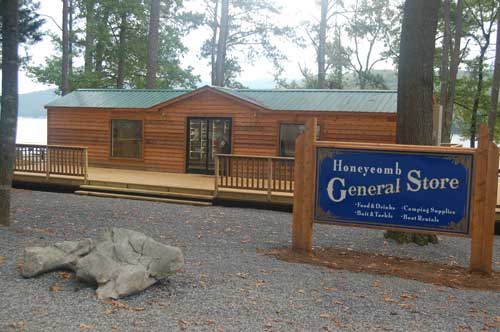
But we still were facing a large expense for buildings. I asked my equipment finance guy - will you finance a modular building? "Sure," he says. So we started rethinking the whole design using factory-built buildings. We combined three modules to make the store and office:
The entry / gatehouse was entirely factory built:
In another location at Burney Falls, California, we equipment financed 24 cabins by, you guessed it, having them factory built rather than built on-site. They came out pretty well:
I was really amazed at how well they came out. Modular has really come a long way. And since in many locales they are permitted different, some of the paperwork and approvals and inspections were streamlined as well.
Thanks to my readers, I have cracked the problem of finding white non-fluorescent paper, which I will post here for the benefit of future Google searchers. At first I tried some natural bond paper, and it didn't fluoresce, but it added too much yellow to the final product. I was just in the middle of playing with Photoshop to see if I could compensate, when Agesilaus said that this was a concern in archival and art photography and what I wanted was OBA-free paper. OBA is the term for a class of optical brighteners that fluoresce and are used in most papers, and because they can cause fading, artists and photographers create a market for OBA-free paper. It can be expensive, like 70 cents a sheet, but since I can put most all the signs and details I need on a sheet or two, that is no big deal. Here is one source, not surprisingly from the comments, a photography outlet.
Thanks everyone!
PS - TJIC thought the scorpion thing was creepy. It sort of is, but it beats shoveling snow.
I am working on the first module in a new N-scale model railroad layout. In this urban scene, I am using florescent paints of various types under black light to simulate neon and other lighting in night scenes.
I use printed paper in a lot of applications in my modeling - not just for business signs but highway signs, tar paper on roofs, some areas of brick and concrete, small details, etc. The unexpected problem I am having is finding any white printer paper that doesn't fluoresce under black light (it is the whiteners that are used in modern papers that fluoresce -- in fact one test to see if you have an older document in your hand is to put it under black light). Stop signs and tar paper roofs of buildings and manhole covers should NOT be glowing at night.
I am told some art supply stores sell non-fluorescent natural white papers, but I have yet to track any down. I went into the OfficeMax yesterday with a handheld black light (we all own these in Phoenix for finding scorpions in our houses at night, as they fluoresce too, but that is another story). The good news is that Homeland Security did not bust me for odd behavior, but I did not find anything that would work. I actually have some clear paint that is a UV block, but it dries glossy, so right now I am painting a layer of the block and then a layer of matte clear coat. This does not look entirely right, and is a pain to do for every item.
On the off chance one of you has an idea with this ridiculously niche bleg, fire away in the comments.
This decision by the Supreme Court may be a surprise to anyone who reads the regular media, which long ago fricasseed Skilling. But Houston attorney Tom Kirkendall has been covering the Enron-related cases for years, and has reported on any number of prosecutorial abuses. As he writes:
On the heels of the U.S. Supreme Court's decision earlier this year to hearConrad Black's appeal of his criminal conviction on honest services wire-fraud charges under 18 U.S.C. § 1346 ("Section 1346), the Court yesterday granted former Enron CEO Jeff Skilling's appeal on similar grounds. A copy of the Skilling's cert petition and its appendix, which are bookmarked in Adobe Acrobat to facilitate ease of review, can be downloaded here.
My sense is that Skilling has a good chance of having the Supreme Court overturn his conviction. Here's why.
This is the ironic gist of the appeal in layman's terms:
Honest services wire-fraud under Section 1346 was intended by Congress to penalize corporate executives and governmental officials for accepting bribes and kickbacks and for engaging in self-dealing at the expense of the employer-- i.e., the private gain requirement of the crime.
The Task Force faced a big problem with prosecuting Skilling at all because he never stole a dime from Enron (that is, no private gain). In fact, the Task Force conceded at trial that, not only did Skilling not embezzle any money from Enron, the case against him was not about "greed," that Skilling always sought to pursue Enron's "best interests," and that every act for which he was being prosecuted was undertaken for the purpose of protecting Enron and promoting its share price.
Despite the foregoing, the Task Force persuaded U.S. District Judge Sim Lake to allow the prosecution to proceed against Skilling on a much broader honest services theory -- that is, that Skilling simply took on too much risk for the long-term good of Enron and improperly touted the company to the markets.
However, all corporate executives take business risks and promote their companies, so a rule that criminalizes any business decision that seems imprudent to prosecutors or lay jurors operating with hindsight bias -- even if if the executive was pursuing the interest of the company -- would force corporate executives to proceed at peril of criminal liability in making day-to-day business judgments. Indeed, in a civil case, Skilling would have had the protection of the "business judgment rule" for his business decisions, but the Enron Task Force's theory of honest services in Skilling's case provided for no such defense. Instead, the Task Force lawyers urged the jury to send Skilling to prison effectively for life simply because he breached his duty to do his job and do it appropriately.
Meanwhile, Skilling may also get a new trial from the 5th Appeals court based on charges of prosecutorial abuse:
In that regard, the Fifth Circuit decision invited Skilling to file a motion for new trial based on issues of prosecutorial misconduct that Skilling raised in the appeal after discovering the evidence post-trial. Specifically, the Fifth Circuit was particularly concerned about the failure of the Enron Task Force to comply with federal rules requiring the disclosure of exculpatory evidence to the defense from the Task Force's pre-trial interviews with main Skilling accuser, former Enron CFO Andrew Fastow.