Snow, Woohoo
We got over 2 feet of snow in Flagstaff, with six foot drifts, the most snow we have ever gotten this early in Northern Arizona. We are opening our Flagstaff snow play area today.
Dispatches from District 48
We got over 2 feet of snow in Flagstaff, with six foot drifts, the most snow we have ever gotten this early in Northern Arizona. We are opening our Flagstaff snow play area today.
We see all kinds of alarmist spin being attempted on the CRU emails. For those who are interested, this is best layman's article I have found to discuss the now-famous Michael Mann "trick," what it is, and the obfuscation in the CRU's response.
I have at least one experience with the core alarmist community responding where I pointed out an error. The responses I got in that case are very similar to the ones today for the CRU - basically the responses either are tangential to the basic point or try to retroactively change the alarmists original assertions. They are responses that stand up only if the questioner is unwilling or unable to do the smallest amount of verification work (in other words, they work with most of the media).
The series of posts began with this image from the recent US government climate assessment. Its point was to provide electric grid outages as a proxy measurement variable for severe weather, the point being that severe weather must have increased.

I thought this chart smelled funny
This chart screams one thing at me: Basis change. Somehow, the basis for the data is changing in the period. Either reporting has been increased, or definitions have changed, or there is something about the grid that makes it more sensitive to weather, or whatever (this is a problem in tornado charts, as improving detection technologies seem to create an upward incidence trend in smaller tornadoes where one probably does not exist). But there is NO WAY the weather is changing this fast, and readers should treat this whole report as a pile of garbage if it is written by people who uncritically accept this chart.
So I called the owner of the data set at the EIA
He said that there may be an underlying upward trend out there (particularly in thunderstorms) but that most of the increase in this chart is from improvements in data gathering. In 1997, the EIA (and Makins himself) took over the compilation of this data, which had previously been haphazard, and made a big push to get all utilities to report as required. They made a second change and push for reporting in 2001, and again in 2007/2008. He told me that most of this slope is due to better reporting, and not necessarily any underlying trend. In fact, he said there still is some under-reporting by smaller utilities he wants to improve so that the graph will likely go higher in the future....
At the end of the day, this disturbance data is not a good proxy for severe weather.
The author of that section of the report, Evan Mills, responded and then I dealt with his response here. Here is just one example of the BS we have to slog through every time we criticize even a tangential analysis like this. See the links for his whole response, but he says in part:
As noted in the caption to the figure on page 58 of our report (shown above)"”which was masked in the blogger's critique [ed. actually it was not masked- the source I got the chart from had left off the caption]"”we expressly state a quite different finding than that imputed by the blogger, noting with care that we do not attribute these events to anthropogenic climate change, but do consider the grid vulnerable to extreme weather today and increasingly so as climate change progresses, i.e.:
"Although the figure does not demonstrate a cause-effect relationship between climate change and grid disruption, it does suggest that weather and climate extremes often have important effects on grid disruptions."
The associated text in the report states the following, citing a major peer-reviewed federal study on the energy sector's vulnerability to climate change:
"The electricity grid is also vulnerable to climate change effects, from temperature changes to severe weather events."
This was pretty amazing - citing his chart's caption but hoping that somehow I or other readers would miss the very first line of the caption which he fails to quote:
To Dr. Mills' point that I misinterpreted him "” if all he wanted to say was that the electrical grid could be disturbed by weather or was vulnerable to climate change, fine. I mean, duh. If there are more tornadoes knocking about, more electrical lines will come down. But if that was Dr. Mills ONLY point, then why did he write (emphasis added):
The number of incidents caused by extreme weather has increased tenfold since 1992. The portion of all events that are caused by weather-related phenomena has more than tripled from about 20 percent in the early 1990s to about 65 percent in recent years. The weather-related events are more severe"¦
He is saying flat out that the grid IS being disturbed 10x more often and more severely by weather. It doesn't even say "reported" incidents or "may have" "” it is quite definitive. So which one of us is trying to create a straw man? It is these statements that I previously claimed the data did not support, and I stand by my analysis on that.
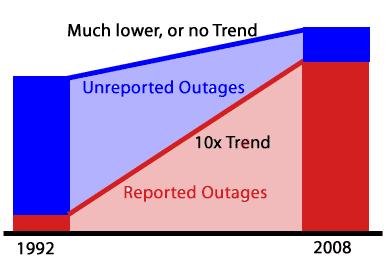
I deconstructed a lot of the rest of his longer post, and you can follow it all, but the bottom line is that if a you are drawing a trend line between two points, and you have much more data missing from the begginning end point than the end, your trend is going to be SNAFU'd. Period. No point in arguing about it. See the chart below. It represents the situation at hand. The red is the reported data. The blue is the unreported data, which declines as a percentage of the total due to a push for better data reporting by the database owners. My point was simply that the red trend line was meaningless. Its amazing to me that even accepting the basics of this picture, Dr. Mills wants to fight that conclusion.
I am reminded by one of the now-famous quotes from the CRU emails
I really wish I could be more positive about the Kyrgyzstan material, but I swear I pulled every trick out of my sleeve trying to milk something out of that. I don't think it'd be productive to try and juggle the chronology statistics any more than I already have - they just are what they are...
Yep, sometimes the measured results from nature are what they are. Well, I actually that most of the time they are what they are, but not in climate apparently. Never give up a flawed analysis that yields the "right" answer without a fight. I concluded:
Look Dr. Mills, I don't have an axe to grind here. This is one chart out of bazillions making a minor point. But the data set you are using is garbage, so why do you stand by it with such tenacity? Can't anyone just admit "you know, on thinking about it, there are way to many problems with this data set to declare a trend exists.
Taxpayers in Maricopa County (which includes Phoenix) are paying millions of dollars for officials within the county government to sue each other:
Lawsuits between county agencies including the Sheriff's Office, the County Attorney's Office and the Treasurer's Office against county administration have cost more than $2.5 million in legal fees according to the county's records through early November.
The Sheriff's Office has used attorneys from Ogletree, Deakins, Nash, Smoak and Stewart to wage legal battles with the county on issues including control of a law-enforcement computer system and the need to release surveillance footage of sheriff's deputies arresting Supervisor Don Stapley
in a county parking garage.
Next year, the Sheriff's office has asked for $7 million for this purpose. Wow. Given that I despise Sheriff Arpaio, I would love to lay this all at his door step but my sense is that the dysfunctionality goes broader and deeper.
One of the great appeals of catastrophic anthropogenic global warming theory in certain sectors is the fact that what it takes to fight the imagined threat (reduced trade, reduced economic growth, government controls on the economy, populist hammering of energy companies, micro-controls on individual decision-making) are exactly the things the socialists wanted to do before their schtick became tired. Global warming has become the back-door to state control, combining some exaggerated science with a lot of folks' uninformed desire to "do the right thing", to create a new vector for old objectives.
Today, 56 newspapers are all allowing some global warming activist to take over their newspapers to run the same panicky plea. Bruce McQuain picks up the story:
In reality, I've come to understand this isn't about "climate change", this is about the politics of income redistribution. I've spoken of it in the past. This has been a goal of the third-world debating club, also known as the UN, since it has come into existence. The IPCC is just a convenient vehicle on which to base their claims and put them forward to the industrialized countries for fulfillment. The underlying "science", like a wet paper box, is coming apart at the seams. And not a single mention in the editorial. But it becomes clear, the further you get into it, that it is about what I contend it is about:
Social justice demands that the industrialised world digs deep into its pockets and pledges cash to help poorer countries adapt to climate change, and clean technologies to enable them to grow economically without growing their emissions. The architecture of a future treaty must also be pinned down "“ with rigorous multilateral monitoring, fair rewards for protecting forests, and the credible assessment of "exported emissions" so that the burden can eventually be more equitably shared between those who produce polluting products and those who consume them. And fairness requires that the burden placed on individual developed countries should take into account their ability to bear it; for instance newer EU members, often much poorer than "old Europe", must not suffer more than their richer partners.
If you were playing buzz word bingo with this paragraph you'd be at the prize table right now picking one out. It hits all of the favorite themes of income redistributionists. And its blatancy should scare you. This is about your wallet, your money and the rest of the world making a claim on it. This is the third world's dream come true.
I have to object somewhat to his last line. This is the third world leader's dream come true, as I think most adults understand from past experience that aid like this gets siphoned off by the ruling regime. What the Third World's people really need is what Southeast Asia and India and China have - real private investment making for real economic growth (to be fair, I think Bruce would accept this correction).
I thought this bit was hilarious:
It is in that spirit that 56 newspapers from around the world have united behind this editorial. If we, with such different national and political perspectives, can agree on what must be done then surely our leaders can too.
Apparently we are supposed to be dazzled that 56 institutions that all, in unison, blindly cling to the same 150-year-old failed business model, hoping that some other group can be prevailed upon to bail them out, would actually think alike about some issue. Amazing!
On a normal day, Majken Friss Jorgensen, managing director of Copenhagen's biggest limousine company, says her firm has twelve vehicles on the road. During the "summit to save the world", which opens here tomorrow, she will have 200.
"We thought they were not going to have many cars, due to it being a climate convention," she says. "But it seems that somebody last week looked at the weather report."
Ms Jorgensen reckons that between her and her rivals the total number of limos in Copenhagen next week has already broken the 1,200 barrier. The French alone rang up on Thursday and ordered another 42. "We haven't got enough limos in the country to fulfil the demand," she says. "We're having to drive them in hundreds of miles from Germany and Sweden."
And the total number of electric cars or hybrids among that number? "Five," says Ms Jorgensen. "The government has some alternative fuel cars but the rest will be petrol or diesel. We don't have any hybrids in Denmark, unfortunately, due to the extreme taxes on those cars. It makes no sense at all, but it's very Danish."
The airport says it is expecting up to 140 extra private jets during the peak period alone, so far over its capacity that the planes will have to fly off to regional airports - or to Sweden - to park, returning to Copenhagen to pick up their VIP passengers.
As well 15,000 delegates and officials, 5,000 journalists and 98 world leaders, the Danish capital will be blessed by the presence of Leonardo DiCaprio, Daryl Hannah, Helena Christensen, Archbishop Desmond Tutu and Prince Charles. A Republican US senator, Jim Inhofe, is jetting in at the head of an anti-climate-change "Truth Squad." The top hotels - all fully booked at £650 a night - are readying their Climate Convention menus of (no doubt sustainable) scallops, foie gras and sculpted caviar wedges.
I am trying to emulate these brave reformers. In that spirit, I drove all the way across town to take my daughter to the Trans-Siberian Orchestra concert -- very likely the band with the largest carbon footprint in the world (if you have seen their concerts, you know what I mean).
A couple of years ago I wrote:
Activist: A person who believes so strongly that a problem needs to be remedied that she dedicates substantial time to "¦ getting other people to fix the problem. It used to be that activists sought voluntary help for their pet problem, and thus retained some semblance of honor. However, our self-styled elite became frustrated at some point in the past that despite their Ivy League masters degrees in sociology, other people did not seem to respect their ideas nor were they particularly interested in the activist's pet issues. So activists sought out the double shortcut of spending their time not solving the problem themselves, and not convincing other people to help, but convincing the government it should compel others to fix the supposed problem. This fascism of good intentions usually consists of government taking money from the populace to throw at the activist's issue, but can also take the form of government-compelled labor and/or government limitations on choice.
So now, we have the next step -- advocating that others spend their time convincing government to use compulsion to solve some imagined problem. Kevin Drum urges:
The only real way to address climate change is to make broad changes to laws and incentives. It puts everyone on a level playing field, it gives everyone a framework for making their own choices, and it gives us a fighting chance of making the deep cuts we need to. So listen to Tidwell: "Don't spend an hour changing your light bulbs. Don't take a day to caulk your windows. Instead, pick up a phone, open a laptop, or travel to a U.S. Senate office near you and turn the tables: 'What are the 10 green statutes you're working on to save the planet, Senator?'"
Jackboots seem to be "in" this season.
Postscript: In the language of mathematics (I mentioned before I am in the middle of Goedel-Escher-Bach) if actually aiding someone is "helping," then I guess organizing people to help is meta helping, and lobbying government to force other people to help is meta meta helping and so advocating on your blog that people should lobby the government to force other people to help is meta meta meta helping. Must really warm Drum's heart to be so directly connected with helping people.
Via Wawick Hughes, this "voting" site is pretty funny.

Apparently Google has launched a site where you can "vote" on climate change and the IPCC process. Except that you can only vote "yes." Fill in your name and hit submit, and you are counted as having voted the party line. Seriously. Since when does this meet anyone's definition of "vote?"
Every day Google innovationist Justin Baird pedals to work at the internet giant, where he is thinking big in his global campaign to act on climate change.
"My personal mission is to drive positive change through technology," he said.
"I am in a position where I can understand the issues surrounding climate change. And understanding the technology solution that can empower us to communicate collectively."
I guess we know now why Google did not have any qualms about cooperating with the Chinese government. They have been "communicating collectively" in their elections for years.
"From your local postcode it aggregates it together to a state level, then country level, then across the world, so what we're doing is generating a global statistic. Over time it starts to generate and show the strength of public support of what's happening," Mr Baird said.
Wow - I am predicting his point of view wins in a landslide
Chairman of the Copenhagen Climate Council, Tim Flannery, says the Google tool is an interesting invention.
"I can imagine a day not so long from now where the UN secretary-general is elected through Show Your Vote. It's a very interesting world that we're entering into," he said.
Yeah, unfortunately, I can imagine a day too. Already leaders around the world in countries like Venezuela, Cuba, and Iran are elected just this way.
When someone starts to shout "but its in the peer-reviewed literature" as an argument-ender to me, I usually respond that peer review is not the finish line, meaning that the science of some particular point is settled. It is merely the starting point, where now a proposition is in the public domain and can be checked and verified and replicated and criticized and potentially disproved or modified.
The CRU scandal should, in my mind, be taken exactly the same way. Unlike what more fire-breathing skeptics have been saying, this is not the final nail in the coffin of catastrophic man-made global warming theory. It is merely a starting point, a chance to finally move government funded data and computer code into the public domain where it has always belonged, and start tearing it down or confirming it.
To this end, I would like to share a post from year ago, showing the kind of contortions that skeptics have been going through for years to demonstrate that there appear to be problems in key data models -- contortions and questions that could have been answered in hours rather than years if the climate scientists hadn't been so afraid of scrutiny and kept their inner workings secret. This post is from July, 2007. It is not one of my most core complaints with global warming alarmists, as I think the Earth has indeed warmed over the last 150 years, though perhaps by less than the current metrics say. But I think some folks are confused why simple averages of global temperatures can be subject to hijinx. The answer is that the averages are not simple:
A few posts back, I showed how nearly 85% of the reported warming in the US over the last century is actually due to adjustments and added fudge-factors by scientists rather than actual measured higher temperatures. I want to discuss some further analysis Steve McIntyre has done on these adjustments, but first I want to offer a brief analogy.
Let's say you had two compasses to help you find north, but the compasses are reading incorrectly. After some investigation, you find that one of the compasses is located next to a strong magnet, which you have good reason to believe is strongly biasing that compass's readings. In response, would you
Most of us would quite rationally choose #2. However, Steve McIntyre shows us a situation involving two temperature stations in the USHCN network in which government researchers apparently have gone with solution #1. Here is the situation:
He compares the USHCN station at the Grand Canyon (which appears to be a good rural setting) with the Tucson USHCN station I documented here, located in a parking lot in the center of a rapidly growing million person city. Unsurprisingly, the Tucson data shows lots of warming and the Grand Canyon data shows none. So how might you correct Tucson and the Grand Canyon data, assuming they should be seeing about the same amount of warming? Would you
average them, effectively adjusting the two temperature readings
towards each other, or would you assume the Grand Canyon data is cleaner
with fewer biases and adjust Tucson only? Is there anyone who would not choose the second option, as with the compasses?
The GISS data set, created by the Goddard Center of NASA, takes the USHCN data set and somehow uses nearby stations to correct for anomalous stations. I say somehow, because, incredibly, these government scientists, whose research is funded by taxpayers and is being used to make major policy decisions, refuse to release their algorithms or methodology details publicly. They keep it all secret! Their adjustments are a big black box that none of us are allowed to look into (and remember, these adjustments account for the vast majority of reported warming in the last century).
We can, however, reverse engineer some of these adjustments, and McIntyre does. What he finds is that the GISS appears to be averaging the good and bad compass, rather than throwing out or adjusting only the biased reading. You can see this below. First, here are the USHCN data for these two stations with only the Time of Observation adjustment made (more on what these adjustments are in this article).
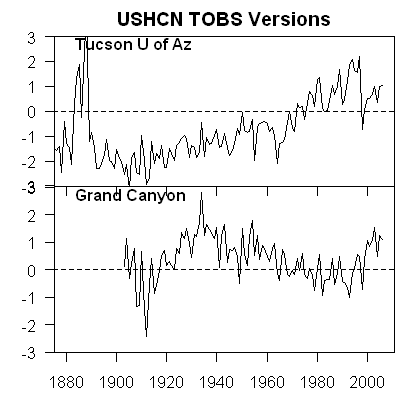
As I said above, no real surprise "“ little warming out in undeveloped nature, lots of warming in a large and rapidly growing modern city. Now, here is the same data after the GISS has adjusted it:
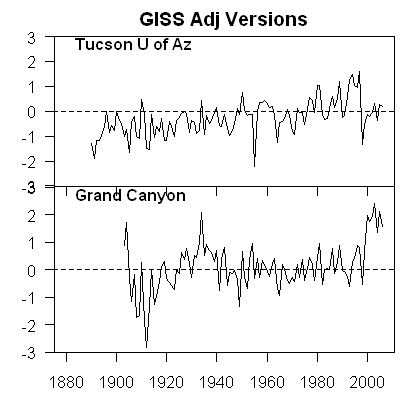
You can see that Tucson has been adjusted down a degree or two, but Grand Canyon has been adjusted up a degree or two (with the earlier mid-century spike adjusted down). OK, so it makes sense that Tucson has been adjusted down, though there is a very good argument to be made that it should be been adjusted down more, say by at least 3 degrees**. But why does the Grand Canyon need to be adjusted up by about a degree and a half? What is biasing it colder by 1.5 degrees, which is a lot? The answer: Nothing. The explanation: Obviously, the GISS is doing some sort of averaging, which is bringing the Grand Canyon and Tucson from each end closer to a mean.
This is clearly wrong, like averaging the two compasses. You don't average a measurement known to be of good quality with one known to be biased. The Grand Canyon should be held about the same, and Tucson adjusted down even more toward it, or else thrown out. Lets look at two cases. In one, we will use the GISS approach to combine these two stations"“ this adds 1.5 degrees to GC and subtracts 1.5 degrees from Tucson. In the second, we will take an approach that applies all the adjustment to just the biases (Tucson station) "†this would add 0 degrees to GC and subtract 3 degrees from Tucson. The first approach, used by the GISS, results in a mean warming in these two stations that is 1.5 degrees higher than the more logical second approach. No wonder the GISS produces the highest historical global warming estimates of any source! Steve McIntyre has much more.
** I got to three degrees by applying all of the adjustments for GC and Tucson to Tucson. Here is another way to get to about this amount. We know from studies that urban heat islands can add 8-10 degrees to nighttime urban temperatures over surrounding undeveloped land. Assuming no daytime effect, which is conservative, we might conclude that 8-10 degrees at night adds about 3 degrees to the entire 24-hour average.
Postscript: Steve McIntyre comments (bold added):
These adjustments are supposed to adjust for station moves "“ the procedure is described in Karl and Williams 1988 [check], but, like so many climate recipes, is a complicated statistical procedure that is not based on statistical procedures known off the island. (That's not to say that the procedures are necessarily wrong, just that the properties of the procedure are not known to statistical civilization.) When I see this particular outcome of the Karl methodology, my mpression is that, net of the pea moving under the thimble, the Grand Canyon values are being blended up and the Tucson values are being blended down. So that while the methodology purports to adjust for station moves, I'm not convinced that the methodology can successfully estimate ex post the impact of numerous station moves and my guess is that it ends up constructing a kind of blended average.
LOL. McIntyre, by the way, is the same gentleman who helped call foul on the Mann hockey stick for bad statistical procedure.
It is amazing that a scandal that has appeared on something like 14 million web pages (per Google, though ymmv as I see people getting all kinds of numbers) in a matter of just 2 weeks has yet to appear on the US mainstream network news. I mean, these were the guys who spent breathless hours of live coverage reporting every breaking rumor about changes to Michael Jackson's coffin.
No real point. Not calling for government intervention, obviously. Just amazing how irrelevant the networks have become. If it weren't for Time and Newsweek, and I would say they were the least relevant major news outlets in the country.
Some major, must-report outcome is going to come out of this Internet hype, and at that point the networks will find themselves in a position they have already been in several times this year -- trying to explain significant actions resulting from a long-standing scandal or controversy they never reported.
I thought this was funny. I am not going to deconstruct or lampoon this guy's beliefs, nor am I knowlegeable enough to argue whether Genesis 1:28 really mandates that man should forecast the climate system. I am in fact trying really hard to say that I am not making an ad hominem attack here, but merely pointing out an irony: Many dismiss skeptics as all part of the religious fundamentalist Right, I presume to try to lump us in with evolution deniers. I can't tell you how many emails I get calling me some sort of religious fundamentalist freak, which is actually hilarious given a) I never mention religion of the g-word on either of my sites almost ever and b) the actual nature of my beliefs.
So this is funny in an ironic way: The guy that originally wrote a bunch of the CRU code that has since been criticized as forcing a warming result is Tim Mitchell, who has shared some of his thoughts online (via Odd Citizen):
The climate system is made up of the earth's atmosphere, oceans, ice, vegetation, and streams. It is both beautiful and complex. Humans have a mandate to forecast its behavior and use it (Genesis 1:28). However, we feel in awe of its destructive potential, seen in such things as hurricanes and floods, which are part of the curse inflicted upon the earth following the Fall (Genesis 3.17). Moreover, control and certainty belong to God alone (Job 38-41). So there is a possibility that our actions may affect the climate system in unexpected ways. It was claimed in the 1970s that the earth might be about to enter an ice age. The evidence for this was minimal, but the decades of painstaking research that have followed the 1970s have unveiled both the natural variability in the climate system, and the dramatic effects of human actions....
What can individual Christians do? Some, but not many, are called to be scientists and politicians. However, we all have the vote, and environmental issues ought to be among those that we weigh up carefully before casting our vote. We are also each responsible for a small part of the daily emissions of greenhouse gases. Do we use our energy-intensive cars wisely? Are we guilty of worldly attitudes to public transport? With domestic heating and insulation, do we spend more and pollute more than is necessary? The government urges us to reduce our energy usage so that we may indulge ourselves in other ways, but we have a higher motive for reducing waste (1 Timothy 6.17-19). Although I have yet to see any evidence that climate change is a sign of Christ's imminent return, human pollution is clearly another of the birth pangs of creation, as it eagerly awaits being delivered from the bondage of corruption (Romans. 19-22).
Tim Mitchell works at the Climactic Research Unit, UEA, Norwich, and is a member of South Park Evangelical Church.
Again, I am not trying to purge the scientific ranks of Christian fundamentalists, I just think this is funny given all the accusations of blind Christian fundamentalism aimed (often with no basis) at skeptics.
Some good news after years of bad decisions:
New York's Supreme Court Appellate Division (First Department) handed down a massive victory for property rights yesterday in the case of Kaur v. New York State Urban Development Corporation. At issue was the state's highly controversial use of eminent domain on behalf of Columbia University, which wants free rein over the West Harlem neighborhood of Manhattanville, where it plans to build a fancy new research campus.
As I discussed in an article last February, there is overwhelming evidence that the Empire State Development Corporation (ESDC) actively colluded with Columbia in order to produce the very conditions that would then allow ESDC to seize property on the university's behalf. At the time of ESDC's 2006 blight study, for instance, Columbia owned 76 percent of the neighborhood and was thus directly responsible for the overwhelming majority of blight that the report alleged, ranging from overflowing basement trash heaps to major roof and skylight leaks. As numerous tenants have reported, the university refused to perform basic and necessary repairs, which both pushed tenants out and manufactured the ugly conditions that later advanced Columbia's long-term interests. Preliminary findings delivered to the ESDC admitted as much, noting "Open violations in CU Buildings" and "History of CU repairs to properties" among the "issues of concern."
Thankfully, the New York court recognized this shameful mess for what it is: eminent domain abuse. As Justice James Catterson wrote for the majority:
the blight designation in the instant case is mere sophistry. It was utilized by ESDC years after the scheme was hatched to justify the employment of eminent domain but this project has always primarily concerned a massive capital project for Columbia. Indeed, it is nothing more than economic redevelopment wearing a different face.
This, from the Court's majority decision, was especially heartening post-Kelo:
The time has come to categorically reject eminent domain takings solely based on underutilization. This concept put forward by the respondent transforms the purpose of blight removal from the elimination of harmful social and economic conditions in a specific area to a policy affirmatively requiring the ultimate commercial development of all property regardless of the character of the community subject to such urban renewal.
This was pretty unexpected given how the Atlantic Yards case went. I am not sure how to reconcile the two decisions. Damon Root at the link above has the same concerns.
It was pointed out to me that a number of my old posts from my unlamented Typepad era are full of comment spam that carried over into the wordpress database. My current comment spam filtering for new comments works fine. Does anyone know of a solution that will actually go back through the data base and mine out old spam?
Further complicating this picture is that Sheriff Joe Arpaio, despite erratic and confrontational conduct that has repeatedly put him at the wrong end of lawsuits and press coverage, is immensely popular with Maricopa County voters. In fact, recent polling suggests that the governor's office is his for the asking. He's a favorite for the Republican nod and an apparent shoe-in in the general election.
I was under the impression that the Repub's cut Arpaio loose in the last election, but I don't really follow the politics stuff much. JD has an update on the latest Arpaio shenanigans, as does Radley Balko:
Wow, it sure is a real coincidence when a bomb threat against the public defenders (it was a public defender the deputy originally stole the document from) at the exact same moment the sheriff's were trying to disrupt the courthouse over a dispute involving the public defenders office.
Those who don't live here would be appalled and disgusted by how such a large segment of the local population absolutely revere this man. He's like the right-wing Obama, living off a manufactured image.
From the AZ Republic, which just can't stop itself from shamelessly cheerleading any effort to spend billions on rail in Phoenix (perhaps the world's worst candidate for rail transit given its density and distribution of businesses).
Enough people would board a train in the Valley's suburbs that a future commuter-rail system would be as popular as some of the busiest lines in the West, new studies have found.
Well, that's a low bar.
A trio of yearlong rail studies, in nearly final form, indicates commuter rail could carry almost 18,000 passengers a day by 2030. Planners at the Maricopa Association of Governments
say, based on the findings, they favor a 105-mile, X-shaped system that could feature 33 stations and cost roughly $1.5 billion. That's a little more than the Valley's 20-mile, light-rail starter line.
If this was presented to me as a business opportunity, I would have had them stop right there. Even before inevitable cost overruns and over-confidence in ridership, even with the supporters' numbers, they want $1.5 billion to carry 18,000 people a day. That is a capital cost of $83,000+ per daily rider, beating the old record of Phoenix light rail which cost around $75,000 per daily rider.
Planners assume the trains will recoup about 40 percent of their expenses, based on the national average for similar service. The average fare would be about $6 to $7, Wallace said, although no detailed study has gone into fares. Generally, rates would go up the farther the trip.
Can you imagine any other investor in the world other than the government making an investment knowing that in the best case of its strongest supporters revenues will only cover 40% of costs? And why should the rest of us subsidize folks who live in outlying areas to commute? They moved to those areas in large part because housing was cheap and cost of living was low, with the knowlege they had a long commute. So those of us with the forsight to live close to work have to subsidize them? This is a really valuable service for them but they can't even pay half the cost?
Further, lets look at those cost estimates. If we get 18,000 a day on weekdays and a third that on weekends, that yields 5 million round trips. Given an 8% interest rate over 30 years, the capital charge is $134 million a year before overruns. That means the fare would have to be $27 round trip or $13.50 one way just to cover the capital cost alone, without even considering operating costs.
This means their figures are nuts. $6-$7 one-way fares barely covers 40% of the capital costs, much less the operating expenses. We are talking about an offering that is deep in the red. $13 round trip at 5,000,000 round trips equals $65,000,000 of revenue. That means that taxpayers will have to foot the bill for all the operating costs ($30 million? $60 million) and at least $69 million of capital charges. It is not unfair to assume that this would punch a minimum $100 million hole each year in the government's budget that we will have to make up with taxes.
Update: Gotta achnowlege this bit of sanity in the AZ Republic comments from "astonished"
Light rail is such a boondoggle. It's expensive to build and always runs at a loss. It is very hard to change the routes to respond to ridership needs. It's a vanity project for hip liberals.
If public transportation is a goal, then get some buses going. Buses are flexible, cost effective, cheap to run and maintain, and if ridership changes, you just change the routes and schedules.
His first impulse was to dismiss the ominous email as a prank, says a young Iranian-American named Koosha. It warned the 29-year-old engineering student that his relatives in Tehran would be harmed if he didn't stop criticizing Iran on Facebook.
Two days later, his mom called. Security agents had arrested his father in his home in Tehran and threatened him by saying his son could no longer safely return to Iran.
"When they arrested my father, I realized the email was no joke," said Koosha, who asked that his full name not be used....
In recent months, Iran has been conducting a campaign of harassing and intimidating members of its diaspora world-wide -- not just prominent dissidents -- who criticize the regime, according to former Iranian lawmakers and former members of Iran's elite security force, the Revolutionary Guard, with knowledge of the program.
Part of the effort involves tracking the Facebook, Twitter and YouTube activity of Iranians around the world, and identifying them at opposition protests abroad, these people say.
Interviews with roughly 90 ordinary Iranians abroad -- college students, housewives, doctors, lawyers, businesspeople -- in New York, London, Dubai, Sweden, Los Angeles and other places indicate that people who criticize Iran's regime online or in public demonstrations are facing threats intended to silence them.
Although it wasn't possible to independently verify their claims, interviewees provided consistently similar descriptions of harassment techniques world-wide. Most asked that their full names not be published.
I am currently, finally reading a book that most of you who know how much of a geek I am probably already assumed I had read: Geodel- Escher- Bach. I guess I was turned off by how hip the book was when it came out, so I assumed it was some new age goofiness. As many of you know, it turns out to be a very readable book on modern number theory and all sorts of related mathematical topics. I'm really enjoying it.
But I would add that it is a blessing I waited until today to read it. 20 years ago I was way to impatient to really savor and appreciate it. The book is working on 3 or 4 levels at the same time at every turn, and I am not sure I would have been mature enough to appreciate it earlier. I can just see myself screaming, "and what's the deal with this stupid turtle?"
I had a similar reaction after recently reading Les Miserables. I couldn't understand it 30 years ago - a 100 pages in and we are still talking about this freaking priest and haven't met the main characters yet? What gives? Others may have been more mature at 17, but I needed a few decades to really appreciate it. This time around, I thought the book was beautiful. Really enjoyed it.
Next up in this vein? Probably Foucault's Pendulum, which I pick up and give up on every decade or so.
One of the points I make in my climate lectures - global warming panic has sucked the life out of environmental concerns that matter. Illustration - US sewage plants still making massive untreated dumps.
I know this might sound retro to some readers. But we need to finish what the early 1970s environmental pollution control laws set out to do: clean up all the sources of air and water pollution. The environmental movement has run out of steam and gotten distracted. Get back to the basics.
Agreed. Another point I often make - we don't know how to keep growing China without creating CO2, but we do know how to grow China without making the air in cities like Beijing breathable. Instead of talking to them about CO2 capture, what about air pollution 101 type things like ash bags and exhaust scrubbing?
And while I am on the topic, do we have to keep destroying the Amazon just to clear land to grow more plants for ethanol that in the end does nothing to abate CO2 emissions?
Being a red state, maybe if AZ fails before CA, it will be less likely that Congress and the Administration will do some sort of bailout to head off local accountability. It sure seems we might be able to pull off an early failure:
Arizona state government has managed to blow through a $700 million loan from the Bank of America in less than a week, and that wasn't even enough to keep things going.According to Treasurer Dean Martin, his office had to dip into internal sources to come up with the extra $73 million the state needed just to keep the lights on.
"Government spending in Arizona is out of control. We are more than three-quarters of $1 billion in the red for daily operations," Martin says. "As we predicted in our forecasts, just one week after setting up essentially the largest line of credit in state history, the state of Arizona has maxed it out. The governor and Legislature need to [rein] in excessive spending; we can no longer afford to continue spending more than we make."
The state is currently about $1.6 billion in the hole, and the $700 million loan the state spent last week is just the beginning of excessive spending of borrowed money.
This was simply amazing to me. For years, I and others have said that putting more health care spending under insurance plans was going exactly the wrong direction, both from an individual choice as well as a system cost perspective. By eliminating the need or incentive to shop by the consumer of services, prices almost inevitably rise.
Here is a fabulous smoking gun example from my windshield repair today. I happen to have free windshield replacement in my insurance policy. I called the insurance company and said I had an auto glass claim. I was transferred to Safelite Auto Glass, who apparently (very intelligently) have a contract to process claims for my insurance company. They said I could use any provider, but would I like them to call out someone for me -- if I used their choice, the insurance company would guarantee the work.
Well, what did I care -- I wasn't paying for it -- so I had them make an appointment for me. Unsurprisingly, it was with Safelite Auto Glass.
I must add here that Safelite did an exceptional job, the guy who showed up at my workplace was friendly and competent. No complaints at all about the service or workmanship.
Anyway, I got a bill for which I owed zero dollars, which I suppose is heading right this minute for the insurance company. Before I show it to you, I was curious what I would have paid for this service if it hadn't been insured and I shopped around. I got just one quote - from the Safelite Auto Glass web site. This is a bit unrealistic because for a purchase this large, I would have gotten several quotes. But this was the only quote I needed. The charge to me if I bought the new glass service with my own money without insurance was$321.05 (click to enlarge).

And this was the bill I signed for the insurance company:

For a total of $710.40. Same service. Same car. Same customer. Same part. Probably the same repair guy. 2.2x higher price.
Now, I suppose I might be willing to believe there is some invoice pricing game here and the insurance company may get a discount over invoice, similar to car sales, though I am not sure what their incentive would be for this game -- it should be the opposite. In fact, we can be nearly positive they are marking up the price to insurance companies given a) the web quote says right up front it is not good for insurance work and b) I have already shown how glass companies give enormous consumer kickbacks for insurance work.

If I had cared, I would have eschewed the offer on the call to have them set up the appointment and shopped around for the best kickback. All a cross subsidy from those who don't use the insurance to those who do use the insurance. Talk about a terrible incentive.
I think the conclusion is pretty strong. Anything we shift to insurance from having individuals pay out of pocket gets substantially more expensive. And this doesn't even address my changing willingness to live with a small windshield crack and avoid this purchase altogether when I am paying the bills vs. when I am not.
Just what we need, the government choosing winners and losers in media like they do earmark recipients. Since government ownership of GM was politicized in Congress before the ink on the court agreements was dry, I wonder how fast Congress will find a way to use a government media bailout to punish the critical and reward sycophants.
A top Democratic lawmaker predicted on Wednesday that the government will be involved in shaping the future for struggling U.S. media organizations.House Energy and Commerce Committee Chairman Henry Waxman, saying quality journalism was essential to U.S. democracy, said eventually government would have to help resolve the problems caused by a failing business model.
Waxman, other U.S. lawmakers and regulators are looking into various options to help a newspaper industry hurt by the shift in advertising revenues to online platforms.
Waxman continues:
"Eventually government is going to have to be responsible to help and resolve these issues,"
Why? You mean like when the US government stepped up in the 19th century to bail out pamphleteers and failing broadsheet publishers when the market moved to new media? Or when it moved to bail out network television under assault from new cable channels? Remember that? Neither do I.
Next steps:
At the Federal Communications Commission, officials are embarking on a quadrennial review of the state of U.S. media. The study, which is mandated by Congress, seeks to determine whether current rules should be changed to allow for a more vibrant media industry serving a diverse audience.
We have that. Its called the Internet. It emerged entirely free of government action (save some funding of some original infrastructure). Go away.
I totally missed this angle on Sheriff Joe, though to be fair our major paper in town never runs anything negative about him, so you have to ferret this stuff out from other sources. Sarah Fenske observes, relevent to Sheriff Joe's deputy who was cited for contempt for swiping papers from the defense table during a trial and refusing to appologize for it:
Yesterday, the Maricopa County Sheriff's deputy accused of brazenly swiping -- and photocopying -- a defense lawyer's paperwork reportedly checked himself into jail, as ordered by Judge Gary Donahoe.
Deputy Adam Stoddard had refused to apologize for his actions, which ignited a firestorm from defense attorneys across the country. That put him in contempt of Judge Donahoe's order, and that meant jail time.
But as astute readers may recall, everyone in Maricopa County knows there's jail time -- and then there's jail time for Friends of Sheriff Joe.
For at least five years, Sheriff Joe Arpaio has maintained one jail for the hapless pre-trial detainees and Mexicans he boasts about tormenting -- and another one, a posh place New Times dubbed the "Mesa Hilton," for his supporters and celeb friends.
Any guesses which jail might now be housing Deputy Stoddard?
She links to an older John Dougherty article, who has been a long-time pain in Arpaio's backside:
Rather than serving time in hellish Tent City, Arpaio allows his special guests to serve their sentences in private, climate-controlled cells at the Mesa Hilton. The lucky inmates are also allowed to bring luxury personal items into the jail, including cell phones, musical instruments, computers and takeout meals.
Arpaio knows that the genteel class is willing to do just about anything to avoid having to serve time in the tents, where inmates are packed in like rats to swelter in the summer and get chilled to the bone in the winter.
It's not uncommon for those who serve jail sentences in the Mesa Hilton to do substantial favors for Arpaio.
Country-western singer Glen Campbell served his DUI sentence in the Mesa facility last July. On his last day in jail, Campbell threw a concert at Tent City that got Arpaio's smiling face on news shows across the globe.
Professional-sports mogul Jerry Colangelo's daughter, Mandie, also served her DUI sentence at Mesa, after which dad hosted an extravagant fund raiser for Arpaio that raised $50,000 in one day.
Likewise, Phoenix businessman Joseph Deihl served time in the Mesa jail on a solicitation conviction after his father donated $10,000 to Arpaio's reelection campaign.
Believe it or not, I am not going to update on the CRU emails. The insights into the science process are illuminating, and confirm much that we have suspected, but faults in transparency do not automatically win the game -- they lead to [hopefully] future transparency which then allows for better criticism and/or replication of the work.
My frustration today is a recent article in Scientific American [with the lofty academic title "Seven Answers to Climate Contrarian Nonsense"] which purports to shoot down the seven key skeptics arguments. Many others have shown how the author does not do a very good job of shooting down these seven, but that is not my main frustration. The problem is that, like many of the global warming myth buster articles like this, the author completely fails to address the best, core arguments of skeptics, preferring to snipe around at easier prey at the margins.
In this post, I discuss his article and suggest 7 better propositions alarmists should, but never do, address.
You can see discussion of all of these in my recent lecture, on video here.
Don't have 90 minutes? Richard Lindzen of MIT has a great summary in the WSJ that mirrors a lot of what I delve into in my video.
Here are my seven alternative skeptics' claims I would like to see addressed:
Claim A: Nearly every scientist, skeptic and alarmist alike, agree that the first order warming from CO2 is small. Catastrophic forecasts that demand immediate government action are based on a second theory that the climate temperature system is dominated by positive feedback. There is little understanding of these feedbacks, at least in their net effect, and no basis for assuming feedbacks in a long-term stable system are strongly net positive. As a note, the claim is that the net feedbacks are not positive, so demonstration of single one-off positive feedbacks, like ice albedo, are not sufficient to disprove this claim. In particular, the role of the water cycle and cloud formation are very much in dispute.
Claim B: At no point have climate scientists ever reconciled the claims of the dendroclimatologists like Michael Mann that world temperatures were incredibly stable for thousands of years before man burned fossil fuels with the claim that the climate system is driven by very high net positive feedbacks. There is nothing in the feedback assumptions that applies uniquely to CO2 forcing, so these feedbacks, if they exist today, should have existed in the past and almost certainly have made temperatures highly variable, if not unstable.
Claim C: On its face, the climate model assumptions (including high positive feedbacks) of substantial warming from small changes in CO2 are inconsistent with relatively modest past warming. Scientists use what is essentially an arbitrary plug variable to handle this, assuming anthropogenic aerosols have historically masked what would be higher past warming levels. The arbitrariness of the plug is obvious given that most models include a cooling effect of aerosols in direct proportion to their warming effect from CO2, two phenomenon that should not be linked in nature, but are linked if modelers are trying to force their climate models to balance. Further, since aerosols are short lived and only cover about 10% of the globe's surface in any volume, nearly heroic levels of cooling effects must be assumed, since it takes 10C of cooling from the 10% area of effect to get 1C cooling in the global averages.
Claim D: The key issue is the effect of CO2 vs. other effects in the complex climate system. We know CO2 causes some warming in a lab, but how much on the real earth? The main evidence climate scientists have is that their climate models are unable to replicate the warming from 1975-1998 without the use of man-made CO2 -- in other words, they claim their models are unable to replicate the warming with natural factors alone. But these models are not anywhere near good enough to be relied on for this conclusion, particularly since they admittedly leave out any number of natural factors, such as ocean cycles and longer term cycles like the one that drove the little ice age, and admit to not understanding many others, such as cloud formation.
Claim E: There are multiple alternate explanations for the 1975-1998 warming other than manmade CO2. All likely contributed (along with CO2) but it there is no evidence to give most of the blame to Co2. Other factors include ocean cycles (this corresponded to a PDO warm phase), the sun (this corresponded to the most intense period of the sun in the last 100 years), mankind's land use changes (driving both urban heating effects as well as rural changes with alterations in land use), and a continuing recovery from the Little Ice Age, perhaps the coldest period in the last 5000 years.
Claim F: Climate scientists claim that the .4-.5C warming from 1975-1998 cannot have been caused natural variations. This has never been reconciled with the fact that the 0.6C warming from 1910 to 1940 was almost certainly due mostly to natural forces. Also, the claim that natural forcings could not have caused a 0.2C per decade warming in the 80's and 90's cannot be reconciled with the the current claimed natural "masking" of anthropogenic warming that must be on the order of 0.2C per decade.
Claim G: Climate scientists are embarrassing themselves in the use of the word "climate change." First, the only mechanism ever expressed for CO2 to change climate is via warming. If there is no warming, then CO2 can't be causing climate change by any mechanism anyone has ever suggested. So saying that "climate change is accelerating" (just Google it) when warming has stopped is disingenuous, and a false marketing effort to try to keep the alarm ringing. Second, the attempts by scientists who should know better to identify weather events at the tails of the normal distribution and claim that these are evidence of a shift in the mean of the distribution is ridiculous. There are no long term US trends in droughts or wet weather, nor in global cyclonic activity, nor in US tornadoes. But every drought, hurricane, flood, or tornado is cited as evidence of accelerating climate change (see my ppt slide deck for the data). This is absurd.
from Times Online via Overlawyered
Shoppers stared in bemusement at the mysterious object that landed in a shopping precinct in Poole, Dorset, this week. Some compared it to a giant traffic cone, a witch's hat or a cheap special effect from an early episode of Doctor Who.
The 33ft structure turned out to be their Christmas tree, designed according to the principles of health and safety, circa 2009.
Thus it has no trunk so it won't blow over, no branches to break off and land on someone's head, no pine needles to poke a passer-by in the eye, no decorations for drunken teenagers to steal and no angel, presumably because it would need a dangerously long ladder to place it at the top....
The tree was commissioned by the Poole Town Centre Management Board because of fears that a real one would pose a hazard to shoppers.
When Sheriff Joe Arpaio does not have his deputies busy arresting anyone found driving while Mexican, he is showing his contempt for the legal process. Another weird story just keeps getting weirder:
Defying a court order, Maricopa County detention officer Adam Stoddard said he would rather go to jail than apologize for swiping a defense attorney's court file.Now it's up Superior Court Judge Gary Donahoe to follow through on his contempt of court finding against Stoddard and place him in jail.
However, Maricopa County Sheriff Joe Arpaio "“ who runs the jails "“ has vowed to challenge the order if it comes down to that....
...when it appeared that Stoddard was not going to call a press conference for his public apology, he called an impromptu press conference at 8:30 p.m. tonight "“ to state that he wasn't going to apologize.
If you missed it, Carlos Miller at the link above has the act of the deputy taking defense briefs off their table in court on video.
This is not the only example of the Sheriff going to extraordinary lengths to obtain information to which he has no right. In an incredible and under-reported story, his armed posse actually stormed into the County offices and took over the computing center that contained emails he had been unable to obtain through court order.
Update: Not sure I think too much of a judge's order to issue a public apology, but that is another story.
