Posts tagged ‘prices’

Yep, This Is The Perfect Antidote for a Recession

Kevin Drum is off his meds, and is generating a lot of good fodder for me today. I made a couple of small edits in the name of intellectual honesty:

The news keeps getting better and better. The House Democratic caucus just voted 137-122 to replace John Dingell (D"“General Motors) as chair of the Energy and Commerce Committee. The new chair will be Henry Waxman, who cares deeply about [0.01% changes in atmospheric composition] and will be a huge ally in the fight to get serious[ly high fuel and electricity prices] next year. This is change we can believe in.

I am willing to put my disagreement with a lot of the world on whether on not global warming is dangerous into the "reasonable people can disagree" category.  But it just strikes me as outright insanity to try to push forward and pretend that anything that makes a meaningful dent in CO2, and so which has to make a meaningful dent in fuel and electricity consumption, will require either massive shortages or much higher prices.  Even a third-way plan that says we will evade this trade-off with new technologies  (whatever the hell those are) faces the massive dead-weight-loss of having to obsolete perfectly good power generation or transportation infrastructure and replace it wholesale with trillions of dollars of new stuff.  If we found out tomorrow that exposed brick caused global warming, and all of our houses had to be knocked down and rebuilt, would anyone really think we were all richer for that?

The amazing thing to me is that the left has all gotten on the "this will be a net positive for the economy, 5 million jobs, blah blah" message.  This is nuts.  This is the broken windows fallacy on Barry Bonds' entire steroid inventory.  Folks often respond to me, "but we will gain because we will reduce the cost of global warming."  But reasonable, non-loony folks don't really honestly think we are incurring any costs right now from global warming.  There is an argument that they might exist 50 years from now and that they might be high enough to get started on now, but for the next 10 years or more, there is just cost, no benefit.

A Thought on Global Warming Action

Here is the hard truth for those of us who believe that, since CO2 has had little effect on global temperatures to date, expensive abatement plans will similarly have little if any measurable effect:  They are coming anyway.  It is actually probable that the Republicans could combine with heavy industrial states like Michigan in the Senate to block dramatic new legislation.  But President Obama already has the legal and legislative authority to enact sweeping and expensive CO2 mandates without going back to Congress. 

So with that depressing thought, here is a bit of good news:  The media may well come over to the skeptics' side soon, at least partially.  Here is why:  The media is extraordinarily loath to really challenge policy proposals in advance that are popular with the center-left.  They are even less likely to challenge said proposals when they touch on a story of doom.  There is nothing the media enjoys more than piling on a good public scare. 

But history has shown that the media will turn on these proposals once they are implemented, and sometimes quite soon after.  Remember ethanol subsidies?  The press were behind this crap all the way, until Congress passed enhanced subsidies a while back, and then the press suddenly starting "discovering" the effect on rising food prices, the environmental problems with land use, the ugliness of some of the subsidy politics, the fact that few scientists think corn ethanol will actually reduce CO2, etc.  Yeah, I know, all of this was entirely predictable (and predicted by many of us) in advance.  But this just seems to be how the media works.

Because the only thing the media loves more than fear-mongering a crisis that is 20-years away is fear-mongering one that is visibly upon us.  The press freaked at the California energy crisis a few years ago, peppering the public with stories of rising prices and rolling blackouts.  And what has happened since then?   Electricity demand has risen, no one can build electrical capacity, wind and solar are a joke, and Obama is only going to make it harder and more expensive to produce enough power (I think Obama's exact words were "bankrupt the coal industry.") 

$485 Billion in Value Destroyed, and Counting

David Yermack has an awesome essay in the WSJ this weekend, encouraging Congress to just say no to spending $25-$50 billion bailing out Ford and GM.  Why?  Well, beyond the obvious moral hazard, these companies are value destruction machines of epic proportions.

Over the past decade, the capital destruction by GM has been breathtaking, on a greater scale than documented by Mr. Jensen for the 1980s. GM has invested $310 billion in its business between 1998 and 2007. The total depreciation of GM's physical plant during this period was $128 billion, meaning that a net $182 billion of society's capital has been pumped into GM over the past decade -- a waste of about $1.5 billion per month of national savings. The story at Ford has not been as adverse but is still disheartening, as Ford has invested $155 billion and consumed $8 billion net of depreciation since 1998.

As a society, we have very little to show for this $465 billion. At the end of 1998, GM's market capitalization was $46 billion and Ford's was $71 billion. Today both firms have negligible value, with share prices in the low single digits. Both are facing imminent bankruptcy and delisting from the major stock exchanges. Along with management, the companies' unions and even their regulators in Washington may have their own culpability, a topic that merits its own separate discussion. Yet one can only imagine how the $465 billion could have been used better -- for instance, GM and Ford could have closed their own facilities and acquired all of the shares of Honda, Toyota, Nissan and Volkswagen.

Let GM Fail!

This is a reprise of a much older post, but it struck me as fairly timely.

I had a conversation the other day with a person I can best describe as a well-meaning technocrat.  Though I am not sure he would put it this baldly, he tends to support a government by smart people imposing superior solutions on the sub-optimizing masses.  He was lamenting that allowing a company like GM to die is dumb, and that a little bit of intelligent management would save all those GM jobs and assets.  Though we did not discuss specifics, I presume in his model the government would have some role in this new intelligent design (I guess like it had in Amtrak?)

There are lots of sophisticated academic models for the corporation.  I have even studied a few.  Here is my simple one:

A corporation has physical plant (like factories) and workers of various skill levels who have productive potential.  These physical and human assets are overlaid with what we generally shortcut as "management" but which includes not just the actual humans currently managing the company but the organization approach, the culture, the management processes, its systems, the traditions, its contracts, its unions, the intellectual property, etc. etc.  In fact, by calling all this summed together "management", we falsely create the impression that it can easily be changed out, by firing the overpaid bums and getting new smarter guys.  This is not the case - Just ask Ross Perot.  You could fire the top 20 guys at GM and replace them all with the consensus all-brilliant team and I still am not sure they could fix it.

All these management factors, from the managers themselves to process to history to culture could better be called the corporate DNA*.  And DNA is very hard to change.  Walmart may be freaking brilliant at what they do, but demand that they change tomorrow to an upscale retailer marketing fashion products to teenage girls, and I don't think they would ever get there.  Its just too much change in the DNA.  Yeah, you could hire some ex Merry-go-round** executives, but you still have a culture aimed at big box low prices, a logistics system and infrastructure aimed at doing same, absolutely no history or knowledge of fashion, etc. etc.  I would bet you any amount of money I could get to the GAP faster starting from scratch than starting from Walmart.  For example, many folks (like me) greatly prefer Target over Walmart because Target is a slightly nicer, more relaxing place to shop.  And even this small difference may ultimately confound Walmart.  Even this very incremental need to add some aesthetics to their experience may overtax their DNA.

Corporate DNA acts as a value multiplier.  The best corporate DNA has a multiplier greater than one, meaning that it increases the value of the people and physical assets in the corporation.  When I was at a company called Emerson Electric (an industrial conglomerate, not the consumer electronics guys) they were famous in the business world for having a corporate DNA that added value to certain types of industrial companies through cost reduction and intelligent investment.  Emerson's management, though, was always aware of the limits of their DNA, and paid careful attention to where their DNA would have a multiplier effect and where it would not.  Every company that has ever grown rapidly has had a DNA that provided a multiplier greater than one... for a while.

But things change.  Sometimes that change is slow, like a creeping climate change, or sometimes it is rapid, like the dinosaur-killing comet.  DNA that was robust no longer matches what the market needs, or some other entity with better DNA comes along and out-competes you.  When this happens, when a corporation becomes senescent, when its DNA is out of date, then its multiplier slips below one.  The corporation is killing the value of its assets.  Smart people are made stupid by a bad organization and systems and culture.  In the case of GM, hordes of brilliant engineers teamed with highly-skilled production workers and modern robotic manufacturing plants are turning out cars no one wants, at prices no one wants to pay.

Changing your DNA is tough.  It is sometimes possible, with the right managers and a crisis mentality, to evolve DNA over a period of 20-30 years.  One could argue that GE did this, avoiding becoming an old-industry dinosaur.  GM has had a 30 year window (dating from the mid-seventies oil price rise and influx of imported cars) to make a change, and it has not been enough.  GM's DNA was programmed to make big, ugly (IMO) cars, and that is what it has continued to do.  If its leaders were not able or willing to change its DNA over the last 30 years, no one, no matter how brilliant, is going to do it in the next 2-3.

So what if GM dies?  Letting the GM's of the world die is one of the best possible things we can do for our economy and the wealth of our nation.  Assuming GM's DNA has a less than one multiplier, then releasing GM's assets from GM's control actually increases value.  Talented engineers, after some admittedly painful personal dislocation, find jobs designing things people want and value.  Their output has more value, which in the long run helps everyone, including themselves.

The alternative to not letting GM die is, well, Europe (and Japan).  A LOT of Europe's productive assets are locked up in a few very large corporations with close ties to the state which are not allowed to fail, which are subsidized, protected from competition, etc.  In conjunction with European laws that limit labor mobility, protecting corporate dinosaurs has locked all of Europe's most productive human and physical assets into organizations with DNA multipliers less than one.

I don't know if GM will fail (but a lot of other people have opinions) but if it does, I am confident that the end result will be positive for America.

* Those who accuse me of being more influenced by Neal Stephenson's Snow Crash than Harvard Business School may be correct.
** Gratuitous reference aimed at forty-somethings who used to hang out at the mall.  In my town, Merry-go-round was the place teenage girls went if they wanted to dress like, uh, teenage girls.  I am pretty sure the store went bust a while back.
Good. Now We Have It On The Table

I am happy to see that Barack Obama is not entirely in reality-avoidance mode with his climate policy:

You know, when I was asked earlier about the issue of coal, uh, you know "” Under my plan of a cap and trade system, electricity rates would necessarily skyrocket. Even regardless of what I say about whether coal is good or bad. Because I'm capping greenhouse gases, coal power plants, you know, natural gas, you name it "” whatever the plants were, whatever the industry was, uh, they would have to retrofit their operations. That will cost money. They will pass that money on to consumers.

To folks with any kind of background in economics, this has to be the case.  Reducing the total output of current power plants, and thereby obsoleting all that investment and squeezing supply, at least in the medium term until new capacity of other types can be built, can only lead to a) rationing through blackouts or b) higher prices to ration the shorter supply.  The cost of option a is so high that price is going to have to be the rationing mechanism.  Skyrocket is actually pretty close to what would happen to rates if Obama sticks by his plan of limiting greenhouse gasses to 1990 or earlier levels.  (His explanation is actually pretty poor for the mechanism - pass-through of retrofit costs would likely be minor to the supply / demand balancing effect of shaving 20/30% off supply in a short period of time.

I think a frank discussion of the dangers of a "pollutant" vs. the cost of abatement is a fair one.  I personally think the threat of CO2 is wildly exaggerated, and the cost of doubling or tripling electricity costs will hurt Americans far worse than a few tenths of a degree of warming.

But don't get too excited.  Obama is still living in economic never-never land on other related issues:

yes, there is going to be some increase in electricity rates on the front end, but that over the long term, because of combinations of more efficient energy usage, changing lightbulbs and more efficient appliance, but also technology improving how we can produce clean energy, the economy would benefit.

Sorry, but this is way wrong.  Obsoleting perfectly good infrastructure and wholesale replacing it with trillions of dollars of new infrastructure does not help the economy any more than if a massive earthquake had destroyed the plants.  This is the broken windows fallacy on steroids.  The only benefit from all this cost will be whatever climate benefit we accrue from the CO2 reduction.  For there to be such a benefit, one must assume a) substantial future warming and b) that the current temperature happens to be the best possible temperature we could ever be at.  But that, as they say, is a whole other blog.

Can't Happen Fast Enough

The ethanol industry is struggling and a number of players are facing bankrupcy:

The ethanol industry built tremendous production and transportation infrastructure. It was a "if we build it, they will come" strategy.

Then, the world fell apart. Prices for gas at the pump are back down well below $3 instead of being headed toward $5 as they were in August.

Verasun says it will keep operating, but common shareholders have been crushed to death. The stock was at nearly $18 late last year. Now it is under $.40.

The only quibble I have is in the first sentence.  I would would have written the ethanol strategy as "If we seek rents, they will come."

Absolutely Predictable

Apparently, even before the first train starts carrying passengers (sometime in December), Phoenix's new light rail system is already forcing bus fares up.  (via a reader)

Before the Valley's light-rail service ever begins, the cost to ride the train and city buses may be headed up.

The issue of raising the Valley's regional fare policy has been brewing for several months as transit officials have struggled to cover
rising gas prices and other increased operation costs, said Greg Jordan, Tempe's transit administrator. Transit and light-rail costs are covered by a half-cent sales tax, which has fallen over the past year.

The real issue is that transit agencies are generally given a fixed pot of money for operating subsidies (in this case the proceeds of a half-cent sales tax) and rail tends to take a hugely disproportionate share of that money, starving out less sexy but more practical and cost-effective bus systems.  Even in the that wet dream of rail planners, Portland:

In fact, 9.8 percent of Portland-area commuters took transit to work before the region build light rail. Today it is just 7.6 percent. In a story repeated in numerous cities that have built rail lines, rail cost overruns forced the city to raise bus fares and reduce bus service. That's a success?

This is even more likely in Phoenix, where buses make far more financial sense than rail, given our very low densities, lack of a real downtown area, and numerous commuting routes.  In fact, not only is it predictable, but I predicted it:

Rail makes zero sense in a city like Phoenix.  All this will do is create a financial black hole into which we shift all of our bus money, so the city will inevitably end up with a worse transportation system, not a better one.  Cities that build light rail almost always experience a reduction in total transit use (even the great God of planners Portland) for just this reason - budgets are limited, so since rail costs so much more per passenger, other transit is cut back.   But the pictures of the train will look pretty in the visitor's guide.

So If It's All About the TED Spread, Should We Be Worried?

Us non-financial types are always learning something new.  After a lifetime of thinking that our economy rests on free markets, entrepreneurship, an educated and flexible labor force, risk-taking, etc., we suddenly find that everything depends on the TED Spread, a metric most of which most of us were blissfully ignorant 2 months ago.

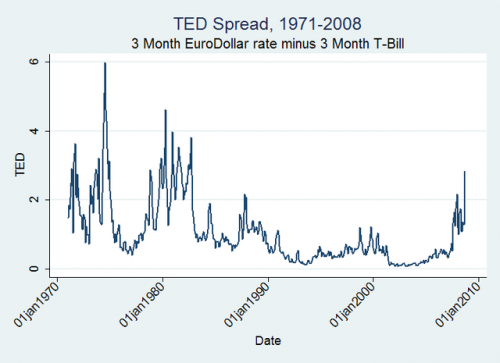
The TED spread is basically the difference or spread between short term inter-bank loan rates and short term treasuries or T-bills.  It is in some sense a measure of perceived risk of lending to banks vs. (what are considered) low or near-zero risk US treasury obligations.  One way to think about it in the current market is how much extra would you need in interest to lend to your slacker brother-in-law Earl vs. say to Bill Gates.

Not surprisingly, the TED spread has shot up over the last few weeks, and it tends to be the #1 metric cited in declaring impending doom for the US economy.  But Alex Tabarrok looked at a longer view of the TED spread, and found this:

ted-spread

Now, the period from 1970-1983 were not by any means an economic glory period, but on the other hand its clear that TED spreads of the order of magnitude we have seen in the past weeks are not unprecedented by any means.

The problem I have with the TED spread is that higher recent spreads are being used as an indicator that credit has "dried up" and lending is at a standstill.  Why do I resist this conclusion?  Because of this chart:

real_gas_prices

So, gasoline prices rocketed from $1.50 a gallon to over $4.00 a gallon.  Does this mean that gasoline purchases have stopped?  Has the gasoline market closed up shop?  Of course not.  It just means the price went up.  It is absurd to show me a price chart, which is what the TED spread graph is, and infer from it changes in the underlying transaction volume.

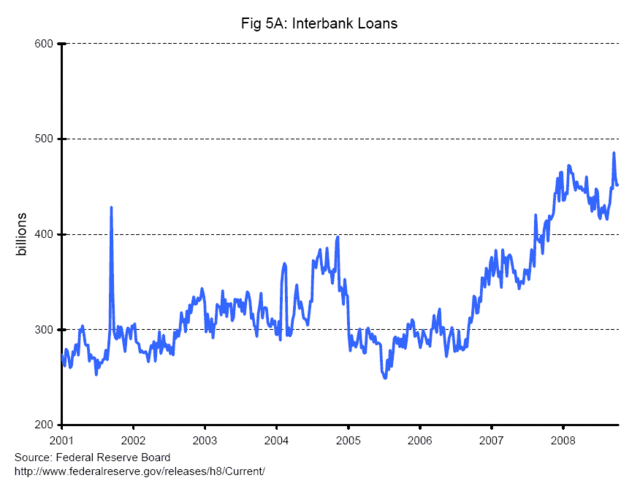
In fact, when one looks at actual volume, of inter-bank loans or new commercial lending, there is not (at least yet) any of the drop-off everyone seems to assume exists.  For example:

Interbank_4

Another Bubble! We Need More Regulation!

From the WSJ:

Despite recent declines, prices are still higher than they were a
year ago. But the recriminations over what went wrong have begun,
complete with calls for more government involvement, efforts to make
the industry more transparent and reforms to restore market confidence....

"[the market] is out of control," says H. Djusdil Akrim, director of a
factory in Makassar, Sulawesi's biggest city.... "It's a wild, wild market
-- and no one is running it," he says. "I think we need more
regulation."...

No one knows when the market will hit bottom. Some
traders are sitting on stockpiles they bought when the market was hot,
and if global growth slows further, as expected, demand could weaken.

Whatever happens, the latest volatility is a wake-up call for the ... industry, which has been growing steadily for years.

I blame George Bush.  Oh, by the way, the industry is seaweed.

Another State-Run Oil Company Fiasco

And it couldn't happen to a nicer guy (hat tip to a reader):

Venezuela's daily oil production has fallen by a quarter since President Hugo
  Chavez won power, depriving his "Bolivarian Revolution" of much of
  the benefit of the global boom in oil prices...

The state oil company, PDVSA, produced 3.2 million barrels per day
in 1998, the year before Mr Chavez won the presidency. After a decade
of rising corruption and inefficiency, daily output has now fallen to
2.4 million barrels, according to OPEC figures. About half of this oil
is now delivered at a discount to Mr Chavez's friends around Latin
America. The 18 nations in his "Petrocaribe" club, founded in 2005, pay
Venezuela only 30 per cent of the market price within 90 days, with
rest in instalments spread over 25 years.

The other half - 1.2 million barrels per day - goes to America, Venezuela's only genuinely paying customer.

Meanwhile,
Mr Chavez has given PDVSA countless new tasks. "The new PDVSA is
central to the social battle for the advance of our country," said
Rafael Ramirez, the company's president and the minister for petroleum.
"We have worked to convert PDVSA into a key element for the social
battle."

The company now grows food after Mr Chavez's price
controls emptied supermarket shelves of products like milk and eggs.
Another branch produces furniture and domestic appliances in an effort
to stem the flow of imports. What PDVSA seems unable to do is produce
more oil.

Venezuela has proven reserves of 80 billion barrels,
but estimates suggest that it may possess 142 billion barrels - more
than anywhere else except Saudi Arabia....

All
this means that Venezuela has missed much of the benefit from the oil
boom and, now that prices are falling, Mr Chavez faces huge financial
problems. Nobody is sure at what point his government would be unable
to pay its bills, but most sources consulted believe this would
probably happen if oil falls to $80 a barrel. Yesterday, oil was
trading at $79.80.

More on "peak oil" being at least partially a function of state mis-management of promising oil reserves here.  Jim Kingsdale estimated last year, when prices were over $100 for oil, that oil prices would probably trade under $50 if the reserves were controlled by private companies rather than government buffoons.

Don't Panic

The best way to mobilize people is to make them panic.  That is why so many institutions have incentives to may you panic over the environment, or global warming, or the threat of terrorism, or the economy.  In most cases (Naomi Klein's hypothesis not-withstanding) these folks want you to get so worried you will give up something, either money or freedom or both.

Some kind of recession at this point is unavoidable, I guess.  But in fact, we really haven't seen what I would call a real recession since the early 1980's.  We've had a really long run, and now its time to cut back on that spending and board up the financial windows for a little while.  The economy has to de-leverage itself some, and that is going to slow things down for a while.  People keep talking about the Great Depression, and I don't see it.  I don't even think its going to be the 1970's.

The most visible symbol of financial problems seems to be the falling stock market.  But all those companies in those indexes are the same ones that were there a month ago, and are still healthy and making money.  The fall in the markets does not represent and change in the current health of industrial America.  The lower prices reflect a changing expectation about those company's future prospects, but the folks driving the market are just guessing, and really, their guesses aren't really any better than yours or mine.  Similar expectations drove oil up to $145 and now back down under $80.  Wall Streeters work really hard to portray themselves as smarter than you or I, but they are not.  I went to school with them.  I know these guys.  They aren't smarter, and they aren't any less susceptible to panic.  In fact, because they are often highly leveraged and are worried about making payments on that new Jaguar they just bought for their mistress, they tend to be more easily stampeded.

In October of 1987, the stock market fell 22.6% in one day.  If you date the current financial issues to about September 22, when the market closed around 11,000, then the market has fallen over these tumultuous weeks by 22.0% at last night's close -- dramatic, but still not as bad as the one day drop in '87. 

Proof Positive Legislators Don't Understand Even the Basics of Economics

OK, actually, this could also just be proof positive that legislators know exactly what they are doing and want legislation that panders to powerful interest groups without actually doing anything.  Democrats in Congress have proposed a new nationwide CO2 emissions / permitting system.  The point is to allocate permits for something less than current emissions, forcing Americans to either cut back to their permit level or trade permits around. 

So I thought this provision was hilarious:

The bill tries to address the economic concerns by excluding small
businesses and increasing the number of permits when prices spike.

So when permit prices go up, they will increase the number of permits.  But permit prices will necessarily go up if they are doing their job of limiting emissions below current levels.  So, in effect, they are saying that if the permit process really does start limiting emissions, new permits will be issued to to allow more emissions. 

Why Politicians Favor Cap and Trade over a Carbon Tax

There are a lot of incredibly good reasons to favor a carbon tax over cap-and-trade if we simply most reduce CO2 emissions.  Even a minor inspection of the inner workings of the California Air Resources Board under their AB32 cap-and-trade style program provides lists of examples of abuses, rent-seeking, inefficiency, etc. under cap-and-trade.  But Joe Nation, one of the California legislators who authored AB32, told me that he could not get even a 5-cent gasoline tax through a legislature that enthusiastically embraced the 100x (or more) expensive AB32.  Why?  Silly rabbit, because public costs of cap-and-trade can be fudged, hidden, ignored, and, when they absolutely have to be recognized, blamed on private companies.

Via a reader, here is our Arizona governor discussing the costs of cap-and-trade in Arizona:

Napolitano brushed aside questions of what effect the plan will have on utility rates.

"First of all, that it may increase electric bills doesn't mean it will increase them now," Napolitano said.

Brave, isn't she?  They are already preparing the story line to blame private industry for future price increases:

Napolitano said there is "lots of data" to suggest that utilities
eventually will be able to save money "by moving to a system of 'green'
energy."...

Fox said that, on a long-term basis, there may be cost savings.

You get that?  We smart government guys conducted a lot of really high-power circle jerks among graduate students and the consensus was that forcing the electrical industry to obsolete much of its current capacity and rebuild with some other uproven but more expensive technology would save them money in the long term.  If utilities raise prices, it's because they were not smart enough to figure out what we already know and they are just greedy capitalist pigs so blame them for the price increases, not use faithful public servants.  You see?  Cap-and-trade is like money laundering for taxes.  The tax is there, but its hidden well enough that a lazy media will not bother to trace it back to its owner.

But I wouldn't want you to take my assertion on faith (as Obama does with his 5 million green jobs promise), so lets look at what will have to happen.

The exact goals are hazy, but it appears our governor has committed the state to cutting CO2 emissions by 15% over the next 10 years.  One of the main ways that calling CO2 "pollution" is misleading is to imply it is some kind of combustion by-product, like soot or SO2, that could be scrubbed out.  But it is not.  It is fundamental to combustion.  So a 15% cut in CO2 emissions is 10-15% cut in power generation  (we likely get numbers lower than 15% by assuming cuts in production are preferentially from higher carbon sources like coal plants). 

So, basically this law requires the state's electrical utilities to obsolete 10% of its installed capacity, and either a) have tons of rolling blackouts; b) raise prices enough to force a large cut in demand  (remember, demand must be cut 10% AND all future growth must be halted); or c) the industry must spend hundreds of billions of dollars to build a ton of capacity in some other technology.  Option a will never fly politically.  Option c is almost sure to fail as well.  The permitting and construction processes can take decades.  From a cold start, I don't think its possible to rebuild 10+% of the states generation capacity in 10 years, either in nuclear or some other not-yet-ready technology.  The numbers simply don't work.  The only possible way I can imagine is maybe to install a zillion natural gas turbines, but to make the CO2 balance work out, you probably would have to rebuild 15% or more of the capacity, not just 10%, because there would still be some carbon emissions. 

Really, realistically, one is left with option b.  Prices are going to go up (just they would have to in option c to pay for replacement production capacity).  The price increases would be about as much as the carbon tax would have had to be to get the same effect, but price increases are corporation's fault while taxes are politicians' fault.  See?  The only good news is that the price increase will go to private players rather than the government.  That is until someone thinks to put in a windfall profits tax on utilities that are making lots of money on the government-enforced shortage.

In Praise of Price Gouging

As I have pointed out any number of times, when supplies of something are short, you can allocate them either by price or by rationing.  Robert Rapier, via Michael Giberson made the point that combining shortages with tough state price-gouging laws inevitably led to rationing and long lines:

Someone asked during a panel discussion at ASPO whether we were going
to have rationing by price. I answered that we are having that now. But
prices aren't going up nearly as much as you would expect during these
sorts of severe shortages. Why? I think it's a fear that dealers have
of being prosecuted for gouging. So, they keep prices where they are,
and they simply run out of fuel when the deliveries don't arrive on
time. If they were allowed to raise prices sharply, people would cut
back on their driving and supplies would be stretched further.

Neal Boortz made the same point yesterday, as the gas shortages in the southeast dragged out (unsurprisingly) for a second week:

nearly 200 gas stations in Atlanta are being investigated for price gouging.  Don't investigate them!  Reward them!  Price gouging is exactly what we need!  It should be encouraged, not investigated....

The real problem now is panic buying.  People will run their tanks
down by about one-third and then rush off to a gas station.  Lines of
cars are following gas tanker trucks around Atlanta. The supplies are
coming back up, but as long as people insist on keeping every car they
own filled to the top and then filling a few gas cans to boot, we're
going to have these outages and these absurd lines. 

So, how do you stop the panic buying?  Easy.  You let the market do
what the market does best, control demand and supply through the price
structure.  The demand for gas outstrips the supply right now, so allow
gas stations respond by raising the price of gas .. raise it as much as
they want.  I'm serious here so stop your screaming.  The governor
should hold a press conference and announce that effective immediately
there is no limit on what gas stations can charge for gas.  I heard
that there was some gas station in the suburbs charging $8.00 a
gallon.  Great!  That's what they all should be doing.  Right now the
price of gasoline in Atlanta is artificially low and being held down by
government.  That's exacerbating the problem, not helping it.  Demand
is not being squelched by price. 

As the prices rise, the point will be reached where people will say
"I'm fed up with this.  I'll ride with a friend, take the bus or just
sit home before I'll pay this for a gallon of gas."  Once the price of
a gallon starts to evoke that kind of reaction, we're on our way to
solving the problem.  When gas costs, say, $8.00 people aren't going to
fill their tanks.  They also aren't going to rush home to get their
second car and make sure it is filled up either ... and you can forget
them filling those portable gas cans they have in the trunk.  Some
people will only be able to afford maybe five gallons!  Fine!  That
leaves gas in the tanks for other motorists.  Bottom line here is that
people aren't going to rush out to fill up their half-empty tanks with
$8.00 gas.

Here is something else to think of about lines and shortages.  What is the marginal value of your time?  I think most people underestimate this in their day to day transactions.  Some will say it is whatever they make an hour at work, and that is OK, but I will bet you that is low for most folks.  Most folks would not choose to work one more hour a week for their average hourly rate.  Start eating into my free time and family time, and my cost goes up.  That's why overtime rates are higher.   

So let's say an individual values his/her time at the margin for $25.  This means that an hour spent waiting in line or driving around town searching to fill up with 10 gallons raises the cost by $2.50 a gallon.  And this does not include the fuel or other wear on the car used in the search.  Or the cost of that sales meeting you missed because you did not have the gas to get there.  So an anti-gouging law that keeps prices temporarily down by a $1 or so a gallon may actually cost people much more from the shortages it creates.   

Save Our Industry, The Economy Depends on It

I have been on a Civil War reading binge lately, which began when I read "Time on the Cross", which is a really interesting economic analysis of American slavery.  Since I have read a number of other Civil War and Ante-Bellum history books, including James McPherson's excellent one volume Civil War history.

I was struck in several of these books by the reaction of British textile manufacturers to the war and, more specifically, the informal southern embargo of cotton exports in 1860-61.  These textile producers screamed bloody murder to the British government, demanding that they recognize the Confederacy and intervene on their behalf, claiming that the lack of cotton would doom their industry and thereby doom the whole country.  On its face, this was a credible argument, as textiles probably made up more of the British GDP at the time than any three or four industries account for in the US today. 

Fortunately, the British chose not to intervene, and risked the economic consequences of not supporting the textile industry by jumping into the American Civil War.  As it turned out, the British economy was fine, and in fact even the textile industry was fine as well, as demand was still high and other sources around the world stepped up (because of the higher prices that resulted from the Southern boycott) with increased cotton supplies.

Cargo Cult Regulation

Someone noticed that just before certain stocks crash in value, there is a lot of short-selling.  So the US government has banned short-selling, at least temporarily.  Classic cargo-cult logic. 

Boy this sure makes perfect sense in a time when we are concerned about speculative bubbles -- let's ban one of the most important tools that exist for bubbles to be shortened and made less, uh, bubbly.  Here is why (very briefly and non-technically) short-selling takes the edge off speculative excesses.

At the start of the bubble, a particular asset (be it an equity or a commodity like oil) is owned by a mix of people who have different expectations about future price movements.  For whatever reasons, in a bubble, a subset of the market develops rapidly rising expectations about the value of the asset.  They start buying the asset, and the price starts rising.  As the price rises, and these bulls buy in, folks who owned the asset previously and are less bullish about the future will sell to the new buyers.  The very fact of the rising price of the asset from this buying reinforces the bulls' feeling that the sky is the limit for prices, and bulls buy in even more. 

Let's fast forward to a point where the price has risen to some stratospheric levels vs. the previous pricing as well as historical norms or ratios.  The ownership base for the asset is now disproportionately
made up of those sky-is-the-limit bulls, while everyone who thought
these guys were overly optimistic and a bit wonky have sold out. 99.9% of the world now thinks the asset is grossly overvalued.  But how does it come to earth?  After all, the only way the price can drop is if some owners sell, and all the owners are super-bulls who are unlikely to do so.  As a result, the bubble might continue and grow long after most of the world has seen the insanity of it.

Thus, we have short-selling.  Short-selling allows the other 99.9% who are not owners to sell part of the asset anyway, casting their financial vote for the value of the company.  Short-selling shortens bubbles, hastens the reckoning, and in the process generally reduces the wreckage on the back end.

Update:  From Don Boudreaux:

To ban short-selling of stocks is to short-circuit an important
mechanism through which people share their knowledge and expectations
with others.  Banning a mechanism that better allows share prices to
reflect the expectation that the underlying assets are not worth as
much as current market prices suggest does nothing to change the
underlying reality.  Such a ban merely distorts knowledge of this
reality

Re-Evaluating Home Ownership

Mark Perry has had a series of posts of late presenting the hypothesis that high rates of home ownership in the US may be detrimental as it reduces labor mobility.  The argument goes that homeowners have a harder time moving for new jobs than renters do.

Homeownership
impedes the economy's readjustment by tying people down. From a social
point of view, it's beneficial that homeownership encourages commitment
to a given town or city. But, from an economic point of view, it's good
for people to be able to leave places where there's less work and move
to places where there's more. Homeowners are much less likely to move
than renters, especially during a downturn, when they aren't willing
(or can't afford) to sell at market prices. As a result, they often
stay in towns even after the jobs leave. And reluctance to move not
only keeps unemployment high in struggling areas but makes it hard for
businesses elsewhere to attract the workers they need to grow.

The argument makes sense on its surface, but I am having a bit of trouble buying into it (though I will admit that as an American, I am steeped in decades of home-ownership-boosterism, so I may not be approaching the problem without bias).

On the plus side, the selling a home and buying a new one certainly has more costs than switching apartments, particularly if you add in a moving premium for home owners who can accumulate a lot more stuff than apartment dwellers and the switching costs due to emotional attachment to the current house.  Also, on its face, the argument is similar to criticisms of the economy of the antebellum south, where too much capital was invested in land and assets tied to the land.

However, I see a couple of problems with it.  First, its hard to find an increase in structural unemployment rates in the past decades to correlate to the increase in home ownership.  Second, the costs to change homes has been falling of late as the government-protected Realtor monopoly is finally being broken by technology and commission rates are falling.  Third, my sense is (though I can't dig up the data) that the average time in a home is dropping, meaning homes flip owners more frequently, again indicating a decreasing barrier to moving.

I would, however, be willing to accept that in a high home ownership regime, falling home prices and lengthening for-sale times could exacerbate an economic downturn by slowing mobility and thereby slowing the correction.  I would have argued in the past that this was offset by home equity as a savings tool and a source of cash in difficult times, but that could be different this time around as mortgage policies have tightened, drying up the ability to convert equity to emergency cash.

Is There a Zero-Cost Regulatory Solution to Energy Efficiency?

A while back, I criticized a story in the NY Times, as quoted by Kevin Drum, that said that California had among the lowest per capita electricity usage of any state (true) and that this was because of the intelligent regulation regime in the state (yes, but not the way they meant).  The implication of Drum's argument was that there was some sort of efficiency ideal that a smart group of technocrats could reach at limited cost to the state (false). Specifically, Drum argued:

Anyway, it's a good article, and goes to show the kinds of things we
could be doing nationwide if conservative politicians could put their
Chicken Little campaign contributors on hold for a few minutes and take
a look at how it's possible to cut energy use dramatically "” and reduce
our dependence on foreign suppliers "” without ruining the economy. The
energy industry might not like the idea, but the rest of us would.

My response, in part, was this:

Well, here are the eight states in the data set above that the
California CEC shows as having the lowest per capita electricity use:
CA, RI, NY, HI, NH, AK, VT, MA.  All right, now here are the eight
states from the same data set that have the highest electricity prices:  CA, RI, NY, HI, NH, AK, VT, MA.  Woah!  It's the exact same eight states!  The 8 states with the highest prices are the eight states with the lowest per capita consumption.
Unbelievable.  No way that could have an effect, huh?  It must be all
those green building codes in CA.  I suspect Drum is sort of right,
just not in the way he means.  Stupid regulation in each state drives
up prices, which in turn provides incentives for lower demand.  It
achieves the goal, I guess, but very inefficiently.  A straight tax
would be much more efficient.

As part of a presentation I am working on about global warming and proposed California CO2 abatement bill AB52, I had the occasion to do a bit more research.  All of my data is from the Energy Information Administration, whose page URLs keep changing and thus breaking my links but this index page to data seems to stay the same.

I found three factors that seem to be the main drivers of state electricity demand (which is measured in all of the charts below in thousands of kw-h per capita).  The first factor is climate, and certainly California has one of the milder climates.  The chart below looks at residential electricity demand vs. cooling degree days (weighted for population location).  Each data point is a state, with California is shown as the red data point:
Electricitybystatecdd

We get something similar for heating degree days, with electrical use going down as the climate gets milder, though not as good of a fit, which is not surprising since electricity is less important to heating than cooling.  Since California is well below the line, mild climate can be said to explain some of its lead on other states, but not all.

So I looked next at the percentage of electricity demand that goes to industry.  More heavily industrialized states will have a higher total per capita demand, because heavy industry chews up electricity that other types of businesses do not.  It turns out that California has a relatively low industrial use, which is not surprising given the regulatory environment there and the degree to which industry has been chased out of the state (one would have to be a madman to, all things considered, set up a new factory in California).  So here is the same type of chart of total electrical per capita use by state vs. the % industrial demand, again with each data point a state and California in red:
Electricitybystateindust

Again there is a pretty strong relationship, and again we see some but not all of California's low per capita consumption explained.  In effect, states on the left have exported their high-electricity-use industries to the states on the right (or to other countries).

I have saved the most obvious relationship for last:  price.  It turns out unsurprisingly that the states with the highest electricity prices have the lowest per capital consumption:

Electricitybystateprice

Rolling climate, industrial intensity, and price together, these factors seem to explain at least 80% of California's efficiency lead over other states.  California government regulatory policy does indeed drive lower electrical consumption, just not exactly the way they would like you to think.  By chasing industries out of the state and raising electricity costs above those of almost every other state, California has reached a lower per capita consumption level.

Dumbest Thing I Have Read Today

From the department of wishful thinking comes this:

The worst oil shock since the 1970s has put a permanent mark on the
American way of life that even a drop in oil's price below $100 a
barrel won't erase.

Public transportation is in. Hummers are out. Frugality is in. Wastefulness is out....

As prices come falling back to earth, Americans aren't expected to
drop their newfound frugality. The jarring reality of $4-a-gallon
gasoline stirred up an unprecedented level of consumer angst that
experts say will keep people from reverting to extravagant energy use
for years to come - if ever again.

High gas prices prompted calls to lower speed limits to 55 mph in some states and touched off a seemingly endless wave of "Go Green" campaigns.

"I see a permanent shift," said Kit Yarrow, a consumer psychologist
at San Francisco's Golden Gate University who has studied how high oil
prices have affected Americans' buying behavior. "Historically, when
gas prices come down, people use more. But we've learned a lot of new
things during this period and it will be hard to go back to our
gas-guzzling ways."

Really?  I could have sworn people said that in 1972 and again in 1978.  But the SUV and the Hummer were not even invented until after these oil shocks.  He mentions the 55 mph speed limit, but we once had a national speed limit at 55 in the 1970s and we chucked it.  What possible evidence does this guy have, particularly since the recent shock was not nearly as bad as 1972 or 1978.  In fact, you can see that here in this graph of gas price pain:

Gas_prices_2

And, we have not seen the absolute shortages and gas lines we saw in the 1970s.  Usually these weird statements like this published by the AP are the start of some kind of broader political campaign.  The only thing I can guess is that this is the front end of some leftish/Obama polical message that we need to keep slamming on government conservation directives and alt-energy subsidies even as prices fall.

Settled Science

I always find it fascinating to observe how the same folks who criticize the US for not taking drastic action based on the "settled science" of global warming are often the first to ignore hundreds of years of study in the science of economics.  While the full breadth of economics is far from settled science, one thing that is far better understood than the effect of CO2 on global temperatures is the effect of higher prices on demand:  (via Market Power)

This chart confirms that for teenagers, those between the ages of 16
and 19 years old, all of the jobs that disappeared in 2007 were minimum
wage jobs. In essence, a total of 94,000 hourly jobs disappeared for
this age group overall. This figure is the net change of this age group
losing some 118,000 minimum wage earning jobs and gaining some 24,000
jobs paying above this level.

This represents what we believe to be the effect of the higher
minimum wage level increasing the barriers to entry for young people
into the U.S. workforce. Since the minimum wage jobs that once were
held by individuals in each age group have disappeared, total
employment levels have declined as those who held them have been forced
to pursue other activities.

Now consider this: The minimum wage was just reset on 24 July 2008
to $6.55 per hour, a 27.2% increase from where it was in early July
2007. Our best guess is that a lot of additional teenagers will be pursuing those other activities

Meanwhile, the lack of employment opportunities for the least
educated, least skilled and least experienced segment of the U.S.
workforce will likely have costs far beyond the benefits gained by
those who earn the higher minimum wage. The government might be able to
make the minimum wage earning teenage worker disappear, but they didn't
do anything to make the teenagers themselves disappear.

Numberminwagebyagegroup20052007

The increase in minimum wage earners in some of the middle brackets is likely due to a sweeping effect -- if the minimum wage is increase from $6 to $7, people making $6.50 before are swept into the "minimum wage" characterization.   

The Real Reason Why ExxonMobil Profits Suck

Because they are too freaking low!  ExxonMobil (XOM) is a cyclical company that is following on 20 years of middling prices for their commodity and finally have a price spike, and they only manage to make 8.5% return on sales  ($11.68 billion profit on $138 billion of revenues).  At the top of their cycle they are barely making the same profit margin as the average industrial company.  This is not good.   Sure, the absolute dollars are large, but it is a large company, and the absolute dollars of revenues, expenses, and taxes are also large.

While this outcome may be confusing to many  (since the press and politicians insist on calling these mediocre profits "windfall"), they are in effect the reflection of a new reality for western oil companies.  Less and less do companies like XOM operate their own oil fields.  They are increasingly concession operators or really glorified service companies and middle men to state producers. 

Disclosure:  I am an XOM stockholder, and I am not happy.

Postscript:  This from Mark Perry is kind of interesting:

Exxon has already paid $19.828 billion in income taxes for 2008 (data here),
and will probably pay almost $40 billion in income taxes this year (see
graph above, income tax data for 1999-2007 taken from Exxon's annual
reports).

To
put $40 billion of income taxes in perspective, it can be reasonably
estimated that Exxon will pay more in income taxes this year (both here
and outside the U.S.) than the entire bottom 50% of American individual
taxpayers (about 67 million) will pay in income taxes this year.

Perry has a number of notes and updates in response to questions about how he got these figures at the bottom of his post.

Update:  Yahoo Finance data and ranking on profitability by industry.  Integrated oil companies come in around #60.

Duh

From the Interagency Task Force on Commodity Markets, via Mark Perry:

The Task
Force's preliminary assessment is that current oil prices and the
increase in oil prices between January 2003 and June 2008 are largely
due to fundamental supply and demand factors. During this same period,
activity on the crude oil futures market "“ as measured by the number of
contracts outstanding, trading activity, and the number of traders "“
has increased significantly. While these increases broadly coincided
with the run-up in crude oil prices, the Task Force's preliminary
analysis to date does not support the proposition that speculative
activity has systematically driven changes in oil prices.

The
world economy has expanded at its fastest pace in decades, and that
strong growth has translated into substantial increases in the demand
for oil, particularly from emerging market countries. On the supply
side, the production of oil has responded sluggishly, compounded by
production shortfalls associated with geopolitical unrest in countries
with large oil reserves. As it is very difficult to rely on substitutes
for oil in the short term, very large price increases have occurred as
the market balances supply and demand (see top two charts above).

If
a group of market participants has systematically driven prices,
detailed daily position data should show that that group's position
changes preceded price changes. The Task Force's preliminary analysis,
based on the evidence available to date, suggests that changes in
futures market participation by speculators have not systematically
preceded price changes. On the contrary, most speculative traders
typically alter their positions following price changes, suggesting
that they are responding to new information "“ just as one would expect
in an efficiently operating market.

Congress and other agencies have commissioned studies of this type on oil markets and prices approximately every 90 days or so for the last 35 years, and every one of them have come to the same conclusion:  Oil markets move based on the participant's best guesses about trends in supply and demand.  Duh.  As I wrote previously, the last hydrocarbon price manipulation case I have seen in court was aimed at a group that allegedly manipulated prices for 30 seconds at the end of a trading day whose closing price affected certain contracts.  And it is not clear that they were successful. 

Why Its OK If GM Fails

This is a reprise of a much older post, but since I have limited time for blogging, I thought it might be timely to reprise it:

I had a conversation the other day with a person I can best describe
as a well-meaning technocrat.  Though I am not sure he would put it
this baldly, he tends to support a government by smart people imposing
superior solutions on the sub-optimizing masses.  He was lamenting that
allowing a company like GM to die is dumb, and that a little bit of
intelligent management would save all those GM jobs and assets.  Though
we did not discuss specifics, I presume in his model the government
would have some role in this new intelligent design (I guess like it
had in Amtrak?)

There are lots of sophisticated academic models for the corporation.  I have even studied a few.  Here is my simple one:

A corporation has physical plant (like factories) and workers of
various skill levels who have productive potential.  These physical and
human assets are overlaid with what we generally shortcut as
"management" but which includes not just the actual humans currently
managing the company but the organization approach, the culture, the
management processes, its systems, the traditions, its contracts, its
unions, the intellectual property, etc. etc.  In fact, by calling all
this summed together "management", we falsely create the impression
that it can easily be changed out, by firing the overpaid bums and
getting new smarter guys.  This is not the case - Just ask Ross Perot.
You could fire the top 20 guys at GM and replace them all with the
consensus all-brilliant team and I still am not sure they could fix
it. 

All these management factors, from the managers themselves to
process to history to culture could better be called the corporate
DNA*.  And DNA is very hard to change.  Walmart may be freaking
brilliant at what they do, but demand that they change tomorrow to an
upscale retailer marketing fashion products to teenage girls, and I
don't think they would ever get there.  Its just too much change in the
DNA.  Yeah, you could hire some ex Merry-go-round** executives, but you
still have a culture aimed at big box low prices, a logistics system
and infrastructure aimed at doing same, absolutely no history or
knowledge of fashion, etc. etc.  I would bet you any amount of money I
could get to the GAP faster starting from scratch than starting from
Walmart.  For example, many folks (like me) greatly prefer Target over
Walmart because Target is a slightly nicer, more relaxing place to
shop.  And even this small difference may ultimately confound Walmart.
Even this very incremental need to add some aesthetics to their
experience may overtax their DNA.

Corporate DNA acts as a value multiplier.  The best corporate DNA
has a multiplier greater than one, meaning that it increases the value
of the people and physical assets in the corporation.  When I was at a
company called Emerson Electric (an industrial conglomerate, not the
consumer electronics guys) they were famous in the business world for
having a corporate DNA that added value to certain types of industrial
companies through cost reduction and intelligent investment.  Emerson's
management, though, was always aware of the limits of their DNA, and
paid careful attention to where their DNA would have a multiplier
effect and where it would not.  Every company that has ever grown
rapidly has had a DNA that provided a multiplier greater than one...
for a while.

But things change.  Sometimes that change is slow, like a creeping
climate change, or sometimes it is rapid, like the dinosaur-killing
comet.  DNA that was robust no longer matches what the market needs, or
some other entity with better DNA comes along and out-competes you.
When this happens, when a corporation becomes senescent, when its DNA
is out of date, then its multiplier slips below one.  The corporation
is killing the value of its assets.  Smart people are made stupid by a
bad organization and systems and culture.  In the case of GM, hordes of
brilliant engineers teamed with highly-skilled production workers and
modern robotic manufacturing plants are turning out cars no one wants,
at prices no one wants to pay.

Changing your DNA is tough.  It is sometimes possible, with the
right managers and a crisis mentality, to evolve DNA over a period of
20-30 years.  One could argue that GE did this, avoiding becoming an
old-industry dinosaur.  GM has had a 30 year window (dating from the
mid-seventies oil price rise and influx of imported cars) to make a
change, and it has not been enough.  GM's DNA was programmed to make
big, ugly (IMO) cars, and that is what it has continued to do.  If its
leaders were not able or willing to change its DNA over the last 30
years, no one, no matter how brilliant, is going to do it in the next
2-3.

So what if GM dies?  Letting the GM's of the world die is one of the
best possible things we can do for our economy and the wealth of our
nation.  Assuming GM's DNA has a less than one multiplier, then
releasing GM's assets from GM's control actually increases value.
Talented engineers, after some admittedly painful personal dislocation,
find jobs designing things people want and value.  Their output has
more value, which in the long run helps everyone, including themselves.

The alternative to not letting GM die is, well, Europe (and Japan).
A LOT of Europe's productive assets are locked up in a few very large
corporations with close ties to the state which are not allowed to
fail, which are subsidized, protected from competition, etc.  In
conjunction with European laws that limit labor mobility, protecting
corporate dinosaurs has locked all of Europe's most productive human
and physical assets into organizations with DNA multipliers less than
one. 

I don't know if GM will fail (but a lot of other people have opinions) but if it does, I am confident that the end result will be positive for America.

* Those who accuse me of being more influenced by Neal Stephenson's Snow Crash than Harvard Business School may be correct.
**
Gratuitous reference aimed at forty-somethings who used to hang out at
the mall.  In my town, Merry-go-round was the place teenage girls went
if they wanted to dress like, uh, teenage girls.  I am pretty sure the
store went bust a while back.

Just When Yout Thought Air Travel Could Not Get Worse...

US Airways has chosen to try to cover rising fuel prices by unbundling their ticket price and charging for services that were here-to-fore free, or built into the base ticket price.  They now charge $15 for the first piece of checked baggage ($25 for the second), and charge for most in-cabin services, including for soft drinks.

I'm not going to argue with them about this.  Airline pricing is a wickedly complex topic, and folks who know more than I do think this is the best way to get incremental revenue.  Really, these charges don't affect me (I almost never check bags, except when on vacation with my family).  In fact, as I write this, it strikes me that the baggage charge is really a price hike mostly on non-business travelers, which is interesting as it bucks the trend of having increasing price spreads over the years between business/last-minute and tourist pricing.

Anyway, the net effect has been to absolutely jam the security screening station this morning.  Every passenger seems to be carrying every bag he or she can on board to avoid the $15 charge.  What a mess.  I can't wait to see what the boarding process is going to be like.  Glad I don't have any bags today.

By the way, a few weeks ago I shipped a 60 pound trunk to my kids' camp for about $16 via UPS.  If these airline bag charges stick, it might be time for UPS to start soliciting the send-your-luggage-ahead business in earnest.  Next time we go skiing or some such place, I am going to seriously consider sending a couple of duffle bags ahead by UPS.

Update: The luggage bins were completely full before the fourth group out of six were called.  There was a fairly long line down the jetway of people gate-checking their bags.  Apparently, the airline is not set up to charge the $15 when they gate-check the bags, so everyone is hauling all of their bags to the gate and either bringing them on the plane or checking them at the gate for free.

Twisted Into Pretzels

A few weeks ago, Kevin Drum had a post on shale oil development, quoting from a speech by Congressman Ken Salazar.  It is hard to really excerpt the piece well, but my take on their argument against shale oil leasing is:

  • Shale oil technology is unproven
  • The government is leasing the shale oil rights too cheap
  • There is already plenty of shale oil land for development, so new leases won't increase development
  • This is just being done by the Bush Administration to enrich the oil companies
  • The administration is rushing so fast that Congress has not had the chance to put a regulatory regime in place

In many ways, the arguments are surprisingly similar to those against new offshore and Alaskan oil leasing.  Through it all, there is this sort of cognitive dissonance where half the arguments are that the oil won't be developed, and the other half seem to be based on an assumption that a lot of oil will be developed.  For example, how can the leases be "a fire sale" if shale oil technology is unproven and development is not likely to occur?  I would say that if these assumptions were true, then any money the government gets for a worthless lease is found money. 

Similarly, how are oil companies going to enrich themselves by paying for leases if the technology is not going to work and no development is going to occur?  This same bizarre argument became Nancy Pelosi's talking point on offshore oil leasing, by saying that oil companies were somehow already cheating us by not drilling in leases they already have.  Only the most twisted of logic could somehow come to the conclusion that oil companies were enriching themselves by paying for leases were they found no developable oil.

From the standpoint of Democratic Party goals, there is absolutely nothing bad that happens if the government leases land for oil shale or oil drilling and oil companies are unable to develop these leases  (there is some small danger of royalty loss if leases are not developed when they could be economically, but most private royalty agreements are written with sunset periods giving the lease-holder a fixed amount of time to develop the lease or lose it -- I don't know how the government does it).  The net result of "no drilling" or "oil shale technology turns out not to work" is that the government gets money for nothing. 

Here is the problem that smart Democrats like Drum face, and the reason behind this confusing logic:  They have adopted environmental goals, particularly the drastic reduction of CO2 in relatively short time frames, that they KNOW, like they know the sun rises in the east, will require fuel and energy prices substantially higher than they are today.  They know these goals require substantially increased pain and lifestyle dislocation from consumers who are already fed up with fuel-cost-related pain.  This is not because the Democrats are necessarily cruel, but because they are making the [faulty] assumption that the pain and dislocation some day from CO2-driven global warming outweighs the pain from higher priced, scarcer energy.

So, knowing that their policy goal is to have less oil at higher prices, and knowing that the average consumer would castrate them for espousing such a goal, smart Democrats like Drum find themselves twisted into pretzels when they oppose oil development.  They end up opposing oil development projects because in their hearts they want less oil around at higher prices, but (at least until their guy gets elected in November) they justify it with this bizarre logic that they oppose the plan because it would not get us oil fast enough.  The same folks who have criticized capitalism for years for being too short-term focused are now opposing plans that don't have a payoff for a decade or so.

At the end of the day, most Democrats do not want more oil developed, and they know that much higher prices will be necessary to meet their climate goals.  It sure would be refreshing to hear someone just say this. As I wrote at Climate Skeptic, the honest Democrat would say:

Yeah, I know that $4 gas is painful.  But do you know what?  Gas
prices are going to have to go a LOT higher for us to achieve the CO2
abatement targets I am proposing, so suck it up.  Just to give you a
sense of scale, the Europeans pay nearly twice as much as we do for
gas, and even at those levels, they are orders of magnitude short of
the CO2 abatement I have committed us to achieve.  Since late 2006, gas
prices in this country have doubled, and demand has fallen by perhaps
5%.  That will probably improve over time as people buy new cars and
change behaviors, but it may well require gasoline prices north of $20
a gallon before we meet the CO2 goal I have adopted.  So get ready.

Postscript:  By the way, oil companies have been trying to develop shale oil since the 1970s.  Their plans went on hold for several decades, with sustained lower oil prices, but the call by the industry to the government for a clarified regulatory regime has been there for thirty years.  The brief allusion in Salazar's speech to water availability is a valid one.  I saw some studies at Exxon 20+ years ago for their Labarge development that saw water availability as the #1 issue in making shale oil work.

PPS:  I mention above that the pain of fuel prices not only hits the wallet, but hits in term of painful lifestyle changes.  One of the things the media crows about as "good news" is the switch to mass transit from driving by a number of people due to higher oil prices.  This is kind of funny, since I would venture to guess that about zero of those people who actually switched and gave up their car for the bus consider it good news from their own personal life-perspective.  Further, most of the reduction in driving has been the elimination of trips altogether, and not via a switch to mass transit.  Yes, transit trips are up, but on a small base.  95%+ of reduced driving trips are just an elimination of the trip.  Which is another form of lifestyle pain, as presumably there was some good reason to make the trip before.

Update: Updated on Canadian Oil Sands production here.  Funny quote:

Fourth, and potentially most important, the U.S. "green" lobby is
pushing legislation that could limit purchases of oil sands products by
U.S. government agencies based on its GHG footprint.  It would be well
beyond stupid for Congress to prohibit our buying oil from Canada while
we increase buying it from countries that threaten our security.  But
just because something is stupid certainly does not mean Congress may
not do it.