Home School Sports in Arizona?

Quick bleg here -- if you have any contacts with organizations of homeschoolers in AZ, could you drop me an email?  Our small high school is, due to some random factors, short of baseball players.  We have a well-coached program on a nice field and play in the Arizona (AIA) 2A league against public and private schools.  Homeschoolers are eligible to play for us and we would love to find some dedicated players looking for this kind of experience.   Many of our kids make the starting lineup as Freshmen, so there is a lot better chance of getting good playing time here vs. other larger high school programs.  All positions are welcome but from a personal standpoint, since my son is first in the rotation, we could really use some pitchers so he doesn't need Tommy John surgery by the end of the year ;=)

The Looming Failure of Obamacare. Part 1: Information

My new column is up at Forbes.com, and it is the first in a three-part series on Obamacare.

In order to protect the core of Obamacare, Congressional Democrats have recently begun to acquiesce to a few incremental changes to the legislation that fix some of the most egregious parts of the plan (e.g. the burdensome 1099 requirements).  The implicit message is that yes, the legislation was rushed and has some flaws, but these flaws can be fixed by targeted tweaks around the edges.

Today I will begin the first of a three-part series explaining several reasons why any health care law that relies on the fundamental assumptions of Obamacare is doomed to fail, even if crafted by the smartest people through the best process.  In this first installment, we will discuss information problems inherent in the law’s top-down approach.  In the second segment, we will cover incentives issues that will breed a myriad of unintended consequences.  In the final part, we will discuss the ever-powerful urge to rent-seeking among certain businesses that will likely turn Obamacare into the largest single corporate welfare program in the history of this country.

I Hate to Enjoy This, But...

Apparently Google is under attack from many directions for anti-trust violations, the main complaint seeming to be that Google tilts its search results to favor its own divisions   (e.g. Google Places at the top of travel searches).    The Reason article as well as the Politico piece illustrate just how much competitors with political pull, rather than consumers, are the true beneficiaries of anti-trust policy.

I really have nothing but disdain for this use of government power, but I can't help but laugh at the plight of Google, whose CEO had a large role in suing Microsoft for browser anti-trust years ago for the horrible crime of giving away a free browser with their OS.  In fact, ironically, the core of this suit was about Microsoft going too far in integrating the OS with browser.  In many ways, Microsoft was probably prescient (for once, they tend to be a follower) in looking towards an OS built around browser.  In fact, by preventing Microsoft from such integration, the suit cleared the way for an integrated browser based OS to be introduced by.... Google with Chrome OS.  And there sure is a lot of browser / OS integration in my Google android-based phone.  I also don't remember my Android phone offering me a range of browser and search choices, requirements their CEO had the government impose on Microsoft.

More recently, Google has led the charge in Washington to regulate broadband suppliers in the name of "net neutrality."  This classic bit of tilting the playing field in the name of creating a level playing field was theoretically aimed at stopping broadband companies from tilting their bandwidth for or against different web sites.  Thus critics of Google who are concerned with the tilting of their search results for or against companies are demanding "search neutrality."  This is a horrible bit of government interventionism, but the irony is delicious.

Google's efforts in net neutrality really are a head scratcher for me.  What did they really get from that, and was it really worth opening the Pandora's box of government Internet regulation?  And didn't anyone there not see the obvious application of the same logic to themselves?  If you establish the principle that Cox Cable has to be a common carrier, it seems like a small step to say that Google Search must be as well.  And maybe Amazon.com next must be a common carrier of retail goods.    This is bad, bad stuff and Google and its CEO has brought it all on themselves.

Correlation in Political Views

(via Popehat) one of the writers at Balloon Juice offers this test of a "reasonable" Conservative blog

1) Do you believe in evolution?

2) Do you believe that the average temperature on earth has increased over the past 30 years?

A few semi-random thoughts:

  • Count me as a yes for both
  • Is the best test of the likely reasonableness of a political blog really to ask two questions about science that such a blog might never even touch?  This is not an entirely rhetorical question -- just the other day I linked the data that suggested that asking your date about beer might be the best way to test their views on sex.  Sometimes odd cross-correlations exist, but I don't think these would be my first test
  • I find the Left's obsession with evolution as a litmus test for political thought to be funny, as the theory of evolution is largely irrelevant to any political questions except fairly narrowly the question of teaching evolution in schools.   I find it funny as much of the Left does not believe in a science - micro economics (very specifically differentiated from macro) - that is also fairly old and well understood and is much more relevant to typical political blog discourse.  I had a debate on national TV a few weeks ago with a man who claimed, as many on the Left will, that raising the minimum wage will increase employment.   If we want to test blogs based on scientific questions, why wouldn't a far more relevant question in public discourse be "do you believe demand curves slope down" or perhaps something like "do you believe breaking windows stimulates the economy?"
  • The second test is not a bad test of any site writing about global warming and climate change.  I don't know many science-based skeptics who would deny that global temperatures have likely increased over the last 30 years  (from a data base without UHI or alarmist manual adjustments or large data holes, the trend is something like 0.1C per decade).   I say "likely" because it could be argued that 0.1C is within the error bar of the measurement. Even so, this wouldn't be my first test, even for climate sites
  • I would tend to have four tests of the liberal and conservative sites I read
    • Is it interesting to read (after all, this is a freaking unpaid hobby)
    • Is the data-analysis-to-name-calling ratio fairly high
    • Are they willing to step out of team politics and question their own team from time to time
    • Do they have interesting perspectives on individual liberty.  I can plow through Marxist economic posts on progressive sites if from time to time they have a useful perspective on, say, indefinite detentions or gay marriage.  I can plow through some social Conservatism if they have useful posts on economics and fiscal policy.

This post from Nick Gillespie is sort of relevent, in which he talks about CPAC and social conservatives.  One line that struck me

A person's choice of sexual partner in no way means he or she can't be in favor of less spending on farm subsidies.

If I weeded out every blog that held some sort of view with which I disagree (or might even call "unreasonable") I would be down to about 3 blogs in my reader.

Race Tests in America

Glenn Reynolds mentions an article on racial tests in Hawaii.  I blogged about a similar Hawaiian program several years ago, where $1 a year land leases are granted by the state to native Hawaiians

Qualifying for the program requires that the recipient pass a strict racial test, which the HHL web site says is "50% or greater native Hawaiian blood".  Setting eligibility for a government program based on racial tests is pretty outlandish in and of itself, but it gets worse.  People taking advantage of the program need to think carefully about the race of their mate before they decide how much to invest in their home.  A 75% Hawaiian who marries a full-blooded Hawaiian will be able to pass the improvements on to their children (since the children will be more than 50% Hawaiian), and thus can justify a large home investment.  The same person who marries a full-blooded Japanese or African or Anglo-Saxon will not be able to pass their home on to their kids, since their kids will fail the race test.  So, not only is there a race-test for a government program, but the government is providing strong financial incentives not to "dilute" a certain race.  Hawaii uber alles.

Do You Like the Taste of Beer?

Who knew that this was the key question to ask on a first date.

The simplicity / complexity question is also interesting as a predictor of political views.  I prefer simplicity but apparently must subconsciously seek complexity because that is what I seem to get.  Does that make me libertarian?  A libertarian would argue that both liberals and conservatives act, at least in the political arena, from a deep hatred of complexity, or at least unpredictability.  You can't really love capitalism without being able to accept chaos  (chaos in the sense of "unpredictable, bottom-up, unregulated and uncontrolled," not the more nihilistic Road Warrior connotation).

Called This One

Via the NY Times, no flaws found with Toyota accelerators

The Obama administration's investigation intoToyota safety problems found no electronic flaws to account for reports of sudden, unintentional acceleration and other safety problems. Government investigators said Tuesday the only known cause of the problems are mechanical defects that were fixed in previous recalls.

The Transportation Department, assisted by engineers withNASA, said its 10-month study of Toyota vehicles concluded there was no electronic cause of unintended high-speed acceleration in Toyotas. The study, which was launched at the request of Congress, responded to consumer complaints that flawed electronics could be the culprit behind Toyota's spate of recalls.

"We feel that Toyota vehicles are safe to drive," said Transportation Secretary Ray LaHood.

Officials with the National Highway Traffic Safety Administration said they reviewed consumer complaints and warranty data in detail and found that many of the complaints involved cases in which the vehicle accelerated after it was stationary or at very low speeds.

NHTSA Deputy Administrator Ron Medford said that in many cases when a driver complained that the brakes were ineffective, the most likely cause was "pedal misapplication," in which the driver stepped on the accelerator instead of the brakes.

As Walter Olson writes of the original overblown brouhaha

Did it make a difference that the federal government has taken a proprietor's interest in major Toyota competitors GM and Chrysler, or that a former trial lawyer lobbyist heads the National Highway Traffic Safety Administration?

I had more back in July (and here, where I observe that scientific data on breast implant safety did nothing to stop the torts, and is unlikely to do so in this case).  I questioned the US Government's conflict of interest in this matter way back in January of 2010.

By the way, anyone want to reopen the case on that guy in LA with the runaway Prius -- I thought it was concocted at the time (I called him balloon boy in a Prius) and am doubly sure now.  How is what he did, in retrospect, and different from leading the police on a high-speed chase?

Public Choice Theory

I asked Don Boudreaux his opinion of the best primer on public choice theory, a topic of interest to many libertarians.  He recommended William Mitchell & Randy Simmons, Beyond Politics (1994).  I have ordered a used copy from Amazon and will give my thoughts on it once I have had a chance to peruse it.

Licensing to Restrict Competition

The WSJ has yet more examples of crazy job licensing, example:  (ht Alex Tabarrok)

But economists—and workers shut out of fields by educational requirements or difficult exams—say licensing mostly serves as a form of protectionism, allowing veterans of the trade to box out competitors who might undercut them on price or offer new services.

"Occupations prefer to be licensed because they can restrict competition and obtain higher wages," said Morris Kleiner, a labor professor at the University of Minnesota. "If you go to any statehouse, you'll see a line of occupations out the door wanting to be licensed."...

Texas, for instance, requires hair-salon "shampoo specialists" to take 150 hours of classes, 100 of them on the "theory and practice" of shampooing, before they can sit for a licensing exam. That consists of a written test and a 45-minute demonstration of skills such as draping the client with a clean cape and evenly distributing conditioner. Glass installers, or glaziers, in Connecticut—the only state that requires such workers to be licensed—take two exams, at $52 apiece, pay $300 in initial fees and $150 annually thereafter.

California requires barbers to study full-time for nearly a year, a curriculum that costs $12,000 at Arthur Borner's Barber College in Los Angeles. Mr. Borner says his graduates earn more than enough to recoup their tuition, though he questions the need for such a lengthy program. "Barbering is not rocket science," he said. "I don't think it takes 1,500 hours to learn. But that's what the state says."

Many, many other examples -- it takes 750 hours of training to be a manicurist in Alabama.  Somehow my daughter learned to paint her own nails during the course of a single sleepover.

Don't Know How I Ran Into This...

Some surfing around on YouTube led me to this seemingly odd combo -- Slash playing with Chic on their song "le Freak."  Slash comes out about half way.

Awesome Story of the Day

California Cap-and-trade plan may be put on hold because they failed to do an Environmental impact study.  LOLOLOL

The California Air Resources Board violated state environmental law in 2008 when it adopted a comprehensive plan to reduce greenhouse gases and again last year when it passed cap-and-trade regulations, a San Francisco Superior Court judge has ruled in a tentative decision.

If the decision is made final, California would be barred from implementing its ambitious plan to combat global warming until it complies with portions of the California Environmental Quality Act, though it is not yet clear what the air board would have to do to be in compliance. The state’s plan, which implements AB32, the Global Warming Solutions Act of 2006, would reduce carbon emissions to 1990 levels by 2020.

Paying for Incompetance

We and our children will be paying for the recent spate of government fiscal incompetence for literally decades.  This letter I got from our payroll company provides a small but pointed reminder of this.  Here is the key graf:

Can you imagine getting a note in January from Amazon.com, saying their costs last year were higher than they expected and they were going to send you an additional bill?  Or how about BP sending all its customers a note saying that the cleanup costs in the Gulf cost it a lot of money and that they would all get an extra bill for X cents per gallon of fuel they purchased last year from BP?

Update: So in other words, I was hiring people in Florida in August of 2009, and will not find out until sometime in 2011 the true cost of this labor, because only now am I being told what taxes I have to pay on this labor.  And people wonder why businesses are reluctant to hire.  We may think we have a Constitutional ban on ex post facto law, but businessman know this is BS.

What if We Bought Into the Light Rail Hype, and Built It For Everyone?

Last year, there were about 3.2 trillion passenger miles driven by urban drivers in cars in the US.  My point about light rail is that we can barely afford it for just a few people, given that we spent $1.3 billion to build a rail line for just 17,000 daily round trip riders in Phoenix.  If it were truly a sustainable technology, it could be applied to all commuters.  But at a national average taxpayer subsidy per light rail passenger mile of about $2**, this means that to roll light rail out to every urban commuter would cost $6.4 trillion a year in government spending, almost half our annual GDP.  If it required the subsidy rates we have in Phoenix per passenger-mile, such a system would cost over $12 trillion  year.  In fact, the numbers would likely be even higher in reality, because light rail in most cities is almost certainly built on the highest populated corridors with the most bang for the buck (though some of the diminishing returns would be offset by network effects).

Light rail only works today because we drain resources from millions of taxpayers to benefit just a few generally middle class commuters.    This is not a model that will scale.

** This includes both service on the debt, which is payment for the original construction costs, as well as annual operating losses.  This subsidy is required essentially forever.  After 20-30 years when the original bonds are paid off, by that time systems generally have to be rebuilt in their entirety   (as folks in places like Washington DC are learning).  There are probably only 5-6 cities in this country that have the urban population densities to make rail systems come even in the ballpark of working financially, and places like Phoenix, Seattle, Houston, Portland and LA are NOT among them.

Light Rail and Sustainability

Let me offer up a definition of sustainability that I think most environmentalists and progressives would accept:

We are acting in a sustainable manner if we are achieving our goals in a way that does not hamper the ability of other people in the world, or of future generations, to achieve their goals.

Most environmentalists and progressives would call light rail lines in US cities a "sustainable" technology because of its notional impact on fuel use and CO2 output (yeah, I know, but we are not going to address those assumptions today).

Let me present one fact, from Federal Transit Administration's 2009 survey of public transit authorities, whose data is linked in various ways here.  Or you can download the summary spreadsheet here.  For all US light rail systems in total:

User fares paid per passenger-mile:           $0.18

Total cost per passenger-mile:                     $2.22

Taxpayer subsidy per passenger-mile:       $2.04

Since I live in Phoenix and the Phoenix light rail system seems to get particular praise as a "success" from light rail supporters, here are the Phoenix light rail numbers;

User fares paid per passenger-mile:          $0.07

Total cost per passenger-mile:                     $3.89

Taxpayer subsidy per passenger-mile:       $3.82

So there, folks, is your sustainable technology.  As I have written before about sustainability, "I do not think that word means what you think it means."

Nationwide, non-users of light rail pay for 92% of its costs.   In Phoenix, non-users pay for 98% of the costs.  Taking the Phoenix system as an example, resources are drained from literally millions of people so that 17,000 or so people can ride it round trip each day.   Using resources from millions of people, and building up debts that will last into the next generation, to support the transit of just a few people, seems to be the antithesis of sustainability.

If there is any common denominator among progressives, it is that they have little respect for how individuals spend their money.  So they might be unmoved by the loss of resources from so many.  So lets just look narrowly at transit, which I presume the do care about.

Before Valley Metro operated a light rail system in Phoenix, they also operated a bus transit system.  This system still requires a subsidy, but it is much lower than the light rail subsidy.  In 2009, the bus subsidy was $0.74 per passenger-mile.  This means that for the same amount of taxpayer funds, Valley Metro can provide 1.0 passenger-mile by train or 5.2 by bus ($3.82/$0.74).   I can guarantee that cities building light rail are not having their budgets quintupled.  So the result is that, as light rail gets built, total transit ridership falls in most cities as rail costs crowd out existing bus services.

Update: Most light rail articles in our local papers, which have been mindless boosters of the system, generally consist of asking riders if they like the system, who inevitably answer "yes!"  This is somehow a proof the system is great.  Well, duh.  I too am likely to be happy with a service where I only pay 2% of the costs.

Update #2:  Last year, there were about 3.2 trillion passenger miles driven by urban drivers in cars in the US.  My point about light rail is that we can barely afford it for just a few people, given that we spent $1.3 billion to build a rail line for about 17,000 daily round trip riders in Phoenix.  If it were truly a sustainable technology, it could be applied to all commuters.  But at a national average taxpayer subsidy per light rail passenger mile of about $2, this means that to roll light rail out to everyone would cost $6.4 trillion a year, almost half our annual GDP.  If it required the subsidy rates we have in Phoenix per passenger-mile, such a system would cost over $12 trillion  year.  In fact, the numbers would likely be even higher in reality, because light rail in most cities is almost certainly built on the highest populated corridors with the most bang for the buck (though some of the diminishing returns would be offset by network effects).

Business Relocation Subsidies

I return to an old favorite topic of mine this week, government subsidies for business relocation, in my column at Forbes.com.  An excerpt:

To see this clearer, lets take the example of Major League Baseball (MLB).  We all know that cities and states have for years been massively subsidizing new baseball stadiums for billionaire team owners.  Let’s for a minute say this never happened – that somehow, the mayors of the 50 largest cities got together in 1960 and made a no-stadium-subsidy pledge.  Would baseball still exist?  Sure!  Teams like the Giants have proven that baseball can work financially in a private park, and baseball thrived for years with private parks.  But would baseball be in the same cities?  Well, without subsidies, baseball would likely be in the largest cities, like New York and LA and Chicago, which is exactly where they are now.  The odd city here or there might be different, e.g. Tampa Bay might never have gotten a team, but that might in retrospect have been a good thing.

The net effect in baseball is the same as it is in every other industry:  Relocation subsidies, when everyone is playing the game, do nothing to substantially affect the location of jobs and businesses, but rather just transfer taxpayer money to business owners and workers.

Trick Memory

I would have sworn I hated the whole Duran Duran catalog, but I was watching this video (because a friend of mine did the costumes, including the wedding dress) and I must say its not a bad song.  So my apologies to Duran Duran.

By the way, my friend said that I would be surprised how many women later wanted to get married in exactly this dress.

Also, speaking of music videos, if you have never seen the Hugh Grant / Drew Barrymore movie Music and Lyrics, the plot is an utterly predictable romantic comedy (with Hugh Grant playing the same guy he always plays) but in the opening scene they nail the 1980's pop music video genre dead on.  I can't embed it but the video is here. You can miss the rest of the movie, but the spoof is genius.

Fascinating Insight into the Corporate State

This story is from the WSJ, and gets extra bonus points for including the poster-boy of the corporate state, Jeffrey Immelt

Treasury and OMB singled out an 845-megawatt wind farm that the Energy Department had guaranteed in Oregon called Shepherds Flat, a $1.9 billion installation of 338 General Electric turbines. Combining the stimulus and other federal and state subsidies, the total taxpayer cost is about $1.2 billion, while sponsors GE and Caithness Energy LLC had invested equity of merely about 11%. The memo also notes the wind farm could sell power at "above-market rates" because of Oregon's renewable portfolio standard mandate, which requires utilities to buy a certain annual amount of wind, solar, etc.

But then GE said it was considering "going to the private market for financing out of frustration with the review process." Anything but that. The memo dryly observes that "the alternative of private financing would not make the project financially non-viable."

Oh, and while Shepherds Flat might result in about 18 million fewer tons of carbon through 2033, "reductions would have to be valued at nearly $130 per ton CO2 for the climate benefits to equal the subsidies (more than 6 times the primary estimate used by the government in evaluating rules)."

So here we have the government already paying for 65% of a project that doesn't even meet its normal cost-benefit test, and then the White House has to referee when one of the largest corporations in the world (GE) importunes the Administration to move faster by threatening to find a private financial substitute like any other business. Remind us again why taxpayers should pay for this kind of corporate welfare?

First, the moment GE said that this could be financed privately, the Feds should have said "then what the f*ck are you talking to us for? Get out of here."  By the way, privately probably does not mean privately -- it probably means going to private banks or investors who in turn access many of the same taxpayer funds.

Second, its amazing that the threat to finance this privately rather than sponging off taxpayer funds is treated as a threat by the Obama Administration.  They desperately want to "take credit" for the project and can only do so by spending our money  (this is the same impulse that propels politicians who have never given a dime to charity to want to spend taxpayer money in order to be called "caring.")

An Agency Problem?

Kevin Drum wonders whether the proposed $700 million bid by Farmers Insurance for naming rights on a prospective LA NFL stadium makes any economic sense.   It is an interesting question.  I wrote:

This has always struck me as one of those agency problems, where the executive's incentives are different from the shareholders. Executives get a ton of benefits personally from this -- higher profile for the company which improves their profile and marketability, they get a prime box for the games, parties, etc.

Before the audience here slips into a round of corporate executive bashing, my sense is that the same perverse incentives are working for municipal leaders who have a mismatch with taxpayer interests when they shove huge amounts of taxpayer funds to owners in stadium deals (deals which economists speak with one voice on -- they never pay off for the community in full). One of the dirty secrets of these deals is that they generally include a sort of kickback in the form of boxes and club seats for the Mayor and city council's use (and sometimes multiple boxes for leaders of other government agencies in the town).

Speaking of Income Distribution

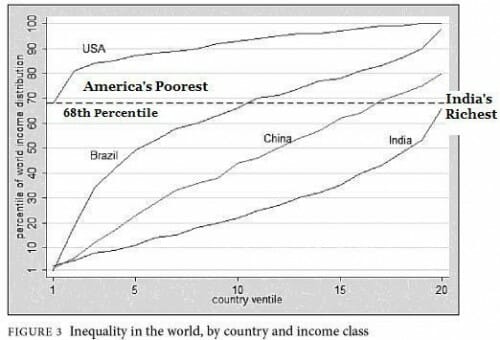
This chart, from a book by Branko Milanovic via Carpe Diem reinforces a point about income distribution I make all the time -  for all we talk about income distribution in this country, our poorest 20% would be middle class in many countries of the world.  While I would love to see our poor doing even better, it begs the question of whether distribution or absolute prosperity is more important.

Just to give you a feel for reading the chart, the US's lowest ventile, or bottom 5%, have income that would put them in the 68th percentile worldwide.    Our poorest 20% (the first 4 ventiles) would be upper middle class or better in Brazil, China, and India.

When comparing to European social democracies, it turns out that while the US's income distribution is wider, that is almost entirely due to the top end being higher.  The poorest 10% make about the same as the poorest 10% in Europe, and I would argue that this analysis (from a leftish think tank) actually underestimates a quality of life advantage for American poor, who come out higher even than the middle class in Europe on things like living space and appliance ownership.

Perhaps more importantly than income inequality, income mobility remains high in this country. More on income inequality concerns here.

Awesome Idea for Making Fannie and Freddie Go Away

I am in the process of completing a home mortgage.  The process has become awful again, not as bad as it was in the early 90's but harder and more frustrating than in the mid-2000's.  There is one set of rules, and if one's situation does not fit those rules, good freaking luck.  Right now, for example, getting a home mortgage when one is self-employed, even in a pretty large business with a decade of history, is really hard.

So I like this proposal

At the moment there is nobody doing conforming mortgages except Fannie and Freddie. Indeed there is almost nobody doing mortgages of any kind except Fannie and Freddie. If the free market wants the business they can have it. (They just don't want it at this sort of interest rate spread - and I don't blame them.)

All the government need to do is tell Frannie to raise their price a little each quarter. Currently they charge 20-25bps for guaranteeing mortgages. (The free market won't take credit risk at that price.) So it is entirely open to the FHFA (and hence the Treasury) to tell Fannie and Freddie to raise their prices by 5bps. The government will get paid better for the risk they are taking (and what free market ideologue will disagree with that) and the private sector can compete if they want to.

I doubt the free market will. But then in a quarter or two Frannie can raise their pricing by another 5 bps. And a quarter or two later Frannie can raise by another 5bps.

At some stage you will get to a level where the private sector chooses to compete. Frannie should not set its price competitively though. In another quarter they should raise the price another 5bps. And in another quarter they should raise again.

By the way, this is a classic example of not learning from your last mistake.  That spread is absurdly low.  I wouldn't guarantee my best friend's loan for 20bp.  Would you take on the default risk of a $100,000 mortgage for $200 a year?

Immigration and Median Income

I have hypothesized that immigration may have an effect on median income -- not because it is bad for the economy per se but just form the fact of adding millions of new people in the bottom quartiles would tend to shift the median downwards (just the pure math of the thing).

I have only given them a quick glance at this point, but Tyler Cowen links several studies that tend to say my hypothesis is false.

Also, here is an interesting discussion about the median income stagnation hypothesis itself and how sensitive it is to the end point, pointing out in particular that most folks start their analysis from a point within Nixon's wage and price controls, which skew the data - shifting the start point forward even a couple of years makes most of the stagnation go away.  He builds on a post by Brink Lindsey showing historic median income growth over a longer time frame, implying the aberration may have been the boom of the 1950s and 1960s rather than the lower growth rates of today.

I would normally find this a fascinating debate if it weren't for the dark cloud behind it that half the folks arguing the point wish to use it as a justification for further reductions in economic liberties.

Peak IP

Human ingenuity keeps finding more oil and gas but we are close to running out of IP addresses, at least in the old IPv4 system, which all of your are probably using right now.  This does not mean the world will shut down - already, for example, all the computers in your home probably share a single IP address to the outside world, and for many of you that IP address is dynamically assigned by your Internet provider to further save addresses.  Many web sites on the same server will share an IP address (which is actually a good reason not to used shared hosting, because if one of the other accounts on your server is a bad actor, your IP address can effectively get banned from sites and networks trying to ban that other person on your server).

However, a new system is in place, but as with many standards transitions the details are tricky.  It will be interesting to see how this mostly free-market transition goes in comparison to government enforced transitions (e.g. television broadcast standards).

The following will probably just demonstrate my total ignorance of networking protocols, but I am not sure why IPv6 couldn't be written in a way that the extra bytes would just be ignored by IPv4 systems.  It could be assumed that all IPv4 addresses of the form www.xxx.yyy.zzz map to www.xxx.yyy.zzz.000.000 in IPv6, but this may be wildly simplifying what is going on.

The reason I bring this us is because I have always thought the way black and white TV was transitioned to color was particularly clever.  They could have broadcast color with three signals of Red, Green, and Blue levels, and then black and white TVs would have to be thrown out - they wouldn't show anything meaningful with that signal.  Instead, though, they mapped color with a three part system of an absolute brightness signal for each pixel, plus two color signals.  If you are familiar with Photoshop, when you choose a color, you can enter the color as three numbers R-G-B for the intensity of each color or as Hue-Saturation-Brightness.  While not the same as the TV system, it is similar in that it has a pixel brightness component, plus to color components.  (my memory is that in the TV system, it is brightness plus two colors and the third color -- blue, I think -- is arrived at by subtraction from the total brightness minus the two other colors.)

Here is the trick - the signal which was just the pixel brightness component is essentially identical to the old black and white TV signal -- after all, a black and white signal is just the relative brightness of each pixel.  So they took a black and white signal and then added bandwidth so that there was more information if one had a color set.  Both technologies, old and new, worked from the same signal.

I suppose the problem with this is that I am thinking of routers like telephones.   Most folks know that if we dial more than 10 digits, the extras are just ignored.  My guess is that routers are more finicky and precise than this, and they can't just ignore the fact the IP address they are getting are too long.  But I still would imagine there could be a simple hardware hack to cheaply strip off the last part of a longer IP address so that older IPv4 infrastructure could still work in an IPv6 world.  Or is this hopelessly misinformed and naive?

Worst Losses Ever

This is a great post, with a lot of terrific video links, on one man's list of the worst sports endings ever.  (via Tom Kirkendal).  It is very long, but my favorite was probably #10.  And of course all of us of a certain age probably remember watching #1 live.

Strategic Vs. Tactical Victory

This is a strategy that I think makes a lot of sense (via Overlawyered)

Vowing no longer to be Mister Nice City (assuming it ever qualified as such), Chicago is now willing to pay $50,000 to fight (successfully) a police-misconduct case it could have settled for $10,000:

Even though the city stands to lose money litigating every case under $100,000, a spokeswoman for the law department said that recently compiled figures showed the strategy seemed to be saving taxpayer money by dissuading lawyers from suing the police unless they are confident of victory.

I used to work for Emerson Electric, a company that amongst its divisions made both ladders and table saws, two sure-fire litigation magnets.  We got ladder suits, for example, from some guy who propped the base of the ladder up on 6 stacked paint cans and then leaned the top of the ladder on some high voltage lines, all during a hurricane and got hurt, and immediately sued the ladder manufacturer for making a defective product.

Emerson decided early on it was going to be a hard target.  It hired in-house legal staff and fought nearly every single suit all the way to court if necessary.  If attorneys had a good case of a real defect or negligence, fine, they could win their day in court.  However, if they were looking for a quick percentage of a settlement, they needed to look elsewhere.  Turned out there were a lot of the latter.

Creepy

If there is anything creepier than weird children's art on the walls of an abandoned mental institution, I am not sure what it is.  From here. (for those who like urban architecture, urban archeology, and/or New York, this is a great site).