"How much is sustainability worth?" asks Pulitzer-prize winning reporter Nigel Jaquiss. "Try $65 million in public money." That's how much taxpayers will be spending on a $72 million "green" building in downtown Portland. At $462 a square foot, it will be "perhaps the most expensive office space ever built in Portland."
The director of the Oregon Environmental Council defends the building as something that can "leverage long-term outcomes," whatever that means. But she would defend it, since the state is promising OEC, 1000 Friends of Oregon, and other left-wing environmental groups office space in the building at low rents that are guaranteed to stay fixed for decades.
Although the public is paying for most of the building, "tenants will be expected to share a commitment to help advance Oregon's leadership in sustainable development, collaborate with fellow tenants, and pursue OSC's standards for energy and water use." Apparently, people who don't share those "commitments" won't be welcome, even if their taxes helped pay for the building and even if they are willing to pay more for office space than the greenies.
Sustainability supposedly bills itself as being about using a reduced amount of resources. But this goal is already accomplished by pricing signals, as they signal the relative scarcity of resources we might want to employ. By definition, then, building the most expensive office space ever means that they are more resources (or a mix of scarcer resources) per square foot than any other previous construction project. How in heavens name is this "sustainable?"
Like many such public projects (e.g. light rail), this project drains resources from millions of people via taxation to benefit just a few. It takes an approach that could never, ever be scaled to benefit everyone in the city as it would be bankrupting. This construction uses unreasonably large resources for an application that will never come close to returning this investment and can only be funded on a small scale using the resources drained from millions of people. How is this "sustainable?"
I will leave the answer to these questions to the reader, but here is a hint: Those advocating projects like this tend to treat human labor as free, to be deployed like Egyptian slaves to the whim of the state planner, either via taxation or more directly through demands for free labor (e.g. in recycling programs).
A decade ago, I was an executive at an Internet startup named Mercata. Mercata was one of a couple of entrants in a field we had named "group buying." In practice, this meant there were limited time sales where the price of a product would fall based on the number of people who agreed to buy. Obviously the volumes were not large enough to get economies of scale of any sort, so they main advantage of the approach was viral marketing -- once you had agreed to buy, you had an incentive to get others to join in as more buyers would reduce your price.
The company eventually folded. The company was very professionally run for an Internet startup of the day, but it had a lot of overhead for its volume, and, as eBay would learn, a lot of people wanted to buy immediately rather than wait for some sort of auction to play out.
But it turns out that one of our biggest failures was timing. Recently, a company called Groupon has taken advantage of social networking that did not exist 10 years ago and has been quite succesful building a business using a very similar model to Mercata's. It appears that Google has just bought Groupon for $2.5 billion. Sigh.
This is not, however, even my largest financial missed opportunity. I still have in my desk a 1984 job offer from Microsoft, which I eschewed at the time because it paid less than my other offers and tried to compensate me in these crazy pieces of paper called "options." I once calculated the current value of the options just in the offer letter (ie not including any future grants over time) and their value was well north of any conceivable net worth I might reach currently.
10 of the 25 most lucrative stimulus-funded contracts for work inside the state were awarded by the U.S. Environmental Protection Agency to one Alaskan company.
Bristol Environmental Remediation Services LLC, based in Anchorage, was not required to bid for the work, which is valued at more than $140 million and involves ground-pollution monitoring and cleanup at 10 Arizona sites, including San Carlos, Parker, Tuba City and Window Rock
Who wants to bet this company has had friends named Stevens and Murkowski? What is it about Alaska?
As an added bonus, to my frequent point that regulation in general and our new emerging corporate state in general tend to favor large companies over small:
Tom Mertz is Tempe-based Sundt Construction Inc.'s federal division vice president, a position that has few counterparts among Sundt's smaller competitors.
Contracts funded by the federal government tend to favor larger companies such as Sundt, Mertz said, because there are additional steps involved in completing such a project, many of them involving protocol and paperwork.
"Federal-government work certainly is not for everyone," he said.
Sundt has landed both state and federal economic-stimulus projects, including one of Arizona's biggest, a $24.6 million contract to build federal-courthouse facilities in Yuma....
Mark Stapp, director of ASU's Master of Real Estate Development program and a longtime developer in the Valley, said that the problems smaller contractors encounter most often on public projects have little to do with the work itself.
"It's the administration of the work that kills them," he said.
As a result, many small and midsize contractors have avoided government-sponsored work, which adds to their current disadvantage now that the public sector is hosting the only game in town.
After several posts yesterday, I rewrote my thoughts on EV's and the new EPA mileage numbers. I am more convinced than ever that this standard borders on outright fraud, particularly when the DOE published what should be the correct methodology way back in the Clinton Administration and the EPA has ignored this advice and gone with a methodology that inflates the MPG (equivilant) of EV's by a factor of nearly 3. For example, the list the Nissan Leaf with an MPGe of 99, but by the DOE methodology the number should be 36.
The end result is startling. Using the DOE's apples to apples methodology, the MPGe of the Nissan Leaf is not 99 but 36! Now, 36 is a good mileage number, but it is pretty pedestrian compared to the overblown expectations for electric vehicles, and is actually lower than the EPA calculated mileage of a number of hybrids and even a few traditional gasoline-powered vehicles like the Honda CR-Z.
Supporters of the inflated EPA standards have argued that they are appropriate because they measure cars on their efficiency of using energy in whatever form is put in their tank (or batteries). But this is disingenuous. The whole point of US fuel economy standards is not power train efficiency per se, but to support an energy policy aimed at reducing fossil fuel use. To this end, the more sophisticated DOE standard is a much better reflection of how well the Nissan Leaf affects US fossil fuel use. The only reason not to use this standard is because the EPA, and the Administration in general, has too many chips on the table behind electric vehicles, and simply can't afford an honest accounting.
Update: True MPGe is closer to 36, see below. The 36 actually comes from the government's own research and rule-making, which they have chosen to ignore.
The EPA has done the fuel economy rating for the all-electric Nissan Leaf. I see two major problems with it, but first, here is the window sticker, from this article
Problem #1: Greenhouse gas estimate is a total crock. Zero?
The Greenhouse gas rating, in the bottom right corner, is that the car produces ZERO greenhouse gasses. While I suppose this is technically true, it is wildly misleading. In almost every case, the production of the electricity to charge the car does create greenhouse gasses. One might argue the answer is zero in the Pacific Northwest where most power is hydro, but even in heavy hydro/nuclear areas, the incremental marginal demand is typically picked up by natural gas turbines. And in the Midwest, the Leaf will basically be coal powered, and studies have shown it to create potentially more CO2 than burning gasoline. I understand that this metric is hard, because it depends on where you are and even what time of day you charge the car, but the EPA in all this complexity chose to use the one number - zero - that is least likely to be the correct answer.
Problems #2: Apples and oranges comparison of electricity and gasoline.
To understand the problem, look at the methodology:
So, how does the EPA calculate mpg for an electric car? Nissan's presser says the EPA uses a formula where 33.7 kWhs are equivalent to one gallon of gasoline energy
To get 33.7 kWhs to one gallon, they have basically done a conversion through BTUs -- ie 1 KWh = 3412 BTU and one gallon of gasoline releases 115,000 BTU of energy in combustion.
Am I the only one that sees the problem? They are comparing apples and oranges. The gasoline number is a potential energy number -- which given inefficiencies (not to mention the second law of thermodynamics) we can never fully capture as useful work out of the fuel. They are measuring the potential energy in the gasoline before we start to try to convert it to a useful form. However, with electricity, they are measuring the energy after we have already done much of this conversion and suffered most of the losses.
They are therefore giving the electric vehicle a huge break. When we measure mpg on a traditional car, the efficiency takes a hit due to conversion efficiencies and heat losses in combustion. The same thing happens when we generate electricity, but the electric car in this measurement is not being saddled with these losses while the traditional car does have to bear these costs. Measuring how efficient the Leaf is at using electricity from an electric outlet is roughly equivalent to measuring how efficient my car is at using the energy in the drive shaft.
An apples to apples comparison would compare the traditional car's MPG with the Leaf's miles per gallon of gasoline (or gasoline equivalent) that would have to be burned to generate the electricity it uses. Even if a power plant were operating at 50% efficiency (which I think is actually high and ignores transmission losses) this reduces the Leaf's MPG down to 50, which is good but in line with several very efficient traditional cars.
Update: I have new numbers, which in part help respond to the first commenter. The short answer to his comment is that there is a big difference between handwaving away10% you missed and handwaving away 70%. I agree that the EPA numbers for the Leaf are valid "tank-to-wheel" numbers (meaning how efficiently does the car use the energy in its tank). The question is, whether tank-to-wheel has any meaning at all. My article above is basically an argument for why it is not valid. Here is an extreme example -- what if we ran cars off of replaceable flywheels that were spun up by third parties and then put in our cars already energized. These would be highly efficient on a tank to wheel basis, as we just need to transmit what is already mechanical energy to the wheels. But does ignoring the energy costs and inefficiencies in spinning these things up offline really make sense?
We can go to the government itself to solve this. In this rule-making document, the DOE defines some key numbers we need here.
They define petroleum refining and distribution efficiency as .83, meaning it takes 1 gallon of gas out of the well to get .83 in your tank.
For electricity, they define two numbers that must be multiplied together. The fossil fuel electrical generation efficiency is .328 and the transmission efficiency is .924, for a net of .303.
Note the big freaking difference between .83 and .303, which is why to call it all handwaving is disingenuous. Sure, we often handwave away the fossil fuel cost of getting gas in our cars, but the fossil fuel cost of getting electricity in the batteries is four times higher. The government even does the math, multiplying the 33.7 Kwh/gal used above by .303 and dividing by .83 to get an apples to apples well to wheels mpge number for electric vehicles of 12.3 Kwh/gal.
So a total apples to apples comparison factor already exists, and the government chose not to use it for the window stickers. This is probably because it would have given the Nissan Leaf an mpge of 36, not bad but fairly pedestrian for such an overhyped technology. And at some level the Leaf is irrelevant. This entire process has likely been tilted to make the Government Motors Volt look better.
Robert Orr, UN under secretary general for planning, said the next Intergovernmental Panel on Climate Change report on global warming will be much worse than the last one.
Hmm, that kind of confirms what critics have been saying for years, that the IPCC has nothing to do with science. Because, you see, to my knowledge the scientists of the next IPCC have not even started their work, but the UN leadership has already determined what the report will say. Which is consistent with their process in the last go around, where the UN political guys crafted the management summary first, and then circulated it to the scientific teams with instructions to adjust their sections of the report to fit the pre-existing conclusion.
In the same article, we get more of the "accelerating" nonsense:
He said UN Secretary General Ban Ki-moon would make it clear to world leaders in Cancun "that we should not take any comfort in the climate deniers' siren call."
"The evidence shows us quite the opposite-- that we can't rest easy at all" as scientists agree that climate change "is happening in an accelerated way."
Its not even clear what the value of the first derivative is for climate change, or even if such a metric has any meaning in the complex climate system where regional trends can easily be going in opposite directions. But anyone who can tell you that we know the second derivative, or even its sign, is totally full of crap.
Never (except perhaps with shark attack scares which come and go) have I seen such a classic case of observer bias. Certain events occur in the tail ends of the normal distribution. Suddenly everyone claims that these events are happening with more frequency, mainly because they get reported with more frequency. I reported on a great example of this from a supposedly scientific government report here, where researchers mistook improved measurement of certain events as a real underlying increase in the number of such events. Another example here.
Of course, 95 percentile events can't be, by definition, happening more frequently. The only thing that can happen is the normal distribution can have its standard deviation increase. Similar to the second derivitive argument above, I am not a statistician, but my sense is that the odds that we could detect a standard deviation shift in the distribution of weather events using just a few years of highly imperfect data, even if such an underlying shift existed, is really really low.
The Anti-Planner argues that mass transit will never be energy efficient, mainly because it is virtually impossible to improve occupancy. The arguments for transit saving money all tend to include the line "will be efficient when occupancies increase" but he shows pretty clearly why that is probably not going to happen.
Also note pages 2-15 and 2-16 of this report. Compare the trends of auto and airline energy intensity with rail and bus. While cars and planes have decreased their energy use per passenger mile by quite a bit, rail has been flat and buses have been getting worse. In fact, auto transit became more energy efficient than buses twenty years ago and continues to get better. Airline travel has become nearly as energy efficient as Amtrak.
I wanted to link to Richard Lindzen's Congressional testimony. For slides, they are pretty easy to follow as they are mostly text. I want to particularly point out slide 4, which I think on one page outlines the single most important point to understand about anthropogenic global warming theory. When given just one minute to discuss climate, this slide embodies the message I give.
Here are two statements that are completely agreed on by the IPCC. It is crucial to be aware of their implications.
1. A doubling of CO2, by itself, contributes only about 1C to greenhouse warming. All models project more warming, because, within models, there are positive feedbacks from water vapor and clouds, and these feedbacks are considered by the IPCC to be uncertain.
2. If one assumes all warming over the past century is due to anthropogenic greenhouse forcing, then the derived sensitivity of the climate to a doubling of CO2is less than 1C. The higher sensitivity of existing models is made consistent with observed warming by invoking unknown additional negative forcings from aerosols and solar variability as arbitrary adjustments.
Given the above, the notion that alarming warming is "˜settled science' should be offensive to any sentient individual, though to be sure, the above is hardly emphasized by the IPCC. 4
My most recent climate video, which discusses this issue and more, is here. I also have an older, shorter video focusing on just the issues in Lindzen's fourth slide here.
Fred Singer offered to debate Richard Somerville and Naomi Oreskes in January in San Diego. Both declined. Oreskes said she didn't want to debate someone "with a known record of promoting public misrepresentation of science."
This is used as an excuse to avoid debate by climate alarmists all the time. But it makes no sense. If someone is either a) using really bad arguments or b) spreading misrepresentations, I would definitely want to debate them.
Last week my speech at Arizona State on privatizing the operation of state parks was turned into a debate between myself and the most vocal opposition to the approach, the head of the Arizona Sierra Club. When asked if I would be willing to debate rather than speak, my answer was "hell yes."
You see, I am actually confident in my arguments. I was longing to have a face to face debate on this topic. In fact, I was incredibly frustrated that opponents of using private companies to help manage public recreation were constantly arguing against a straw man that doesn't actually exist in reality. You can see that in spades in the debate below (I am the second speaker, the Sierra Club person is the third). Note how, despite nearly a year in Arizona of public discourse on this topic (pushed mainly by yours truly), opponents are still criticising the model based on hypothesized implementations, rather than observation of actual examples within an hour's drive of where we were speaking.
I start at 19:45, which I am sure everyone wants to watch ;=) And yes I talk too fast, to make it a debate they cut my 45 minutes down to 10.
One aspect of the TSA debate I find hilarious as a libertarian is that we get to see yet another example of partisans switching sides on an issues based on whose team is in the White House. Since when have Republicans had this deeply held concern about liberty and privacy vs. security against terrorism. And now leftie Kevin Drum steps up to say that all the extract screening makes sense (to my college roommate Brink Lindsey: Sorry, but the whole liberaltarian thing is a myth. When in power, they seem to act just as authoritarian on social and civil rights issues as Conservatives).
Anyway, Drum is certainly not full-bore backing the TSA, but he does write
I hate the TSA screening process. Everyone hates the TSA screening process. You'd be crazy not to. It's intrusive, annoying, and time-wasting. It treats us all like common criminals even though most of us are just ordinary schlubs trying to get on a plane and go somewhere.
But guess what? The fact that you personally are annoyed "” you! an educated white-collar professional! "” doesn't mean that the process is idiotic. I've heard it called "security theater" so many times I'd be rich if I had a nickel for each time it popped up in my browser, but although the anti-TSA rants are often cathartic and amusing, they've never made much sense to me. All the crap that TSA goes through actually seems pretty clearly directed at improving the security of air travel.
The point is not, as implied by Drum, that current TSA screening isn't protection against certain types of threats. Let's be generous and assume that the TSA's screening, generally concocted in a barn-door approach after someone tries a particular approach, is effective at catching the threats it is designed to catch.
The point is that nearly anyone with a room temperature IQ can think of 20 ways to attack an airplane that is not covered by the screening. If there are, say, a hundred imaginable threats, how much privacy do you want to give up to protect yourself from 35 of them?
For example, you know what is in the cargo hold below your seat? The US Mail. You know how much screening is performed on the US Mail? Zero. How hard would it be to wire up a package with a bomb and an altimeter, or perhaps just a noise sensor, and send it off airmail. They screen the crap out of your bags and body and then throw them on the plane right next to a bunch of anonymous, unscrutinized cargo. And that is just one example.
In 8th grade, my son won his science fair with this easy and fun project to measure the urban heat island effect around our city. I know parents and kids alike can struggle to find a good project. This is one that not only is interesting, but helps to prove the existence of a phenomenon that many climate alarmists work hard to deny. Imagine a temperature measurement point in downtown Phoenix, which we found to be 7-10F hotter than the outlying areas just 30 miles away.
What did that thermometer read 100 years ago? How much of measured global warming is due to this effect, particularly since our airport, the typical place where temperature records are based for large cities, is right in the center of town?
Anyway, we had to kluge together some stuff to make this work, but the Weather Shop now offers a simple kit. The site suggests keeping track of position in a log vs. time, which is what we did the first time and works just fine. However, the second time through, we got fancy and also had a GPS logger.
We have all heard environmentalists and other American intellectual snobs lamenting that we just are not as smart as Europeans because we have so much less passenger rail. But because freight and high-speed passenger rail service does not coexist well on the same tracks, urging more passenger rail on the US rail net is effectively asking for more freight to be dumped onto the highways.
Moving freight by rail rather than by truck is an enormous carbon saving; one locomotive can haul as much as hundreds of trucks. It also reduces highway congestion. Unfortunately, it's hard for passengers and freight to share tracks. In part, it's difficult simply because it's expensive to upgrade track to handle passenger speeds, but also because freight moves much more slowly, and on an irregular schedule.
I might well argue that if we were simply trying to maximize environmental benefit, we'd ignore passenger rail, and focus on upgrading our freight systems, which sorely need it. Moreover, these upgrades could largely be made without the massive procedural obstacles that block new high speed rail lines.
But freight rail is not sexy. It does not excite donors, and it does not excite most of the voters who are motivated by high speed rail. Politicians win votes by delivering (or at least promising) highly visible improvements; not by silently enhancing the movement of goods from port to Wal-Mart.
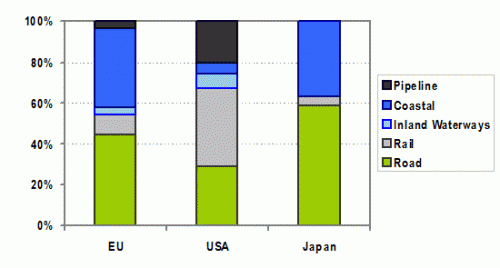
See the percentage of goods moved by freight, which is dramatically higher for the US. The end result is we have a LOT less freight on our roads than the EU or Japan, and might have even less if US maritime laws had not done so much to kill coastal shipping.
This is the great unseen in all these "sophisticated" conversations about Europe. These Euro-philes are so much smarter than the rest of us that they manage to ignore the most important part of the equation (largely because it is unseen and not sexy). In fact, the US has the best rail system in the world, and in fact the governments of Europe and Japan have likely sub-optimized their rail systems by forcing their focus towards passengers rather than freight. I will leave the last word to the Anti-Planner:
Europe has decided to run its rail system primarily for passengers, while America's system is run mainly for freight. Europe's rail system has about 6 percent of the passenger travel market, while autos have about 78 percent. Meanwhile, 75 percent of European freight goes by highway. Here in the U.S., highway's share of freight travel is only 29 percent, while the auto's share of passenger travel is about 82 percent. So trains get 4 percent of potential auto users in Europe out of their cars, but leave almost three times as much freight on the highway.
A little late Al -- some of us realized this way back when it could have done some good, like before we spent billions of tax dollars and subsidized a stupid industry into being:
ATHENS, Nov 22 (Reuters) - Former U.S. vice-president Al Gore said support for corn-based ethanol in the United States was "not a good policy", weeks before tax credits are up for renewal.
...
"It is not a good policy to have these massive subsidies for (U.S.) first generation ethanol," said Gore, speaking at a green energy business conference in Athens sponsored by Marfin Popular Bank.
"First generation ethanol I think was a mistake. The energy conversion ratios are at best very small.
"It's hard once such a programme is put in place to deal with the lobbies that keep it going."
He explained his own support for the original programme on his presidential ambitions.
"One of the reasons I made that mistake is that I paid particular attention to the farmers in my home state of Tennessee, and I had a certain fondness for the farmers in the state of Iowa because I was about to run for president."
...
Gore said a range of factors had contributed to that food price crisis, including drought in Australia, but said there was no doubt biofuels have an effect.
"The size, the percentage of corn particularly, which is now being (used for) first generation ethanol definitely has an impact on food prices.
"The competition with food prices is real."
A couple of thoughts here. First, many detractors like myself have made the link between Iowa's role in the Presidential nomination process and support for corn ethanol, but it is nice to see a supporter confirm the link. Second, I wonder how many other scientific opinions Gore holds where political expediency blinds him to the reality of the data? I can think of at least one big one....
As can be expected, the media really did a poor job of covering the GM IPO, consistently underestimating the total public cost of the bailout (e.g. no one is mentioning the $45 billion in tax-loss carryforwards GM was allowed to keep, against all precedent).
But the real cost of the handling of the GM bankruptcy is in 1) the terrible precedents it set in hammering secured creditors to the benefit of favored political allies of the Administration and 2) the loss of the opportunity to get billions of dollars in production assets out of the hands of the people who have be sub-optimizing them.
All these management factors, from the managers themselves to process to history to culture could better be called the corporate DNA. ...
Corporate DNA acts as a value multiplier. The best corporate DNA has a multiplier greater than one, meaning that it increases the value of the people and physical assets in the corporation. When I was at a company called Emerson Electric (an industrial conglomerate, not the consumer electronics guys) they were famous in the business world for having a corporate DNA that added value to certain types of industrial companies through cost reduction and intelligent investment. Emerson's management, though, was always aware of the limits of their DNA, and paid careful attention to where their DNA would have a multiplier effect and where it would not. Every company that has ever grown rapidly has had a DNA that provided a multiplier greater than one"¦ for a while.
But things change. Sometimes that change is slow, like a creeping climate change, or sometimes it is rapid, like the dinosaur-killing comet. DNA that was robust no longer matches what the market needs, or some other entity with better DNA comes along and out-competes you. When this happens, when a corporation becomes senescent, when its DNA is out of date, then its multiplier slips below one. The corporation is killing the value of its assets. Smart people are made stupid by a bad organization and systems and culture. In the case of GM, hordes of brilliant engineers teamed with highly-skilled production workers and modern robotic manufacturing plants are turning out cars no one wants, at prices no one wants to pay.
Changing your DNA is tough. It is sometimes possible, with the right managers and a crisis mentality, to evolve DNA over a period of 20-30 years. One could argue that GE did this, avoiding becoming an old-industry dinosaur. GM has had a 30 year window (dating from the mid-seventies oil price rise and influx of imported cars) to make a change, and it has not been enough. GM's DNA was programmed to make big, ugly (IMO) cars, and that is what it has continued to do. If its leaders were not able or willing to change its DNA over the last 30 years, no one, no matter how brilliant, is going to do it in the next 2-3.
So what if GM dies? Letting the GM's of the world die is one of the best possible things we can do for our economy and the wealth of our nation. Assuming GM's DNA has a less than one multiplier, then releasing GM's assets from GM's control actually increases value. Talented engineers, after some admittedly painful personal dislocation, find jobs designing things people want and value. Their output has more value, which in the long run helps everyone, including themselves.
The alternative to not letting GM die is, well, Europe (and Japan). A LOT of Europe's productive assets are locked up in a few very large corporations with close ties to the state which are not allowed to fail, which are subsidized, protected from competition, etc. In conjunction with European laws that limit labor mobility, protecting corporate dinosaurs has locked all of Europe's most productive human and physical assets into organizations with DNA multipliers less than one.
Folks are excited about Obama because, in essence, they don't know what he stands for, and thus can read into him anything they want. Not since the breathless coverage of Geraldo Rivera opening Al Capone's vault has there been so much attention to something where we had no idea of what was inside. My bet is that the result with Obama will be the same as with the vault.There is some sort of weird mass self-hypnosis going on, made even odder by the fact that a lot of people seem to know they are hypnotized, at least at some level. I keep getting shushed as I make fun of friends' cult behavior watching the proceedings today, as if by jiggling someone's elbow too hard I might break the spell. Never have I seen, in my lifetime, so much emotion invested in a politician we know nothing about. I guess I am just missing some gene that makes the rest of humanity receptive to this kind of stuff, but just for a minute snap your fingers in front of your face and say "do I really expect a fundamentally different approach from a politician who won his spurs in "¦. Chicago? Do I really think the ultimate political outsider is going to be the guy who bested everyone at their own game in the Chicago political machine?"
Well, the spell will probably take a while to break in the press, if it ever does "” Time Magazine is currently considering whether it would be possible to put Obama on the cover of all 52 issues this year "” but thoughtful people already on day 1 should have evidence that things are the same as they ever were, just with better PR. For God sakes, as his first expenditure of political capital, Obama is pushing for a trillion dollar government spending bill that is basically one big pork-fest that might make even Ted Stevens blush, a hodge-podge of every wish-list of leftish lobbyists that has been building up for eight years. I will be suitably thrilled if the Obama administration renounces some of the creeping executive power grabs of the last 16 years, but he has been oddly silent about this. It seems that creeping executive power is a lot more worrisome when someone else is in power.
To this last point, the recent recommendations by the Center for American Progress to Obama are pretty chilling.
[The] Center for American Progress today is releasing a report, "Power of the President," proposing 30 executive actions the president can take to advance progressive change in the areas of energy, the economy, health care, education, foreign policy, and national security. "The following authorities can be used to ensure progress on key issues facing the country today: Executive orders, Rulemaking, Agency management, Convening and creating public-private partnerships , Commanding the armed forces, Diplomacy.
The New York Times fleshes out these proposals with some suggestions about policy changes across the board. The ideology of George Soros shines through the Center's report as it justifies this forceful approach to circumvent Congress when it states that:
[The] legislative battles that Mr. Obama waged during his first two years "“ notably on health care and financial regulatory reform "“ have created a weariness among the general public with the process of making laws. And it hints it has not helped Mr. Obama politically in the process.
In other words, when Congress passed a variety of laws Americans became dismayed by the horse-trading and bribes that were resorted to by Democrats to impose these policies on us. Instead of compromise and listening to the American people, Soros counsels that more forceful measures should be used to override the will of the American people.
But what is really happening here is that the dollar is being devalued. This is one of the semantic quirks that make me laugh "” when Argentina or Zimbabwe do this, its called devaluation. When a western nation does it, it is called quantitative easing.
Fed Chairman Ben Bernanke, fresh from injecting hundreds of billions of new U.S. currency units into the economy "“ and from planning the injection of yet an additional 600 billion such units "“ criticizes the Chinese government for injecting hundreds of billions of new Chinese currency units into the economy ("Bernanke Takes Aim at China," Nov. 18). Apparently, when Beijing increases the supply of Chinese currency it does so as part of what Prof. Bernanke ominously labels a "strategy of currency undervaluation," but when Uncle Sam does the same thing with U.S. currency units it's called "quantitative easing" and "a move in the right direction."
My 16-year-old son is ranked 28th in the country in the ESPN fantasy football power rankings for 10-team leagues. Wish he spent as much time on his calculus homework.
Yeah, I can see the Administration has its finger on the pulse of what all Americans feel to be the real, burning issue confronting the TSA. Specifically:
"It is no secret that the morale of the TSO workforce is terrible as a result of favoritism, a lack of fair and respectful treatment from many managers, poor and unhealthy conditions in some airports, poor training and testing protocols and a poor pay system," said AFGE President John Gage. "The morale problems are documented by the government's own surveys. TSOs need a recognized union voice at work, and the important decision of the FLRA finally sets the process in motion to make that right a reality."
At every airport I have been to lately, there are probably two TSA workers standing around doing nothing for every one working. Obviously this is a brutal productivity standard, and TSA workers long for the conditions that obtain, say, among municipal road workers where five or six workers stand around doing nothing for every one working.
I tell folks all the time that 99% of the time the problem with bad governance is not bad people in the government (or at least not bad before they entered government) but bad incentives and information.
Take the recent public reaction against the new TSA search procedures. Its not that everyone in the TSA aspired for a job where they could grope stranger's nads. Its that the incentives in government make risk management impossible.
Let's look first at the cost side. How much do internal TSA evaluation and incentive systems value
protection of individual rights and privacy
stewardship of taxpayers money
Can we safely say close to zero? I don't think anyone at the TSA is being denied promotion because they were insufficiently concerned with the fourth amendment.
So what is it that does matter in their incentive system? I would argue that they have one single, overriding concern -- to avoid an incident for which they can be retroactively blamed as being insufficiently diligent. If you are confused about how this incentive might arise, Conservatives need only look at themselves. How many of you have pounded Janey Napolitano for being insufficiently diligent, for example in her "the system worked as it was supposed to" comments.
I spent a lot of time at HBS, in consulting at McKinsey, and in corporate life worrying about incentive systems. And the absolute first rule, in my mind, is to ignore the official incentive system and explore what really drives behavior. For example, a company might have a finely balanced set of published performance measures, but if the last three promotions all went to the person who sucked up the most to the boss, the latter will likely influence behavior much more than the published system.
The same is true at the TSA. I have no idea what their official performance metrics are. But to a large extent these metrics are irrelevant anyway in an environment where it's impossible to be fired and salaries and promotions have more to do with seniority than performance. In this environment, unofficial incentives are going to be very powerful, and I am virtually positive the overriding such incentive is avoiding blame due to lack of diligence.
So we should not be surprised if the TSA runs out of control with its diligence in a way that is unchecked by any considerations of cost, privacy, or risk management. This incentive is so powerful that the only way to override it is either through executive leadership or legislative action. We'll see if we get either, but trashing privacy and the fourth amendment tend to be bipartisan hobbies so I am not wildly confident much will change.
When health care is paid for by public funds, politicians only need to argue that some behavior affects health, and therefore increases the state's health care costs, to justify regulating the crap out of that behavior.
"Too many lives are lost in motorcycle accidents," Christopher A. Hart, NTSB vice chairman, said in announcing that helmets had been added to the board's annual "most-wanted list" of safety improvements. "It's a public health issue."
This nifty quote from Senator Jay Rockefeller got me to thinking:
"There's a little bug inside of me which wants to get the FCC to say to FOX and to MSNBC: "˜Out. Off. End. Goodbye.' It would be a big favor to political discourse; our ability to do our work here in Congress, and to the American people, to be able to talk with each other and have some faith in their government and more importantly, in their future."
This last election demonstrated exactly what politicians don't like about election law when they complain about things like Citizens United. No, its not the influx of campaign donations-- politicians are perfectly thrilled to be on the receiving end of more money. The failure in the eyes of politicians was the large turnover in Congress and the losses suffered by many incumbents. For most in Congress, election law is about maintaining their incumbency. Any law that makes it harder for them to be criticized in the press or by challengers is good. Anything that increases public criticism of them is bad.
When it comes to wine, there is no ingredient more important than location. The land, air, water and weather where grapes are grown are what make each wine unique. That is why we, as wine enthusiasts, demand that a wine's true origin be clearly identified on its label in order for us to make informed decisions when purchasing and consuming wine. This ensures we know where our wine comes from and protects wine growing regions worldwide.
Use the form below to sign the petition to protect wine place and origin names:
I hereby sign the Wine Place & Origin Petition. In doing so, I join the signatories of the Joint Declaration to Protect Wine Place & Origin - Champagne, Chianti Classico, Jerez, Napa Valley, Oregon, Paso Robles, Porto, Sonoma County, Tokaj, Victoria, Walla Walla, Washington State and Western Australia - and a growing list of consumers in supporting clear and accurate labeling to better ensure consumers will not be misled by wine labels.
Some countries like Germany cannot use "champagne" or "Cognac" to describe similar products. Do you know why? These conditions were actually thrown in to the Treaty of Versailles at the end of WWI. Since the US never signed the treaty, it and its citizens and growers are not bound by this restriction.
In the same spirit I demand that: 1) Hamburgers only be made in Hamburg 2) Franfurters can only be made in Frankfort 3) Wiener Snitzel can only be made in Vienna 4) Hollandaise Sauce can only be made in the Netherlands 5) Boston baked beans can only be made in Boston. Obviously we consumers are all duped, thinking our hamburger was actually made in Germany. Had I only known!
I have nothing to add to this takedown, but in case you have not seen it you should really this. A printed magazine called Cooks Source took an online article written by an author (Monica Gaudio) without the author's permission or any payment. When the author complained and asked for a small bit of compensation (in the form of a donation to the Columbia Journalism School, lol), the magazine editor fired off this amazing email to the author whose work she stole:
Yes Monica, I have been doing this for 3 decades, having been an editor at The Voice, Housitonic Home and Connecticut Woman Magazine. I do know about copyright laws. It was "my bad" indeed, and, as the magazine is put together in long sessions, tired eyes and minds somethings forget to do these things.
But honestly Monica, the web is considered "public domain" and you should be happy we just didn't "lift" your whole article and put someone else's name on it! It happens a lot, clearly more than you are aware of, especially on college campuses, and the workplace. If you took offence and are unhappy, I am sorry, but you as a professional should know that the article we used written by you was in very bad need of editing, and is much better now than was originally. Now it will work well for your portfolio. For that reason, I have a bit of a difficult time with your requests for monetary gain, albeit for such a fine (and very wealthy!) institution. We put some time into rewrites, you should compensate me! I never charge young writers for advice or rewriting poorly written pieces, and have many who write for me"¦ ALWAYS for free!"
I was in discussions with California State Parks over the last few days. Given that their new earmarked funding source was defeated in the last election, they are facing cuts next year. A number of parks will again face closure. As I have many times, I said that I could easily keep many of these parks open under our operations using only the gate fees and no public subsidies.
For the first time, someone explained to me why they could not entertain my proposal. It is illegal in California to replace any function performed by a public employee with a private contractor. The only way they could consider private operation of a park is to allow it to close, lay everyone off, let it sit closed to the public for a while, and then possibly reopen it with private management. And even that approach will likely be challenged in the court. The public employees unions are committed to allowing parks to permanently close rather than establish the precedent of private management.
More on public-private partnerships in recreation and how private management of public recreation works, here.