Awesome Story of the Day

California Cap-and-trade plan may be put on hold because they failed to do an Environmental impact study.  LOLOLOL

The California Air Resources Board violated state environmental law in 2008 when it adopted a comprehensive plan to reduce greenhouse gases and again last year when it passed cap-and-trade regulations, a San Francisco Superior Court judge has ruled in a tentative decision.

If the decision is made final, California would be barred from implementing its ambitious plan to combat global warming until it complies with portions of the California Environmental Quality Act, though it is not yet clear what the air board would have to do to be in compliance. The state’s plan, which implements AB32, the Global Warming Solutions Act of 2006, would reduce carbon emissions to 1990 levels by 2020.

Paying for Incompetance

We and our children will be paying for the recent spate of government fiscal incompetence for literally decades.  This letter I got from our payroll company provides a small but pointed reminder of this.  Here is the key graf:

Can you imagine getting a note in January from Amazon.com, saying their costs last year were higher than they expected and they were going to send you an additional bill?  Or how about BP sending all its customers a note saying that the cleanup costs in the Gulf cost it a lot of money and that they would all get an extra bill for X cents per gallon of fuel they purchased last year from BP?

Update: So in other words, I was hiring people in Florida in August of 2009, and will not find out until sometime in 2011 the true cost of this labor, because only now am I being told what taxes I have to pay on this labor.  And people wonder why businesses are reluctant to hire.  We may think we have a Constitutional ban on ex post facto law, but businessman know this is BS.

What if We Bought Into the Light Rail Hype, and Built It For Everyone?

Last year, there were about 3.2 trillion passenger miles driven by urban drivers in cars in the US.  My point about light rail is that we can barely afford it for just a few people, given that we spent $1.3 billion to build a rail line for just 17,000 daily round trip riders in Phoenix.  If it were truly a sustainable technology, it could be applied to all commuters.  But at a national average taxpayer subsidy per light rail passenger mile of about $2**, this means that to roll light rail out to every urban commuter would cost $6.4 trillion a year in government spending, almost half our annual GDP.  If it required the subsidy rates we have in Phoenix per passenger-mile, such a system would cost over $12 trillion  year.  In fact, the numbers would likely be even higher in reality, because light rail in most cities is almost certainly built on the highest populated corridors with the most bang for the buck (though some of the diminishing returns would be offset by network effects).

Light rail only works today because we drain resources from millions of taxpayers to benefit just a few generally middle class commuters.    This is not a model that will scale.

** This includes both service on the debt, which is payment for the original construction costs, as well as annual operating losses.  This subsidy is required essentially forever.  After 20-30 years when the original bonds are paid off, by that time systems generally have to be rebuilt in their entirety   (as folks in places like Washington DC are learning).  There are probably only 5-6 cities in this country that have the urban population densities to make rail systems come even in the ballpark of working financially, and places like Phoenix, Seattle, Houston, Portland and LA are NOT among them.

Light Rail and Sustainability

Let me offer up a definition of sustainability that I think most environmentalists and progressives would accept:

We are acting in a sustainable manner if we are achieving our goals in a way that does not hamper the ability of other people in the world, or of future generations, to achieve their goals.

Most environmentalists and progressives would call light rail lines in US cities a "sustainable" technology because of its notional impact on fuel use and CO2 output (yeah, I know, but we are not going to address those assumptions today).

Let me present one fact, from Federal Transit Administration's 2009 survey of public transit authorities, whose data is linked in various ways here.  Or you can download the summary spreadsheet here.  For all US light rail systems in total:

User fares paid per passenger-mile:           $0.18

Total cost per passenger-mile:                     $2.22

Taxpayer subsidy per passenger-mile:       $2.04

Since I live in Phoenix and the Phoenix light rail system seems to get particular praise as a "success" from light rail supporters, here are the Phoenix light rail numbers;

User fares paid per passenger-mile:          $0.07

Total cost per passenger-mile:                     $3.89

Taxpayer subsidy per passenger-mile:       $3.82

So there, folks, is your sustainable technology.  As I have written before about sustainability, "I do not think that word means what you think it means."

Nationwide, non-users of light rail pay for 92% of its costs.   In Phoenix, non-users pay for 98% of the costs.  Taking the Phoenix system as an example, resources are drained from literally millions of people so that 17,000 or so people can ride it round trip each day.   Using resources from millions of people, and building up debts that will last into the next generation, to support the transit of just a few people, seems to be the antithesis of sustainability.

If there is any common denominator among progressives, it is that they have little respect for how individuals spend their money.  So they might be unmoved by the loss of resources from so many.  So lets just look narrowly at transit, which I presume the do care about.

Before Valley Metro operated a light rail system in Phoenix, they also operated a bus transit system.  This system still requires a subsidy, but it is much lower than the light rail subsidy.  In 2009, the bus subsidy was $0.74 per passenger-mile.  This means that for the same amount of taxpayer funds, Valley Metro can provide 1.0 passenger-mile by train or 5.2 by bus ($3.82/$0.74).   I can guarantee that cities building light rail are not having their budgets quintupled.  So the result is that, as light rail gets built, total transit ridership falls in most cities as rail costs crowd out existing bus services.

Update: Most light rail articles in our local papers, which have been mindless boosters of the system, generally consist of asking riders if they like the system, who inevitably answer "yes!"  This is somehow a proof the system is great.  Well, duh.  I too am likely to be happy with a service where I only pay 2% of the costs.

Update #2:  Last year, there were about 3.2 trillion passenger miles driven by urban drivers in cars in the US.  My point about light rail is that we can barely afford it for just a few people, given that we spent $1.3 billion to build a rail line for about 17,000 daily round trip riders in Phoenix.  If it were truly a sustainable technology, it could be applied to all commuters.  But at a national average taxpayer subsidy per light rail passenger mile of about $2, this means that to roll light rail out to everyone would cost $6.4 trillion a year, almost half our annual GDP.  If it required the subsidy rates we have in Phoenix per passenger-mile, such a system would cost over $12 trillion  year.  In fact, the numbers would likely be even higher in reality, because light rail in most cities is almost certainly built on the highest populated corridors with the most bang for the buck (though some of the diminishing returns would be offset by network effects).

Business Relocation Subsidies

I return to an old favorite topic of mine this week, government subsidies for business relocation, in my column at Forbes.com.  An excerpt:

To see this clearer, lets take the example of Major League Baseball (MLB).  We all know that cities and states have for years been massively subsidizing new baseball stadiums for billionaire team owners.  Let’s for a minute say this never happened – that somehow, the mayors of the 50 largest cities got together in 1960 and made a no-stadium-subsidy pledge.  Would baseball still exist?  Sure!  Teams like the Giants have proven that baseball can work financially in a private park, and baseball thrived for years with private parks.  But would baseball be in the same cities?  Well, without subsidies, baseball would likely be in the largest cities, like New York and LA and Chicago, which is exactly where they are now.  The odd city here or there might be different, e.g. Tampa Bay might never have gotten a team, but that might in retrospect have been a good thing.

The net effect in baseball is the same as it is in every other industry:  Relocation subsidies, when everyone is playing the game, do nothing to substantially affect the location of jobs and businesses, but rather just transfer taxpayer money to business owners and workers.

Trick Memory

I would have sworn I hated the whole Duran Duran catalog, but I was watching this video (because a friend of mine did the costumes, including the wedding dress) and I must say its not a bad song.  So my apologies to Duran Duran.

By the way, my friend said that I would be surprised how many women later wanted to get married in exactly this dress.

Also, speaking of music videos, if you have never seen the Hugh Grant / Drew Barrymore movie Music and Lyrics, the plot is an utterly predictable romantic comedy (with Hugh Grant playing the same guy he always plays) but in the opening scene they nail the 1980's pop music video genre dead on.  I can't embed it but the video is here. You can miss the rest of the movie, but the spoof is genius.

Fascinating Insight into the Corporate State

This story is from the WSJ, and gets extra bonus points for including the poster-boy of the corporate state, Jeffrey Immelt

Treasury and OMB singled out an 845-megawatt wind farm that the Energy Department had guaranteed in Oregon called Shepherds Flat, a $1.9 billion installation of 338 General Electric turbines. Combining the stimulus and other federal and state subsidies, the total taxpayer cost is about $1.2 billion, while sponsors GE and Caithness Energy LLC had invested equity of merely about 11%. The memo also notes the wind farm could sell power at "above-market rates" because of Oregon's renewable portfolio standard mandate, which requires utilities to buy a certain annual amount of wind, solar, etc.

But then GE said it was considering "going to the private market for financing out of frustration with the review process." Anything but that. The memo dryly observes that "the alternative of private financing would not make the project financially non-viable."

Oh, and while Shepherds Flat might result in about 18 million fewer tons of carbon through 2033, "reductions would have to be valued at nearly $130 per ton CO2 for the climate benefits to equal the subsidies (more than 6 times the primary estimate used by the government in evaluating rules)."

So here we have the government already paying for 65% of a project that doesn't even meet its normal cost-benefit test, and then the White House has to referee when one of the largest corporations in the world (GE) importunes the Administration to move faster by threatening to find a private financial substitute like any other business. Remind us again why taxpayers should pay for this kind of corporate welfare?

First, the moment GE said that this could be financed privately, the Feds should have said "then what the f*ck are you talking to us for? Get out of here."  By the way, privately probably does not mean privately -- it probably means going to private banks or investors who in turn access many of the same taxpayer funds.

Second, its amazing that the threat to finance this privately rather than sponging off taxpayer funds is treated as a threat by the Obama Administration.  They desperately want to "take credit" for the project and can only do so by spending our money  (this is the same impulse that propels politicians who have never given a dime to charity to want to spend taxpayer money in order to be called "caring.")

An Agency Problem?

Kevin Drum wonders whether the proposed $700 million bid by Farmers Insurance for naming rights on a prospective LA NFL stadium makes any economic sense.   It is an interesting question.  I wrote:

This has always struck me as one of those agency problems, where the executive's incentives are different from the shareholders. Executives get a ton of benefits personally from this -- higher profile for the company which improves their profile and marketability, they get a prime box for the games, parties, etc.

Before the audience here slips into a round of corporate executive bashing, my sense is that the same perverse incentives are working for municipal leaders who have a mismatch with taxpayer interests when they shove huge amounts of taxpayer funds to owners in stadium deals (deals which economists speak with one voice on -- they never pay off for the community in full). One of the dirty secrets of these deals is that they generally include a sort of kickback in the form of boxes and club seats for the Mayor and city council's use (and sometimes multiple boxes for leaders of other government agencies in the town).

Speaking of Income Distribution

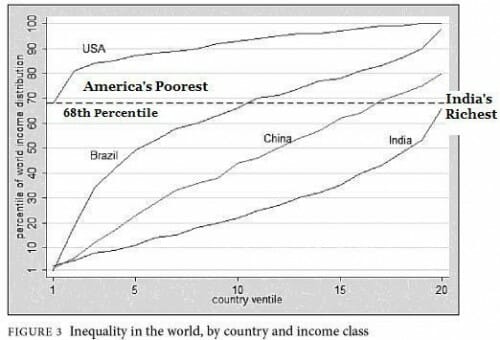
This chart, from a book by Branko Milanovic via Carpe Diem reinforces a point about income distribution I make all the time -  for all we talk about income distribution in this country, our poorest 20% would be middle class in many countries of the world.  While I would love to see our poor doing even better, it begs the question of whether distribution or absolute prosperity is more important.

Just to give you a feel for reading the chart, the US's lowest ventile, or bottom 5%, have income that would put them in the 68th percentile worldwide.    Our poorest 20% (the first 4 ventiles) would be upper middle class or better in Brazil, China, and India.

When comparing to European social democracies, it turns out that while the US's income distribution is wider, that is almost entirely due to the top end being higher.  The poorest 10% make about the same as the poorest 10% in Europe, and I would argue that this analysis (from a leftish think tank) actually underestimates a quality of life advantage for American poor, who come out higher even than the middle class in Europe on things like living space and appliance ownership.

Perhaps more importantly than income inequality, income mobility remains high in this country. More on income inequality concerns here.

Awesome Idea for Making Fannie and Freddie Go Away

I am in the process of completing a home mortgage.  The process has become awful again, not as bad as it was in the early 90's but harder and more frustrating than in the mid-2000's.  There is one set of rules, and if one's situation does not fit those rules, good freaking luck.  Right now, for example, getting a home mortgage when one is self-employed, even in a pretty large business with a decade of history, is really hard.

So I like this proposal

At the moment there is nobody doing conforming mortgages except Fannie and Freddie. Indeed there is almost nobody doing mortgages of any kind except Fannie and Freddie. If the free market wants the business they can have it. (They just don't want it at this sort of interest rate spread - and I don't blame them.)

All the government need to do is tell Frannie to raise their price a little each quarter. Currently they charge 20-25bps for guaranteeing mortgages. (The free market won't take credit risk at that price.) So it is entirely open to the FHFA (and hence the Treasury) to tell Fannie and Freddie to raise their prices by 5bps. The government will get paid better for the risk they are taking (and what free market ideologue will disagree with that) and the private sector can compete if they want to.

I doubt the free market will. But then in a quarter or two Frannie can raise their pricing by another 5 bps. And a quarter or two later Frannie can raise by another 5bps.

At some stage you will get to a level where the private sector chooses to compete. Frannie should not set its price competitively though. In another quarter they should raise the price another 5bps. And in another quarter they should raise again.

By the way, this is a classic example of not learning from your last mistake.  That spread is absurdly low.  I wouldn't guarantee my best friend's loan for 20bp.  Would you take on the default risk of a $100,000 mortgage for $200 a year?

Immigration and Median Income

I have hypothesized that immigration may have an effect on median income -- not because it is bad for the economy per se but just form the fact of adding millions of new people in the bottom quartiles would tend to shift the median downwards (just the pure math of the thing).

I have only given them a quick glance at this point, but Tyler Cowen links several studies that tend to say my hypothesis is false.

Also, here is an interesting discussion about the median income stagnation hypothesis itself and how sensitive it is to the end point, pointing out in particular that most folks start their analysis from a point within Nixon's wage and price controls, which skew the data - shifting the start point forward even a couple of years makes most of the stagnation go away.  He builds on a post by Brink Lindsey showing historic median income growth over a longer time frame, implying the aberration may have been the boom of the 1950s and 1960s rather than the lower growth rates of today.

I would normally find this a fascinating debate if it weren't for the dark cloud behind it that half the folks arguing the point wish to use it as a justification for further reductions in economic liberties.

Peak IP

Human ingenuity keeps finding more oil and gas but we are close to running out of IP addresses, at least in the old IPv4 system, which all of your are probably using right now.  This does not mean the world will shut down - already, for example, all the computers in your home probably share a single IP address to the outside world, and for many of you that IP address is dynamically assigned by your Internet provider to further save addresses.  Many web sites on the same server will share an IP address (which is actually a good reason not to used shared hosting, because if one of the other accounts on your server is a bad actor, your IP address can effectively get banned from sites and networks trying to ban that other person on your server).

However, a new system is in place, but as with many standards transitions the details are tricky.  It will be interesting to see how this mostly free-market transition goes in comparison to government enforced transitions (e.g. television broadcast standards).

The following will probably just demonstrate my total ignorance of networking protocols, but I am not sure why IPv6 couldn't be written in a way that the extra bytes would just be ignored by IPv4 systems.  It could be assumed that all IPv4 addresses of the form www.xxx.yyy.zzz map to www.xxx.yyy.zzz.000.000 in IPv6, but this may be wildly simplifying what is going on.

The reason I bring this us is because I have always thought the way black and white TV was transitioned to color was particularly clever.  They could have broadcast color with three signals of Red, Green, and Blue levels, and then black and white TVs would have to be thrown out - they wouldn't show anything meaningful with that signal.  Instead, though, they mapped color with a three part system of an absolute brightness signal for each pixel, plus two color signals.  If you are familiar with Photoshop, when you choose a color, you can enter the color as three numbers R-G-B for the intensity of each color or as Hue-Saturation-Brightness.  While not the same as the TV system, it is similar in that it has a pixel brightness component, plus to color components.  (my memory is that in the TV system, it is brightness plus two colors and the third color -- blue, I think -- is arrived at by subtraction from the total brightness minus the two other colors.)

Here is the trick - the signal which was just the pixel brightness component is essentially identical to the old black and white TV signal -- after all, a black and white signal is just the relative brightness of each pixel.  So they took a black and white signal and then added bandwidth so that there was more information if one had a color set.  Both technologies, old and new, worked from the same signal.

I suppose the problem with this is that I am thinking of routers like telephones.   Most folks know that if we dial more than 10 digits, the extras are just ignored.  My guess is that routers are more finicky and precise than this, and they can't just ignore the fact the IP address they are getting are too long.  But I still would imagine there could be a simple hardware hack to cheaply strip off the last part of a longer IP address so that older IPv4 infrastructure could still work in an IPv6 world.  Or is this hopelessly misinformed and naive?

Worst Losses Ever

This is a great post, with a lot of terrific video links, on one man's list of the worst sports endings ever.  (via Tom Kirkendal).  It is very long, but my favorite was probably #10.  And of course all of us of a certain age probably remember watching #1 live.

Strategic Vs. Tactical Victory

This is a strategy that I think makes a lot of sense (via Overlawyered)

Vowing no longer to be Mister Nice City (assuming it ever qualified as such), Chicago is now willing to pay $50,000 to fight (successfully) a police-misconduct case it could have settled for $10,000:

Even though the city stands to lose money litigating every case under $100,000, a spokeswoman for the law department said that recently compiled figures showed the strategy seemed to be saving taxpayer money by dissuading lawyers from suing the police unless they are confident of victory.

I used to work for Emerson Electric, a company that amongst its divisions made both ladders and table saws, two sure-fire litigation magnets.  We got ladder suits, for example, from some guy who propped the base of the ladder up on 6 stacked paint cans and then leaned the top of the ladder on some high voltage lines, all during a hurricane and got hurt, and immediately sued the ladder manufacturer for making a defective product.

Emerson decided early on it was going to be a hard target.  It hired in-house legal staff and fought nearly every single suit all the way to court if necessary.  If attorneys had a good case of a real defect or negligence, fine, they could win their day in court.  However, if they were looking for a quick percentage of a settlement, they needed to look elsewhere.  Turned out there were a lot of the latter.

Creepy

If there is anything creepier than weird children's art on the walls of an abandoned mental institution, I am not sure what it is.  From here. (for those who like urban architecture, urban archeology, and/or New York, this is a great site).

Who Defused the Population Bomb?

Fred Pearce has a nice article (in Grist of all places) about how the Population Bomb essentially defused itself.

For a start, the population bomb that I remember being scared by 40 years ago as a schoolkid is being defused fast. Back then, most women round the world had five or six children. Today's women have just half as many as their mothers -- an average of 2.6. Not just in the rich world, but almost everywhere.

This is getting close to the long-term replacement level, which, allowing for girls who don't make it to adulthood, is around 2.3. Women are cutting their family sizes not because governments tell them to, but for their own good and the good of their families -- and if it helps the planet too, then so much the better....

And China. There, the communist government decides how many children couples can have. The one-child policy is brutal and repulsive. But the odd thing is that it may not make much difference any more. Chinese women round the world have gone the same way without compulsion. When Britain finally handed Hong Kong back to China in 1997, it had the lowest fertility in the world -- below one child per woman. Britain wasn't running a covert one-child policy. That was as many children as the women in Hong Kong wanted.

This is almost certainly one of those multiple-cause things, and we have always had the hypothesis that wealth and education reduced population growth.

But the author makes an interesting point, that urbanization, even in poorer countries, may a big driver as well.  After all, in the city, food and living space for children are expensive, and there are fewer ways children can support the family (I hadn't thought of this before, but I wonder if industrial child-labor restrictions, which mainly affected cities, had an impact on birth rates by making urban children less lucrative?)  In fact, urban jobs require educations which are expensive  (even if they are free, non-productive family members must be fed and housed for years).

Born to Rule

I thought this a good commentary on the whole Tiger mom thing.  Via Insty [Note I added some paragraph breaks -  sorry Mr. Smith, but I simply cannot abide by paragraphs as long as yours]

But here's the thing.  And here the point has been made easier to make by the curious fact that Tiger Mom is a Yale Law School professor and as Professor Bainbridge has pointed out, it seems almost an epidemic among faculty parents in New Haven.

My fear is that little tiger kittens are not being groomed to make things that you and I can buy if we feel like it.  I'm afraid, call me paranoid if you like, that those little achievers will want to grow up to, well, rule.  Not in the imperial Chinese way, though I take it that is the ultimate inspiration for this model of child rearing.  If my high school understanding of Chinese history is correct, that Empire used to be ruled by a giant bureaucracy into which one got by passing extraordinarily difficult exams, competing against other fanatically hopeful parents who saw it as one of the few ways to get the young persons out of a life of horrible drudgery.  But rather in something more like the imperial Chinese way than my ideal, which is more like Thomas Jefferson's, without the antique and misguided dislike of commerce.

So, if I'm sitting in the middle of my Jeffersonian space, able to order whatever I want, within my budget of course, from Amazon, working at something I like, not taxed to death or harassed by officious officials;  if I can provide for my family and hope to provide a similarly independent life for my offspring, then what's it to me if some mom somewhere wants to drive her children so that someday they will produce a recording or a pill I might want to buy?  Only good.

But if we are sliding toward a world like the one that is, to exaggerate only a little, like that I was taught we should be sliding toward when I restlessly roamed the hallowed halls the The Yale Law School many years ago, then I am not so sanguine.  Then I worry that all this fierce intelligence, all this ambition, all this work are going toward the building of world in which my children will be mere, well, what do you call the people who support those who so intelligently manage things from on top.  Not to mention the unbelievably well educated 35 year old who will tell me someday I didn't score well enough in some algorithm I can't even understand to get my arteries bypassed or my prostate cancer treated.

I want to live in a world, and I want my children to as well, where we are free individuals, and geniuses can sell us stuff if we want to buy it.  When I suspect the little elites of tomorrow are just being made more formidable still, it excites not my admiration as much as my anxiety.

Justifying Genocide as Green

I kid you not

So how did Genghis Khan, one of history's cruelest conquerors, earn such a glowing environmental report card? The reality may be a bit difficult for today's environmentalists to stomach, but Khan did it the same way he built his empire — with a high body count.

Over the course of the century and a half run of the Mongol Empire, about 22 percent of the world's total land area had been conquered and an estimated 40 million people were slaughtered by the horse-driven, bow-wielding hordes. Depopulation over such a large swathe of land meant that countless numbers of cultivated fields eventually returned to forests.

In other words, one effect of Genghis Khan's unrelenting invasion was widespread reforestation, and the re-growth of those forests meant that more carbon could be absorbed from the atmosphere.

Weirdly, the author equates cooling the Earth with "a glowing environmental report card?"  How did cold become green?

In fact, the world did substantially cool in the 14th century.  The previous 300 warm years had brought prosperity and growth to Western Europe, in fact the first population growth in Europe since as early as 300AD.  The commercial and intellectual regression that is often called the Dark Ages or the early Middle Ages (say 700-1000AD) is often attributed to a demographic collapse in Western Europe.  There are many who credit, at least in part, this collapse for the fall of the Western Roman Empire.

The years 1000-1300 saw a real recovery, the first population growth for hundreds of years, and a number of important (though to us prosaic) technological, intellectual and societal advances. There are several factors behind this boom, but a large one is the Medieval Warm Period, where we can find records of certain crops (e.g. grapes in England) being grown far north of where they can be even today.

The early 1300's coincided with the return of cold, wet weather to Europe.  Whether this is in part attributable to Genghis Khan's killing rampage, I can't say.  But the effects were clear.  The 1320's and 1330's saw a series of terrible harvests and resulting famines.   By the 1340's, much of Europe was hungry and malnurished, weakening the population for the arrival of some rats carrying Bubonic Plague.  Again, not a few historians have noted that the climate-change-induced famines of the early 1300's likely made the early plagues more virulent.

This world of failed harvests, starving, and plagues -- this is a greener world we should aspire to?

(HT:  A reader)

Not A Human Right

I want to post more later when I have time on the whole notion of giving the US President an Internet kill switch (short review:  yuk!)

But I wanted to correct one bit of sloppiness in a number of posts.  Access to the Internet is not a human right.  If it were, the implication is that some groups of people would have to be coerced to provide Internet access to those who currently don't enjoy it.

The correct way to phrase the issue is "Turning off or blocking the Internet is not a government right."

Climate Feedback

Take all the psuedo-quasi-scientific stuff you read in the media about global warming.  Of all that mess, it turns out there is really only one scientific question that really matters on the topic of man-made global warming: Feedback.

While the climate models are complex, and the actual climate even, err, complexer, we can shortcut the reaction of global temperatures to CO2 to a single figure called climate sensitivity.  How many degrees of warming should the world expect for each doubling of CO2 concentrations  (the relationship is logarithmic, so that is why sensitivity is based on doublings, rather than absolute increases -- an increase of CO2 from 280 to 290 ppm should have a higher impact on temperatures than the increase from, say, 380 to 390 ppm).

The IPCC reached a climate sensitivity to CO2 of about 3C per doubling.  More popular (at least in the media) catastrophic forecasts range from 5C on up to about any number you can imagine, way past any range one might consider reasonable.

But here is the key fact -- Most folks, including the IPCC, believe the warming sensitivity from CO2 alone (before feedbacks) is around 1C or a bit higher (arch-alarmist Michael Mann did the research the IPCC relied on for this figure).  All the rest of the sensitivity between this 1C and 3C or 5C or whatever the forecast is comes from feedbacks (e.g. hotter weather melts ice, which causes less sunlight to be reflected, which warms the world more).  Feedbacks, by the way can be negative as well, acting to reduce the warming effect.  In fact, most feedbacks in our physical world are negative, but alarmist climate scientists tend to assume very high positive feedbacks.

What this means is that 70-80% or more of the warming in catastrophic warming forecasts comes from feedback, not CO2 acting alone.   If it turns out that feedbacks are not wildly positive, or even are negative, then the climate sensitivity is 1C or less, and we likely will see little warming over the next century due to man.

This means that the only really important question in the manmade global warming debate is the sign and magnitude of feedbacks.  And how much of this have you seen in the media?  About zero?  Nearly 100% of what you see in the media is not only so much bullshit (like whether global warming is causing the cold weather this year) but it is also irrelevant.  Entirely tangential to the core question.  Its all so much magician handwaving trying to hide what is going on, or in this case not going on, with the other hand.

To this end, Dr. Roy Spencer has a nice update.  Parts are a bit dense, but the first half explains this feedback question in layman's terms.  The second half shows some attempts to quantify feedback.  His message is basically that no one knows even the sign and much less the magnitude of feedback, but the empirical data we are starting to see (which has admitted flaws) points to negative rather than positive feedback, at least in the short term.  His analysis looks at the change in radiative heat transfer in and out of the earth as measured by satellites around transient peaks in ocean temperatures (oceans are the world's temperature flywheel -- most of the Earth's surface heat content is in the oceans).

Read it all, but this is an interesting note:

In fact, NO ONE HAS YET FOUND A WAY WITH OBSERVATIONAL DATA TO TEST CLIMATE MODEL SENSITIVITY. This means we have no idea which of the climate models projections are more likely to come true.

This dirty little secret of the climate modeling community is seldom mentioned outside the community. Don’t tell anyone I told you.

This is why climate researchers talk about probable ranges of climate sensitivity. Whatever that means!…there is no statistical probability involved with one-of-a-kind events like global warming!

There is HUGE uncertainty on this issue. And I will continue to contend that this uncertainty is a DIRECT RESULT of researchers not distinguishing between cause and effect when analyzing data.

If you find this topic interesting, I recommend my video and/or powerpoint presentation to you.

Post Office: Mail Delivery or Welfare?

The management of the Post Office is a joke, and it is hardly worth the electrons to write more about it.   But I did find this factoid in Tad DeHaven's commentary on the Post Office's hopeless efforts at cost reduction interesting.

Traditional post offices, which number about 27,000, cannot be closed “for solely operating at a deficit” and the closure process is burdensome.

Wow, that is a bad law (though no worse than 10,000 others like it).  This sounds similar to the military base problem, where every facility that needs closure has a Congressperson desperately trying to keep it open against all economic reality, merely as a jobs/welfare program once its true utility is over.   Apparently, the Post Office has an overcapacity problem that rivals the US Military's after the Cold War (and really to be honest after WWII)

Full post offices are more costly to operate than other means of serving customers. The average post office transaction cost 23 cents per dollar of revenue in 2009 while the average transaction at a contract postal unit cost just 13 cents. Post offices used to generate almost all postal retail revenue, but 29 percent is now generated online through usps.com and other alternative channels.

In 2009 post offices recorded 117 million fewer transactions than in 2008. Four out of five post offices are operating at a loss. However, the postal network’s overcapacity has drawn little corrective action from Congress. In fact, legislation introduced in the House with 102 cosponsors would apply the burdensome procedures for closing post offices to other postal outlets as well. Congress is actively working against the modernization of the U.S. postal system.

The amazing thing is that they have tons of extra capacity and still provide poor service.  Just compare the process of mailing a package UPS vs. USPS.  I have a UPS account, I can print my own labels, I get billed automatically, I get package tracking, and I can send the package from the drop box downstairs in my building.

It is almost impossible to do this with the USPS.  To mail anything larger than 13 ounces, to buy postage without an expensive meter, to get a greatly inferior sort of tracking -- all require a grim trek to the post office.

My guess is that just like Pemex is not longer really about producing oil, the USPS mission is no longer primarily about delivering mail, its a welfare program.

PS - my USPS delivery guy is great.  Nicest guy in the world.  The mistake for years in criticizing the USPS has always been about criticizing the people.  Not only is that wrong, but it distracts from the problem.  By implying the problem is bad, surly people, it implies the problem is fixable with new people.  But in fact, the problem, as with all government, is information and incentives .... and in this case Congressional meddling in their mission.

Green Jobs & Public Investment = Corporate Welfare

The recent naming of GE's Jeffrey Immelt to head a presidential commission on, err, something or other seems to have been an occasion for bipartisan gnashing of teeth about what I call the growth of the American corporate state.  I was encouraged by the bipartisan negative reaction from the left, right, and of course the libertarians, the latter of whom have always understood the difference between being pro-capitalism and pro-business.

But all it takes is a nomenclature change of this corporate welfare to "green jobs" or "investment in the future" or "bridge to the future" or similar bullsh*t and suddenly many of the exact same people, at least on the left, are swooning again.  Why is it not obvious that, for example, green energy subsidies are just the same old corporate welfare?

Here is one aggravating example

Despite millions in government grants and subsidies, the Manitowoc company President Barack Obama called a glimpse of the future lost $4.2 million last year and cannot promise shareholders it will be profitable in the foreseeable future....

“We may continue to incur further net losses and there can be no assurance that we will be able to increase our revenue, expand our customer base or be profitable,” the report indicates.

Investors have responded to the company’s volatility, and Orion stock has plummeted in the past four years.  It closed 2007 at $18.82 a share.  By the end of 2010 it was $3.34.

Regardless, President Obama is putting his, and the U.S. taxpayers’, money on companies like Orion.

“It’s important to remember that this plant, this company has also been supported over the years not just by the Department of Agriculture and the Small Business Administration, but by tax credits and awards we created to give a leg up to renewable energy companies,” Obama said at the Orion plant on Wednesday.

The State of Wisconsin has also given its share trying to help Orion to succeed.  Since 2005, the state has given the company $350,000 in community development zone tax credits, $506,000 in economic development funds, and $420,000 from the Wisconsin Energy Independence Fund.  Plus the company got another $260,000 in stimulus funds for a State Energy project.

In addition to direct aid, public policy has also helped the struggling company.  Wisconsin law requires that 10 percent of all electricity sold in the state come from renewable sources by 2015.  Orion knows that without government intervention like that, there would be little prospect for the green economy.

“The reduction, elimination or expiration of government mandates and subsidies or economic or tax rebates, credits and/or incentives for alternative renewable energy systems would likely substantially reduce the demand for, and economic feasibility of, any solar photovoltaic and/or wind electricity generating products, applications or services and could materially reduce any prospects for our successfully introducing any new products, applications or services using such technologies,” the SEC report states.

By the way, in 2010, while the government was pouring taxpayer money into Orion, its founder and CEO was pulling his out, selling (by my count of SEC filings) 130,000 shares, despite equity prices that were at a five year low.    It is dangerous to draw conclusions form insider sales (we don't know what personal financial issues may be driving their actions) but it is interesting that the president and founder is taking the exact opposite point of view on the company's prospects than is President Obama.

Reservoir of Meyers

I thought this map in the National Geographic was cool- it shows the most popular surname in different areas of the country.  I am not sure what geographic divisions they use (why does Texas have so little granularity?).  But it does turn out there are a couple of "Meyer" labels on the chart, which kind of surprised me  -- though they did spell it the right damn way - no "s" on the end, no Mayer, no Myer or other such nonsense ;=)

The "Meyer" in the middle of Iowa is pretty much where my dad's family settled when they came over from Northern Germany.  Though I am confused as to why they show it color-coded as English origin -- I am pretty sure this area is German  (the Meyer over around northern Nebraska and in Wisconsin is coded German).

HT:  Flowing Data

Arrogance of the State

I know this is just a trivial example, but somehow it seems to be representative for me of a larger class of legislation - yield to the state!

In 2009, Colorado legislators passed the Yield to Bus Law to help transit agencies that were finding that the inability of buses to get quickly back into the traffic flow after a stop was hurting their on-time performance.

Steamboat Springs Transit helped push for the law after it had to add time to routes to stay on schedule because too often its buses were boxed in by traffic at stops, said Philo Shelton, director of Steamboat's public works department, which runs the 24-bus transit operation....

The hope is that motorists will get in the habit of yielding, thereby minimizing the need for enforcement of the law, officials say.  (via the antiplanner)

That does seem to be the point - produce citizens that are in the habit of yielding to the state.   Because we all know that having the state's bus full of empty seats stay on schedule is far more important than the schedule of all the little people around it.  When government schedules don't work, what do they do?  Change the schedules?  No!  Change the behavior of the citizenry so the schedules can be made to work.  Nothing wrong with the schedules - its all you folks who are broken.

This Explains A Lot

Some days I almost can't remember my own kids' names

The mysteries of the brain may be virtually endless, but a team of researchers from two institutes in Göttingen, Germany now claim to have an answer for at least one question that has remained a puzzle: just how fast does the brain forget information? According to the new model of brain activity that the researchers have devised, the answer to that is one bit per active neuron per second. As Fred Wolf of the Max Planck Institute for Dynamics and Self-Organization further explains, that "extraordinarily high deletion rate came as a huge surprise," and it effectively means that information is lost in the brain as quickly as it can be delivered -- something the researchers say has "fundamental consequences for our understanding of the neural code of the cerebral cortex."