A Truly Bad Study

Imagine this study:  An academic who is a strong Democrat wants to do a study to discover if Republicans suffer from a psychological tendency to bizarre conspiracy theories.  OK, the reasonable mind would already be worried about this.  The academic says his methodology will be an online survey of the first 1000 people who reply to him from the comment sections of certain blogs.   This is obviously terrible -- a 12-year-old today understands the problems with such online surveys.  But the best part is that he advertises the survey only on left-wing sites like the Daily Kos, telling anyone from those heavily Democratic sites that if they self-identify as Republicans, they can take this survey and their survey responses will be published as typical of Republicans.  Anyone predict what he would get?

It is hard to believe that even in this post-modern academic world, that such a piece of garbage could get published.  But it did.  The only difference is that the academic was a strong believer in global warming, he was writing about skeptics, and sought out survey respondents only on strong-believer sites.   What makes this story particularly delicious is the juxtaposition of the author's self-appointed role as defender of science with his atrocious scientific methodology.   The whole story is simply amazing, and you can read about it at JoNova's site.

In one way, it is appropriate to have this published in a psychology journal, as it is such a great example of the psychological need for confirmation.  You can just see those climate alarmists breathing a little easier - "we don't have to listen to those guys, do we?"  No need for debate, no need for analysis, no need for thought.  Just immediate dismissal of their arguments because they come from, well, bad people.   Argumentum ad hominem, indeed.


My Abusive Spouse Just Offered Me Flowers

I got a call today from the National Conference of Mayors.  They wanted to send somebody by to talk to me about just how committed these great folks were to small business success.

The call began poorly, as their representative tried to use a tactic I mostly only get from penny-stock boiler rooms - pretending that she and I had talked some time in the past and that I had committed to meeting with her.  I suppose this tactic might have worked with a frazzled exec, but it is one sure fire way to immediately get me pissed off in a phone call.  After telling her that she and I had no such call and that I did not appreciate the cheap telemarketing tactic, I said that I had absolutely no desire to help the mayors put some fake pro-business patina on their activities that are generally hostile to commerce and free markets.   I told them that I did not want a subsidy, handout, any special access, training programs, etc., I just wanted to be left alone.  I was not going to participate in some program where I get my picture taken shaking some politicians right hand while he is whacking me with a stick with his left.  The representative, to her credit before she hung up, admitted she gets this reaction a lot.

One only has to look at their "plan" (pdf)  to see what their vision entails for "helping" small business.  Here is a summary of the planks:

  1. More Federal spending on local infrastructure
  2. More Federal unemployment spending and lower Federal payroll taxes
  3. Create new Federal subsidy and loan programs and job training programs for businesses in favored, sexy-sounding industries (e.g. "manufacturing" or "high-tech").  I presume someone starting a restaurant or hair salon or without any political clout need not apply.  To their credit they also advocate free trade agreements and visa reform, though they then lose that credit by also advocating failed ideas like "trade adjustment assistance" and "metropolitan export plans"
  4. More Federal spending in urban areas (police, job training, affordable housing, community development).

As will not be surprising, absolutely nothing in the Mayor's plans dealt with actual issues under their control, such as business, occupational, and occupancy licencing reform.   Also not surprisingly, the mayors call for hundreds of billions of dollars in new Federal spending narrowly aimed at urban areas without once explaining why these can't or shouldn't be funded locally.  If Los Angeles wants more money for its police, or trains, or schools, and if that spending has real demonstrable value to the city, then why can't they sell the new taxes and spending to their own citizens?  Why do they need the money from the Feds (ie from the rest of us)?

But you can just see the corporate state a work.  A few companies will cynically climb on board, knowing this is all BS, but also knowing that they will get a nice subsidy or sweetheart project in exchange for letting the majors check their "pro-business" box  (pro-business used here as distinct from pro-market).


If You Just Loved The Solyndra Technology...

...you will love this too.  Solyndra used cylindrical solar cells nested inside a u-shaped mirror to concentrate sunlight to get more power per square inch of solar cell.  The problem is that all that extra shaping and mirrors added cost, and only made sense if solar cells were expensive.  After all, if solar cells are cheap, if one wants 20% more output, it's easier to just increase the solar cell area by 20% than to add all the concentrator rigmarole.

Well, dreams die hard, and here is the latest idea -- spherical concentrators.  These things have huge spheres and tracking motors, all for a 35% increase in efficiency.  Methinks that just adding 35% more PV cell area is going to be cheaper, but this could well be yet another flytrap for Obama Administration officials, who are to sexy-looking new technologies like a degenerate wagerer at the track is to a hot tip.

Things You Didn't Know About the European Debt Crisis

Apparently the most important issue is not the unsustainability of deficit spending, lack of fiscal responsibility, or the tough problems of balancing expensive bailouts with expensive defaults.  It is making sure the timing of a Greek default does not negatively affect Obama's re-election.  From the Independent (UK) entitled, "Obama asks eurozone to keep Greece in until after election day"

American officials are understood to be worried that if they decide Greece has not done enough to meet its deficit targets and withhold the money, it would automatically trigger Greece's exit from the eurozone weeks before the Presidential election on 6 November.

They are urging eurozone Governments to hold off from taking any drastic action before then – fearing that the resulting market destabilisation could damage President Obama's re-election prospects. European leaders are thought to be sympathetic to the lobbying fearing that, under pressure from his party lin Congress, Mitt Romney would be a more isolationist president than Mr Obama.


Scene from the Fountainhead

It appears that a scene in the Fountainhead that I thought was a facetious absurdity actually occurred:

Famous architects dress as their buildings:

No Cosmo-Slotnick building

Rising Health Care Costs are No Mystery

Over the last 50 years, real per capital health care spending has increased substantially.   Certainly there are multiple reasons for this, but the most obvious one is seldom ever mentioned -- that the US has seen huge increases in personal wealth over this period, and unsurprisingly people choose to spend a lot of this extra wealth on their own health and life expectancy.  In an age where consumerism is often derided as shallow and trivial, what could be more sensible than spending money on more and better life?

Many have pointed to the increased technological intensity of health care to explain rising costs.  I suppose this could be true, though in almost every other industry in modern times, increased technological intensity has reduced rather than increased costs.

One issue that does not get enough attention is the prosaic act of shopping.   I spend my own money, and I care about price.  I spend someone else's money, I don't give a rip.  Josh Cothran did a visualization of who is spending health care money.  Just look at the 1960 and 2012 charts, and pay particular attention to the orange "out-of-pocket" number.  Another way to rewrite these charts is to say consumers care about prices for spending in the orange band only.

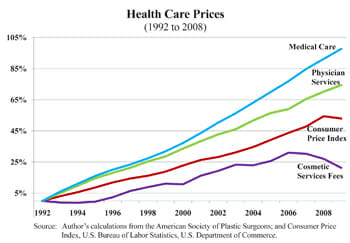
Update:  Health care cost inflation.  Note cosmetic surgery, a field with significant increases in technological intensity over the last few decades, but for which almost all costs are out-of-pocket

source


One of the Year's Most Distasteful Activities

The government just sent me a letter informing me that it is time, in the name of creating a race-blind society, to categorize all my employees by race, count them up, and report everyone's color to the government.

As an aside, I found this bit of privacy reassurance to employees to be pretty funny.  This is suggested language for an employer to use when asking, "um, by the way, can you tell me what race you are?"**

"The employer is subject to certain governmental recordkeeping and reporting requirements for the administration of civil rights laws and regulations. In order to comply with these laws, the employer invites employees to voluntarily self-identify their race or ethnicity. Submission of this information is voluntary and refusal to provide it will not subject you to any adverse treatment. The information obtained will be kept confidential and may only be used in accordance with the provisions of applicable laws, executive orders, and regulations, including those that require the information to be summarized and reported to the federal government for civil rights enforcement. When reported, data will not identify any specific individual."

So the private data you share will only be used if Congress writes a law, the President issues an executive order, or a bureaucrat writes a rule saying they can use it.  And this is comforting?  Our President claims the right to assassinate Americans by executive order, for God sakes, and this paragraph makes people feel better about categorizing themselves with the government in ways that, in the past, have been used by numerous governments in a variety of pogroms.


** I do not allow my supervisors to even ask.  We just do our best from our knowledge of all the employees.  My vision of the relationship I have with my employees does not include inquiring about their race (or religion, or sexual orientation) in an official capacity.  It also, does not encompass testing their bodily fluids, which is why I refuse to bid on management contracts that require drug testing of our employees.


More Planets

Earlier I tried drawing Earth-like planets.  I wanted to try a gas giant.  Here is the first shot at it:

Most of this is like the last project.  The difference is in coming up with the flat map for a banded gas giant rather than for land and oceans.  I finally cracked the code at the suggestion of someone online.  I wanted to create the bands in great detail, but drawing line after line in different colors seemed tedious.  He suggested taking a one pixel wide slice from a picture and then spreading it horizontally to get lines.  I used a slice through the red rocks near Sedona,  giving me nice Jovian colors.  I then blurred the lines and then used Photoshop liquify and a pen tablet to squiggle the lines.

The rest is just a series of overlays to give the colors a bit more variance, and the halo and dark side like the planets before.

The detail is pretty satisfying

I Was Reading Matt Ridley's Lecture at the Royal Society for the Arts....

... and it was fun to see my charts in it!  The lecture is reprinted here (pdf) or here (html).  The charts I did are around pages 6-7 of the pdf, the ones showing the projected curve of global warming for various climate sensitivities, and backing into what that should imply for current warming.  In short, even if you don't think warming in the surface temperature record is exaggerated, there still has not been anywhere near the amount of warming one would expect for the types of higher sensitivities in the IPCC and other climate models.  Warming to date, even if not exaggerated and all attributed to man-made and not natural causes, is consistent with far less catastrophic, and more incremental, future warming numbers.

These charts come right out of the IPCC formula for the relationship between CO2 concentrations and warming, a formula first proposed by Michael Mann.  I explained these charts in depth around the 10 minute mark of this video, and returned to them to make the point about past warming around the 62 minute mark.   This is a shorter video, just three minutes, that covers the same ground.  Watching it again, I am struck by how relevant it is as a critique five years later, and by how depressing it is that this critique still has not penetrated mainstream discussion of climate.  In fact, I am going to embed it below:

The older slides Ridley uses, which are cleaner (I went back and forth on the best way to portray this stuff) can be found here.

By the way, Ridley wrote an awesome piece for Wired more generally about catastrophism which is very much worth a read.

Striking a Blow Against the State

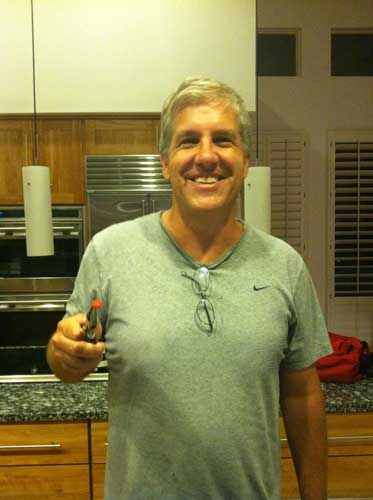
Fortunately I am not vain, so that I can still post this terrible picture of myself.  I am proudly holding the government-mandated flow restrictor I just removed from my most recent shower head purchase.  I don't buy any shower head until I make sure it has a removable restrictor.


The Federal laws restricting shower head flows have got to be among the dumbest on the books.  Some thoughts:

  • Water is not equally scarce everywhere.  So why is everyone required to conserve?  Why is the ideal flow rate the same in Seattle as in Phoenix?
  • Government policy for over a century has been to promote subsidized water prices that don't reflect its true scarcity (particularly to farmers).  Then, having guaranteed overuse via its pricing actions, the government then implements silly laws like this to try to offset the harm from its meddling in prices.
  • We have a lawn in Phoenix that needs constant watering and a pool that evaporates so fast in the summer one can almost see the water level dropping.  But the state's priority is to knock of a few gallons of water use from my shower.
  • With the low flow shower heads, it takes me three times longer to get the soap and shampoo off of me than with a full-flow head.  So we cut the water rate by half, but extend shower times by three.  And this helps, how?  And don't even get me started on low-flow toilets
  • The last three hotel rooms I have stayed in have had double shower heads, to make up the lost flow from wimpy government-approved single heads.  This process of cutting back on how much a single head can flow and then adding extra heads is incredibly dumb and wasteful.
  • I suspect this is all secret revenge from some English expat that wanted US showers to be as bad as those in Britain.

Shot Trying to Escape

It's become a joke of totalitarian states that prisoners killed by the state are all "shot trying to escape."  I can't get that phrase out of my head when I read this

A state crime lab report claims Chavis Carter, the man shot to death while handcuffed in the back of a Jonesboro, Arkansas police cruiser, committed suicide.

The left-handed Carter, the report claims, retrieved a 380-caliber Cobra semi-automatic, which he had managed to conceal from officers during two searches, and used his right hand to shoot himself in the head.

Comments: Disqus Coming

Well, this has been a while in coming, but for a variety of reasons I am switching to Disqus comments on this site.  Essentially this means commenters will have to register, though I feel like the registration is pretty un-intrusive as Internet things go.  Active commenters in the blogosphere likely already have a Disqus account.   And there are some definite benefits in terms of comment ranking and such that I hope will offset any hassle.  I have been testing Disqus on Climate Skeptic, along with the security updates I have been slowly porting over here, and I am pretty happy with the result.

What this means is that for several days, comments will disappear here as Disqus imports them.   Though they they promise a day turnaround, on Climate Skeptic it took them nearly a week.  With all the comments on this site, it may take a while.  New comments will still work, but the old ones will go away, and then magically return a few days later.  Hopefully.

By the way, this is a mild illustration of what started the security lockdowns at the climate blog.  These are actually minor spikes compared to some in the past, and so far I have seen no similar patterns at any of the other blogs I run.  A number of folks active in the climate debate have been hacked of late.

Something I Was Reminded of Today

The world's most unproductive task is attempting to enforce self-awareness on someone else.  Keeping this one truism in mind, while shelving one's ego, seems the best approach to solving conflicts in my business, whether it be with partners, employees, or customers.

Awesome Timing

From something called the Washington Free Beacon, via Real Science

Just days after the Export-Import Bank approved a multi-million dollar federal loan guarantee to benefit a mostly foreign-based wind-energy outfit, the company pink-slipped more than 200 American workers.

The Export-Import Bank, a federal agency that promotes and finances sales of U.S. exports to foreign buyers, approved a $32 million loan guarantee on Aug. 2 for a Brazilian firm to purchase wind turbines from LM Wind Power. According to itswebsite, LM Wind Power is headquartered in Denmark.

“Ex-Im Bank’s financing, which guarantees a Bank of America loan, will support approximately 250 permanent American jobs at the company’s Little Rock, Ark., and Grand Forks, N.D., manufacturing facilities,” the bank said in a release.

The company maintains a manufacturing presence in Arkansas and North Dakota—but the company laid off 234 of the Arkansas plant’s roughly 300 workers just two days after its loan was approved.

“We have this week told our workforce that we are re-sizing our workforce and business to fit our plans for 2013,” Adam Ruple, human resources director for LM Wind Power, told the City Wire of Arkansas.

A spokesman for LM Wind Power referred the Free Beacon to the company’s website.

When LM Wind Power came to Little Rock, Arkansas, in 2007, it said it would employ 1,000 people by 2012. But the global economic crunch led to diminishing demand. Three months before its loan guarantee was finalized, LM Wind Power announced its profits had fallen 41 percent last year.

It really takes some amazing stones to grab a $32 million subsidized government loan on the promise to add 250 jobs just days before a planned  234-person layoff.

Obama Bravely Fighting Against Deleveraging

I found this chart interesting, but am not entirely sure what conclusion to draw (via Zero Hedge)

In 2009, I think most everyone understood that the economy would have to reduce debt and that this process would be painful in terms of creating years of slow growth.  The good news from this chart is that the financial and consumer deleveraging has indeed been occurring, so at least our pain is not for naught.  The debate that will likely go on for years after this recession is whether the rapidly increasing Federal debt helped or hurt:  did it help offset the cost of the private deleveraging, or did it drag out the recession by keeping total debt levels from dropping?  Is it private debt that matters, or total debt?  Of course this makes the analysis more complicated.


Things I Did Not Know

I suppose I should have guessed this, but it never occurred to me.  There seems to be a problem with growing weed resistance to herbicides that is entirely parallel to growing antibiotic resistance of certain germs.

Lessons From the Corporate State

In my younger, more naive days, I would have drawn the following lesson from this story:  "Never create a business plan predicated on subsidy checks from the government.  They may stop at any time."  I still think this is mostly true, as FirstSolar is finding out.  But my sense is that a range of folks from GE to Kleiner Perkins still get their checks.  So one may cynically rewrite the rule: "Never create a business plan predicated on subsidy checks from the government unless you are confident you have the political connections to guarantee and expedite the payments."

It seems like local solar company perfect power tried to feed at the government trough without actually having sufficient clout in the corporate state.  Bad idea

About 100 Arizona homeowners who paid $4,500 up front for solar-power systems fear they may never get their rooftop panels after being left waiting for months by the installation company.

Angry homeowners are demanding their systems or refunds. The company, Perfect Power Solar, is blaming the delays on federal government red tape.

Perfect Power owner Lynn Paige said the company has cash-flow problems because energy grants that were supposed to provide substantial funding of the solar systems aren't being approved quickly enough. She pledged to deliver the systems or refund all customers by the end of the year.

Treasury officials would not comment on the situation. Government e-mails sent to Paige suggest Perfect Power's grant applications were incomplete. In them, officials point to problems with submissions and warn of potential denials.

Industry experts and owners of other solar companies in Arizona said that the grant program is fraught with risks for solar companies and that some built business models based on future payments from the government without the financial reserves to cope with delays. They describe the situation as a high-tech gamble that some companies lost.

Residential solar-power systems cost $15,000 to $40,000. The Section 1603 grant program, part of the American Recovery and Reinvestment Act, offered developers cash to offset 30 percent of the costs. Although the program was not available to homeowners, some companies tapped the grants to sell residential solar systems as leases. A company would install and own the system, then lease it to a homeowner.

Program rules required developers to complete installations before they could apply for reimbursement. But funding was not guaranteed, and even after systems were built, the government delayed approval of some applications and denied others.

If this was one of Kliener Perkins' companies, for example, Ray Lane would just call the White House and get his money released. If your solvency depends on continued flow of taxpayer cash, you better have the clout to keep the money flowing or you are likely to get hosed.  Bureaucracies tend to have default answers of "wait" and "no".  Those are the answers average people without pull are going to get.  The "yes" goes to those who cut through the red tape from the top.  These yeses, like the ones to Solyndra, only make it more likely everyone else get the "no" answer, as the agencies need to show they are being particularly diligent to offset the impression of sloppiness they get from the Solyndra-type cases.

Retroactively, the company's leadership has figured this out, that to survived at the government trough, they have to go political

Paige has asked customers not to file complaints or talk to the media about problems the company is facing.

"It has been very unhelpful ... that a few customers have chosen to write very negative letters to the BBB," she wrote in a May e-mail to customers.

Instead of filing complaints, Paige said, customers should write to Arizona U.S. Sens. John McCain and Jon Kyl to request their help in freeing up the government grant money and to pressure the Treasury Department....

That month, the BBB revoked Perfect Power's accreditation and gave the company an F rating. The company had 16 complaints filed against it the past year. The registrar shows four open complaints against Perfect Power; a fifth complaint was listed as settled or withdrawn.

Forget about the customers.  Let's just focus our attention on our two Senators.

"Abnormal" Events -- Droughts and Perfect Games

Most folks, and I would include myself in this, have terrible intuitions about probabilities and in particular the frequency and patterns of occurance in the tail ends of the normal distribution, what we might call "abnormal" events.  This strikes me as a particularly relevant topic as the severity of the current drought and high temperatures in the US is being used as absolute evidence of catastrophic global warming.

I am not going to get into the global warming bits in this post (though a longer post is coming).  Suffice it to say that if it is hard to accurately directly measure shifts in the mean of climate patterns given all the natural variability and noise in the weather system, it is virtually impossible to infer shifts in the mean from individual occurances of unusual events.  Events in the tails of the normal distribution are infrequent, but not impossible or even unexpected over enough samples.

What got me to thinking about this was the third perfect game pitched this year in the MLB.  Until this year, only 20 perfect games had been pitched in over 130 years of history, meaning that one is expected every 7 years or so  (we would actually expect them more frequently today given that there are more teams and more games, but even correcting for this we might have an expected value of one every 3-4 years).  Yet three perfect games happened, without any evidence or even any theoretical basis for arguing that the mean is somehow shifting.  In rigorous statistical parlance, sometimes shit happens.  Were baseball more of a political issue, I have no doubt that writers from Paul Krugman on down would be writing about how three perfect games this year is such an unlikely statistical fluke that it can't be natural, and must have been caused by [fill in behavior of which author disapproves].  If only the Republican Congress had passed the second stimulus, we wouldn't be faced with all these perfect games....

Postscript:  We like to think that perfect games are the ultimate measure of a great pitcher.  This is half right.  In fact, we should expect entirely average pitchers to get perfect games every so often.  A perfect game is when the pitcher faces 27 hitters and none of them get on base.  So let's take the average hitter facing the average pitcher.  The league average on base percentage this year is about .320 or 32%.  This means that for each average batter, there is a 68% chance for the average pitcher in any given at bat to keep the batter off the base.  All the average pitcher has to do is roll these dice correctly 27 times in a row.

The odds against that are .68^27 or about one in 33,000.  But this means that once in every 33,000 pitcher starts  (there are two pitcher starts per game played in the MLB), the average pitcher should get a perfect game.  Since there are about 4,860 regular season starts per year (30 teams x 162 games) then average pitcher should get a perfect game every 7 years or so.  Through history, there have been about 364,000 starts in the MLB, so this would point to about 11 perfect games by average pitchers.  About half the actual total.

Now, there is a powerful statistical argument for demonstrating that great pitchers should be over-weighted in perfect games stats:  the probabilities are VERY sensitive to small changes in on-base percentage.  Let's assume a really good pitcher has an on-base percentage against him that is 30 points less than the league average, and a bad pitcher has one 30 points worse.   The better pitcher would then expect a perfect game every 10,000 starts, while the worse pitcher would expect a perfect game every 113,000 starts.  I can't find the stats on individual pitchers, but my guess is the spread between best and worst pitchers on on-base percentage against has more than a 60 point spread, since the team batting average against stats (not individual but team averages, which should be less variable) have a 60 point spread from best to worst. [update:  a reader points to this, which says there is actually a 125-point spread from best to worst.  That is a different in expected perfect games from one in 2,000 for Jared Weaver to one in 300,000 for Derek Lowe.  Thanks Jonathan]

Update:  There have been 278 no-hitters in MLB history, or 12 times the number of perfect games.  The odds of getting through 27 batters based on a .320 on-base percentage is one in 33,000.  The odds of getting through the same batters based on a .255 batting average (which is hits but not other ways on base, exactly parallel with the definition of no-hitter) the odds are just one in 2,830.  The difference between these odds is a ratio of 11.7 to one, nearly perfectly explaining the ratio of no-hitters to perfect games on pure stochastics.

Evidence We Are Winning the War on Poverty

Over the last few days I have heard the same radio commercial three times, trying to raise awareness about hunger and poverty.  A little girl's voice says that when she goes downstairs and looks in the refrigerator, she does not see any food.  I too aspire to eliminating hunger from the world, but if our poor have electricity, refrigerators, and two-story houses, we must be doing something right.

The Real Culprit Behind High Food Prices

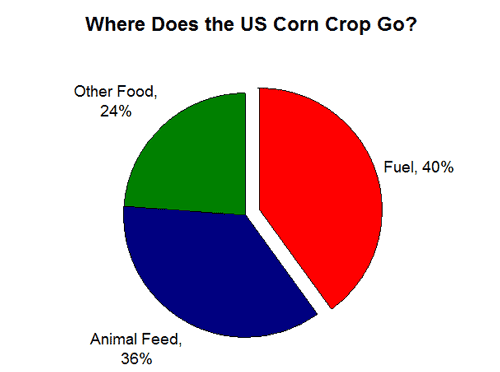
Here is an amazing bit of data on where the US corn crop goes:


The Department of Agriculture says the corn crop in the US will be down 13% due to the drought.  But corn available for food uses is down 40% due to the ethanol mandate.  You do the math.  Wait, I don't trust your math.  I will do it for you:

PS-  It's kind of amazing the supposed worst drought ever has dropped corn yields by just 13%.  Hurray for modern agriculture.   This year we will still produce about the same amount of corn we did in 2006.

Savage Austerity

It seems very popular to publicly declare, even continually reiterate, that there is a trend without actually, you know, showing the trend data.  I won't declare this to be a media trend, but this summer we were plagued with news reports about the drought "trend" when in fact no such trend exists in the US data  (NOAA data from this article). Something similar holds for the supposed British austerity.  Here is British government spending in real dollars (via here)

Everyone's Snout is in the Trough

Economists advocate for Federal funding of economists.  Because if there is anything economics has taught us, its that the Feds do such a good job at allocating resources.

Via the Unbroken Window  (arguing against personal interest, I suppose, since the author is a professor of economics)

Proof We Live In a World With Statist Assumptions

Only a mostly-statist world would consider Paul Ryan a libertarian.

Also, here is my growing Romney fear -- that this guy shares many of the same assumptions as President Obama about the government's role in top-down management of the economy.  So far, his rhetoric has the feel not of seeking freedom from state authority but instead that, in the context of top-down state authority, he will be the better, smarter manager.  In other words, we are doomed.  Which is about the way I sum up every Presidential election.

Working on Security

I am working on site security, so if you get locked out for some reason, let me know by hitting the email here, or if you can't get in here, over at climate-skeptic.com.  I thought I had this process pretty well practiced as I did everything I wanted first at two other blogs, but this morning I managed to lock myself out of the site.  Oops.  So screw-ups are definitely possible.

The Real Issue in Climate

I know I hammer this home constantly, but it is often worth a reminder.  The issue in the scientific debate over catastrophic man-made global warming theory is not whether CO2 is a greenhouse gas, or even the approximate magnitude of warming from CO2 directly, but around feedbacks.   Patrick Moore, Greenpeace founder, said it very well:

What most people don't realize, partly because the media never explains it, is that there is no dispute over whether CO2 is a greenhouse gas, and all else being equal would result in a warming of the climate. The fundamental dispute is about water in the atmosphere, either in the form of water vapour (a gas) or clouds (water in liquid form). It is generally accepted that a warmer climate will result in more water evaporating from the land and sea and therefore resulting in a higher level of water in the atmosphere, partly because the warmer the air is the more water it can hold. All of the models used by the IPCC assume that this increase in water vapour will result in a positive feedback in the order of 3-4 times the increase in temperature that would be caused by the increase in CO2 alone.

Many scientists do not agree with this, or do not agree that we know enough about the impact of increased water to predict the outcome. Some scientists believe increased water will have a negative feedback instead, due to increased cloud cover. It all depends on how much, and a t what altitudes, latitudes and times of day that water is in the form of a gas (vapour) or a liquid (clouds). So if  a certain increase in CO2 would theoretically cause a 1.0C increase in temperature, then if water caused a 3-4 times positive feedback the temperature would actually increase by 3-4C. This is why the warming predicted by the models is so large. Whereas if there was a negative feedback of 0.5 times then the temperature would only rise 0.5C.

My slightly lengthier discussions of this same issue are here and here.