Archive for the ‘Government’ Category.

Hair of the Dog?

WTF is this designed to accomplish, except to give Obama something to crow about in one or two news cycles while doubling down on the same kind of practices that got the housing market and banks into the current mess?  This reminds me so much of the final days of the government in Atlas Shrugged.  Fannie and Freddie are bankrupt?  Well, lets do the same thing to the FHA, just to save our sorry government jobs for a few weeks longer.

The Federal Housing Administration is heading toward a taxpayer bailout, yet the president's latest mortgage modification plan would further increase the agency's exposure to risky mortgages. Mark Calabria calls it a "Backdoor Bank Bailout."The administration's plan would encourage borrowers who owe more than their house is worth to refinance into FHA-insured mortgages. Therefore, the risk of a future foreclosure on these mortgages would fall to the government and taxpayers instead of private lenders.

A recent study from economists at New York University found that the FHA is underestimating its risk exposure. One of the problems is that the FHA isn't properly accounting for the risk to underwater FHA mortgages that have been refinanced into new FHA mortgages. So it's hard to see how the president's plan to refinance private underwater mortgages into FHA mortgages won't further exacerbate the situation.

Blaming Private Companies for Government Procurement Errors

The blaming of private companies for government procurement errors is one I deal with frequently at my privatization blog.  This seems to be a particularly egregious example:

Maricopa County officials can't sue the Sheriff's Office for buying a $465,000 bus without their approval, so now they want to sue the bus company.

Precisely why Motor Coach Industries would be sued over the internal squabble remains unclear.

The county has maintained in this months-long bus battle that Sheriff Arpaio's office bought the vehicle with Jail Enhancement funds, when it should have used a typical county procurement process.

From the bus company's point of view, though, the Sheriff's Office was a customer with cash. For the county to demand a full refund, without so much as a deduction for the depreciation, seems like a raw deal for MCI.

Cari Gerchick, spokeswoman for the county, says text of the lawsuit won't be released until after the Board of Supervisors votes on it at Monday's meeting. She could not provide the legal justification for the expected lawsuit, beyond saying that MCI "should have known" the MCSO had not followed the county's procurement process.

Get that?  The company should have known that our County's chief law enforcement officer was not following the law.  This is obviously an absurd contention, but further the company had two geographic disadvantages:  1.  Not being from AZ, they don't know just how unethical our sheriff really is; and 2.  Being from Chicago, even if they had recognized unethical behavior, they would have assumed it was perfectly legal

Assessing the Marginal Price for a Congressional Vote

Via the Sunlight Foundation:

A day after Rep. Bart Stupak, D-Mich., and ten other House members compromised on their pro-life position to deliver the necessary yes-votes to pass health care reform, the "Stupak 11" released their fiscal year 2011 earmark requests, which total more than $4.7 billion--an average of $429 million worth of earmark requests for each lawmaker.

The eleven members were the focus of high level pressure by House Speaker Nancy Pelosi and other top Democrats because they threatened to vote against the health care reform bill, which passed the House on Sunday, March 21, by a seven vote margin. Granting earmark requests are one of the ways leadership can encourage members to vote their way.

When it was announced the other day that three little-used airports in Stupak's district were given about 3/4 of a million dollars on the day before the health care vote, Stupak made it clear that he would never sell his vote for so little.  "It is absurd to think I would change my vote for a tow truck and a fence to keep deer from walking onto the runway of an airport in my district," Stupak said in a statement.  So it should not be surprising that he is asking for more.

Update:  The Sunlight Foundation has partially backed off on this story

Congress

Via Katherine Mangu-Ward, word count by Pew Research when Americans are asked about Congress

This would make a great piece of modern art to put on the walls of the Rotunda.

This is Stupid

From the new bill signed by Obama today:

Under the new law, businesses that hire anyone unemployed for at least 60 days would be exempt from paying the 6.2 percent Social Security payroll tax through December. Employers also would get an additional $1,000 credit if new workers remain on the job a full year.

This is absurdly game-able.  How do I know?  Because as I read this here (I have not read the legislation) this is a ridiculous windfall for our company.  As a seasonal business, my current payroll is about 40 people.  Over the next two months, I will hire nearly 400 workers for the summer, most of whom have not been working over the winter as they are retired and just work a few months of the year.  Am I really not going to have to pay Social Security taxes on all these people?

And how is anyone going to administer this?  Are my payroll company and I going to have to figure out the employment status of all of our hires for the last 60 days to figure out what taxes to collect?  Does anyone in Congress even think about this stuff when they pass this garbage?

Update: ADP has more

Update #2: Here is my prediction, if they forgot about seasonal hiring  (again, I have not read the letter of the law yet).  This will be like the cash for clunkers program - in a month or two they will announce that they have used up the money they had allocated for the whole year.

By "Broadband" They Mean Banding Together to Broaden Federal Powers

The new FCC broadband policy just looks stupid.  It is classic political campaign fodder -- who can be against high-speed Internet access?  But what are they really trying to achieve?  Well, it does not seem that respect for individual preferances or decision-making has anything to do with it (emphasis added)

In addition, the plan is designed to encourage more people to subscribe to broadband. About two-thirds of U.S. households have high-speed Internet access now. Many people in the other one-third could get broadband but choose not to buy it, either because they think it's too expensive or because they don't see a need for it. The FCC plan calls for increasing adoption rates to more than 90 percent of the population.

So their major goal is to encourage people who do not value high-speed Internet access to suddenly value it.  How?  By force?  By subsidizing people who don't really even want it?   "We elites can't imagine living without Twitter for a whole day so the rest of you need to value the same things too. "

Imagine...

Per Nancy Pelosi:

"Think of an economy where people could be an artist or a photographer or a writer without worrying about keeping their day job in order to have health insurance."

Yeah, its a world where only the suckers work hard and try to be productive.

Somebody Should Write About This...

Years ago, I wrote a novel (still available at Amazon!) wherein a key plot point was a conspiracy between a Senator, a law firm, and a media company to create a high-profile tort case out of thin air.

Today, we may be seeing something similar with the Toyota sudden acceleration case.  In this case, we have the Senate calling stooges of the plaintiff's bar as "expert witnesses" with the whole thing getting a third of the air time on nightly news programs.   In my book, the whole thing was kicked off by a media company afraid of a new competitor - in this case it was kicked off by the US government, which controls GM, trying to sit on a competitor.

It is hard to spot the lowest behavior in the affair so far, but that honor can arguably go to ABC and the lengths to which it went to pretend it had recreated the problem.  In fact, they had to strip three wires, splice in a resistor of a very specific value and then short two other wires.  They made it sound like this is something that could easily happen naturally  (lol) but this is an easy thing to prove - and inspection of actual throttle assemblies from cars that have supposedly exhibited the sudden acceleration problem have shown no evidence of such shorting.  So the ABC story was completely fraudulent, similar to the old Dateline NBC story that secretly used model rocket engines to ignite gas tanks.   Its amazing to me that Toyota, acting in good faith will get sued for billions over a complex problem which may or may not exist in a few cars, while ABC will suffer no repercussions from outright fraud.

Basically ABC proved that if you bypass a potentiometer with a resistor, you can spoof the potentiometer setting.  Duh.  The same hack on a radio would cause sudden acceleration of your volume.

Henry Payne has more.

Hot Money

Apparently our state government has been in another subsidy bidding war over a plant relocation, and fortunately it lost.  Why the state government pulls together Defcon 5 activity levels to bring 80 jobs to a town of 4 million is just beyond me.  But beyond my usual problems with subsidizing business relocation, which haven't changed from this post way back when I talked about relocation subsidies in the context of the prisoner's dilemma, I have three issues specific to our state's efforts to attract solar manufacturers:

  1. I am constantly amazed at the strategic planning that says Arizona residents should pay more taxes to promote a solar manufacturing industry because, uh, we have a lot of sun.  That's roughly as logical as saying an FM radio maker should manufacture in NY City because they have a lot of radio stations.  I suppose you could argue it would reduce shipping costs to solar using areas, but I can't believe that shipping costs dominate since most of the panels we buy in this country originated in Japan or Germany.
  2. Companies and industries that seek subsidies are like hot money in the investment world.  Even if you attract it today, they will jump next week to another location that offers them more.  We see it in this case, as AZ bought Kyocera's presence at one facility but can't afford the price to get them to build this new facility.
  3. The state's approach defies all business strategy, and is making a typical novice investment approach.  Specifically, they are chasing the hot industry.  Everyone is bidding for solar plants, so the price goes way up.  This is why we have bubbles in housing and Internet, because people all pile into the same investment like lemmings.  If I were to run a government business relocation strategy (which I most certainly would never do) I would be focusing on boring stuff no one subsidizes.  We offered nearly 100% property tax abatement plus investment tax credits and can't get a solar plant.  Instead we should be up in business hostile states like CA and NY getting rubber stamp makers and garage door manufacturers.  Surely we could get 70 jobs a lot cheaper.

It's Been A While Since I Dissed on Ethanol...

... so it's probably about time.  Kevin Drum has a very cogent analysis of all the issues, and is, if anything, givin ethanol the benefit of the doubt with some of the numbers he uses.  He ends by echoing something I have said any number of times:

Bottom line: corn ethanol is no greener than gasoline. In fact, it's almost certainly less green, and at the very least, there's no urgent need for the U.S. government to pay billions of dollars to subsidize its production. Too bad Iowa is the first state on the primary calendar every four years, isn't it?

What I find amazing is that when he wants to, Drum can be quite insightful about this kind of political failing,  What I don't understand is why he continues to advocate programs like government health care that are almost assured of being dominated by the same horrible incentives and decision-making.  Under either the House or Senate health care bills, for example, just imagine the line of lobbyists who will be working to get their pet procedures covered under insurance  must-cover rules.  How can he possibly imagine that the same Congress that votes for ever-expanding ethanol subsidies is going to make good cost-benefit tradeoffs based on science for health care procedures?   Doing the same thing over and over and expecting different results is the definiation of, what?

Seen in DC Today

I wish I had my cell phone camera with me - in a single intersection (somewhere around 14th and Mass) there were a full 6 -- count them SIX -- traffic cops directing traffic.   Jobs created or saved, baby.

Headline of the Day

A reader sent this to me:

Snow shuts down federal government, life goes on

WASHINGTON (AP) - If snow keeps 230,000 government employees home for the better part of a week, will anyone notice?

With at least another foot of snow headed for Washington, Philadelphia and New York, we're about to find out. The federal government in the nation's capital has largely been shut down since Friday afternoon, when a storm began dumping up to 3 feet of snow in some parts of the region. Offices were remaining closed at least through Wednesday.

The Federal Government is Working Hard To Shield States From Their Own Irresponsibility

Many states managed to grow state spending in the last decade far faster than inflation and population growth, soaking up every new dime in bubble-generated tax revenue they could.   It may seem like states were forced to make a lot of hard decisions last year, but in fact they were sheltered from really dealing with the full measure of their own fiscal problems by large influxes of Federal "stimulus" money.  As I demonstrated way back in January of 2009, most of the stimulus was actually ear-marked not for the mythical shovel read project, but for "stabilization" of state and federal budgets.  This is a couple of months old, but still applies:

A historic nosedive in state tax collections extended into the third quarter of the year, and only an infusion of federal economic stimulus money has averted widespread program cuts and worker layoffs.
Tax collections from July through September dropped an average of 8.3% from a year earlier in the eight states that release up-to-date monthly tax figures, a USA TODAY survey found. New York's tax collections fell 8.9%, despite an income tax hike earlier this year. States reporting partial third-quarter results showed a similar downward spiral in tax collections, including 13.2% drop in Arizona.

Federal stimulus money has protected states from making big cuts in the number of government workers, in aid to schools or in spending on Medicaid, the health care program for the poor. But most federal stimulus money ends in December 2010.

This is not a new trend, from Tad DeHaven of Cato:

201001_blog_dehaven_tot

According to the Goldwater Institute, over a third of the AZ state budget is federal money.

Where-the-Budget-Comes-From

How can there possibly be any accountability for how this is spent, though it actually is larger than the amount raised by state taxes?  If we want the government to buy us goodies in this state, we should at least pay for them ourselves and not take money from others.  By the way, every time I raise this argument, someone says "well our state pays more federal taxes than it gets back."  First, every state says this so it can't possibly be true in every case.  Second, it's a terrible practice from the standpoint of accountability.

Related, via Matt Welch:

The biggest single national political donor in the country during the 2007-08 election cycle, according to OpenSecrets.org, was the overwhelmingly Democrat-supporting teachers union the National Education Association. What category of worker was the biggest single beneficiary of stimulus spending? Public school teachers. Who, according to Vice President Joe Biden, accounted for 325,000 of the first 640,000 jobs "created or saved." While it's true that teachers are Americans (even my brother), in the vast majority of these cases, the jobs in question weren't "created," just maintained, since it is nearly impossible to fire public school teachers.

Like Me Choreographing a Ballet

I often respond to various articles that a group of politicians are going to create a strategic plan** for the local economy that this is similar to my trying to choreograph a ballet .  TJIC has similar words for this effort:

Governor Deval Patrick and Senate President Therese Murray plan to propose this week several ways to improve the Bay State's business climate, saying they need to be more aggressive in steering the region out of its economic malaise.

Both have lifelong careers in non-business sectors (government, academia, journalism, legal, non-profit).  TJIC responds:

Asking them to design programs to better the business climate is about like asking me to design menstrual pads "“ I don't understand the sector, I don't understand the features, I don't understand the problems, and there's no way that the effects of my work will ever come back to make an impact on me.

This is reminiscent of this great comment from Kevin Williamson  via Instapundit

The good news is that, when it comes to reshaping the U.S. mortgage market [any market for that matter "” ed.], the Obama administration's top guns are bringing to bear all of the brisk, rough-'n'-ready entrepreneurial know-how they picked up in their previous careers as university professors, nonprofit activists, and holders of political sinecures.

But we are spending more and more to get this "expertise", as documented in a depressing post at Carpe Diem on the growth of government employment and salaries.  One chart out of many:

fedemp

** Footnote:  About once a month we get some group lamenting that Phoenix has no master plan to create some kind of economic focus for itself.  One of the hilarious things about this is that if you go back and look, about half of the past proposals have Phoenix focusing on some super-hot industry (e.g. semiconductor manufacturing, e-commerce) that is just about to crash.  Lately, everyone has decided that Phoenix should be the center of the solar industry, because, uh, we have a lot of sun, without any particular explanation of why having a lot of sun should be an advantage in precision manufacturing and assembly of solar components.  But we are shelling out all kinds of tax breaks and subsidies for these companies to come here.  My prediction - solar will be the next ethanol.  In ethanol, increases in government subsidies caused a lot of manufacturing capacity to be built.  But subsidies could not grow as fast as capacity, and a glut resulted in a huge shakeout.  The solar boom will occur when a technology is perfected that makes solar economic without subsidies.  When that occurs, I will be the first in line to cover my roof in the new tech.

Bigger Oil

Roger Pielke, Jr. (hat tip to a reader) points to an interesting FT Lex column that should offer some interesting insights to America's progressives:

9c437598-11bb-11df-9d45-00144feab49a

"Big" and "oil" are mentioned so often in the same breath that it is easy to lose perspective. Motorists and environmentalists never tire of berating the dominant supermajors whose petrol stations and share listings make them the public face of the industry, their favourite target being America's ExxonMobil. If market value were the sole magnet for opprobrium then Exxon's executives could breathe a bit easier because PetroChina recently overtook it as the world's most valuable listed energy company.

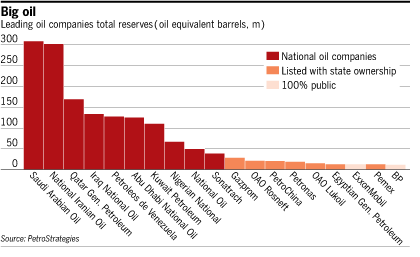
But there is "Big Oil" "“ last year, Royal Dutch Shell earned more than $1bn a month "“ and then there is bigger oil. No oil major is able to affect energy prices on its own and even Exxon is far smaller than the world's largest energy company. It is not even close. Saudi Aramco's estimated hydrocarbon reserves of 300,000 million barrels of oil equivalent make it 15 times Exxon's size. Exxon comes in about 17th place, with the top 10 being entirely state-owned.

US oil company executives routinely get pulled in front of Congress to defend themselves against charges they are manipulating world oil prices.   Huh? It would be as rational to accuse Grinnell College of manipulating national tuition rates.  Americans can take comfort in the fact that by limiting their ability to seek new oil in the US, we have made sure that oil markets are not controlled by evil publicly traded companies like Exxon and Shell but instead are controlled by entirely more trustworthy entities like the governments of Iran, Saudi Ariabia, Venezuela, Russia, Nigeria, and China.

This chart also supports the one good argument I think there is for peak oil -- that most of the world's oil reserves are controlled by patently incompetent institutions (e.g. governments) that have very bad incentives that make them highly unlikely to invest well.  The only reason these countries are able to produce at all is because western companies are stupid enough to keep walking into this cycle:

1.  US companies invest huge amounts of capital and know-how to build oil industry
2.  Once things are producing, local government steals it all (they call it "nationalization")
3.  Oil fields go into extended decline due to short-term focused and incompetent government management
4.  US companies invited back int to invest huge amounts of know-how and capital
5. repeat

Utterly Without Shame

Via Megan McArdle:

"We need to stand up to the special interests, bring Republicans and Democrats together, and pass the farm bill immediately," Barack Obama

Self-parody in action.

Further Thoughts on Corporate Speech

The reaction by the left to the Supreme Court decision yesterday overturning speech limitations on corporations seems tremendously hypocritical.  No one seems to complain on the left when certain groups/corporations (call them "assembly of individuals") get special access to the government and policy making.  Jeffrey Immelt and GE, Goldman Sachs, the SEIU, and the UAW all get special direct access to shape legislation in ways that may give special privileges to their organization -- access I and my company will never have.

Deneen Borelli wrote, in response to Keith Olberman's fevered denunciations of free speech for corporations

"It also seems as if the pot is calling the kettle black. MSNBC is currently owned by General Electric. GE Capital was bailed out by the taxpayers. GE CEO Jeff Immelt is a close advisor to President Obama, and GE would profit from Obama policies such as cap-and-trade. Olbermann has served as a cheerleader for all of this. Are Immelt and Olbermann simply afraid to allow others to possibly gain the attention and influence GE has had all along?"

Here is an example -- has the health care bill considered my company's situation, where we have 400 seasonal workers, almost all of whom are over 70 and on Medicare already?  How, in these circumstances, do we offer health care plans?  Are we relieved of the penalty for not offering a plan if they are on Medicare or a retirement health plan already?  The legislation does not address these issues (see Hayek) and I am sure numerous others, but I will never be able to cut a special deal for my workers or my industry as GE or the UAW have.

Further, corporate paid speech is alive and well in this administration, you and I just can't see it.  Lobbyists are all having record, banner, unbelievable revenues, in large part because the government is putting such a large chunk of the economy in play for forced redistribution and everyone who can afford it is paying to influence the process.

But nothing in any of the good government reforms have (rightly) ever put any kind of restrictions on this kind of speech directly to legislators.  The only speech they limit is speech to the public at large.  In effect, McCain-Feingold said that it is just fine to spend gobs of money speaking directly to us government folks, but try to go over our heads and talk directly to the unwashed masses, well, we have to make that illegal.  Far from tilting the balance of power to a few rich elite firms, the recent Supreme Court decision gives new power to the rest of us who don't have privileged access.

Update: Speaking of hypocrisy, the NY Times Corporation is outraged other corporations have been given the same rights it has had all along.  In a sense, the Times is lamenting their loss of a monopoly.

Update #2: Ilya Somin:  Corporate speech is actually an equalizer for far worse inequalities of political influence and access that already exist.

Hostage Crisis

The Florida sales tax auditor has been in my office for 2 days and shows no sign of leaving.  Most of the audit is as expected and I ceased long ago getting ticked off about it;  but the new focus on use tax - ie, not just did you collect and pay sales tax on your retail sales but did you pay proper sales tax on every purchase, is really annoying.  We are going to have to be pulling invoices and xeroxing for weeks.  Somehow, if as a retailer I don't collect enough sales taxes, I am liable for the shortage.  But if someone else sells me something and there is not enough sales tax collected, I am again apparently liable for the difference.  The latter makes no sense to me.    Apparently I owe taxes in this non-symmetric way based on the deep philosophic principle that he is sitting in my office, not theirs.

Update: Now he suddenly thinks that I am getting over because there is no sales tax shown on my liability insurance premiums.    AAArrrrggghhh.  Two entire days lost.

How Is This For Fiscal Responsibility?

I received a sales tax audit notice for Alabama today.  I found this odd, as it is a three year audit and we have only operated in the state for 6 months.  In fact, all four of the audit sample months they chose had zero sales.  I have never even heard of anyone being audited with this little history.

So, I call the auditor, and explain all of the above, expecting an answer like "oops, no point in proceeding."  How naive I am.  He says we have to proceed with this, and listed a pile of documents he has to see which will take me about 6 hours of my time to track down and Xerox.  Included in this, in addition to all the revenue records, he wants to see every single invoice we paid in Alabama to make sure we didn't secreatly buy stuff out of state and avoid their use tax (the tax you are supposed to pay, ha ha, if you buy items out of state with no sales tax.  You guys all file your use tax reports on Amazon purchases, right?)

But here is the part that really pissed me off.  When I asked him why I was being audited after just 6 months, he said he knew the audit was senseless but his office is desperately trying to keep everyone employed during recent budget cuts so that no one would lose their job.  Also he said is was good training for him.  Great.  I have to do 6 hours of extra work so that later I can pay higher state taxes to support more government workers.  What a deal.

Consider the Incentives

Consider the incentives for a bank trying to set the risk profile of its investments.  Should it go for higher returns at higher risk, or dial back the risk at a cost to near-term profits?  Now consider this decision in the context of two actions from the past year:

  • Large banks that took on too much risk are bailed out and management mostly preserved
  • Banks that eschewed higher profits by avoiding bad risks are now forced to pay for the bailout of those that went wild:

Obama administration officials and lawmakers are scrambling to find a way to funnel some of the financial industry's record earnings back to the taxpayers who helped rescue the industry from looming disaster.The White House is considering a fee on banks and other financial companies

as one approach, with revenues earmarked to help recoup any losses from the government's $700 billion bailout fund, a senior administration official said.

Some in Congress want to add a new tax on bonuses or assess a small fee on all stock transactions, which would hit large banking companies the hardest.

Note that there is no attempt here to only charge banks who received bailout money, but all banks will be charged equally.  To each according to his need, from each according to his ability.  This is moral hazard in spades.

Cutting the Right Expenses

In 2003, my company was in some serious financial problems.  Post 9/11 commercial insurance premiums had just risen substantially, so much so that my premiums went up more than my total annual profits.  At the same time I found out that a number of operations I had just acquired were profitable only because they were not in compliance with labor law, and my crash program to bring them into compliance was going to put me deeply in the red for that year.

I did a whole bunch of things to right the ship, but the two most important were 1)  I eliminated a whole layer of management, slashing 5 vice-presidents and having all the front line managers report directly to me; and 2)  I eliminated the smallest and worst performing business units.

Now, contrast this to what governments do in the same situation.  Their first response, of course, is to do something I could not do - compel more revenue for themselves by increasing taxes.  Those of us who make our living by the free decision making of others don't have this dictatorial option.

The second thing that governments do is cut their MOST important, MOST valuable operations.  In Seattle, it was always fire and ambulance services that would be cut.  Because the whole game was to find the cuts that would most upset the public to try to avoid the necessity of having to make cuts at all.  Its an incredibly disingenuous process.  Any staffer of a private company that made cost savings prioritization decisions like government officials would be fired in about 2 minutes.

The third thing that governments do if forced to actually, really cut costs (meaning that every other stalling tactic, taxation method, and accounting trick has been exhausted) is to cut field staff who actually do the work rather than high-paid, bloated administrative staffs.  This means teachers get cut but not vice-principals.  And it means that preventative maintenance gets cut and not transit staffers:

Having removed a mere 25 employees so far, and having just suffered its deadliest year ever, Metro officials now want to raid $10 million from the agency's preventive maintenance fund in order to cover operating expenses, including salaries and benefits. Metro managers would rather skimp on passenger safety and reliability than clear out the system's deadwood and force serious concessions by the transit union.

Moreover, even as it asks riders to sacrifice, Metro is fattening itself up, hiring two new "senior planners," one to a newly created position. According to Metro's official job description, they will be "responsible for participation in the development of an annual business plan ... identifying opportunities for future growth and development" and "defining future strategies."

An Apt Analogy

In his regular email, Bill Leonard recounts a story told by the California governor to the legislator that may be even more apt than he intended:

The Governor told a delightful story to the Joint Session of the Legislature regarding the animals at his home.  It seems that the pet pony and the pet pot-bellied pig work together to knock the dog's food canister off the kennel then using feet, hooves and snout, they pry the lid off to get to the food.  The Governor's message: if my pony and pig can co-operate like this, then certainly the Governor and the Legislature can cooperate.

But I got to thinking about the dog.  His food was gone, taken without his permission.  So who is the dog in the Governor's analogy?  I am hoping it is not me and the millions of other taxpayers who lose our canisters of food every time the Governor and the Legislature cooperate on taxes.

I am afraid the dog is probably the rest of us, and this is exactly how politicians think - how can we all cooperate to get down to the real business of government -- taking more of the dog's food.

Ugh! $2 Trillion

Not good, but not really a surprise:

The estimate by Orin Kramer will fuel investors' concerns over the deteriorating financial health of US states after the recession. "State and local governments are correctly perceived to be in serious difficulty," Mr Kramer told the Financial Times.

"If you factor in the reality of these unfunded promises, their deficits will rise exponentially."

Estimates of aggregate funding requirement of the US pension system have ranged between $400bn and $500bn, but Mr Kramer's analysis concluded that public funds would need to find more than $2,000bn to meet future pension obligations.

Kenneth Anderson asks:

Two trillion dollars?  One question about these obligations is whether taxpayers will stick around to pay them, or instead will vote with their feet.  ("Vote with their feet" is something that has been discussed in various ways at VC "” as an aspect of a federal system and states with their own laws.)  Many of these pension obligations have been incurred by municipalities and others by states, and in some cases the obligations are intertwined.  But what happens if voters-taxpayers move out?

The assumption has long been that taxpayers are stuck, on account of jobs and other circumstance.  But query whether that is necessarily true as the baby boom generation retires.  In that case, it might find itself far more mobile, in circumstances where rising taxes at every level make relocation a more valuable decision at the margin.  For that matter, if otherwise desirable locales manage to tax their businesses away, will the baby boomers' kids and grandkids have reason ever to locate in places that lack jobs?  They might have been raised there "” but would they go back?

Would people leave California? They are leaving now, true, but would they leave in the future specifically for this reason or generally on account of the tax burden, particularly as retirees?  Or New Jersey?  What about the city of Oakland?  Or even smaller cities, such as the towns in California "” not large at all, small towns, that have already declared bankruptcy over pension obligations?  It's easy to move out of those towns.

My guess is that the Feds are going to pick up a lot of these state and local obligations, making it effectively impossible for taxpayers to escape them short of leaving the country (and creating the mother of all moral hazards, by the way).  After all, if the current administration will bail out Wall Street banks with whom they have little ideological sympathy, they certainly will do so to keep SEIU-represented government employees in jobs.

Unfortunately, I Have Lately Had Cause to Lament the Same Thing

Via Mises Blog:

The hidden hand behind this unsanitary calamity is the US government. The true origin of the mess was not in the hour before I arrived but back in 1994, when Congress passed the Energy Policy and Conservation Act.This act, passed during an environmentalist hysteria, mandated that all toilets sold in the United States use no more than 1.6 gallons of water per flush. This was a devastating setback in the progress of civilization. The conventional toilet in the US ranges from 3.5 gallons to 5 gallons. The new law was enforced with fines and imprisonment.

For years, there was a vibrant black market for Canadian toilet tanks and a profitable smuggling operation in effect. This seems either to have subsided or to have gone so far underground that it doesn't make the news. I've searched the web in vain for evidence of any 3.5 or 5.0 gallon toilet tanks for sale through normal channels. I wonder what one of these fetches in the black market. This possible source has no prices and an uncertain locale.

The toilet manufacturers, meanwhile, are all touting their latest patented innovations as a reason for the reduced hysteria surrounding the toilet disaster. I suspect something different. We have all gotten used to a reduced standard of living "” just as the people living in the Soviet Union became accustomed to cold apartments, long bread lines, and poor dental care. There is nothing about our standard of living that is intrinsic to our sense of how things ought to be. Let enough time pass and people forget things. So let us remember way back when:

  • Toilets did not need plungers next to them, and thank goodness. Used plungers are nasty, disease carrying, and filthy. It doesn't matter how cute the manufacturer tries to make them or in how many colors you can buy them. In the old days, you would never have one exposed for guests. It was kept out in the garage for the rare occasion when someone threw a ham or something stranger down the toilet.
  • Toilet paper was super thick and getting thicker. None of this one-ply nonsense.
  • You never had any doubt about the capacity of the toilet to flush completely, with only one pull of the handle. The toilet stayed clean thanks to five gallons of rushing water pouring through it after each flush.

It concludes:

"Capitalism achieved something spectacular in waste disposal. Government came along and took it away from us."

In Case You Were Not Depressed Enough...

I wrote the other day about restrictions in the Federal stimulus bill that substantially reduced the ability of state governments to cut spending in response to lower tax revenues.  It turns out there are a myriad of other limitations, including court cases and past consent decrees, that make it nearly impossible for states to do much if anything about their budget shortfalls (except raise taxes, of course).  Just about everyone except for taxpayers have a set of lawyers in courts full time preventing budget changes that affect their special interests.

If you thought elected officials in your state were running the budget show, you might be in for a surprise.  Likely as not the federal courts are more powerful budget authorities than the state's legislature or executive.  A few consent decrees can easily cripple any attempt to pass a balanced budget requirement in a state legislature, and overturn the act itself in federal court if it does happen to pass.  Tennessee, for instance, was shacked by three consent decrees, all of which were administered by federal judges.  Before even writing budget legislation, the governor of Tennessee had to persuade two federal judges, who were the de facto managers of the state's health care system, that any changes were a good idea.

The most damaging consent decrees to state budgets tend to be related to staffing levels.  A number of state agencies settled all manner of employment and discrimination claims by entering consent decrees freezing staff levels.  Often state employee unions were among the most active consent decree wielders.  These decrees tend to lock up not only staff levels, but salaries (through "constructive termination" clauses that equate even modest pay cuts with termination and thereby trigger staffing minimum clauses) and pension benefits as well.

Explain to me again how these government officials who signed these incredibly short-sighted consent decrees just to get through their own term in office are more long-term focused than private actors?  Would any of you short-term-focused capitalists sign an open-ended agreement to never cut staff or salaries or benefits for employees no matter what the future fortunes of your company were?

The only way through this is going to be a massive string of state and local government bankruptcies.

Update: Sort of related, I got this in my email today from a reader

The City of San Francisco pays for two Police Departments and two Fire Departments, less about 5%.
Both have one active-duty department and one retired-duty department.
When a cop or firefighter retires in San Francisco, he receives a 90% pension.

Then, every year THEREAFTER, the retiree receives 50% of every raise negotiated by the active duty Memorandum of Understanding.

He seems to have it right, he links to this site, which does indeed show that the COLA on retiree pay includes 50% of all raises given to active duty employees.  I wonder how early they are vested?

Update #2: Via Nick Gillespie, update #1 is not that unusual:

Retirement incomes for the most experienced government employees top out at 88 percent of their active-duty pay. Unlike most private-sector workers, whose retirement is driven by the strength of the stock market and their 401-k plans, the pensions for government employees are guaranteed.

In addition to higher average retirement incomes, government retirees in Ohio also enjoy government-sponsored health care, can retire as young as 48 for police and firefighters, and have the opportunity to 'retire' and collect a full pension while going back to work, often at full pay for doing the same job. Such 'double-dippers' were paid more than $741 million by the State Teachers Retirement System last year and $240 million by the Public Employees Retirement System, records show.

In Toledo, even the mayor is a double-dipper.

Since starting his current term in January 2006, Toledo Mayor Carty Finkbeiner has drawn his annual salary of $136,000 in addition to a state pension for more than two decades in elected and unelected positions. He is leaving office on Monday.

And because he is already receiving a Public Employees Retirement System pension, Toledo taxpayers have paid $75,221 into an annuity as an additional retirement fund for Finkbeiner.