Archive for the ‘Government’ Category.

Government Decision-Making in the Gulf

My first column at Forbes.com is up here (and on the opinion home page, which is kind of cool), and extends on some thoughts I have already posted on my blog about why government decisions in multi-agency task forces, such as those running the Gulf cleanup effort, seem to be made in such a stupid manner.

As most scientists know, one of the best tests of a theory is whether it makes correct predictions about future events.  Since I wrote this article several days ago, we have seen this new story which is absolutely consistent with the decision-making paradigm I describe in the article (from Q&O)

Louisiana has been busily building berms about a mile out from the coast to halt the infiltration of oil into its sensitive marshes, wetlands and prime fishing areas. This process was greatly delayed by federal red tape, and now that the state has permits in hand it's being order to stop because, according to the U.S. Fish and Wildlife Department, it's doing it wrong:

The federal government is shutting down the dredging that was being done to create protective sand berms in the Gulf of Mexico.

The berms are meant to protect the Louisiana coastline from oil. But the U.S. Fish and Wildlife Department has concerns about the dredging is being done.

Plaquemines Parish President Billy Nungesser, who was one of the most vocal advocates of the dredging plan, has sent a letter to President Barack Obama, pleading for the work to continue.

[...]

Nungesser has asked for the dredging to continue for the next seven days, the amount of time it would take to move the dredging operations two miles and out resume work.

Work is scheduled to halt at midnight Wednesday.

Pat Austin is trying to understand the federal obstruction, but finds that political reasoning is the only thing that makes sense of it all:

I'm trying to see both sides here; I'm trying to understand the "coastal scientists" who contend that the berms will "change tidal patterns" and lead to more long term erosion of the islands, but if the islands are killed off by the oil what difference does it make? To borrow from Greta Perry's analogy, if my house is on fire, what does it matter what room I try to extinguish first? It's all doing down.

Read the Forbes article -- why exactly this decision was not only possible but inevitable is discussed in detail.

Home Sales Following Cash-For-Clunkers Trajectory

As a reminder, here is the effect of the cash-for-clunkers new car sales "stimulus."

A lot of taxpayer money was spent to line the pockets of a few lucky buyers without doing anything to change the overall trend of auto sales.

Well, it looks like with the end of the housing stimulus program, we are seeing the exact same effect:

Sales of new homes collapsed in May, sinking 33 percent to the lowest level on record as potential buyers stopped shopping for homes once they could no longer receive government tax credits.The bleak report from the Commerce Department is the first sign of how the end of federal tax credits could weigh on the nation's housing market.

The credits expired April 30. That's when a new-home buyer would have had to sign a contract to qualify.

...

New-home sales in May fell from April to a seasonally adjusted annual sales pace of 300,000, the government said Wednesday. That was the slowest sales pace on records dating back to 1963. And it's the largest monthly drop on record. Sales have now sunk 78 percent from their peak in July 2005.

Analysts were startled by the depth of the sales drop.

"We all knew there would be a housing hangover from the expiration of the tax credit," wrote Mike Larson, real estate and interest rate analyst at Weiss Research. "But this decline takes your breath away."

The Record-Keeping Tax

I offer as the irritating story of the day, this one on sales tax audits of restaurants in New York.

The state also recently started using desk audits, in which they use third-party information to scrutinize whether businesses may be making more money than they're reporting. For example, the state can look at how many pizza boxes a vendor has sold to a pizzeria and if the number of boxes is more than the number of pizzas the company said it sold, the state can look closer to find whether tax evasion is the source of the discrepancy.

"If the state went through a normal audit process and determined that we owed money, we wouldn't fight it. We're not opposed to paying taxes," said Panaro.

Instead, he said he was told all of his paperwork checked out, but he didn't meet the state's standards for keeping "adequate records." The restaurant had failed to keep every paper copy of each guest's order receipt for the entire three-year period. That opened the door for the auditor to use "indirect audit methods" to estimate what he thought the restaurant owed.

The method of estimation the state used was to observe the restaurant's sales for a day, then compare it with the same date on a previous year. The previous year's reported sales were 25 percent lower, so the auditor took that percentage and multiplied it over each day's sales of the three-year period, deciding the restaurant did enough unreported business to owe an additional $330,000 in sales tax....

Joe Giafaglione, owner of Bar Bill Tavern in East Aurora, has been audited twice in the past four years. His purchase of ground hamburger raised suspicion when it was found there were no hamburgers on the menu (it was being used as an ingredient in chili).

"It's totally ridiculous the way they come up with figures without any evidence," said Giafaglione. "They say they need 20 [documents], so you give them 19 and they say, "Ah, you don't have that? Well, now we'll have to estimate.'"š"

A similar situation occurred with our company a number of years ago on a contract where some of the work had to be done using Davis-Bacon type mandated wage rates.  These rates, for those who have never seen them, come in two parts.  They might say, for example, that the minimum for such and such a job is $12.10 per hour plus $3.07 per hour cash instead of fringe benefits for a total of $15.17.

Using these figures, we gave folks an offer letter saying you will be paid $12.10 base pay plus $3.07 fringe for a total of $15.17 an hour.  Then on the paycheck, they just got one line for their total hours times $15.17.  Well, said the Department of Labor in an audit, you are not paying them the fringe, you are just paying the base pay -- we only see one number on the pay check.  So you owe $3.07 times 20,000 or so hours, pay up.

Well, I was pretty surprised.  I said it was pretty clear I was paying the fringe - why in the heck else would I pay someone an oddball wage like $15.17 that just so happened to be equal to the sum of base plus fringe.  You can see the calculation in each offer letter.  No dice, they said, the law requires that the payments have to be broken out on the pay stub.

This was back in my younger, naive days, when I thought the "expert" auditors actually knew the law.  Now I know they are sometimes just making stuff up, but I was smart enough at the time to ask them to show me the legal requirement that these two payments be broken out on the pay stub -- show me something in writing.  Nothing was forthcoming.   My attorney later educated me that there is hierarchy of quality to what might be in writing:

This is where I began to learn about the hierarchy of labor law. As I understand it (and remember, I am not a lawyer) it is something like this, from strongest to weakest:

  1. The actual statute as written by Congress, e.g. the Fair Labor Standards Act
  2. Court rulings and precedents
  3. Approved regulations what have been through the public comment and approval process
  4. Formal DOL rulings
  5. Internal DOL guidelines and manuals
  6. Informal DOL rules of thumb

Numbers 1, 2, and 3 have a lot of legal force. Five and six may or may not "“ they represent the DOL's opinion, but that opinion has not been vetted by a regulatory hearing or court decision. These get overturned by courts all the time.

When the DOL tells you can or can't do something, they likely will say it with equal authority if it comes from 1 or 6. For example, in this case, the DOL said with total authority that the wage and fringe have to be split on the paycheck.

Anyway, I read the actual law myself.  The only mention of anything even related to this was the need for adequate record-keeping to prove we had foll0wed the rules.  I searched as far as I could through labor department regulations online and found no more detail.  So I argued that unless they could produce something different, my position was that the offer letter plus the pay stub was adequate record keeping.

Eventually, the DOL let the issue drop - petulantly, they never actually dropped the claim, just told me they were choosing not to go to court against me at that time.  Of course I am only a glutton for so much punishment, so in the future we split the payments out on the pay stub.  It creates more work doing payroll, but what is government for, after all?

PS, if its helpful, I have a three part series on my interactions with the Department of Labor beginning here.

Very Awesome -- The Moocher Index

The Moocher Index.  Percent of people in the state on the public dole minus the percent below the poverty line. Click to enlarge

I am sure you are blown away with surprise at the list of states at the top.

The Power to Say "Yes"

Bruce McQuain tells some stories of bureaucratic frustration in the Gulf, as local governors trying to protect their state from the spill fights against a myriad of mindless bureaucracies.

The governor said the problem is there's still no single person giving a "yes" or "no." While the Gulf Coast governors have developed plans with the Coast Guard's command center in the Gulf, things begin to shift when other agencies start weighing in, like the Environmental Protection Agency and the U.S. Fish and Wildlife Service. "It's like this huge committee down there," Riley said, "and every decision that we try to implement, any one person on that committee has absolute veto power."

I would state the problem differently.  In the Federal bureaucracy, seemingly everyone has the power to say "no," and absolutely no one is willing to risk their career or even a minor bureaucratic sanction to over-rule when someone else in the room says "no."  I have seen it a hundred times in my business -- we will be close to doing something for the public, building a new shower building in a campground for example, and some government employee in the room will say that their sister's gynecologist's barber's housekeeper once overheard a conversation in a bar that some guy who may have visited a university once said he had heard a rumor that there might have been a Native American settlement somewhere within 100 miles of that spot 10,000 years ago -- and suddenly the work on the shower has to stop for 6 months while we all run around calling in archeologists and taking this concern seriously.

The problem  in a government discussion, particularly a multi-agency discussion, is that EVERYONE can say "no," and worse, since their incentives are loaded towards risk avoidance (they get punished for violating procedure, but never punished for missing an opportunity), they have a tendency to say "no" a lot, in fact to say "no" by default.  In the Gulf you have a thousand federal employees from 20 agencies whose entire incentive system, whose entire career, whose every lesson from every bureaucratic battle in a sort of long-term aversion therapy, prompts them to say "no" by reflex.

What is missing is someone who can say "yes," and make it stick against all the no's.  That does not have to be Obama -- but it probably does have to be someone very senior who knows (and who everyone else knows) is backed to the hilt by the President and has an incentive system where the only measure of success is more or less oil damage, and thus for whom aggrieved bureaucrats (even senior ones) and petty procedure are irrelevant.  It does not appear such a person has been appointed.

Postscript: By the way, I don't want folks to fall into the trap of thinking that these government folks are necessarily bad people.  I think that is a mistake both conservatives and liberals make -- conservatives vilify government employees, while liberals want to believe that government would work right if we just had the right people in it.   I work with a lot of very bright, very good people in government.  The problem is that their incentives and information are awful.  How would you behave if for 20 years your main feedback was to be criticized for violating minor procedures or trying new things?  How would you have any understanding of business if you grew up in the bizarro world of government budgeting and accounting?   This is the problem with government - not that it is full of bad stupid people, but it takes good smart people and incentivizes them do counter-productive things.

Update: Here is a great example, from Kevin Drum, who is a smart guy but can't do anything but dither in a decision among multiple risks:

It's pretty hard to take the other side of this argument [ie defending the Coast Guard's decision to hold up the GUlf cleanup barges for minor rules violations]. But I wonder. We are, after all, talking about barges that are sucking up oil, and the last time I checked oil was pretty damn flammable. Everyone wants the cleanup operation to proceed with breakneck speed, but that's exactly when people get tired and sloppy. And I wonder what everyone would think of the Coast Guard's ridiculous rules if they waived them and then some boat went up in a huge fireball because a spark caught somewhere and no one had a fire extinguisher handy?

I will say again - I have been in many rooms of bureaucrats, both federal and private, and they all think this way.  These rooms are full of Kevin Drum's wondering out loud, "I don't know, what happens if..."  This is such a common phrase in these meetings I wish I had a dollar for every time I heard it.  Then everyone in the room defers to this hypothetical risk.   Bureaucrats are always more worried about sins of commission  (e.g. knowingly allowing a barge to go out without enough fire extinguishers in violation of guidelines) than the sin of omission (e.g. delay will allow the spill to get worse).  Even when the omission is 100% certainty and the danger from the act of commission is vaguely hypothetical.  It takes a leader to say "send the damn barges out now."

It Is Your Obligation to Drop Everything When We Call and Kowtow to US

Via Instapundit:

When Apple didn't participate in an April hearing on children's online privacy, [John Rockefeller] the West Virginia Democrat who chairs the Senate Commerce, Science and Transportation Committee, gave voice to his suspicions.

"When people don't show up when we ask them to ... all it does is increases our interest in what they're doing and why they didn't show up," Rockefeller said of Apple and Google, which both declined to testify. "It was a stupid mistake for them not to show up, and I say shame on them."

Well, You Had To Expect This Was Coming

Via the Washington Post:

President Obama urged reluctant lawmakers Saturday to quickly approve nearly $50 billion in emergency aid to state and local governments, saying the money is needed to avoid "massive layoffs of teachers, police and firefighters" and to support the still-fragile economic recovery.

In a letter to congressional leaders, Obama defended last year's huge economic stimulus package, saying it helped break the economy's free fall, but argued that more spending is urgent and unavoidable. "We must take these emergency measures," he wrote in an appeal aimed primarily at members of his own party.

Of course, in retrospect we have learned that the first stimulus was mostly about saving government jobs as well, rather than creating any private stimulus.   Government workers are among the Democrats most reliable political supporters, and the SEIU, among other organizations, have had close ties to Obama for years.  State and local governments are finally facing some accountability for spending and being forced to roll back spending increases of the last few years that have far outpaced inflation and population growth, so of course Obama wants to short-circuit this accountability process.

Think about this -- every one of these bailed out governments have certainly had local legislative deliberations and likely votes on bonds and tax increases over the last year.  If their problems still persist, its because the local taxpayers don't want to pony up any more money for their local government and the local legislators refuse to cut spending sufficiently.  So if Smallsville, California won't pony up more money for their government and won't balance their budget, why should I be on the financial hook to bail them out?

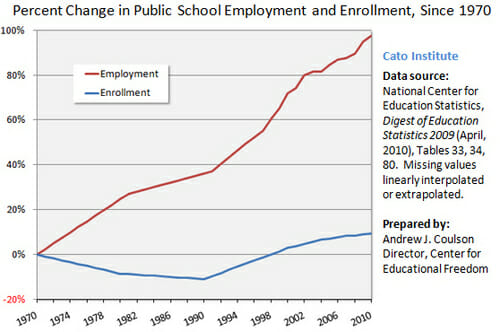
Andrew Coulson looks at one of these groups, teachers, and wonders what all the fuss is about -- its about time we laid some public school employees off after years of rapidly declining productivity:

I have been looking for a good excuse to clear my reader cache of a whole series of articles on government salaries and pensions, and this seems a really good time.

Much like the bailout of billionaires on Wall Street, the government worker bailout is targeting a group already doing much better than their peers in private industry.  (via Carpe Diem)

Related, via Carpe Diem:

"Who are America's fastest-growing class of millionaires? They are police officers, firefighters, teachers and federal bureaucrats who, unless things change drastically, will be paid something near their full salaries every year--until death--after retiring in their mid-50s. That is equivalent to a retirement sum worth millions of dollars.

Chris Edwards has a related essay, focusing on federal government pay.

Matt Welch looks at two DC-area counties and shows how their relative financial health is closely related to their hiring and pay policies.

Answer: 36 to 38

Question:  How many years does it take for a typical government / green investment to pay off?

Example 1:

Mesa got $1 million in federal stimulus money to replace 2500 traffic lights with LED's. That's $400 a light which probably includes the cost of installation. Once they are operational, Mesa expects to save $0.028 million per year in electricity costs. At that rate, it will only take 35.7 years of savings to get the $1 million back.

Example 2:

Nine turbines from seven manufacturers, including Reno's Windspire, are being installed to test their performances in different environments. The first turbine was installed at the sewer plant in Stead and the second at Mira Loma Park.The nine turbines and several solar projects together are a $3.5 million investment, before $1.7 million in energy rebates are applied to reduce that cost. The projects are expected to save 788,932 kilowatt hours a year for an annual savings of $91,000 a year [a 38-year payback].

The latter example actually over-estimates the payback, because it ignores the substantial maintenance costs of wind turbines (what percentage have you actually seen running?) as well as the systematic over-estimation of their power output.  Incredibly, the SF Chronicle's green writer/blogger actually brags up the Reno boondoggle.

Postscript: In the comments of the wind turbine article I added, in response to the projects green credentials:

But, you say, its not about return on investment but CO2 reduction. OK, lets look at that, forgetting for a minute whether Reno taxpayers should be paying extra for electricity to reduce global temperatures by 0.00000000001C.

Let's consider an alternate investment in gas turbine electric generation, and assume it and the wind turbines are displacing coal-fired power. Per Kw-H, gas turbines are going to, even including the fuel, produce power for a fourth or less the cost of wind with these relatively small turbines. And gas is plentiful and most of it comes from the gold old USofA (or at least North America).

But it's not zero emission you say. OK, but if it is 1/4 the cost that means that it can displace four times as much coal power for the same investment. And it is as low of CO2 emissions per btu as you can get in a fossil fuel. In fact, 4X of gas generation would reduce CO2 emissions more than 1X of wind. So even in terms of CO2 emissions, wind here is a bad investment.

The Government Would Never Be This Short-Term Focused on Quarterly Accounting... NOT

If you have worked in a large corporation, you probably have witnessed some end of quarter or end of year sales push, to buff up the current period's results.  People who buy cars often get the advice to buy at the end of the month or year to take advantage of this motivation.  A great example of this was in the book Barbarians at the Gate, where RJR would load the channel at the end of each quarter with tons of extra inventory to buff up quarterly profits.  Of course, this just creates the incentive next year to load the channel even more to top the previous quarter's profits that were pumped up by loading.

All of this is both rational and irrational.  From a shareholder standpoint it is irrational -- the end of the reporting period is arbitrary and all the company is doing is shifting some sales a few days, rather than generating new ones.  It can even be negative for shareholders, as in the RJR case when loading caused inventory to sit on shelves for longer and get stale and thereby less appealing to customers.   For employees of the company, this can be entirely rational depending on their incentives.  While pulling sales forward to get a better grade or commission for this quarter feels good now, it can make the next quarter harder.  But who knows what will happen in the next quarter?  In a high turnover world, I could be in a new job or new company next quarter.  Anyone who has worked with corporate incentive programs knows that it is impossible to eliminate all the unintended consequences -- all one can do is minimize them.

But supporters of government superiority to private enterprise argue that this is exactly why government is superior, because it does not have these short-term focused goals.  HAH!

Politicians are among the worst at this.  It used to be they would do short term things to get elected, leaving the following election to take care of itself.  Now, they will take short term actions just to dominate the current news cycle.  Next week? That's an eternity, we have problems now.  Every single action taken over the last two years by both this and the previous administration and the current one relative to the economy have been totally short-term focused.  Let's bail everyone out.  Moral hazard?  That's the next administration's problem.  Just look at cash for clunkers, where the government paid $4000 for cars that blue-booked for $1500 all to pull September sales into August.  But they won the news cycle in August!

But the actual reason for my rant is a note I got from the Arizona Department of Revenue.  Apparently they have a program where large filers have to do a special report to pre-pay June sales tax** collections by June 29  (rather than by July 20 when they would usually be due).  As is so often the case, the law has been changed such that a special requirement for large filers had its threshold changed such that small-medium filers like myself also now have to play.  This is a sort of 13th report one must file (we file reports monthly) and the processing of it takes a lot of private time, plus the state has to hire a number of temps and pay overtime to receive this filing.

So why the special requirement?  Well, Arizona is on a July-June fiscal year, so June 29 is just about the end of their fiscal year.  And they are on a cash accounting basis (like most governments) so any cash that comes in the door, even if it is for a pre-payment of a future liability, counts as current period income.  This means that the state is spending a lot of overtime money shifting income by 21 days just to make its current period look better -- just like RJR or any other dynsfunctional private company.

But what makes this even more short term is that it only works once -- the first time.  It will make the first year this trick is applied look better, but then every year after will go back to being the same, with July losses to the prior year offset by June gains from the forthcoming year.  In fact the only way this game can work twice is if the threshold for pre-paying is lowered -- which is why I am having to fill out an extra form and pay a large bill 3 weeks in advance.  Arizona is looking for another one time gain.  And the larger the gain, the harder it will be to unwind this stupid costly process in the future.

** Footnote:  Actually we don't have a sales tax but a "transaction privilege tax."  However, that term gets me so infuriated, as it is based on the premise that private commercial transactions can be made only as a privilege granted by the government, that I refuse to use the term.  Right from the AZ DOR web site:  "the tax is on the privilege of doing business in Arizona."  Barf.  Don't let anyone tell you Arizona is a wild, libertarian, free market state.

More Stimulus Follies

Readers will remember my chart the other day on the effects of the cash-for-clunkers auto stimulus program:

Folks who understand this dynamic will not be surprised by what is going on in the housing market now that free taxpayer cash for home buyers no longer is being handed out

Everybody take a nice long look at today's Pending Home Sales Index from the National Association of Realtors, because it's just about the last positive picture we're going to see for a while.

Yes, the index rose even more than expected, as buyers rushed in to take advantage of the home buyer tax credit.And yes, those numbers will show up in Existing Home Sales in May and June, but then look out.

This index is based on contracts signed in August, and that's how the credit was set up; you had to sign your contract by April 30th and close by June 30th in order to get your $8000 if you're a first time buyer and $6500 if you're a move up buyer.

And then came May, traditionally the height of the spring housing season.

Mortgage applications to purchase a home began to sink. Now, four weeks later, mortgage purchase applications are down nearly 40 percent from a month ago to their lowest level since April of 1997.

More on Coyote's Media Theorem

Back in January, I wrote about both ethanol and the stimulus bill, observing:

I have decided there is something that is very predictable about the media:  they usually are very sympathetic to legislation expanding government powers or spending when the legislation is being discussed in Congress.  Then, after the legislation is passed, and there is nothing that can be done to get rid of it, the media gets really insightful all of a sudden, running thoughtful pieces about the hidden problems and unintended consequences of the legislation

My emerging theorem about the media is that they want to be on the record as having predicted problems with legislation, but that for leftish legislation they personally support, they defer their most insightful analysis until after the law has passed.  That way, their favored legislation gets on the books, but they are also on the record as having spotted potential problems and can make the argument later that they were not rubes or useful idiots.

We are seeing this yet again, as the New York Times questions some obvious flaws with the Dartmouth health savings data (ht Insty)

Of course, the article misses the most obvious point -- while the Dartmouth data was certainly used to try to sell Obamacare, nothing in the actual legislation does anything to capture these supposed potential savings.  The $700 billion in waste number is more of a sort of happy thought that lets politicians sign the ridiculously expensive bill while pretending that some mythical savings are somehow available in the future through unidentified mechanisms to pay for the program.

Conservatives are Screwing Up

Conservatives, nominally supporters of smaller government and free markets, are yet again torpedoing these principles in the name of short term political expediency.  In order to score a few fleeting points against Obama, they are calling him out over the BP oil spill, saying that this is his Katrina, a massive failure both in regulation and response.

That's stupid.  One can certainly raise some questions about the government -- why have they been collecting an oil spill cleanup tax but not any oil spill cleanup capability or equipment, why are we driving oil companies out of easy oil in shallow waters to crazy-hard oil in deep waters.  But this is not Obama's fault nor the government's fault.  This is BP's fault.  They screwed up and started the spill, and it was they that had no contingency plan for such a disaster.  And its going to cost them a staggering amount of money, as it should.

After all, what are the feds going to do?  They certainly can't be expected to maintain the expertise to deal with this kind of thing, particularly in cutting-edge deep water.  Which is why Obama has had to resort mostly to joggling BP's elbow demanding that hey hurry.

We have the incredible sight of Conservatives, rightly, saying that more regulation could not have prevented the financial crisis because regulators are any better than industry participants in spotting problems when entering uncharted territory.  But here we have exactly the same situation and Conservatives are hammering on Obama for not being authoritarian enough or regulating enough.

Postscript: One of the few things the Obama administration has done is demand BP stop using a certain oil dispersant chemical because it is toxic.  Duh.  So is all the oil.  Which is probably why BP ignored him.  Government is terrible with this type of decision.  We have something really bad happening that we can't control.  But we can make it less bad by doing X, but X has some downsides as well.   In the heat of battle, when discretion is required, government will choose the sin of omission (letting more oil reach the shore) over the sin of commission (using a toxic dispersant), even if this decision is irrational.  In their incentive system, the sin of commission is impossible to sluff off on someone else.  The sin of omission can always be blamed on BP, or Bush, or whoever.  This is one reason why government bureaucratic rules are often so detailed and prescriptive -- given these incentives, certain decisions will never be made in the heat of battle by bureaucrats unless their actions are guided by detailed rules, which then give them cover.

Postscript #2: I think the media has tended to underestimate the difficulty here.  5000 feet of water is really deep and complicated to work in, orders of magnitude harder than shallow water, which in turn is orders of magnitude harder than on land.  In a way, its actually kind of amazing that BP has sealed this thing, given that the Soviets, in much less difficult leaks, reportedly had to resort to nukes to seal the well.

Grim Milestone

Via the USAToday

Paychecks from private business shrank to their smallest share of personal income in U.S. history during the first quarter of this year, a USA TODAY analysis of government data finds.

At the same time, government-provided benefits "” from Social Security, unemployment insurance, food stamps and other programs "” rose to a record high during the first three months of 2010.

Those records reflect a long-term trend accelerated by the recession and the federal stimulus program to counteract the downturn. The result is a major shift in the source of personal income from private wages to government programs.

Buried in the ariticle is a quote that I have to cite as perhaps the worst analysis I have ever seen:

The shift in incomeshows that the federal government's stimulus efforts have been effective, says Paul Van de Water, an economist at the liberal Center on Budget and Policy Priorities.

"It's the system working as it should," Van de Water says. Government is stimulating growth and helping people in need, he says. As the economy recovers, private wages will rebound, he says.

How does the income shift prove the stimulus worked?  The problem is, as usual, a difficult one of evaluating what the economy would have done without the stimulus.  The mere shift in income is a necesary outcome of the stimulus -- all it means is that we have succesfully robbed Peter to pay Paul -- it says nothing about whether Peter and Paul are more wealthy in aggregate had we not moved money around by force.  In fact, proponents of the stimulus never, ever address a very simple fact - someone was using the money to run a business or invest or buy things or employ people before the government took it for stimulus programs.  And it is really, really hard to look at the body of stimulus programs and come to the conclusion that the private sector was investing the money worse, which is the only way stimulus would occur.

Green Rent Seeking

I am a little late on this but want to link it none-the-less:

As predicted was inevitable, today the Spanish newspaper La Gaceta runs with a full-page article fessing up to the truth about Spain's "green jobs" boondoggle, which happens to be the one naively cited by President Obama no less than eight times as his model for the United States. It is now out there as a bust, a costly disaster that has come undone in Spain to the point that even the Socialists admit it, with the media now in full pursuit....

La Gaceta boldly exposes the failure of the Spanish renewable policy and how Obama has been following it. The headline screams: "Spain admits that the green economy as sold to Obama is a disaster."

This is a failure of every single number ever published by supporters of government stimulus programs.  They always fail to acknowledge that the money for these programs came from somewhere.  It was being employed by someone to buy something or to invest in something or to pay someone's wages.  Every private company in the world seems to understand this concept of opportunity cost, so it is amazing that it is so hard to grasp in the media which breathlessly reports every BS number Obama has spit out.

Eskimos Running Out of Ice

At least, that is, when the government is managing the ice supply:

Venezuela's economy is in trouble despite the country's huge oil reserves. Blackouts plague major cities. Its inflation rate is among the world's highest. Private enterprise has been so hammered, the World Bank says, that Venezuela is forced to import almost everything it needs.....

This is not the way it was supposed to be. Venezuela is one of the world's great energy powers. Its oil reserves are among the world's largest and its hydroelectric plants are among the most potent.

Great Moments in Government Investment

Remember how the US gasoline-powered automobile market would never have developed without the massive government grants to Standard Oil to build out a gas station network?  Yeah, neither do I.

But I Was Not One of Them

I liked this bit from Megan McArdle on Elena Kagan because it fit so well with a category of people I saw all the time at Princeton (Kagan and I overlapped somewhat though I did not know her).

But I do think that David Brooks is onto something when he notes that her relentless careerism, her pitch-perfect blandness, are a little creepy. Not in themselves, but because they're a symptom of a culture that increasingly values what Brooks calls Organization Kids: the driven, hyperachieving spawn of the Ivy League meritocracy who began practicing Supreme Court nomination acceptances and CEO profile photo poses long before they took notice of the opposite sex.

The discussion of late is whether these Ivy Leaguers really are representative of the broader country, but I would add that these folks really were not liked even within Princeton.  A great example is Eliot Spitzer.  His treatment of Princeton and its student government as a sort of minor league tryout for future political ambitions drove everyone nuts, to the point that he even triggered an outlandish opposition party, the Antarctic Liberation Front.

Back when I was an undergrad at Princeton, one of my fondest memories was of a bizarre Student Body Governing Council (USG) election.  The previous USG administration, headed by none other than fellow Princetonian Eliot Spitzer, had so irritated the student body that, for the first time in memory, the usually apathetic voting population who generally couldn't care less who their class president was actually produced an energetic opposition party.  Even in his formative years, Spitzer was expert in using his office to generate publicity, in this case frequent mentions in the student newspaper that finally drove several students over the edge.The result was the incredibly funny and entertaining Antarctic Liberation Front.  I wish I had saved their brochures, but their proposals included things like imposing a dawn to dusk curfew on the school and funding school parties by annexing the mineral rights between the double yellow lines of the US highways.  All of this was under the banner of starting jihad to free Antarctica.  The ALF swept the USG election.  This immensely annoyed Spitzer and other USG stalwarts, who decried the trivialization of such an august body.  The pained and pompous wailing from the traditional student council weenies (sounding actually a lot like liberals after the last presidential election) only amused the general student population even further.  After a few student-council-meetings-as-performance-art, the ALF resigned en mass and life went back to being just a little bit more boring.

(Don't miss Virginia Postrel's take on the whole episode, occasioned by Spitzer whining about the episode 20 years later in the New Yorker.)

One other data point:  Two years later, after drinking a few adult beverages, it came into my head that it would be a really good idea to moon the USG meeting being held nearby.  I asked for volunteers, expecting a handful, and got over 40.  The episode saddens me only because I did not think of it soon enough to have mooned Spitzer.

Update: Hilarious

The Most Outlandish Historical Revisionism I Have Ever Seen

First, the background.  Veronique de Rugy writes something that is undeniably true, though the Left has played semantic games with words like "trust fund" and "lockbox" for years to try to "shelter" the public from this reality:

In practice, [] the trust fund and interest payments it receives are simply accounting fiction. For years, the federal government has been borrowing the Social Security Trust Fund assets for its daily spending. The fund has nothing left in it except IOUs from the federal government. In fact, even the interest is paid in IOUs.

Hence, the only way Social Security will not go into the red this year and in future years is if the federal government pays back Social Security. But since the money has long ago been consumed, it must borrow money from the public or raise taxes to pay its Social Security debts.

In response, Kevin Drum whips out this absolutely stunning statement:

Back in 1983, we made a deal. The deal was this: for 30 years poor people would overpay their taxes, building up the trust fund and helping lower the taxes of the rich. For the next 30 years, rich people would overpay their taxes, drawing down the trust fund and helping lower the taxes of the poor.1

Well, the first 30 years are about up. And now the rich are complaining about the deal that Alan Greenspan cut back in 1983. As it happens, I agree that it was a bad deal. If it were up to me, I'd fund Social Security out of current taxes and leave it at that. But it doesn't matter. Once the deal is made, you can't stop halfway through and toss it out. The rich got their subsidy for 30 years, and soon it's going to be time to raise their taxes and use it to subsidize the poor. Any other option would be an unconscionable fraud.

I really had a WTF moment when reading this.  Its hard to know where to start, so here are some reactions in semi-random order:

  • For those of you over 40, do you remember such a deal?  No, you don't, because there never was one.  What happened was that Congress decided to sweep the Social Security surplus into the deficit calculation in order to disguise the magnitude of unsustainable spending, to help prevent the kind of electoral backlash we may well see later this year.  This is Soviet-style history making.
  • Here is a thought problem: Picture Tip O'Neil, Speaker of the Democrat dominated House of Representatives at the time, publicly signing on to a deal that the poor would pay higher taxes for 30 years to give the rich a tax break.  It is a total joke to even consider.   The absurdity of such a notion is mind-boggling.
  • It took me a while to parse this and figure out what he was even talking about.   For example, there was never a tax increase to the poor during the 1980's, so what does he mean that the poor would pay more for 30 years?  The only way this can even be the correct view of the world is if one makes two assumptions:
      1. Everything Congress chooses to spend money on is perfectly, morally justifiable and therefore spending levels are a fact of nature beyond our ability to challenge or question
      2. Rich people have the moral obligation to pay for all incremental government programs, and all budget gaps will be closed by new taxes on rich people.  Taxes on rich people, as a corollary, are never too high.

      Given these assumptions, then the "Deal" sort of kind of makes sense.  By the progressive "logic" of these two assumptions, social security taxes in an alternate world would have been reduced during the surplus and the general budget deficit would have been filled not with social security surpluses but higher taxes on the rich.

      • The previous logic depends on treating social security taxes as unfairly regressive taxes as part of an income transfer / welfare program.  If you treat them as premiums in an insurance program, the retroactive logic trying to cast this as a "deal" in 1983 doesn't work.  Interestingly, many on the left in other forums have argued against calling social security taxes anything but insurance premiums, including....Kevin Drum

      The men in my family of my father's generation returned home after serving their country and got jobs in the local steel mills, as had their fathers and their grandfathers. In exchange for their brawn, sweat, and expertise, the steel mills promised these men certain benefits. In exchange for Social Security taxes withheld from their already modest paychecks, the government promised these men certain benefits as well.

      "¦.These were church-attending, flag-waving, football-loving, honest family men. They are rightfully proud of providing homes and educations for their children and instilling the sorts of values and manners that serve them well as adults. And if I have to move heaven and earth, now that they've retired, the Republican party is NOT going to redefine them as welfare recipients.

      • Note by the way, that if this really is an insurance program, any private insurer or private pension fund managers in America would be in jail had they done what our trustworthy federal government did.  In effect, they spent other people's pension money on current operations.

      If we want to describe the last 30 year history of Social Security surpluses as a deal, here is what the actual deal was without ex post facto varnish:  Congress in the eighties said that they were going to spend that surplus money now to get themselves re-elected, and some other Congress 30 years hence would have to figure out how to deal with the bare cupboard.   That was the deal.  It was a simple screw you to future generations.

      Drum, given his progressive assumptions, fantasizes a deal based on his assumption that the only way to fill in the hole is with higher taxes on the rich, because his mind is incapable of wrapping itself around any other alternatives (see the two assumptions above).

      But it is worth noting that the surplus was in the main handed away by the Democrats to the poor and middle class through new entitlement spending.  Its hard to figure how a series of actions that took seniors pensions and frittered it away in a variety of programs that at best helped the poor and in reality probably helped no one but government bureaucrats somehow obligates the rich to pay 30 years of new taxes to clean the whole mess up.

      Juxtaposition

      This post and this post came up back to back in my feed reader this morning.  The first explored per capita GDP between Greece and Germany, and wonders why the published numbers can be so close when visual evidence is that the average Greek is far less prosperous than the average German.  Brian Caplan explains the largest difference between Greece and Germany in terms of public sector productivity, with 10% of the workforce in Germany working for the state while a third of Greeks do so.

      Knowing the Germans, it's easy to believe that its government employees accomplish as much as the Greeks' despite their smaller population share.  This implies that 25% of the Greek labor force is, contrary to official stats, producing nothing.

      So using Sumner's other numbers - and assuming output is roughly proportional to labor force - per-capita GDP is more than 50% higher in Germany than Greece.  First-hand observation tells me that's still an understatement, but it still closes a big chunk of the gap between official stats and reality.  How's that for a mental image?

      UPDATE: The NY Times apparently overstated the 1/3 figure, see here.

      Right after reading that piece, I read this from Jim O'Brien via Tad DeHaven:

      Back in 1990, Halstein Stralberg coined the term "automation refugees" to describe Postal Service mail processing employees who were assigned to manual operations when automation eliminated the work they had been doing. Since the Postal Service couldn't lay off these employees, they had to be given something to do, and manual processing seemed to have an inexhaustible capacity to absorb employees by the simple expedient of reducing its productivity. The result was a sharp decline in mail processing productivity and a sharp increase in mail processing costs for Periodicals class. Periodicals class cost coverage has declined steadily since that time.

      O'Brien then tells of visiting seventeen mail processing facilities as part of a Joint Mail Processing Task Force in 1998. During those visits he noted that the periodical sorting machines always happened to be down even though the machines were supposed to be operating seventeen hours a day. Although the machines weren't working, manual operations were always up and running.

      A decade later, O'Brien points out that the situation apparently hasn't changed:

      More Periodicals mail is manually processed than ever, and manual productivity continues to decline. Periodicals Class now only covers 75% of its costs. How can this dismal pattern of declining productivity and rising costs continue more than two decades after it was first identified, especially when the Postal Service has invested millions of dollars in flats automation equipment?

      Years ago, I briefly consulted to the SNCF, the French national railroad.  I say briefly, because thought they technically asked us to benchmark them against US firms, its clear they did not really want to hear the results.  The one figure that sticks in my mind is that they had something like 100,000 freight cars, but 125,000 freight car maintenance employees.  I remember observing to a highly unamused SNCF executive that they could assign one maintenance worker to his very own freight car and still lay off 20% of the staff.  And apparently France is an order of magnitude better on stuff like this than Greece.

      Government Employee of the Year

      Outright Fraud

      I was suspicious of GM's announcement that they were paying off government loans quickly, an action that was attached to a clear PR message that can be boiled down to "taxpayers did the right thing giving us billions."  I was suspicious because I had thought most of the money GM got was an equity infusion as well as certain guarantees, such as of the UAW mention and retirement medical plans.  As such, I suspected that a small debt repayment was trivial and just a token PR move.

      I was wrong.  Well, actually, everything I wrote above is correct.  But I was wrong in that I underestimated how fraudulent this announcement was.

      The issue came up yesterday at a hearing with the special watchdog on the Wall Street Bailout, Neil Barofsky, who was asked several times about the GM repayment by Sen. Tom Carper (D-DE), who was looking for answers on how much money the feds might make from the controversial Wall Street Bailout.

      "It's good news in that they're reducing their debt," Barofsky said of the accelerated GM payments, "but they're doing it by taking other available TARP money."

      In other words, GM is taking money from the Wall Street Bailout "“ the TARP money "“ and using that to pay off their loans ahead of schedule.

      "It sounds like it's kind of like taking money out of one pocket and putting in the other," said Carper, who got a nod of agreement from Barofsky.

      "The way that payment is going to be made is by drawing down on an equity facility of other TARP money."

      Translated "“ they are using bailout funds from the feds to pay off their loans.

      Un-freaking-believable.   And as an aside, I know that we traditionally have a 5-year waiting period, but can we go ahead and add TARP now to the hall of fame of worst legislation?

      Update: It turns out it is even worse.  More Here.

      Thought For the Day

      Radley Balko with this observation:

      I don't promote government failure, I expect it. And my expectations are met fairly often. What I promote is the idea that more people share my expectations, so fewer people are harmed by government failure, and so we can stop this slide toward increasingly large portions of our lives being subject to the whims, interests, and prejudices of politicians.

      I will concede that there's a problem, here. In the private sector failure leads to obsolescence (unless you happen to work for a portion of the private sector that politicians think should be preserved in spite of failure). When government fails, people like Dinauer and, well, the government claim it's a sign that we need more government. It's not that government did a poor job, or is a poor mechanism for addressing that particular problem, it's that there just wasn't enough government. Of course, the same people will point to what they call government success as, also, a good argument for more government.

      It's a nifty trick. The right does it with national security. The fact that we haven't had a major terrorist attack since September 11, 2001 proves that the Bush administration's heavy-handed, high-security approach to fighting terrorism worked! But if we had suffered another attack, the same people would have been arguing that we need to surrender more of our civil liberties to the security state. Two sides. Same coin.

      Public Sector Unions

      Readers of the site know that I do not generally join in with the Conservative bashing of unions, except to the extent that they feed at the public trough (e.g. at GM) where I will bash them equally with all other similar hogs.  Unions are perfectly acceptable associations of individuals in a free society for a generally rational purpose.  What upsets this equation is when the government attempts to intervene to tilt the playing field either towards employers or unions in their negotiations -- but this is a government intervention issue, not a union issue per se.

      Far more problematic is the growing influence of public employee unions.  Union advocates talk about the need to help private unions in a power imbalance with large corporations, but talk about a power imbalance!  In the public sector, we have hugely powerful unions with absolutely no one willing to take them on.  Government leaders who supposedly should be advocates of taxpayers and pushing back against union demands are typically in bed with unions.  One might say it is a similar case to unions owning the private company in which they work, but in that case there are market dynamics that mitigate against overly high pay or indifferent customer service.  No such balancing mechanisms exist in government monopoly institutions.

      There have been a lot of articles on this topic of late that I have been keeping in my reader but have not linked, so to do a bit of tab-clearing, here are some good recent articles on public sector unions.

      Carpe Diem shows the direct relationship between increasing public sector unionization and public sector debt.  Chris Edwards appears to be the original source.

      Chris Edwards followed up to show an inverse relationship between state management quality and unionization.

      Bruce McQuain discusses the $500 billion California unfunded pension liability.  And this does not include the unfunded liabilities of all the state's cities and towns and counties, which typically don't book any liability at all for their future pension and medical commitments.

      Steven Malanga on how public sector unions broke California.

      The camera focuses on an official of the Service Employees International Union (SEIU), California's largest public-employee union, sitting in a legislative chamber and speaking into a microphone. "We helped to get you into office, and we got a good memory," she says matter-of-factly to the elected officials outside the shot. "Come November, if you don't back our program, we'll get you out of office.'

      Traditionally, public sector unions have exercised a lot of power in elections, as evidenced by this example of the success of unions in fielding winning candidates in California school board elections.   Bruce McQuain reports that the SEIU has even formed its own 3rd party in North Carolina.  Its amazing that candidates whose main platform is to shift more taxpayer resources to the pockets of government workers has success.

      Finally, according to the GAO, union contracts have a lot to do with why the USPS is failing  (as labor accounts for 80% of USPS costs).  They seem to have all the labor problems GM had, except there is even less pressure to correct the problems, since after all we can't get our mail delivered by Honda or Toyota.  Here is an example:

      • USPS workers participate in the federal workers' compensation program, which generally provides larger benefits than the private sector. And instead of retiring when eligible, USPS workers can stay on the "more generous" workers' compensation rolls.
      • Collective bargaining agreements limit the amount of part-time and contract workers the USPS can use to fit its workload needs, and they limit managers from assigning work to employees outside of their crafts. The latter explains why you get stuck waiting in line at the post office while other postal employees seemingly oblivious to customers' needs go about doing less important tasks.
      • Most postal employees are protected by "no-layoff" provisions, and the USPS must let go lower-cost part-time and temporary employees before it can lay off a full-time worker not covered by a no-layoff provision.
      • The USPS covers a higher proportion of employee premiums for health care and life insurance than most other federal agencies, which is impressive because it's hard to be more generous than federal agencies.
      • If the collective bargaining process reaches binding arbitration, there is no statutory requirement for the USPS's financial condition to be considered. This is like making the decision whether or not to go fishing, but not taking into consideration the fact that the boat has holes in its bottom.

      And People Trust Government?

      I have total sympathy with those who distrust corporations.  Distrust and skepticism are fine things, and are critical foundations to individual responsibility.   History proves that market mechanisms tend to weed out bad behaviors, but sometimes these corrections can take time, and in the mean time its good to watch out for oneself.

      However, I can't understand how these same people who distrust the power of large corporations tend to throw all their trust and faith into government.  The government tends to have more power (it has police and jails after all, not to mention sovereign immunity), is way larger, and the control mechanisms and incentives that supposedly might check bad behavior in governments seldom work.

      Here is a great example of behavior that is inconcieveable in the private sector, or, if found at a private company, would quickly result in its extinction.

      The system that Lower Merion school officials used to track lost and stolen laptops wound up secretly capturing thousands of images, including photographs of students in their homes, Web sites they visited, and excerpts of their online chats, says a new motion filed in a suit against the district.

      More than once, the motion asserts, the camera on Robbins' school-issued laptop took photos of Robbins as he slept in his bed. Each time, it fired the images off to network servers at the school district.

      Back at district offices, the Robbins motion says, employees with access to the images marveled at the tracking software. It was like a window into "a little LMSD soap opera," a staffer is quoted as saying in an e-mail to Carol Cafiero, the administrator running the program.

      "I know, I love it," she is quoted as having replied.

      Anyone want to be how many of the guilty in this case will be around in 5 years.  The over / under from Vegas is "all."

      I'm Almost Glad I Am Getting Old...

      ... because I won't have to face the full consequences of this:

      The 2009 federal balance sheet indicates that the government's net position (total assets less total liabilities) is a negative $11.5 trillion, 12.3 percent worse than the previous year. But that's just the tip of the iceberg. That negative balance excludes government obligations for social insurance programs, mainly Social Security and Medicare.

      Whether social insurance should be booked as a liability has long been a controversial issue among government accountants....

      Unable to reach agreement as to whether social insurance should be included as a balance sheet liability, the members of the FASAB compromised, and thus, immediately following the balance sheet is a "Statement of Social Insurance." In the 2009 annual report this indicates that the total present value of estimated social insurance expenditures over revenues is $45.9 trillion.

      Hence, simple addition indicates that the total net position of the government is a whopping negative $57.4 trillion.