Archive for 2008

Freedom from Criticism

I have argued many times on this page that there is a dangerous new rights theory gaining traction in today's college campuses.  That theory holds that there exists a freedom (mostly for people in "protected" groups -- women, minorities, etc) from being offended or even being criticized, and that this trumps free speech. 

For years I have supported the legality of what is called hate speech -- not because I agreed with it, but because I thought its expression, no matter how contemptible, should be legal.  Free speech should have no content tests.  I also argued that there was a slippery slope.  If making racist remarks is illegal today, perhaps just criticizing a woman or an African American might be illegal tomorrow.

Enter Priya Venkatesan, former English teacher at Dartmouth.  Ms. Venkatesan was hired by Dartmouth to teach all kinds of odd (but always trendy) socialist eco-feminist babble.  Such courses seem to be a staple of colleges today.  I remember a number of such professors at Princeton, but it was no big deal as long as the course were clearly labeled and one could avoid them.  After all, if people really were attracted to such drivel, it just left more spots open for the rest of us in classes that actually prepared us for the real world. 

The problems began, though, when Ms. Venkatesan's students refused to blindly agree with her  (apparently, they did not attend the University of Delaware indoctrination course that explained why you are not allowed to criticize anyone but white males).

The agenda of Ms. Venkatesan's seminar, then, was to
"problematize" technology and the life sciences. Students told me that
most of the "problems" owed to her impenetrable lectures and various
eruptions when students indicated skepticism of literary theory. She
counters that such skepticism was "intolerant of ideas" and "questioned
my knowledge in very inappropriate ways." Ms. Venkatesan, who is of
South Asian descent, also alleges that critics were motivated by
racism, though it is unclear why.

After a winter of discontent, the snapping point came
while Ms. Venkatesan was lecturing on "ecofeminism," which holds, in
part, that scientific advancements benefit the patriarchy but leave
women out. One student took issue, and reasonably so "“ actually,
empirically so. But "these weren't thoughtful statements," Ms.
Venkatesan protests. "They were irrational." The class thought
otherwise. Following what she calls the student's "diatribe," several
of his classmates applauded.

Ms. Venkatesan informed her pupils that their behavior
was "fascist demagoguery." Then, after consulting a physician about
"intellectual distress," she cancelled classes for a week. Thus the
pending litigation.

Litigation, exposure of the names behind anonymous course evaluations, and email threats from Ms. Venkatesan follow.  More from Lubos Motl.

Postscript:  By the way, it is just astounding to me that anyone with an over-room-temperature IQ could passionately believe that technological progress is bad for women.  One might argue that way society is organized still under-utilizes women and/or puts artificial roadblocks up to a woman's progress, but get some perspective!

Pre-modern life for women was horrible.  Because of the biological complexities of child-rearing alone, they died young far more often than men and their physical vulnerability caused them to be marginalized in virtually every society of every culture of the world until at least 1750 and really until 1900.  The whole women's movement is built on a platform of technology that only begins with the pill and encompasses a thousand things from automobiles to computers that reduce the importance of size and physical strength in getting ahead in the world. 

Question about Energy "Subsidies"

Kevin Drum and Alex Knapp write that there appears to be $20-$50 billion in federal energy subsidies each year going to the oil industry, and that this should be a target for elimination before any windfall profits tax.  I wrote in the comments:

I agree 100%.  Let's cut all the subsidies.

However, before you get too excited, my guess is that most of the
money marked as "oil company subsidies" really in fact goes to non-oil
projects like alternative energy. In the same way that a huge portion
of federal "highway" funds don't go to highways but to silly
politically correct failing transit projects, my guess is that,
similarly, "oil industry" subsidies go for a lot of silly alternative
energy projects.

I personally don't care where it goes. I am all for eliminating all
of this subsidy mess, equally, whether it's for oil exploration or
energy-from-donkey-poop or for CEO salary enhancement. But recognize
before you make this the liberal rallying cry, much of this subsidy
money may well be going to liberal pet projects.

Anyone have any better idea where this money goes that they are referring to?

Our Fault? Who, Us?

This is funny, in a depressing sort of way:

Twenty-four Republican senators, including presidential candidate Sen.
John McCain of Arizona, sent a letter to the Environmental Protection
Agency suggesting it waive, or restructure, rules that require a
five-fold increase in ethanol production over the next 15 years.

They make it sound like some weird EPA rule-making, but in fact the Senate, of which these folks are members, voted these provisions into law just 20 weeks ago.  Now, this is not a totally uncommon practice by lawmakers on the losing side of an issue to go to the administration to prevent enforcement.  And, in fact, I hope they are succesful.  But when the vote was taken 143 days ago, only 11 Republican Senators opposed the measure and one was a no-show for the vote (McCain).  So half of these 24 have buyer's remorse for legislation they voted for and on which the ink is barely dry. 

I have written on this enough, but ethanol makes no sense either as energy policy (it takes more energy to produce from corn than it provides) or as environmental policy (it does not reduce CO2 and causes ancillary environmental damage in terms of land and water use).  But Iowa is the first primary, and for some reason politicians just can't break the habit of pandering to Midwest farmers:

Friedman, Billings, Ramsey & Co. analyst Kevin Book argued in a
recent note to clients that Congress will not "turn on the corn belt"
because of the significant number of votes held by ethanol-producing
states.

We Are All Terrorists Now

In the future, we may or may not each get our 15 minutes of fame, but it appears will we all be on the terrorist watch list.  According to Kevin Drum, the GAO reported 755,000 records in the the terrorist watch list.  Drum helpfully graphs the growth of the list and extrapolates to 2008:
Blog_gao_no_fly

I had a fleeting warm fuzzy feeling, thinking "well, at least the GAO is on their case."  But in fact, they are not.  Here is the summary paragraph from the report:

GAO recommends several actions to promote a comprehensive and coordinated approach to terrorist-related screening. Among them are actions to monitor and respond to vulnerabilities and to establish up-to-date guidelines, strategies, and plans to facilitate expanded and enhanced use of the list.

The departments that provided comments on the report generally agreed with GAO's findings and recommendations.

No discussion about the size of the list - the sole recommendation is around using the list in more places for more purposes.  The report, while discussing a number of times the number of people detained for matching the list, does not even mention the false positive issue.  This is just criminally stupid, and these numbers underestimate the true cost.  First, there is no way that 755,000 or even 75,000 people traveling in this country are terrorist threats, so the list is dominated by false positives.  But in addition, if every name on the list is shared, on average, by 10** people who have no relation to the suspect but the name, then the results are insane.  Five or ten thousand (at most) truly dangerous people are sharing the list with 10 million innocents.  That's a false positive rate over 99.9%.

**UPDATE: This seems conservative.  This site tells me that Warren Meyer, not a particularly common name, is shared by 80 people in the US.

HowManyOfMe.com
Logo There are
80
people with my name
in the U.S.A.

How many have your name?

California Energy Leadership: Leading the Race to the Bottom

California is apparently trumpeting its "leadership in energy."  The centerpiece of its claims is its low per capita electricity use.  Arnold is making the claim now, but Kevin Drum was pushing this a while back when he said:

Anyway, it's a good article, and goes to show the kinds of things we
could be doing nationwide if conservative politicians could put their
Chicken Little campaign contributors on hold for a few minutes and take
a look at how it's possible to cut energy use dramatically "” and reduce
our dependence on foreign suppliers "” without ruining the economy. The
energy industry might not like the idea, but the rest of us would.

Max Schulz of the Manhattan Institute is not impressed:

California's proud claim to have kept per-capita energy consumption
flat while growing its economy is less impressive than it seems. The
state has some of the highest energy prices in the country "“ nearly
twice the national average "“ largely because of regulations and
government mandates to use expensive renewable sources of power. As a
result, heavy manufacturing and other energy-intensive industries have
been fleeing the Golden State in droves.

Neither am I.  I addressed this issue a while back in response to Drum's post, but since the meme is going around again, I will excerpt from that old post.

The consumption data is from here.
You can see that there are three components that matter - residential,
commercial, and industrial.  Residential and commercial electricity
consumption may or may not be fairly apples to apples comparable
between states (more in a minute).  Industrial consumption, however, will not be comparable, since the mix of industries will change radically state by state.....

Take two of the higher states on the list.  Wyoming, at the top of
the per capita consumption list, has industrial electricity consumption
as a whopping 58% of total state consumption.  KY, also near the top,
has industrial consumption at 50% of total demand.  The US average is
industrial consumption at 29% of total demand.  CA, NY, and NJ, all
near the bottom of the list in terms of per capital demand, have
industrial use as 20.6%, 15.1%, and 16% respectively.  So rather than
try to correlate electricity consumption to local energy regulations,
it is clear that the per capita consumption numbers by state are a much
better indicator of the presence of heavy industry. In other
words, the graph Drum shows is actually a better illustration of the
success of CA not in necessarily becoming more efficient, but in
exporting its pollution to other states.
  No one in their
right mind would even attempt to build a heavy industrial plant in CA
in the last 30 years.  The graph is driven much more by the growth of
industrial electricity use outside CA relative to CA.

Now take the residential numbers.  Lets look again at the states at
the top of the per capita list:  Alabama, South Carolina, Louisiana,
Tennessee, Arkansas, Mississippi, Texas.  Can anyone tell me what these
states have in common?  They are hot and humid.  Yes, California has
its hot spots, but it has its mild spots too  (also, California hot
spots are dry, so they can use more energy efficient evaporative
cooling, something that does not work in the deep south).  These
southern states are hot all over in the summer.  So its
reasonable to assume that maybe, just maybe, some of these hot states
have higher residential per capita consumption because of air
conditioning load?
  In fact, if one recast this list as
residential use per capita, you would see a direct correlation to
summer air conditioning loads.   This table of cooling degree days weighted for population location is a really good proxy for how much air conditioning is needed by state.  (Explanation of cooling degree days).
You can see that states like Alabama and Texas have two to four times
the number of cooling degree days than California, which should
directly correlate to about that much more per capita air conditioning
(and thus electricity) use....

OK, now I have saved the most obvious fisking for last.  Because
even when you correct for these numbers, California is pretty efficient
vs. the average on electricity consumption.  Drum attributes this,
without evidence, to government action.  The NY Times basically does
the same, positing in effect that CA has more energy laws than any
other state and it has the lowest consumption so therefore they must be
correlated.  But of course, correlation is not equal to causation.
Could there be another effect out there?

Well, here are the eight states in the data set above that the
California CEC shows as having the lowest per capita electricity use:
CA, RI, NY, HI, NH, AK, VT, MA.  All right, now here are the eight
states from the same data set that have the highest electricity prices:  CA, RI, NY, HI, NH, AK, VT, MA.  Woah!  It's the exact same eight states!  The 8 states with the highest prices are the eight states with the lowest per capita consumption.
Unbelievable.  No way that could have an effect, huh?  It must be all
those green building codes in CA.  I suspect Drum is sort of right,
just not in the way he means.  Stupid regulation in each state drives
up prices, which in turn provides incentives for lower demand.  It
achieves the goal, I guess, but very inefficiently.  A straight tax
would be much more efficient.

Subsidizing Real Estate Developers Ruled to be Clearly in the Public Interest

The city of Phoenix's $97 million subsidy for the developers of a new Phoenix shopping mall has been ruled by a local judge as being "'undoubtedly' in the public interest."  Even weirder, the developers lawyers are so mad at having their largess questioned that they are demanding the Goldwater Institute pay them $600,000 in attorneys fees as punishment for even questioning whether funding private mall parking lots that would have been built anyway is really in the public interest.

The subsidy, which I described in more detail here, provides $97 million for the construction of a parking garage at a new mall in North Phoenix, with the only condition being that the mall owners provide free parking in the garage to the public.  I can think of only three reasons this would be in the public interest:

1.  Without the subsidy, the mall might not provide enough parking
2.  Without the subsidy, the mall might charge for parking
3.  The parking garage could serve other surrounding businesses or homes within walking distance

Now, some of you on the coasts may be confused about this, so let me give you one other piece of background.  There are hundreds of shopping malls in the Phoenix area, from local strip malls to huge mega-malls of the type in this case.  At least 99.9% of the parking at all of these malls has been paid for with private funds.   Every one of these has plenty of parking.  This might not be the case in Boston, where land costs are high, but here in Phoenix, land is relatively cheap and malls are plentiful -- If I can't find a parking space, I would just go to a different place to shop.

Further, do you know the total number of these spaces at mall in Phoenix that are not free?  Zero.  OK, there may be one mall downtown that charges money to park, but for any mall in the area in which this one is being constructed, it would be insane to charge to park.  There are just too many competitor malls with free parking.

Finally, as to #3, look at the satellite view here.  Enough said. 

So the city paid $97 million in return for nothing of value, or at least nothing of value that the mall owners would not have provided on their own out of their own self-interest.  The only thing that I can identify the $97 million bought was possibly influencing the decision of one store (Nordstrom's) to locate in this particular development rather than 1 mile away, over the city line in another development planned in the City of Scottsdale.

About the numbers:   I really can't get away without taking on this statement in the same article:

According to its developers, CityNorth is expected to generate $1.9 billion in annual economic activity

In 2005, the metro Phoenix area had a GDP of $160 billion dollar.  The retail component of this is about $12 billion.  So this one mall / real estate project in one small part of Phoenix, one of hundreds just like it all over town, will increase our city's GDP by over 1% and in particular increase the city's retail output by 16%.  Sure.  I really wish our local paper would be just a tiny bit more credulous about printing these numbers from promoter's press releases.

The Profit Motive Rocks

This post from TJIC, which is really about something entirely different, mentions that the price of cocaine has been dropping sharply over the last 10 years.  This is something I have heard police officials lament as well.

Does the profit motive rock or what?  The largest and most powerful government in the world stations armed men and ships around the country.  It has a legal system in place with huge penalties that has of late been nearly entirely dedicated to drug enforcement.  The US has even subverted 200 year old Constitutional restrictions on searches and property seizures (the Patriot Act is mostly used for drug, not terrorism, actions).  All to stop the importation of certain valuable substances.  And even so, the human mind is powerful enough to subvert all of these restrictions and bring in so much supply that the price continues to drop.

Al Gore believes that alternative energy efforts in the US are being subverted by the oil companies:

Apparently, according to Gore, the oil companies drive up prices
reducing supply and then depress them in a telling pattern. As soon as
the political will swells to a light boil, the companies reduce
prices/increase supply.

Really?  Independent drug traders are able to subvert a million government officials with guns to keep cocaine prices low, but Exxon, with a 5% market share (at most) in oil, is able to hold the line on oil supply?

Sure.  In 1972 and 1978 there were a series of oil price shocks (to real levels about where they are today) that convinced everyone that oil prices would keep going up and up and that oil would run out within a few decades.  Of course, in about 1984 oil prices crashed, and stayed down for almost 20 years.  Depending on how you date it, it took oil supply development between 6 and 12 years after the price signal to flood the world with oil, and that was in an environment with price controls and windfall profit taxes that reduced development incentives. 

Right now, we are about 5 years in to the current oil price spike.  Go long at your own risk.

More on supply and demand vs. price manipulation in oil here.  More on Al Gore, including a fisking of his solar plan, here.

Update: Of course, the Democrats in Congress are doing everything possible to keep oil prices up.  If I wanted to ensure high oil prices, I would 1.  Kill incentives to increase supply, perhaps with a "windfall" profits tax and 2.  Put the most promising potential new exploration areas off-limits to new development.  Congressional scorecard:  #2 is in place, and both Obama and Hillary and Pelosi are proposing #1.

Update #2:   Another thought on Gore's statement:  The boom-bust
patterns in oil are characteristic of nearly every other commodity out
there, which therefore presupposes that if oil prices are the result of
manipulation, then every other commodity must be as well since their
prices demonstrate the same patterns.  We see these patterns in
commodities that politicians have never even heard of and in which they
have never thought to exercise their "political will."  (political will
in this context defined as use of government force against a segment of
the populace).

A reasonable person might
suppose that the surge in prices followed by a drop a number of years
later is better explained by the time delay in increasing oil
production after oil prices spike. In many ways, Al's theory is simply
delusional.  If your friend started trying to tell you, in all
seriousness, that every action Microsoft takes is actually aimed at
thwarting him personally, you would think him insane.  But this is
effectively Gore's argument, showing the immensity of the politician's
ego.  Oil prices move not because of supply and demand, but because of
us politicians.  Every tick up and down is carefully managed to thwart
us brave Congressmen!

When a politician describes price signals as mainly influencing political actions, rather than the actions of free producers and consumers, they are probably a socialist.

McCain and the Suppresion of Dissent

Anyone who still believes that campaign finance "reform" is really about cleaning up politics rather than protecting incumbents and government entities from challenge and dissent need to read George Will's column this week.

The First Amendment guarantees freedom of association, "the right of
the people peaceably to assemble, and to petition the government for a
redress of grievances." The exercise of this right often annoys
governments, and the Parker Six did not know that Colorado's
government, perhaps to discourage annoyances, stipulates that when two
or more people associate to advocate a political position, and spend
more than $200 in doing so, they become an "issue committee."

As such, they probably should hire a lawyer because even Colorado's
secretary of state says the requirements imposed on issue committees
are "often complex and unclear." Committees must register with the
government; they must fund their activities from a bank account opened
solely for that purpose; they must report to the government the names
and addresses of all persons who contribute more than $20; they must
also report the employers
of plutocrats who contribute more than $100; they must report non-cash
contributions such as lemons used for lemonade, and marker pens and
wooden dowels for yard signs.

McCain-Feingold makes it impossible for me to vote for McCain.  Of course, other such issues make it impossible for me to vote for the other two yahoos either.  Siqh.

Will Hillary Sue the US Congress?

Hillary apparently wants to sue OPEC for not producing enough oil. If this idea had come in via the constituent mail, Hillary's staffers would probably have laughed themselves silly, but it is an election year, and no bottom has been found below which candidates are unable to keep a straight face while uttering what they know to be nonsense.

But should Hillary be suing OPEC, or the US?  Because if you ranked the world's countries on those that are doing the least to develop the most promising potential oil deposits, the US would be right at the top of that list.  By Hillary's logic, Western Europe and Japan should be suing us.

Nozone

Know Your Enemy

I want to thank Tom Nelson for the pointer, because I usually don't hang out much at the Socialist Unity site.  But I thought that this post was telling.

While it may be urgent that we create a red green alliance to
strengthen radical social action to stop climate change, our collective
problem is how are we going to do that?

The Climate Change Social Change Conference
held in Sydney Australia during April tried to tackle that
challenge.This was a bold attempt to bring together left and green
activists in order to locate a shared perspective around which we could
begin more consciously organize....

Foster and Perez urged the conference's participants to consider
socialism as the only viable solution to the climate emergency. This
was a persistent theme discussed throughout the three day event as
speakers were drawn from a range of environment movements and
organisations (such as the Australian Greens and Friends of the Earth)
as well as academic specialists "” who preferred solution packages which
were not consciously committed to a socialist transformation of
society..

Footloose, Arizona Style

At San Tan Flats, you can dance if you want to:

Outdoor dancing is now allowed at San Tan Flat.

Pinal County Superior Court Judge William O'Neil Wednesday
overturned the decision of the county board of supervisors that said
the restaurant was operating illegally by allowing patrons to dance to
live music on its back patio.

The case, which stretched over two years, drew national attention.

The supervisors' decision stemmed from a 1962 ordinance that banned outdoor dance halls.

Dale Bell, owner of the restaurant, contended the county violated his rights to run his business.

He sued the county for $1.

"That $1 is about freedom and about civil liberties and the government not being allowed to overreact," Bell said Wednesday.

Pinal County threatened to fine Bell $700 for each day he violated the ordinance.

While We Are On The Subject of Oil...

Glen Reynolds brings us this:

A provision in the US Carbon Neutral Government Act incorporated
into the Energy Independence and Security Act of 2007 act effectively
bars the US government from buying fuels that have greater life-cycle
emissions than fuels produced from conventional petroleum sources.

The United States has defined Alberta oilsands as unconventional
because the bitumen mined from the ground requires upgrading and
refining as opposed to the traditional crude pumped from oil wells.

California Democrat Representative Henry Waxman, chairman of the
House Committee on Oversight and Government Reform and Republican Tom
Davis added the clause.

Uh, right.  Since we all burn pure unrefined crude oil pumped right from the oil well in our car. 

Here is what a traditional crude oil goes through before it becomes gasoline:

  • Water and salt must be removed
  • The oil is heated up to over 700 degrees, and is separated into its fractions via distillation.  Oil is made up of hydrocarbon chains of many lengths, from short ones (methane, ethane, propane) to very long ones (asphalt, heavy motor oils).  Gasoline is somewhere in between.
  • Each fraction generally has to be de-sulfurized.  This generally occurs by injecting hydrogen into the fraction across a catalyst bed to remove the sulfur as Hydrogen Sulfide, a dangerous gas that must be further processed to produce pure sulfur.
  • The gasoline fractions in a typical oil are nowhere near large enough for the relative demand.  So additional steps must be taken to produce gasoline:
    • Very heavy fractions have their molecules cracked at high temperatures, either in cokers, high temperature crackers or in fluid catalyst bed crackers.  These processes either remove carbon in its pure form or remove it by combining it with hydrogen
    • Certain fractions are reformed in combination with hyrdrogen, sometimes across a platinum catalyst, to produce molecules with better properties for gasoline, including higher octane.
    • All over a refinery, there are small units that take individual fractions that use a variety of processes to create specific molecules that have useful properties
  • All of these different fractions and products are blended in various proportions to make different grades of gasoline.  These blends and proportions can change from city to city (to meet environmental regulations, Phoenix must have a gasoline blend that is unique in the US) and must change season to season (gas that burns well in winter will vapor lock in the summer time).

I am sure I left tons of steps out, but you get the idea.  Below are my old digs at Exxon's Baytown Texas Refinery, where I worked as an engineer for 3 years out of college:

Baytown2  Baytown_2

Cognitive Dissonance

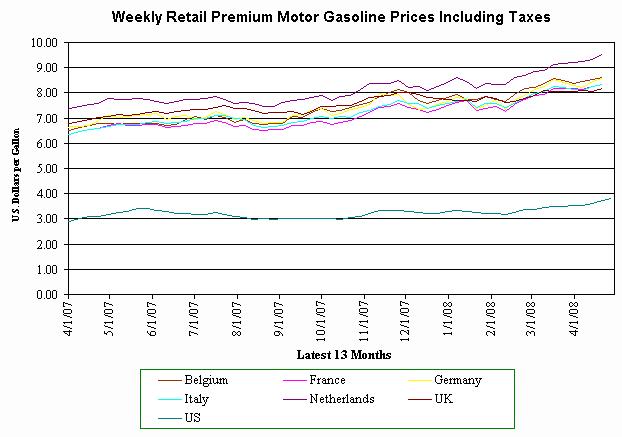
As a follow-up to this post on gas-price demagoguery, I would like to observe that the very same people who are most likely to demagogue about high gas prices in this country are the very same ones who advocate that the US adopt European-style taxation levels, regulatory policy, and CO2 targets, the results of which can be seen here:

Gas1

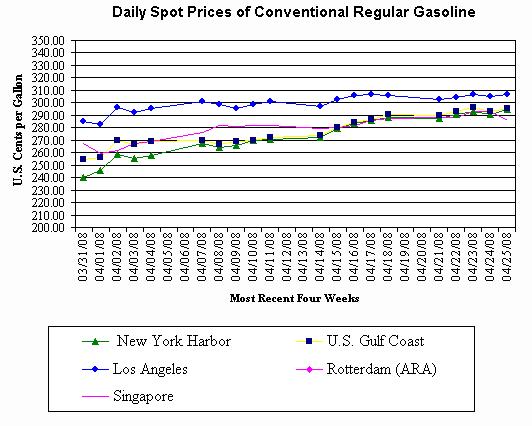
If you can't read the colors on the scale well, I think you can guess which is the US price line and which are the European gas prices.  Source here.  Just to be clear, this has nothing to do with wholesale gasoline prices, which are substantially similar between the US and Europe:

Gas2

Since the difference in price does not go to the producer, I will leave it as an exercise to guess where the extra $5 per gallon is going (hint:  Uncle Francois)  The cognitive dissonance required to call for 80% CO2 reductions while simultaneously decrying $3.50 gas prices is just stunning to me.

Update:  From the same source, here are the gas prices in dollars per US gallon EXCLUDING taxes:


Date Belgium France Germany Italy Nthrlnds UK US
4/14/2008 3.32 3.28 3.18 3.61 3.85 3.09 3.21

Update #2:  More here on Hillary's sleight of hand.  And this from Robert Samuelson, at how this cognitive dissonance extends to exploration limits:

We could be producing more, but Congress has put large areas of
potential supply off-limits. These include the Atlantic and Pacific
coasts and parts of Alaska and the Gulf of Mexico.
By government estimates, these areas may contain 25 billion to 30
billion barrels of oil (against about 30 billion barrels of proven U.S.
reserves today) and 80 trillion cubic feet or more of natural gas
(compared with about 200 tcf of proven reserves).

What keeps these areas closed are exaggerated environmental fears,
strong prejudice against oil companies and sheer stupidity. Americans
favor both "energy independence" and cheap fuel. They deplore imports
-- who wants to pay foreigners? -- but oppose more production in the
United States. Got it? The result is a "no-pain energy agenda that
sounds appealing but has no basis in reality," writes Robert Bryce in
"Gusher of Lies: The Dangerous Delusions of 'Energy Independence.' "

Cui Bono?

Here is something I didn't know:  Way back in the 1990's, Enron was lobbying hard for cap and trade legislation to create a lucrative new trading profit center for the company (HT Tom Nelson)

In the early 1990s Enron had helped establish the market for, and
became the major trader in, EPA's $20 billion-per-year sulphur dioxide
cap-and-trade program, the forerunner of today's proposed carbon credit
trade. This commodity exchange of emission allowances caused Enron's
stock to rapidly rise.

Then came the inevitable question, what
next? How about a carbon dioxide cap-and-trade program? The problem was
that CO2 is not a pollutant, and therefore the EPA had no authority to
cap its emission. Al Gore took office in 1993 and almost immediately
became infatuated with the idea of an international environmental
regulatory regime. He led a U.S. initiative to review new projects
around the world and issue "˜credits' of so many tons of annual CO2
emission reduction. Under law a tradeable system was required, which
was exactly what Enron also wanted because they were already trading
pollutant credits.

Thence Enron vigorously lobbied Clinton and
Congress, seeking EPA regulatory authority over CO2. From 1994 to 1996,
the Enron Foundation contributed nearly $1 million dollars - $990,000 -
to the Nature Conservancy, whose Climate Change Project promotes global
warming theories. Enron philanthropists lavished almost $1.5 million on
environmental groups that support international energy controls to
"reduce" global warming. Executives at Enron worked closely with the
Clinton administration to help create a scaremongering climate science
environment because the company believed the treaty could provide it
with a monstrous financial windfall. The plan was that once the problem
was in place the solution would be trotted out.

With Enron out of the picture, the way is clear for new players to dominate this multi-billion dollar new business.  And look who is ready to take over from Enron:

The investment
vehicle headed by Al Gore has closed a new $683m fund to invest in
early-stage environmental companies and has mounted a robust defence of
green investing.

The Climate Solutions Fund will be one of the biggest in the growing market for investment funds with an environmental slant.

The fund
will be focused on equity investments in small companies in four
sectors: renewable energy; energy efficiency technologies; energy from
biofuels and biomass; and the carbon trading markets.

This is
the second fund from Generation Investment Management, chaired by the
former vice-president of the US and managed by David Blood, former head
of Goldman Sachs Asset Management.

The first, the Global Equity
Strategy Fund, has $2.2bn invested in large companies the company
judges have "sustainable" businesses, from an environmental, social and
economic viewpoint. Mr Blood said he expected that fund to be worth
$5bn within two years, based on commitments from interested investors.

Going green indeed.

The Wussification of America

From the Arizona Republic, presented without comment:

Phoenix fire vehicles, including some hazardous-materials units,
responded to a small mercury spill at Mountain Pointe High School
Tuesday afternoon. No one "complained of medical problems" or was
transported to a hospital, said Mark Faulkner, Phoenix Fire Department
division chief for the public affairs.

At about 1:30 p.m. a call came to the Fire Department about a
"dime-size spill of mercury" on the campus at 4201 E. Knox Road in
Ahwatukee Foothills, Faulkner said.

The mercury was in a science laboratory but how it spilled is unknown.
It could have been part of an experiment or possibly a thermometer
cracked, Faulkner said.

One of My Favorite Short Stories as a Boy

I rediscovered today an old favorite of mine, a short story written by Winston Churchill (yes, the same guy) in about 1930.  My son was searching for examples of alternative history, and found "If Lee Had Not Won the Battle of Gettysburg"

Amazon One-Star Reviews

Have I ever told you that I really like author John Scalzi?  Not just because I love his books, but I do really enjoy his work.  I like him because he spends a lot of time promoting the work of other young writers and promoting the science fiction and fantasy genre in general.

Recently, Scalzi published on his blog all his Amazon one-star reviews.  As a fairly novice writer who will never write as well as Scalzi, I found this quite liberating.  If folks like him endure these bad reviews, maybe I should not let my own setbacks get me down.  He has challenged other authors to do the same, publishing their Amazon one-star reviews online.  In this post, he links a number of authors who have taken up the challenge, including Charles Stross and Jo Walton.

So, though I am not in the league of these other authors, I will post my one-star review for my book BMOC.

I like the concept for the book and like reading Warren Meyer's Coyote
Blog. I don't understand how crude and uncouth became popular and I am
disappointed that is the approach that was chosen with this book. I
should have paid attention to the review by "Warren's mother." I've
returned my copy to Amazon for a refund.

Wow, I actually feel better.  Based on this review, I will warn you as I warn my friends when I give them a copy:  The book has its crude parts, and I have only let my kids read highly edited portions.  That being said, its not Fear of Flying either, and my parent's priest read it without spontaneously combusting.  But don't buy it if you are turned off by harsh language and some sexual humor.  I have two youth novels in the works, you can save your money for them ;=)

Postscript:  This is one of the one-star reviews posted for Anya Bast's Witch Fire:

"Not romance, not erotica, basically porn - what little plot there is
exists to connect the sex scenes, note I didn't say love making scenes.
Altogether distasteful and I won't waste money on this author again."

LOL, if the review is trying to hurt Ms. Bast's sales, I am not positive this is the right approach.

OMG

Wow- a video of Jimmy Page in 1957.  For you younger folks, Page was lead guitarist for the Yardbirds and Led Zeppelin, among others.

Demagoguery

Hillary has jumped on the gas tax holiday along with John McCain.   Kevin Drum calls it pure demagoguery (he probably wouldn't have been so blunt about Hillary, but since he already derided McCain for the idea, he has the good grace to apply the same criticisms to Hillary:

I'd say there's approximately a zero percent chance that Hillary
Clinton or John McCain actually believe this is good policy. It would
increase oil company profits, it would make hardly a dent in the price
of gasoline, it would encourage more summertime driving, and it would
deprive states of money for transit projects. Their staff economists
know this perfectly well, and so do they.

But they don't care. It's a way to engage in some good, healthy
demagoguery, and if there's anything that the past couple of months
have reinforced, it's the notion that demagoguery sells. Boy does it
sell.

I tend to agree with Drum.  The gas tax, at least when applied to its original purpose of funding highways and roads, is one of the better taxes out there, doing a pretty good job of matching the costs of roads to the users of the roads.  However, I did make this point in Drum's comment section:

I am glad you see that an 18.4 cent gas price reduction is small compared to the total price and proposing such a reduction by government fiat is pure demagoguery. 

I would like to point out that most oil companies have a profit on a wholesale gallon of gas that is also about 18-20 cents.  The reason they make so much money is that they sell a lot of gallons of gas (plus many other petroleum products).  So is it similarly pure demagoguery to blame oil company profits for the price of gas, or to suggest government schemes (e.g. windfall profits tax) to reduce these profits?

By the way, Hillary is particularly hypocritical on this, because she has adopted the 80 by 50 CO2 target (80% reduction by 2050).  To meet this target, which I think would be an economic disaster, is not going to require an 18.4 cent gas tax, but something like a $10 a gallon gas tax, or more.  Since she has adopted her 80 by 50 target, her correct answer on gas taxes should not be to propose a holiday, but to say "suck it up, because taxes are going to go a hell of a lot higher."  McCain, who has also adopted a CO2 target, though a less stringent one, is in the same boat.

Update:  OK, the $10 per gallon tax is probably gross under-estimated.  The number is likely to have to be much higher than that, given that Europeans are already paying nearly $10 a gallon and are not even in the ballpark of these CO2 targets.

Cost of gasoline
(U.S. Dollars per Gallon)
Date___     Belgium  France  Germany  Italy  Netherlands  UK  _ US
4/20/98     3.43___  3.44__  3.25___  3.48_  3.56_______ 4.04  1.21
4/21/08     8.62___  8.34__  8.58___  8.32_  9.51_______ 8.17  3.73

HT:  Hall of Record

From Now On I Must Be Addressed as "Award winning Filmmaker" Coyote

Here is the public announcement of my second prize in a climate video contest.  I am pretty sure I am not a kid, though, nor do I remember portraying myself as such. 

By the way, for those who don't know me well, the title of this post is a joke.  I often deride people for adopting titles like "award-winning X" when the award in question is often unknown or even, like as not, a product of a paid PR effort. 

Two-Income "Trap", aka the Government Trap

Todd Zywicki has a nice post on the The Two-Income Trap: Why Middle Class Mothers and Fathers are Going Broke by Professor Elizabeth Warren and Amelia Warren Tyagi. 

In his writings on the tactics for engineering the communist state, Karl Marx talked a lot about the need to "proletarianize the middle class."  This has been a very popular tactic among leftish writers and politicians today, attempting to convince the middle class that they never had it so bad.

I won't repeat Zywicki's whole post, but the books author's argument revolve around examples which purport to show that as families go from one to two earners, their costs (health care, child care, cars, mortgage, etc.) go up by more than the additional income, making them poorer on a discretionary spending basis.

Zywicki first points out the same thing I immediately thought of when I read a summary of the book:

It is not clear what to make of all of this, except that it is hard to
see how this confirms the central hypothesis of "The Two-Income Trap"
that "necessary" expenses such as mortgage, car payments, and health
insurance are the primary draing on the modern family's budget. And
again, this unrealistically assumes that all increased spending on
houses and cars is exogenously determined, ignoring the possibility
that an increase in income leads to an endogenous decision by some
households to increase their expenditures on items such as houses and
cars.

While the assumption seems crazy, it makes sense in the context of leftish ideology, which holds that the middle class have only limited free will and tend to have their decision making corrupted by advertising and other corporate pressures.

But Zywicki goes further, and actually digs into the author's numbers.  He finds that the authors are surprisingly coy about addressing changes in taxation in their numbers.   Zywicki then uses the authors' own numbers, this time with taxes factored in using the authors' own assumptions, and gets these two charts:
Toddtwo_income_3

Toddtwo_income_4

As Zywicki summarizes:

As can readily be seen, expenses for health insurance, mortgage, and automobile, have actually declined
as a percentage of the household budget. Child care is a new expense.
But even this new expenditure is about a quarter less than the increase
in taxes. Moreover, unlike new taxes and the child care expenses
incurred to pay them, increases in the cost of housing and automobiles
are offset by increases in the value of real and personal property as
household assets that are acquired in exchange.

Overall, the typical family in the 2000s pays substantially
more in taxes than in their mortgage, automobile expenses, and health
insurance costs combined.
And the growth in the tax obligation
between the two periods is substantially greater the growth in
mortgage, automobile expenses, and health insurance costs combined. And
note, this is using the data taken directly from Warren and Tiyagi's
book.

Something Else I didn't Know

Something I didn't know:  Arizona has a State Board of Homeopathic Examiners.   Seriously?  Do we also have a state board for horoscope writers?  For witch doctors?  For water diviners?  Doesn't the Flat Earth society need some supervision?

How do you have a board of scientific examiners for a discipline that has no science behind it.  A key part of homeopathy is the repetitive dilution of active ingredients to make "medicines."  In fact, homeopathy advocates claim that more diluted mixtures are more potent.  Here is an example, via Wikipedia:

Hahnemann advocated 30C dilutions for most purposes (that is, dilution by a factor of 1060).[73] A popular homeopathic treatment for the flu is a 200C [1 in 10400] dilution of duck liver, marketed under the name Oscillococcinum. Comparing these levels of dilution to Avogadro's number, one liter of a 12C homeopathic remedy created from diluting 1 liter of 1 molar solution
contains on average only about 0.602 molecules of the original
substance per liter of the 12C remedy. Similarly, the chance of a
single molecule of the original substance remaining in a liter of 15C
remedy dose is about one in 1.7 million, and about one in 1.7 trillion
trillion trillion (1036) for a 30C solution.

So what does the Homeopathic board do, look at the products sold for $100 by homeopaths and say, yep, that's pure water, it must be a valid homeopathic brew?

According to our governor here in Arizona, the Homepathic examiners are not doing their job.  What does that mean?  Did some homeopath actually sell a product that had a measurable amount of the active ingredient?  Anyway, the two comments so far on the Republic article sort of sum the whole debate up:

Commenter 1:  The number of people injured by homeopathic treatments is a tiny
fraction of the number of people killed and injured by regular
allopathic physicians and prescription drugs. The allopathic community
doesn't like the competition, though, so they create a crisis.

Commenter 2:The number of people helped by homeopathic treatments remains zero, so
the cost/benefit ration is infinitely higher than that of allopathy.  It's true that the allopathic medicine industry doesn't like
competition, but that doesn't change the fact that homeopathy is
nothing more than faith healing.

A couple of notes, just so I am not misunderstood:

  1. I am sympathetic with the desire not to load oneself up with drugs as much as many doctors seem to prescribe.  I have been prescribed antibiotics about 10 times in the last 20 years and have actually taken them once.  That being said, all those drugs and medical procedures have a real utility in aggregate.  To some extent homeopaths are, like vaccination avoiders, free riders on the medical care provided everyone else.  Go try your diluted duck liver in a plague-ravaged Middle Age city and see how far it gets you.  Go back 100 years and see how many of your children you can save from early death with homeopathy.
  2. I am very sympathetic to those who are frustrated that the current medical profession provides only one type of care without competition.  I have argued this same thing many times.  Its absurd, for example, that we have to go to a person with 8 years of medical education to get a few stitches put in.  Why can't someone with far less expensive education set up an emergency practice without an MD to dress and sew up simple wounds?  Think how much this would clear out the typical ER.  But we can't, because the government colludes with doctors to protect their medical monopoly and their single preferred (read intensive and expensive) style of care.

Why You Seldom See Me In My Own Comment Threads

A reader asks:

I enjoy reading your Coyote and Climate Skeptic blogs, thanks for hosting
them! I am curious why you don't take part in the comments that rage
over many of your postings.

There are several reasons.  First, I usually feel that I have said what I have to say in a particular post.  I enjoy reading the comments, but don't have a strong need to correct or combat those who misinterpret or disagree with me.  I learn from comments and try to make my arguments more bullet-proof in the future.  Second, I find it infinitely more powerful if my reader base makes the rebuttals for me.

Third, and most importantly, I just don't have the time.  Way back when, I used to get sucked into all kinds of chat-room flame wars.  It is just way to time-consuming.  Even blogging itself takes more time than I really should commit to an activity that does nothing to advance the well-being of my family or my business.  There is a person I consider an online friend (I have never met him in person) who writes a climate blog and gets sucked into the flame wars on his blog, and it seems to cause him all kinds of stress. 

This cartoon from XKCD seems appropriate as a summation:

Duty_calls

So, if I do not respond to your critiques in the comment thread, do not assume that your wit and eloquence have silenced me.  I am probably waiting to re-post on the subject in the future.  Just because you don't yet feel anything nibbling on your legs does not mean that the fin swimming around you in the water is going to go away peacefully.

The Newest Threat to the Republic

There are two America's:  The one that is trying to steal my freedom from the top down (wiretaps, proscutorial abuse, expanding executive power) and the one that is trying to steel freedom from the bottom up.  Reason, as quote by TJIC, has a nice piece on one of the bottom-up fascists:

Amid the hustle and bustle of downtown Los Angeles, there exists
another world, an underground world of illicit trade in - not drugs or
sex - but bacon-wrapped hot dogs. Street vendors may sell you an
illegal bacon dog, but hardly anyone will talk about it, for fear of
being hassled, shut down or worse. Our camera caught it on tape. One
minute bacon dogs are sold in plain view, the next minute cops have
confiscated carts, and ordered the dogs dumped into the trash.

Elizabeth Palacios is one of the few vendors willing to speak
publicly. "Doing bacon is illegal," she explains. Problem is customers
love bacon, and Palacios says she loses business if she doesn't give
them the bacon they demand. "Bacon is a potentially hazardous food,"
says Terrence Powell of the LA County Health Department. Continue
selling bacon dogs without county-approved equipment and you risk fines
and jail time.

Palacios knows all about that. She spent 45 days in the slammer for selling bacon dogs,
and with the lost time from work, fines, and attorney's fees, she fears
she might lose the house that bacon dogs helped buy. She must provide
for her family, but remains trapped between government regulations and
consumer demand. Customers don't care about safety codes, says
Palacios. "They just want the bacon."

TJIC, as he often does, captures a number of the best comments.  The full reason video is below:

I Was Right -- Superbowl Economic Contribution Numbers Completely Bogus

In this post, I called bullsh*t on this economic contribution number:

A study released today by the Arizona Super Bowl Host Committee
estimates professional football's championship game at University of
Phoenix Stadium in Glendale generated an economic impact of $500.6
million for the state.

I used some quick reality checks to show that the likelihood that this was a truly incremental economic contribution number was zero.  Now, Arizona has released its February sales tax numbers (the data I suggested was the best way to try to do this analysis).  As I suspected the numbers are not even close.  Let's start with this report from the Arizona Republic:

Sales-tax collections at hotels and motels showed the strongest gains
among tourism-related businesses as thousands of out-of-town visitors
booked rooms for the National Football League's Feb. 3 championship
game at University of Phoenix Stadium in Glendale.

The Arizona Department of Revenue said February sales-tax collections
jumped 12.4 percent at hotels and motels. It was the lodging industry's
best showing, as measured by sales-tax collections, since January 2007.

Bars and restaurants also rebounded from two consecutive monthly declines to post a 4 percent gain in tax collections.

Despite the improved showing in those tourism-related categories,
the state's overall collections continued a downward trend, punctuated
by slumping retail sales and the real-estate industry's decline.
Arizona's total tax collections for the month checked in at $444.1
million, a decline of nearly 1.2 percent from the month before.

Well, that sure doesn't sound like $500 millions worth.  Let's look at the hotel number.  From this Arizona DOR source document (Feb 2008 Tax Facts), the taxable hotel/motel sales in February were about $215 million.  A 12.4% jump, if you attributed it all to the Superbowl, would thus be $27 million.  Similarly, a 4% jump in restaurant would be $33 million.  As I predicted, these don't even add up to $50 million and it is unlikely all of this is due to the Superbowl. 

[The above is still substantially correct.  What follows is corrected in the update] But wait, there's more!  I then I started looking closer at the February tax report.  I don't know what copy the reporter was using [probably one "specially annotated" by the Sports Authority], but my copy shows hotel/motel revenues in Arizona going down by 9% in February 2008 vs. Feb 2007.  It shows restaurants and bars going down by 2%. I checked the Feb 2007 report, just to make sure, and sure enough the 2007 numbers were much higher, despite one more day in February in 2008!  One can find ZERO incremental impact from the Superbowl.

Now these are statewide numbers, and it is possible the author of the article mixed in Maricopa County numbers and that is where the increases were seen.  If true, though, this means the dollar increase was much less, because we are using a smaller base (ie just one county, though a very large one).  And it means that the County numbers may be misleading, because the Phoenix area just cannibalized sales from the rest of Arizona, which was way down.  Either way, it means the $500 million number the Republic keeps pushing is total BS  (incredibly, the author reprints the $500 million number in his article, as if it were consistent with the sales tax data he is quoting.)

Update:  OK, I was right and wrong.  Apparently, when the state of Arizona says "February 2008 Taxable Sales" they mean Taxable sales on reports that they receive in February.  Because reports come in after the tax month is closed, by February 2008 taxable sales they actually mean sales that occurred in January, 2008.  Many apologies to Arizona Republic writer Ken Alltucker who was kind enough to set me straight.  The Arizona DOR report for March 2008 sales, which we now know is actually February 2008 sales, has not been posted online but I am willing to take his word on it.  This is not the first time, alas, that I have been fooled by the fact that the government uses cash rather than accrual accounting.

The wasted effort I expended on the February report which is actually January is not wasted:  From it, we do know that from studying what is actually the sales for January, the Superbowl had no discernible effect on hotel or restaurant revenues in the weeks leading up to the game, since these numbers were down substantially.  I am sure that you will find a few people singing the praises of the Superbowl.  I have not doubt that a few exclusive Scottsdale clubs benefited from having a series of celebrity parties during the run-up to the Superbowl, but overall the impact is low for exactly the reason I already stated:  Superbowl week, due to the nice weather and the Phoenix Open golf tournament, is already a big one for Phoenix area hotels and restaurants.

The point still stands.  I got diverted off on the report discrepancy, but using what I now understand to be correct numbers in the article shows that the ASU B-school study seems to have exaggerated the Superbowl's financial impact by as much as an order of magnitude.

So maybe in the future I will show more respect for reporters who make dumb numerical errors.  Or maybe I won't, since I don't get paid to do this nor do I have 2 or 3 layers of editors looking over my shoulder.