Archive for 2008

Weird Day

Well, I just managed to get trapped in an elevator by myself for 45-minutes.  They just got me out.  The good news:  I was bringing my lunch to the office, so I just sat on the floor and ate until they got me out.  I think that my biorhythms may be on a low today, so I may just call it a day before I get hit by a bus or something.

Prosecutorial Abuse vs. Parental Abuse

Apparently, the State of Texas is still trying to figure out what to do with those 400+ kids rounded up at the YFZ Ranch.  I don't really know enough about the case to comment on whether these kids were victims or not, though from reading this the evidence looks thin.

Here is my concern.  About 15 years ago I sat on a jury in Dallas.  The particular case was a child abuse case, with the state alleging a dad had sexually assaulted his daughter.  The whole case took about 3 days to present and it took the jury about 2 hours to find the guy innocent, and it took that long only because of one holdout.

The reason we found him innocent so quickly is because it became clear that the state had employed Janet Reno tactics (the Miami method, I think it was called) to put pressure on the child over a period of 6 months to break her out of her position that her dad had done nothing.  (By the way, is anyone else flabbergasted that Janet Reno, of all people, is on the board of the Innocence Project?).

Anyway, the dad was first arrested when the teenage babysitter told police that the daughter was behaving oddly and it seemed just like a story she had seen on Oprah.   Note, the babysitter did not witness any abuse nor did the girl mention any abuse to her.  She just was acting up one night.  At trial, the babysitter said her dream was to have this case propel her to an Oprah appearance of her own (I kid you not).

On that evidence alone, the state threw the dad in jail and starting a 6 month brainwashing and programming process aimed at getting the girl to say her dad abused her.  They used a series of negative reinforcements whenever the girl said dad was innocent and offered positive reinforcements if she would say dad had said X or Y.  Eventually, the little girl broke and told the state what they wanted to hear, but quickly recanted and held to the original story of her dad's innocent, all the way through the trial.

So, as quickly as we could, we set the dad free  (the last jury holdout, interestingly, was a big Oprah fan).  No one ever compensated for states abuse of the dad, and perhaps even worse, the states psychological abuse of his daughter.  I know nothing of what became of them, but I hope they are all OK.  I guess its lucky he did not get convicted, because while the Innocence project has freed a lot of people in Dallas, it sure is not going to work on this type of case with Janet Reno on its board.

Coming back to the YFZ case, I am worried that the state seems to be wanting to hold the kids for as long as possible, presumably to apply these methods to start getting kids to adopt the stories of abuse prosecutors want to hear.  In some ways, the YFZ case is even more dangerous from a prosecutorial abuse standpoint.  That is because there are a large number of people who think that strong religious beliefs of any type are, well, weird, and therefore are quicker to believe that other weird behavior may also be present.

Laughing at Florida and Michigan

I must say I am laughing my butt off at the states of Michigan and Florida.  If they had kept their original primary dates, their elections would likely have been critical, if not decisive, in the Democratic nomination.  Both would have gotten full-bore candidate attention, much as Ohio and now Pennsylvania have.  It could have been them who were joining Iowa in the great vote sell-off, trading delegates for promises of ethanol subsidies or whatever the states are perceived to want.  But instead, in a bid to become more relevant, they tried to skirt the rules and in the process became irrelevant.  So instead of promising Floridians that they will enhance old age benefits or doing something with Cuba, the candidates instead are out there promising Pennsylvanians and Ohioans that they will throttle our North American trading partners.

Arthur C. Clarke Was Wrong, So Progress Must Have Stopped

Neo-Erlichism from Paul Krugman:

Much of what I did back then was look for estimates of the cost of
alternative energy sources, which played a big role in Nordhaus's big paper that
year. (Readers with access to JSTOR might want to look at the
acknowledgments on the first page.) And the estimates "” mainly from
Bureau of Mines publications "” were optimistic. Shale oil, coal
gasification, and eventually the breeder reactor would satisfy our
energy needs at not-too-high prices when the conventional oil ran out.

None of it happened. OK, Athabasca tar sands have finally become a
significant oil source, but even there it's much more expensive "” and
environmentally destructive "” than anyone seemed to envision in the
early 70s.

You might say that this is my answer to those who cheerfully assert
that human ingenuity and technological progress will solve all our
problems. For the last 35 years, progress on energy technologies has
consistently fallen below expectations.

I'd actually suggest that this is true not just for energy but for
our ability to manipulate the physical world in general: 2001 didn't
look much like 2001,
and in general material life has been relatively static. (How do the
changes in the way we live between 1958 and 2008 compare with the
changes between 1908 and 1958? I think the answer is obvious.)

My goodness, its hard to know where to start.  Forgive me if I do not remain well-organized in this post, but there is so much wrong here it is hard to know where to start.

A forecast is not reality

First and foremost, the fact that forecasters, whether they be economists or science fiction writers, are wrong on their forecasts does not say anything about the world they are trying to model -- it merely says that the forecasters were wrong.  The fact that the the Canadian will be wrong in its prediction that 4.5 billion people will die by 2012 due to global warming does not mean that the physical world will somehow have changed, it means that the people at the Canadian are idiots.  The fact that an ice shelf in Antarctica collapsed earlier than one forecaster expected does not mean global warming is accelerating, it means the forecaster was wrong.

In fact, I can play this kind of game in exactly the opposite way in the energy field.  I can point out that economists like Krugman predicted that we were going to be out of oil (and food, etc) by 1980, then by 1985, and later by 1990, and by 2000, and by... now.  Does the fact of their continuing forecast errors on oil supply and demand tell us anything meaningful about oil markets, or does it tell us something about economists?  He practically begs for this counter-example by titling his article "limits to growth..." which hearkens back to the horribly wrong sky-is-falling forecasts in the 1970s by the likes of the Club of Rome and Paul Ehrlich. 

Advances in Energy

But his key statement is that progress on alternative energy technologies has consistently fallen below expectations?  Whose expectations?  Certainly not mine, or those of the knowledgeable energy industry insiders, who have been consistently pessimistic about most of these alternatives over the last decade or two.   Perhaps they have fallen below Krugman's or Greenpeace's expectations, but so what?

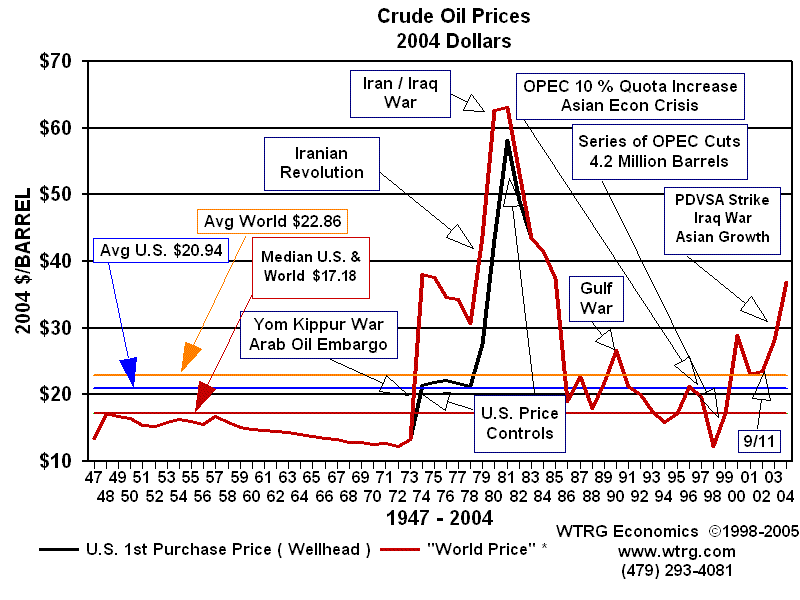
At this point, though it is embarrassing to have to point this out to a man who once was a real economist rather than a political hack, I must remind Mr. Krugman that since we are talking about substitutes for oil, then perhaps oil prices might have something to do with this "lack of progress."  Because, while we may tend to forget the fact over the last few years, for 20 of the last 25 years oil prices have been, on a real basis, near all-time lows.  They languished for decades at $20 or less, a price level that made the economics of substitutes impossible.  Nobody is going to put real money into substitutes when oil is at $16 or so.  Exxon, for example, had huge money invested in LaBarge, WY oil shale in the late 70's until decades of middling oil prices in the eighties and nineties forced them to pull the plug.  Ditto everyone and everything else, from shale oil to coal gasification.  And I can't even believe any sentient adult who lived through this period actually needs it pointed out to him that maybe there are non-technical reasons breeder nuclear reactors have not advanced much, like say the virtual shutdown of the nuclear business by environmentalists and local governments.

I will myself confess to being a bit surprised that solar efficiencies have not advanced very much, but again I remind myself that until the last few years, there was virtually no economic justification for working much with the technology. 

But all this masks another fact:  One of the reasons that these technologies have not advanced much is due to the absolutely staggering advances in oil exploration and production technology.  The last 35 years has seen a revolution, from computer reservoir modeling to horizontal drilling to ultra deep sea oil production to CO2 floods, it is in many ways a totally new industry.

Here is the way to decode what Mr. Krugman is saying:  It is not that the energy industry is not making huge technology gains, but that it is making gains in areas that Mr. Krugman did not expect, and, even more likely, it is not making its gains in the areas that Mr. Krugman wanted them to be.

Other technological advances

But Mr. Krugman did not stop there.  He could not resist throwing out a bit more red meat when he posits that all of our advances over the last 50 years in manipulating the material world have been disappointing.  Really?  Again, by what metric?  The revolution in computing alone has been staggering, and I feel like I could just say "Moore's Law" and leave my rebuttal at that.  Kevin Drum, oddly, suggests that Krugman means to say "besides computers" by using the "manipulate the physical world" wording.  If so, that is pretty hilarious.  Saying that "when you leave out computing and semiconductors, we haven't done much with technology over the last 50 years" is roughly equivalent to saying "leaving out the energy revolution and the application of steam power, there was not much progress in the early industrial revolution."   It's a stupid, meaningless distinction.  I am sure he would include a "car" in his definition of manipulating the physical world, but then how would you explain all those semiconductors under the hood?

But, that being said, I will take up the challenge.  Here are a number of technological revolutions besides computing and semiconductors over the last 50 years that clearly outstrip the previous 50:

  • Cost / Affordability Revolution.  One can argue that many of the technologies we enjoy today existed, at least in primitive form, in 1958.  But the vast majority of these items, from television to automobiles to air conditioning to long distance travel were playthings for the rich.  Over the last 50 years, we have found a way to revolutionize the cost and availability of all these items, such that most are available to everyone  (more on this below)
  • Reliability revolution.  In 1958, and even in 1968 and to a lesser extent in 1978, it was critical to have an address book full of good repair people.  Cars, televisions, home appliances, radios, air conditioners -- all were horrendously unreliable.  They could fail on you at any time, leaving you in an awkward or even dangerous spot, and repairs were common and expensive.  When I was a kid, we used to have a guy in our house at least twice a year fixing the TV -- when was the last time you saw a TV repair man?  I would argue that reliability (and this applies to industrial products as well) barely budged from 1908 to 1958, but has improved exponentially in the last 30-40 years.
  • Environmental and efficiency Revolution.  This one is no contest.  The environmental improvement -- in air quality, in water quality, in litter, in just about every category -- has shown substantially more improvement since 1958 than it did in the first half of the century.  This one is no contest
  • Safety revolution.  While there are ways in which this has gone too far, there is no denying that a huge amount of engineering over the last 50 years has gone into making products and services safer to use and operate.  And by the way, on the topic of flying cars (everyone likes to lament, "where is my flying car") could one not imagine that one reason we don't have flying cars is that anyone who is smart enough to design one is smart enough to know the government is never going to let people fly around willy-nilly, so maybe there is no mass market for them worth the investment and time?
  • Bio-medical revolution.  In less than 20 years from the time the world really recognized and understood the AIDS virus, science had a fairly good treatment for it.  And people complained it took too long!  Think of it -- a new, totally foreign virus that is extremely deadly appears nearly out of nowhere, and science cracks it in 2 decades.  No such ability existed before 1958.
  • Communications and Entertainment revolution.  1958:  Three US TV networks.  2008: 300 million people with the ability to broadcast their thoughts, their movies, their works of art to the world.  'nuff said.

In many ways, all of these thoughts come together if we look at a car.  Its easy to say that cars have not changed much - no wings yet!  But in fact, a car mechanic from 1909 would have a fighting chance to work on a 1958 engine.   No way a 1958 mechanic could make much progress with a 2008 internal combustion engine, much less a hybrid.  A car in 1958 was nearly as unsafe, and unreliable, and inefficient, and polluting, as a car in 1908.  Today, all of these have improved by orders of magnitude.  In addition, our cars have air conditioning and leather seats and hard-top convertible roofs and satellite radios and DVD players for the kids.  And mostly, the don't rattle like they used to after 6000 miles.

Material Life

But Krugman is still not done throwing out red meat, as he concludes that material life has not improved much over the last 50 years, and the answer is "obvious", to him at least, as to whether it has improved more in the last 50 years or the previous 50 years. 

Well, first I would observe that one should probably not trust people in data-based professions like economics who say that the answers to complicated questions are obvious without feeling the need to put any facts on the table.  By so positing, he looks extraordinarily lazy compared to folks like Steven Levitt who are out there trying to quantify the seemingly unquantifiable.

But the question is not at all obvious to me.  I suppose one could argue that the very rich have not seen much change in their material condition.  In 1958 they could jet around the world and had televisions and air conditioning and could afford the costs of unreliable products  (it does not matter so much if your car breaks down a lot if you can afford to have five or six cars).

But is strikes me that the material condition of the poor and middle class have improved markedly over the last 50 years.  As I mentioned before, there has been a revolution in the price and availability of what used to be luxury items:

The following are facts about persons defined as "poor" by the Census Bureau, taken from various gov­ernment reports:

  • Forty-three
    percent of all poor households actu­ally own their own homes. The
    average home owned by persons classified as poor by the Census Bureau
    is a three-bedroom house with one-and-a-half baths, a garage, and a
    porch or patio.

  • Eighty percent of poor households
    have air conditioning. By contrast, in 1970, only 36 percent of the
    entire U.S. population enjoyed air conditioning.

  • Only 6 percent of poor households are over­crowded. More than two-thirds have more than two rooms per person.
  • The
    average poor American has more living space than the average individual
    living in Paris, London, Vienna, Athens, and other cities throughout
    Europe. (These comparisons are to the average citizens in foreign countries, not to those classified as poor.)

  • Nearly three-quarters of poor households own a car; 31 percent own two or more cars.
  • Ninety-seven percent of poor households have a color television; over half own two or more color televisions.
  • Seventy-eight percent have a VCR or DVD player; 62 percent have cable or satellite TV reception.
  • Eighty-nine percent own microwave ovens, more than half have a stereo, and more than a third have an automatic dishwasher.

What has not improved

To bring us back full circle, the one thing I would argue that definitely has not improved much is forecasting and modeling.  It appears from Krugman in this article (and form global warming modelers)  that orders of magnitude increases in computing power have improved neither the hubris of the modelers nor the quality of their forecasts.  I am sure I could as easily find someone in 1958, or even 1908, out there crying "My forecast is fine - its reality that's broken!"

OK, I am spent.  I am sure there is more that could be said on this, but I will leave the rest to you guys.

Modern Witch Trials

Kevin Drum, while sympathetic (as we all are) to the plight of parents of kids with autism, is obviously frustrated that a few people with no science behind them are causing kids to go un-vaccinated.  Both he and Megan McArdle suggest some reasons for this.  I added this in the comment section:

It all strikes me as part of the general rebellion against reason we see today, alas.

Last week in my class on the late Middle Ages, we learned about the
early origins of witchcraft denunciations. Most denunciations were
initiated by someone who had undergone a tragedy that seemed
inexplicable -- e.g. the death of a loved one due to disease or a crop
failure or, most commonly, the death of a child. It seems to be part of
human nature to seek out something or someone to blame, and in this case
people latched onto the least sympathetic, most marginalized people
around them (often widowed women) and accused them of witchcraft as the
cause for their tragedy.

The parallels, to me, are striking. I think many of the witchcraft accusers had the same
motivation with the Thimerosal crowd, with only the target changing (now drug companies are the
unsympathetic ones). The only real difference is that we have in fact
added a positive feedback to this point of human nature, by creating a
tort system dominated by sympathy over reason, which tends to pay off
on such wild accusations of witchcraft. 

Breast implant makers?  Burn them!  Vaccine manufacturers?   Burn them!  Obstetricians?  Burn them!

Phoenix Lights Return

Apparently, the Phoenix Lights may have returned last night:

Arizona Republic reporter Anne Ryman, who lives in Deer Valley,
reported seeing four lights in a square shape that eventually became a
triangular shape. The lights were moving to the east and they
disappeared one by one. She said the lights were visible for about 13
minutes at about 8 p.m...

Ian Gregor, a spokesman for the Federal Aviation Administration said
that air traffic controllers at Sky Harbor Airport also witnessed the
lights, but they do not know the cause.

The incident is similar to the "Phoenix Lights" seen on March 13, 1997.
Thousands of residents reported seeing a mile-wide, v-shaped formation
of lights over the Valley. In that case the lights appeared about 7:30
p.m. and lasted until 10:30 p.m.

My friend Brink helpfully sent me an email this morning saying, "The UFOnauts are coming.  Watch out for anal probes."   Always good advice, I guess.

When Penguins Fly

I thought this was a pretty clever video the BBC came up with (on April 1?) to promote their video service. 

Thoughts for the Day

Happy Birthday Vladimer Lenin Earth Day.  I have a few thoughts for the day:

Sucking the Oxygen Out of the Environmental Movement

Observe today how little of the discussion is about anything other than climate.  There are still many environmental issues in the world that can be improved by the application of man's effort and technology -- unfortunately, climate is the least of these but the issue getting the most attention.  Consider how the global warming panic has sucked the oxygen out of the environmental movement.  Ten years from now, I predict that true environmentalists will be looking back on the hysteria over trace amounts of CO2 in the atmosphere as a huge setback for real environmental progress.

Environmentalism and Socialism

If you attend any Earth Day events today, notice how many of the speeches and presentations and such are anti-corporate, anti-trade, anti-capitalist, anti-wealth screeds, and have little to do with the environment.  If you actually go to a live Earth Day event, you will see why the selection of Lenin's birthday was no accident.  You will not see this on the network news, because the media is sympathetic to the environmental movement and tends to edit the socialist rants out as PR protection for the environmentalists, knowing that American audiences would lose sympathy for them if they listened to the whole package. (This is mostly an American phenomenon - I have found from my brief travels in Europe that the media there does less such editing, perhaps because they know their audience is more comfortable with socialism).

The Climate Denier Trick

There are a lot of reasons not to be worried about "inaction" on global warming.  To justify the enormously expensive cuts in CO2 productions, on the order of 80% as supported by Obama and Clinton, one has to believe every element of a five-step logic chain:

  1. Mankind is increasing CO2 concentrations in the atmosphere
  2. Increased atmospheric CO2 causes the world to warm (by some amount, large or small)
  3. The increases in CO2 from man will cause substantial warming, large enough to be detectable above natural climate variations
  4. The increases in world temperatures due to man's CO2 will have catastrophic impacts on civilization
  5. These catastrophic impacts and their costs are larger than the enormous costs, in terms of poverty and lost wealth, from reducing CO2 with current technologies.

Climate alarmists have adopted a rhetorical trick that no one in the media seems willing to call them on.   They like to wage the debate over global warming policy on points one and two only, skipping over the rest.  Why?  Because the science behind numbers one and two are pretty strong.  Yes, there are a few folks who will battle them on these points, but even very strong skeptics like myself accept points one and two as proved. 

Here are some examples of how this trick works.  If, like me, you do not accept steps 3-4-5 in the above logic chain, you will be called a "denier."  When asked what a denier means, a climate alarmist will often position this denial as somehow disputing #1 and #2.  On the other hand, if one publicly accepts #1 and #2, the alarmist will shout "QED" and then proceed to say that strong action on CO2 is now justified.  When an alarmist says that the a consensus exists, he is probably correct on points 1 and 2.  But he is absolutely incorrect that a consensus exists on 3-4-5.

Don't believe me?  Think back to the early Republican debate, where the moderator asked for a show of hands whether [I can't remember the exact question] man was causing global warming.  The implication is that you either have to accept this whole logic chain or not.  One can see why Fred Thompson begged to have 90 seconds to explain his position, and why the moderator, presumably in the alarmist camp, denied it to him. 

Over the last year or two, skeptics have gotten a lot better at making their argument.  Most all of them, like I do, begin their arguments by laying out a logic chain like this and explaining why one can believe that man-made greenhouse gases cause warming without accepting the need for drastic climate action.  The result?  Alarmists have stopped debating, and/or have declared that the debate is "over."  Remember that last great Al Gore climate debate?  Neither do I.

The Single Best Reason Not To Be Worried About Climate

I could, and have, in my books and videos, made arguments on many points in 3-4-5 (links at the bottom of the post).  In four, no one ever considers the good effects of warming (e.g. on growing seasons and crop yields) and most every other problem is greatly exaggerated, from hurricane formation to sea level rises.  And in five, every time someone has tried to put a price on even small reductions in CO2, the numbers are so enormous that they are quickly suppressed by a environmentalist-sympathetic media.  Suffice it to say that even the climate-sanctimonious Europeans have not been willing to pay the price for even slowing down their CO2 growth (which has risen faster than in the US), much less reducing it.

But in this logic chain, there is little need to argue about four and five if #3 is wrong.  And it is.

The effects of CO2 acting alone on temperatures are quite small -- And everyone, even the alarmists, agree!  A doubling of CO2 concentrations, without other effects that we will discuss
in a moment, will heat the earth no more than about 1 degree Celsius (though several studies recently have argued the number is much less).  This is not some skeptic's hallucination -- this is
straight out of the IPCC third and fourth assessments [IPCC text quoted here].  In fact, the IPCC in their reports has steadily reduced their estimate of the direct contribution of CO2 on temperatures.  CO2, acting
alone, warms the Earth only slowly, and at this rate we would see less
than a degree of warming over the next century, more of a nuisance than
a catastrophe.

But some scientists do come up with catastrophic warming
forecasts.  They do so by assuming that our Earth's climate is
dominated by positive feedbacks that multiply the initial warming from
CO2 by a factor of three, four, five or more.  This is a key point -- the
catastrophe does not come from the science of greenhouse gases, but
from separate hypotheses that the earth's climate is dominated by
positive feedback.
This is why saying that greenhouse gas
theory is "settled" is irrelevant to the argument about catastrophic
forecasts.  Because these positive feedbacks are NOT settled science.

In fact, the IPCC admits it does not even know the sign of
the most important effect (water vapor), much less its magnitude.  They
assume that the net effect is positive, and in fact strongly so - on the order of 60-80% feedback or more, nearly unprecedented numbers for a long-term stable physical system [more on feedback and its math here].  This is particularly ironic because alarmist Michael Mann, with his hockey stick, famously posited that temperatures over the last 1000 years were incredibly flat and stable until man started burning fossil fuels, a proposition that is hard to believe if the climate is dominated by strong positive feedback.   Note that when people like Al Gore say things like "tipping point," they are in effect hypothesizing that feedback is greater than 100%, meaning that climate can be a runaway process, like nuclear fission.

In fact, with the 100 or so years of measurements we have for temperature and CO2, empirical evidence does not support these high positive feedbacks.
Even if we assign all the 20th century warming to CO2, which is
unlikely, our current warming rates imply close to zero feedback.  If
there are other causes for measured 20th century warming other than
CO2, thereby reducing the warming we blame on CO2, then the last
century's experience implies negative rather than positive feedback in
the system.  As a result, it should not be surprising that high
feedback-driven forecasts from the 1990 IPCC reports have proven to be
way too high vs. actual experience (something the IPCC has since
admitted).

However, climate scientists are unwilling to back down from the thin
branch they have crawled out on.  Rather than reduce their feedback
assumptions to non-catastrophic levels, they currently hypothesize a
second man-made cooling effect that is masking all this feedback-driven
warming.  They claim now that man-made sulfate aerosols and black
carbon are cooling the earth, and when some day these pollutants are
reduced, we will see huge catch-up warming.  If anything, this cooling
effect is even less understood than feedback.  What we do know is that,
unlike CO2, the effects of these aerosols are short-lived and therefore
localized, making it unlikely they are providing sufficient masking to
make catastrophic forecasts viable.  I go into several reality checks
in my videos, but here is a quick one:  Nearly all the man-made cooling
aerosols are in the northern hemisphere, meaning that most all the
cooling effect should be there -- but the northern hemisphere has
actually exhibited most of the world's warming over the past 30 years,
while the south has hardly warmed at all.

In sum, to believe catastrophic warming forecasts, one has to believe both of the following:

  1. The climate is dominated by strong positive feedback, despite
    our experience with other stable systems that says this is unlikely and
    despite our measurements over the last 100 years that have seen no such
    feedback levels.
  2. Substantial warming, of 1C or more, is being masked by aerosols,
    despite the fact that aerosols really only have strong presence over
    5-10% of the globe and despite the fact that the cooler part of the
    world has been the one without the aerosols.

Here's what this means:  Man will cause, at most, about a degree of
warming over the next century.  Most of this warming will be
concentrated in raising minimum temperatures at night rather than
maximum daytime temperatures  (this is why, despite some measured
average warming, the US has not seen an increase of late in maximum
temperature records set
).  There are many reasons to believe that man's
actual effect will be less than 1 degree, and that whatever effect we
do have will be lost in the natural cyclical variations the climate
experiences, but we are only just now starting to understand.

To keep this relatively short, I have left out all the numbers and
such.  To see the graphs and numbers and sources, check out my new climate video, or my longer original video, or download my book for free.

Update: Very relevant article by Roy Spencer on the over-estimation of feedback in climate models.

Many of us, especially those who were trained as meteorologists,
have long questioned the climate research community's reliance on
computerized climate models for global warming projections.  In
contrast to our perception that the real climate system is constantly
readjusting to internal fluctuations in ways that stabilize the system,
climate models built upon measured climate behavior invariably suggest
a climate system that is quite sensitive - sometimes catastrophically
sensitive "” to perturbations such as those from anthropogenic
greenhouse gas emissions.  Unfortunately, it has been difficult to
articulate our "˜hand-waving' concerns in ways that the modelers would
appreciate, i.e., through equations.   

After years of pondering this issue, and after working on our two
latest papers on feedbacks (Spencer et al., 2007; Spencer and Braswell,
2008, hereafter SB08), I believe that I can now explain the main reason
for this dichotomy.   Taking the example of clouds in the climate
system, the issue can be introduced in the form of a question:

To what extent are climatic variations in
clouds caused by temperature change (feedback), versus temperature
change being the result of cloud variations? 

City Branding

This is the kind of local government silliness that really drives me up a tree.  The town of Peoria, Arizona (Peoria is basically a suburb of Glendale which in turn is a suburb of Phoenix) apparently has paid $81,000 for a new town logo:

Peoria's new tagline, "Naturally Connected," came under attack this week.

The city is working on establishing a brand name to better market itself.

"Naturally connected?" resident Dolores Ceballos said at Tuesday's City
Council meeting. "I'm still trying to feel it here. I can't find it.

"Nine years ago, I moved here, not because of a logo. I came for the downtown and for the schools."

Ceballos questioned the city's expenditure of taxpayer dollars for such an endeavor.

Peoria has paid $81,000 to North Star Destinations Strategies in
Tennessee, which developed the tagline and new logo that features the
city's name with swirling lines and Southwestern colors of blue, green and brown.

But what the Republic misses, but those of us with any business experience understand, the logo development, overpriced as it may be, is only a fraction of the branding effort.  The town is going to have to spend 10x this amount to start pushing the logo and the craptacular "naturally connected" tagline into peoples' faces. 

Corsette said that because the tagline and logo are not in use yet, it's hard for people to feel a connection.

"It's not surprising people don't get it," he said. "Once we start
using it in context of everything the city does, it will resonate with
people and take on some meaning and it will be a positive thing for us."

An important component to the draft manual is the education of the public and city employees, he said.

Can't wait to see the time and effort on the manual and training effort that will go into educating public employees on how to use the logo.

My New Favorite Audio Device

About two years ago I made the time investment to rip all my CD's to digital  (this was a real death-march, at 20 CDs a night for a month).  In doing so, I actually ripped every one of them twice:  once into a small, variable bit-rate MP3 file for my iPod, and a second time into a much larger FLAC digital file  (this is an open-source lossless compression format).  All the FLAC files sit on an old computer on my network that does nothing but act as a file server for these music files.

Now, having lots of nice, high quality digital files, the trick is to play them through my home audio system.  My first solution was an iPod dock on my home audio system, but I found this awkward.  Next, I added a Squeezebox from SlimDevices, a small inexpensive box that hangs on the network that basically takes the digital files off the network and puts then in an analog or digital signal my stereo system knows what to do with.    SlimDevices has always been a favorite among audiophiles, because of their open-source approach and their willingness to continue to improve their product with user feedback.  And, they are pretty reasonably priced.

Both of these solutions suffered from one problem.  My living room is fairly large, and while each system had a remote, the menu screen I was navigating was way over there, either on the small iPod screen or on the larger squeezebox screen.  Either way, I still did not like the ergonomics.

In their new version of the Squeezebox
, Slimdevices has come out with what I consider the near perfect streaming audio device.  The product consists two pieces.  First, the audio device, which is pretty small, that hangs on the network (either by cable or wireless) and does the same job as the old boxes I had, converting digital music files to a format my music equipment can handle.  The key area of improvement is in the remote control.   The remote communicates with your wireless network, and allows one to scroll through his whole music collection right on the remote in an interface nearly identical to the iPod, including album cover art if one so chooses. (click for larger view)

Duet_hero_500_2


I have had this new Squeezebox for over a month now, and I love it.  For those of you with a lot of CDs, like I have, it is just amazing how much more I listen to my music collection with this setup.  In the old world of shuffling through CD cases in a rack, I would tend to get the same five or six in a rotation.  Now, I listen to much more.  The remote also has a headphone jack so it can operate like a portable music player  (as long as it is in range of your wireless network).

By the way, I know there are devices like this that are all-in-one, meaning that they have their own hard drive so you don't need to network it to a computer.  I find those boxes to be a) way expensive and b) difficult to upgrade.  The cost of a cheap computer (it does not need much of a processor to just serve digital files up to the network) with a good size hard drive is cheap, and is the perfect use for an old computer you have upgraded.  The only real flaw of this device is its inability to do video, but SlimDevices has always focused on audio and will probably stay that way.

This Is Pretty Funny

Funny video about the 2009 job market.  Ht:  Maxed Out Mamma

Government-Think in Marion County, Florida

I just encountered an absolutely classic bit of government think.  Here is the background.

In Florida, on each night stay in the campgrounds we run in Marion County, we collect a 6% state sales tax, a 0.5% county sales tax, and a 2% tourist development tax, for a total of 8.5%.  Until this month, we reported and paid all three taxes to the state of Florida on one simple return.  The state then divvied the money up to the counties.  Apparently, this latter process could take up to 90 days before the County got their tourist development money.

The County commissioners of Marion County did not like waiting 90 days for their tourist development money.  Remember, this is not general revenue money, but supposedly trust fund money that must be spent on tourist advertising and the like.  Also, recognize that 90 days for a government body to disperse money is pretty normal - I find I often have to wait as long as 6 months to get a check out of the feds.

Anyway, the County wanted its money faster.  So it decided to collect the money itself.  First this involved more staff hours and designing a new online collection system, costs that are completely incremental because the state of Florida was performing these functions before (and still are performing them).  Today, it now requires two systems and clerical staffs to collect money that was once required by just one. 

Already, this seems like idiocy to any business person.  Is adding a whole new staff and systems really worth getting money 90 days faster?  I guess it is possible, but even if one could argue this point, we now get to the real government-think.  Because there is no way anyone in whatever cost-benefit trade-off they ran considered the time and effort that would be required of individual taxpayers.  Even in my small company, this will now require extra clerical labor each month as well as an initial system reprogramming to add the extra tax authority.  If one considers thousands of other businesses in the exact same position, the amount of investment is enormous.

But in my experience, when running cost-benefit trade-offs, the government never, ever considers investment and time required of the citizens who must comply.  I have seen governments make changes designed to save a few man-hours a month in their own clerical departments that cause thousands or millions of man-hours of extra work among taxpayers.   A year or two ago, Mono County, California forced us to go from one to twelve reports each month for our lodging tax payments just to save auditors a few hours work every three years.   And do you know why?  Because the government treats us all as serfs.  As far as they are concerned, our labor is free, because they have the power to compel us to do whatever they ask without compensation.

Postscript:  Here is my other Florida county tax collector pet peave.  All the tax collectors in Florida put their own personal name all over everything.  Their web site is not "marion county tax collector"  but "George Albright, Marion County Tax Collector." Their stationary has this man's name all over it.  When I right a check to them, I am supposed to include this man's name.  I hate this kind of public employee self-aggrandizement.  It is a blatant use of taxpayer money to try to aid one's next election chances, and it is a waste of money when a new person comes in office because every piece of printed material must be thrown out and reprinted.  This seems to be fairly unique to Florida.  Look at the Marion County links for other states in the same search and you don't see the same thing going on in those states.

Firefox Version?

Perhaps it is a glitch in the tracking software, but my logs show that 90% of the Firefox browsers that come to this site are version 1.x rather than 2.x.  Is there a reason for this?  I have been on 2.x for quite a while and have a beta running of 3.x.

If you are still on version 1, Firefox automatic updater will not take you to version 2 automatically.  You need to do it yourself here.

(Of course, the logs show 0.2% of you still using Windows ME.  God help you.)

And the Winner Is...

Mixed news on the contest front.  My outline and draft novel did not make the finals of the Mackinac Center's Freedom in Fiction Prize.

However, my 3-minute climate video did win second place in the Kids and Globaloney contest

The results surprise me a bit.  I really felt good about my story concept for the fiction prize, so much so I will likely finish it and at least release it as an e-book.  On the other hand, I found the 3-minute limit almost impossible to make work in the video contest, and thought my video, which I include below, was rushed.

A better version is the 9-minute version here which covers the same subjects but with a bit more leisure and explanation.  This video, however, is a bit dated.  As I write in the YouTube comments, I want to take a better shot at explaining the issues around positive feedback.  I think I can fix it with just a rewrite of the narration.  That longer video is here and below.

My really long video, 60-minutes in 6 parts, is here.

Big Flashing Red Bullsh*t Alarm Going Off

Huge alarm bells are going off as I read this headline in the Arizona Republic, whose motto should be "Happy to credulously print any crazy number your lobbying group puts in a press release."  In this case, the headline reads:

Ariz. economy reaped $500M from Super Bowl

Uh, sure.  Right.  Bet that is a quality number.  Lets first vet the source.  Who provided the paper with this number?

A study released today by the Arizona Super Bowl Host Committee
estimates professional football's championship game at University of
Phoenix Stadium in Glendale generated an economic impact of $500.6
million for the state.

Oh, I see.  Certainly a disinterested party.  And how was this number arrived at?

Arizona State University's W.P. Carey School of Business
completed the economic-impact report based on surveys of more than
1,500 visitors who came to the Valley to attend the game or take part
in festivities.

The survey revealed that visitors stayed in Arizona for an average of
3.9 nights and spent an average of $617 each day on hotels, food,
alcohol, transportation, recreation, shopping and other categories. The
report also calculated the amount that organizations dropped during
Super Bowl week.

Well, its good to see the business school at America's #1 party college on the case.  I would have thought this would be a very challenging study to conduct.  In my naiveté, I might have assumed that these Superbowl visitors might have displaced other potential visitors who would have been there anyway.  I would have fixated on the fact that Superbowl week is also Phoenix Open week and, given the beautiful winter weather here, one of the prime tourist weeks of the year even without the Superbowl.  I might have wondered how hotel stays during a week when most local resort hotels are full anyway could have been credited to the Superbowl, particularly when many locals left town to avoid the scene.   I might have been worried that I was not counting truly incremental revenues, but the folks in the business school at the university with Americas hottest coeds must be smarter than I am.

So apparently, these geniuses have found a way to assume that 100% of this $617 per day times 3.9 days is incremental and that there is no substitution effect.  However, they have also managed to somehow assume that University of Phoenix Stadium is even larger than I thought.  Because using these numbers, the only way to get to $500 million is if there were nearly 210,000 visitors.  Wow.  This does not even include the thousands of us from Phoenix who were also in the stadium. 

Look, the way to do this study is simple.  You look at sales tax receipts in Maricopa county over the period of January 2007-February 2008.  You calculate an underlying growth rate.  Then you compare the sales tax receipts for the Superbowl months (Jan-Feb 2008) with the same months a year previously, and see how much growth there is, if any, above the underlying growth rate.  I will tell you the answer right now:  It ain't anywhere close to $500 million.  I will eat my hat if its over $50 million.

Here is a reality check:  In 2004 the entire retail trade, from restaurants to stores to hotels, was $16.4 billion for all of Arizona.  This is $315 million per week.  Basically the study is saying that the entire retail trade for the whole state of Arizona was more than doubled in Superbowl week. 

Bullshit.

When is Curtailing Freedom the Mature and Wise Choice?

.... Uh, never.  Except of course at Colorado College, according to Amanda Udis-Kessler, Colorado College's Director of Institutional Research and Planning:

Social inequality is deeply grounded in a lack of respect-for women,
people of color, lesbian and gay people, and others. When we choose to
curtail our freedom to disrespect others in order to build a meaningful
society, we have made a mature and wise choice-and one that college
should help us learn.

The rest of the post is a roundup of the fallout over the punishment by the university of a parody of a campus feminist publication.  Basically, the argument boils down to the feminists feeling "dissed" and arguing that being dissed is a sufficient reason to curtail speech if one is in a protected group.   But remember this plea by the Colorado College feminists:

But please stop fabricating a story about humorless, offended feminists silencing men's free speech.

Oh, okay.

There are enough cases of this new theory of speech running around, that speech may be curtailed if someone in a protected group feels hurt or challenged by the speech, for real concern.  It is the same theory at the heart of the kerfuffle in Canada over the human rights commission's attack on conservative magazines and bloggers, and the same theory in the recent New Mexico decision that a photographer cannot choose not to photograph gay marriages.

Lost Art of the Business Letter

Way back around 1985, when I was an entry-level engineer at Exxon, the company had a training session with a writing instructor.  The course, if it had a name, could be called "the art of the business memo." 

Now, I know that you 20-somethings in the world of text messaging and soon-to-be-f*cked internet companies are probably cringing at the thought of learning to write business memos the Fortune 50 way.  But there was something about this course I found compelling.  Since then, I have taken a lot of communications courses, particularly presentation courses, of varying utility.  McKinsey & Company taught me the pyramid principal for organizing persuasive letters and presentations, something that has been so useful to me that I wonder why none of the expensive schools I attended ever bothered to teach it.

To this day, I am still compelled by the perfect business letter.  I know this may seem weird, but I still remember several of my best efforts from years ago.  I sometimes go back and read them lovingly.  I have three lifetimes of projects that I would like to put together, but one fun one would be to put together a book collection of great business letters.  I fell like its an art that should better recognized.

Anyway, I was reminded of all this by this letter that has been linked around the blogosphere a bit this morning.

100% of People With No Mortgage Payment Rate their Mortgage Payment as "Fair"

Apparently, according to one survey, a majority of people think their taxes are "fair"

Fairtax

The 60% is an interesting figure.  It also roughly corresponds to the percentage of people who get more government benefits back than they pay in taxes:

Taxfoundation

So 60% of the people vote themselves goodies from the other 40%, and coincidently, 60% of the people think the arrangement is fair.

Just Because We Elect Them Now...

Richard Conniff in the NYT:

But we need language to remind us that this is our government, and that
we thrive because of the schools and transit systems and 10,000 other
services that exist only because we have joined together. Instead of
denouncing taxes, politicians would do better to appeal to the
patriotic corners of our hearts that warm to phrases like "we the
people." "Taxation" is a throwback to the time when kings picked our
pockets. "Paying my dues," a phrase popularized in the jazz music
world, is language by which we can stand together as Americans.

I am confused as to what the substantial difference is between 1 king picking our pockets and 535 kings picking our pockets.   Just because I get the annual opportunity to cast a meaningless vote between the Coke and Pepsi party does not change my view of government. 

To my mind, this is the #1 incorrect perception people have about the American Revolution.  So many people, like this author, seem to think it was about voting and democracy.  Bleh.  The Revolution was about the relationship between human beings and government.  Voting was merely one tool among many the founders adopted to try to protect man from government.  Unfortunately, this intellectual battle is being lost. 

JFK was the president that first made it clear that those of us who love freedom have been losing this battle.  In his famous quote "ask not what your country can do for you - ask what you can do for your country,"  JFK defined the heads-statists-win-tails-freedom-loses choice that people like Mr. Conniff continue to try to present us with.   These collectivists define our relation to government as either the recipient of unearned loot or milch cow to the whims of the voters.  Neither part of JFK's challenge represents a relation between man and government a freedom-loving person should accept.

More on why voting is not what makes our country great here.

What We Learn About Climate and Public Policy from Y2K

Remember Y2K?  If you took the media and politicians seriously, this sure did seem like it was going to big a big apocalyptic deal (see survey in the postscript about economic depression and civil insurrection).  Until it wasn't.

Odd Citizen points to an interesting study on this topic.  The author links this
Australian study
looking retrospectively at the Y2K scare, trying to understand
why an irrational collective hysteria developed that allowed for no skepticism
(seem familiar).  The whole thing is interesting, but here is the money
quote
:

From the perspective of public administration, the two most
compelling observations relate to conformity and collective amnesia. The
response to Y2K shows how relatively subtle characteristics of a policy problem
may produce a conformist response in which no policy actors have any incentive
to oppose, or even to critically assess, the dominant view. Moreover, in a
situation where a policy has been adopted and implemented with unanimous
support, or at least without any opposition, there is likely to be little
interest in critical evaluation when it appears that the costs of the policy
have outweighed the benefits.

The article is written without any reference to current
climate issues, but wow, does this sound familiar?  It is a dead-on description of what is occurring with global warming. 

The author also goes on to discuss public choice theory and why it is not necessarily a good explanatory model for the Y2K scare.  He argues that a better explanation was the asymmetry of blame:

Individuals and groups who argued for a 'fix on failure' approach stood to benefit only modestly if this approach avoided unnecessary costs, but faced the risk of blame in the event of significant system failures attributable (accurately or otherwise) to Y2K related problems. Conversely, it was evident in advance that there was little risk of loss to individuals who advocated comprehensive remediation. The absence of any serious Y2K problems could always be attributed to the success of the remediation program.

The asymmetry of incentives was amplified by the possibility of litigation, particularly in the United States and, to a lesser extent, in other English-speaking countries. The reliance of the United States on tort litigation as a method of compensating those experiencing adverse outcomes of various kinds produces a strong bias in favour of 'defensive' expenditures. In particular, jurors have been highly unsympathetic to individuals and organisations that have chosen to disregard known low-probability risks.

The special characteristics of the Y2K problem were ideally suited to produce this kind of reaction. On the one hand, the problem was both widespread and comprehensible to non-experts, such as potential jurors. On the other hand, if 'embedded systems' are disregarded, the Y2K problem differed from most other computer 'bugs' in that a complete solution was feasible, though very expensive.

In these circumstances, litigation against organisations that had failed to undertake comprehensive Y2K remediation, and experienced any form of system breakdown in early 2000, was virtually guaranteed of success. By contrast, the risk of blame being allocated to organisations that overspent on Y2K remediation was perceived to be minimal. The absence of litigation or other processes for the allocation of blame in the aftermath of the Y2K non-event shows that this perception was accurate.

A rough parallel to this in the global warming world is the apparent ease of assigning blame for CO2 emissions to energy producers and car manufacturers (despite the fact that it is all of us who uses this energy and buys these cars) vs. the reluctance of media and others to quantify and assign blame for reductions in wealth and economic prosperity that might result from CO2 limitations.

Postscript:  One other thing that is interesting to me as a libertarian:  I often point out that the political parties are a joke, a mish-mash of shifting political positions that has little to do with deeply held theories of government and more to do with branding and populist electioneering.  The Y2K-Climate comparison caused me to find a good example.  In 1999, it was the Republicans using the Y2K issue as a club on the Democrats, arguing that the Clinton Administration, and Al Gore in particular, were ignoring this critical end-of-the-world crisis and that the government needed to be doing more.  Really.  Just check this out from Dec, 1999:

Last year, The National Journal devoted an entire issue to the subject, with headlines such as "The Big Glitch" and "Sorry, Al, This Bug's for You." In the special issue, Neil Munro cites a survey of industry and government executives and
programmers concerning potential fallout from the millennium bug, showing that 70 percent
anticipated a negative effect on the economy, with 10 percent of respondents not ruling
out the possibility of economic depression and civil insurrection.   

With a technology problem of this magnitude on the national horizon, where was the leadership of the nation's No. 1 techno-nerd and self-proclaimed creator of the "information superhighway," Vice President Al Gore?   

Gore's familiarity with and personal interest in technology, specifically computer technology, makes suspect his long silence on the Y2K issue.   

In his biography, "Gore: A Political Life," Bob Zelnick writes that Gore "had nothing to say during the first five-and-a-half years of his vice presidency
about the biggest problem in the history of high-tech America."

Let the record show that I was a Y2K skeptic before I was a climate skeptic.

I may be making common cause with some Republicans on the climate issue at the moment, but I don't trust them.  In fact, already we see McCain jumping on the climate bandwagon (as he does with every populist issue -- he believes in nothing) and I have a strong sense GWB may dive into the climate fray quite soon.

A Few Tax Day Thoughts

From Jane Galt:

All this useless activity is so that our politicians can look like They
Care by giving tiny tax breaks to all of their favorite people--that is
to say, the people who vote for them and give them money. All of these
tax breaks, almost without exception, do the most good for the people
who least need them. Meanwhile, they waste time for the rest of us,
distort the economy, and require us to pay extra people to process tax
returns. It's lose-lose-lose all around unless you owned a seal-fur
farm between 1987 and 1991.

She also outlines her alternative tax plan.

From the Beatles (yes, those guys)   (Beatles, Robin Hood, and of course they perform the song)

From yours truly, the five worst traits about taxes

Algae have extraordinarily diverse sex lives

OK, I buried the lede.  The post is actually not the sex lives of algae.  But I was fascinated that CNN chose to list this among the "story highlights" of this article.  The story supports my sense that if biofuels are ever going to make sense, they are not going to be made from corn.  The story also reinforces the notion that biofuels are just another type of solar energy, though they are in fact even more inefficient than our not-there-yet solar panels in converting sunlight to usable energy.  The only reason biofuels currently look more economic than solar are the enormous operating subsidies and the much lower capital costs  (though even the latter is open to argument since biofuels have huge capital costs in terms of land, but that generally is factored in as "zero" because the land is already being farmed.)

Before you get too excited about algae, note from the picture that the algae at this farm is grown in plastic packets that I would bet my life require more hydrocarbons to produce than the algae inside them provides.

Save XP

If you are happy with Vista, fine.  Polls show that the majority of us are not.  I continue to order all of our company PCs with XP and have downgraded all of my home PCs back to XP.  If you want to try to get Microsoft's attention to keep XP past the June 30 stop-sell date, check out this petition.

Save XP

If you are happy with Vista, fine.  Polls show that the majority of us are not.  I continue to order all of our company PCs with XP and have downgraded all of my home PCs back to XP.  If you want to try to get Microsoft's attention to keep XP past the June 30 stop-sell date, check out this petition.

Duh

A reader pointed me to this article about a really amazing piece of government science:

A strong and deadly
earthquake is virtually certain to strike on one of California's major
seismic faults within the next 30 years, scientists said Monday in the
first official forecast of statewide earthquake probabilities.

They calculated the probability at more than 99 percent that one or
more of the major faults in the state will rupture and trigger a quake
with a magnitude of at least 6.7.

Uh, okay.  Next up:  California demonstrates more than a 99% chance that I will be dead in 100 years.  I would also give them the false precision award:

An even more damaging quake with
a magnitude of 7.5 or larger, the earthquake scientists said, is at
least 46 percent likely to hit on one of California's active fault
systems within the next three decades.

Are they really sure that its not 46.1%?

"The report's details should
prove invaluable for city planners, building code designers, and home
and business owners who can use the information to improve public
safety and mitigate damage before the next destructive earthquake
occurs," said geophysicist Ned Field of the Geological Survey, who
headed the Working Group on California Earthquake Probabilities, which
developed the forecasts.

Really?  How?  They should have given me the money and I would have written a two sentence report:  "You are going to have an earthquake in the future -- duh, its California.  Plan for it."

Update: A reader notes that this was funded by some insurance companies or trade group, and the whole point is the unspoken message "insurance rates are going up."  You guys are so cynical.