Fighting Fire with Fire

So I guess the Democratic response to the Bush administration's 8-years of disrespect for the separation of powers is to one-up him?

On the op-ed page of the New York Times,
Jean Edward Smith argues that if the Roberts Court keeps on its current
path, a future Democratic President and Democratic Congress should
consider a court-packing plan and add Justices to ensure a liberal
majority on the Supreme Court. This might be necessary, Smith contends,
because the Roberts Court has "adopt[ed] a manifestly ideological
agenda," "plung[ing] the court into the vortex of American politics"
where it now decides political questions rather than the purely legal
decisions of the Warren Court.

And by the way, I would have said that the Roberts court has followed a distinctly non-ideological agenda.  In fact, I can't figure out how they are making decisions from one case to the next.  This court bears the hallmarks of one that is really evenly divided, with backroom negotiating going on to get a majority that reeks of compromise rather than anything either ideological or Constitutional.  Every major decision seems to have five or six written opinions.

Those Dirty Nasty Steam Plumes

Don Surber writes:

The tax-exempt Environmental Integrity Project in Washington, D.C.,
issued its annual list of the 50 dirtiest power plants in America. This
is illustrated by a photo showing steam "” water vapor "” escaping from a
cooling tower. Sigh.

I made this same point long ago, laughing at the huge number of air pollution reports that are illustrated with pictures of steam plumes.  I also showed how photographers seemed to try to photograph the steam plumes at sunset, trying to turn them brown-looking to make it look like pollution.  Unfortunately for pollution-report illustrators, power plants have been cleaned up enough that they don't really emit visible smoke plumes any more.

Ap6

New Orleans, Progressive Paradise

From the USA Today:

In working-class areas here, homes for sale
have begun to move briskly. But in the ritzy Uptown district and other
well-to-do neighborhoods, the picture is bleaker. "New Price" and
"Reduced" signs adjoin grand Victorian homes "” symbols of a struggling
upscale housing market.

They're the lingering effects of Hurricane
Katrina. In coastal Louisiana and Mississippi, a glut of higher-end
homes points to soaring property insurance costs that are pricing many
people out of the market. It also speaks to the legions of doctors and
other professionals who have left the area and have yet to return. The
price of their exodus could be severe: Economic development experts
warn that if these professionals stay away en masse, it could cripple
the region's recovery.

For anyone with a stake in the region's recovery, the loss of
higher-income residents "” and their job skills "” is alarming. The
problem is compounded by the shortage of upper-income buyers willing to
put down stakes to replace those who have left.

So what is the problem?  I thought this would make New Orleans a progressive paradise.  No rich to get richer and create envy in the working classes.  No issues with income distribution.  Just a worker's paradise with no capitalist oppressors.  Huge portions of the populations dependent on the government and refusing to rebuild until they get government handouts to do so.  This sounds like everything Progressives are working for.  But...

Doctors, bankers and other professionals are "the backbone of the
community," says William H. Frey, a demographer at the Brookings
Institution, a Washington think tank. "They're the people who will help
the tax base. If they leave, they are going to be very hard to replace."

Oh, I see.  We don't really want them around, but we need milch cows we can tax so we can have handouts for everyone else.  It must be a hard tightrope for progressives to walk -- they hate rich people but need them to pay for their schemes.

Reputation with Whom?

Eliot Spitzer has been caught using the power of his office to go after his enemies.  Wow, what a surprise.  Frequent readers of this blog will know I don't think much of Spitzer, who tended to overreach his office all the way back to student government at Princeton.  What I found surprising, though, was this quote from the NY Times:

The report was a blow to Mr. Spitzer, a former prosecutor who came into
office less than seven months ago with a reputation for integrity and
who promised to bring a new ethical climate to Albany.

A reputation for integrity with whom?  Mr. Spitzer, as attorney general, was a sort of liberal bookend to George W. Bush, consistently exceeding the limits of his authority to achieve some goal he argued trumped a narrow reading of the law.  His supporters, just as Bush's do, justify his overreaching his office on the grounds that the ends justified the means, in Spitzer's case the assault on various corporate and Wall Street firms liberals were frustrated that Washington would not pursue.  Critics like myself argued that many of his crusades were abuses of his prosecutorial office to pursue personal vendetta's and to generate headlines to position himself for a run for governor.

I would think that any reasonable definition of "integrity" when applied to an attorney general would include a respect for the letter of the law, something that even his supporters would probably admit Spitzer cast aside when he thought it was for a good cause.  The only interpretation of "integrity" I can come up with in the context of this article is that Spitzer had integrity in the past because his abuses of power were in pursuit of causes the author agreed with.

Look, this is the man that began supporting campaign finance limitations, which tend to support incumbents, starting the day after he became an incumbent.  This is the man who described himself as governor thus:  "I
am a fucking steamroller and I'll roll over you or anybody else
".  This is the man who involved the State of New York and the courts in a private compensation deal, just to burnish his populist credentials.  In the latter trial, he explicitly left prominent Democrats who had the most involvement with the deal alone and indicted side figures who were Republicans.  Tom Kirkendall has a much longer bill of particulars against Spitzer here.

Phoenix Envy

Today I read one of the most bizarre articles I have read in quite a long time.  Murray Whyte of the Toronto Star (HT: Junk Science) seems to have developed a fantasy that climate change will drive people out of Arizona and back to Cleveland, Buffalo and Toronto.  Uh, yeah.  The article is laden with shoddy science, gross contradictions, bad economics, and a recurrent envy of wealth and success.  The article is so much of a mess that I just can't resist fisking it in detail, despite its length. 

Before I begin, though, I am not necessarily a huge Arizona booster.  Phoenix works pretty well for me at this point in my life, but I have lived in many great places.  And I am the last one to criticize anyone who decides that they just can't live in a place where it is 110F for 6 weeks straight.  That being said, lets get into it.  The article is titled: 

Climate Change Herald Mass Migration:  Concerns
raised as the U. S. Southwest grapples with historic drought, water
supply depletion and the creeping sense that things can only get worse.

We will get into all this later, but you gotta love the "creeping sense that things can only get worse."  Who has this sense, other than the author?  Phoenix is one of the most optimistic and positive places I have ever lived.

The state of Arizona has more than 300 golf courses, a booming economy,
endless sunshine and, at last count, at least five Saks Fifth Avenue
department stores "” in short, nearly everything the well-heeled
sybarite would need.

He sets the tone right up front.  This article is not about climate or rain or anything else.  It is about envy and a distaste for other people's wealth and success.

There's just one thing missing: rain.

For the past
month, not a drop has fallen in Maricopa County, home to greater
Phoenix, the state's economic engine and fastest-growing hub. Over that
period, temperatures have hovered five to seven degrees above the
30-year average, at one point holding steady at over 43C for 10
straight days, while hundreds of brush fires burned statewide.

Its the freaking Sonoran desert!  We go months without rain.  We are supposed to go months without rain.  We average like 8 inches a year.  This county went months at a time without rain long before human beings burned their first molecule of fossil fuels.  If we got much more rain than this, all of our Saguaro cactuses would die.

And 43c is 109F.  We almost always go 4-6 weeks with temperatures over 109.  And he is saying this is 6C (10F) more than normal.  Get real!  I can't remember any June or July we ever went even 5 straight days under 100F during this part of the summer. By the way, Arizona's highest June temperature was recorded in 1994, its highest July temperature in 1905, and its highest August temperature in 1933. So much for record highs of late. (Maybe one reason it seems to be getting hotter is that they are measuring the temperature of asphalt parking lots).

"And they're still building billion-dollar houses, right in the
middle of the desert," says Paul Oyashi, incredulous. "It doesn't seem
rational, does it?"

Holy Crap!  Billion dollar houses!  Our retractable roof football stadium didn't cost a billion dollars, Canadian or US.  Oh, and you see that having gone 4 paragraphs without being snide about wealth, he needed to get back to this topic.  And who the $%@!! is Paul Oyashi?

In a word, no. Rational, some would say,
would be a mass migration from the drought-ravaged American southwest,
where Southern California just experienced its driest 12-month period
in recorded history, to more verdant climes.

One such place?
Cleveland, the battered hub of Cuyahoga County, where Oyashi sits as
director of the department of development. "We don't have earthquakes,
we don't have brush fires, we've got all the fresh water you could ever
want," Oyashi says. "That's logic. But the problem is, it flies in the
face of reality."

So this Oyashi guy is the development guy for Cleveland?  Who made the Toronto Star a shill for the Cleveland chamber of commerce?  Is it really this writer's premise that we are on the verge of a reverse migration from Phoenix to Cleveland?  My sense is that we are not on the verge of such a reverse migration, and this is a chance for everyone in the Rust Belt to lament that fact.

At first glance, the crises
of the rust belt and the Southwest would seem unrelated. They are, in
fact, inexorably linked. Each has what the other does not. In Phoenix,
tremendous affluence; in Cleveland, and in Detroit, Toledo, Youngstown,
Buffalo, Rochester, Thunder Bay and Sault Ste. Marie, abundant,
near-endless water "“ in the Great Lakes alone, as much as 25 per cent
of the world's supply.

Note the writer implicitly accepts the zero-sum wealth fallacy -- in his eyes, wealth is a natural resource just like water.  Cleveland has water, Phoenix has wealth.  I won't get into this fallacy much here, but suffice it to say wealth is not something that springs magically from a well.  More here.  For a hundred years, Cleveland was a wealth-creation machine.  To the extent they are not today, they might check their tax and regulatory policies.

And as the Southwest and parts of the
Southeast grapple with historic drought, water supply depletion "“
earlier this year, Lake Okeechobee in Florida, a primary water source
for the Everglades, caught fire "“ and the creeping sense that, with
climate change, things can only get worse, a new reality is dawning:
that logic, finally, will have a larger role to play in human migratory
dynamics, continent-wide. With it come not just doomsday scenarios, but
for certain urban centres left for dead in the post-industrial
quagmire, a chance at new life.

Wow, where to start?  Anyone note the irony of Cleveland pointing fingers at someone because their lake caught on fire?  Not that he bothers to explain why a lake catching on fire is related to climate change or even drought.  And why on an article on the Southwest is the only example of water shortage taken from Florida?

But what you really need to note is the arrogant technocratic bent of the author.  He is saying that all you idiots in Phoenix are defying reality, and that finally maybe you will start making the right choices.  This is typical elitist crap.  In the author's world, anyone who makes a choice the author would not is making a wrong choice.

"Sticking a straw in the Great
Lakes is not a solution to Phoenix's water problems," says Robert
Shibley, director of the Urban Design Project at the State University
of New York at Buffalo. "Maybe it's time to really think about what
constitutes need and stop spending money to build carrying capacity in
places that don't have it by nature, and start investing in places that
do."

Shibley has long been a champion of Buffalo's dormant
potential "“ a potential reduced by half or more through the latter part
of the 20th century, as the population fell below 300,000 from a
historic high of more than 700,000.

OK, now we quote a second guy about problems in the American Southwest.  This guy is from Buffalo, New York and is a promoter of the city of Buffalo.  Why is the Toronto Star giving these guys paid advertising for their causes under the guise of a news article?  And who the hell ever suggested sending water from the Great Lakes to Phoenix?  This is a "straw" man if I ever heard one.  Even if we started building pipelines east, there would be no reason to go past the Missouri or Mississippi.

And I love this "investing in carrying capacity" thing.  What the hell does that mean?  Yeah, we have to build infrastructure when the city grows.  We have to look for water, you have to pay for snow plows.  To build in the desert, we have to pipe in water to survive.  So what?  Buffalo and Toronto and Cleveland have to truck or pipe in coal and heating oil in the winter to survive.  What's the difference?

He suggests that in the
Great Lakes basin, where less than half a per cent of the world's
population sits within easy reach of a quarter of the planet's fresh
water, the opportunity for harmony exists. In a perfect world governed
by reason, Shibley says, the only robust economic centre in the region
would serve as its heart. And that would be Toronto.

Oh my God, what a statement.  Humanity's last hope to live in harmony with nature is to move to the Rust Belt, home of a disproportionate number of America's Superfund sites and the burning Coyahoga River.  These are cities that still use the Great Lakes as a toilet, dumping tons of raw sewage out in the lakes every day.

That's an
issue for international bureaucrats to solve. But the reality is this:
according to the U.S. government, the population of the United States
is expected to reach 450 million by 2050 "“ an increase of almost 50 per
cent. The predicted pattern of settlement for these new citizens will
take them to the seven most built-out regions of the country "“ Arizona,
Texas, Florida and California among them.

Have you seen Arizona?  Is this guy really arguing that Arizona is more built-out than Michigan, New York, and Ohio?

"You're going to have
150 million people living in at least seven of the major regions that
don't have water, don't have carrying capacity, can't feed themselves,"
Shibley says. "It's an ecological disaster waiting to happen. So
there's a good reason to think that people should come back to the
Northeast, where we have the carrying capacity, and have the water."

First, we have water.  We don't even have rationing here in Phoenix, and have not in my memory.  What does "have no water mean?"  The issue with Phoenix water is that we have about the cheapest water in the country.  Any overuse (whatever that means) of water here is because politicians pander to citizens and set the price very low.  So yes, I have a big lawn that seems nuts in the desert, but that is because my water bill here is less than half of what it was in Seattle(!)  Raise the price, and I would probably xerascape my lawn.

And what city in the Great Lakes area "feeds itself?"  No one in American cities feeds themselves.  Its called division of labor.

Some have already taken notice. Last year, The Economist
ranked Cleveland the most liveable city in America (26th in the world)
based on five categories: stability, health care, culture and
environment, education and infrastructure. Among the booming cities of
the Southwest, only Los Angeles and Houston cracked the top 50. Phoenix
didn't make the list, falling behind Nairobi, Algiers and Phnomh Penh
among the world's top 126 urban centres.

LOL.  I love it, we're behind Nairobi in some survey.  Look, there is a huge disconnect in this whole argument.  If Cleveland is really more liveable, then people will move there.  But the author is saying that people are moving to Phoenix instead.  So the theme of the article is that, what?  Phoenix has a problem with too many people moving in and has a problem with too many people moving out?  This is back to the technocratic elitism.  The author is just upset that ordinary people don't do what journalists tell them they should do.

Water is a factor. It
is already a significant issue in the major regions Shibley mentions
which, not coincidentally, depend on the same diminishing source for
much of their hydration.

In 1922, seven states "“ many of them,
like Nevada, Arizona, Texas and California, desperately arid "“ signed
the Colorado River Compact, which divvied up the mighty waterway's
seemingly abundant flow.

But recent observation of the river is
alarming. Only two per cent of the river's water makes it beyond the
U.S. border, where large Mexican cities dependent on its bounty are
left with a trickle "“ much less than they need. With climate change,
river flow has been dwindling, due, among other things, to decreasing
snowfall and less consequent spring runoff, which forms a significant
part of the Colorado River basin's lifeblood.

The river is the
main water source for more than 30 million people stretching from
Colorado in the north all the way down to the U.S.-Mexico border. By
the end of the century, inflow to the river (which includes runoff and
tributaries) is expected to drop by as much as 40 per cent.

First, who is saying that climate change is affecting the flow of the Colorado River?  Annual variations certainly affect it, but no one, and I mean no one, has created a climate model with the resolution to say that if there is substantial global warming in the future,the effect on the Colorado River flow will be X or Y.  Even the IPCC admits it really doesn't have a clue how world temperature changes might affect river flows, or the water cycle in general.  People always want to assume that hotter means drier, but hotter also means a lot more ocean evaporation which can translate into more, not less, precipitation. 

The problem with the use of the Colorado is not climate, but price.  As mentioned above, Phoenix has among the lowest water prices in the country.  In addition, farmers in Arizona and Southern California, who use most of the water despite the snide remarks about golf courses and billion dollar homes, get rates subsidized even lower.  Letting water prices rise to a real supply/demand clearing price that matches demand to river flow would solve the water "crisis" in about five minutes.

At
the same time, climate change projections show temperatures in the most
parched regions of the Southwest increasing between five and seven
degrees. That would make Phoenix's hottest days well over 54C.

Five to seven degrees C are at the high, worst case end of the IPCC projections, which are themselves grossly overstated for a number of reasons I wrote here and here.  Also, much of the warming would be winter nights -- you just can't add the global warming projections to the daytime maximums -- this is plain ignorant.   One thing I agree with -- if our daytime temperatures were to reach 54C, which is over 129F, I will be moving. 

In
Arizona, though, these warnings seem to fall on deaf ears. "The Greater
Phoenix region continues to bust at the seams," says Christopher Scott,
a research professor of water resource policy at the University of
Arizona in Tucson. "People look at this and think, `This can't go on,
can it?'"

But it does, and faster than anywhere else in America.
From 1990 to 2005, the population of Greater Phoenix grew 47.7 per
cent. In Scottsdale, a posh, affluent corner of Greater Phoenix that,
despite the lack of moisture, has more golf courses per capita than
anywhere else in America, growth was 72.1 per cent over the same
period.

Altogether, Greater Phoenix will likely crest at 4
million people some time this year, making it the fourth-largest
metropolitan area in America. By mid-century, some estimates suggest it
will reach 10 million, leaving Phoenix and Tucson fused in the desert.
"We'll basically be one massive urban corridor," Scott says.

Hey, he quoted a guy from west of the Mississippi!  This is the same kind of language that every anti-growth person uses in every city.  And by the way, there is that class thing again -- "posh, affluent."  And what does "bust at the seams" mean?  Phoenix has some of the least-bad traffic of any major city, we have sufficient water, sufficient power, lots of raw land, etc.

Phoenix
receives water from the Colorado through canals hundreds of kilometres
long, pumped through parched landscapes and small communities along the
way that take their fill. It is, essentially, a city that shouldn't be
there, so distant is the water supply.

"Shouldn't be there," by what definition?  Here is what that means:  "I, the author, don't think there should be a city there."  OK, don't live here.  Couldn't I write this sentence instead, "Cleveland receives petroleum from Texas and the Middle East in pipelines hundreds of miles long to provide needed heat in their cold winters.  Its is, essentially, a city that shouldn't be there, so distant is its energy supply."  Jeez, why is it we can have a global economy and division of labor and move resources around the world, but we have to build cities right next to water sources.  What about Aluminum, oil, gold, bauxite, lead, zinc, and iron?  Must we only build cities where all these are near by as well?

Scott, who has studied
water supply issues from India to Mexico to West Africa, has seen no
end to water-appropriation schemes in development-crazy Arizona.
"Piping in sea water from the Sea of Cortez in Mexico, desalinating it,
and then piping the salty brine back into the ocean "“ that's the kind
of hare-brained notion I've heard here," he says. "Do I consider these
things tenable? Not at all. But these are proposals people are talking
about seriously, in public, and they're getting a lot more play."

Scott
worries that technology may well make such things possible, but at a
destructive energy cost that simply exacerbates the problem. "We're
already starting to ask questions about the larger issues associated
with pumping in all that water along those canals "“ the energy costs,
and the carbon impact associated with it," he says. "They may solve the
water issue short-term, but they pull the sustainability rug out from
under you in the process."

We now see the author's real position.  He is not really lamenting the lack of water in the Southwest - he likes it.  He wants to drive people out.  We see he and professor Scott here actually lamenting the fact that technology might solve the water problem.

As to the sustainability issue, its absurd.  I will admit I don't know the figures, but I would be shocked if moving water around was even 0.1% of US energy use.  And besides, we move everything else around the world, moving water is trivial.

Finally, I don't really want to accept the author's premise that CO2 reduction is so critical, but if I were to accept it, I might point out that most of our electricity in Phoenix is provided by America's largest nuclear plant supplemented by natural gas, while mid-Western cities are fed mostly by big old honkin coal burning plants.  I would put our electric generation carbon footprint up against most any Rust Belt city.

The long-term solution, of course, is
to relocate people where they can comfortably exist. (Oyashi certainly
knows a place where you can get a decent house on the cheap.) In a free
society, of course, forced migration isn't really an option.

Do you get the sense he says the last line with a frustrated sigh, lamenting the fact that he can't force people to live where he thinks they should live?

But
as the sustainability crisis worsens, "usually economic forces will do
it for you," says Robert McLeman, a professor of geography at the
University of Ottawa. "When cities have to build new infrastructure and
to jack up taxes to cope, when the cost of running a household becomes
prohibitive, people will move."

Fine, but I will bet you a million dollars our taxes in Phoenix are a lot lower than they are in Toronto. And I know for a fact, since I almost moved there once, that our cost of living is a lot lower.  So maybe this infrastructure and sustainability crisis in Phoenix is a chimera?  Maybe its just wishful thinking?

..."Once the heat becomes unbearable, they may find the
freezing cold a little more bearable"“especially if it's not quite so
freezing cold as they remember."

It won't happen without help. In
Buffalo, Shibley speaks of a federal urban sustainabilty plan that
funnels federal money to the Great Lakes region to help draw population
back. It's been more than 30 years since the U.S. had a comprehensive
national urban plan. Looming ecological crises in burgeoning urban
centers more than justify a revival. "Cities don't grow by topsy, it's
not a thing of nature "“ it's a function of public policy," he says.

Oops, we seem to be abandoning the whole "free society" thing above.  Sure looks like they want to use federal law and tax policy to drive migration where they want it to go, against where people are moving currently of their own free will.  Oh, and city growth is NOT a function of public policy.  Cities grew up and evolved long before government ever took a heavy hand in their development.

But
a significant piece is missing, McLeman warns. "These cities will have
milder climates, be easier to live in, and cheaper," he says, "but
ultimately, they'll have to have the jobs to go with them."

Oyashi
is painfully familiar with the concept. Cleveland may have a surfeit of
cheap, liveable housing and an abundance of fresh water, but its
problems are legion. Abandoned industrial sites litter the area, too
big or too expensive to put to other purposes. Small victories pale in
the face of greater challenges, like trying to convince Ford not to
close two of its three plants in the region. "We've got some dinosaurs
walking around here," he says.

Speaking of public policy and taxation, you don't think that different public policy choices in Cleveland vs. Phoenix might have a teensy bit to do with this?

But those problems, endemic
rust-belt-wide, are just the most visible. High crime rates,
languishing schools and spiralling urban poverty plague Cleveland, too.
Phoenix, for all its money, can't make it rain any more than Cleveland,
with all its water, can print the money it needs....

Gee, the relative growth in Phoenix vs. the lack thereof in Cleveland sure is a head scratcher.  Its incredible that people would tolerate long transportation distances for water just to escape things like high crime rates, languishing schools and spirally urban poverty.

He lays the responsibility at the federal
government's door. "It's not like we have a policy that says, `You
know, we should have a national policy that provides incentive for
people to live in ecologically sustainable areas,'" he says. "What we
have here is `Go wherever you want, do whatever you want, and the
government will follow with its chequebook.' You get this haphazard
checkerboard of winners and losers, rather than directed development in
the regions that can sustain it. It's crisis management."

Yes, its just awful that the government lets people live wherever they want and then puts infrastructure in the places people choose to live.  So haphazard!  People are doing things that are not controlled or directed!  Eek!Clearly the author thinks the government should build the infrastructure wherever it wants to, and then force people to live in those places.   We elites know better!  We will tell you where you should live!  And by the way, who in the hell anointed the Rust Belt with the title of "most sustainable area."  And what is sustainability?  Couldn't I argue that all those midwest cities are sitting on valuable cropland or forest land, and that Phoenix is the most sustainable because we are just building on empty desert?  And if there is such a thing as sustainability in city development, who decided that the proximity of fresh water was the #1 be-all end-all component?

So, I will make a counter-proposal.   Rather than focusing on cities, let's focus on agriculture, because water IS a be-all end-all component to agriculture.  Much of the water we use in the Southwest is for agriculture, and I
don't think that agriculture would be here without huge subsidies. Frankly, the sustainability problem of agriculture in the desert is orders of magnitude worse than that of cities here.  So here is the plan:

1) Sell water in Arizona for a price that better matches supply and demand

2) Stop subsidizing water for agriculture

3) Stop sending farm subsidies, such as for cotton, to people to grow crops in the desert.

This would relieve a taxpayer burden AND it would likely shift farming out of the Southwest to places like the Midwest.    As a result, you would get a migration of farmers and agriculture back east and you would free up a lot of water in the southwest so more people can live here, where they really want to live.    But of course, this is not what the author wants.  He wants more people in the cities, paying absurdly high Detroit property and income taxes.  Well, good luck.

Update:  Large follow-up post to this one, including research on Arizona water use and how the Rust Belt treats the Great Lakes like a toilet here.

I Lost My Google Ranking

Bummer.  I seem to have lost the #1 Google search result for myself (though I do have 6 of the first 8). My blog gets crazy Google love, so its odd that some guy's training page (or whatever the hell that is) at the Church of Scientology could outrank me.  Have to start some serious SEO ;=)

Finished Harry Potter (no Spoilers)

My whole family was nice enough to choose this weekend to be away, so I could read Harry Potter 7 in peace (yes, I know, I am getting old when I use a bachelor weekend to read a book).  I thought is was a well-done conclusion to the series.

On Friday at midnight, I went out to get a copy for my son, who was driving with friends to San Diego early Saturday morning.  The Borders near us was a zoo -- what looked like a 2-hour line, and I didn't even have the right armband to get into it.  Fortunately, the 24-hour grocery store 2 blocks away had plenty and no line, so I did not have to wait.  (My bet is that if I had gone back to the Borders and shouted that there were books with no waiting a few blocks away, only a few would leave -- it was an event, not just a line.  Somehow, I think the perceived value of the book went up having waited in line for it.)

Anyway, I just wanted to make a couple of observations about the Harry Potter books:

  • You can complain all you want about JK Rowling's writing style or selective character development or whatever, but anyone who can have teenagers waiting in line at midnight to buy the last 800 pages of a nearly 5000 page narrative -- waiting in line to read! -- should have a spot reserved for her in the Poet's corner at Westminster Abbey.
  • Name any other book that had such an even mix of adults and kids reading it over the weekend
  • I am not big on the need for shared national experiences like certain conservatives or liberals are, but the Harry Potter books certainly constituted such a shared experience. 

The Pepsi Challenge

Many of us remember the old Pepsi challenge commercials, where blind taste tests vs. Coke showed people preferring Pepsi.  One of the interesting results of these commercials was that Pepsi gained market share, but Coke did not lose it -- much of the Pepsi market share gain came from other brands.  In essence, the commercials established in consumer's minds that the cola choice was Coke or Pepsi, and so it did as much for Coke as it did Pepsi.

So now take this experience to anti-smoking commercials.  It turns out that they may backfire:

The more anti-smoking ads middle schoolers see, the more likely they are to smoke, according to a study in the August issue of Communication Research.
Hye-Jin Paek, an assistant professor at the University of Georgia's
College of Journalism and Mass Communication, and Albert Gunther, a
professor of life sciences communication at the University of
Wisconsin at Madison, analyzed data from surveys that asked middle
school students about their exposure to anti-smoking messages and their
intention to smoke:

They found that, overall, the
more the students were exposed to anti-smoking messages, the more
inclined they were to smoke. The exception"”where exposure to
anti-smoking ads correlated with a reduced intention to smoke"”occurred
among students who said their friends were influenced by anti-smoking
messages.

In the context of other advertising research, such as the old Coke/Pepsi campaign, this is not surprising.  It is even less surprising for this type of ad, where a certain amount of anti-authoritarian response can be expected.  In fact, I have seen a number of ads that use this anti-authoritarian streak and distrust of the government as a feature.  Ads that say "The government doesn't want you to know about X" or "What the oil companies don't want you to know."

I wonder when the first member of the plaintiff's bar will initiate a lawsuit against the tobacco companies for promoting teenage smoking by running... anti-smoking ads.

Contributing to Science

I got to make a real contribution to science this weekend, and I will explain below how you can too.  First, some background.

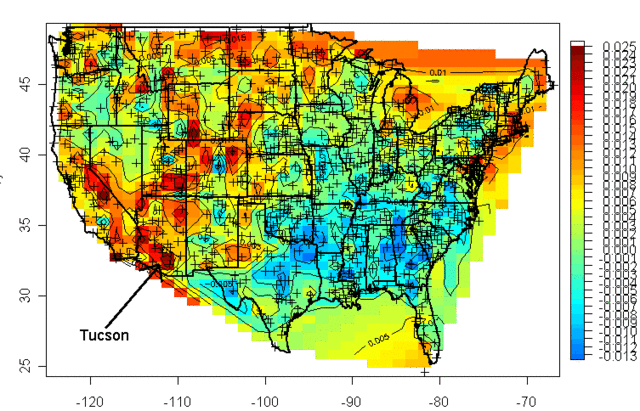
A while back, Steve McIntyre was playing around with graphing temperature data form the US Historical Climate Network (USHCN).  This is the data that is used in most global warming studies and initializes most climate models.  Every climate station is not in this data base - in fact, only about 20 per state are in the data base, with locations supposedly selected in rural areas less subject to biases over time from urban development (urban areas are hotter, due to pavement and energy use, for reasons unrelated to the greenhouse effect).  The crosses below on the map show each station.

He showed this graph, of the USHCN data for temperature change since 1900 (data corrected for time of day of measurement).  Redder shows measured temperatures have increased since 1900, bluer means they have decreased.
Usgrid80

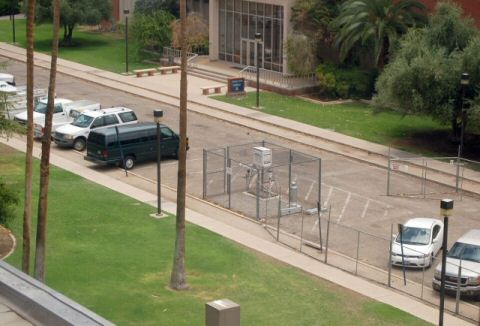
He mentioned that Tucson was the number one warming site -- you can see it in the deepest red.  My first thought was, "wow, that is right next door to me."   My second thought was "how can Tucson, with a million people, count as rural?"   Scientists who study global warming apply all kinds of computer and statistical tricks to this data, supposedly to weed out measurement biases and problems.  However, a number of folks have been arguing that scientists really need to evaluate biases site by site.  Anthony Watts has taken this idea and created SurfaceStations.org, a site dedicated to surveying and photographing these official USHCN stations.

So, with his guidance, I went down to Tucson to see for myself.  My full report is here, but this is what I found:
Tucson1

The measurement station is in the middle of an asphalt parking lot!  This is against all best practices, and even a layman can see how that would bias measurements high.  Watts finds other problems with the installation from my pictures that I missed, and comments here that it is the worst station he has seen yet.  That, by the way, is the great part about this exercise.  Amateurs like me don't need to be able to judge the installation, they just need to take good pictures that the experts can use to analyze problems.

As a final note on Tucson, during the time period between 1950 and today, when Tucson saw most of this measured temperature increase, the population of Tucson increased from under 200,000 to over 1,000,000.  That's a lot of extra urban heat, in addition to the local effects of this parking lot.

The way that scientists test for anomalies without actually visiting or looking at the sites is to do some statistical checks against other nearby sites.  Two such sites are Mesa and Wickenburg.  Mesa immediately set off alarm bells for me.  Mesa is a suburb of Phoenix, and is often listed among the fastest growing cities in the country.  Sure enough, the Mesa temperature measurements were discontinued in the late 1980's, but surely were biased upwards by urban growth up to that time.

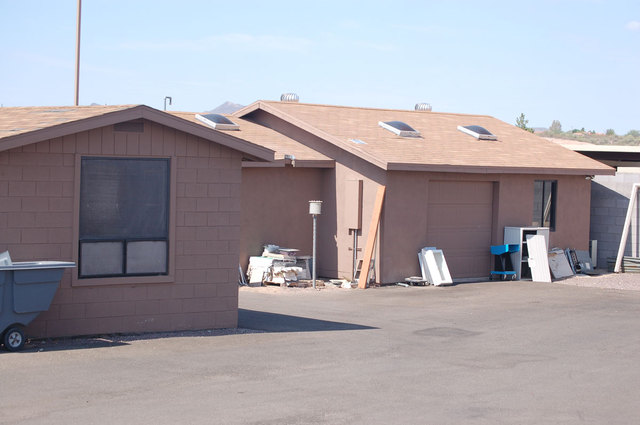
So, I then went to visit Wickenburg.  Though is has been growing of late, Wickenburg would still be considered by most to be a small town.  So perhaps the Wickenburg measurement is without bias?  Well, here is the site:

Wickenburg_facing_sw

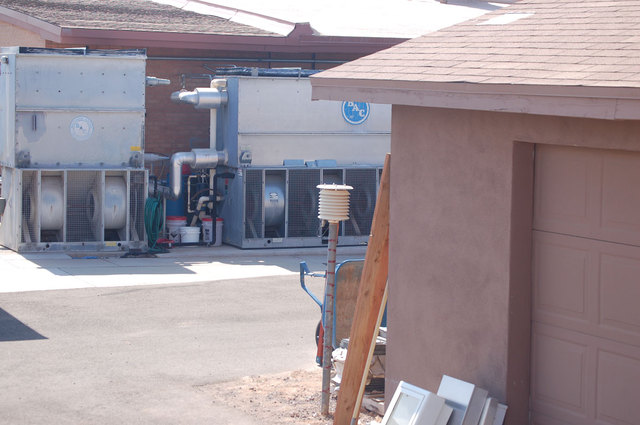
That white coffee can looking thing on a pole in the center is the temperature instrument.  Again, we have it surrounded by a sea of black asphalt, but we also have two building walls that reflect heat onto the instrument.  Specs for the USHCN say that instruments should be installed in an open area away from buildings and on natural ground.  Oops.  Oh, and by the way, lets look the other direction...

Wickenburg_facing_se

What are those silver things just behind the unit?  They are the cooling fans for the building's AC.  Basically, all the heat from the building removed by the AC gets dumped out about 25 feet from this temperature measurement.

Remember, these are the few select stations being used to determine how much global warming the US is experiencing.  Pretty scary.  Another example is here.

Believe it or not, for all the work and money spent on global warming, this is something that no one had done -- actually go document these sites to check their quality and potential biases.  And you too can have the satisfaction of contributing to science.  All you need is a camera (a GPS of some sort is also helpful).  I wrote a post with instructions on how to find temperature stations near you and how to document them for science here.

For those interested, my paper on the skeptics' arguments against catastrophic man-made global warming is here.  If that is too long, the 60-second climate skeptic pitch is here.

What the Chamber of Commerce Forgot to Say

Somehow, it never is mentioned in the Phoenix promotional literature that it occasionally rains mud here.  Below is my car, which I parked outside at night in a very clean condition.  Behold it in the morning:
Car_mud

No, it did not get stolen and taken out four-wheeling  (for some reason, teenage kids don't seem to steal Volvo's to go hot-rodding around -- go figure).  This is a result of the rainstorm last night.  What happens is we get big winds that whip up a lot of dirt in the air, so we get this really nice dust cloud.  Then it rains, with the water pulling the dirt out of the air and depositing it on the car.  Because the rain does not last long, the dirt stays on the car.  Instant mess.

Offset Sellers Only Double-Dipping?

From Steven Malloy:

Congress
began investigating the carbon offset industry this week. The inquiry
could produce some "inconvenient truths" for Al Gore and the nascent
offset industry.

Carbon offsets ostensibly allow buyers to
expunge their consciences of the new eco-sin of using energy derived
from fossil fuels. Worried about the 8 tons of carbon dioxide (CO2)
emitted each year by your SUV? Similar to the indulgences offered by
Pope Leo X in the 16th century, you can absolve yourself of sin by
purchasing $96 worth of CO2 offsets "“ typically offered at $12 per ton
of CO2 emitted "“ from offset brokers who, in turn, supposedly use your
cash to pay someone else to produce electricity with low or no CO2
emissions....

A
Capitol Hill staffer told me that the congressional inquiry would look
into the possibility of "double-dipping" in the offset industry.

Only double-dipping?  Earlier, I argued that the purveyors of offsets may be triple dipping:

  1. Their energy projects produce electricity, which they sell to
    consumers.  Since the
    electricity is often expensive, they sell it as "CO2-free"
    electricity.  This is possible in some sates -- for example in Texas,
    where Whole Foods made headlines by buying only CO2-free power.  So the
    carbon offset is in the bundle that they sell to
    electricity customers.  That is sale number one. 
  2. The company most assuredly seeks out and gets
    government subsidies.  These subsidies are based on the power being
    "CO2-free".  This is sale number two, in exchange for subsidies. 
  3. They still have to finance the initial construction of the plant, though.  Regular heartless
    investors require a, you know, return on capital.  So Terrapass
    finances their projects in part by selling these little certificates that you
    saw at the Oscars.  This is a way of financing their plants from people
    to whom they don't have to pay dividends or interest "”just the feel-good
    sense of abatement.  This is the third sale of the carbon credits.

Let's Not Start a Jihad against ISPs

McQ at QandO posts a number of examples of jihadi websites hosted on American ISPs, and goes on to urge:

If you're doing business with any of these ISPs, you may want to advise
them of your displeasure that your fees are helping support a company
that is hosting websites of avowed enemies of your nation and culture.
Granted, because these are in arabic, the ISPs may not even know what
the sites are, but now you do. Point the ISPs to the MEMRI post. Tell
them that websites which call for the killing of Americans, waging war
against us and teaching radicals how to make bombs are unacceptable.
This is not something which you must wait on government to do. These
sites need to come down and they need to come down because of
grassroots and market pressure to do so. Shut them down.

I have a number of problems with this.  Of course, in a free society, one can choose an ISP any way one likes.  However, given the nature of the Internet, this is one of those suggestions that may sort of feel good but have no chance of having any kind of impact.  Even if wildly successful, all you are going to do is drive these sites to offshore hosts, and I sure hope no one is talking about setting up Chinese-type filters and firewalls at our borders.

Further, there is nothing I like more than having my ISP blissfully ignorant of, and apathetic to, whatever it is they are hosting for me.  I DO NOT want to gear up ISP's to start reviewing and disallowing content.  That is a horribly slippery slope that will only end badly, as we have started to see with video banning at Google and YouTube.  In fact, given the precedents we have seen at YouTube, I would be willing to guess that if ISP's did start** putting a filter on sites and start** banning them based on public complaints, that McQ is not going to be happy be my sense is that their political filters are different than his.  Just look at campuses today -- many universities have defined a new right not to be offended that trumps free speech.  Do we really want to bring this horrible "innovation" to the Internet?

Finally, I think its awesome and what makes America great that we are so tolerant of speech from even the nuttiest of our worst enemies.  I had kind of hoped that GoDaddy would be on his list, just to experience the cultural irony of GoDaddy girl meets fundamentalist Islam.

** Actually, "start" is not the right word, since some undoubtedly kill certain sites when people complain.  Usually but not always today this is based more on irritating Internet behavior (e.g. spamming) rather than content of speech.  It would be more accurate to have said "substantially increase the banning of sites based on content."

Vote For Me Because I Care

How many politicians have you heard say that they care deeply.  I hate politicians who care.  You know why?  Because the way they demonstrate that they care is by using my money against my will to help someone else.  It is a freaking slap in the face every time I hear this.

Now, government employees in Massachusetts are getting a new way to demonstrate they care at taxpayer expense:

A much-hyped program that
gives state workers up to a dozen paid days off per year to "volunteer"
in a wide variety of community activities gives another perk to
employees who already have one of the most generous benefit packages in
the country....

   A Herald analysis
shows that if the 80 employees in the governor's office took full
advantage of the program, the one-year cost would be $217,000. The
taxpayer cost just for Patrick, who makes $140,000, to take all 12 paid
volunteer days would be about $6,400. There are 50,000 state workers
eligible to participate in the program.

    "Beyond
the loss of productivity for days off, consider the cost of tasking
other state employees with making sure their co-workers aren't just
extending their weekends," said state GOP spokesman Brian Dodge. "With
bright ideas like this one, the stream of wasted money directly
attributed to Deval Patrick is quickly becoming a raging river."

Its not "volunteering" if you get paid to do it, any more than its "charity" when you give away other people's money.  (HT:  Maggie's Farm)

Prosecurtorial Abuse

As the DOJ's Corporate Fraud Task Force pats itself on the back for the great job it is doing, Tom Kirkendall rips them up in a scathing rebuttal.  I encourage you to follow the links -- he has great depth on every point he makes.

Prosecurtorial Abuse

As the DOJ's Corporate Fraud Task Force pats itself on the back for the great job it is doing, Tom Kirkendall rips them up in a scathing rebuttal.  I encourage you to follow the links -- he has great depth on every point he makes.

Prosecurtorial Abuse

As the DOJ's Corporate Fraud Task Force pats itself on the back for the great job it is doing, Tom Kirkendall rips them up in a scathing rebuttal.  I encourage you to follow the links -- he has great depth on every point he makes.

Out on your ass, Jane Austen

Some frustrated writer apparently submitted a Jane Austin novel to a publisher and had it rejected.  The point being, I guess, that publishers are all screwed up and therefore the author in question can now whine a little louder about his work being rejected.  John Scalzi makes short work of this:

Honestly, you'd think newspapers would be bored of reporting this genre
of stunt by now.
You know, as an aside to this foolishness: If I were an editor today,
and Jane Austen had not previously existed, and someone submitted Pride and Prejudice as a mainstream novel, I'd probably reject it. Because it's the 21st goddamn century,
that's why, and the style is all wrong to sell a whole bunch of them
(even if it were pitched as a mainstream historical novel). In point of
fact, I'd probably reject anything written in a 19th century manner,
with the possible exception of Mark Twain's work; for my money he's
probably the only 19th century author whose writing style doesn't make
me feel like I'm slogging through a morass of commas and odd language
structure....

So, yes. Out on your
ass, Jane Austen, until you can write in a contemporary way.

Yes, its a major pain to get published by a top house, and in fact I have yet to be successful, though I honestly think the current book I am writing has a good shot.  But there are lots of reasons a publishing house might reject a perfectly good book:  It may not fit the types of books they publish (you don't send a period piece to a sci-fi house); the publisher's pipeline might be full;  the author's synopsis or the first 30 pages might not be catchy enough (publishers cannot read every word of every submission they get); or the publisher could be missing an opportunity; or the book might, gasp, not be as good as the author thinks it is.

Silver Lining

I have always hated the inevitable posturing during the party presidential conventions that the newly selected vice-presidential candidate would have unprecedented access to the president and that the presidential candidate would reinvent the office of the vice-presidency to take advantage of his running mate's unique skills, blah blah.  Kennedy giving NASA to Johnson not-withstanding, this is mostly face-saving for the vice-presidential candidate, since he or she has typically just been relegated to an appendage of the person they were very recently running against.  Also, there just isn't any Constitutional role for the vice-president short of breaking ties in the Senate and fogging a mirror in case the President dies.

Say what you will about the Bush White House, but I can pretty much gaurantee we are not going to hear much this election cycle about powerful and active future vice-presidents.

Privatizing Public Recreation

A bit over five years ago, I wrote an op-ed piece in our local paper calling for further privatization of public recreation.  The editorial was in response to a proposal for a large bond issue to rebuild recreation infrastructure.  I argued that the state should instead be focusing on attracting private investment.  Not only was there more money for recreation in private hands than public, but I sensed that private funds would more likely be invested in facilities the public really wanted, rather than goofy politically correct projects.  Further, private operators could operate recreation facilities much less expensively, in part because they are not tied to ridiculous public pay scales, pension plans, and job classifications.

Soon after, I had a business broker call me and ask me if I wanted to put my money (such that it was) and time where my mouth was.  After a lot of twists and turns, I ended up the owner of a recreation concession company.  In a recreation concession, a private operator pays the government rent in exchange for the ability to charge visitor fees and run the recreation facility for profit.  In most cases, our company can operate a property and make a profit on fees lower than the government must charge just to break even.

My business, Recreation Resource Management, has prospered since then.  And as I have gotten deeper into public recreation, what I have learned has only confirmed what I wrote in that editorial.  I have seen that when the government runs recreation facilities, it almost never spends enough money on capital maintenance and refurbishment.  The reason seems to be that legislators, given the choice, would much rather spend $X on a shiny new facility they can publicize to their constituents than spend $X maintaining facilities that already exist.  I laugh when I here progressives argue that private industry is too short-term focused and only the government invests for the long-term.  In practice, I find exactly the opposite is true.  Think about hotels, or gas stations, or grocery stores.  Private businesses understand that every 15-20 years, they need to practically rebuild existing infrastructure from scratch to keep them fresh for customers.  This kind of reinvestment almost never happens in public recreation.

Except this week!

After years of building up our business, we just completed a project with California State Parks that is what I have always wanted to achieve with the company.  At McArthur-Burney Falls State Park, California State Parks had an aging concession store and an outdated section of the campground that it really did not have the money to rehabilitate (by the way, this is an absolutely beautiful park -- I highly recommend it).  We crafted a two-part lease with the state which eventually led to us investing over a million dollars in the park:  In phase one, we built a new concession store (old store on left, our new store on right):

Park_storeexterior000  Store3

In phase two, just complete, we took an old tent-camping loop with no utilities and added 24 new cabins.  These cabins not only refurbish an aging and dated section of the campground, but they also add new amenities to the park to attract visitors who may not own an RV and who don't want to sleep in a tent.  In addition, since they are insulated and heated, these cabins will extend the camping season -- in fact, we already have a number of reservations for Thanksgiving, a time when no one would have wanted to tent camp here.

Cabin1    Cabin_inside2

Its a  win-win-win, where  we make money, the state gets lease revenues
from us that exceed their previous camping revenues, and the public
gets new amenities without any taxes or public spending.

So, in answer to the question I so often get, "why does a libertarian run a company that works with the government?"  Now you know why.  I will admit that from time to time I find myself on the losing end of libertarian-intellectual-purity debates because I choose this path rather than, say, living in a cabin in the wilderness and manufacturing rifle barrels for a living.  *Shrug*

Postscript:  One lesson I have also learned is that state governments are not always a monolith.  Texas and Florida, for example, while being beloved of libertarians for having no state income tax, can be horribly bureaucratic in certain areas (e.g. sales tax reporting and vehicle registrations).  California, on the other hand, which in many ways is one of the worst states to do business in, actually has what is probably the most innovative and business-friendly state parks organization in the country.  Go figure.

PS#2:  By the way, the cabins shown are actually modular buildings, built here in Phoenix by Cavco, and shipped to the site.  The classy interior work was done my by maintenance supervisor.

Worst Music Video Ever

It has been a while since I have posted this, but I am still convinced this is the worst music video ever made.  The only competitor I can think of is if you classified the movie "Sgt. Pepper's Lonely Hearts Club Band" as a music video.  Enjoy (or not):

Seriously, this is wrong is so many ways.

EEEEK!

I have argued for a while that American support for real free speech seems to be languishing, and we seem to be more and more comfortable with making exceptions to the first amendment for "hate speech" and speech that offends people, and speech that costs money during an election.  And now this, via Q&O, from a Rasmussen poll:

A large segment of the public would like to extend the concept of the
Fairness Doctrine to the Internet as well. Thirty-four percent (34%)
believe the government should "require web sites that offer political
commentary to present opposing viewpoints." Fifty percent (50%) are
opposed.

They could only dredge up a bare majority of 50% to oppose this?

The Individual Responsibility Bomb

Yesterday I saw Live Free or Die Hard, and I must say that it was an unexpectedly enjoyable film.  Good action from earlier movies combined with an unlikely buddy movie element.  I was disappointed only with one bit towards the end that overtaxed my suspension of disbelief.

Anyway, not to spoil too much, a mysterious group has hacked into government computers to shut down most public functions - air traffic control, traffic lights, emergency response.  They've also messed with communications and stock market computers. 

In pushing their terrorist attack, the message was interesting.  I can't remember the exact words, but it was stuff like "what if you called the government and no one was there to answer.  What if you needed help and government agencies could not help you.  You are all alone"  This struck me as a thoroughly modern form of attack -- the terrorists cut the welfare state off from the government, forcing them to take responsibility for their own lives, and everyone panics in response.

I remember one line where Bruce Willis says "Surely the government has departments full of people to deal with this kind of thing" and the other character says "it took the government five days after Katrina to get water to the Superdome."  Again, the assumption is that as the tools of civilization fail, only the government could put things together again, and they were undermanned.  But after Katrina, Wal-Mart and Home Depot had extra inventory in their local stores, with a focus on plywood and generators and the like, in hours rather than days.  FEMA on the other hand spent more time after Katrina keeping individuals from helping in New Orleans of their own initiative than doing anything themselves.   Civilization was built by individuals, not the government, and if it ever comes to rebuilding it, the same will be true.

A Parable of Cars and Contact Lenses

I drive into my local Shell station to fill up, and stick my card in the pump, but the pump refuses to dispense.  I walk into the office and ask the store manager why I can't get gasoline.  She checks my account, and says "Mr. Meyer, your Volvo fuel prescription has expired."  I say, "Oh, well its OK, I am sure I am using the right gas."  She replies, "I'm sorry, but the law requires that you have to have a valid prescription from your dealership to refill your gas.  You can't make that determination yourself, and most car dealerships have their prescriptions expire each year to make sure you bring the car in for a checkup.  Regular checkups are important to the health of your car.  You will need to pay for a service visit to your dealership before we can sell you gas."  I reply, "RRRRRRR."

OK, so if this really happened we would all scream SCAM!  While we all recognize that it may be important to get our car checked out every once in a while, most of us would see this for what it was:  A government regulation intended mainly to increase the business of my Volvo dealership's service department by forcing me to pay for regular visits.

So why don't we cry foul when the exact same situation occurs every day with glasses and contact lenses?  The parable above is nearly exactly the conversation I had the other day with the operator at 1-800-CONTACTS, except with "gas" substituted for "contacts".  I know that my contact lens prescription is a bit out of date, but I really needed them for a trip, and in terms of safety, a slightly out-of-date contact lens in my eye is much better than none (My contacts are about -6.5, which means I am pretty blind without them).  No joy, though.  I did not have time to get to the doctor, so I wore -5.0 contacts I found in a drawer just to have something.  The operator told me that doctors have the prescriptions expire each year so that I am forced to come see them.  Why with eye doctors do we consider this "for my own good" when in any other profession it would be called a scam? 

In fact, each year I know my eyes get about 0.25 worse on each lens.  I would really like to just self-medicate and order myself the next level up, but of course that is way out of bounds.  Can't trust people to figure out their own lens correction (though we do allow this for reading glasses, go figure).

The 60-Second Climate Skeptic

I was trying to think about what I wanted to do for my last post in my recent orgy of global warming writing.  My original attempt to outline the state of the climate skeptic's case ballooned into 80+ pages, so there may be many people who rationally just have no desire to tackle that much material.  So I decided for this last post to try to select the one argument I would use if I had only 60 seconds to make the climate skeptic's case. But how do you boil down 80 pages to a few simple statements?

I'm not that interested in the Sun or cosmic rays -- they are interesting topics, but its dumb to try to argue we overestimate our understanding of man's impact on climate only to counter with topics we understand even less.  One of the reasons I wrote the paper in the first place was because I thought recent skeptical documentaries spent too much time on this subject.  And I would not get into tree rings or ice cores or other historic proxy data, though there is a lot happening in these areas.  I wouldn't even delve into the hysterical treatment of skeptics by man-made climate advocates  -- these are ad hominem issues that are useful to understand in a more comprehensive view but don't make for strong stand-alone arguments.

Anyway, here goes, in a logic chain of 8 steps.

  1. CO2 does indeed absorb reflected sunlight returning to space from earth, having a warming effect.  However, this effect is a diminishing return -- each successive increment of CO2 concentrations will have a much smaller effect on temperatures than the previous increment.  Eventually, CO2 becomes nearly saturated in its ability to absorb radiation.  The effect is much like painting a red room with white paint.  The first coat covers a lot of red but some still shows through.  Each additional coat will make the room progressively whiter, but each successive coat will have a less noticeable effects than the previous coat, until the room is just white and can't get any whiter.
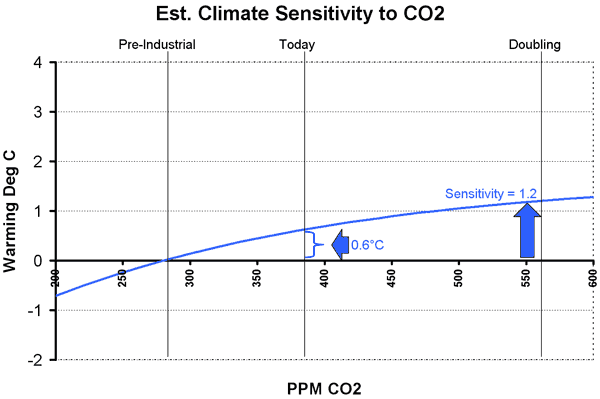
  2. In the 20th century, the UN IPCC claims Earth's surface temperatures have increased by about a 0.6 degree Celsius (though there are some good reasons to think that biases in the installation of temperature instruments have exaggerated this apparent increase).  To be simple (and generous), let's assume all this 0.6C increase is due to man-made greenhouse gasses.  Some may in fact have been due to natural effects, but some may also have been masked by man-made sulfate aerosols, so lets just call man-made warming to be 0.6C. 
  3. Since the beginning of the industrial revolution, it is thought that man has increased atmospheric CO2 concentrations from 0.028% of the atmosphere to 0.038% of the atmosphere.  Since scientists often talk about the effect of a doubling of CO2, this historic rise in CO2 is 36% of a doubling.
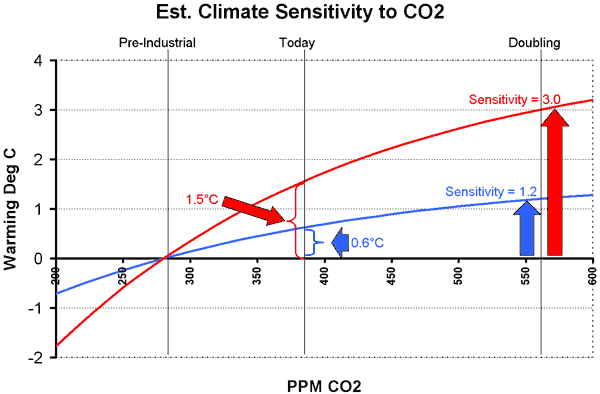
  4. Using simple math, we see that if temperatures have risen 0.6C due to 36% of a doubling, we might expect them to rise by 1.67C for a full doubling to 0.056% of the atmosphere.  But this assumes that the rise is linear -- and we already said (and no one denies) that it is in fact a diminishing return relationship.  Using a truer form of the curve, a 0.6C historic rise for 36% of a doubling implies a full doubling would raise temperatures by about 1.2C, or about 0.6C more than we have seen to date (see chart below).   This means that the magnitude of global warming in the next century might be about what we have seen (and apparently survived) since 1900.
  5. Obviously, there is some kind of disconnect here.  The IPCC predicts temperature increases in the next century of 4-8 degrees C.  Big difference.  In fact, the IPCC predicts we will get a 0.5C rise in just 20 years, not 70-100.  Whereas we derived a climate sensitivity of 1.2 from empirical data, they arrive at numbers between 3 and 4 or even higher for sensitivity.  The chart below shows that to believe sensitivity is 3, we would have to have seen temperature rises due to man historically of 1.5C, which nobody believes. 

    So how do they get accelerating temperatures from what they admit to be a diminishing return relation between CO2 concentration and temperature? And for which there is no empirical evidence?  Answer:  Positive feedback.

  6. Almost every process you can think of in nature operates by negative
    feedback.  Roll a ball, and eventually friction and wind resistance bring
    it to a stop.  Negative feedback is a ball in the bottom of a bowl; positive feedback is a ball perched precariously at the time of a mountain. Positive feedback
    breeds instability, and processes that operate by positive feedback are
    dangerous, and usually end up in extreme states -- these processes tend to
    "run away" like the ball rolling down the hill.  Nuclear fission, for example, is a positive feedback process.  We should be happy there are not more positive feedback
    processes on our planet.  Current man-made global warming theory, however, asserts that our climate is dominated by positive feedback.  The IPCC posits that a small increase in temperature from CO2 is multiplied 2,3,4 times or more by positive feedbacks like humidity and ice albedo.
  7. There are three problems with these assumptions about positive feedback.  One, there is no empirical evidence at all that positive feedbacks in climate dominate negative feedbacks.   The 20th century temperature numbers we discussed above show no evidence of these feedbacks.  Two, the long-term temperature record demonstrates that positive feedbacks can't dominate, because past increases in temperature and CO2 have not run away.  And three, characterizations of stable natural processes as being dominated by positive feedback should offend the intuition and common sense of any scientist.
  8. An expected 21st century increase of 0.5 or even 1 degree C does not justify the massive imposed government interventions that will be costly both in dollars and lost freedoms.  In particular, the developing world will be far better off hotter by a degree and richer than it would be cooler and poorer.  This is particularly true since sources like an Inconvenient Truth wildly exaggerate the negative effects of global warming.  There is no evidence tornadoes or hurricanes or disease or extinction are increasing as the world warms, and man-made warming advocates generally ignore any potential positive effects of warming.  As to rising sea levels, the IPCC predicts only a foot and a half of sea level rise even with 4 or more degrees of warming.  Sea level rise from a half to one degree of warming would be measured at most in inches.

OK, so that was more than 60 seconds.  But it is a lot less than 80 pages.  There is a lot of complexity behind every one of these statements.  If you are intrigued, or at least before you accuse me of missing something critical, see my longer paper on global warming skepticism first, where all these issues and much more (yes, including tree rings and cosmic rays) are discussed in more depth.

Why a Carbon Tax is Superior

I don't think that government action on greenhouse gasses is justified.  That's not to say that man is not helping nature warm the planet some, its that the man-made warming, when you strip away the exaggerations, does not justify the cost of preventing it.  Since I wrote 80+ pages on it here, I won't delve much further into it. 

However, if we are going to take action, a carbon tax is way, way better than cap and trade.  I used to think that cap and trade made more sense, but I have changed my mind.  Cap and trade systems have a lot of potential for error and abuse, but there is one issue that is not adequately discussed:  They are also a huge subsidy and protection for current businesses, effectively penalizing new entrants.

Why?  Because most cap and trade systems begin by giving out emissions credits to current industry incumbents.  These are credits that new entrants will have to purchase, tilting the playing field in favor of current industry leaders.  This is the kind of thing Europeans love, because their largest business interests effectively control the government and keep out new competition, causing their economies to stagnate.  Steven Milloy is one of the few folks raising the red flag on this issue:

Under
the LCEA, the federal government would annually issue rights or
"allowances" to emit GHGs. In the first year of the bill, slated as
2012, allowances would be issued for approximately 6.65 billion metric
tons of GHGs. The amount of allowances slightly decreases every year "“
for example, 6.59 billion metric tons in 2013, 6.53 billion metric tons
in 2014, etc. "“ until it finally levels out at 4.82 billion metric tons
in 2030 and beyond.

These allowances have monetary value "“ a lot.

Owners
of allowances can either use them to pay for their GHG emissions or
they can sell them to other emitters who need allowances. Emitters can
also simply pay the federal government directly to emit GHGs at a cost
of $12 per metric ton of carbon dioxide starting in 2012. This price is
slated to increase annually by the inflation rate plus 5 percent. By
2030 "“ and unrealistically assuming that no inflation occurs "“ the
pay-to-emit price would be about $27.50 per metric ton of carbon
dioxide.

Using the pay-to-emit price, the GHG emissions
allowances issued by the federal government in 2012 will have a
potential market value of $80 billion. The annual market value of these
government-issued allowances will rise to over $100 billion by 2018 and
hit $130 billion in 2030. It will only take about 10 years "“ exclusive
of any inflation "“ for value of the allowances issued by the government
to exceed $1 trillion.

And incredible as it sounds, the bulk of
these allowances "“ 76 percent for the first five years, declining to 47
percent by 2030 "“ will be given away at no charge to special interests
including private industry, farmers and states. This global warming
giveaway works out to a total of $1.34 trillion of free money "“ not
adjusted for inflation "“ that would be handed out to global warming
special interests from 2012-2030. After 2030, the annual amount of free
money handed out is about $65 billion, increasing by 5 percent per
year, exclusive of inflation.

Unfortunately, politicians will always favor an indirect tax over a direct tax because they are gutless and entirely free of any nagging principles.  Cap and trade systems would raise consumer prices at least as much as a carbon tax, but the price increase would appear to be made by industry and not due to a visible government tax.  Congress can point the finger at industry and say, it's not our fault, it's those greedy guys in industry driving up prices.

Further, the carbon tax is hard to game.  Everybody pays.  But cap and trade - Oh the beautiful potential to milk various constituencies for donations!  If the government sets up a program where some groups get credits for free, and some have to pay for them, well of course every industry is going to pour millions upon millions into politician's hands trying to make sure they are in the favored group. 

What a mess.  We are already seeing the huge distortions coming from nutty ethanol subsidies, and that is due to the pressure of just one industry (farmers and ADM).  Just think of the distortions form this program.  There may be a good chance that misguided attempts to manage greenhouse gasses may well be the largest threat to the American economy and free marketplace, well, ever.  Which, by the way, is why every Marxist and socialist on the face of the earth are right at the forefront of the global warming movement.

If you suspect that the world may be warming, but not nearly enough to justify such costs in terms of both dollars and lost freedom, you might want to read this.