Good News: Hansen Releases the Temperature Code

Good news this week:  James Hansen and NASA have now deigned to release for scrutiny their taxpayer-funded temperature aggregation and adjustment code.  I go in more detail and explain why this matters over at Climate Skeptic.

By the way, if you are wondering why I have calmed down a bit on climate of late here at Coyote Blog, it is because I have decided that my climate work really was diluting what I want to do here at Coyote Blog, and it really deserved its own home and audience.  I have begun archiving old posts over at Climate Skeptic, and I will do most of my new posting on climate there.  Those interested in the climate issues are encouraged to bookmark the new site and/or subscribe to its feed.

For a little while, I will still mirror the headlines over here at Coyote Blog (after all, the paint is still so wet over at Climate Skeptic that I don't think Google has found me yet -- a few blogrolls wouldn't hurt, hint, hint.)

Also, in the next few weeks I plan release my own video on issues with catastrophic anthropogenic (man-made) global warming theory.  The core of this video will be based on this skeptics summary post and my 60-second climate overview as well as my free 80-page skeptics primer, of course.

Immigrants and Poverty

Robert Samuelson makes the point I made here:

The standard story is that poverty is stuck; superficially, the

statistics support that. The poverty rate measures the share of

Americans below the official poverty line, which in 2006 was $20,614

for a four-person household. Last year, the poverty rate was 12.3

percent, down slightly from 12.6 percent in 2005 but higher than the

recent low, 11.3 percent in 2000. It was also higher than the 11.8

percent average for the 1970s. So the conventional wisdom seems amply

corroborated.

It isn't. Look again at the numbers. In 2006, there were 36.5

million people in poverty. That's the figure that translates into the

12.3 percent poverty rate. In 1990, the population was smaller, and

there were 33.6 million people in poverty, a rate of 13.5 percent. The

increase from 1990 to 2006 was 2.9 million people (36.5 million minus

33.6 million). Hispanics accounted for all of the gain.

Consider:

From 1990 to 2006, the number of poor Hispanics increased 3.2 million,

from 6 million to 9.2 million. Meanwhile, the number of non-Hispanic

whites in poverty fell from 16.6 million (poverty rate: 8.8 percent) in

1990 to 16 million (8.2 percent) in 2006. Among blacks, there was a

decline from 9.8 million in 1990 (poverty rate: 31.9 percent) to 9

million (24.3 percent) in 2006. White and black poverty has risen

somewhat since 2000 but is down over longer periods

This is not a ding on immigration, as readers will know I am a supporter of open immigration.  But it is an important context to have when evaluating poverty numbers.  The drop in black poverty in these numbers is an ENORMOUS piece of good news that I bet you have not read anywhere.

Immigrants and Poverty

Robert Samuelson makes the point I made here:

The standard story is that poverty is stuck; superficially, the

statistics support that. The poverty rate measures the share of

Americans below the official poverty line, which in 2006 was $20,614

for a four-person household. Last year, the poverty rate was 12.3

percent, down slightly from 12.6 percent in 2005 but higher than the

recent low, 11.3 percent in 2000. It was also higher than the 11.8

percent average for the 1970s. So the conventional wisdom seems amply

corroborated.

It isn't. Look again at the numbers. In 2006, there were 36.5

million people in poverty. That's the figure that translates into the

12.3 percent poverty rate. In 1990, the population was smaller, and

there were 33.6 million people in poverty, a rate of 13.5 percent. The

increase from 1990 to 2006 was 2.9 million people (36.5 million minus

33.6 million). Hispanics accounted for all of the gain.

Consider:

From 1990 to 2006, the number of poor Hispanics increased 3.2 million,

from 6 million to 9.2 million. Meanwhile, the number of non-Hispanic

whites in poverty fell from 16.6 million (poverty rate: 8.8 percent) in

1990 to 16 million (8.2 percent) in 2006. Among blacks, there was a

decline from 9.8 million in 1990 (poverty rate: 31.9 percent) to 9

million (24.3 percent) in 2006. White and black poverty has risen

somewhat since 2000 but is down over longer periods

This is not a ding on immigration, as readers will know I am a supporter of open immigration.  But it is an important context to have when evaluating poverty numbers.  The drop in black poverty in these numbers is an ENORMOUS piece of good news that I bet you have not read anywhere.

Southwest Airlines Seat Selection

Today, I made a pretty rookie mistake in seat selection on Southwest.

I was in the "A" group so was almost certain to be able to get an aisle seat.   From the look of the crowd behind me, it was clear that some, but not all the middle seats would eventually be taken.

I am pretty good at taking up a lot of space even without trying (I am 6-4) but when inspired I can really spread out in my aisle seat to make the middle seat uninviting to the average middle seat shopper.  And an empty middle seat looked like a layup on this flight, since only about 7 or 8 would be filled, and several of the rows around me had really tiny people on the aisle.

But then I glanced at the occupant of the window seat.  AARRGGGHHH!  Sitting there was an extraordinarily attractive young female, dressed quite fetchingly with a bare midriff and a short skirt.  At that moment, I knew I was doomed.  No matter how small I made the middle seat look, some twenty-something guy with minimal self-awareness was going to take that seat to try to hit on the girl at the window.  And sure enough, despite the fact he was as big as me and our shoulders were ordained to fight for space for the two-hour flight, he homed in on the middle seat next to me like a cruise missile.  Worse, I had to listen to him trying to pick the girl up for 2 hours.  I will say it was hilarious for about a third of that time as he tried valiantly to feign interest in the hard-core collectivist-socialist drivel she was selling.  I worried towards the end that he might actually be bonding with her as they both came to quick agreement that all their job prospects seemed to much like "work," but fortunately for my piece of mind she shot him down in flames as we were exiting.

You Better Shop Around

From Kevin Drum:

Marc Cooper spends 20 hours in the hospital and tells his story here.  Price of stay without insurance: $116, 749.  Price with insurance: $4,730.  Only in America, folks.

He's not very clear if this was an emergency situation -- like, did he have a heart attack and get rushed to the hospital in an ambulance -- or an important but non-emergency situation.  I will assume the latter by the tone of Marc Cooper's detailed post.

If so, then my first comment is, indeed only in America would he have gotten this procedure without waiting twelve weeks or without traveling to, say, America to get it done more expeditiously,

Second, I wonder:  Did he ask for a price estimate in advance? Did he ask, as most of
us do with all of our large purchases, for a written estimate or
quotation? Did he get such estimates from two or three competitors? Did
he shop around?

Of course not! Because in a system where someone else is paying the
bills, we have no incentive to shop around. So providers have no
incentive to compete on price or to worry about productivity and cost
control.

Sure, this looks like a rip-off.  But if you went in to buy a car, concerned only with the quality of the
car, and never asked the price and then got a bill for $100,000 a few
weeks later, would you be surprised?  Would anyone give you sympathy if you complained you paid $100,000 for the car but admitted you never asked what the price was?

So this is a dead-obvious outcome from the health care system we
have, where no one has the incentive to shop. By the way, I have a high-deductible policy which causes me to
shop around, because costs come out of my own pocket. I ask questions
like, is that extra CT scan really necessary?

It's incredible to me that given this situation, the solution for
this blog's author and most of his readers is not "we should find a way
to have individuals experience both the cost and benefits of care,
because only they can make these tradeoffs for themselves and shop
around for better options" but is instead "lets just turn it over to
the government, since they do such a good job with Iraq and the mail
and our schools."

Finally, I would point out that the author is making some wild assumptions about an insurance statement he probably does not understand (I say that with confidence since no one understands health insurance statements).  His assumption that the walk-in poor would have had to pay $100,000 for the procedure or would have been left to die are demonstrably untrue, since there is just not that much evidence that either outcome is occuring with any regularity.  That is why health care socialization supporters always talk about the number of people uninsured, which is almost irrelevant, instead of the number of people who don't get care, which is a much much smaller, almost vanishingly small number.

New iPod

The newly announced iPod, which is basically an iPhone without the phone but with all the same screen, interface, wi-fi, etc. looks pretty good.  The only problem I have with it (without having actually held one) is that the storage is pretty thin* at 16GB given that it is such a natural for movies.  Still, I can see having one of these for travel while keeping my current 60GB iPod for my music collection  (and by the way, new, thinner traditional iPods with more memory are also on the way.  160GB, woot!).  This is getting close to what I had hoped the Nokia 770 was going to be, but was crippled by lack of memory.  If they would make a folding wireless bluetooth keyboard work with this, it will be great.

* Spoken by the person who thought he would never fill his first 10BM hard drive add-in card on his first PC

Larry Craig

OK, I have resisted commenting on Larry Craig.  My reactions are:

  1. We are so off topic here it is unbelievable.  For Congress, exercising arbitrary powers over individuals in violation of the intent, if not the letter, of the Constitution:  OK.  Playing footsie in the bathroom: Not OK
  2. Are we really going to have a Congressman resign for tapping his foot in a public bathroom while a man who had $100,000 in cash bribe money found in his freezer still sits in office?
  3. Why is it that Democrats, against their political beliefs, feel the need to criticize Republicans for being gay while Republicans feel the need to criticize Democrats for having large homes and SUVs?
  4. Do we really pay police officers to sit on the toilet for hours and try to catch men who are soliciting consensual sex?  And if so, do they also pay female officers to patrol for the same thing among women?  This is a real threat to us?

David Bernstein has more.  Via TJIC.

Update:  A reader pointed out to me I had a fairly relevant passage in my novel BMOC, when the Senator is confronted with his $50,000 earmark nominally for a "women's consulting company" turned out to be directed at a house of prostitution [edited to remove the more raunchy terminology]:

Taking a deep
breath, [the Senator's aid] said, "Senator, there is a reason that this one is not going
away. I will spell it out: S-E-X. The press doesn't give a shit about a few billion dollars of waste. No one tunes in to the evening news if the
teaser is "˜Government pays too much for a bridge, news at eleven.' The Today Show doesn't interview the
contractors benefiting from a useless bridge."

"However, everybody and his dog will tune in if
the teaser is "˜Your tax dollars are funding call girls, film at eleven'. Jesus, do you really think the CBS Evening
News is going to turn down a chance to put hookers on the evening news? Not just tonight but day after day? Just watch "“ Dan Rather will be interviewing
hookers and Chris Mathews will be interviewing hookers and for God's sakes
Barbara Walters will probably have a weepy interview with a hooker."

"And you know
what?" Givens continued, his voice rising. "The whole act makes me sick. All
these media types are going to be piously turning up their nose at you and
those women, while at the same time making more money for themselves off those
prostitutes than those women ever made for themselves on their back. It's rank
hypocrisy but it's the facts of life in Washington,
and I shouldn't have to be explaining this to you."

"You guys in the
Senate can get away with a lot, as long as long as a) you don't get caught or
b) the scandal is so boring or complex that it won't sell newspapers. Hell, I saw a poll the other day that a
substantial percentage of Americans to this day don't understand or even
believe what Richard Nixon did wrong. But if you polled those same people, every freaking one of them would
say that they knew and believed that Bill Clinton [fooled around with] an intern. What's the difference? Sex. Bill Clinton was impeached and lost his law license, not because he did
or did not commit fraud with Whitewater Development Corp., but because he lied
about [sex with] a young girl."

Help Me Out on Darfur

Many of the very same folks who are vocal critics of the war in Iraq have "Save Darfur" banners on their web site.  I followed one, and clicked around a lot to find out what the hell they thought should be done.  They have some woman on the home page "running for Darfur" but I am not sure that is much of a practical solution.  I see they also want to send in the UN peacekeepers, but they seem to imply the problem is that the government needs to go, and I have never known UN peacekeepers to overthrow any governments (or to do anything really, other than maybe participate in some of the looting themselves).  And I can't believe that any adult really thinks sending aid money to this area with a rapacious government is going to help one bit.

Isn't the only real solution to send in troops, overthrow the old boss, and hang around for a decade or so until the new boss is stable?  And how is that any different than Iraq.

Seriously, I thought opposition to Iraq was about not engaging in wars we don't have to for mainly humanitarian reasons.  I am very sympathetic to this position, but it means that you are just going to have to watch and weep when the inevitable Darfurs come along.  But all this Darfur stuff is making me think that the opposition to Iraq is more about wars started by our guy vs. wars started by your guy.  I think it is perfectly valid to have a discussion about whether we want to try to take on by military force every bad government in the world (see: Cleaning the Augean Stables).  Unfortunately, I think the discussion is instead devolving into whether we should use our army to attack governments George Bush doesn't like vs. those Bono doesn't like.

Help Me Out on Darfur

Many of the very same folks who are vocal critics of the war in Iraq have "Save Darfur" banners on their web site.  I followed one, and clicked around a lot to find out what the hell they thought should be done.  They have some woman on the home page "running for Darfur" but I am not sure that is much of a practical solution.  I see they also want to send in the UN peacekeepers, but they seem to imply the problem is that the government needs to go, and I have never known UN peacekeepers to overthrow any governments (or to do anything really, other than maybe participate in some of the looting themselves).  And I can't believe that any adult really thinks sending aid money to this area with a rapacious government is going to help one bit.

Isn't the only real solution to send in troops, overthrow the old boss, and hang around for a decade or so until the new boss is stable?  And how is that any different than Iraq.

Seriously, I thought opposition to Iraq was about not engaging in wars we don't have to for mainly humanitarian reasons.  I am very sympathetic to this position, but it means that you are just going to have to watch and weep when the inevitable Darfurs come along.  But all this Darfur stuff is making me think that the opposition to Iraq is more about wars started by our guy vs. wars started by your guy.  I think it is perfectly valid to have a discussion about whether we want to try to take on by military force every bad government in the world (see: Cleaning the Augean Stables).  Unfortunately, I think the discussion is instead devolving into whether we should use our army to attack governments George Bush doesn't like vs. those Bono doesn't like.

Number of the Day

$400,000

Amount the University of Michigan paid Appalachian State to come up and kick its ass.

Postscript:  I remember a while ago there was a item on eBay where you could pay a guy to come to your house and kick your ass.  The whole marketing pitch was hilarious, but I remember the final price was a lot less than $400,000.  Update:  Found the eBay item archived here.

Speaking of Technocrats...

Apparently leading technocrat and Mussolini-style-economic-dictator Robert Reich is at it again, arguing the path to freedom requires more government coercion.  Ronald Bailey reminds us that Reich was the one who advocated the US adopt Japanese MITI-style economic management, just before the American economy took off for 25 years and Japan's spiraled into stagnation.  Now, he is arguing that capitalism is the enemy of democracy:

As Freedom House points out the number of countries that qualify as free rose from just 44 in 1972 to 89 in 2005,
even as capitalism expanded around the globe. It has been hypothesized
that as incomes increase in a country (rise of a middle class), the
demand for democratic governance becomes irresistible. This seems to
have been the pattern in South Korea, Chile, and Taiwan. Will the same
thing happen in China? As a negative leading indicator---whatever Reich
predicts, the opposite occurs-don't be surprised if China becomes a
democracy in the next decade.

Why Aren't Women Fighting the Health Care Trojan Horse?

Reader Robert Hammond, who always sends me good stuff, pointed out this article from the Evening Standard about proposed new health care rules in England.  Frequent readers will know that I have long argued that nationalized or single-payer health care is a Trojan Horse for fascism (and much more here) in the form of micro-management of individual decisions.  If your personal choices that in the past only put yourself at risk now cost other taxpayers money, then those other taxpayers are going to try to redirect your choices.

Failing to follow a healthy lifestyle could lead to free NHS treatment being denied under the Tory plans. 

Patients would be handed "NHS Health Miles Cards" allowing them to earn
reward points for losing weight, giving up smoking, receiving
immunisations or attending regular health screenings.

Like a
supermarket loyalty card, the points could be redeemed as discounts on
gym membership and fresh fruit and vegetables, or even give priority
for other public services - such as jumping the queue for council
housing.

But heavy smokers, the obese and binge drinkers who
were a drain on the NHS could be denied some routine treatments such as
hip replacements until they cleaned up their act.

Those who
abused the system - by calling an ambulance when a trip to the GP would
be sufficient, or telephoning out of hours with needless queries -
could also be penalised.

The report calls for a greater
emphasis on the "citizen's responsibility" to be healthy and says no
one should expect taxpayers to fund their unhealthy lifestyles
.

Here is the real problem:  This is absolutely logical.  There is nothing at all incorrect about the last statement for example.  This is not an abuse or an excess.  This is a completely predictable result of single-payer health care.  Any single-payer is going to have these incentives, but when the single-payer is the government, they not only have the incentives but the full coercive power to do something about it.  I am exhausted with the statist defense against such outcomes that "well, its just the particular individuals in charge -- if we could get the right guys in there, it would work great."  No.  The right guys are never in there, despite technocrats' big dreams, in part because the incentives in place turn even the right guys into the wrong guys. 

One of the reasons we spend so much on health care today is because most of us can do so without any personal financial cost.  Few of us (I am an exception, with a very high deductible policy) actually have to make cost-benefit trade offs in each of our health care purchases like we do in contrast for ... absolutely everything else we buy except health care.   The results are predictable.  We get pissed off when our insurance company denies coverage on some procedure or cost, we is part of the base-level of discontent that health care "reformers" draw on.  But it is stunning to me that people who have discontent with their current insurer feel like things will be better with the government!

Hey, this sounds like a women's issue!

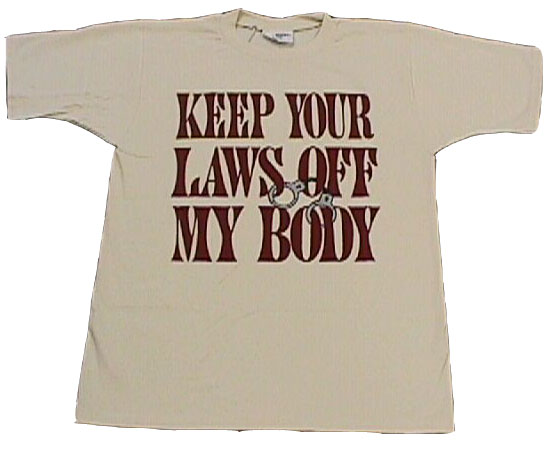
What this article really shows is that by going with a single-payer government system, each of us would be ceding the decisions about our health care, our bodies, and even lifestyle to the government.  So surely women's groups, who were at the forefront of fighting against government intrusion into our decisions about our bodies, is out there leading the fight against government health care.  WRONG!  Their privacy arguments stand out today as sham libertarian arguments that applied only narrowly to abortion.  It's clear that as long as they can get full access to abortion, women's groups are A-OK with government intrusion into people's decisions about their bodies.

So please, dedicated feminists are urged to comment.  How do I relate this T-shirt from the NOW web store:
Tskyl2

With this button from the NOW home page:
Codebluebutton

And a bit of text from their site:

People need and deserve universal, continuous,
and accessible health coverage that is provided by a single payer and
does not require full-time employment and a beneficent employer.
Learn more with our action toolkit....

With the recent release of Michael Moore's new movie, "SiCKO", and the
introduction in Congress of a bill to provide health insurance to all
U.S. residents, the movement for universal single-payer health
insurance is gaining momentum. This toolkit is provided to help you
take action on this important issue....

Health care is a right, not a privilege.

Al Gore's $100 Million Screensaver

This is an interesting study of the intersection of politics and science at NASA:

The new dramatic invention of the inventor of the Internet was to place
a satellite so far that the whole Earth can be observed 24 hours a day.
Isn't it fascinating? Why didn't you think about that? :-) Some
scientists refined the details for him - for example that the satellite
should be located in the L1 Lagrange point. The price? Well, the first
modest estimate was USD 135 million.

If you think about it for a
while, the scientific content of this project is next to nil. It is a
typical idea of a crackpot who has no tools to determine whether a
project is scientifically interesting or not. Already in 1999, during the Clinton-Gore administration, the project - nicknamed GoreSat or Gore's Screensaver - was more or less doomed. NASA Inspector General has also determined that the project is driven by politics, not science. It was found that the budget estimate was underestimated, too.

How
did they ever justify to study that project at all? Did they just tell
NASA that it has appeared in a dream of a prophet? Well, Al Gore wanted
the fresh picture of the whole Earth (well, just one-half, but it's OK)
to be constantly available as a source of inspiration: people could
finally see through the Internet, his other invention, that the Earth
is a little vulnerable child who has a fever. ;-) NASA added some
survey tasks, including measurements of the albedo every fifteen
minutes, that were not really needed and that are effectively performed
by existing devices, for example by CERES.

US Finally Fulfills Treaty Obligations, Maybe

After more than a decade, the US may finally allow Mexican truckers on US highways, something we actually agreed to in NAFTA:

The 9th Circuit Court of Appeals in San Francisco late on
Friday denied an emergency petition sought by the Teamsters
union, the Sierra Club and consumer group Public Citizen to
halt the start of a one-year pilot program that was approved by
Congress after years of legal and political wrangling.

I guess I can understand the Teamsters attempt to have the government shield them from competition -- that has practically become a national sport.  And I presume that the Sierra Club has some environmental concerns with Mexican trucks, though that seems flimsy given trucks must meet US environmental requirements and my guess is that Mexican trucks are at least as fuel efficient as US trucks.   But how can a nominal consumer group possibly justify this action?  Blocking competition in any part of the economy can only increase prices and reduce choices for consumers, particularly in an area like trucking that has almost no impact on the safety of the products actually being shipped.   I wish I could say this was some strange exception, but  consumer groups have for years backed protectionist efforts that do nothing but hurt consumers.

Via Cafe Hayek

The Perfect Political Bludgeon

I am often asked, "why, if the threat of global warming is really so overstated, does the issue have such legs with politicians, media, and activists?"

Answer:  Because it is the perfect political bludgeon.  One of the reasons I felt like high school debate really was broken (I don't know if it has been fixed since) was because every single debate eventually devolved into which side was more likely to cause a nuclear war.  It didn't matter if you were arguing about energy policy or the presidential primary system, no good debate case stopped short of blaming the other side for nuclear war.

Today, with nuclear weapons mostly forgotten (unfortunately not gone), global warming is the new nuclear war. It doesn't matter what you are arguing about:

There was Clare Short, a member of the British Parliament and Secretary
for International Development under Prime Minister Tony Blair until she
resigned in 2003 over the Iraq war. Claiming that Israel is actually
"much worse than the original apartheid state" and accusing it of
"killing (Palestinian) political leaders," Ms. Short charged the Jewish
state with the ultimate crime: Israel "undermines the international
community's reaction to global warming." According to Ms. Short, the
Middle East conflict distracts the world from the real problem:
man-made climate change. If extreme weather will lead to the "end of
the human race," as Ms. Short warned it could, add this to the list of
the crimes of Israel.

Great Moments in Marketing

Whose idea was it to rename Division I-AA college football as the "Football Championship Subdivision?"

Isn't This A Measurement Problem?

I often see the stat that US manufacturing employment has shrunk substantially over the last 50 or so years, usually accompanied by much wailing from the left (yes, the same people who criticized manufacturing work as dehumanizing 40 years ago).

The WaPo, via Hit and Run, says that US manufacturing output is at an all time high, and that the only way to reconcile these two is with technology and productivity.  Which is certainly part of the story, and its refreshing to see someone telling this story and not trying to cast the manufacturing numbers as a reason to slam the borders closed against imports.

But isn't there also a measurement problem here?  Eighty years ago, if a Ford Motor factory needed the windows cleaned, a Ford employee did it.  If it needed the parking lot striped, Ford workers did it.  When it needed the bathrooms cleaned at night, Ford janitors did it.  Today, the same Ford factory needs its windows and bathrooms cleaned, but an outside service contractor likely does the work.  In the economic statistics, haven't these workers migrated from "manufacturing" to "service" without anything real on the ground changing?

Internet Technology Bleg

Back in 2003 when I set up this blog, I knew less than nothing about how to do it.  I mostly did things in a way I am still happy with, but I made one mistake.  In setting up the domain mapping from CoyoteBlog.com to Typepad, I mapped CoyoteBlog.com to my entire Typepad account, not just this blog.  As a result, my permalinks take the form of www.coyoteblog.com/coyote_blog/blahblah.html rather than www.coyoteblog.com/blahblah. 

I now know how to fix it, but when the site republishes, I am pretty sure that anyone who has ever linked to a permalink on the site will get an error, because they will be remapped to the shorter address in the www rather than the /coyote_blog domain.  My question is this, if I access to all the A and MX and CNAME etc. records for CoyoteBlog, is there some way to calls the the www.CoyoteBlog.com/Coyote_blog/ domain to www.CoyoteBlog.com/ ?  If I can do this, I *think* my old permalinks will work.  Maybe. 

I probably will be too scared to try this, unless I can get a good solution for this problem

Why I Blog

I had a call today from a reporter at the Christian Science Monitor who wanted to discuss climate skepticism.  What a disaster of an interview I am!  He would ask an open-ended question, and off I would go into feedback theory and then to acoustics and then into helicopter dynamics and back to the ice age and then to temperature measurement in Tucson.  I try to follow 6 trains of thought simultaneously and the result is a mess. 

The poor reporter was quite friendly and ended with "I am not sure where we are going with this story" which is the universal reporter speak for "your interview was such a mess I am not sure how we would ever use it."  LOL.  Only by writing, with the implicit governor applied by the keyboard, am I able to organize my thoughts well.  Which is why I have never invested in a computer dictation product - I shudder to think what I would find on the page after a session.  Which reminds me of the early Doonesbury cartoons with Duke when he was a reporter at the Rolling Stone, when he would come into the his editor's office and claim to have dictated some really powerful stuff, only to find a garbled drug-induced mess, which was obviously a reference to Hunter S. Thompson, who... oh crap, I'm doing it again.

On the Virtues of the Modern Economy

Best thing I have read in a long time:

Imagine an egalitarian world in which all food is organic and local,
the air is free of industrial pollution, and vigorous physical exertion
is guaranteed. Sound idyllic?

But hold on"¦ Life expectancy is 30 at most; many children die at or
soon after birth; life is constantly lived on the edge of starvation;
there are no doctors or dentists or modern toilets. If it is
egalitarian it is because everyone is dirt poor, and there is no
industrial pollution because there are no factories. Food is organic
because there are no pesticides or high technology farming methods. As
a result, producing food means long hours of back-breaking physical
work which may end up yielding little.

There is "“ or at least was "“ such a
place. It is called the past. And few of us, it seems, recognise the
enormous benefits to humanity of escaping from it. On the contrary,
there is a pervasive culture of complaint about the perils of affluence
and a common tendency to romanticise the simple life.

Via Hit and Run.  I made a fairly similar point here when I compared California "robber baron" Mark Hopkins mid-19th century house to one a friend of mine used to own in Seattle:

One house has hot and cold running water, central air conditioning,
electricity and flush toilets.  The other does not.  One owner has a a
computer, a high speed connection to the Internet, a DVD player with a
movie collection, and several television sets.  The other has none of
these things.  One owner has a refrigerator, a vacuum cleaner, a
toaster oven, an iPod, an alarm clock that plays music in the morning,
a coffee maker, and a decent car.  The other has none of these.  One
owner has ice cubes for his lemonade, while the other has to drink his
warm in the summer time.  One owner can pick up the telephone and do
business with anyone in the world, while the other had to travel by
train and ship for days (or weeks) to conduct business in real time.

On the Virtues of the Modern Economy

Best thing I have read in a long time:

Imagine an egalitarian world in which all food is organic and local,
the air is free of industrial pollution, and vigorous physical exertion
is guaranteed. Sound idyllic?

But hold on"¦ Life expectancy is 30 at most; many children die at or
soon after birth; life is constantly lived on the edge of starvation;
there are no doctors or dentists or modern toilets. If it is
egalitarian it is because everyone is dirt poor, and there is no
industrial pollution because there are no factories. Food is organic
because there are no pesticides or high technology farming methods. As
a result, producing food means long hours of back-breaking physical
work which may end up yielding little.

There is "“ or at least was "“ such a
place. It is called the past. And few of us, it seems, recognise the
enormous benefits to humanity of escaping from it. On the contrary,
there is a pervasive culture of complaint about the perils of affluence
and a common tendency to romanticise the simple life.

Via Hit and Run.  I made a fairly similar point here when I compared California "robber baron" Mark Hopkins mid-19th century house to one a friend of mine used to own in Seattle:

One house has hot and cold running water, central air conditioning,
electricity and flush toilets.  The other does not.  One owner has a a
computer, a high speed connection to the Internet, a DVD player with a
movie collection, and several television sets.  The other has none of
these things.  One owner has a refrigerator, a vacuum cleaner, a
toaster oven, an iPod, an alarm clock that plays music in the morning,
a coffee maker, and a decent car.  The other has none of these.  One
owner has ice cubes for his lemonade, while the other has to drink his
warm in the summer time.  One owner can pick up the telephone and do
business with anyone in the world, while the other had to travel by
train and ship for days (or weeks) to conduct business in real time.

Why the NASA Temperture Adjustments Matter

NASA's GISS was recently forced to restate its historical temperature database for the US when Steve McIntyre (climate gadfly) found discontinuities in the data that seemed to imply a processing error.  Which indeed turned out to be the case (store here).

The importance of this is NOT the actual change to the measurements, though it was substantial.  The importance, which the media reporting on this has entirely missed, is it highlights why NASA and other government-funded climate scientists have got to release their detailed methodologies and software for scrutiny.  The adjustments they are making to historical temperatures are often larger(!) than the measured historical warming (here, here, here) so the adjustment methodology is critical. 

This post from Steve McIntyre really shows how hard government-funded climate scientists like James Hansen are working to avoid scientific scrutiny.  Note the contortions and detective work McIntyre and his readers must go through to try to back into what NASA and Hansen are actually doing.  Read in this context, you should be offended by this article.  Here is an excerpt (don't worry if you can't follow the particular discussion, just get a sense of how hard NASA is making it to replicate their adjustment process):

If I average the data so adjusted, I get the NASA-combined version
up to rounding of 0.05 deg C. Why these particular values are chosen is
a mystery to say the least. Version 1 runs on average a little warmer
than version 0 where they diverge ( and they are identical after 1980).
So why version 0 is adjusted down more than version 1 is hard to figure
out.

Why is version 2 adjusted down prior to 1990 and not after? Again
it's hard to figure out. I'm wondering whether there isn't another
problem in splicing versions as with the USHCN data. One big version of
Hansen's data was put together for Hansen and Lebedeff 1987 and the
next publication was Hansen et al 1999 - maybe different versions got
involved. But that's just a guess. It could be almost anything....It would be interesting to check their source code and see how they get this adjustment, that's for sure.

A basic tenant of science is that you publish enough information such that others can replicate your work.  Hansen and NASA are not doing this, which is all the more insane given that we as taxpayers pay for their work.

Hansen cites the fact that Phil Jones gets somewhat similar results as
evidence of the validity of his calculations. In fairness to Hansen,
while they have not archived code, they have archived enough data
versions to at least get a foothold on what they are doing. In
contrast, Phil Jones at CRU maintains lockdown anti-terrorist security
on his data versions and has even refused FOI requests for his data.
None of these sorts of analyses are possible on CRU data, which may or
may not have problems of its own.

Poverty Ain't What it Used to Be

The Heritage Foundation has an interesting study out on the population that lives below the poverty line.  While we typically get lots of headlines like "A million more people in poverty,"  the real headline should be "Poverty ain't what it used to be."  Create a mental image for yourself about poverty then read the first part of the article.

I won't repeat the studies points -- you can read them at the link or you have probably seen the study already linked around the blogosphere (e.g. Captains Quarters, Cato-at-Liberty, Reason, Maggie's Farm).  Reading the descriptions, its clear that most of our visual images and assumptions about US "poverty" don't line up well with this list.   This is by design.  Progressives who want more transfer payments and more government interventionism work hard to create a stark mental image of poverty through anecdotes, and then try to apply that mental image to a much larger population based on a very different definition of poverty than in this mental image. 

However, this approach may be set to backfire.  By defining poverty broadly to try to pump up the numbers, they are at risk of people losing sympathy for the poor.  I can see the progressive reaction now -- they are going to say (correctly) that buried in these numbers are a hard core of people who are really destitute.  And they are correct.  But they only have themselves to blame for burying these folks in a larger group whose lives don't match our mental picture of poverty.  And the poverty numbers aren't the only place where this approach is taken. 

I am sure you have heard the commercials that say something like one in six kids in America are hungry.  It's a crock.  There are at most perhaps 2-3 million people in this country who are really destitute.  The Census department found that only 6% of the people below the poverty line, about 2 million people, reported they sometimes did not have enough food to eat.  Sure, that sucks.  Which is why I volunteer with my kids at the local food bank.  But it's way, way short of the numbers activists try to use to justify huge new government programs and transfers.

Other thoughts

One issue not discussed, but covered in other studies, is the transience of people in the bottom quintile of income.  Most of us imagine the same people in poverty survey after survey, and again that is probably true for the hard core of 2-3 million.  But many of the rest move out of poverty over time.  In particular, we have had a huge influx of immigrants (legal and illegal) over the last several decades.  These folks are all counted in the poverty numbers.  Many immigrants arrive below the poverty line, and then work their way out of it. 

In a related post, Brad DeLong looks at what life was like even for the well off in 1900, and one can easily come to the conclusion that being poor today might be better than well off in 1900.  I made a similar point in this post, when I compared the life of the very rich in 1850 to the middle class today.  All of this is empirical proof that wealth is not zero-sum, as assumed by progressives, but is created and expends.  My post of the zero-sum wealth fallacy is here.

I've made the point for a long time that our poor are better off than the middle class in most countries of the world.  This living space comparison is an example - our poor typically have more living space in their homes than the middle class in Europe, or the well-to-do in many other countries.  But there is always that issue of income inequality that is raised, to which I typically answer "so what?"  If the poor are better off in the US, does it matter if the rich are really, really better off?  Note sometime the language that is always used in income inequality discussions.  You will hear folks talking about the "share of total income" as if income is a spring bubbling up in the desert, spewing a fixed amount of wealth, and the rich are the piggy folks up front getting more than their fair share of this limited resource. 

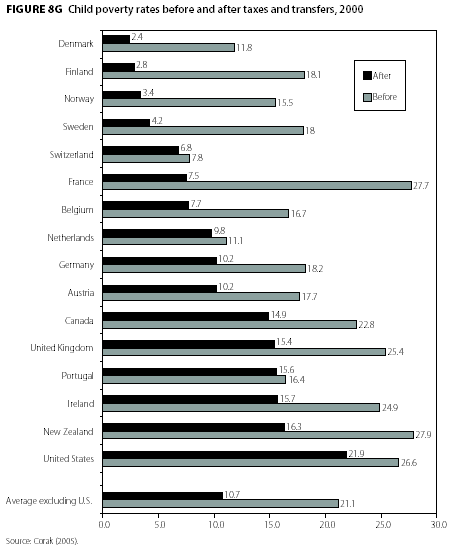
Leftish studies love to show how the US economic model is so much more heartless than those wonderful Europeans.   Below is a typical chart they use, and it will bring us full circle to our original point about measuring poverty.
Study1

Wow, those heartless damn Americans!  Letting those children suffer.  But wait, we talked earlier about definitions of poverty - how do they define poverty here?  It turns out that poverty is defined as income 50% or less of the median income in that country.  Yes, you heard that right -- the standard for poverty changes country to country.  So the US has the worst results here because in large part, since it has the highest median income of any country in this survey, it has been given the highest poverty line.  Of COURSE we will have higher poverty numbers if you give us a higher poverty bar.  The honest way to do this study would be to set an absolute poverty line and apply it to each country on a purchasing power parity basis.  But of course, the progressives would not like the results of such an honest study.

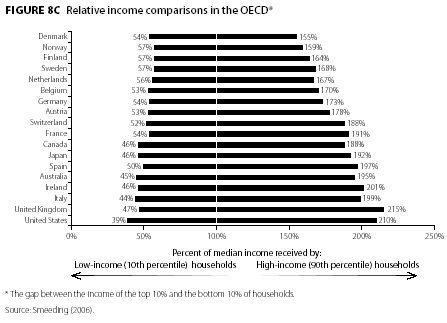
BUT, someone in this study made a mistake -- they should lose their socialist decoder card for this.  Because in a fit of honesty, they actually restated one of their charts on a relatively fair basis.  Here is the original income equality chart:
Study3

You get the point, the US sucks as always -- our poor are the poorest.  But are they?  Again, the standard in each line is the median income of that country, so it is a changing standard in each case.  But what if we restated it all to a common dollar amount.  This is where the progressives fell into a fit of honesty.  They restated this chart so that every bar is a percentage of the US median income.

Study2

Now we see the real story - except for Norway and Switzerland, our poorest folks are about on par with those in other western countries, and this is WITHOUT the crushing burden of welfare state regulation and taxation.  Further, the poor in the US are much more mobile than those in other country -- the ranks of our poor will have turned over much more than any of these other countries in 10 years.  Finally, my bet is that if you did this chart without recent immigrants, the US poor would best most every country in Europe in terms of income -- US has a lot of immigration and it is disproportionately poor vs. immigration into other European countries (note that most poverty numbers include illegal immigrants, but most official immigration numbers do not include illegal immigrants).

So, if our poor are doing just as well, then I leave it as an exercise to give any rational reason why the fact that our rich are doing much better matters one damn bit.

Contributing to Science, Follow-up

My photo survey of the Tucson USHCN climate station is still creating a lot of discussion.  Discussion, for example, is here, here, and here.

And you too can have the satisfaction of contributing to science.  All
you need is a camera (a GPS of some sort is also helpful).  I wrote a
post with instructions on how to find temperature stations near you and how to document them for science here.  Believe it or not, for all the work and money spent on global warming,
this is something that no one had done -- actually go document these
sites to check their quality and potential biases.

Mindless Rules Enforcement

So where do government bureaucrats go to learn how to push the frontiers of mindless rules enforcement?   Well, there are certain enclaves of the private sector who are pretty good at strict enforcement of silly rules -- The RIAA comes to mind.  But where do leading brain-dead bureaucracies, like say, school boards, learn to push the frontiers of pettiness?  Perhaps the NCAA can help out:

Just hours after Oklahoma football recruit Herman Mitchell was shot to
death Friday in Houston, Adam Fineberg started raising money for
Mitchell's family.

But after raising $4,500, enough to cover almost half the cost of
Mitchell's funeral, Fineberg stopped. An OU compliance officer told him
his actions would constitute an NCAA rules violation against the
Sooners.

Now, Mitchell's mother likely will never receive that money.

That money is considered illegal financial assistance under NCAA
rules because Mitchell's brother is a sophomore fullback at Westfield
High School in Spring, Texas, and because Fineberg is an OU fan who
attends Sooner football games and solicited donations through an OU fan
Web site. [. . .]

OU spokesman Kenny Mossman said the an official with the
university's compliance office contacted Fineberg on Monday asking to
him halt his fundraising efforts until the OU received a rules
interpretation from the NCAA. That interpretation came Tuesday.

"This is not a permissible expense for OU or someone who could be
construed as an OU supporter," said Mossman, an associate athletic
director for communications. "We're not trying to be the bad guys, but
we have to play by their rules."

Because it's still a recruiting violation, even if the recruit is dead.  The NCAA said the college could apply for a waiver.  They shouldn't even have to -- the NCAA's reaction should have been to issue a waiver without even being asked.  This should have taken a conference call among the key decision-makers about 8 seconds to decide.

Update:  I may have been wrong by putting the NCAA over school boards, as a Colorado Springs school board has banned playing tag.  So I guess smear the queer is out (we actually called it Kill the Man with the Ball, but I am told that Smear the Queer is the more common and even less politically correct name).