Paying Cash for Health Care

There just seems to be a tremendous mental block people have about paying cash for health care.  Megan McArdle is surprised at how strong this bias is in some of her readers.  I'm not, as I see it in my wife and friends all the time.

Several years ago we switched to a high-deductible catastrophic health care policy.  We save a TON of money with this policy, such that year in and year out, even with fairly high out of pocket expenditures, our total health care expenses have been lowered.

Generally, I go ahead and wash all of the charges through the policy so I get credit for them against the cumulative deductible.  But since we have never hit the number, I am increasingly less attached to this approach.  Particularly since a number of doctors and other providers are offering cash discounts now for bypassing insurance and paying cash.

Here is an example -- my son has had some elbow pain pitching lately, so seeing all the kids who are having to get Tommy John surgery before they are out of high school, we decided to make sure everything was OK.  We took him to a GP who specialized in sports medicine and works with a number of MLB pitchers as a team physician to the Brewers.   For cash, he charged me $50 and spent nearly 30 minutes with my son.  Then he sent us downstairs for some x-rays of his elbow, and the radiology group there, again for cash, charged us $35 total for three x-rays.  There are people who pay more for a pedicure.

Nothing is ever going to improve in health care costs until individuals take more responsibility for the cost-benefit tradeoffs of the services they receive.

Update on the Health Care Trojan Horse for Fascism

I have warned for quite a while that government health care is a Trojan horse for all kinds of intrusive micro-regulations of our decisions and behaviors.  Here's an update: (via Maggies Farm)

"As the government assumes a larger share of health care costs, it is increasingly able to use that as a justification to intrude into personal decisions or private enterprises, whether it's a matter of smoking policy, trans-fats, or salt," we wrote last month. Now the Wall Street Journal is out with an editorial praising Michelle Obama's campaign against childhood obesity, reasoning, "the reality is that U.S. obesity imposes huge costs on taxpayers. In 2006, the per capita increase in spending attributable to obesity was 36% for Medicare and 47% for Medicaid, according to a paper last year in Health Affairs. Many fat kids grow up to be fat adults, and you've got to start somewhere."

Almost any behavior or decisions, from eating to driving to sports participation, has implications on one's potential future health care costs.  So by this logic, almost anything can be regulated.  For example, I would argue that sex has a much higher health care cost impact than eating, not just in STD's but in the cost of pregnancies and pediatrics.   Or as another example, our family spent far more in health care costs on treating our kids' accidents while playing sports than in dealing with any obesity costs.  Should we be requiring kids to stay indoors playing on the computer where they will be safe from potentially expensive accidents?

I Can't Let This Pass Without Some Scorn

Via the Telegraph:

The American blogosphere is going increasingly "viral" about a proposal advanced at the recent meeting of the Davos Economic Forum by Craig Mundie, chief research and strategy officer for Microsoft, that an equivalent of a "driver's licence" should be introduced for access to the web. This totalitarian call has been backed by articles and blogs in Time magazine and the New York Times.

As bloggers have not been slow to point out, the system being proposed is very similar to one that the government of Red China reluctantly abandoned as too repressive. It was inevitable that, sooner or later, the usual unholy alliance of government totalitarians and big business would attempt to end the democratic free-for-all that is the blogosphere. The United Nations is showing similar interest in moving to eliminate free speech.

I called this one back in 2005.  This isn't the first attempt by the UN in particular to throttle free speech via licensing way back in 1985.

Headline of the Day

A reader sent this to me:

Snow shuts down federal government, life goes on

WASHINGTON (AP) - If snow keeps 230,000 government employees home for the better part of a week, will anyone notice?

With at least another foot of snow headed for Washington, Philadelphia and New York, we're about to find out. The federal government in the nation's capital has largely been shut down since Friday afternoon, when a storm began dumping up to 3 feet of snow in some parts of the region. Offices were remaining closed at least through Wednesday.

Feature Not a Bug

I find it pretty hilarious that folks on the left suddenly feel the US is ungovernable, largely because they have not been able to pass a couple of complicated and risky legislative initiatives.  Was the US ungovernable when Bush couldn't pass Social Security reform?   It seems that showing leadership on a national scale with diverse interests is a tad harder than running a grad school policy round-table.  Oddly, the left seems befuddled by actual diversity of opinion, rather than the faux diversity with lock-stepped beliefs they built in academia and among themselves.

I don't read Real Clear Politics much but I thought Jay Cost makes a good point:

Let's acknowledge that governing the United States of America is an extremely difficult task. Intentionally so. When designing our system, the Founders were faced with a dilemma. How to empower a vigorous government without endangering liberty or true republicanism? On the one hand, George III's government was effective at satisfying the will of the sovereign, but that will had become tyrannical. On the other hand, the Articles of Confederation acknowledged the rights of the states, but so much so that the federal government was incapable of solving basic problems.

The solution the country ultimately settled on had five important features: checks and balances so that the branches would police one another; a large republic so that majority sentiment was fleeting and not intensely felt; a Senate where the states would be equal; enumerated congressional powers to limit the scope of governmental authority; and the Bill of Rights to offer extra protection against the government.

The end result was a government that is powerful, but not infinitely so. Additionally, it is schizophrenic. It can do great things when it is of a single mind - but quite often it is not of one mind. So, to govern, our leaders need to build a broad consensus. When there is no such consensus, the most likely outcome is that the government will do nothing.

The President's two major initiatives - cap-and-trade and health care - have failed because there was not a broad consensus to enact them. Our system is heavily biased against such proposals. That's a good thing.

One of the roles of the President is to bring some adult supervision to his party in Congress.  Bush failed on this, allowing Republicans to run rampant in earmarking excess, and Obama has if anything been even worse on this dimension.  He routinely remains aloof from the legislative details (some would say he just got rolled by Nancy Pelosi) and then proceeds to speak as if the actual bill matches his grand words and promises when it is obvious to all that it does not.

The Federal Government is Working Hard To Shield States From Their Own Irresponsibility

Many states managed to grow state spending in the last decade far faster than inflation and population growth, soaking up every new dime in bubble-generated tax revenue they could.   It may seem like states were forced to make a lot of hard decisions last year, but in fact they were sheltered from really dealing with the full measure of their own fiscal problems by large influxes of Federal "stimulus" money.  As I demonstrated way back in January of 2009, most of the stimulus was actually ear-marked not for the mythical shovel read project, but for "stabilization" of state and federal budgets.  This is a couple of months old, but still applies:

A historic nosedive in state tax collections extended into the third quarter of the year, and only an infusion of federal economic stimulus money has averted widespread program cuts and worker layoffs.
Tax collections from July through September dropped an average of 8.3% from a year earlier in the eight states that release up-to-date monthly tax figures, a USA TODAY survey found. New York's tax collections fell 8.9%, despite an income tax hike earlier this year. States reporting partial third-quarter results showed a similar downward spiral in tax collections, including 13.2% drop in Arizona.

Federal stimulus money has protected states from making big cuts in the number of government workers, in aid to schools or in spending on Medicaid, the health care program for the poor. But most federal stimulus money ends in December 2010.

This is not a new trend, from Tad DeHaven of Cato:

201001_blog_dehaven_tot

According to the Goldwater Institute, over a third of the AZ state budget is federal money.

Where-the-Budget-Comes-From

How can there possibly be any accountability for how this is spent, though it actually is larger than the amount raised by state taxes?  If we want the government to buy us goodies in this state, we should at least pay for them ourselves and not take money from others.  By the way, every time I raise this argument, someone says "well our state pays more federal taxes than it gets back."  First, every state says this so it can't possibly be true in every case.  Second, it's a terrible practice from the standpoint of accountability.

Related, via Matt Welch:

The biggest single national political donor in the country during the 2007-08 election cycle, according to OpenSecrets.org, was the overwhelmingly Democrat-supporting teachers union the National Education Association. What category of worker was the biggest single beneficiary of stimulus spending? Public school teachers. Who, according to Vice President Joe Biden, accounted for 325,000 of the first 640,000 jobs "created or saved." While it's true that teachers are Americans (even my brother), in the vast majority of these cases, the jobs in question weren't "created," just maintained, since it is nearly impossible to fire public school teachers.

Like Me Choreographing a Ballet

I often respond to various articles that a group of politicians are going to create a strategic plan** for the local economy that this is similar to my trying to choreograph a ballet .  TJIC has similar words for this effort:

Governor Deval Patrick and Senate President Therese Murray plan to propose this week several ways to improve the Bay State's business climate, saying they need to be more aggressive in steering the region out of its economic malaise.

Both have lifelong careers in non-business sectors (government, academia, journalism, legal, non-profit).  TJIC responds:

Asking them to design programs to better the business climate is about like asking me to design menstrual pads "“ I don't understand the sector, I don't understand the features, I don't understand the problems, and there's no way that the effects of my work will ever come back to make an impact on me.

This is reminiscent of this great comment from Kevin Williamson  via Instapundit

The good news is that, when it comes to reshaping the U.S. mortgage market [any market for that matter "” ed.], the Obama administration's top guns are bringing to bear all of the brisk, rough-'n'-ready entrepreneurial know-how they picked up in their previous careers as university professors, nonprofit activists, and holders of political sinecures.

But we are spending more and more to get this "expertise", as documented in a depressing post at Carpe Diem on the growth of government employment and salaries.  One chart out of many:

fedemp

** Footnote:  About once a month we get some group lamenting that Phoenix has no master plan to create some kind of economic focus for itself.  One of the hilarious things about this is that if you go back and look, about half of the past proposals have Phoenix focusing on some super-hot industry (e.g. semiconductor manufacturing, e-commerce) that is just about to crash.  Lately, everyone has decided that Phoenix should be the center of the solar industry, because, uh, we have a lot of sun, without any particular explanation of why having a lot of sun should be an advantage in precision manufacturing and assembly of solar components.  But we are shelling out all kinds of tax breaks and subsidies for these companies to come here.  My prediction - solar will be the next ethanol.  In ethanol, increases in government subsidies caused a lot of manufacturing capacity to be built.  But subsidies could not grow as fast as capacity, and a glut resulted in a huge shakeout.  The solar boom will occur when a technology is perfected that makes solar economic without subsidies.  When that occurs, I will be the first in line to cover my roof in the new tech.

Paul Krugman Has Convinced This Libertarian to Vote Republican in the Next Election

Paul Krugman in the NY Times, Via Todd Zwycki

The truth is that given the state of American politics, the way the Senate works is no longer consistent with a functioning government. Senators themselves should recognize this fact and push through changes in those rules, including eliminating or at least limiting the filibuster. This is something they could and should do, by majority vote, on the first day of the next Senate session.

Don't hold your breath. As it is, Democrats don't even seem able to score political points by highlighting their opponents' obstructionism.

It should be a simple message (and it should have been the central message in Massachusetts): a vote for a Republican, no matter what you think of him as a person, is a vote for paralysis.

OK, sign me up.

Quote of the Day

From the NY Times, June 23, 2005

Mr. Bush has reacted by railing against Democrats for obstruction -- as if Democrats are duty-bound to breathe life into his agenda and, even sillier, as if opposing a plan that the people do not want is an illegitimate tactic for an opposition party.

Support The Intrusive State. Buy an Audi

Am I the only one who is wildly less likely to buy an Audi after Sunday?   Advertising is often about image.  Frankly, almost none of the ads yesterday addressed their product's or service's value propositions in any real way.  They are trying to connect their product with images and emotions - Coke has always been great at that.  Beer commercials always try to connect their product with, well, sex with hot women.  This is pretty traditional for beer, though less so for ISP hosting until GoDaddy came along.

So now "Audi" has been permanently tied up in my mind with intrusive state control and loss of individual liberty.   Perhaps they were trying to be funny, but I really got the impression they were more than half serious, maybe because several of the examples (composting, light bulbs) are real issues subject to state control even in parts of this country.

Update: Obama appointee expresses need for SWAT teams in neighborhoods to enforce energy efficiency.

It's Just Going to Get Worse

California high-speed rail advocates are already backpedalling on the numbers, and from experience with other such projects, it will only get worse.

In the face of the state's perpetual budget crisis, some Californians are beginning to regret their votes in favor of the $9.9 billion high-speed rail bond last year. Even though proponents of the train have now admitted the bond was only a down payment on the actual cost to build the system, the numbers that were projected are changing"”and all in the wrong direction.

The business plan released by the train's advocates last month show the dramatic differences in what the voters were told and what reality is. For example, the price of a ticket from San Francisco to Los Angeles is now projected at $105, up from the previous $55 estimate.  That new number changed the ridership predictions: now 41 million annual riders by 2035, down from last year's prediction of 55 million passengers by 2030. The cost for building the train system has also grown.  The proponents had been thinking $33.6 billion (2008 dollars) but have revised upward to $42.6 billion.  Recently, the Obama administration announced $2.25 billion in funding for the project. Proponents said federal money would be used to close the gap between the voter-approved bond and the ultimate cost, but
this is a drop in the bucket and still will not work.

Do not expect a true LA to SF high speed rail line for less than $75 billion and the ridership numbers are still absurd, as discussed here.  By the way, Southwest's advanced fair from LAX to SFO is $114 right now.  If you are willing to go Burbank to Oakland, the fair is $90.

Irony

Via the WSJ, on the Mortgage Banker's Association (MBA) being underwater on their real estate loan:

On Friday, CoStar Group Inc., a provider of commercial real estate data, announced that it had agreed to buy the MBA's 10-story headquarters building in Washington, D.C., for $41.3 million. The price is well below the $79 million the trade group says it paid for the glass-walled building in 2007, while it was still under construction. The price also falls short of  the $75 million of financing that the MBA received from a group of banks led by PNC Financial Services Group Inc. for the purchase.

John Courson, chief executive officer of the trade group, declined in an interview Saturday to say whether the MBA would pay off the full loan amount. "We're not going to discuss the financing," he said. A spokeswoman for the MBA added that the MBA has reached "an agreement with all relevant parties" regarding the outstanding amount on that loan but declined to provide any details.

...In an interview late last year, Mr. Courson said he believed mortgage borrowers should keep paying their loans even if that no longer seemed to be in their economic interest.  He said paying off a mortgage isn't only a matter of personal interest.  Defaults hurt neighborhoods by lowering property values, Mr. Courson said. "What about the message they will send to their family and their kids and their friends?" he asked.

New York Takes a Cue From Italy

Via the NY Daily News:

The race for governor just got a whole lot sexier.

"Manhattan Madam" Kristin Davis is tossing her lacy brassiere into the political ring - with the help of one of the GOP's most fearsome strategists.

Though he's often labeled a "trickster," former Nixon, Reagan and Bushes operative Roger Stone tells us he's dead serious about getting Davis on the ballot.

"This is not a hoax, a prank or a publicity stunt," said Stone, who has been quietly huddling with Davis for months. "I want to get her a half-million votes."

I love this:

Davis laid out her credentials last weekend at a Libertarian Party convention on the lower East Side.

"I was valedictorian of my high-school class," said the golden-tressed Davis, sporting a modest black suit but wicked Christian Louboutins with 5-inch heels. "I worked 10 years in finance. I was vice president of a hedge fund. I went on to build a multimillion-dollar business from scratch."

While branding "taxation as confiscation," the former escort empress said the legalization of prostitution and marijuana could provide $2.5 billion in revenue to help close the budget gap.

"I'm a natural Libertarian," said Davis, who also embraces gay marriage and the views of the National Rifle Association.

And here is some great political strategy:

Even though she needs only 15,000 signatures to get on the ballot, she's shooting for 45,000 - and Stone doesn't see any problem getting them.

"Kristin knows lots of Penthouse Pets," he said. "We'll get four, make them notary publics and have them, suitably attired, collecting signatures at Grand Central Station during rush hour."

Hire Some More Freaking People

A reader sent me this list at of salaries at BART (via here).  The amazing thing is to sort the list by overtime.  Pages and pages of people with $50-$100 thousand a year in overtime.  This is just insane.  Either put these guys on salary or, if it really is a job that is non-exempt and legitimately pays hourly, hire some more freaking people.  I can't in my wildest dreams imagine such overtime being paid in my company year in and year out.  If it is not for isolated cases, it is a sign of poor management.

Photography is Not a Crime

I made this from a link at Radley Balko's site for Carlos Miller.

photo_not_crime

Will They Never Learn?

When will attorneys every get a clue?  Trying to strongarm people in the Internet age often backfires, as it did in this case, where lawyers demand comic book retailer Heavy Ink remove copies of a comic book parodying their client.   Thirty seconds spent perusing Heavy Ink founder Travis Corcoran's blog should have convinced them this would not end well.  TJIC's letter is a great example of not being intimidated by lawyers or the law.

Whither Private Property

A man has to tear down a house he built with his own money on his own property because he did not get government bureaucrats' permission to build it.  Don't tell me we are living in a free market economy when the only way to build shelter on your own property is to do it in secret.

Bigger Oil

Roger Pielke, Jr. (hat tip to a reader) points to an interesting FT Lex column that should offer some interesting insights to America's progressives:

9c437598-11bb-11df-9d45-00144feab49a

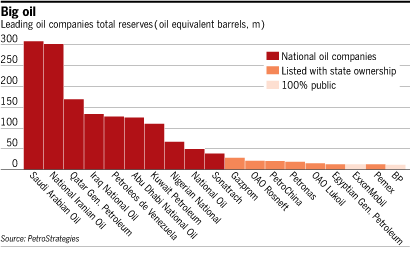
"Big" and "oil" are mentioned so often in the same breath that it is easy to lose perspective. Motorists and environmentalists never tire of berating the dominant supermajors whose petrol stations and share listings make them the public face of the industry, their favourite target being America's ExxonMobil. If market value were the sole magnet for opprobrium then Exxon's executives could breathe a bit easier because PetroChina recently overtook it as the world's most valuable listed energy company.

But there is "Big Oil" "“ last year, Royal Dutch Shell earned more than $1bn a month "“ and then there is bigger oil. No oil major is able to affect energy prices on its own and even Exxon is far smaller than the world's largest energy company. It is not even close. Saudi Aramco's estimated hydrocarbon reserves of 300,000 million barrels of oil equivalent make it 15 times Exxon's size. Exxon comes in about 17th place, with the top 10 being entirely state-owned.

US oil company executives routinely get pulled in front of Congress to defend themselves against charges they are manipulating world oil prices.   Huh? It would be as rational to accuse Grinnell College of manipulating national tuition rates.  Americans can take comfort in the fact that by limiting their ability to seek new oil in the US, we have made sure that oil markets are not controlled by evil publicly traded companies like Exxon and Shell but instead are controlled by entirely more trustworthy entities like the governments of Iran, Saudi Ariabia, Venezuela, Russia, Nigeria, and China.

This chart also supports the one good argument I think there is for peak oil -- that most of the world's oil reserves are controlled by patently incompetent institutions (e.g. governments) that have very bad incentives that make them highly unlikely to invest well.  The only reason these countries are able to produce at all is because western companies are stupid enough to keep walking into this cycle:

1.  US companies invest huge amounts of capital and know-how to build oil industry
2.  Once things are producing, local government steals it all (they call it "nationalization")
3.  Oil fields go into extended decline due to short-term focused and incompetent government management
4.  US companies invited back int to invest huge amounts of know-how and capital
5. repeat

A Proposal to Keep Arizona State Parks Open

Due to budget cuts, Arizona State Parks is closing 13 of its 22 state parks.  This last week, I have been making the rounds of the state government, from the state legislature to the head of Arizona State Parks, with a proposal to keep the 7 largest of these closed parks open, and pay the state money for the privilege.  Unfortunately, we have had only mixed success with a proposal that seems to me to be a win-win for everyone.  Our local newspaper editorialized against my proposal, without even knowing the details  (my response here).  So in this post, I am going to give the details of our proposal, and solicit your feedback, especially those of you in Arizona.  All I ask is that you read the whole thing, and not just leap into the comments section having just read and reacted to (positive or negative) this first paragraph about private operation of public parks.

Background

Our company, Recreation Resource Management (RRM), is over 20 year old, and we operate over a hundred public parks under concession agreement for the US Forest Service, the National Park Service, the Tennessee Valley Authority, California State Parks, and many others.  Traditionally, park concessions used to be limited to private companies running the gift shop or the bike rental inside a park.  And we do some of that (for example we run the store and marina at Slide Rock and Patagonia Lake State parks).  But our preferred niche has always been to run entire parks on a turnkey basis.  We run a huge variety of facilities that largely parallel anything we might find in the Arizona State Parks system -- including campgrounds, day use and picnic areas, boat ramps, hiking trails, wilderness areas and historic buildings.  The largest parks we run are twice as busy as Slide Rock or Lake Havasu and four times as busy as any of the parks we are proposing to manage.  We currently run parks today literally right beside some of these Arizona State parks.  All of this is to say that the parks in Arizona are absolutely normal and typical resources that we manage.

A concession contract works much like a commercial lease.  We sign a contract allowing us to run the park for profit, and then pay the state a rent in the form of a percentage of fee revenues.  The typical operating agreement includes over 100 pages of standards we must conform to, from fee collection to uniforms to customer service to bathroom cleaning frequency to operating hours.

Our Proposal

At all of my meetings this week I made three offers, each of which we were willing to commit to immediately  (we could actually be up and running with about 21 days notice):

  1. RRM offered to keep some or all of six parks open out of thirteen on the current closure list.  These parks are Alamo Lake, Roper Lake, Tonto Natural Bridge, Lost Dutchman, Picacho Peak and Red Rocks (park but not the environmental center).  Not only could these stay open, but we could pay rent as a percentage of fee revenues to the state, money that could be used to keep other operations open.  While these parks represent about half of the closure list by number, by visitation they represent well over 90% of the closure list.  Combined these parks had a net operating loss of $659,000 to ASP, which we propose to turn into a net gain for the parks organization.
  2. RRM offered to operate five parks that are currently slated to stay open but where we could pay rents that are higher than the net revenue figure ASP showed for FY2009.  These parks are Patagonia Lake, Buckskin Mountain, Dead Horse Ranch, Fool Hollow and Cattail Cove.  Combined, this group of parks lost money for ASP in 2009 which we propose to turn into a solid net gain.
  3. While we would need to do more study, RRM suggested it might take on some of the smaller, money-losing parks beyond those mentioned above if they were packaged in a contract with some of the other parks listed above

To avoid problems with the procurement process, we offered to take as short as a 1-year contract to give ASP time to prepare a longer-term bid process.  We also agreed to maintain all current park fees for the next year without change (in contrast to ASP current plans to raise fees), and agreed that no fee could be changed without ASP approval.  The only help we asked for was

  • We perform rules enforcement, but we need law enforcement backup form time to time
  • We perform routine maintenance and keep the park safe and attractive, but many of these parks have substantial deferred maintenance problems that we cannot take on with only a 1-year contract  (but would be willing to invest capital to repair under a longer term arrangement)

And if the ability to keep almost half the parks slated for closure open was not enough of a value proposition, we proposed one additional benefit.  Any parks that are put under private concession management immediately cease to be a political football.  For years, parks organizations have closed and opened parks in a game of chicken with legislators, with the public as the victim.  Parks under private concession management no longer are subject to such pressures, as they are off the budget.  Back in the 1990's, when the new Republican Congress squared off with President Clinton over the budget, the government was shut down for a while, including all federal recreation facilities -- EXCEPT those under private concession management.  We got calls from the media saying, why are you open?  To which we replied -- hey, you have now discovered one benefit of private concession management -- the parks we manage are no longer political pawns.

Reactions

So far we have had really good and positive reactions from Arizona legislators  (I have not been able to see any of the Governor's staff).

The reaction from Arizona State Parks has been more muted.  While they are publicly open to all proposals, in reality this is the absolute last thing most of their organization wants to do  (you should see the body language in some of our meetings, it is a lot like trying to sell beer at a Baptist picnic).  They have not said so explicitly, but from long history with this and other parks organizations I can guess at some of the issues they have:

  1. Distrust of and distaste for private management runs deep in the DNA of the organization.  Many join parks with a sense of mission, seeing unique value to public ownership of parks and lands.  I attempt to explain that this value still exists, that what they are turning over is operations, not management and control, but I don't get very far.  I try hard to give the new management of Arizona State Parks a clean slate, but I can't help but be affected by something I saw their previous director say.  Back in about 2004 we hosted a breakfast at a convention of state parks directors up in Michigan, I believe.  Someone must have forgotten to throw us out of the room, because we witnessed the head of Arizona State Parks stand up in front of his peers and demand that they all hold the line against private management as one of their highest priorities.  It was made clear that state organizations that stepped out of line would incur the wrath of other states.  This summer we participated in a series of meetings in California called by Ruth Coleman, who is the head of the parks organization there and someone I admire.  She was trying to break the organization out of its old culture, but it was very clear in roundtable discussions that the rank and file would rather see the parks closed to the public than kept open using private concession management.
  2. I mentioned earlier that private management brings a benefit to the public of keeping the parks from being a political football.  But the parks organization feels like it needs that football.  Without the threat of park closures, it feels like its budget will be gutted like a fish.  And, now that its budget has been gutted, it still holds out hope its money will be restored and needs the park closures to keep up the pressure.  As long as there is even the slightest hope of budget restoration, a hope which I am pretty sure will "spring eternal," my proposal, no matter how much it makes sense for the people of Arizona, will never be adopted.

Again, these are just guesses.  Renee Bahl of Arizona State Parks has told me they are open to all new ideas, and I will take her at her word.

Libertarian Concerns

Those of you who know me to be a libertarian might wonder how I function in this environment.  The answer is, "with difficulty."  I have a strong philosophic passion to bring quality private management to public services, and this opportunity is a good one.  And I am not adverse to making money while doing so.  But I am adverse to rent-seeking, and there is admittedly a thin line between trying to make positive change and rent-seeking in this case.

I generally avoid this by insisting on short initial contracts (in this case 1 year) to prove out the concept and to allow time for the public agency to figure out how to put this beast through a procurement process that probably was not well designed for this type of thing.   This is what I did when the US Forest Service approached us with an idea to bring private management to the snow play area at Wing Mountain near Flagstaff.  We took it on a one-year contract (which grew to 2 years) and then the contract went out for public bid  - which we won - for 10 years.  We are very good at what we do and are not at all afraid to compete.  The only time I will not compete is when I perceive someone has a political connection that gives them an inside track.  After two or three losses in Florida counties to a company with no experience but a brother-in-law on the County commission, I realized it was just a waste of time to bid on these situations.

Conclusion

Please give your reactions and concerns in the comment section.  For those who disagree with private management of public resources, I will be honest and say you are unlikely to change my mind, as I have dedicated all my time and my life savings to the proposition.  But you may help me better understand and tailor our service to address public concerns.  I will try to keep the FAQ below updated based on what I am seeing in the comments.  If you are in Arizona and know someone you think I should be talking to, drop me an email at the link above.

FAQ

Does your company take ownership of the park? No.  The parks and all the facilities remain the property of Arizona State Parks.  We merely sign an operating lease, with strict rules, wherein we operate the park, keep the fees paid by the public, and pay the state a "rent" based on a percentage of the fee collections.  Even when we invest in facilities, like this store building and cabins, they become the property of the public at the end of the contract.

How can the state afford to pay you if they have no budget? We are not paid by the state, and receive no subsidy.  100% of our revenue is from fees paid by visitors to the park we operate.  If we don't run a good operation that is attractive to visitors, we don' t make any money.

Doesn't the state lose out if you keep all the fees? No.  Mainly because in all the parks we have proposed to take over, the state has net operating losses of up to $200,000 or more a year.  By taking over the park, their losses go away AND they receive extra money in the form of rents we pay.  We are able to do so because we have developed efficient processes for managing campgrounds and have a flexible and dedicated work force.

Are you going to build condos and a McDonald's? No.  The fact that this is such a common question is amazing to me, as we operate over 100 parks in this manner across the country and you would not be able to tell the difference between the facilities we manage and any other public park.  Under the terms of our operating contract, we cannot change fees, facilities, operating hours, or even cut down a tree without written approval form the parks organization.

Are you going to just jack up fees? No.  We have committed in our offers to keep fees flat for the next year.  We cannot raise fees without state approval, and we work hard to keep public recreation affordable.  Last year was a very good year for us because, in a recession, our low-cost recreation options gave many families on a budget a chance to have a quality recreation experience.

Why just a one year contract? We would actually prefer a longer contract, as this allows us to actually make approved capital improvements to parks (for example, we have installed many cabins in public parks we operate).  However, we have offered to take these under an initial contract that is just long enough to allow longer-term contracts to be fairly offered on a competitive bid basis.

Maybe no one trusts you because you are small and unproven? Well, perhaps.  But last year our total fee revenue was nearly $11 million, making us slightly larger than the Arizona State Parks system.  We have a proven record with decades of positive performance reviews from government agencies around the country.   For example, for those of you form Arizona, if you have stayed at a US Forest Service developed campground near Flagstaff, Sedona, Payson, or Tucson,  or sledded at Wing Mountain, you probably have stayed in a facility we operated.  We already operate two concessions in Arizona State Parks, and have a great record working with the organization.

Utterly Without Shame

Via Megan McArdle:

"We need to stand up to the special interests, bring Republicans and Democrats together, and pass the farm bill immediately," Barack Obama

Self-parody in action.

Amazon and Macmillan

I have been kind of amazed at the backlash at Amazon over its showdown with Macmillan Publishing.  As I understand it, Apple, with its new iPad, had adopted a strategy of wooing publishers by offering promises of higher retail prices, an offer Amazon basically refused to match.   This dynamic (with retail discounters pleasing customers but ticking off manufacturers and product suppliers) is not at all new to retail.  I am sure a lot of manufacturers wish Wal-Mart was never invented, but they have to try to play ball with them because Wal-Mart wields so much power with customers, in large part because of their pricing.

In this sense, I have always thought of Wal-Mart and Amazon as my agents, using the power of my and other consumer's volume to pound manufacturers on price.  They serve the same role as, and in fact are more effective than, a buying cooperative or consumers union.

So my agent, Amazon, had to go to the mattresses with a publisher on its pricing.  This happens in all negotiations -- if you are not willing to walk out the door, then at some point there is a limit to your bargaining power.  I was ready to applaud them for it.  Sure, they had selfish interests of their own, but who cares?  That is how capitalism works -- through the alignment of incentives, people who really don't even know me or really care if I live or die work hard to create value for me  (this is the opposite of big government, where people who claim to care about me deeply work really hard to destroy value).

Anyway, the clients that Amazon represents apparently lost faith quickly, and decided they were more freaked out by a couple day blackout than increased retail prices.  Wimps.

Postscript: I understand the debate is a bit more subtle, with Macmillan arguing that they want price flexibility over a range from $6-$16 (or whatever) for e-books rather than a hard cap at $9.99.  Trust me, though, any inference that this approach roughly averages Amazon's approach is so much chin music.  Most sales would be for new books at the high price, with low-volume books at the lower price  (something, by the way, Amazon already does).  The average sales price is higher in the Macmillan approach, and I don't blame them for trying.  And Apples is just trying to differentiate itself, and attempting to lock up publishers into exclusives or sweetheart arrangements fits their proprietary business model.   So I am not crying foul, I simply was rooting for Amazon because I felt my interests as a consumer lay with them in this dispute.   And I am wondering why so many people see it differently.

Welcome to the Acme Corporation. Check Your Rights at the Door

Ilya Shapiro:

Well of course they aren't "” but that's constitutionally irrelevant:  Corporations aren't "real people" in the sense that the Constitution's protection of sexual privacy or prohibition on slavery make no sense in this context, but that doesn't mean that corporate entities also lack, say, Fourth Amendment rights.  Or would the "no rights for corporations" crowd be okay with the police storming their employers' offices and carting off their (employer-owned) computers for no particular reason? "” or to chill criticism of some government policy.

Or how about Fifth Amendment rights?  Can the mayor of New York exercise eminent domain over Rockefeller Center by fiat and without compensation if he decides he'd like to move his office there?

So corporations have to have some constitutional rights or nobody would form them in the first place.  The reason they have these rights isn't because they're "legal" persons, however "” though much of the doctrine builds on that technical point "” but instead because corporations are merely one of the ways in which rights-bearing individuals associate to better engage in a whole host of constitutionally protected activity.

That is, the Constitution protects these groups of rights-bearing individuals. The proposition that only human beings, standing alone, with no group affiliation whatsoever, are entitled to First Amendment protection "” that "real people" lose some of their rights when they join together in groups of two or ten or fifty or 100,000 "” is legally baseless and has no grounding in the Constitution. George Mason law professor Ilya Somin, also a Cato adjunct scholar, discusses this point here.

A Few More Thoughts on Citizen's United

A friend of mine from Princeton days writes:

... and you seem in favor of the Supreme Court decision in Citizens United vs the FEC, I was wondering how you feel about being a customer or supplier or competitor of large businesses who can spend far more than your business to influence the rules of the game.

From what I read, I am sure you have a compelling answer, but I would be scared to death. (Maybe that's why I work for a large corporation [Target] instead of attempting to run my own business.)

I thought this was a pretty good question, and I answered:

  1. I try hard not to make utilitarian arguments to Constitutional and rights issues.  As an example, I am sure we might have less crime if the police were empowered to incarcerate anyone they wanted without trial, but we don't do it that way.
  2. I worry most about corporate lobbying (e.g. by Immelt at GE) and this is unaffected by this ruling - it was legal before and after.   This decision allows corporate advertising, which is public and visible, which I can at least see and react to, as opposed to back room deal making.
  3. Libertarians certainly worry about your question, and why many of us fear that what we are creating in this country is a European-style corporate state, rather than socialism.  To a libertarian, the answer is not less speech, but less government power to pick winners and losers in commerce.

Trial By Ordeal

Peter Leeson has an article on Medieval trial by ordeal that is getting a lot of attention.

Modern observers have roundly condemned ordeals for being cruel and arbitrary. Ordeals seem to reflect everything that was wrong with the Dark Ages. They're an icon of medieval barbarism and backwardness.

But a closer look suggests something very different: The ordeal system worked surprisingly well. It accurately determined who was guilty and who was innocent, sorting genuine criminals from those who had been wrongly accused. Stranger still, the ordeal system suggests that pervasive superstition can be good for society. Medieval legal systems leveraged citizens' superstitious beliefs through ordeals, making it possible to secure criminal justice where it would have otherwise been impossible to do so. Some superstitions, at least, may evolve and persist for a good reason: They help us accomplish goals we couldn't otherwise accomplish, or accomplish them more cheaply.

I guess I agree with the proposition that pervasive shared superstitions allow the populace to be more easily governed, or more rightly, make it easier for rulers to exercise power over the masses through leverage of shared superstition.  Whether it improves our well-being is an entirely different matter, but for a certain type of intellectual (I have no idea if Leeson is among them) more government power = well-being.  The author cites oath-swearing as a modern superstition that allows us to be governed more easily, but I am not sure that is correct as I think the power of oaths today are driven by peer-pressure and mass response to publicly broken oaths as well as perjury laws.  A better example of modern superstitions that allow easier exercise of power include things like global warming catastrophism.

I am not a medievelist, except as a hobby, but I would offer a couple of rebuttals to specific points he makes:

  • I think he overstates the cost savings of ordeals.  There were prominent folks in the Catholic Church that had doubts about ordeals long before they were banned, and ordeals were typically used as a last result when fact-finding and other methods didn't work.  We have to be careful comparing costs.  One lord gathering evidence for a few days might be, as a percentage of the government's resources, as costly then as a 1-year OJ trial is today.
  • Trials were not broken because they were too costly, they were broken because the law was bad.  There was no such thing as a state prosecutor, so all criminal actions were basically private actions, and they tended to have a rough version of loser pays.  For example, if one accused his neighbor of a capital offense, and the neighbor was acquitted, then the accuser suffered the punishment - ie death.   As a result, the state was left without an effective tool to prosecute crime, and in fact most justice was private justice (ie vengeance of family and friends) and never saw a court, ordeal or other sort.
  • I had a great Medievalist professor at Princeton that I am totally blanking on his name right now [update:  William Jordan, now apparently department head at Princeton].  He used to argue, I think compellingly, that all ordeals had an element of discretion.  Sure, you had to grab the rock in the boiling water, but the real test was that your wounds would be bound and then several days later inspected by the clergy to see if it was festering or not.   This is obviously a judgment call, and thus 1. gave the priests the power to be the effective jury for these actions and 2.  gave the priests a substantial amount of power  (as well as money, since they made good coin charging for ordeals).  [update:  A better summary of Leeson's work says that Leeson is arguing the same thing.  See here]

Update: Intriguingly, from a review of Jordan's book  "the Great Famine," a story I also discuss in my climate videos

The early 1300s must have seemed like the end of the world to the unfortunate inhabitants of Europe: brutally severe winters gave way to lightning storms and torrential, crop-destroying rains in spring, followed by cold summers and then bitter winters again. "The whole world was troubled," wrote one Austrian chronicler; yet that was only the beginning. Princeton University historian William Chester Jordan reconstructs the terrible decades when climatological change led to famine, disease, rampant inflation, and social breakdown across the European continent, a time when every prayer for relief was met by even crueler turns of fate.

Damn those 14th century oil companies!

Faith-Based Government Investment

The Tampa Rail blog has responded to my post criticizing Phoenix light rail (which the Tampa folks used as a glowing example of rail success).  Remember I wrote, in part:

Look, I don't think I have ever argued that Phoenix Light Rail was run poorly or didn't have pretty trains.   And I don't know if moving 18,000 round trip riders a day in a metropolitan area of 4.3 million people is a lot or a little (though 0.4% looks small to me, that is probably just my "pre-web" thinking, whatever the hell that is).The problem is that it is freaking expensive, so it is a beautiful toy as long as one is not paying for it.  Specifically, it's capital costs are $75,000 per daily round trip rider, and every proposed addition is slated to be worse on this metric (meaning the law of diminishing returns dominates network effects, which is not surprising in this least dense of all American cities).

Already, like in Portland and San Francisco, the inflexibility of servicing this capital cost (it never goes away, even in recessions) is causing the city to give up bus service, the exact effect that caused rail to reduce rather than increase transit's total share of commuters in that wet dream of all rail planners, Portland.  Soon, we will have figures for net operating loss and energy use, but expect them to be disappointing, as they have in every other city (and early returns were that fares were covering less than 25% of operating costs).

Of course, as with all government issues, the ultimate argument is that I am some sort of Luddite for actually demanding definable results for billion dollar government spending

Sorry Coyote, save for the topic matter I'm afraid I'm just not going to be much fodder for you. We're years past 'it's an expensive tax thing'.

We know that. We know rail like any capital project is expensive to execute and expensive to maintain - in dollars. But anyone who raises the math to me will wind up with the same big 'so what'. Community investment doesn't bother everyone the same way and different people see different value. There's no way you or I cold supernaturally understand the net benefit for or against light rail. We must simply choose to believe and pick our sides.

If you believe that just because rail is expensive they aren't worthwhile, you need to explain every public vote that has gone for implementing and expanding rail systems around the world even though most operations are publicly subsidized.

Gotta run'em well, and, over time, integrate with a city, but LR is a carefree mobility solution in areas where people choose to support and pay for it.

See, they are well past my neolithic argument, into their little post-modernist world where aesthetics and political correctness trump any actual need to demonstrate money is being used well.  Though it is interesting to see him resorting to faith as a justification.

I have two words for this person -- "opportunity cost."  On one hand, the money for this project must be taken out of private hands to build the rail line -- even leaving out the substantial individual liberties questions here, there is still some obligation to demonstrate the money is better used than it would have been in the private hands from which it is taken.  Ditto, by the way, for the stimulus bill.   On the other hand, to the extent that one wishes to spend government money to move people from A to B, one needs to demonstrate that this method is better than others.  I would argue high speed rail fails both tests.

Update: Joel Epstein and I have a go around the same issues in the Huffpo comments.