Accountability?

From New York Magazine

The wrinkly old men that we elect to Congress are so horny and gross that the American taxpayer shells out on average $1 million a year in settlements to sexually harassed Hill staffers, according to the Office of Compliance. The level of perviness fluctuates from year to year "” in 2007, 25 staffers were paid a total of $4 million.

Kids Prefer Cheese comments

Wouldn't such settlements possibly be of interest to voters, the media, and opponents of the crotch-grabbing perv-boys? It sure would! And that is why Congress passed a law saying that no one can obtain this information!

Via the South Bend Seven.  The New York article also makes this observation:

According to the same Office of Compliance, which is on a roll today, "the Capitol and other congressional buildings are rife with fire traps and other pervasive problems of age and dangerous design, with an estimated 6,300 safety hazards lurking on Capitol Hill this Congress." Congress has exempted itself from federal workplace safety regulations, so it isn't legally obligated to repair any of these hazards, many of which will be expensive. It's the kind of short-sightedness we've all come to expect from our lawmakers.

It is irritating that they exempt themselves from the same laws everyone else has to follow, though I can't say I am too worked up at the thought of some Senator slamming his or her head on a low doorway.

Cool Places I Didn't Know Existed

Via Scouting NY, restored 19th century domed West Baden Springs Hotel.  In southern Indiana.  I am amazed I never heard of it, because I used to run campgrounds almost next door to it.

All My Business Problems Diagnosed

As explained by Steven Pearlstein, who presumably has created so much economic value in his lifetime that he can cast stones from the high ground

And some of it, to be quite frank, Robert, is an appalling lack of imagination and guts on the part of these same CEOs who are complaining and pointing the finger at every else. You know, these guys are very good at cutting. They're very good at blaming others. They're a little less good at coming up with creative new products and services, and they've got a little flabby in that regard in the last few years where the focus has been on surviving and cutting, as it should had been. But they're not the gutsiest group of people in the world.

And by the way, they get into this group think which you - you know, the fact that they all say it, it's sort of like a notion that starts in the country club locker room, and everyone is nodding, and then the one passes it on to the other. And now, you know, this similarity of the comments betrays this sort of group think that is almost self-fulfilling at this point.

Mr. Pearlstein is absolutely right.  As CEO of my company, I am out of creativity.  I will give you an example.  The new health care law appears (the implementation is still hazy) to impose a $2000 penalty per employee for not having a corporate health care plan (all my employees are retired, so they already have health care plans, but that does not affect the penalty).  With a bit over 400 employees, that makes the penalty something north of $800,000 a year.  This is larger than my annual net income.  And Mr. Pearlstein is correct -- I am absolutely at a loss as to how to deal with this, which just proves his point that all we CEO's have an appalling lack of creativity.

Mr. Pearlstein seems to be holding an image of the Fortune 25 in his head, but in fact most job creation is by smaller companies.  I wrote a while back on Forbes.com why CEO's of smaller companies have be having their creativity diverted.

Postscript: On January 10, 2008, our company actually, shockingly, had a creative idea.  Instead of refueling our boats at a lake in Ventura County, CA using zillions of 5 gallon gas carriers, lets put in a small double wall gas tank.  It would save a ton of useless labor, it would greatly reduce fuel spills on the lake (the nozzle, unlike the 5 gallon cans, has overflow protection), it would save lots of trips into town to fill gas tanks -- a winner all the way around.  Granted this was a pretty small idea, but sometimes success in small business is a lot of bunts and singles.

After hundreds of manhours of effort, numerous checks written to the County and the state, and I don't know how many forms filled out, on July 1, 2010, exactly 901 days after we got the creative idea, Ventura County gave us the last permit we needed to go forward.

History Stuttering

Megan McArdle has a long excerpt from a PJ O'Roarke book that described a sudden acceleration panic around Audis in the the 1980s.  You will be amazed at how similar it all is to the more recent Toyota panic.

I Do Not Think That Word Means What You Think It Means

Today's word in question:  "safe"

The Environmental Protection Agency is holding public hearings today to review a proposed safe exposure limit for dioxin, a known carcinogen and endocrine disruptor produced as a common industrial byproduct.

It's all but impossible to avoid exposure to dioxin. Research done by the Environmental Working Group has shown that adults are exposed to 1,200 times more dioxin than the EPA is calling safe "” mostly through eating meat, dairy and shellfish "” and mothers pass it on to babies in the womb and in breast milk. A nursing infant ingests an amount 77 times higher than what the EPA has proposed as safe exposure. (Formula is also widely contaminated with the stuff.)

If you tell me that despite falling cancer incidence and survival rates and longer life-spans, we are all exposed to a chemical at 1200x its "safe" level, I might argue that we have defined the safe level too low.  Of course, the author draws just the opposite conclusion, arguing the standard needs to be tightened.

Two observations

  1. Things are getting better.  Apparently dioxin emissions (mostly from burning trash) have fallen by 90+% over the last twenty years.  In the blog post above, the author lambastes the EPA for dragging its feet on this standard for 30 years, but the lack of it sure does not seem to have been a problem

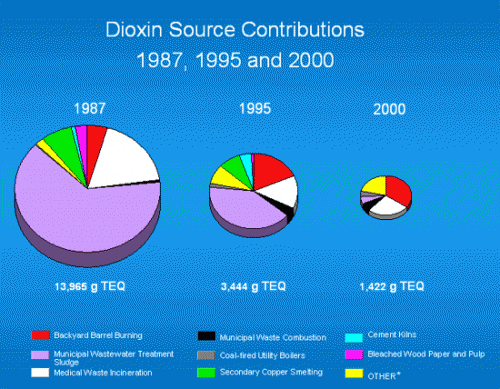
  2. I am not sure how setting a dioxin standard by the EPA is going to help.  Since most dioxin makes its way into the food chain (such as into dairy products), I suppose this would then give the government license to pound dairy farmers for the dioxin content of their products.  But what does this get us, and how is this the dairy farmers' fault?  For the last 30 years, as described at this site, the EPA and voluntary efforts by emitters have been working step by step through the pie chart above, knocking off the worst emitters.   You can see that clearly in the change of mix and the overall reduction.  This seems like a smart strategy.

Told Ya

Based on past studies of sudden acceleration problems  (e.g. that the vast majority of sudden acceleration problems mysteriously happen to senior citizens) I predicted that many of the Toyota failures would come down to operator error.  The incentives for operators are substantial, even before tort action, both from a psychological and monetary standpoint to blame their own errors on Toyota.

The U.S. Department of Transportation has analyzed dozens of data recorders from Toyota Motor Corp. vehicles involved in accidents blamed on sudden acceleration and found that at the time of the crashes, throttles were wide open and the brakes were not engaged, people familiar with the findings said.

The results suggest that some drivers who said their Toyota and Lexus vehicles surged out of control were mistakenly flooring the accelerator when they intended to jam on the brakes. But the findings don't exonerate Toyota from two known issues blamed for sudden acceleration in its vehicles: sticky accelerator pedals and floor mats that can trap accelerator pedals to the floor.

The findings by the National Highway Traffic Safety Administration involve a sample of reports in which a driver of a Toyota vehicle said the brakes were depressed but failed to stop the car from accelerating and ultimately crashing.

The data recorders analyzed by NHTSA were selected by the agency, not Toyota, based on complaints the drivers had filed with the government.

The findings are consistent with a 1989 government-sponsored study that blamed similar driver mistakes for a rash of sudden-acceleration reports involving Audi 5000 sedans.

The Toyota findings, which haven't been released by NHTSA, support Toyota's position that sudden-acceleration reports involving its vehicles weren't caused by electronic glitches in computer-controlled throttle systems, as some safety advocates and plaintiffs' attorneys have alleged. More than 100 people have sued the auto maker claiming crashes were the result of faulty electronics.

Of course breast implants pretty clearly never caused immune disorders, but that did not stop tort lawyers from bankrupting an entire industry on that theory.  So it is nice that Toyota has the facts on its side, but that may or may not help in court, and almost certainly will not help in Congress or the Administration, whose agendas were always driven more by the desire to help domestic auto companies against a powerful foreign rival.

Prosecutorial Abuse

One of my theories I have mentioned before on this blog is that the worst abuses of freedom occur when the Left and Right in this country agree.  Here is another great example -- combine the Right's law-and-order drive to hand more power to,  and remove accountability from, police and prosecutors with the Left's need to string up some executives after the Enron collapse -- and you get this:

The DOJ has inexplicably teed up another trial of Brown, who was the only one of the Merrill defendants who was convicted on additional charges of perjury and obstruction of justice for having the temerity of protesting his innocence to the grand jury that originally investigated the Nigerian Barge deal. Brown's new trial is currently scheduled to begin on September 20.

But in the meantime, Brown's legal team has been leafing through enormous amounts of exculpatory evidence that the Enron Task Force withheld from the Merrill defendants in connection with the first trial back in 2005, but which the DOJ has recently been forced to disclose.

The result of the Brown team's effort is set forth below in the Supplemental Memorandum in support of a motion for a new trial for Brown on the perjury and obstruction charges (the downloaded version of the memo is bookmarked in Adobe Acrobat to facilitate ease of review). The memorandum details the appalling length that the Enron Task Force went during the first trial in suppressing exculpatory evidence in favor of Brown and his co-defendants and generally disregarding the rule of law in order to obtain convictions. As the memorandum concludes:

The conclusion is now inescapable that the ETF engaged in a calculated, multi-step process to deprive Brown of his constitutional right to Due Process. (1) They repeatedly denied the existence of Brady material, told this court they had met their Brady obligations and fought vehemently against producing anything [exhibit reference and footnote omitted]. They highlighted only selected material in a veritable garden of Brady evidence "“ much of their selections being vague, tangential or marginal"“while working around clear, declarative, relevant exculpatory material even in the same page, paragraph or document. (3) When ordered by the Court to produce summaries to the defense, they further redacted even the Brady material they had themselves highlighted and withheld the crucial facts that they had highlighted as Brady. (4) They egregiously capitalized on their misconduct at trial by making assertions that were directly belied by the exculpatory evidence they withheld.  .  .  .

The memorandum goes on to set out dozens of Brady violations, including charts that compare the exculpatory statements that the Enron Task Force withheld prior to the first trial with the incriminating statements that the Enron Task Force extracted from witnesses during that trial.

Folks, this is really bad stuff. But as bad as it is, I have not seen any mention of it in the mainstream media.

Pretty Cool

I thought this was interesting, not only for the unified control algorithm, but also just for the lifting capacity of these little buggers.  Via Engadget

Green Triumphalism

Via a reader, the cost of a few politicians deciding that there absolutely had to be an Australian-assembled hybrid.

"My wife was looking for an Australian-made hybrid car," Rudd told John Laws in March, 2007, "and I'm sure some of your listeners would have found this out "“ you can't find one.

"So, that started me thinking about why don't we have one in this country."

There are certain people from whom the phrase "that started me thinking" serves as a 150-decibel alarm. We weren't to know it at the time, but Kevin Rudd turned out to be one such bloke. Instead of settling on a nice secondhand Prius, Rudd's simple quest to find some wheels for the missus quickly led, once he was elected, to the $500 million Green Car Fund.

Why couldn't Ms Rein have been interested in something less expensive, like knitting? No, scratch that "“ once her husband "started thinking", we'd have been stuck with a $2 billion National Crochet Initiative.

Subsidies appear to amount to about $(AU)100,000 per private car sale.  This is a sort of new brand of left-progressive triumphalism that reminds me of an essay Ayn Rand wrote decades ago on statism and prestige.  These are the modern Green equivalents of the Brandenburg Gate -- they cost a lot of money, they don't really do anything useful, but everyone can point at them and marvel.

And speaking of which, our current Administration in the US in by no means immune

U.S. President Barack Obama will attend a groundbreaking ceremony on Thursday for an LG Chem plant in Holland, Michigan, the company said Sunday. It is very unusual for an incumbent U.S. president to appear at such an event for a foreign company, and it is the first time for a Korean firm.

LG is investing US$300 million to build the plant which will produce batteries for electric vehicles. First-phase commercial production is scheduled to begin in the first half of 2012, and once completed in 2013 the plant will churn out lithium ion cells for 200,000 hybrid cars annually.

Ah, there Coyote goes exaggerating -- because the article explicitly says that a private company will be investing the money, so this isn't really a government project.   Ah, but read to the last paragraph

As part of efforts to revive the auto industry by bringing more green vehicles to the road, the U.S. government has lent considerable support to LG's Holland plant, including $151 million from a federal stimulus program. The Michigan state government also offered tax cuts worth $130 million, which together with the stimulus funds will almost offset LG's entire construction costs. The plant will help ease unemployment in the state by creating some 400 jobs, U.S. media reported.

So $281 million of the $300 million LG is investing is actually taxpayer money.  More brave capitalists! But fortunately we will have lots more batteries so rather than burn gasoline, electric vehicles can charge themselves from coal plants.

PS- Don't forget the jobs, though, created for the low low taxpayer cost of $702,500 each!

PS #2 - I had not noticed before I wrote it, but both of these articles also share in common the government subsidizing foreign companies to manufacture in their country, rather than producing these goods elsewhere and importing them.  This reduces the benefit of these investments even further - its pretty clear that both batteries and Prius's would have been made somewhere in the world, so they would have been available to consumers (probably at lower prices), but these investments merely were to shift production across some line on a map.

Update: John Stossel discusses another form of modern statist triumphalism -- the government-funded sports stadium

South Africa's ability to pull it all together for six weeks doesn't mean the World Cup will be a net benefit to the country in the long term. As the ESPN video below explains, South Africa's government spent $6 billion on the tournament. Tournament-related revenues are expected to fall well short of that figure. Some of the hundred million dollar stadiums built for the tournament won't get much use now that the games are over. The video points to one stadium built for the tournament which will likely remain vacant"”it sits over over slums that lack running water.

Fond memories of the month South Africa performed marvelously on the world stage are nice. But $6 billion is a lot to pay for a memory. These spectacles"”the World Cup and the Olympics"”are nearly always money losers. They're a lousy investment in wealthy countries. They're particularly garrish in countries that aren't as affluent.

Remember that Greece got the same kudos for not screwing up the Olympics, but years later it sure seems like the $15 billion that was sunk into those games by the Greek government has contributed to its financial crisis.

Same Here

Tyler Cowen writes:

If aggregate demand is so low, why are profits so high?

TJIC responds

SmartFlix  [TJIC's company] has show paper losses every year it's been in existence "¦ but I expect that this year it will show it's first ever paper profit.

"¦which is not a sign of macroeconomic health, but is, in fact, a sign of my very poor expectations for the economy.

Ditto here. We will probably show our largest paper profit this year, but it is mainly because we have cut way back on investment in new projects.  And this has nothing to do with demand - we are experiencing a boom, as the recession pushes Americans towards lower cost recreation of the type we operate, at the same time it cuts state budgets and makes them more amenable to our business model of private operation of public parks.

So why are we cutting back investment?  I run a very low margin service business. Here is a simplified calculation: We make, say, 8% of revenues before taxes and accelerated depreciation. 50% of our costs are labor, and the new health care law may raise our labor costs by 8% or even more.  A four percentage point cut in margins is not a big deal to Microsoft, but it is to us.  Until we figure out how this all will play out, we are still investing but only in above-average opportunities.

When we invest in a new project, it hits that year's income in two ways.  First, we have accelerated depreciation on the new capital equipment.  And second, we typically have a startup loss in the first year.  In the last few years of rapid growth, we have had close to zero paper earnings because of these growth effects.  Once we take our foot off the pedal this year, though, we will show a large positive income.  For us, reduced growth and investment = higher short term reported profits.

Did You Ever Notice....

Did you ever notice that when government programs are labeled "popular," it is always by their beneficiaries, e.g.

For the second time in two years, the state universities are weighing whether to limit or even get rid of the popular AIMS scholarship, which waives tuition and fees for thousands of college students.

Since most similar government programs consist of giving people something of value for free or at least for a below-market price, aren't they always going to be popular with their recipients?  Wheat subsidies are popular with wheat farmers, light rail subsidies are popular with those who ride it, cash-for-clunkers was popular with folks who got 2-3x blue book value for their trade-ins, and education subsidies are popular with the students and parents who get them.  In this usage, then, I would argue that the word "popular" in the paragraph above is entirely tautological and should therefore be eliminated from standard usage.  The only meaningful definition of "popular" vis a vis a public program should be "popular with those who fund it."

Kobach's Defense of SB1070

I have had a bunch of people send me this article defending Arizona's SB1070, our now infamous immigration law.  A couple of responses:

1.  I have never been wildly worked up by SB1070 after it  was amended a week or so after its initial passage.  I have used the debate around SB1070 to reiterate my case, particularly to Conservatives, for more open immigration.  Our immigration laws are prohibition redux, though in this case we are messing with people's desire to work rather than drink.  As such, the laws to enforce the prohibition are less important to me than the fact of prohibition itself.   IOur immigration laws are an incredible restriction on commerce, free labor markets, and even private property (SB1070 redefines trespassing as not having the government's, rather than the private owner's, permission to be on a piece of property), and this is true with our without SB1070.

I would likely have dropped SB1070 coverage a while ago had it not been for the rhetoric that is used by SB1070 supporters.  When our governor is saying that the majority of Arizona's 500,000 illegal immigrants are all drug mules, that none of them are really looking for honest work, and that all they do is cause crime up to and including beheadings in the desert, I get angry to hear the same stupid arguments that many of our grandparents heard about their ethnic groups (though the beheading thing seems to lack historical precedent).  (more on the immigration non-crime wave here).

2.  The language of SB1070 has never matched the arguments supporting it.  SB1070 mainly gives the police power to be more intrusive at certain traffic stops and harass day labor centers.  What in the heck does this have anything to do with drug cartels and armed paramilitary gangs on the border?  If, as our governor says, illegal immigrants are not really looking for legitimate work, then why is most of our enforcement via employers offering legitimate work?

3.  When Kris Kobach says "In four different sections, the law reiterates that a law-enforcement official 'may not consider race, color, or national origin' in making any stops or determining an alien's immigration status," he is ignoring reality.  The law asks police to make a determination (e.g. probable cause that one is an illegal immigrant) that is impossible for actual human beings to make without such profiling.  It's like passing a law that says "police must drive their cars 30 miles a day but can't drive their cars to do so."  The reality on the ground here in Arizona is that, illegal or not, Sheriff Joe Arpaio has been using racial profiling to make arrest sweeps for years, and his officers have become masters at finding some pretext to pull over a Mexican they want to check out  (e.g. the broken tail light).   Words in this law about racial profiling are not going to change anything.

4.  Kobach makes much of the  revision of the law, post-passage, to narrow the circumstances under which police can stop and check for immigration status

But Section 2 of S.B. 1070 stipulates that in order for its provisions to apply, a law-enforcement officer must first make a "lawful stop, detention, or arrest . . . in the enforcement of any other law or ordinance of a county, city or town or this state."

The original wording made reference to "lawful contact"; this was revised to "lawful stop, detention, or arrest" to make clear that officers could not stop someone simply on suspicion and ask for his papers.

There are folks, including most in the Obama administration, that are still criticizing the original "lawful contact" language and need to catch up.  However, this seems a thin branch for Kobach to stand on in lashing out at the law's critics.  Because in fact this over-broad language did pass and get signed into law, and only the immediate and vociferous public backlash against the language caused it to be changed.  Kobach acts like it was changed based of some internal discussion or discovery of error, but in fact "lawful contact" was how Kobach himself helped write the law and wanted it to read, and was supporters like himself were forced to change it only after a lot of vocal opposition.  Its disingenuous to use the modified language as defense against critics when it was only due to the critics that the modified language was inserted.

At this point, I am done criticizing SB1070.  It is not a great law but it is not particularly worse, in its current form, than laws in some other states or federal law.  I don't really anticipate that it will get struck down by the Supreme Court, though its enforcement may be enjoined through the hearing process.

However, I am not done criticizing our prohibitionist immigration regime nor am I done calling out those on the eliminationist side of the debate, like Jan Brewer, who are starting to show their true stripes as the debate proceeds.  I know some of you are tired of it and to some disagree with me, such that I have lost about half my readers over this.  But this debate has been an eye-opener to me.

For years I have taken many of the AZ politicians at their word that they had no problem with Mexicans per se but were concerned with the load on social services and other government budgets.  I understand how the intersection of immigration and the welfare state causes problems, and have proposed solutions to deal with them.  I am willing to have a friendly agree-to-disagree discussion with such folks.  But when our leaders are talking about 500,000 drug mules and mysterious beheadings and crime waves that somehow exist in a state with rapidly falling crime rates, its clear to me something more insidious is driving some of the folks in the debate.

Huh?

Kevin Drum observes that the Post Office is more efficient and effective than we give it credit because ... it fully accrues for future pension and medical costs.

Over at Jon Cohn's place, Alexander Hart explains why the post office is better run than you think. Go read it. I don't have any big axe to grind in favor of the USPS "” in fact, I'm pretty annoyed at how complicated it is to calculate postage these days on supposedly "odd" size envelopes "” but the fact is that they're actually pretty efficient and pretty cost effective. I'd welcome private competition for first class mail, but just go ahead breathe the words "universal service" and see how many private sector companies are still eager to compete with the post office for 46 cents an ounce.

Wow, I have been so unfair to the post office.  I commented:

Great - the post office is really efficient because ... it fully accrues for benefits plans that are way beyond anything paid in the private sector, and reliably pays these benefits to huge, bloated work forces.  I am confused Kevin.  I read the article you linked.  What the heck did you find in the linked article that had anything to do with "efficient" or "cost effective."  Postal rates have grown at something like twice the rate of inflation.  Even industries you demagogue against, like oil, have raised prices less than the post office.

I don't know much about Alexander Hart, but my suspicion is that this is somehow a broadside in the public-private battle.  If so, then his focus is awfully narrow.  The feds may have accrued for their pension and health benefits, but they sure have not socked away any assets besides government IOU's to pay for them.  At the end of the day, most private company health and retirement plans are actually backed with real, 3rd party assets.  If you want to talk about pension law, private companies are not allowed to invest but a small percent of pension funds in their own stocks and bonds.  Not so the Feds -- the Post Office is running the equivalent of the Enron 401K invested 100% in Enron bonds.

And oh by the way, if we turn our attention to the states or local governments, the situation is entirely reversed.  In fact, many US public entities have ZERO percent funding of health plans and ZERO accrual of future costs, taking retiree benefits entirely out of current cash flow.

Layout Progress: Base & Initial Trackwork

This is part of a recurring series on the evolution of my n-scale switching layout.  More after the break...

Continue reading ‘Layout Progress: Base & Initial Trackwork’ »

New Jersey Privatization Initiative

New Jersey under Christie continues to be a leader in challenging traditional government models.   I discuss and link to some of the findings over at my privatization blog, including some interesting findings on recreation.  This is from Reason's Len Gilroy:

Park management concession agreements: Having written numerous articles in recent months suggesting that states embrace the private operation of state parks"”something relatively "new" to states, but common at the federal level"”it was particularly rewarding to see the Task Force embrace the concept, recommending that the state should enter into one or more long"term concession agreements with private recreation firms for the operation and management of all state parks. Annual savings to the state were estimated to range between $6-8 million annually, a significant sum relative to overall park spending. This is the boldest, most sweeping call for state park privatization that I've personally ever seen at the state level, and Gov. Christie and NJ State Parks have an opportunity to blaze a new and transformational path forward on state parks management that policymakers in every state should be watching closely.

More Green Silliness

I couldn't care less what happens to my body after I die and I am done using it.  So the following, which I suppose is intended to freak me out, simply leaves me amazed yet again at green thinking

Undertakers in Belgium plan to eschew traditional burials and cremations and start dissolving corpses instead.

The move is intended to tackle a lack of burial space and environmental concerns as 573lbs of carbon dioxide are released by each cremated corpse.

Under the process, known as resomation, bodies are treated in a steel chamber with potassium hydroxide at high pressure and a temperature of 180c (350f).

The raised pressure and temperature means the body reaches a similar end point as in standard cremation "” just bones left to be crushed up "” in two to three hours.

My first thought on reading this was "Soylent Green is People!"

My second is to wonder how a torched body creates 573 pounds of CO2.  12 pounds of carbon combusts to 44 pounds (approx) of Co2.  This means that to combust to 573 pounds of Co2, the human body must have 156 pounds of carbon.  WTF?   But carbon in 18% of human body weight, which means that to produce 573 pounds of CO2, the human body would have to weigh 867 pounds.   One might be able to get this number by including the cremation fuel in the equation (though this is a generous interpretation since this is not how the article is written), but since it is usually gas used for cremation it would take a hell of a lot of gas given its low carbon content.

My third thought is what does any of this have to do with CO2 reduction

  • The process occurs at 350F.  You mean no fossil fuels are used to get the chamber up to 350F.  What, are they using solar mirrors?
  • The process occurs at high pressure.  This takes energy
  • The end product is a carb0n rich soup that they pour down the drain or pour on their garden.  I have a clue for you, all oxidation is not combustion.  That carbon dumped in your garden or in your compost heap will still become CO2 even without seeing aflame.

You Libertarians are So Paranoid. Government Would Never Use its Power to {Fill in the Blank}

From San Francisco, of course.  Via Maggies Farm's great daily link roundup

If the commission approves the ordinance at its meeting tonight, San Francisco could soon have what is believed to be the country's first ban on the sale of all pets except fish.That includes dogs, cats, hamsters, mice, rats, chinchillas, guinea pigs, birds, snakes, lizards and nearly every other critter, or, as the commission calls them, companion animals.

"People buy small animals all the time as an impulse buy, don't know what they're getting into, and the animals end up at the shelter and often are euthanized," said commission Chairwoman Sally Stephens. "That's what we'd like to stop."

This is the same city that is replacing Cokes with Soy Milk in its vending machines.  Oddly, when you read the pet article, it turns out their main concern is with hamsters, that get euthanized a huge rates as people who initially think they are cute wake up one day and realize they are just irritating rodents.  One wonders then why they ban on all animals just to get at one kind.  And why are fish OK but dogs are not?

I think I blogged this the other day but I want to repeat the un-ironic comment made by a city official on the soda ban in vending machines:

"It's entirely appropriate and not at all intrusive for city government to take steps to discourage the sale of sugary sodas on city property."

One wonder if any limitation on individual choice (save perhaps on abortion) would be considered inappropriate or intrusive by these folks.

Beware the Thin Edge of the Wedge

As someone who once spent nearly a hundred hours to defeat a $20 Department of Labor claim, mainly to fight the precedent, I can sympathize 100% with Wal-Mart spending millions to fight a $7,000 OSHA claim.  Note that despite all the OSHA wailing about not understanding why Wal-Mart is fighting so hard and causing them so much trouble, they admit at the end that they are trying to set a precedent for future actions.

For several years I worked for Emerson Electric, which among its many divisions owned a ladder manufacturer.  If there ever was a product that simply is what it is, totally WYSIWYG, it's a ladder.  But it turns out in this age of personal responsibility that anyone who ever gets hurt using a ladder, usually doing something stupid, will sue the ladder manufacturer for his or her injury.  Emerson fought every one, all the way to trial and sometimes appeal.  Lawyers said they were crazy, that in any given case, it would be cheaper (considering legal fees) to just settle.  But Chuck Knight (Emerson CEO) knew that these were not individual cases, they were multiple events in an ongoing "game," and game theory gives a different answer.  Fight enough of these, and tort lawyers looking for a quick buck with little work and cost will choose to spend their time elsewhere.

What Fresh Hell Is This?

My new column is up this week at Forbes.  This week it discusses the regulatory burden on small businesses.  Here is an excerpt:

Typically taxation issues get a lot more attention than these regulatory issues in discussions of government drags on the economy. But these small regulations, licenses, and approvals consume management time, the most valuable commodity in small businesses that typically are driven by the energy and leadership of just one or two people. If getting a certain license is a tremendous hassle in California, large corporations have specialized staff they throw at the problem. When a company like ours gets that dreaded call that the County wants a soil sample from under the parking lot, odds are that the owner has to deal with it personally.

So the ultimate cost of many of these silly little regulations is that they each act as a friction that wears away a bit more available time from entrepreneurs and small business owners. The entrepreneur who has to spend two hundred hours of her personal time getting all the licenses in place for a new restaurant is unlikely to have the time to start a second location any time soon. Since small businesses typically drive most new employment growth in the United States, can it be a surprise that new hiring has slowed?

Incredibly, after the column was in the can, I experienced another perfect example of this phenomenon.

In the camping business, July 4 is the busiest day of the year.  This year, on July 3, I got a call from one of my managers saying that the County health department had tested 20 ground squirrels in the area and found one with the plague.  I know this sounds frighteningly medieval, but for those of you who live out west, you may know that some percentage of all the cute little western rodents, from prairie dogs to chipmunks, carry the plague.  Its why its a bad idea for your kids and dogs to play with them.

Anyway, in the past, we have usually been required to post warnings in the area giving safety tips to campers to avoid these animals, what to do if one is bitten, etc.  At the same time, we then begin a program of poisoning all the lairs we can find.  It's about the only time any government body anywhere lets us kill anything, because only the hardest core PETA types will swoon over rubbing out a rodent carrying the black death.

But apparently, in the past when these mitigation approaches applied, the county health department was not in a budget crunch and in need of high-profile PR stories that would reinforce with taxpayers the need to fund their organization.  This time the health department marched out and closed the campground on July 4 weekend, kicking out campers from all 70 sites.  We spent the day dealing with angry customers, refunding money, and trying to find them new lodging on a weekend where most everything was booked up.  Fortunately we have a large overflow area at a nearby campground and offered everyone a special rate over there.

It is hard to imagine that, given the whole year to test, they just suddenly happened to find a problem at one of the busiest sites in the LA area on the busiest weekend of the year, particularly since they simultaneously changed their mitigation approach from notification to closure.   I have tried hard to find the original time stamp on the press release they sent out.  I can't prove it, but it sure seemed like a lot of media had the story before we (operating the campground) had been informed of a thing.  Incredibly, the health department was directing the campers to a nearby campground that was easily close enough to our campground to share the same rodent populations.  But that campground had not had a positive plague test.  Why?  Because that campground has not been tested recently, at least according to the official who brought us the news.  We're in very good hands.

Layout Update - Track Planning

Rather than starting a new blog,  I think I warned you that I would be doing model railroad layout updates here as a reference for fellow hobbyists.  You are welcome to blow right on past if the hobby is too geeky for your taste.

I have completed Version 1.0 of the track plan for an 18" by 9-foot shelf-style switching layout in N-scale.  I used the 3rd PlanIt CAD program to do the design.  Click to enlarge:

The layout has a number of features I wanted

  • Staging area (not shown, around a corner to the left)
  • Interchange with 2 other railroads
  • Small yard
  • Lots of industry space
  • Space for urban scenery

The layout is an imaginary short line switching urban tracks in the Phoenix area, interchanging with both the Union Pacific and BNSF, set in modern day or perhaps backdated to pre-merger ATSF.  I have spent several weeks photographic rail lines and industries in the area and have a good idea of the look and feel I want.  I am going to build it in two modules which split just right of the diagonal interchange line.

Because I am a masochist, I am using code 40 hand-laid track with hand made turnouts using Fast Tracks fixtures.   While newer code 55 rail is a big improvement over older rail, it is still out of scale.  I may make the diagonal main line crossing at the junction code 55 just to emphasize the difference between main and branch line -- also because I don't really like building crossovers by hand and Atlas has a nice code 55 45-degree crossover I can use.

I am not going to run the largest modern diesels or any long passenger equipment so I am going to try to get away with #5 turnouts, except on crossovers where I will use #8 if I can make them fit.  I am still debating some issues like turnout control, so I will leave that for later chapters.   Minimum radius can be big - 18" or more, except on the interchange track because it has to tuck behind the backdrop.

You will see I have already planned some mirrors into the design.  That was something that always got visitor's attention on my old layout -- tracks or roads appearing to go on forever.  This time I will use it for the interchange track as well as the yard (a la John Allen).  I am also going to try to double the apparent length of my grain elevator with one.  As always, the hard part is hiding the edges.  The interchange track will be easy, and a highway overpass will likely work on the yard, but I have not yet figured out how to disguise the mirror at the elevator.

This weekend I hope to actually build the base of the modules, using 1-inch extruded foam insulation board glued to 1/4" Lauan plywood.  Stay tuned, I hope to have it all in pictures.

Price Controls

Unless you are from Mars, you probably know LeBron James is a free agent, being courted by a number of teams, ultimately deciding on Miami over his home town and former team in Cleveland.

This has been an odd auction for his services, because except for some tax issues (which certainly may have been a factor in going to Florida), price controls in the league effectively cap how much James can be paid.  And given his talent, it was clear that every team would be willing to pay him the max.  This has led to offers based mostly on non-monetary factors, with Cleveland mainly taking the Glenn Close approach from Fatal Attraction, basically saying it would have to commit suicide if LeBron breaks up with the city.

Many have commented on how much Cleveland, economically, had riding on James and that it may well get the biggest economic benefit, bigger certainly than Miami which has fairly indifferent and easily distracted fans, of any of the teams in the auction.  But with price controls, Cleveland lost because it was not able to bid for LeBron's services what he was really worth  (in fact, it was pretty clear that all the teams involved expected to have a huge consumer surplus from LeBron's acquisition, since his value to any team seems to be higher than the salary cap).

By the way, speaking of surplus or lack thereof, my belief is that New York has continued its tradition of offering long-term lucrative deals to disappointing players.  Having watched Amare Stoudemire for seven years, I can say that he is fully poised to be the next Stephon Marbery for the Knicks.  He can be brilliant, and he is very talented, but he has focus issues that are not going to be enhanced in New York and at times was thrown off-kilter by the media pressure in Phoenix where the press is a cupcake compared to New York.  He is not even much of an upgrade from David Lee, but he gets paid a lot more guaranteed money.

Cancer Incidence Rates Dropping

Ronald Bailey in Reason has the numbers. Note the data is for detected incidence rate.  Since detection continues to improve, the numbers likely understand the true drop in incidence rates.  Further, since people tend to live longer, and cancer rates are higher as we get older, there should be a demographic trend to higher rates, but in fact we see the opposite (I don't know if they do some kind of age correction, but it doesn't appear so).  This means, again, the improvement for, say, the average 50-year-old is understated.

Making Entrepreneurship Harder

The Free Market Project wonders why the government wants to make it harder for entrepreneurs to attract investment capital.

This is the same government that has no problem with the poorest people in our society, or anyone else, playing the lottery every week, or heading to an Indian casino or Las Vegas.  For certain, they don't have an income limit on who can contribute to a political campaign, despite the fact that there is generally no pay-off for that unless you're able to contribute thousands or bundle tens or hundreds of thousands in campaign donations....

My question is this: With the transparency possible using the Internet, why aren't average citizens able to spend small amounts of money (like, lottery ticket money) on seed-money investments?  With proper transparency and protections in place, why aren't entrepreneurs allowed to put their idea online so that the average Joe (or anyone) can look at what they're doing and invest in it if they like the idea?

There Goes My Free Time

Arrogant Ignorance

Years ago I coined a term for a number of people I deal with in business -- "arrogant ignorance."  I don't mind running into folks who are young and inexperienced and admit such -- in fact, I like educating and training people and sharing what limited knowledge I have accumulated.  But what really sets me off are folks who have no idea about the subject on which they are making decisions but act as if their judgment is beyond question.  This tendency seems to be reinforced by organizations that have few real performance metrics and where, as such, looking like one knows what he or she is doing is more important than actually doing anything.

More recently, I found that this effect already has a name - Dunning-Kruger, though I think my term is much more evocative.  Anyway, this is an interesting article on Dunning-Kruger and its legitimacy in describing actual human behavior.

Via Tyler Cowen