Harry Reid on the Filibuster

Libertarians are always somewhere between irate and amused at how the Coke and Pepsi parties suddenly change their principles based on who is in the White House.  The latest example:  As the left cries foul on the Republican use of the filibuster in the lame duck session, Democratic leader Harry Reid once praised the filibuster, at least back in the day it was a bull-work against Bush-Cheney fascism:

"¦when legislation is supported by the majority of Americans, it eventually overcomes a filibuster's delay, as public protests far outweigh any senator's appetite for filibuster. But when legislation only has the support of the minority, the filibuster slows the legislation, prevents a senator from ramming it through and gives the American people enough time to join the opposition.

Mr. President, the right to extended debate is never more important than when one party controls Congress and the White House. In these cases, the filibuster serves as a check on power and preserves our limited government. "¦

For 200 years we've had the right to extended debate [i.e., filibuster]. It's not some procedural gimmick. It's within the vision of the founding fathers of our country. "¦ They established a government so that no one person and no single party could have total control.

Some in this chamber want to throw out 214 years of Senate history in the quest for absolute power. They want to do away with Mr. Smith, as depicted in that great movie, being able to come to Washington. They want to do away with the filibuster. They think they're wiser than our founding fathers. I doubt that that's true.

I like the filibuster most all the time.  I once suggested that the rules be changed to not allow filibuster when the Senate is exercising its duty to approve administrative officials and judges, but I am not sure I support even that exception.

Train to Nowhere

Apparently, Congress just before the election appropriated $900 million to build part of a high speed rail line in CA.  Rather than focusing either on LA or SF, Congress apparently appropriated the money for a mostly rural district that just coincidentally had a Democratic Congressman embroiled in a difficult election.  So now Congress has dedicated a billion dollars of your money for this high speed rail line, from Borden to Corcoran:

I am not kidding you.  More here from the AntiPlanner.

I discussed the CA high speed rail project here and here.  I discussed the practice of building even one useless section as a way to commit the public to building the whole thing here.  An excerpt of how this is done the Chicago way:

But what is really amazing is that Chicago embarked on building a $320 million downtown station for the project without even a plan for the rest of the line "” no design, no route, no land acquisition, no appropriation, no cost estimate, nothing.  There are currently tracks running near the station to the airport, but there are no passing sidings on these tracks, making it impossible for express and local trains to share the same track.  The express service idea would either require an extensive rebuilding of the entire current line using signaling and switching technologies that may not (according to Daley himself) even exist, or it requires an entirely new line cut through some of the densest urban environments in the country.  Even this critical decision on basic approach was not made before they started construction on the station, and in fact still has not been made.

Unchecked Power

Private companies can be jerks too, but they don't write the laws or control law enforcement.  That is why government is so dangerous, not because I necessarily trust it less, but because there is nothing acting to circumscribe its power.

Ian Cotterell got bad news Monday night when he learned that a city tow truck had plowed into a Roxbury apartment building he owns, blasting a hole in the brick facade and forcing his 17 tenants to vacate. Yesterday, he got more bad news: The city is ticketing him.

After building inspectors examined the building to assess damage from the crash, they cited Cotterell for "structural defects" including collapsed bricks, damaged windows, and other "unsafe and dangerous" conditions, according to an order issued by the city yesterday.

The order noted that a Boston Transportation Department truck "drove into building," but it also ordered Cotterell to fix the problems within 24 hours and appear in court."It's unfair; the code violations I have because the truck made them,"

TJIC has more at the link

Business Valuation

One issue I discussed in my article on buying your own business was business valuation.  This article from Inc magazine talks about business valuations during this recession, and includes an interview with Walt Lipski, a terrific investment banker in the small business sector who represented me in my purchase.

Japanese Lesson

From the view count (over 3 million), I seem to be the last person to have seen this, but I found this pretty amusing (yeah, I know, I am such a guy). Maybe I need to restart the 100 pushup program.

I'm Not Crazy! Update on Electric Vehicle MPG

I will tell you that no matter how confidence in one has in his own intellectual ability, it's hard not to experience an "am I crazy?" moment when one reaches a conclusion different from everybody else's.  Case in point is my critique of the EPA's mpg numbers for electric vehicles.   The EPA's methodology strikes me as complete BS, but everyone, even folks like Popular Mechanics, keep treating the number like it is a serious representation of the fossil fuel use of vehicles like the Volt and Leaf.

Sot it was therefore nice to see a mechanical engineering professor independently make the same points I did in this Pajamas Media article. Also, my Princeton classmate Henry Payne, who often writes on automotive issues, linked my article at the Michigan View.

Government Oversight Worse Than Private Alternatives

Via Overlawyered:

As part of the Consumer Product Safety Improvement Act of 2008 (CPSIA), Congress mandated that the CPSC create a "publicly available consumer product safety information database" compiling consumer complaints about the safety of products. Last week, by a 3-2 majority, the commission voted to adopt regulations that have dismayed many in the business community by ensuring that the database will needlessly include a wide range of secondhand, false, unfounded or tactical reports. The Washington Times editorializes:

"¦[Under the regulations as adopted last week] anybody who wants to trash a product, for whatever reason, can do so. The commission can leave a complaint on the database indefinitely without investigating its merits "even if a manufacturer has already provided evidence the claim is inaccurate," as noted by Carter Wood of the National Association of Manufacturers' "Shopfloor" blog"¦.

Trial lawyers pushing class-action suits could gin up hundreds of anonymous complaints, then point the jurors to those complaints at the "official" CPSC website as [support for] their theories that a product in question caused vast harm. "The agency does not appear to be concerned about fairness and does not care that unfounded complaints could damage the reputation of a company," said [Commissioner Nancy] Nord.

Commissioners Nord and Anne Northup introduced an alternative proposal (PDF) aimed at making the contents of the database more reliable and accurate but were outvoted by the Democratic commission majority led by Chairman Inez Tenenbaum. Nord: "under the majority's approach, the database will not differentiate between complaints entered by lawyers, competitors, labor unions and advocacy groups who may have their own reasons to "˜salt' the database, from those of actual consumers with firsthand experience with a product."

Any number of private actors have already tackled this problem. Amazon.com has probably the most comprehensive set of product reviews, and has taken a number of steps (e.g. real name reviews) to increase trust in their system.  Reviewers who are shills (either for or against a product) are quickly outed by other reviewers.   Another site whose reviews I rely on a lot is TripAdvisor, which has hotel and other travel reviews.   TripAdvisor allows the reviewed hotels to respond to individual reviews in a way that the consumer can see to get both sides of the story.

Apparently, none of this back and forth will be allowed in the CPSC data base.  The Democrats who wrote the process only want bad stuff in the data base, so it will not allow manufacturer responses or even positive reviews to appear.  The only possible justification for the government to run this database would be for the government to take a role in investigating and confirming or overturning claims and complaints, but it is clear it won't be doing this either.   This will just be a location for disgruntled people to drop turds on various manufacturers, all with the imprimatur of the government.  I can't see consumers finding much value here compared to the alternatives, but I can see the value in a courtroom to be able to stuff a government site with unsubstantiated claims and then use that site to say that the "official" government site is full of criticisms of the product.

Shareholder Suits

From Overlawyered today:

"A new study in the Financial Analysts Journal casts serious doubt on the premise [of litigation social efficiency], at least when it comes to shareholder class actions. In most cases, the authors found, the litigation mainly serves to punish shareholders who have already suffered from a downturn in their stock. Only suits targeting illegal insider trading, and to a lesser extent, accounting fraud were associated with subsequent higher long-term returns."

Way back in early 2006 (have I been blogging so long?) I was guest blogging at Overlawyered and I wrote this:

But from a philosophical standpoint, shareholder suits have never made much sense to me. While I can understand the shareholders of the company suing a minority shareholder who might be enriching themselves disproportionately (e.g. Rigas family at Adelphia), suits by shareholders against the company they own seem"¦ crazy.

Any successful verdict for shareholders against the company would effectively come out of the pockets of the company's owners who are.. the shareholders. So in effect, shareholders are suing themselves, and, win or lose, they as a group end up with less than if the suit had never been started, since a good chunk of the payout goes to the lawyers. The only way these suits make financial sense (except to the lawyers, like Bill Lerach) is if only a small subset of the shareholders participate, and then these are just vehicles for transferring money from half the shareholders to the other half, or in other words from one wronged party that does not engage in litigation to another wronged party who is aggressively litigious. Is there really justice here?

OK, you could argue that many of these shareholders are not suing themselves, because they are past shareholders that dumped their stock at a loss. But given these facts, these suits are even less fair. If these suits are made by past shareholders who held stock (ie, were the owners) at the time certain wrongs were committed, they are in fact paid by current and future shareholders who may well have not even owned the company at the time of the abuses, and who may in fact be participating in cleaning the company up. So these litigants are in effect making the argument that because the company was run unethically when they owned it, they are going to sue the people who bought it from them and cleaned it up? Shouldn't the payment be the other way around, with past owners paying current owners for the mess they left?

I understand that theoretically they might have an incentive improvement from the threat of these suits that improves corporate governance.  But this is mitigated by the fact that most corporations consider these suits to be random landmines without merit, to be avoided if possible, to be settled if necessary, but that have little bearing on the underlying governance of the company.

Horrible State Brutality

This is absolutely awful.  A main who is chained and drugged is being beaten by Maricopa County officers (yes, these guys report to Arpaio).

We can award extra points here to Arpaio who is saying how incredibly difficult it is to detect these incidents - Just think, he says, how much video we would have to go through.  But my untrained eyes show in every case at least 3 and sometimes many more county employees looking on.  Apparently none of these folks reported the incident.  Which means that unlike what they are trying to portray here as an isolated incident due to one bad apple, this is a systematic culture of violence against citizens that pervades the whole organization.

Double extra credit for the implication that none of the onlookers who watched a violent felony in progress and who are nominally law enforcement officers will be punished for covering up the incident  (brief opening commercial)

The Usual Suspects

The new food-safety bill, soon to be law, features all the usual suspects of the regulatory state

  • Strong support from large corporations, who know the regulations will kill off their smaller rivals and make it harder for new entrants to compete with them
  • Regulations nominally aimed at fixing a recent "crisis" (e.g. last year's salmonella outbreak) with no actual logic of how the new regulations would have prevented the past crisis.  In fact, they very likely would not have  (just as TSA new x-ray machines sold as a way to stop future underwear bombers likely would not have detected the original underwear bomber)
  • Numerous special exemptions, subsidies, etc. for narrow, favored constituencies
  • Pious statements from the priests of statism, who define small government per se as a problem.  Example from Tom Harkin, "It's shocking to think that the last comprehensive overhaul of the food-safety system was in 1938."  Why is the lack of new legislation a better indicator of a problem than, say, incidence or death rates which have fallen consistently for years.

For an extra bonus, those who most vocally support the law are also politically among those who most support the local food movement, which one can pretty much write off unless they get exemptions from this law.  And if they do, what's the point?  Do I really fear the operating safety of Nestle more than Joe who has a farm 30 miles away?  Remember the toy safety law -- it was spurred by a series of recall of mostly Matel toys, but in the actual law Matel became exempt from Federal inspection while the regulations have become a crushing burden for small toy makers.

More here.

Kudos to Hunter-Douglas

I have a bunch of motorized shades on the high clerestory windows around my house (these are about 10 feet off the floor so impossible to manually open and close).  I had the ladder out this weekend and was replacing batteries when I found one of the battery cases was corroded beyond repair because a battery had leaked.

I checked the Hunter-Douglas web site, and found the parts request link.  It said that if they had the part in stock, they would send it to me for free.  That sounded like BS, and I wrote them that I was happy to be charged, I just wanted the part.

Today I got this email:

It's our pleasure to provide you with the replacement Duette PowerRise AA battery Wand requested and sending them to the address provided.  These parts are offered at no charge to our consumers.  You will receive your parts within 10 business days.

Awesome.

The Problem With Google

Google grew up providing a number of free services (email, search, etc.)  Given that they were free, it was not unreasonable to avoid providing any live customer support via email or phone.  Users weren't paying anything, so if they had a problem they could try to solve it on the boards.  In fact, I have criticized whiners on boards for their absurd expectations of customer support for a free product.

Today, Google now offers a number of paid services (e.g. Adwords search advertising) but it still brings its old customer service mentality to these free services.  I pay thousands of dollars a year in advertising to Google, and many others pay much more than this.   Unfortunately, there is absolutely no option for support from a real person on my advertising account.  Sure, there is a section marked "contact us" on their web sit, but all that is is a fairly lame troubleshooting script that does not lead to any sort of contact form or phone number. Just try searching "how do I contact google adwords" to see all the frustration.

I know many companies that are able to provide live support for a $12 purchase, much less a $1200 purchase.  Even Intuit Quickbooks, which pretty much defines the low end of customer service in my little world, is easier to reach than Google.

In the past, I have recommended Google Adwords because it gets results.  While that is still true, I have to withdraw my recommendation.  Right now, my account is effectively closed -- though not, as you might expect, in a fit of pique from 5 hours of trying to get an answer to a simple account question.  It's closed because something broke, and I cannot get it fixed.  The only workaround on the boards for this problem is to close my account (and lose all the records of past search terms used, campaign success details., etc) and open a new account.  Roughly the equivalent of tearing your house down to fix a bad electrical outlet.  No way.  I was looking for a way to economize and Google has apparently just volunteered themselves as my target.  Thousands of dollars of revenue tossed because they wanted to save five bucks of labor.

Backwards

Well, as usual, the progressives have the rights and roles of private individuals vs. government exactly backwards, from Kevin Drum:

As I said earlier, I'm on the fence a bit about whether an indiscriminate release of thousands of U.S. embassy cables is useful. After all, governments have a legitimate need for confidential diplomacy. But when I read about WikiLeaks' planned financial expose [release of private emails from a private corporation], I felt no such qualms. A huge release of internal documents from a big bank? Bring it on!

The government and public officials acting in a public capacity have no rights to privacy of their work and work products from the public that employs them (except to the extent that privacy pays some sort of large benefit, which I would define pretty narrowly).  While things like the recent Wikileak are certainly damaging to things like sources and foreign relations, I have sympathy for such a mass dump when the government so systematically defaults to too much secrecy and confidentiality for what should be public business, mainly to avoid accountability.  The public has the right to know just about whatever the government is doing, in detail.

In the private sector, ordinary citizens have no similar "right to know" the private business of private entities, the only exception being in criminal investigations where there are clear procedures for how confidential private information may be obtained, used, and protected.  Had the proposed email dump related to alleged misconduct, I would have been pretty relaxed about it.  But the proposed document dump is just voyeurism.  One may wish for more accountability processes vis a vis banks, but in a country supposedly still founded on the rule of law, we don't get to invent new ex post facto rules, such as "if your industry pisses off enough Americans, all the material that was previously legally private is retroactively made part of the public domain."

Drum may be gleeful now, but someday he just might be regretful of establishing a precedent for consequence-free theft and publication of private information.   Had, for example, the words "big bank" in the paragraph been replaced by, say, "Major newspaper," we would likely see Drum in a major-league freak out, though the New York Times corporation has exactly the same legal status as Citicorp.

Everyone thinks his own information is "different" and somehow on a higher plane than other people's information.  Drum likely thinks his communication by email with sources is special, while I would argue release of my confidential internal communication about new service offerings and pricing strategies would be particularly damaging.  The way we typically settle this is to say that private is private, and not legally more or less private based on subjective opinions by third parties about the value of the data.

Paging L. Bob Rife

The Brits are selling an aircraft carrier via an internet auction.

WTF?

I obviously need to go out and buy an SUV to reverse this:

Phoenix-area temperatures could drop as low as the mid-20s early Tuesday morning, possibly breaking the record low temperature of 30 degrees set in 1911.

The Bankruptcy of Sustainability

This story just floored me:

"How much is sustainability worth?" asks Pulitzer-prize winning reporter Nigel Jaquiss. "Try $65 million in public money." That's how much taxpayers will be spending on a $72 million "green" building in downtown Portland. At $462 a square foot, it will be "perhaps the most expensive office space ever built in Portland."

The director of the Oregon Environmental Council defends the building as something that can "leverage long-term outcomes," whatever that means. But she would defend it, since the state is promising OEC, 1000 Friends of Oregon, and other left-wing environmental groups office space in the building at low rents that are guaranteed to stay fixed for decades.

Although the public is paying for most of the building, "tenants will be expected to share a commitment to help advance Oregon's leadership in sustainable development, collaborate with fellow tenants, and pursue OSC's standards for energy and water use." Apparently, people who don't share those "commitments" won't be welcome, even if their taxes helped pay for the building and even if they are willing to pay more for office space than the greenies.

Sustainability supposedly bills itself as being about using a reduced amount of resources.  But this goal is already accomplished by pricing signals, as they signal the relative scarcity of resources we might want to employ.  By definition, then, building the most expensive office space ever means that they are more resources (or a mix of scarcer resources) per square foot than any other previous construction project.  How in heavens name is this "sustainable?"

Like many such public projects (e.g. light rail), this project drains resources from millions of people via taxation to benefit just a few.  It takes an approach that could never, ever be scaled to benefit everyone in the city as it would be bankrupting.  This construction uses unreasonably large resources for an application that will never come close to returning this investment and can only be funded on a small scale using the resources drained from millions of people.  How is this "sustainable?"

I will leave the answer to these questions to the reader, but here is a hint:  Those advocating projects like this tend to treat human labor as free, to be deployed like Egyptian slaves to the whim of the state planner, either via taxation or more directly through demands for free labor (e.g. in recycling programs).

Timing is Everything

A decade ago, I was an executive at an Internet startup named Mercata.  Mercata was one of a couple of entrants in a field we had named "group buying."   In practice, this meant there were limited time sales where the price of a product would fall based on the number of people who agreed to buy.   Obviously the volumes were not large enough to get economies of scale of any sort, so they main advantage of the approach was viral marketing -- once you had agreed to buy, you had an incentive to get others to join in as more buyers would reduce your price.

The company eventually folded.  The company was very professionally run for an Internet startup of the day, but it had a lot of overhead for its volume, and, as eBay would learn, a lot of people wanted to buy immediately rather than wait for some sort of auction to play out.

But it turns out that one of our biggest failures was timing.  Recently, a company called Groupon has taken advantage of social networking that did not exist 10 years ago and has been quite succesful building a business using a very similar model to Mercata's.  It appears that Google has just bought Groupon for $2.5 billion.  Sigh.

This is not, however, even my largest financial missed opportunity.  I still have in my desk a 1984 job offer from Microsoft, which I eschewed at the time because it paid less than my other offers and tried to compensate me in these crazy pieces of paper called "options."  I once calculated the current value of the options just in the offer letter (ie not including any future grants over time) and their value was well north of any conceivable net worth I might reach currently.

Hail Porkulus

Via the AZ Republic

10 of the 25 most lucrative stimulus-funded contracts for work inside the state were awarded by the U.S. Environmental Protection Agency to one Alaskan company.

Bristol Environmental Remediation Services LLC, based in Anchorage, was not required to bid for the work, which is valued at more than $140 million and involves ground-pollution monitoring and cleanup at 10 Arizona sites, including San Carlos, Parker, Tuba City and Window Rock

Who wants to bet this company has had friends named Stevens and Murkowski?  What is it about Alaska?

As an added bonus, to my frequent point that regulation in general and our new emerging corporate state in general tend to favor large companies over small:

Tom Mertz is Tempe-based Sundt Construction Inc.'s federal division vice president, a position that has few counterparts among Sundt's smaller competitors.

Contracts funded by the federal government tend to favor larger companies such as Sundt, Mertz said, because there are additional steps involved in completing such a project, many of them involving protocol and paperwork.

"Federal-government work certainly is not for everyone," he said.

Sundt has landed both state and federal economic-stimulus projects, including one of Arizona's biggest, a $24.6 million contract to build federal-courthouse facilities in Yuma....

Mark Stapp, director of ASU's Master of Real Estate Development program and a longtime developer in the Valley, said that the problems smaller contractors encounter most often on public projects have little to do with the work itself.

"It's the administration of the work that kills them," he said.

As a result, many small and midsize contractors have avoided government-sponsored work, which adds to their current disadvantage now that the public sector is hosting the only game in town.

More Thoughts on EV MPG

After several posts yesterday, I rewrote my thoughts on EV's and the new EPA mileage numbers.  I am more convinced than ever that this standard borders on outright fraud, particularly when the DOE published what should be the correct methodology way back in the Clinton Administration and the EPA has ignored this advice and gone with a methodology that inflates the MPG (equivilant) of EV's by a factor of nearly 3.  For example, the list the Nissan Leaf with an MPGe of 99, but by the DOE methodology the number should be 36.

The full article is in Forbes.com and is here.  An excerpt:

The end result is startling.  Using the DOE's apples to apples methodology, the MPGe of the Nissan Leaf is not 99 but 36! Now, 36 is a good mileage number, but it is pretty pedestrian compared to the overblown expectations for electric vehicles, and is actually lower than the EPA calculated mileage of a number of hybrids and even a few traditional gasoline-powered vehicles like the Honda CR-Z.

Supporters of the inflated EPA standards have argued that they are appropriate because they measure cars on their efficiency of using energy in whatever form is put in their tank (or batteries).  But this is disingenuous.  The whole point of US fuel economy standards is not power train efficiency per se, but to support an energy policy aimed at reducing fossil fuel use.  To this end, the more sophisticated DOE standard is a much better reflection of how well the Nissan Leaf affects US fossil fuel use.  The only reason not to use this standard is because the EPA, and the Administration in general, has too many chips on the table behind electric vehicles, and simply can't afford an honest accounting.

Nissan Leaf EPA Rating Hugely Flawed

Update: True MPGe is closer to 36, see below.  The 36 actually comes from the government's own research and rule-making, which they have chosen to ignore.

The EPA has done the fuel economy rating for the all-electric Nissan Leaf.  I see two major problems with it, but first, here is the window sticker, from this article
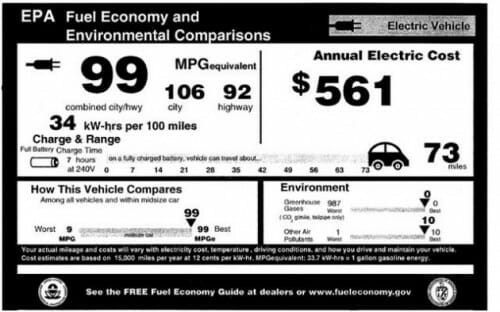
Problem #1:  Greenhouse gas estimate is a total crock.  Zero?

The Greenhouse gas rating, in the bottom right corner, is that the car produces ZERO greenhouse gasses.  While I suppose this is technically true, it is wildly misleading.  In almost every case, the production of the electricity to charge the car does create greenhouse gasses.  One might argue the answer is zero in the Pacific Northwest where most power is hydro, but even in heavy hydro/nuclear areas, the incremental marginal demand is typically picked up by natural gas turbines.  And in the Midwest, the Leaf will basically be coal powered, and studies have shown it to create potentially more CO2 than burning gasoline.  I understand that this metric is hard, because it depends on where you are and even what time of day you charge the car, but the EPA in all this complexity chose to use the one number - zero - that is least likely to be the correct answer.

Problems #2:  Apples and oranges comparison of electricity and gasoline.

To understand the problem, look at the methodology:

So, how does the EPA calculate mpg for an electric car? Nissan's presser says the EPA uses a formula where 33.7 kWhs are equivalent to one gallon of gasoline energy

To get 33.7 kWhs to one gallon, they have basically done a conversion through BTUs -- ie 1 KWh = 3412 BTU and one gallon of gasoline releases 115,000 BTU of energy in combustion.

Am I the only one that sees the problem?  They are comparing apples and oranges.  The gasoline number is a potential energy number -- which given inefficiencies (not to mention the second law of thermodynamics) we can never fully capture as useful work out of the fuel.  They are measuring the potential energy in the gasoline before we start to try to convert it to a useful form.  However, with electricity, they are measuring the energy after we have already done much of this conversion and suffered most of the losses.

They are therefore giving the electric vehicle a huge break.  When we measure mpg on a traditional car, the efficiency takes a hit due to conversion efficiencies and heat losses in combustion.  The same thing happens when we generate electricity, but the electric car in this measurement is not being saddled with these losses while the traditional car does have to bear these costs.  Measuring how efficient the Leaf is at using electricity from an electric outlet is roughly equivalent to measuring how efficient my car is at using the energy in the drive shaft.

An apples to apples comparison would compare the traditional car's MPG with the Leaf's miles per gallon of gasoline (or gasoline equivalent) that would have to be burned to generate the electricity it uses.  Even if a power plant were operating at 50% efficiency (which I think is actually high and ignores transmission losses) this reduces the Leaf's MPG down to 50, which is good but in line with several very efficient traditional cars.

Update: I have new numbers, which in part help respond to the first commenter.   The short answer to his comment is that there is a big difference between handwaving away10% you missed and handwaving away 70%.  I agree that the EPA numbers for the Leaf are valid "tank-to-wheel" numbers (meaning how efficiently does the car use the energy in its tank).  The question is, whether tank-to-wheel has any meaning at all.  My article above is basically an argument for why it is not valid.  Here is an extreme example -- what if we ran cars off of replaceable flywheels that were spun up by third parties and then put in our cars already energized.  These would be highly efficient on a tank to wheel basis, as we just need to transmit what is already mechanical energy to the wheels.  But does ignoring the energy costs and inefficiencies in spinning these things up offline really make sense?

We can go to the government itself to solve this.  In this rule-making document, the DOE defines some key numbers we need here.

They define petroleum refining and distribution efficiency as .83, meaning it takes 1 gallon of gas out of the well to get .83 in your tank.

For electricity, they define two numbers that must be multiplied together.  The fossil fuel electrical generation efficiency is .328 and the transmission efficiency is .924, for a net of .303.

Note the big freaking difference between .83 and .303, which is why to call it all handwaving is disingenuous.  Sure, we often handwave away the fossil fuel cost of getting gas in our cars, but the fossil fuel cost of getting electricity in the batteries is four times higher.   The government even does the math, multiplying the 33.7 Kwh/gal used above by .303 and dividing by .83 to get an apples to apples well to wheels mpge number for electric vehicles of 12.3 Kwh/gal.

So a total apples to apples comparison factor already exists, and the government chose not to use it for the window stickers.  This is probably because it would have given the Nissan Leaf an mpge of 36, not bad but fairly pedestrian for such an overhyped technology.  And at some level the Leaf is irrelevant.  This entire process has likely been tilted to make the Government Motors Volt look better.

Science That Is Run Like a Soviet Election

News from the United Nations:

Robert Orr, UN under secretary general for planning, said the next Intergovernmental Panel on Climate Change report on global warming will be much worse than the last one.

Hmm, that kind of confirms what critics have been saying for years, that the IPCC has nothing to do with science.  Because, you see, to my knowledge the scientists of the next IPCC have not even started their work, but the UN leadership has already determined what the report will say.  Which is consistent with their process in the last go around, where the UN political guys crafted the management summary first, and then circulated it to the scientific teams with instructions to adjust their sections of the report to fit the pre-existing conclusion.

In the same article, we get more of the "accelerating" nonsense:

He said UN Secretary General Ban Ki-moon would make it clear to world leaders in Cancun "that we should not take any comfort in the climate deniers' siren call."

"The evidence shows us quite the opposite-- that we can't rest easy at all" as scientists agree that climate change "is happening in an accelerated way."

Its not even clear what the value of the first derivative is for climate change, or even if such a metric has any meaning in the complex climate system where regional trends can easily be going in opposite directions.  But anyone who can tell you that we know the second derivative, or even its sign, is totally full of crap.

Never (except perhaps with shark attack scares which come and go) have I seen such a classic case of observer bias.   Certain events occur in the tail ends of the normal distribution.  Suddenly everyone claims that these events are happening with more frequency, mainly because they get reported with more frequency. I reported on a great example of this from a supposedly scientific government report here, where researchers mistook improved measurement of certain events as a real underlying increase in the number of such events.  Another example here.

Of course, 95 percentile events can't be, by definition, happening more frequently.  The only thing that can happen is the normal distribution can have its standard deviation increase.  Similar to the second derivitive argument above, I am not a statistician, but my sense is that the odds that we could detect a standard deviation shift in the distribution of weather events using just a few years of highly imperfect data, even if such an underlying shift existed, is really  really low.

Mass Transit and Energy Use

The Anti-Planner argues that mass transit will never be energy efficient, mainly because it is virtually impossible to improve occupancy.  The arguments for transit saving money all tend to include the line "will be efficient when occupancies increase" but he shows pretty clearly why that is probably not going to happen.

Also note pages 2-15 and 2-16 of this report.  Compare the trends of auto and airline energy intensity with rail and bus.  While cars and planes have decreased their energy use per passenger mile by quite a bit, rail has been flat and buses have been getting worse.  In fact, auto transit became more energy efficient than buses twenty years ago and continues to get better.   Airline travel has become nearly as energy efficient as Amtrak.

The Crux of the Climate Debate

Cross-posted from Climate Skeptic

I wanted to link to Richard Lindzen's Congressional testimony.  For slides, they are pretty easy to follow as they are mostly text.  I want to particularly point out slide 4, which I think on one page outlines the single most important point to understand about anthropogenic global warming theory.  When given just one minute to discuss climate, this slide embodies the message I give.

Here are two statements that are completely agreed on by the IPCC. It is crucial to be aware of their implications.

1. A doubling of CO2, by itself, contributes only about 1C to greenhouse warming. All models project more warming, because, within models, there are positive feedbacks from water vapor and clouds, and these feedbacks are considered by the IPCC to be uncertain.

2. If one assumes all warming over the past century is due to anthropogenic greenhouse forcing, then the derived sensitivity of the climate to a doubling of CO2is less than 1C. The higher sensitivity of existing models is made consistent with observed warming by invoking unknown additional negative forcings from aerosols and solar variability as arbitrary adjustments.

Given the above, the notion that alarming warming is "˜settled science' should be offensive to any sentient individual, though to be sure, the above is hardly emphasized by the IPCC. 4

My most recent climate video, which discusses this issue and more, is here.  I also have an older, shorter video focusing on just the issues in Lindzen's fourth slide here.

On Wanting to Debate

This has to be one of the lamest things I have seen in a while.

Fred Singer offered to debate Richard Somerville and Naomi Oreskes in January in San Diego. Both declined. Oreskes said she didn't want to debate someone "with a known record of promoting public misrepresentation of science."

This is used as an excuse to avoid debate by climate alarmists all the time.  But it makes no sense.  If someone is either a) using really bad arguments or b) spreading misrepresentations, I would definitely want to debate them.

Last week my speech at Arizona State on privatizing the operation of state parks was turned into a debate between myself and the most vocal opposition to the approach, the head of the Arizona Sierra Club.  When asked if I would be willing to debate rather than speak, my answer was "hell yes."

You see, I am actually confident in my arguments.  I was longing to have a face to face debate on this topic.  In fact, I was incredibly frustrated that opponents of using private companies to help manage public recreation were constantly arguing against a straw man that doesn't actually exist in reality.  You can see that in spades in the debate below (I am the second speaker, the Sierra Club person is the third).   Note how, despite nearly a year in Arizona of public discourse on this topic (pushed mainly by yours truly), opponents are still criticising the model based on hypothesized implementations, rather than observation of actual examples within an hour's drive of where we were speaking. 

I start at 19:45, which I am sure everyone wants to watch ;=)  And yes I talk too fast, to make it a debate they cut my 45 minutes down to 10.

Missing the Point

One aspect of the TSA debate I find hilarious as a libertarian is that we get to see yet another example of partisans switching sides on an issues based on whose team is in the White House.  Since when have Republicans had this deeply held concern about liberty and privacy vs. security against terrorism.  And now leftie Kevin Drum steps up to say that all the extract screening makes sense (to my college roommate Brink Lindsey:  Sorry, but the whole liberaltarian thing is a myth.  When in power, they seem to act just as authoritarian on social and civil rights issues as Conservatives).

Anyway, Drum is certainly not full-bore backing the TSA, but he does write

I hate the TSA screening process. Everyone hates the TSA screening process. You'd be crazy not to. It's intrusive, annoying, and time-wasting. It treats us all like common criminals even though most of us are just ordinary schlubs trying to get on a plane and go somewhere.

But guess what? The fact that you personally are annoyed "” you! an educated white-collar professional! "” doesn't mean that the process is idiotic. I've heard it called "security theater" so many times I'd be rich if I had a nickel for each time it popped up in my browser, but although the anti-TSA rants are often cathartic and amusing, they've never made much sense to me. All the crap that TSA goes through actually seems pretty clearly directed at improving the security of air travel.

The point is not, as implied by Drum, that current TSA screening isn't protection against certain types of threats. Let's be generous and assume that the TSA's screening, generally concocted in a barn-door approach after someone tries a particular approach, is effective at catching the threats it is designed to catch.

The point is that nearly anyone with a room temperature IQ can think of 20 ways to attack an airplane that is not covered by the screening. If there are, say, a hundred imaginable threats, how much privacy do you want to give up to protect yourself from 35 of them?

For example, you know what is in the cargo hold below your seat? The US Mail. You know how much screening is performed on the US Mail? Zero. How hard would it be to wire up a package with a bomb and an altimeter, or perhaps just a noise sensor, and send it off airmail.  They screen the crap out of your bags and body and then throw them on the plane right next to a bunch of anonymous, unscrutinized cargo.  And that is just one example.