Posts tagged ‘US’

China Continues to Subsidize Lower Prices for Consumers

From today's WSJ ($) online:

Turning aside growing congressional anger over low everyday prices, President George W. Bush's
administration today will reject demands that it formally accuse
Beijing of subsidizing lower prices for U.S. consumers.

With U.S. lawmakers gearing up to punish China for using Chinese funds to subsidize low U.S. consumer prices, Treasury
Secretary Henry Paulson is expected to use a semiannual currency
report, to be released today, to reinforce his calls for Beijing to
allow prices in the U.S. to rise faster....

OK, I confess I fibbed a bit.  The actual article reads:

Turning aside growing congressional anger over the
U.S. trade deficit with China, President George W. Bush's
administration today will reject demands that it formally accuse
Beijing of "manipulating" its currency to give Chinese companies an
edge over American businesses.

With U.S. lawmakers gearing up to punish China for
keeping the yuan artificially weak against the dollar, Treasury
Secretary Henry Paulson is expected to use a semiannual currency
report, to be released today, to reinforce his calls for Beijing to
allow the yuan to rise faster. But Mr. Paulson won't brand China a
currency manipulator despite congressional demands that he do so.

But it means the same thing as my version.  Thanks to Congress for looking after us consumers.  Our Chinese sister publication Panda Blog addressed these issues from the Chinese perspective a while back.  In short, the Chinese are wondering what we are complaining about:

Our Chinese government continues to pursue a policy
of export promotion, patting itself on the back for its trade surplus
in manufactured goods with the United States.  The Chinese government
does so through a number of avenues, including:

  • Limiting yuan convertibility, and keeping the yuan's value artificially low
  • Imposing strict capital controls that limit dollar reinvestment to low-yield securities like US government T-bills
  • Selling exports below cost and well below domestic prices (what
    the Americans call "dumping") and subsidizing products for export

It is important to note that each and every one of these
government interventions subsidizes US citizens and consumers at the
expense of Chinese citizens and consumers.  A low yuan makes Chinese
products cheap for Americans but makes imports relatively dear for
Chinese.  So-called "dumping" represents an even clearer direct subsidy
of American consumers over their Chinese counterparts.  And limiting
foreign exchange re-investments to low-yield government bonds has acted
as a direct subsidy of American taxpayers and the American government,
saddling China with extraordinarily low yields on our nearly $1
trillion in foreign exchange.   Every single step China takes to
promote exports is in effect a subsidy of American consumers by Chinese
citizens.

This policy of raping the domestic market in pursuit of exports
and trade surpluses was one that Japan followed in the seventies and
eighties.  It sacrificed its own consumers, protecting local producers
in the domestic market while subsidizing exports.  Japanese consumers
had to live with some of the highest prices in the world, so that
Americans could get some of the lowest prices on those same goods.
Japanese customers endured limited product choices and a horrendously
outdated retail sector that were all protected by government
regulation, all in the name of creating trade surpluses.  And surpluses
they did create.  Japan achieved massive trade surpluses with the US,
and built the largest accumulation of foreign exchange (mostly dollars)
in the world.  And what did this get them?  Fifteen years of recession,
from which the country is only now emerging, while the US economy
happily continued to grow and create wealth in astonishing proportions,
seemingly unaware that is was supposed to have been "defeated" by Japan.

We at Panda Blog believe it is insane for our Chinese government
to continue to chase the chimera of ever-growing foreign exchange and
trade surpluses.  These achieved nothing lasting for Japan and they
will achieve nothing for China.  In fact, the only thing that amazes us
more than China's subsidize-Americans strategy is that the Americans
seem to complain about it so much.  They complain about their trade
deficits, which are nothing more than a reflection of their incredible
wealth.  They complain about the yuan exchange rate, which is set today
to give discounts to Americans and price premiums to Chinese.  They
complain about China buying their government bonds, which does nothing
more than reduce the costs of their Congress's insane deficit
spending.  They even complain about dumping, which is nothing more than
a direct subsidy by China of lower prices for American consumers.

And, incredibly, the Americans complain that it is they that run
a security risk with their current trade deficit with China!  This
claim is so crazy, we at Panda Blog have come to the conclusion that it
must be the result of a misdirection campaign by CIA-controlled
American media.  After all, the fact that China exports more to the US
than the US does to China means that by definition, more of China's
economic production is dependent on the well-being of the American
economy than vice-versa.  And, with nearly a trillion dollars in
foreign exchange invested heavily in US government bonds, it is China
that has the most riding on the continued stability of the American
government, rather than the reverse.  American commentators invent
scenarios where the Chinese could hurt the American economy, which we
could, but only at the cost of hurting ourselves worse.  Mutual Assured
Destruction is alive and well, but today it is not just a feature of
nuclear strategy but a fact of the global economy.

Ah, the Joy of Settled Science

Since many advocates of anthropomorphic global warming theory have declared the twenty-year-old science to be "settled," then there must not be very much controversy or disagreement in the peer review reader comments to the UN's Fourth IPCC report.  Except, no one seems willing to publicize these comments.  Even US government organizations paid for by taxpayers.  Steve McIntyre is again having to resort to filing FOIA's to get the details of climate research.

Update: It appears that Congress is taking a similar approach to climate research when it comes to openness about earmarks.

Thanks for the Help, MSM

Well, thanks a hell of a lot, mainstream media, for doing such a good job of delivering the facts.   QandO, in discussing the issues behind my earlier post on testing for mad-cow disease (BSE) helpfully includes this link to the EU's BSE testing site (the home of the testing program supposedly so much more enlightened than ours):

No method will detect BSE early in the infection. BSE has an average incubation period of 4-6 years. Therefore the EU testing programmes are targeted at animals over 30 months. The PrPres has not been detected in bovine brain or other nervous tissue very early in the disease and infectivity has not been shown either. In experimental infection where very high doses were administered, infectivity has been found in the ileum, part of the intestine. This has not been detected in natural infections.

Robert Fulton, via QandO, supplies the one other missing fact:  Most US cows are slaughtered as two-year-olds.  So they can't have BSE, because you can't have a five-year incubation disease in a 2-year-old animal.  And further, even if the animal has latent BSE infection, which has never been shown to harm humans, it can't be detected by current technology!  Even those superior Euros only test at 30 months.  This is an issue for aging dairy cows sent to slaughter, not for most of the US beef supply.

Well, those facts certainly would have been good to know, though in reading at least 20 mad cow articles in the MSM over the years, I have never seen it mentioned.  And it certainly hasn't been mentioned in the current testing brouhaha. 

I stand by my statement that private companies should be allowed to compete on full testing if they wish.  Hell, most of the stuff that is labeled "organic" and sells at a premium price is probably no safer than normal stuff, but companies are welcome to try to profit from the public's perceived need for organic stuff.

Assuming this is the reason behind the administration's decision to test only 1%, for which they have been chastised for years, it is yet another example of Bush's ham-handedness on communication.  Why not change the policy from "1% of all steers" to "100% of all beef from cattle over 36 months old." The latter would not represent much more testing, but would sure calm people a lot more than the other statement.

Climate Scavenger Hunt (No Climate Expertise Required)

Anthony Watts is offering an opportunity to help out climate science and participate in something of a climate scavenger hunt.  What is considered the most "trustworthy" temperature history of the US comes from a series of temperature measurement points called the US Historical Climate Network (USHCN).  There are perhaps 20-25 such measurement points in each state, usually in smaller towns and more remote spots.  Some of these stations are well-located, while others are not - having been encroached by urban heat islands of growing towns or having been placed carelessly (see here and here for examples of  inexcusably bad installations that are currently part of the US historical temperature record).

Historically, climate scientists have applied statistical corrections to try to take into account these biasing effects.  Unfortunately, these statistical methods are blind to installation quality.  Watt is trying to correct that, by creating a photo database of these installations, with comments by reviewers about the installation and potential local biases. 

He has created an online database at surfacestations.org, which he explains here.  Your faithful blogger Coyote actually contributed one of the early entries, and it was fun  -- a lot like geocaching but with more of a sense of accomplishment, because it was contributing to science.

So why is it a scavenger hunt?  Well, my son had a double header in Prescott, AZ, which I saw was near the Prescott USHCN station.  Here is what I began with, from the official listing: 

PRESCOTT (34.57°N, 112.44°W; 1586 m)

That looks easy -- latitude and longitude.  Well, I stuck it in Google maps and found this.  Turns out on satellite view that there is nothing there.  So I then asked around to the state climatologist's office - do you know the address of this station.  Nope.  So I zoomed out a bit, and started doing some local business searches in Google maps around the original Lat/Long.  I was looking for government property - fire stations, ranger stations, airports, etc.  These are typically the location of such stations.  The municipal water treatment plant to the east looked good.  So we drove by, and found it in about ten minutes and took our pictures.  My entry is here.

Not only was it fun, but this is important work.  In trying to find some stations in several states, I actually called the offices of the local state climatologist (most states have one).  I have yet to find one that had any idea where these installations were beyond the lat-long points in the data base.  If we are going to make trillion dollar political choices based on the output of this network, it is probably a good idea to understand it better.

The American Dream

I am still underwater here completing a few projects, but Brink Lindsey is blogging on the most recent study claiming that income growth and the American Dream are somehow dead for the average American. 

Seriously folks, if I had a betting market that would allow you to bet on either income mobility in the US or in France, which would you take?  Seriously?  Given that the US has higher economic growth, orders of magnitude lower barriers to entrepreneurship, and no history of bright-line class distinctions that carry down through history, as France does, where would you bet?

Well, actually, there is such a betting market, and it is called immigration.  Guess which way it is running for the most talented people for whom income mobility would pay the greatest benefits?  Have you heard the stories of the brilliant young technology minds moving from the US to France to start their new business?  Yeah, neither have I.

And don't make the mistake that "Oh, this is fine for smart college educated kids, but how about for poor people?"  Congress is currently tying itself into knots over the problem of about 12 million poorer people for whom America was such an economic attraction that they were willing to break the law to come here.  Which, coincidently, also goes a long way to explaining why US median income always seems stagnant in studies over the last 30 years.  It is because tens of millions of poor immigrants have come in at the bottom, bringing down the mean and median at the same time most individuals are climbing.  It is for this reason that the average individual can be doing better and better at the same time the mean is flat or even going down.

Postscript:  I was emailing back and forth with Brink and he made a great point, which you should look for him to embellish on his blog tomorrow, which I would summarize this way -- No number of dollars in 1970 would buy a laptop computer
loaded with a real-time strategy game that you can play with 64 of your
friends over the Internet or on which you could store a few thousands CD-quality (CD, what's a CD?) songs.

How's That Welfare State Working Out For You

Note: Lots of updates at the bottom

We have all heard that the US is backward vs. our much more enlightened bretheren in Europe on income inequality.  The general argument is that US is somehow a worse place because out income inequality is higher than in most European countries.

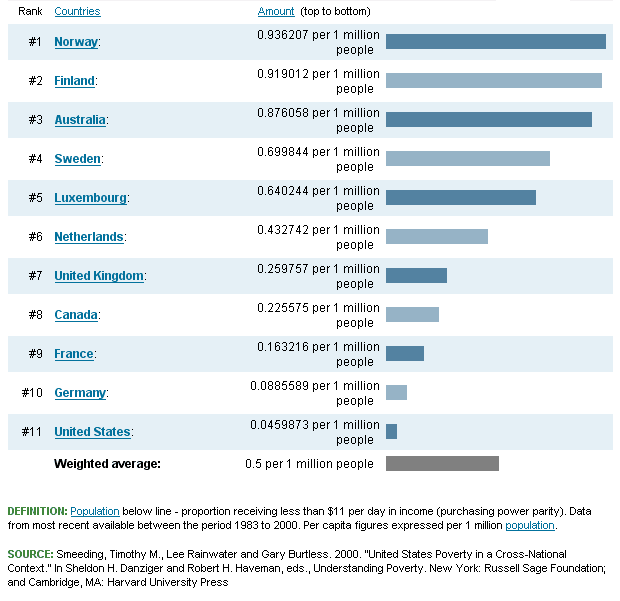
My reaction has always been, so what?  Why should I care about how well I am doing vs. the richest folks.  Shouldn't I care more how I am doing on an absolute scale?  And in fact, on an absolute scale, our poor are doing better than everyone else's poor, and better than many nation's middle classes.  I thought this analysis of poverty was interesting:  It is the number of people (per million) in a county living on less than $11 per day  (lower number and rank is better)

Per Capita Population Under $11 per Day

Poverty1

So, nations of Europe, how is that welfare state working out for you?  Socialist paradise Norway is 20 times worse!  How long will your poor be happy being told that, well, yes, the poor in the US are better off than you are, but you should feel better, because our rich in Europe are doing much worse than the rich in the US.

PS- Stats from NationMaster.com, a database of country by country statistics of all sorts.  Cool site, which also has a state by state counterpart.

Update:  Now that I have had time to poke around, I cannot find this data in the sources quoted, so it must be considered potentially suspect.  The sources quoted actually try to make the point that US lags Europe in fighting poverty, so the conclusion of the chart above is not even consistent with the sources.  (my guess is the data comes from the Luxemburg Income Study). However, it is interesting that this source material makes the same mistake I am trying to correct for here:  That is, it defines poverty as a percentage of the median income in the particular country, rather than an absolute value, such that a country can have poor who are better off but still fail on the metric.  You can see that here, where US has high poverty as on a "percent of median income" definition, but since we have the highest incomes in the world, it effectively gives the US the highest poverty bar to clear.

Here is what I am looking for:  Ideally, I would like to find a comparison of the median income say of the bottom quintile of each country, compared in absolute dollars on a PPP basis across countries.  I would like to see the number both before and after government transfer payments.  Europe, in their welfare economies, do better on poverty metrics when government transfer payments are included (and I am almost sure the chart above is before government transfer payments).  However, I would argue that for the long term health of the economy, you would like to see how the poor are doing before these payments.  Ultimately, and I will borrow a bit of environmentalist language here, this is going to be the most sustainable economy, where the poor gain wealth on their own, not from the welfare system.  In fact, the welfare state, and this was my original point, actually suppresses self-earned income of much of the poor by eliminating the incentive to work.  That is why I still think the chart at the top may be correct.

Update #2:  One other difference between the US and European nations is that we are much more open on immigration (yes, it may be illegal, but we pretty much still allow it).  These immigrants, legal or not, are counted in our economic and poverty stats.  If we assume there are about 15 million mostly poor illegal immigrants, plus millions of other quasi-legal immigrants, plus millions more who got amnesty in the 1980's, these immigrants add at least a fast five percentage points to any poverty metric the US is measured on. 

I have been surfing tonight, and it seems there are a ton of studies showing that US poverty is growing for some reason.  Duh.  Tens of millions of absolutely poor people, mainly from south of the border, have come to the US over the last several decades.  It is no secret all these immigrants are poor -- that is why they are coming here, to find something better for themselves.  Of course we have had a surge in poverty - we have been importing it like crazy!  I happen to be pro-immigration, but I am fed up with these studies that try to pin the blame on growing poverty in the US on government transfer payment policy.  It's the immigration, stupid!  Several studies particularly lament the fact that childhood poverty is rising in the US.  Can anyone think of a way this might be correlated to tens of millions of strongly Catholic Mexican immigrants, each and every one committed to large families?

Greenpeace Blasts Exercise of Free Speech

Today, Greenpeace attacked ExxonMobil for exercising its free speech rights.  In particular, it criticized Exxon-Mobil for spending $2 million funding about 40 groups it calls "global warming skeptics."  For perspective (missing from this article), pro-anthropomorphic global warming research receives over $2 billion in the US alone (and that is just government money, it does not include private money), making Exxon's funding less than 0.1% of that provided to groups with opposing viewpoints. 

How settled can the science be if the anthropogenic global warming (AGW) believers feel horribly threatened by a group they outspend more than 1000:1?  This is like Hillary Clinton complaining that Mike Gravel is being allowed to spend too much money.  The AGW folks have consistently lost debates where they went head to head against credible skeptics.  If you don't want to argue the issues, you resort to ad hominem attacks.

By the way, shame on Exxon-Mobil for getting all defensive about their spending.  They should have said "sure we are skeptics, and we think there are a lot of good reasons to be skeptics.  In fact, we'd love to have a televised debate with Greenpeace on AGW."

Update: In a related announcement, scientists declared the science of Phlogiston settled.

That 70's Show

Straight from the 1970's, the US's golden era of bumbling government intervention in the economy, come the same proposals that worked oh-so-well the first time around.  Democracts blame big oil for gas prices, and propose channeling solutions from Hugo Chavez:   (via Q&O)

Congressional Democrats are taking aim at big oil companies as U.S. gasoline prices near a record average $3.05 a gallon.

Although
industry experts doubt it will have any effect, half a dozen senators
gathered in front of a Washington service station to push their own
remedies to the situation, the Washington Post said.

The latest average price for a gallon of unleaded regular gas was $3.042, according to the AAA Fuel Gauge report.

Sen.
Charles Schumer, D-N.Y., called on Congress to consider breaking up the
giant companies. Sen. Bernard Sanders, I-Vt., pushed for a windfall
profits bill.

Sen. Maria Cantwell, D-Wash., promoted her
anti-price-gouging bill, which the Senate Commerce Committee adopted
earlier this week.

Gee, since every transaction in a free market requires a willing buyer and a willing seller, wouldn't it be just as correct to blame profligate consumers for the increase?  And why is it I don't remember any of these actors in Congress rushing to clamp down on greedy sellers when home resale prices skyrocketed far more than gas prices have?  Does anyone remember Maria Cantwell imposing windfall profits taxes on home-sellers?  Or, for that matter, on sellers of Internet stocks who financed their campaigns selling stock above $80 that would soon trade only in the single digits?  And by the way, how can any party who elected Maria Cantwell to the Senate seriously call members of the other party "stupid."

Let's do a thought experiment.  Let's assume that through a series of government actions, Congress is able to return oil profits "to the people."  Oil company profits are now reduced to zero.  That should make a huge difference in gas prices, right?  Well, out of a $3.00 gas price, taxes and the retailers margin are probably 75 cents or so (46 cents tax, 10% or 30 cent retail margin).  This leaves $2.25 for the greedy oil companies.  It turns out large oil companies like Exxon make about 6% of revenues in the bad times, and 10% in the good times, like now.  So, this leaves a profit of  14-22 cents per gallon.  The "people" are saved!  Gas prices can come down by a whole 15-20 cents.  Of course, in return for saving a buck or two on fill-ups, we've nuked the whole incentive system for investment and finding new oil and improving efficiency.  Gas prices over time will rise much higher than they are now, and lines will start reappearing at gas stations, but that probably won't show up until after the next election, so why should anyone in Congress care?

A Quick Thought Experiment

Which country has more power over us?  Is it China, who could suddenly try to sell our assets back to us at cut rate prices, thereby, uh, taking a huge financial loss for themselves to temporarily roil our markets.  Or is it Venezuela, who can (and has) simply seized all the assets in their country owned by Americans and repudiated its debts?

Not clear enough?  OK, lets go back to the cold war.  Let's say the USSR had lent our government a trillion dollars or so, thereby holding lots of dollar denominated US government debt.  Let's say they also made massive investments in US land and buildings.  Would we have said, "boy, they have us now?"  No.  I mean, hell no!  We'd have their money, they'd just hold our paper.  If the Russki's got adventurous in Afghanistan, we could just say, sorry, we are going to stop paying on all those bonds you hold until you get out.  This situation is so clear that in fact it was the USSR's strategy to do just the opposite, ie to borrow as much as possible from the west, taking western money to fund their economy while creating a threat of loan default they could use strategically.  American hawks argued that it was insane to lend to the USSR, because this gave them leverage over us. 

Capitalism Rorschach Test

The current failures in the subprime mortgage market, both of borrowers and lenders, has become one of those classic Rorschach tests where people self-identify by what description they apply to the market fallout.  Views on capitalism, free interchange, and individual responsibility are all tied up in the choice between:

  1. Businesses recognized an opportunity to expand the mortgage market by offering mortgages to poorer, riskier borrowers and managing the risk by securitizing these loans and reselling them in the increasingly robust institutional market for such loan packages.  While certainly in it for the profit, this move was consistent with the long-term trend in the US to wider home ownership.  It turned out, however, that almost everyone involved were working off some poor assumptions.  Borrowers over-estimated their ability to pay and counted too much on the continued upward trajectory of real estate values.  Lenders made a number of bad credit decisions, something not wholly surprising in a new market.  And institutions and other investors under-estimated the risk in these packages, particularly the systematic risk associated with falling housing prices.   The sub-prime market will likely re-emerge, but with everyone smarter the next time around.  Huge losses give lenders and institutions all the incentive they need to change their behavior in the future.
    -- OR --
  2. Unscrupulous lenders created the sub-prime market as a way to make a quick buck off of naive and inexperienced borrowers.  They tricked these borrowers into taking on more debt than they could handle in order to get large up-front fees.  Institutions were not arms-length investors, but were explicitly knowledgeable and "in on" this con.  Their goal was to sell worthless bonds to unsuspecting investors.  The fact that the lenders and institutions are taking the biggest losses in the market collapse is not a sign that they are innocent, but that the market fell apart faster than they expected, so they had not had the chance to unload the securities on duped individual investors.  Without regulation, lenders and institutions will continue committing these same crimes and poor people have proven that they need outside help to make good decisions with their money.  Congress needs to step in and prevent poorer borrowers from being offered mortgages in the future, and institutional investors need to be held financially accountable when borrowers take on more debt than they can handle.

Update:  There are several comments that say "can't it be both?"  Surely there can be simultaneous examples of both in the same market, but, as an example, proponents of #2 talk as if theirs is the dominant explanation, and are proposing legislation on that basis. 

Recognize that you have to really believe #2 all the way to even consider some of the draconian measures that Congress is entertaining.  There is legislation that is being seriously considered at this moment
that will fundamentally change the entire mortgage market, not just the
sub-prime piece, for the worse.  In particular, Congress is considering making financial institutions that invest in securitized batches of mortgages liable for any illegal lending practices of the originator.  This will effectively kill the securitization process.  Many of you younger folks won't know what that means, but in effect it will send us back to the mortgage process of the 1970's, which I promise you really, really sucked.  This will make it much harder for everyone to get mortgages.  Since securitization, there are an order of magnitude more mortgage competitors, the mortgage approval and application process take about 1% of the time it used to, rates are lower, and there is much more flexibility in mortgage design. 

Wealth Creation and the Zero-Sum Fallacy

This is an update of an article I post every year or two around tax day.  I was going to skip this year, but tomorrow is the premiere of a show (which I have not seen yet) called the Ultimate Resource which seems to be named after Julian Simon's great book, and looks to be focused on many of the same issues I address in this post.

One of the worst ideas that affect public policy around the world is that wealth is somehow zero sum - that it can be stolen or taken or moved or looted but not created.  G8 protesters who claim that poor nations are poor because wealthy nations have made them that way;  the NY Times, which for years has flogged the idea that the fact of the rich getting richer in this country somehow is a threat to the rest of us; Paul Krugman, who fears that economic advances in China will make the US poorer:  All of these positions rest on the notion that wealth is fixed, so that increases in one area must be accompanied by decreases in others.  Mercantilism, Marxism, protectionism, and many other destructive -isms have all rested on zero-sum economic thinking.

The (Incorrect) Physics Analogy

My guess is that this zero-sum thinking comes from our training and intuition about the physical world.  As we all learned back in high school, nature generally works in zero sums.  For example, in any bounded environment, no matter what goes on inside (short of nuclear fission) mass and energy are both conserved, as outlined by the first law of thermodynamics. Energy may change form, like the potential energy from chemical bonds in gasoline being converted to heat and work via combustion, but its
all still there somewhere.

In fact, given the second law of thermodynamics, the only change that will occur is that elements will end in a more disorganized, less useful form than when they started.  This notion of entropic decay also has a strong effect on economic thinking, as you will hear many of the same zero sum economics folks using the language of decay on human society.  Take folks like Paul Ehrlich (please).  All of their work is about decay:  Pollution getting worse, raw materials getting scarce, prices going up, economies crashing. They see human society driven by entropic decline.

Wealth Is Demonstrably Not Zero-Sum

So are they wrong?  Are economics and society driven by something similar to the first and second laws of thermodynamics?  I will answer this in a couple of ways.

First, lets ask the related question:  Is wealth zero sum and is society, or at least the material portions of society, always in decline?  The answer is so obviously no to both that it is hard to believe that these concepts are still believed by anyone, much less by a large number of people.  However, since so many people do cling to these false notions, we will spend a moment or two with it.

The following analysis relies on data gathered by Julian Simon and Stephen Moore in Its Getting Better all the Time:  100 Greatest Trends of the Last 100 Years. In fact, there is probably little in this post that Julian Simon has not said more articulately, but if all we bloggers waited for a new and fresh idea before we blogged, well, there would not be much blogging going on.

Lets compare the life of an average American in 1900 and today.  On every dimension you can think of, we all are orders of magnitude wealthier today (by wealth, I mean the term broadly.  I mean not just cash, like Scrooge McDuck's big vault, but also lifespan, healthiness, leisure time, quality of life, etc).

  • Life expectancy has increase from 47 to 77 years
  • Infant mortality rates have fallen from one in ten to one in 150.
  • Average income - in real dollars - has risen from $4,748 to $32,444

In 1900, the average person started their working life at 13, worked 10 hours a day, six days a week with no real vacation right up to the day they died in their mid-forties.  Today, the average person works 8 hours a day for five days a week and gets 2-3 weeks of vacation.  They work from the age of 18, and sometimes start work as late as 25, and typically take at least 10 years of retirement before they die.

But what about the poor?  Well, the poor are certainly wealthier today than the poor were in 1900.  But in many ways, the poor are wealthier even than the "robber barons" of the 19th century:  Just check out this comparison!  Today, even people below the poverty line have a good chance to live past 70.  99% of those below the poverty line in the US have electricity, running water, flush toilets, and a refrigerator.  95% have a TV, 88% have a phone, 71% have a car, and 70%have air conditioning.  Cornelius Vanderbilt had none of these, and his children only got running water and electricity later in life.

To anticipate the zero-summer's response, I presume they would argue that the US somehow did this by "exploiting" other countries.  Its hard to imagine the mechanism for this, especially since the US did not have a colonial empire like France or Britain, and in fact the US net gave away more wealth to other nations in the last century (in the form of outright grants as well as money and lives spent in their defense) than every other nation on earth combined.  I won't go into the detailed proof here, but you can do the same analysis we did for the US for every country in the world:  Virtually no one has gotten worse, and 99.9% of the people of the world are at least as wealthy (again in the broad sense) or wealthier than in 1900.  Yes, some have slipped in relative terms vs. the richest nations, but everyone is up on an absolute basis.

The (Correct) Physics Analogy

Which leads to the obvious conclusion, that I shouldn't have had to take so much time to prove:  The world, as a whole and in most of its individual parts, is wealthier than in was in 1900.  Vastly more wealthy.  Which I recognize can be disturbing to our intuition honed on the physical world.  I mean, where did the wealth come from?  Out of thin air?  How can that be?

Interestingly, in the 19th century, scientists faced a similar problem in the physical world in dating the age of the Earth. There was evidence all around them (from fossils, rocks, etc) that the earth had to be hundreds of millions, perhaps billions of years old. The processes of evolution Darwin described had to occur over untold millions of years.  Yet no one could accept an age over a few million for the solar system, because they couldn't figure out what could fuel the Sun for longer than that.  Every calculation they made showed that by any form of combustion they understood, the sun would burn out in, at most, a few tens of millions of years.  If the sun and earth was so old, where was all that energy coming from?  Out of thin air?

It was Einstein that solved the problem.  E=mc2 meant that there were new processes (e.g. fusion) where very tiny amounts of mass were converted to unreasonably large amounts of energy.  Amounts of energy so large that it tends to defy human intuition.  Here was an enormous, really huge source of potential energy that no one before even suspected.

The Human Mind Has Huge Potential Energy

Which gets me back to wealth.  To balance the wealth equation, there must be a huge reservoir out there of potential energy, or I guess you would call it potential wealth.  This source is the human mind.  All wealth flows from the human mind, and that source of energy is also unreasonably large, much larger than most people imagine.

But you might say - that can't be right.  What about gold, that's wealth isn't it, and it just comes out of the ground.  Yes, it comes out of the ground, but how?  And where?   If you have ever traveled around the western US, say in Colorado, you will have seen certain hills covered in old mines.  It has always fascinated me, how those hills riddled with shafts looked, to me, exactly the same as the 20 other hills around it that were untouched.  How did miners know to look in that one hill?  Don Boudroux at Cafe Hayek expounded on this theme:

I seldom use the term "natural resource." With the possible exception of water, no resource is natural. Usefulness is not an objective and timeless feature ordained by nature for those scarce things that we regard as resources. That is, all things that are resources become resources only after individual human beings creatively figure out how these things can be used in worthwhile ways for human betterment.

Consider, for example, crude oil. A natural resource? Not at all. I suspect that to the pre-Columbian peoples who lived in what is now Pennsylvania, the inky, smelly, black matter that oozed into creeks and streams was a nuisance. To them, oil certainly was no resource.

Petroleum's usefulness to humans "“ hence, its value to humans "“ is built upon a series of countless creative human insights about how oil can be used and how it can be cost-effectively extracted from the earth. Without this human creativity, oil would objectively exist but it would be either useless or a nuisance.

A while back, I published this anecdote which I think applies here:

Hanging out at the beach one day with a distant family member, we got into a discussion about capitalism and socialism.  In particular, we were arguing about whether brute labor, as socialism teaches, is the source of all wealth (which, socialism further argues, is in turn stolen by the capitalist masters).  The young woman, as were most people her age, was taught mainly by the socialists who dominate college academia nowadays.  I was trying to find a way to connect with her, to get her to question her assumptions, but was struggling because she really had not been taught many of the fundamental building blocks of either philosophy or economics, but rather a mish-mash of politically correct points of view that seem to substitute nowadays for both.

I picked up a handful of sand, and said "this is almost pure silicon, virtually identical to what powers a computer.  Take as much labor as you want, and build me a computer with it -- the only limitation is you can only have true manual laborers - no engineers or  managers or other capitalist lackeys".

She replied that my request was BS, that it took a lot of money to build an electronics plant, and her group of laborers didn't have any and bankers would never lend them any.

I told her - assume for our discussion that I have tons of money, and I will give you and your laborers as much as you need.  The only restriction I put on it is that you may only buy raw materials - steel, land, silicon - in their crudest forms.  It is up to you to assemble these raw materials, with your laborers, to build the factory and make me my computer.

She thought for a few seconds, and responded "but I can't - I don't know how.  I need someone to tell me how to do it"

The only real difference between beach sand, worth $0, and a microchip, worth thousands of dollars a gram, is what the human mind has added.

The economist Julian Simon is famous for his rebuttals of the zero summers and the pessimists and doom sayers, arguing that the human mind has unlimited ability to bring plenty our of scarcity.

"The ultimate resource is people - especially skilled, spirited, and hopeful young people endowed with liberty- who will exert their wills and imaginations for their own benefit, and so inevitably benefit not only themselves but the rest of us as well."

A Framework For Wealth Creation

As a final note, it is worth mentioning that the world still has only harnessed a fraction of this potential.  To understand this, it is useful to look back at history.

From the year 1000 to the year 1700, the world's wealth, measured as GDP per capita, was virtually unchanged. Since 1700, the GDP per capita in places like the US has risen, in real terms, over 40 fold.  This is a real increase in total wealth, created by the human mind.  And it was unleashed because the world began to change in some fundamental ways around 1700 that allowed the human mind to truly flourish.  Among these changes, I will focus on two:

  1. There was a philosophical and intellectual change where questioning established beliefs and social patterns went from being heresy and unthinkable to being acceptable, and even in vogue.  In other words, men, at first just the elite but soon everyone, were urged to use their mind rather than just relying on established beliefs.  In this formulation, I use "beliefs" in its broadest possible meaning, encompassing everything from the belief that the earth is the center of the universe to the belief that music has to be sold in stores on physical media There were social and political changes that greatly increased the number of people capable of entrepreneurship.  Before this time, the vast vast majority of people were locked into social positions that allowed them no flexibility to act on a good idea, even if they had one.  By starting to create a large and free middle class, first in the Netherlands and England and then in the US, more people had the ability to use their mind to create new wealth without the encumbrance of artificial state-imposed class limits or mind-numbing regulatory barriers.  Whereas before, perhaps 1% or less of any population really had the freedom to truly act on their ideas, after 1700 many more people began to have this freedom.
  2. So today's wealth, and everything that goes with it (from shorter work hours to longer life spans) is the result of more people using their minds more freely.

The problem (and the ultimate potential) comes from the fact that in many, many nations of the world, these two changes have not yet been allowed to occur.  Look around the world - for any country, ask yourself if the average person in that country has the open intellectual climate that encourages people to think for themselves, and the open political and economic climate that allows people to act on the insights their minds provide and to keep the fruits of their effort.  Where you can answer yes to both, you will find wealth and growth.  Where you answer no to both, you will find poverty and misery.

Even in the US, regulation and the inherent conservatism of the bureaucracy slow our potential improvement.  Republicans block stem cell research, Democrats block genetically modified foods, protectionists block free trade, the FDA slows drug innovation, regulatory bodies of all stripes try to block new business models.

All over the world, governments shackle the human mind and limit the potential of humanity.

Postscript: From the press release for the Ultimate Resource, showing why the show has me interested:

Free Market incentives are spectacularly changing lives over much of the world. In the last 25 years, hundreds of millions of people-- 400 million in China alone-- have climbed out of the dire poverty of living on less than $1 per day. It is the largest movement out of poverty in human history.

Yet, two thirds of the world's population-- four billion people-- still does not have the tools to thrive in free markets. Forced to operate outside the rule of law, they have little education, no legal identity, no fungible property, no credit, no capital, and thus few ways to prosper.

This documentary is the story of what can happen when ordinary people around the world are given the tools to help themselves. "The Ultimate Resource" is people-- skilled, spirited and hopeful people, who are using their wills and imaginations for their own benefit, and, inevitably, they will benefit the rest of the world, as well.
State-Run Companies and Investment, Part 3

One of the urban legends of the civics world is that is some project really requires investment for the long-term, the government needs to do it since private companies are too short-term profit focused. 

Over a series of posts, I have been showing just how terrible state run companies are at making long-term investments compared to private companies.   I showed the Mexican state oil company eschewing investment in favor of bloated patronage-based payrolls and social spending, and the nationalized Venezuelan companies doing the same thing.  What you see in both cases is that the state run oil companies are particularly bad at making investments to maintain production, investments that can be huge in the oil business.  Leftists have convinced themselves that oil companies make a fortune with little or no work, that oil extraction is kind of like clipping coupons.  But the maintenance of any infrastructure is hugely expensive, and takes a discipline and focus that the state does not have.  Belatedly, some of them are learning that producing oil takes real work and constant re-investment.  It bizarrely reminds me of Carl talking to Vernon in the Breakfast Club:
"You took a teaching position, 'cause you thought it'd be fun, right?
Thought you could have summer vacations off...and then you found out it
was actually work...and that really bummed you out"

But I don't want to imply that this is just a poor-country, banana republic problem.  Defenders of big government in the US will say that government can do all these things just fine, if only you have the right people in charge.  But under-investment in public assets, particularly in refurbishment, is a constant problem in the US as well.  Every Senator likes to get his name on building a new facility, but you don't get your name on a maintenance contract, so lots of things get built by the government but few get maintained.  Disney would never let its parks get as run down as the government
allows its public parks to get.  Wal-Mart (like most retailers) virtually rebuilds its stores every
twenty years, and would never let its infrastructure get as run
down as, say, the average US post office.

So I take as my example the Washington Metro system, one of the highest-profile public infrastructure projects in the country:

The Metro Rail system was built with federal dollars, with the
understanding that local governments would pay for its operation. But
no one was prepared to pay for rail reconstruction, which is
needed every 30 years or so and which costs a substantial fraction of
the original construction cost. Now, some of the system is approaching
30 years of age and is breaking down with increasing frequency.

The article, by Randal O'Toole of Cato, goes on to show another example of this same mindset:

Meanwhile, everyone is trying to ignore the gorilla in the corner,
which is that VTA's board wants to spend $4.7 billion to connect the
San Francisco BART system to San Jose. The agency only has enough money
to build to the edge of San Jose, but even if it had all the money for
construction, its general manager admits "we clearly do not have the money to operate the system." Nevertheless, the board recently voted to spend $185 million "” more than half of VTA's annual operating budget "” on preliminary engineering.

Meanwhile, VTA is still short on operating funds, so it is contemplating "eliminating or consolidating" service on more than a quarter of its remaining bus lines.

Why Does Socialism Sometimes Seem to Sort of Work, At First?

Sometimes industries get nationalized, and they seem to do OK, at least for a while.  Sometimes when countries go socialist, and they appear to function well, at least at first (Sweden, for example, was held up as a model for a while).  I had a couple of thoughts on this topic as we seem to be at the precipice of nationalizing the health care industry in this country:

  • Among some, the work ethic dies hard.  Medicine is a great example.  Because of how difficult it is to become a doctor in this country, the medical profession attracts very few people with poor work ethics.  One can see these folks continuing to work hard, even under socialized medicine where many of the incentives to do so have been taken away.  It can take a whole generation for socialism to kill the work ethic in an industry, but when it finally does so, the effect is dramatic.  For example, doctors in the US see 60% more patients in a day than doctors in countries with socialized medicine (ie everywhere else).  Eventually, though, the highest talent, most motivated people move on to other industries or occupations where their hard work is rewarded, and are replaced by a new generation of workers who are attracted to a job where only attendance (and sometimes not even that) is required.
  • Incentives can work quickly, or they can take a while to operate.  Some incentives can work quickly -- for example, if on any given day, the government were to decide to cap gasoline prices twenty percent below the market level, we would see gasoline lines in less than a week.  On the other hand, the welfare program of the late 1960's provided incentives for out-of-wedlock births that took 20+ years to reach its peak.  Beyond the moral failures of socialism, one** of its practical failures revolves around incentives.  Customers get subsidized products or services, forgetting that that this will cause people to use more than is available.  Employees don't get rewarded for merit or hard work, but the system is constructed such that it won't work without these.
  • Assets and capital equipment act like a storage battery.  Businesses that are purely human, like a restaurant, you can screw up in a week.  I think everyone has had the experience of going to a service business under new management and being really disappointed.  Capital-intensive businesses, particularly extractive ones, can be looted for decades by kleptocratic governments.   Even so, the game can't go on forever.

What drives me most crazy is when socialism's advocates answer criticisms about socialism's consistently dismal long-term results by saying "but it will work if only we can get the right people in charge" (usually this means the speaker and his/her cronies).  If you are a Star Trek fan, you will understand why I call this the "John Gill Fallacy."  As I wrote before:

Technocratic idealists ALWAYS lose control of the game.  It may feel
good at first when the trains start running on time, but the
technocrats are soon swept away by the thugs, and the patina of
idealism is swept away, and only fascism is left.  Interestingly, the
technocrats always cry "our only mistake was letting those other guys
take control".  No, the mistake was accepting the right to use force on
another man.  Everything after that was inevitable.

** Other failures of socialism include this.  And this:

You can't make better decisions for other people, even if you are
smarter, because every person has different wants, needs, values, etc.,
and thus make trade-offs differently.  Tedy Bruschi of the Patriots is willing to take post-stroke risks by playing pro football again I would never take, but that doesn't mean its a incorrect decision for him.

State-Run Companies and Investment, Part 2

In my earlier post, I commented that one reason a number of foreign oil fields may be "peaking" is not necesarily because they are hitting their production limits, ala "peak oil theory," but because state run companies tend to be terrible at making the intelligent long-term investments that are needed to maintain oil production in aging fields.  I observed:

There are a lot of things you can do to an aging oil field,
particularly with $60 prices to justify the effort, to increase or
maintain production.  In accordance with the laws of diminishing
returns, all of them require increasing amounts of capital and
intelligent management.

Unfortunately, state owned oil companies like Pemex (whose assets,
by the way, were stolen years ago from US owners) are run terribly,
like every other state-owned company in the world.  And, when
politicians in Mexico are faced with a choice between making capital
available for long-term investment in the fields or dropping it into
yet another silly government program or transfer payment scheme, they
do the latter.  And when politicians have a choice between running an
employment meritocracy or creating a huge bureaucracy of jobs for life
for their cronies they choose the latter. 

So today, via Hit and Run, we see this exact same effect in Venezuela:

No one sees an immediate crisis at Petróleos de Venezuela. But its
windfall from high oil prices masks the devilish complexity and rising
costs of producing heavy oil. Meanwhile, the company acknowledged last
month that spending on "social development" almost doubled in 2006, to
$13.3 billion, while its spending on exploration badly trailed its
global peers. And Petróleos de Venezuela's work force has ballooned to
89,450, up 29 percent since 2001 even as production declined
...
Petróleos
de Venezuela's cash is said to be running short as Mr. Chávez uses its
revenue to cement political alliances with Bolivia, Cuba and Nicaragua.
The company has borrowed more than $11 billion since the start of the
year, a rapid debt buildup that reflects a wager by Mr. Chávez that oil
prices will remain high indefinitely.

Rosie O'Donnell and the Failure of Scientific Education

Rosie O'Donnell is a great example of the failure of scientific education in this country.  Of late, Rosie has joined the "truthers," using her show to flog the notion that the WTC was brought down in a government-planned controlled demolition.

I will have to yield to Popular Mechanics for most of the discussion about WTC7.  However, I can, from my own engineering training, rebut one point on WTC1&2.  (Note again, future commenters, this applies to WTC 1&2.  There was a different dynamic at work in WTC 7).

Rosie, as others have, made a point of observing that jet fuel does not burn hot enough to melt steel, and therefore the fire in the main towers could not have caused the structure to yield and collapse.  This is absurd.  It is a kindergartener's level of science.  It is ignorant of a reality that anyone who has had even one course in structural engineering or metallurgy will understand.  The argument made that "other buildings have burned and not collapsed" is only marginally more sophisticated, sort of equivalent to saying that seeing an iceberg melts proves global warming.  (Note that this is all written by a person who has no faith in government and is at least as suspicious about government motivations at any truther).   

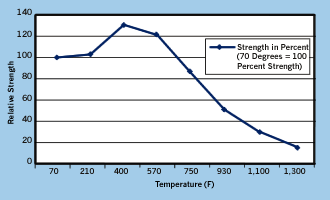
Here is the reality that most 19-year-old engineering students understand:  Steel loses its strength rapidly with temperature, losing nearly all of its structural strength by 1000 degrees F, well below its melting point but also well below the temperature of burning jet fuel.  For three years I designed piping and pressure vessel enclosures at a refinery.  Many of the processes in a refinery crave heat and run better at elevated temperatures.  In fact, what refineries can do, and how efficient they can be, is really limited by the strength of steel at high temperatures.  Refineries end up being limited to process temperatures no higher than 600 to 800 degrees, and even then these require expensive special metallurgies.  Anything higher requires a very expensive vessel lined with some sort of ceramic insulation material.

The strength curve of steel vs. temperature is dependent on the type of steel, but the curve below is about what I remember from my old textbooks.  Note by 930 degrees the steel strength has dropped by half and in the next 100 degrees it halves again.

Steel

But the proof of what went wrong in WTC1 and WTC2 does not take a college education.  You only have to look at building codes.  Building codes generally require that structural steel members be coated with a fireproofing material

As the critical temperature for steel is around 540°C (give or take, depending on whose country's test standards one reads at the time), and design basis fires
reach this temperature within a few minutes, structural steel requires
external insulation in order to prevent the steel from absorbing enough
energy to reach this temperature. First, steel expands, when heated,
and once enough energy has been absorbed, it softens and loses its
structural integrity. This is easily prevented through the use of fireproofing.

You have probably seen it- that foamy tan stuff sprayed on girders before the rest of the building is filled out.  In fact, this stuff is not fireproofing per se but insulation.  It is there to keep the structural steel cool during a fire, so the steel will not fail.  Generally the standards are set in the code that the insulation has to be able to stand X time of fire (generally several hours) and keep the steel below its critical yielding temperatures.   Engineers know that a building fire, which burns much cooler than a jet fuel fire, can cause steel members to weaken and fail and the building to collapse.  If this were not the case, then why do builders spend billions every year to insulate structural steel building components?? 

I wrote about this issue in more depth here.  In this post, one of the commenters listed a series of building fires and asked, why did these buildings not collapse?  The answer is:  Because insulation is applied to the building structural steel members to try to prevent the collapse.  Even insulation is just a stopgap -- if the fire burns long enough and
hot enough (or if the insulation is stripped off, say by an airplane
shearing through the building) then the steel will heat up and fail.   So there are three reasons that some buildings have fires and don't fail while the WTC did fail:

  • Some building fires can and do cause buildings to collapse.  Insulation on steel members help many buildings to survive, and often does save the building from collapse, but not always.  This building did collapse, at least the top 6 stores.  Oddly, this is actually used by truthers as further proof, somehow, that the WTC fires could not have brought down the building (the link is actually one of their web sites, I think).  But in fact, the Madrid building failed the same way as WTC 1 and 2, with the top six floors collapsing.  Since the building was not fully constructed on these top floors, there was not the huge weight collapsing that created the battering ram effect that brought down the WTC.  The Madrid floors took longer to collapse, but they were 1) under far less stress, since the building above them was not complete; 2) the fire burned much cooler and 3) the insulation had not been mechanically scrubbed from the beams, so it took longer for the beams to heat up.  To me, this is a clear parallel to the official version of the WTC collapse, but even this is distorted somehow by the truthers.
  • Fuel burns hotter than normal building fires, so even insulated members will heat up faster.  I have many pictures in my personal collection of refinery fires where the main thing you can see in the aftermath is all the structural steel bent and collapsed.  Truthers may not be able to find many examples of building collapsing in a fire, but you would be hard-pressed NOT to find examples of collapsed structural steel at every refinery and petrochemical fire.
  • The insulation that normally protects buildings was stripped off by the mechanical action of an enormous airplane shearing through the building at 300 miles an hour. 

This is in addition to the actual removal of some support columns by the crashing aircraft, which put more load on the remaining structure and thereby hastened the collapse.

postscript: By the way, can anyone tell me why the so called "reality-based"
community, that so often criticizes the Right for theocratic attacks on
science, is so quick to fall for this pseudo-scientific junk?

Update: One other thought:  The hallmark of truthers is that they take small abnormalities or uncertainties in the failure analysis and event reconstruction as justification for throwing out the whole explanation of events in favor of an alternate series of events with much, much larger gaps, contradictions, and logical problems (e.g. how did the buildings get wired for demolition without anyone noticing? or, how did the planes manage to crash into the precise floors wired for demolition without dislodging the charges and their wiring?  or, how did such a massive conspiracy get pulled off without one leak when the administration can't even competently fire 9 US attorneys?)

Anyone who has ever done root cause analysis of a catastrophic failure knows there are always questions no one can answer when all is said and done.  And people who say things like "always happen" or "can never happen" typically don't have any real-world engineering experience.

Update2: One other thought on WTC7, since most of the sites I have visited over the last several days really seem to focus on WTC7.  I consider our government capable of all kinds of hijinx, but why WTC7?  I would argue that about 0.00001% of the outrage that resulted from 9/11 is attributable to WTC7.  How many people not associated with the truthers have even heard of WTC7?  In fact, one could argue that the strike on the Pentagon was effectively irrelevant, since no one really even seems to remember that one.

One minor note:  I saw on a conspiracy site the claim that all military planes were ordered to stand down on 9/11.  I know from personal experience that can't possibly be true.  I was in Manhattan during 9/11 and remember well people in the streets hitting the ground in fear every time a military jet rocketed over the city.

I don't buy all this conspiracy theory not because I think well of the government, but just the opposite.  I consider the conspiracies posited at these various sites to be orders of magnitude beyond this government's capabilities.  Remember Coyote's Law:

When the same set of facts can be explained equally well by

  1. A massive conspiracy coordinated without a single leak between hundreds or even thousands of people    -OR -
  2. Sustained stupidity, confusion and/or incompetence

Assume stupidity.

Update3:  I guess I need to throw out a few more things.  This was not meant to be a comprehensive or definitive rebuttal of the 9/11 conspiracy theories.  I merely used as a starting point one stupid comment by Rosie O'Donnell on melting, a comment I have heard a lot of times, and that I knew I could refute of my own knowledge.  Those who want to get mad at me because I did not refute this or that, sorry, go deal with the book by the Popular Mechanics guys.  The only other thing I can contribute other than engineering sanity is the fact I have participated in many engineering failure analyses and the fact that I watched the towers fall live, with my own eyes, from the streets of Manhattan.

Every single engineering failure analysis I have ever participated in, from refinery explosions to airplane crashes, has always left unanswered questions and nagging inconsistencies that had, I am sure, nothing to do with conspiracies. We had many things we could never explain about a heat exchanger fire at our refinery in 1985, but I don't think that those unknowns and uncertainties leave the door open to blame government agents for the fire. 

I'll say again, if you want to argue that the WTC buildings were demoed by explosives, you have to explain how the explosives were laid, and, more important, how the explosives and their delicate wiring and detonators survived a plane crashing into the same floors.  And by the way, given that the buildings had not external markings showing the floors, how did the people flying the airplanes hit the exact correct parts of the building?  For every problem with the core hypothesis I could name 10 problems with the truther alternative.  I have no problem with offering an alternative hypothesis to the original thesis, but it is silly to criticize the core thesis for small problems only to replace it with a hypothesis that has problems that are orders of magnitude larger.

A Zero-Sum Wealth Quiz

One of the really bad ideas that drive some of the worst government actions is the notion that wealth is somehow fixed, and that by implication all wealth is acquired at someone else's expense.  I am working on my annual tax-day post on the zero sum fallacy, but in the mean time here is a brief quiz.

The quiz consists of matching a description to the owners of these two houses:

House1a House2b

One house has hot and cold running water, central air conditioning, electricity and flush toilets.  The other does not.  One owner has a a computer, a high speed connection to the Internet, a DVD player with a movie collection, and several television sets.  The other has none of these things.  One owner has a refrigerator, a vacuum cleaner, a toaster oven, an iPod, an alarm clock that plays music in the morning, a coffee maker, and a decent car.  The other has none of these.  One owner has ice cubes for his lemonade, while the other has to drink his warm in the summer time.  One owner can pick up the telephone and do business with anyone in the world, while the other had to travel by train and ship for days (or weeks) to conduct business in real time.

I think most of you have guessed by now that the homeowner with all the wonderful products of wealth, from cars to stereo systems, lives on the right (the former home of a friend of mine in the Seattle area).  The home on the left was owned by Mark Hopkins, railroad millionaire and one of the most powerful men of his age in California.  Hopkins had a mansion with zillions of rooms and servants to cook and clean for him, but he never saw a movie, never listened to music except when it was live, never crossed the country in less than a week.  And while he could afford numerous servants around the house, Hopkins (like his business associates) tended to work 6 and 7 day weeks of 70 hours or more, in part due to the total lack of business productivity tools (telephone, computer, air travel, etc.) we take for granted.  Hopkins likely never read after dark by any light other than a flame.

If Mark Hopkins or any of his family contracted cancer, TB, polio, heart disease, or even appendicitis, they would probably die.  All the rage today is to moan about people's access to health care, but Hopkins had less access to health care than the poorest resident of East St. Louis.  Hopkins died at 64, an old man in an era where the average life span was in the early forties.  He saw at least one of his children die young, as most others of his age did.  In fact, Stanford University owes its founding to the early death (at 15) of the son of Leland Stanford, Hopkin's business partner and neighbor.  The richest men of his age had more than a ten times greater chance of seeing at least one of their kids die young than the poorest person in the US does today.

Hopkin's mansion pictured above was eventually consumed in the fires of 1906, in large part because San Francisco's infrastructure and emergency services were more backwards than those of many third world nations today.

Here is a man, Mark Hopkins, who was one of the richest and most envied men of his day.  He owned a mansion that would dwarf many hotels I have stayed in.  He had servants at his beck and call.  And I would not even consider trading lives or houses with him.  What we sometimes forget is that we are all infinitely more wealthy than even the richest of the "robber barons" of the 19th century.  We have longer lives, more leisure time, and more stuff to do in that time.   Not only is the sum of wealth not static, but it is expanding so fast that we can't even measure it.  Charts like those here measure the explosion of income, but still fall short in measuring things like leisure, life expectancy, and the explosion of possibilities we are all able to comprehend and grasp.

More, coming soon...

Update:  An example of why this topic is always timely:

Paul Krugman foresees an increasing left-leaning electorate. The cause?

The main force driving this shift to the left is probably rising

income inequality. According to Pew, there has recently been a sharp

increase in the percentage of Americans who agree with the statement

that "the rich get richer while the poor get poorer."

Russel Roberts goes on to tear into this red meat.  Read it all.


I Couldn't Be More Pleased

I couldn't me more pleased that Congress is about to enter an orgy of hearings on the US Attorney firings.  Not because of the issue itself, since I really don't have a clue what is going on.  But nothing would make me happier than to see Congress dissipate itself on this crap for a couple of years.   Maybe we could even revive interest in impeachment hearings.  Anything that soaks up time from passing new boneheaded legislation and gives Congressmen a chance to demagogue without threatening my individual freedoms is OK by me.

Update:  OK, I am catching up and learning bit by bit about this case.  I found this in particular to be hilarious:

One of those attorneys was Paul Charlton of Arizona.  Adult Video News  (link NSFW) did some sleuthing, and found some interesting stuff. Charlton did
in fact bring one federal obscenity case in Arizona. But while he was
bringing that particular series of indictments, it turns out that
another chain of adult video stores based in Arizona continued to sell
and rent the same titles the other store was indicted for selling.

The
kicker is that the unindicted store had recently declared bankruptcy,
and was being run by trustees from the federal government. So while the
federal government was indicting one business for breaking federal
obscenity laws, the government itself was breaking those same laws just
a few miles away, in order to recoup federal taxes owed by a rival
store.

Even more interesting, it looks like Charlton may have
balked on the case after learning about the discrepancy via a brief
from attorneys for the indicted store. And that balk may have cost him
his job.

By the way, I was a bit flip up top, because I was trying to make a separate point.  However, I do believe strongly that principled prosecutorial discretion is absolutely critical in this world where everything is illegal.  If the Bush administration turns out to have fired these guys for exercising sensible discretion, then they deserve to be toasted for it, though I have a number of other issues I would tend to toast them for first.

Politically Correct Medicine

I am always floored by the number of progressives who embrace all kinds of wacky non-scientific health theories.  These are the same folks who criticize creationists as being anti-scientific.  I am not a creationist, but I might be able to embrace it faster than I could, say, the insanity that is homeopathic medicine**. 

Unfortunately, these are the same folks who will likely make up the backbone of the socialized medicine bureaucracy when and if the US finally decides to hand health care over to a consortium of the Post Office and Walther Reed.  So here is a preview of what we will get:

Tom and Donna (not their real names) are professional
shamen. They teach classes in shamanism at a "foundation", where you
can learn "soul retrieval healing", help the dead "continue their
journey into the Hereafter", and investigate "the Fairy Kingdom". These
soul retrievers and Fairy Kingdom investigators also work for the NHS "”
where, according to Tom's foundation profile, they "use complementary
therapies to help those with mental health difficulties". Shaman
therapies are not the only unorthodox treatments for which the NHS will
gladly pay.

Taxpayers are also subsidising Emotional
Freedom Technique (EFT) "therapy", in which, according to one NHS
trust, "subtle energies" are reordered via "tapping with the fingertips
to stimulate certain meridian energy points while the client is "˜tuned
in' to the problem". "¦If EFT doesn't do the job, an NHS foot massage
might help. Reflexologists believe that each part of the foot maps to a
different organ, and that massaging a particular point can treat that
organ. Medical doctors think it's absurd. "¦Most depressing of all for
the rational taxpayer is the NHS Directory for Alternative and
Complementary Medicine, which aims to promote "dowsers", "flower
therapists" and "crystal healers". We've just learnt that some
hospitals are removing every third light bulb to save money, and that
nurses are being paid half the minimum wage "” or being asked to work
for nothing "” at others. That's how bad the financial crisis has
become. Meanwhile, the National Health Service is employing shaman
fairy enthusiasts as psychological counsellors, enthusiastically
providing treatments invented by "an ordained minister and a personal
performance coach" who thinks tapping your body can cure diabetes,
promoting dowsers and crystal healers and spending vast amounts on
therapies that can't be scientifically supported.

Just as with the Walther Reed mess, the left wants to write off this stuff as just bad management, as an exception.  But unfortunately, this is the rule for government management.  It always goes bad.  Mismatched incentives + lack of individual choice + strong unionized bureaucracy most concerned with its own job security + impossibly complex information flows = mess.  Always.  I get very tired of the excuse, as I wrote here, that "if only we were in charge, everything would work great." 

Throughout these years, libertarians like myself argued that there
were at least three problems with all of this technocratic statism:

  • You can't make better decisions for other people, even if you
    are smarter, because every person has different wants, needs, values,
    etc., and thus make trade-offs differently.  Tedy Bruschi of the
    Patriots is willing to take post-stroke risks by playing pro football again I would never take, but that doesn't mean its a incorrect decision for him.
  • Technocratic idealists ALWAYS lose control of the game.  It may
    feel good at first when the trains start running on time, but the
    technocrats are soon swept away by the thugs, and the patina of
    idealism is swept away, and only fascism is left.  Interestingly, the
    technocrats always cry "our only mistake was letting those other guys
    take control".  No, the mistake was accepting the right to use force on
    another man.  Everything after that was inevitable.

Everyone has had a turn running the place (except libertarians, I might observe) and everyone has screwed things up.

** I am amazed I have not posted a rant on homeopathic medicine, but searching through my archives, I don't find anything.  If you don't know, here is the fast answer why homeopathy is silly.  Advocates of homeopathy argue that they can make certain substances more effective by diluting them, and the more they dilute them, the more effective they are.  Go to one of their web sites, and you will see dilution rations that translate into having less than one molecule of the active ingredient in a mass of water the volume of all the world's oceans.  Advocates argue that even though the molecules are gone, some sort of resonance remains.  Uhh, right.

We Should Just Say "Thanks" Instead

Don Boudreaux argues that we should not retaliate vs. countries who subsidize exports to the US.

I know of no cases in which a country was impoverished, or even

measurably damaged, by its refusal to "retaliate" against alleged

instances of foreign subsidies. This fact, combined with the ease of

abusing the ability to accuse foreign rivals of being subsidized,

counsels strongly in favor of our own government turning a deaf ear to

such accusations.

I have never, ever, ever understood how the average person in the US could actually get mad that a foreign government taxes its people for the sole purpose of subsidizing lower prices in the US.  I have the same reaction to "dumping" accusations, where folks get upset that some foreign company is allegedly selling its products in the US below cost.   Instead of complaining, I think we should just say "thanks."  And maybe "cha-ching!"  Nothing like getter over on the taxpayers of China or Japan. 

I'm Confused. Why Is This Illegal?

Apparently there was another payola bust.  I'm confused.  Why is this illegal?  I guess in the 1950's I might understand it, when there was only one way to listen to music anywhere outside your home.  But today there are about 20 different ways, including several flavors of radio.  If a radio station overplays the same song to the point of insanity, just listen to something else. 

Paying for placement in overcrowded distribution channels is routine in many industries and certainly not the subject of federal law.  If you don't believe me, try taking your new brand of potato chips over to Safeway and try to get on the shelf.   Now, I know folks would argue that this contributes to Safeway's selection being bland.  But that is also why new competitors, like Whole Foods, have emerged to serve folks who don't like Safeway's selection of products.

By the way, does anyone think its funny that record producers are in the news for paying for play at the same time they are in the news for charging for play?

Update:  More on charging for play:

On March 1, 2007 the US Copyright Office stunned the Internet radio
industry by releasing a ruling on performance royalty fees that are
based exclusively on the number of people tuned into an Internet radio
station, rather than on a portion of the station's revenue. They
discarded all evidence presented by webcasters about the potentially
crippling effect on the industry of such a rate structure, and
rubber-stamped the rates requested by the RIAA (Recording Industry
Association of America).

Under this royalty structure, an
Internet radio station with an average listenership of 1000 people
would owe $134,000 in royalties during 2007 -- plus $98,000 in back payments for 2006. In 2008 they would owe $171,000, and $220,000 in 2009.

Finally, Someone States the Obvious

The media and many politicians have an inventive system that drives them to take the most pessimistic possible interpretation of every economic event (the media to sell papers, politicians to panic us into giving them more control of the economy).   Chinese ownership of US debt securities is one such issue that everyone seems to be in a tizzy about.  Thanks to Don Boudreaux for finally stating the obvious:

In fact,
foreign-government
holdings of U.S. debt arguably make these governments "hostage to the
economic decisions being made in Washington."  The Fed, after all,
could monetize this debt, inflating away its value.  Or Uncle Sam could
repudiate this debt, or unilaterally change its terms in ways
unfavorable to holders.  Or you and your colleagues could implement
economically disastrous policies that drive up long-term interest rates
and, hence, drive down the value of outstanding treasuries.

Finally!  All you have to do to understand this is reverse the situation.  If the US government owned a hundred billion dollars of Venezuelan government bonds, would this really give us power over Hugo Chavez?  Or would it, more likely, given him more power over us, at least in terms of circumscribing our actions?

Is Jury Nullification Libertarian?

A while back, at our local libertarian discussion group, we spent an evening discussing centralization vs. decentralization of government, and whether one or the other better protects individual liberties. 

Many libertarians argue for decentralization.  The anarchists in the room will argue for the ultimate decentralization, all the way to the individual level, essentially voiding the concept of government altogether.  Others who are more amenable to some government argue for decentralization because it tends to allow for competition, with citizens voting with their feet and wallets for more favorable tax and regulatory regimes.

On the other hand, the US provides historical examples of the benefits of federalism in protecting individual rights.  Certainly the abolition of slavery and later of Jim Crow laws were a positive outcome from the feds, as are the enforcement of Bill of Rights protections on the states.  I would personally love to see a federal system like our own with all legislative power held as locally as possible, but with a federal government whose main purpose domestically was not taxation/regulation/legislation but instead enforcement of a more robust Bill of Rights and nullification of state and local law that violated protected individual freedoms.

Anyway, one topic related to decentralized authority was jury nullification.  Jury nullification is the ability for juries to rule on the law, rather than guilt or innocence.  An example might be "the jury thinks Joe is guilty of smoking pot, but we don't think smoking pot should be illegal, so we are going to let Joe go."  Most state law technically does not allow juries to rule on the law itself, but as a practical matter there is no way juries can be prevented from doing so  (Prosecutors really go non-linear over jury nullification -- I remember Patterico had a long series inveighing against it.)

Anyway, as you might imagine, the libertarians in the room mostly love jury nullification.  Despite being a good anarcho-capitalist, I disagreed. I understood that most of the examples people brought up did indeed demonstrate that jury nullification could be a tool for protecting individual rights.  However, I believe that nullification could equally be a tool of oppression.  For example, in criminal law, take the Enron-Skilling trial.  I am not saying this happened, but one could certainly imagine a properly inflamed jury saying "well, we don't think he is technically guilty beyond a reasonable doubt on the charges based on the evidence here in court, but he's rich and Enron failed and people lost money and we're pissed off, so we will find him guilty.  They would be saying "what he did was not a violation of the law, but it should be, so we are sending him to jail." This is just as much jury nullification as my previous example.

I don't think this kind of anti-individual-rights jury nullificatin happens often in criminal court, but I do think it is happening a lot in civil court.  In fact, I think one way you could summarize what is wrong with torts and litigation in this country is that we are seeing rampant jury nullification in favor of wealth redistribution.  Juries are ignoring the law, the facts of the case, and all reason for one and only one consideration:  "One guy in the room is rich, one guy is not, and I have a chance to take money from the rich guy and give it to the poor guy."  For while it may be hard in America to get 51% of the voters to support substantial increases in wealth distribution, smart lawyers like Peter Angelos and Jon Edwards have figured out that it is not that hard through voi dire to get at least seven or eight such votes in a room of twelve people.

Particularly if you are good at venue-shopping:

In Race, Poverty and American Tort Awards (and here),
Eric Helland and I show that tort awards increase strongly with county
poverty rates especially with minority poverty.  A 1% increase in black
poverty rates, for example, can increase tort awards by 3-10 percent
with a similar increase in Hispanic poverty rates.   Careful forum
shopping can easily raise awards by 50-100%.

Anthony Buzbee, a famed plaintiff's attorney, inadvertently let the
cat out of the bag recently when talking about Starr county in Texas.

"That venue probably adds about seventy-five percent to the value of
the case," he said. "You've got an injured Hispanic client, you've got
a completely Hispanic jury, and you've got an Hispanic judge. All
right. That's how it is."

In other parts of Texas, Buzbee went on, a plaintiff may have the
burden of showing "here's what the company did wrong, all right? But
when you're in Starr County, traditionally, you need to just show that
the guy was working, and he was hurt. And that's the hurdle: Just prove
that he wasn't hurt at Wal-Mart, buying something on his off time, and
traditionally, you win those cases."

The problem with letting juries write law in the jury room is that there are no Constitutional protections at all.  If they want to make the law, at least for that day, read that homeowners are liable for injuries suffered by burglars trying to break into their house, then that is what the law becomes, fair or not.  If they want to make the law read that drug companies shouldn't sell painkillers that have any risk at all, then that is what the law is, and the rest of us 300 million minus twelve people have to live with fewer choices for managing our migraines. 

History I Never Knew

Via Maggie's Farm, the heretofore unknown (to me) history of the Republic of West Florida.  Its annexation into the US denied Dickie Scruggs and Trent Lott the chance to be king of their own banana republic.

Is Climate Becoming More Extreme?

Bruce Hall at Hall of Record has performed a really interesting analysis.  He created a data base for each state which shows in what year that state's monthly temperature records were set.   So for each state, he has the years when the twelve monthly high temperature records were set (e.g. year of highest Arizona Jan temp, year of highest Arizona Feb temp, etc.) and the years when the twelve monthly low temperature records were set.  Here, for example, is his data for Arizona:

Extremetempsarizona

So, for example, the record for the highest July temperature was set in 1905 at Parker, Arizona with a scorching 127 degrees.  The entry in his database would then be Arizona-July:  1905.  He notes that there is a bias in the data toward more recent years, since if the record was set in 1905 and tied in 1983, only the newer 1983 date will show in the data.  I would also observe that this data is uncorrected for urban heat island effects (as cities urbanize they get hotter, and effect that is different than CO2-cause global warming and is usually corrected for in global warming studies).  There is also a bias towards the present in having more measurement points today than 100 years ago:  More measurement points means that, over a state, one is more likely to pick up the true high (or low).

Though I have other problems with the anthropomorphic global warming hypothesis, I have never really doubted that the world has warmed up over the last century.  So even I, a skeptic, would expect a disproportionate number of the all-time high temperatures to be in the last decade, particularly without UHI correction and with the bias discussed above.  The global warming folks would argue that the effect should be doubly pronounced, since they claim that we are seeing not just a general heating, but an increase in volatility (ie more extreme variation around the mean).

But Hall doesn't find this when he graphs the data.  Take the 600 state monthly high temperature records that exist on the books today (50 states times 12 months) and graph the distribution of years in which these records were set:

Hightempchart

Assuming about 120 years of data, you should expect to see a high temperature record on average in a database of 600 records at 5 per year, which is precisely where we have been of late and well below the record years in the thirties (remember the dust bowl?) and the fifties. It seems to actually show a reduction in temperatures or volatility or both.  Hmm.

Of course, the US is not the whole world -- in fact, all developed land masses are only 25% of the world, so there is a lot not covered by such records.  Also, statisticians are welcome to comment on whether looking only at extremes in a data set is even meaningful.  But this sure isn't what you might expect from, say, watching the Oscar telecast or the nightly news.

Hall also has the low temperature records in his very comprehensive post, which, surprisingly, do show more activity in the last several decades.  He has a follow-up here.  Finally, Hall has summarized his data a different way in this post -- you have to click on the chart to really see it in all its beauty.  Just take a quick look.  I won't steal his thunder by reproducing it here, but suffice it to say it reminded me of some of the best examples in the book Visual Display of Quantitative Information.

On Being Skeptical of Data That Supports My Point of View

I am pretty convinced that the case for anthropomorphic global warming is being overblown, and part of my reasoning is that other factors, like recent increases in solar activity, are being virtually ignored in the race to place a big fat blame sign on man (and on the US in specific).

So I was ready to really like this chart, via Q&O via RedState via Hall of Record (click image for larger view):

Globalwarmingaa

Increases in sunspot activity are generally correlated with increases in solar output, so the chart seems to show a correlation between solar output and global temperatures that is much better than the correlation with CO2 concentration.  Now, this still may be correct (I have what is probably a better chart below), but this particular graph is odd in a few ways.  First, the Y-axis scale is "Sunspot Cycle Length" presumably in years (thus the "y").  But how does that make sense?  If it is the length of the trailing cycle, it should go up uniformly then drop to zero, like a sawtooth.  I don't know who a cycle length that seems to average around 11 years can look like that line on that timescale.  I tried to get back to the original, but it was attributed to a presentation that did not seem to be online by a professor that doesn't seem to work in exactly this field of study.  If anyone has any insight on this chart, please comment.

So, as much as this chart would be good news (remember my definition of good news here), I have to be skeptical of it.  I do think the underlying point is a good one:  It is well known that we are in a period of unusually high sunspot activity and solar output.  A better chart may be this one, from this study and via junkscience.com: