WASHINGTON, D.C.///February 20, 2013///Sequestration will cut visitor access to the rim of the Grand Canyon, significantly delay the spring opening of key portions of Yellowstone and Yosemite, reduce emergency response help for drivers in the Great Smoky Mountains, limit access to the beach at the Cape Cod National Seashore, and impair the experiences in many other ways for millions of visitors at America’s national parks. In addition, local, regional and state economies that depend on national parks will take huge hits as visitors are either turned away or skip visits due to the impact of the mindless sequestration budget cuts.....
CNPSR Spokesperson, Joan Anzelmo, former Superintendent of Colorado National Monument said: “Congress might just as well put a big “Keep Out !” sign at the entrance to Yellowstone, Grand Canyon, Yosemite, the Cape Cod Seashore, and every other iconic national park in the U.S. This foolhardy path tarnishes America’s ‘crown jewels’ and is a repudiation of the nation’s national parks often touted as ‘America’s best idea’. Millions of Americans depend on national parks for their vacations and livelihood. Those Americans are being told that national parks don’t count … that people who use national parks don’t count … and that people who live and work near national parks don’t count.”
A few observations:
It's a 5% freaking cut. I bet Wal-Mart is a more tightly-run organization than the NPS, and I further bet if I forced an immediate 5% cut at Wal-Mart they would do it without cutting store hours or service to customers.
Again, we see government officials cutting the most cherished, visible services, rather than the chaff, in order to maximize citizen outrage rather than do their freaking job and set priorities
It's a freaking 5% cut. Did I say that already?
I could cut huge chunks from the NPS budget while improving service by having private companies perform many operating functions. Our company runs nearly 175 parks and in every one we have seen something like a 50% reduction in cost over government operation while simultaneously increasing staffing in the parks.
This is absolutely boilerplate from every single agency and constituency that gets threatened with even the tiniest budget cut -- "you are telling XXX group they don't count." Barf.
I was going to make some observations about their budget over the last few years, but all their budget detail pages online seem to be down
I am currently as depressed and cynical as I have ever been today due to this absurd reaction to a trivial spending cut. I have about zero hope that Federal spending will ever be reigned in. Politicians of both parties and the special interests that support them will spend and spend until we find ourselves calling Greece asking for a bailout.
If the Republicans are supposed to be the voice of fiscal responsibility in Washington, then we are doomed. They are absolutely as bad as Obama, running around in panic that the trivial cuts required by the sequester (not 8% this year or 5% or even 2% but 1% of Federal spending). I have never seen a private organization with a large administrative staff that could not take a 5% reduction and generally be better off for it. I absolutely guarantee that I could take 5% or more off the top of every agency's budget and you would never notice it.
This includes the military. In fact, this includes the military in particular. The military is never asked to prioritize. We still have armored divisions in Germany. It is always incredible to me that Republicans, who doubt that the government can ever manage or spend wisely, suddenly cast aside all these doubts when it comes to the military. I understand the honor that folks accord to front-line soldiers vs., say, DMV workers. But they are not the ones spending the money. I am tired of such honor for the troops being used to bait and switch me from a very reasonable focus on DOD spending and waste.
When it comes to the military, Republicans use the same "closing the Washington Monument" tactics that Democrats use for social programs, essentially claiming that a 5% (or 1%) spending cut will result in the cessation of whatever activity taxpayers most want to see continue. This process of offering up the most, rather than the least, important uses of money when spending cuts are proposed as a tactic to avoid spending cuts is one of the most corrupt practices imaginable. No corporate CEO would tolerate it of his managers for a micro-second.
In today's history lesson, we have something called the "Addled Parliament." Surely that cannot be a good name to have, and in fact the name was given as a term of derision, very like how the Left describes the current Congress as obstructionist and ineffectual.
So why did it gain the name "addled"? It turns out, for about the same reasons the current Congress comes under derision from Obama: It did not give the King all the money he wanted. Via Wikipedia:
The Addled Parliament was the second Parliament of England of the reign of James I of England (following his 1604-11 Parliament), which sat between 5 April and 7 June 1614. Its name alludes to its ineffectiveness: it lasted no more than eight weeks and failed to resolve the conflict between the king, who wished to raise money in the form of a 'Benevolence', a grant of £65,000 and the House of Commons (who were resisting further taxation). It was dissolved by the king.
Parliament also saw no reason for a further grant. They had agreed to raise £200,000 per annum as part of the Great Contract and as the war with Spain had reached its resolution with the 1604 Treaty of London, they saw the King's continued financial deficit as a result of his extravagance (especially on Scottish favourites such as Robert Carr) and saw no justification for continued high spending.
Moreover there remained the continuing hostility as a result of the kings move of setting impositions without consulting Parliament.
Wow, none of that sounds familiar, huh? In fact, James was an awful spendthrift. Henry the VII was fiscally prudent. Henry the VIII was a train wreck. Elizabeth was a cheapskate but got into expensive wars, particularly in her declining years, and handed out too many government monopolies to court favorites. But James came in and bested the whole lot, tripling Elizabeth's war time spending in peace time, mainly to lavish wealth on family and court favorites, and running up debt over 3x annual government receipts. History, I think, pretty clearly tells us that Parliament was absolutely correct to challenge James on spending and taxes, and given that it took another century, a civil war, a Glorious Revolution, a regal head removal, and a lot of other light and noise to finally sort this issue out, it should not be surprising that this pioneering Parliament failed. Yet we call it "addled".
I am sick and tired of politicians impugning the ethics of private individuals engaged in commerce. There are certainly a small minority of fraudsters in the world of business, but there is a supermajority of unethical people in Congress, arguably approaching 100%.
My latest evidence for such is this article in the Washington Post about the ethical bankruptcy of the Federal budgeting process. It is impossible to excerpt, but here is a representative example:
At the Census Bureau, officials got credit for a whopping $6 billion cut, simply for obeying the calendar. They promised not to hold the expensive 2010 census again in 2011.
By law, the next census is not until 2020. There was never, ever going to be a census in 2011. But Congress claimed $6 billion in savings for not having one none-the-less. Here is more:
In the real world, in fact, many of their “cuts” cut nothing at all. The Transportation Department got credit for “cutting” a $280 million tunnel that had been canceled six months earlier. It also “cut” a $375,000 road project that had been created by a legislative typo, on a road that did not exist....
Today, an examination of 12 of the largest cuts shows that, thanks in part to these gimmicks, federal agencies absorbed $23 billion in reductions without losing a single employee.
You can impugn business ethics all you want, and I can add a few stories to yours, but I have worked at fairly senior positions in two Fortune 50 companies and as a worker bee in a third, and in all three it would be a firing offense to engage in this kind of Charlatanism.
Republicans like to say we have a spending problem, not a taxing problem, but the evidence doesn't back that up. Total government spending didn't go up much during the Clinton era, and it's actually declined during the Obama era. In the last two decades, it's only gone up significantly during the Bush era, the same era in which taxes were cut dramatically.
I have several comments about this craziness, but I need to preface it with an observation, an observation that I presume my readers have already figured out, unlike the willfully blind of the reality-based community. This is the total of all government spending at all levels, not just Federal. In fact, had he shown Federal spending (likely more appropriate given he is trying to draw conclusions about Presidents), the numbers would have continued up over the last few years. Only a substantial decline in state and local spending has offset the increase in Federal per capital spending. Which leads us to a few conclusions, starting with the most obvious:
Under our Constitution, last I checked, the President had exactly zero to do with local spending. Obama actually was a sort of exception to this, attempting to prop up local spending, or at least to prop up union civil service payrolls, in the 2009 stimulus. However, this is well behind us and all this did was put off the financial reckoning in state and local governments.
It is odd that Drum should claim this proves that all is well, since if it is so, it is due to a lot of governments, many of them majority Republican, following exactly the opposite strategy than the one he advocates. In other words, they showed fiscal restraint, which somehow allows Drum to argue that Obama should therefore show lack of restraint. I am not sure how improving state and local financial position by doing the opposite of what Drum advocates is a logical justification for the Feds doing what Drum advocates.
This shift in the spending mix from state and local to Federal is actually a fiscal disaster in waiting. Local spending has far more accountability, where spending stays close to voters so that those who pay taxes can assess the spending's merits and effectiveness. Further, most state and local governments must operate with a balanced budget and are banned from deficit spending. The Feds have no such restraints.
The fact that many state and local governments live within their means does not somehow make the federal government's debauchery justified. Seriously, this is like saying that Greece does not have a spending problem because overall EU spending has declined.
Even state and local spending is declining only because the government is on cash rather than accrual accounting. If states do not fund their pension obligations in a year, realistically they are still incurring the liability, but cash accounting would show that spending is declining. In this sense, cash spending is a poor gauge of the real health of state and local governments.
Everyone always shows these spending charts by red / blue President. It would be interesting instead to see them by red / blue Congress.
Update: Drum responds to others making similar arguments here. He modifies the chart to include just federal per capital spending, and unsurprisingly, it is up steeply in the first year of Obama's Presidency but flatish (not down) after that. Drum draws the conclusion that Obama's spending is OK because Bush's was worse. Huh? This is the bizarre tu quoque team politics game that drives me insane. Bush sucked on spending. Bush with a Democratic Congress in his last years sucked worse. Obama has sucked. None of this somehow proves spending is not a problem.
His chart says this: Real (meaning adjusted for inflation) per capita (meaning adjusted for population growth) Federal spending is up something like 47% in the last 10 years. Anyone feel like they are getting 47% more value?
In this case, the USDA imposed on the [raisin farming] Hornes a “marketing order” demanding that they turn over 47% of their crop without compensation. The order—a much-criticized New Deal relic—forces raisin “handlers” to reserve a certain percentage of their crop “for the account” of the government-backed Raisin Administrative Committee, enabling the government to control the supply and price of raisins on the market. The RAC then either sells the raisins or simply gives them away to noncompetitive markets—such as federal agencies, charities, and foreign governments—with the proceeds going toward the RAC’s administration costs.
I have seen estimates that a Medieval serf had to pay between 30 and 70 percent of his crop to his master. The RAC seems to be right in line with these numbers.
Here is a recent example of the sorts of ways that this success has been enabled. Rather than entirely depending on the political process to get things done, environmental advocacy groups, recreation groups, conservation groups and private interests have frequently put their money where their mouths are and taken up the role of conservation themselves. Private landowners on a famous canoe carry to Raquette Lake around the Marion River rapids were planning on selling property for development purposes (why is another story). Rather than use the town zoning thugs or some obscure environmental law to prevent the sale and development, concerned groups who claimedthe land was more valuable in recreation use took it upon themselves to purchase the land and keep it in its natural state:
The Open Space Institute has acquired the historic Marion River canoe carry and 295 surrounding acres in Hamilton County. There has been concern about preserving access to the canoe carry in recent years, after the owner announced plans to build several homes along Utowana Lake. The acquisition will ensure the carry remains open to the public.
“The potential for development made the Marion River Carry a higher, more immediate priority for conservation,” said Kim Elliman, president and CEO of the private non-profi t land preservation organization.
The OSI is paying $2 million for the land …
A couple of months ago a local resident was going to tear down a Frank Lloyd Wright house for development. Outrage poured from all quarters of this town that was once Wright's winter residence. We have got to stop this! So seemingly everyone in the area rushed to the city council to force this guy to keep his house intact.
I am a fan of the old master, though I also think (gasp!) he built a lot of crap, too. I personally would never live in one of his houses. Not even Falling Water, which is beautiful but not very liveable (and FLW definitely had a bias against tall people).
My argument all along was, well, if this house's continued existence is so valuable to so many people, why don't you buy it? After all, shouldn't the people who value the house pay for the cost, including the opportunity cost, of its preservation? Why should this guy who does not value the house be forced to bear a lot of the cost of its preservation? Most people looked at me as if I was from Mars.
Eventually, someone who wanted to preserve the house made an offer for $2 million. The buyer rejected it as less than what he would make from development. Everyone went nuts again - they said the $2 million was more than the owner paid for the house, he should accept it. Why? He's held this house through the downturn and born the holding costs to make a profit, not just get his money back. If supporters can't come up with another half million, is it really worth saving?
I actually missed the ultimate resolution. A few weeks ago the city council was gearing up to "protect" the house, meaning that supporters could have the house without actually paying for it, a sort of eminent domain seizure this guy likely will never be compensated for.
PS- I love FLW's theaters. He had a home theater in Taliesen West where all the chairs are skewed facing a bit right of the screen. He observed people like to put their legs off to the side when they face the screen and tilt at the waist a bit. He built the theater to match this position. It is a very comfortable way to watch a film. ASU's Gammage auditorium, originally designed for Bagdad I think, is not very attractive from the outside but is an incredibly comfortable place to see a show. It has the widest spacing between rows of seats I have ever seen in a theater. You do not have to stand up for people to move down the aisle. Acoustics there are not great, but a lot of auditoriums of that era screwed up their acoustics. LOL, until a recent renovation it had about 2 women's bathroom stalls for the whole place. The lines for the women's room were the worst I have ever seen. My son and I used to sing a song there (to the tune of the Village People's YMCA): "I'm glad I have a Y chromosome...." I wonder if this was due to the original specs being from Iran?
I couldn't resist clicking through to this article supposedly laying out a "trend" that increasing numbers of women were finding "sugar daddies" to pay for college. I was considering an article calling BS on the whole trend when my attention was diverted. I found the best single-statement illustration of the attitude that is bankrupting this nation. First, the basic story:
Nearly 300 NYU co-eds joined the site’s service last year seeking a “mutually beneficial” arrangement with rich older men — a 154 percent jump over 2011.
It was the second-highest number of new members for any college in the country.
Hundreds more young women from Columbia, Cornell and Syracuse universities also have recently signed up for the service, the site said.
“I’ll admit that I’ve thought about doing something like that,” said a Columbia junior who gave only her first name, Karen.
“It would be easier in some ways than working, taking classes and then spending years paying back loans.”
The writer is obviously trying to get me to be outraged, but all I can do is shrug. There are a lot of worse things in the world to worry about than people entering into "mutually beneficial relationships." But this is the line that stopped me short:
“Clearly, we need more financial aid if those are the lengths people are going to pay for school,” sniffed Ashley Thaxton, 20, an NYU theater major.
God, is there ever going to be a non-problem that doesn't require more government spending. How about lowering tuition? Cutting back on bloated administrative staffs? Eliminating useless academic departments? Channeling less money to the football team? Or how about we just accept that some people make personal choices that might be distasteful to us, but are really their own god damned business.
Of late I have been seeing a lot of examples of people trying to claim that complex, even chaotic multi-variable systems are in fact driven by a single variable. Whether it be CO2 in climate or government spending in Keynesian views of the economy, this over-simplification seems to be a hubris that is increasingly popular.
The worst example I believe I have ever seen of this was in the editorial page today in the Arizona Republic. Titled Arizona vs. Massachusetts, this article purports to blame everything from Arizona's higher number of drunk driving accidents to its higher number of rapes on ... the fact that Arizona has lower taxes. I kid you not:
In the absence of discernible benefits, higher taxes are indeed a negative. We would all like to keep more of what we earn. That is, if there are not other negative consequences. So, it is reasonable to ask: What do Massachusetts citizens get for these increased public expenditures? A wide range of measures from widely disparate sources provide insight into the hidden costs of a single-minded obsession with lower taxes at all costs.
The results of such an investigation are revealing: Overall, Massachusetts residents earn significantly higher salaries and are less likely to be unemployed than those who live in Arizona. Their homes are less likely to be foreclosed on. Their residents are healthier and are better educated, have a lower risk of being murdered, getting killed in a car accident or getting shot by a firearm than are Arizonans. Perhaps these factors explain the lower suicide rate in Massachusetts than in Arizona as well as the longer life spans.
None of this supposed causation is based on the smallest scrap of evidence, other than the spurious correlation that Arizona has lower taxes at the same time it has more of the bad things the authors don't like. The authors do not even attempt to explain why, out of the thousands of variables that might have an impact on these disparities, that taxation levels are the key driver, or are even relevant.
Perhaps most importantly, the authors somehow fail to even mention the word demographics. Now, readers know that I am not very happy with Arizona Conservatives that lament the loss here of the Anglo-Saxon mono-culture. I think immigration is healthy, and find some of the unique cultures in the state, such as on the large tribal reservations, to make the state more interesting.
However, it is undeniable that these demographic differences create wildly different cultures between Arizona and Massachusetts, and that these differences have an enormous impact on the outcomes the authors describe. For example, given the large number of new immigrants in this state, many of whom come here poor and unable to speak English, one would expect our state to lag in economic averages and education outcomes when compared to a state populated by daughters of the revolution and the kids of college professors (see immigration data at end of post). This is made worse by the fact that idiotic US immigration law forces many of these immigrants underground, as it is far harder to earn a good income, get an education, or have access to health care when one does not have legal status. (This is indeed one area AZ is demonstrably worse than MA, with our Joe-Arpaio-type fixation on harassing illegal immigrants).
By the way, it turns out Arizona actually does pretty well with Hispanic students vs. Massachusetts -- our high school graduation rate for Hispanics is actually 10 points higher than in MA (our graduation rate for blacks is higher too). But since both numbers are so far below white students, the heavy mix of Hispanic students brings down Arizona's total average vs. MA. If you don't understand this issue of how one state can do better than another on many demographic categories but still do worse on average because of a more difficult demographic mix, then you shouldn't be writing on this topic.
Further, the large swaths of this state that are part of various Indian nations complicate the picture. AZ has by far the largest area under the management of tribal nations in the country -- in fact, almost half the tribal land in the country is in this one state. These tribal areas typically add a lot of poverty, poor education outcomes, and health issues to the Arizona numbers. Further, they are plagued with a number of tragic social problems, including alcoholism (with resulting high levels of traffic fatalities) and suicide. But its unclear how much these are a result of Arizona state policy. These tribal governments are their own nations with their own laws and social welfare systems, and in general fall under the purview of Federal rather than state authority. The very real issues faced by their populations have a lot of historical causes that have exactly nothing to do with current AZ state tax policy.
The article engages in a popular sort of pseudo-science. It drops in a lot of numbers, leaving the impression that the authors have done careful research. In fact, I count over 50 numbers in the short piece. The point is to dazzle the typical cognitively-challenged reader into thinking the piece is very scientific, so that its conclusions must be accepted. But when one shakes off the awe over the statistical density, one realizes that not one of the numbers are relevant to their hypothesis: that the way Arizona runs its government is the driver of these outcome differences.
It's really not even worth going through the rest of this article in detail. You know the authors are not even trying to be fair when they introduce things like foreclosure rates, which have about zero correlation with taxes or red/blue state models. I lament all the negative statistics the authors cite, but it is simply insane to somehow equate these differences with the size and intrusiveness of the state. Certainly I aspire to more intelligent government out of my state, which at times is plagued by yahoos focusing on silly social conservative bugaboos. I am open to learning from the laboratory of 50 states we have, and hope, for example, that Arizona will start addressing its incarceration problem by decriminalizing drugs as has begun in other states.
The authors did convince me of one thing -- our state university system cannot be very good if it hires professors with this sort of analytical sloppiness. Which is why I am glad I sent my son to college in Massachusetts.
PS- If the authors really wanted an apples to apples comparison that at least tried to find states somewhat more demographically similar to Arizona, they could have tried comparing AZ to California and Texas. I would love for them to explain how well the blue state tax heavy model is working in CA. After all, they tax even more than MA, so things must be even better there, right? I do think that other states like Texas are better at implementing aspects of the red-state model and do better with education for example. You won't get any argument from me that the public schools here are not great (though I work with several Charter schools which are fabulous). For some reason, people in AZ, including upper middle class white families, are less passionate on average about education than folks in other states I have lived. I am not sure why, but this cultural element is not necessarily fixable by higher taxes.
Update- MA supporters will argue, correctly, that they get a lot of immigration as well. In fact, numerically, they get about the same number of immigrants as AZ. But the nature of this immigration is totally different. MA gets legal immigrants who are highly educated and who come over on corporate or university-sponsored visa programs. Arizona gets a large number of illegal immigrants who get across the border with a suitcase and no English skills. The per-person median household income for MA immigrants in 2010 was $16,682 (source). The per-person median household income for AZ immigrants was $9,716. 35.3% of AZ immigrants did not finish high school, while only 15.4% of MA immigrants have less than a high school degree. 48% of AZ immigrants are estimated to be illegal, while only 19% of those in MA are illegal. 11% of Arizonans self-report that they speak English not at all, vs. just 6.7% for MA (source).
Note: I am not an expert on the Fed or the operation of the money supply. Let me know if I am missing something fundamental below
Kevin Drum dredges up this chart from somewhere to supposedly demonstrate that only a little bit of spending cuts are needed to achieve fiscal stability.
Likely the numbers in this chart are a total crock - spending cuts over 10 years are never as large as the government forecasts and tax increases, particularly on the rich, seldom yield as much revenue as expected.
But leave those concerns aside. What about the Fed? The debt as a percent of GDP shown for 2012 in this chart is around 72%. Though it is not labelled as such, this means that this chart is showing public, rather than total, government debt. The difference is the amount of debt held by federal agencies. Of late, this amount has been increasing rapidly as the Fed buys Federal debt with printed money. Currently the total debt as a percent of GDP is something like 101%.
The Left likes to use the public debt number, both because it is lower and because it has been rising more slowly than total debt (due to the unprecedented growth of the Fed's balance sheet the last several years). But if one insists on making 10-year forecasts of public debt rather than total debt, then one must also forecast Fed actions as part of the mix.
Specifically, the Fed almost certainly will have to start selling some of the debt on its books to the public when the economy starts to recover. That, at least, is the theory as I understand it: when interest rates can't be lowered further, the Fed can apply further stimulus via quantitative easing, the expansion of the money supply achieved by buying US debt with printed money. But the flip side of that theory is that when the economy starts to heat up, that debt has to be sold again, sopping up the excess money supply to avoid inflation. In effect, this will increase the public debt relative to the total debt.
It is pretty clear that the authors of this chart have not assumed any selling of debt from the Fed balance sheet. The Fed holds about $2 trillion in assets more than it held before the financial crisis, so that selling these into a recovery would increase the public debt as a percent of GDP by 12 points. In fact, I don't know how they get the red line dropping like it does unless they assume the current QE goes on forever, ie that the FED continues to sop up a half trillion dollars or so of debt every year and takes it out of public hands.
This is incredibly unrealistic. While a recovery will likely be the one thing that tends to slow the rise of total debt, it may well force the Fed to dump a lot of its balance sheet (and certainly end QE), leading to a rise in public debt.
Here is my prediction: This is the last year that the Left will insist that public debt is the right number to look at (as opposed to total debt). With a reversal in QE, as well as the reversal in Social Security cash flow, public debt will soon be rising faster than total debt, and the Left will begin to assure us that total debt rather than public debt is the right number to look at.
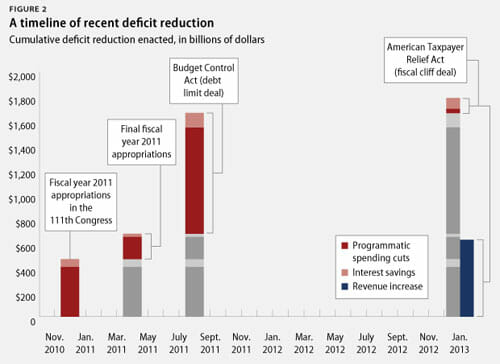
Kevin Drum is claiming that the government has already done much fine work on deficit reduction, reducing spending by $1.8 trillion and increasing taxes by $600 billion.
This is fantasy, pure and simple, and perhaps why the term "reality-based community" has fallen out of favor among Progressives. There has been and will likely be no reduction in spending -- these "spending cuts" are merely reductions in spending growth rates from the Administration's initial wet dream spending proposals. I am sure the tax increases are probably real, but Obama and the Congress were already proposing to spend most of those in new stimulus and other boondoggles right in the end of year tax legislation.
The tax numbers are characteristic of the stupid budget games played by both parties. For example, the recent tax law represents a tax increase over law in place on 12/31/2012, but represents a massive tax cut vs. law set to be in place on 1/1/2013. This gives the administration cover to call it both! When it wants to portray itself as a deficit hawk, as in this case, it was a tax increase. When it wants to portray itself as being populist, it was a tax cut.
Charts like this are absolutely worthless. We will likely get deficit reduction over the next few years, but it will be entirely due to rising tax revenues from an improving economy.
And here we are back to my constant theme -- if you want to posit a trend, then show the trend.
When I was reporting on Wall Street, I used to be told with some regularity that government was needed to counteract the short-term thinking of the business sector, who never thought much beyond the next quarterly earnings report. This now seems as quaintly adorable as picture hats and daily milk deliveries. An ADHD day trader with a cocaine habit and six months to live has considerably more long-term planning skills than our current congress.
Eugene Volokh is writing about a case against an attorney who defrauded his firm. The details are not important, what caught my eye is what is highlighted below:
Once again, this case does not turn on the bare fact that Attorney Siderits wrote-down his time; this case is about Attorney Siderits abusing his write-down discretion and lying to his law partners in order to collect almost $47,000 in bonuses to which he was not entitled. Attorney Siderits cannot seriously contend that firms must have a written policy forbidding stealing and lying before a misconduct charge for one of these actions can be sustained.
That certainly makes sense, but it does not apply at the California EDD, which administers (among other things) the state unemployment insurance program. We terminated an employee for accepting money from a customer to provide a service, then pocketing the money and not providing the service. I call this "theft", and had assumed all would understand that stealing from customers is a firing offense. When California sent out its unemployment paperwork, we said this employee had been fired "for cause", which in many states means that they are ineligeable for full unemployment payments.
However, after some back and forth, I was eventually informed by the EDD that since I did not have an explicit policy in the employee manual that said "employees may not steal money from customers", then they could not recognize that she was fired for cause. Even if I had put that in the manual, it probably would not have counted because the next thing EDD asked for is something in writing proving, with the employee's signature, that she had read that passage. And from past experience with the EDD, my guess is that they likely would not have accepted firing on the first offense, but would have insisted we needed to have her steal from multiple customers, with written warnings each time, before we terminated her.
Basically, what this all means is that while the law technically says people can't be paid unemployment if fired for cause, California has made the standards of proof so absurd that this requirement is meaningless. Everyone is going to get unemployment.
As it turns out, there is a silver lining from this lack of diligence by the state. My business is seasonal and I can only offer summer work. Most of my employees are happy with this, as they like to take the winter off (many are retired). One is not supposed to collect unemployment if he or she is not actively seeking work, but my employees have discovered that California does zero dilligence to check this. So some of them lie and say they are looking for work over the winter when they are not, and collect unemployment. I know of two couples who spend their winter in Mexico but still collect their California unemployment like clockwork. Not only is California not dilligent about it, but when I tried to report someone I knew who was collecting unemployment but not even in the country, I was threatened by the EDD official that I was risking substantial personal liability by submitting such a claim and opening my self up to civil suits and even prosecution for harassing the worker. So of course I dropped it.
So what is the silver lining? California is so eager to hand money in the off-season to support my employees' seasonal vacations that my unemployment insurance premium rate is already the worst possible. My rates can't go any higher. So if they insist on giving state money to a thief, it's not coming out of my pocket.
Hardcore Keynesian theory says that even paying someone to dig a hole one day and fill it in the next is stimulative. This has always seemed insane to me -- how could it possibly be a net gain in growth and wealth to shift resources from productive activities to unproductive ones? But in line with this theory, the Keynesians in the Obama Administration have hit on the perfect stimulus:
A cargo train filled with biofuels crossed the border between the US and Canada 24 times between the 15th of June and the 28th of June 2010; not once did it unload its cargo, yet it still earned millions of dollars... The companies “made several million dollars importing and exporting the fuel to exploit a loophole in a U.S. green energy program.” Each time the loaded train crossed the border the cargo earned its owner a certain amount of Renewable Identification Numbers (RINs), which were awarded by the US EPA to “promote and track production and importation of renewable fuels such as ethanol and biodiesel.”
What I will say is that folks who have enthusiastically supported the war should understand that the war is going to have the following consequences:
In 2009 we will have a Democratic Congress and President for the first time since 1994.
The next President will use the deficits from the $1.3 trillion in Iraq war spending to justify a lot of new taxes
These new taxes, once the war spending is over, will not be used for deficit reduction but for new programs that, once established, will be nearly impossible to eliminate
No matter what the next president promises to the electorate, they are not going to reverse precedents for presidential power and secrecy that GWB has established. Politicians never give up power voluntarily. [if the next president is Hillary, she is likely to push the envelope even further]. Republicans are not going to like these things as much when someone of the other party is using them.
1. The prediction was 100% correct, and in fact even went further as the donkeys gained a filibuster-proof majority in the Senate, at least for a year. Though the war likely had little to do with the outcome, which was driven more by the economy
2. Dead-on. Five years later Obama still blames the deficit on Bush. This is no longer true -- Obama has contributed far, far more than Bush to the deficit -- but the Republicans' fiscal irresponsibility during their tenure have robbed them of any credibility in criticizing Obama
3. Mostly true (and usually a safe bet with government). Tax increases were deferred for four years due to an economy I had not foreseen would be so bad, but they are coming. At the time, it seemed logical to blame a lot of the deficit issues on war spending. Today, though, 1.3 trillion is barely 8% of the debt and is almost trivial to more recent money wasting activities.
4. Absolutely true. In spades. The only thing I missed was I thought Obama might be less likely to go overboard with the whole executive authority and secrecy thing than Hillary, but boy was I wrong. Obama has absolutely embraced the imperial presidency in a way that might have made Dick Cheney blush. Accelerated drone war, constant ducking of FOIA and transparency, increased use of treason laws to prosecute whistle blowers, claiming of power to assassinate Americans on the President's say-so, accelerated warrant-less wiretapping, using executive orders to end-run Congress, etc. etc. And I never guessed how much the media which so frequently criticized Bush for any expansions in these areas would roll over and accept such activity from a President of their party.
As I understand it, the justifications for strong and detailed government oversight of commerce rests on two ideas:
That government officials somehow have better incentives than private actors and are more likely to act in the interests of the general public
That a few carefully selected smart people standing on top of the system managing top down can impose better structural solutions for markets than will emerge organically.
Readers will know in advance that I think both of these statements are total crap, but I don't need to explain the reasons yet again because Democrats in the House of Representatives just created the most clear refutation possible by making Maxine Waters the ranking Democrat on the House Financial Services committee (which has oversight for the most regulated industry in this country).
Ms. Waters fails both these tests. She has a history of putting her own financial interests ahead of her oversight mission, and as far as the smart person standing at the top model, she has time and again demonstrated her complete lack of understanding of the very industry she regulates (well, either that or her entire career in Congress has actually been an elaborate bit of Dada-ist performance art).
Although a monarchy, Kuwait has an elected parliament and a generally free media. It regularly invites foreign analysts and journalists to observe its elections. I am making my second trip this year.
Tremors from the Arab Spring are being felt here. The parliament elected in 2009 faced charges of corruption and lost popularity, and was dissolved at the beginning of the year. Elections were held in February.
All very democratic.
The new legislature was dominated by anti-government activists and, more important, Islamists. Top of the latter’s agenda was making Sharia the basis of all laws, imposing the death penalty for blasphemy, and closing Christian churches. Not very good for liberty.
The Kuwaiti emir, Sheikh Sabah al-Ahmad al-Sabah, said no to all three. Liberty was protected only because Kuwait was not a genuine parliamentary system where elections determine the government.
Please, do not over-interpret my point here. I am well aware that the Emir in Kuwait holds a number of illiberal views with which I would disagree. But its an interesting example none-the-less.
I have already written that the supposed European austerity (e.g. in the UK) is no such thing, and "austerity" in these cases is being used to describe what is merely a slowing in spending growth.
Apparently the same Newspeak is being applied to spending cuts in the US. How else can one match this data:
"If we're going to raise revenues that are sufficient to balance with the very tough cuts that we've already made and the further reforms in entitlements that I’m prepared to make, then we’re going to have to see the rates on the top two percent go up"
Seriously? The only small reductions in the budget were because some supposedly one-time expenses (like TARP bailouts, war costs, and stimulus spending) were not repeated. Allowing one-time costs to be, uh, one-time does not constitute "tough cuts."
Tough cuts are when we knock government spending back down to 19-20 percent of GDP. Clinton level spending in exchange for Clinton tax rates. That's my proposed deal.
Once upon a time, government officials decided it would help them keep their jobs if they could claim they had expanded the middle class. Unfortunately, none of them really understood economics or even the historical factors that led to the emergence of the middle class in the first place. But they did know two things: Middle class people tended to own their own homes, and they sent their kids to college.
So in true cargo cult fashion, they decided to increase the middle class by promoting these markers of being middle class. They threw the Federal government strongly behind promoting home ownership and college education. A large part of this effort entailed offering easy debt financing for housing and education. Because the whole point was to add poorer people to the middle class, their was a strong push to strip away traditional underwriting criteria for these loans (e.g. down payments, credit history, actual income to pay debt, etc.)
We know what happened in the housing market. The government promoted home ownership with easy loans, and made these loans a favorite investment by giving them a preferential treatment in the capital requirements for banks. And then the bubble burst, with the government taking the blame for the bubble. Just kidding, the government blamed private lenders for their lax underwriting standards, conviniently forgetting that every President since Reagan had encouraged such laxity (they called it something else, like "giving access to the poor", but it means the same thing).
A similar bubble is just about to burst in the college loan market, and this time it will be much harder for the government to blame private lenders, since the government effectively nationalized the market several years ago and for years has been the source of at least 90% of all college loans. In the Wall Street Journal today, it was reported that student loans are now the largest component of consumer debt, and growing
The scary part was found by Zero Hedge in the footnotes of the report, which admit that this number is understated by as much as half, meaning the true delinquency rate of student debt may be north of 20%.
The Journal article linked above explains why this is:
Nearly all student loans—93% of them last year—are made directly by the government, which asks little or nothing about borrowers' ability to repay, or about what sort of education they intend to pursue.
President Barack Obama championed easy-to-get loans during the campaign, calling higher education "an economic imperative in the 21st century." A spokesman for Education Secretary Arne Duncan said the goal is "to make student loans available to as many people as possible," and requiring minimum credit scores would block many Americans
Any of this sound familiar? I seldom learn much from anecdotes in new stories since it is too easy to craft a stirring anecdote on either side of just about any issue. But I was amazed at the story of the woman who was issued $184,500 in student debt to send her son to college when her entire income is a $1600 a month disability check.
I go nuts when I see a bad process. It bothers me so much I had to stop going to the local bagel outlet because their process behind the counter was so frustratingly awful it made my teeth hurt (take order here, walk all the way to other end to get bagel, walk all the way back to toaster, then cross back over to get spread, all while nobody is able to pay because the only cashier also seems to be the only one assigned to fulfilling complicated coffee orders).
Because of this, going through TSA screening makes me completely nuts. Screening is a classic assembly line process with steps that include putting shoes in bin, putting toiletries in bin, putting laptop in bin, shoving bin through x-ray, walking through scanner, retrieving items from x-ray, putting on shoes, putting items back in luggage, stacking bins and returning them to the front. In many airports, I have observed that the long lines for screening are due to a simple bottleneck that could easily be removed if anyone in the TSA actually cared about service performance.
For example, I was in the San Jose airport the other day. They had a really large area in front of the scanners with really long tables leading to the x-ray. I thought to myself that this was smart - give people plenty of time in the line to be organizing their stuff into bins so one of the key potential bottlenecks, the x-ray machine, is always fed with items and is never waiting.
But then I got to the end of the process. The landing area for stuff out of the x-ray was incredibly short. When just one person tries to put their shoes on while their bag was still on the line, the whole x-ray conveyor gets jammed. In fact, when I was there, the x-ray guy had to sit and wait for long periods of time for the discharge end to clear, so he could x-ray more bags. One might have blamed this on clueless passengers who held up the line trying to put on shoes when they should step out of line and find a bench, but there were just two tiny benches for five screening lines. The only place to get your stuff organized and get dressed was at the discharge of the x-ray, guaranteeing the x-ray gets held up constantly.
I can almost picture what happened here, but since I don't fly to San Jose much I haven't observed it over time. But I bet some well-meaning but clueless person thought he saw a bottleneck in the entry to the x-ray, shifted everything to dedicate a ton of space to the entry, and thus created an enormous new bottleneck at the back end. This kind of thing is stupid. We are, what, 11 years into this screening? Can you imagine Texas Instruments tolerating such a mess on their calculator assembly line for 11 years?
I know what you are thinking -- in this post title Coyote has engaged in some exaggeration to get our attention. But I haven't! Felix Salmon actually says this, in reaction to a group of CEO's who wrote an open letter to the feds seeking less deficit spending.
There are lots of serious threats out there to the economic well-being and security of the United States, and the national debt is simply not one of them. Nor is it growing. The chart on the right, from Rex Nutting, shows what’s actually going on: total US debt to GDP was rising alarmingly until the crisis, but it has been falling impressively since then. In fact, this is the first time in over half a century that US debt to GDP has been going down rather than up.
So when the CEOs talk about “our growing debt”, what they mean is just the debt owed by the Federal government. And when the Federal government borrows money, that doesn’t even come close to making up for the fact that the CEOs themselves are not borrowing money.
Money is cheaper now than it has been in living memory: the markets are telling corporate America that they are more than willing to fund investments at unbelievably low rates. And yet the CEOs are saying no. That’s a serious threat to the economic well-being of the United States: it’s companies are refusing to invest for the future, even when the markets are begging them to.
Instead, the CEOs come out and start criticizing the Federal government for stepping in and filling the gap. If it wasn’t for the Federal deficit, the debt-to-GDP chart would be declining even more precipitously, and the economy would be a disaster. Deleveraging is a painful process, and the Federal government is — rightly — easing that pain right now. And this is the gratitude it gets in return!
I seldom do this, but let's take this apart paragraph by paragraph:
There are lots of serious threats out there to the economic well-being and security of the United States, and the national debt is simply not one of them. Nor is it growing. The chart on the right, from Rex Nutting, shows what’s actually going on: total US debt to GDP was rising alarmingly until the crisis, but it has been falling impressively since then. In fact, this is the first time in over half a century that US debt to GDP has been going down rather than up.
So when the CEOs talk about “our growing debt”, what they mean is just the debt owed by the Federal government.
Duh. Of course they are talking about the government deficit and not total deficit. But he is setting up the game he is going to play throughout the piece, switching back and forth between government debt and total debt like a magician moving a pea between two thimbles. We can already see the game. "Look folks debt is not a threat, it is going down", but it is going down only at this total public and private debt number. The letter from the CEO's made the specific argument that rising government debt creates current and future issues (see: Europe). Just because all debt may be going down does not mean that the rise of one subset of debt is not an issue.
Here are two analogies. First, consider a neighborhood where most all the residents are paying down their credit card debt except for Fred, who is maxing out his credit cards and has just taken out a third mortgage. The total debt for your whole neighborhood is going down, but that does not mean that Fred is not in serious trouble.
Or on a larger scale, take consumer debt. Most categories of consumer debt are falling in the US. But student debt is rising alarmingly. Just because total consumer debt may be falling doesn't change the fact that rising student debt is a serious threat to the well-being of a subset of Americans.
And when the Federal government borrows money, that doesn’t even come close to making up for the fact that the CEOs themselves are not borrowing money
What?? Whoever said that the role of the Federal government is to offset changes in corporate borrowing? In his first paragraph, he already called the rise in total debt "alarming", and I get the sense that both CEO's and consumers agree and so they have been trying to reduce their debts. So why should the Feds be standing athwart the private unwinding of an "alarming" problem? And how does he know CEO's and their corporations are part of this deleveraging? I see no evidence presented. Corporate debt is but a small part of total US debt. Corporations may be a part of this, or not.
In fact, they are not. Corporate borrowing in the securities market has increased almost every quarter since 2008, such that total corporate bond debt is about 10-15% higher than in 2008 (see third chart here). And here is total debt to GDP broken down by component (this is for non-financial sectors) source.
Government debt is basically offsetting the consumer deleveraging. Since consumers have to eventually pay this government debt off, as they are taxpayers too, then the government is basically flipping consumers the bird, forcing them to take on debt they are trying to get rid of. Hard working consumers think they are making progress paying off debt, but the joke is on them - the feds have taken the debt on for them, and the bill will be coming in future taxes for them and their kids.
He might argue, "this is Keynesianism." But is it? If corporations are actually deleveraging, we still don't know how. Is it through diverting capital investment to debt repayment (as I think Salmon is assuming) or are they raising capital from other sources and rejiggering the right side of their balance sheets? And even if this deleveraging is coming at the expense of corporate investment, I thought Keynesians virtually ignored investment or "I" in their calculations (you remember, don't you, from macro: C+I+G+X-M?). In fact, if I remember right, "I" is treated as an exogenous variable in the famous multiplier "proof".
Money is cheaper now than it has been in living memory: the markets are telling corporate America that they are more than willing to fund investments at unbelievably low rates. And yet the CEOs are saying no. That’s a serious threat to the economic well-being of the United States: it’s companies are refusing to invest for the future, even when the markets are begging them to.
This is the real howler -- that "markets" are sending a low-interest signal. Markets are doing nothing of the sort. The Federal Government, via the Fed, is sending this signal with near-zero overnight borrowing rates and $30-$40 billion a month in money printing that is used to buy up government debt from the market. If any signal is being sent at all, it is that the Federal Government is main economic priority is continuing to prop up the balance sheet and profitability of major US banks.
Investment is also not solely driven by the price of funds. There must be opportunities where businesses see returns that justify the spending. Unlike the Federal government, which is A-OK blowing billions on companies like Solyndra, businesses don't invest for the sake of spending, they invest for returns. A soft economy combined with enormous government driven uncertainties (e.g. what will be our costs to comply with Obamacare) are more likely to affect investment levels than changes in interest rates.
Instead, the CEOs come out and start criticizing the Federal government for stepping in and filling the gap. If it wasn’t for the Federal deficit, the debt-to-GDP chart would be declining even more precipitously, and the economy would be a disaster. Deleveraging is a painful process, and the Federal government is — rightly — easing that pain right now. And this is the gratitude it gets in return!
This is where economic thinking has ended up in 2012: To Salmon, it does not matter where the Federal government spends this money, so long as it is spent. He never even tries to justify that the government is running up debt in a good cause, because what it spends money on does not matter to him. For him, the worst possible thing for the economy is for people to spend their money paying down debt. Spend it on more drone strikes or more Solyndras or more squirrel research -- it does not matter to Salmon as long as the money is used for anything other than to pay down debt.
Here is the bottom line: Businesses and individuals are trying to reduce their debt. And many hard-working people think they are being successful at this. But the joke is on them. The government is running up trillions in debt in their name, thwarting American's desire to de-leverage. Mr. Salmon wants us to thank the government for this. Hah.
All-in-all, this is an awful argument to try to justify Congressional and Presidential fecklessness vis a vis the budget.
Glenn Greenwald has shown an admirable willingness to call out "his guy" to frequently criticize Obama's claim to be able to order Americans killed at his say-so, "without a whiff of due process, transparency or oversight". In a recent article, he is flabbergasted that Congresswoman Debbie Wasserman Schulz, who is also head of the DNC, does not seem to have heard of the policy.
I am less surprised than he at the ignorance and mendacity of politicians. But I did like the question Wasserman Schulz was asked: did she trust Romney (ie her political bête noire) with such power. This is a question that everyone should always ask at proposed expansions of government, and particularly Executive, power. Choose the politician you least trust and/or disagree with the most. Are you comfortable giving this power to that person?
So many of the Left (Greenwald being one of the few exceptions) have ignored this story, I think because they trust Obama. Fine, but are you really going to trust the next guy in power? Because now that you have established that this power is A-OK with a Democrat-Progressive child of the sixties, it is highly unlikely the next Republican in office is going to eschew it. Wouldn't folks have been a bit more careful about giving this a pass had George Bush claimed the power. (There is a sort of domestic policy parallel in this, in Republicans rolling over for Medicare part D when Bush was in office when they never would have done so for Clinton).
For this calculation, actuaries assume a rate of return on all the money invested. The assumed rate of return, or “discount rate”, makes a big difference in how big current liabilities might be. For example, if you invested enough now to pay back a $100 debt in 10 years and you expected a rate of return of 5 percent each year, you would need to invest $61.39. But, if you expected an 8 percent return each year, you would only need to invest $46.32 today.
Arizona’s government pension funds use a discount rate of either 8 or 8.25 percent, considerably higher than the 5 percent they have actually earned over the last decade. Consequently, while Arizona’s unfunded pension liabilities are officially $16 billion, a huge sum, the unfunded liabilities using the actual rate of return of 5 percent are more like $37 billion. That’s $5,800 for every man, woman, and child in the state.
Administrative bloat is a natural tendency of organizations. I am not entirely sure why, though I understand some of the drivers. Never-the-less, I have seen it in nearly every organization I have worked in or consulted for.
Even the best-run private companies still have this problem. To remain competitive, then, they have to come through every few years and wield the ax on these growing staffs, almost like trimming back a hedge that keeps trying to overgrow your house. I spent a depressing amount of time as a consultant helping them. It is uncomfortable, sometimes heartbreaking work, and one wonders the whole time why there is not some better way to keep staff in check. To my mind, there is a still a great academic work to be written on this topic some day.
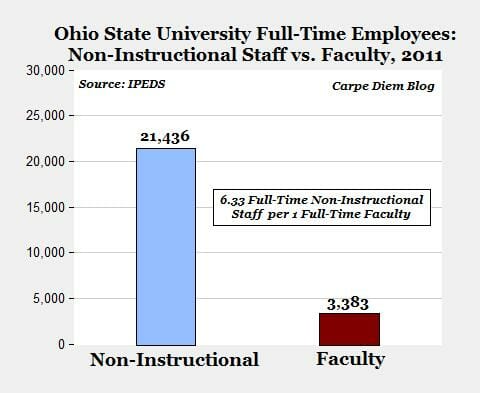
The alternative, in organizations that can get away with it, is administrative bloat. Like, for example, in this public institution:
That staff adds up to an incredible billion dollars in administrative salaries, or nearly $21,000 a year per full-time student. And remember, if this is just salaries, the actual cost is much higher because they all need offices, supplies, travel, etc.




 There are lots of serious threats out there to the economic well-being and security of the United States, and the national debt is simply not one of them. Nor is it growing. The chart on the right, from