Archive for the ‘Government’ Category.

The Problem with Infrastructure

Obama, accompanied by the usual chorus on the Left including Kevin Drum, is yet again trumpeting infrastructure spending as a partial economic solution for what ails us, in part based on a McKinsey Global Institute report.   Infrastructure is like education (the other half of the Obama "plan") -- it's hard to find anyone against it per se, it is easy to find examples of it failing, and it is really hard to craft programs at the Federal level that really improve anything.

Having been inside the McKinsey sausage factor for five years, I was loath to just accept their conclusion without seeing the data, so I read the section of the report on infrastructure.  Having read the report, I still don't see how they got to the under-funding number.  Some of the evidence is laughably biased, such as pronouncements from the American Society of Civil Engineers, who clearly would be thrilled with more government infrastructure spending.  The rest comes from something called the world economic forum, but I simply don't have the energy right now to follow the pea any further.

I had two reactions to this plan:

  1. Presumably what infrastructure projects we choose matters, so how can we have any confidence (given things like our green energy investment program) that these investments will be chosen wisely and not based on political expediency?
  2. From my experience, and also from the McKinsey numbers, most of the infrastructure needs are refurbishment and replacement of existing infrastructure, rather than new infrastructure.  But politicians are typically loath to make these kind of investments, preferring to offer new toys to voters rather than saying all that money was spent just to keep their existing toys.  Just look at the DC metro system, which is still pursuing expensive expansion plans at the same time it refuses to perform capital maintenance and replacement on its current crumbling infrastructure.  Or look at Detroit which is falling apart but still wants to spend $400 million on a new hockey rink.

I was pleasantly surprised that McKinsey actually raised both of these issues as critical.  To the point about project selection:

To effectively deploy additional investment in infrastructure, the United States will have to improve its performance on project election, timely delivery and execution, and maintenance and renewal. This could raise the overall productivity of US infrastructure by as much as 40 percent and generate more economic impact for every dollar spent. And there is added pressure to raise infrastructure productivity today: as commodity prices rise, input costs are going up as well. In extreme circumstances, this can even lead to spot shortages of asphalt and other critical materials, making productive use of such assets even more important.

One of the most effective ways to make infrastructure investment more productive is to choose the right mix of projects from the outset. Too often, the primary approval criteria for project selection in the United States are political support and visibility rather than comprehensive cost-benefit analysis.129 Even when economic analysis is used, it is not always rigorous, or it may be disregarded in actual decision making. When state and local governments choose sub-optimal projects, the cost of financing rises, so focusing on those projects with the clearest returns is a crucial part of taking a more cost-effective approach for the nation as a whole.

In addition, planners at all levels of US government tend to have a bias toward addressing congestion and bottlenecks by building new capacity. But rather than immediately jumping to build new infrastructure projects to solve problems,
planners and project sponsors might first consider refurbishing existing assets or using technology to get more out of them. (See “Better maintenance, optimization, and demand management can extend the life of existing infrastructure assets” later in this chapter.)

The McKinsey study is not arguing for Keynesian digging holes and filling them in again.   They are arguing for infrastructure spending but only if it is better targeted than such programs have been in the past.   Anything about this Administration (or any other Administration, really) that gives you confidence this will happen?

In fact, they argue that a large reason for under-developed infrastructure is not the spending level per se but the insanely inefficient way in which government spends the money

Delays and cost overruns are a familiar refrain in infrastructure projects. Boston’s Big Dig, for example, remains the costliest highway project in US history and was plagued by years of delay and shoddy construction. Originally estimated at $2.6 billion, it now has a final price tag estimated by the Massachusetts Department of Transportation at $24.3 billion, including interest on borrowing. More recently, the San Francisco–Oakland Bay Bridge is being completed almost a decade late, and its original budget of $1.3 billion has grown to more than $6 billion.

Finally, their recommendation focuses more on maintenance and the prosaic, rather than expensive sexy headline grabbing investments (cough California high speed rail cough) that politicians prefer

Another major strategy for increasing infrastructure productivity involves maximizing the life span and capacity of existing assets. In many cases, directing more resources to these areas may be a more cost-effective choice for policy makers than new build-outs.

First, there is a need to focus more attention on maintenance, refurbishment, and renewal. This is an increasingly urgent issue for the nation’s aging water infrastructure, much of which was built in the years immediately after World War II; some of the nation’s oldest pipe systems are now more than a century old. Even more recent water treatment plants will need refurbishment: many built in the
1970s after passage of the Clean Water Act will soon require rehabilitation or replacement. Proactive maintenance to upgrade and extend the life of these aging systems is becoming a more urgent priority.

The study uses a GDP multiplier of 1.77 for infrastructure spending, which explains why their claimed GDP impacts are so high.  Using this kind of chicked-in-every-pot high multiplier will of course make infrastructure spending seem like a no-brainer.  Of course those of us with more sympathy towards Austrian economics, wherein recessions are caused by misallocations of capital, will worry that this kind of government spending program, shifting private resources to public decision makers to spend, will only double down on the same crap that caused the recession in the first place.  I grew up with Japan's MITI being praised as a model by the American Left, watched the lost decades that followed this government-directed investment program, and believe that a similar reckoning is coming in China.

Government "Investment" Of the Day

Over the course of Lance Armstrong's career, the US Postal Service paid him over $40 million in sponsorship money (at least according to the radio report I heard this morning).

I don't necessarily begrudge advertising -- the USPS was nominally acting as a business enterprise, and businesses advertise to promote their services.

But I do find this expenditure odd in the extreme for a couple of reasons.

  • First, sponsorship money of this sort generally can only build name recognition.  Paying to name a ballpark "Chase Field" builds name recognition for Chase, but by necessity does not communicate anything else about its services or value proposition.  The same is true for putting one's name on Lance Armstrong's jersey.  Does the US Post Officer really need name recognition?  Are there people wandering around unaware of the US mail?  I could understand advertising such as "this is why our express mail is better than Fedex" or "you should send a real paper thank you note and not just an email to really thank someone."  But name recognition for the USPS?  "Oh, so that is what that funny box in front of my house is...."
  • Second, to the extent one did indeed feel the need to build name recognition, why in the hell would one do it in a sport primarily competed and followed in Europe?  This seems an odd strategy for a service that is essentially limited by statute to US operations.

The only thing I can guess is that someone in the USPS decided, "Hey, everyone hates us.  Let's sponsor someone (preferably in a tangential sport that we could actually afford) who is beloved so some of those positive feelings might transfer to us."   That worked out well, huh?

New Emergency Broadcast Texts

Don't know if you have seen these, but many cellular networks activated the capability to broadcast government "emergency" messages in the last week.  Mine has gone off twice in 3 days.  I get a tone like the old emergency broadcast network test on the radio and then a text like this one.  Not sure why dust storms that are routine features of summer here in Phoenix warrant having the NWS spam my phone, but there it is.  Tornado and tsunami warnings certainly make sense.  Wonder when the first conspiracy theory / scandal hits, such as the election day alert that warns people to avoid travel.

photo (2)


PS, gotta love "til" rather than "until".   Can't wait for the "Tornado Warning - FML" message.

On Crazy Government Requests and Subsidizing Economists

There is some chance this may be apocryphal (I don't see any evidence the reporters confirmed this with the FDA), but as someone who has had government inspectors show up on our property demanding to see our license to sell eggs, it wouldn't surprise me if true.  I am bombarded with government insanity of this genre every day.

Apparently, a children's magician who was forced to obtain a government license for his stage rabbit is claiming

My USDA rabbit license requirement has taken another ridiculous twist. I just received an 8 page letter from the USDA, telling me that by July 29 I need to have in place a written disaster plan, detailing all the steps I would take to help get my rabbit through a disaster, such as a tornado, fire, flood, etc. They not only want to know how I will protect my rabbit during a disaster, but also what I will do after the disaster, to make sure my rabbit gets cared for properly.  I am not kidding–before the end of July I need to have this written rabbit disaster plan in place, or I am breaking the law.

The bizarre government requests like this one at least give us a laugh around here.  Less funny are the zillions of other pieces of waste paper that must be supplied to various agencies every month -- for example the 9 different permits which took 3 years to accumulate from Ventura County just to remove a dangerous and rotting deck  (not coincidentally, we are closing all our business in Ventura County at the end of this year).  Just in the last several days the Department of Labor asked for new, more onerous monthly reporting of headcounts and payroll by state (I declined) and the census bureau asked for quarterly rather than annual detailed reports of our lodging business (I declined).

One piece of advice I would give to harried small business people is to say "no" as often as possible to these data requests.  Obviously, you will need to turn in your monthly sales tax reports or you will be going to jail, but do you really need to feed the census?  The department of Commerce?  The Department of Agriculture?  The Labor Department?  Much of this data they gather is used either 1) to craft regulations that will just make your life as a business owner harder in the future or 2) to subsidize academics and economists in the form of free data.  As I told the Labor Department the other day, I am happy to fill out their survey if they want to pay me, say, $100 a month to compensate me for my time.  Otherwise they are just stealing free labor and proprietary data from me to help some grad student write her PHD or help some Wall Street hedge fund manager better call the market.

National Adolescence

I have been toying with a concept I am calling national adolescence.  My emerging theory is that civilizations go through phases much like that of a human male, and the most dangerous to all around it is adolescence.  Adolescent males can do crazy, unproductive things to show off, to count coup, to bolster their ego and perceived status.  They are more prone to being violent and dangerous, to pick stupid fights to prove their alpha-maleness rather than to achieve rational goals.

Nations often go through an adolescent phase.  Sometimes it can last for decades or centuries.  Two symptoms of this phase are 1) Imperialism and over-readiness to fight and 2) monument-building and other such show-offery.

I have written a number of times about monument building, for example here.  We see it in countries trying to build record-tall buildings -- note who is doing it, they are always the nouveau riche (e.g. Dubai).  We see it in cities wanting to have light rail systems in order to be considered a real city (ie as a status project).  We see it in every Thomas Friedman column about China doing big things while we are not.  And we see it now in the fear that somehow having China sending men into space 50 years after the US and USSR did so somehow is a marker in the decline and fall of the US.

I don't buy it.  What you are seeing, what Thomas Friedman is seeing, is adolescence.  We may regret lacking as much youthful vitality, but we should not aspire to the adolescent's poor judgement.  Our sixties space program went exactly nowhere, except to let us count coup on the rest of the world and cement our status.  The Chines space program as currently configured will achieve nothing more.

PS-  The Egyptians may be a good example.  All the great Pyramids were built when the Egyptian civilization was really young.  There are a variety of reasons why pyramid building ended, but surely a maturing confidence in their civilization's greatness must be one.

Power Without Accountability Will Be Abused

President Obama argued that he should be trusted with the (in the US at least) nearly unprecedented power to order anyone he wants killed -- military or civilian, American or foreign-born -- sending a drone after them.  He claimed to have this really detailed and careful process -- heck, they even had a spreadsheet.

Most of us expressed skepticism, and several folks in the know have expressed fear that, as with most such powers, its use has been creeping from an extraordinary measure against uniquely qualified targets to an almost casual use against rank and file targets.  Turns out this fear was justified:

The CIA did not always know who it was targeting and killing in drone strikes in Pakistan over a 14-month period, an NBC News review of classified intelligence reports shows.

About one of every four of those killed by drones in Pakistan between Sept. 3, 2010, and Oct. 30, 2011, were classified as "other militants,” the documents detail. The “other militants” label was used when the CIA could not determine the affiliation of those killed, prompting questions about how the agency could conclude they were a threat to U.S. national security.

The uncertainty appears to arise from the use of so-called “signature” strikes to eliminate suspected terrorists -- picking targets based in part on their behavior and associates. A former White House official said the U.S. sometimes executes people based on “circumstantial evidence.”

Not sure this even requires further comment.

Three Cheers For Goldwater Institute Fighting Pension Spiking

The Goldwater Institute is threatening to sue the City of Phoenix in order to stop pension spiking.  According to the Arizona Republic,

State law says “unused sick leave, payment in lieu of vacation, payment for unused compensatory time or payment for any fringe benefits” cannot be used as compensation to compute retirement benefits.

State law also says that only “base salary, overtime pay, shift differential pay, military differential wage pay, compensatory time used by an employee in lieu of overtime not otherwise paid by an employer and holiday pay” may be used to calculate pension benefits.

This seems pretty explicit.  The City admits to using sick leave, vacation pay, and fringe benefit values (e.g. cars and cell phones) in the pension calculation.  So this seems pretty cut and dried.  The city is breaking the explicit letter of the law.

That Goldwater has a good case can be judged from the fairly lame defenses of Phoenix practices by local unions.  None seem to address the basic legal issue, but instead accuse Goldwater of "wasting taxpayer funds if it forced Phoenix to defend itself in court", a fairly hilarious attempt to claim the moral high ground of fiscal responsibility.

In fact, it appears that public workers believe  (and I think this is a fairly common belief) that their collective bargaining agreements trump state law.

John Teffy, a Phoenix Fire Department captain, said Goldwater should stand down.

“It seems to me that if the Goldwater Institute took the time to understand how the city works and how contracts work, they would know there is a much simpler way to address this than with (threats of) frivolous lawsuits,” Teffy said.

I did not understand this statement at first, but what I think he is saying is that since the "Contract" in his mind supersedes all laws, then the way to deal with this is through a contract renegotiation.  I think public workers see the writing on the wall and know that pension spiking is illegal, so they are hoping to handle this through a contract negotiation that just shifts this lost spiked value to workers in some other more legal form.  A great strategy for them, but a terrible one for taxpayers, who should not have to pay for the union's past illegality.

Privatization and Private vs. Public Profits

My new column is up at Forbes.com.  A sample:

The most frequent argument I hear is that "its wrong to make a profit on public lands."  Most recently, I heard this from a manager of a large campground and lakefront day use area who works for a federal agency.  I was not normally in my usual diplomatic mood, and I snapped "so you work for free?"

If my company operated that park for the federal agency, a park that nets about $300,000 a year in visitor revenue, my company would probably make $15,000 or $20,000 a year in profit doing so, if all goes well, which it seldom does (this is a very low margin business).  I have no idea what that park manager makes in salary and benefits, but I would be surprised if it were less than $55,000 plus benefits, and probably more.  Why is his $55,000  "clean" but my $15,000 for the same task "dirty"?  Particularly when the increase in his and his staff's salaries and their increases in benefits has left the park financially tottering and on the brink of closure?

Go read it all.

Update:  I have added some comments on privatization design on the Privatization blog

Reject These Voices....

image001

via a reader.


Wherein I Tell The Census Bureau to Take a Leap

Every year I am required by law to fill out what is called the "Accommodation Report" by the Census Bureau.  As a lodging company (we run campgrounds) I must reveal my revenues and some of my expenses.  They ask for numbers aggregated differently from how we collect them for GAAP, so it is not a simple exercise.  But I do it under protest, even though several of my competitors do not seem to be similarly punished with this requirement.

Well, I don't actually fully comply.  We run over 150 small locations, and technically I am supposed to fill out an 8-page accommodation survey for every one of them.  This would take a week of my time.  So I pretend I have only one campground and report my summary revenue numbers for all our campgrounds as if they were for one location.   Also, a year ago the Census folks began demanding the data quarterly, and I told them to pound sand, that I was on the verge of not doing the annual report and so I definitely was not going to do all that work quarterly.

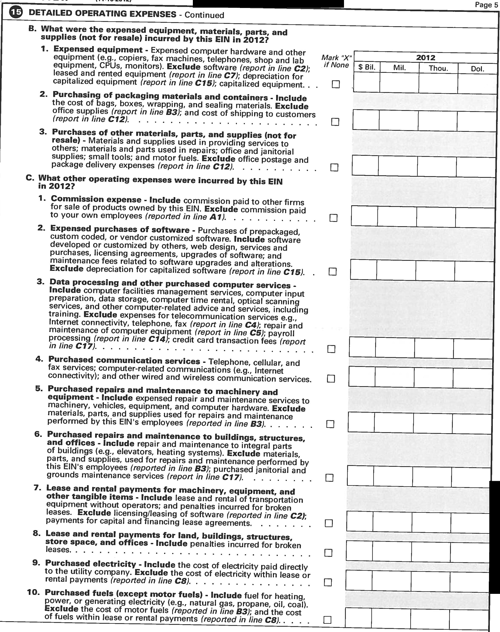
Well, this year it got worse.  For some reason, the survey this year had 3 extra pages asking me to break down my expenses in detail, in many categories that do not match those that I use in my bookkeeping.  Here is an example page:


First, not only do I not have time to figure this out (who tracks software purchases as its own item in the accounting system?), but it is not the government's business, particularly given that I am a private company.  Even the IRS is not this intrusive.

Further, at best the data I report will be used for nothing.  More likely, it will be used to justify new taxes on me, new regulations on me, or new subsidies for my competitors.  I have no desire to aid any of these activities.

Postscript:  And you know what I have zero patience with? -- otherwise free market academic economists who support this kind of data gathering because it is critical.  Yes, I am sure they much prefer to get free statistics for their work gathered via government coercion  rather than have to pay for it, as one would have to do if we relied on private companies to gather this data rather than the government.  There is absolutely no difference between an economist supporting government statistics gathering and any other company or individual asking that the government subsidize their inputs.  But, but, we are critical to the country!  Yeah, the sugar industry says the same thing.

Social Security Worse Than Even the Most Corrupt Private Funds

Kevin Drum and Matt Yglesias think that 401-K's are a total ripoff.

After the new fee disclosure statements went out, roughly the same percentage—half!—of participants said that they still do not know how much they pay in plan annual fees and expenses, according to a recent survey by LIMRA, an association of insurance and financial services organizations.

....For those 401(k) participants who said they thought they knew how much they paid in fees, most of them were way off base. One out of four participants thought they paid 25% or more in fees, 16% thought they paid between 10% to 24% in fees, and 30% thought they paid between 2% and 9% in fees. Only 28% of participants thought their fees were less than 2%.

That group is the closest to reality. On average fees and expenses range between 1 to 2 percent, depending on the size of the plan (how many employees are covered) and the employees’ allocation choices (index funds versus actively managed funds), says LIMRA.

First, this is bizarre, as the indictment here of private fund management seems to be that people are *gasp* paying fees that are much lower than they think they are.   Also, it may well be that these people are not mistaken, but just using a different mental definition for fee percentage.  After all, why is total assets necessarily the best denominator for this calculation?  Obviously the fund industry likes it that way because it gives the lowest number, but it could be that people are thinking about annual fees as a percentage of the annual income.  Thus a fee of 1-2% of assets could well be 25% of annual income.  Hell, since I invest for income growth, I could argue that this is a MORE rational way to think about fees.  Obviously Drum and Yglesias are just captive mouthpieces of big Mutual Fund.

Second, and perhaps more importantly -- do you know what retirement fund has higher implicit fees and a lower lifetime total return than nearly any private fund in existence?   Social Security.  Read your statement you get and do the math.  You will find that the total you will likely get out will be less than you put in, even BEFORE present value effects, even if you have put money in for 30 years.  In other words, the internal rate of return on your and your employer's taxes is less than zero.

Ahh, but you say, that is because your Social Security taxes are going to subsidize people who don't work.  Fine, but then don't be surprised if there is strong support for a retirement system that does not pass the money through government hands.  Even getting a crappy rate of return from some hack investment manager is likely still better than putting your money in a government system where cash is skimmed off to feed whatever political constituency has the clout to grab it.

Postscript -- by the way, I leave aside the issue of whether it is a productive thing to tax-subsidize.  I am generally against tax preference for selected behaviors, even relatively popular  ones like savings.  But Yglesias wants to replace 401-K's with some kind of coerced government system (the note about fees above is to make the case that the average person cannot be trusted and that our masters need to do the savings for us).  Image one giant Calpers.  Ugh.

More Washington Hypocrisy

When an election was in the offing and 60 Minutes was paying attention, Congress voted a couple of years ago to finally remove the exemption that protected Congress and its staff from insider trading laws that apply to everyone else.

Now that the election is over and no one is looking, Congress has reversed itself 

So... with very little fanfare, Congress quietly rolled back a big part of the law late last week. Specifically the part that required staffers to post disclosures about their financial transactions, so that the public could make sure there was no insider trading going on. Congress tried to cover up this fairly significant change because they, themselves, claimed that it would pose a "national risk" to have this information public. A national risk to their bank accounts.

It was such a national risk that Congress did the whole thing quietly, with no debate. The bill was introduced in the Senate on Thursday and quickly voted on late that night when no one was paying attention. Friday afternoon (the best time to sneak through news), the House picked it up byunanimous consent. The House ignored its own promise to give Congress three days to read a bill before holding a vote, because this kind of thing is too important to let anyone read the bill before Congress had to pass it.

Government Agencies Run For the Benefit of Their Employees

I have written before that the single best framework for explaining the actions of most government agencies is to assume they are run for the benefit of their employees.  This certainly seems to be the case at the FAA, which can't over 10+ years complete a modernization of its computer system or match free, private Internet tools for flight tracking, but it was able to very quickly publish a web application to promote the danger of the sequester.  Public service is not even on these guys radar screens, as they have shown themselves completely willing to screw the public in a game of chicken to get more funding back for their agency

But after Mr. Coburn published his letter on his website, FAA regional employees wrote to blow the whistle on their bosses. As one email put it, "the FAA management has stated in meetings that they need to make the furloughs as hard as possible for the public so that they understand how serious it is."

Strategies include encouraging union workers to take the same furlough day to increase congestion. "I am disgusted with everything that I see since the sequester took place," another FAA employee wrote. "Whether in HQ or at the field level it is clear that our management has no intention of managing anything. The only effort that I see is geared towards generating fear and demonstrating failure." Just so.

How To Win An Argument With Those Who Already Agree, and Lose With Everyone Else

I think that I am just going to post this line from Kevin Drum largely without comment:

In particular—and please excuse the wild guess here—I imagine that most people who have a serious jones for cutting federal spending are really only interested in cutting spending on poor people. Cutting other services just isn't what they signed up for. It's the Obamaphones and the food stamps that are wasteful, not the Yellowstone snowplows and small town air traffic controllers.

One of the things I tell folks in the climate debate -- don't try to learn about the other side of the argument from yours by listening to your own folks' characterization of it, go actually listen to the other side.  This is what comes of  trying to understand people only by listening to their intellectual enemies.  It is also why I read a lot of blogs (like Drum's) with which I disagree.

Has Drum seriously not ever heard the concentrated benefits, dispersed cost argument?

This Would Never Happen Today

I love this little story of one of the richest men in the world being unable to complete a real estate parcel he wanted.  Why?  Because this would never happen today.  The owners and tenants of the small properties Rockefeller wanted to acquire actually had strong property rights in the 1930's.  Today, a rich real estate developer would just go to the city and have their property declared blighted, seized by eminent domain, and handed to them on a platter.

The Missing Warning Label

Zero Hedge pointed out this ad for California state bonds:

20130404_cali


In light of the recent Stockton bankruptcy, this should carry a warning label:  "California reserves the right to repudiate up to 100% of these bonds whenever payment of the interest or principle interferes with paying state employees the maximum possible pension benefits.  These bonds are subordinated to any promises made at any time by any politician to state employees unions, past, present, or future."

Government Prioritization Fail: Adding Staff When It Is Least Essential

Matt Welch has a good article here about a self-refuting NPR piece, which was obviously supposed to be a scare story about the loss of Sequestration money but turned out to be an illustration of just how stupid the sequestration panic was.  It's funny listening to the podcast of this episode as the NPR hosts desperately try to support the Administration position.

But one thing I thought was funny was this bit illustrating pre-sequester government staffing prioritization:

NPR's David Greene brings on Yvette Aehle, director of the Southwest Georgia Regional Airport in Albany, Georgia, to talk about the terrible danger that passengers will face now that Aehle's airport stands to lose its air traffic controllers:

AEHLE: Well, I don't really want to say anything is less safe. It's just a better opportunity for people to listen and to be heard and to understand where they are. And also, I'd like to point out that we don't have 24-hour tower coverage here currently. Those air traffic controllers are only directing traffic between 8 am to 8 pm seven days a week. And most of our heavy traffic is outside of those hours.

So the government chooses to staff the control tower only half the day.  But they choose to staff the tower during the 12 hours of lightest traffic, presumably because the employees wanted day jobs rather than night jobs.

As an aside, I will confess that my business of running public parks benefits from this.  The biggest management load on parks is obviously on weekends and in the evenings (in campgrounds).  Most employees of public agencies only work weekday days.  Its incredibly typical that public parks employees will take their vacations in July and August, by far the busiest months.  One advantage  (other than the obvious cost advantage) we have over public operations is that public agencies can't or won't ask their employees to work weekends and defer their vacations out of the summer time.  We are perfectly happy to hire people with very clear expectations that the job involves work on weekend and holidays.

I will give you my reminder of how to understand most government agencies:  Ignore the agency's stated purpose, and assume that it is being operated primarily for the benefit of its employees.  One will very often find that this simple heuristic is far better at explaining agency decisions than relying on the agency's mission statement  (this does not mean that there are not dedicated individuals in the agency truly, even selflessly, dedicated to the stated mission -- these two notions are not at all mutually exclusive.  Government agencies do not act badly because they are full of bad people, they act badly because their incentives cause good people to do stupid things).

My Retirement Rant

First, I will say that I am perfectly happy for folks who are either good earners or good savers or both and who choose to use their accumulated wealth to stop working at some age.

However, I am completely lost as to how we have somehow decided that multi-decade end-of-life paid vacations, starting as early as age 50, is somehow an inalienable right that must be guaranteed by government.  I suppose I can see a safety net for folks who, though age and disability, simply get too old to be productive (but remember that I have nearly 500 people mostly over 65 who work for me, mostly doing manual trades, so don't tell me older people can't be productive).  And that was what Social Security initially was -- the age 65 was chosen as a retirement age not because it guaranteed 10-15 years of senior leisure but because it matched the life expectancy at the time.  The equivalent age would be well into the 70's today.

Of course, others think differently.  A group is now proposing an expanded Social Security program that would guarantee nearly 100% of earnings to low-income retirees (there are smaller increases for higher income workers but most all the change is for low-income folks).

While they are proposing higher taxes to support this, my guess is that it will not be long before a wealth tax is suggested.  After all, they are hoping to replace 401K's as a savings vehicle.  If so, why not seize those funds to help pay for the plan.  The other day, Kevin Drum mocked those who fear a government seizure of 401K's as the tinfoil hat brigade.  I would be willing to bet him that within the decade, it will become a mainstream idea in the progressive community to fund shortfalls in Social Security and Medicare with a full or partial seizure of 401K's.

Arrogance and Coercion

Years ago I had an argument with my mother-in-law, who is a classic Massachusetts liberal  (by the way, we get along fine -- I have no tolerance for the notion that one can't be friends with someone who has a different set of politics).  The argument was very clarifying for me and centered around the notion of coercion.

I can't entirely remember what the argument was about, but I think it was over government-mandated retirement programs.  Should the government be forcing one to save, and if so, should the government do the investment of those savings (ie as they do in Social Security) even if this means substantially lower returns on investment?

The interesting part was we both used the word "arrogant."  I said it was arrogant for a few people in government to assume they could make better decisions for individuals.  She said it was arrogant for me to assume that all those individuals out there had the same training and capability that I had to be able to make good decisions for themselves.

And at the end of the day, that is essentially the two sides of the argument over government paternalism boiled down to its core.  I thought coercion was immoral, she thought letting unprepared people make sub-optimal decisions for themselves when other people know better is immoral.  As with most of my one on one arguments I have with people, I left it at that.  When I argue face to face with real people, I have long ago given up trying to change their minds and generally settle for being clear where our premises diverge.

I am reminded of all this reading Bruce McQuain's take on Sarah Conly's most recent attempt to justify coercive paternalism (the latter is not an unfair title I have saddled her with -- it's from her last book).  Reading this I had a couple of other specific thoughts

  1. I am amazed how much Conly and folks like her can write this stuff without addressing the fundamental contradiction at its core -- if we are so bad making decisions for ourselves, why do we think the same human beings suddenly become good at it when they join government?  She would argue, I guess, that there are a subset of super-humans who are able to do what most of us can't, but how in a democracy do we thinking-impaired people know to vote for one of the supermen?  Or if you throw our democracy, what system has ever existed that selected for leaders who make good decisions for the peasants vs., say, selected for people who were good generals. 
  2. Is there any difference between Conly's coercive paternalism and Kipling's white man's burden?  Other than the fact that the supermen and the mass of sub-optimizing schlubs are not differentiated by race?  It's fascinating to see Progressives who are traditionally energized by hatred of colonialism rejuvinating one of imperialism's core philosophical justifications.

But A Minimum Wage Hike is A-OK?

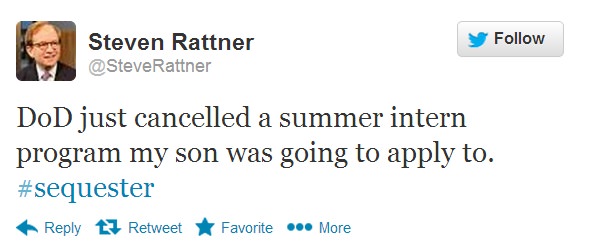
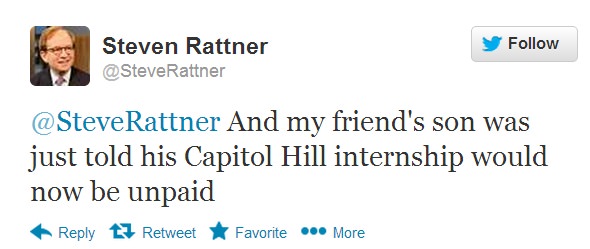
I don't know how I got onto blogging all Steven Rattner, all the time, but here I go again.  Mr. Rattner is complaining that the sequester is costing his son a chance at a government internship for which he had wanted to apply.

So perhaps Mr. Rattner's son could go work in a productive field instead?  Oops, probably not, because rising minimum wages and Obama Administration crack-downs on unpaid private internships have made it harder for all the rest of us to get our little preciouses an internship.  I will bet any amount of money that the number of internships killed by minimum wage laws is at least two orders of magnitude larger than the number of internships killed by the sequester.

And besides, we should be thrilled that  one less young person is having their formative organizational experiences (from conflict resolution to productivity expectations) in government.

Oh, and by the way, that bit about the Obama Administration cracking down on unpaid internships?  Well, that only applies to you private employers who are teaching useless skills like innovation and wealth creation.  Jobs that teach Congress's organizational and productivity secrets don't have to be paid because of all the valuable lessons taught.

Update on Steve Rattner, Friend of Investors (as long as they are rich or voted for Obama)

Last week, I noted a piece by Steve Rattner who was horrified that individual investors, empowered by companies like Kickstarter, might one day be able to invest in startups without paying a fee to Goldman Sachs.

I noted that Mr. Rattner's concern for investors seemed to be coming rather late, given that "he was the primary architect of the extra-legal screwing of GM and Chrysler secured creditors in favor of the UAW and other Obama supporters."

A Detroit News piece by my Princeton classmate Henry Payne has more:

The administration has treated obstacles to its agenda with ruthless tactics. In April 2009, that agenda was to hand an outsized, 55 percent majority interest of embattled Chrysler to the United Auto Workers in a government-orchestrated bankruptcy. But by law secured creditors are first in line in bankruptcy, and bondholders — representing their working-class pension clients — refused to accept Obama's unfair deal for a measly 29 cents on their investment dollar.

Send in the muscle.

"One of my clients was directly threatened by the White House and in essence compelled to withdraw its opposition to the deal under threat that the full force of the White House press corps would destroy its reputation if it continued to fight," said Tom Lauria, lawyer for Perella Weinberg investment firm, on Frank Beckmann's Detroit radio program. Lauria later said the brass knuckles belonged to White House Auto Task Force leader Steve Rattner. Lauria's account was disturbing, too, in revealing the confidence that the White House has in its press allies to aid Obama's agenda. Sure enough, Washington reporters quickly attacked the messenger. "(Lauria's) charge is completely untrue," White House deputy press secretary Bill Burton told ABC News' Jake Tapper, "and there's obviously no evidence to suggest that this happened in any way." Actually, there was plenty of evidence. Jim Carney of Business Insider corroborated Lauria's account, reporting that "sources familiar with the matter say that other firms felt they were threatened as well." The White House escalated the threats when Obama himself singled out creditors for obstruction, accusing them of being "speculators" preying on an American auto icon — bullying words from a man with the IRS and SEC at his disposal.

"The sources, who represent creditors to Chrysler, say they were taken aback by the hardball tactics that the Obama administration employed to cajole them into acquiescing to plans to restructure Chrysler," continued the Insider. "One person described the administration as the most shocking 'end justifies the means' group they have ever encountered."...

"The president's attempted diktat takes money from bondholders and gives it to a labor union that delivers money and votes for him," wrote Cliff Asness, a managing partner at AQR Capital Management. "Shaking down lenders for the benefit of political donors is recycled corruption and abuse of power."

Sequester Horror Story

Courtesy of a reader, what happens when the sequester cuts maintenance funding for critical infrastructure?

This is an older video that someone has re-purposed, I think, to make fun of progressives but it is funny none-the-less.  It reminds me of the movie Live Free or Die Hard, when the villain sent all of America into a panic because the government might not be immediately available to help with every little thing.

For One Brief Moment, I Thought Reason Might Enter the Discourse on Budgets

Kevin Drum quoted this from James Fallows in a post labelled "threat inflation"

As I think about it this war and others the U.S. has contemplated or entered during my conscious life, I realize how strong is the recurrent pattern of threat inflation. Exactly once in the post-WW II era has the real threat been more ominous than officially portrayed

I thought, "wow, someone from the Coke or the Pepsi party is finally going to call BS on all the apocalyptic forecasts from both parties over the sequester."  But alas, he was just discussing foreign policy.  That is not to say I don't agree with the basic point, that foreign policy prescriptions are often accompanied by exaggerated horror stories of imminent threats -- I just wish they would recognize the same dynamic on the domestic front, whenever the smallest cut in government spending growth rates suddenly mean we are are going to put grandma out on an ice flow to freeze.

The Sequester in One Chart

sequester-cut-debt


source (and don't miss the Maxine Waters classic about 150 million jobs at stake, at the link).

Via Maggies Farm

ohnoes

Sequester Fear-Mongering, State Version

The extent to which the media is aiding and abetting, with absolutely no skepticism, the sky-is-falling sequester reaction of pro-big-government forces is just sickening.  I have never seen so many absurd numbers published so credulously by so much of the media.  Reporters who are often completely unwilling to accept any complaints from corporations as valid when it comes to over-taxation or over-regulation are willing to print their sequester complaints without a whiff of challenge.  Case in point, from here in AZ.  This is a "news" article in our main Phoenix paper:

Arizona stands to lose nearly 49,200 jobs and as much as $4.9 billion in gross state product this year if deep automatic spending cuts go into effect Friday, and the bulk of the jobs and lost production would be carved from the defense industry.

Virtually all programs, training and building projects at the state’s military bases would be downgraded, weakening the armed forces’ defense capabilities, according to military spokesmen.

“It’s devastating and it’s outrageous and it’s shameful,” U.S. Sen. John McCain told about 200 people during a recent town-hall meeting in Phoenix.

“It’s disgraceful, and it’s going to happen. And it’s going to harm Arizona’s economy dramatically,” McCain said.

Estimates vary on the precise number of jobs at stake in Arizona, but there’s wide agreement that more than a year of political posturing on sequestration in Washington will leave deep economic ruts in Arizona.

Not a single person who is skeptical of these estimates is quoted in the entirety of the article.  The entire incremental cut of the sequester in discretionary spending this year is, from page 11 of the most recent CBO report, about $35 billion (larger numbers you may have seen around 70-80 billion include dollars that were going away anyway, sequester or not, which just shows the corruption of this process and the reporting on it.)

Dividing this up based on GDP, about 1/18th of this cut would apply to Arizona, giving AZ a cut in Federal spending of around $2 billion.  It takes a heroic multiplier to get from that to  $4.9 billion in GDP loss.  Its amazing to me that Republicans assume multipliers less than 1 for all government spending, except for defense (and sports stadiums) which magically take on multipliers of 2+.

Update:  I wrote the following letter to the Editor today:

I was amazed that in Paul Giblin’s February 26 article on looming sequester cuts [“Arizona Defense Industry, Bases Would Bear Brunt Of Spending Cuts”], he was able to write 38 paragraphs and yet could not find space to hear from a single person exercising even a shred of skepticism about these doom and gloom forecasts.

The sequester rhetoric that Giblin credulously parrots is part of a game that has been played for decades, with government agencies and large corporations that supply them swearing that even trivial cuts will devastate the economy.  They reinforce this sky-is-falling message by threatening to cut all the most, rather than least, visible and important tasks and programs in order to scare the public into reversing the cuts.  The ugliness of this process is made worse by the hypocrisy of Republicans, who suddenly become hard core Keynesians when it comes to spending on military.

It is a corrupt, yet predictable, game, and it is disappointing to see the ArizonaRepublic playing along so eagerly.