Archive for the ‘Government’ Category.

When You Convert the Police to Revenue Generators

When you convert the police from crime solvers to revenue generators, this is a pretty logical outcome.  Hat tip to a reader.  A man has his cars stolen, the police ticket them and tow them but refuse to return them to him.

No Wonder Police Want To Make Videotaping Them Illegal

Wow, this officer is a total loser.  Absolutely out of control.  Hand-held video recorders may well be the greatest defense yet against the over-bearing state.  No wonder many police organizations want to ban videotaping of police officers.  Sometimes I watch "The Wire" and wonder, even as a libertarian, if the government and police suckage portrayed there is exaggerated.  And then I see this ... in Baltimore now less!

Update:  The guy in the video likely supports this site.

$100 Million Incentive to Move About 1 Mile

The City of Phoenix is subsidizing a mall developer to the tune of $100 million dollars.  Why?

Desperate to keep another Nordstrom store out of Scottsdale, the City
of Phoenix put together a $100 million incentive deal to lure the
upscale retailer to the new CityNorth development.

That picture emerged in Maricopa County Superior Court arguments Monday over the constitutionality of the package.

That deal bought a parking deck -- at $30,000 per parking spot.

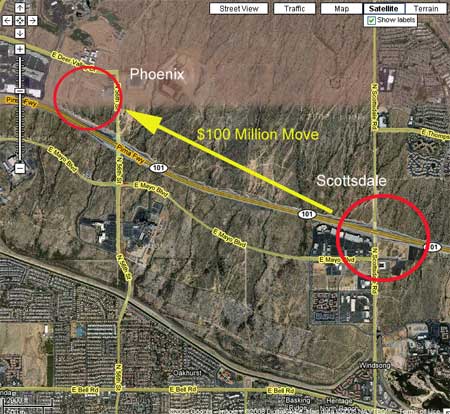
You see, the developer and its allies in city hall were afraid that Nordstrom's might instead locate their new store waaaaayyyyy over in Scottsdale, probably at the shopping development getting started ... about a mile away and all of one exit further down loop 101, as show below or here.
100milliondollarmove

Here is the gist of it:

At issue in the lawsuit is an agreement between the developers
of CityNorth and the city of Phoenix that enables the developers,
Related Urban Development and the Thomas J. Klutznick Co., to retain
half of the project's sales taxes in exchange for free public parking
spaces in a parking garage. The agreement goes for 11 years or $97.4
million, whichever occurs first.

Now, those of you who are from New York or Boston may be saying -- Hmm, free public parking.  Thats a good deal.  Well, in Phoenix, its absurd.  All the mall parking is free.  All the mall parking garages are free.  Every mall around these two locations provide free parking and parking garages.  In fact, a mall developer would get run out of town on a rail in north Scottsdale or Phoenix for even uttering the words "paid parking."  People freak out around here if the valet parking is not free.  Further, the city is trying to somehow portray that the parking is a useful asset for the community at large.  Look at the Phoenix site above.  Do you see a lot of stuff in the surrounding acres that is demanding a lot of parking?

Effectively, this is all a smoke screen for the city giving a $100 million handout to developers to build something, ie free parking, they already had to build.  And the incremental sales revenue argument is absurd.  All the wealthy Scottsdale folks who want to shop at Nordstrom's are already doing so, or are shopping at nearby Desert Ridge.  Only the worst sort of analysis would show incremental sales from this location - all it will do is shift sales around a bit.

I am reminded of my previous post on the subsidization of business relocations as a prisoners dilemma problem.


How Public Decisions Get Made

The Anti-Planner has an absolutely fabulous article about a Wisconsin passenger rail proposal, but in fact what the article really is about is how government decisions get made.

According to RTA's latest newsletter,
the KRM would cost about $200 million to start up and would require a
$6.3 million annual operating subsidy. For that it would carry about
1.7 million trips per year, which translates to 6,700 per weekday.

In other words, RTA wants to spend $200 million to take 3,350 people
to and from work each day. The Milwaukee-Racine-Kenosha urbanized areas
have about 750,000 commuters, so RTA's proposal would take less than
half a percent of them to work. But they would all have to pay for it
in the form of some local taxes plus a diversion of a share of federal
and state gasoline taxes to fund the rail line.

By the way, though this post isn't meant to be entirely about rail itself, let's use Coyote's test on this rail proposal.  As a reminder, here is Coyote's test:

Take the total capital charge and compare it to the cost of buying every projected rider at $22,000 Prius.  Then, take the operating subsidy (which is always higher than projected) and see how it compares to the average gas consumption in a year of said Prius's.  If the projected capital charge and subsidy could have bought every rider a car and all the gas they need to drive it, then the rail line is not only an average run-of-the-mill government boondoggle, but a total and complete ripoff.

And, the KRM... FAILS.  And fails miserably.  The $200 million charge would have bought every rider TWO Prius's and still have some money left over, and the operating subsidy, sure to be larger in reality, would buy each rider about 627 gallons of gas a year, which at 30mpg would get them 19,000 miles per year.  But don't worry, KRM, every single new rail system to which I have applied the test has failed (Phoenix, Houston, LA, Albuquerque).

But lets continue:

The planned commuter line would run 14 round trips per day, which
means each train would have about 240 people on board. That's about
five bus loads. So why not just buy five buses for each planned
trainset and move people by bus instead?

The newsletter explains that RTA considered a bus alternative, but
it would attract only a third as many people as the rail line. It would
also cost only an eighth as much to start up, so I always wonder why
don't they just invest three-eighths as much in buses and carry as many
people as the rail line.

But then I noticed that the rail line was projected to have seven
stops between Milwaukee and Kenosha, while the bus line would stop 27
times. As a result, the bus would take almost twice as long as the
train. No wonder it attracted so few people!

The train would average just 38 miles per hour and RTA admits that
it would not go significantly faster than motor vehicles, so there is
no reason why buses could not be run on schedules similar to the train.
So why didn't they consider an alternative in which buses stopped only
seven times?

It turns out they did. The report
from the consultant hired by RTA included a bus-rapid transit
alternative that stopped fewer times than the regular bus alternative.
It included some exclusive busways, so it cost a lot more than the
regular bus alternative, but it would cost only half as much as the
train. Moreover, it was projected to carry as many riders as the train.

Naturally, RTA told the consultant to drop this alternative from further consideration.

The Anti-Planner shoots back what to me looks like a really good proposal:

The consultant had also estimated that the bus-rapid transit
alternative would disrupt traffic more than the trains. But if the
busways (which would move no more than about 5 buses per hour) were
opened to low-occupancy vehicles that pay a toll, they would actually
relieve congestion. Plus, the tolls would pay for most if not all of
the new lanes, and by varying the toll, the lanes would never get
congested so the buses could meet their schedules. This would result in
transportation improvements for both auto drivers and transit riders,
and at a very low cost to taxpayers
Notice: All the World's Major Problems Have Been Solved

Clearly, all the major problems of the world have been solved, because Arlen Specter wants to focus the Senate's time on the New England Patriots' violation of NFL rules for which they were severely punished and which violations in no way tread on any law, just NFL rules.

In a telephone interview Thursday morning, Senator Arlen Specter,
Republican of Pennsylvania and ranking member of the committee, said
that Goodell would eventually be called before the committee to address
two issues: the league's antitrust exemption in relation to its
television contract and the destruction of the tapes that revealed
spying by the Patriots.

"That requires an explanation," Specter
said. "The N.F.L. has a very preferred status in our country with their
antitrust exemption. The American people are entitled to be sure about
the integrity of the game. It's analogous to the C.I.A. destruction of
tapes. Or any time you have records destroyed."

Please, to the friends of Arlen Specter:  It is time for an intervention, before the man hurts himself any more. 

Next Up:  Kay Bailey Hutchison calls Jerry Jones in front of Congress to explain why the Cowboys gave up on the running game in the fourth quarter of this year's playoff game against the Giants.

The New Micro-Fascism

Get ready, because global warming will soon be an excuse for government micro-management of any number of everyday behaviors.  We have already seen California's attempt to have the government take control of your home thermostat.  In England, the target is patio heaters:

Britain's growing café culture and taste for alfresco drinking and
dining may be under threat from MEPs who want to ban the patio heater.

A
vote in Brussels today is expected to call on the European Commission
to abolish the heaters to help to tackle climate change. Such a move
could cost the pub and catering trade dear.

Pubs spent about £85
million on patio heaters after the smoking ban was introduced last
year. Besides forcing smokers into the cold there is concern that a ban
on patio heaters could bring a significant cash loss to pubs, cafés and
restaurants.

By the way, something not mentioned in the article, perhaps because it takes a knowledge of actual science and stuff, is that these heaters tend to burn LPG and propane, which due to their molecular structure produce far less CO2 per BTU than other fossil fuels.

One is left to wonder what pareto-style ranking of CO2 reduction opportunities put patio heaters at the top of the list.  In fact, there is no possible rational analysis that would make this a legislative priority.  It is a great illustration of two points about such technocratic endeavors:

  1. Government cannot correct supposed market irrationalities because governments always act more irrational than private players in the market, no matter who is in charge.
  2. Most legislation supposedly to fight global warming is using global warming as a fig leaf to hide the actual reason for the legislation.  My guess in this case is that the sponsors of this legislation have some other reason for wanting the ban, but dress it up as global warming.  This mirrors the larger issues, there socialists, unrepentant Ehrlich admirers,  and anti-globalization loonies have repackaged themselves as fighting global warming and then, surprise, proposed the same government actions they were pushing for pre-global-warming-hysteria.

Trojan Horse for Totalitarianism

Over at Maggies Farm, The News Junkie discusses a topic close to my heart, how feel good government programs like health care and education become Trojan horses for fascism. 

When Government Intervenes in Bargaining

A lot of conservatives have an incredible loathing for unions.  Which is one of the reasons why I differ from them as a libertarian.  In a free society, any group of people, including workers at a company, should be able to associate to achieve certain goals, including to increase their bargaining power in wage negotiations.  As I said here:

If a group of even two people want to get together at GM and call
themselves a "union" and approach management to negotiate, they should
be able to have at it.  In a free society, this is how things should work -- any
number of employees should be able to organize themselves.  If they get
enough people, then they will have enough clout, perhaps, to be
listened to by management.

Here is where the problem comes in, though.  Over history, governments have intervened to increase the power of unions vs. the companies they work for.  Some of the early legislation was fine from an individual rights perspective - e.g. "companies can't hire thugs to beat the crap out of workers to get them to come back to work."  However, over time, the government has passed laws to increase the bargaining power of unions artificially and to increase their power in general (e.g. to violate workers association rights by forcing them to join a pre-existing union or to at least pay union dues as a pre-condition to work in certain companies or industries).  In some states we have come nearly full cirle, to the point that it is almost impossible to prevent unions from using violence in strikes, for example against people crossing picket lines.

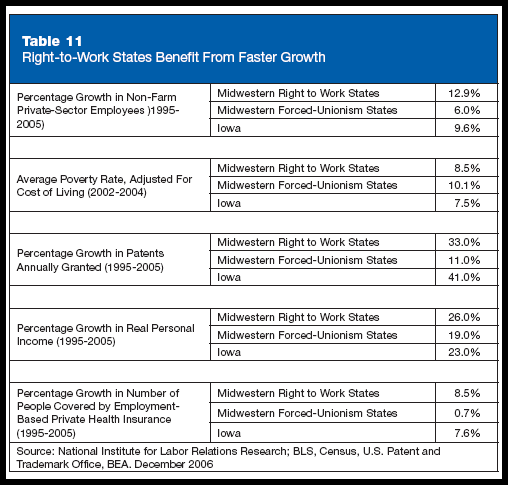
So when I see studies like this one, I don't see it as an indictment of unions per se, since unions exist in "right to work" states, but rather an indictment of government intervention trying to ham-handedly balance bargaining.  Here is the interesting chart, from a study by Arthur Laffer:

Righttoworkstates

Michigan in particular has made itself downright hostile to employers.  Given that the official government position is that "we aim to tilt the bargaining power against you in your negotiations with your largest suppliers," it is a wonder any business locates there.

Looming Problems at Fannie Mae

Maxed Out Mamma tells us that Fannie Mae may already have huge subprime exposure (emphasis added):

Maybe most voters believe
that FNMA and FHA are just in the conservative loan business.
HAHAHAHAHAHAHAHA. Certainly no "trained journalist" is going to ask any
questions about this topic.

Both Fannie and FHA will go to DTIs of over 60% in some cases. Especially refis. Try this thread on FHA.
If only I had saved down the 100 odd links or so I've run into over the
last year about how brokers were getting loans that the subprime
companies refused (who have since defaulted) through under FNMA!!! The
reason they did it as a last resort was only because FNMA paid less for
the loan. FNMA is already going to run into huge problems because of
the slopover into their portfolio in the interim between most of the
subprime lenders going down and FNMA's meaningful tightening of lending
standards. So FNMA already faces years of worsening financial trouble
without any new risks. Why does OFHEO oppose this? Hmmmm?

You can get information on Fannie's loan types at efanniemae.com. Believe me, they do high LTV, hybrids, 40 year etc. This page will show you information about Fannie's ARM products. Take a look. Take a good look. You want a 100% interest-only? They got it!! In fact, they'll take downpayment assistance, and go up to 105% with special programs. Chortle! Ya want interest-only ARM hybrids with DAP? Sure. BRING IT ON, cries Fannie. Simultaneous seconds? Sure 'nuff!!! (By the way, this is the escape from the refusal of the MI companies to play.)

The
bottom line is that every risk afflicting Alt-A lenders in high-cost
areas can afflict Fannie and really has. It's just that no one is
paying attention.

Why These Particular People?

People have been defaulting on mortgages for all of recorded history.  In Roman times, such a default could well result in the mortgage-holder getting sold into slavery, so things have improved a bit.  But seriously, people default on their mortgages all the time.  So what makes those currently in default more deserving of taxpayer aid than those before them or after them?  I mean, other than the fact that the press is paying attention to these particular defaults?  A similar question was reasonably asked of 9/11 victims who scored government compensation when victims before or after of other transportation accidents and building fires have not been so rewarded.

I challenge any politician to answer this question with an answer other than "well, these people are in the media spotlight right now and as a politician, I want to be in the spotlight with them."

Update: More analysis here, including the bright side of the burst housing bubble:

Countrywide wants to be
able to take its loans that the market won't accept and refi them under
FHA or FNMA. That's what this is all about. Don't forget that.

It's
not about homeownership. Let's look at the latest 25th percentile
(starter homes) list prices for a range of CA cities, compared to the
price in January 2007:

LA: $365,000/ $429,920
OC: $414,900/ $499,000
Riverside: $259,900/ $335,000
Sacramento: $229,900/ $316,477
San Diego: $325,000/ $392,279
San Francisco: $380,000/ $468,376
San Jose: $489,950/ $580,589
Santa Cruz: $489,000/ $577,400

What
you see above is great news for all the people who would like to buy
homes without going bankrupt a few years down the line. It's VERY bad
news for banks and financial companies that made the original bad loans
without bothering to check whether the borrowers could pay the danged
loan. You figure out who this country should reward - responsible
aspiring home owners or stupid banks.

Dilemma that's Not Really a Dilemma

When businesses get US Census surveys, they are not the happy smiling documents one gets as an individual.  Stamped all over it is "Your Response Is Required By Law" and when filling it out, one has the suspicion that he is facilitating his own doom by providing government weenies the data ammunition they need to tax or regulate us more. 

The survey asks for total revenues and costs and payrolls cut a bunch of different ways, and takes about 1-2 hours to fill out if one is trying to be accurate.  However, I looked at the survey closer this year and  I noticed that this seven-page survey is for an individual business location

I have nearly 200 campgrounds and other recreational sites.  One of the tricks of our business is we have learned to operate a lot of small dispersed sites in a cost-effective manner.  But now it turns out that to be strictly compliant with the census process, I need to fill out all of this information for each of these sites.  In other words, rather than spend 1-2 hours (the feds say it should take an hour) on one summary report, in fact what I am technically legally supposed to do is fill out two hundred such reports, at a cost of at least 200 hours of my time.  That is 10% of a standard man-year.

So -- do I do it the "right" at the cost of 200 hours of my time or do I do it the way I did it last year?  I won't give my actual answer, which I think the post title telegraphs fairly well, but you can think about yours  (yes, Travis, I know, more rope).

Unvarnished Technocracy

The New York Times editorial board had one of the most jaw-dropping pieces I have read in a long time.  In it, they are absolutely unapologetic in saying that they think the government can spend your money better than you can -- and the larger the government take, the happier we all will be.

The munificence of American corporate titans warms the heart, sort of.
The Chronicle of Philanthropy reports that the top 50 donors gave $7.3
billion to charity last year "” about $150 million per head....

Yet we'd be so much happier about all the good things America's
moneyed elite pay for if the government made needed public investments
.

The flip side of American private largess is the stinginess of
the public sector. Philanthropic contributions in the United States "”
about $300 billion in 2006 "” probably exceed those of any other
country. By contrast, America's tax take is nearly the lowest in the
industrial world.

Oh my God, does anyone actually believe that Congress does a better job spending your money than you do?  Apparently they do:

Critics of government spending argue that America's private sector does
a better job making socially necessary investments. But it doesn't.
Public spending is allocated democratically among competing demands.
Rich benefactors can spend on anything they want, and they tend to
spend on projects close to their hearts.

LOLOLOL.  Has anyone looked at the last highway bill?  How many tens of thousands of politically motivated earmarks were there?   

Philanthropic contributions are usually tax-free. They directly reduce
the government's ability to engage in public spending. Perhaps the
government should demand a role in charities' allocation of resources
in exchange for the tax deduction. Or maybe the deduction should go
altogether. Experts estimate that tax breaks motivate 25 percent to 30
percent of contributions.

At the end of the day, this is not about a better prioritization process for spending -- this is about the NY Times getting a bigger say for itself in said spending.  They know that Warren Buffet couldn't give a rat's behind what the NY Times thinks about how he spends his money, but Congressmen trying to get reelected do care.  The NY Times wields a lot of political, but little private, influence, so they want to see as much spending as possible shift to political hands where the Times wields clout.

Postscript: Boy, here is some quality journalism:

Federal, state and local tax collections amount to just more than 25.5
percent of the nation's economic output. The Finnish government
collects 48.8 percent. As a result, the United States spends less on
social programs than virtually every other rich industrial country,
according to the Organization for Economic Cooperation and Development.
The Finnish government probably has money to build children's health
clinics.

"Probably has money?"  What does that mean?  Do they have government-funded children's health clinics or not?  The Times couldn't work up enough energy to fact-check that?  And by the way, who, other than the NY Times, declared that the best marginal use of additional public funds is for children's health clinics?

Postscript #2: Many of the very rich have been funding schools that are competitive with government-monopoly schools.  In this and many other cases, wealthy people fund programs that work better and cheaper than government alternatives.  I am sure that not only would the feds be happy to have this money to spend themselves (on some fat earmarks for key donors, most likely) but they would additionally be thrilled to get rid of the competition.

Update:  I must be going senile.  I missed the most obvious logical fallacy of all.  The NY Times says that our democratic government is the best possible mechanism for allocating funds.  But doesn't that also mean its the best possible mechanism for setting spending levels?  How can it complain that our democratic government is doing a bad job in setting total spending levels but does a great job in allocating that spending?

Why We Don't Need More Highway Funds

We don't need more highway funds because right now, as estimated by the Anti-Planner, about 40% of Federal highway funds go to non-highway projects.   In particular:

Over the past fifteen years alone, America has spent well over $100
billion on rail transit construction projects but has little to show
for it. As mobility advocate John Semmens pointed out a few days ago in
a recent Washington Times op ed, transit's share of urban travel has actually declined since 1995.
Transitvdriving_800_2

Wow, money well spent, huh?  I have written many times on commuter rail follies in Phoenix and other western cities that are utterly unsuited to rail transit.  The most recent news here in Phoenix is that design flaws are appearing, even before the first train is run.

Government is The Biggest Barrier to Alternative Energy

And by the title of this post, I don't mean because they are not throwing enough money and mandates at it.  Here is what I wrote about the alternative energy mandates in the most recent energy bill:

They want 15% of power generation from renewables by 2020.  I am not
sure if this includes hydro.  If it does, then a bunch of Pacific
Northwest utilities already have this in the bag.  But even if
"renewable" includes hydro, hydro power will do nothing to meet this
goal by 2020.  I am not sure, given environmental concerns, if any
major new hydro project will ever be permitted in the US again, and
certainly not in a 10 year time frame.  In fact, speaking of
permitting, there is absolutely no way utilities could finance, permit,
and construct 15% of the US electricity capacity by 2020 even if they
started today.  No.  Way.   By the way, as a sense of scale, after 35
years of subsidies and mandates, renewables (other than hydro) make up
... about .27% of US generation.

Here is an example of what I mean about the permitting process:  10-years a counting between proposal for a wind farm and having a chance to build it.  And I assure you that there is not way this thing will clear remaining regulatory hurdles to be in place even by 2011.

Thank God The Government Was on the Job

Thank God the government and not the private sector is in charge of road design and construction.  Because those private sector guys just aren't accountable and might have screwed up.

On Political Calibration

If I had to choose one word that describes why I despair of politics, it is "calibration."  Recently, it has been observed that Ron Paul, for example, cannot possibly win because he sticks to a basic set of beliefs and never calibrates his message to the electorate and recent polls.  On the other end of the scale, Hillary Clinton is famous for endlessly calibrating everything she does in the hopes of maximizing the votes she receives.

Calibration is one of those dangerous words that tend to obfuscate the underlying reality.  Because, there are only two possible definitions of calibration as used in this political context:

  • Lying, i.e. telling the electorate what they want to hear with the intention of acting differently once in office
  • Total nihilism,, i.e. willingness to shift beliefs based on whatever is effective

Russell Roberts describes the situation pretty well:

But there is little difference between Republican and Democratic
Presidents in what they actually do. In what they say? Sure. Both
Reagan and Bush talk about individual responsibility and the market
blah blah blah. Bill Clinton talked more about feeling people's pain
and the downtrodden blah blah blah. Similarly, in the current
presidential campaign, there are stark rhetorical differences between
say Giuliani and Romney on the one hand and Obama and Clinton on the
other.

But will the actual results be different? Will Hillary double the
minimum wage? Change our health care system to be more socialized?
Eliminate corporate welfare? Will Giuliani make the health care system
less socialized? Eliminate the minimum wage? Get rid of farm subsidies?
Stop spending federal money on education?

Most of it is talk and it's not just because change is hard to
achieve. It's because they really don't want change. Did Bill Clinton
get rid of income inequality? Dent it? The share of income going to the
top 1% rose throughout most of the Clinton administration. Was it his
policies? The steady rise in the share of income going to the top 1%
started rising in 1976. Was it Carter's doing?

Was Bush or Reagan a hard core free trader in practice? Nope. They
used protectionism when it was politically expedient. Just like Bill
Clinton signed welfare reform and NAFTA and then chose not to enforce
the truck provision of NAFTA because the Teamsters didn't like it.

Government gets bigger under both Republicans and Democrats. What
they spend money on is a little different, yes. But to hate George Bush
for being a free market guy is to miss what is really going on. And to
hate Hillary because she doesn't understand the power of markets and to
love, say, Mitt Romney, is to misunderstand both of them. They use
rhetoric to dupe you. Don't be duped.

This all leads to the question of into which category should we place Paul Krugman - lier or nihilist?

Paul Krugman worries that,
although trade between high-wage countries is mutually beneficial,
"trade between countries at very different levels of economic
development tends to create large classes of losers as well as winners"
- and so is suspect because it likely harms ordinary American workers
("Trouble With Trade," December 28).

A famous trade economist
argues that this concern is misplaced.  In a 1996 essay, this economist
- responding to a protectionist who fretted that western trade with
low-wage countries would harm workers in the west - wrote that this
protectionist "offers us no more than the classic 'pauper labor'
fallacy, the fallacy that Ricardo dealt with when he first stated the
idea, and which is a staple of even first-year courses in economics. In
fact, one never teaches the Ricardian model without emphasizing
precisely the way that model refutes the claim that competition from
low-wage countries is necessarily a bad thing, that it shows how trade
can be mutually beneficial regardless of differences in wage rates."

Oh - the economist who wisely warned against the pauper-labor fallacy is none other than Paul Krugman.

The Public Interest is One Guy

TJIC has a disgusting story of the state legislature passing a law just to bail out one guy who could not do well on his civil service tests but had friends in high places, vaulting him from 623 to 1 on the waiting list  (if only I could get the same law for me and security lines at airports).

Now, it is always possible to find anecdotes of government patronage, but I thought this quote from the Boston Globe about the extent of such help-one-person laws was incredible:

A Globe review found that 40 of the 218 state laws passed in 2007
provide benefits to specific individuals by name. Thirty allowed
employees of certain state agencies to donate sick days to particular
colleagues, and three granted retirement benefits to certain public
employees. Six exempted particular police and firefighter applicants
from maximum age requirements, allowing them to take civil service
tests and apply for municipal jobs at an older age.

If each of these is a worthy goal, then change the law to allow everyone to do it, not just your pals.

It's More Expensive, but Makes Up For It By Being Less Flexible

I have chastised our city on many occasions (more here) for spending enormous amounts of money on a new light rail / streetcar system for Phoenix.  These light rail systems can be twenty or more times as expensive, per mile or passenger carried, than a similar bus system.  But what really, really makes light rail nuts for Phoenix is the lack of flexibility.   Our hugely expensive new light rail system serves just one corridor, in a city that really does not even have a downtown.  Phoenix is characterized by a nearly infinite number of commuting routes that don't overlay nicely on a suburbs to city-center pattern as they might in, say, Chicago.  Further, the current route arguably follows the least congested route of any in the city!

The incremental cost of light rail over bus systems has been justified to us by our government overlords by economic development.  The argument goes that light rail creates more business development along their routes than a bus system.  Now, I am skeptical of this, given the region justified building a billion dollar stadium for the hapless Cardinals on the same justification (not to mention numerous subsidies of a couple of college bowl games that add little to an area that is going to get holiday tourists because of its climate whether there is a football game or not.

But what about Portland?  Supposedly Portland light rail is the go-by which all we unplanned cities should emulate.  But the Anti-Planner brings this helpful observation about Portland's experience with light rail and development:

Streetcar advocates often say that 7-mile-per-hour streetcars aren't about transportation, they are about economic development.
But they expect the Department of Transportation to pay for them out of
highway user fees. Why didn't they ask the Department of Housing and
Urban Development for the money?

Of course, the Antiplanner doesn't believe
that streetcars catalyze economic development. Instead, they merely
catalyze more tax subsidies for economic development. Portland spent
$90 million on a streetcar line and $665 million on subsidies to
development "” then credited the development to the streetcar line.
Yeah, right.

California Insanity

The WSJ ($) has an article on California showing the growth of expenditures and the budget deficit.  I took the expenditures numbers and converted them to 2007 dollars and put them on a dollar per state resident basis, to correct both for growing population and inflation.  Here are California government general fund expenditures on a 2007 dollar per person basis:

1990-1991: $2,755
1995-1996: $2,470
2000-2001: $3,558
2005-2006: $3,416
2007-2008: $3,767

From these figures, we can learn a couple of things.  First and foremost, the state of California demonstrates itself to be just as financially incompetent as any condo-flipping doctor who now finds himself stuck with a bunch of mortgages he can't pay.  Lured by the false prosperity of the Internet bubble, California increased real government spending per resident by nearly 50% in the latter half of the nineties, and has done nothing to reign this spending in (thus the deficits).  The only place where the analogy with the person caught short by the housing bust falls apart is that the person with expensive mortgages is probably not out buying a new Mercedes and big screen TV, whereas that is exactly what California is doing, passing a $14 billion a year health care plan that will whose price tag can only rise.

Can We Get Over Our Obsession with Agriculture?

Dan Griswold writes today about our depressing continued subsidization of the agriculture business, up to and including gutting any reasonable energy policy in favor of subsidizing corn farmers.

Beyond shear inertia and the fact that Iowa leads the primaries, can anyone really explain this.  For God sakes, we have a cabinet-level position for agriculture, and, in case of a massive Cylon attack, the secretary of agriculture is 8th in line for the Presidency.

Here is some perspective:  Agriculture, even if you include fishing and forestry, accounts for 1.1% of US GDP.  $122 billion of total value added.  Computers and electronic parts is a larger industry.  As is entertainment and recreation.  As is the restaurant industry.  Heck, Exxon and Wal-Mart are probably more deserving of cabinet positions. 

Congress: We Can't Stop Ourselves From Doing Harm

From the Washington Post, via Tom Nelson, comes a nice summary of the consequences of Congress's addiction to ethanol mandates and subsidies.  The last sentence in particular is one I have warned about for a while on this issue.

To be sure, some farmers in these countries benefit from higher prices.
But many poor countries -- including most in sub-Saharan Africa -- are
net grain importers, says the International Food Policy Research
Institute, a Washington-based think tank. In some of these countries, the poorest of the poor spend 70 percent or more of their budgets on food.
About a third of the population of sub-Saharan Africa is
undernourished, according to the Food and Agriculture Organization of
the United Nations. That proportion has barely changed since the early
1990s. High food prices make gains harder.
...
It's
the extra demand for grains to make biofuels, spurred heavily in the
United States by government tax subsidies and fuel mandates, that has
pushed prices dramatically higher
. The Economist rightly calls
these U.S. government subsidies "reckless." Since 2000, the share of
the U.S. corn crop devoted to ethanol production has increased from
about 6 percent to about 25 percent -- and is still headed up.
...
This
is not a case of unintended consequences. A new generation of
"cellulosic" fuels (made from grasses, crop residue or wood chips)
might deliver benefits, but the adverse effects of corn-based ethanol
were widely anticipated. Government subsidies reflect the careless and
cynical manipulation of worthy public goals for selfish ends. That the
new farm bill may expand the ethanol mandates confirms an old lesson:
Having embraced a giveaway, politicians cannot stop it, no matter how
dubious.

Moral Hazard

The Anti-Planner has a series of posts of late on light rail that in total point to a perverse moral hazard in public transportation funding that helps to explain why states and cities are building so many rail projects, when the numbers almost never make any sense (as I blogged for LA, Phoenix, and Albuquerque).  Though the Anti-Planner does not state these rules, from his recent posts I have inferred three rules:

  • A city can get capital construction dollars from the feds, but you can almost never get maintenance or operations money (similar story in recreation)
  • The feds will fund big, expensive, sexy rail projects.  They will not fund purchases of buses and are unlikely to fund something so prosaic as a bus stop or terminal  (general rule of thumb:  federally funded projects must be large enough to justify being named at some future point after the local Congressman or Senator who earmarked the project.)
  • It is very easy to de-fund bus systems -- you just don't replace aging buses and cut routes over time.  It is hard to de-fund, or, god forbid, abandon a rail line, since the thing sits out there so visibly.  Sunk costs can also be a political issue if rail lines were to be closed.

For most public transportation goals, particularly in spread out western and southern cities, buses are a cheaper and higher service solution than rail.  They can carry the same passenger traffic for far less total dollars (capital plus operating costs) and they can cover far more routes.  In fact, one can argue that rail lines are inherently regressive, as they tend to serve commuting corridors of the middle and upper classes rather than the typical routes of the poor, for whom the systems are nominally built.

So what can one expect by the application of these three rules?  Well, we would expect local authorities to favor large, expensive capital rail projects rather than refurbishment or expansion of bus systems.  As operating costs rise for the trains, we would expect bus service to be cut back to pay for the rail operating deficit.

Stlouis
Which is exactly what happens.  In fact, rail tends not to increase total ridership at all, at best shifting ridership from inexpensive buses to expensive trains, and at worst decreasing total ridership as rail lines with just  a few stations and routes replace more extensive webs of bus transport.  And, in twenty years, when these rails systems need extensive capital overhauls, we find cities with huge albatrosses on their hands that they are unable to maintain or update.

Great Moments in Progressive Taxation

Many government programs have both a stated justification as well as a second, unstated justification which is the real reason that politicians support the program.  For example, many regulations are portrayed as pro-consumer when in fact their real utility is in protecting a favored company or political donor from new competition.

The same is true for progressive taxation.  The public logic is usually about the rich paying a "fair share" or reducing income inequality (by cutting down the oaks to give the maples more sunshine).  However, progressive taxation pays rich dividends to politicians looking to increase the size of government and their own personal power.  Some time in the last 10 years, we crossed an invisible line where less than half of American families pay for effectively all government programs (leaving aside Social Security). 

This means that when any politician stands up and proposes a new program, a majority of Americans know that they are not going to pay for it.  In fact, the situation is even more obvious when you consider new programs at the margin.  If you listen to the Democratic debates, nearly every candidate is proposing to pay for his or her expensive programs via new taxes aimed solely at the top 10 or 20% of earners.  Every time they propose a program, there is an unstated but increasing clear clause "and 80% of you won't have to pay anything for this."  Already, we see many states funding new programs with surcharges on the rich.  Here is but one example:

California voters agreed to tax the rich to support public mental health
services. 

More than half of them (53.3 percent) voted last month in favor of
Proposition 63, which will impose a tax surcharge of 1 percent on the taxable
personal income above $1 million to pay for services offered through the
state's existing mental health system. The initiative will generate an
estimated $700 million a year....

Richard A. Shadoan, M.D., a past president of the CPA, wrote in Viewpoints
in the September 3 issue of Psychiatric News, "The scope of the
program and its tax-the-rich source will provoke a debate. But it's an
argument worth having to make California face the neglect of not providing
treatment to more than 1 million people with mental illness."

So what happened?  I don't know how many people make a million dollars in California, but it is certainly less than 5% of the population.  So the headline should read "53.3% of people voted to have less than 5% of the people pay for an expensive new program."  If the 53.3% thought it was so valuable, why didn't they pay for it?  Well, it is clear from the article that the populace in general has been asked to do so in the past and refused.  So only when offered the chance to approve the program if a small minority paid for it did they finally agree.  This is the real reason for progressive taxation.  (by the way, these 53.3% will now feel really good about themselves, despite the fact they will contribute nothing, and will likely piss on millionaires next chance they get, despite the fact that they are the ones who will pay for the program).

Ultimate Example of Progressive Taxation

My story today comes from the Roman Empire just after the death of Julius Caesar.   At the time, three groups vied for power:  Octavian (Augustus) Caesar, Mark Antony, and republican senators under Brutus and Cassius.   Long story short, Octavian and Antony join forces, and try to raise an army to fight the republicans, who have fled Italy.  They needed money, but worried that a general tax would turn shaky public opinion in Rome against them.  So they settled on the ultimate progressive tax:  They named about 2500 rich men and ordered them killed, with their estates confiscated by the state. 

This approach of "proscriptions" had been used before (e.g. Sulla) but never quite as obviously just for the money.  In the case of Octavian and Antony, though nominally sold to the public as a way to eliminate enemies of Rome, the purpose was very clearly to raise money.  All of their really dangerous foes had left Rome with the Republicans.  The proscriptions targeted men of wealth, some of whom had been irritants to Octavian or Antony in the past (e.g. Cicero) but many of whom had nothing to do with anything.  Proscribed men were quoted as saying "I have been killed by my estates."

I wonder how many of today's progressives would be secretly pleased by this approach?

Great Moments in Progressive Taxation

Many government programs have both a stated justification as well as a second, unstated justification which is the real reason that politicians support the program.  For example, many regulations are portrayed as pro-consumer when in fact their real utility is in protecting a favored company or political donor from new competition.

The same is true for progressive taxation.  The public logic is usually about the rich paying a "fair share" or reducing income inequality (by cutting down the oaks to give the maples more sunshine).  However, progressive taxation pays rich dividends to politicians looking to increase the size of government and their own personal power.  Some time in the last 10 years, we crossed an invisible line where less than half of American families pay for effectively all government programs (leaving aside Social Security). 

This means that when any politician stands up and proposes a new program, a majority of Americans know that they are not going to pay for it.  In fact, the situation is even more obvious when you consider new programs at the margin.  If you listen to the Democratic debates, nearly every candidate is proposing to pay for his or her expensive programs via new taxes aimed solely at the top 10 or 20% of earners.  Every time they propose a program, there is an unstated but increasing clear clause "and 80% of you won't have to pay anything for this."  Already, we see many states funding new programs with surcharges on the rich.  Here is but one example:

California voters agreed to tax the rich to support public mental health
services. 

More than half of them (53.3 percent) voted last month in favor of
Proposition 63, which will impose a tax surcharge of 1 percent on the taxable
personal income above $1 million to pay for services offered through the
state's existing mental health system. The initiative will generate an
estimated $700 million a year....

Richard A. Shadoan, M.D., a past president of the CPA, wrote in Viewpoints
in the September 3 issue of Psychiatric News, "The scope of the
program and its tax-the-rich source will provoke a debate. But it's an
argument worth having to make California face the neglect of not providing
treatment to more than 1 million people with mental illness."

So what happened?  I don't know how many people make a million dollars in California, but it is certainly less than 5% of the population.  So the headline should read "53.3% of people voted to have less than 5% of the people pay for an expensive new program."  If the 53.3% thought it was so valuable, why didn't they pay for it?  Well, it is clear from the article that the populace in general has been asked to do so in the past and refused.  So only when offered the chance to approve the program if a small minority paid for it did they finally agree.  This is the real reason for progressive taxation.  (by the way, these 53.3% will now feel really good about themselves, despite the fact they will contribute nothing, and will likely piss on millionaires next chance they get, despite the fact that they are the ones who will pay for the program).

Ultimate Example of Progressive Taxation

My story today comes from the Roman Empire just after the death of Julius Caesar.   At the time, three groups vied for power:  Octavian (Augustus) Caesar, Mark Antony, and republican senators under Brutus and Cassius.   Long story short, Octavian and Antony join forces, and try to raise an army to fight the republicans, who have fled Italy.  They needed money, but worried that a general tax would turn shaky public opinion in Rome against them.  So they settled on the ultimate progressive tax:  They named about 2500 rich men and ordered them killed, with their estates confiscated by the state. 

This approach of "proscriptions" had been used before (e.g. Sulla) but never quite as obviously just for the money.  In the case of Octavian and Antony, though nominally sold to the public as a way to eliminate enemies of Rome, the purpose was very clearly to raise money.  All of their really dangerous foes had left Rome with the Republicans.  The proscriptions targeted men of wealth, some of whom had been irritants to Octavian or Antony in the past (e.g. Cicero) but many of whom had nothing to do with anything.  Proscribed men were quoted as saying "I have been killed by my estates."

I wonder how many of today's progressives would be secretly pleased by this approach?

The Core Problem with Social Security

I am happy to see others making the point I have tried to make for years:  That the coming financial problems with Social Security are not its biggest problem.  Megan McArdle and Clive Cook say it very well:

In this post on Paul Krugman and Social Security,
Clive, as usual, targets with laser accuracy the real problem with the
Social Security system: not that it is bankrupt, but that it encourages
people to make extremely bad decisions about providing for their future.

It starts with childbearing:  social security systems seem to exert downward pressure on birthrates,
in effect undermining their own actuarial base. Social security
socializes the benefits of childbearing in providing for retirement,
but no one has yet figured out how to socialize the main cost, which is
turning your life choices over to a screaming pre-verbal dictator.
People are thus tempted to free ride on the childbearing of others, and
the more generous benefits are, the more they seem to free ride. This
is one reason that Social Security, which used to have more than 30
workers for each retiree, now has only three, headed towards two.

Social Security also encourages people to leave the workforce
earlier than they otherwise would. People are healthier than ever at
65, but while in 1950, almost half of all men over the age of 65
worked, that number is now less than 20%. This appears to be highly
correlated with the spread of defined benefit pensions such as social
security, which offer no advantage to delaying retirement. Indeed,
Social Security perversely penalizes anyone who takes early benefit but
continues to work, docking a third of their earnings.

Finally, Social Security discourages private savings. This is
terrible for two reasons. If future fiscal problems force the
government to reduce benefits, the people who didn't save enough
because they relied on those promises will be made much worse off than
they would otherwise have been.

The other problem is that Social Security is not a productive
investment. Privately saved money is mostly lent to corporations that
mostly use the money to do things that make the economy more
productive, such as R&D and capital equipment upgrades. Social
security "contributions" are lent to the government, where they are
mostly spent on things that could not be remotely described as
improving our economy's productive capacity, such as farm subsidies.

Excellent.  I ran the numbers and discussed what a bad investment return was paid by Social Security here.  I discussed Social Security as intellectual welfare here.