Archive for the ‘Government’ Category.

This Could Easily Be Said About Phoenix Light Rail

Tom Kirkendall observes that this could have been written about Houston light rail.  I would add that it also could have easily been written about Phoenix light rail, which I have criticized here and here and here.  And heavy rail? Don't get me started.

Beyond these impressions, Tom Rubin observes that VTA has "the worst
operating statistics fo any American transit operator." The reason for
this, he says, is that San Jose "” being built mostly after World War II
"” is one of the most spread-out urban areas in the country. Not only
are people spread out, but jobs are spread out, with no job
concentrations anywhere.

This makes large buses particularly unsuitable for transit because
there is no place where large numbers of people want to go. So what was
VTA's solution when its bus numbers were low relative to other transit
agencies? Build light rail "” in other words, use an expensive
technology that requires even more job concentrations.

Now it has one of the, if not the, poorest-patronized light-rail
systems in America. So what is its solution? Build heavy rail, a
technology that requires even more job concentrations.

This is an interesting factoid from another Anti-Planner post:

The amazing thing to the Antiplanner is that anyone would take this
proposal seriously. The average urban freeway lane costs about $10
million per mile. The average light-rail line costs about $50 million
per mile and carries only a fifth as many people. Seattle's proposed
lines were going to cost $250 million per mile, making then 125 times
more expensive at moving people than a freeway lane.

Very Interesting Observation

From Tyler Cowen:

The NIH works as well as it does because the money is mostly protected
from Congress. It is not a success which can easily be replicated. The
more money is at stake, the more Congress wants to influence
allocation. We should guard this feature of the system jealously and
try to learn from it. If we can.

I had not ever thought about it this way, but this is probably a correct observation about government:  The more money in a program, the more likely it is that Congress will want to direct that money to take political credit for it and reward their cronies, and therefore the more likely the program is to fail.

Improving My View of Ralph Nader

For much of my adult life, Ralph Nader was my least favorite living Princeton alum*.  But Eliot Spitzer may be challenging for the title.  Sure, I never really liked Spitzer when he was at Princeton, but I never really liked any of the student government types, as evidenced by the fact that I led a mass-mooning of one governing council meeting (yes, I know, you are shocked that this sophisticated commentator could have been so immature).  Besides, Spitzer was the butt of one of Princeton's great jokes and works of performance art, when he was defeated by the Antarctic Liberation Front.

But since his tenure as AG and now governor of New York, the guy has turned from an irritating joke to a real threat to freedom.  His abuse of the AG job for personal aggrandizement is legend, and, after having been given a free pass by the press in that job, he is finally being cornered for various ethical violations. 

So it is with great satisfaction that I read today that Spitzer was forced to back off his plan to tax out of state Internet sales, abandoning his unique view that an affiliate program created a corporate presence in-state.

Update:  A Spitzer roundup of sorts at Reason.

I Guess Its Not Working Very Well

From my daily email from the Goldwater Institute:

In only five years, the Arizona Health Care Cost Containment System budget is slated to more than double.

When double-speak government agency names meet reality!

Due Process? Not When There Is Money in it for US

One of the worst violations of due process on the books today is law enforcement's ability to seize cash and assets from people only suspected to be drug dealers, with no due process whatsoever.  In fact, the only process involved is that, once seized, the private citizen from which the assets were taken must prove beyond a reasonable doubt that the money or assets are legitimately theirs, rather than the other way around.  This was a great case in point.

Along the same lines, the city of Washington DC has decided that all that due process stuff is getting in the way of their harvesting the maximum amount of cash from drivers:

In an attempt to stem the loss of revenue from motorists contesting
parking tickets, cities are effectively eliminating the traditional due
process rights of motorists to defend themselves at an impartial
hearing. By the end of next year, Washington, DC's Department of Motor
Vehicles (DMV) will not allow anyone who believes he unfairly received
a citation to have his day in an administrative hearing.

"DMV
will complete the phase-out of in-person adjudication of parking
tickets in favor of mail-in and e-mail adjudication by December 2008,"
the Fiscal Year 2008 DMV plan states.

The move is intended to allow automated street sweeper parking ticket machines
to boost the number of infractions cited well beyond the 1.6 million
currently handed out by meter maids. As one-third of those who contest
citations in the city are successful, the hearings cut significantly into the $100 million in revenue tickets generate each year.

Under
the DMV's plan, motorists will only be able to object to a ticket by
email or letter where city employees can ignore or reject letters in
bulk without affected motorists having any realistic recourse.

Thanks to Radley Balko, who also found this little gem:

In Boston and other cities in Massachusetts,
motorists cannot challenge a $100 parking ticket in court without first
paying a $275 court fee. If found innocent, the motorist does not
receive a refund of the $275.

Why Campaign Spending Will Continue to Rise

Because the government has put itself in the job of redistributor-in-chief, and there is just too high of a financial return from influencing who are to be the beneficiaries, and who are to be the sacrificial lambs.  This is particularly the case when Congress can aim dollars at a small group who will give back generously in return, and where the costs are dispersed across large numbers of people, generally consumers or taxpayers or both:

Dan Morgan has another excellent Washington Post report
on our tangled web of farm subsidies, tariffs, government purchases,
and so on. This time he examines the sugar industry's political
contributions"“"more than 900 separate contributions totaling nearly
$1.5 million to candidates, parties and political funds" in 2007 alone.
Most of the money went to Democrats, apparently, which might explain
why Democrats opposed more strongly than Republicans an amendment
to strike the sugar subsidy provisions from the bill. Morgan delights
in pointing out members of Congress such as Rep. Carolyn Maloney of
Queens and Manhattan and Rep. Steven Rothman of bucolic Hackensack and
Fort Lee, New Jersey, who received funds from the sugar magnates and
voted to protect their subsidies despite the fact that they would seem
to have more sugar consumers than sugar growers in their districts....

So $1.5 million is a lot of money, and it seems to have done the trick.
But . . . is it really so much money? According to Morgan, the sugar
provisions in the farm bill are worth $1 billion over 10 years. That's
a huge return on investment. In what other way could a business invest
$1.5 million to reap $1 billion?

The real campaign finance reform that is needed is to get the government out of the business of naming winners and losers.

Update:  More on the sugar fiasco here.

Under the current system, the government guarantees a price floor for
sugar and limits the sugar supply "” placing quotas on domestic
production and quotas and tariffs to limit imports. According to the
Organization for Economic Cooperation and Development, sugar supports
cost American consumers "” who pay double the average world price "” more
than $1.5 billion a year. The system also bars farmers in some of the
poorest countries of the world from selling their sugar here.

The North American Free Trade Agreement is about to topple this
cozy arrangement. Next year, Mexican sugar will be allowed to enter the
United States free of any quotas or duties, threatening a flood of
imports. Rather than taking the opportunity to untangle the sugar
program in this year's farm bill, Congress has decided to bolster the
old system.

Both the House bill, which was passed in July, and the Senate
version, which could be voted on as early as this week, guarantee that
the government will buy from American farmers an amount of sugar
equivalent to 85 percent of domestic consumption "” regardless of how
much comes in from abroad. To add insult to injury, both also increase
the longstanding price guarantee for sugar.

The bills encourage the government to operate the program at no cost
to the budget, by selling the surplus sugar to the ethanol industry.
That's not likely. Ethanol makers will never accept paying anywhere
near sugar's guaranteed price. According to rough estimates from the
Congressional Budget Office, supports for sugar in the House bill could
cost taxpayers from $750 million to $850 million over the next five
years.

Only in Congress

The House version of the bill spends $14 billion.  The Senate version spends $15 billion.  So what is the compromise between the two.  14.5?  No, spend $23.2 billion!

Definition of an Activist

Activist:  A person who believes so strongly that a problem needs to be remedied that she dedicates substantial time to ... getting other people to fix the problem.   It used to be that activists sought voluntary help for their pet problem, and thus retained some semblance of honor.  However, our self-styled elite became frustrated at some point in the past that despite their Ivy League masters degrees in sociology, other people did not seem to respect their ideas nor were they particularly interested in the activist's pet issues.  So activists sought out the double shortcut of spending their time not solving the problem themselves, and not convincing other people to help, but convincing the government it should compel others to fix the supposed problem.  This fascism of good intentions usually consists of government taking money from the populace to throw at the activist's issue, but can also take the form of government-compelled labor and/or government limitations on choice.

I began this post yesterday, with the introduction above, ready to take on this barf-inducing article in the Washington Post titled " Fulfillment Elusive for Young Altruists In the Crowded Field of Public Interest."  Gee, who would have thought it difficult for a twenty-something with no real job experience to get someone like me to pay you to lobby the government to force me to pay for your personal goals for the world?

Fortunately, since it is a drop-dead gorgeous day outside, TJIC has already done the detail work of ripping this article apart.  Here is one snippet, you should read the whole thing:

So the best they can imagine doing is "advocating".

Here's a hint: maybe the reason that your "sense of adulthood"
is "sapped" is because you haven't been doing anything at all adult.

Adults accomplish things.

They do not bounce around a meaningless series of do-nothing graduate programs, NGOs, and the sophisticated social scene in DC.

If you want to help the poor in Africa, go over there, find
some product they make that could sell here, and start importing it.
Create a market. Drive up the demand for their output.

Or find a bank that's doing micro-finance.

Or become a travel writer, to increase the demand for photography safaris, which would pump more dollars into the region.

Or design a better propane refrigerator, to make the lives of the African poor better....

One thing that disgusts me about "wannabe world changers" is that
mortaring together a few bricks almost always is beneath them - they're
more interested in writing a document about how to lobby the government
to fund a new appropriate-technology brick factory.

Special mutual admiration bonus-points are herein scored by my quoting TJIC's article that quotes me quoting TJIC.

I will add one thing:  I have to lay a lot of this failure on universities like my own.  Having made students jump through unbelievable hoops just to get admitted, and then having charged them $60,000 a year for tuition, universities feel like they need to make students feel better about this investment.   Universities have convinced their graduates that public pursuits are morally superior to grubby old corporate jobs (that actually require, you know, real work), and then have further convinced them that they are ready to change to world and be leaders at 22.  Each and every one of them graduate convinced they have something important to say and that the world is kneeling at their feet to hear it.  But who the f*ck cares what a 22-year-old with an Ivy League politics degree has to say?  Who in heavens name listened to Lincoln or Churchill in their early twenties?  It's a false expectation.  The Ivy League is training young people for, and in fact encouraging them to pursue, a job (ie 22-year-old to whom we all happily defer to tell us what to do) that simply does not exist.  A few NGO's and similar organizations offer a few positions that pretend to be this job, but these are more in the nature of charitable make-work positions to help Harvard Kennedy School graduates with their self-esteem, kind of like basket-weaving for mental patients.

So what is being done to provide more pretend-you-are-making-an-impact-while-drawing-a-salary-and-not-doing-any-real-work jobs for over-educated twenty-something Ivy League international affairs majors?  Not enough:

Chief executives for NGOs, Wallace said, have told her: "Well, yeah, if
we had the money, we'd be doing more. We can never hire as many as we
want to hire." Wallace said her organization drew more than 100
applicants for a policy associate position. "The industry really needs
to look at how to provide more avenues for young, educated people," she
said.

Excuses, excuses.  We are not doing enough for these young adults.  I think the government should do something about it!

Update:  Oh my God, a fabulous example illustrating exactly what universities are doing to promote this mindset is being provided by the University of Delaware.  See the details here.

Proposal For Those Empty Carpool Lanes

TJIC points to an article in the local Boston news that planners are shocked -- SHOCKED -- that the carpool lanes they spent tens of millions of dollar on are going unused.  I thought this was the best line:

Amazing.

I would never in a thousand years have guessed that people, -
if they have the means - prefer to commute to work on their own
schedules, in their own cars instead of in some sort of communitarian
Charlie Foxtrot where they have to coordinate schedules with their
neighbors, and have no flexibility to do errands on the way home, and
must welcome other people into their private domain.

And it's not just me - no one at all thought that people might
prefer privacy, individualism and freedom over enforced contact,
compromise, and obligation.

Quite a while ago, I made a counter-proposal for using the carpool lanes:

Several years ago, I sent in a proposal to the Arizona
Dept. of Transportation for their new HOV lanes in the Phoenix area,
though I never got a response back.  I suggested that HOV lanes
probably did not really increase carpooling, since they probably just
shifted vehicles that would have already been carrying 2+ people into
the faster lane.  Why should I get this artificial subsidy of a
dedicated lane when I am driving my kid to a soccer game but not when I
am driving myself to do productive work?  Either way, the lane is not
changing my behavior.

Anyway, I suggested that instead, AZ DOT should create a
number of special passes for exclusive use of the HOV lane.  The number
of passes should be set as the largest number that could be issued
while keeping the HOV lane moving at the speed limit at rush hour.
Maybe 5000?  Anyway, they would have the stats to set the number, and
it could be adjusted over time.  I proposed that they then auction off
these passes in a dutch auction once a year.  I posited that the
clearing price might be as high as $1000, thus raising $5,000,000 a
year that could be used for other transportation projects.

I have friends that said I was crazy, that no one would
spend $1000.  Back then, I argued it in two ways.  First, thousands of
people in town spend not $1000 but tens of thousands of dollars, in the
form of purchasing a nicer-than-basic-car, to make their driving
experience better.  In those terms, to the Mercedes or Lexus owner,
$1000 was nothing and in fact the price might go higher.  Second, if
each pass holder saved 15 minutes per commute, or 30 minutes per day
over 250 work days, they would save 125 hours of their time each year.
Bidding just $1000 for this would mean that people would have to value
their free time (since commuting generally comes out of free and family
time) at $8 an hour.  I certainly value my free time at a MUCH higher
rate than this.

More Light Rail Suckage

Portland is the poster child for light rail "success," but this is an interesting definition of success:

"Many (Portlanders) use their public transportation system," says
Weyrich. In fact, 9.8 percent of Portland-area commuters took transit
to work before the region build light rail. Today it is just 7.6
percent. In a story repeated in numerous cities that have built rail
lines, rail cost overruns forced the city to raise bus fares and reduce
bus service. That's a success?

A lot more money for fewer total transit riders.  This is absolutely predictable.  Light rail creates huge investment along one single route.  The assets created are totally inflexible -- unlike buses, they can only run one single route.  For most western cities with low density and literally hundreds of different commuting routes this way and that, light rail is silly.  Here are a couple of analysis I did for Albuquerque, LA and Phoenix.  Here is more about Portland.

Joe Arpaio and Abuse of Power

Here in Phoenix we have a sheriff named Joe Arpaio.  Sheriff Joe, as sensitive to building his media image as he is to fighting crime, has built himself a reputation among the majority of voters that he is a tough-on-crime code-of-the-west kind of guy.  As the Phoenix New Times describes his image:

While voters lapped up the sheriff's harsh approach to inmates in his
jails "” from forcing them to wear pink underwear, to feeding them
oxidized, green bologna, to working them in chain gangs, to housing
inmates in tents "” New Times
writers pointed out that the cruelty and violence in Arpaio's lockups
prompted Amnesty International's first investigation in America.

I, however, see Sheriff Joe as a shameless self-promoter, uncaring about basic civil rights, and a serial abuser of government power.  A number of Phoenix New Times (our free alt-weekly) reporters have been on Arpaio's ass for years, dogging him in the best tradition of American media trying to hold public officials accountable.

In 2004, during an election cycle, reporter John Dougherty found that Arpaio had over a million dollars of investments in commercial real estate parcels.  Dougherty asked the question, how does a lifetime public official making $78,000 a year have so much real estate?  Arpaio could have replied that his family was independently wealthy or that he had parlayed his real estate investment from rags to riches.  Instead, Arpaio used an obscure law aimed at protecting the home addresses of government officials to remove access to any public records of his commercial real estate transactions at the same time he removed his home address from these data bases.  Instead of explaining where the money came from, he used his power to cover his tracks.

The cool thing about alt-weeklies is that they are feisty in a way that major newspapers used to be but are no longer.  The paper responded by publishing Arpaio's home address in an editorial.  Ill-considered?  Perhaps, but the paper pointed to several public web site where Arpaio's home address was already published, including several government sites.  Their point:  Arpaio's concern about his home address was a smokescreen to mask the fact he was really trying to remove the records of his real estate investments.  If he had really been concerned about his home address being public, he would have removed it from all the other sites it appeared on, not just the data base he wished to purge of his commercial investments.  [update:  the law apparently bars publishing the address on the Internet, but not in other media.  The New Times is legally OK for publishing it in their print edition, but technically broke the law by having that print edition also appear on the web]

Joe Arpaio is never one to just "move on."  In response to the paper's editorial, Joe Arpaio used the full force of his public office to form a grand jury to investigate the Phoenix New Times.  Via the grand jury, his prosecutor-buddy has slapped a really amazing subpoena on this small newspaper.  This first part is bad enough:

In a breathtaking abuse of the United States Constitution, Sheriff Joe
Arpaio, Maricopa County Attorney Andrew Thomas, and their increasingly
unhinged cat's paw, special prosecutor Dennis Wilenchik, used the grand
jury to subpoena "all documents related to articles and other content
published by Phoenix New Times newspaper in print and on the Phoenix
New Times website, regarding Sheriff Joe Arpaio from January 1, 2004 to
the present."

Pretty broad scope, huh?  If the case were really about whether the paper broke any laws by publishing his address, they would just subpoena that particular editorial.  But this case appears to be about a lot more, specifically a chance by Sheriff Joe to finally punish the New Times for years of critical reporting.  But the subpoena goes even further, into total la-la land:

The subpoena demands: "Any and all documents containing a compilation
of aggregate information about the Phoenix New Times Web site created
or prepared from January 1, 2004 to the present, including but not
limited to :

A) which pages visitors access or visit on the Phoenix New Times website;


B) the total number of visitors to the Phoenix New Times website;


C) information obtained from 'cookies,' including, but not limited to,
authentication, tracking, and maintaining specific information about
users (site preferences, contents of electronic shopping carts, etc.);

D) the Internet Protocol address of anyone that accesses the Phoenix New Times website from January 1, 2004 to the present;


E) the domain name of anyone that has accessed the Phoenix New Times website from January 1, 2004 to the present;


F) the website a user visited prior to coming to the Phoenix New Times website;


G) the date and time of a visit by a user to the Phoenix New Times website;


H) the type of browser used by each visitor (Internet Explorer,
Mozilla, Netscape Navigator, Firefox, etc.) to the Phoenix New Times
website; and

I) the type of operating system used by each visitor to the Phoenix New Times website."

I am sorry to do this to you, but if you clicked through to the Phoenix New Times site via the links in this story, any personal information that is recoverable about you is now subject to this subpoena. 

For years I have argued against special privileges like shield laws for the press.  My point has always been that we should not create a special class of citizen with more or less rights.  And this case does not change my mind, for this reason:  We all should have protection against this kind of abusive and intrusive probing by a public official, not just the press.  The Phoenix New Times should not have to divulge the details of its readership, but neither should my blog or Jane Doe's MySpace page.  This kind of prosecutorial fishing expedition against a critic of a government official is not wrong because it is directed at the press; it is wrong because it is directed at any American.

Update:  I didn't get into all the really weird stuff.  For example, Joe Arpaio argued that publication of his home address was damaging because groups were out to assassinate him:

A Mexican drug cartel acting on behalf of the Minutemen through the
intercession of a pro-immigration rights radio talk show host intended
to assassinate Arpaio, according to a sheriff's office investigation
detailed on the front page of the Sunday, October 7, edition of the Arizona Republic.


Now just think about this for a second. The Minutemen hate Mexicans
sneaking across the border. They are even less fond if the Mexicans are
smuggling drugs.

And we are supposed to believe that the Minutemen, seldom associated
with unexplained stashes of bling, agreed to a $3 million assassination
fee and put 50 percent down?

And that this was brokered by Elias Bermudez, a talk radio host, former
mayor of Mexican border town San Luis Rio Colorado in Sonora, and an
outspoken critic of Sheriff Arpaio "” and, obviously, no fan of the
Minutemen?

And a key linchpin in this comic book farce was a teenage girl in a
prep school in Hartford, Connecticut, who was an exchange student at
one point in San Luis. If the drug cartel needed to contact the
Minutemen "for any reason," they could use a particular e-mail address
. . . which, as the officers discovered, belonged to a kid in a private
school.

And from the Arizona Republic, our mainstream paper that usually fawns over Arpaio:

The Maricopa County Sheriff's Office spent an estimated $500,000
during the past six months protecting Joe Arpaio from an assassination
that supposedly was designed to cause a furor in the United States over
illegal immigration.

The convoluted plot, reported to police by a paid informant,
purportedly involved members of the Minuteman border group hiring a hit
squad from a Mexican drug cartel and using an outspoken
immigrant-rights advocate as their intermediary.

Sheriff's officials now acknowledge that virtually none of the information supplied by the source panned out.

I'm sorry, but the person who dreams this stuff up has a huge burden of proof to even argue that he is sane, much less should be our sheriff.  The Minutemen love Sheriff Joe -- they are peas in a pod.  They believe many of the same things.  The odds they would be trying to assassinate him are ZERO.  By the way, this is not the first time Arpaio dreamed up an assassination plot:

in 2003 ... prosecutors took hapless James Saville to trial for
"plotting" to kill Arpaio. Jurors wound up deciding that deputies set
up the assassin, coaxing and entrapping him. Saville was acquitted ("The Plot to Assassinate Arpaio," August 5, 1999).

                                     
Then there was the time Arpaio identified a threat upon his life that
turned out to be an art student's sculpture of a spider left upon his
lawn.

Update:  Joe Arpaio has arrested the owners of the Phoenix New Times paper for revealing the contents of the subpoena.

Government Sucks

I really wanted to fisk in depth this post at Government Is Good.  While there are loads of factual inaccuracies and logical fallacies, the most common is the assumption that if the government does something today, that activity would not have been performed by anyone without government.  For example, if the government did not educate our kids, we'd all be happy to let them lay around all day and play Nintendo.

The article reminds me of nothing so much as the old "better living through chemicals" commercials which were so ably parodied with the Kentucky Fried Movie skit about zinc oxide.

Unfortunately, I don't have the time. Fortunately, TJIC has already done a great job. Here is one example from a long post:

7:01 a.m. Government also helps you own your house in more than the
legal sense. On a more practical level, the federal government actually
gives you money every year to help pay for your house. It's called a
mortgage interest tax deduction

So I earn $100, and the government would normally steal $30 of
that, but because I fill out certain forms, the government only steals
$20 of it"¦and the $10 that the government would have stolen, but chose
not to, is a "gift" ?

The Long Drain

The long drain begins:

When Kathleen Casey-Kirschling signs up for
Social Security benefits Monday, it will represent one small step for
her, one giant leap for her baby boom generation "” and a symbolic jump
toward the retirement system's looming bankruptcy.

Casey-Kirschling "” generally recognized as the
nation's first boomer (born in Philadelphia on Jan. 1, 1946, at
12:00:01 a.m.) "” won't bankrupt the Social Security system by taking
early retirement at 62. But after her, the deluge: 80 million Americans
born from 1946 to 1964 who could qualify for Social Security and
Medicare during the next 22 years.

The first wave of 3.2 million baby boomers turns
62 next year "” 365 an hour. About 49% of the men and 53% of the women
are projected to choose early retirement and begin drawing monthly
Social Security checks representing 75% of the benefit they'd be
entitled to receive if they waited four more years to retire.

If Social Security were a well-managed private insurance program, this would be a non-event.  The returns on investments over the last 40 years have been tremendous, such that a private fund could easily start paying out benefits based on boomers' premiums.

Unfortunately, as a government program, the funds in the program are subject to the whims of politicians.  And it turns out that boomers have elected politicians who have spent all the money that has been contributed to Social Security (despite USA Today in their graphics trying to continue the myth that a meaningful "trust fund" actually exists as anything but a bunch of government IOU's to itself.)  So, because Congress has spent all the past contributions, an action that would have had any private manager jailed decades ago, Social Security must now run itself as a Ponzi scheme, where current contributions pay off retiree benefits.  This game runs out somewhere in the 2020's.  And this all despite the fact that Social Security pays out a negative rate of return.

We're Saved!

The Arizona Republic had this headline on the front of the business section this morning:

Arizona economy will get boost

Oh, is there some interesting structural change in the economy?  Did some local company get a big contract.  No, it turns out that the state government is going to reorganize some of its committees:

Gov. Janet Napolitano announced creation of a new non-profit on
Thursday aimed at improving the state's economy and reducing its
dependence on housing and construction.

The Arizona Economic Resources Organization, or AERO, will bring
together the state's "disorganized" business-recruiting efforts, she
said.

AERO's board of directors will include representatives of government
organizations such as the Commerce and Economic Development Commission,
private enterprise and the state's universities, the governor said.

Is there a single person who reads this and thinks to himself "Oh, that should help?"  Is this really what the Arizona Republic thinks boosts economies and creates value?  Some reorganization among the bureaucrats that run around doling out taxpayer money for relocations so the governor can claim to have boosted the economy, or God forbid, to have created jobs?  How about an income tax cut instead?

Just as an aside, I couldn't help but note this hilarious quote:

"The governor has taken some important and bold steps, probably steps
that we should have taken 20 if not 30 years ago," said Barry Broome,
president and chief executive of the Greater Phoenix Economic Council,
which he said has discussed representation on the AERO board with the
governor.

It's simultaneously "bold" and 30 years late.   Is that possible?

Update:  As to my last question, it probably is possible.  After all, actually limiting the Congress to the enumerated powers in the Constitution would be both bold and about a hundred years late.

Government Thugs

Rad Geek has three awful stories of petty little thugs hired by government schools to harass and intimidate students.  At least one of these stories has racial overtones, but it would be a mistake to ascribe these actions merely to prejudice.  This is what inevitably happens when government employees are given carte blanch to exercise cohesive power.

In the first story, a 13-year-old girl was asked to strip naked because school security thugs has "reliable" information that she had an ibuprofen tablet - basically a freaking aspirin.

In the second story, security officers quiz high school girls about whether they are having their period to see if it is OK that they are carrying a small purse.

In story number three, a fifteen-year-old girl was tackled by security officers, forced down on a table, and had her wrist broken in an arm lock.  Later she was arrested and charged with assault.  All because she failed to fully clean up a piece of cake she dropped on the floor. 

Cakedropping

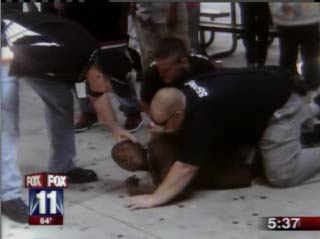
In the same incident, two onlookers were attacked, tackled, handcuffed, and arrested for photographing and video-taping the incident.  This is what you get for trying to record video of government employees at work:

Bystander

Twenty years ago, when I would have called myself a conservative instead of a libertarian as I do today, I probably would have said, "Oh, there are probably two sides of the story.  He probably provoked them."  I am embarrassed to admit it, but that might have been my reaction.  But watch the video that is linked from Rad Geeks post.  What could he have possibly done to warrant this?  You can see in the video he was just circling the security guards filming them until one pointed at him, the other came at him, and then this.  This boy was led from the school in handcuffs and spent the night in jail.  Sick.

Hat tip Catallarchy.

Dispatches from Zimbabwe

Here are a few scenes from Zimbabwe, stitched together form several posts by Cathy Buckle.  For all of those who support Hugo Chavez, and there are a surprising number in this country, this is exactly where Venezuela would be in a year if it wasn't for its oil.  And it may get there none-the-less (hat tip Q&O):

After three months of price controls the food situation in the country is
perilous and even those who were able to stock their pantries and cupboards are
now in trouble. In a main supermarket in my home town this week there was air
freshener, window cleaner, some vegetables, Indonesian toothpaste and imported
cornflakes from South Africa - one single packet costing more than half of a
teachers monthly salary.  There was also milk being sold from a bulk tank to
people who bring their own bottles and the queue went through the empty shop,
out the door and along the pavement. The line broke up suddenly before 10am when
the milk ran out and the huge shop was suddenly completely empty - nothing left
to sell, no more customers. This situation was a mirror image of conditions at
three other major supermarkets in the town and so we look desperately into
another week of struggle, praying for relief....

Milk is like gold in our town, as it is almost all over the country. When you
appreciate that the shops are empty and there is no food to buy, no protein, no
meat or eggs and now not even bread, you understand that people are desperate
for nourishment. A phone call to the local bulk dairy marketing outlet this week
went as follows:

Q: Hello, Do you have milk please?
A: Nothing.
Q: What about lacto (sour milk)?
A: Nothing.
Q: Any cheese?
A: (Bored) Nothing
Q: Ice Cream! ?
A: (Slightly annoyed) No, we have nothing. We are playing football in the car
park!
...

Standing outside over yet another smoky fire late one afternoon this week, a
Go-Away bird chastised me from a nearby tree. I'm sure this Grey Lourie is as
fed up of me intruding into its territory as I am of  being there - trying to
get a hot meal for supper. For five of the last six days the electricity has
gone off before 5 in the morning and only come back 16 or 17 hours later a
little before midnight. "Go Away! Go Away!" the Grey Lourie called out
repeatedly as my eyes streamed from the smoke and I stirred my little pot. My
hair and clothes stink of smoke, fingers are yellow and sooty but this is what
we've all been reduced to in Zimbabwe. Our government don't talk about the power
cuts anymore and don't even try and feed us with lame excuses about how the
power is being used to irrigate non-existent crops. We all know it's not true
and the proof is there in the empty fields for all to see.

Something else our government aren't talking about  anymore is the nationwide
non availability of bread and the  empty shops in all our towns and cities.
Everywhere you go people are struggling almost beyond description to try and
survive and yet the country's MP's, both from the ruling party and the
opposition, do nothing to put an end to this time of  horror. I have lost count
of how many weeks this has been going on for but it must be around three months.
None of the basics needed for daily survival are available to buy. There is no
flour to bake with, no pasta, rice, lentils, dried beans or canned goods. People
everywhere are hungry, not for luxuries like  biscuits or snack food but for the
staples  that fill your stomach. When you ask people nowadays how they are
coping, mostly they say that they are not, they say they are hungry, tired and
have little energy. This is a national crisis almost beyond description and
people say they are alive only because of " the hand of God."

I am Tired of Paying For People's Winter Vacations

I hire retired couples for the summer to run campgrounds and other recreation facilities.  Since these campgrounds are closed in the winter (most are under 8 feet of snow) I lay most of these folks off in October. 

The vast majority of my employees do not work the winter.  They have other retirement savings that they supplement working for me in the summer and then they take the winter off.   And that would be all of the story, except in  California.  For some reason in California, but not in most other states, all these folks run straight to the unemployment office and file for unemployment over the winter.  For those of you who don't know how unemployment insurance premiums work, the premium I pay as a percentage of wages is based on past claims experience.  In California, I am an "F", the worst category, and have to pay over 6%(!) of wages to unemployment insurance. 

Now in most states, what these employees are doing is illegal.   It is typical of unemployment offices that you have to call in each week and certify that you are looking for work.  If you are not actively looking for work, then you are not eligible, and most states outside CA seem fairly diligent about enforcing the rules.  Last year, not one but two of the people who were claiming unemployment in CA over the winter were in Mexico on the beach the whole time!  I know, because they called me from there to see if they were going to be rehired in the spring.

It was then that I found out why this happens more in CA than in other states.  I called the California state unemployment office and asked them how I could have cases of unemployment fraud (ie claiming unemployment when one is not actually looking for work) investigated.  The person from the state office got very hostile with me.  She said that I was making a very serious charge, and that if I made such a charge, and fraud was not proven, then I could be liable for civil and even criminal penalties for asking for the investigation.  I said forget it, raised prices to customers to cover the extra winter vacation wages I was forced to pay, and moved on.   

Simply Outrageous

Via Cato@liberty, comes this really outrageous incident:

The Gilpin County Sheriff's Office was
apologizing Monday after a weekend effort to help a research group led
to complaints about what appeared to be a DUI checkpoint - but wasn't....

Sgt.
Bob Enney said deputies assisted the Pacific Institute for Research and
Evaluation in stopping motorists at five sites along Colorado 119 for
surveys on any drug and alcohol use. Surveyors then asked the motorists
to voluntarily submit to tests of their breath, blood and saliva. At
least 200 drivers were tested, Enney said....

They were greeted by "youthful, college" surveyors dressed in jumpsuits and blue generic caps.


"We
had a 10-year-old in the back who's tired, we tell them thanks but no
thanks, we have to get this child back home to bed," Sequeira said.

He said a worker persisted, saying that the researchers would assist in driving the family home if they needed assistance.


When the Sequeiras again demurred, a supervisor offered them a $100 money order.


"We
say, 'No, thank you, we have to get our child home,"' Sequeira
recalled. "At this point, both clones start chortling at us and
ridiculing us."

The problem in this case is that many people don't take the time to even take a 5-minute survey over the phone, much less to pull over on the roadside and donate bodily fluids.  Every market researcher understands this problem, and tries to deal with it.  But the government has one tool in its bag that ordinary private firms do not have:  The coercive power of the government.  Whether they were tested or not, motorists who were in complete obedience to the law were forced to pull over by government law enforcement officials merely to increase their survey response rate.  This is such a typical government solution that I think most people are desensitized to it.

Asymmetrical Explanations

Crime rates seem to bounce up and down over time.  Has anyone noticed that city governments typically ascribe rising crime rates to uncontrollable demographic trends while crediting falling crime rates to improved policing?

The drop comes nine months after Mayor Antonio
Villaraigosa and Los Angeles Police Chief William J. Bratton vowed to
crack down on gangs. But though previous anti-gang campaigns have
involved mass arrests and high-profile sweeps, this effort has been
more targeted.

And in its most radical shift, the LAPD is putting aside decades of
suspicion and turning for help to gang intervention workers, many of
whom were gang members.

....Overall, Los Angeles has recorded [289] homicides so far this
year, with Bratton saying he believes the city will end the year with
the lowest number of killings in 37 years (in 1970, there were 394
homicides). Authorities believe the help of gang intervention workers
has made a difference, but they acknowledge that they can't fully
explain the drop.

By the way, I will be waiting for those who ascribe rising crime rates in Southern California to illegal immigrants to admit their mistake this week.

Commuter Rail: 1. Dig Hole. 2. Pour In Money 3. Repeat

The AZ Republic, long-time cheerleader for our current light rail project, writes another ode to commuter rail.  Today's love note is on the Albuquerque commuter rails system.

Sharon Hedrich heads out a little before 7 each morning for the 20-mile
trip to the law office where she works in downtown Albuquerque. She
used to leave home earlier for the dreaded crawl down the city's
congested freeway.

Driving to work could take 40 minutes or
more, depending on the number of emergencies stalling traffic. Now, she
boards a commuter train, settles into a plush red seat and spends the
half-hour ride reading a novel.

She says the train saves her aggravation - and money.

"I put 7 miles a day on my car instead of 50," Hedrich said recently as
the train zipped toward Albuquerque, New Mexico's largest city. "It's
50 bucks a month for me to ride this. I couldn't even get two tanks of
gas for that."

I am just all aglow for Sharon.  But does the project make sense for the taxpayers of the city and the state (and probably nation) that funded it?  Well, we don't know.  Because the AZ Republic writes 56 paragraphs lauding the system without once telling us anything about the system performance.  Does it cover its costs?  Are city roads visibly less congested?  Is there a net energy savings?  Is there measurably less pollution?  We don't know.  All we know is that three people, Geronimo Trujillo, Briana Duran, and Sharon, like it. 

Well, let's see if we can do the analysis that the Republic couldn't manage.  We are told it has 3000 presumably round-trip riders a day, and the fare for these riders is $50 per month.  That's $150,000 of revenue a month or $1.8 million a year.  How much does it take to operate?  Well, we are not told by the Republic and the Albuquerque authority ties itself in pretzels avoiding the question in this FAQ (question 1) comparing apples to oranges and lemons and bananas and any other fruit that might divert our attention.  But I can absolutely guarantee that it costs a hell of a lot more than $1.8 million.  I am not sure that covers the fuel bill, but it certainly does not cover wages, fuel, maintenance and whatever the state is paying the private owner of the rails for trackage rights. 

Let's see if we can find an analog that does disclose its costs to the public.  The commuter rail system in Northern Virginia called the VRE is about twice as long and carries about twice the passengers as the Albuquerque system.  Its costs are $55.4 million per year, so we can conservatively assume that the Albuquerque system is costing perhaps $20 million a year, a figure that exceeds its revenues by a factor of 11x.  That equates to a taxpayer subsidy of $6,000 per rider per year, which is not atypical for these systems.

And this ignores the capital cost.  Unbelievably, the article does actually mention the capital cost in the 36th paragraph, which is $135 million.  That is $45,000 per rider, or enough to buy two Prius's for each rider.

So Sharon Hedrich is happy?  Of course she is freaking happy.  The taxpayers paid $45,000 up front costs and $6,000 per year so she can save 43 miles of driving a day.  Assuming she has a 20 mpg car, pays $3 a gallon for gas, and rides the train to work 250 days a year, taxpayers are paying $6,000 a year to save Sharon $1,612.50 a year in gas.  If we want to consider gas plus wear and tear on her car at 45 cents per mile, taxpayers are paying $6,000 a year to save Sharon $4,837.50 per year.   The taxpayers would have been better off -- by a LOT -- buying her a Prius and paying her expenses to drive than buying and operating a train for her.  This is consistent with my past number crunching on other urban rail systems here and here.

Does the Republic mention these problems?  Sort of:

The system endured the typical raps against a big public-works project:
It fell behind schedule, an anti-tax foundation called it a bad idea
and there were some startup problems.

Dang those tax foundation guys - always getting in the way of progress!  Thank god such a great idea as subsidizing Sharon "endured" these Luddites.

By the way, I am a long-time train watcher and model railroader.  I love trains.  And, all things being equal and if everything was free in the world, I would love to have more commuter rail trains. Unfortunately, all things are not free.  And in most cases, particularly low-density cities outside the northeast, rail tends to be the most expensive possible option.  As a libertarian, I would rather the government just not appropriate this money in the first place.  But given that they are insisting on spending $135 million plus $20 million a year on transportation, nearly any other conceiveable project would have gotten more bang for the buck.

Update:  Below is a picture of Brianna Duran riding in an empty rail car.  It's good Albuquerque is keeping all those empty seats off the highway.

0930rail

Update 2: Here is the predictable response to the empty seat snark:  Well, it's the people's fault for not choosing such an obviously superior mode of transport.  Wrong.  Its the government's fault for not taking people's preferences into account when spending all that taxpayer money.  A government that adjusts itself to the citizens is a Democracy.  A government that demands citizens adjust themselves to the government is fascism.

Update #3:  I am getting email about the government subsidy of highways.  In theory, this is not supposed to be a subsidy.  The large gasoline prices we pay at the pump are supposed to be for highway funds.  This is actually a pretty intelligent way to pay for roads, because it does a decent job at matching use to fees, with a bit of a penalty thrown in for low mpg cars.  To the extent that gas taxes do not match road costs, I am all for eliminating any subsidy and making them match with the right gas tax.  But I know whatever subsidy there is is not as high as for this rail.  Using the numbers for this example, applied to 100 million US commuters, would imply a capital cost of $4.5 trillion and a yearly operating subsidy of $600 billion.  And this would only cover commuting.  Remember, the people in the story can't give up their cars - rail lines only run a few places.  These costs would be to allow commuters to give up their cars part of the time -- about the same number of roads and cars would still be necessary.

What if the Interstate Highway System Became Obsolete Every Five Years?

Tim Wu believes he has diagnosed the problems of public Wi-fi.  Public wi-ife is a great idea, he says, but the problem is that municipalities have not recognized they need to spend real money on it.

It's hard to dislike the idea of free municipal wireless Internet
access. Imagine your town as an oversized Internet cafe, with invisible
packets floating everywhere as free as the air we breathe....

Not quite. The basic idea of offering Internet access as a public
service is sound. The problem is that cities haven't thought of the
Internet as a form of public infrastructure that"”like subway lines,
sewers, or roads"”must be paid for.

It could be, however, there are a few tiny differences between public wi-fi and public roads:

  • Any wi-fi system you install today will be dated in three years and obsolete in five. In fact, given the long delay in public projects between design (and presumably technology selection) and deployment, the system may well be obsolete on the day it gets turned on.  Would we have made the same public highway investment we did if roads went obsolete every five years?
  • Roads don't tend to have private competitors.  And when roads are constructed by private entities, say in a new housing development, you can absolutely bet that the municipality doesn't feel the need to invest in "public" roads to run beside them.

Wu admits that both cable and DSL have a much lower cost to serve urban customers, which is why private efforts for urban wi-fi tend to fail.  Free municipal wi-fi will therefore be more expensive to build and operate than if you just provided direct public subsidy payments to poorer people to use existing private solutions.  Further, a huge part of the investment will go towards giving away free access to people who already have internet service from a private supplier and are willing and able to pay for it.

Note that Wu never actually names a goal for municipal wi-fi or a
problem it is solving, just this beautiful vision of a city-wide
internet cafe (are we going to provide municipal coffee too?)  This fascination with municipal wi-fi reminds me of nothing so much as a similar fascination with light rail.  You can see it in his opening comment about the "oversized internet cafe."  This is an aesthetic, not an economic, vision.  Our light rail project here in Phoenix is the same way.  It will haul passengers more expensively and at a far higher investment and with less flexibility than our bus and road system.   With the investment we are putting into the system we could have instead bought cars for every rider and had money left over.  It makes zero sense for the density and commuting patterns of this city, but still we are doing it, because there is a subset of people who love light rail as some sort of pleasing aesthetic vision.  Name any goal either one is trying to solve (e.g. access to transportation or internet) with public investments in light rail or municipal wi-fi and those goals could be solved more cheaply some other way. 

Postscript:  A while back, I wrote about another danger of municipal wi-fi:  That bureaucrats in charge of the system will try to protect their jobs by blocking new competitors:

[the municipal wi-fi authority] can use its government authority to block new entrants. ...  Take another large government network business: The Post
Office.  The USPS tried like hell to get the government to block Fedex,
and almost succeeded.  The government continues to block competition to
the USPS for first class local mail.  Heck, the USPS has tried at
various times to argue that it should have authority over email and the
Internet.  The government blocks new cigarette manufacturers to protect
the settlement money it gets from the old-line tobacco companies and it
blocks usage of Love Field in Dallas to protect D/FW airport.
Bureaucracies never, ever let themselves die, and there is no way a
municipal broadband business will ever let itself be killed by a
competitor - that competitor will be blocked, even if that likely means
that local broadband consumers have to stick with higher costs and
outdated technologies.

You see something very similar with municipal water systems trying to get the government to limit the growth of bottled water.  It happens all the time.  Already, examples exist of municipalities trying to shut down wi-fi competition from private companies.

Boston's Logan International Airport is attempting to pull the plug on
Continental Airlines' free Wi-Fi node, which competes with the airport's
$7.95-a-day pay service.

In an escalating series of threatening letters sent over the last few weeks,
airport officials have pledged to "take all necessary steps to have the (Wi-Fi)
antenna removed" from Continental's frequent flyer lounge....

No Delegates for Iowa

When the left lambasts a government intervention into the economy and energy policy, you know the program has to be bad.  From Kevin Drum:

Terrific. Let's see: (a) environmentally speaking, corn ethanol is a
pretty dodgy idea, (b) we're subsidizing it anyway to the tune of $3
billion per year, (c) farmers, as you'd expect, are responding to the
subsidies by reducing the amount of farmland used for food production,
(d) this is driving up the price of staple food worldwide, and (e)
we're going to toss another $10 billion in ag welfare to already-rich
corn farmers on top of all that. Jeebus. Can anyone think of any other
single policy that has as many simultaneous baneful effects? Are we
complete morons?

The only quibble I would have with this paragraph is to change environmentally "dodgy" to "provably disastrous in study after study."  Corn ethanol subsidies and regulations raise gas prices, raise food prices,raise taxes, actually increase total energy use (since it takes more energy to make than it provides) and increases CO2 production.  A lose-lose-lose-lose-lose.

Here is an interesting question:  How much of the current government corn ethanol support and regulation would exist if Iowa has the last presidential primary, rather than the first  (yeah, I know, its a caucus, whatever).

Bush Sucks

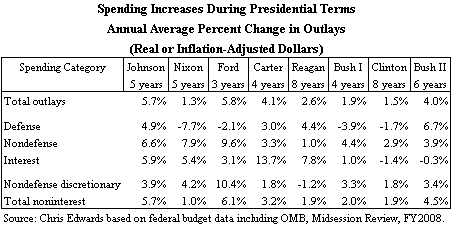
Chris Edwards of Cato has the numbers:

Edwards_0907

I always laughed at Democrats that tried to woo me to their party.  Now I laugh at Republicans too.  MoveOn may get mileage out of attacking Bush, but he has done more for the left/liberal cause than Clinton.  Clinton had NAFTA, welfare reform, and (moderated by an aggresive Republican Congress) fiscal sanity.  While he too had an Iraq-like war in Kosovo, he never got sucked into the sweeping nation-building Bush has taken on.

Bush II is also leading this poll for the modern inductee to the free market hall of shame.

Ubelieveable

This is one of the most incredible videos I have ever seen.   It looks like a big wack-a-mole game.  The last half of pious analysis is kind of boring but the first half is incredible.

Don't Ever Lend Money to Politicians

I don't have a problem with someone who has had a bankruptcy in the past.  Bankruptcy is not some Scarlet B that should ruin one for life.  Ideally, its bad enough that folks should want to avoid it but forgiving enough that people can move on and get a fresh start.  Via TJIC

"¦ moderator Tim Russert asked former senator Mike Gravel about Gravel's
somewhat troubled financial history. A condominium business started by
Gravel went bankrupt, and Gravel himself once declared personal
bankruptcy. "How can someone who did not take care of his business,
could not manage his personal finances, say that he is capable of
managing the country?" Russert asked.

Here would be my answer:  "Bankruptcy does not necessarily mean that one has managed finances poorly or that one is somehow guilty of malfeasance.  It can mean those things, but it can also mean that one took a risk on a business vision, did the best job possible, but the vision turned out to somehow be wrong.  Some of the greatest names in American business backed Internet ventures that went bankrupt.  Some were just poorly managed, but many just made poor bets as to what would and would not work over the internet.  When people look at Enron, they assume that there must have been malfeasance for the company to go bankrupt.  And while folks were indeed breaking some laws there, those actions had nothing to do with Enron's bankruptcy.  Enron died because they made some huge bets on things like broadband that didn't pan out."

Here, in contrast, is Gravel's response:

"Well, first off, if you want to make a judgment of who can be the
greediest people in the world when they get to public office, you can
just look at the people up here," Gravel said in a nod to his fellow
candidates.

"Now, you say the condo business," he continued. "I
will tell you, Donald Trump has been bankrupt 100 times. So I went
bankrupt once in business.

Doesn't this guy sound like some overweight guy wearing a wife-beater and sitting in his trailer with a cheap beer watching a baseball game on his old black and white TV, railing against all the rich guys that never gave him a chance?  But the best is yet to come:

who did I bankrupt? I stuck the credit card companies with $90,000 worth of bills, and they deserved it "“ "

People in the audience began to laugh.

"They
deserved it," Gravel repeated, "and I used the money to finance the
empowerment of the American people with a national initiative."

That sound you hear is the dying gasps of individual responsibility.  And what the hell is that last part about "empowerment of the American people?"  Sounds like Gravel is channeling Lee Hunsacker.