Gut Them Like Trouts

Kevin Drum is glad the Democrats are ready to body-slam the health insurance companies, and is rooting them on:

It means the health insurance industry is scared that we might actually do something in 2009 and they want to be seen as something other than completely obstructionist. That means only one thing: they've shown fear, and now it's time to bore in for the kill and gut them like trouts. Let's get to it.

Because everyone knows that most of the costs of healthcare reform can be paid for by ripping the excess profits out of the health insurance business like a liver from a fish.  Just to remind everyone, these are net profit margins reported by Google Finance for 3Q2008 of the largest health care providers and insurers:

Cigna: 3.50%
United Health Group: 4.56%
Aetna: 3.64%
WellCare:  4.08%
Amerigroup: 3.51%
Humana 2.56%
WellPoint: 5.49%

Napolitano to Homeland Security

Yeah, I know it is not a done deal, but the rumors are that our governor Janet Napolitano will be Obama's choice for Homeland Security.

On its face, this both makes a ton of sense, and simultaneously is odd.  It makes sense because Napolitano is one of those rising Democratic stars who get special love in part for not being white males.  It is odd because pulling her up to Washington would, by law, pass the governorship for the next two years to the Republicans (the Secretary of State completes the term, and she is a Republican).  It also strikes me as odd because I think Homeland Security would be an absolutely awful platform for launching a run for higher office.  That job has no upside - it is all downside.

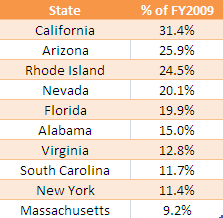
But the final reason in the end that this may make sense can be seen in this table below from Paul Kedrosky on projected state budget deficits as a percentage of state revenues:

state_deficits

Arizona is almost in as bad of shape as California, and California is a disaster area.  So the financial chickens are about to come to roost here in Arizona for the drunken spending spree the state has been on, presided over by Napolitano.  To preserve her from going to the Gray Davis Memorial Retirement Home for Failed Governors, Obama is likely to beam her up to Washington.

Last One -- Thank God

My kids' middle school has a tradition among 5th and 6th graders that once a year each student creates a science model out of food.  The kids love it, because they get to eat them after each presentation.  But all we parents know how stressful science fair projects can be.  Trying to create a meaningful science display from only edible materials is really a pain.  We pretty much nuked the kitchen this Sunday and spent all day with this.  But it's the last one!  And it came out pretty well -- this is my daughter's "physics of the circus."

edible

PS - TGFF - Thank God For Fondant, a material used in making fancy cakes that you can think of as edible clay.  The materials here are graham cracker, Hershey bar, and sugar wafer stands, gum drop and lemon ball audience, frosted vanilla cake for the platforms, pretzels for the posts, licorice for the ropes, donuts for the cannon and the hoop, and fondant for the animals and people.  And two full pounds of royal icing to glue everything together.

PSS - One of the things you discover about food is that despite the incredible amount of quality control on its composition and taste, there is not much quality control on its construction properties.  Pretzel rods that always seemed straight enough turn out to be, when you come to actually build something from them, more warped than picked-over Home Depot lumber.  Ditto graham crackers.  Mini donut sizes vary tremendously.  Licorice tensile strength that always seemed fine turns out to be woefully inadequate.  And don't even get me started on gumdrop repeatability.

A Thought on Global Warming Action

Here is the hard truth for those of us who believe that, since CO2 has had little effect on global temperatures to date, expensive abatement plans will similarly have little if any measurable effect:  They are coming anyway.  It is actually probable that the Republicans could combine with heavy industrial states like Michigan in the Senate to block dramatic new legislation.  But President Obama already has the legal and legislative authority to enact sweeping and expensive CO2 mandates without going back to Congress. 

So with that depressing thought, here is a bit of good news:  The media may well come over to the skeptics' side soon, at least partially.  Here is why:  The media is extraordinarily loath to really challenge policy proposals in advance that are popular with the center-left.  They are even less likely to challenge said proposals when they touch on a story of doom.  There is nothing the media enjoys more than piling on a good public scare. 

But history has shown that the media will turn on these proposals once they are implemented, and sometimes quite soon after.  Remember ethanol subsidies?  The press were behind this crap all the way, until Congress passed enhanced subsidies a while back, and then the press suddenly starting "discovering" the effect on rising food prices, the environmental problems with land use, the ugliness of some of the subsidy politics, the fact that few scientists think corn ethanol will actually reduce CO2, etc.  Yeah, I know, all of this was entirely predictable (and predicted by many of us) in advance.  But this just seems to be how the media works.

Because the only thing the media loves more than fear-mongering a crisis that is 20-years away is fear-mongering one that is visibly upon us.  The press freaked at the California energy crisis a few years ago, peppering the public with stories of rising prices and rolling blackouts.  And what has happened since then?   Electricity demand has risen, no one can build electrical capacity, wind and solar are a joke, and Obama is only going to make it harder and more expensive to produce enough power (I think Obama's exact words were "bankrupt the coal industry.") 

Get Bob Cratchitt to Do It

The Town of South Attleboro, MA sent out wildly threatening past due letters for folks with balances as low as 1-cent  (thereby investing at least 42 cents to get one back).  In response to charges that this was stupid, City Collector Debora Marcoccio responded:

A computer automatically printed the letters for any account with a balance remaining, and they were not reviewed by staff before being sent out, Marcoccio said.

"It would be fiscally irresponsible for me to have staff weed through the bills and pull out any below a certain amount," Marcoccio said. " And what would that amount be?"

What, are we living in the 19th century with clerks in a musty room preparing bills by hand?  This fix probably requires one whole entire line of program code in the billing system to fix.  I could probably teach myself to code whatever language the payroll system is written in (my guess is COBOL, which, god help me, I already know) in less time than this woman has spent fielding complaints and media inquiries.  Compare this to what TJIC has to do just to get the mail out.

And don't you love people who don't even have enough spine to make a simple decision about the cutoff for minimum bill size.  I have found this is one of those things the government is really, really bad at -- making decisions under uncertainty  (which covers about all decisions, except routine ones embodied in SOP).  Government has no incentives, in general, for productivity, or production, or customer satisfaction.  The only time government employees get feedback at all is when they get negative feedback from having someone yell at them for making a decision that some higher-up didn't like..  So if a decision is not justifiable either by past precedent/SOP or explicitly by the rules, it is not made.

By the way, I had a personal programming milestone last night.  I finally built a website without using a WYSIWIG editor that formatted the way I wanted it to all in CSS without a single table.  I predict that now that I have finally gotten a decent handle on CSS, which mainly consists of learning all the workarounds for when it doesn't work as you would expect, that someone is about to introduce a whole new system for formatting web pages.

Thanks Bush Family

Update:  Chart below is not correct.  It's enough in error that I have deleted it.  Author explains here.

William Biggs has a bunch of charts showing historic federal outlays, but below is his chart for year-over-year changes in federal outlays per capita, adjusted for inflation:

CHART DELETED

Random Entertainment Notes

I feel I need to clarify one thing.  I am a huge fan of the old Bond movies.  Goldfinger, Thunderball, Diamonds are Forever, Goldeneye -- all great.  Despite my comments above, I even like most of the Roger Moore films, though you have to take a different approach to them.  But the formula was tired.  The Survivor formula was hugely popular at first, but in season 9 or 10 or whatever, it's just done.  You either are repeating the same tired cliches, because you feel locked into a formula by your fans who will get pissed (as they did with Casino Royale) when you violate any minute detail the Formula, or you fall into the trap of trying to top yourself with goofier and goofier plots.  I actually thought the series was dead around about View to a Kill, but Pierce Brosnan really brought new life to the series for a while.

Oh, and I wanted to really make fun of the plot in the new movie, because it really is a great WTF moment, but I didn't want to include a spoiler, since there is some mis-direction in the movie.  However, the spoilers have already come out in the comments, so if you are interested, I reveal the incredible world-shaking evil plot around comment #6 here.

  • I saw a trailer for the upcoming Star Trek movie, which could essentially be called "young Spock and Kirk."  It could be good.  Talk about a franchise, though, that has been milked to death.  A new take would be refreshing.  We'll see.  Never forget Battlestar Galactica - from the ultimate in goofiness came one of the better science fiction series to hit television.
  • The note above reminds me of an idea I have for a movie that I think would be a no-brainer.  The Star Wars clone wars stuff has pretty much lost me  (actually the dialog in episodes 1-3 pretty much lost me).  But I always thought a young Han and Chewie movie - how they met, various pirate adventures, young Lando, etc.  would be almost a layup to make succesful.  I am increasingly convinced that that the Star Wars movies were good almost in direct proportion to how much Han Solo was on the screen  (well, maybe pre-dryfreeze Han Solo -- after he was unfrozen, he was a little goody-two-shoes for my taste.)

Humiliating Your Pet

My COO reports that his dog Ranger was slashed pretty badly in brawl with a javelina near the family home.  The dog is doing fine, and should be proud he defended his territory against the evil interloper.

So why is the poor dog being humiliated?  OK, he has to wear one of those funnel things that keep the dog from picking at his stitches.  These are kind of embarrassing, but after being nearly emasculated in the field of battle, does he really need this indignity, courtesy of my friend's daughter?

dog_flower

Poverty Is Not Sustainable

This article from Climate Resistance about the sustainability movement is terrific.  I want to excerpt a relatively long chunk of it:

It is our belief that Oxfam's increasingly shallow campaigns reflect the organisation's difficulty in understanding development and poverty, and the relationship between them. In other words, it seems to have lost its purpose. This is a reflection of a wider political phenomenon, of which the predominance of environmentalism is a symptom. We seem to have forgotten why we wanted development in the first place. It is as if the lifestyles depicted in Cecil's painting were to be aspired to, were there just a little more rain. Development is a bad thing. It stops rain.

If we were to add a city skyline into the background of Cecil's painting it might ask a very different question of its audience. Why are people living like that, with such abundance in such proximity? Of course, in reality, many miles separate the two women from any such city, but the question still stands; there is abundance in the world, and there is the potential for plenty more. Yet Oxfam have absorbed the idea from the environmental movement that there isn't abundance. This changes the relationship between development and poverty from one in which development creates abundance into one in which development creates poverty; it deprives people of subsistence. But really, the city (not) behind the two women could organise the infrastructure necessary to irrigate the parched landscape, the delivery of fertiliser, and a tractor. The field could be in full bloom, in spite of the weather. The two women could be wealthy.

Oh no, says Oxfam. That's not sustainable....

The myth of sustainability is that it is sustainable. The truth is that drought and famine have afflicted the rural poor throughout history "“ before climate change was ever used to explain the existence of poverty. Limiting development to what "˜nature' provides therefore makes people vulnerable to her whims. Drought is "˜natural'. Famine is "˜natural'. Disease is "˜natural'. They are all mechanisms which, in the ecologist's lexicon are nature's own way of ensuring "˜sustainability'. They are checks and balances on the dominance of one species. To absorb what Hitler called "˜the iron logic of nature' is to submit to injustice, if famine, drought and disease characterise it. We can end poverty, but not by restricting development. Yet that seems to be Oxfam's intention. That is why we criticise it.

Hat tip:  Tom Nelson.

Intellectual Network Effects

John Scalzi writes:

I do get occasionally amused at being a poster child for Science Fiction's Digital Future when I live in a rural town of 1,800 people with agricultural fields directly to my east, south and west, and Amish buggies clopping down the road on a daily basis. It's, like, three cheers for cognitive dissonance.

I responded in the comments:

I would have had exactly the opposite reaction, that your situation is entirely representative.  For 500 years,  from the Italian Renaissance through the 20th century, intellectual thought moved forward mainly hand in hand with urbanization.  I am not really an expert in describing the ins and outs of this, but there is clearly a density and network effect to intellectual advancement, and given past communication approaches, this required physical proximity.  The promise of modern IT technology is that it may allow us to achieve this density without physical proximity.

A Bit More Hope Than I Thought

GM, as reported by Reason's Hit and Run, has actually already had something of a breakthrough in labor costs, at least for new employees:

The current veteran UAW member at GM today has an average base wage of $28.12 an hour, but the cost of benefits, including pension and future retiree health care costs, nearly triples the cost to GM to $78.21, according to the Center for Automotive Research.

By comparison, new hires will be paid between $14 and $16.23 an hour. And even as they start to accumulate raises tied to seniority, the far less lucrative benefit package will limit GM's cost for those employees to $25.65 an hour.

So this puts GM in the position of shoving experienced employees out the door as fast as they can, to make way for lower cost employees hired under this new deal.  Apparently GM also has more flexibility to manage costs in a downturn.  Good news, assuming they can accelerate a 20 year demographic transition to about 6 months, avoid giving away too much to these newer workers when times are good again, and arrest market share declines with better cars. Oh, and I presume the UAW has not abandoned seniority, which means that in recession-driven layoffs over the next year, GM must being by laying off these much cheaper younger workers.  Layoffs will actually mix their labor cost upwards.

I still don't want to bail them out.  Like numerous other industries, from steel to airlines, there is no reason GM shouldn't have to pass through Chapter 11 on the road to recovery.  However, the argument that GM is turning a corner if we just give them a little help seems to be persuasive with many folks around me, so much so I am tempted to buy some GM stock as a way to go long on my prediction of the creeping corporate state.

Update: On the other hand, this is a sign that GM may be scraping the bottom of the barrel for cash:

Cash-strapped General Motors Corp. said Monday it will delay reimbursing its dealers for rebates and other sales incentives, an indication that the company is starting to have cash-flow problems....Erich Merkle, lead auto analyst at the consulting firm Crowe Horwath LLP, said GM wouldn't delay payments if it had enough cash.

In the third quarter of this year, GM's operations burned through $7.5 billion in cash, offset somewhat by asset sales and financing activities.  But this is really a pre-recession burn rate.  What will the burn rate be over the next 6 months?  There is an argument to be made that $25 billion is not going to last even a year, particularly given the dynamic that layoffs will hit mostly the lower-cost workers, and a Democratic Congress and Administration that is handing over the money may well restrict GM's freedom of movement on layoffs anyway.  I can see the Obama administration now -- don't lay them off, lets put them all in a factory making green energy, uh, stuff.

"I don't even think they've got 60 days," Merkle said. "Their cash position is probably getting pretty weak right now, and it's cutting into those minimum reserves that they need on hand."

Great Report on Earmarks

The Seattle Times has done a ton of work on earmarks, and has a report here.  Nothing here will be much of a surprise for earmark critics.  This was probably my favorite bit:

Last year, Congress promised to shed light on the secretive process. But the lists of earmarks are still buried in obscure documents that are difficult to find and search. Until Congress put them online a couple of weeks ago, the House disclosure letters, linking lawmakers to companies, were thick volumes of paper kept in a cabinet in the offices of the House Appropriations Committee.

When a reporter for the Congressional Quarterly pointed out how difficult it remains to pull all the information together, Rep. John Murtha, D-Pa., chairman of the committee that drafts the defense bill, had a quick answer: "Tough shit."

Murtha, for those who don't know, consistently leads the earmarking numbers, and came in #1 among Congressmen in reaping campaign donations from earmark recipients, bringing in over $1.6 million.  They have a database here where you can look up your Congressman (mine, John Shadegg, was one of the few with zero).  My sense is that this database is only from the military appropriation and that there are many more earmarks hidden out there in other bills, but it is a good start.  (hat tip Hit and Run)

The new, but not surprising, information for me was how Congress easily sidesteps the new disclosure rules.

After months of investigating the $459 billion 2008 defense bill, The Times found:

  • The hidden $3.5 billion included 155 earmarks, among them the most costly in the bill. Congress disclosed 2,043 earmarks worth $5 billion.
  • The House broke the new rules at least 110 times by failing to disclose who was getting earmarks, making it difficult for the public to judge whether the money is being spent wisely.
  • In at least 175 cases, senators did not list themselves in Senate records as earmark sponsors, appearing more fiscally responsible. But they told a different story to constituents back home in news releases, claiming credit for the earmarks and any new jobs.

The Times includes several irritating but entertaining stories of rent-seeking.  Take Cyberlux, for example.  What do you do when your company has sunk $50 million into a new product, has a $18 million a year burn rate, and only has $300,000 is revenues for the first six months of the year?  Why, you call your Congressman and generate revenues via earmarks, with a quick thank you in the form of company-sponsored fundraising for said representative.

And this certainly is a feel-good story for those rooting for the government to re-engineer the American auto industry:

Latrobe Specialty Steel of Latrobe, 40 miles east of Pittsburgh, makes specialty steel for aircraft parts.
In 2006, its parent company, Timken, spent $2.9 million lobbying Congress on various issues and persuaded lawmakers to ban the Defense Department from buying any products using foreign-made specialty steel. As the sole U.S. producer of certain kinds of specialty steel, Latrobe saw its orders climb. Timken then sold Latrobe to a group of investors in a $250 million deal.

But the buy-American restrictions for specialty steel caused serious problems for the Air Force, creating a 17-month lag in getting spare parts for aircraft used in the wars in Iraq and Afghanistan.

In May 2007, Latrobe said it needed to expand but complained of high electric bills and publicly threatened to build a new plant in Virginia or West Virginia instead. Pennsylvania offered grants and tax credits to the company worth $1.2 million.

In Congress, lawmakers were quietly lining up a much sweeter package.

In the defense bill passed in December, someone had inserted language that ultimately directed $18.4 million for "domestic expansion of essential vacuum induction melting furnace capacity and vacuum arc remelting furnace capacity."

"Latrobe Specialty Steel is the only domestic producer of that steel," Army Lt. Gen. William Mortensen said at a hearing.

A month after the bill passed, Latrobe began a $62 million expansion in its home state.

No one in Congress has admitted sponsoring the Latrobe earmark.

One congressman's fingerprints, however, weren't so easy to conceal. Latrobe sits in the congressional district of Rep. John Murtha, a Democrat who chairs the subcommittee that drafts the defense bill and wields the most power over defense earmarks.

Latrobe's officials have given $5,000 to Murtha's re-election fund in the past two years.

Also, Murtha had talked about giving taxpayer dollars to Latrobe. "We're trying to get together to see how we can work out an increased capacity for that particular company," Murtha said at a subcommittee hearing in April 2007. "I've talked to that producer. And what I'd like to see is them put some money in, us put some money in, and reduce the time it takes to get those spare parts out."...

The company would not comment on any discussions it had with Murtha. A spokeswoman defended getting the grant, saying it had been competitively bid. Even so, she acknowledged that Latrobe is the sole U.S. producer of certain specialty steels, a requirement for getting the money.
You Mean It Was Just A Money Grab? I'm So Disillusioned

Via the Liberty Papers:

U.S. states have not lived up to their commitment to devote a major portion of their huge legal settlement with the tobacco industry a decade ago on anti-smoking efforts, health advocacy groups said on Tuesday.

In the 10 years since the landmark deal, the states have received $79.2 billion of the settlement and another $124.3 billion from tobacco taxes, but have spent only about 3 percent of it "” $6.5 billion "” on tobacco prevention and cessation programs, the groups said in a report.

Gee, I really thought the settlement was about health care and tobacco education, and now I find out it was just a crass money grab?  Who could have ever predicted that?

Those who have read my novel will recognize the sarcasm.

A Well-Deserved Honor

Boston City Hall as the world's ugliest building.  I would add an honorable mention to Boston's Peabody Terrace, the ugliest building I have ever lived in.

Choices Make a Difference

I have no problem if women want to spend four years at college studying (at their own expense) the role of indigenous women in the postmodernist Marxist movement of 1960's Paraguay, or whatever.  However, I do have a problem when these same folks later complain that their income is below average or they are under-represented in the board room.  Just peruse the top and bottom of this list at Carpe Diem

College degrees most dominated by women include library science, consumer science, social science, education, language, psychology, and gender studies.  Top college degrees most dominated by men include construction trades, engineering tech, transportation, military technologies, engineering and computer science. 

Sorry, but I cannot imagine any possible restructuring of society and the economy where the first list is more valuable and has higher income potential than the second list.

$485 Billion in Value Destroyed, and Counting

David Yermack has an awesome essay in the WSJ this weekend, encouraging Congress to just say no to spending $25-$50 billion bailing out Ford and GM.  Why?  Well, beyond the obvious moral hazard, these companies are value destruction machines of epic proportions.

Over the past decade, the capital destruction by GM has been breathtaking, on a greater scale than documented by Mr. Jensen for the 1980s. GM has invested $310 billion in its business between 1998 and 2007. The total depreciation of GM's physical plant during this period was $128 billion, meaning that a net $182 billion of society's capital has been pumped into GM over the past decade -- a waste of about $1.5 billion per month of national savings. The story at Ford has not been as adverse but is still disheartening, as Ford has invested $155 billion and consumed $8 billion net of depreciation since 1998.

As a society, we have very little to show for this $465 billion. At the end of 1998, GM's market capitalization was $46 billion and Ford's was $71 billion. Today both firms have negligible value, with share prices in the low single digits. Both are facing imminent bankruptcy and delisting from the major stock exchanges. Along with management, the companies' unions and even their regulators in Washington may have their own culpability, a topic that merits its own separate discussion. Yet one can only imagine how the $465 billion could have been used better -- for instance, GM and Ford could have closed their own facilities and acquired all of the shares of Honda, Toyota, Nissan and Volkswagen.

Like GM Executives Buying Toyotas

I am not sure this chart from Mark Perry requires much comment, except to say the contrast on the same metric for the children of members of Congress would be even more stark.

teachers

Kelo Update

The AntiPlanner has an update on the New London, CT development that spawned the notorious Kelo case.  In short, they tore Ms. Kelo's house down against her will, and then the whole development deal fell through.  The city now has a nice vacant lot.

The homes of Susette Kelo and her neighbors have all been torn down or removed. But, except for the remodeling of one government building into another government building, virtually no new development had taken place in the Fort Trumbull district by May, 2008.

Having spent at least $78 million on the Fort Trumbull project, the city had awarded development rights to a company named Corcoran Jennison, which planned to build a hotel, an office complex, and more than 100 upscale housing units. The developer had until November, 2007, to obtain financing.

When that deadline lapsed, it received an extension to May 29, 2008. In desperation, the developer sought an FHA loan of $11.5 million. When that didn't work and May 29 came and went, New London revoked the agreement.

Quantum of Solace

First, I want to preface that I absolutely loved Casino Royale.  I had expected not to like it, being skeptical of Daniel Craig and the apparently trendy substitution of Texas Hold'em for Baccarat.  But the movie was fabulous, easily the best Bond ever, and a long-overdue retooling of the franchise.  In comparison, the campy Roger Moore 70's Bond movies are almost embarassing.

All that said, I was disapointed in Quantum of Solace.  The movie was entertaining and worth the price of admission, but two aspects really hurt the movie for me:

  1. The directors have adopted the currently popular edgy filming style of action sequences which involve lightning quick cuts and jerky camera pans (used in the Bourne movies, for example).  The style really increases the confusion of the moment, and has its place in creating tension and giving a first person feel to the action, but it gets tiring and confusing after a time.  Compare the opening chase sequences in this movie to the absolutely fabulous chase scene through the construction site near the beginning of Casino Royale.  I thought the Casino Royale sequence was much a better, but I must admit I am a big fan of long tracking shots over quick cuts, so I guess your mileage may very.  There was one shot I thought really cool in the new movie.  Bond and mystery villain #3 or 4 fall through a glass ceiling, and you fall with them POV-style. 
  2. The movie seems to be a return to the WTF-style plot of a lot of modern action movies, especially sequels, that put one-upping the action sequences of the previous movie over having a coherant plot.  I don't mind twists and turns, but in the end, all the motivations have to make sense.  I mean, how many mystery guys can Bond chase, kill, and then say, well, I guess we'll never figure out who that guy was.  The early parts were like the Seinfeld version of action movies -- they are not about anything, they are just chase scenes.  And, I still don't understand why the bad guys in QoS are doing what they are doing.  Its another one of those "spend a billion dollars in a vast conspiracy to make $100 million" Bond villain plans.  In contrast, Casino Royale was anchored to what I think was the best Ian Fleming book, and it stuck close to the book.  Even when it deviated, for example with the shift from bacarrat to Texas Hold'em, it actually improved the plot, as it shifted to a game that at least involves some skill.

Update:  I feel I need to clarify one thing.  I am a huge fan of the old Bond movies.  Goldfinger, Thunderball, Diamonds are Forever, Goldeneye -- all great.  Despite my comments above, I even like most of the Roger Moore films, though you have to take a different approach to them.  But the formula was tired.  The Survivor formula was hugely popular at first, but in season 9 or 10 or whatever, it's just done.  You either are repeating the same tired cliches, because you feel locked into a formula by your fans who will get pissed (as they did with Casino Royale) when you violate the formula, or you fall into the trap of trying to top yourself with goofier and goofier plots.  I actually thought the series was dead around about View to a Kill, but Pierce Brosnan really brought new life to the series for a while. 

Update #2:  Tigerhawk has similar thoughts

Regulation is About Protecting Incumbents

Darin Morely sent me this.  Woe be it to the upstart competitor with a new business model who challenges an incumbent with political connections.  This goes double when the incumbent is the government itself:

One of the great things about the web, obviously, is that it allows for much more efficient communication that opens up new and useful offerings. For example: the web offers the ability to find other people traveling to the same general place you're heading and to set up a convenient carpool. It's good for the environment. It's good for traffic. It just makes a lot of sense. Unless, of course, you're a bus company and you're so afraid that people will use such a system rather than paying to take the bus. That's what happened up in Ontario, as earlier this year we wrote about a bus company that was trying to shut down PickupPal, an online carpooling service, or being an unregulated transportation company. TechCrunch points us to the news that the Ontario transportation board has sided with the bus company and fined PickupPal. It's also established a bunch of draconian rules that any user in Ontario must follow if it uses the service -- including no crossing of municipal boundaries -- meaning the service is only good within any particular city's limits.

All of us in the states need to be prepared for more of this corporate economy thing in the US.  I saw last night on Sunday Night Football that NBC is really going hard on some green initiative, including having a green peacock.  GE (parent company of NBC) is a smart company and sees the writing on the wall.  It understands the new administration and Congress seem hell-bent on moving us to a more European model.  In that model, there are 10-20 corporations per country that insinuate themselves into government and get the opportunity to help run the country to their own benefit.  GE wants to be one of these chosen few.  The push is going on not just at NBC, but in light bulbs (betting on Congressional action to provide regulatory support for a new type of bulb they have invented) and in power systems (who are making large bets on wind that will not pay off without a government subsidy program).

In the near term, GE may need a bailout in its financial arm.  GE must have seen that GM made a huge public push for its Chevy Volt over the last 6 months, spending hundreds of million in advertising on a car that does not exist yet. Why would a company near bankrupcy do this?  We now know the advertising was aimed at Congress and the Administration, not consumers, trying to burnish their green image to give Democrats enough political cover to vote for the bailout their UAW supporters so desperately need  (any chapter 11 would likely result in enormous restructurings of union contracts).

So Just What Was the Omitted Intervention

In a post earlier today on the mortgage market meltdown, I wrote:

And that is what the argument usually boils down to - someone smart should have been watching them.  But lots of smart people were watching all the time.  You can see one such person featured in Lewis's article.  Guys run all over Wall Street looking every day for some single digit basis point spread they can make money off of.  But untold wealth was just sitting there for someone who was willing to call bullshit on the whole CDO/CDS pyramid game.  These guys playing this game were searching for people to bet against them.

And despite this, despite untold wealth as an incentive, and companies looking for folks to take the other side of their transactions, only a handful saw the opportunity.  Thousands of people steeped in the industry with near-perfect incentives to identify these issues ... did not.  What, then, were our hopes of having some incremental government bureaucrats do so?  Usually, after this kind of crisis, there are lines of pundits and writers ready to suggest, with perfect hindsight, new regulations to avert the prior crisis.  But, tellingly, I have heard very few suggestions.

So in this context, I found these comments by leftish Kevin Drum, certainly no knee-jerk advocate of free markets, quite interesting:

No argument on the greed and ideology front, but I'm curious: was there really anyone who made the right call on all this at a policy level? There were, of course, plenty of people who recognized the housing bubble for the idiocy that it was (Alan Greenspan notably not one of them), but were there any major voices making specific policy proposals to slow down the bubble? Or rein in the mortgage market? Or regulate the CDO/CDS market in a way that would have prevented some of
the damage? I'm talking specifics here, not just general observations that the FIRE sector was out of control. Arguments about interest rates being too low count, if they were made for the right reason, but I'm interested mainly in more detailed recommendations.

I don't have any big point to make here. I'm genuinely curious. There were many moments in the past few years when perhaps something could have been done, but what? And who was proposing serious measures that would have helped? Any major Dems? Economic pundits? Wall Street mucky mucks? Who were the unsung heroes? Help me out here.

A Peak Inside the Boiler Room

I got another boiler room broker call today, so I guess the recent downturn has not flushed out all the cockroaches.  A while back I discussed the frequent calls I get from boiler room stock promoters.  The approach they use with me is this:

So the other day, I accidentally let one of them go further than I usually allow.  He said he was from Olympia Asset Management.  (There is an Olympia Asset Management web page, but I don't know if it is the same company and the web page has not been updated for several years.)  I let him run for a bit because a friend of mine runs a very well-respected financial planning firm with a different name but also with Olympia in the title, and for a moment I thought it might have been one of his folks.

Anyway, he proceeds to try to convince me that we have talked before and discussed a certain security.  "Remember me, we talked six months ago about ____".  Of course, I had never heard of the guy.  At this point I usually hang up, because I have heard this crap before -- it is a common pitch.

Its pretty clear to me now that this is what he is doing:

  1. Trying to imply that we have some kind of relationship we actually don't have.  Or worse...
  2. Trying to convince me that he touted stock A six months ago, so now he can tell me stock A has gone up in price.  Many reputable brokers built their reputation by cold calling people and saying:  Watch these 3 stocks and see how they do and I will call you back in 6 months.  That way, you can evaluate their stock picking without risk.  The modern sleazy approach is to pick a stock that has gone up a lot in the last 6 months, and then call some harried business person and pretend you called them with that pick 6 months ago, hoping that they will give you the benefit of the doubt.

The call just went downhill from there.  I hung up after his discussion of throwing Molotov cocktails into the cars of people he doesn't like.  That was right after I asked him if Tony Soprano was standing beside him listening in on the call.

Anyway, beware.  The guy today called me and asked me if I remembered him calling 6 months ago predicting the downturn in the mortgage market and the crash of the financial stocks.  You are not crazy - no matter how certain the guy seems, you really did not talk to him 6 months ago.

By the way, I am not the only one getting this pitch.  Ed Moed got the same pitch from the same script from the same company.  Many of his commenters share similar experiences.

Update: Wow, they sure do like Mitt Romney over at Olympia Asset Management.  I'm sure there was no arm-twisting here, when every single employee of the company seems to have given the max donation to the same candidate, with no breaking of ranks.

Update #2: Mike Murphy, CEO of Olympia Asset Management, was "a member of the [Hoffstra's] elite football team."  Wow.  Remember that time Hoffstra ripped through all those SEC teams?  Yeah, neither do I.  Anyway, this achievement does not hold a candle to the fact that I was once captain of Princeton Tower Club's elite intramural coed field hockey team.

A Better 404 Page

Google's got a new little widget one can embed in a custom 404 error page that looks like this.  Its cool because in addition to a search box, it claims to be able to provide the user the closest matching page in cases of typos.  I am playing around with it for several of my sites, though I don't think it is an option for the blogs -- I am pretty sure there is no way to implement a custom 404 page on a typepad search.  By the way, the Google dashboard / webmaster tools site is pretty helpful, particularly if you are really interested in where and how your search traffic is coming in.  I implemented a new sitemap for each of my blogs and uploaded them to google via the webmaster tools site and saw an immediate increase in search hits.

Kudos for Typepad

I have criticized the new Typepad editor several times in the last several weeks, and I stand by those criticisms.  It is just daffy to have a spell check without a "skip all" or "add to dictionary" option, for example.

But Typepad has really come through for me in the last several days.  Their customer service folks helped me modify some of my archive templates so that they include even my oldest posts, and the archives now have a new navigation structure.  Also, I would add that for all the problems I have had with the editor, the new publishing platform I am on is much faster, and at least once has been able to help me recover unsaved material I was writing, always a pet peeve of mine when using an online editor. 

Seductive Technocracy

The technocratic compulsion is very seductive to a lot of people (including, I think, our President-elect).  I can't tell you how often I hear "if we just had one smart person to clean up the mess..."  But it never works.  Just think about this auto czar idea being trial-ballooned this week.  Even if you could find someone brilliant enough to perfectly discern and synthesize the diverse buying interests of a hundred million consumers, he can never have the right incentives sitting in that government job.  Pretty soon he has group A insisting that he needs to mandate more fuel economy and group B that he needs to protect union jobs and group C that he needs to save jobs in Michigan in preference to Ohio and group D advocating for Ohio over Michigan and... you get the point.  All rolled up with the incentive problem that if he actually solves the problem at hand, he will be out of a job, so you can bet the problem is never fully solved.

My wife read the Michael Lewis article and comes back to me and says "I can't imagine how you can read that and still oppose government intervention and increased regulation."  I said, "why?"  Sure, people screwed up and did stupid stuff, but no defender of capitalism promises that won't happen.  Besides, what regulation would you propose?  "I don't know, but someone smart should have been watching them."

And that is what the argument usually boils down to - someone smart should have been watching them.  But lots of smart people were watching all the time.  You can see one such person featured in Lewis's article.  Guys run all over Wall Street looking every day for some single digit basis point spread they can make money off of.  But untold wealth was just sitting there for someone who was willing to call bullshit on the whole CDO/CDS pyramid game.  These guys playing this game were searching for people to bet against them. 

And despite this, despite untold wealth as an incentive, and companies looking for folks to take the other side of their transactions, only a handful saw the opportunity.  Thousands of people steeped in the industry with near-perfect incentives to identify these issues ... did not.  What, then, were our hopes of having some incremental government bureaucrats do so?  Usually, after this kind of crisis, there are lines of pundits and writers ready to suggest, with perfect hindsight, new regulations to avert the prior crisis.  But, tellingly, I have heard very few suggestions. 

Back in the 1980's, everyone was freaked out about junk bond-financed hostile takeovers, greenmail, leveraged buyouts and the like.   Since, while this activity has not disappeared, the wackiest of this behavior has really died down.  Do you remember that act of Congress and subsequent regulation that really curtailed this behavior?  Yeah, neither do I.  The fact is that, if they are allowed -- and if they are not shielded by taxpayer-funded bailouts from the consequences of their actions -- individuals learn from their excesses.  Or they go bankrupt.