The Bailout Playbook

Step 1:  Really, really screw up your industry beyond all hope of repair, while paying yourself a nice salary to do so

Step 2:  Claim to the world that your industry is unique and different, and failure of your company and/or industry will cause a chain reaction that will bring down the whole economy and cost the country many multiples of the bailout price tag

Advocates for the nation's automakers are warning that the collapse of the Big Three - or even just General Motors - could set off a catastrophic chain reaction in the economy, eliminating up to 3 million jobs and depriving governments of more than $150 billion in tax revenue.

Step 2 is obviously pulled off easier if either a) representatives from your industry run the Treasury department or b) the new President owes your unions big time for his recent victory in a critical state.  For those of you just trying to keep you small business afloat, don't try this at home.  No bailout will ever be forthcoming if you don't have the power to move electoral votes, but you should expect to pay for other people's bailouts.

Postscript: This is funny:

Automakers say bankruptcy protection is not an option because people would be reluctant to make long-term car and truck purchases from companies that might not last the life of their vehicles.

I think if people still buy tickets on airlines that are operating out of chapter 11 (an item that has zero value if the company folds) then people will still buy cars.  This is so totally lame it is tremendously irritating.

Michael Lewis on ... Whatever the Hell is Happening on Wall Street

As usual, Michael Lewis is a great and informative read, trying to unravel the whole subprime mortgage / CDS / CDO bundle somewhat for laymen.  The article does not excerpt well, but I would summarize it in saying he identified four mistakes by the financial world.  The first two I would describe as real problems but not really new mistakes -- something similar could have been said about S&L's in the 1980's.  These are:

  1. A lot of subprime loans were issued to people with no freaking hope of repaying them, in an incredible general lowering of underwriting standards.  (we all should remember, though, the government and the media was trumpeting this as good news -- increase in home ownership rates, blah blah blah).
  2. People who bought these securities grossly underestimated the default risks, particularly in the crappiest tranches  (securitized packages of loans are resold in tiers, with a AAA tranche getting first call on any payouts, and the tail end BBB tier getting high interest rates but who takes the first principal losses if the loans default).

    But Lewis highlights two mistakes that are in some sense brand new.  These mistakes were effectively vast increases in leverage that acted as a multiplier for the subprime problem, while simultaneously spreading the problem into the hands of AAA investors who accepted the higher returns without paying too much attention to how they were obtained

  3. Someone started scooping up the BBB tranches from various securities packages, bundled these together, and somehow got a ratings agency to declare that the top 60% tranche of these repackaged dog turds were AAA. 
  4. Credit default swaps, originally insurance policies on loan portfolios, turned into a sort of futures market on subprime mortgage packages.  But, unlike futures markets, say in oil, where the futures trading volume are generally well under the total volumes of the underlying commodity flowing around the world, CDS values grew to as much as 100x the underlying commodity volume (in this case subprime mortgage securities).  CDS's went from a risk-management tool to a naked side-bet.

This is interesting stuff, and it was really only reading this piece that I think I started to understand #4 above (though if readers think I am describing this wrong, let me know).  All of this leads me to a few thoughts:

  • Nothing about this convinces me any of these firms need to be saved or bailed out.  Let them die.  Maybe the guys who rebuild the industry in their place will be smarter and more careful.  The country is going to face a recession whether Wall Street is bailed out or not -- too much (paper) value disappeared from consumer's net worths (or their perceptions of their net worth) for that not to be the case.  I lived through Texas in the 1980s when the S&L industry went bust almost to the last institution.   Nearly every one of the top 10 banks in the state went into FDIC recievership. 
  • I have seen people observe that this is an indictment of capitalism because so many people made such bad mistakes.  Sure.  No one said capitalism is a gaurantee against stupidity, or even fraud.  The difference is that the consequences of said stupidity and fraud have to be less in a free market system than if the same people had the power of cersion via government.  In a free market, these guys will fail and be wiped out and get washed away.  The people who they drag down may consider themselves to be innocent, but they participated of their own free will -- if they did not understand what they were doing, that is their problem.  In a statist system, you still have mistakes like this, but they are infinitely more catastrophic, as the stakes in play are often higher.  And the people who made the mistakes are never punished financially, because they are in charge of the machinery of state  (or friends of those in charge).  They make damn sure the power of the state is used to make everyone else pay for their mistake, kind of like ... this $700 billion bailout.
  • Lewis seems to have a hypothesis that the main system change that allowed all this to happen was the shift in ownership structure from partnerships to publicly-held corporations.  And certainly you do get some added agency risks with this, though I find this explanation a bit shallow.  I do think that folks with money are going to approach Wall Street "experts" and rating agencies with a lot more skepticism for a long time, and that can't be a bad thing.
  • The opportunity really exists for someone smart to start a brand new rating agency from scratch.  The only reason the current ones won't get wept away is simply that there are not many alternatives right now.  Warren Buffett should partner with someone well-connected with the new administration (Maybe Larry Summers, since there is no way he will survive a confirmation hearing with his men-are-from-large-standard-deviations-women-are-from-narrow-distributions baggage.)
  • Lewis is unfair in depicting all the mortgage lenders as predatory.  I am sure some were cheats, but remember that as far as Congress, the Administration, the Federal Government, and the media were concerned, these lenders making subprime loans were doing God's work -- they were expanding home ownership and bringing the dream of owning a home to poor people historically redlined, blah blah blah.  It is only with hindsight that we demonize them for doing the wrong thing -- at the time, absolutely everyone on in the country was pushing them to do exactly what they did.  This is also why Democrats struggle to suggest a resposive regulatory package to this whole mess, as any real reform would have to address minimum underwriting standards, which in turn would have the direct effect of limiting lending to the poor, an outcome with which no Democrat wants to be associated.

Update:  Just to be clear, as I have said before, this is about half of what happened.  There are really two stories, and usually authors focus on one or the other.  Story 1 is the steps taken by the Federal Government  (Fannie, Freddie, Community Reinvestment Act, mortgage interest deduction, low interest rates) that fueled the housing bubble and the expansion of credit to questionable borrowers.  It is described here, among other places.  Story 2 is the one above, how private firms decided not only to purchase these questionable loans made on bubble-inflated assets, but to leverage these assets up to staggering levels. 

Accountability to Forecasts of Doom

Activists are always making exaggerated statements on current problems and extrapolate these into forecasts of doom.  One thing activists really, really hate is when people come back later and hold them accountable for these forecasts.  You can see it as NASA officials squirm and fire off condescension at skeptics who have the temerity to actually check their global warming forecasts against actual temperatures.

If I had a newspaper, I'd have a special regular feature where I dig back 10-20 years in my archives to find such forecasts of doom and check them against reality  (actually, if I had a paper, I would not allow activist's press releases to show up virtually unedited as "news" stories, but that is another matter).  Heck, I could have a regular feature just reality-checking old Paul Ehrlich forecasts.

Well, I don't have a newspaper, but I do have a blog, and this is a new feature I am working on.  I am still trying to play with various search engines and news libraries (such as the NY Times) to see if I can come up with some kind of query format that efficiently digs up such predictions that are at least 10 years old.  I am still a little stumped on this, but I am working on it.

But, as a sort of beta-test of the feature, one such comparison fell into my lap today.  I remember my feminist wife reading a book published in 1994 called "Failing at Fairness."  This work was a big, big deal at the time.  Media such as the NY Times fawned on it.  I will let a 1994 review on the Society for Women Engineers' site summarize the book:

Failing at Fairness: How American Schools Cheat Girls eloquently describes the results of years of research into sexism in schools. The study began as an examination of gender bias in textbooks, and evolved into a decade of painstaking classroom observation uncovering a "hidden curriculum" in classroom interaction.   Authors Myra and David Sadker present a compelling tale of gender bias in education at all levels.

Taken at face value, the book more than proves the point of the subtitle: our schools cheat girls out of an education equal to that received by boys. The authors do an excellent job of pointing out some of the more subtle ways of favoring boys over girls. However, so many descriptions of incidents of sexism -- blatant, subtle, by old teachers, young teachers, male teachers, female teachers, and even by one of the Sadkers' own "trained" researchers -- are included that it can seem like overkill at
times. In addition, the wealth of statistics can be overwhelming, and yes, even slightly depressing.

One of the more horrifying aspects of Failing at Fairness is the discussion about standardized tests, their historical deliberate design as culturally biased for exclusionary purposes, and the dive in the scores received by girls as they progress through their education.

Current standardized test administrators claim to be more sensitive to cultural prejudices in today's tests, although minority students still score less than white students (at least on the SAT). Also, the book states quite plainly, "Regardless of ethnic or racial background, all American girls share a common bond: a gender gap in test performance that leaves them behind the boys." The prevailing opinion of the discussion group is that the tests are still exclusionary; they are not measuring achievement, but are rather reflecting the way students are taught.

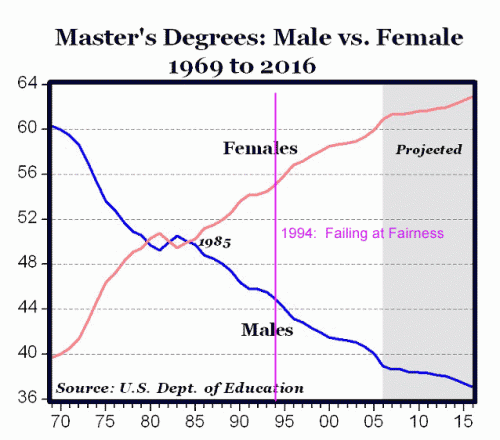
I don't doubt that they found their share of anecdotal issues.  I am sure I could find them today.  But their overall premise that girls were getting hosed by primary education and that standardized tests were structured to exclude girls from college education made no sense even at the time the book was published:

male_female_jobs

The chart is from Mark Perry, and he shows a similar picture for bachelor's degrees, where women blew past men in 1981, and in PHDs, where women passed men in 2006.  People would laugh at this book today, as most discussion is about under-performance of boys.

I don't know the authors, but I would interpret this as the classic inability of activists to declare victory.  I am fairly certain that their hypothesis was far more correct in 1969 than in 1994.  But society really went through a step-change in the 1970s vis a vis attitudes about females.  The previous generation of women's activists did great work to make these issues plain and help lead change in societal attitudes.

But activists have a really hard time declaring victory.  From a quite personal standpoint, declaring victory as an activist is exactly the same as walking into your boss and telling him that the company really doesn't need your job position.  Money, prestige, academic advancement, and attention, and (self-esteem, for certain types of people) are all tied to there being a major problem.  If there is no longer a big problem, then all this stuff goes away.

Explaining Temperature History

I post most of my more detailed climate work over at my other blog.  But I wanted to repost here something I wrote in response to a number of request for a brief version of what is driving global temperatures.

My sense is that medium to long scale 20th century temperature trends can be explained mostly through three drivers:

1.  A cyclical variation driven by multi-decade oceanic cycles like the Pacific Decadal Oscillation (PDO):

pdo

2.  Changes in solar output, either directly as increased heating or indirectly via a variety of theories on things like cosmic rays and cloud formation:

sunspot

3.  A long term trend of up to +0.05C per decade that may include a CO2-warming component.

I am willing to posit a CO2 impact net of feedbacks of perhaps 0.5-1.0C over the next century.  This may appear low, but is the only scale of number reasonably supported by history.  Any higher number would result in temperatures way too high historically.  And even assuming a number this high runs into the following problem:  There was probably a trend of about this magnitude emerging from the little ice age 200+ years ago and extending into the 20th century.  You can see it in the glacier numbers below:  (source)

glacier

Those that want to assign the temperature trend, once the sun and the PDO are removed, post-1950 to CO2, need to explain what effect was causing the nearly exact same trend from 1800-1950, and why that trend conveniently switched off at the exact moment man's CO2 takes over.  In the context of the glacier chart, what was causing the glaciers to retreat in 1880, and why is that effect not the one at work today?

With evidence that the PDO has reversed to its cool phase and that the sun may be shifting into low gear, I think it is reasonable to posit warming no more than 0.5-1.0C over the next century.  For those who have not seen it, Roy Spencer has a new paper on the PDO, clouds and temperature history.   My video on why climate models overstate future warming through absurd assumptions of high positive feedbacks is here.

Yet More Economic Ignorance

Don Boudreax shares this leftish view of the auto bailout from Pat Garofalo:

More importantly though - as Pelosi and Reid said - "federal aid should come with 'strong conditions,' such as requirements that car makers build more fuel-efficient vehicles." Bill Scher at OurFuture writes, "With the auto industry in dire straits, we taxpayers have maximum leverage to demand the cars necessary to help lower energy costs, cut carbon emissions and reduce our dependency on foreign oil."

So, uh, only when the government gets involved do consumers have any leverage with producers in terms of what products they produce?  Hello?  I'm sure Circuit City execs will be relieved to hear this.

In free markets, consumers have all the leverage in determining perhaps not what gets produced, but at least what gets sold in any marketplace.  Producers who are unable to match what they produce to what consumers buy eventually go bankrupt.  In fact, it is this process of consumers exercising their leverage with GM that Congress is attempting to interrupt with a bailout. Consumers are telling GM loud and clear that GM is not making the cars at the price points they want.  Unable to do so, GM will likely fail.  This failure will result either in 1) GM, under bankruptcy protection, shedding any number of constraints that are preventing it from making what the consumers want or 2) GM liquidating its production assets to other owner/management groups who can do a better job with them.

This quote is a great example of the technocratic bent many leading Democrats bring to economics.  What these guys are asking for is not leverage for consumers, but leverage for a few Democratic technocrats to makeover the auto industry the way they want it.  People like Nancy Pelosi who would never in a million years be given the keys to a manufacturing corporation by a sane ownership group can effectively grab that jobs via the leverage her seat in Congress gives her.

Postscript: Garofalo adds:

and if you think about the ripple effects, they are the backbone of our manufacturing economy." Indeed, according to estimates, one in 12 U.S. jobs is tied to car manufacturing, and a bailout of the industry could help boost the U.S.'s ailing manufacturing sector.

A couple of points.  First, a GM bankruptcy is hugely, enormously unlikely to mean the whole company is just shut down.  If you have flown in the last 10 years, unless you have favored only Southwest Airlines, you probably have traveled on a carrier in chapter 11.  That's what chapter 11 is - a breathing space while the company continues to operate but is able to restructure its liabilities.  Personally, I would love to see the company go chapter 7 and have a new wave of innovative people take over the assets and see what they could do with them.  But it is not going to happen.  GM may shed jobs over the next year, but they are going to do so anyway in the teeth of a recession, not because they went bankrupt.

Podesta must know that the issue in a bankruptcy will not be jobs, but labor contracts  (airlines have practically patented the chapter 11 vehicle for renegotiating union contracts).  Most GM manufacturing employees would probably keep their jobs through a bankruptcy, but they may well lose their contract that says they get paid $75.86 an hour with 34.5 days a year of paid leave.  Garofalo and Podesta are shilling for the union over wage bargaining, not jobs.

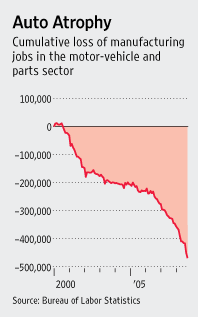
The other observation I want to make is to ask why the loss of these 250,000 jobs is going to be so much worse than the loss of 500,000 jobs over the last several years.

auto_jobs

I know parts of Michigan suffered, but Podesta is claiming knock-on effects for the whole country.  So where were they?

Let GM Fail!

This is a reprise of a much older post, but it struck me as fairly timely.

I had a conversation the other day with a person I can best describe as a well-meaning technocrat.  Though I am not sure he would put it this baldly, he tends to support a government by smart people imposing superior solutions on the sub-optimizing masses.  He was lamenting that allowing a company like GM to die is dumb, and that a little bit of intelligent management would save all those GM jobs and assets.  Though we did not discuss specifics, I presume in his model the government would have some role in this new intelligent design (I guess like it had in Amtrak?)

There are lots of sophisticated academic models for the corporation.  I have even studied a few.  Here is my simple one:

A corporation has physical plant (like factories) and workers of various skill levels who have productive potential.  These physical and human assets are overlaid with what we generally shortcut as "management" but which includes not just the actual humans currently managing the company but the organization approach, the culture, the management processes, its systems, the traditions, its contracts, its unions, the intellectual property, etc. etc.  In fact, by calling all this summed together "management", we falsely create the impression that it can easily be changed out, by firing the overpaid bums and getting new smarter guys.  This is not the case - Just ask Ross Perot.  You could fire the top 20 guys at GM and replace them all with the consensus all-brilliant team and I still am not sure they could fix it.

All these management factors, from the managers themselves to process to history to culture could better be called the corporate DNA*.  And DNA is very hard to change.  Walmart may be freaking brilliant at what they do, but demand that they change tomorrow to an upscale retailer marketing fashion products to teenage girls, and I don't think they would ever get there.  Its just too much change in the DNA.  Yeah, you could hire some ex Merry-go-round** executives, but you still have a culture aimed at big box low prices, a logistics system and infrastructure aimed at doing same, absolutely no history or knowledge of fashion, etc. etc.  I would bet you any amount of money I could get to the GAP faster starting from scratch than starting from Walmart.  For example, many folks (like me) greatly prefer Target over Walmart because Target is a slightly nicer, more relaxing place to shop.  And even this small difference may ultimately confound Walmart.  Even this very incremental need to add some aesthetics to their experience may overtax their DNA.

Corporate DNA acts as a value multiplier.  The best corporate DNA has a multiplier greater than one, meaning that it increases the value of the people and physical assets in the corporation.  When I was at a company called Emerson Electric (an industrial conglomerate, not the consumer electronics guys) they were famous in the business world for having a corporate DNA that added value to certain types of industrial companies through cost reduction and intelligent investment.  Emerson's management, though, was always aware of the limits of their DNA, and paid careful attention to where their DNA would have a multiplier effect and where it would not.  Every company that has ever grown rapidly has had a DNA that provided a multiplier greater than one... for a while.

But things change.  Sometimes that change is slow, like a creeping climate change, or sometimes it is rapid, like the dinosaur-killing comet.  DNA that was robust no longer matches what the market needs, or some other entity with better DNA comes along and out-competes you.  When this happens, when a corporation becomes senescent, when its DNA is out of date, then its multiplier slips below one.  The corporation is killing the value of its assets.  Smart people are made stupid by a bad organization and systems and culture.  In the case of GM, hordes of brilliant engineers teamed with highly-skilled production workers and modern robotic manufacturing plants are turning out cars no one wants, at prices no one wants to pay.

Changing your DNA is tough.  It is sometimes possible, with the right managers and a crisis mentality, to evolve DNA over a period of 20-30 years.  One could argue that GE did this, avoiding becoming an old-industry dinosaur.  GM has had a 30 year window (dating from the mid-seventies oil price rise and influx of imported cars) to make a change, and it has not been enough.  GM's DNA was programmed to make big, ugly (IMO) cars, and that is what it has continued to do.  If its leaders were not able or willing to change its DNA over the last 30 years, no one, no matter how brilliant, is going to do it in the next 2-3.

So what if GM dies?  Letting the GM's of the world die is one of the best possible things we can do for our economy and the wealth of our nation.  Assuming GM's DNA has a less than one multiplier, then releasing GM's assets from GM's control actually increases value.  Talented engineers, after some admittedly painful personal dislocation, find jobs designing things people want and value.  Their output has more value, which in the long run helps everyone, including themselves.

The alternative to not letting GM die is, well, Europe (and Japan).  A LOT of Europe's productive assets are locked up in a few very large corporations with close ties to the state which are not allowed to fail, which are subsidized, protected from competition, etc.  In conjunction with European laws that limit labor mobility, protecting corporate dinosaurs has locked all of Europe's most productive human and physical assets into organizations with DNA multipliers less than one.

I don't know if GM will fail (but a lot of other people have opinions) but if it does, I am confident that the end result will be positive for America.

* Those who accuse me of being more influenced by Neal Stephenson's Snow Crash than Harvard Business School may be correct.
** Gratuitous reference aimed at forty-somethings who used to hang out at the mall.  In my town, Merry-go-round was the place teenage girls went if they wanted to dress like, uh, teenage girls.  I am pretty sure the store went bust a while back.

Republicans to Receive Bailout from Congress

Congressional Democrats announced today that they had agreed to a bailout plan for Republicans after last week's devastating election results.  While exact details are unavailable, sources tell us that the Republicans will be given 4 seats in the Senate and 15 in the House.  Nancy Pelosi said in a statement today: "We've established pretty clearly over the last several months that failed strategies and management should not necessarily have to result in losses in market share, particularly for well-connected Washington insiders."

Asked for comment, Democratic strategist James Carville was giddy.  "This is brilliant.  It really doesn't give up anything of substance to the Republicans.  But it will sap the energy from the Republican Party for making any substantial changes, and make it more likely they will continue the failed strategies that led to this most recent loss.  After their recent failures, the Republicans were on the verge of being forced to reinvent their whole organization.  This bailout should reduce the likelihood of that substantially."

When asked if bailouts of AIG, General Motors, Ford, Chrysler, Freddie Mac, Fannie Mae, and Bear Stearns wouldn't similarly reduce the urgency to change failed approaches, Carville answered "no comment."

More on the Stagnating Wage Myth

A while back, when I discussed the stagnating wage myth, I observed that folks spreading this meme were careful to show figures only for cash wages, and not for total compensation.  In the period from 2000-2006, which is the typical period critics focus on (in part because it implies blame on the Bush administration, and in part because it lets them measure economic peak to trough) there has been a substantial shift in compensation mix from cash to non-cash benefits, including health care and paid time off.  Ignoring these components is particularly disingenuous given that many of these same critics have been long-time supporters of more paid time off and better company-funded health care.

As an example, this data (courtesy of Mark Perry) on the Big 3 automakers contracts is telling.  In 2000 (table page 3) it shows cash wages per hour worked at $22.71 and total comp at $43.57.  In 2006, the most recent year of data, it shows cash wages per hour worked at $29.15 and total comp at $75.86.  So, while cash wages per hour have increased about 4.25% compounded each year, total compensation has increased more than twice as fast, at 9.7% a year.  That latter increase is due both to a rapid rise in health care expenditures for employees as well as an increase in paid day off to 34.5 a year.  (by the way, if you are wondering why the UAW is fighting so hard for a government bailout, look no further than jobs with $75.86 an hour total comp. and seven weeks a year of paid days off.)

Obama Transition Site Gets Stealth Edit

Last week I quoted from the Obama transition site:

The Obama Administration will call on Americans to serve in order to meet the nation's challenges. President-Elect Obama will expand national service programs like AmeriCorps and Peace Corps and will create a new Classroom Corps to help teachers in underserved schools, as well as a new Health Corps, Clean Energy Corps, and Veterans Corps. Obama will call on citizens of all ages to serve America, by developing a plan to require 50 hours of community service in middle school and high school and 100 hours of community service in college every year.

Now, it says this:

Obama will call on citizens of all ages to serve America, by setting a goal that all middle school and high school students do 50 hours of community service a year and by developing a plan so that all college students who conduct 100 hours of community service receive a universal and fully refundable tax credit ensuring that the first $4,000 of their college education is completely free.

Ben Smith and others argue that Obama never said it was mandatory.  Fortunately, I got a screen shot of the "require" language before the Obama department of Truth got to the page (click for full size):

obama-service-plan

Thanks to Walter Olson for bringing the swap to my attention.

Postscript: 100 hours for $4000 is a pretty good deal.  Not many private sector employers offering $40 an hour to recent high school grads.  Everyone out there OK with the government paying the equivalent of $80,000 a year salaries to 18-year-olds for sorting food at the food bank?

Refresher: It seems that some basic definitions are in order.  If one is required to work at a certain task, he is not a volunteer.  If one is paid $4000 for 100 hours of labor, he is not a volunteer.  A volunteer is someone who works of his or her own free will without monetary compensation, solely for the satisfaction of helping out.

A Last Case for Payday Loans

Well, we have upheld the ban on payday loans here in Arizona.

The payday-loan industry, which flourished this past decade on Arizonans' almost-insatiable need for quick, short-term loans regardless of their high interest rates, may have to close down in Arizona unless state lawmakers can be persuaded to ignore voters' wishes.

Voters last week overwhelmingly rejected Proposition 200, a ballot initiative financed and written by the loan companies to allow them to continue charging high interest rates on small loans. That decision placed Arizona among a growing number of states that have effectively shut down the payday lenders.

So, payday loans from company A to person B are really popular with both A & B, and the industry has "flourished."  But persons C, who don't participate in this market, have decided that, for their own good, A & B need to stop engaging in this behavior.  One such third party explains it this way:

Sen. Debbie McCune Davis, D-Phoenix, opposed Prop. 200 and has steadfastly fought payday lenders. She sees no need to let payday lenders continue to charge higher interest rates than other lenders.

Her and voter's actions have effectively limited payday loan companies to charging total interest and fees equivalent to no more than 36% annual interest.  OK, you say, this seems like a really high rate.  That should be enough, right?  Well, the problem comes with fixed costs and loan size.  Lets look at an example.

A typical payday loan size and term is about $400 for 18 days (pdf).  A typical fee for such a loan is $50, which includes both fixed costs and interest.  Wow, annualized that is 250%.  Usurious!  So would you personally go out and get a payday loan?  No way! And that is why voters vote to ban them - they are not good for me personally, so they must not be good for anyone else.

But here is the problem.  How do you maintain a storefront and trained people and all the documentation and collection apparatus for less than $50?  The same loan at 36% would allow a fee of only $7.20.  That barely even covers paying someone to originate the loan at the counter, much less pay interest and a risk premium.

Try going to the bank and getting a home loan or some other type of loan for only a $50 fee.  Granted those loans are more complicated, but in turn you will likely get charged hundred and probably thousands of dollars in fees.  There is a large fixed cost component to the act of lending which we tend to ignore on larger loans, but is there none-the-less.  In fact, just try to go to a bank and get a loan for $400 at all.  They don't make them, outside of the credit card industry, which solves this problem in part through economies of scale and in part through cost-shifting costs to merchants, options not really available to payday loan companies.

And so far, we are only talking about fixed costs, not the underwriting risk of extending loans to about any person who wanders in the door and can sign his/her name.  Anyone remember sub-prime mortgages?  Maybe there is a justification for large risk premiums, after all, on loans to under-qualified borrowers.  Particularly when you consider that most payday loan customers could not qualify even for a sub-prime mortgage.

The best equivalent to a payday loan offered by banks is overdraft protection, where the bank will go ahead and pay out on checks where there are insufficient funds, though they will charge a $20-$30 fee per check paid.  As you can see, these fees are very similar in magnitude to those charged by payday loan companies, particularly when you consider that these fees are generally charged on checks that average about $150.  Also, folks who get one overdraft fee usually get several in a row.  People are willing to pay these fees because they are in fact lower than the fees of actually having a check bounce, which can incur similar fees from merchants as well as hurting one's credit.

So, you just had to write three checks to get the power and water and telephone turned on, and you are pretty sure the money is not there in your checking account.  You are facing $80 in bounced-check (NSF) fees or overdraft fees.  Now might you consider a $400 loan for a $50 fee?  Well, probably the answer is still no, you would put it on your credit cards.  But everyone doesn't have credit cards, or doesn't qualify for them, or don't have a lifestyle that allows for them.  Where do they go, short of Tony Soprano?

Update: A reader sent me a link to this report, comparing payday loan rates to overdraft protection, and finding them of similar magnitude.  The author calculates an average $28.61 overdraft fee on an average $155 bounced check yields an APR of 478%.  There is a fixed cost to lending, and small very short term loans cost a lot of money, no matter how you get them.

I will remind folks not to be fooled by 18% or 23% rates on credit cards and set that as the market rate for small loans.  First, this misses annual fees for the cards.  But more importantly, it misses merchant fees.  Merchants pay between 2.5% and 3.5% of everything you charge to the credit card companies.  This helps to subsidize rates and, particularly, subsidize the fixed costs of small lending transactions.

Grab Your Ankles

From Jim Moran of Virginia:

We have been guided by a Republican administration who believes in the simplistic notion that people who have wealth are entitled to keep it and they have an antipathy towards redistributing wealth and they may be able to sustain it for a while but it doesn't work in the long run.

Remember, though, calling them socialists is racist.  Video here.

One Movie, Two Governors!

Channel surfing last night, I ran into the Running Man, an unfortunate movie "adaption" of  a pretty good Steven King (as Richard Bachman) book.  For those who have seen one and not the other, they have little in common with each other. 

What I hadn't realized before was just how bizarre the casting for this movie was -- Richard Dawson, the cheesy game show host as a ... cheesy game show host.  Jim Brown, Dweezil Zappa and Mick Fleetwood?  The latter, by the way, as himself but in the future.  Whatever.

But the best part is that the movie has two United States governors in substantial roles -- Arnold Schwarzenegger (California) in the title role and Jesse Ventura (Minnesota) as one of the "stalkers" trying to kill Arnold.  Is this a great country or what?

Do ya'll know any others?  I know Sonny Bono did a Love Boat guest appearance, so there must have been two Congressmen  in one TV episode (with Fred Grandy of Iowa).  There may be a Fred Thompson +1 out there I can't think of.  And of course there were probably some Ronald Reagan matchups, but that is before my time.

Update:  Rob reminds me that the Ventura-Schwarzenegger team can also be found in Predator. 

Obama and the "Patriot Employer"

As mentioned in the updates to this earlier post, the Obama transition web site has, at least temporarily, purged out all the real content they had up about specific programs and legislative goals.  So, as a public service, I will help fill this information gap by re-posting an article I wrote about 9 months ago on the "Patriot Employer Act" sponsored by Barack Obama and likely a kernel for early 2009 legislative action:

Posted 2/13/2008:

It turns out, according to Barack Obama, (who hales from the party that doesn't believe in questioning anyone's patriotism) that I am not a "Patriot Employer." This is from the text of Senate Bill S. 1945 of which he is a co-sponsor (My snark is interspersed in italics): Patriot Employers are to be given tax breaks over unpatriotic employers (I presume this means that their tax rates will be raised less in an Obama presidency than those of other folks) with "patriot employers" defined as such:

(b) Patriot Employer- For purposes of subsection (a), the term`Patriot employer' means, with respect to any taxable year, any taxpayer which-

`(1) maintains its headquarters in the United States if the taxpayer has ever been headquartered in the United States,

OK, I guess I can comply with this. Though I am not sure the best way to begin an Obama "kindler gentler foreign policy" is to tell the nations of the world that we will be taxing their company's income in the US at a higher rate than our own companies.

`(2) pays at least 60 percent of each employee's health care premiums,

So the #1 determinant of patriotism is not commitment to individual rights but paying 60% of employee health care costs. I guess I am so unpatriotic

And, just from a practical standpoint, 90% of my employees are seasonal, hired for about 4 months of the year. To be patriotic, I have to pay their health care costs all year long? Also, since most of my employees are retired, they are on Medicare or an employee retirement medical plan. If they pay $0 in premiums and I pay $0 of that, do I get credit for 60%? Maybe the government can mandate a solution for zero divided by zero, like they did for the value of pi years ago

`(3) has in effect, and operates in accordance with, a policy requiring neutrality in employee organizing drives,

I presume neutrality means that in a hypothetical union drive, I do not express my opinion (and likely opposition) to said unionization drive? I am told that this also entails allowing card checks rather than hidden ballot voting. In other words, patriotism is being defined here as 1) giving up your free speech rights and 2) opposing hidden ballot voting. Uh, right. Besides, if a union organized our company, as unlikely as that would be, I would probably have to do a Francisco d'Anconia on the place.

`(4) if such taxpayer employs at least 50 employees on average during the taxable year-

`(A) maintains or increases the number of full-time workers in the United States relative to the number of full-time workers outside of the United States,

In other words, we don't want American companies growing overseas. This could also be called the "give up international market share act." This implies that it is unpatriotic for US-based Exxon to explore for oil in Asia and that it is more patriotic to let the Chinese national oil company do it. This implies that it is more patriotic for Coke to lose market share in Germany than to gain it. This means that it is more patriotic for Mattel to buy its toys in China from Chinese companies rather than run the factories themselves (and thereby be accountable themselves for product quality and working conditions).

This is beyond stupid. We LIKE to see US companies doing well overseas. If we have to import our raw materials, we feel more comfortable if it is US companies doing the extraction. Don't we? In the name of patriotism, do we really want to root for our domestic companies to fail in international markets?

`(B) compensates each employee of the taxpayer at an hourly rate (or equivalent thereof) not less than an amount equal to the Federal poverty level for a family of three for the calendar year in which the taxable year begins divided by 2,080,

90% of my workers are retired. They work for me to supplement their income, to live our in nature, and to stay busy. They need me to pay them based on the poverty line for a family of three, why? I will tell you right now that if I had to raise wages this much, most of my employees would quit. Many of them force me to give them fewer hours so they can stay under the social security limits for income. I discussed what rising minimum wages often force me to do here, but just as an illustration, a $1 an hour across the board wage increase would easily wipe out all the money I make in a year and put me into a loss position. In which case the lowered tax rate would not do me much good anyway.

`(C) provides either-

`(i) a defined contribution plan which for any plan year-

`(I) requires the employer to make nonelective contributions of at least 5 percent of compensation for each employee who is not a highly compensated employee, or

`(II) requires the employer to make matching contributions of 100 percent of the elective contributions of each employee who is not a highly compensated employee to the extent such contributions do not exceed the percentage specified by the plan (not less than 5 percent) of the employee's compensation, or

`(ii) a defined benefit plan which for any plan year requires the employer to make contributions on behalf of each employee who is not a highly compensated employee in an amount which will provide an accrued benefit under the plan for the plan year which is not less than 5 percent of the employee's compensation, and

Uh, I am not sure why it is unpatriotic for an employee to save for themselves, but I think 401k plans are a nice benefit. I would certainly offer one except for one tiny fact - ALL MY EMPLOYEES ARE ALREADY RETIRED!! They are over 65. They are drawing down on their retirement, not contributing to it.

This is at the heart of the problem with all US labor law. Folks up in Illinois write laws with a picture of a steel mill in mind, and forget that employment and employees have infinite variations in circumstances and goals.

So I am unpatriotic, huh. But if forcing companies to contribute to emplee retirement plans is patriotic, why is hiring folks once they are retired to give them extra income in retirement unpatriotic? In fact, maybe I could argue that 100% of the wages I pay go to retirement spending

`(D) provides full differential salary and insurance benefits for all National Guard and Reserve employees who are called for active duty, and

In other words, we of the government are not going to pay our employees (ie reservists on active duty) what they are worth and are not going to give them benefits, so to be patriotic you need to do it for us. We in Congress are not really very patriotic and don't support the troops, so you need to do it for us.

All kidding aside, I would do this in my company if it was applicable, but I really resent being piously told to do so by several Senators who don't really model this behavior themselves.

`(5) if such taxpayer employs less than 50 employees on average during the taxable year, either-...

blah, blah. Basically the same stuff repeated, though slightly less onerous.

Since when did patriotism equate to "rolling over to the latest AFL-CIO wish list?"
Wow, Obama Has Inverted the Supply Curve

I am having a blast at the Change.gov transition site for Obama, now that I have satisfied myself it is not a fake.  Those who doubt that Obama has super-human powers should read this, from the Obama site:

The Obama-Biden plan provides affordable, accessible health care for all Americans, builds on the existing health care system, and uses existing providers, doctors and plans to implement the plan. Under the Obama-Biden plan, patients will be able to make health care decisions with their doctors, instead of being blocked by insurance company bureaucrats.

Under the plan, if you like your current health insurance, nothing changes, except your costs will go down by as much as $2,500 per year.

If you don't have health insurance, you will have a choice of new, affordable health insurance options.

Wow - so now you can go out purchase any care you want - any tests, any procedures, whatever - and no one is going to tell you no.  Everything is paid for.  You have a blank check to go spend.  And, by granting you an infinite supply of care, your cost is going to go down.  Obama is really superman, because no one else in history has figured out how to invert the supply curve or make 2x cost less than x.

You see, it's all about insurers' margins.  If we can just cut down on those fat margins, everyone can have full health care and a pony for less money.  You doctors who are worried about health care, you will have it better too:

Prevent insurers from overcharging doctors for their malpractice insurance and invest in proven strategies to reduce preventable medical errors.

All these years you thought malpractice insurance costs were high because of huge malpractice court settlements that usually bore little relationship to true malpractice, well, you were wrong.  Its because of the insurers and their margins.  We don't have to reform malpractice tort law (which is just as well since tort lawyers were so generous with donations to our campaign), we just have to get insurers to stop overcharging doctors.

To give you an idea of the absolutely huge amount of savings that can be extracted by just pounding on the insurers to give more coverage for less money, let's take a look at those outsized margins they are making.  These are net profit margins reported by Google Finance for 3Q2008 of the largest health care providers and insurers:

Cigna: 3.50%
United Health Group: 4.56%
Aetna: 3.64%
WellCare:  4.08%
Amerigroup: 3.51%
Humana 2.56%
WellPoint: 5.49%

Freaking robber barons!  Look at those outsized margins.  No wonder we have a health care crisis.  By cutting these guys margins in half, Obama expects to reduce the price of health care by 1-2%, which should be more than enough to pay for large increases in services and 30-50% price cuts.

Update: Oh, its magic.  That explains it.

Update #2: OK, the page has come down, as have most all the pages that had any kind of policy detail or promises in them.  I wish I had screen shots, but I can say everything above was cut and pasted directly form the web site.  Could I make that stuff up?  Too bad, there probably were another 10 blog posts in there somewhere.

Taxing People With No Money

Update:  Over the weekend, without comment, the Obama team pulled down the language below and put up new, vaguer language without the "required."  Discussion and a screen shot of the original is here.

How do you tax people with who have no money?  Why, you take their labor by force.  It worked when we dragged Africans over here against their will in the 19th century, and it can work today.  From the Obama transition site:

The Obama Administration will call on Americans to serve in order to meet the nation's challenges. President-Elect Obama will expand national service programs like AmeriCorps and Peace Corps and will create a new Classroom Corps to help teachers in underserved schools, as well as a new Health Corps, Clean Energy Corps, and Veterans Corps. Obama will call on citizens of all ages to serve America, by developing a plan to require 50 hours of community service in middle school and high school and 100 hours of community service in college every year.

So what was that about no tax increase for people making under $250,000?  Because my guess is that most high school and college kids made close to zero, but here is Obama seeking to expropriate 50-100 hours of their labor.  Sure looks like a tax to me.  By law, high school kids, by DOL rules, can work up to 1200 hours per year.  For kid that works every hour she can, this is about a 4% tax.  Kids that work less pay a higher effective tax rate, up to infinite for kids not working at all  (hey, this tax is even regressive).  Also, richer kids trying to get into top colleges will be the least affected, as they are already volunteering at a level close to this, so most of the burden of this tax will fall on the poor.

I remember when I was slammed by Obama supporters during the election when I said that his call for "universal" community service meant that he was going to mandate it.  Carefully avoiding being clearer about what he meant before the election, Obama sure has not wasted any time making sure everyone understands he is talking about government coercion here, not volunteerism.

PS- I thought this site was fake, because it was amazing to me to see Obama's intentions stated so baldly after he so strenuously avoided clarifying his position during the election.  But the Huffpo and other sites link to this site as if it is real, so I will treat it as such.

PPS - Here is Obama's pledge on taxes from the same site:

Middle class families will see their taxes cut "“ and no family making less than $250,000 will see their taxes increase. The typical middle class family will receive well over $1,000 in tax relief under the Obama plan, and will pay tax rates that are 20% lower than they faced under President Reagan. According to the Tax Policy Center, the Obama plan provides three times as much tax relief for middle class families as the McCain plan.

OK, we are not going to take more money, we are just going to take your labor directly.

Update: Radley Balko adds the chilling speech implications of such a program:

So who gets to decide what constitutes "community service"?  Who gets to decide which causes and organizations will be credit-worthy, and which ones won't?

Something tells me that you'd be more likely to get one of Obama's vouchers by going door to door for one of ACORN's living wage campaigns than, say, volunteering for a libertarian nonprofit organization that advocates against things like government-mandated community service.

Obama supporters will say, no problem, we trust Obama.  Hmm.  The folks who wrote our Constitution designed our government assuming all politicians would be knaves.  Writing laws that depend on the good intentions, fairness, correct incentives, and intellectual capacity of the government folks who run it are doomed to failure.  Would Democrats have been happy to have GWB deciding what community service their kids were forced to endure?  I doubt it.  Well, we don't live in an autarky, and sooner or later GWB's party will be back and making exactly those decisions under such a program.

For Those Who Doubted Me When I Said We Are Heading Towards A European-Style Corporate State

I predicted it here.  Now see it here:

House Speaker Nancy Pelosi said Wednesday that Congress is considering bailing out Detroit's Big Three automakers."We may need to make a statement of confidence in our auto industry," Pelosi told NPR this afternoon. "We're not saving those companies, we're saving an industry. We're saving an industrial technological and manufacturing base... It's about jobs in America."

I wrote why its better to let GM fail.

So what if GM dies?  Letting the GM's of the world die is one of the best possible things we can do for our economy and the wealth of our nation.  Assuming GM's DNA has a less than one multiplier, then releasing GM's assets from GM's control actually increases value.  Talented engineers, after some admittedly painful personal dislocation, find jobs designing things people want and value.  Their output has more value, which in the long run helps everyone, including themselves.

The alternative to not letting GM die is, well, Europe (and Japan).  A LOT of Europe's productive assets are locked up in a few very large corporations with close ties to the state which are not allowed to fail, which are subsidized, protected from competition, etc.  In conjunction with European laws that limit labor mobility, protecting corporate dinosaurs has locked all of Europe's most productive human and physical assets into organizations with DNA multipliers less than one.

Pelosi held a meeting Monday with Democratic leaders to consider a request from Detroit's Big Three automakers for another $25 billion in "bridge financing" to help them survive a huge downturn in auto industry.

Getting Out While There is Still Time

I worked for several years for AlliedSignal engines, now Honeywell, here in Phoenix.  At our main engine plant here, we endured a couple of union organizing campaigns that both fell just shy of winning a position for the union.  A reasonable manager might expect that under the Democrat's proposed card-check system which replaces anonymous votes with open petitions, that enough hijinx could be brought to bear to put the union over the top.  I don't now if this is what they have in mind, but...

Phoenix-based Honeywell Aerospace plans to move 700 manufacturing jobs from Phoenix to Mexico and the Czech Republic.

Employees were notified Thursday of the cuts, which will begin in the second quarter of 2009 and continue for three years. Most of the job cuts are expected in the first year.

Workers who asked not to be identified said the news caught employees completely off-guard.

I think the timing just a day after election results in, and the level of surprise, are telling.  Time to get this done now, before the owners have to go cap in hand to their employees to ask permission to run their business as they see fit.  I thought this last bit they added brings a nice irony to the situation:

The announcement came two days after Barack Obama, who has promised to take a hard line with companies that move manufacturing jobs overseas, was elected the 44th U.S. president.

Whatever that means, but it does give yet another reason to get out fast.

Socialism in One Picture

I don't often pass on the cartoons that cross my desk, but I thought this was pretty good:

socialism

Now They Tell Us

It's fascinating that our local paper, after months of positive Obama coverage, manages to express its first printed criticism of Obama on ... the day after the election.

With President-elect Barack Obama promising tougher government regulations on some sectors, including the financial markets, a handful of business leaders expressed concern Wednesday.

"The key thing is to not choke us to death with regulation," said Ioanna Morfessis, an economic-development consultant and Greater Phoenix Economic Council founding member.

With the faltering of the financial markets and a massive federal bailout this fall, Obama and congressional Democrats, who expanded their majorities with an upset electorate, have called for more federal oversight on Wall Street. Obama also has called for more regulation in the energy and health-care sectors, and Democrats could more strictly enforce environmental rules....

Morfessis said before lunch Wednesday, she received phone calls from 11 entrepreneurs concerned there would be a "higher premium for taking risks or entering new markets."

Californians Will Go Into Debt For About Anything

Incredibly, it looks like Proposition 1A in California is going to pass.  This act authorizes a $9 billion dollar bond issue to start a high-speed rail passenger line from the Bay Area to the LA Area. 

Why do I say "start."  Because even the line's supporters put the minimum cost at $40 billion, so the taxpayers have authorized 22% of the line.  And this is by supporters numbers.  By my numbers they have likely authorized less than 10% of the line. 

I wonder if voters knew they were authorizing either a) $40-$100 billion, in effect, rather than $9 billion; or b) a $9 billion white elephant of a rail line that ends up incomplete and going nowhere or c) something that is not really high speed rail and therefore not different from Amtrak service that already exists.  (What are you talking about Coyote, government transit people would never begin a project without full funding and leave an orphaned white elephant in place.)

The state that makes up a huge percentage of the current mortgage and
foreclosure problem seems to not have learned its lesson about
borrowing.

I am generally an optimistic guy, but I wonder if we have gotten to the point where there is a large subset of the population for whom voting is solely for the purposes of boosting self-esteem.  I feel good when I support public transit, so I vote for Prop 1A, despite the fact there is no possible way it will ever deliver any public transit.

Updated Disney World Reviews

I have updated my post on Disney World reviews and advice based on my October trip with my daughter.  Below is a picture from the trip.  I am the one in orange.

coyote_tigger

The Silver Lining

TJIC has the silver lining nailed for libertarians:

Let us not forget the good news from the election: one statist, speech limiting, freedom-agnostic candidate lost.

I'm kind of ambivalent this morning -  I knew in advance that freedom was going to lose again in this election, no matter what the outcome.

If I am depressed this morning, it is more about propositions and side issues than about the President and Congress.  Had this been a leftward shift in the county, I could have been satisfied that at least losses in freedom in one area might be substituted by gains in others  (though for me personally, changes in economic freedom tend to have far more direct and immediate impact than changes in social freedoms).

But the only pattern I could see yesterday was not leftward but government-ward.  In the same states where Democratic candidates won with economic interventionist messages, Constitutional bans on gay marriage also won by sizable majorities.   In Arizona, gay marriage was banned, an initiative to limit future tax increases was defeated, an initiative to protect health care choice was defeated, an initiative to soften last year's anti-immigrant legislation was defeated, and a payday loan ban was confirmed.  The voting in some way defies a traditional left-right explanation and is only consistent in that it was almost all the reverse of the libertarian position.  And to make the results even more irrational, nearly the biggest defeat of any ballot initiative in Arizona was for a pay increase for state legislators -- the voters seem to like government but don't trust or respect the individuals employed there.

After the last Bush election, a number of leftish folks claimed they were moving to Canada or France or wherever.  But that's the problem for libertarians in this country -- there is not place to run.  Those who want to run away to a country with a more controlling government have 180 or so choices.  Those of us who seek more freedom have approximately none.

Update: This slight paraphrase from the movie Zoolander encapsulates my thought on this election:

They're the same! Doesn't anybody notice this? I feel like I'm taking crazy pills!

I am actually less frightened by the candidates than by people who seem to get so excited by one or the other of them.

I Like the Way My District Does Voting

I have voted in a lot of different states, but the way we do it here in my current district seems to work well.  I got my ID checked against the voting record -- the lady may an explicit check to make sure the addresses matched.  Then I got a paper ballot and a black magic marker.  Next to each name is an arrow pointing to the name with a gap in it.  One fills in and completes the arrow pointing to the candidate one is voting for.  Then, when done, the voter takes the ballot to a machine that looks like a big shredder.  She/he feeds the ballot into the slot, and the ballot is automatically read and counted right there.  There is a LED readout on the front with a total ballot count that increments by one if the ballot is read correctly, providing a psychologically satisfying feeling that one's vote has been counted.  At the end of the day no further counting is required, and I presume they pull the vote counts out electronically or with some kind of summary report.  The ballots stay in a locked vault in the scanner and provide a paper trail if the count has to be checked later. 

By the way, no line at all.  Glad I didn't wait 2+ hours last weekend to vote early in order to avoid the lines.  One has to wonder at the decision-making ability of folks who waited hours to vote early to avoid lines that couldn't possibly be any longer on election day.  Good to see such folks out voting ;=)

Election Day Music

Public Administration Majors Score Dead Last on GRE Scores

Can't say this surprises me:

test_scores

Seriously - couldn't you have predicted the last three in advance?