Posts tagged ‘prices’

Disturbing Trade News From China

The following is from our Chinese sister publication called Panda Blog:

Our Chinese government continues to pursue a policy of export promotion, patting itself on the back for its trade surplus in manufactured goods with the United States.  The Chinese government does so through a number of avenues, including:

  • Limiting yuan convertibility, and keeping the yuan's value artificially low
  • Imposing strict capital controls that limit dollar reinvestment to low-yield securities like US government T-bills
  • Selling exports below cost and well below domestic prices (what the Americans call "dumping") and subsidizing products for export

It is important to note that each and every one of these government interventions subsidizes US citizens and consumers at the expense of Chinese citizens and consumers.  A low yuan makes Chinese products cheap for Americans but makes imports relatively dear for Chinese.  So-called "dumping" represents an even clearer direct subsidy of American consumers over their Chinese counterparts.  And limiting foreign exchange re-investments to low-yield government bonds has acted as a direct subsidy of American taxpayers and the American government, saddling China with extraordinarily low yields on our nearly $1 trillion in foreign exchange.   Every single step China takes to promote exports is in effect a subsidy of American consumers by Chinese citizens.

This policy of raping the domestic market in pursuit of exports and trade surpluses was one that Japan followed in the seventies and eighties.  It sacrificed its own consumers, protecting local producers in the domestic market while subsidizing exports.  Japanese consumers had to live with some of the highest prices in the world, so that Americans could get some of the lowest prices on those same goods.  Japanese customers endured limited product choices and a horrendously outdated retail sector that were all protected by government regulation, all in the name of creating trade surpluses.  And surpluses they did create.  Japan achieved massive trade surpluses with the US, and built the largest accumulation of foreign exchange (mostly dollars) in the world.  And what did this get them?  Fifteen years of recession, from which the country is only now emerging, while the US economy happily continued to grow and create wealth in astonishing proportions, seemingly unaware that is was supposed to have been "defeated" by Japan.

We at Panda Blog believe it is insane for our Chinese government to continue to chase the chimera of ever-growing foreign exchange and trade surpluses.  These achieved nothing lasting for Japan and they will achieve nothing for China.  In fact, the only thing that amazes us more than China's subsidize-Americans strategy is that the Americans seem to complain about it so much.  They complain about their trade deficits, which are nothing more than a reflection of their incredible wealth.  They complain about the yuan exchange rate, which is set today to give discounts to Americans and price premiums to Chinese.  They complain about China buying their government bonds, which does nothing more than reduce the costs of their Congress's insane deficit spending.  They even complain about dumping, which is nothing more than a direct subsidy by China of lower prices for American consumers.

And, incredibly, the Americans complain that it is they that run a security risk with their current trade deficit with China!  This claim is so crazy, we at Panda Blog have come to the conclusion that it must be the result of a misdirection campaign by CIA-controlled American media.  After all, the fact that China exports more to the US than the US does to China means that by definition, more of China's economic production is dependent on the well-being of the American economy than vice-versa.  And, with nearly a trillion dollars in foreign exchange invested heavily in US government bonds, it is China that has the most riding on the continued stability of the American government, rather than the reverse.  American commentators invent scenarios where the Chinese could hurt the American economy, which we could, but only at the cost of hurting ourselves worse.  Mutual Assured Destruction is alive and well, but today it is not just a feature of nuclear strategy but a fact of the global economy.

Panda Blog goes on to ask that their government end these distorting policies, for the sake of China's future.  I for one kindof hope that they keep subsidizing the stuff I buy over at Wal-mart...

Gas Prices a Crisis??

The media is just longing to make current gas prices into a crisis.  And you can already see them gearing up to bash oil companies for "record" profits (by the way, when reading the profit announcements, pay attention not to just total dollars but to profit margins, then read this).

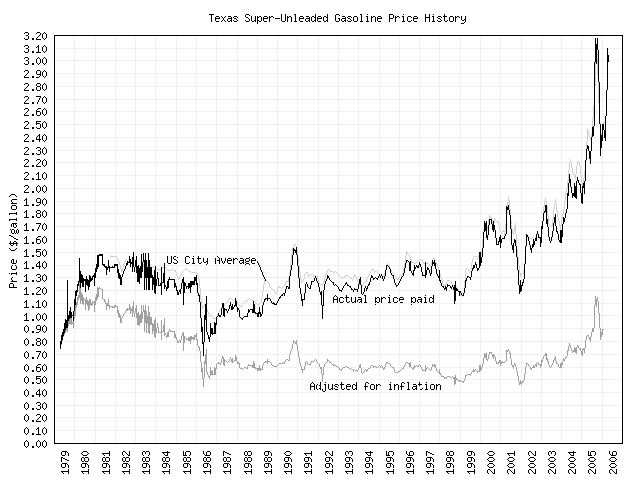
Glenn Reynolds links this gas price chart this morning at Random Useless Data, showing that in real terms, gas prices are still below their peaks, and not at "all-time highs."

Gasprice_1

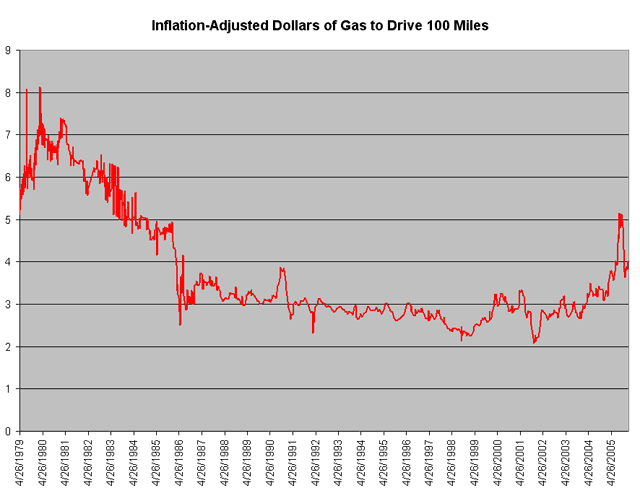
I took this one step further, based on the assumption that it isn't the price per gallon that matters for gas, but the price to drive a fixed mileage, say 100 miles.  Since average automobile fuel economy has continued to improve, in real terms we are far below the peak cost of gasoline.  Using this and this MPG data (for passenger cars) and the inflation adjusted gas prices here, I got this chart (1979 dollars)

Gas_price_100_1

By the way, just so you know my personal incentives, there are very few people out there who run a business whose fortunes are more sensitive to gas prices than my recreation business.  This will not be a very good summer for me, but if we leave the market alone to do its work, things will likely be better in 2007.  Intervention by Congress will pretty much assure that things will get worse.

The Peak Whale Theory

After reading this article on the earth running out of resources,  I discovered another article from the archives of the Coyote Broadsheet, a predecessor of this blog written by one of my distant relatives, dated April 17, 1870:

As the US Population reaches toward the astronomical total of 40 million persons, we are reaching the limits of the number of people this earth can support.    If one were to extrapolate current population growth rates, this country in a hundred years could have over 250 million people in it!  Now of course, that figure is impossible - the farmland of this country couldn't possibly support even half this number.  But it is interesting to consider the environmental consequences.

Take the issue of transportation.  Currently there are over 11 million horses in this country, the feeding and care of which constitute a significant part of our economy.  A population of 250 million would imply the need for nearly 70 million horses in this country, and this is even before one considers the fact that "horse intensity", or the average number of horses per family, has been increasing steadily over the last several decades.  It is not unreasonable, therefore, to assume that so many people might need 100 million horses to fulfill all their transportation needs.  There is just no way this admittedly bountiful nation could support 100 million horses.  The disposal of their manure alone would create an environmental problem of unprecedented magnitude.

Or, take the case of illuminant.  As the population grows, the demand for illuminant should grow at least as quickly.  However, whale catches and therefore whale oil supply has leveled off of late, such that many are talking about the "peak whale" phenomena, which refers to the theory that whale oil production may have already passed its peak.  250 million people would use up the entire supply of the world's whales four or five times over, leaving none for poorer nations of the world.

Too bad Julian Simon wasn't around to make a bet on whale oil prices.

Force over Choice

Progressives often wrap themselves up in a lot of libertarian-sounding jargon.  But when push comes to shove, progressives are more comfortable with coercion than free association.  James Taranto links this piece in his Friday Best of the Web:

A longtime singer and guitarist with the Zucchini Brothers and a substitute teaching assistant for Washington-Saratoga-Warren-Hamilton-Essex BOCES [school board], Powell has lived frugally for years. He works about three days a week as a sub, earning about $70 a day, with no benefits. From March to October, he rides his bike 20 miles to work when work is available....

Part of that survival--or so he thought--included shopping at Wal-Mart to take advantage of cheaper prices for himself, his partner and her two children. Then his discussions about Wal-Mart with Sandra Carner-Shafran, a teaching assistant at BOCES and a member of the Board of Directors of New York State United Teachers, started churning inside him. . . .

"I don't like what Wal-Mart stands for," Powell said, noting the mega-chain's scanty health insurance for staffers. "Because of all those things they can lower the prices."

He and his partner agreed to go on food stamps for their family rather than shop at Wal-Mart any longer.

Please observe the moral choice he made that is being applauded by those on the left:  Rather than get low cost food from Wal-mart, which generally* transacts with its suppliers, employers, and customers through mutual self-interest and the consent of all parties in each transaction, he has decided it is MORE MORAL to get his food expropriated from the American taxpayer without their consent.  Lovely.  By the way, it is ironic that he is mad that Wal-mart employees accepts jobs with no health benefits when he in fact has made the same choice himself.

More on what makes progressives tick here.

*The exception being that Wal-Mart does use the force of government via imminent domain to obtain land where the free will of landowners would not cooperate and to get special tax credits from local governments to get area citizenry to subsidize its business.  If Mr. Powell were to protest these practices, I would be all for it, but my guess is that he is not protesting government handouts to Walmart by signing up for... government handouts for himself.

Rising Tide of Protectionism

As a followup to this post on security as a Trojan horse for protectionism, I wanted to link this article in the WSJ($) called The Perils of Protectionism:

Fifty-six percent of the economists polled in the latest WSJ.com
forecasting survey -- conducted in the aftermath of a flap over foreign
management of U.S. ports -- say protectionism will lead to some
slowdown in U.S. growth over the next several years, and 8% predict
that the slowdown will be significant....

The ports controversy came at a time of growing concern about
protectionism around the world. It followed the blocked bid by China's
Cnooc Ltd. to acquire Unocal Corp. last year and emerged as European
governments angle to prevent high-profile utility deals within their
borders. The fear is that if governments take steps to shield their
countries' businesses, international trade and investment flows could
be reduced. Corporations will find it more difficult to reach new
markets.

Protectionism is unambiguously bad," said David Berson, chief economist
at Fannie Mae. Indeed, the free flow of capital across national borders
is conventionally looked upon by economists as a long-term good, and
69% of those surveyed say foreign ownership of U.S. assets is positive
for the economy in the long run.

One example of why the protectionist arguments are short-sighted is demonstrated by this passage from the same WSJ article:

While the ports row has receded, the U.S.'s large bilateral trade
deficit with China, which was $17.91 billion in January, remains a
flashpoint. Some lawmakers complain the imbalance has been inflamed by
an artifically low exchange rate for China's yuan against the dollar.
Though Beijing modestly revalued the yuan last summer, allowing it to
float in a narrow range against a basket of foreign currencies, critics
have continued to lash China's currency policy and call for further
revaluation.

So the Chinese government is artificially subsidizing the US economy through reduced prices of Chinese goods via a low valuation for the yuan vs. the dollar.  And that's a bad thing?  If the Chinese government is holding down the exchange rate, then they are in fact taking their money and the money of their citizens and pumping it into lower prices for US consumers and lower interest rates on US government debt.  Ooooh, color me really concerned.

As far as the "well, we're going into debt to pay for our consumerism" argument, I and others have tried and tried to educate the world that the trade deficit is not a debt, and running a trade deficit is not bad.

More Reasons to Fear the Patriot Act

There have been any number of stories about how provisions of the Patriot Act are used more routinely to proecute drug cases than to pursue, you know, terrorists.  Note, however, this provision in the Patriot Act that has nothing to do with national security (via Overlawyered).

Quietly slipped into the reauthorization of the Patriot Act:
first-time-ever authority for the Justice Department to engage in
wiretapping and bugging of private premises for purposes of going after
antitrust violators.

Given the fact the the feds regularly prosecute companies with large market shares for A) raising prices (i.e. monopoly pricing); for B) lowering prices (i.e. predatory pricing); and for C) keeping prices the same (ie price fixing), this becomes an open mandate to listen into any private conversation at any company with a non-trivial market share.  Have fun at your next staff meeting over there at Microsoft or Exxon. 

From the Incredible Bread Machine by G.W. Grant:

"Now let me state the present rules,"
The lawyer then went on,


"These very simple guidelines,
You can rely upon:
You're gouging on your prices if
You charge more than the rest.
But it's unfair competition if
You think you can charge less!
"A second point that we would make
To help avoid confusion...
Don't try to charge the same amount,
That would be Collusion!
You must compete. But not too much,
For if you do you see,
Then the market would be yours -
And that's Monopoly!

Security as Trojan Horse for Protectionism

I can't help but suspect of late that the whole Dubai ports mess signals an intent by protectionists of many stripes to hop on the security bandwagon as a way to repackage protectionism.  One had but to observe the many Congressmen who up to date have shown very little interest in security issues suddenly becoming born-again hawks with on the Dubai issue.  Democratic politicians who up to this point had opposed any actions targeted at Arabs or Muslims as profiling and hate-based suddenly saw the light and opposed the deal based on absolutely no other evidence than the fact the owners were from Dubai.  I particularly laughed at the quote by Howard Dean lamenting that "control of the ports of the United States must be retained by American companies" (funny, since Dubai-ownership was taking over operations from a British company, not an American company).  The Dubai ports deal opposition was first and foremost protectionism, begun at the behest of a domestic company that lost a bid in Miami and a number of domestic unions.

Now we can start to see this bandwagon grow.  I was in the airport and saw one Congressman (Duncan Hunter, I think, but I am not positive) on CNN proposing new legislation to ban foreign ownership of any infrastructure deemed security-sensitive.  He specifically mentioned power plants, which told me that he was thinking pretty expansively. This is rank protectionism, pure and simple.  You can quickly imagine everything from power plants to oil companies to telephone providers - really just about anyone - coming under the auspices of a critical industry that should be all American.  Just check out the case of low-cost airline upstart Virgin America to see how this security dodge is being used to protect companies from competition and prevent consumers from getting more choices and lower prices (also see WSJ$).

Xenophobia, in terms of this protectionism and the new immigrant backlash, appears to be one of the few bipartisan issues that politicians from both sides of the aisle can get behind.  I fear a new McCarthyism in the works.

Edward Glaeser on Urban Economics

Check out this very nice NY Times article (I think it is outside the firewall) on Harvard economist Edward Glaeser and his takes on urban economics and housing markets.  One study of his that resonates with me is his research about just how much modern regulation and zoning is contributing to the high cost of housing:

Glaeser and several colleagues considered two explanations. First, the
possibility that builders in the metro area were running out of land and that
home prices reflected that scarcity. The second hypothesis was that building
permits were scarce, not land. Had the 187 townships in the metro area created a
web of regulations that hindered building to such a degree that demand far
outstripped supply, driving prices up?

Almost as a rule, Glaeser is skeptical of the lack-of-land argument. He has
previously noted (with a collaborator, Matthew Kahn) that 95 percent of the
United States remains undeveloped and that if every American were given a house
on a quarter acre, so that every family of four had a full acre, that
distribution would not use up half the land in Texas. Most of Boston's metro
area, he concluded, wasn't particularly dense, and even in places where it was,
like the centers of Boston and Cambridge, there was ample opportunity to
construct higher buildings with more housing units.

So, after sorting through a mountain of data, Glaeser decided that the
housing crisis was man-made. The region's zoning regulations "” which were
enacted by locales in the first half of the 20th century to separate residential
land from commercial and industrial land and which generally promoted the
orderly growth of suburbs "” had become so various and complex in the second half
of the 20th century that they were limiting growth. Land-use rules of the 1920's
were meant to assure homeowners that their neighbors wouldn't raise hogs in
their backyards, throw up a shack on a sliver of land nearby or build a factory
next door, but the zoning rules of the 1970's and 1980's were different in
nature and effect. Regulations in Glaeser's new hometown of Weston, for
instance, made extremely large lot sizes mandatory in some neighborhoods and
placed high environmental hurdles (some reasonable, others not, in Glaeser's
view) in front of developers. Other towns passed ordinances governing sidewalks,
street widths, the shape of lots, septic lines and so on "” all with the result,
in Glaeser's analysis, of curtailing the supply of housing. The same phenomenon,
he says, has inflated prices in metro areas all along the East and West Coasts.

One of his other areas of research was new to me.  Glaeser argues that the long-lived nature of housing is part of what keeps cities like Detroit and St. Louis around long after the economic and demographic logic would have had them die. 

Glaeser and Gyourko determined that the durable nature of housing itself
explains this phenomenon. People can flee, but houses can take a century or more
to finally fall to pieces. "These places still exist," Glaeser says of Detroit
and St. Louis, "because the housing is permanent. And if you want to understand
why they're poor, it's actually also in part because the housing is permanent."
For Glaeser, this is the story not only of these two places but also of Buffalo,
Baltimore, Cleveland, Philadelphia and Pittsburgh "” the powerhouse cities of
America in 1950 that consistently and inexorably lost population over the next
50 years. It is not just that there were poor people and the jobs left and the
poor people were stuck there. "Thousands of poor come to Detroit each year and
live in places that are cheaper than any other place to live in part because
they've got durable housing still around," Glaeser says. The net population of
Detroit usually decreases each year, in other words, but the city still attracts
plenty of people drawn by its extreme affordability. As Gyourko points out, in
the year 2000 the median house price in Philadelphia was $59,700; in Detroit, it
was $63,600. Those prices are well below the actual construction costs of the
homes. "To build them new, it would cost at least $80,000," Gyourko says, "so
there's no builder who would build those today. And as long as those houses
remain, the people remain."

There's a lot more in the article, including a positive economic take on the role of roads and automobiles that he sets in counterpoint to the typical aesthetic arguments against sprawl. 

I found this next bit supremely ironic, though it matches my observations of these cities as well:

Zoning and housing supply ultimately determine not only who lives in a city but
also the very nature of these places. Boston, San Francisco and Manhattan are
obviously becoming rarefied destinations, mostly for America's elites (Glaeser
calls the cities "luxury goods"), with housing floating beyond the reach of the
young and the middle class. These cities' economies are in the process of
becoming boutique, too, accommodating only the most skilled and privileged.
Their desire to limit construction and grow not in buildings and population but
in prices has, in effect, begun to shape their destiny.

Residents of these cities turn up their noses at the aesthetics and red-state politics of places like Houston and Phoenix, piously believing that all the while they are the true friends of the poor, while at the same time putting in place a government-enforced housing system that only the rich can afford, driving those of moderate incomes to, well, Houston and Phoenix.

This last observation provides a fitting conclusion:

And what surprises him is that the changes in how we have treated property
rights for the last 40 years "” who gets permission to build, the size and
location of what owners are permitted to build "” have been the subject of
virtually no national dialogue, even as the effects on prices, in his view, have
been extraordinary.

What a Jerk

Via ABC News, comes this story of Congressman Randall Cunningham:

Prosecutors call it a corruption case with no parallel in the long
history of the U.S. Congress. And it keeps getting worse. Convicted
Rep. Randall "Duke" Cunningham actually priced the illegal services he
provided.

Prices came in the form of a "bribe menu" that detailed how much it
would cost contractors to essentially order multimillion-dollar
government contracts, according to documents submitted by federal
prosecutors for Cunningham's sentencing hearing this Friday....

The card shows an escalating scale for bribes, starting at $140,000
and a luxury yacht for a $16 million Defense Department contract. Each
additional $1 million in contract value required a $50,000 bribe.

The rate dropped to $25,000 per additional million once the contract went above $20 million.

We Don't Need No Stinking Consistency

For the past 6-months, gas station owners have been under attack by state regulators for their pricing practices just after Katrina, when fears of shut-in Gulf oil production and refining capacity led to a temporary spike in gas prices.  Gas station owners have tried to patiently explain about supply and demand and market dynamics, but to no avail, and are starting to settle:

Sunoco Inc. became the second oil company to
settle a price gouging lawsuit brought by New Jersey authorities,
agreeing to pay $325,000 but admitting no wrongdoing....

As part of a state probe into all oil companies doing business
in New Jersey, more than 100 violations were found at 400 gas
stations in the first week of September, the most common of which
were prices being raised more than once every 24 hours, and
stations showing different prices at the pump compared to their
posted prices, officials said.

Nobody is really getting fined hundreds of thousands of dollars for changing their prices more than once in a day.  Gasoline retailers are getting fined for being unliked, and because politicians find it a populist boon to their reelection to wack on oil companies every once in a while.  One of the reasons that gasoline retailers get fined for petty crap like this is that they are the only retail industry that I know of that actually posts their prices so you can see them on the street when you drive by.  A while back we also highlighted this funny bit of high-handedness in Illinois:

Illinois State Attorney General Lisa Madigan asked 18
operators whose prices jumped significantly after Hurricane Katrina to
donate $1,000 to the American Red Cross or risk a potential consumer
fraud lawsuit, reports the Chicago Tribune.

And you just knew enemy-of-Antarctica and Aspiring Governor Eliot Spitzer couldn't miss out on the populist fun:

Illinois isn't the only state to go after retailers for
price gouging after Hurricane Katrina; New York Attorney General Eliot
Spitzer fined 15 operators $10,000 for pumping up their prices.

Anyway, I guess we still haven't gotten to the "consistency" thing I mentioned in the title.  Having been at the receiving end of such ill-conceived and populist price-gouging and anti-trust lawsuits, what is the gas station trade group doing this week?  Why, appearing in front of Congress to accuse someone else of price-gouging.  In this case, they have dragged credit card companies in front of Congress to demand action on interchange fees:

All consumers pay more at the store and at the pump" as
a result of high interchange rates, added Mierzwinski. He also noted
that "legally suspect" practices have led to market power of the card
associations, and that banks engage in a variety of deceptive practices
to steer customers toward higher transaction fees, such as charging
customers who use PIN debit, as opposed to signature-based debit, which
is much less secure yet carries a higher transaction fee to the
retailer.

Of course, he is all for free markets, as he says with this pious piece of BS:

I believe in the light of day and I believe in free
markets," noted Armour, in explaining what retailers are--and
aren't--seeking with regard to interchange. He stressed that retailers
are not requesting price caps and price controls, but rather a better
understanding of why U.S. interchange rates are so high.

Right.  Then why are we dragging these people in front of Congress, except that you want to use the coercive power of government to change their business practices?  If you have Ralph Nader's PIRG behind you, then you are looking to weild the government's hammer to achieve something you couldn't achieve through free, voluntary association and negotiation.

As a retailer, credit card companies piss me off too, but I don't run to Uncle Sam for relief.  I just don't accept certain types of cards, like ATM cards with PIN verification, since they cost a fortune in fees.   And in a lot of locations, I don't accept cards at all.  We have put ATM's onsite in a lot of places, reasoning that if consumers want debit card convinience, they can pay the fees by using the ATM machine and then paying us in cash.

Regulation and Choice

Andrew Ferguson tells the story of federal regulation of toilets (via overlawyered).  The amazing thing about this story is it is just one examples of thousands -- in other words, its not a humorous outlier, it is the rule of how government works today.  It is a common story of technocrats distrusting market signals and individual preferences, hoping to impose a better order from above, but merely resulting in reduced consumer choice and crappy low-flow toilets even in areas of the country flush with water (sorry, couldn't resist).

The grassroots revolt winked out too. Today's toilets are better than the
first 1995 models, though not as good or as cheap as the toilets of our youth.
U.S. consumers in 2006 can thus buy a worse product at a higher price than they
could in 1992, thanks to the government's insistence on fixing a problem that
wasn't there.

With a chill I remember, from the late 1990s, the look a plumber shot me when
I pleaded with him, quietly, to find me a toilet that worked.

``No way,'' he said. ``I'm not going to jail over a toilet.''

It also is yet another example of regulation primarily being supported by incumbents in an industry trying to limit the number of ways potential new competitors can come at them.  The general effect is always to raise prices and reduce consumer choice.  Ironically, consumer groups are often the worst about this.   In fact, it would be interesting to find even one regulation consumer groups have supported that is not primarily aimed at actually reducing consumer choice - i.e. not of the form "consumers shouldn't buy this because we smarter than they are and we think they should not have it."

Cooler but Poorer

Its probably time for another once-every-six-months update on global warming.  In this post I will address the current leading climate intervention position, which is:  Even if we don't understand global warming fully, the time to take massive action is now, before the process builds momentum (similar to the notion that it is easier to deflect a meteor away from earth when it is millions of miles away, rather than right on top of us).  The potential downside of global warming, it is argued, is too high to justify waiting until we are sure.   

While I find arguments that attempt to challenge the current global warming orthodoxy in any way tends to get one labeled a Luddite not worth listening to, giving one the feeling of being a southern Baptist advocating creationism in a room full of Massachusetts Democrats, I will once again try to refute this need to immediate and massive intervention.

The shorthand I use for my argument against intervention is "creating a cooler but poorer world".  In a nutshell, given current technology and likely government intervention approaches, slowing global warming almost certainly entails slowing world growth.  And while the true cost of warming is poorly understood, the true cost of reduced world economic growth is very well understood and is very high.  The real question, then, is do we understand global warming and its potential downsides enough to believe that curbing them outweighs the almost certain negative impact from a poorer world.

I will begin by conceding some warming

Typically when making this argument, I will concede some man-made global warming.  It is hard to refute the fact from various CO2 concentration estimates that man has increased the amount of CO2 in the atmosphere over the last 50 years, and that this CO2 likely has had and will have some impact on global temperatures.  As a result, I am willing to concede a degree or two of warming from man-made effects over the next century.  This is lower than most of the warming estimates that you see in the press, but scientists will have to nail down a lot more issues before they can convince me these higher numbers are correct.  Some of these issues include:

  • World temperatures rose by a half degree in the first half of the 20th century through mostly natural phenomena.  No one knows why (though solar activity may help explain it), but even global warming's strongest supporters agree that it was probably not due to man.  No one can therefore with any accuracy separate warming in the late 20th century due to this natural effect and warming due to man's impact.  Check out Mann's now-famous hockey stick below:

Hockeystick

Global warming advocates love this chart - I mean this is their chart, not the skeptics' - and it probably plays well with non-scientific editors who are believers themselves, but I sure wouldn't want to defend this in a board room.  What if this were a sales chart, and I wanted to claim that the sales increase after I started work in 1950 was all due to my effort.  I can just see my old boss Chuck Knight at Emerson, or maybe Larry Bossidy at AlliedSignal, saying - "well Warren, it sure looks like things changed in 1900, not 1950.  And whatever was driving things up from 1900 to 1950, why do you think that that effect, which you can't explain, suddenly stopped and your influence took over.  And by the way, why did you end your chart with 1998 - I seem to remember 1998 was the peak.  Isn't it kind of disingenuous to leave off the last 6 years when the numbers came back down some?" (update:  Even in the arctic, where the media writes with so much confidence that global warming is having a measurable impact, the difference between cyclical variations and man-made effects is hard to unravel.)

  • No one really understands the cyclical variations in world temperatures and climate.  I think it is large, and certainly there are historical records of the last 800 years that seem to point to climactic extremes.  Mann, et. al. claim to have shown that man's effects dwarf these natural variations with their 1000-year hockey stick, but there are a lot of problems with Mann, not the least of which is his unbelievably suspicious refusal to release his data and methodology to the scientific community, behavior that would not be tolerated of any other scientist except one who supported the global warming consensus view.
  • It is still not clear that the urban heat island effect has been fixed in the ground data, so satellite data tends to show less warming (but some none-the-less).
  • The climate models are absurd in ways even a non-climatologist can figure out.  For example, economies in energy inefficient undeveloped nations are assumed to grow like crazy in the IPCC scenarios, such that "then the average income of South Africans will have overtaken that of
    Americans by a very wide margin by the end of the century. Because of
    this economic error, the IPCC scenarios of the future also suggest that
    relatively poor developing countries such as Algeria, Argentina, Libya,
    Turkey, and North Korea will all surpass the United States."
  • I no longer trust the scientific community on global warming.  This quote from National Center for Atmospheric Research (NOAA) researcher and global warming action promoter, Steven Schneidersays it all:

We have to offer up scary scenarios, make simplified, dramatic
statements, and make little mention of any doubts we have. Each of us
has to decide what the right balance is between being effective and
being honest.

While many serious scientists are working on the issue, 100% of the anti-growth, anti-technology, anti-America, and anti-man folks have jumped strongly on the global warming bandwagon, and many of these folks have in fact grabbed the reins, leading major efforts and groups.  It is important to note that these folks do not care about scientific accuracy or facts.  Their agenda is completely and absolutely to use global warming as their lead issue to push their anti-growth agenda.  As such, none of these folks are going to tolerate any fact, study, or scientific voice that in any way questions the global warming orthodoxy.  And can any scientist be considered serious who uttered the following statement (from the UN's IPCC Conference Summary, page 2):

"It is
likely that, in the Northern Hemisphere, ... 1998 [was] the warmest year during the past thousand years."

My physics instructors in college used to criticize us students constantly for not understanding the error range in our lab work.  I wonder what they would think of a group of scientists that stated with confidence that 1998 was the warmest year in the last one thousand, when they only have direct measurement for the last 100 years or so and even then over only a small percentage of the planet and the other 900 years are estimated from tree rings and ice cores.  I am tired of being criticized as a Luddite for challenging "scientists" who think they know with confidence the exact world temperature since Charlemagne. 

Anyway, to avoid getting bogged down in this mess, I am willing to posit some man-made warming, say 1-2 degrees over the next 100 years.  For most who argue the subject, this is the end of the discussion.  For me, it is just the beginning.

What impact, warming?

Beyond bad cinema and Sunday supplement hyperbole, its difficult to find the good science aimed at quantifying the impacts, positive and negative, from global warming.  In fact, it is impossible in any venue at any level of quality to find any mention of the positive impacts of warming, though anyone with half a brain can imagine any number of positive impacts (e.g. longer growing seasons in cold climates) that will at least partially offset warming negatives.

Now, I am sure many scientists would respond that climate is complicated, and its hard to judge what will happen.  Which I believe is true.  But surely the same scientists that can cay that the world will warm by x degrees with enough certainty to demand that billions or even trillions of dollars be spent to change energy use should be able to come to some conclusions about the net effects, both positive and negative, from warming.

Certainly sea levels will probably rise, as some ice caps melt, by maybe a foot in the consensus view.  And storms and hurricanes may get worse, though its hard to separate the warming effect from the natural cyclical variation in hurricane strength, at least in the Atlantic.  What does seem to be clear is that the warming disproportionately will occur in colder, drier climates.  For example, a large part of the world's warming will occur in Siberia. 

When I hear this, I immediately think longer growing seasons in cold climates plus less impact in already warm climates = more food worldwide.  It strikes me that since the climate models tend to spit out warming not only world wide but by area of the world, it would be fairly easy to translate this into an estimate of net impact on food production.  This seems to be such an obvious area of study that I can only assume it has been done, and, since we have not heard about it, that the answer from global warming was "increased food production".  Since this conclusion neither supports scary headlines, increased grant money, or the anti-growth agenda, no one really talks about it or studies it much.  I would bet that if I took all the studies and grants today aimed at quantifying the impact of global warming, more than 95% of the work, maybe 100% of the work, would be aimed solely at negative impacts, studiously ignoring any positive counter-veiling effects.

I often get looks from global warming advocates like I am from Mars when I suggest work needs to be done to figure out how bad warming is, or even if it is really that bad at all.  I have learned that there are typically two reasons for this reaction:

  1. I am talking to one of the anti-growth types, for whom the global warming issue is but a means to the end of growth limitation.  These folks need global warming to be BAD as a fundamental premise, not as something that can be fact-checked.  They cannot have people questioning that global warming is the ultimate bad thing that trumps everything else anymore than the Catholic Church can have folks start to question the fallibility of the Pope.
  2. I am talking to an environmentalists who considers man's impact impact on earth as bad, period.  It is almost an aesthetic point of view, that it is fundamentally upsetting to see man changing the earth in such a measurable way, irregardless of whether the change affects man negatively.  These are the same folks with whom you cannot argue about caribou in ANWR.  They don't oppose ANWR drilling because they honestly think the caribou will be hurt, but because they like the notion that there is a bunch of land somewhere that man is not touching

By the way, though I know this will really mark me as an environmental Luddite, does anyone really believe that in 100 years, if we've really screwed ourselves by making things too hot, that we couldn't find a drastic way to cool the place off?  Krakatoa's eruption put enough dust in the air to cool the world for a decade.  The world, unfortunately, has a lot of devices that go bang laying around that I bet we could employ to good effect if we needed to put some dust in the stratosphere to cool ourselves off.  Yeah, I am sure that there are hidden problems here but isn't it interesting that NO ONE in global warming, inc. ever discusses any option for solving warming except shutting down the world's economies?

What impact, Intervention?

While the Kyoto treaty was a massively-flawed document, with current technologies a Kyoto type cap and trade approach is about the only way we have available to slow or halt CO2 emissions.  And, unlike the impact of warming on the world, the impact of such a intervention is very well understood by the world's economists and seldom in fact disputed by global warming advocates.  Capping world CO2 production would by definition cap world economic growth at the rate of energy efficiency growth, a number at least two points below projected real economic growth.  In addition, investment would shift from microprocessors and consumer products and new drug research and even other types of pollution control to energy. The effects of two points or more lower economic growth over 50-100 years can be devastating:

  • Currently, there are perhaps a billion people, mostly in Asia, poised to exit millenia of subsistence poverty and reach the middle class.  Global warming intervention will likely consign these folks to continued poverty.  Does anyone remember that old ethics problem, the one about having a button that every time you pushed it, you got a thousand dollars but someone in China died.  Global warming intervention strikes me as a similar issue - intellectuals in the west feel better about man being in harmony with the earth but a billion Asians get locked into poverty.
  • Lower world economic growth will in turn considerably shorten the lives of billions of the world's poor
  • A poorer world is more vulnerable to natural disasters
  • The unprecedented progress the world is experiencing in slowing birth rates, due entirely to rising wealth, will likely be reversed.  A cooler world will not only be poorer, but likely more populous as well.  It will also be a hungrier world, particularly if a cooler world does indeed result in lower food production than a warmer world
  • A transformation to a prosperous middle class in Asia will make the world a much safer and more stable place, particularly vs. a cooler world with a billion Asian poor people who know that their march to progress was halted by western meddling.
  • A cooler world would ironically likely be an environmentally messier world.  While anti-growth folks blame all environmental messes on progress, the fact is that environmental impact is a sort of inverted parabola when plotted against growth.  Early industrial growth tends to pollute things up, but further growth and wealth provides the resources and technology to clean things up.  The US was a cleaner place in 1970 than in 1900, and a cleaner place today than in 1970.  Stopping or drastically slowing worldwide growth would lock much of the developing world, countries like Brazil and China and Indonesia, into the top end of the parabola.  Is Brazil, for example, more likely to burn up its rain forest if it is poor or rich?

The Commons Blog links to this study by Indur Goklany on just this topic:

If global warming is real and its effects will one day be as devastating as
some believe is likely, then greater economic growth would, by increasing
greenhouse gas (GHG) emissions, sooner or later lead to greater damages from
climate change. On the other hand, by increasing wealth, technological
development and human capital, economic growth would broadly increase human
well-being, and society's capacity to reduce climate change damages via
adaptation or mitigation. Hence, the conundrum: at what point in the future
would the benefits of a richer and more technologically advanced world be
canceled out by the costs of a warmer world?

Indur Goklany attempted to shed light on this conundrum in a recent paper
presented at the 25th Annual North American Conference of the US Association for
Energy Economics, in Denver (Sept. 21, 2005). His paper "” "Is a
richer-but-warmer world better than poorer-but-cooler worlds?"
"” which can
be found here, draws
upon the results of a series of UK Government-sponsored studies which employed
the IPCC's emissions scenarios to project future climate change between 1990 and
2100 and its global impacts on various climate-sensitive determinants of human
and environmental well-being (such as malaria, hunger, water shortage, coastal
flooding, and habitat loss). The results indicate that notwithstanding climate
change, through much of this century, human well-being is likely to be highest
in the richest-but-warmest world and lower in poorer-but-cooler worlds. With
respect to environmental well-being, matters may be best under the former world
for some critical environmental indicators through 2085-2100, but not
necessarily for others.

This conclusion casts doubt on a key premise implicit in all calls to take
actions now that would go beyond "no-regret" policies in order to reduce GHG
emissions in the near term, namely, a richer-but-warmer world will, before too
long, necessarily be worse for the globe than a poorer-but-cooler world. But the
above analysis suggests this is unlikely to happen, at least until after the
2085-2100 period.

Policy Alternatives

Above, we looked at the effect of a cap and trade scheme, which would have about the same effect as some type of carbon tax.  This is the best possible approach, if an interventionist approach is taken.  Any other is worse.

The primary other alternative bandied about by scientists is some type of alternative energy Manhattan project.  This can only be a disaster.   Many scientists are technocratic fascists at heart, and are convinced that if only they could run the economy or some part of it, instead of relying on this messy bottom-up spontaneous order we call the marketplace, things, well, would be better.  The problem is that scientists, no matter how smart they are, miss with their bets because the economy, and thus the lowest cost approach to less CO2 production, is too complicated for anyone to understand or manage.  And even if the scientists stumbled on the right approaches, the political process would just screw the solution up.  Probably the number one alternative energy program in the US is ethanol subsidies, which are scientifically insane since ethanol actually increases rather than reduces fossil fuel consumption.  Political subsidies almost always lead to investments tailored just to capture the subsidy, that do little to solve the underlying problem.  In Arizona, we have thousands of cars with subsidized conversions to engines that burn multiple fuels but never burn anything but gasoline.  In California, there are hundreds of massive windmills that never turn, having already served their purpose to capture a subsidy.  In California, the state bent over backwards to encourage electric cars, but in fact a different technology, the hybrid, has taken off.

Besides, when has this government led technology revolution approach ever worked?  I would say twice - once for the Atomic bomb and the second time to get to the moon.  And what did either get us?  The first got us something I am not sure we even should want, with very little carryover into the civilian world.  The second got us a big scientific dead end, and probably set back our space efforts by getting us to the moon 30 years or so before we were really ready to do something about it or follow up the efforts.

If we must intervene to limit CO2, we should jack up the price of fossil fuels with taxes, or institute a cap and trade scheme which will result in about the same price increase, and the market through millions of individual efforts will find the lowest cost net way to reach whatever energy consumption level you want with the least possible cost.  (The only real current alternative that is rapidly deploy-able to reduce CO2 emissions anyway is nuclear power, which could be a solution but was killed by...the very people now wailing about global warming.)

Conclusion

I would like to see some real quality discussion as to the relative merits of the path the world is on today vs. an interventionist world that is cooler but poorer, more populous, hungrier, and less politically stable.  If anyone knows of some thoughtful work in this area, please leave a link in the comment area or in my email.

By the way, I got through this whole post without mentioning or quoting Bjorn Lomborg, which really is not fair since he has been very eloquent about just this cooler but poorer argument, but since he is treated like the anti-Christ by global warming believers, it generally only causes people to stop listening when you mention him.

Note finally that other past articles in this series can be found here and here and here.

Disclosure:   I am not funded in any way by the automobile or electric power industry. In fact, my personal business
actually benefits from higher oil prices, since our recreation sites
tend to be near-to-home alternatives for those who can't afford to
drive across country, so global warming intervention would probably help me in the near term.  However, I do own a fair amount of Exxon-Mobil stock, so you may assume that all my opinions are tainted, following the tried and true Global Warming formula that any money from the energy industry is automatically tainting, but incentives that tie grant money, recognition, or press exposure to the magnitude of warming a scientist predicts never carry a taint.  My opinions carry with them an honest concern for the well-being of non-Americans, like the Chinese, which I'm told used to be considered a liberal value until liberals and progressives decided more recently that they actually fear and oppose economic growth in places like China.
More Price Gouging Shenanigans

This holiday season, several gasoline retailers found extortion notes from the state AG in their stockings.  In Illinois:

Illinois State Attorney General Lisa Madigan asked 18
operators whose prices jumped significantly after Hurricane Katrina to
donate $1,000 to the American Red Cross or risk a potential consumer
fraud lawsuit, reports the Chicago Tribune.

I would define consumer fraud as getting something from a retailer different than was promised.  I am not sure how it is fraud if retailers put their prices on a great big sign right on the street, and then actually charge those prices as promised.  Unfortunately, we seem to have filled positions of political power with the economically ignorant, who are stuck on cost-based pricing:

"When we're in an emergency situation, such as we were,
retailers have the obligation not to increase their prices to the
general public over what wholesalers are charging them," Hagan told the
Associated Press.

Uh, why?  Retailers move their markup around all the time.  Most every retailer has drastically higher markups on December 1 for Christmas tree ornaments than they do on December 27, but no one seems to complain.  Workers increased the price of their labor post-Katrina, sometimes by a factor of three, and their costs weren't going up at all, so why weren't they gouging?  Its just bizarre how we treat gasoline so much different than every other product we buy.  Perhaps its because they are the only retail product that actually posts their current prices right on the street. 

As I read this article, AG Hagan reminded me of my least favorite Aspiring Governor, fellow Princetonian and enemy-of-Antarctica Eliot Spitzer.  So it was funny when the article continued on to discuss similar actions taken by Spitzer.  This was the quote I loved:

Spitzer told the Press & Sun-Bulletin that
he "hoped it would send a clear message to others that 'you cannot,
under New York law, use an environmental emergency to raise prices.'"

OK, but can I use a massive supply-demand imbalance caused by an environmental disaster to raise prices?  And I sure bet that politicians can use an environmental emergency to raise taxes  (in fact, since NY's gas tax is a percentage of the price rather than fixed, the state of NY did indeed contribute to the post-Katrina price hike). 

Here is my quote back to Mr. Spitzer:

"I hope to send a clear message that the state Attorney General position cannot be used for grandstanding forays against innocent but unpopular business entities* in order to raise one's profile to run for higher office"

*See Dick Grasso, Microsoft, et al.

Update:  More at Professor Bainbridge on Elito Spitzer  (and here)

Sarbanes-Oxley and Enron

Personally, I think you are insane to be a CEO or a board member of a public company under Sarbanes-Oxley.  There is no way I am going to sign a document on threat of prison that no one of the thousands of employees who work for me did anything to screw up the books.  Heck, I run a private company owned only by me where there is no incentive other than to report the numbers like they are, I sit next to my bookkeeper who is the only other one who touches the books, and I still find errors from time to time in past periods.

But what got me going on this post was a TV interview I tuned in the middle of last week.  I can't find a version online or even the name of the people interviewed, but the gist of the discussion was how Sarbanes-Oxley was going to prevent Enron-type situations that bankrupt investors.

I wonder how many people believe this?  Because Enron was going down, with or without the accounting shenanigans.  Its trading-based business model followed a life-cycle that should be familiar to anyone who has been in trading -- that is, they had unbelievable margins early on, but as others figured out what they were doing and duplicated it, the margins narrowed.  As trading margins narrow, the only way to maintain profits is to increase volume, leveraging up your capital into larger and larger trades at narrower and narrower spreads.  This volume strategy requires a very low cost of capital, which means low borrowing costs and a high stock price.  By hiding debt and losses in off-book subsidiaries, the Enron managers may have delayed the ultimate reckoning (by keeping equity prices high and its bond yields low), but the accounting games were not the cause of the failure.  In the same way, the march of long distance rates towards zero ultimately brought down Worldcom, not accounting.  In the latter case, if you borrow lots of money to buy long-distance companies, as Worldcom did,  assuming say 20 cent per minute long distance rates and then the rate goes to 5 cents, you are probably in trouble.

I am all for curbing the imperial CEO and giving shareholders and boards more power to police accounting and establish transparency.  I am not sure SarbOx does any of this.  My gut feel is that five years from now we will view SarbOx as more of an enabler for state attorney general self-promotion (as each races to try to prosecute some high-profile CEO for arcane accounting errors) and tort bar shenanigans.

I am honsetly curious, do any of you, as equity holders, feel better about your equities today with SarbOx than without it, especially given the added expense every company has had to take on?  It would be interesting to test the market's perceived value of SarbOx by allowing shareholders to vote to opt in or out of SarbOx.  Not only would their voting be interesting, but, if they opt out, it would be interesting to see if the stock price goes down (meaning SarbOx has perceived value) or up (meaning SarbOx is mostly perceived as extra regulatory expense).

Gas Prices, Minimum Wage, Wal-mart

Some days, I just don't have the energy to issue yet another rebuttal of serial economic ignorance.  But the folks at Cafe Hayek never seem to get tired.  You can find thoughtful rebuttals to accusations that Oil prices are too high, Wal-Mart prices are too low, and the minimum wage needs to be raised.

Why Its OK if GM Dies

I had a conversation the other day with a person I can best describe as a well-meaning technocrat.  Though I am not sure he would put it this baldly, he tends to support a government by smart people imposing superior solutions on the sub-optimizing masses.  He was lamenting that allowing a company like GM to die is dumb, and that a little bit of intelligent management would save all those GM jobs and assets.  Though we did not discuss specifics, I presume in his model the government would have some role in this new intelligent design (I guess like it had in Amtrak?)

There are lots of sophisticated academic models for the corporation.  I have even studied a few.  Here is my simple one:

A corporation has physical plant (like factories) and workers of various skill levels who have productive potential.  These physical and human assets are overlaid with what we generally shortcut as "management" but which includes not just the actual humans currently managing the company but the organization approach, the culture, the management processes, its systems, the traditions, its contracts, its unions, the intellectual property, etc. etc.  In fact, by calling all this summed together "management", we falsely create the impression that it can easily be changed out, by firing the overpaid bums and getting new smarter guys.  This is not the case - Just ask Ross Perot.  You could fire the top 20 guys at GM and replace them all with the consensus all-brilliant team and I still am not sure they could fix it. 

All these management factors, from the managers themselves to process to history to culture could better be called the corporate DNA*.  And DNA is very hard to change.  Walmart may be freaking brilliant at what they do, but demand that they change tomorrow to an upscale retailer marketing fashion products to teenage girls, and I don't think they would ever get there.  Its just too much change in the DNA.  Yeah, you could hire some ex Merry-go-round** executives, but you still have a culture aimed at big box low prices, a logistics system and infrastructure aimed at doing same, absolutely no history or knowledge of fashion, etc. etc.  I would bet you any amount of money I could get to the GAP faster starting from scratch than starting from Walmart.  For example, many folks (like me) greatly prefer Target over Walmart because Target is a slightly nicer, more relaxing place to shop.  And even this small difference may ultimately confound Walmart.  Even this very incremental need to add some aesthetics to their experience may overtax their DNA.

Corporate DNA acts as a value multiplier.  The best corporate DNA has a multiplier greater than one, meaning that it increases the value of the people and physical assets in the corporation.  When I was at a company called Emerson Electric (an industrial conglomerate, not the consumer electronics guys) they were famous in the business world for having a corporate DNA that added value to certain types of industrial companies through cost reduction and intelligent investment.  Emerson's management, though, was always aware of the limits of their DNA, and paid careful attention to where their DNA would have a multiplier effect and where it would not.  Every company that has ever grown rapidly has had a DNA that provided a multiplier greater than one... for a while.

But things change.  Sometimes that change is slow, like a creeping climate change, or sometimes it is rapid, like the dinosaur-killing comet.  DNA that was robust no longer matches what the market needs, or some other entity with better DNA comes along and out-competes you.  When this happens, when a corporation becomes senescent, when its DNA is out of date, then its multiplier slips below one.  The corporation is killing the value of its assets.  Smart people are made stupid by a bad organization and systems and culture.  In the case of GM, hordes of brilliant engineers teamed with highly-skilled production workers and modern robotic manufacturing plants are turning out cars no one wants, at prices no one wants to pay.

Changing your DNA is tough.  It is sometimes possible, with the right managers and a crisis mentality, to evolve DNA over a period of 20-30 years.  One could argue that GE did this, avoiding becoming an old-industry dinosaur.  GM has had a 30 year window (dating from the mid-seventies oil price rise and influx of imported cars) to make a change, and it has not been enough.  GM's DNA was programmed to make big, ugly (IMO) cars, and that is what it has continued to do.  If its leaders were not able or willing to change its DNA over the last 30 years, no one, no matter how brilliant, is going to do it in the next 2-3.

So what if GM dies?  Letting the GM's of the world die is one of the best possible things we can do for our economy and the wealth of our nation.  Assuming GM's DNA has a less than one multiplier, then releasing GM's assets from GM's control actually increases value.  Talented engineers, after some admittedly painful personal dislocation, find jobs designing things people want and value.  Their output has more value, which in the long run helps everyone, including themselves.

The alternative to not letting GM die is, well, Europe (and Japan).  A LOT of Europe's productive assets are locked up in a few very large corporations with close ties to the state which are not allowed to fail, which are subsidized, protected from competition, etc.  In conjunction with European laws that limit labor mobility, protecting corporate dinosaurs has locked all of Europe's most productive human and physical assets into organizations with DNA multipliers less than one. 

I don't know if GM will fail (but a lot of other people have opinions) but if it does, I am confident that the end result will be positive for America.

* Those who accuse me of being more influenced by Neal Stephenson's Snow Crash than Harvard Business School may be correct.
** Gratuitous reference aimed at forty-somethings who used to hang out at the mall.  In my town, Merry-go-round was the place teenage girls went if they wanted to dress like, uh, teenage girls.  I am pretty sure the store went bust a while back.

Worse than a Murderer?

Jason McBride was arrested for selling gasoline at too high of a price during the shortages that followed Katrina, under an Alabama anti-price-gouging law.  What was the legal price he violated?  Well, the law doesn't actually set a price maximum, it just makes you liable to be arrested if a random government bureaucrat feels like your price is too high.  Mr. McBride followed up with more information on his original story to Christopher Westley at the Mises Blog:

I recently heard from Jason McBride, who was the subject of my last Mises.org
article, "The Right to Set Your Own
Price"
. McBride, a gas station owner from Aliceville, Alabama, was arrested
for violating Alabama's "anti-gouging" law on the day that Hurricane Katrina
slammed into the Gulf Coast.

Jason told me that there was more to the story than what had been reported in
the newspapers. He said that the price he charged for a gallon of gas that day
was actually $3.49 (not the $3.69 that was reported) and that he purchased that
gas that very day for $3.29 a gallon. He said that this information was provided
to the district attorney during his investigation.

But there's more. Jason told me that he sold gas for only three hours at the
$3.49 price until he received a call of complaint from the D.A.'s office. His
response was to shut down his pumps until the the State of Alabama contacted him
with a "correct price." His pumps were shut down for 18 hours until the
state told him he could sell gasoline for $3.09 a gallon. This happened in the
midst of a crisis when consumer demand for gasoline increased dramatically.

Despite his bending over backwards to comply with the law, and despite zero
evidence of malicious intent, the district attorney's office still arrested him.
His picture was on the front page of a state newspaper the next day (while, he
pointed out, a report on a murder was relegated to page 6).

During these same hours that Mr. McBride was shut down by the state, my COO was actually in southern Alabama, desperately driving all over creation looking for anyone who had gas, trying to get any supply he could at any price to prevent him from running out of gas entirely in an unfamiliar state.

Mr. McBride went to jail solely to allow some DA or elected official to get 24 hours of populist media coverage to tell the world that they were "doing something" about high gas prices.

AZ Republic Takes Shot at Oil Companies

In a remarkable example of an anti-business hit-piece called "Fueling Contempt" on the front page of the AZ Republic, the Republic leads with this line:

Reaction to major oil producers' staggering profits ranges from rage at
the pumps to calls for profits to be reinvested in exploration,
alternative-energy research or simply returned somehow to the public.

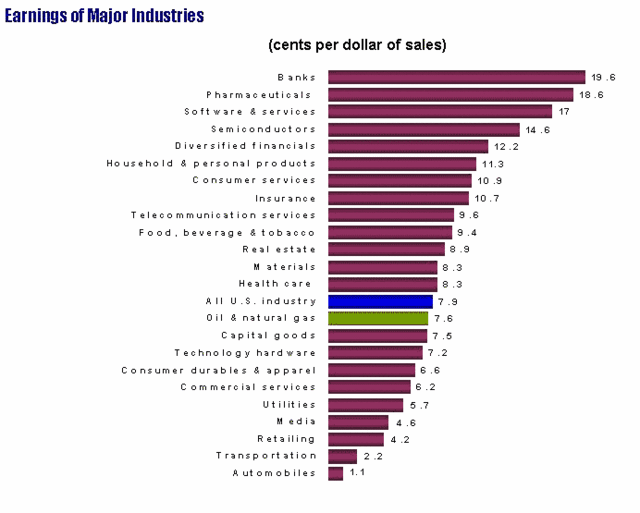
The article is mainly focused on the profit announcement at Exxon-Mobil, so I will use their numbers to put "staggering" into context.  E-M announced profits of $9.9 billion on sales of $101 billion.  For those who cannot divide, that is a profit margin of 9.9% of sales.  Since when is a profit margin at a cyclical peak of 9.9% considered "staggering"?  Microsoft makes 30%, in good times and bad, with a fraction of the investment or risk X-M takes.  From this chart, you can see the average for all industry is about 8%, with the oil industry generally below this number in all but cyclical peak quarters and banks, pharma, software, semiconductors, financials, household products and many others all consistently over 10%.  Procter and Gamble makes a margin of nearly 13% of sales selling toothpaste and detergent but we are going to begrudge oil companies 7.6% on average and 10% in their best quarters?

The article does absolutely nothing to put the profits in their proper context, though I was able to do it in one paragraph.  This is the only context the article offers:

The oil companies assert that their profits are no larger than other
businesses and that they just look big because it is a big business.

Exxon Chairman Lee R. Raymond said in a statement that the company
"acted responsibly" in its pricing and said its fourth-quarter profits
would come nowhere close to the $9.9 billion in the third quarter.

That doesn't necessarily wash with Adrienne Valdez of Phoenix.

"I can't afford to buy socks because I am paying twice what I used to
for gas," she said. "It's not right that they should be making billions
at our expense."

In Phoenix, gas prices soared to $3.14 after Hurricane Katrina hit the
Gulf Coast. The average Valley price per gallon, which has been falling
in recent weeks, was $2.72 Thursday, according to AAA Arizona.

Bruce Trushinsky, owner of the former Moon Valley Exxon station at 1901
W. Thunderbird Road in Phoenix, called Exxon Mobil's $9.9 billion
quarterly profit "disgusting."

He became so upset at the $7.6 billion profit posted by the company in
the second quarter that he canceled a longtime branding agreement.

"I ripped down all the Exxon signs and threw them in the garbage,"

he said. Now, after 30 years, Moon Valley Exxon is Carmel Automotive
and Fuel. Trushinsky said the high wholesale prices charged by Exxon
were devastating to his business and that the last straw was when the
company canceled its dealer-incentive program.

"They cut us off, then they announced their (second-quarter) profit increased $2 billion."

This is populist crap, and is the reason the MSM cannot be taken
seriously when they say that they are neutral reporters.  They are not
reporting, they are cheerleading an anti-oil company bigotry that has
existed for decades.  I think that the E-M management should be embarrassed to make such a small return in their best quarter.  Shareholders should take management to the woodshed for investing and risking so much in a cyclical business and making so little.  For gods sakes, they make a lower margin than Jif peanut butter earns.  Is anyone suggesting that we impose a windfall profits tax on Charmin?

I find the title of the article "Fueling Contempt" interesting - I am not sure if it was meant to refer to high oil company profits or if it was just a statement of intent for the article.

UPDATE:

Since 1977, governments collected more than $1.34 trillion, after adjusting for
inflation, in gasoline tax revenues"”more than twice the amount of domestic
profits earned by major U.S. oil companies during the same period

This is just gasoline taxes - it does not include income tax payments, property tax payments, and oil lease royalty payments.

More on California Bounty Hunting

Walter Olson has a post on California Prop 79, which

contains a sneaky, little-discussed provision that will empower trial
lawyers to file bounty-hunting suits against pharmaceutical companies
if the companies charge prices "that lead to any unjust and
unreasonable profit", with a minimum $100,000 plus fees guaranteed to
plaintiffs if a jury agrees that they have proved this (very hazily
defined) offense.

He has a roundup of posts on other California bounty-hunting laws.  I knew about a few of these, but the list is a lot longer than I suspected.

Are Homeowners the Largest Government Rent-Seekers?

I read an interesting article in the NY Times, via Marginal Revolution, interviewing the CEO of homebuilder Toll Brothers about housing prices.  His assertion was:

"In Britain you pay seven times your annual income for a home; in the U.S. you
pay three and a half." The British get 330 square feet, per person, in their
homes; in the U.S., we get 750 square feet. Not only does Toll say he believes
the next generation of buyers will be paying twice as much of their annual
incomes; in terms of space, he also seems to think they're going to get only
half as much. "And that average, million-dollar insane home in the burbs? It's
going to be $4 million."

I don't necessarily buy this whole story.  For one, Mr. Toll has business reasons for taking a public position that prices will keep rising - after all, his customers buy his product in part as an investment, and would be leery about paying current prices if they thought prices might fall in the future.  Second, as I have talked about a number of times with petroleum, when prices of any product start to rise, observers always tend to underestimate market and technology responses that might bring supply more into balance.

However, the one exception I did make in my oil price posts was that government supply restrictions, both on lands that can be explored for oil as well as things like refinery permitting, may indeed put structural upward pressure on prices.  And in fact, this is where Mr. Toll puts the blame for high housing prices as well:

Toll agrees with Glaeser et
al.
that the key force driving up prices is zoning and growth regulations. 
In New Jersey it now takes Toll Brothers up to two million dollars in legal fees
and ten years in time to get the permits necessary to build.

Which got me thinking that home owners (of which I am one) may be the worst rent-seekers of all.  Most people are already familiar with the very large tax breaks for home buyers, in the form of the mortgage interest tax deduction, that is not available to people who rent or to people who borrow for purposes other than home purchase.  However, it may be that a much larger implicit subsidy to home-owners is the government restrictions on new home supply.  By restricting supply, the government is keeping prices up for current home-owners and restricting new entrants who might compete with our homes in the resale market.

Rates are Too High -- So Lets Limit Competition

Apparently, some of our local politicians in the Phoenix area are upset about payday loan companies.  According the an AP report in the AZ Republic:

The stores cater to customers who live paycheck to paycheck who need
quick access to a few hundred dollars for rent, car repairs or just to
make ends meet. Banks traditionally don't make those type of small,
short-term loans.

So these stores provide loans to people no one else will touch.  And customers use their services of their own free will.  So what is the problem?  Well, not surprisingly, the rates on these loans are high, and the default terms tend to be drastic.  "Activists" think that people are making the wrong decision using these services, and, to be fair, I would certainly advise anyone who asked to try to find another alternative.  But what do my preferences matter?  Its easy for me to say in my middle-upper class hubris that such services don't make sense, but I have a steady job and ready access to bank loans.  In a free society, both I and those activists are free to convince people to not use these services, but its wrong to artificially limit people's choices out of some elitist sense that we can make decisions for other people better than they can for themselves.

Besides, lets think about the alternative.  These folks are not going to get bank loans -- in fact many customers may be illegal aliens who are, post 9/11, effectively barred from the banking system.  The only other alternative before these payday loan companies were loan sharks, whose interest is even higher and whose penalty for non-payment even more dire. This reminds me of the people who decry Nike "sweatshop" jobs in poor countries.  "Activists" similarly decry these jobs as if the alternative is $25 an hour office work, when in fact the alternative is actually grinding subsistence agricultural work for half the pay.  You may not like the payday loan companies, but they are replacing a much worse system.

But the really funny thing about this article is their proposed solution to the problem of rates for these payday loan services being too high.  Their solution?  Limit competition!  (emphasis added)

Arizona now has more than 600 payday loan stores - with 165 in the [Phoenix suburb] Mesa area alone - and some residents are upset about it.

"People are sick of it in west Mesa," said Dave Richins, a neighborhood
activist and executive director of the West Mesa Community Development
Corporation.

Richins and other critics claim the stores exploit customers with high interest rates.

[Phoenix suburb] Peoria blocks the shops from opening within 1,000 feet of a competing
store. Phoenix and Tucson are looking to that city's restrictions as a
model for new rules in their communities, with action possible by early
next year.

Gee, I bet that will help keep rates down -- make sure there are no competitors nearby!  Lets make sure it is as hard as possible to compare rates, particularly since the customer base is one that can't afford the gas, or doesn't even have a car, to drive all over town shopping.  I wonder why no one is suggesting the same thing for gas stations to keep gas prices down, lol.

The Perils of Prop 79

California has another confusing slate of initiatives on the ballot for the next election, including several related to various interventions in pharmaceutical pricing  (helping to demonstrate that grass roots democracy can be just as tyrannical to individual rights as any other form of government).  Bill Leonard, of the California BOE, notes in his weekly email:

Proposition 79 seeks to capitalize on public outrage over high drug prices by creating a new big government program that would supposedly mandate drug discounts for low-income Californians.

It turns out that the initiative contains a little-noticed provision that will allow private trial lawyers to sue drug companies for the new tort of "profiteering in prescription drugs."  Under this sneaky provision, which will be effective immediately even if the drug discount program is never implemented (Federal approval is required), drug makers would be prohibited from demanding "an unconscionable price" or demanding "prices or terms that lead to any unjust and unreasonable profit." These terms are not defined anywhere in the initiative or elsewhere in state or federal law, so your guess as to what these terms mean is probably as good as mine.  A violation of this new offense would carry a minimum fine of $100,000 or triple the amount of damages (whichever is greater) plus court costs and legal fees.  You can see why the trial lawyers love this initiative!  It is bad enough to have government bureaucrats setting drug prices, but imagine having drug prices set by randomly-selected jurors!

Can you imagine offering a product in a market and not knowing if your pricing was legal until after a jury trial?  Actually, until after multiple jury trials, since in cases like this there is effectively no restriction on being tried one, two, or ten thousand times for the same thing.  Not only will prices be set by a jury, but they will be set by the single most aggressive jury in what is sure to be an onslaught of trials.

In case you have any confusion or failure of imagination as to how poorly this will work out, California tort lawyers have slipped this same provision into other laws, notably the sue your boss over picayune labor code violations law and the Unruh Act, which allows lawyers to serially sue businesses for picayune technical violations of the ADA.  Here is an example of Unruh at work:

Molski, who lives in Woodland
Hills, has sued dozens of Central Coast businesses, from the Santa Ynez
Valley to Paso Robles, for alleged violations of the ADA. Among them
are Firestone, Fess Parker and Kalyra wineries in the Santa Ynez
Valley, Cambria Winery in northern San Luis Obispo County, and Fosters
Freeze restaurants in San Luis Obispo and Morro Bay.

A provision of California state law known as the Unruh Act allows Molski to demand $4,000 in damages per violation, per day.
                  

Molski
has said in the past that an average settlement is $20,000. He
testified in the Los Angeles trial that he personally nets an average
of $4,000 per settlement, after paying attorney's fees, Beardsley said....

As of Friday, 528 cases were listed under Molski's name in federal civil courts....
   

Also
fighting Molski in court is Harmony Cellars in northern San Luis Obispo
County. Winery owner Chuck Mulligan sees the L.A. decision as a good
sign, but isn't counting on winning.

"You
just never know. A jury trial is always a crap shoot," Mulligan said.
"I think the public sees through this whole quagmire that's going on.
They claim they are trying to do something for society but it's really
just pulling money away from society that could be used for jobs," and
other purposes, he said.


Molski's
suit against the Hitching Post in Casmalia alleged a wheelchair ramp
was too steep, and the bathroom wasn't accessible because the toilet
was a half inch too close to the wall; and the sink was three inches
too high, and the soap dispenser was too high.


Stricklin contends the bathroom is fully accessible.
                   

"Our
restaurant's accessible and has been for a long time. Our mother is in
a wheelchair. Of course it would be accessible," Stricklin said. "Every
customer we have that's disabled has gotten into our restaurant, and
we've never had a complaint."

"I've
talked to about five people in Solvang and Cambria who have been sued
twice in the last year," Stricklin said. "They're stuck. Unless you
close your doors, somebody else can come along and sue you, and that's
why we're fighting. If they can see that we're not going to roll over
and settle, they'll think twice about going to trial."

At least in the case of Unruh, there is a defined legal standard, even if suing for $4000 per day for violations of 1/2-inch are ridiculous.  Prop 79 would allow suits with no standards, except whatever a jury happens to come up with on a particular day.  And we all know how smart and thoughtful juries can be (from recent Vioxx case):

Jurors who voted against Merck said much of the science sailed right over their
heads. "Whenever Merck was up there, it was like wah, wah, wah," said juror John
Ostrom, imitating the sounds Charlie Brown's teacher makes in the television
cartoon. "We didn't know what the heck they were talking about."...

... [juror] Ostrom, 49, who has a business remodeling homes, was also disturbed
that former Merck Chief Executive Raymond Gilmartin and another top Merck
official gave videotaped testimony but weren't in the courtroom. "The big guys
didn't show up," said Mr. Ostrom. "That didn't sit well with me. Most definitely
an admission of guilt."...

One juror, Ms. Blas, had written in her questionnaire that she
loves the Oprah Winfrey show and tapes it. "This jury believes they're going to
get on Oprah," Ms. Blue told Mr. Lanier. "They only get on Oprah if they vote
for the plaintiff."

Previously, I made my own tongue-in-cheek suggestions for follow-ups to Unruh, but prop 79 may be worse than any of these:

So, I would like to propose my
own Unruh II law.  I propose that in California, every citizen now has
the right to sue any other person they observe violating any sort of
traffic law.  If you observe someone speeding, doing a rolling stop at
a stop sign, failing to signal a lane change or turn, with a burned out
tail light, not wearing a seat belt, jaywalking, etc, you may now sue
them for $4000 per occurrence. 

Coming in future posts, I will
propose Unruh III to empower citizens to sue over health code
violations, Unruh IV to empower citizens to sue over fire code
violations, and Unruh V to sue anyone for any reason if they have a net
worth higher than you do.

It strikes me that my suggestion for Unruh V is where we are really going.

Update: More bounty hunting here, via Overlawyered.

Let's Tax These Bubble-Driven Windfall Profits

A number of politicians are calling for taxing "windfall profits" driven by the "price bubble" in gasoline and oil.  Previously, I narrow-mindedly opposed this, arguing that the whole point of the pricing signal being sent is to call for new supplies, which won't happen if the government takes the money away from suppliers.

I say narrow-mindedly, because I have had an epiphany.  I realize now that it is indeed unfair for sellers to benefit from such a pricing bubble.  However, I think the politicians are wrong for looking at oil, since that bubble is only small potatoes.  I propose we start with the much bigger bubble:  In housing prices.  In a time of housing shortages, it pains my heart to Americans profiteering from artificially high prices.  Besides, oil companies actually do something useful with their windfall profits, like finding more oil; home sellers will just blow their proceeds on a big screen TV or something.

My proposal is that the government set a "fair price" for housing, based on a standard rate of appreciation.  The price of the house in a base year, such as 1970, adjusted for the CPI is a good starting point, but a process can be created modeled after Hawaiian gas pricing regulation to set up the exact standard.   Every house in the country then will be appraised.  Any house selling for or appraised for an amount above the 1970 price+CPI adjustment will be deemed as having reaped windfall profits.  The government is authorized to seize 100% of these windfall profits.  When this program is a success, we should then consider a retroactive program to seize windfall profits from the Internet stock bubble.

So, for all you who were supporting government intervention into gasoline pricing and profits, this must make you feel even better, since it is a much, much bigger bubble.  Right?  Or was it somehow more fun when Exxon was a target instead of, say, you?

Update:  I thought it was obvious, but I guess not from the email I have gotten:  I am being sarcastic here.  I would oppose a "windfall" profits tax on oil, houses, Internet Stocks, Pokeman cards, or whatever. 

The WSJ ($?) had this editorial on Saturday:

We keep hearing the word "bubble" to describe
industries with rapid and unsustainable rising prices. Hence, the
Internet bubble, the telecom bubble, stock market bubble, and now, some
analysts believe, a housing bubble. Yet for some mysterious reason no
one speaks of the oil bubble -- though prices have tripled in two years
to as high as $70 a barrel.

Reviewing the history of oil-market boom and bust
confirms that we are in the midst of a classic oil bubble and that
prices will eventually fall, perhaps dramatically. Despite apocalyptic
warnings, the world is not running out of oil and the pumps are not
going to run dry in our lifetimes -- or ever. What's more, the
mechanism that will surely prevent any long-term catastrophic shortages
in energy is precisely the free-market incentive to make profits that
many politicians in Washington seem to regard as an evil pursuit and
wish to short circuit.

The best evidence for an oil bubble comes from the
lessons of America's last six energy crises dating back to the late
19th century, when there was a great scare about the industrial age
grinding to a halt because of impending shortages of coal. (Today coal
is superabundant, with about 500 years of supply.) Each one of these
crises has run almost an identical course.

First, the crisis begins with a spike in energy prices
as a result of a short-term supply shock. Next, higher prices bring
doomsday claims of energy shortages, which in turn prompts government
to intervene ineffectually into the marketplace. In the end, the advent
of new technologies and new energy discoveries -- all inspired by the
profit motive -- brings the crisis to an abrupt end, enabling oil and
electricity markets to resume their virtuous longterm downward price
trend.

The limits-to-growth crowd has predicted the end of
oil since the days when this black gold was first discovered as an
energy source in the mid-19th century. In the 1860s the U.S. Geological
Survey forecast that there was "little or no chance" that oil would be
found in Texas or California. In 1914 the Interior Department forecast
that there was only a 10-year supply of oil left; in 1939 it calculated
there was only a 13-year supply left, and in 1951 Interior warned that
by the mid-1960s the oil wells would certainly run dry. In the 1970s,
Jimmy Carter somberly told the nation that "we could use up all of the
proven reserves of oil in the entire world by the end of the next
decade."

We can ridicule these doom and gloom predictions
today, but at the time they were taken seriously by scholars and
politicians, just as the energy alarmists are gaining intellectual
traction today. But as the late economist Julian Simon taught, by any
meaningful measure oil (and all natural resources) has gotten steadily
cheaper and far more bountiful in supply over time, despite periodic
and even wild fluctuations in the market.

Technorati Tags:  ,

Maybe He Should Have Worn a Cardigan

Truck and Barter is not very impressed with Bush's call for us all to drive less. 

I'd like to know just why I should conserve. We supposedly live in a
capitalist society based on property-rights and free-trade; why, all of a
sudden, do you ask that I not trust that the price of fuel incorporates all the
scarcities at every level of production? What economic lever broke in the past
month? Why do you think the price system is failing so bad that we need to
"conserve" more than the price signal warrants?

I won't pretend that market prices don't exist, or that markets have suddenly
stopped working; I won't pretend that prices are inefficient allocators of
resources; I won't pretend that I cannot buy as much gasoline as I can afford at
current prices.

Furthermore, Mr. President, I will not pretend that you have legal or moral
authority to tell me how much gasoline I may purchase. I will not pretend that
your feeble call to use less has any impact whatsoever on my psyche. I will not
pretend that the Federal Government knows better than me how much gasoline I
should purchase.

Awesome, well said.  Maybe if Bush had worn a cardigan, like Jimmy Carter did when he asked the same thing, he might have been more successful.  Or then again, maybe Bush should have thought twice about channeling Jimmy Carter on any energy or economics related issue.

By the way, there is much more to the post - make sure to read it all.

Update: This one attracted a number of comments fast.  Here are some additional thoughts

Doesn't it make sense to conserve gas?  Isn't what Bush said correct?

Sure it makes sense, but I didn't need Bush to tell me.  Seeing my average 15 gallon fillup go from $30 to $45 nearly overnight told me everything I needed to know.   I adjusted my driving behavior based on how I value various types of trips.  And so, apparently, did everyone else, as gas consumption in this country dropped almost 10%.  Bush doesn't have to tell you to refinance your home when mortgage rates drop, or to buy less OJ when the orange crop failed -- prices signal these things quite nicely.

By the way, I limited my driving years ago (e.g. I live 1 mile from my office) but not because of gas prices.  Lets say 1 hour of driving gets me 30 miles in the city, and requires 1.5 gallons of gas.  The recent increase in gas prices has increased the cost of that 1 hour of driving by about $1.50.  That is NOTHING compared to how I have increased how I value my free time as I have grown older.  That hour may use up five bucks of gas but hundreds of dollars of my leisure time.  I have often told people that the biggest change you go through getting older is how much your internal valuation of your own free time goes up.  In college, I would wait for 8 hours in a line to get concert tickets at face value.  Today, I buy them market up at eBay, because that 8 hours is now worth far, far more to me than the markup.

Wouldn't voluntary conservation beyond what you have already cut back help reduce gas prices in the US?

Sure, if everyone cut back some percentage more than what they would have already done due to the price increase, then yes that might help push prices down.  Of course every person who did this would lose from doing so.  When the price increases, everyone eliminates their marginal use of gasoline, ie every use or trip that is worth less to them than the cost in fuel.  That means that the trips that remain are worth more to them than the gas (and other)  costs.  Therefore, remaining trips are a net increase to their well-being.  If a remaining trip is then eliminated voluntarily, or the cost of that trip is increased due to the increased hassle of carpooling or using public transit, then their well-being is reduced. 

However, this is the great thing about America:  If you personally value voluntarily reducing your gas consumption to help reduce prices for others, in a free society, no one is going to stop you.

By the way, here is the reason I don't worry about it:  I am old enough to have been driving in the late 1970's.  And I know from experience that allowing prices to shoot up for a period of time, without government price caps or windfall profit confiscation silliness, is going to lead to more supply and lower prices in the future.

Don't you think its unethical not to conserve in times like this?

No.  I don't associate consumption and ethics.  If it is sold legally at a certain price, and I can afford and wish to pay that price, then I don't see that morality or ethics come into play.  While there certainly can be ethical problems spending money unwisely (e.g. blowing money on coke or gambling that was needed to feed your kids), that is a different situation.  I don't feel guilty about consuming gas.

Isn't it a security issue?  Shouldn't we be asked or forced to conserve more to make the US independent of foreign oil?

There is only one time this argument makes any sense - if the world is in a full scale shooting war and all foreign trade and international markets are halted, and then we would have much bigger problems.

Short of the breakdown of world trade and markets, being "independent of foreign oil" is a mirage, an impossible non-goal.  Lets say that the world energy supply and demand was exactly the same as it was today, except that the US produced domestically exactly enough oil to satisfy domestic demand.  But in this case there is still a world market for oil.  The price of oil and gas in this country would not be more or less than it is today, except maybe for a few cents of transportation cost differences.  And if there is an oil supply shock, the pricing in the US will be virtually the same in this hypothetical situation as it would be in today's structure.

Shouldn't the President be doing something?

Sure.  Get the hell out of the way of the people who can fix the problem.  Rethink the regulatory regime that is preventing refinery construction.  Revamp the licensing approach for nuclear power.  Open up oil drilling in proscribed areas.  And find his lost veto pen and ax any dumbshit regulation out of Congress managing energy prices, taxing windfall profits, or attempting to pick winners via subsidies.

Technorati Tags:  ,

Water: The Only Market the Government Screws Up Worse than Oil

Arizona Watch makes a great observation about water use here in the desert.  All-too-often, the anti-growth folks use the water issue to try to make us feel like Phoenix is heading toward some parched apocalypse.  Arizona Watch makes the following point:

Scott Patterson's "Swimming in the desert," is dangerously miss-informed. To
advance his anti-growth agenda, he predicts future water shortages in Arizona
due to urban population growth. Urban growth is not to blame.

Nearly 70% of Arizona's water is used for agricultural purposes. What's more,
the cost of water for agricultural use is significantly lower than for
industrial or household use. The problem is not that people live in this desert,
it's that people inefficiently grow crops in this desert, and the inefficiency
is encouraged by price controls on water. If water costs for agriculture were
not subsidized, then market pricing would ensure a plentiful supply of water for
generations to come.

Read the whole thing for the cites to the actual statistics.  I cannot understand why water can't be sold at a market rate.  If you subsidize water prices, and more people then come to the desert than the water supplies can support, is it the fault of the individuals who show up, or is it the fault of the government that can't seem to allow markets to operate when it comes to water?  This is yet another example of the government creating a problem with regulation, blaming the adverse results on the free market, and using the ensuing mess to justify more regulation.

Farmers in particular are getting paid by you and me, in the form of subsidized water, to try to grow wet-country crops out here in the desert.  This water subsidy is on top of the huge farm subsidies Arizona farmers get, including over $100 million a year in cotton subsidies alone.  The government is paying farmers to dump tons of water on cotton plants in the desert that grow perfectly well without irrigation in many other states. 

Postscript:  Farmers really have done an amazing job lobbying for themselves in this country.  They are particularly succesful here in Arizona, where the largest farms are owned by Indian tribes, that have the added lobbying strength of protected-group status.  The other night I was serving out my painful 7 hours or so in drivers ed. class when it was mentioned that us urban dwellers will get a huge fine for not having our 4 year old strapped down in a car seat, but rural pickup truck drivers in Arizona can legally have a 6-month-old rolling around in the back of a bouncing pickup truck without any restraint and be perfectly legal.  Why the difference?  Because the farmers wanted it that way.