Posts tagged ‘prices’

And I Thought OUR Governor Was an Idiot

Cafe Hayek has a fabulous fisking of Missouri governor Matt Blunt's letter to the editor explaining why his call for price controls on gasoline is consistent with his free market principals.  Its all good, I can't pick out any one quote.  Read it all.

But wait!  This just in!  Maybe our governor IS this dumb.

Our great benevolent leader, Janet Napolitano, has stated in press conference
the she is going to investigate these fuel prices of ours. Mostly she was
ruffling her feathers right after Hurricane Katrina shutdown a good 30% of the
domestic supply source. So of course prices increased slightly to account for
the lack of supply. This trend that followed exactly what even very simple
supply and demand theory would predict was not enough to convince miss Gov. J.No
not to call for yet another investigation. No way! She was not going to be
swayed by facts, reality or "assurances from the oil industry" that these were
fair market prices. Nope. An investigation was needed.

A little over a year ago, a pipeline broke and the only source of gasoline into Phoenix was stopped.  Due to EPA regulations, Phoenix requires a special gas blend made in only one refinery coming to us through one pipeline, so it is not surprising that if that source is interrupted, gas might be short here for a while and prices might spike up.  Which they did.  Governor Napolitano at that time blamed the whole situation on the oil industry and called for investigations.  Tellingly, she took only three policy actions:

  • Temporarily waived regulations for a special blend of gas in Phoenix
  • Temporarily waived regulations on truckers that were preventing them from filling in for the broken pipeline
  • Considered circumventing regulations that were preventing a local refinery to serve the Phoenix market from being built.

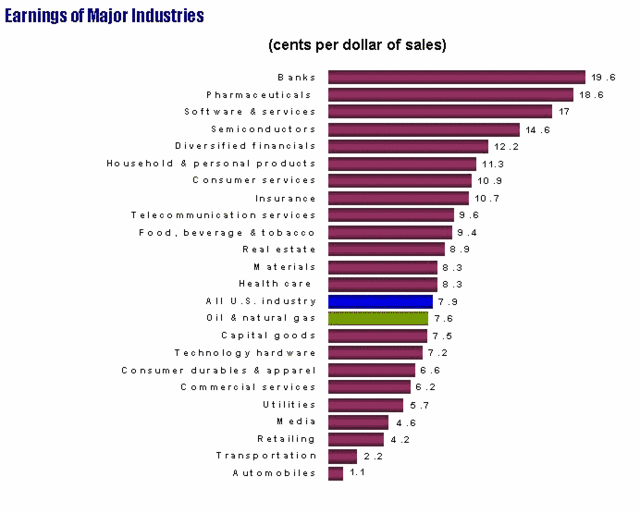
So the rhetoric at the time was "its all the oil companies faults" but the solution was "repeal government regulations".  Hmmmmm.  By the way, the Commons Blog created a nice chart showing how those filthy rich oil companies are making, uh, ahem, lower profits than average for US industry (click to enlarge).  I wish they were more profitable- we would probably have a lot more oil.

Margins1a

Supply and Demand in Gasoline

Via Lynne Keisling of the Knowledge Problem comes two good articles on supply and demand in the gasoline markets. 

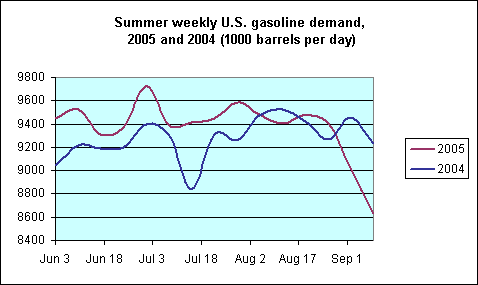
The first is from James Hamilton, who analyzes the effect of gasoline price increase on demand and finds, amazingly to some I guess, that demand has fallen substantially.

Gas_demand_1

We have certainly seen this in the camping and travel business, as visitation has fallen off the map of late, though fortunately it comes right at the end of the season.  It appears that demand has fallen about 10% with the increase to circa $3 gas, about matching the shortfall in US refining capacity post-Katrina.  Does anyone doubt that we would have seen gas lines had prices not risen?

The second article is from Steve Chapman. Apparently, Democratic senators are separately working to make sure that higher oil prices are not allowed to spur either lower demand or higher supply.   First he takes on serial-stupid-statement-making Maria Cantwell who is working the demand-side with her desire to have the US President set retail gasoline prices:

This week, as gasoline prices remained above $3 a
gallon, [Maria Cantwell] proposed giving the president the power to tell retailers
what they can charge at the pump.

A lot of people grew anxious
seeing long lines forming last week, as motorists rushed to fill their
tanks in the aftermath of Hurricane Katrina. But Cantwell apparently
enjoyed the sight well enough that she'd like to make those lines a
permanent feature of the landscape. If so, she has the right approach.
The government does many things badly, but one thing it knows how to do
is create shortages through the vigorous use of price controls.

That's what it did in the oil market in 1979-80, under President Jimmy
Carter. He was replaced by Ronald Reagan, who lifted price caps on gas
and thus not only banished shortages but brought about an era of low
prices.

Cantwell thinks oil companies have manipulated the
energy market to gouge consumers, though she is awaiting evidence to
support that theory. "I just don't have the document to prove it," she
declared. Her suspicions were roused when she noticed that prices
climbed in Seattle--though most of its oil comes from Alaska, which was
not hit by a hurricane.

Maybe no one has told Cantwell that oil
trades in an international market, and that when companies and
consumers in the South can't get fuel from their usual sources, they
will buy it from other ones, even if they have to go as far as Prudhoe
Bay.

If prices rose in Dallas and didn't rise in Seattle, oil
producers would have a big incentive to ship all their supplies to
Texas--leaving Washingtonians to pay nothing for nothing. When a freeze
damages Florida's orange juice crop, does Cantwell think only
Floridians feel the pain?

Then, he turns his attention to Senator Dorgan, who wants to make sure we get no new oil supplies by having the government confiscate "windfall profits"

Sen. Byron Dorgan (D-N.D.), meanwhile, was outraged by
the thought of giant oil companies making money merely for supplying
the nation's energy needs. He claimed they will reap $80 billion in
"windfall profits" and wants the government to confiscate a large share
of that sum through a special federal tax.

But the prospect of
occasional "windfall" profits is one reason corporations are willing to
risk their money drilling wells that may turn out to be drier than Alan
Greenspan's reading list. Take them away, and investors may decide
they'd rather speculate in real estate.

Speaking of real
estate, Americans seem to feel no moral compunction about getting rich
from unforeseen increases in the price of another vital necessity. You
think home sellers in Baton Rouge haven't raised their asking prices in
the last 10 days? You think Dorgan wants to tax their windfall?

It's hard to see why oil companies shouldn't make a lot of money when
the commodity they provide is suddenly in short supply. After all, they
are vulnerable to weak profits or even losses during times of glut.
Back when Americans were enjoying abundant cheap gasoline, the joke was
that the surest way to make a small fortune in the oil industry was to
start with a large fortune.

Oil companies are also subject to
the whims of nature. No one is holding a charity fundraiser for the
businesspeople whose rigs and refineries were smashed by Katrina. No
one will come to their aid if prices drop by half.

Maybe Senator Dorgan can go back and confiscate the windfall profits that Maria Cantwell made in the Internet Bubble, where she made a fortune cashing out to later investors who took a bath.  At least oil companies are creating value with new oil production with their windfall profits:

Calgary"” Penn West Energy Trust is holding
a huge land sale -- looking to sell exploration rights to more than
500,000 hectares of undeveloped territory in Western Canada -- and the
offering has stirred a frenzy among many oil and natural gas companies
hungry for new drilling options.

"Demand is phenomenal," said Moya Little, president of Western
Divestments Inc., the firm brokering the sale. "It's a wide spectrum of
companies, startups, majors, any company that needs to drill."

And more here:

The world's biggest oil producers have significantly
boosted investment in oil exploration for the first time in nearly two
decades.

The Organisation of the Petroleum Exporting Countries,
the cartel controlling 75 per cent of the world's oil reserves, on
Monday revealed its most important members had drilled 7.5 per cent
more wells last year than in 2003 in response to the oil price boom.
Opec's annual statistical bulletin also showed that the number of rigs
in operation within the 11-member cartel rose 18.8 per cent last year
after dropping by almost 6 per cent a year earlier.

What useful purpose is Cantwell using her windfall Internet stock profits for, other than financing her own run for the Senate?  Could the Democratic Party be any more clueless about economics?  Jeez, why is it that our opposition party in this country has to be such a joke?

Technorati Tags:  ,

More Thoughts on Price Gouging

In an earlier post, I wrote a defense of price gouging.  Incredibly, one of the best simple summaries of why "profiting off disaster" is actually a good thing comes from the NY Times of all places:

All this, of course, is capitalism at work, moving quickly to get
resources to where they are needed most. And those who move fastest are
likely to do best.

Exactly (by the way, the above is quoted from an Austin Bay post, which was aimed more at criticizing the NY Times for dropping such pro-capitalist sentences from its European version.)

Higher prices for generators and lumber in the disaster area is what tells Home Depot and others that it makes sense to shift lumber and generator inventory to Louisiana from California.  High prices for gas give the following two messages simultaneously and unambiguously to hundreds of millions of people:  "you can make some good money if you can figure out how to get more gas to consumers right now" and "you might want to drive a little less right now". 

Think about that last statement.  Congress has over the last 30 or so years generated numerous energy "plans" and has spent billions of dollars to figure out ways to promote conservation and increased supply.  All of these plans have been expensive failures.  But now, post Katrina, in less than 48 hours, with no one in charge, the market has achieved what Congress could never do.  The least valuable auto-miles will be eliminated, without years of study by Congress to figure out which miles are the least valuable.  The most economic new sources of gasoline will be tapped, without debating in Washington what those sources are.  All bottom-up, with no one ruling the process, by the voluntary self-interested efforts of hundreds of millions of Americans reacting to a simple price signal.

(previous paragraph best read out-loud with someone humming America the beautiful in the background)

Postscript:  Apparently, according to Austin Bay, Texas and more specifically Houston are now the great Satan.   Since I am a white male in my forties who is fairly well-off, still believes in free markets, and was born Houston, Texas, I guess that makes me the ultimate oppressor.

Technorati Tags:  ,

ATM Cards More Expensive to Process than Credit?

Does this make any sense:  It costs us a lot more, for small transactions, to process an ATM / debit card with the pin pad than a credit card.  Bank of America charges a flat 60 cents per ATM card / PIN pad transaction in our stores but charges 10 cents plus 2% on credit cards.  So, on a typical $5 convenience store purchase, BofA charges $0.60 or 12% to process a ATM / debit card but $0.20 or 4% for the credit card.

I understand the difference between value- and cost-based pricing, but in an economy of scale transaction processing business with a lot of competitors, I would think debit would be cheaper to process, even without the credit risk issues. 

Customers give me feedback that I am a neanderthal for not accepting ATM cards with a pin pad at the registers.  This is the reason.  Its cheaper for me to provide an ATM and then have them pay cash - that way they pay the fee, not me.  Also, their fee is lower.  Even if they only take out $20 and pay a $1.50 fee, they are still only paying 7.5% vs. the 12% typical I would be paying.  If anyone knows a company that offers a better deal, the comment section is wide open!

Update:  A couple of notes based on the comments.  First, I do indeed understand that prices are not cost-based.  The notion that pricing should be cost-based is one of the worst economic misconceptions held by the average person (behind the commerce is zero-sum myth).  When prices don't make sense to me, I don't run to the government asking for Senate hearings so corporations can "justify" their pricing, I just don't buy from them. 

Second, to another commenter's point, most card processing agreements and some state laws prevent merchants from passing card processing fees onto consumers in a discriminatory way - ie they can be built into the general pricing but you can't charge one person one price and another a different price for the same item based on what kind of payment they use.

Double-Speak is Alive and Well

This was funny, from labor boss John Sweeney (via Cafe Hayek):

Let's require big, profitable companies such as Wal-Mart to provide health care
to their employees instead of passing the cost along to everybody else, and
let's begin to develop a national health care plan that provides affordable
coverage to all Americans.

This is really, really funny.  Notice that in the first half of the sentence, he decries passing health care costs "along to everybody else" and then in the second half advocates a national health insurance plan that would pass individual health care costs onto... everybody else.  Also note that since Wal-mart, despite Mr. Sweeney's description as being big and profitable, has one of the lowest profit margins in the Fortune 100, it would likely have to raise prices in order to... pass these costs along to everybody else.

What Mr. Sweeney is actually frustrated about is that there are a large number of individuals in the labor force that he does not make decisions for and who do not in turn contribute to his personal power.

Cafe Hayek has more.

Please, Let There Be Gas Price Gouging

Katrina comes at a very bad time for US gasoline markets.  Supplies are already tight, and now a substantial amount of US oil production and refining capacity are shut in, for an unknown period of time.  Long ago, I worked as an engineer in a refinery and it can take days to get everything restarted from a cold start.  The result will almost certainly be near-term gas shortages.

There are two ways this can play out:  1)  a short term spike in prices, as much as a dollar or more a gallon or 2) long and irritating gas lines.  Lets hope that prices are allowed to reach their level and gas lines can be avoided, but who knows what political stupidities (ala Hawaii) will be proposed. 

I really, really hate gas lines.  I hate the uncertainty of whether or not I can find a station open.  I hate refilling my tank every day to make sure I am not caught short.  And for those of you who say I am arrogant since I can afford higher prices but the poor cannot, I assure you that folks who are paid by the hour are hurt much worse waiting around for hours in gas lines than the mere irritation I encounter.  More on gas line expectations as a semi-self-fulfilling prophecy here.

PS-  Expect to see news of a refinery fire or explosion over the next week.  The risk of accidents is very high when these complex plants have to start up -- they weren't really meant to be turned on and off.

Update:  First signs of a gas shortage?
Update #2:  The Mises Blog has a roundup of economics posts supporting price spikes during spot shortages (popularly known as gouging).
Update #3:  Jane Galt has more in praise of price gouging

More on Gasoline Prices

Lynne Kiesling is on fire, with a series of posts on gasoline pricing over at the Knowledge Problem.  She has posts here and here showing how gasoline purchases have fallen steadily as a percentage of household income, and she also has a nice summary post about the recent runup in prices here.

She is now headed up to the Boundary Waters - hopefully she is camping the Boundary Waters here.

Peoples Republic of Hawaii

Well, our most socialist state is attempting to repeal the laws of supply and demand:

Hawaii issued a list of wholesale price caps for gasoline, the
state Public Utilities Commission said, amid this month's
record-breaking run up in retail gas that saw island residents paying
some of the highest prices in the nation.

This marks the first state cap on gasoline prices since the 1970s
energy crisis, when the average inflation-adjusted price of a gallon of
regular unleaded hit $3.

Hawaii's recently enacted gas cap law goes into effect on September 1, with the pre-tax wholesale cap in Honolulu set at $2.1578

Gee, I bet this will work out really well.  Either the price cap will be set high, such that it is meaningless, or it will be set low, such that Hawaii will likely get this:

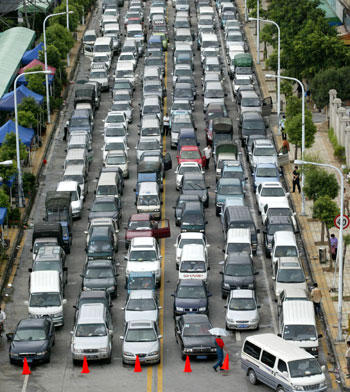
China_gas2
update:  given the structure of the price caps, the result could actually be higher rather than lower prices at the pump -- see update #2 below.

It's good to know that Hawaii is looking to China for economics ideas.

The Chinese government and its state-owned oil companies are locked
in battle over artificially low gasoline prices at the pump that has
caused a massive shortage in the southern manufacturing province of
Guangdong....

The crisis
highlights the persistent problems Beijing faces as the economy is
transformed to a more market-based system but that is often retarded by
authorities who fear loosing political control in the face of
full-fledged capitalist rules.

Beyond the obvious run-up in world-wide oil prices and Hawaii's logistical isolation that raises all of the prices on the island, the article on CNN identified one other possible culprit for high prices: the state government

Higher-than-average taxes on gasoline in Hawaii contribute to those
high prices. The state levies a 16 cent per gallon tax, and various
local authorities add on other taxes.

In Honolulu, for example, total state, federal and local gas taxes
amount to about 53 cents per gallon, one of the highest rates in the
United States. The national average, according to the American
Petroleum Institute, is about 42 cents per gallon

It seems like only a few days ago I was pointing how governments have a hard time resisting meddling in oil markets, and that this meddling never works out well.

Even in the US, which is typically more comfortable with the operation
of the laws of supply and demand than other nations, the government has
been loathe to actually allow these laws to operate on oil.  During the
70's, the government maintained price controls that limited demand side
incentives to conserve, thus creating gas lines like the ones we are
seeing in China today for the same reason.  When these controls were
finally removed, a "windfall profits tax" was put in place to make sure
that producers would get none of the benefit of the price increases,
and therefore would have no financial incentive to seek out new oil
supplies or substitutes.  Within a few years of the repeal of these
dumb laws, oil prices fell back to historical levels and stayed there
for 20 years.

Like the gas rationing and price controls in the 1970's, this occurs in a Republican administration (Hawaiian Governor Lingle).  It continue to be difficult to take the Republican Party's professed support for free markets seriously.

Hawaii's Star Bulletin reported that Governor Linda
Lingle (R) is an opponent of the caps. The newspaper said Lingle
believes it would be better to force oil companies to open their books
and show consumers how much money they make at each stage of business.

If she is so opposed to it, why didn't she veto the bill?  And is having government officials marching into private offices to confiscate accounting data really her preferred "free market" alternative?

Update:  Apparently the cap in Hawaii was passed pre-Lingle, and she fought to reverse it, so I will cut her some slack. Lynne Kiesling has more details on the plan, which includes how the cap will be calculated week to week.  Politicians there are calling it a "market-based price cap".  LOL.  Next we will see freedom-based speech limitations and privacy-based telephone taps.  Note that how the cap is calculated does not change the statement I made before:  Either the price cap will be set high, such that it is meaningless, or
it will be set low, such that Hawaii gets gas lines.

PS- Lynn is the economic goddess of energy markets, so if energy and power markets and regulation interest you, I recommend her blog.

Update #2:  Jane Galt makes the good point that the Hawaiian price caps are on wholesale gasoline prices, so while there may be gas shortages at the wholesale level, retail prices may be able to float higher to close the supply gap.  This would ironically lead to higher, not lower prices at the pump, and large profits for gasoline retailers.  Since wholesale sources of gas tend to be out-of-state corporations, and gasoline retailers tend to be smaller, locally owned businesses, I wonder if this is a case of rent-seeking by gas station owners.

More on the Housing Bubble

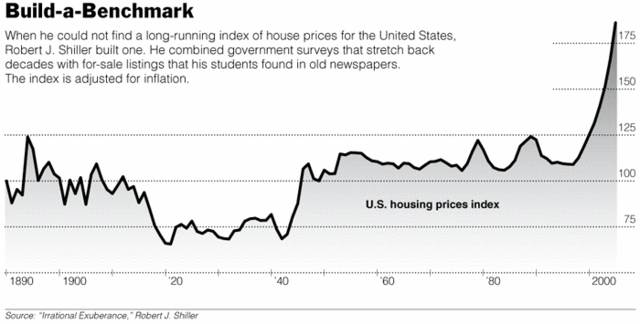
I can't check the guy's methodology, but Robert Shiller claims in the NY Times to have built a better, more accurate measure of housing prices.  You might ask, don't we already have that - I always see things like "median home sales price" in the paper?  The problem with existing metrics is that they don't correct for mix.  If a lot of large houses in the pricey part of town sell, median home prices will rise just given the mix shift of the sample.  What you really want is a price index for equivalent home sales, something that corrects for things like square feet, inflation, and perhaps zip code.  This is what Shiller claims to have done, and the results are dramatic.  He shows that real housing prices have been flat for most of the century, right up until the last decade, where they have increased dramatically.

Housingprices

I can't think of any structural change that would explain this (except maybe a change in relationship between mortgage rates and inflation) so it certainly creates a flashing red light saying "bubble". 

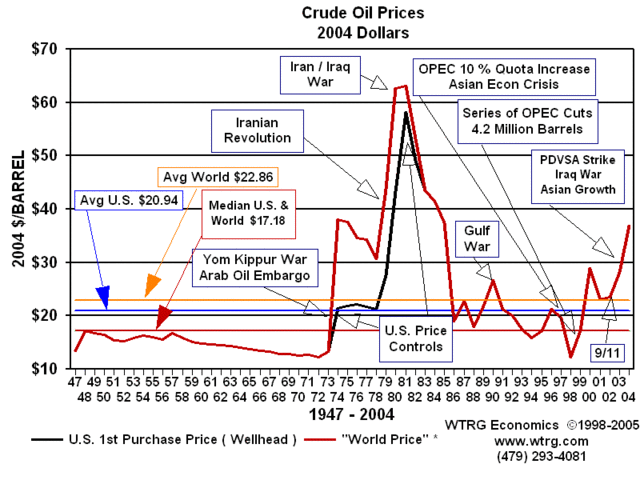
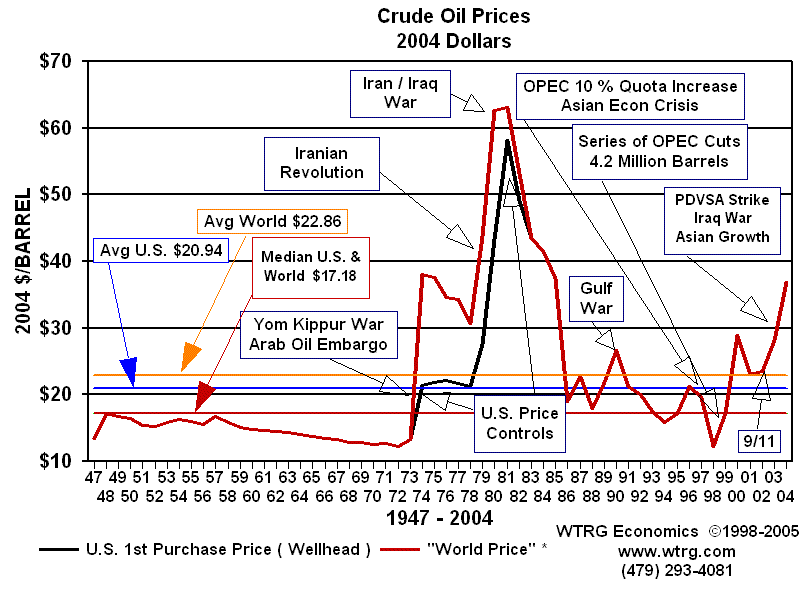
By the way, isn't it interesting that people can see the graph above and immediately think "prices are due to crash" but when they see this very similar chart:

Oilprice1947

...and think that prices will keep going up and up and up.

Hat tip to Marginal Revolution.  Other posts on housing prices here, here and here.  More on oil prices here.

More on Peak Oil

Everything old is new again.  Back in the late 70's, all the talk was about the world running out of oil.  Everywhere you looked, "experts" were predicting that we would run out of oil.  Many had us running out of oil in 1985, while the most optimistic didn't have us running out of oil until the turn of the century.  Prices at the time had spiked to about $65 a barrel (in 2004 dollars), about where they are today.  Of course, it turned out that the laws of supply and demand had not been repealed, and after Reagan removed oil price controls and goofy laws like the windfall profits tax, demand and supply came back in balance, and prices actually returned to their historical norms.

Today, as evidenced by the long article on "peak oil" in the NY Times Magazine this weekend, we are apparently once again headed for imminent disaster.  The Freakonomics blog has already chimed in with a partial rebuttal, but I wanted to share some of my own thoughts.

Are the Saudis hiding a reserve shortfall?  Much of the peak oil phenomena consists of Paul Ehrlich type doom-saying that takes pains to ignore the laws of supply and demand.  However, the question of Saudi behavior is an interesting one.  Lets for a moment hypothesize that the Saudis were indeed somehow running out of oil.  One thing the article misses is how bad a thing this would be for the Saudi leadership.  The author notes that the ruling family shouldn't care, since it is already rich, so declining oil revenues won't hurt it.  But that misses the point.  With a large percentage of the world's oil, the Saudis are a country that must be treated with respect and deference.  Without oil, Saudi Arabia becomes that Arab nation that virtually enslaves half its population (ie the females) and that funds much of the world's terrorism, including the 9/11 attacks.  Suddenly, without oil reserves, the Saudi's might find themselves moving up the Bush-Rumsfeld priority list for a little visit from the US military.  I have no way of knowing if the Saudis are hiding anything -- the fact that some Saudi fields are using secondary and tertiary recovery methods (as noted in the article) really does not mean much.  But if they were losing reserves, they sure would have the incentive to hide it.

Reserve accounting is a tricky thing.  The vagaries of reserve accounting are very difficult for outsiders to understand.  I am not an expert, but one thing I have come to understand is that reserve numbers are not like measuring the water level in a tank.  There is a lot more oil in the ground than can ever be recovered, and just what percentage can be recovered depends on how much you are willing to do (and spend) to get it out.  Some oil will come out under its own pressure.  The next bit has to be pumped out.  The next bit has to be forced out with water injection.  The next bit may come out with steam or CO2 flooding.  In other words, how much oil you think will be recoverable from a field, ie the reserves, depends on how much you are willing to invest, which in turn depends on prices.  Over time, you will find that certain fields will have very different reserves numbers at $70 barrel oil than at $25.

Trust supply and demand.  Supply and demand work to close resource gaps.  In fact, it has never not worked.  The Cassandras of the world have predicted over the centuries that we would run out of thousands of different things.  Everything from farmland to wood to tungsten have at one time or another been close to exhaustion.  And you know what, these soothsayers of doom are 0-for-4153 in their predictions.  Heck, they are about 0-for-five on oil alone:

Most experts do not share Simmons's concerns about the imminence of peak oil. One of the industry's most prominent consultants, Daniel Yergin, author of a Pulitzer Prize-winning book about petroleum, dismisses the doomsday visions. ''This is not the first time that the world has 'run out of oil,''' he wrote in a recent Washington Post opinion essay. ''It's more like the fifth. Cycles of shortage and surplus characterize the entire history of the oil industry.'' Yergin says that a number of oil projects that are under construction will increase the supply by 20 percent in five years and that technological advances will increase the amount of oil that can be recovered from existing reservoirs. (Typically, with today's technology, only about 40 percent of a reservoir's oil can be pumped to the surface.)

One of the problems with oil is that governments have a real problem with allowing supply and demand to operate.  I have wondered for a while why Chinese demand has kept growing so fast in the face of rising prices.  The reason is that the Chinese government still is selling gasoline way below market rates, shielding consumers from incentives to reduce consumption.  On the supply side, I also wondered when I was in Paris why gasoline prices as high as $6 per gallon were not creating incentives for new sources of supply.  It turns out that nearly $4 of the $6 are government taxes, so none of this higher price goes to producers or creates any supply-side incentives.  Instead, it goes to paying unemployment benefits, or whatever they do with taxes in France.

Even in the US, which is typically more comfortable with the operation of the laws of supply and demand than other nations, the government has been loathe to actually allow these laws to operate on oil.  During the 70's, the government maintained price controls that limited demand side incentives to conserve, thus creating gas lines like the ones we are seeing in China today for the same reason.  When these controls were finally removed, a "windfall profits tax" was put in place to make sure that producers would get none of the benefit of the price increases, and therefore would have no financial incentive to seek out new oil supplies or substitutes.  Within a few years of the repeal of these dumb laws, oil prices fell back to historical levels and stayed there for 20 years.

But meddling with prices is not the only way the government screws up the oil market.  I laugh when I see people with a straight face say that we have not opened up any big new fields in this country since Prudhoe Bay.  This is in large part because the three most promising oil field possibilities in this country -- ANWR, California coast, and the Florida coast -- have all been closed to exploration by the government.

In addition, the government has, through a series of energy bills that are each stupider than the last, managed to divert valuable energy investment capital into a range of politically correct black holes.  All we seem to get are unsightly windmills in Palm Springs that always seem to be broken and massive ethanol subsidies that actually increase oil consumption rather than decrease it.  It should come as no surprise that  despite government subsidies for a range of automotive technologies like fuel cells and all-electric cars, the winning technology to date has been hybrids, which weren't on the government subsidy plan at all.

Don't Ignore Substitutes.  All the oil doomsayers tend to define the problem as follows:  Oil production from current fields using current methods and technologies will peak soon.  Well, OK, but that sure defines the problem kind of narrowly.  The last time oil prices were at this level ($65 in 2004 dollars), most of the oil companies and any number of startups were gearing up to start production in a variety of new technologies.  I know that when I was working for Exxon in the early 80's, they had a huge project in the works for recovering oil from oil shales and sands.  Once prices when back in the tank, these projects were mothballed, but there is no reason why they won't get restarted if oil prices stay high.  At $65 a barrel, even nuclear starts looking good again, though we would have to come up with a more sane regulatory environment.  Look for venture capital to steer away from funding the next shoelace.com and start looking for energy investments.

Dueling Catastrophes.  As a final note, its funny seeing the New York Times crying "disaster" over the peak oil scenario.  Those who read this blog know that I am skeptical that the harm from man-made global warming is bad enough to justify large, immediate Kyoto-like reductions in hydrocarbon consumption.  However, the New York Times is on record as a big believer in and cheerleader for immediate cuts in hydrocarbon consumption to head off global warming.  So why is peak oil so bad?  Shouldn't they be celebrating an ongoing drop in oil availability, which would force the world to produce less CO2?  Along the same vain, it is funny seeing a publication that has decried over and over again our dependence on Saudi Arabian and other foreign oil at the same time lamenting the fact that Saudi Arabia is running out.  If that's true, won't Saudi reserve declines solve the whole dependence problem, one way or another?

Postscript:  The other day, I found one of Paul Ehrlich's doomsday books from the 70's in a used book store.  When I have a chance, I am going to post some of its predictions, which were treated with breathless respect by most of the media, including the NY Times.

China and California Following Similar Energy Policies

A couple of years ago, California suffered through a summer of electricity blackouts while the state and  state-protected power monopolies nearly bankrupted themselves.  While California politicians have tried to cover their behinds by blaming Enron for the problems, the real mistake that led to the debacle was allowing the wholesale price of electricity to float higher, while the retail price remained low and fixed.  As a result, as wholesale prices skyrocketed, the State and the power monopolies had to buy high and sell low, causing massive financial losses.  At the same time, consumers saw no change in prices, so they had no incentive to change their behavior and cut back on usage, which they would have done if retail electricity prices had been allowed to rise with the market.

Via Instapundit and Gateway Pundit, comes this article about gas shortages in China and the ensuing lines at retail gas stations, that look worse than anything we suffered through in this country.  The article makes fairly clear what is going on:

The Chinese government and its state-owned oil companies are locked
in battle over artificially low gasoline prices at the pump that has
caused a massive shortage in the southern manufacturing province of
Guangdong.

For weeks skyrocketing global oil prices and rising
demand has led to a fuel-supply crunch as domestic refineries have been
caught short in Guangdong.

Some fear it is only a matter of time before gas-guzzling cities such as Shanghai are hit too.

The
government has blamed recent stormy weather for the shortfall, which is
feasible but not enough to result in the kilometre long queues at
filling stations that drivers in Guangdong have endured for nearly a
month.

As oil prices climbed, a standoff erupted between China's
National Development Reform Commission (NDRC) -- a key economic policy
planning body -- and the country's two largest state oil groups
PetroChina and Sinopec, analysts said Wednesday.

The crisis
highlights the persistent problems Beijing faces as the economy is
transformed to a more market-based system but that is often retarded by
authorities who fear loosing political control in the face of
full-fledged capitalist rules.

I blame Enron.  Anyway, I wrote about gas line and what caused them in the US here.  Some genius also attempted the same policy as China is pursuing in post-war Iraq, with similar results.

Julian Simon Would Have Loved This

When I read this article on waste disposal, via Instapundit, all I could think of was Julian Simon.  For those who may be too young to remember, back in the 80's, after the panic that we were running out of oil was over, but before the current panic that we are producing too much carbon dioxide, there was a panic that we were running out of garbage dump space.  Uh, never mind:

Simply put, operators of garbage dumps are stuffing more waste than
anyone expected into the giant plastic-lined holes, keeping disposal
prices down and making the construction of new landfills largely
unnecessary....

The
productivity leap is the second major economic surprise from the trash
business in the last 20 years. First, it became clear in the early
1990's that there was a glut of disposal space, not the widely believed
shortage that had drawn headlines in the 1980's. Although many town
dumps had closed, they were replaced by fewer, but huge, regional ones.
That sent dumping prices plunging in many areas in the early 1990's and
led to a long slump in the waste industry.

Since then, the
industry and its followers have been relying on time - about 330
million tons of trash went into landfills in the United States last
year alone, according to Solid Waste Digest, a trade publication - to
fill up some of those holes, erase the glut and send disposal prices
skyward again. Instead, dump capacity has kept growing, and rapidly,
even as only a few new dumps were built.

Shortages seldom persist where the human mind is left free to attack the problem, and economic incentives are allowed to operate freely.  I wrote my own post attacking the zero-sum mentality that causes certain people to jump from one shortage-panic to the next. 

My prediction:  Five years from now, we will be seeing the same article on oil and natural gas.  "This oil field in west Texas is over 80 years old, and was thought to be depleted, until $60 oil prices and some new technology...."   You get the idea.

More "Government Coersion = Freedom" Arguments

The other day, I posted on a NY Times editorial that attempted to make the point that a .

This aggressively ridiculous position is none-the-less repeated by statists every day in many contexts.  Today I will focus on a post by David Sirota on the Huffington Blog.  Its premise is that government ownership of commercial assets is more conducive to freedom that private ownership.  I could probably have found a more serious writer to Fisk, but I am bored this afternoon and needed some fun.  Besides, its fun to see someone actively channeling some of the minor characters in Atlas Shrugged.

First, to be fair, I have to start with a strong point of agreement with Mr. Sirota:  Both of us are frustrated with the corporate welfare, subsidies, eminent domain land grabs, new stadiums, and incumbent protection laws handed by all levels of government to various corporations.  Mr. Sirota cites the stadium example in particular, which has always been a pet peeve of mine as well:

Usually, government is in the business of handing over huge amounts of
our taxpayer money to corporations, so that the corporations can just
take all the profits, and charge whatever they want to the customers.
That's been the backbone of the recent spate of high-profile stadium
deals, whereby city and state governments just fork over cash to private pro sports teams,
while getting no share of the massive profits in return, and letting
those teams charge higher and higher ticket prices to the fans whose
tax dollars are supporting them.

I feel fairly well protected on the price angle by the fact that I can just choose to not go to the games, but he is right that the government is handing over stadium money with little to show for it in return.

But this is where he and I diverge.  My answer is to stop crony capitalism, and to stop using government money and regulatory authority to support favored businesses.  Mr. Sirota goes the other direction, which one might call "in for a penny, in for a pound", of having the government continue investing in businesses but to do so on the government's own account.

ordinary Americans are realizing that there's an alternative path,
whereby community ownership of certain economic institutions and
businesses are a pretty good deal. Instead of allowing Corporate
America to reap the windfalls of everything, more and more communities
are trying to get a piece of the action "“ all while making sure the
public is adequately served, and not abused.

The highest profile example of this is in municipal broadband, where city governments are developing taxpayer-owned high speed Internet networks.
Instead of allowing Verizon or other corporations to control Internet
access and rake in all the profits from it, these communities are
making Internet access a public utility and sharing in the profits.
These communities can make some money at it, while doing the public a
service by keeping rates low.

I will accept his chosen example of broadband networks. I will also, for today, give the author a break and not challenge the bizarre notion that replacing a private company like Verizon who has a 5-10% profit margin with an inefficient government bureaucracy can yield substantial cost savings for customers AND fat profits for the municipal government.  In fact, I will leave the obvious efficiency arguments behind entirely and only discuss the morality, the right and wrong involved in his proposition.

Ownership and Capital Investment
Corporations like Verizon are owned by communities of millions of ordinary people through a mechanism we call "stocks".  Even the few large shareholders of Verizon tend to be investment funds, which are really just vehicles for aggregating ownership of many many ordinary people via mutual funds and/or the pension obligations they back.  Owners of Verizon provide capital to the company through their stock investment in an uncoreced transaction and of their own free will.  Their ownership is evidenced by actual paper shares, and is portable, such that they retain ownership anywhere they live, even overseas.  Investors at any time, if they don't like the company's performance or prospects, are able to cash out at the market price, and companies routinely return a portion of their surplus to them in the form of dividends.  Investors elect a board of directors to steward their investment in the company, and can throw these directors out any year with a 51% vote.  The company they have invested in must provide them clear reports quarterly using GAAP accounting rules about how their investment is fairing.

Contrast this to a municipal-owned broadband network.  In some sense, all members of the municipality have an ownership interest in the network, but they receive no documented evidence or guarantee of this ownership.  Local citizens are required by law to contribute capital to the enterprise via their taxes.  Their investment is mandated by the state, is not optional, and non-investment (via non-payment of taxes) is met with a prison sentence.  Once their money is invested, they may not sell their interest or in any way recover their investment.  History has shown that surpluses in municipal owned business seldom exist, but when they do, they are never returned to the citizens, but are spent in other government functions at the whim of the local authorities.  If the citizen moves, he loses any benefit of his investment.  Municipal authorities seldom produce financial statements for these enterprises, and, when they do, they would never pass GAAP muster.  Since the author mentions Enron, I will say that Enron had cleaner financial statements than most government entities.

The author clearly prefers the latter.  Does someone who chooses the latter over the former really care about freedom and individual rights?

Competition and Evolution

A private company, particularly in an industry like broadband with rapid technology change, is constantly subject to getting beaten by a competitor with better technology or a lower cost position.  In the absence of government intervention, the private company has to constantly match competitive technology changes and cost improvements, or die.  Its interesting that the author would choose broadband, because the corpses of literally hundreds of failed broadband companies litter the American landscape.  Broadband has historically been a brutal business, with most companies failing to repay their investment in their infrastructure.  I will confess that many of the major communications players have been slow to move in this area, but in large part it has been government incumbent protection, not market incentives, that have slowed progress.  Wireless broadband providers and equipment producers have to move rapidly -- they have already migrated from proprietary designs to A to B to G and now to N in just five years or so.  A private company without government protection in this environment is faced with two choices:  constantly upgrade, or die.

Now, lets look at municipally-owned broadband company.  Like the private company, it will have to make a large start-up investment to get the infrastructure in place.  Also like the private company, repaying this investment (and thereby avoiding hitting their taxpayers with new charges each month for operations, ala Amtrak) will require putting a lot of volume on the network.  Finally, also like the private company, it will be facing new technologies and new potential competitors almost before the network is complete.  So what does it do?  It could begin to reinvest in the infrastructure, earning the ire of local citizens because it goes back for yet more taxes for the development.  It could cut prices and drive for market share, lengthening the time before it breaks even and eliminates the tax subsidy it will require. 

Or, it has a third option that the private company does not have:  It can use its government authority to block new entrants.  I will tell you right now - the government will use this third option every single time.  Take another large government network business: The Post Office.  The USPS tried like hell to get the government to block Fedex, and almost succeeded.  The government continues to block competition to the USPS for first class local mail.  Heck, the USPS has tried at various times to argue that it should have authority over email and the Internet.  The government blocks new cigarette manufacturers to protect the settlement money it gets from the old-line tobacco companies and it blocks usage of Love Field in Dallas to protect D/FW airport.  Bureaucracies never, ever let themeselves die, and there is no way a municipal broadband business will ever let itself be killed by a competitor - that competitor will be blocked, even if that likely means that local broadband consumers have to stick with higher costs and outdated technologies.

Gee, that sounds great, huh?

Pricing
My sense is that this is what gets the socialists and community ownership guys excited.  You can see from the quotes above, the author sees the world of private enterprise as this enormous price gouging domain, with no accountability on prices.  Though he does not say it explicitly, I am sure if asked he would say that private corporations have no accountability to the public (ie consumers)on pricing, whereas the local municipal government would.  This pricing issue is I think at the heart of his support for public over private ownership:

People know corporations right now have far too much power
and far too much leeway to rip off ordinary citizens - but there is a
feeling that that's "just a fact of life." The Community Ownership
movement shows it doesn't have to be a fact of life, and that there is
an alternative

The obvious response is that private companies have a tremendous accountability on price, from two directions.  First, consumers, if prices are too high, can choose not to buy.  Second, if prices remain "too high" for long, then competitors emerge to undercut them.  Like most socialists or "progressives", the author doesn't understand or trust these mechanisms - he prefers top down rather than bottom-up accountability.

In this sense, he prefers the comfort of the municipal business where elected officials that the consumer votes for set prices, and trusts these elections to provide more accountability than the market  (how ). Even forgetting that government inefficiency will make price savings impossible in such a thin margin business, how can anyone look at Congress or this administration and believe that electoral accountability is stronger than the market.  Do you really feel that you can do more about to affect government set rates like local sales tax rates than you can in response to say rising cell phone rates?  If I don't like my cell phone rate, I can switch plans, switch companies, or switch to other technologies (land lines, VOIP, etc).  If I don't like the sales tax rate, the best I can do is move to New Hampshire.

Conclusion

Wow, this piece really went on for a long time, and certainly far longer than Mr. Sirota's article deserved.  As a final comment on the author's grasp of reality, note this quote, where he refers to:

the out-of-touch confines of the Beltway where free market extremism reigns supreme

LOL.  I would love to find even a little bit of free market extremism inside the Beltway.  And if by free-market extremism he means crony capitalism of the sort I described at the top of the post, well, he should be more careful with his word choice. 

For too long, our side has rolled over and died when it comes to
questions about how to manage the free market so that it works for
ordinary people.

Here is a hint - if you want to participate in the profits of the free market just like the fat cats, try this.
Why Aren't We Seeing Long Gas Lines

An email from a friend recently got me thinking about why, despite rising prices and tight worldwide demand, we aren't seeing gas station lines this year, like we did during oil shocks of the early and late 70's.  I remember both well, but the later shocks resonate with me more because as a newly minted 16-year-old driver, I was given the family job of driving around town hunting for gas for the family cars.

My first thought was that it was related to the speed and sharpness of the supply discontinuity.  Certainly the 1972 embargo represented a sharp supply change which took the world market a while to absorb, and what we have seen of late has been more gradual.  This is certainly part of the explanation, but incomplete, as the gas lines of the late 1970's were not accompanied by a similar discontinuity.  I might add that many economists at the time might have said that the speed should not matter that much, since it was accepted at the time that energy demand was inelastic, that it did not change much with price.  Therefore, the speed would not matter, since the market's corrective mechanism of price would not work well anyway.  Since then, we have learned that energy demand is very elastic, and that usage will adjust itself based on price.

My second thought was that regulation has a role in the explanantion.  Usually, when you see people queing up for a product or service, it means that prices or supply or both have been artificially limited.  Certainly last year's gas lines we got in Phoenix were almost entirely due to regulation.  Here in Phoenix, the government requires a blend of gas used no where else in the country.  The gas comes in from another state via a single pipeline.  Mobil tried for years to build a small refinery here to produce this blend closer to the market, but were never allowed by state regulators.  So, last year when the pipeline broke, we had shortages.  Our intrepid governor, as most politicians love to do in an oil shortage, blamed greedy gas station operators and oil companies for the problem.  However, when it came time to issuing her plan for dealing with the crisis, here were the first three steps:

  • Temporarily repeal regulations setting the unique gas blend for Phoenix
  • Temporarily repeal regulations on truckers to allow them to better take up the transportation slack
  • Reevaluate regulations that have restricted the construction of a refinery in Arizona

LOL, so it is all the oil companies' faults but the solution was to repeal three sets of government regulations.  Much the same situation occured in the early 70's.  Richard Nixon was probably one of the worst presidents from an economics standpoint that we have had in the last half century.  Few people remember just how close we got to a government program of gas rationing and how loud the calls were for nationalisatoin of oil companies.  Fortunately this never happened, but other bad stuff did.  For example, the markets ability to close the supply-demand gap were limited by a number of pricing controls on oil and other energy subsitutes, regulations that were not repealed until nearly a decade later.  Even weirder, the US government put in place distribution rules that said that oil companies had to send each market (I think it was done county by county) the same proportion of supply as in the year before the embargo.  I am not sure what fear drove this rule, but the result was chaotic.  For example, the previous summer lots of people drove cross-country for vacation, filling up out on the interstate in the countryside.  With shortages, no one wanted to drive long distance.  As a result, rural areas typically had plenty of gas, and cities were running out.  Demand patterns shifted (duh) but the government would not allow supply distribution to shift to match.

The final, and perhaps most important reason, though, that we have not had long gas lines is because people are not expecting them.  Fear of gas lines is a self-fulfilling prophacy, for the following reason:

Take the example of 1972, and we will use typical numbers of that era.  Lets say there were 100 million cars each with an average 20 gallon tank.  Lets
say normally, people refill their tank when it is ¼ full, so on
average their tank is 5/8 full.  Doing the math, there are 5/8 times 20 times 100
million gallons actually in cars or about 1,250 million gallons.  That's right - one of the largest single inventories of gas in this country is in people's tanks.

Now, lets say
due to supply panic, everyone suddenly refills at ¾ full. No one wants to be caught short (I remember in the 1970's, people would wait in line to put a gallon or two in their tanks -- it was nuts).  In this case, on average they
are 7/8 full or there are a total of 1750 Million gallons in cars' tanks.  So, in the space of
what might be two or three days, people suddenly demand 500 million gallons above and
beyond their normal usage to increase their tank's inventory.  Boom, stations are
out of gas, which causes people to feel even less secure without a full tank, so
they inventory more (many in spare gas cans) and the problem gets
worse.

One of the conspiracy theories of the 1970's was that we had gas lines because oil companies were holding tankers offshore waiting for prices to rise (the early 1970's were the point in time where the leadership banner for conspiracy theory nuts was handed off from the right wing to the left).  The irony is that the answer to the "mystery" of where all the gasoline inventory went was right under people's noses.  If an average tanker of the time carried 500,000 barrels of oil, and each barrel of crude oil produces about 20 gallons of gasoline (in addition to all of the other fuels) then then the act of gassing up cars faster caused 50 tanker loads of oil to disapear into people's gas tanks.  The "missing oil" was right in their garage!

Fascism and the Philadelphia Eagles

Living for many years in Dallas, including the three-Superbowl period in the mid-eighties, it was nearly impossible not to jump on the Dallas Cowboy bandwagon.  And, part and parcel (Parcell?) of being a Cowboys fan was hating those NFL east franchises the Giants, Redskins, and the Eagles (the Cardinals were also in the division, but were such a joke that they were not even worth hating, which is ironic since they are now my team here in Phoenix).

When we were driving up to Princeton reunions from Washington DC, my old roommate Brink Lindsey pointed out to me, as we passed the new Philadelphia stadium, that the Eagles were named in the 1930's after the blue eagle of the National Recovery Administration, or NRA.

I found this hard to believe, that anyone would name a sports franchise after one of the worst pieces of legislation in American history, but it seems to be true.  Apparently, naming the team the eagles was part of a larger soviet-style propaganda program:

For a while, there was no escaping the bird. Towns all over the country got on the Blue Eagle bandwagon. A hundred thousand schoolchildren clustered on Boston Common and were led in an oath administered by Mayor James Michael Curley: "I promise as a good American citizen to do my part for the NRA. I will buy only where the Blue Eagle flies." In San Francisco, 8,000 schoolchildren were dragooned into showing their
allegiance by forming themselves into a human Blue Eagle on the outfield in Seals Stadium. In Cleveland, 35,000 enthusiasts gathered in the public square to cheer the unveiling of the Blue Eagle flag while city officials proclaimed the "end of the depression." In Memphis, 125,000 people watched another 50,000 march in the city's traditional Christmas parade; on the final float Santa Claus sat resplendent upon a big Blue Eagle, from which perch he threw candy to children. In a New
Orleans park, NRA celebrants erected an enormous pyramid on which were inscribed the names of more than 7,000 people and businesses who had taken the pledge; on top of the pyramid was a nine-foot eagle made of blue lights, while red and white bulbs spelled out "We Do Our Part." In Philadelphia, citizens were soon cheering for a new professional football team whose name was inspired by the general's icon: the Philadelphia Eagles. In Roanoke, North Carolina, "Shanghai Mickey" offered Blue Eagle tattoos for a mere 50 cents. In Atlantic City, beauty contestants had the Blue Eagle stamped on their thighs.

What's next?  Should we rename the Red Sox the Boston Alien and Sedition Acts?  How about having the Chicago Smoot-Hawley Tariffs?

By the way, for those who are not familiar, the National Industrial Recovery Act of 1933 that formed the NRA was the centerpiece of Roosevelt's New Deal, and was modeled on Mussolini's fascism in Italy (via Sheldon Richman of the Concise Encyclopedia of Economics):

The image of a strong leader taking direct charge of an economy during hard times fascinated observers abroad. Italy was one of the places that Franklin Roosevelt looked to for ideas in 1933. Roosevelt's National Recovery Act (NRA) attempted to cartelize the American economy just as Mussolini had cartelized Italy's. Under the NRA Roosevelt established industry-wide boards with the power to set and enforce prices, wages, and other terms of employment, production, and distribution for all companies in an industry. Through the Agricultural Adjustment Act the government exercised similar control over farmers. Interestingly, Mussolini viewed Roosevelt's New Deal as "boldly... interventionist in the field of economics." Hitler's nazism also shared many features with Italian fascism, including the syndicalist front. Nazism, too, featured complete government control of industry, agriculture, finance, and investment.

And further, from John Flynn's The Roosevelt Myth via Anthony Gregory:

[Mussolini] organized each trade or industrial group or professional group into a state-supervised trade association. He called it a corporative. These corporatives operated under state supervision and could plan production, quality, prices, distribution, labor standards, etc. The NRA provided that in America each industry should be organized into a federally supervised trade association. It was not called a corporative. It was called a Code Authority. But it was essentially the same thing. These code authorities could regulate production, quantities, qualities, prices, distribution methods, etc., under the supervision of the NRA. This was fascism. The anti-trust laws forbade such organizations. Roosevelt had denounced Hoover for not enforcing these laws sufficiently. Now he suspended them and compelled men to combine.

If you are not familiar with the NRA, you need to be if you are going to come to a conclusion about the New Deal and just how statist FDR's aspirations were.  Henry Hazlitt has a long evaluation here. In the end, the NRA was struck down by the Supreme Court, and never revived in large part because it was a disaster for the economy.  Many blame the NRA for strangling the recovery that began in 1933-34 and thus extending the depression. Parts of the law (collective bargaining, minimum wage) were incorporated in other later legislation, but the core concept of organizing industrial cartels with government backing to run industries and set prices, wages, and production levels died, fortunately.

By the way, the countries today that I know of that most closely adhere to the assumptions of the NRA are France and Germany, who expelled the fascists in the forties only to eventually adopt most of their corporatist economics.

More Suggestions for Helping Africa

Reason has a good article on helping Africa.  To some extent, their arguments echo the ones I made in my previous post:

Despite political pressures, increasing the U.S. foreign aid budget would be a
mistake. The true cause of Africa's poverty is the continent's long history of
crippling misgovernance"”a problem that is exacerbated by rich countries' trade
protectionism, particularly with respect to agriculture....

The aid is ineffective because of the appalling way in which Africa is
governed. In recent decades, of each dollar given to Africa in aid, 80 cents
were stolen by corrupt leaders and transferred back into Western bank accounts.
In total, Nigerian President Olusegun Obasanjo estimated, "corrupt African
leaders have stolen at least $140 billion from their people in the [four]
decades since independence." All that is left when these regimes eventually
collapse is a massive public debt.

The article discusses how US and European agricultural subsidies really hurt the poorest nations:

While advocates of current market-distorting agricultural policies do not
intend to harm developing nations, the collective effect of U.S. farm policies
is devastating for producers of agricultural goods worldwide. American farm
policies might provide short-term benefits for agricultural producers in the
U.S., but those benefits are more than offset by the cost to American consumers
who pay higher taxes to support the U.S. farmers and higher prices for
agricultural products. Meanwhile, U.S. tariffs, quotas, and export subsidies
exacerbate poverty in regions like sub-Saharan Africa where people are heavily
dependent upon agriculture....

U.S. agriculture policy undermines U.S. efforts to alleviate poverty because
it drives down global agricultural prices, which in turn cost developing
countries hundreds of millions of dollars in lost export earnings. The losses
associated with cotton subsidies alone exceed the value of U.S. aid programs to
the countries concerned. The British aid organization Oxfam charges that U.S.
subsidies directly led to losses of more than $300 million in potential revenue
in sub-Saharan Africa during the 2001/02 season. More than 12 million people in
this region depend directly on the crop, with a typical small-scale producer
making less than $400 on an annual cotton harvest. By damaging the livelihoods
of people already on the edge of subsistence, U.S. agricultural policies take
away with the right hand what the left hand gives in aid and development
assistance.

GM Employee Pricing

When I first heard the GM ad campaign to give consumers access to the same discounts their employees get, I had two reactions:

  • I sure hope that they have some alternative employee incentive lined up.  I remember when I applied to GM as an engineer, this car discount was high on the list of how they sold the job.  Now what are employees thinking, since their employment buys them nothing on this dimension?  They are probably thinking they weren't getting much of a discount if GM can offer that discount to everyone
  • If I were a stockholder, I would be selling, because it sure smacks as desperation.  If you think of all the incentives GM has offered over the years, if they are offering an incentive that is unprecedented in their 80+ year history, then you know there must be some panic in the boardroom

Only GM could come up with a program that makes both employees and shareholders upset.  George's Emploment Blawg has more thoughts along these lines.  This all assumes that "same pricing as employees"  means just that -- remember that this is the industry where "invoice pricing" means nothing of the sort.

Many people have analyzed GM's problems.  It is tempting to say that their main problem is that they have not good cars, but I want to be careful not to substitute my preferences for market research.  So, instead, I will point out a couple of facts:

  • GM makes most of its profit from SUV's
  • All the profit in a car line, given high fixed costs, come from the last 10-15% of the cars produced.

So, as gas prices rise and silly tax loopholes are closed [thanks Mark], SUV sales only need to fall 10-15% to wipe out most of GM's profitability.

More on Statism and the Housing Bubble

In a followup post to the impact of "smart growth" policies on housing prices and availability, Tim Cavanaugh has this in Reason:

What's weird is how rarely, in San Francisco media, you'll hear the above
argument made at all. The "crisis" in housing prices is almost invariably
described as an inexplicable force of nature (in the local TV news) or as a
conspiracy by developers (in the alt.weeklies). You'd think, in a city full of
progressives who can talk all day about how they wish they could afford a home,
somebody might have started to wonder whether there's a connection between
political decisions and the fact that the city is remarkably segregated and
prohibitively expensive.

He has more, as does Thomas Sowell:

That fact has much to do with skyrocketing home prices. The people who vote on
the laws that severely restrict building, create costly bureaucratic delays, and
impose arbitrary planning commission notions need not pay a dime toward the huge
costs imposed on anyone trying to build anything in the San Francisco Bay area.
Newcomers get stuck with those costs...

People who wring their hands about a need for "affordable housing" seldom
consider that the way to have affordable housing is to stop making it
unaffordable. Foster City housing was affordable before the restrictive land use
laws made all housing astronomically expensive. Contrary to the vision of the
left, the free market produced affordable housing -- before government
intervention made housing unaffordable.

Smart Growth and the Housing "Bubble"

The other day, I wrote fairly tongue-in-cheek about dentists, their investment choices, and the housing "bubble".  In that article I linked to several much weightier analyses, if you are interested in the topic.  The Commons Blog has chimed in today with an interesting point about "smart growth" policies (which I have derided in many other posts):

But few reporters have bothered to ask why some markets have a bubble while
other fast-growing markets do not. The usual answer is that the bubbles are on
the coast because everyone is moving there, but many fast-growing regions in the
West and South do not appear to have a bubble.

The answer appears to be that "smart growth" and other growth-management
policies restrict housing supply. Since housing is an inelastic good, a small
restriction on supply leads to rapid increases in prices. This brings
speculators into the market -- and a large percentage of homes today are being
purchased with no-down-payment, interest-only loans by people who don't plan to
live in the homes; in other words, speculators.

A list of regions that are suffering bubbles reveals that a very high
percentage have implemented some form of growth management such as urban-growth
boundaries, greenbelts, or restrictions on building permits.

More on smart growth and housing bubbles here.  More smart growth resources via Cato.


Protecting the Consumers from Low Gas Prices

Decades ago, anti-trust regulation abandoned any pretense that its goal was protecting consumers.  The vast majority of anti-trust laws and cases today are more about protection of businesses from competition.  A good historic example is the Microsoft case, where consumers were bravely protected by the government from getting various utilities included free with their operating system.  You only had to look at the major defenders of the anti-Microsoft anti-trust suit (e.g. Sun, Oracle, etc) to know that the suit was about protecting other businesses rather than protecting consumers.

It would be difficult to find a better example of this today than for gasoline in Maryland:

A gasoline price war erupted in St. Mary's County last week after one station
slashed its price for regular to $1.999 a gallon and spurred three others to
follow suit, giving drivers some hope of relief at the pump.

But the price dip proved fleeting.

Maryland regulators quickly stepped in and told the stations that their prices
were too low. They needed to go up by 5 cents...

The sudden fluctuation in the Lexington Park area was the result of a
little-noticed Maryland law that took effect in 2001. The General Assembly
mandated that stations cannot charge less than what they pay for gas -- unless
they're lowering prices to compete with a nearby station.

The rationale for the law is ostensibly this:

Independent service station owners pressed lawmakers for the measure as a way to
protect themselves from big retailers selling gas below cost to drive them out
of business and limit competition. Maryland is one of at least 13 states to
adopt similar laws, which are not in effect in the District or Virginia.

First, its not the government's job to protect individual businesses.  Businesses should be treated like adults who knew the risks they were getting into in a business.

Second, this argument is specious anyway.  The logic is that ostensibly these dealers will be driven out of business, and then the big guys, without competition, will jack up their prices.  This is absurd.  It is important to note that it never happens this way, not for any sustained period of time in any market in the hundred years of gasoline retailing.  Gasoline retail margins are low, have been low, and will always be low.  If they ever creep up locally, someone has the incentive to undercut prices because volume is so important to profitability.  In fact, people have accused Wal-mart of this for years - ie they cut
prices and drive out the independents.  But so what, particularly if
prices never go back up?  This is even more true in gasoline retailing because gasoline station capacity never really leaves the market.  Because of the unique nature of the infrastructure, and the environmental rules vis a vis underground tanks, the best use for a gasoline station sold in bankruptcy is another gasoline station.  Even if an independent goes bankrupt, the site will likely stay a gas station, under different ownership.

Finally, in the current gasoline market, there are very good reasons not related to driving competitors out for one to sell gas under cost.  Many modern gas stations make as much or more profit on their convenience stores, car washes, and other services than they do on gas.  I know my company does in the few places where we sell gasoline.  Using gasoline as a loss leader to bring in convenience store traffic is perfectly valid.  Grocery stores have been doing this with eggs and milk for years.

This type law is a lazy protection device for a few companies that happen to have political clout in the government.  Maybe the IJ will get on the case.  Overlawyered.com has commentary and examples from other states.

Update:  One should also note that it various circumstances, the oil industry has, in addition to this case where a company was hit by the government for selling at a lower price than competitors, been accused of gauging (selling above cost and other competitors) and collusion (selling at the same price as competitors).  The Mises Blog has a nice link to R.W. Grants the Incredible Bread Machine, a poem that includes this stanza:

"These very simple guidelines,
You can rely upon:
You're gouging on your
prices if
You charge more than the rest.
But it's unfair competition if

You think you can charge less!
"A second point that we would make
To
help avoid confusion...
Don't try to charge the same amount,
That would
be Collusion!
You must compete. But not too much,
For if you do you see,

Then the market would be yours -
And that's Monopoly!


Flagstaff Not Yet Ready To Abandon Property Rights

Yesterday, Flagstaff, AZ became the latest community to vote on limits to "big box" stores.  When Wal-mart wanted to create a larger store that offered groceries, a group of local citizens didn't like the idea.  Not satisfied with exercising their individual right not to shop there, they got their city government to craft an ordinance to stop Wal-mart from expanding.  Wal-mart supporters gathered signatures and forced the ordinance to clear the voters as Proposition 100.   Via Arizona Watch, the ordinance would:

  1. Prevent retail establishments larger than 125,000 square feet
  2. Require retail establishments larger than 75,000 square feet to restrict the
    sale of non-taxable grocery items to less than 8% of their floor space
  3. Require retail establishments larger than 75,000 square feet to be subject
    to economic impact studies
  4. Require a conditional use permit (and the associated community input and
    hearings) for establishments larger than 75,000 square feet

Like all zoning, the ordinance was an attempt of citizens to control the use of someone else's property without having to actually buy the property.  Fortunately, the measure failed, though narrowly.  I will say that to some extent, I have trouble defending Wal-mart.  Wal-mart often takes advantage of statist actions to grow, including accepting loads of local government incentives and even eminent domain to grow.   To some extent, getting nailed by a local government is just getting hoist on its own petard, but I will defend them anyway because I could be next.

Supporters of the ban rallied under the "new urbanism" concept:

Meanwhile, the New
Urbanism concept -- a community design that mixes residential and
businesses districts to decrease the need to drive to outlying areas --
may face some challenges.

"What this
means is we're going to have to make some alternatives to the New
Urbanism vision," said Councilmember Kara Kelty. "We understand that we
have to maximize land usage. We need to continue that effort, but we
can't do that without the public."

Basically New Urbanism supporters would rather have a bunch of expensive and limited choice (but cute!) boutiques for you to shop at rather than whatever store you would prefer to shop at.  Rather than leaving this decision up to consumers, we-know-better-than-you planners in government take this upon themselves.  Reason had a nice article on New UrbanismCato critiqued the smart growth folks here.

But, don't be fooled that this is just about land use.  This reaction article from the Arizona Daily Sun has some priceless quotes (note that these are from people the reporter found shopping in Wal-mart!):

"I voted 'Yes.' I'm really
disappointed because this town has enough Wal-Marts, and I don't know
where they're going to find land space for huge stores, with that kind
of square feet. We're running out of room for people to live here. I
wonder how happy they'll be if the Super Wal-Mart was built on McMillan
Mesa, that's private land. I don't know where they're going to put one."

First, if they can't find the land, then there won't be a problem, will there?  And god forbid someone builds a Wal-mart on private land. Should we use eminent domain instead?  I must admit that to some extent I sympathize with the residents of Flagstaff.  Like Boulder or Vail, it is a small town in a beautiful mountain setting.  And, like Boulder and Vail, the wealthy of nearby large cities (Phoenix) have descended on it, buying second homes like crazy.  The result has been increased traffic and prices, offset by a white-hot economy, increases in wealth for long-time residents via existing home prices, and huge boost to the tax base that is much larger than the cost of serving the new part-year residents.  The locals are trying to figure out how to keep the capital gains in their homes, keep the extra jobs, and keep the extra taxes without actually having any new people in town, and its not really working for them.

"My first reaction was
'Boo' when they announced it. They announced it over the loudspeaker. I
heard some cheers, and I heard some claps. The one thing I hate is the
thought of creating minimum-wage, part-time jobs that do not pay their
employees' benefits. They're just going to exploit more college
students, like they do here. I do shop here for lack of a better place
to shop."

Whoa, this doesn't sound much like land use, but it sure is heard as a rationale a lot for anti-Walmart zoning.  Look, if Wal-mart is paying too little, then no one will take the jobs.  Since these are net new jobs, they likely will go to people not now currently working.  How does that hurt anyone?  By the way, you gotta love the "exploit more college students" swipe.  Since when are college students owed more than minimum wage?  I worked for minimum wage in college, and I seem to be OK.  Also, how can many college students want anything other than part-time work?  And, most hilariously, I don't know any [mostly young, healthy] college student that gives a rip about benefits (by which I presume they mean medical).  Very few college students have or need health coverage separate from their parents or school programs anyway. I wrote a lot more about Wal-mart and wages here.

By the way, this man's commitment to principals is hilarious.  When quoted, he was shopping at Wal-mart.  This person can't even be bothered with the one strong individual free-will non-coercion option open to him:  Don't shop there.  When quoted, he was at that very moment benefiting in the form of lower prices for whatever was in his cart from these supposedly horrible labor practices.  Jeez, talk about knee-jerk statism.  If half of the shoppers in that store voted for this limit Wal-mart ordinance, then get them together and boycott the damn place and you'll probably shut it down, and you could leave the government and property rights violations out of it.

Now, let us all get out our violins for this guy who voted for the limits:

"I feel like a hypocrite
because I do shop at Wal-Mart. If we let them build a Super Wal-Mart,
what happens to this current store? Are we going to have a big empty
space there? If they move it to the other side of town, I won't go over
there. This is convenient for me.

OK, so this man voted to use government force and coercion to wipe out the property rights of other private individuals because... he was afraid new stores might be less convenient?  Look folks, this is why we have a Constitution and Bill of Rights, and why the founders did not create an unlimited democracy.  51% of the people are not supposed to vote away the rights of the other 49%.  We protect rights like speech against such tyranny of the majority.  At some point, unfortunately, we stopped protecting property rights.  This is the result - your property rights effectively subsumed to people who are worried about driving too far to the store.

I will end on this one:

"I think it stinks. I
voted 'Yes' for the proposition. I definitely didn't like the tactics
(Wal-Mart) used. I wish people didn't go and shop there. I really
thought it was going to get beat. We voted down fluoride, so why not
vote down Super Wal-Mart? 
That's the kind of town we are. This town has
that kind of progressive attitude. I'm just disgusted with the whole
corporation -- Wal-Mart. I think it's wrong."

I have written a number of times:  Do not be fooled by the term "progressive".  Progressives, despite the name, hate bottom-up, non-controlled-from-the-top change.  More than that, they hate the decisions you make with your own property.  They believe that they can make much better decisions for your property than you can.  The next time you support the "progressives" in stripping some third party of their property rights, remember that you might be next.  Remember the progressive slogan:  "All Your Base Are Belong to Us".

I Guess I am an Extremist

I have not really had the time to do the research to form an opinion about Bush's judicial nominees, and the MSM is not very helpful in its coverage on the issue.  I wrote here that the judiciary has started to overreach of late, legislating from the bench to advance an agenda generally supported by the Democrats.  I don't know the candidates well enough to decide if these proposed judges are conservative activists who want to legislate from the bench but for conservative ends, or if they represent a first shot at reversing extra-constitutional judicial activism (which I would support).

However, I may have started to develop an favorable opinion on a couple of judges, based on what I have learned from their detractors.

Take this example, from a NY Times editorial, March 6, 2005.  In disparaging how extremist Bush judge nominees are, they use the example of:

Janice
Rogers Brown, who has disparaged the New Deal as ''our socialist
revolution.''

Woe is me, I must be an extremist.  First, the New Deal was clearly a "revolution", in that it was one of two events (the other being the Civil War) in the last 200 years that fundamentally changed the role of the federal government in what was a massive reinterpretation of the Constitution.  But was it socialist?  We can argue about whether the New Deal legacy that reaches us today is socialist or not- many quite normal non-extremist folks would argue yes and many similarly rational folks would argue no.

However, arguing the nature of the New Deal from what programs reach us today leaves out a lot of the picture.  Much of the New Deal was voided by the Supreme Court.  While some was re-passed later once FDR had a chance to remold the court with his own (for the time) extremist ideologues, some of the most socialist-statist-fascist legislation never was reinstituted.

The most dramatic of these institutions that fortunately were left on the cutting room floor was the National Industrial Recovery Act, or NRA.  Roosevelt actually modeled the NRA on Mussolini's fascism in Italy, so I guess it might be more correct to call it fascist rather than socialist but in practice, I can't ever tell those two apart.*

The image of a strong
leader taking direct charge of an economy during hard times fascinated
observers abroad. Italy was one of the places that Franklin Roosevelt
looked to for ideas in 1933. Roosevelt's National Recovery Act (NRA)
attempted to cartelize the American economy just as Mussolini had
cartelized Italy's. Under the NRA Roosevelt established industry-wide
boards with the power to set and enforce prices, wages, and other terms
of employment, production, and distribution for all companies in an
industry. Through the Agricultural Adjustment Act the government
exercised similar control over farmers. Interestingly, Mussolini viewed
Roosevelt's New Deal as "boldly... interventionist in the field of
economics." Hitler's nazism also shared many features with Italian
fascism, including the syndicalist front. Nazism, too, featured
complete government control of industry, agriculture, finance, and
investment.

If you are not familiar with the NRA, you need to be if you are going to come to a conclusion about the New Deal and just how statist FDR's aspirations were.  The actual text of the act is hereHenry Hazlitt has a long evaluation here.  In the end, the NRA was scrapped in large part because it was a disaster for the economy.  Many blame the NRA for strangling the recovery that began in 1933-34 and thus extending the depression.  Parts of the law (collective bargaining, minimum wage) were incorporated in other later legislation, but the core concept of organizing industrial cartels with government backing to run industries and set prices, wages, and production levels died, fortunately.

Update:  More here.  Mr. Gregory quotes John Flynn's The Roosevelt Myth:

[Mussolini] organized each trade or industrial group or professional group into a state-supervised trade association. He called it a corporative. These corporatives operated under state supervision and
could plan production, quality, prices, distribution, labor standards,
etc. The NRA provided that in America each industry should be organized
into a federally supervised trade association. It was not called a
corporative. It was called a Code Authority. But it was essentially the
same thing. These code authorities could regulate production,
quantities, qualities, prices, distribution methods, etc., under the
supervision of the NRA. This was fascism. The anti-trust laws forbade
such organizations. Roosevelt had denounced Hoover for not enforcing
these laws sufficiently. Now he suspended them and compelled men to
combine.

*  I disagree with people who want to argue that socialism is freedom but without property rights while fascism is property rights without other freedoms.  Neither of these conditions are stable, and both converge to the same destination of suffocating statism, just with different starting points and different people in charge.  One of the things that drive libertarians nuts is being presented with a grade school civics book that has a linear political spectrum with fascism on one end and communism on the other.  Are those really my only two choices? 


Observations on Walmart, Women, and Wages

After my earlier post on Walmart, I got to thinking about a number of Walmart-related topics.  My brain is a bit too fried on Friday night to organize these thoughts too much, so here they are, roughly following my stream of consciousness:

Exxon may have finally handed off the Great Satan title

The socialists of this country (who now generally call themselves progressives but its pretty much the same thing) usually need a company they can focus their attention on.  In the 1960's, this was probably General Motors, though defense contractors in the Vietnam War made a run at the title.  After the oil embargo of 1972, that title clearly moved to Exxon. I remember in one month in the early 1970's, the head of Exxon got called into Congress twice in a few weeks, once to combat the urban myth that oil companies were greedily holding oil off the market to drive up prices, and once to explain to Congress why they were greedily trying to expand oil production in Alaska.  My family and many of my friends worked for large oil companies, and we had several friends who were injured by letter bombs from domestic leftist terrorists (though the media did not call them terrorists then).

Exxon held the great Satan title for a long time.  It probably could have shed the title with low oil prices in the 80's, but the stupidity of the Valdez mess in the mid-80's and the vociferous opposition to the politically correct Kyoto accords in the mid-90's help them retain the title for a record number of years.

Finally, however, it appears that a new contender is at hand.  Walmart, so recently the most admired corporation in America, has become the new socialist whipping boy and lawsuit magnet.  Just search for Walmart in Google and you will get pages and pages of Wal-mart bashing sites.  Its kind of an amazing story how the former blue collar low-price hero of the working man trying to make ends meet has suddenly become a class enemy.  However, coming from a family that had many members who worked for Exxon, it comes as some relief to pass the Great Sata title on.

I wish everyone at Walmart could make $100,000 per year

In this, I am exactly in the same boat as Walmart detractors.  I would love for everyone at Walmart to make a ton of money.  Whether this is realistic is another story.

In America, people take jobs voluntarily

I would generally class this as a blinding glimpse of the obvious, but it appears that it has to be said.  And, if you accept that people are operating in their own rational self-interest (by the way, this is not a given -- many on the left do not think the average American is smart enough to make decisions for themself and that they need smart technocrats to look after them).  Anyway, were was I?  Oh yes, if you accept that people operate in their own rational self-interest, then by definition the job for Walmart employees is their best option, and any other option is worse.

This is the logical fallacy of those who attack Walmart (or offshore companies) for paying too low of wages.  Their concern is that these wages are lower than they, as an outside obviously smarter than everyone else observer, think they should be.  The reality is that these wages are higher than that employee's other options, and therefore is an improvement over that job not existing at all.  Note this story I told in an earlier post:

Progressives do not like American factories appearing in third world
countries, paying locals wages progressives feel are too low, and
disrupting agrarian economies with which progressives were more
comfortable.  But these changes are all the sum of actions by
individuals, so it is illustrative to think about what is going on in
these countries at the individual level. 

One morning, a rice farmer in southeast Asia might face a choice.
He can continue a life of brutal, back-breaking labor from dawn to dusk
for what is essentially subsistence earnings.  He can continue to see a
large number of his children die young from malnutrition and disease.
He can continue a lifestyle so static, so devoid of opportunity for
advancement, that it is nearly identical to the life led by his
ancestors in the same spot a thousand years ago.

Or, he can go to the local Nike factory, work long hours (but
certainly no longer than he worked in the field) for low pay (but
certainly more than he was making subsistence farming) and take a shot
at changing his life.  And you know what, many men (and women) in his
position choose the Nike factory.  And progressives hate this.  They
distrust this choice.  They distrust the change.  And, at its heart,
that is what opposition to globalization is all about - a deep seated
conservatism that distrusts the decision-making of individuals and
fears change, change that ironically might finally pull people out of
untold generations of utter poverty.  (update:  good post in the Mises blog on Taco Bell and wages here)

It's Wages vs. Prices, not Wages vs. Profits

In aggregate, because they have so many stores, Walmart makes about $10 billion a year in pre-tax net income.  Which is a lot.  But when looked at as a percentage of sales, it is pathetic.  Given its nearly $300 billion in sales, this is about a 3.5% return on sales, which while not unusual for retailers, in the grand scheme of American business is pathetically low.  I would have to shut down my business tomorrow if I only made 3.5% of sales -- I couldn't support the investments I have to make.

Its illuminating to compare this to all those small family owned boutique
businesses that Walmart supposedly shuts down.  So here is a little
example.  Lets say that the alternative to Walmart in Smallsville, USA would be a series of boutique stores, like
the mythical Nan's Clothing Shop.  Lets
say Nan does $250,000 a year in sales,which
would actually make her shop more successful than average, particularly for smaller town mid-America.  If Nan had to live with Walmart's profit margin of 3.5%, she would end up with an annual profit of  ... $8,750.   And, if Nan is working full-time trying to make the store work, and assuming 2300 hours a year, which is probably low for a small business person, she would be making a whopping  $3.80 an hour running her store, such that she would be much better off (leaving out the personal satisfaction of running your own business) working for Walmart at the average wage there of $6.50 an hour. 

While socialists and progressives are programmed in the deepest recesses of their DNA to blame everything on profit, the wage savings Walmart may get are not going to profit.  Their profit margins are low, in fact lower than most of the smaller stores they are replacing.  If there is a wage trade-off going on, it is between lower wages and lower prices to consumers.  Which obviously makes socialist demagoguery a bit less compelling, since it means that in some sense consumers and not Walmart are to blame if wages are too low, since presumably it is consumers who make the choice to switch from the higher cost traditional boutique alternatives to Walmart.

Walmart detractors have one good point - Walmart gets far too much preferential tax treatment

I don't know why it is, but Walmart is a magnet for taxpayer subsidies.  Not only does the government love to hand out tax breaks to Walmart, it local governments go so far as to use eminent domain to put together land parcels for them.  If I was a local retailer and had my tax money used to subsidize a new competitor, or worse got my land siezed to hand over to Walmart, I would be pissed off too.

I have not really studied Walmart's tactics in this, but my sense is that they have gotten good at getting neighboring communities competing with each other.  This is a crock and a waste of taxpayer money, and nearly as bad as subsidizing sports teams.  I have a long post on the sad practice of subsidizing business relocations here.

A final thought on the most unpublicized economic miracle of the last century

Since many of Walmart's attackers focus on their treatment of women, in part due to numerous accusations of discrimination in pay and promotions, it led me to a final thought about a great economic miracle that occurred in this country in the last decades of the 20th century.

Check this data out, from the BLS:

  • In 1968, the unemployment rate was 3.8%.  22.9 million women were employed in non-farm jobs, accounting for 34% of the work force.
  • In 2000, the unemployment rate was 4.0%.  62.7 million women were employed in the work force, accounting for 48% of the total
  • In these years, the number of women employed increased every single year.  Even in the recession years of 1981-1983 when employment of men dropped by 2.5 million, women gained 400,000 jobs

This is phenomenal.  After years of being stay-at-home moms or whatever, women in America decided it was time to go to work.  This was roughly the equivalent of having 40,000,000 immigrants show up on our shores one day looking for work.  And you know what? The American economy found jobs for all of them, despite oil embargos and stagflation and wars and "outsourcing".

I would love to see women at Walmart making more money, and some day they probably will.  Even so, though, the fact that so many have found work there is a miracle unto itself. Remember that the alternative to a $6.50 job at Walmart if the left is successful in eliminating these jobs is probably not new $15.00 jobs - it is no job at all.  Just ask the French.  Also see my recent post on the minimum wage.

Update:  This is some pretty smart PR by Wal-Mart to deflect the sprawl argument often used against it.  By the way, I challenge someone to define sprawl adequately for me in the context it is used by people who are decrying it.

In Praise of "Robber Barons"

After seeing a piece of my son's history curriculum at school, I realized for about the hundredth time just how poor an understanding most people have about the great industrialists of the 19th century, so unfairly painted as "robber barons".  While it is said that "history is written by the victors", I would observe that despite the fact that socialism and communism have been given a pretty good drubbing over the last 20 years, these statists still seem to be writing history.  How else to explain the fact that men who made fortunes through free, voluntary exchange of products can be called "robber barons"; while politicians who expropriate billions by force without permission from the most productive in society are called "progressive".

To be sure, capitalists of the 19th century sometimes played by rules very different from ours today, but in most cases those were the rules of the day and most of what they did was entirely legal.  Also to be sure, there were a number of men who were fat ticks on society, making money through fraud and manipulation rather than real wealth creation (Daniel Drew comes to mind).  However, most of the great industrialists of the 19th century made money by providing customers with a better, cheaper product.  In the rest of this post, I will look at two examples.

The first is Cornelius "Commodore" Vanderbilt, the person to whom the term robber baron was originally applied (by the New York Times, interestingly enough - some things never change).  While Vanderbilt is perhaps best known for his New York Central railroad, the term was actually applied to him earlier in life in his shipping days, where he made a fortune running steamships in and out of New York City.  Vanderbilt stood accused of overly predatory tactics in moving into rivals territories.  However, in 1859 Harpers Weekly observed (via An Empire of Wealth by John Steele Gordon):

...the results in every case of the establishment of opposition lines by Vanderbilt has been the permanent reduction of fares.  Wherever he 'laid on' an opposition line, the fares were instantly reduced, and however the contest terminated, whether he bought out his opponents, as he often did, or they bought him out, the fares were never again raise to the old standard.  This great boon -- cheap travel-- this community owes mainly to Cornelius Vanderbilt". (sorry, no link available -- I guess they weren't putting their articles online in 1859)

In many ways, Vanderbilt was the Southwest Airlines of his day, and, just like with Southwest today, towns begged for him to serve them because they knew he would bring down rates.  In fact, there is actually another parallel with Southwest Airlines.  In the early days of Southwest, most of the airline industry was regulated such that new entrants competing at lower prices were pretty much excluded by government rules.  Southwest got around these rules by flying only in Texas, where interstate rules did not apply.  Their success in Texas was a large reason for the eventual demise of government regulation that effectively protected fat and inefficient incumbent airlines, with drastically lower fairs the result.

When Vanderbilt first entered the steamship business, most routes were given as exclusive charters to protected monopoly companies, most run by men with friends in the state government.  Vanderbilt took on the constitutionality of these government enforced monopolies and, with the help of Daniel Webster, won their case in the Supreme Court.  Within a decade, the horrible experiment with government monopoly charters was mostly over, much to the benefit of everyone.  While private monopolies have always proved themselves to be unstable and last only as long as the company provides top value to customers, publicly enforced monopolies can survive for years, despite any amount of corruption and incompetence.  Vanderbilt, by helping to kill these publicly enforced monopolies, did more than perhaps any other man in US history to help defeat entrenched monopolies, yet today most would call him a monopolist. 

By the way, there are two charges against Vanderbilt that partially stick.   Those are that he bribed legislators and that he sought out price fixing agreements with his competitors.  Both are true, but both need context. 

To understand the bribery, one has to recognize that NY state passed a law that you could not be convicted of bribery solely on the evidence of the other party involved in the bribe.  In other words, they effectively made bribery legal as long as you were smart enough to do it without witnesses.  The real corruption was in the NY legislature at the time.  While Vanderbilt's motives were likely not always pure, no one who understands the state of NY at the time would deny that Vanderbilt would have been gutted had he not pro-actively played the bribery game himself in Albany in self-defense.

The price-fixing charge is even easier to deal with in context - basically price fixing agreements were entirely legal at the time.  In fact, price-fixing has been thought necessary, particularly in transportation, by politicians of all stripes for centuries - remember as late as the 1970's we had government enforced price-fixing in railroads and airlines.  In the 1930's, FDR via the NRA briefly instituted a government price-collusion scheme on the entire economy.

My other featured industrialist here on hug-a-robber-baron day here at Coyote Blog is John D. Rockefeller.  At one point of time, Rockefeller controlled 90% of the refining capacity in the country via his Standard Oil trust.  He was and is often excoriated for his accumulation of wealth and market share in the oil business, but critics are hard-pressed to point to specifics of where his consumers were hurt.  Here are the facts, via Reason

Standard Oil began in 1870, when kerosene cost 30 cents a gallon. By 1897, Rockefeller's scientists and managers had driven the price to under 6 cents per gallon, and many of his less-efficient competitors were out of business--including companies whose inferior grades of kerosene were prone to explosion and whose dangerous wares had depressed the demand for the product. Standard Oil did the same for petroleum: In a single decade, from 1880 to 1890, Rockefeller's consolidations helped drive petroleum prices down 61 percent while increasing output 393 percent.

By the way, Greenpeace should have a picture of John D. Rockefeller on the wall of every office.  Rockefeller, by driving down the cost of Kerosene as an illuminant, did more than any other person in the history to save the whales.  By making Kerosene cheap, people were willing to give up whale oil, dealing a mortal blow to the whaling industry (perhaps just in time for the Sperm Whale).

So Rockefeller grew because he had the lowest cost position in the industry, and was able to offer the lowest prices, and the country was hurt, how?  Sure, he drove competitors out of business at times through harsh tactics, but most of these folks were big boys who knew the rules and engaged in most of the same practices.  In fact, Rockefeller seldom ran competitors entirely out of business but rather put pressured on them until they sold out, usually on very fair terms.

From "Money, Greed, and Risk," author Charles Morris

An extraordinary combination of piratical entrepreneur and steady-handed corporate administrator, he achieved dominance primarily by being more farsighted, more technologically advanced, more ruthlessly focused on costs and efficiency than anyone else. When Rockefeller was consolidating the refining industry in the 1870s, for example, he simply invited competitors to his office and showed them his books. One refiner - who quickly sold out on favorable terms - was 'astounded' that Rockefeller could profitably sell kerosene at a price far below his own cost of production.   

More here. In fact, many, many of these defeated competitors became millionaires in their own right with the appreciation of the Standard Oil stock they got in the merger.

Eventually the Standard Oil monopoly weakened as most private monopolies do.  Monopolies seldom if ever engage in the price-increase games everyone expects them to, but they do get risk averse and lose vitality over time without serious competition.  This indeed did happen to Standard Oil, and it missed a number of key market turns, such as the Texas oil boom.  By the time is was broken up under the Sherman anti-trust act, Standard's market share had already fallen to 60%.  As would be the case many times in history, the government acted on the economic "threat" of Standard Oil at the very time the market was already doing the job.

Ever since, people have expended a lot of unnecessary energy getting worried about bigness and monopolies in industry.  I always laugh when "progressives" decry the monopoly power of the oil industry to manage prices.  I worked for the oil industry in the 80s, and if they had the power to manage prices they sure were doing a crappy job of it.  If someone thinks that oil companies have been manipulating prices, they have to explain this chart to me.  If prices are manipulated at all, they look like they are being kept low and stable.

Another great example of monopoly paranoia is the near continuous Microsoft-bashing in the courts.  The most famous anti-trust case was the successful case by Netscape and numerous other Microsoft competitors attempting to kneecap Microsoft, nominally for monopolizing the browser market.  Now lets leave aside the obvious issue of just how consumers are getting hurt by being given a free browser by Microsoft.  The plaintiffs apparently successful argument (incredibly) was that through a series of technology and marketing moves, Microsoft prevented competition.  If that is so, if competing with Microsoft is so hard, then why are 30% of my visitors using Firefox when none used it a year ago.  I use Firefox, and you know what, it took me about 5 minutes to download, install it and start running it.  Boom, monopoly gone.  Lots more on anti-trust here.

UPDATE:  Welcome to the Greenwich Public Schools.  Thanks for linking me from your web site.  Despite my Arizona home today, I actually lived in Greenwich for a while growing up.  You can find other essays on capitalism and individual freedoms here and here, or you can check out Dave Berry, who is much funnier than I am.  If you are looking for a stronger defense of free markets than you can find in most public schools, a good place to start is at the Cato Institute.

"Sin" Taxes Put Perverse Incentives on Government

The government has found over time that it is able to sell higher taxes to the voters on certain items if they can portray those items as representing some socially unwanted behavior. These are often called "sin" taxes. The justification for the tax in its beginning is as much about behavior control as revenue generation.  Taxes on cigarettes, alcoholic beverages and even gasoline and plastic grocery bags have all been justified in part by the logic that higher taxes will reduce consumption.

However, a funny thing happens on the way to the treasury.  Over time, government becomes dependent on the revenue from these taxes.  The government begins to suffer when the taxes have their original effect -- ie reducing consumption -- because then tax revenues drop.  The government ultimately finds itself in the odd position of resisting consumption drops or restructuring the tax so it no longer incentivizes reduced consumption so that it can protect its tax revenue collections.

Cigarettes are a great example.  In this article, via overlawyered, from Forbes (simple registration required):

Big tobacco was supposed to come under harsh punishment for decades of deception when it acceded to a tort settlement seven years ago. Philip Morris, R.J.Reynolds, Lorillard and Brown & Williamson agreed to pay 46 states $206 billion over 25 years. This was their punishment for burying evidence of cigarettes' health risks.

But the much-maligned tobacco giants have subtly and shrewdly turned their penance into a windfall. Using that tort settlement, the big brands have hampered tiny cut-rate rivals and raised prices with near impunity. Since the case was settled, the big four have nearly doubled wholesale cigarette prices from a national average of $1.25 a pack (not counting excise taxes) in 1998 to $2.10 now. And they have a potent partner in this scheme: state governments, which have become addicted to tort-settlement payments, now running at $6 billion a year. A key feature of the Big Tobacco-and-state-government cartel: rules that levy tort-settlement costs on upstart cigarette companies, companies that were not even in existence when the tort was being committed.

So, a tax that was originally meant to punish supposed past wrong doing by cigarette makers is causing problems because it was... actually doing what it was supposed to by hurting those companies.  Lots of good stuff, I encourage you to read it all - basically state governments have gone from opponents of the cigarette companies to their partners.  Antarctic Liberation Front opponent Eliot Spitzer comes in for particular attention.

A second example I discussed comes from San Francisco, where a tax aimed at discouraging use of plastic garbage bags was modified so that it collected more money, but no longer discouraged use of plastic.

A third example comes to us via Vodka Pundit, which points out that California now is considering supplementing their gas tax with a per-vehicle-mile tax.  The gas tax was always effectively a per-vehicle-mile tax, since the amount of gas you used was proportional to the number of miles you drove.  And, of course, the gas tax is far easier to manage than a per-vehicle-mile tax (yes, coming soon, its the odometer auditors!)

So why a need for the new tax?  Well, it turns out that Californians are buying a lot of very fuel-efficient cars, including new hybrids, which reduces gas consumption and thus taxes.  Of course, this is EXACTLY what most people hope the gas tax is doing - helping to conserve gasoline and reduce emissions and incentivizing people to purchase efficient vehicles.  Now California is considering substituting a new tax that collects more money but provides no conservation incentives.

UPDATE:  Welcome Carnival of the Vanities!  If you're looking to kill more time at work today, check out my rant on the recent New London eminent domain case in front of the Supreme Court titled "all your base are belong to us".