Archive for 2008

So If It's All About the TED Spread, Should We Be Worried?

Us non-financial types are always learning something new.  After a lifetime of thinking that our economy rests on free markets, entrepreneurship, an educated and flexible labor force, risk-taking, etc., we suddenly find that everything depends on the TED Spread, a metric most of which most of us were blissfully ignorant 2 months ago.

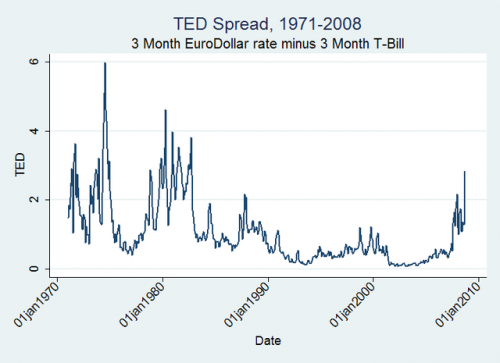
The TED spread is basically the difference or spread between short term inter-bank loan rates and short term treasuries or T-bills.  It is in some sense a measure of perceived risk of lending to banks vs. (what are considered) low or near-zero risk US treasury obligations.  One way to think about it in the current market is how much extra would you need in interest to lend to your slacker brother-in-law Earl vs. say to Bill Gates.

Not surprisingly, the TED spread has shot up over the last few weeks, and it tends to be the #1 metric cited in declaring impending doom for the US economy.  But Alex Tabarrok looked at a longer view of the TED spread, and found this:

ted-spread

Now, the period from 1970-1983 were not by any means an economic glory period, but on the other hand its clear that TED spreads of the order of magnitude we have seen in the past weeks are not unprecedented by any means.

The problem I have with the TED spread is that higher recent spreads are being used as an indicator that credit has "dried up" and lending is at a standstill.  Why do I resist this conclusion?  Because of this chart:

real_gas_prices

So, gasoline prices rocketed from $1.50 a gallon to over $4.00 a gallon.  Does this mean that gasoline purchases have stopped?  Has the gasoline market closed up shop?  Of course not.  It just means the price went up.  It is absurd to show me a price chart, which is what the TED spread graph is, and infer from it changes in the underlying transaction volume.

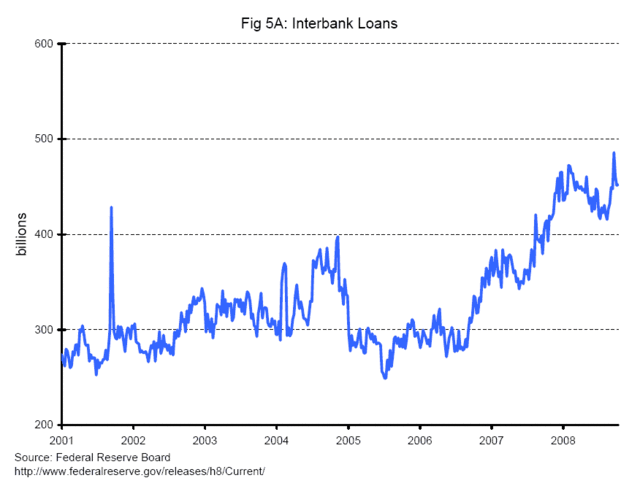
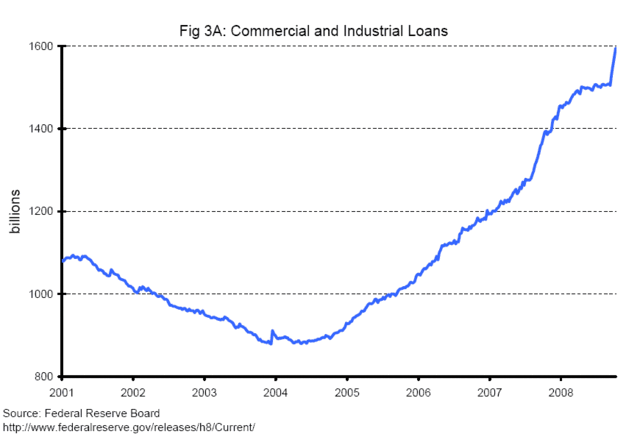
In fact, when one looks at actual volume, of inter-bank loans or new commercial lending, there is not (at least yet) any of the drop-off everyone seems to assume exists.  For example:

Interbank_4

Defending Speech With Which I Don't Agree

Yeah, I think the title is worded awkwardly, but I am trying to curb my enthusiasm for ending sentences with prepositions  (I will continue to boldly split infinitives that no man has split before).

Anyway, in the spirit of this post and this one, I try from time to time to reinforce my support for free speech as an absolute right by publicly supporting the speech rights of those with whom I disagree.  Today's case is the public University of Nebraska-Lincoln deciding to un-invite former terrorist William Ayers to speak on campus.  The reason given was the current weak-ass excuse often used to reverse the invitation of controversial speakers, "we can't gaurantee security." 

Though I would never have hired the guy, Ayers is a professor at a real public university, and what he has to say is particularly relevant given his ties to Barack Obama.  I find the behavior of Nebraska's conservative politicians to be especially absurd here -- after months of calling for more discussion and disclusore of Ayers and his ties to Obama, they want to prevent Ayers from speaking publicly?

Update:  In an odd coincidence, at about the same time I was writing this post, the NY Times blog was posting on split infinitives.

No Thanks, We're Waiting on Our Bailout

Via a reader:

An auction that netted $7.5 million in bids on 56 distressed Utah properties fell through last week after the owners -- three banks and two private lenders -- decided they may get a better deal by holding out for the government's bailout plan.

"There were buyers, but we couldn't sell the homes because free enterprise has gone out of the market," said Eric Nelson, founder of Las Vegas-based Eric Nelson Auctioneering.

His company on Sept. 30 put up for sale 56 foreclosed properties and lots, most of which are in Utah County.

The auction, held in Salt Lake City, attracted thousands, including 200 bidders who bid between $275,000 and $615,000 for 10 luxury homes in Midway and Murray that were appraised at between $525,000 and $652,000. They bid between $26,000 and $100,000 for 44 custom lots in Mapleton, Elk Ridge, Lehi, Alpine, Ogden, West Haven and Willard that were valued between $112,000 and $290,000 a piece.

The most-expensive properties on the auction block included a $1.2 million unfinished home in Draper, which attracted the highest bid at $615,000, while a 62-acre parcel in Park City that's valued at $3.5 million, snagged the highest bid at $1.125 million, said Eric Taylor Nelson, the company founder's nephew.

But all those bids were rejected late last week...

"This has never happened before. In the 25 years we've conducted lender-owned auctions, we've consistently closed over 95 percent of all high bids," Nelson said.

"The stock market's historic drop last week and the bailout plan are some of the main reasons why the lenders rejected the bids," he said. "They're thinking, 'Why sell the properties for 50 cents on the dollar when they may get 75 cents or 80 cents through the bailout?' "

Aaaarrrrggghhh- Typepad Put This Blog on New Editor, Which Sucks

The new Typepad editor is not at all ready for prime time.  I cannot find a single new feature in it, but it is rife with bugs.  Ones I have found so far:

  • Certain images will not upload correctly into a post.  The Typepad folks do not know why
  • Twice I had a crazy error when all of the text and buttons in the "add link" popup window suddenly were inserted into the post
  • All my category setup was overwritten and I had to redo it all
  • The spell checker is awful.  There is no "skip all" button.  I used "IPCC" 50+ times in one post at my other blog, and had to hit skip 50 times over and over
  • The eliminated the blockquote editor option.  Good job on a blog editor!
  • It is slow, slow, slow.

This is one of those enforced beta situations where all of use users are forced to do the beta testing they should have done.  This is the one downside to web-based applications, because there is no way I can do a rollback to the old version.

Update:  Also, publish is way slowed down.  Sometimes it take several minutes to be able to see new posts on my blog. This one still has not appeared after hitting shift-refresh now for 3 minutes.

Update #2:  They sent me an article to trumpet all the new features, but I could find not a single new feature listed.  And it is probably a bad sign they felt the need to put this up front in the article:

If you are seeing the new compose, please be aware that it is not a beta version, it's an upgraded editor that you should be seeing.

LOL

Update #3:  Getting good comments about WordPress.  I may have to check it out.

You Heard It Here First

I said it a couple of weeks ago:

Economists will be poking through this situation years from now, and may well find the bunkers
empty of WMD's.  Another trillion dollar commitment and unprecedented
expansion of executive power ramrodded on the back of fear mongering
and chicken-little crisis declaration.

And even before that on October 1

Well, they're picking through the bunkers now, and its not at all clear the threat was what it was portrayed to be.  The Fed of Minneapolis debunks four myths (pdf)

Myth 1. Bank lending to non…nancial corporations and individuals has declined sharply.
Myth 2. Interbank lending is essentially nonexistent.
Myth 3. Commercial paper issuance by non…nancial corporations has declined sharply and rates have risen to unprecedented levels.
Myth 4. Banks play a large role in channeling funds from savers to borrowers.

Apparently, others are starting to make the WMD comparison.

A couple of examples below.  First, sure looks like all the inter-bank lending has dried up:

Interbank_4

Yep, and no one is lending to Main Street businesses either, so we better do something!

Commercial_2

Just to avoid confusion, that upward spike began in September, well before the Lehman bankruptcy.  Similar stories in commercial paper, consumer lending, leases, etc.  See the whole thing.

New Typepad Editor Bugged

For some reason, Typepad put one of my blogs (but not my
others) on a new editor, probably as an involuntary beta.  The new
editor is much, much slower, and has fatal bugs that make use of images
in posts virtually impossible.  I have wasted a lot of time today.

This is actually a problem with online applications I had not
considered before.  When I heard iTunes 8 was initially bugged or
learned to hate Vista, I would just avoid making the "upgrade."  But
with online services, I have no choice but to accept the new version,
even if I consider it worse (as is so often the case nowadays in
software).

Students Make $100 Financial Mistake: Very Alarming!

This story comes from the Arizona Republic as part of the general effort to maintain the ban on payday loan companies passed earlier this year (their is a proposition on the ballot in November to overturn the ban).

At least 5 percent of last year's freshmen at the University of Arizona obtained a payday loan, a figure the surveyor described as "very alarming."

Arizona's Norton School of Family and Consumer Sciences conducted
the survey, which measured the financial habits of 2,172 freshmen -
about a third of the class - who enrolled in fall 2007.

Student use of payday loans
more than doubled based on a survey taken a year ago that included
freshmen through seniors, said professor Soyeon Shim, the group's
director.

"As consumers, students shouldn't be using payday loans as a resort to deal with financial stress," Shim said.

I wouldn't really recommend that students use this expensive form of ready cash, but I can't say I am particularly alarmed.  How can any of us know what pressures they are under.  In most circumstances, paying a 30% interest rate seems too high.  But I know, from personal experience, there are times when short term liquidity is so valuable you might pay anything for it  (just look - the American taxpayers are paying about a trillion dollars this year just for short-term liquidity).

In fact, if students have a bad experience, it's probably better to learn a $100 life lesson in college rather than a $500,000 life lesson later flipping condos on interest-only loans.  I personally had my own caveat emptor eye-opener with Columbia House Records in college.  Nothing like getting stuck with a couple of over-priced America albums to teach financial horse sense.  Muskrat Love... aaaarrrggghhh!

Anyway, the effort to ban payday loans altogether is one of those elitist, snobby, holier-than-thou, we're smarter than you unwashed masses issues.  Middle class homeowners who are upside down in their mortgages are not calling for inexpensive mortgages to be banned, they just want a government bailout.  The government may spend a trillion dollars in the end supporting the mortgage market.  But if poor people pay a high fee for a $100 loan, we have to ban the whole industry. 

The fact is that there is always a demand for ready cash at high interest rates, and if you drive it under ground, people just go to Tony Soprano instead. 

Oh, but you are not for banning payday loans, you just think the interest rates are too high, and that what is needed is government regulation of the rates?  Uh, OK, I'm sure that will go well.  Past government efforts to reduce the interest rate premium for risk have worked out really well *cough* mortgages *cough*. 

But, if you are still thinking that you are much smarter in money management than people who go to payday loan stores and you really want to use the coercive power of government to force poor people to make the same decisions you would, here's this:

However, for those who think they are ever so much smarter than payday
loan customers, who are charged a lot of money for small liquidity
boosts, consider this:  Let's say you take out $40 each week from an
ATM to keep you liquid and that the ATM fee is $1.50.  You are
therefore spending $1.50 or 3.75% for a one week liquidity boost of
$40, which you must again refresh next week.  Annualized, you are
effectively paying 195% to get liquid with your own money.  For this kind of vig, at least payday loan customers are getting the use of someone else's money.

First Democratic Agenda Item: Grow Union Membership

Because they have done such a good job helping workers in the auto and airline industries.

auto_jobs

From the WSJ here.  Its all part and parcel of the "stagnant middle class income" fib, discussed here.

Another Bubble! We Need More Regulation!

From the WSJ:

Despite recent declines, prices are still higher than they were a
year ago. But the recriminations over what went wrong have begun,
complete with calls for more government involvement, efforts to make
the industry more transparent and reforms to restore market confidence....

"[the market] is out of control," says H. Djusdil Akrim, director of a
factory in Makassar, Sulawesi's biggest city.... "It's a wild, wild market
-- and no one is running it," he says. "I think we need more
regulation."...

No one knows when the market will hit bottom. Some
traders are sitting on stockpiles they bought when the market was hot,
and if global growth slows further, as expected, demand could weaken.

Whatever happens, the latest volatility is a wake-up call for the ... industry, which has been growing steadily for years.

I blame George Bush.  Oh, by the way, the industry is seaweed.

Another State-Run Oil Company Fiasco

And it couldn't happen to a nicer guy (hat tip to a reader):

Venezuela's daily oil production has fallen by a quarter since President Hugo
  Chavez won power, depriving his "Bolivarian Revolution" of much of
  the benefit of the global boom in oil prices...

The state oil company, PDVSA, produced 3.2 million barrels per day
in 1998, the year before Mr Chavez won the presidency. After a decade
of rising corruption and inefficiency, daily output has now fallen to
2.4 million barrels, according to OPEC figures. About half of this oil
is now delivered at a discount to Mr Chavez's friends around Latin
America. The 18 nations in his "Petrocaribe" club, founded in 2005, pay
Venezuela only 30 per cent of the market price within 90 days, with
rest in instalments spread over 25 years.

The other half - 1.2 million barrels per day - goes to America, Venezuela's only genuinely paying customer.

Meanwhile,
Mr Chavez has given PDVSA countless new tasks. "The new PDVSA is
central to the social battle for the advance of our country," said
Rafael Ramirez, the company's president and the minister for petroleum.
"We have worked to convert PDVSA into a key element for the social
battle."

The company now grows food after Mr Chavez's price
controls emptied supermarket shelves of products like milk and eggs.
Another branch produces furniture and domestic appliances in an effort
to stem the flow of imports. What PDVSA seems unable to do is produce
more oil.

Venezuela has proven reserves of 80 billion barrels,
but estimates suggest that it may possess 142 billion barrels - more
than anywhere else except Saudi Arabia....

All
this means that Venezuela has missed much of the benefit from the oil
boom and, now that prices are falling, Mr Chavez faces huge financial
problems. Nobody is sure at what point his government would be unable
to pay its bills, but most sources consulted believe this would
probably happen if oil falls to $80 a barrel. Yesterday, oil was
trading at $79.80.

More on "peak oil" being at least partially a function of state mis-management of promising oil reserves here.  Jim Kingsdale estimated last year, when prices were over $100 for oil, that oil prices would probably trade under $50 if the reserves were controlled by private companies rather than government buffoons.

Security Theater

Anyone who flies regularly and has not thought of at least five ways they could easily beat airport security isn't really trying.  Jeffrey Goldberg actually tries a few:

Suspicious that the measures put in place after the attacks of September 11 to prevent further such attacks are almost entirely for show"”security theater is the term of art"”I have for some time now been testing, in modest ways, their effectiveness. Because the TSA's security regimen seems to be mainly thing-based"”most of its 44,500 airport officers are assigned to truffle through carry-on bags for things like guns, bombs, three-ounce tubes of anthrax, Crest toothpaste, nail clippers, Snapple, and so on"”I focused my efforts on bringing bad things through security in many different airports, primarily my home airport, Washington's Reagan National, the one situated approximately 17 feet from the Pentagon, but also in Los Angeles, New York, Miami, Chicago, and at the Wilkes-Barre/Scranton International Airport...

Schnei­er and I walked to the security checkpoint. "Counter­terrorism in the airport is a show designed to make people feel better," he said. "Only two things have made flying safer: the reinforcement of cockpit doors, and the fact that passengers know now to resist hijackers." This assumes, of course, that al-Qaeda will target airplanes for hijacking, or target aviation at all. "We defend against what the terrorists did last week," Schnei­er said. He believes that the country would be just as safe as it is today if airport security were rolled back to pre-9/11
levels. "Spend the rest of your money on intelligence, investigations, and emergency response."

Though I have to give props to the TSA for supporting first Amendment rights, I am not sure their concern over free speech and privacy was driving this encounter:

On another occasion, at LaGuardia, in New York, the
transportation-security officer in charge of my secondary screening
emptied my carry-on bag of nearly everything it contained, including a
yellow, three-foot-by-four-foot Hezbollah flag, purchased at a
Hezbollah gift shop in south Lebanon. The flag features, as its
charming main image, an upraised fist clutching an AK-47 automatic
rifle. Atop the rifle is a line of Arabic writing that reads Then surely the party of God are they who will be triumphant.
The officer took the flag and spread it out on the inspection table.
She finished her inspection, gave me back my flag, and told me I could
go. I said, "That's a Hezbollah flag." She said, "Uh-huh." Not "Uh-huh,
I've been trained to recognize the symbols of anti-American terror
groups, but after careful inspection of your physical person, your
behavior, and your last name, I've come to the conclusion that you are
not a Bekaa Valley"“trained threat to the United States commercial
aviation system," but "Uh-huh, I'm going on break, why are you talking
to me?"

It turns out, incredibly, that most airport employees are not screened.  Because, you know, it would be grossly unfair to subject airport staff to the same sort of time-wasting indignities to which we all must acquiesce.  Also, many commercial flights have a belly-full of US mail which I am pretty sure is not inspected in any way.

Maybe Its 1850 Again

In 1850, the hottest topic in politics was slavery.  But an awkwardness developed in the political parties.  The Democrats were pretty clearly the pro-slavery party, or at least the conservative maintain the status quo party.  But the Whigs, their opposition, were internally split on slavery.  What that meant was that there was no obvious home for the voters who were against the expansion of slavery into the territories, or more radically, were for slavery's abolition.  A Free Soil third party emerged, but the US has always seemed to seek out a two-party equilibrium.  In just a few years, the Whigs collapsed, and the anti-slavery wing merged with the Free Soilers to form the Republican party.  In the end, having no real contrast among the two major parties on the major issue of the day was unstable.

The only faint hope from this election for libertarians, particularly those concerned with economic freedom issues, is that it may finally highlight to lack of choice we have on these issues between the two major parties.  A few examples like Jeff Flake notwithstanding, the Republican party under GWB and McCain have become virtually indistinguishable from the Democrats on most economic freedom issues.  While I might have had hope 15 years ago that the Republicans could reinvent themselves as classical liberals, I now think this is demonstrated to be hopeless.  Unfortunately, an 1850's style breakup of the party seems unlikely too.  So I guess I don't have much hope after all.

Postscript: Remember, it was Republicans who did this:

The chief executives of the nine largest banks in the
United States trooped into a gilded conference room at the Treasury
Department at 3 p.m. Monday. To their astonishment, they were each
handed a one-page document that said they agreed to sell shares to the
government, then Treasury Secretary Henry M. Paulson Jr. said they must
sign it before they left.

"They weren't allowed to negotiate.
Mr. Paulson requested that each of them sign. It was for their own good
and the good of the country, he said, according to a person in the
room."

At least one banker objected. "But by 6:30, all nine chief
executives had signed "” setting in motion the largest government
intervention in the American banking system since the Depression."

More of the Carbon Offset Folly

A while back, in relation to a company called Terrapass that sells carbon offset certificates (or smugness coupons, as I called them) I observed:

My guess is that TerraPass, when it sells the electricity from these
projects to customers, is selling it on the basis that it is
earth-friendly and causes no CO2 emissions.  This lack of emissions is
likely part of the "bundle" sold to electricity customers.  But note
that this would be selling the same lack of emissions twice -- once to
TerraPass certificate holders, and once to the electricity customers.
I am sure they are both told they are avoiding X tons of emissions, but
it is the same X tons, sold twice (at least).

We are starting to see this all over now.  From the WSJ, via Tom Nelson:

America's garbage dumps are reaping a windfall from the fight against
global warming. But their payday might not be doing much to reduce
greenhouse-gas emissions.

For more than a decade, the landfill
here has made extra profit simply by collecting methane given off by
rotting trash, and selling it as fuel. Last year, the landfill learned
that doing this also qualified it to earn hundreds of thousands of
dollars via a new program that pays companies to cut their
greenhouse-gas emissions.

Eliminating methane lets dumps sell
"carbon credits" to environmentally conscious people and companies. The
long-term goal of trading credits -- basically, vouchers representing
reductions in carbon dioxide and other greenhouse gases -- is to reduce
global pollution by encouraging others to cut emissions when the buyers
of the credits can't or won't cut their own.

"It seemed a little suspicious that we could get money for doing nothing,"
says Charles Norkis, executive director of the Cape May County
Municipal Utilities Authority, which has raised $427,475 selling
credits since February, or 3% of the authority's projected solid-waste
revenue for the year.

The sale of credits by these landfills
undermines a premise of the global fight against climate change. The
credit system was designed to encourage pollution cuts that wouldn't
have happened without a financial incentive. But the credits aren't helping the environment if they're merely providing extra profit for cleanups already made. And dumps already have an incentive to capture methane because selling it can be profitable.

More on this same carbon offset issue in the European / UN system here.

Why a carbon tax, if we really feel we must limit CO2, is better than cap-and-trade / offset system here.

A Brief Thought on Wealth

One of the pieces of data that turns out to be nearly impossible to find is a direct comparison of the median income by quartile on a PPP basis between countries.  In other words, how does the income of, say, the US lower quartile compare to other countries?  There are a zillion sites with metrics of income inequality and GINI indexes and such, but to my mind these are meaningless.  OK, the poor in the US are much less wealthy than the rich in the US, but how do they compare to the poor of other nations.  The few studies I have seen have reluctantly (remember, these are leftish academics) admitted that the US poor do pretty well vs. the poor in other nations.  Here is data for US vs. Europe.

I got a lot of grief a few years ago when I said, related to Kwanzaa:

Every African-American should wake up each morning and say "I give
thanks that my ancestors suffered the horrors of the slavery passage,
suffered the indignity and humiliation of slavery, and suffered the
poverty and injustices of the post-war South so that I, today, can be
here, in this country, infinitely more free, healthier, safer and
better off financially than I would have been in Africa."

I wanted to actually make this comparison more real.  I used the CIA Factbook to estimate the share of per capita GDP on a PPP basis earned by the top decile, or top 10% wealthiest individuals, in a number of African nations (Example page here for Ethiopia -- calculation would be [25.5%/10%] x $700 per capita). 

So here are the results:

  • Ethiopia top 10%:      $1,785
  • Nigeria top 10%:        $6,972
  • Zimbabwe top 10%:    $800

Hopefuly this is enough of a sample to give you an idea of the range.  Only South Africa is a real outlier from this range.  Now, by the same methodology and source, here is the average share of the per capita GDP for the bottom 10% of earners in the US:

  • United States bottom 10%:   $9,160
  • United States African-American avg (est):  $32,060**

Wow!  This means that the average person in the bottom 10% in the US, most of whom we classify as below the poverty line, would easily, by multiples and orders of magnitude, be in the top 10% richest people in most African nations.   And the surviving decedents of those poor folks who got dragged to the US in slavery would be the Bill Gateses of their mother countries.

The point being, of course, that the size of the pie is typically more important than how you divide it up.  And it is nearly an axiom that government efforts to divide the pie more evenly almost always make it smaller.

** estimated based on 2006 median black household wages being about 70% of the US median household wages.  Yes, I know, we are wildly mixing apples and oranges here to get African American share of GDP per capita in the US, but its in the ballpark -- certainly close enough to make my basic point.  And yes, I know there are flaws in measuring income across countries even on a PPP basis.  If anyone knows of how to get this data more directly, please email me.

Bending Over Backwards to Try to Show Wage Stagnation

The media is really bending over backwards to find ways to twist earnings data for average Americans to try to make the point that real income for many folks has stagnated or dropped.  They are doing this to support a two-pronged legislative strategy in the next Obama administration:

  1. Use the power of the government to further tilt the balance towards unions and against employers in wage negotiations  (this strategy having worked out so well to create prosperity in the automobile and airline industries)
  2. Further modify the income and Social Security tax structures to make them even more regressive than they are today.

They are firing on all cylinders behind this strategy.  They are even mobilizing the neo-Keynesians to make the pitch that the Great Depression and the current financial crisis were caused by a shift in wealth from laborers to the capital classes, and that the only way to prevent future crises and depressions is to, wait for it, increase the power of unions and institute more wealth redistribution  (Example here, via Kevin Drum).

I was going to do a post fisking the James Livingston article linked above on Kevin Drum's site, but Livingston's hypothesis was such a mess that it was just going to take too much of my day.  But in doing some research, I found this chart from a couple of years ago in the NY Times that really caught my attention:

Timeswagechart

Talk about chutzpuh -- look at the lede on the chart and then look at the chart itself.  Yes, the lede is correct, but only if you choose the totally meaningless number of "cash wages" rather than total compensation.  If one looks at total compensation (or what they call "overall" compensation), the entire argument falls apart.   Workers have maintained about their same "share" of the economy.

Sure, a large percentage of that is now in health care benefits, but that's a choice workers have made (and the government has encouraged through tax policy).  In fact, this compensation mix has been driven in large part by the Left's beloved unions, so on what basis can folks say that these other benefits somehow "don't count?"  Certainly, they cost their employers equally, whether it is cash or health care.  Corporate profits are up a bit, but in line with their normal historical levels in the 1950s and 1960s, the golden age of the US economy, according to the Left.  (By the way, the pattern of falling wage shares and rising profit shares after recessions is a well-documented one.  Wage-earners do best at the end of an economic cycle, employers more towards the beginning.  The chart cut off after 1997 would look about the same as the last several years).

I will tell you right now that every time you hear someone bemoaning the stagnation of wages, they will never, ever, ever be talking about total compensation per individual.  Having, through government policy and union activity pushed the compensation mix to non-cash elements, they then play a heads-I-win-tails-you-lose game of not giving any credit for those compensation elements.

Other games that are played to try to make the case that real earnings have stagnated include:

  • Time frame selection. Everyone making this argument will choose 2000 as a starting point.  They justify it by saying it is the beginning of the Bush years, but 2000 is really selected because it is a pre-recession peak, and they have to measure peak-to-trough of the economic cycle to try to make their point.  Just as an example, if you look at the household income numbers below, you can see there is very typically a 5-year drop after a recession followed by net gains.  If we chose, say, the first Clinton term we could play the same game, showing a peak-to-trough drop in real incomes.
  • Household income game. The household income numbers are fraught with peril, because companies don't pay households, they pay individuals.  And household makeups are changing simultaneous to income changes.  For example, imagine the economy was just my household.  If my wife were to get fed up with my shtick and divorce me tomorrow, average household income would drop by 50% in one day (as our total income stays the same but we go from one to two households).  If my wife were to go back to her high-paying pre-kids job tomorrow (if only it were so!) our household income would go way up, in part because the labor department does not capture the value of the labor she provides at home.Mark Perry has a lot more on the household income numbers here, but he shows that the household size number has been changing a lot, causing the metric to understate income changes per individual:

Income3

  • Individuals matter. Median income looks at the middle person on the ranked list of US incomes.  So, for example, if there are 100 million income earners, the median income is the income of number 50 million on this list.  But whoever the person is at spot 50 million is almost certainly not the same person who was at spot 50 million last year.  They might have fallen on the list, but the odds are they moved up.  As folks age and gain experience and/or seniority, they tend to increase income faster than inflation.  Most minimum wage earners, for example, tend to be under 25.  The number of families supporting three kids on minimum wage (at least of the primary bread-winner) at the age of 45 is really, really low, despite the anecdotes we are bombarded with in the media.

Numberminwagebyagegroup20052007

  • Immigration has a huge effect. The total number of foreign born people in the labor force is estimated around 21 million, of which perhaps 6.3 million are illegal immigrants.  Positing that at least 10 million of these arrived in the last two decades, and that many of these folks began at relatively low, below-median incomes, means that median incomes are hugely affected by immigration.  Leaving immigrants out so the comparison is close to apples and apples, to find the true median income gain over the last 20 years one would have to count up 10 million or so spots on the list.  Again, as in the previous point, most individuals can be better off even if the median stagnates  (presumably immigrants coming in at the bottom are also better off, even at the bottom, than where they were before, or they would not have come.  We often forget that much of our bottom quartile of income in this country would be upper middle class in many other nations).  This is a classic mix problem that most people, and the media, almost always get wrong.  In a situation with a changing mix of multiple groups, each of the groups can be improving on some metric, but the overall metric can go down.  You can see the income stats by race here.  Every race group has increasing median income, but since the Hispanic group has grown 8x faster than the anglo population in the US, the total results are mixed downwards.Here is a quick example.  Group A has values of 5,6,6,7.  Group B has values of 1,2,3.  Ten years later Group A is the same size and has values of 6,7,7,8.  Group B has doubled in size, and now has values of 2,3,4,2,3,4.  In these examples, every single individual has a higher value.  Also, Group A's median has increased from 6 to 7, and Group B's has increased from 2 to 3.  But the median for the whole combined group A+B has dropped from 5 to 4.  Both medians (and averages) can do funny things when mix is shifting.
  • Even the NY Times. The NY Times actually makes two of these points for me in another article, arguing that historic median income drops were concentrated in areas of high immigration, and reported drops were due to the choice of the economic peak as a starting point.  WOW?  Is this the same NY Times I began this post criticizing.  Yes it is, the only difference is that this article ran in 2001, when they were reporting on the economy during a Democratic administration.
  • Income taxes are already wildly progressive.  While I would love to be in that top 1% group, I don't really begrudge them their success.  Besides, who can look at the chart below, again from Mark Perry, and come to the conclusion that the top 1% are being treated unfairly generously.

Tax2

  • Every country that has implemented this plan (government-backed unions and wildly progressive tax policy), including most of Western Europe, is demonstrable worse off than the US on absolute measures.  This is both the median, but also in every quintile, including the poorest.  While it is true the poorest quintile has a bigger gap from the riches in the US vs. France for example, on an absolute basis our poorest are at least as well off  (particularly when differences in immigration policy are taken into account).

New Open Office Release

I have for quite a while been a big supporter of OpenOffice 2.0 as an alternative to MS Office.  It is free, and it tends to be quite compatible with MS Office file formats.  In fact, I use the Open Office spreadsheet to open and fix Excel spreadsheets that Excel corrupts and cannot open.

I have not yet read the release notes, so I don't know what has been updated, but version 3.0 was released the other day.

We've Apparently Run Out of Stuff to Be Worried About

The lesson I take from the numerous efforts to regulate/ban/demonize bottled water is that we have officially run out of real stuff to be worried about.  Seriously, when bottled water is the health and environmental risk of the decade, it is time to declare victory over Mother Nature.  More here.

My Head is Spinning

I am on vacation this week, so blogging will be light.  Just as well, as I have absolutely no idea where to begin with the Federal plan to semi-nationalize the banking industry.  I fear that the Bush administration has done it to us again.  Economists will be poking through this situation years from now, and may well find the bunkers empty of WMD's.  Another trillion dollar commitment and unprecedented expansion of executive power ramrodded on the back of fear mongering and chicken-little crisis declaration.  Henry Paulson screams to the world that the sky is falling, and then wonders why he can't stop the panicked stampede.  The Fed breaks the discount window wide open and promises to lend and recieve near infinite amounts of bank funds, and then wonders why banks have stopped lending to each other and only will do business with the Fed.

The Panic Imperative

Eric Posner writes:

Many legal academics claimed that courts should serve as fire walls
against the conflagration of fear. When the government locks someone
up, the courts should realize that in many cases either government
officials have panicked or are violating someone's civil liberties
merely to assure frightened citizens that something is being done. For
that reason, courts should treat the government's justifications with
skepticism, and never ever trust the executive branch.

These arguments have not yet surfaced in the current crisis. The
specter of fear is everywhere, not just on Wall Street. And the scale
of the government's reaction is no less than what it was after
9/11"”that is what probably scares ordinary people the most. Yet no one
who believes that the government exploited fears after 9/11 to
strengthen its security powers is now saying that the government is
exploiting financial crisis fears in order to justify taking control of
credit markets. No one who thinks that government would use fear to
curtail civil liberties seems to think that government would use fear
to curtail economic liberties. Why not?

No one, except me of course.  From my October 1 discourse with a Democratic friend:

I find it surprising that you take this administration
on faith in its declaration of emergency in the financial sector.
You've lamented for years about the "rush to war" and GWB's scare
tactics that pushed, you felt, the nation into a war it should not be
fighting, all over threats of WMD's that we could never find.  You
lamented Democrats like Hillary Clinton "falling for this" in Congress

But now the mantra is the same - rush, rush, hurry, hurry, fear,
fear, emergency, emergency. Another GWB declared crisis in which the
country needs to give the administration unlimited power without
accountability and, of course, stacks of taxpayer dollars to spend.  A
decision that has to be made fast, without time for deliberation.
Another $700 billion commitment.     And here the Democrats go again.
Jeez, these guys may have the majority in Congress but it is sure easy
for GWB to push their buttons when he wants to.  Heck, Pelosi is acting
practically as the Republican Whip to get GWB's party in line.

This is Iraq without the body bags, and without the personal honor
of brave soldiers in the trenches to give the crisis some kind of
dignity.

Good News, Really

Believe it or not, I think this picture is actually good news:

Dowtrend

This is a little flawed, since we would expect a constant trend to be a constant percent increase each year, which would be upward curving on this chart, not a straight line trend  (it would be straight on a log scale).  Never-the-less, it makes a point  (by the way, it is interesting the 1980's are considered the decade of greed on Wall Street rather than the 1990s, from this chart).

Here is a better way to make my point.  We get a similar chart if we look at PE ratios for the S&P500  (the chart below is on trailing 10 year average earnings).

Sandp_pe

Why is this anything but depressing?  Because I get the sense that many people, without any other general indicator of how bad things are in the financial markets, are using the steep drops in the stock market as a proxy measure.  The stock market looks like a disaster, so everything else must be a disaster.

But in a large sense, at least so far, all the stock market has done in the last 2 weeks is return to historical norms.  This tells me that there is nothing about the current level of the stock market that is screaming disaster signals.  In fact, the current level of the stock market is screaming normalcy. 

Of course, this does not mean the drop will stop here.  PE's in the worst of times have headed on down to 5 (which would be about DOW 3000, yuk).  And corrections seldom stop at the mean - they usually over-correct on below the mean.  But seen on these charts, this recent move looks more like the completion of the correction to the late 1990's bubble rather than necessarily an indicator of current financial disaster.

Don't Panic

The best way to mobilize people is to make them panic.  That is why so many institutions have incentives to may you panic over the environment, or global warming, or the threat of terrorism, or the economy.  In most cases (Naomi Klein's hypothesis not-withstanding) these folks want you to get so worried you will give up something, either money or freedom or both.

Some kind of recession at this point is unavoidable, I guess.  But in fact, we really haven't seen what I would call a real recession since the early 1980's.  We've had a really long run, and now its time to cut back on that spending and board up the financial windows for a little while.  The economy has to de-leverage itself some, and that is going to slow things down for a while.  People keep talking about the Great Depression, and I don't see it.  I don't even think its going to be the 1970's.

The most visible symbol of financial problems seems to be the falling stock market.  But all those companies in those indexes are the same ones that were there a month ago, and are still healthy and making money.  The fall in the markets does not represent and change in the current health of industrial America.  The lower prices reflect a changing expectation about those company's future prospects, but the folks driving the market are just guessing, and really, their guesses aren't really any better than yours or mine.  Similar expectations drove oil up to $145 and now back down under $80.  Wall Streeters work really hard to portray themselves as smarter than you or I, but they are not.  I went to school with them.  I know these guys.  They aren't smarter, and they aren't any less susceptible to panic.  In fact, because they are often highly leveraged and are worried about making payments on that new Jaguar they just bought for their mistress, they tend to be more easily stampeded.

In October of 1987, the stock market fell 22.6% in one day.  If you date the current financial issues to about September 22, when the market closed around 11,000, then the market has fallen over these tumultuous weeks by 22.0% at last night's close -- dramatic, but still not as bad as the one day drop in '87. 

Proof Positive Legislators Don't Understand Even the Basics of Economics

OK, actually, this could also just be proof positive that legislators know exactly what they are doing and want legislation that panders to powerful interest groups without actually doing anything.  Democrats in Congress have proposed a new nationwide CO2 emissions / permitting system.  The point is to allocate permits for something less than current emissions, forcing Americans to either cut back to their permit level or trade permits around. 

So I thought this provision was hilarious:

The bill tries to address the economic concerns by excluding small
businesses and increasing the number of permits when prices spike.

So when permit prices go up, they will increase the number of permits.  But permit prices will necessarily go up if they are doing their job of limiting emissions below current levels.  So, in effect, they are saying that if the permit process really does start limiting emissions, new permits will be issued to to allow more emissions. 

Why Politicians Favor Cap and Trade over a Carbon Tax

There are a lot of incredibly good reasons to favor a carbon tax over cap-and-trade if we simply most reduce CO2 emissions.  Even a minor inspection of the inner workings of the California Air Resources Board under their AB32 cap-and-trade style program provides lists of examples of abuses, rent-seeking, inefficiency, etc. under cap-and-trade.  But Joe Nation, one of the California legislators who authored AB32, told me that he could not get even a 5-cent gasoline tax through a legislature that enthusiastically embraced the 100x (or more) expensive AB32.  Why?  Silly rabbit, because public costs of cap-and-trade can be fudged, hidden, ignored, and, when they absolutely have to be recognized, blamed on private companies.

Via a reader, here is our Arizona governor discussing the costs of cap-and-trade in Arizona:

Napolitano brushed aside questions of what effect the plan will have on utility rates.

"First of all, that it may increase electric bills doesn't mean it will increase them now," Napolitano said.

Brave, isn't she?  They are already preparing the story line to blame private industry for future price increases:

Napolitano said there is "lots of data" to suggest that utilities
eventually will be able to save money "by moving to a system of 'green'
energy."...

Fox said that, on a long-term basis, there may be cost savings.

You get that?  We smart government guys conducted a lot of really high-power circle jerks among graduate students and the consensus was that forcing the electrical industry to obsolete much of its current capacity and rebuild with some other uproven but more expensive technology would save them money in the long term.  If utilities raise prices, it's because they were not smart enough to figure out what we already know and they are just greedy capitalist pigs so blame them for the price increases, not use faithful public servants.  You see?  Cap-and-trade is like money laundering for taxes.  The tax is there, but its hidden well enough that a lazy media will not bother to trace it back to its owner.

But I wouldn't want you to take my assertion on faith (as Obama does with his 5 million green jobs promise), so lets look at what will have to happen.

The exact goals are hazy, but it appears our governor has committed the state to cutting CO2 emissions by 15% over the next 10 years.  One of the main ways that calling CO2 "pollution" is misleading is to imply it is some kind of combustion by-product, like soot or SO2, that could be scrubbed out.  But it is not.  It is fundamental to combustion.  So a 15% cut in CO2 emissions is 10-15% cut in power generation  (we likely get numbers lower than 15% by assuming cuts in production are preferentially from higher carbon sources like coal plants). 

So, basically this law requires the state's electrical utilities to obsolete 10% of its installed capacity, and either a) have tons of rolling blackouts; b) raise prices enough to force a large cut in demand  (remember, demand must be cut 10% AND all future growth must be halted); or c) the industry must spend hundreds of billions of dollars to build a ton of capacity in some other technology.  Option a will never fly politically.  Option c is almost sure to fail as well.  The permitting and construction processes can take decades.  From a cold start, I don't think its possible to rebuild 10+% of the states generation capacity in 10 years, either in nuclear or some other not-yet-ready technology.  The numbers simply don't work.  The only possible way I can imagine is maybe to install a zillion natural gas turbines, but to make the CO2 balance work out, you probably would have to rebuild 15% or more of the capacity, not just 10%, because there would still be some carbon emissions. 

Really, realistically, one is left with option b.  Prices are going to go up (just they would have to in option c to pay for replacement production capacity).  The price increases would be about as much as the carbon tax would have had to be to get the same effect, but price increases are corporation's fault while taxes are politicians' fault.  See?  The only good news is that the price increase will go to private players rather than the government.  That is until someone thinks to put in a windfall profits tax on utilities that are making lots of money on the government-enforced shortage.
It's a Feature, not a Bug

Laws that require the goodwill and ethical functioning of its participants, without oversight, always worry me.  The companion argument to this is when someone says (and this is popular among Democrats nowadays) all this infrastructure in the government that does not work will be fine when we get our own smart people running it.

It never, never works.  Here is yet another example:  All that extra post-9/11 investigatory power?  Trust us, we only use it on the bad guys.

The Maryland State Police classified 53 nonviolent activists as
terrorists and entered their names and personal information into state
and federal databases that track terrorism suspects, the state police
chief acknowledged yesterday.

Police Superintendent Terrence B.
Sheridan revealed at a legislative hearing that the surveillance
operation, which targeted opponents of the death penalty and the Iraq
war, was far more extensive than was known when its existence was
disclosed in July....

Said the unrepentant leader of this efort:

"I don't believe the First Amendment is any guarantee to those who wish to disrupt the government," he said.

Reading my history, disrupting the government was not the last thing they were trying to protect, it was the first thing. 

Fake but Accurate -- Now Coming to the Hard Sciences

Most of us remember the famous "fake but accurate" defense of Dan Rather's story on GWB using forged National Guard documents.  If the post-modernism movement were to have an insignia, their tag line  (their "E. Pluribus Unum') could well be "fake but accurate." 

I have written for a while that post-modernism seems to be coming to the hard sciences (I differentiate the hard sciences, because the soft sciences like sociology or women's studies are already dominated by post-modernist thinking).  For example, I quoted this:

For
those of you who cling to scientific method, this is pretty bizarre
stuff. But she, and many others, are dead serious about it. If a
research finding could harm a class of persons, the theory is that
scientists should change the way they talk about that finding. Since scientific method is a way of building a body of knowledge based on skeptical testing, replication, and publication, this is a problem.The tight framework of scientific method mandates figuring out what would disprove the theory being tested and then looking for the disproof.
The thought process that spawned the scientific revolution was
inherently skeptical, which is why disciples of scientific method say
that no theory can be definitively and absolutely proved, but only
disproved (falsified). Hypotheses are elevated to the status of
theories largely as a result of continued failures to disprove the
theory and continued conformity of experimentation and observation with
the theory, and such efforts should be conducted by diverse parties.Needless to say postmodernist schools of thought and scientific method are almost polar opposites.

So here is today's example of fake but accurate in the sciences, not surprisingly also from climate science:

While the critic's advice - to use trained statisticians in studies
reliant on statistics - may seem too obvious to need stating, the
"science is settled" camp resists it. Mann's hockey-stick graph may be
wrong, many experts now acknowledge, but they assert that he
nevertheless came to the right conclusion.

To which the critics,
and doubtless others who want more rigourous science, shake their heads
in disbelief. They are baffled by the claim that the incorrect method
doesn't matter because the answer is correct anyway. With bad science, only true believers can assert that they nevertheless obtained the right answer.

A huge number of physicists and geologists who actually take the time to look into the details of climate science come away being shocked at the scholarship.  Take a world class physicist, drop him into a discussion of the details of the Mann hockey stick analysis, and in an hour you will have a skeptic.

Crazy?  Remember the words of from National Center for Atmospheric Research (NOAA) climate researcher and global warming action promoter, Steven Schneider:

We
have to offer up scary scenarios, make simplified, dramatic statements,
and make little mention of any doubts we have. Each of us has to decide
what the right balance is between being effective and being honest.