Let's consider two investors. Investor A buys a piece of land and builds a campground on it, intending to run the campground for decades. Investor A gets her return on investment from the profits each year running the campground, profits that are taxed as regular income (Full disclosure: In my business life, I am essentially investor A).
On the other hand, Investor B buys the same piece of land and builds the same campground on it, but in about a year Investor B sells the newly developed facility, making a profit on the sale over his original investment. Investor B likely will pay taxes on this gain at reduced capital gains tax rates.
But why? When Investor B sold the property, the price he got was probably something like the present value of the expected cash flows from operating the campground. Both Investor A and B created essentially the same value., but Investor B took the value as a single lump sum rather than as a stream of income over time. Why is Investor B's approach preferred in the tax code? Or, stated another way, why does the tax code favor asset flipping over long-term operations?
I guess I never really paid much attention to how the Obamacare "risk corridors" work. These are the reinsurance program that were meant to equalize the risks of various insurers in the exchanges -- but as exchange customers prove to be less healthy than predicted, they are more likely to become a government subsidy program for insurers.
According to the text of Obamacare, the health law's risk corridors—the insurance industry backstop that’s been dubbed a bailout—are only supposed to last through 2016. For the first three years of the exchanges, insurers who spend 3 percent more on health costs than expected will be reimbursed by the federal government. It’s symmetrical, so insurers who spend less will pay in, but there’s no requirement that the program be revenue neutral
So what, exactly, are the incentives for cost control? If you lose control of your costs, the government simply pays for the amount you overspent. Combine this with the fact that Obamacare puts caps on insurer non-patient-cost overhead spending, and I don't think you are going to see a lot of passion for claims management and reduction. Note after a point, excess claims do not hurt profits (via the risk corridor) but more money spent on claims reduction and management does reduce profits (due to the overhead caps).
Nice incentives.
Postscript: There is one flaw with my analysis -- 3% is a LOT of money, at least historically, for health insurers. Why? Because their margins are so thin. I know this will come as a surprise with all the Obama demonization of insurance profits, but health insurers make something like 3-5% of revenues as net income. My Boston mother-in-law, who is a very reliable gauge of opinion on the Left, thinks I am lying to her when I say this, even when I show her the Google finance pages for insurers, so convinced is she by the NYT and PBS that health insurer profits consume a huge portion of health care spending.
All that being said, I am pretty sure if I were an insurer, I could raise prices slightly, cut back on claims overhead, and make a guaranteed profit all while the government absorbs larger and larger losses.
Looking at this map of state licensing regimes (darker is more onerous, with AZ being the worst), it is hard to correlate with states being Republican or Democrat. That doesn't surprise me, because I have always thought the urge to restrict competition and protect incumbents has always been a bipartisan enterprise.
So I sat and thought for a minute about my home state of AZ. Why is it the worst? We have a pretty good libertarian history here, from Goldwater onwards. We have at least one fairly libertarian Senator (Jeff Flake). So what is the deal?
My hypothesis is that it is related to immigration. The same majority Republican legislators who are generally open to free markets simultaneously have an incredible fear and loathing of immigration. Perhaps our onerous business licensing regime is driven by nativists wanting to protect themselves from competition by new immigrants, immigrants who would struggle to compete onerous licensing requirements?
So what does this map look like vs. immigrant population density? Via Wikipedia, here are the states on density of Hispanics
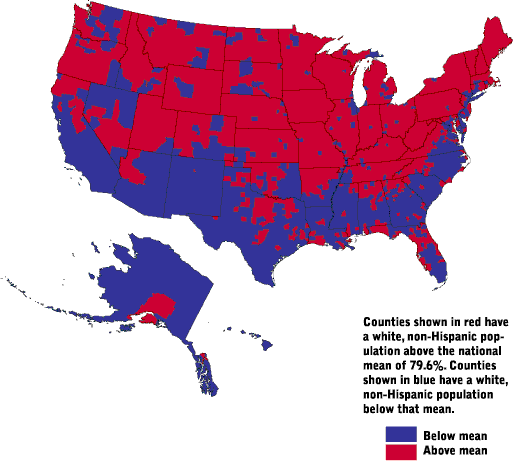
Hmm, we might be getting somewhere, but its not a perfect fit. So instead, let's hypothesize that business licensing is aimed at non-white, non-hispanic groups in general (similar to early justifications for the minimum wage as a way to keep black workers migrating from the south out of traditionally "white" jobs). I cannot get it by state, but the map below by county looks pretty dang similar to the licensing map. Areas in blue have above average percent of non-whites, red is below average.
Not a perfect fit certainly (one would expect Texas to be more onerous), but perhaps close enough to treat the hypothesis seriously. I had always thought that I would be the last one to play the race card in a policy analysis, but business licensing tends to have an inherently base motive (protect one group from competition from another group) that is pretty easy to square with racial and ethnic fear.
Here is the problem: There exists a highly dynamic, multi- multi- variable system. One input is changed. How much, and in what ways, did that change affect the system?
Here are two examples:
The government makes a trillion dollars in deficit spending to try to boost the economy. Did it do so? By how much? (This Reason article got me thinking about it)
Man's actions increase the amount of CO2 in the atmosphere. We are fairly confident that this has some warming effect, but how how much? There are big policy differences between the response to a lot and a little.
The difficulty, of course, is that there is no way to do a controlled study, and while one's studied variable is changing, so are thousands, even millions of others. These two examples have a number of things in common:
We know feedbacks play a large role in the answer, but the system is so hard to pin down that we are not even sure of the sign, much less the magnitude, of the feedback. Do positive feedbacks such as ice melting and cloud formation multiply CO2 warming many times, or is warming offset by negative feedback from things like cloud formation? Similarly in the economy, does deficit spending get multiplied many times as the money gets respent over and over, or is it offset by declines in other categories of spending like business investment?
In both examples, we have recent cases where the system has not behaved as expected (at least by some). The economy remained at best flat after the recent stimulus. We have not seen global temperatures increase for 15-20 years despite a lot of CO2 prodcution. Are these evidence that the hypothesized relationship between cause and effect does not exist (or is small), or simply evidence that other effects independently drove the system in the opposite direction such that, for example, the economy would have been even worse without the stimulus or the world would have cooled without CO2 additions.
In both examples, we use computer models not only to predict the future, but to explain the past. When the government said that the stimulus had worked, they did so based on a computer model whose core assumptions were that stimulus works. In both fields, we get this sort of circular proof, with the output of computer models that assume a causal relationship being used to prove the causal relationship
So, for those of you who may think that we are at the end of math (or science), here is a class of problem that is clearly, just from these two examples, enormously important. And we cannot solve it -- we can't even come close, despite the hubris of Paul Krugman or Michael Mann who may argue differently. We are explaining fire with Phlogiston.
I have no idea where the solution lies. Perhaps all we can hope for is a Goedel to tell us the problem is impossible to solve so stop trying. Perhaps the seeds of a solution exist but they are buried in another discipline (God knows the climate science field often lacks even the most basic connection to math and statistics knowledge).
Maybe I am missing something, but who is even working on this? By "working on it" I do not mean trying to build incrementally "better" economics or climate models. Plenty of folks doing that. But who is working on new approaches to tease out relationships in complex multi-variable systems?
It used to be that updates of software products were something to look forward to. I used to be a bleeding edge guy who, like as not, was using beta versions of most software. Now I avoid updates and upgrades like the plague, particularly since companies like Apple make it virtually impossible to roll back any software update. The four products that have scared me off of upgrades altogether are:
Windows 7 to Windows 8
Old versions of Office to the new versions with the stupid toolbars rather than menus where I still can't find what I want all the time. On a bunch of my computers I still use Office 2002 and 2003 and it works just fine.
Most all itunes updates, particularly 10 to 11 which has done nothing but make critical options harder to find and make the platform, at least on Windows, less stable. I am told people are having major difficulty with the 11.3 to 11.4 update
iOS 6 to iOS 7, which decreased battery life without adding any real user features. So glad I still have not upgraded, though I am sure I will have to soon.
And don't even get me started on software like windows 8 and most of the recent Adobe products that require some sort of user login to even use the product at all.
The other day I had a little fun with Bing's search results on Windows 8 problems. But this seems much more serious. From a reader:
No comment.
That’s Microsoft’s response to new revelations that the search engine is censoring Chinese searches in the United States — not just in China. Searches on Chinese topics in the U.S. now produce markedly different search results than Google, results that mimic those in China. China broadly censors the Internet, blocking topics like the Dalai Lama and Tiananmen Square.
The censorship blog Greatfire.org was the first to point out that Bing’s search results display information propagated by Chinese authorities. A Chinese language search in Bing for the Dalai Lama (达赖喇嘛 in Chinese) produces two results from China’s Wikipedia (Baidu Baike) and one from the state-owned television station CCTV. In Google, the same search returns two Wikipedia entries and the Dalai Lama’s official site.
Microsoft responded to a request from Charlie Smith’s Greatfire to explain the discrepancy. At first, the software juggernaut replied: “We’ve conducted an investigation of the claims raised by Greatfire.org. First, Bing does not apply China’s legal requirements to searches conducted outside of China. Due to an error in our system, we triggered an incorrect results removal notification for some searches noted in the report but the results themselves are and were unaltered outside of China.”
But after finding the “due to Chinese laws and regulations” search result, Microsoft replied: “Thanks for your inquiry. We have no comment on this topic.”
Much more detail at the link, with examples and screenshots
Kevin Drum argues that rules preventing voting in many states by felons are unfair. After all, we don't deny them their first amendment rights for having been in prison, right?
Well, unlike Drum, I put voting further down the list of essentials for a free society, well behind property rights and the rule of law (see here and here). If I wanted to get worked up about post-incarceration loss of rights, I would address the increasingly draconian post-incarceration restrictions on those convicted of even trivial "sex" crimes (treating 17 years olds that sent a nude selfie the same as a rapist).
However, let's talk voting. Yes we do not deny ex-cons their first amendment rights. But we do deny them their second amendment rights. So I offer this compromise:
I propose this bipartisan compromise: Voting and gun ownership rights for convicted felons should be identical. Set them wherever you think is fair, but make them consistent. I am not sure this is really a very fair comparison -- after all, a politician can do a heck of a lot more damage than a gun -- but as I said, I am willing to compromise.
Once we equate making people feel bad with actually attacking them, free expression is basically obsolete, since anything a person does, makes or says could be interpreted as abuse.
Beyond the general amazing sight of feminists acting like Victorian women with the vapors rather than strong, confident human beings, I am still amazed at this interpretation of the art as somehow representing a male threat. Perhaps this is one area where the campus is poorer for the lack of male voices. I can't imagine there are many men who see this statue as anything other than a representation of fear and vulnerability and helplessness. Seriously, does anyone consider sleepwalking at school in your tighty whities as anything but a bad dream? If you had showed me this statue before all the brouhaha and asked me if it was more threatening to men or women, I would have answered "men" without a second thought.
Consider what administration officials announcing the new exemption for medium-sized employers had to say about firms that might fire workers to get under the threshold and avoid hugely expensive new requirements of the law. Obama officials made clear in a press briefing that firms would not be allowed to lay off workers to get into the preferred class of those businesses with 50 to 99 employees. How will the feds know what employers were thinking when hiring and firing? Simple. Firms will be required to certify to the IRS – under penalty of perjury – that ObamaCare was not a motivating factor in their staffing decisions. To avoid ObamaCare costs you must swear that you are not trying to avoid ObamaCare costs. You can duck the law, but only if you promise not to say so.
As I have written about before, our company closed some California operations in December and laid off all the employees. As with most business closures, we had multiple reasons for the closure. The biggest problems were the local regulatory issues in Ventura County that made it impossible to make even simple improvements to the facilities. But certainly looking ahead at costs soon to be imposed due to looming California minimum wage increases and the employer mandate contributed to the decision.
So, did I fire the workers over Obamacare? If Obamacare were, say, 10% of the cause, would I be lying if I said I did not fire workers over Obamacare? Or does it need to be 51% of the cause? Or 1%? Or 90%. Business decisions are seldom based on single variables. I am just exhausted with having my life run by people whose only experience with the real world was sitting in policy seminars at college.
Update: The actual effect of this will not likely be to change business behavior, but change how they talk about it. Worried that there will be too many stories next election about job losses due to Obamacare, the Administration is obviously cooking up ways not to limit the job losses, but to limit discussion of them.
In most commodities that we consume, market price signals serve to match supply and demand. When supplies are short, rising prices send producers looking for new supplies and consumers to considering conservation measures. All without any top-down intervention by the state. All without any coercion or tax money.
But for some reason water is managed differently. Water prices never rise and fall with shortages -- we have been told in Phoenix for years that Lake Powell levels are dropping due to our water use but our water prices never change. Further, water has become a political football, such that favored uses (farmers historically, but more recently environmental uses such as fish spawning) get deep subsidies. You should see the water-intensive crops that are grown in the desert around Phoenix, all thanks to subsidized water to a favored constituency. As a result, consumers use far more water than they might in any given year, and have no natural incentive to conserve when water becomes particularly dear, as it is in California.
So, when water is short, rather than relying on the market, politicians step in with command and control steps. This is from an email I just received from state senator Fran Pavley in CA:
Senator Pavley said the state should consider measures that automatically take effect when a drought is declared to facilitate a more coordinated statewide response.
“We need a cohesive plan around the state that recognizes the problem,” Pavley said at a committee hearing. “It’s a shared responsibility no matter where you live, whether you are an urban user or an agricultural user.”
Measures could include mandatory conservation, compensation for farmers to fallow land, restrictions on the use of potable water for hydraulic fracturing (“fracking”), coordinated publicity campaigns for conservation, increased groundwater management, and incentives for residents to conserve water. Senator Pavley noted that her hometown Las Virgenes Municipal Water District is offering rebates for customers who remove lawns, install rain barrels or take other actions to conserve water.
Pavley also called for the state to create more reliable, sustainable supplies through strategies such as capturing and re-using stormwater and dry weather runoff, increasing the use of recycled water and cleaning up polluted groundwater basins.
Note the command and control on both sides of the equation, using taxpayer resources for new supply projects and using government coercion to manage demand. Also, for bonus points, notice the Senator's use of the water shortage as an excuse to single out and punish private activity (fracking) she does not like.
All of this goes to show exactly why the government does not want a free market in water and would like to kill the free market in everything else: because it gives them so much power. Look at Ms. Pavley, and how much power she is grabbing for herself with the water shortage as an excuse. Yesterday she was likely a legislative nobody. Today she is proposing massive infrastrure spending and taking onto herself the power to pick winners and losers (farmers, I will pay you not to use water; frackers, you just have to shut down). All the winners will show their gratitude next election cycle. And all the losers will be encouraged to pay protection money so that next time around, they won't be the chosen victims.
Faulting the IRS for attempting to “unilaterally expand its authority,” the D.C. Circuit today affirmed a district court decision tossing out the agency’s tax-preparer licensing program. Under the program, all paid tax-return preparers, hitherto unregulated, were required to pass a certification exam, pay annual fees to the agency, and complete 15 hours of continuing education each year.
The program, of course, had been backed by the major national tax-return preparers, chiefly as a way of driving up compliance costs for smaller rivals and pushing home-based “kitchen table” preparers out of business. Dan Alban of the Institute for Justice, lead counsel to the tax preparers challenging the program,called the decision “a major victory for tax preparers—and taxpayers—nationwide.”
The licensing program was not only a classic example of corporate cronyism, but also of agency overreach. IRS relied on an 1884 statute empowering it to “regulate the practice of representatives or persons before [it].” Prior to 2011, IRS had never claimed that the statute gave it authority to regulate preparers. Indeed, in 2005, an IRS official testified that preparers fell outside of the law’s reach.
Perhaps a first indication that the Obama Administration strategy to pack the DC Circuit with Obama appointees may not necessarily protect his executive overreach.
PS - you gotta love the IJ.
PPS - The IRS justified its actions under "an obscure 1884 statute governing the representatives of Civil War soldiers seeking compensation for dead horses"
People like to compare what Krugman writes today in his political hack era with what he wrote in his real economist era. But this time I do not have to look that far back.
On February 5 and On February 6, Krugman essentially agrees with the OMB review of Obamacare effects on employment, saying that the health care subsidies for lower-income workers would cause millions to work less by reducing the incentive to work, which he called "a good thing." More here.
On February 9, Krugman returns to a theme he has been hitting on for some weeks now, calling the Republicans anti-science, mean-spririted, etc. for actually believing that unemployment benefits might reduce employment by reducing the incentive to work. And here is what he wrote on the topic on December 8:
The view of most labor economists now is that unemployment benefits have only a modest negative effect on job search — and in today’s economy have no negative effect at all on overall employment. On the contrary, unemployment benefits help create jobs, and cutting those benefits would depress the economy as a whole.
Yes I understand the shape of the subsidy patterns with income are different, but good God man you cannot reasonably argue that the labor supply curve is sensitive to means-tested government subsidies for one program but not at all for another without a heroic analysis that I cannot imagine and Krugman has not supplied.
Don't let Amazon's placement of it in the "craft" section fool you. E-6000 is the best all-purpose, stick-any-two-arbitrary-things-together adhesive I have ever found.
I made my daughter a Christmas present which was a reproduction of the painting in the Disney Haunted Mansion where the man in the picture slowly turns to a skeleton. I will post a build report at some time, but I had to anchor a heavy computer monitor to a wood box and an Ikea plastic frame, and E-6000 welded the whole thing together. I also have used it recently to glue studs to a concrete floor to support a cabinet and to put a rubber weir under my garage door. It takes a day to cure, and will not go on thin and sometime can be messy, but it makes an awesome bond. I almost never touch epoxy or Liquid Nails any more.
Update: I know Gorilla Glue has its adherents. The problem is that it expands so much (it kind of foams), it is really hard to control and get good results, at least in my opinion. Neither of these replace ACC when you need to bond something fast or when you want your fingers stuck together all day.
This is a pretty amazing chart from Jed Graham and IBD which I have annotated a bit
Note first that the diversion between high and low-wage** industries did not occur during the recession, and in fact through the recession the two groups tracked each other pretty closely until early 2010. Then, in early 2010, something made the two lines start to diverge and in 2012-2013 they really went in opposite directions.
Well, my suggestion for the "something" is Obamacare. In March 2010, the PPACA was passed. Looking at the jobs data, one can date the stall in the economic recovery almost precisely from the date the PPACA was passed (e.g. here).
The more important date, though, is January 1, 2013. This is a date that every business owner was paying attention to at the time but which seems entirely lost on the media. All the media was focused on the start-date of the employer mandate on January 1, 2014. Why was the earlier date important? Let's go back in time.
At that time, the employer mandate had yet to be delayed. The PPACA and IRS rules in place at the time called for a look-back period in 2013 where actual hours worked for each employee would be tracked to determine whether the employee would classified as full or part-time on the Jan 1, 2014 start date. So, if a company wanted to classify an employee as part-time at the start of the employer mandate (and thus avoid penalties for that employee), that employee needed to be converted to part-time as early as possible, preferably before 2013 even started and at worst by mid-year 2013 [sorry, I typo-ed these dates originally].
Unlike the government, which apparently waits until after the start-up date to begin building large pieces of major computer systems, businesses often tackle problems head on and well in advance. Faced with the need to have employees be working 29 hours or less a week in the 2013 look-back period, many likely started making changes back in 2012. Our company, for example, shifted everyone we could to part time in the fourth quarter of 2012. I know from talking to the owners of several restaurant chains that they were making their changes even earlier in 2012. One employee of mine went to Hawaii in October of 2012 and said that all the talk among the resort employees was how they were getting cut to part-time over Obamacare.
Yes, the employer mandate was eventually delayed, but by the time the delay was announced, every reasonably forward-looking company that was going to make changes had already done so. Having made the changes, there is no way they were going to switch back, and then back yet again when the Administration finally stumbles onto an actual implementation date.
If this chart gets any traction over the next few days, expect to see a lot of ignorance as PPACA defenders claim that the fall in low-wage work hours can't possibly have anything to do with the PPACA because the employer mandate has not even started. Now you know why this argument is wrong. The PPACA, and associated IRS implementation rules, drove companies to convert full-time to part-time jobs as early as 2012.
Usual warning: Correlation is not causation. However, I will submit that I was predicting exactly this sort of result years before it occurred. This is not a spurious correlation that is ex post facto blamed on whatever particular bete noir I might have. I and many other predicted that Obamacare would drive down work hours per week in lower-wage industries, and now having seen exactly that correlated with key Obamacare dates, it is not going to far to hypothesize a connection.
** Why could low-wage industries be impacted more than high-wage? Two reasons. One, low-wage industries are far less likely to offer a full Obamacare-compatible health plan to employees than high wage industries. Second, the fixed penalties ($2000 and $3000 per employee) for lack of insurance plans are obviously a far higher percentage of the total pay in low-wage vs. high-wage industries. A penalty that is 15% of annual pay is much more likely to cause employers to shift or reduce work than a 3% penalty.
Today I have yet another person with a full disability settlement (e.g. from Social Security) telling me that they are fully capable of working and pestering me to hire them. The rub is that paying them any money would endanger their disability payments, so they ask me to pay the money to someone else (husband, child) or to pay them off books in cash. Essentially, they are asking me to violate the law in order the help them violate the law.
Why would I take this risk? Last year I had 21,000 people sign up on a mailing list looking for work.
Perhaps I am somehow an outlier because I hire so many older folks, but I get dozens of request like this a year. You can't convince me that the disability system is not broken.
Studies are still mixed about the direction of feedbacks, with as many showing negative as positive feedback. No study that I have seen supports positive feedbacks as large as those used in many climate models
As a result, climate models are systematically exaggerating warming (from Roy Spenser, click to enlarge). Note that the conformance through 1998 is nothing to get excited about -- most models were rewritten after that date and likely had plugs and adjustments to force the historical match.
To defend the forecasts, modellers are increasingly blaming natural effects like solar cycles on the miss, natural effects that the same modellers insisted were inherently trivial contributions when skeptics used them to explain part of the temperature rise from 1978-1998.
By the way, 1978-1998 is still the only period since 1940 when temperatures actually rose, such that increasingly all catastrophic forecasts rely on extrapolations from this one 20-year period. Seriously, look for yourself.
Alarmists are still blaming every two or three sigma weather pattern on CO2 on global warming (polar vortex, sigh).
Even when weather is moderate, media hyping of weather events has everyone convinced weather is more extreme, when it is not. (effect explained in context of Summer of the Shark)
My temperature forecast from 2007 still is doing well. Back in '07 I regressed temperature history to a linear trend plus a sine wave.
Carlson confirms this sad tale by reporting that increases in administrative staffing drove a 28 percent expansion of the higher education work force from 2000 to 2012. This period, of course, includes several years of severe recession when colleges saw their revenues decline and many found themselves forced to make hard choices about spending. The character of these choices is evident from the data reported by Carlson. Colleges reined in spending on instruction and faculty salaries, hired more part-time adjunct faculty and fewer full-time professors and, yet, found the money to employ more and more administrators and staffers.
Administrative bloat is a problem in every organization. It would be nice to think that organizations can stay right-sized at all times, but the reality is that they bloat in good times, and have to have layoffs to trim the fat in bad times.
The difference between high and low-performing organizations, though, is often where they make their cuts. It appears from this example that academia is protecting its administration staff at the expense of its front-line value delivery staff (ie the faculty). This is a hallmark of failing organizations, and we find a lot of this behavior in public agencies. For example, several years ago when Arizona State Parks had to have a big layoff, they barely touched their enormous headquarters staff and laid off mostly field customer service and maintenance staff. (At the time, Arizona State Parks and my company, both of whom run public parks, served about the same number of visitors. ASP had over 100 HQ staff, I had 1.5).
This tendency to protect administrative staff over value-delivery staff is not unique to public institutions - General Motors did the same thing for years in the 70's and 80's. But it is more prevalent in the public realm because of lack of competition. In the private world, companies that engage in such behaviors are eventually swept away (except if you are GM and get bailed out at every turn). Public agencies persist on and on and on and never go away, no matter how much they screw up. When was the last time you ever heard of even the smallest public agency getting shut down?
I would love to see more on the psychology of this tendency to protect administrative over line staff. My presumption has always been that 1) those in charge of the layoffs know the administrative staff personally, and so it is harder to lay them off and 2) Administrative staff tend to offload work from the executives, so they have more immediate value to the executives running the layoffs.
This startling assertion of government power became public in December when the FEC released an enforcement file in the case of a Boston television station's regular Sunday-morning news program, "On the Record." The station, WCVB, had invited two congressional candidates (a Democrat and a Republican) into its studio to appear on "On the Record" in the weeks leading up to the 2012 election and formatted the joint appearance as a 30-minute debate.
Another candidate (a libertarian) who was not invited filed a complaint alleging that the value of WCVB's production costs and airtime constituted unlawful corporate contributions to the two candidates who were invited.
Wow, I am sure glad the "libertarian" is pushing for government regulation of speech and government restrictions on the decision-making of private businesses.
Go into Google and search "Windows 8 is " and you will get auto-suggestions "Crap, Rubbish, Awful, Terrible, Horrible, Slow, A Disaster, A Flop". When this was first noticed, folks suggested Google was playing games, though personally having tried Windows 8 a couple of times I thought the suggestions were dead on. So Don Charisma tried the same thing with Microsoft's search engine Bing:
It appears that Microsoft got the message and has done a little managing of their algorithm, because now you get this:
Cool? Great? Amazing? Seriously, who are they fooling? Even Yahoo, which is powered by Bing (I think) doesn't give this kind of result
Cancer is skyrocketing worldwide and urgent steps are needed to curtail a catastrophic rise in incidents of the disease, the World Health Organization said in a report this week.
New cancer cases are expected to soar globally from an estimated 14 million in 2012 to 22 million new cases a year within the next 20 years.
Cancer deaths are expected to jump from about 8.2 million to 13 million a year.
I guess my question is, is there really an epidemic of new cancers, or can this be explained by:
Better and earlier identification of cancers that always existed but went undiagnosed.
A reduction in early death and disease that allows more people to grow old into the years where cancers are common
In both these explanations, increases in cancer diagnoses could easily be, counter-intuitively, caused by improving local medical care rather than any environmental or genetic factor.
The article seems to imply that the explosion is due to environmental and nutrition issues. I am certainly willing to believe that rising incomes allow more people to smoke, causing cancer issues. But my guess is that most of this increase is from my two explanations. Far be it for me to suggest that folks who depend on fear-driven funding of cancer care might exaggerate the scope of the "epidemic".
My dad grew up in farm country in Iowa. He told me stories of the early days of commodity futures when a number of farmers lost a lot of money betting the wrong way. The error they made is that they would look at their local weather and assume everyone was experiencing the same. For example, some guy in Iowa would be experiencing a drought and facing a poor corn crop, and would buy corn futures assuming the crop would be bad everywhere. Unfortunately, this was often not the case.
A few climate sites have monthly contests to predict the next month's average global temperature anomaly. Apparently, everyone really missed in the January betting. Since most of the participants were American, they assumed that really cold weather in the US would translate to falling global temperatures. They were wrong. The global temperature anomaly in January actually rose a bit.
This is a variation of the same effect I often point out in the opposite direction -- that heat waves in even seemingly large areas do not necessarily mean anything for global temperatures. The US is only about 2% of the global surface area (land and ocean) and since the cold spell was in the eastern half of the US, it therefore affected perhaps 1% of the globe. And remember, on average, some area representing 1% of the globe should constantly be seeing a 100-year high or low for that particular day. It's just how averages work.
No particularly point here, except to emphasize just how facile it is to try to draw conclusions about global temperature trends from regional weather events.
Trader Joe’s wanted to build a new store in Portland, Oregon. Instead of heading to a tony neighborhood downtown or towards the suburbs, the popular West Coast grocer chose a struggling area of Northeast Portland.
The company selected two acres along Martin Luther King Blvd. that had been vacant for decades. It seemed like the perfect place to create jobs, improve customer options and beautify the neighborhood. City officials, the business community, and residents all seemed thrilled with the plan. Then some community organizers caught wind of it.
The fact that most members of the Portland African-American Leadership Forum didn’t live in the neighborhood was beside the point. “This is a people’s movement for African-Americans and other communities, for self-determination,” member Avel Gordly said in a press conference. Even the NAACP piled on, railing against the project as a “case study in gentrification.” (The area is about 25 percent African-American.)
After a few months of racially tinged accusations and angry demands, Trader Joe’s decided it wasn’t worth the hassle. “We run neighborhood stores and our approach is simple,” a corporate statement said. “If a neighborhood does not want a Trader Joe's, we understand, and we won't open the store in question.”
Hours after Trader Joe’s pulled out, PAALF leaders arrived at a previously scheduled press conference trying to process what just happened. The group re-issued demands that the now-cancelled development include affordable housing, mandated jobs based on race, and a small-business slush fund. Instead, the only demand being met is two fallow acres and a lot of anger from the people who actually live nearby.