Carnival of the Capitalists

This week's Carnival is up at Gongol.com

Continuing in the efforts of the host last week, Brian has tried to reformat that Carnival to make it more useful and user-friendly than the data-dump model.  I think he has done a really nice job, and I am not just influenced by the fact that my article this week gets an "editors choice".

The Scandinavian Standard of Living Myth

There is a widespread notion that the Scandinavian countries somehow have crafted for themselves the highest standard of living in the world.  This never made much sense to me, since I just couldn't believe their socialist economies could really create the wealth needed to support this alleged standard of living.  As it turns out, they can't and don't, and owe their reputation more to PR than reality:

THE received wisdom about economic life in the Nordic countries is
easily summed up: people here are incomparably affluent, with all their
needs met by an efficient welfare state. They believe it themselves.
Yet the reality - as this Oslo-dwelling American can attest, and as
some recent studies confirm - is not quite what it appears....

All this was illuminated last year in a study by a Swedish research
organization, Timbro, which compared the gross domestic products of the
15 European Union members (before the 2004 expansion) with those of the
50 American states and the District of Columbia. (Norway, not being a
member of the union, was not included.)

After adjusting the
figures for the different purchasing powers of the dollar and euro, the
only European country whose economic output per person was greater than
the United States average was the tiny tax haven of Luxembourg, which
ranked third, just behind Delaware and slightly ahead of Connecticut.

The next European country on the list was Ireland, down at 41st
place out of 66; Sweden was 14th from the bottom (after Alabama),
followed by Oklahoma, and then Britain, France, Finland, Germany and
Italy. The bottom three spots on the list went to Spain, Portugal and
Greece.

Alternatively, the study found, if the E.U. was treated
as a single American state, it would rank fifth from the bottom,
topping only Arkansas, Montana, West Virginia and Mississippi. In
short, while Scandinavians are constantly told how much better they
have it than Americans, Timbro's statistics suggest otherwise. So did a
paper by a Swedish economics writer, Johan Norberg.

So Europeans, in terms of being well-off, rank right up there with... Appalachia.  "Jimmy, you have to finish that liver - you know there are starving kids in Norway that would love to have that food."

Anyway, if this topic interests you, of true comparisons of US vs European economies, income distribution, work weeks, etc., Cowboy Capitalism is a good place to start.  (hat tip Instapundit)

The ACLU is a Little Late to the Party

Reason reports that the ACLU is jumping into the fray to try to prevent Las Vegas from levying a special sales tax on strippers (emphasis added)

A Nevada bill that would impose a
10 percent tax on strip club dancing will be struck down in
court if lawmakers pass it, an American Civil Liberties Union
lawyer said on Wednesday.

"You can not have a special tax aimed at First Amendment
activity based on content," said Allen Lichtenstein, general
counsel of the ACLU of Nevada.

"Adult entertainment, which is protected by the First
Amendment, is being targeted to bear the burden of taxes where
other businesses are not," Lichtenstein said, referring to the
bill. "To single out a particular business based on content and
tax it with a special tax is unconstitutional
."

Don't get me wrong, I am certainly happy that the ACLU has suddenly discovered the rights of taxpayers, but they seem a bit late to the party.  I mean, states that charge the same tax to every business, especially the same sales tax rate, are the exception.  States all charge special hotel rates, rent car taxes, airport fees, long distance surcharges, etc etc.  For example, here are just a few of the special unique industry-specific taxes on the California BOE site (by the way, you know you live in a socialist state when your tax department is called the "Board of Equalization"):

This is far from a complete list, but you get the idea. This article from the Tax Policy Center explains that narrow industry specific excise taxes have a very long history in this country.  And this completely leaves off the issues of subsidies that are targeted at particular industries, such as the billions in direct subsidies received by farmers, not to mention the additional billions in price supports they get as well.  (Reason, by the way, has done some entertaining research on the millions of dollars of farm subsidies received by the family of Farm-aid founder John Cougar Mellancamp).  I am eager to see the ACLU begin tackling these other "special taxes" on "particular businesses".

I am not sure what motivated the ACLU to finally join the taxpayer cause, other than perhaps a personal financial interest their leadership team might have in this particular tax, but I for one am happy to welcome them to the cause.

Update: I am still having fun trying to imagine how the ACLU, the supposed protector of individual rights that has never had a problem up 'till now with our class warfare tax rates that are zero on some Americans and 40+% on others, suddenly had an epiphany about unequal levels of taxation when it comes to taxing strippers.  I have this visual picture in my head of the local head of the ACLU slipping a five into an entertainers g-string but getting mad when he couldn't get the two extra quarters in there to pay the tax.

Update #2: By the way, for all the flippancy in my post about the ACLU, they are absolutely right in this case, if way too narrowly focused.  I criticize the ACLU often because of the 21 policy areas it considers critical to individual rights, none have anything to do with property rights or economic freedom.  However, the ACLU is a strong and consistent defender of free political speech during a time when speech is under attack from all sides of the political spectrum.  The ACLU realized early on something the left still won't acknowledge, that it is impossible to separate regulation on spending for speech from restrictions on speech itself

Unfortunately, what the ACLU refuses to recognize is that all commerce, not just purchasing political ads or buying couch dances, is a form of communication and free expression.  The economy is nothing more than individuals, millions of times a day, communicating and reaching agreements to trade for mutual benefit.   Why is it any less of a restriction of free speech when the government places restrictions on this communication, say by restricting the range of wages I can offer an employee?  Or, more obviously, how can the government place regulations on what I can say about my company in an advertisement, but not on what I say about a political candidate?

The ACLU in this case seeks to evade sanctioning free speech in that dirty commercial world by apparently arguing that stripping is not commerce but artistic expression.  But by that logic, the government shouldn't be allowed to tax building and construction, for surely buildings are a strong and lasting form of art and expression.  Or how about cars - I certainly consider a Ferrari a much higher form of expression than a couch dance.  How can the government tax cars?  Or what about T-shirts with a political message -- can governments charge sales taxes on those?  What about the lawn service I pay to have a beautiful green lawn, which is the ultimate form of suburban expression?

At the end of the day, it is impossible to separate money and commerce and property from speech and expression.  Commerce is the most ubiquitous and important form of free expression we have in this country.  So far, the ACLU seems to acknowledge this fact only for topless dancers and politicians.  I wish they would extend their efforts to protect both free speech and free commerce to the rest of us.

OK, this is Weird

I resisted blogging about it when a woman claimed to have found a human finger in her Wendy's chili.

I was tempted to blog when it was discovered that the woman had a suspicious history of torts against other restaurants and public companies.

I still held out when authorities began searching the woman's home, supposedly to find evidence that she put the finger in herself, perhaps from her dead grandmother's hand.

However, I just can resist this new addition to the story:

A woman who lost part of her finger to a leopard in Nevada thinks it
somehow ended up in a bowl of chili in a California Wendy's.

Her
lawyer says Sandy Allman wants to participate in any DNA test on the
finger. The lawyer says Allman last saw her digit packed in ice in a
Las Vegas emergency room. Doctors had told her it couldn't be
reattached.

The hospital says it can't account for the three-quarter-inch fingertip.

Las
Vegas resident Anna Ayala claimed she found an inch and a-half
fingertip in her chili about a month after the leopard attack.

Update: Unfortunately, authories are now leaning away from the leopard story.  Have they checked Roy Horn?

Movie-Making Becoming a Subsidy Magnet

Politicians seem to love the movie business, or so I infer from the rash of proposals of late to subsidize the movie business. 

New York City seems to have been first out of the blocks, with this program to provide tax rebates and free advertising for shooting movies in NYC.  The article tells us this is the only industry being so targeted at this point by NY.  Why?  Why are movie jobs and movie makers somehow better than every other kind?  Maybe its because they think the movies provide good advertising for NYC, like the great light they cast on the city in movies like this and this.

Anyway, the trend got my attention when our own Arizona governor lamented that Arizona is no longer home to as many movie shoots as it once was decades ago.  Far be it for me to suggest that this is probably more of an issue of westerns going in and out of style (since about a majority of movies shot in Arizona were westerns).  Nevertheless, Napolitano is pushing ahead with her plan to improve the net income line of Hollywood studios by subsidizing production in Arizona.

Finally, via Reason, we see that Hollywood is worried that it is being left out of the subsidy competition, by actually paying companies to film in LA:

Mayor James K. Hahn on Thursday announced a plan he hopes will keep Hollywood in
Hollywood "” by paying film production companies to shoot in Los Angeles.

Hahn's proposal, which was inspired by a program that New York City
adopted in December, would use as much as $15 million in public funds to
reimburse companies that make a movie in Los Angeles, paying them 5% of their
production costs or up to $625,000.

OK, so one would think that all these locations have struggling media and production industries.  But in fact, just the opposite is true.  In New York:

But Wylde thinks film is just the tip of the iceberg. The city's entire media sector is growing explosively, she notes. From Time Warner to Hearst to Bloomberg LLP, media firms account for $13 billion in city wages, 50% more than tourism.

And, in LA:

Last year, however, film, video and television production in Los Angeles
actually reached record highs. Entertainment Industry Development Corp. issued
permits for 52,707 location production days "” one day representing a single day
of work on a single project "” a 19% increase over 2003.

Doesn't sound like they are in much trouble.  Their film and media businesses are already growing explosively to record highs.  So why do they need a subsidy?  Doesn't exactly sound like the New England textile business.

Look, at the end of the day, this is about politicians handing taxpayer money to powerful media people, people who have the ability to disproportionately influence public opinions and things like ... elections!  This is a barely disguised campaign expenditure, except for the fact that taxpayers pay the bill.

I wrote more about the idiocy of subsidizing corporate relocations to one's state or city here.

Update:  Match Welch has more

State Payroll and Tax Links

Here is a great link page to tax and employment related agencies in the 50 states.  And this is a good link page pointing to the text of labor law from all 50 states.  This is particularly useful if you do business in multiple states or you are considering growth into a  new state.  Thanks to George's Employment Blawg for the link.

Who Will Die in the Next Harry Potter Book

We are big Harry Potter fans in our house.  The world has been warned that another major character will buy it in the next book Harry Potter and the Half-Blood Prince (similar to Sirius Black's death in the last book).  Trust the Brits to have a betting line on it:

Hagrid (6/4)
Professor Dumbledore (2/1)
Cho Chang (3/1)
Neville Longbottom (3/1)
Professor McGonagall (7/2)
Fred and/or George (4/1)

Selective Libertarianism

When it comes to defending abortion, women's groups are great libertarians. They will point out that abortion is about the right to choose and about protecting the "fundamental civil and human right of women to make the most intimate decisions about their bodies and their lives".  Its about not letting the government interfere with individual decision-making or a "woman's right to privacy".  Its about assuming women are grown-up enough to make difficult choices about their fetus and their own health and safety.  Opponents of such choice are "ultra-conservatives trying to deny women control over their own bodies".  (all quotes from the NOW web site).

So, women's groups seem to be good libertarians concerned with the primacy of women's decision-making over their own body.  Except when they're not.  NOW has been feverishly campaigning to get the government to limit a women's right to choose breast augmentation, despite the fact that the science is overwhelmingly behind the safety of implants.  Sure, as in any medical procedure, there are some risks, but I defy anyone to tell me that the risks associated with breast implants are greater than the risks associated with abortion.  Abortion is a much weightier and more difficult decision, and, unlike breast implants, it is irreversible.  If women are mature enough to make abortion decisions, they certainly are mature enough to weigh the risks of breast implants.  Or take the birth control pill -- the impact to a woman's body of silicone sacks in their boobs is far less than that of trashing their entire hormone balance.  Sure, the pill makes sense for a lot of people and its great that the option exists, but don't tell me that the the changes the pill engenders in the body are OK but bags of silicone are not.

The real issue, as pointed out early and often by Virginia Postrel, is that feminists consider breast implants as at best frivolous, and at worst a demeaning surrender to male objectification of the female's body.  They don't think women who choose these implants are making the right choice, so they, in their elite holier-than-thou wisdom, want to take the decision away from women.  Hmmm.  Freedom for me but not for thee.  More along the line of distrusting individual decision-making here.

Update:  My main point of this post was on breast implants, and comparing feminist retoric on that issue vs. their retoric on abortion.  I feel the need, though, to mention that I don't accept that abortion is necesarily a pure individual choice situation.  Individual decision-making should be trusted when individuals make choices that affect only themselves, without coersion or fraud.  The problem in the case of abortion is whether the fetus is a piece of tissue that is a part of a woman's body, or an independent life.  In the former case, its removal is subject to individual decision making, but not in the latter.  As I have written before, I think the fetus is protoplasm at 1 week and a baby at 8 months.  At some point in between we draw an arbitrary line between part-of-the-mom and independent life.

Many abortion supporters, unwilling to risk that society might draw this line earlier in the pregnancy than they might want it, take the extra step of arguing that the very determination of whether the fetus is a life or not at 2 or 5 or 7 months should be up to individual taste, and that the government should have no say in that determination.  That strikes even me as the hardcore libertarian as going too far.  Certainly in its limited role of protecting individual rights, the government has a role in determining just who is an individual with rights subject to protection.  Determining if a fetus is an individual with independent rights and at what point in the pregnancy it is treated as such are reasonable roles for government legislation.

Academic Thought Police

Hans-Hermann Hoppe is finally able to tell his story of his academic inquisition at UNLV, all begun because one student in one of his lectures felt that his feelings had been hurt.  Kudos to the ACLU for supporting professor Hoppe.  Here was his crime (via this article comparing Hoppe's aggressive defense of himself with Lawrence Summers total capitulation):

Hoppe's
violation of thought control was the view that homosexuals, along with others
who tend not to have children, have a higher than average time preference rate.
They are willing to trade more future income for present gratification than
others, such as parents.

Neither of these
claims is at all unexceptionable "“ within economics. Both would be widely agreed
to within this profession. Certainly, neither would raise any untoward number of
eyebrows within this discipline.

By the way, I am officially declaring that the term "hate speech", as currently used, has joined the ranks of completely useless terminology.  This term is being used as a lever to attack the first amendment all over this country, and not just on campuses.  Like any assault on fundamental rights, it begins by defining a very narrow category of speech that is so offensive that people will accept an exception to first amendment protections.  Then, once that exception exists, the definition of hate speech is expanded to include, basically, "any speech I don't agree with".  That's why I am opposed to any exceptions to the first amendment, even for outlawing hate speech.  To be a true defender of the first amendment, you have to be ready to defend the speech rights of some of the most outrageous and grotesque people.

Wealth of Nations

Socialists and "progressives" of various stripes always want to argue that the distribution of wealth among nations is basically due to luck, in large part related to the distribution of natural resources.

This is disprovable in about 2 seconds:  Russia (via Cafe Hayek) and the Netherlands.   Russia, resource-wise, is perhaps the richest country in the world.  It is, our could be, among the largest producers of any number of natural resources, from diamonds and gold to oil and uranium.  But its economy is a disaster.  The Netherlands, resource wise, has about nothing.  There are few third world economic hell-holes that don't begin with infinitely more resources than the Dutch, but the Dutch are among the richest nations in the world. 

Wealth comes not from labor or capital or resources - wealth comes from the mind, and as such requires a rule of law where the mind is free not only to imagine new ideas but to pursue and reap the fruits of these ideas.  As I said in this article:

From the year 1000 to the year 1700, the world's wealth, measured as GDP per capita, was virtually unchanged.
Since 1700, the GDP per capita in places like the US has risen, in real
terms, over 40 fold.  This is a real increase in total wealth - it is
not money stolen or looted or exploited.  Wealthy nations like the US
didn't "take" the wealth from somewhere else - it never even existed
before.  It was created by the minds of human beings.

How?  What changed? 

  1. There was a philosophical and intellectual
    change where questioning established beliefs and social patterns went
    from being heresy and unthinkable to being acceptable, and even in
    vogue.  In other words, men, at first just the elite but soon everyone,
    were urged to use their mind rather than just relying on established
    beliefs
  2. There were social and political changes that greatly increased
    the number of people capable of entrepreneurship.  Before this time,
    the vast vast majority of people were locked into social positions that
    allowed them no flexibility to act on a good idea, even if they had
    one.  By starting to create a large and free middle class, first in the
    Netherlands and England and then in the US, more people had the ability
    to use their mind to create new wealth.  Whereas before, perhaps 1% or
    less of any population really had the freedom to truly act on their
    ideas, after 1700 many more people began to have this freedom. 

So today's wealth, and everything that goes with it (from shorter
work hours to longer life spans) is the result of more people using
their minds more freely.


Economics of Tipping

I've written a couple of times about how I find the whole process of tipping in this country to be irritating.  There is absolutely no logical framework you can come up with to say why we are expected to tip restaurant workers but not, say, retail workers.  Tipping has long, long ago passed the point where it was a practice to reward good service and has instead become a way for employers to shift the burden of paying wages to their employees onto their customers.  For example, I wrote (or more accurately, ranted) here:

Unfortunately, restaurants and other service establishments have
twisted this act of reward and generosity into having customers pay the
wages of their staff.  Restaurants are simultaneously increasing
tipping expectations (from 15% to 20%+) while requiring tips on more
and more occasions by building them automatically into the bill.

The event that brought my irritation to a boil the other day
actually happened valet parking my car at a restaurant.  As background,
the establishment charged $4 to valet park your car.  Now, I am not a
socialist, so I accept that value is not driven by cost but rather by
what I am willing to pay for it, and I was willing to pay $4 to avoid
having to walk a few blocks from the free lot  (those of you from
Boston or NY are wondering what the fuss is about -- a valet parking
charge of any amount is virtually unprecedented in Phoenix, at least
until recently).

So I paid my $4, and then I saw the sign:

"Our employees work for tips"

What?
You mean I just paid your company $4 for what amounts to about 5
minutes of labor, and now you are telling me that in addition, I need
to pay your employees' wages for you too?  This is pretty nervy - I
mean, other than a percentage concession payment they are probably
making to be the parking company at that location, what other costs do
they have?  I didn't want to hurt the young guy actually doing the
parking, but for the first time in years I didn't tip the valet.  That
little sign turned, for me, an act of goodwill into a grim obligation,
extorted from me by guilt.

I bring all this up because I saw an interesting piece the other day on Marginal Revolution:

1. Two studies show little relationship between quality of waiter service and
size of tip.

2. Hotel bellboys can double the size of their tips, on average, by showing
guests how the TV and air conditioning work.

3. Tipping is less prevalent in countries where unease about inequality is
especially strong.

4. The more a culture values status and prestige, the more likely that
culture will use tipping to reward service.

5. Tips are higher in sunny weather.

6. Servers can increase their tips by giving their names to customers,
squatting next to tables, touching their customers, and giving their customers
after-dinner mints. (query: how do lap dances fit into this
equation?)

7. Drawing a smiley face on the check increases a waitress's tips by 18
percent but decreases a waiter's tips by 9 percent.

8. In one study, waitresses increased their tips by 17 percent by wearing
flowers in their hair.  In general it pays to look distinctive albeit not freaky


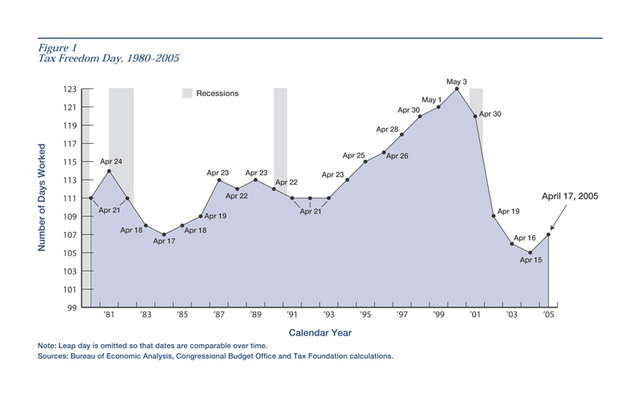
April 17 is Tax Freedom Day

Per the Tax Foundation:

The report compares the number of days Americans work to pay taxes to the number of days they work to support themselves.
      

"Despite
all the tax cuts that the federal government has passed recently,
Americans will still spend more on taxes than they spend on food,
clothing and medical care combined," said Hodge.

In
2005, Americans will work 70 days to afford their federal taxes and 37
more days to afford state and local taxes. Other categories of spending
measured in the report include housing and household operation (65
days), health and medical care (52 days), food (31 days),
transportation (31 days), recreation (22 days), clothing and
accessories (13 days), saving (2 days) and all other (42 days).

Tax Freedom day has moved around over the last few years:

Tfd1800px_1

Enjoy!

Observations on Walmart, Women, and Wages

After my earlier post on Walmart, I got to thinking about a number of Walmart-related topics.  My brain is a bit too fried on Friday night to organize these thoughts too much, so here they are, roughly following my stream of consciousness:

Exxon may have finally handed off the Great Satan title

The socialists of this country (who now generally call themselves progressives but its pretty much the same thing) usually need a company they can focus their attention on.  In the 1960's, this was probably General Motors, though defense contractors in the Vietnam War made a run at the title.  After the oil embargo of 1972, that title clearly moved to Exxon. I remember in one month in the early 1970's, the head of Exxon got called into Congress twice in a few weeks, once to combat the urban myth that oil companies were greedily holding oil off the market to drive up prices, and once to explain to Congress why they were greedily trying to expand oil production in Alaska.  My family and many of my friends worked for large oil companies, and we had several friends who were injured by letter bombs from domestic leftist terrorists (though the media did not call them terrorists then).

Exxon held the great Satan title for a long time.  It probably could have shed the title with low oil prices in the 80's, but the stupidity of the Valdez mess in the mid-80's and the vociferous opposition to the politically correct Kyoto accords in the mid-90's help them retain the title for a record number of years.

Finally, however, it appears that a new contender is at hand.  Walmart, so recently the most admired corporation in America, has become the new socialist whipping boy and lawsuit magnet.  Just search for Walmart in Google and you will get pages and pages of Wal-mart bashing sites.  Its kind of an amazing story how the former blue collar low-price hero of the working man trying to make ends meet has suddenly become a class enemy.  However, coming from a family that had many members who worked for Exxon, it comes as some relief to pass the Great Sata title on.

I wish everyone at Walmart could make $100,000 per year

In this, I am exactly in the same boat as Walmart detractors.  I would love for everyone at Walmart to make a ton of money.  Whether this is realistic is another story.

In America, people take jobs voluntarily

I would generally class this as a blinding glimpse of the obvious, but it appears that it has to be said.  And, if you accept that people are operating in their own rational self-interest (by the way, this is not a given -- many on the left do not think the average American is smart enough to make decisions for themself and that they need smart technocrats to look after them).  Anyway, were was I?  Oh yes, if you accept that people operate in their own rational self-interest, then by definition the job for Walmart employees is their best option, and any other option is worse.

This is the logical fallacy of those who attack Walmart (or offshore companies) for paying too low of wages.  Their concern is that these wages are lower than they, as an outside obviously smarter than everyone else observer, think they should be.  The reality is that these wages are higher than that employee's other options, and therefore is an improvement over that job not existing at all.  Note this story I told in an earlier post:

Progressives do not like American factories appearing in third world
countries, paying locals wages progressives feel are too low, and
disrupting agrarian economies with which progressives were more
comfortable.  But these changes are all the sum of actions by
individuals, so it is illustrative to think about what is going on in
these countries at the individual level. 

One morning, a rice farmer in southeast Asia might face a choice.
He can continue a life of brutal, back-breaking labor from dawn to dusk
for what is essentially subsistence earnings.  He can continue to see a
large number of his children die young from malnutrition and disease.
He can continue a lifestyle so static, so devoid of opportunity for
advancement, that it is nearly identical to the life led by his
ancestors in the same spot a thousand years ago.

Or, he can go to the local Nike factory, work long hours (but
certainly no longer than he worked in the field) for low pay (but
certainly more than he was making subsistence farming) and take a shot
at changing his life.  And you know what, many men (and women) in his
position choose the Nike factory.  And progressives hate this.  They
distrust this choice.  They distrust the change.  And, at its heart,
that is what opposition to globalization is all about - a deep seated
conservatism that distrusts the decision-making of individuals and
fears change, change that ironically might finally pull people out of
untold generations of utter poverty.  (update:  good post in the Mises blog on Taco Bell and wages here)

It's Wages vs. Prices, not Wages vs. Profits

In aggregate, because they have so many stores, Walmart makes about $10 billion a year in pre-tax net income.  Which is a lot.  But when looked at as a percentage of sales, it is pathetic.  Given its nearly $300 billion in sales, this is about a 3.5% return on sales, which while not unusual for retailers, in the grand scheme of American business is pathetically low.  I would have to shut down my business tomorrow if I only made 3.5% of sales -- I couldn't support the investments I have to make.

Its illuminating to compare this to all those small family owned boutique
businesses that Walmart supposedly shuts down.  So here is a little
example.  Lets say that the alternative to Walmart in Smallsville, USA would be a series of boutique stores, like
the mythical Nan's Clothing Shop.  Lets
say Nan does $250,000 a year in sales,which
would actually make her shop more successful than average, particularly for smaller town mid-America.  If Nan had to live with Walmart's profit margin of 3.5%, she would end up with an annual profit of  ... $8,750.   And, if Nan is working full-time trying to make the store work, and assuming 2300 hours a year, which is probably low for a small business person, she would be making a whopping  $3.80 an hour running her store, such that she would be much better off (leaving out the personal satisfaction of running your own business) working for Walmart at the average wage there of $6.50 an hour. 

While socialists and progressives are programmed in the deepest recesses of their DNA to blame everything on profit, the wage savings Walmart may get are not going to profit.  Their profit margins are low, in fact lower than most of the smaller stores they are replacing.  If there is a wage trade-off going on, it is between lower wages and lower prices to consumers.  Which obviously makes socialist demagoguery a bit less compelling, since it means that in some sense consumers and not Walmart are to blame if wages are too low, since presumably it is consumers who make the choice to switch from the higher cost traditional boutique alternatives to Walmart.

Walmart detractors have one good point - Walmart gets far too much preferential tax treatment

I don't know why it is, but Walmart is a magnet for taxpayer subsidies.  Not only does the government love to hand out tax breaks to Walmart, it local governments go so far as to use eminent domain to put together land parcels for them.  If I was a local retailer and had my tax money used to subsidize a new competitor, or worse got my land siezed to hand over to Walmart, I would be pissed off too.

I have not really studied Walmart's tactics in this, but my sense is that they have gotten good at getting neighboring communities competing with each other.  This is a crock and a waste of taxpayer money, and nearly as bad as subsidizing sports teams.  I have a long post on the sad practice of subsidizing business relocations here.

A final thought on the most unpublicized economic miracle of the last century

Since many of Walmart's attackers focus on their treatment of women, in part due to numerous accusations of discrimination in pay and promotions, it led me to a final thought about a great economic miracle that occurred in this country in the last decades of the 20th century.

Check this data out, from the BLS:

  • In 1968, the unemployment rate was 3.8%.  22.9 million women were employed in non-farm jobs, accounting for 34% of the work force.
  • In 2000, the unemployment rate was 4.0%.  62.7 million women were employed in the work force, accounting for 48% of the total
  • In these years, the number of women employed increased every single year.  Even in the recession years of 1981-1983 when employment of men dropped by 2.5 million, women gained 400,000 jobs

This is phenomenal.  After years of being stay-at-home moms or whatever, women in America decided it was time to go to work.  This was roughly the equivalent of having 40,000,000 immigrants show up on our shores one day looking for work.  And you know what? The American economy found jobs for all of them, despite oil embargos and stagflation and wars and "outsourcing".

I would love to see women at Walmart making more money, and some day they probably will.  Even so, though, the fact that so many have found work there is a miracle unto itself. Remember that the alternative to a $6.50 job at Walmart if the left is successful in eliminating these jobs is probably not new $15.00 jobs - it is no job at all.  Just ask the French.  Also see my recent post on the minimum wage.

Update:  This is some pretty smart PR by Wal-Mart to deflect the sprawl argument often used against it.  By the way, I challenge someone to define sprawl adequately for me in the context it is used by people who are decrying it.
Walmart Litigation How-To

Like a smoker trying to quit for the twenty-seventh time, I have tried really, really hard to limit the number tort-related rants in my blog lately.  I sometimes go for weeks without falling off the wagon,and then something comes along that is so insane, I can't resist.

Via Overlawyered.com comes this site from attorney Lewis Laska dedicated to outlining all the ways people too bored or incompetent to make money the old fashion way can try to support their lifestyles by suing Walmart.  Don't miss this page, where the attorney will sell you packets of information for how to sue for various occurrences, such as:

Parking Lots- Uneven Surface and Protrusions (16 items, $135)

Parking Lots- Improper Parking Lot Design or Marking (11 items, $90)

Entering the Store - Entranceway Floors and Floormats (21 items, $160)

Entering the Store - Doors and Doorways - Tracked-in Water (32 items,
$200)

Aisle Ways - In-Store Consumable Food on Floor (18 items, $160)

Aisle Ways - Out-of-Store Consumable Food on Floor (14 items, $120)

Aisle Ways - Unknown Substance on Floor (59 items, $200)

Aisle Ways - Packaged Product on Floor (14 items, $110)

Aisle Ways - Unpackaged Product on Floor (13 items, $100)

Merchandise - Merchandise Protruding (1 item, $15)

Shelving and Racks and Displays - Vegetable Produce Displays (1 item,
$15)

Shelving and Racks and Displays - Water/Condensation From
Vegetable/Refrigeration/Freezer Displays (6 items, $55)

Shopping Carts - Overloaded (4 items, $45)

Shopping Carts - Defective (4 items, $45)

This is only a very short sample of the whole list.  I especially like the packaged product on floor.  Get your friend to drop a box of Wheaties on the floor, and then you follow him and sue.  And how the heck is Wal-Mart at fault if you overload your own shopping cart?  Anyway, I am going to order one to see what I get.

By the way, I especially liked this whopper, I guess because he is trying to portray himself as the brave man taking on huge odds:

Most lawyers are not interested in filing suits against Wal-Mart.
The company is reluctant to settle cases promptly and fairly and almost
seems eager to take cases to trial. One of the goals of the Wal-Mart Litigation
Project is to identify lawyers who are ready, willing and able to sue the
company where a case has merit.

I hardly know where to start.  First, if lawyers are so reluctant to sue Wal-Mart, why does Wal-Mart have like 20,000 suits pending against it? (note the numbers in this article, and it is 4 years old) Second, you gotta love the part about the attorney put out because Wal-Mart won't play the part of the victim like other companies and actually demands their right to a trial.  In this one statement, you see exactly how the plaintiff's bar works - they don't really want to go to a trial.  They want to force a fast settlement that requires little of their own time and move on with their 30+% of the take.


More on the Republicn Party

My post on libertarians and Republicans, and ones like it on other sites, has generated a lot of response from folks arguing about whether there is a true schism emerging in the Republican Party.  I am not a Republican, so I am not on the inside.  Strong libertarians like me (read this if you want to know what that means) can pretty safely be treated as a fringe, so I haven't really been in a position to argue that the Republicans mights truly be in trouble.

However, yesterday I had the chance to interact with a number of family friends.  Included were a number of men, many in their 60's-80's, who have been lifelong classic Chamber of Commerce Republicans, including two that ran Fortune 100 companies.  These were classic red state Republicans, many of whom had been active in the party at some point in their lives.  And, almost to a man, they were disenchanted with the Republicans.  They cited trade protectionism, profligate spending, and Tom-DeLay-type capture by the system.  These men, all who would call themselves religious, were frustrated at the apparent capture of the Party by religious interests.

Several of these folks pointed me to this editorial by John Danforth as representing what is frustrating them about the Administration and the Party.

    During the 18 years I served in the Senate, Republicans often disagreed with
  each other. But there was much that held us together. We believed in limited
  government, in keeping light the burden of taxation and regulation. We encouraged
  the private sector, so that a free economy might thrive. We believed that judges
  should interpret the law, not legislate. We were internationalists who supported
  an engaged foreign policy, a strong national defense and free trade. These were
  principles shared by virtually all Republicans.

    But in recent times, we Republicans have allowed this shared agenda to become
  secondary to the agenda of Christian conservatives. As a senator, I worried
  every day about the size of the federal deficit. I did not spend a single minute
  worrying about the effect of gays on the institution of marriage. Today it seems
  to be the other way around.

    The historic principles of the Republican Party offer America its best hope
  for a prosperous and secure future. Our current fixation on a religious agenda
  has turned us in the wrong direction. It is time for Republicans to rediscover our roots.

For those of you who don't know and might mistake Mr. Danforth for some rampaging secularist, former Senator Danforth, beyond having gone to the greatest undergraduate institution in the world, is a pro-life .

I encourage you to read it all. 


More on the UN

Awesome article in the Observer via the Guardian Online on the UN by a former UN Human Rights lawyer:

Having worked as a UN
human rights observer in Somalia, Rwanda, Haiti and Liberia, there are
two savage paradoxes for me here. The first is that, while the media
and conservative politicians and pundits have suddenly discovered that
the UN has been catastrophically incompetent, this is very old news to
anyone with the mud (or blood) of a UN peacekeeping mission on his
boots...

The
second searing irony for me is that the American neoconservative right
has occupied the moral high ground in critique of Annan, outflanking
the left, which sits on indefensible territory in his support. But if
prevention of genocide and protection of the vulnerable are not core
priorities on the left, then what is? If anyone's values have been
betrayed, it is those of us on the left who believe most deeply in the
organisation's ideals. I am mystified by the reluctance of the left
both in the US and the UK (the Guardian 's coverage, for example) to
criticise Annan's leadership. The bodies burn today in Darfur - and the
women are raped - amid the sound of silence from Annan. How many
genocides, the prevention of which is the UN's very raison d'être, will
we endure before the left is moved to criticise Annan? Shouldn't we be
hearing the left screaming bloody murder about the UN's failure to
protect vulnerable Africans? Has it lost its compass so badly that it
purports to excuse the rape of Congolese women by UN peacekeepers under
Annan's watch? Is stealing money intended for widows and orphans in
Iraq merely a forgivable bureaucratic snafu?

The article includes many detailed anecdotes of failure and corruption. 

It is time to fix the UN, or better yet, replace it.  Many UN defenders want to blunt attacks on the UN by somehow implying that UN critics are against international cooperation.  This is silly.  Attacking Enron for being corrupt does not mean that I am against the concept of gas pipelines, just as attacking Bernard Ebbers as corrupt does not put me in opposition to long distance telephony.  In fact, just the opposite.  It is clear that Kofi Annan is trying to protect the UN as an institution, even if it means that the UN is so passive it gets nothing done.  Just check out this quote from the above article:

Next to these tributes [in the Rwanda genocide museum]
is another installation - a reproduction of the infamous fax by the UN
Force Commander, General Romeo Dallaire, imploring the then head of UN
peacekeeping, Kofi Annan, for authority to defend Rwandan civilians -
many of whom had taken refuge in UN compounds under implicit and
sometimes explicit promises of protection.

Here,
too, is Annan's faxed response - ordering Dallaire to defend only the
UN's image of impartiality, forbidding him to protect desperate
civilians waiting to die. Next, it details the withdrawal of UN troops,
even while blood flowed and the assassins reigned, leaving 800,000
Rwandans to their fate.


My Most and Least Favorite Business Activity

In the span of one hour this morning, I got to "enjoy" both my most and least favorite business activity.

My least favorite activity is always paying taxes, but within that broad category (remember that being in 10 states and 25 counties means that I file over 50 different tax returns or one sort or another every year) my least least favorite are business property tax returns.  If you have not run a small business, you may not be aware of what a pain these are (individuals don't have to file them, and large companies have poor schleps in accounting to do it). 

First, business property tax statements usually have to be filed by county, so I have to do a zillion of them.  Second, governments require that you report every year and in great detail on essentially every asset your business owns in a state or county.  A business must report these assets, usually with a description, date purchased, original purchase price and estimate current market value.  Imagine as an individual if you had to report this information on everything in your house - furniture, computers, appliances, tools, etc.  Now imagine doing it for a business, which owns a lot more miscellaneous stuff than you have in your house.

What really irritates me is that filing some of these statements requires the person filling out the statement to take a chance.  Clearly, no one is going to list every asset, down to the last pencil and paper clip -- you are going to establish some reasonable cutoff, and group similar assets into catch-alls like "miscellaneous tools" or "office supplies".  Note however, that this is taking a chance:  In counties that require detailed asset listings, there is never any statutory language like "you can ignore items under $100 as de minimis" or "you can group similar items".  Technically, you are supposed to list them all.  Take my word for it, this is very, very tedious.

But wait, as the Ginsu knife guy would say, for our business there is more aggravation.  We do business as a concession holder on federal lands.  For example, we might run a US Forest Service campground.  By US law, states and counties may not charge the US government property taxes on these facilities.  BUT, certain of the most acquisitive states, including California and Washington, have devised taxes that get around this requirement.  These two states make me pay the federal government's property taxes for them at the facilities I operate.  This is kind of like being forced by law to pay your landlord's taxes for him.  I always find this terribly irritating, all the more so since now that I know the game, when time comes to bid on concessions in these states, I just subtract the estimated taxes from what I am willing to pay the government in rent, in effect ensuring that the US government ends up paying the tax. 

This whole enterprise left me feeling depressed, when a couple who I had called about a manager position at a new store concession of ours at Clear Lake State Park in California called me back.  It turned out this couple is incredibly entrepreneurial, has great business experience, and are very well-suited to running my operation with minimal supervision.  I was thrilled to find them, and they were in turn thrilled to find an outdoor summer job opportunity in a nice location which could be flexible enough to accommodate a person with a disability (one of the couple has Parkinsons).  There is NOTHING I enjoy more than finding great people to work for me, and finding such people is all the sweeter if I can offer them an opportunity that uniquely fits their own needs. 

More Enemies of Free Speech

Note that this has become, by accident, my growing post on the Canadian Sponsorship scandal.

The Right (justly) is criticized by the Left for interfering with First Amendment rights by trying to legislate morality in broadcast television. 

However, I find that most people who claim to be free speech supporters, well, aren't.  Here are a couple of examples.

First, the San Francisco Board of Supervisors, the very heart of the American left, is attempting to regulate political speech by licensing and regulating bloggers, (not to mention trying to reinvigorate the Fairness Doctrine).

OK, so if both the Left and Right are threatening free speech in GWB's Amerika, then I guess we need to run off to Canada.  However, now we get to watch Canada's ruling party suppressing reporting on its malfeasance, trying to hold off public disclosure long enough to call elections to keep their jobs.  Even Karl Rove might fear to try that.

UPDATE:  Captains Quarters reports that at least one Canadian web site that linked to their story on the Canada mess is being threatened with legal action by the Canadian government.  Here is the original story, with a description of what's going on.  Are you tired of Enron-like financial scandals where you have to take someone's word for it that illegal things are happening, because all the financial shenanigans are too complicated to understand?  Well, this will be a relief, because it is pretty easy to understand that this is bad:

The sponsorship program eventually became a huge slush fund into which over $250
million was poured, over $100 million of which was paid in fees and commissions
to these five advertising firms, with little or any evidence of work done or
value for money.

In exchange for these large contracts for little or no work, Brault kicked
back generously to the Liberal Party, putting Liberal organizers on his payroll
while they continued to perform party work (including, at one point, Prime
Minister Jean Chrétien's brother, Gaby Chrétien), paying invoices to other
companies for work actually done for the Liberal Party, and giving large
donations -- in cash -- to the Liberal Party through Renaud or Liberal Party
organizer (and close associate of Public Works Minister Alfonso Gagliano) Joe
Morselli.

Update #2:  Winds of Change has more detail about what is going on and the context of the Sponsorship program.  I remember a while back GWB rightly caught hell for using government funds to promote administration policies.  The sponorship program seems to have gone way beyond this:

An important note the Captain missed - the $250 million Sponsorship Program was
concentrated in Quebec, where it was used to undermine the separatist Bloc
Quebecois. I'll note for the record that I don't really have an issue with that
aspect of it, though the Bloc sure does; they're Canada's 3rd largest federal
party.

This scandal may well put the separatists in power in Quebec, leading to yet another separation test for Canada.  Its not clear to me how hard, if at all, the rest of the country would fight separation.

Update #3: More on Canadian (non)free speech here.

Update #4: San Francisco officials claim blogs are exempted and some of the quotes in the original article are suspect.  However, to be fair to the original author, there is nothing in writing that blogs are exempted from the regulation - only a verbal assurance.  When evaluating these verbal assurances, remember that when the nationa income tax was initially passed, the country was given the verbal assurance that the tax would never ever apply to more than then richest 1% of taxpayers.

A Guide to Ad Hominem Attacks

Over the last year or so, ad hominem political arguments have really begun to drive me crazy.  I don't think that they are any more prevalent, but since I have begun blogging and tried to really get underneath the factual underpinnings of certain issues, these ad hominem arguments have become more irritating.

What do I mean by ad hominem arguments?  Here are several examples:

Ad Hominem Classic

The classic Ad Hominem attack is one that substitutes a (mostly) irrelevant personal attack on the author of an argument instead of logically or factually disputing the argument itself.  I could pick from about a thousand examples a week from the blogosphere, but a good recent example were conservative attacks on Robert Byrd's admittedly over-the-top defense of allowing filibusters for judicial nominees.  Almost every response I saw to Byrd was careful to remind readers that Bird was a KKK leader forty plus years ago.  Though certainly unsavory, it is unclear how being a KKK member is relevant to the argument about the filibuster rule (the only real connection, though irrelevant to refuting Byrd's arguments, is that Byrd used a filibuster rather famously to try to head off passage of the Civil Rights Act in the early 60's).  If anything, one might argue that Byrd's historic white supremacist activities might make him more rather than less favorable to judicial nominees.  If anything, the one relevant fact about Byrd that might have some bearing on the argument is that he is often considered a constitutional expert, and has been cited as such a number of times by Republicans when it suited his purpose.

Ad Hominem Shorthand

This is a staple of Blog comments.  Examples include "Bush is a Fascist", "Bush is a Liar", "They're Moonbats" etc.  These arguments usually do nothing to enhance an online argument.

Ad Hominem Motivation / bias

A good example is "of course you oppose abortion - you're Catholic".   While bias or group affiliation may be a pointer to potential weaknesses in a person's argument, they are not weaknesses in and of themselves, and pointing out these biases or affiliations does not constitute refutation of an argument.

Ad Hominem Protected Group Status

This is the reverse of the one above.  Rather than trying to refute the argument by pointing out the group affiliation of the other person, you are instead trying to short-circuit the argument by taking advantage of your own group affiliation.  A good example is of those in "protected" groups (blacks, women, etc) responding to arguments by saying you are just being racist / sexist.  This is a very popular tactic on campus's, where members of protected groups use campus speech codes to try to declare certain arguments illegal "hate speech", thereby eliminating the necessity of actually having to respond to or refute the argument.

Ad Hominem Source of Funding

This charge is increasingly prevalent in the blogosphere, as both liberals and conservatives accuse the other of "astroturfing", or offering political opinions for payola.  While source of funds for writing and research are important points of disclosure, the fact that an argument has been subsidized by this or that group does not automatically negate the argument.  For example, global warming activists love to point to studies that refute warming claims by claiming the study was paid for by the power industry, or the oil industry, or whoever.  While this should make one skeptical, it does not constitute sufficient refutation of logic and data, though it is often used that way.

Ad hominem guilt by association

This is perhaps the weakest of all ad hominem attacks.  It attempts to undermine an argument not by pointing out flaws in the person making the argument, but by pointing out flaws in other people making the argument.  For example, conservatives like to dispose of anti-war arguments by pointing the the wackiest of anti-war protesters, and saying "see, you are just one of these moonbats".  More recently, liberals have tried to undermine reasonable people arguing for not removing Terri Shiavo's feeding tube by pointing to how unsavory and unreasonable other people have been in the same cause.  Can't we just admit that for any argument one wants to make, there is someone out there who agrees but who one would not want to be associated with.

*    *    *

Anyway, I probably left a few out.  I don't know if it is still the case, but in British legal arguments there used to be a distinction between hard evidence directly refuting an argument and "pointers", or items that might cause one to be suspicious of the opposite party's arguments, but which don't actually constitute proof.  In this context, ad hominem arguments can be thought to sometimes provide a useful pointer, but they should never be mistaken for a true refutation of the facts.

For more, Wikipedia has a good article.

Congress Appologizes for Spending our Money

In a surprise move, the US House of Representatives, the arm of the government Constitutionally tasked with initiating any new taxation authority, today passed a resolution "apologizing for the way [the Congress] has historically mishandled Americans' hard-earned income".  In part, the resolution reads:

For years, we in Congress have held closely to the notion that we know better than the average American how to spend his or her money.  Facilitated by economists like John Maynard Keynes, we the Congress have increased the government's share of the economy to over 30%, and have invented taxes on about anything, in part by portraying every tax cut a subsidy for the rich, rather than a return of hard-earned income to the productive. 

We have taken the money you might have spent on private schools to fund a public school system that lags most of the Western world.  We have taken the money you might have used to pay your cable bill to pay for a alternative to Nickelodeon and the Discovery Channel, but for effete snobs.  We have taken the money you might have used to buy a new car or a vacation to gift billionaire sports team owners with new stadiums and to subsidize millionaire farmers who have never actually done any farming....[note the resolution continues with examples for another 16 pages]...

We are sorry.

Finally.


Libertarians and Republicans

As a libertarian that voted rather unenthusiastically Republican in the last election, I am right here with Ryan Sager:

While
some libertarian types may have been upset with President Reagan's
deficits, he was at least singing from their hymn book: Government is
the problem, not the solution. George W. Bush on the other hand has
never even gone to the trouble of aping a small-government posture.
Instead, Bush has adopted one of Reagan's other famous lines, sans
irony: I'm from the government, and I'm here to help.


This
represents a fundamental shift in the direction of the Republican Party
and a threat to its traditional alliances. The shift is self-evident.
Instead of being the party that tries to rein in entitlement spending,
the Republican Party is now the party of the $1.2 trillion Medicare
prescription-drug benefit. Instead of being the party that is opposed
to even having a federal Department of Education, the Republican Party
is now the party of extensive intrusion into local schoolhouses by Washington.
And instead of being the party of the rule of law and state's rights,
the Republican Party is now the party of Congressional intervention
into the thoroughly adjudicated medical decisions of an individual
family.

A few weeks ago I wrote here that about the high-stakes battle over judicial nominations.  When Republicans were out of power, they could be trusted to support non-activist judges against liberal activist alternatives.  Now, however, my fear is that Republicans may have shifted their stand, seeking to nominate activist conservative judges.  Leaving no one at all in Washington to support a constitutional separation of powers.

Coyote's Law and WMD

Coyote's Law states:

When the same set of facts can be explained equally well by

  1. A massive conspiracy coordinated without a single leak between hundreds or even thousands of people    -OR -
  2. Sustained stupidity, confusion and/or incompetence

Assume stupidity and incompetence

Conspiracy theories have swarmed around the Internet on how the administration may have systematically lied about WMD to create the outcome (invasion) that it wanted in Iraq.  Today, however, the bipartisan presidential commission set to look into these issues unanimously confirms Coyote's Law - it was incompetence!

In a scathing report, a presidential commission said Thursday that
America's spy agencies were "dead wrong" in most of their judgments
about Iraq's
weapons of mass destruction before the war and that the United States
knows "disturbingly little" about nuclear threats posed by many of its
most dangerous adversaries...

The report implicitly absolves the
administration of manipulating the intelligence used to launch the 2003
Iraq war, putting the blame for bad intelligence directly on the
intelligence community.

"The daily intelligence briefings given
to you before the Iraq war were flawed," it said. "Through
attention-grabbing headlines and repetition of questionable data, these
briefings overstated the case that Iraq was rebuilding its WMD
programs."

Hat tip to Captains Quarters for the link.  By the way, this may take Bush off the hook to some extent for past failures, but the responsibility for reform sits squarely in his lap, and so far we have seen little progress in cleaning up the mess.

Kudos to my Congressman

Its never surprising to see Arizona Congressman Jeff Flake or Texas Congressman Ron Paul voting against pork, they are pretty consistent libertarians in their vote.  However, I have only just begun to follow my own Phoenix-area Congressman John Shadegg.  I was pleased to see that he stood up to considerable pressure and opposed the recent pork-filled Highway bill.

Of late, I have felt used by the Republican party, who put on small-government clothes to entice libertarians like me but who have generally abandoned all spending restraint now that they are in the majority.

Enron and the UN

I was wondering if anyone else noticed this.  Greg Scoblete (hat tip: Instapundit)  points out the very different treatment that the Enron and the UN Scandals have gotten in the NY Times:

Notice the care this New York Times editorial takes
when treating Kofi Annan today, all hedged bets and mild condemnation.
It's only Kojo, after all. Confined to those shifty Swiss. Not a big
deal, besides the only people who care are the warmongers angry that
Kofi wouldn't sign on to the Iraq war. Just do better next time.

In other words, par for the Kofi course.*

Now, Enron.  Hang 'em high! Trust no one. Spare no one. Cast the net wide! Wider! The root of all evil. Crush all Imperial CEOs. Ken Lay - why wait for the trial? Even named a disease after it.

They are different:  The UN scandals are much worse:

  • The UN is a far more important institution -- at the end of the day, Enron is just a pipeline company, and no one, except their hosed employees, really has missed it
  • The UN has overseen a far larger amount of corruption in $ terms.
  • Enron enriched some twits in Houston.  UN enriched a brutal dictator who used the money to cement his totalitarian power over his country
  • At least as far as I know, Enron employees were not guilty of mass rape.

Disclosure: When I was a first year associate at McKinsey & Co.,
I worked on a study team led by Jeff Skilling (it was at McKinsey that
Skilling developped many of his ideas for the gas-trading business that
catapulted him into a senior position at Enron).  I had great respect
for Skilling's off-the-chart intelligence and ability to synthesize
tons of detail.  If that causes the reader to be suspicious of Skilling's Congressional testimony
, well, I will leave that to the reader's opinion and future court
decisions.  Remember, though, that the
I-was-too-dumb-to-know-what-was-going-on defense did not even work for Bernard Ebbers, and Skilling is a lot brighter than Ebbers.

Nanny State 911

I am searching around to get confirmation that this is not a hoax (ala blondestar, which is hilarious by the way if you have not ever heard it) but FoxNews.com seems to think it is really a 911 call so check it out, via the Club for Growth Blog.  I won't give any more details, but it is definitely worth a listen if you want to hear the end game for the Ralph Nader regulatory state.

UPDATE:  OK, (thanks to Kevin Drum for the link) so I can share a tidbit now:

Operator: "... dept, how can I help you?"
Bitch: "Yeah, I'm over here...I'm
over here at Burger King, over here in San Clemente."
O: Mmm-hmm.
B: Um,
no, not San Clemente, I'm sorry, um I live in San Clemente, um, Laguna Niguel I
think that's where I'm at.
O: Mmm-hmm.
B: I'm at a drive-thru right
now.
O: Uh-huh.
B: I ordered my food THREE TIMES, they're mopping the
floor inside and I understand they're busy, they've not even busy okay I've been
the only car here. I asked them four different times to make me a Western BBQ
burger. Okay and she's given me a hamburger with lettuce, tomato, cheese,
onions. And I'm not leaving, I want a Western burger because I just got my kids
from Tae Kwon Do they're hungry, I'm on my way home and I live in San
Clemente.
O: Uh-huh.
B: Okay. She GAVE me another hamburger, it's wrong. I
said 4 times, I said I want it, she said 'Can you go park out in front' I said
NO, I want my hamburger RIGHT. So then the lady came to the manager or whoever
she is and she came up and she said, um, she said um, 'Do you want your money
back'. I said no, my kids are hungry and I have to jump on that 12 freeway. I
said I am not leaving this spot, and I said I will call the police, because I
want my Western hamburger done RIGHT. Now is that so hard?
O: Okay, what
exactly is it you want us to do for you?
B: Uh, send an officer down here. I
want them to make my order right.
O: Ma'am, we're not going to go down there
and escort your Western bacon cheeseburger.

Believe it or not, there is much more.  Very funny if its a put-on like Blondestar, and even funnier if its real.