I saw this while doomscrolling Instagram the other day
Pretty sure the tradwife folks are targeting something more like the 1950's than the 19th century, but it could be funny -- though not at funny as, say, sending the housewives of Orange County or the Kardashians back to a pioneer home.
But I have a MUCH better idea. Let's take Democratic Socialist influencers and politicians and send THEM to actually live the life they are promoting, say in 1930's Ukraine or 1960's China.
I am not going to say I told you so on Iran (in the first days of the conflict here and here} because there is not much reason anyone would trust me on foreign policy. Nobody should necessarily listen to me but everyone should listen to history. History is a laboratory where we can test our social-political theories and plans and see if they make sense. And the judgement of the last 100 years is pretty unequivocal:
Countries don't surrender under the onslaught of air power alone. Ever. If anything relentless bombing tends to heal fractures in the population as people band together against the common threat. As I wrote here
All this of course is to reiterate my skepticism that bombing the sh*t out of Iran is going to lead to any sort of surrender or favorable regime change. I see of late that Trump supporters have adopted the defense that their purpose in Iran is to degrade Iran's military ability and ability to support terrorism and conflicts in the region. But that sure as hell was not the Administration's public line at the beginning of the war. My recollection was that Trump's reasoning was we were going to decapitate the leadership and the people would rise up in revolution
The US has a terrible record of regime change through leadership decapitation and we almost always end up with something worse, at least without the application of a lot of ground troops. Iraq is perhaps better off post-Hussein and Panama is almost certainly better off post-Noriega, but those changes involved a lot of boots on the ground. Venezuela may turn out to be an exception as well but way too early to tell.
Certainly Iran's military has been degraded (though so has ours) but I wonder if the loss of $100 million fighter planes isn't the equivalent of losing the battleships at Pearl Harbor, ie the loss of a very-soon-to-be obsolete military equipment. In the world of drones on what increasingly looks like the nature of the modern battlefield, the loss of the old stuff may just accelerate their switch to the new war technologies (a switch I am not at all sure our military in the US is on top of).
Seeing little hope of victory, I have been hoping that Trump would declare victory and Iran and go home, which he has sort of done. Kudos at least for this, if only the US had done the same in Vietnam in 1965. However, the peace agreement (MOU? Docusign?) appears incredibly cynical. As I understand it, there is an armistice of sorts that lasts until 2 days after the US elections in November. It is clear that whatever JD Vance is spinning, the US got about zero (and maybe less than zero) from this agreement EXCEPT for the Administration's ability to maybe get the war and gas prices out of the paper until after the election.
I am not going to get into some of these more recent twists and turns, but I do want to shatter the mythos that the word "non-profit" is somehow equivalent to "charitable" or "well-intentioned". I know of many non-profits that do good work and for whom we should be grateful, but many many more do very little that is positive and are able to draft off the reputations of the ones who do. I want to describe what I call the original non-profit abuse, one that goes back to the very beginnings of the income tax system. I went to a private school in the 70's and an Ivy League University in the 80's and have seen what I am about to describe many times with my own eyes.
Let's say mom and dad have a business that they are going to be able to sell for $100 million. They have three classic failure to launch kids with expensive degrees in things like art history and anthropology that are not very marketable. All three from time to time have been employed in various roles (some real, some made up) in the family business. Over the years mom and dad have created a non-profit and donated half the equity of the family business. Once the business sells there is now a non-profit they control with $50 million in cash.
OK, so they rename the non-profit the "Smith Family Foundation for Art and Architecture Preservation". That sounds laudable, right? They get a lot of prestige from friends and the press for donating $50 million to "charity."
Making some perhaps over-optimistic assumptions about investment returns, let's assume that this new Foundation invests its $50 million (which they now call their endowment) and gets $4 million a year in income. Here is how this money might get spent:
We need managers of the Foundation -- hey, let's hire the kids. We will pay them each an executive salary of $750,000 a year
We probably need someone who can do actual work, so we will hire an office manager for $60,000 a year
We need an office, something whose prestige matches that of our new Foundation. We rent 5,000 square feet at $30 per square foot for $150,000 a year.
We will need supplies, utilities, etc. Throw in $50,000 a year
We need at least two board meeting a year with mom and dad and the executive team. No reason that this can't be at a nice resort with a spa. Call it $150,000 a year.
The executives need to visit sites with art or architecture preservation needs. Where is that? It could be anywhere, from Florence to Siam Reap. Eight trips per year at perhaps $50,000 each is $400,000 a year.
We will need a PR agency to make sure the world knows the good works we are doing, call it $100,000 a year
We will need to do various tax and legal filings, perhaps $40,000
That leaves $800,000 we can actually donate to other agencies or projects that support our mission. Good for us! Make sure the PR agent gets all the details, because after all this is a charity.
I will assure you that, though the IRS scrutinizes some of this stuff more, this is an entirely representative example. I went to school with kids who have exactly these sort of lives as executives of the family foundation.
Since its origin, this model was expanded and the primary seed of these new non-profits is not generational wealth but money from the government. When I worked more closely with the government running recreation areas, I was frequently frustrated that government employees almost fetishized non-profits, preferring if possible to allocate all outside contracts and partnerships to them if it was at all possible. I am not an expert on the history of this mythology, but I can assure you it exists -- whether Federal, state or local, government agencies almost always believe that non-profits are the best partners as they are safe from the taint of profit motive and thus pure in their intentions.
Sometimes that was true. I remember the government awarding a few campground management contracts to non-profits staffed with volunteers. The problem was -- and I think anyone who has been part of a non-profit can attest to this -- that as the initial passion fades, it is really hard for such volunteer organizations to provide services 24-7-365. Most all of these failed.
But then a more clever actor entered the picture in my little business niche. These were folks who wanted an edge winning contracts, so they built what would in every other respect just have been a business like mine but organized it as a non-profit. They then won contracts from agencies that were far more comfortable working with a "non-profit" than with a for-profit like my company. I remember objecting to the agency and saying that the president of that non-profit paid himself more than I made a year in profit, but I got nowhere. The perceived superiority of non-profits was an idee fixe in the government's mind that I could not overcome.
All of this came back to me as the DOGE effort dug out questionable non-profits on the government take and even more so as frauds in many states like MN and CA have demonstrated that the halo effect around non-profits still exists in government, and can be powerful enough to hide fraud and political money laundering.
Note: I am still much weaker than I expected following a post-operative infection, subsequent surgery to clean it out, and weeks of having my body host microbiological warfare on a grand scale. So I am trying to catch up on a few easy subjects I have intended to write about for a while.
I have been recuperating from some health issues and have not been writing much, but I really don't want to miss out on putting my oar in the water prior to the SpaceX IPO. As background, I love to watch what SpaceX is doing in launch and believe they have made a huge contribution to the world in doing so. As a former operator of hundreds of wilderness campgrounds, Starlink was the greatest single new technology for our business in 20 years. But you don't automatically get your way with stock valuations just because what you do is cool and useful -- there has to be some prospect of making back the investment.
Anyone who has been following Tesla for years has to know what is coming at SpaceX. In the movie Gettysburg, the great Sam Elliot speaks these lines as General Buford, the union Cavalry commander who was able to slow the southerners just enough on day 1 to let the Union grab the high ground. But ahead of this success, he fears that he and the union will fail and the South would slaughter Union troops trying to take the hills too late, as at Fredericksburg (and as happened to Pickett a couple days later).
Devin, I've led a soldier's life, and I've never seen anything as brutally clear as this. It's as if I can actually see the blue troops in one long, bloody moment, goin' up the long slope to the stony top. As if it were already done... already a memory. An odd... set... stony quality to it. As if tomorrow has already happened and there's nothin' you can do about it. The way you sometimes feel before an ill-considered attack, knowin' it'll fail, but you cannot stop it. You must even take part, and help it fail.
Having been a (peripheral) part of the online community skeptical of Tesla stock valuation, I feel I can see the future of SpaceX stock over time as if it has already happened.
There are at least two distinct patterns one sees over time in the stock of Musk-led Tesla that I fully expect to see duplicated at SpaceX. So it is worth reviewing those.
1. Absurd Valuation Based on Musk Shouting "Squirrel"
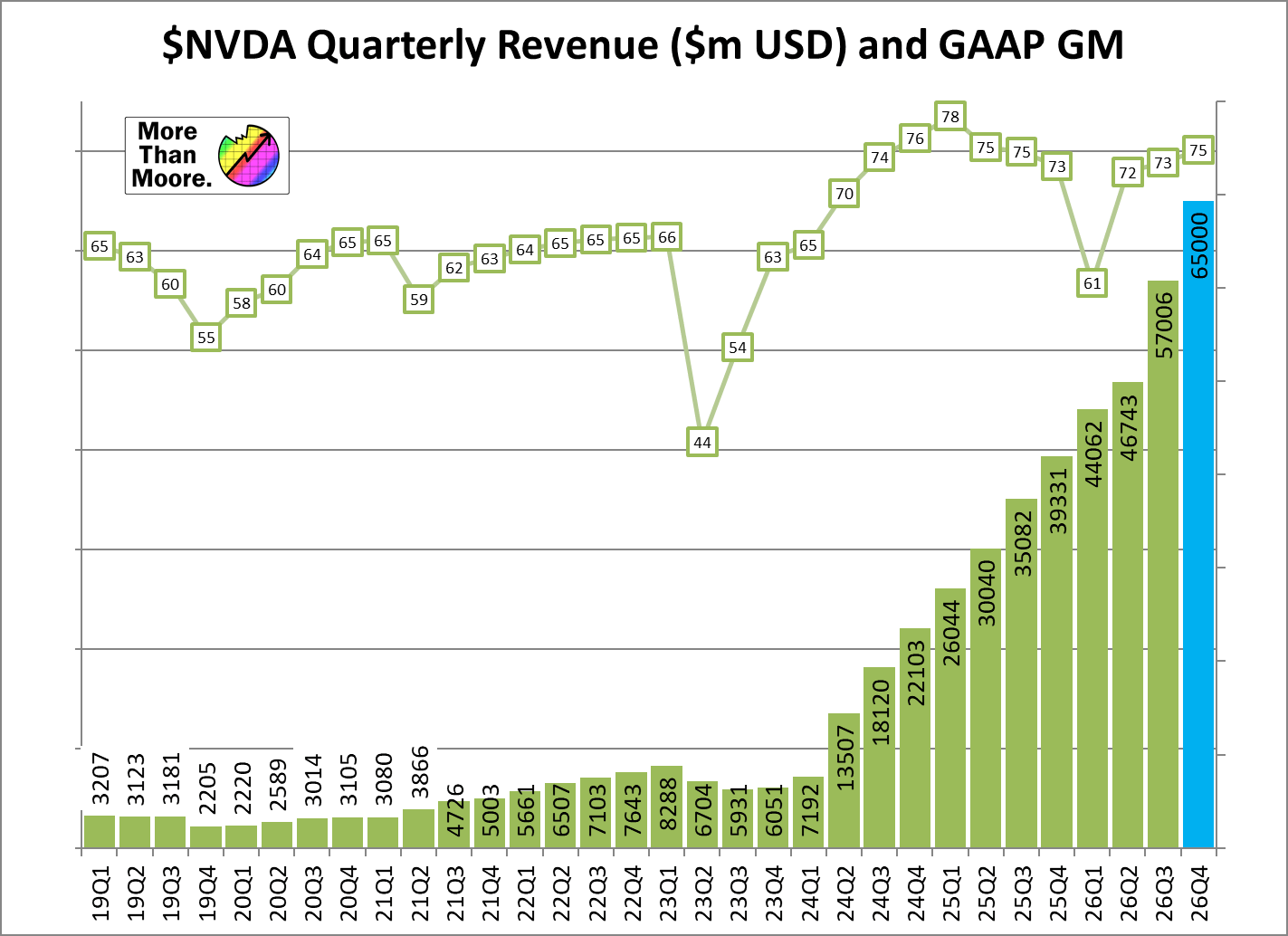
Tesla has a Trailing 12 Month PE ratio of 387(!) and a forward PE of 216. These ratios are almost unprecedented for a company not in the middle of a restructuring, and indicate simply enormous growth expectations. This is not some weird temporary data spike... Tesla has maintained a PE over 150 for years and years. Just to give it context, let's compare it to Nvidia which is perhaps the world's most famous growth company right now. Nvidia's revenues have really gone vertical over the last quarters:
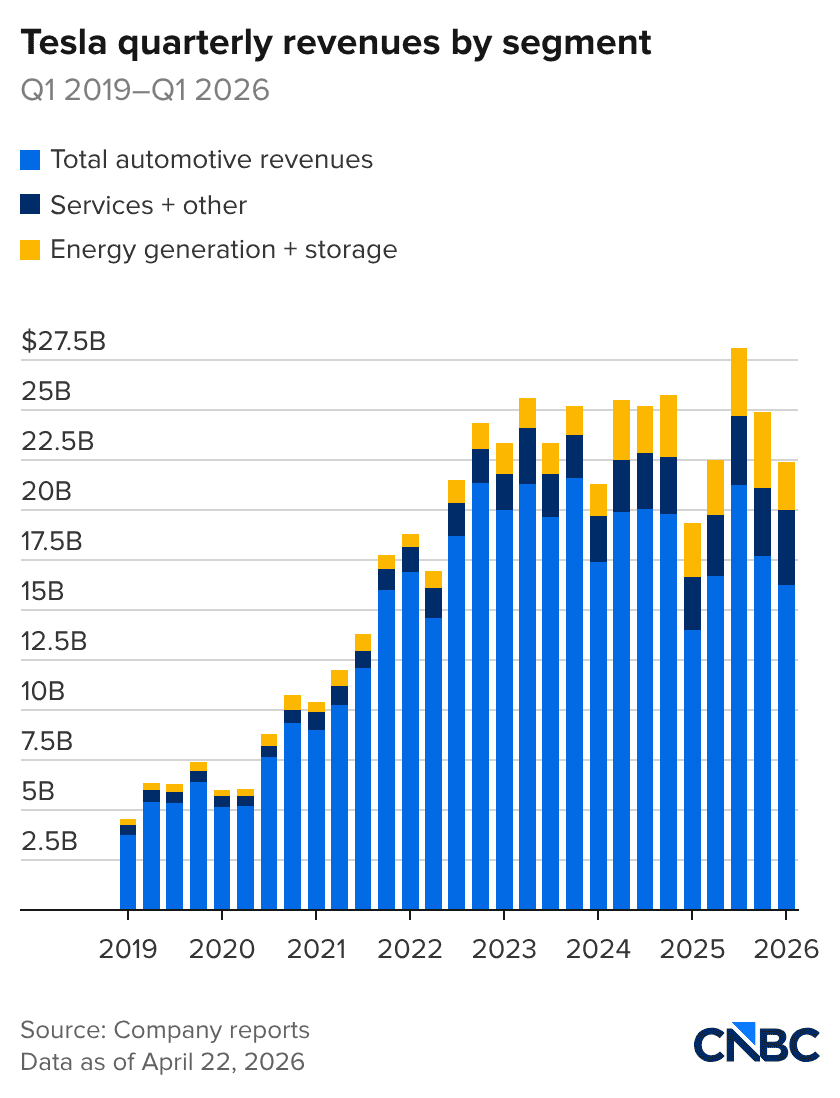
For that it has been rewarded with a PE of 34 / 25 (Trailing / Forward). So Tesla must REALLY be growing to justify a PE of nearly 400, right? Well, not really. In fact, Tesla's revenue has been essentially flat for 14 quarters:
So how does Tesla maintain such a crazy-high valuation? Honestly, I don't know. But from watching it and Musk for years I would argue that the most important factor has been Musk's ability to keep shifting the endgame. The response to valuation concerns is always "yeah, but you are only looking at the current business, [fill in the blank] which is coming soon[-ish] will be worth a trillion dollars." The fill-in-the-blank over the years has included solar roofs, full self-driving, semi-trailers, battery swap, robo-taxis, neural implants, humanoid robots, and AI.
Tesla Translated to SpaceX: The proposed SpaceX valuation of $1.75 trillion is, if anything, even crazier than Tesla's. It is impossible to apply a PE, since SpaceX loses money and can be expected to do so for years, even decades. But with about $18.7 billion in revenue last year, the SpaceX valuation is nearly 100x revenue (Tesla trades at a lofty 15x revenue). Nobody, ever, has made money investing in a 20-year-old company with low margins at 100x revenue (barring the occasional sucker who will later pay 120x).
The tell for me is the emphasis and investment in AI at SpaceX. Strategically, this is a terrible idea as their core business is already very capital intensive and they really don't need a diversion into something else. They are competing in AI with a number of companies that are far ahead of them and I don't see an obvious way to catch up (very similar to Tesla and self-driving). Musk says they are ahead but Musk said Tesla was ahead on self-driving and robotaxis until it has become obvious that they are not even close. There is a potential AI-related launch and hardware opportunity, maybe, someday, to put AI processing in space, but there is no reason that should be dependent on SpaceX's independent investments in AI. The one thing AI gives SpaceX, of course, is a squirrel to help fill in the value hole between "losing money on $18 billion of revenue" and $1.75 trillion. Investors in SpaceX can expect a constant stream of squirrels over the coming years.
2. Propping Up Older Musk Investments with Newer Ones
Over the years of following Musk, the one action of his that aggravated me more than anything else was the transparent bailout of his friends' and family's investment in SolarCity using Tesla stock. Like most other rooftop solar businesses, in 2016 SolarCity was close to bankruptcy. Rather than allowing that to happen, losing money and prestige for Musk, Musk used his extraordinary control of the Tesla board to have Tesla buy out SolarCity for far more than any sensible market value. In doing so, Musk trumpeted another classic Tesla squirrel, presenting the Solar Roof, basically modular rooftop solar tiles that looked like wood or slate that would snap together into an attractive rooftop installation. It was later found that most of the early demo was likely fake, as the tiles were not even close to release-ready and while Musk was predicting 12,000 installations per year and growing, perhaps only 3000 in total were ever completed over 10 years. The Solar City results continued to fall at Tesla and were rapidly buried in the energy sector, making it almost impossible to figure out how much value Tesla got from SolarCity, given that the vast majority of energy sector revenues are unrelated to rooftop solar and are instead large battery storage projects.
Since that time Musk has used his AI lab xAI to buy Twitter/X. And then just this year had SpaceX buy xAI for $250 billion. Does it make sense that an orbital launch company own a social media platform? Absolutely not, but it bailed Musk out of an investment in X that was going to be very hard to ever recover any other way.
Tesla Translated to SpaceX:
Last year Tesla booked $890 million in revenue from SpaceX (cars, battery storage, some AI). This is less than 1% of Tesla's revenues though I expect it to be, since it was not arms length, more profitable than average. But the real threat to SpaceX will be, as Tesla's stock valuation eventually starts to return to Earth, that Musk will use his unique control of both companies to have SpaceX buy Tesla. People are already discussing it. These are two companies that absolutely have no reason to be under one roof EXCEPT that it would help maintain Musk's net worth. Yes, I am sure he will generate a logic that the Musk fan-boys will love -- AI consolidation or some such. And I guess it would be accretive, in an ugly way, with a 100x revenue company buying out a 15x. Just remember that these two companies, which if the IPO price holds for SpaceX, have a combined market cap of $3 trillion and a combined 2025 net income of -$1 billion. Even if your excel spreadsheet has enough columns to add years marching towards the heat death of the universe, I am not sure that investment ever pays off.
Parting Thoughts
None of this necessarily means that the SpaceX IPO will fail or that SpaceX stock won't rise post-IPO. I spent too many years getting burned off and on shorting Tesla to ignore the fact that any Musk enterprise commands a premium among a subset of investors -- he is like Warren Buffet in that his name association with a deal has overwhelming value (the only difference from Buffet being that Buffet's investments actually produce profits). Be aware if you invest that you are likely soon to own Tesla as well, because I do not think Musk can resist the temptation to use high-multiple SpaceX stock as wampum to buy out his other investments.
There is a sort of clock in Musk investments, going back to SolarCity. There is a lot of arm-waving and squirrels to maintain a valuation, but as business performance inevitably does not live up to the valuation hype, its time to have the next investment that is at the peak of its hype with a huge multiple buy out the old one. I really thought Tesla might finally hit that point when the valuation collapses to that of a low-growth car company once the robotaxi initiative proved a loser, but here comes SpaceX just in time.
I do not give out investment advice but if I were short Tesla right now I would run for my life. The SpaceX IPO will essentially be a big Tesla bailout.