Universal Health Care Leads to Speech Limitations

As I wrote in a previous post, state-run health care tends to act as a Trojan Horse for increased government micro-management of our lives by giving the government a financial interest in our health and risk-related decision-making.  A reader sends along this article demonstrating this effect yet again:

An attempt to revive famous TV adverts
from the 1950s that encouraged people to "Go To Work On An Egg"
have been blocked by regulators on health grounds.

The British Egg Information Service (BEIS) had wanted to
bring back the adverts featuring comedian Tony Hancock to mark
the 50th anniversary of the British Lion mark.

But the Broadcasting Advertising Clearance Centre (BACC)
said the famous commercials could not be repeated because
eating eggs every day went against the policy of encouraging
people to eat a varied diet.

"The concept of eating eggs every day for breakfast goes
against what is now the generally accepted advice of a varied
diet and we therefore could not approve the ads for broadcast,"
a BACC spokesman told the BBC.

PS-  Readers who send me stuff - let me know if I can use your name when you email me the post.  When I sit down to blog in short bursts, I am happy to give specific credit but I am always unsure whether to use your real names or not.

The "Crisis" Looks a Lot Like State-Run Medicine

The USAToday published a front-page story today arguing that a health care "crisis" looks a lot like Houston, Texas.  I would argue, from their descriptions, that a health care "crisis" looks exactly like state-run medicine.

Ijeoma Onye awoke one day last month short of
breath, her head pounding. Her daughter, Ebere Hawkins, drove her 45
minutes from Katy, Texas, to Ben Taub General Hospital, where people
without health insurance pay little or nothing for treatment.

Onye, 62, waited four hours to be seen. Still,
going to the emergency room was faster than getting an appointment. For
that, "you have to wait months," Hawkins says....

The huge number of uninsured residents here means that health officials
must make tough decisions every day about who gets treated and when.
"Does this mean rationing? You bet it does," says Kenneth Mattox, chief
of staff at Ben Taub, the Houston area's pre-eminent trauma care
facility.

The article goes on and on like this.  The problem is delays and queuing in facilities that provide free care.   And the difference between this and state-run health care is what exactly?  When a product or service is free, people will tend to over-consume the supply, with rationing taking place via queuing rather than price.  This is how every state-run supply system works, from food in the Soviet Union to health care in Canada.  And by the way, exactly how upset should I be about people receiving an extraordinarily valuable and costly service for free but having to wait a while to get it?

This article is actually a great rebuttal of the inherent message in
the health care debate that "uninsured" means "denied health care."  In
fact, it is clear that even in the spot USAToday picked out as the worst in
the country, the uninsured are in fact getting health care.  It is tedious with long waits, but there are no examples in the long article of people going without.  Yes some people consume less than they might if it was free and convenient, but that is just the rationing at work.  Anyone who says that rationing goes away in a state-run system is bald-faced lying to you.

Remember that national health care does not eliminate queuing and waits for the poor -- it just institutionalizes these waits for the rest of us.   Universal Health Care is equivalent to a Great Society housing program where everyone, rich and poor, have to give up their house and move into a crappy public apartment block.

Postscript: By the way, I am sympathetic to certain hospital administrators who have a "crisis" on their hands because the mass of uninsured show up in their emergency rooms.  That, however, is a problem manageable far short of government-run health care.  They want to blame diversions of critical patients away from over-crowded emergency rooms on the "uninsured" but it is really a function of their own faulty triage.

Update: Michael Moore will soon argue that its better in Cuba.  Hah! That is funny.  If people really want to believe this, then it is another reason is is way past time to open up our relations to Cuba, so people can see for themselves what a lying sack of poop this filmmaker is.

A Gutless Tax

I understand the environmental logic to tax petroleum -- I don't particularly agree with it, but some sort of carbon-based tax is probably the least-bad way to achieve various environmental goals (I will leave for other posts whether these goals make any sense).

However, the Senate's proposal to tax oil companies directly, rather than the oil or petroleum products themselves, is a gutless chickenshit maneuver that is just so typical of politicians.  A tax on oil companies is less efficient than a direct carbon tax on the fuel (because it is operating less directly on price signals), but it makes sense to our political masters for several reasons:

  • Populist Congressman can argue to their constituencies that "we didn't tax you consumers, we taxed those evil bloated oil companies."  Of course, in the end, the money comes from consumers anyway.  That's just basic economics.
  • Oil companies, not politicians, get blamed for collecting the tax from consumers.  This is an tried-and-true approach, that has worked well with gasoline taxes embedded in pump prices.
  • When oil prices inevitably rise due to the tax, the Congress will use this oil price rise as a rallying cry to...increase taxes more.  It is the classic government win-win of proposing increased regulations to solve problems caused by government regulations.

This part is even worse:

Another measure, pushed by Sen. Jeff Bingaman, D-N.M., was aimed at
collected $10.7 billion in royalties the government has been unable to
collect because of flawed oil leasing contracts issued by the Interior
Department in 1998-99. The government would collect an excise tax on
any oil taken from the Gulf of Mexico, subject to royalties not being
paid.

Here is what happened:  The government wrote offshore lease/royalty contracts in a certain way.  Oil companies read the contract language, and entered into the contract as written, and subsequently invested billions of dollars to develop the leases.  More recently, as oil prices rose, the government thinks it made a bad deal, and should have written the contracts differently.  The solution for private companies who make a bad deal: live with it.  The solution for the government, though, it apparently to use the coercive power of the government to extract the royalties you failed to put in the contract 18 years ago via special excise taxes.

And don't even get me started on this farm subsidy program masquerading as energy policy:

The bill would funnel about $11 billion over 10 years into the
development of renewable fuels such as ethanol, biodiesel and power
from wind turbines in a combination of extensions of existing tax
breaks and new tax benefits. An additional $18 billion in tax breaks "”
from tax credits to clean and renewable energy bonds "” also were
approved.

We are making a mistake of epic proportions pouring money and regulatory breaks into ethanol.  Ethanol, in the form we ar investing in it in this country, does NOTHING to reduce our oil use or improve the environment or reduce CO2 emissions.  Nada.  All it does is increase taxes, increase fuel prices, increase food prices, and, soon, cause environmental problems as marginal lands are brought into corn production.  I made a plea to stop this before it is too late, ie before the industry becomes so entrenched it will be politically impossible to cut it off.  I fear we are rapidly approaching this point of no return.

Because the Government is Always Cutting Edge

From a USA Today story on All-Star Ballot counting:

The technology used is so advanced that not even the government has caught up.

Maybe the govenrment might be assumed to lead the private sector in missile defense systems and such.  But in ballot counting?

Does this Make Sense?

I am just finishing up my paper "A Skeptical Layman's Guide to Anthropogenic Global Warming," and one thing I encounter a lot with sources and websites that are strong supporters of Anthropogenic Global Warming (AGW) theory is that they will often say such-and-such argument by skeptics was just disproved by so-and-so. 

For example, skeptics often argue that historical temperature records do not correct enough for the effects of urbanization on long-term measurement points.  The IPCC, in fact, has taken the position that what is called the urban heat island effect is trivial, and does not account for much or any of measured warming over the last 100 years.  To this end, one of the pro-AGW sites (either RealClimate.org or the New Scientist, I can't remember which) said that "Parker in 2006 has disproved the urban heat island effect."

Now, if you were going to set out to do such a thing, how would you do it?  The logical way, to me, would be to draw a line from the center of the city to the rural areas surrounding it, and take a bunch of identical thermometers and have people record temperatures every couple of miles along this line.  Then you could draw a graph of temperature vs. nearness to the city center, and see what you would find.

Is that what Parker did?  Uh, no.  I turn it over to Steve McIntyre, one of the two men who helped highlight all the problems with the Mann hockey stick several years ago.

If you are not a climate scientist (or a realclimate reader), you
would almost certainly believe, from your own experience, that cities
are warmer than the surrounding countryside - the "urban heat island".
From that, it's easy to conclude that as cities become bigger and as
towns become cities and villages become towns, that there is a
widespread impact on urban records from changes in landscape, which
have to be considered before you can back out what portion is due to
increased GHG.

One of the main IPCC creeds is that the urban heat island effect has
a negligible impact on large-scale averages such as CRU or GISS. The
obvious way of proving this would seem to be taking measurements on an
urban transect and showing that there is no urban heat island. Of
course, Jones and his associates can't do that because such transects
always show a substantial urban heat island. So they have to resort to
indirect methods to provide evidence of "things unseen", such as Jones
et al 1990, which we've discussed in the past.

The newest entry in the theological literature is Parker (2004, 2006),
who, once again, does not show the absence of an urban heat island by
direct measurements, but purports to show the absence of an effect on
large-scale averages by showing that the temperature trends on calm
days is comparable to that on windy days. My first reaction to this,
and I'm sure that others had the same reaction was: well, so what? Why
would anyone interpret that as evidence one way or the other on UHI?

He goes on to take the study apart in detail, but I think most of you can see that the methodology makes absolutely zero sense unless one is desperately trying to toe the party line and win points with AGW supporters by finding some fig leaf to cover up this urban heat island problem.  By the way, plenty of people have performed the analysis the logical way we discussed first, and have shown huge heat island effects:

Uhi(Click for a larger view)

The bottom axis by the way is a "sky-view" metric I had not seen before, but is a measurement of urban topology.  Effectively the more urbanized and the more tall buildings around you that create a canyon effect, the lower the sky view fraction.  Note that no one gets a number for the Urban Heat Island effect less than 1 degree C, and many hover around 6 degrees (delta temperature from urban location to surrounding rural countryside).  Just a bit higher than the 0.2C assumed by the IPCC.  Why would they assume such a low number in the face of strong evidence?  Because assuming a higher number would reduce historical warming numbers, silly.

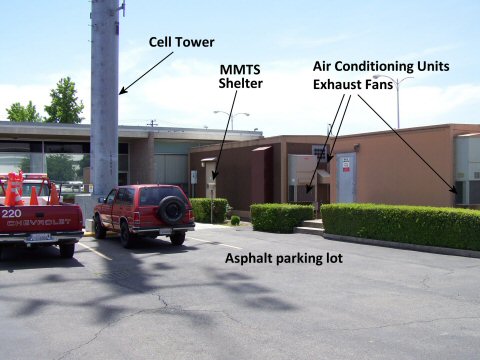
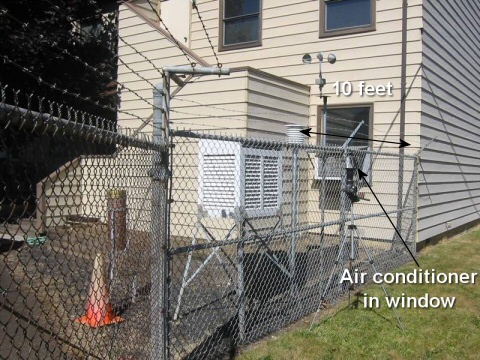
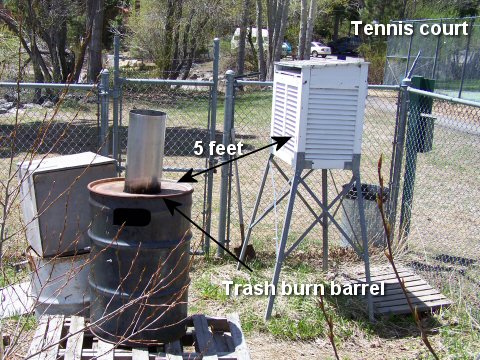
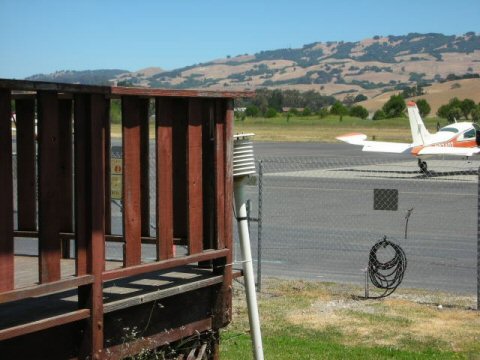
Oh, and the IPCC argues that the measurement points it uses around the world are all rural locations so urban heat island corrections are irrelevant.  Below are some sample photos of USHCN sites, which are these supposedly rural sites that are used in the official historical warming numbers.  By the way, these US sites are probably better than what you would find anywhere else in the world. (All pictures from surfacesations.org)  As always, you can click for a larger view.

Marysville_issues1 

Forestgrove

Tahoe_city3

Petaluma_east

You can help with the effort of documenting all the US Historical Climate Network (USHCN) stations.  See my post here -- I have already done two and its fun!

Universal Health Care Trojan Horse

For quite a while, I have been arguing that universal health care is a Trojan horse for freedom-robbing government interventions into our personal habits (and micro-habits).  Suddenly activities that used to be personal choices that affected only ourselves (e.g. unhealthy diet) become public interest questions affecting government-funded health care costs.

Jonah Goldberg, via Ronald Bailey, seems to agree:

The British government recently unveiled
plans for a massive crackdown on "excessive drinking," particularly
among the middle class. It will include all of the familiar tactics of
public health officials: dire new warnings on wine bottles,
public-awareness campaigns, scolding from men and women in lab coats...

Britain
still subscribes to a system where health care is for the most part
socialized. When the bureaucrat-priesthood of the National Health
Service decides that a certain behavior is unacceptable, the
consequences potentially involve more than scolding. For example, in
2005, Britain's health service started refusing certain surgeries for
fat people. An official behind the decision conceded that one of the
considerations was cost. Fat people would benefit from the surgery
less, and so they deserved it less. As Tony Harrison, a British
health-care expert, explained to the Toronto Sun at the time, "Rationing is a reality when funding is limited."

But
it's impossible to distinguish such cost-cutting judgments from moral
ones. The reasoning is obvious: Fat people, smokers and "” soon "”
drinkers deserve less health care because they bring their problems on
themselves. In short, they deserve it. This is a perfectly logical
perspective, and if I were in charge of everybody's health care, I
would probably resort to similar logic.

But I'm not in charge
of everybody's health care. Nor should anyone else be. In a free-market
system, bad behavior will still have high costs personally and
financially, but those costs are more likely to borne by you and you
alone. The more you socialize the costs of personal liberty, the more
license you give others to regulate it.

Universal health care,
once again all the rage in the United States, is an invitation for
scolds to become nannies. I think many Brits understand this all too
well, which is one reason why they want to fight the scolds here and
now.

I like his term "socializing the costs of personal liberty."  Its a good description of much of what is wrong with government today.

I Must Have Everyone's Verbal Response

This policy at Antioch College, which apparently will soon close its doors due to low enrollment, sounds like the speech I get when I sit in an exit row:

  • Consent is required each and every time there is sexual activity.
  • All parties must have a clear and accurate understanding of the sexual activity.
  • The person(s) who initiate(s) the sexual activity is responsible for asking for consent.
  • The person(s) who are asked are responsible for verbally responding.
  • Each new level of sexual activity requires consent.
  • Use
    of agreed upon forms of communication such as gestures or safe words is
    acceptable, but must be discussed and verbally agreed to by all parties
    before sexual activity occurs.
  • Consent is required
    regardless of the parties' relationship, prior sexual history, or
    current activity (e.g. grinding on the dance floor is not consent for
    further sexual activity).
  • At any and all times when consent is withdrawn or not verbally agreed to, the sexual activity must stop immediately.
  • Silence is not consent.
  • Body movements and non-verbal responses such as moans are not consent.
  • A person can not give consent while sleeping.
  • All
    parties must have unimpaired judgement (examples that may cause
    impairment include but are not limited to alcohol, drugs, mental health
    conditions, physical health conditions).
  • All parties must use safer sex practices.
  • All
    parties must disclose personal risk factors and any known STIs.
    Individuals are responsible for maintaining awareness of their sexual
    health.

I don't know much about Antioch, despite the fact that I think my mother and father-in-law both attended (are there more than one?).  I will observe that for a private institution nowadays with decent name recognition, it really takes some effort to drive away all the students.  Today, good-but-not-Ivy-League schools like Rice and Vanderbilt get nearly as many great applicants as Ivy League schools did when I attended.  The US is virtually swamped with top-notch kids looking for a private university with a good rep.

Relatives in for a Visit

Unfortunately, it was long distance and dark, so conditions were not very good for photography.  Still waiting for that perfect photo-op, but it's surprisingly hard when most family visits we get are at sunset and sunrise.

Coyote1

Update:  By the way, for any of you dog photographers out there - is there a good way to get rid of the bright eye / green eye in dog (or coyote!) photos that is the equivalent of human red eye?

The Health Care Difference

While it may have been unintentional, a quote in New York magazine helps make the point I have been trying to make about universal health care (HT: John Scalzi)

"With universal [health care], you'd get the same kind of
mediocre shittiness that you'd get in all other kinds of standardized
approaches. But for millions of people, that would be a big upgrade."

Americans are unbelievably charitable people, to the extent that they will put up with a lot of taxation and even losses of freedoms through government coercion to help people out.

However, in nearly every other case of government-coerced charity, the main effect is "just" an increase in taxes.  Lyndon Johnson wants to embark on a futile attempt to try to provide public housing to the poor?  Our taxes go up, a lot of really bad housing is built, but at least my housing did not get any worse.  Ditto food programs -- the poor might get some moldy cheese from a warehouse, but my food did not get worse.  Ditto welfare.  Ditto social security, unemployment insurance,and work programs. 

But health care is different.  The author above is probably correct that some crappy level of terribly run state health care will probably be an improvement for some of the poor.  But what is different about many of the health care proposals on the table is that everyone, not just the poor will get this same crappy level of treatment.  It would be like a public housing program where everyone's house is torn down and every single person must move into public housing.  That is universal state-run health care.  Ten percent of America gets pulled up, 90% of America gets pulled down, possibly way down. 

I don't think most Americans really know what they are signing up for.  Which is why it is so important for health care socialists to have people like Michael Moore running around trying to convince the middle class they will be getting better health care.  Because there is almost no possibility of this being true, and health care proposals will never pass if people realize it.

More here.

Wither Supply and Demand, In Favor of the Oil Trading Cabal?

I had an odd and slightly depressing conversation with a friend the other night.  He is quite intelligent and well-educated, and in business is probably substantially more successful, at least financially, than I.

Somehow we got in a discussion of oil markets, and he seemed to find my position suggesting that oil prices are generally set by supply and demand laughable, so much so he eventually gave up with me as one might give up and change the subject on someone who insists the Apollo moon landings were faked. I found the conversation odd, like having a discussion with a fellow
chemistry PHD and suddenly having them start defending the phlogiston
theory of combustion. His core position, as best I could follow, was this:

  1. Limitations on supply in the US, specifically limitations on new oil field development and refinery construction, are engineered by oil companies attempting to keep prices high.
  2. Oil prices are set at the whim of oil traders in London and New York, who are controlled by US oil companies.  The natural price of oil today should be $30 or $40, but oil traders keep it up at $60.  While players upstream and downstream may have limited market shares, these traders act as a choke point that controls the whole market.  All commodity markets are manipulated, or at least manipulatable, in this manner
  3. Oil supply and demand is nearly perfectly inelastic. 
  4. If there really was a supply and demand reason for oil prices to shoot up to $60, then why aren't we seeing any shortages?
  5. Oil prices only rise when Texas Republicans are in office.  They will fall back to $30 as soon as there is a Democratic president.  On the day oil executives were called to testify in front of the Democratic Congress recently, oil prices fell from $60 to $45 on that day, and then went right back up.

Ignoring the Laws of Economics (Price caps and floors)

While everyone (mostly) knows that we are suspending disbelief when the James Bond villain seems to be violating the laws of physics, there is a large cadre of folks that do believe that our economic overlords can suspend the laws of supply and demand.   As it turns out, these laws cannot be suspended, but they can certainly be ignored.  Individuals who ignore supply and demand in their investment and economic decision making are generally called "bankrupt," at least eventually, so we don't always hear their stories (the Hunt brothers attempt to corner the silver market is probably the best example I can think of).  However, the US government has provided us with countless examples of actions that ignore economic reality.

The most typical example is in placing price caps.  The most visible example was probably the 1970's era caps on oil, gasoline, and natural gas prices and later "windfall profit" taxes.  The result was gasoline lines and outright shortages.  With prices suppressed below the market clearing price, demand was higher and supply was lower than they would be in balance. 

The my friend raised is different, one where price floors are imposed by industry participants or the government or more likely both working in concert.   The crux of my argument was not that government would shy away from protecting an industry by limiting supply, because they do this all the time. The real problem with the example at hand is that, by the laws of supply and demand, a price floor above the market clearing price should yield a supply glut.  As it turns out, supply guts associated with cartel actions to keep prices high tend to require significant, very visible, and often expensive actions to mitigate.  Consider two examples:

Realtors and their trade group have worked for years to maintain a tight cartel, demanding a 6% or higher agency fee that appears to be increasingly above the market clearing price.  The result of maintaining this price floor has been a huge glut of real estate agents.  The US is swimming in agents.  In an attempt to manage this supply down, realtors have convinced most state governments to institute onerous licensing requirements, with arcane tests written and administered by... the realtor's trade group.  The tests are hard not because realtors really need to know this stuff, but because they are trying to keep the supply down.   And still the supply is in glut.  Outsiders who try to discount or sell their own home without a realtor (ie, bring even more cheap capacity into the system) are punished ruthlessly with blackballs.  I have moved many times and have had realtors show me over 300 houses -- and you know how many For Sale By Owner homes I have been shown?  Zero.  A HUGE amount of effort is expended by the real estate industry to try to keep supply in check, a supply glut caused by holding rates artificially high. 

A second example of price floors is in agriculture.  The US Government, for whatever political reasons, maintains price floors in a number of crops.  The result, of course, has been a supply glut in these commodities.  Sopping up this supply glut costs the US taxpayer billions.  In some cases the government pays to keep fields fallow, in others the government buys up extra commodities and either stores them (cheese) or gives them away overseas.  In cases like sugar, the government puts up huge tarriff barriers to imports, otherwise the market would be glutted with overseas suppliers attracted by the artificially high prices.  In fact, most of the current subsidy programs for ethanol, which makes almost zero environmental or energy policy sense, can be thought of as another government program to sop up excess farm commodity supply so the price floor can be maintained.

I guess my point from these examples is not that producers haven't tried to impose price floors above the market clearing price, because they have.  And it is not even that these floors are not sustainable, because they can be if the government steps in to help with their coercive power and our tax money to back them.  My point is, though, that the laws of supply and demand are not suspended in these cases.  Price floors above the market clearing price lead to supply gluts, which require very extensive, highly visible, and often expensive efforts to manage.  As we turn now to oil markets, we'll try to see if there is evidence of such actions taking place.

The reasons behind US oil production and refining capacity constraints

As to his first point, that oil companies are conspiring with the government to artificially limit oil production and refining capacity, this certainly would not be unprecedented in industry, as discussed above.  However, any historical study of these issues in the oil industry would make it really hard to reach this conclusion here.  There is a pretty clear documented record of oil companies pushing to explore more areas (ANWR, offshore) that are kept off-limits due to environmental pressures.  While we have trouble imagining the last 30 years without Alaskan oil, the US oil companies had to beg Congress to let them build the pipeline, and the issue was touch and go for a number of years.  The same story holds in refining, where environmental pressure and NIMBY concerns have prevented any new refinery construction since the 1970's (though after years and years, we may be close in Arizona).  I know people are willing to credit oil companies with just about unlimited levels of Machiavellianism, but it would truly be a PR coup of unprecedented proportions to have maintained such a strong public stance to allow more capacity in the US while at the same time working in the back room for just the opposite.

The real reason this assertion is not credible is that capacity limitations in the US have very clearly worked against the interests of US oil companies.  In production, US companies produce on much better terms from domestic fields than they do when negotiating with totalitarian regimes overseas, and they don't have to deal with instability issues (e.g. kidnapping in Nigeria) and expropriation concerns.  In refining, US companies have seen their market shares in refined products fall since the 1970s.  This is because when we stopped allowing refinery construction in this country, producing countries like Saudi Arabia went on a building boom.  Today, instead of importing our gasoline as crude to be refined in US refineries, we import gas directly from foreign refineries.  If the government is secretly helping oil companies maintain a refining capacity shortage in this country, someone forgot to tell them they need to raise import duties to keep foreign suppliers from taking their place. 

What Oil Traders can and cannot do

As to the power of traders, I certainly believe that if the traders could move oil prices for sustained periods as much as 50% above or below the market clearing price, they would do so if it profited them.  I also think that speculative actions, and even speculative bubbles, can push commodity prices to short-term extremes that are difficult to explain by market fundamentals.  Futures contracts and options, with their built in leverage, allow even smaller players to take market-moving positions.  The question on the table, though, is whether oil traders can maintain oil prices 50% over the market clearing prices for years at a time.  I think not.

What is often forgotten is that companies like Exxon and Shell control something like 4-5% each of world production (and that number is over-stated, since much of their production is as operator for state-owned oil companies who have the real control over production rates).  As a point of comparison, this is roughly the same market Toshiba has in the US computer market and well below Acer's.  As a result, there is not one player, or even several working in tandem, who hold any real power in crude markets.  Unless one posits, as my friend does, that NY and London traders somehow sit astride a choke point in the world markets.

But here is the real problem with saying that these traders have kept oil prices 50% above the market clearing price for the last 2-3 years:  What do they do with the supply glut?  We know from economics, as well as the historic examples reviewed above, that price floors above the clearing price should result in a supply glut.  Where is all the oil?

Return to the example of when the Hunt's tried to corner the silver market.  Over six months, they managed to drive the price from the single digits to almost $50 an ounce.  Leverage in futures markets allowed them to control a huge chunk of the available world supply.  But to profit from it (beyond a paper profit) the Hunts either had to take delivery (which they were financially unable to do, as they were already operating form leveraged positions) or find a buyer who accepted $50 as the new "right" price for silver, which they could not.  No one wanted to buy at $50, particularly from the Hunts, since they knew the moment the Hunt's started selling, the price would crash.  As new supplies poured onto the market at the higher prices, the only way the Hunt's could keep the price up was to pour hundreds of millions of dollars in to buy up this excess supply.  Eventually, of course, they went bankrupt.  But remember the takeaway:  They only could maintain the artificially higher commodity price as long as they kept buying excess capacity, a leveraged Ponzi game that eventually collapsed.

So how do oil traders' supposedly pull off this feat of keeping oil prices elevated about the market clearing price?  Well, there is only one way:  It has to be stored, either in tanks or in the ground.  The option of storing the extra supplies in tanks is absurd, especially over a period of years - after all, at its peak, $60 of silver would sit on the tip of my finger, but $60 of oil won't fit in the trunk of my car.  The world oil storage capacity is orders of magnitude too low.  So the only real option is to store it in the ground, ie don't allow it to get produced. 

How do traders pull this off?  I have no idea.  Despite people's image, the oil producer's market is incredibly fragmented.  The biggest companies in the world have less than 5%, and it rapidly steps down from there. It is actually even more fragmented than that, because most oil production is co-owned by royalty holders who get a percentage of the production.  These royalty holders are a very fragmented and independent group, and will complain at the first sign of their operator not producing fast and hard enough when prices are high.  To keep the extra oil off the market, you would have to send signals to a LOT of people.  And it has to be a strong and clear signal, because price is already sending the opposite signal.  The main purpose of price is in its communication value -- a $60 price tells producers a lot about what and how much oil should be produced (and by the way tells consumers how careful to be with its use).  To override this signal, with thousands of producers, to achieve exactly the opposite effect being signaled with price, without a single person breaking the pack, is impossible.  Remember our examples and the economics - a sustained effort to keep prices substantially above market clearing prices has to result in visible and extensive efforts to manage excess supply.

Also, the other point that is often forgotten is that private exchanges can only survive when both Sellers AND buyers perceive them to be fair.  Buyers are quickly going to find alternatives to exchanges that are perceived to allow sellers to manipulate oil prices 50% above the market price for years at a time.  Remember, we think of oil sellers as Machiavellian, but oil buyers are big boys too, and are not unsophisticated dupes.  In fact, it was the private silver exchanges, in response to just such pressure, that changed their exchange rules to stop the Hunt family from continuing to try to corner the market.  They knew they needed to maintain the perception of fairness for both sellers and buyers.

Supply and Demand Elasticity

From here, the discussion started becoming, if possible, less grounded in economic reality.  In response to the supply/demand matching issues I raised, he asserted that oil demand and supply are nearly perfectly inelastic.  Well, if both supply and demand are unaffected by price, then I would certainly accept that oil is a very, very different kind of commodity.  But in fact, neither assertion is true, as shown by example here and here.  In particular, supply is quite elastic.  As I have written before, there is a very wide range of investments one can make even in an old existing field to stimulate production as prices rise.  And many, many operators are doing so, as evidenced by rig counts, sales at oil field services companies, and even by spam investment pitches arriving in my in box.

I found the statement "if oil prices really belong this high, why have we not seen any shortages" to be particularly depressing.  Can anyone who sat in at least one lecture in economics 101 answer this query?  Of course, the answer is, that we have not seen shortages precisely because prices have risen, fulfilling their supply-demand matching utility, and in the process demonstrating that both supply and demand curves for oil do indeed have a slope.  In fact, shortages (e.g. gas lines or gas stations without gas at all) are typically a result of government-induced breakdowns of the pricing mechanism.  In the 1970's, oil price controls combined with silly government interventions (such as gas distribution rules**) resulted in awful shortages and long gas lines.  More recently, fear of "price-gouging" legislation in the Katrina aftermath prevented prices from rising as much as they needed to, leading to shortages and inefficient distribution.

Manipulating Oil Prices for Political Benefit

As to manipulating oil or gas prices timed with political events (say an election or Congressional hearings), well, that is a challenge that comes up all the time.  It is possible nearly always to make this claim because there is nearly always a political event going on, so natural volatility in oil markets can always be tied to some concurrent "event."  In this specific case, the drop from $60 to $35 just for a Congressional hearing is not even coincidence, it is urban legend.  No such drop has occurred since prices hit 60, though prices did drop briefly to 50.  (I am no expert, but in this case the pricing pattern seen is fairly common for a commodity that has seen a runup, and then experiences some see-sawing as prices find their level.)

This does not mean that Congressional hearings did not have a hand in helping to drive oil price futures.  Futures traders are constantly checking a variety of tarot cards, and indications of government regulatory activity or legislation is certainly part of it.  While I guess traders purposely driving down oil prices ahead of the hearing to make oil companies look better is one possible explanation;  a more plausible one (short of coincidence, since Congress has hearings on oil and energy about every other month) is that traders might have been anticipating some regulatory outcome in advance of the hearing, that became more less likely once the hearings actually occurred.  *Shrug*  Readers are welcome to make large short bets in advance of future Congressional energy hearings if they really think the former is what is occurring. 

As to a relationship between oil prices and the occupant of the White House, that is just political hubris.  As we can see, real oil prices rose during Nixon, fell during Ford, rose during Carter, fell precipitously during Reagan, were flat end to end for Bush 1 (though with a rise in the middle) and flat end to end for Clinton.  I can't see a pattern.

If Oil Companies Arbitrarily Set Prices, Why Aren't They Making More Money?

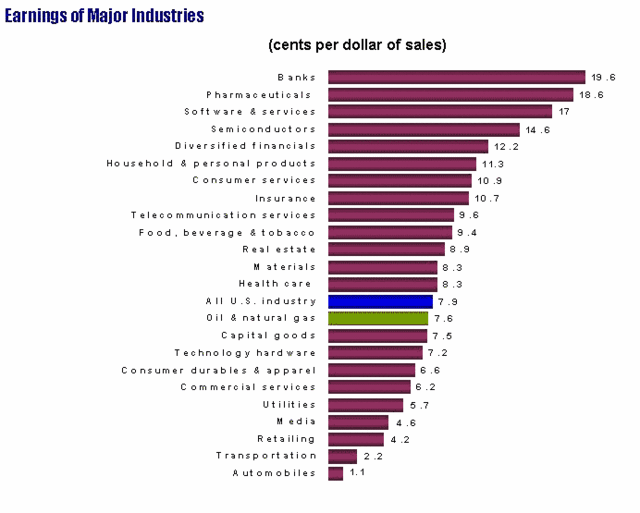
A couple of final thoughts.  First, in these heady days of "windfall" profits, Exxon-Mobil is making a profit margin of about 9% - 10% of sales, which is a pretty average to low industrial profit margin.  So if they really have the power to manipulate oil prices at whim, why aren't they making more money?  In fact, for the two decades from 1983 to 2002, real oil prices languished at levels that put many smaller oil operators out of business and led to years of layoffs and down sizings at oil companies.  Profit margins even for the larges players was 6-8% of sales, below the average for industrial companies.  In fact, here is the profitability, as a percent of sales, for Exxon-Mobil over the last 5 years:

2006:  10.5%

2005:  9.7%

2004:  8.5%

2003:  8.5%

2002:  5.4%

2001:  7.1%

Before 2001, going back to the early 80's, Exxon's profits were a dog.  Over the last five years, the best five years they have had in decades, their return on average assets has been 14.58%, which is probably less than most public utility commissions allow their regulated utilities.  So who had their hand on the pricing throttle through those years, because they sure weren't doing a very good job!  But if you really want to take these profits away (and in the process nuke all the investment incentives in the industry) you could get yourself a 15 to 20 cent decrease in gas prices.  Don't spend it all in one place.

** One of the odder and forgotten pieces of legislation during and after the 1972 oil embargo was the law that divided the country into zones (I don't remember how, by counties perhaps).  It then said that an oil company had to deliver the same proportion of gas to each zone as it did in the prior year  (yes, someone clearly took this right out of directive 10-289).  It seemed that every Representative somehow suspected that oil companies in some other district would mysteriously be hoarding gas to their district's detriment.  Whatever the reason, the law ignored the fact that use patterns were always changing, but were particularly different during this shortage.  Everyone canceled plans for that long-distance drive to Yellowstone.  The rural interstate gas stations saw demand fall way off.  However, the law forced oil companies to send just as much gas to these stations (proportionally) as they had the prior year.  The result was that rural interstates were awash in gas, while cities had run dry.  Thanks again Congress.

More on Price Gouging

Gary Galles at Mises has a good post on why currently proposed "anti-gas-gouging" law is rediculously vague and effectively ex-post-facto law.  I have made this point before as well.

I wanted to comment on something different.  As he begins:

In May, the House of Representatives passed a bill that could lead to
fines as high as $3 million per day for gasoline price gouging, which
it defined as charging a price that "grossly exceeds the average
price"¦offered for sale by that person during the 30 days prior" or
"grossly exceeds the price at which the same or similar gasoline"¦was
readily obtainable in the same area from other competing sellers."

Lets take these two cases in reverse order.  If I am charging a prices that "grossly exceeds the price at which the same or similar gasoline"¦was
readily obtainable in the same area from other competing sellers," then what for God's sakes is the harm?  People will just go to one of the "readily obtainable" other sources.  My business will take a beating, but that's my problem.

The first case is an open invitation for gas lines.  It does not say "grossly exceeds the average
price"¦offered for sale by that person during the 30 days prior unless there is some kind of supply discontinuity or change in wholesale prices."   It sets up a clear if-then:  If you raise your prices by some amount we later rule to be too much, we can fine you $3 million per day.  In the confusion of a supply disruption, gas stations will be afraid to raise their prices despite the new supply-demand reality. They will be afraid of this kind of arbitrary enforcement.  Therefore, the first 100 random people who show up to top off their tanks  or fill their generators to keep their TV running will get the available supply, rather than letting price allocate the gas to the people who value it the most.

I lived through gas lines of the 1970's.  In fact, as the low-driver-on-the-totem-pole, it was my job in the family to cruise around town looking for an open station and then sitting in whatever line I found.  I don't think younger people remember, but in major cities (not in the countryside) in the 1970s, there were weeks when there simply was no gas to be found.  Since that experience, I have pleaded to allow gas gouging in supply emergencies.

What Drives Government Regulation

Since the mid-1970s, various people have decried the growing amount of money spent on elections.  They have tried numerous approaches to limiting campaign funding, all to no avail.  In part, their lack of success has been due to off-and-on efforts of the courts to protect political speech.  However, a large reason for their failure has been that they are addressing a symptom, rather than the cause of the problem.

The real cause is the growing regulatory state.  Without regulation, there would be only limited incentive for corporations and individuals to make large political contributions.   Regulation (combined with taxation) is the fountain from which most campaign money springs.  Threaten to regulate a sector, and you automatically put politicians in the position of creating winners and losers, both of whom will spend money to try to improve their fates.

Holman Jenkins makes this point in today's WSJ($):

Being a shrewd bunch, the private equity industry
presumably has gotten the message: When vast new fountains of wealth
open up in the economy, Congress must receive its ransom in campaign
donations. Delivering the wagged finger were none other than Max Baucus
and Charles Grassley, chairman and ranking member of the Senate Finance
Committee, who've taken to musing aloud about how the tax code's
treatment of private equity's lately fabulous profits might be revised.

The bipartisan nature of the initiative should
reassure readers that there's no philosophical issue here. It's purely
bidness. You, private equity, have been remiss in your patriotic duty.
Cough up.

Anyone who recalls the junk bond wars of the 1980s
will notice a pattern. Then too, Congress was awash in proposals for
taxing the takeover industry: by eliminating the interest deduction for
junk bond interest, by imposing an excise tax on assets acquired in a
hostile takeover, etc. These ideas came to naught, not least because of
the fright the proposals put into the stock market. But the endless
debate unlimbered a delicious flow of campaign dollars from all
concerned.

It appears that everything will turn out OK for the politicians:

But the message has been received. Private equity has now set up a
Washington trade group and has opened its pockets to politicians, with
Barack Obama being a special heartthrob. Oh, happy day for members of
the House and Senate tax committees, who lived for years off the junk
bond wars and now will live for years off the private equity plutocrats.

I remember stock brokers used to say that they had the best job in the market, because whether the market went up or down, they still got their money.  The same is true of politicians -- whether the regulations help or hurt, whether they end up benefiting the incumbents or the new entrants -- the politicians will still get their money.

China Continues to Subsidize Lower Prices for Consumers

From today's WSJ ($) online:

Turning aside growing congressional anger over low everyday prices, President George W. Bush's
administration today will reject demands that it formally accuse
Beijing of subsidizing lower prices for U.S. consumers.

With U.S. lawmakers gearing up to punish China for using Chinese funds to subsidize low U.S. consumer prices, Treasury
Secretary Henry Paulson is expected to use a semiannual currency
report, to be released today, to reinforce his calls for Beijing to
allow prices in the U.S. to rise faster....

OK, I confess I fibbed a bit.  The actual article reads:

Turning aside growing congressional anger over the
U.S. trade deficit with China, President George W. Bush's
administration today will reject demands that it formally accuse
Beijing of "manipulating" its currency to give Chinese companies an
edge over American businesses.

With U.S. lawmakers gearing up to punish China for
keeping the yuan artificially weak against the dollar, Treasury
Secretary Henry Paulson is expected to use a semiannual currency
report, to be released today, to reinforce his calls for Beijing to
allow the yuan to rise faster. But Mr. Paulson won't brand China a
currency manipulator despite congressional demands that he do so.

But it means the same thing as my version.  Thanks to Congress for looking after us consumers.  Our Chinese sister publication Panda Blog addressed these issues from the Chinese perspective a while back.  In short, the Chinese are wondering what we are complaining about:

Our Chinese government continues to pursue a policy
of export promotion, patting itself on the back for its trade surplus
in manufactured goods with the United States.  The Chinese government
does so through a number of avenues, including:

  • Limiting yuan convertibility, and keeping the yuan's value artificially low
  • Imposing strict capital controls that limit dollar reinvestment to low-yield securities like US government T-bills
  • Selling exports below cost and well below domestic prices (what
    the Americans call "dumping") and subsidizing products for export

It is important to note that each and every one of these
government interventions subsidizes US citizens and consumers at the
expense of Chinese citizens and consumers.  A low yuan makes Chinese
products cheap for Americans but makes imports relatively dear for
Chinese.  So-called "dumping" represents an even clearer direct subsidy
of American consumers over their Chinese counterparts.  And limiting
foreign exchange re-investments to low-yield government bonds has acted
as a direct subsidy of American taxpayers and the American government,
saddling China with extraordinarily low yields on our nearly $1
trillion in foreign exchange.   Every single step China takes to
promote exports is in effect a subsidy of American consumers by Chinese
citizens.

This policy of raping the domestic market in pursuit of exports
and trade surpluses was one that Japan followed in the seventies and
eighties.  It sacrificed its own consumers, protecting local producers
in the domestic market while subsidizing exports.  Japanese consumers
had to live with some of the highest prices in the world, so that
Americans could get some of the lowest prices on those same goods.
Japanese customers endured limited product choices and a horrendously
outdated retail sector that were all protected by government
regulation, all in the name of creating trade surpluses.  And surpluses
they did create.  Japan achieved massive trade surpluses with the US,
and built the largest accumulation of foreign exchange (mostly dollars)
in the world.  And what did this get them?  Fifteen years of recession,
from which the country is only now emerging, while the US economy
happily continued to grow and create wealth in astonishing proportions,
seemingly unaware that is was supposed to have been "defeated" by Japan.

We at Panda Blog believe it is insane for our Chinese government
to continue to chase the chimera of ever-growing foreign exchange and
trade surpluses.  These achieved nothing lasting for Japan and they
will achieve nothing for China.  In fact, the only thing that amazes us
more than China's subsidize-Americans strategy is that the Americans
seem to complain about it so much.  They complain about their trade
deficits, which are nothing more than a reflection of their incredible
wealth.  They complain about the yuan exchange rate, which is set today
to give discounts to Americans and price premiums to Chinese.  They
complain about China buying their government bonds, which does nothing
more than reduce the costs of their Congress's insane deficit
spending.  They even complain about dumping, which is nothing more than
a direct subsidy by China of lower prices for American consumers.

And, incredibly, the Americans complain that it is they that run
a security risk with their current trade deficit with China!  This
claim is so crazy, we at Panda Blog have come to the conclusion that it
must be the result of a misdirection campaign by CIA-controlled
American media.  After all, the fact that China exports more to the US
than the US does to China means that by definition, more of China's
economic production is dependent on the well-being of the American
economy than vice-versa.  And, with nearly a trillion dollars in
foreign exchange invested heavily in US government bonds, it is China
that has the most riding on the continued stability of the American
government, rather than the reverse.  American commentators invent
scenarios where the Chinese could hurt the American economy, which we
could, but only at the cost of hurting ourselves worse.  Mutual Assured
Destruction is alive and well, but today it is not just a feature of
nuclear strategy but a fact of the global economy.

The Call-Your-Bluff Tax

Ross McKitrick has suggested a variation on a carbon tax that in effect challenges both Anthropogenic Global Warming (AGW) believers and skeptics to put their money where their mouth is.  I, for one, would accept this challenge.  He proposes a carbon tax on a sliding scale:

Suppose each country implements something called the T3 tax, whose U.S.
dollar rate is set equal to 20 times the three-year moving average of
the RSS and UAH estimates of the mean tropical tropospheric temperature
anomaly, assessed per tonne of carbon dioxide, updated annually. Based
on current data, the tax would be US$4.70 per ton, which is about the
median mainstream carbon-dioxide-damage estimate from a major survey
published in 2005 by economist Richard Tol.

He chooses the "tropical tropospheric temperature anomaly" because that is effectively the canary in the underground mine.  According to AGW theory, the troposphere (the lowest 10km of atmosphere) will be warmed more than the earth's surface.  McKitrick also says that AGW models show the tropics will be warmed more than high latitudes. 

This tax rate is low, and would yield very little emissions
abatement. Global-warming skeptics and opponents of
greenhouse-abatement policy will like that. But would global-warming
activists? They should -- because according to them, the tax will climb
rapidly in the years ahead.

The IPCC predicts a warming rate in
the tropical troposphere of about double that at the surface, implying
about 0.2C to 1.2C per decade in the tropical troposphere under
greenhouse-forcing scenarios. That implies the tax will climb by $4 to
$24 per tonne per decade, a much more aggressive schedule of emission
fee increases than most current proposals. At the upper end of warming
forecasts, the tax could reach $200 per tonne of CO2 by 2100, forcing
major carbon-emission reductions and a global shift to non-carbon
energy sources.

Global-warming activists would like this. But so
would skeptics, because they believe the models are exaggerating the
warming forecasts. After all, the averaged UAH/ RSS tropical
troposphere series went up only about 0.08C over the past decade, and
has been going down since 2002. Some solar scientists even expect
pronounced cooling to begin in a decade. If they are right, the T3 tax
will fall below zero within two decades, turning into a subsidy for
carbon emissions.

At this point the global-warming alarmists would leap up to slam the
proposal. But not so fast, Mr. Gore: The tax would only become a carbon
subsidy if all the climate models are wrong, if greenhouse gases are
not warming the atmosphere, and if the sun actually controls the
climate. Alarmists sneeringly denounce such claims as "denialism," so
they can hardly reject the policy on the belief that they are true.

Under
the T3 tax, the regulator gets to call everyone's bluff at once,
without gambling in advance on who is right. If the tax goes up, it
ought to have. If it doesn't go up, it shouldn't have. Either way we
get a sensible outcome.

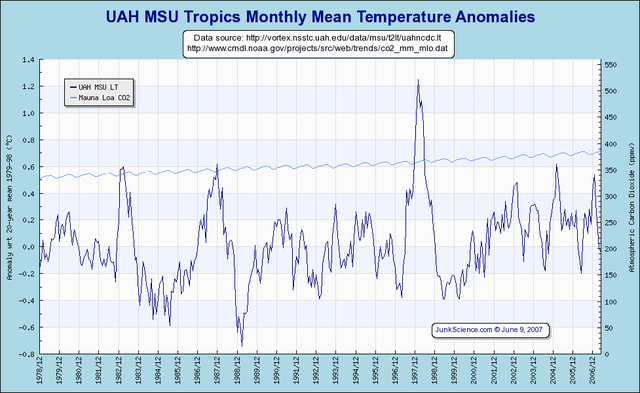
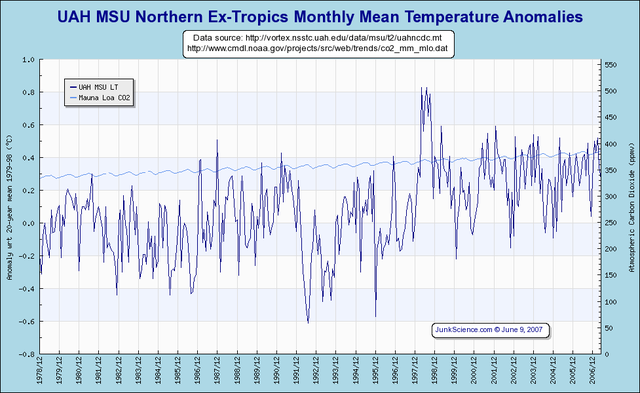
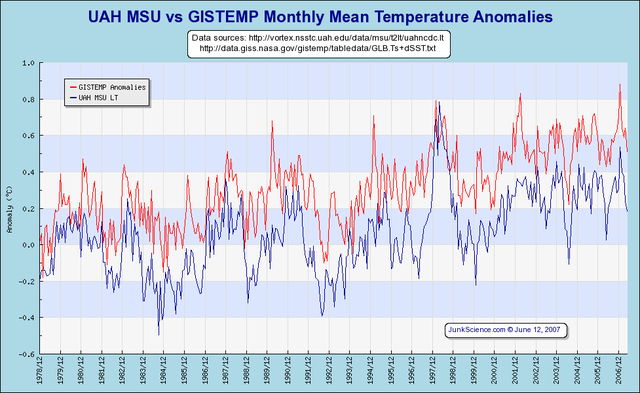
I think many skeptics would jump at such a proposal (as long as there is some control on AGW supporters "restating" and "correcting" the satellite readings -- there is nothing AGW scientists are better at than "correcting" historical numbers that don't fit their story line).  One reason is that we skeptics know one of the AGW dirty little secrets:   In fact, against all predictions of the theory, the troposphere has been warming less than the surface.  Also, while I get conflicting inputs on whether the tropics or the northern latitudes should warm more, but if McKitrick is correct, the fact that the tropics have been warming less than higher norther latitudes (but more than southern latitudes) is also an inconsistency.  In case you don't keep a full set of tropospheric temperature histories sitting on your desk, here are several from Global Warming at a Glance.

Warming for the lower troposphere in the tropics, note the 0.2C anomaly (click any image for larger version):

Uahmsutrop

Here is the lower troposphere for the Northern Hemisphere above the tropics which is warming more than the tropics, with a 0.3 degree anomaly

Uahmsunextm

And here is a comparison of Global lower troposphere temperatures (in blue) vs. one compilation  by the GIS of measured surface temperatures in red.  Note the divergence, which is exactly opposite of what AGW theory says has to happen, given the surface temps have a 0.5 to 0.6 degree anomaly  Note that this may be because of some serious biases to ground based temperature measurement, but then that would mean that global warming is over-stated.

Msuvsgistemp

Look for my upcoming "Skeptical Layman's Primer to Anthropogenic Global Warming" or email me for a pre-release beta copy.

Licensing Protects Incumbents, Not Consumers

Scott Gustafson's Arizona Economics blog points to another example of a local regulatory body, in this case the Structural Pest Commission, bravely protecting incumbent competitors from new competition.  As background, you should know that though we don't have nearly as many pests as most places, the ones we do have (e.g. scorpions) are essentially unkillable with legal chemical technologies.  The best you can hope for is to tighten up your hose to keep them out.  And we have these lovely rodents called roof rats, sort of like squirrels on steroids who are not cute, who like to come in and take up residence in attics and walls.   So a lot of pest control here is about putting up screens over vents and setting traps rather than spraying chemicals.

As retirees go, Rich Hanley seems like a decent enough guy. He's a former cop who came to town a few years ago. He obeys the law. He pays his taxes. In 2004, he started up a little business, repelling roof rats.
 

Specifically, he covers vents with steel mesh so the little fellas can't come calling. 

Once, we would have applauded such enterprise. Now, we issue cease-and-desist orders. 

Yep, it's true. My favorite state bureaucrats over at the Structural Pest Control Commission have decided that Hanley has violated the law... 

"The problem is his advertising," says Lisa Gervase, executive director of the agency... 

The pest-control cops launched a seven-week probe, concluding that Hanley can do the work. He just can't tell people why he's doing the work. Thus, his sales pitch - "Keep birds and rodents from invading your home" - has to go. 

Gervase said the state would have no problem if Hanley says he's covering vents to keep leaves out. "But if he's advertising that he can keep pests from invading your home, that's pest control, and you need a license for pest control."

Its nice, I guess, when you trade group can get the government to use its coercive power to do you work for you.  Much more on licensing as anti-competitive behavior rather than consumer protection.

Anthony Watts Discovers a New Element

From Watts Up With That:

The discovery of the heaviest chemical element yet known to science. The new element has been tentatively  named Governmentium.

Governmentium has 1 neutron, 12 assistant  neutrons, 75 deputy neutrons, and 224 assistant deputy neutrons, giving it  an atomic mass of 312. These 312 particles are held together by forces  called morons, which are surrounded by vast quantities of lepton-like  particles called peons.

Since Governmentium has no electrons, it is  inert. However, it can be detected as it impedes every reaction with which it comes into contact. A minute amount of Governmentium causes one  reaction to take over four days to complete when
it w ould normally take less  than a second.

Of course, there is much more.  Enjoy.

And, don't miss the chance to contribute to Watt's grass roots climate project / scavenger hunt.  Its fun and it contributes a lot to climate science.  I have contributed two sites so far -- I wrote about the first one here.

Schrödinger's Soprano

If I didn't know better, I would swear David Chase was actually a physicist creating an inside Schrödinger's Cat joke out of the last episode.  Quantum mechanics meets pop culture, Tony is both alive and dead simultaneously.

I know most people, while watching the last scene, were thinking of the restaurant scene in the Godfather.  I actually was thinking of the diner scene in Pulp Fiction.  I kept waiting for Jules to pop up with a gun and start talking about the blood of the righteous, or whatever (I bet Tony knew what was in that damned suitcase).

A Court Finally Challenges Indefinite Detainment at the President's Whim

Yeah, I know, security hawks will be lamenting the decision as an open door to terrorists, yada yada, but I think this is refreshing to see at least someone in the judiciary standing up for individual rights.  Orin Kerr reports that the Fourth Circuit has rejected the indefinite detainment of Ali A-Marri of Qatar.

The court takes a very narrow view of the category "enemy combatant";
if I read the court correctly, it sees the category as basically
limited to the catgeory of military opponent in battle rather than
Al-Qaeda terrorist

Fine with me.  The decision reads in part:

[A]bsent suspension of the writ of habeas corpus or declaration of
martial law, the Constitution simply does not provide the President the
power to exercise military authority over civilians within the United
States. The President cannot eliminate constitutional protections with
the stroke of a pen by proclaiming a civilian, even a criminal
civilian, an enemy combatant subject to indefinite military detention.
Put simply, the Constitution does not allow the President to order the
military to seize civilians residing within the United States and
detain them indefinitely without criminal process, and this is so even
if he calls them "enemy combatants."

To sanction such presidential authority to order the military to seize
and indefinitely detain civilians, even if the President calls them
"enemy combatants," would have disastrous consequences for the
Constitution "” and the country. For a court to uphold a claim to such
extraordinary power would do more than render lifeless the Suspension
Clause, the Due Process Clause, and the rights to criminal process in
the Fourth, Fifth, Sixth, and Eighth Amendments; it would effectively
undermine all of the freedoms guaranteed by the Constitution. It is
that power "” were a court to recognize it "” that could lead all our
laws "to go unexecuted, and the government itself to go to pieces." We
refuse to recognize a claim to power that would so alter the
constitutional foundations of our Republic.

I couldn't have said it better myself.  Even if the President really, really needs this power to make us all safe (and I don't really think he does), that fact does not make the action Constitutional.   If the government needs a new power to manage suspected terrorists on US soil, then they are going to have to create it through normal legislative and Constitutional processes.

Kerr projects that this decision is ice in the desert, and will soon be overturned.  Never-the-less, I am glad someone is taking this position.  Maybe it will catch on.

When Prey Decide They Have Had Enough

It seems like there is a taxpayer analogy in here somewhere.

H/T:  Maggies Farm

By the way, if you have not seen it, the BBC Series Planet Earth is just amazing.  I am watching it in High Def via my LG Blu-ray/HD-DVD combo player and it is awesome.

Speed Racer

I guess I must be the last to find out, but I saw this weekend the Wachowski Brothers (Matrix) were doing a live action movie remake of Speed Racer.  Woah.

Nominations for the Worlds Biggest Failure

Forget Scott Norwood, or Bill Buckner, or even Susan Lucci.  I nominate Paris Hilton's parents.

Municiple Wi-Fi in Trouble?

Truck and Barter points to this article reporting that many government wi-fi efforts are encountering problems.  No!  Who would have predicted that?

Signal to Noise Ratio

There is a burgeoning grass roots movement (described here, in part) to better document key temperature measurement stations both to better correct past measurements as well as to better understand the quality of the measurements we are getting.

Steve McIntyre
has had some back and forth conversations with Eli Rabbett about temperature measurement points, each accusing the other of cherry-picking their examples of bad and good installations.  McIntyre therefore digs into one of the example temperature measurement points Rabbett offers as a cherry-picked example of a good measurement point.  For this cherry-picked good example of a historical temperature measurement point, here are the adjustments that are made to this site's measurements before it is crunched up into the official historic global warming numbers:

Corrections have been made for:
- relocation combined with a transition of large open hut to a wooden Stevenson screen (September 1950) [ed:  This correction was about 1°C]
- relocation of the Stevenson screen (August 1951).
- lowering of Stevenson screen from 2.2 m to 1.5 m (June 1961).
- transition of artificial ventilated Stevenson screen to the current KNMI round-plated screen (June 1993).
- warming trend of 0.11°C per century caused by urban warming.

Note that these corrections, which are by their nature guesstimates, add up to well over 1 degree C, and therefore are larger in magnitude than the global warming that scientists are trying to measure.  In other words, the noise is larger than the signal.

Postscript:
  0.11C per century is arguably way too low an estimate for urban warming.

Shopping for Health Care

I missed this article the first time around, but Arnold Kling makes a point that I have been trying to make coherently for a long time:  The biggest problem in health care is not under-insurance or efficiency or drug company profits.  The biggest problem is the insulation of the consumer from health care prices.

For health care providers, insulation is a bonanza. Because
consumers are not spending their own money, they accept doctors'
recommendations for services without questioning them and without
concern for cost. Faced with an insured patient, a health care provider
is like a restaurant catering to convention-goers with unlimited
expense accounts. The customer will gladly take the most high-end
recommendation and not worry about the price.

Consumers are
happy as well. Insulation relieves the patient of the stress of making
decisions about treatment. The patient also does not have to worry
about shopping around for the best price.

The problem with
insulation is that it is not a sustainable form of health care finance.
Individuals, employers, and government are all under stress.

Health care plans on the table basically put decision making for a) making price comparisons and b) deciding if a given procedure is worth the price -- in one of two people's hands:

  • The individual being cared for or
  • The government

That's it.  Its one or the other.  The current system of "nobody" is not sustainable.  To the extent that people have grief about their employer or their insurer, it is usually because the insurer is trying to make these decisions (someone has to) and the individual is resentful that the insurer is not making decisions the way the individual might like.  In this context, it is nuts that many people see the solution not as "let individuals take over this decision" but as "let the government do it."  I'm sure that will turn out well.

By the way, I have been with a high deductible policy for a while now, and the medical care shopping process is a real eye-opener.  I really highly recommend it -- not only am I managing the costs but I am learning more about the care itself.  For those of you who don't want to price compare,  Michael Cannon of Cato makes the very good point that everyone does not have to price shop - only a few people need to for all of us to get the benefit.  I never even look at the price of toilet paper, but I know it is probably a good price because there are folks out there who DO compare.

Open Public Comment on Software Patent Applications