"Snuggles" at One

My daughter's white Maltese, embarrassingly named "Snuggles," just turned one.  Sorry we didn't really clean her up for her birthday pictures  (click to enlarge)

Snugs3

Snugs4

Update, in which I am chastised by my daughter:  I quote from my email this morning,

Why do you always have to talk about snuggles name??????? You say how
embarrassing it is and people laugh. Good for you, you make people laugh all
the time. It is funny to everyone but me. How do you think I feel,
with people laughing at me for naming snuggs that name ??? bad

OK, sorry hon.  Snuggles is actually a perfect name for this dog, who loves nothing more than to just sit in your lap.   Yes, Darwin, cuteness is a survival trait.  And Snuggles is the only other mammal in my household who will go running 3 miles with me, even when it is over 100 degrees out, and despite the fact she has a fur coat and the shortest legs by several orders of magnitude.  And, of course, beware to all intruders who run into this formidable home defense unit.

Ethanol Get's Slammed

Finally, the blinders are coming off and the media is starting to
wake up to the absolute travesty that is the Congress's promotion of
ethanol.  From Rolling Stone(!) emphasis added.

This is not just hype -- it's dangerous, delusional bullshit.  Ethanol doesn't burn cleaner than gasoline, nor is it
cheaper. Our current ethanol production represents only 3.5 percent of
our gasoline consumption -- yet it consumes twenty percent of the
entire U.S. corn crop, causing the price of corn to double in the last
two years and raising the threat of hunger in the Third World. And the
increasing acreage devoted to corn for ethanol means less land for
other staple crops, giving farmers in South America an incentive to
carve fields out of tropical forests that help to cool the planet and
stave off global warming.

So why bother? Because the whole
point of corn ethanol is not to solve America's energy crisis, but to
generate one of the great political boondoggles of our time. Corn is
already the most subsidized crop in America, raking in a total of $51
billion in federal handouts between 1995 and 2005 -- twice as much as
wheat subsidies and four times as much as soybeans. Ethanol itself is
propped up by hefty subsidies, including a fifty-one-cent-per-gallon
tax allowance for refiners. And a study by the International Institute
for Sustainable Development found that ethanol subsidies amount to as
much as $1.38 per gallon -- about half of ethanol's wholesale market
price.

Hurrah!  Unfortunately, I fear we may be waking up too late.  Already, billions of dollars are being invested by politically connected companies
on the promises of subsidies and promotion of ethanol extending out to
the end of the universe.  At this point, ethanol may be as entrenched
as agriculture subsidies, the education department, and depression-era
alcohol regulation.  The government has no problem reneging on contracts with oil companies, but God forbid anyone deny Archer Daniels Midland the right to infinite subsidies.

Stop Right There or I Will Shoot Myself!

Via the Washington Post:

It has become a Capitol Hill ritual: A few senators, always including the New York Democrat Charles E. Schumer, introduce a bill to punish China
if its leaders do not raise the value of the nation's currency. Photos
are taken, news releases are issued, but nothing really happens.

This
year, the atmosphere on the Hill is markedly different. Powerful
senators from both sides of the aisle, Schumer among them, are pushing
two bills that threaten retaliatory action if China does not budge. For
the first time, the idea is gaining broad support. The bills are moving
swiftly through the Senate, and many analysts expect one will pass.

If the bill's authors are successful, the effect at a minimum will be to raise consumer prices in the United States and lower them for Chinese citizens.  So we are going to "punish" China by making our own citizens pay higher prices.  How does this make any sense?  Also, in the process, let's make sure we reduce the capacity of China to buy US government debt, which to this point has been reducing the cost of the Federal budget deficit.

Tyler Cowen argues this is the best we can expect -- the worst is a substantial debalization in the Chinese economy... and ours.  I wrote much more on continuing to allow the Chinese government to subsidize American consumers here.

Barf

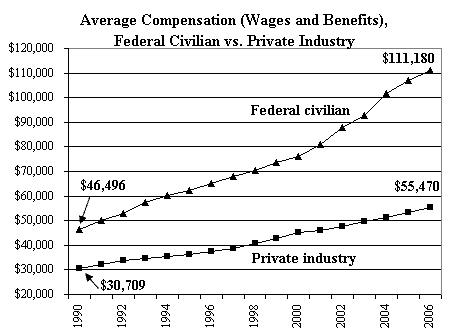
The average federal worker now makes over twice the wages and benefits of the average private worker
Edwards_fed

Maybe they have some sort of incentive plan, receiving a percentage of the value they have personally destroyed.  Because sure as hell none of them are producing anything.  If the Democrats want to fight income inequality and take on excessive compensation that is set without oversight, I might suggest beginning with the federal government. 

Postscript: TJIC has pointed out that he and I, though we tend to agree, often express ourselves differently.  Here is my prediction of TJIC's response to this article:  "We going to need a lot more rope."  How's that, Travis?

Water in the Desert - Is Pheonix "Unnatural?"

A week or so ago, the Toronto Star accused Phoenix of being "unnatural" and hypothesized that water shortages would soon drive people in a reverse migration to the Rust Belt, where lots of underutilized infrastructure exists.  I had a long, long response, because there was just so much silly stuff in the article, but you can bet I argued:

  1. Why is it unnatural for Phoenix to depend on water moved from long distances but it is natural for Buffalo and Cleveland to depend on hydrocarbons for winter heat moved from a long distance away?  When did self-sufficiency in water become the be-all end-all judge of city sustainability?  And how do cities dependent on big old coal-fired plants criticize the CO2 footprint of a city powered by the largest nuclear plant in the country?
  2. To the extent Phoenicians are inattentive to water use, it is because we have some of the cheapest water in the country, provided to us at ridiculously low rates to politicians who would rather manage water supply and demand through command and control than through price and markets.  Much of Arizona's water use is in agriculture, where water hungry crops are grown in the Sonoran Desert because of subsidized water use rates and federal agricultural subsidies.

I did a bit more research, and found this:

In an average year, Arizonans go through about 7.25 million acre-feet,
or nearly 2.4 trillion gallons. Put a different way, that amount of
water could support a residential population of nearly 30 million
people.

Except it doesn't. It's supporting a population of 5.7 million - and a
lot of farms, which use about 68 percent of the state's water.

I have no problem with whoever wants to use the water.  If people want to make a go of cotton farming in the desert, power to them.  EXCEPT when the government provides them massive subsidies for doing so, as is the case in Arizona (and most all southwestern) agriculture.  Cotton farmers, for example, receive massive government subsidies for growing their crops, and water their plants with subsidized artificially low-priced water.  If the distortive government subsidies went away, and water prices were allowed to float up to where supply met demand (and we were not draining down aquifers and Lake Powell) then my guess is that a lot of desert agriculture would disappear.

By the way, I am also perfectly willing to believe that if water prices rose, there would be fewer people moving to the area.  Fine.  However, this effect would likely be small, since water costs are only a small percentage of the costs of home owning but are a huge percent of the costs of agriculture.   But I think we can see that trying to blame Arizona's water problems on inward residential migration is  pointing the finger in the wrong direction.

Interestingly, even that great bete noir of environmentalists and outside critics, our golf courses, really have a minimal impact on the water use:

Everyone's favorite culprit, golf courses use two-thirds of the
industrial supply, or about 4 percent to 5 percent of the total supply.
Some courses use treated effluent, or "gray water." Scottsdale, for
example, requires any new course to use gray water or bring its own
supply.

Postscript:  Water is one of those weird topics, a bit like health care I guess, where most people seem to assume that the normal laws of economics do not apply.   Over the last several months, I have probably read 30 articles on Arizona water use.  Not one single time in any article have I seen mention of the word "price."  Its all about what command and control methods we need to exercise.  Take the guy they interviewed for the article above:

Charles Buerger, who divides his year between homes in Gilbert and
suburban Chicago, is sometimes surprised that people in northern
Illinois, on the banks of Lake Michigan, seem more concerned about
water use than people in dry Arizona.

"They have every-other-day grass watering back there," Buerger said.
"They fine you if you're overwatering or if you're watering on days
you're not supposed to. They're very conscious about water supplies.
The way Arizona's growing, you just wonder, 'Where's all this water
coming from?' "

Pricing matters, even for water!  Not silly even-odd day lawn watering laws.  Just look at these numbers:

City Monthly cost for water service of 8,500 gallons
Memphis, Tennessee $14.16
Phoenix, Arizona $16.27
Charlotte, North Carolina $17.52
Dallas, Texas $20.04
Austin, Texas $23.15
Portland, Oregon $23.44
Louisville, Kentucky $23.47
Houston, Texas $26.49
Milwaukee, Wisconsin $27.86
East Bay MUD, Oakland, California $31.13
Atlanta, Georgia $33.60
San Diego, California $37.52
Seattle, Washington $39.75

What could explain more eloqently why I paid more attention to how I watered my lawn in rainy Seattle than desert-bound Phoenix.  Remember gasoline in the 1970's.  It wasn't even-odd day rationing that solved the supply crisis; in the end, it was elimination of price controls.

Update: The Toronto Star argued that Phoenix represented environmental Armageddon while the Great Lakes region was the environmentally smart place to live.  They suggested "that in the
Great Lakes basin, where less than half a per cent of the world's
population sits within easy reach of a quarter of the planet's fresh
water, the opportunity for harmony exists."  Of course, that's only if you ignore the fact that these cities treat the Great Lakes like one big toilet:

"The Great Lakes basin is one of the most important freshwater
ecosystems on the planet - holding one fifth of the world's
freshwater," said the report's author Dr. Elaine MacDonald. "Yet, the
20 cities we evaluated are dumping the equivalent of more than 100
Olympic swimming pools full of raw sewage directly into the Great Lakes
every single day."

20061129_sign

This is the kind of stuff that has a lot higher immediate impact, and should be worked long before, tenuous claims of damage from CO2 production.

HDR Photography Test

I have never been satisfied with my pictures of the rock formations on my parents ranch.  They have always lacked the depth and detail I saw in nature.  I played around this week with HDR photography, which uses multiple exposures of the same image to bring out more contrast and detail.  Here is a closeup of the rocks.  I also got a nice effect with the clouds, combining multiple exposures with small cloud movement.  (click for higher resolution image)
Hdrengagementweb

OMG

Interstate bridge collapses during rush hour near Minneapolis.  Though the death toll so far of 6 is tragic, it is pretty amazing when you think of 50-100 cars on a collapsing bridge.
Bridge1

Update:  The guy in the van must have a story to tell.

Lord of the Bad Plan

TJIC points to more poor decision-making by LOTR characters.  I can't take these criticisms seriously after seeing the Lord of all ring-plan critiques here:

More Thoughts on Historic Temperature Adjustments

A few posts back, I showed how nearly 85% of the reported warming in the US over the last century is actually due to adjustments and added fudge-factors by scientists rather than actual measured higher temperatures.  I want to discuss some further analysis Steve McIntyre has done on these adjustments, but first I want to offer a brief analogy.

Let's say you had two compasses to help you find north, but the compasses are reading incorrectly.  After some investigation, you find that one of the compasses is located next to a strong magnet, which you have good reason to believe is strongly biasing that compass's readings.  In response, would you

  1. Average the results of the two compasses and use this mean to guide you, or
  2. Ignore the output of the poorly sited compass and rely solely on the other unbiased compass?

Most of us would quite rationally choose #2.  However, Steve McIntyre shows us a situation involving two temperature stations in the USHCN network in which government researchers apparently have gone with solution #1.  Here is the situation:

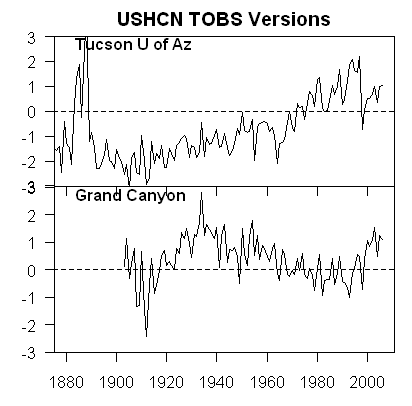
He compares the USHCN station at the Grand Canyon (which appears to be a good rural setting) with the Tucson USHCN station I documented here, located in a parking lot in the center of a rapidly growing million person city.   Unsurprisingly, the Tucson data shows lots of warming and the Grand Canyon data shows none.  So how might you correct Tucson and the Grand Canyon data, assuming they should be seeing about the same amount of warming?  Would you
average them, effectively adjusting the two temperature readings
towards each other, or would you assume the Grand Canyon data is cleaner
with fewer biases and adjust Tucson only?   Is there anyone who would not choose the second option, as with the compasses?

The GISS data set, created by the Goddard Center of NASA, takes the USHCN data set and somehow uses nearby stations to correct for anomalous stations.  I say somehow, because, incredibly, these government scientists, whose research is funded by taxpayers and is being used to make major policy decisions, refuse to release their algorithms or methodology details publicly.  They keep it all secret!  Their adjustments are a big black box that none of us are allowed to look into  (and remember, these adjustments account for the vast majority of reported warming in the last century).

We can, however, reverse engineer some of these adjustments, and McIntyre does.  What he finds is that the GISS appears to be averaging the good and bad compass, rather than throwing out or adjusting only the biased reading.  You can see this below.  First, here are the USHCN data for these two stations with only the Time of Observation adjustment made (more on what these adjustments are in this article).
Grand_12

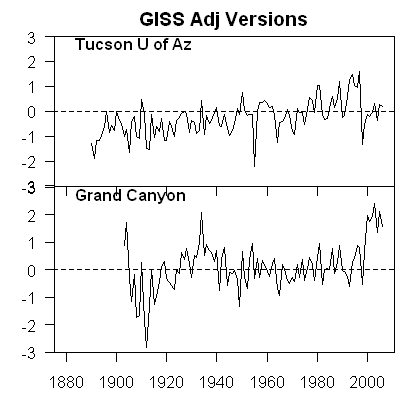
As I said above, no real surprise - little warming out in undeveloped nature, lots of warming in a large and rapidly growing modern city.  Now, here is the same data after the GISS has adjusted it:

Grand_15

You can see that Tucson has been adjusted down a degree or two, but Grand Canyon has been adjusted up a degree or two (with the earlier mid-century spike adjusted down).  OK, so it makes sense that Tucson has been adjusted down, though there is a very good argument to be made that it should be been adjusted down more, say by at least 3 degrees**.  But why does the Grand Canyon need to be adjusted up by about a degree and a half?  What is biasing it colder by 1.5 degrees, which is a lot?  The answer:  Nothing.  The explanation:  Obviously, the GISS is doing some sort of averaging, which is bringing the Grand Canyon and Tucson from each end closer to a mean. 

This is clearly wrong, like averaging the two compasses.  You don't average a measurement known to be of good quality with one known to be biased.  The Grand Canyon should be held about the same, and Tucson adjusted down even more toward it, or else thrown out.  Lets look at two cases.  In one, we will use the GISS approach to combine these two stations-- this adds 1.5 degrees to GC and subtracts 1.5 degrees from Tucson.  In the second, we will take an approach that applies all the adjustment to just the biases (Tucson station) -- this would add 0 degrees to GC and subtract 3 degrees from Tucson.  The first approach, used by the GISS, results in a mean warming in these two stations that is 1.5 degrees higher than the more logical second approach.  No wonder the GISS produces the highest historical global warming estimates of any source!  Steve McIntyre has much more.

** I got to three degrees by applying all of the adjustments for GC and Tucson to Tucson.  Here is another way to get to about this amount.   We know from studies that urban heat islands can add 8-10 degrees to nighttime urban temperatures over surrounding undeveloped land.  Assuming no daytime effect, which is conservative, we might conclude that 8-10 degrees at night adds about 3 degrees to the entire 24-hour average.

Postscript: Steve McIntyre comments (bold added):

These adjustments are supposed to adjust for station moves - the
procedure is described in Karl and Williams 1988 [check], but, like so
many climate recipes, is a complicated statistical procedure that is
not based on statistical procedures known off the island.
(That's not
to say that the procedures are necessarily wrong, just that the
properties of the procedure are not known to statistical civilization.
)
When I see this particular outcome of the Karl methodology, my
impression is that, net of the pea moving under the thimble, the Grand
Canyon values are being blended up and the Tucson values are being
blended down. So that while the methodology purports to adjust for
station moves, I'm not convinced that the methodology can successfully
estimate ex post the impact of numerous station moves and my guess is
that it ends up constructing a kind of blended average.

LOL.  McIntyre, by the way, is the same gentleman who helped call foul on the Mann hockey stick for bad statistical procedure.

More Subsidy Insanity

Over a decade ago, the German government adopted the goal of reducing the country's CO2 emissions back to 1990 levels as part of the Kyoto process.  That's why its incredible to me that after spending billions on various goofy and questionable conservation and alternative energy programs, someone has finally thought to maybe stop massively subsidizing coal production.

For decades, German lawmakers have propped up the industry,
unwilling to risk massive layoffs and reluctant to eliminate a reliable
energy source as gas and oil supplies become scarcer.

But after spending more than $200 billion in subsidies since the
1960s, the federal government this year decided that the practice had
become unaffordable. The 2018 sunset for the hard-coal industry was set.

Economists and free-market lawmakers have long decried the subsidies
as handouts to the politically influential coal industry and powerful
trade unions. This year, for instance, Deutsche Steinkohle AG, the
owner of the remaining eight mines, will receive more in government
subsidies ($3.3 billion) than it will from selling coal ($2.9 billion).

With just 32,000 miners left, that's the equivalent of more than $100,000 in annual subsidies per worker.

I don't know what is more incredible -- $100,000 per worker or the fact that subsidies actually are larger than revenue from coal sales.  In effect, the government is subsidizing more than half of coal's production costs.

Sometimes we in the US forget just how insane the economy in Europe can be.  I remember doing a consulting project for the French national railroad, the SNCF.   It turned out the SNCF, for it's 100,000 freight cars had ... 125,000 freight car maintenance workers.  The headcount number was so insane I had to check it three times to make sure it was right.  I commented at the time that they could assign one car repair worker full time to each freight car, and have him ride around with that car full time, and still cut staffing by 20%.

Ex Post Facto Guilt

You gotta love those vaunted MSM fact-checkers.  I mean, I am all for criticizing George Bush, but this seems to be going a bit too far  (Guardian via Q&O):

Ministers insisted that British secret agents would only be allowed to
pass intelligence to the CIA to help it capture Osama bin Laden if the
agency promised he would not be tortured, it has emerged.

MI6 believed it was close to finding the al-Qaida leader in
Afghanistan in 1998, and again the next year. The plan was for MI6 to
hand the CIA vital information about Bin Laden. Ministers including
Robin Cook, the then foreign secretary, gave their approval on
condition that the CIA gave assurances he would be treated humanely.
The plot is revealed in a 75-page report by parliament's intelligence
and security committee on rendition, the practice of flying detainees
to places where they may be tortured.

The report criticises the Bush administration's approval of practices
which would be illegal if carried out by British agents. It shows that
in 1998, the year Bin Laden was indicted in the US, Britain insisted
that the policy of treating prisoners humanely should include him. But
the CIA never gave the assurances.

LOL.  It seems like Bush has been president forever, but I am pretty sure that Hillary's husband was in the White House until early 2001.

The Highest Paid Public Employees

Phil Miller observes that the new Hawkeye football coach is now the highest-paid government employee in Iowa.  This is wildly unsurprising.  In fact, I renew my question that we never got a final answer on:  Is there any state in which a college athletics coach is NOT the highest paid public employee in the state?

Update:  Tim, who has a blog at Movementarian.com writes with lots more thoughts:

Being from Texas I tried to find some numbers on your question:
- David Lopez, chief executive of the Harris County Hospital
District, has agreed to a three-year deal that could pay him $500,000
annually and would make him the highest-paid county employee.    (
http://www.chron.com/disp/story.mpl/metropolitan/4986829.html
)
 
- Already, the retirement system's chief investment officer, Britt
Harris, is the highest-paid state employee (excluding higher-education
officials and athletic coaches, whose pay isn't tracked by the
comptroller's office). Harris earns a base salary of $480,000 and is
eligible for a maximum bonus of $360,000.  (
http://www.statesman.com/blogs/content/shared-gen/blogs/austin/finance/entries/2007/06/15/bonus_babies_part_i_1.html
)
Other State's
Nevada: Public employees who repair Nevada's local streets and
highways, operate its city and county jails and fill nonteaching jobs
in its school districts are the best paid in the country when compared
with their counterparts in the other 49 states and the District of
Columbia, according to U.S. Census figures for 2001.  (http://www.reviewjournal.com/lvrj_home/2003/May-18-Sun-2003/news/21349243.html)
 
New York: Alain Kaloyeros, vice president and chief administrative
officer at the College of Nanoscale science and Engineering and an
expert in the field of nanotechnology, became the highest paid employee
after the State University of New York (SUNY) chancellor approved a
$142,000 per year raise, bringing his annual salary to $666,995, the
Associated Press reports. (
http://compensation.blr.com/display.cfm/id/155584)
However, based on football coaches in Texas alone (most of whom
make more than $1 mil), none of these other employees come close (just
as you predicted).  Even college basketball coaches are making alot of
money now.  In fact, before A&M's Gillespie bolted to Kentucky, he
was offered $1.75 million a year, up from $500k: (http://sports.espn.go.com/ncb/news/story?id=2832406) -- his replacement, Mark Turgeon, signed a deal worth $1.2 million/year.
 
 
Note: this is one of the better articles covering this issue: http://www.usatoday.com/sports/college/football/2006-11-16-coaches-salaries-cover_x.htm
 
Regarding the Nevada example above, UN basketball coach is raking in more dough than any of those employees as well: http://sports.espn.go.com/ncb/news/story?id=2912916
 
And for the record, I think the coaches that get a cut of ticket
revenues are in a conflict of interest, due to the fact that more than
90% of Div I schools fund athletics departments through student fees (
http://www.mises.org/story/2233#fn6
)
and their sport typically get a large amount of promotion through
by the institution.  Then again, the entire collegiate enterprise is
backwards to begin with...

The State and Local Government Meltdown

I have written before that the government story of the next decade will be the financial meltdown that will ensue as state and local governments are forced to face up to the enormous unfunded pension and medical liabilities they have assumed for their state employees.  Largely, these liabilities are currently well-hidden and off the books, a trick even Jeff Skilling was unable to pull off at Enron. 

My previous prediction that the liabilities probably total over a trillion dollars now seems way low.  Just one state, Illinois, may have over $100 billion in such off-the-books liabilities, and this does not even include liabilities of local authorities like the city of Chicago:

The study puts the state's pension debt at $10 billion, its unfunded
pension costs at $46 billion, its unfunded employee health care costs
at $48 billion, and its unpaid Medicaid bills at $2 billion. The total
costs that will be pushed onto tomorrow's taxpayers without reforms is
an enormous $106 billion, or $8,800 per every person in the state of
Illinois.

Government Relevance

At the exact same time that the President and the Congress have the lowest approval ratings of all time, consumer confidence just hit a 6-year high.  While we all understand the power of the government to screw up the economy, has there ever been quite so eloquent an expression of just how irrelevant the government is to economic expansion?

Government Health Care and Efficiency

I am always absolutely amazed when advocates of some form of national or single-payer health care argue that such a system would be more efficient.  For example, Kevin Drum argued:

A few days ago, during an email exchange with a
friend, I mentioned that I don't usually tout cost savings as a big
argument in favor of universal healthcare. It's true that a national
healthcare plan would almost certainly save money compared to our
current Rube Goldberg system, but I suspect the savings would be
modest. Rather, the real advantages of national healthcare are related
to things like access (getting everyone covered), efficiency (cutting down on useless -- or even deliberately counterproductive -- administrative bureaucracies), choice
(allowing people to choose and keep a family doctor instead of being
jerked around everytime their employer decides to switch health
providers), and social justice (providing decent, hassle-free healthcare for the poor).

I don't think any of these are true.  For example, let's take access.  Yes, everyone in a universal health care system would have a piece of paper that says they have health care, and the left seems really focused on that piece of paper.  But that paper has about as much value as my piece of paper that says I own a hundred shares of Enron.  Because someone has to redeem that piece of paper and actually provide the care, and there is the rub, is it not?  Canadian David Gratzer writes (vis Q&O):

My book's thesis was simple: to contain rising
costs, government-run health-care systems invariably restrict the
health-care supply. Thus, at a time when Canada's population was aging
and needed more care, not less, cost-crunching bureaucrats had reduced
the size of medical school classes, shuttered hospitals, and capped
physician fees, resulting in hundreds of thousands of patients waiting
for needed treatment"”patients who suffered and, in some cases, died
from the delays....

Nor were the problems I identified unique to
Canada"”they characterized all government-run health-care systems.
Consider the recent British controversy over a cancer patient who tried
to get an appointment with a specialist, only to have it canceled"”48
times. More than 1 million Britons must wait for some type of care,
with 200,000 in line for longer than six months. A while back, I toured
a public hospital in Washington, D.C., with Tim Evans, a senior fellow
at the Centre for the New Europe. The hospital was dark and dingy, but
Evans observed that it was cleaner than anything in his native England.
In France, the supply of doctors is so limited that during an August
2003 heat wave"”when many doctors were on vacation and hospitals were
stretched beyond capacity"”15,000 elderly citizens died. Across Europe,
state-of-the-art drugs aren't available. And so on.

I had forgotten about the heat wave.  Could you imagine backwards old America having 15,000 people die when the temperature got into the 90's?

As to efficiency, which Drum defines as "cutting down on useless -- or even deliberately counterproductive -- administrative bureaucracies," does anyone really ascribe these characteristics to the government?  Really?  Even European health care bureaucrats would not agree with this statement:

This privatizing trend is reaching Europe, too.
Britain's government-run health care dates back to the 1940s. Yet the
Labour Party"”which originally created the National Health Service and
used to bristle at the suggestion of private medicine, dismissing it as
"Americanization""”now openly favors privatization. Sir William Wells, a
senior British health official, recently said: "The big trouble with a
state monopoly is that it builds in massive inefficiencies and
inward-looking culture."

I won't get much into the last two, except to say that we actually have a ton of health care choice in the US today, far more than any other country.  And even if we did not, what does doctor choice mean if the best people are driven away from being doctors, as they are in socialized medicine.  And social justice?  Well, the poor get care in the US, the key is the "hassle-free" in his statement.  Would you immediately assume that a government-run service is going to involve less hassle than a private service?  Have you renewed your drivers license lately?  It may well be that the poorest 10% have such an awful health care experience that they will see things better.  But almost assuredly the other 90% are going to be worse off.

Remember this -- Universal health care is NOT a system in which the majority of us who are satisfied with our care can keep our current system, while the poor get a better one.  It is a system where all of us are thrown out of our current system and given the same care the poor get.  It is roughly equivalent to a Great Society housing program in which not just the homeless get housing, but everyone in the country are forced to give up their current house and live in public housing.

Postscript:  There is great improvement to be had in the health care system.  It revolves, though, around making the payer for health care the same person who receives the service, as it is for every other product and service we buy in this country.  We already have too much single-payer.  We need multi-payer.  I won't go there today, but I explained here.

Another Thought:
A huge pillar of the women's movement was that the government should not make decisions for a woman and her body (e.g. by banning abortion).   All well and good.  But I have never understood how this was consistent with support, say, for the FDA, which tells women exactly what they can and can't put in their body.  And now women's groups are all for universal health care, where government will make all the medical decisions about what procedures one can and can't have, and when.  Consistency please?

Apparently Chelsea Clinton and I Have Something in Common

Apparently Chelsea Clinton will start work soon as a McKinsey associate.  However, she doesn't seem to have had to solve eight or ten business case studies in real-time during interviews as I had to, nor am I guessing that she will spend her first year working 80-hour weeks buried in spreadsheets and charts.  As a aside, the first partner I worked with at McKinsey was Jeff Skilling, of Enron fame, one of the brightest people I ever worked with.

An Interesting Source of Man-Made Global Warming

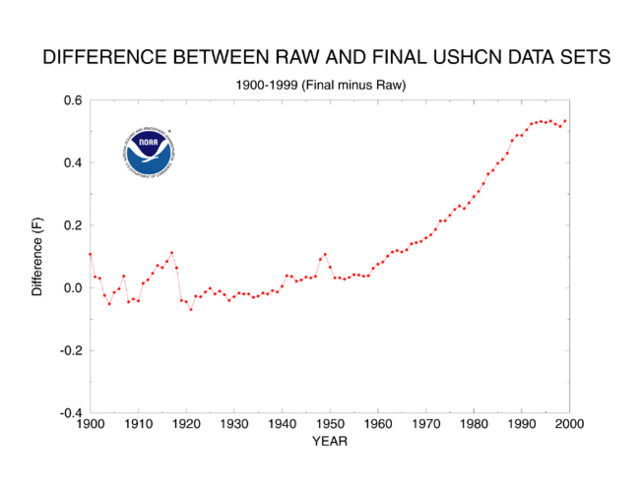
The US Historical Climate Network (USHCN) reports about a 0.6C temperature increase in the lower 48 states since about 1940.  There are two steps to reporting these historic temperature numbers.  First, actual measurements are taken.  Second, adjustments are made after the fact by scientists to the data.  Would you like to guess how much of the 0.6C temperature rise is from actual measured temperature increases and how much is due to adjustments of various levels of arbitrariness?  Here it is, for the period from 1940 to present in the US:

Actual Measured Temperature Increase: 0.1C
Adjustments and Fudge Factors: 0.5C
Total Reported Warming: 0.6C

Yes, that is correct.  Nearly all the reported warming in the USHCN data base, which is used for nearly all global warming studies and models, is from human-added fudge factors, guesstimates, and corrections.

I know what you are thinking - this is some weird skeptic's urban legend.  Well, actually it comes right from the NOAA web page which describes how they maintain the USHCN data set.  Below is the key chart from that site showing the sum of all the plug factors and corrections they add to the raw USHCN measurements:
Ushcn_corrections
I hope you can see this significance.  Before we get into whether these measurements are right or wrong or accurate or guesses, it is very useful to understand that almost all the reported warming in the US over the last 70 years is attributable to the plug figures and corrections a few government scientists add to the data in the back room.  It kind of reduces one's confidence, does it not, in the basic conclusion about catastrophic warming? 

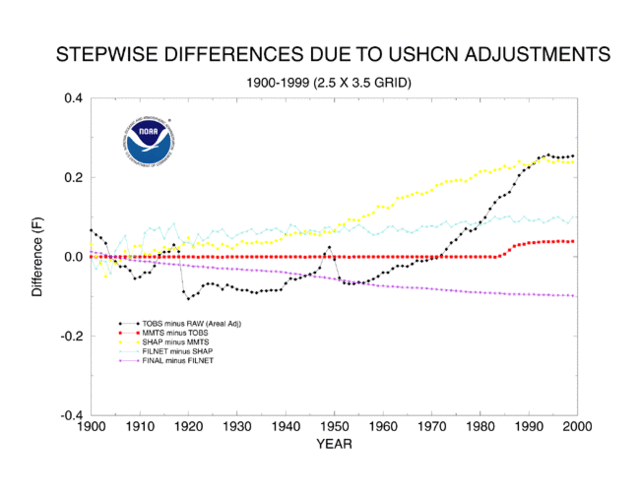
Anyway, lets look at the specific adjustments.  The lines in the chart below should add to the overall adjustment line in the chart above.
Ushcn_corrections2

  • Black line is a time of observation adjustment, adding about 0.3C since 1940
  • Light Blue line is a missing data adjustment that does not affect the data much since 1940
  • Red line is an adjustment for measurement technologies, adding about 0.05C since 1940
  • Yellow line is station location quality adjustment, adding about 0.2C since 1940
  • Purple line is an urban heat island adjustment, subtracting about 0.05C since 1950.

Let's take each of these in turn.  The time of observation adjustment is defined as follows:

The Time of Observation Bias (TOB) arises when the 24-hour daily
summary period at a station begins and ends at an hour other than local
midnight. When the summary period ends at an hour other than midnight,
monthly mean temperatures exhibit a systematic bias relative to the
local midnight standard

0.3C seems absurdly high for this adjustment, but I can't prove it.  However, if I understand the problem, a month might be picking up a few extra hours from the next month and losing a few hours to the previous month.  How is a few hour time shift really biasing a 720+ hour month by so large a number? I will look to see if I can find a study digging into this. 

I will skip over the missing data and measurement technology adjustments, since they are small.

The other two adjustments are fascinating.  The yellow line says that siting has improved on USHCN sites such that, since 1900, their locations average 0.2C cooler due to being near more grass and less asphalt today than in 1900. 

During this time, many sites were relocated from city locations to
airports and from roof tops to grassy areas. This often resulted in
cooler readings than were observed at the previous sites.

OK, without a bit of data, does that make a lick of sense?  Siting today in our modern world has GOT to be worse than it was in 1900 or even 1940.  In particular, the very short cable length of the newer MMTS sensors that are standard for USHCN temperature measurement guarantee that readings today are going to be close to buildings and paving.  Now, go to SurfaceStations.org and look at pictures of actual installations, or look at the couple of installations in the Phoenix area I have taken pictures of here.  Do these look more grassy and natural than measurement sites were likely to be in 1900?  Or go to Anthony Watts blog and scroll down his posts on horrible USHCN sites.

The fact is that not only is NOAA getting this correction wrong, but it probably has the SIGN wrong.  The NOAA has never conducted the site by site survey that we discussed above.  Their statement that locations are improving is basically a leap of faith, rather than a fact-based conclusion.  In fact, NOAA scientists who believe that global warming is a problem tend to overlay this bias on the correction process.  Note the quote above -- temperatures that don't increase as they expect are treated as an error to be corrected, rather than a measurement that disputes their hypothesis.

Finally, lets look the urban heat island adjustment.  The NOAA is claiming that the sum total of urban heat island effects on its network since 1900 is just 0.1C, and less than 0.05C since 1940.  We're are talking about the difference between a rural America with horses and dirt roads and a modern urban society with asphalt and air conditioning and cars.  This rediculously small adjustment reflects two biases among anthropogenic global warming advocates:  1)  That urban heat island effects are negligible and 2) That the USHCN network is all rural.  Both are absurd.  Study after study has show urban heat island effects as high as 6-10 degrees.  Just watch you local news if you live in a city --  you will see actual temperatures and forecasts lower by several degrees in the outlying areas than in the center of town.  As to the locations all being rural, you just have to go to surfacestations.org and see where these stations are.  Many of these sites might have been rural in 1940, but they have been engulfed by cities and towns since.

To illustrate both these points, lets take the case of the Tucson site I visited.  In 1900, Tucson was a dusty one-horse town (Arizona was not even a state yet).  In 1940, it was still pretty small.  Today, it is a city of over one million people and the USHCN station is dead in the center of town, located right on an asphalt parking lot.  The adjustment NOAA makes for all these changes?  Less than one degree.  I don't think this is fraud, but it is willful blindness.

So, let's play around with numbers.  Let's say that instead of a 0.2C site quality adjustment we instead used a -0.1C adjustment, which is still probably generous.  Let's assume that instead of a -0.05C urban adjustment we instead used -0.2C.  The resulting total adjustment from 1940 to date would be +0.05 and the total measurement temperature increase in the US would fall from 0.6C to 0.15C.  And this is without even changing the very large time of observation adjustment, and is using some pretty conservative assumptions on my part.  Wow!  This would put US warming more in the range of what satellite data would imply, and would make it virtually negligible. It means that the full amount of reported US warming may well be within the error bars for the measurement network and the correction factors.

While anthropogenic global warming enthusiasts are quick to analyze the reliability of any temperature measurement that shows lower global warming numbers (e.g. satellite), they have historically resisted calls to face up to the poor quality of surface temperature measurement and the arbitrariness of current surface temperature correction factors.  As the NOAA tellingly states:

The U.S. Historical Climatology Network (USHCN, Karl et al. 1990)
is a high-quality moderate sized data set of monthly averaged maximum,
minimum, and mean temperature and total monthly precipitation developed
to assist in the detection of regional climate change. The USHCN is
comprised of 1221 high-quality stations from the U.S. Cooperative
Observing Network within the 48 contiguous United States.

Does it sound defensive to anyone else when they use "high-quality" in both of the first two sentences?  Does anyone think this is high qualityOr this?  Or this?  Its time to better understand what this network as well as its limitations.

My 60-second climate skepticism argument is here.  The much longer paper explaining the breath of skeptic's issues with catastrophic man-made global warming is available for free here.

PS- This analysis focuses only on the US.  However, is there anyone out there who thinks that measurement in China and India and Russia and Africa is less bad?

UpdateThis pdf has an overview of urban heat islands, including this analysis showing the magnitude of the Phoenix nighttime UHI as well as the fact that this UHI has grown substantially over the last 30 years.

Uhi1

Update2: Steve McIntyre looks at temperature adjustments for a couple of California Stations.  In one case he finds a station that has not moves for over one hundred years getting an adjustment that implies a urban heat island reduction over the past 100 years.


Oddities at Coyote Blog

You may see some odd things happening with the post sorting on the blog tonight, as I am futzing around with them to facilitate some dead-tree archiving.  More on what I am doing here.

Did the Chinese Discover America?

Cool map and historic speculation of whether the Chinese explored America circa 1421.  The map, which is a later copy of a purported 15th century map, may be a little too accurate for credibility, particularly on the Atlantic side.

Tautology (and Thoughts on Ward Churchill)

Todd Zywicki notes that Congress "has been on a binge diet of junk social science."  Is there another kind of social science?  Particularly in the media, I really think the main influence of social science has been to substantially lower the bar for scientific inquiry and skepticism thereof.

Update: On a related note, these really low academic standards in the social "sciences" are the reason I think firing Ward Churchill is bogus, as I wrote here.  Academic standards for things like ethnic or gender studies are incredibly low, particularly for the "research" done in these departments.  As I pointed out before, Cal State Long Beach, for example, hired a paranoid schizophrenic who had served prison time for beating and torturing two women as the head of their Black Studies department.  It is almost impossible to imagine Ward Churchill fired for violating the academic standards of his discipline because his discipline tends to have none, and everyone knows it.  The University of Colorado fully knew what it was getting with Ward Churchill, but they hired him to check a politically correct racial/gender/ethnic box.  Everything UC supposedly fired him for were known to them or should have been known to them with the most minimal of due diligence when they tenured the guy.  Nothing has changed, except that he is no longer a PR asset for the university.  As I wrote previously:

I could go out tomorrow and find twenty tenured professors of
ethnic/racial/gender studies in state universities whose academic
credentials are at least as bad as Churchill's and whom no one would dare fire.  This has nothing to do with Churchill's academic work or its quality.  UC is getting exactly
what it expected when it tenured him.  This is about an attempt to fire
a tenured professor for the content of his speech, speech that has
embarrassed and put pressure on the university, and I can't support
that.

Even More:  Background from KC Johnson:

Churchill was hired through a "special opportunity" position, designed
by the university to help "recruit and hire a more diverse faculty." He
had an M.A. from little-known Sangamon State University and no Ph.D at
all. As documents from the time noted, his qualifications included only two items: strong lobbying from Evelyn Hu-DeHart,
the chair of the Ethnic Studies program, and the now-disputed fact that
"Ward is a Native American," meaning his hire would contribute "to
increasing the cultural diversity on campus."...

How, then, could his fellow academics have originally found Churchill's
scholarship acceptable? The outcome, alas, suggests that in politicized
fields such as African-American Studies, Women's Studies, and Ethnic
Studies, the message too often trumps quality. In this case, it appears
that Churchill's extremist arguments that the U.S. government engaged
in genocide against Native Americans blinded his academic reviewers to
the poor quality of his scholarship. Indeed, some Churchill
sympathizers, led by Cornell professor Eric Cheyfitz,
have continued to maintain that the former professor's writings
constitute appropriate scholarship for the field of Ethnic Studies.

I contend that Churchill was and is still exactly what UC thought he was, and his scholarship was and still does exactly conform to the (miserably low) standards of his discipline.

Market Manipulation...For Eight Minutes

A while back, I wrote of my conversation with a friend who was convinced that oil prices are set by a small cabal of traders, and that while they have been at $60-70 over the last several years, they would have been at $40 or less without the traders manipulating the price.  I won't go into my arguments again here, but I wrote that it would be virtually impossible to maintain a price artificially above the market clearing price for so long without 1) massive product gluts or 2) almost-impossible-to-hide widespread suppression of production involving thousands of parties.

Michael Giberson at the Knowledge Problem writes about a price-fixing case by natural gas traders.  Amaranth is accused of manipulating gas prices, and I won't judge their guilt or innocence.  But, apropos of my statement above, it is interesting to note that the key question is whether it was possible for the company to manipulate commodity prices for eight minutes.  It looks as if they tried it, but it also looks as if they were not successful (since the government is charging they attempted to manipulate the market, but is not trying to prove they succeeded in doing so).  Making it hugely absurd to think that anyone could do it for three or four years.

Avoiding Bad Precedents

I just finished a course on the history of Rome.  The most fascinating era was the Roman revolution, where over about 100 years Rome slid from a Republic to an autocracy.  The final phases of the era, with the Caesars, gets a lot of play in movies and such, but it is actually the early period I found the most interesting.  In effect, Caesar or someone like him was effectively inevitable by that point in time.  The chance to avoid such an outcome actually came a hundred years earlier.

I won't get into the whole history, but suffice it to say that there was a major difference in the Republic between the theoretical power of certain offices and the actual power.  In effect, certain offices could theoretically take some pretty radical actions, but they were circumscribed by tradition and precedent.  However, when these precedents were broken (interestingly by a man who felt he was doing it for a good cause) restraints were removed and politics tended to devolve.

A while back, I wrote a post saying that I would love to see impeachment hearings in the Senate, because it would prevent the Senate from getting anything else done and it would be enormously entertaining. 

I take it back.  Having thought some more about it, I now think that it would be a really bad idea.   Impeachment has always been a power that could be used any time, but was not because the Congress generally recognized that restraint was in order.  The impeachment of Clinton broke with this tradition.  Yes, I know, he lied under oath.  Fine, yank his law license after he leaves office.  Yes, it probably was technically an impeachable offense.  But it falls way, way short of the line that historic precedent has set for when impeachment is appropriate.  And by greatly lowering this line, the Republican Congress took the huge risk of opening the floodgates to impeachment hearings virtually every time the President and Congressional majorities were from opposite parties.

I really would like to see the Democrats exercise restraint here.  I know many libertarians disagree with me, and would love nothing more than to see more frequent impeachments and recalls;  unfortunately, I just don't think that solves the libertarian problem of reducing the power and scope of government.

I don't want to misinterpret Kevin Drum, but he seems to be making a similar plea.  To M.J. Rosenburg, who argues:

The Constitutional remedy of impeachment is no longer
what it once was. For better or worse, the Republicans changed it, for
all time, when they impeached Clinton over, essentially, nothing.

And Clinton changed it as well. Impeachment not only did not end his
Presidency; it did not hurt his standing with the public. His numbers
stayed high, even improved some, and he left office on schedule, a very
popular President.

In other words, impeachment is no longer the political nuclear bomb
it once was, especially if one knows in advance that conviction and
removal from office is unlikely to occur.

Accordingly, impeachment proceedings are essentially the best means
of getting information to the public which is otherwise unavailable.

To this Drum says:

Impeachment should become a routine tool for getting public attention
whenever we disagree with a president of the opposite party? This might
be the worst argument in favor of impeachment of all time.

I agree.  I think Rosenburg is right that the Clinton impeachment changed the precedents around impeachment, but I would like to see the cork put back in the bottle now, before it is too late.

Air Conditioning Is Causing Global Warming

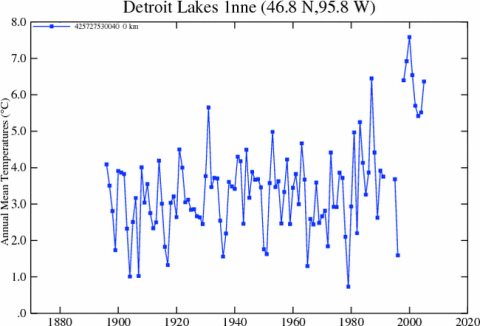
Yep, I admit it, air conditioning may indeed be causing us to measure higher temperatures.  Here is the historic temperature plot of Detroit Lake, MN, one of the thousand or so measurement points in the data base that is used to compute historical warming in the US.
Detroit_lakes_gissplot

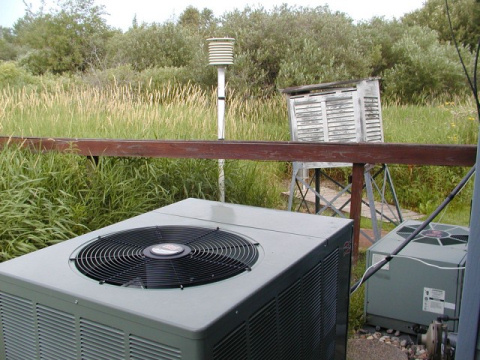
Look at that jump in the last 10 years.  It must be global warming!  Can't possibly be due to these air conditioning units installed around 2000 and venting hot gas on the temperature instrument (in that round louvered thing on the post).
Detroit_lakes_ushcn_2

More from Anthony Watts, who is leading the effort to document all these stations. You too can help.  The odds are you live less than an hour from one of these stations -- take your camera and add it to the data base.  Its fun!

Incredibly, the global warming community still argues that documenting the quality of the installations used in the official global warming numbers is unnecessary.  More air conditioners blowing on official temperature measurements hereWorst temperature installation found to date here, "coincidently" at the site with the highest measured 20th century warming.

Environmentalism and the Division of Labor

Opposition to the world-wide division of labor, which creates so much wealth, is not new.  Ghandi, for example, was a strong proponent of maintaining home-based weaving and manufacturing in a wrong-headed defense of individual "self-sufficiency" against the rising tide of division of labor.  It was a philosophy that would keep Indians poor for another several generations, until they finally began entering the modern economy.  Anti-Globalization advocates, famous for trying to destroy downtown Seattle, have also tried to halt the global division of labor.

Most recently, reversing the global division of labor has become an environmental cause, with buy-local movements springing up all over.  Of course, the success of these efforts would be the express train to poverty -- there is a reason we don't manufacture clothing in every county in America, and it is demonstrated in part by this mess.

The argument these buy-local advocates use is that the global cross-transportation of goods is creating environmental problems, including more CO2.  They also argue that keeping production close to consumers would cause consumers to bear whatever environmental costs there are in manufacturing.  These arguments are absurd.  This might be true, if everything else were held constant, most particularly manufacturing efficiency (but probably not even then).  But of course these other elements would not be held constant.  The efficiency losses from loss of scale alone would dwarf savings in manufacturing costs.  And much of transportation costs are incurred moving extractive resources (eg coal, iron) and these transport costs would only go up if manufacturing destinations were more dispersed.  And all of this is without even discussing division of labor.

Today I saw a story about trash that really hammered home this point:

Contrary to current wisdom, packaging can reduce total rubbish produced. The average household in the United States generates one third
less trash each year than does the average household in Mexico,
partly because packaging reduces breakage and food waste. Turning a live chicken into a meal creates food waste. When chickens are processed commercially, the waste goes into marketable products
(such as pet food), instead of into a landfill. Commercial processing of 1,000 chickens requires about 17 pounds of packaging, but it also recycles at least 2,000 pounds of by-products.

When you push animal-slaughter down to the household level, there is a huge loss in efficiency and increase in environmental impact.  Note how industrial farming, a huge bete noir of modern environmentalists, greatly improves recycling and reduces waste.  Yes, industrial farming seems to have a large environmental impact, but that is in many cases just because it is all in one place and visible.  Blowing these operations up does not reduce the damage, it just spreads it around and makes it less visible.  This kind of narrow-focus static analysis has become fairly typical of today's environmentalists.

Environmentalism and the Division of Labor

Opposition to the world-wide division of labor, which creates so much wealth, is not new.  Ghandi, for example, was a strong proponent of maintaining home-based weaving and manufacturing in a wrong-headed defense of individual "self-sufficiency" against the rising tide of division of labor.  It was a philosophy that would keep Indians poor for another several generations, until they finally began entering the modern economy.  Anti-Globalization advocates, famous for trying to destroy downtown Seattle, have also tried to halt the global division of labor.

Most recently, reversing the global division of labor has become an environmental cause, with buy-local movements springing up all over.  Of course, the success of these efforts would be the express train to poverty -- there is a reason we don't manufacture clothing in every county in America, and it is demonstrated in part by this mess.

The argument these buy-local advocates use is that the global cross-transportation of goods is creating environmental problems, including more CO2.  They also argue that keeping production close to consumers would cause consumers to bear whatever environmental costs there are in manufacturing.  These arguments are absurd.  This might be true, if everything else were held constant, most particularly manufacturing efficiency (but probably not even then).  But of course these other elements would not be held constant.  The efficiency losses from loss of scale alone would dwarf savings in manufacturing costs.  And much of transportation costs are incurred moving extractive resources (eg coal, iron) and these transport costs would only go up if manufacturing destinations were more dispersed.  And all of this is without even discussing division of labor.

Today I saw a story about trash that really hammered home this point:

Contrary to current wisdom, packaging can reduce total rubbish produced. The average household in the United States generates one third
less trash each year than does the average household in Mexico,
partly because packaging reduces breakage and food waste. Turning a live chicken into a meal creates food waste. When chickens are processed commercially, the waste goes into marketable products
(such as pet food), instead of into a landfill. Commercial processing of 1,000 chickens requires about 17 pounds of packaging, but it also recycles at least 2,000 pounds of by-products.

When you push animal-slaughter down to the household level, there is a huge loss in efficiency and increase in environmental impact.  Note how industrial farming, a huge bete noir of modern environmentalists, greatly improves recycling and reduces waste.  Yes, industrial farming seems to have a large environmental impact, but that is in many cases just because it is all in one place and visible.  Blowing these operations up does not reduce the damage, it just spreads it around and makes it less visible.  This kind of narrow-focus static analysis has become fairly typical of today's environmentalists.