Video Release

Please check back Monday morning, as I will be releasing my new video, "What is Normal:  A Critique of Catastrophic Man-Made Global Warming Theory."  As with my global warming book, which began as a ten page summary and ended up as an 85-page manuscript, the video started at a goal of 15 minutes and eventually ended up at 50 minutes.  However, unlike other global warming-related videos I will not name, it is all climate science, with no self-congratulatory segments on my childhood.

Warming and Drought

"It's hot in the desert, so therefor warmer temperatures must cause drought."  That is the logical fallacy I address today over at Climate Skeptic, where we find evidence that, if anything, global warming is making things wetter rather than drier.

Comments are Weirding Out

Not sure what is up with comment viewing.  Have sent service ticket to Typepad.

Immigration Thought of the Day

Frequent readers will know that I am a strong supporter of open immigration.  I don't disagree with McQ at Q&O when he writes "Open Borders or Welfare State: Pick One," but I don't think that this is the logic of most folks who are anti-immigration.  It may be their public stance, but if more folks really thought this way, there would be serious discussion of tiered citizenship or guest worker models similar to what I have proposed on several occasions.

However, I am tempted to become a close-the-border proponent if the left continue to use numbers skewed by immigration to justify expansions of taxation and the welfare state.  Whether they are illegal or not, whether they should be allowed to stay or not, the fact is that tens of millions of generally poor and unskilled immigrants have entered this country over the last several decades.  These folks dominate the lower quintile of wage earners in this country, and skew all of our traditional economic indicators downwards.  Median wages appear to be stagnating?  Of course the metric looks this way -- as wages have risen, 10 million new folks have been inserted at the bottom.  If you really want to know what the current median wage is on an apples to apples basis back to 1970, take the current reported median wage and count up about 10 million spots, and that should be the number -- and it will be much higher. 

Income distribution numbers are the same way.  I showed in a previous post how these numbers are deceptive, when we compare them to Europe, because though European poor have a higher percentage of the median wage in their country, it is a higher percentage of a lower number.  When you correct for that effect, the US poor look pretty equal.  But immigration exaggerates this effect even more.  Instead of having income distribution numbers comparing, say, a lawyer and a blue collar worker, they are now comparing a lawyer and a non-English-speaking recent unskilled immigrant.  Of course the disparity looks worse!

The folks using these numbers have to be smart enough to understand this issue, so it can only be hugely disingenuous that they simultaneously promote immigration (which I support) while at the same time using immigrant-skewed numbers to say that the average US worker is somehow worse off.  If they keep this tactic up, even I may be tempted to close the borders.

Hang in There

Maggie's Farm has a great series of pictures of a bear rescue from a high bridge.

We Just Don't Have Enough Taxes

I propose a survey.  We will ask 500 CEO's of large company's and 500 small business owners just one question

1.  Do you agree/disagree with the following statement:  In order to make my business more competitive in international markets, the federal government needs to raise taxes and expand its scope

How many out of the 1000 would answer "Agree?"  Well, at least the number won't be zero, as long as you ask the NY Times:

"¦the taxes collected last year by federal, state and local governments in the
United States amounted to 28.2 percent of gross domestic product. That
rate was one of the lowest among wealthy countries - about five
percentage points of GDP lower than Canada's, and more than eight
points lower than New Zealand's. "¦the meager tax take leaves the United
States ill prepared to compete. From universal health insurance to
decent unemployment insurance, other rich nations provide their
citizens benefits that the U.S. government simply cannot afford.
"¦revenue will prove too low to face the challenges ahead.

I love the part about unemployment insurance particularly -- other countries are more competitive than we are because they pay their citizens more not to work.  Huh?  Daniel Mitchel responds:

The editorial conveniently forgets to explain, though, how America is
less competitive because of supposedly inadequate taxation. Is it that
our per capita GDP is lower than our higher-taxed neighbors in Europe?
No, America's per capita GDP is considerably higher. Is it that our disposable income is lower? It turns out that Americans enjoy a huge advantage in this measure. Is our economy not keeping pace? Interesting thought, but America's been out-performing Europe for a long time. Could higher rates of unemployment be a sign of American weakness? Nice theory, but the data show better job numbers in the United States.

I also would point out the general direction of net immigration, which has always been towards the US from nearly every country in the world rather than the other direction.

The favorite argument du jour for more taxes is that the US has more income inequality than other countries.  Well, that is sort of true.  Our rich are richer than theirs.  But are our poor poorer?  In fact, as I posted here, the data (from a liberal think tank) shows that they are not.   The poor in European countries have a higher percentage of a lower median wage.  When you normalize European income distribution numbers to percentages of the US median wage, you can see our poor do at least as well as those in Europe, while our middle class and rich do better.

Study2

The US poor still trail countries like Switzerland, but that is because of very different immigration realities.  The US numbers for the bottom quartile are weighed down by tens of millions of recent immigrants (both legal and not) whereas those of Switzerland and Norway are not.  If you left out recent immigrants, my guess is that the US poor would be the richest in the world.

Go, Megan, Go

Best thing I have read all week, from Megan McArdle:

I very rarely get angry about politics. But every time I see some
middle class parent prattling about vouchers "destroying" the public
schools by "cherry picking" the best students, when they've made damn
sure that their own precious little cherries have been plucked out of
the failing school systems, I seethe with barely controllable inward
rage. It is the vilest hypocrisy on display in American politics today.

Maybe They Choose to be Uninsured

Via Arnold Kling, Maggie Mahar writes:

Some citizens of the Commonwealth don't even want to pay for their own
health care insurance. Under the plan, everyone in Massachusetts is
required to buy insurance (or pay a penalty), with the state providing
a 100% subsidy for those who earn less than 150% of the poverty level.
Those receiving the full subsidy are enthusiastic. The state had hoped
to sign up 57,000 uninsured and they've over-shot their target: 76,200
of Massachusetts' poorest citizens have enrolled.

At the other end of the spectrum, the program isn't doing as well.
Uninsured citizens earning more than 300% of the poverty level are
expected to buy their own insurance. Here, the state hoped that 228,000
of its uninsured citizens would sign up. So far, just 15,000 have
enrolled.  Apparently, they've done the math and decided that it would
be cheaper to pay the penalty.  But their premiums are needed to keep
the program going.  If more in this group don't sign up, it is not at
all clear how the state will be  able to continue subsidizing the poor.

All of this adds up to "people without health insurance are so because it is not worth the price."  If they get it free, fine, they will use it like crazy, but they won't pay for it.  So I should for them?

Rollover

The visit counter rolled over 1,000,000 this morning.   I'm not sure that this number is very meaningful any more, as Coyote Blog gets about a thousand feed readers a day who don't register on Site Meter, but its a fun milestone anyway.  Thanks to all you readers for your interest.

Request to Inventors

I am working this afternoon to put a narration track on my climate movie.  The problem is that I don't really want to hire a narrator, and I don't really have that strong of a narration voice.  What we need is some kind of digital filter that I could apply to my narration mp3 file to make me sound better.  Click on "bbc" and suddenly I would sound like I have a lovely British accent.  Click on "darth" and I would have James Earl Jones' deep baritone.  In fact, in anticipation of such technology in the future, I think James Earl Jones needs to spend several days in a sound booth reading the dictionary so that future generation will have access to his voice, at least digitally.

Environmental Preservation of a Man-Made Lake

Environmentalists are working to preserve another priceless natural treasure, one that has been on this earth supporting its habitat for, uh, decades.  From the Save the Salton Sea web site:

The
proposed transfer of water from the Imperial Valley to San Diego as
part of the reduction of California's Colorado River use, the possible
reclamation of New River water by Mexico, and the increased evaporation
from the Sea's restoration all threaten to reduce lake levels.  The
proposed transfer of the 300,000 acre feet alone, if inflows are not
replaced, is estimated to drop lake levels by over 16 feet, exposing
almost 70 square miles of sediments.  The result could be potential air
quality problems caused by blowing dust, seaside homes stranded far
from the Sea, and greatly accelerated concentrations of salts and
nutrients.

Of course its freaking drying up.  In a sense, this lake represents the United States' largest industrial spill, as early in the 20th century a couple of Colorado River aqueducts broke and poured water into the Salton basin, creating a brand new sea.  By usual environmentalist arguments, this lake is supposed to dry up, having been an artificial creation of man.  (By the way, as an extra credit task, I challenge you to find anywhere in the web site linked above where they mention that the lake is a man-made accident that is barely 100 years old).

HT:  Maggies Farm

Government Limitations on Choice

I am a little late on this, but Ilya Somin has a nice post on Joel Waldfogel's book on capitalism and serving niche markets. 

University of Pennsylvania business Professor Joel Waldfogel argues that markets give us too few choices because
they often fail to provide products that satisfy minority preferences.
This is the opposite of Barry Schwartz's argument that markets are bad
because they give people too many choices, which I criticized here.
In one sense, Waldfogel's point is irrefutable: due to high startup
costs or fixed costs and just to the general scarcity of resources in
the world, there are some minority preferences that the market won't
satisfy. The market is undoubtedly inferior to a hypothetical world in
which all preferences, no matter how unusual, could be satisfied at
zero cost. Not even the most hard-core of libertarian thinkers denies
this. That, however, says little about the question of whether
government could satisfy such minority preferences better, or whether
it is even a good thing to provide products whose costs are greater
than their benefits.

He makes a number of good points, including the one that first comes to my mind -- that in most cases, it is the government that tends to limit choice.

the relative lack of diversity of programming on radio stations - one
of Waldfogel's principle examples of the inability of the market to
satisfy minority interests - is actually a failure of government
regulation. As Jesse Walker documents in this book,
the FCC has for decades colluded with big broadcasters in suppressing
alternative and "microradio" broadcasters, thereby greatly reducing the
number of stations and making it very difficult to run a station that
caters primarily to the interests of a small minority. Even a
completely free broadcasting market would not satisfy all potential
listeners. But it would have a great deal more diversity than is
currently permitted by the FCC.

I called for the end of broadcast licensing here.  By the way, the author also ignores Sirius and XM, which have some incredibly niche offerings, and which happen to be in the least regulated part of broadcasting.  Why Sirius would have more niche choices than Clear Channel is explained here.

I could add many other examples onto this.  The FCC's regulation of the cell phone market creates the stupid environment we have today, arguing about locked iPhones.  In a previous post, I demonstrated how new government "a la carte pricing' regulation will lead to more homogenization and less focus on niche viewing audiences in the cable TV industry:

I can add a million examples.  Hair braiders are stepped on by the government in collusion with licensed beauticians.  Taxi companies get the government to quash low-cost or innovative shuttle transportation.  Discount casket companies are banned by government in collusion with undertakers.  Take dentistry.  Why do I need to go to an expensive dentist when 99% of my dental needs could be served by a hygienist alone?  Because the government colludes with dentists to make it so.  And don't even get me started on medicine.  My guess is a huge percentage of the conditions people come into emergency rooms with are treatable by someone without a 4 year medical degree and 6 years of internship.  Does one really need a full medical education to stitch up a kids cut knee?  Well, yes, you do today, because doctors collude with the government to make it so.  Why can't people specialize, with less than 10 years of education, on just, say, setting bones and closing cuts?  Why can't someone specialize in simple wills or divorces without a full law degree?

Every business where the government has licensing is an industry where the government is limiting consumer choice.  It is limiting the number of competitors, and it is specifying a narrow subset of ways in which a company can compete, eliminating service or product innovation.  In Colorado, my employees needs a license to take our customers fishing on a lake.  In Phoenix, you need a license to paint street numbers on a curb.  In Scottsdale you need a license to work out of your own home, a license to valet park cars, and a license to give massages.  And, of course, there are our tremendously dated liquor licensing laws.

Per Milton Friedman:

The justification offered is always the same: to protect the consumer. However, the reason
is demonstrated by observing who lobbies at the state legislature for
the imposition or strengthening of licensure. The lobbyists are
invariably representatives of the occupation in question rather than of
the customers. True enough, plumbers presumably know better than anyone
else what their customers need to be protected against. However, it is
hard to regard altruistic concern for their customers as the primary
motive behind their determined efforts to get legal power to decide who
may be a plumber.

Update:  Just for fun, I sat here and came up with 10 business ideas that would provide better service for customers, would reduce costs in notoriously high cost industries (e.g. medicine, dentistry, law) and which would make me a pile of money. which are all illegal due to licensing requirements that are set in collusion with current industry incumbents.

Garbage Nazis

Apparently, the garbage nazis have won the contract in Seattle.  To remind you, here were some of their proposals in their bid for the contract:

If [CEO Chris] Martin is allowed to implement what he calls "my best
idea, my get-people-riled-up thing," we could all soon be subject to a
kind of garbage audit, too. He wants to bring the equivalent of the
red-light camera to your front curb. Just as the traffic camera
captures you running through a stoplight, CleanScapes' incriminating
photos would catch you improperly disposing of a milk carton. (It
belongs in the recycling bin.)

He also has advocated mandatory waster audits, whatever those are.  This is the choice that libertarians face every day -- we can either vote for a party that wants to listen to our phone calls or the party that wants to search our garbage.  Put a pizza carton in the recycling, you spend a night in the box.  Put a milk carton in the trash, you spend a night in the box.

It's never too early to start google bombing the company's home page:  Garbage Nazis

Frampton Still Alive

I saw Peter Frampton in concert tonight from the eighth row of a small venue.  He still puts on a really good concert.  It is really rare to see someone who has been touring as long as he has having so much fun on stage.  The 40 minute rendition of "Do You Feel Like We Do" was worth the price of admission alone.  The show had a little of everything, from some acoustic guitar to a Soundgarden cover.  He ended the final set with his friend George Harrison's "While my Guitar Gently Weeps," which was quite good.

Giant Trash Island

I am more than willing to believe that too many people treat the oceans as a big trash can.  In particular, I have written before about how Southern Californians in general seem to love to leave their trash lying aboutHowever, I am going to call bullshit on this article:

In reality, the rogue bag
would float into a sewer, follow the storm drain to the ocean, then
make its way to the so-called Great Pacific Garbage Patch - a heap of debris floating in the Pacific that's twice the size of Texas, according to marine biologists.

The enormous stew of trash - which consists of 80 percent plastics
and weighs some 3.5 million tons, say oceanographers - floats where few
people ever travel, in a no-man's land between San Francisco and
Hawaii.

Marcus Eriksen, director of research and education at the Algalita
Marine Research Foundation in Long Beach, said his group has been
monitoring the Garbage Patch for 10 years.

"With the winds blowing in and the currents in the gyre going
circular, it's the perfect environment for trapping," Eriksen said.
"There's nothing we can do about it now, except do no more harm."

The patch has been growing, along with ocean debris
worldwide, tenfold every decade since the 1950s, said Chris Parry,
public education program manager with the California Coastal Commission
in San Francisco.

Uh, right.  Funny that it does not seem to show up in satellite photos.  Again, I am not minimizing the fact that a lot of jerks litter and the trash ends up in the ocean, but the floating island of trash twice as big as Texas and growing by 10x every decade?   I'll file that right next to the story of the grandmother who tried to dry her cat in the microwave.

Magic Act

OK, via Theo comes one of the odder magic acts I have seen for a while.  Not safe for work, as the magician gets nekkid by the end.  Definitely puts to rest the "nothing up my sleeve" thing.

Pumpkin Idea

I see my past pumpkin-carving posts are getting high Google traffic this week.  If you are looking for a pumpkin idea, this was my favorite past effort:

Pumpkin1   Pumpkin2

I traced a world map on the pumpkin, and then thinned the pumpkin skin in the land masses without cutting all the way through.  Since there are no holes, you will need an electric light to illuminate it.

Backyard Nuclear Reactor

I couldn't make the return on investment
(even with a 50% government subsidy and in one of the best solar sites
in the world) work for solar on my home in Phoenix, at least at current
prices and technology.  Maybe I can justify a backyard nuclear reactor?

Hat tip:  Another Weird SF Fan

It Really is a Smaller World

Anthony Watt has a pointer to a nice presentation in four parts on YouTube by Bob Carter made at a public forum in Australia.  He walks through some of the skeptics' issues with catastrophic man-made global warming theory.

What caught my attention, though, were the pictures Mr. Carter shows in his presentation about about 1:30 into part 4.  Because I took the pictures he shows, down at the University of Arizona, as part of Mr. Watts project to document temperature measurement stations.  Kind of cool to see someone I don't know in a country I have (sadly) never visited using a small bit of my work.  Part 4 is below, but you can find links to all four parts here.

I Second the Motion for UnSexy

TJIC quotes Scott Rafer:

Rafer's Rule #1: "˜Un-sexy' is good business. This is a riff on a market
principle Rafer picked up from a couple of his ancestors back east: one
who ran Rafer's Kosher Meats; and his grandfather, who ran Rafer's Army
Navy Surplus (both were in business in the 1950s, long before Rafer was
born.) The idea here is that there is potential in furnishing a
(seemingly) boring business that plenty of people need, but which few
people want to do - a.k.a. stuff that ain't sexy. Which also means
you're likely to have a reliable market for your business, and might
not have so much competition - good!

I absolutely agree.  I have been in sexy and I have been in boring, and from a long-term profit perspective, boring is better.  Here is the way I put it to friends:  "Avoid any business where there are substantial non-monetary reasons why people might want to start a business there."  For example, the bankruptcy roles are littered with brew-pubs.  Guys have a male fantasy of owning their own bar and brewery, and, shazam, there are way too many of them.  Many parts of aerospace are the same way, filled with guys who love aviation more than making money.

From reading the press, it would seem that what the world is short of is "bold new visions."  But in fact bold new visions are a dime a dozen.  I had to try to sell a number of them when I was in the Internet world.  I would argue that what is in fact in desperately short supply is managers and companies who can focus, day after day, ruthlessly on operational excellence.  I worked for years for a company called Emerson Electric in St. Louis, a conglomerate that owned the world's greatest collection of boring businesses.  In their prime, under CEO Chuck Knight, they were unbelievable at blocking and tackling in boring businesses.

This point about boring and sexy is so important that when I was at Harvard Business School, the first two classes in the first year competition and strategy course hammered these points home.  Class one was the story of Rockwell Water Meters.  Class two was the story of some go-go semiconductor business (maybe Fairchild?)  These two cases epitomized "cool" and "uncool", but in the end it turned out the semiconductor firm never made a return on capital, while the water meter business had stratospheric returns.

The common response I get to this is, "but what about all of those Internet millionaires?"  With a few exceptions (Amazon, eBay), most of the folks who made millions in the Internet did not make them from operating profits.  They made them with timing, selling out inflated stock to the public or to a bigger sucker (e.g. Yahoo) before the whole Ponzi scheme crashed.  Does anyone really think that Maria Cantwell created real value in the marketplace?

More Light Rail Suckage

Portland is the poster child for light rail "success," but this is an interesting definition of success:

"Many (Portlanders) use their public transportation system," says
Weyrich. In fact, 9.8 percent of Portland-area commuters took transit
to work before the region build light rail. Today it is just 7.6
percent. In a story repeated in numerous cities that have built rail
lines, rail cost overruns forced the city to raise bus fares and reduce
bus service. That's a success?

A lot more money for fewer total transit riders.  This is absolutely predictable.  Light rail creates huge investment along one single route.  The assets created are totally inflexible -- unlike buses, they can only run one single route.  For most western cities with low density and literally hundreds of different commuting routes this way and that, light rail is silly.  Here are a couple of analysis I did for Albuquerque, LA and Phoenix.  Here is more about Portland.

Update on the Health Care Trojan Horse

I have argued on numerous occasions that government-funded health care is a Trojan Horse for detailed regulation of how we treat our bodiesThe Economist Blog has a great post on this topic:

Why exactly is obesity a public health issue? Well, when,
by force of law, you externalise responsibility for providing a good,
such as health care, then the effects of all individual choices that
affect the cost of providing that good for the individual are thereby
transformed from internal to external effects. If you, like
Mr Dubois, are in the grip of the blithe assumption that reducing
negative externalities by raising the cost of the behaviour that causes
them is simply what government does, then obviously my gluttony and sloth are public problems. Because public policy made them public problems! So, obviously,
it's up to the government to fiddle with prices to manipulate our
behavior in order to minimise its impact on the tax-financed national
budget.

This sort of thing drives me crazy because it's just so
thoughtlessly arbitrary -- intellectual empty calories. Why
specifically a tax on junk food? Yes, one
of the causes of obesity is "the consumption of too many calories."
Another is the failure to burn the calories one consumes. So why not
levy huge fines on people for not showing up at "voluntary"
government-funded yogalates classes? Or if people are consuming too
many calories, then just put a tax on calories. Why tax some calories
but not others? You can get fat eating steak, too. Maybe a national
"cap and trade" system of calorie credits would do the trick. Hey, do
you know who's healthy? Mormons are. Maybe the government should
provide giant tax credits for being Mormon. Or perhaps it would be
easier if the national health care system could just deny services for
ailments it judged to be obesity-related.  You could even decide not to
have a national health care system at all and allow insurance premiums to reflect the actuarial risk of individual behavior! But that would be crazy. 

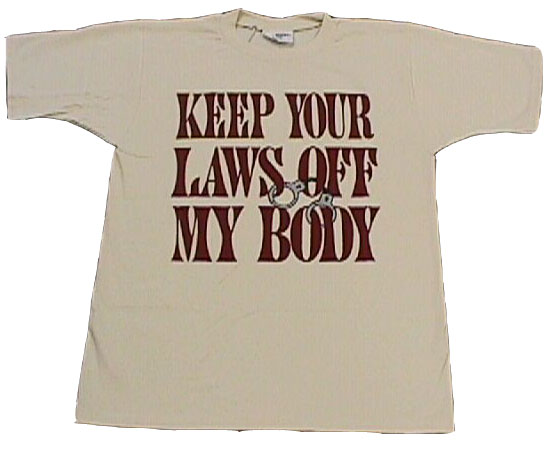
Hat tip to TJIC, who has more.  I think this would be a great anti-universal-coverage T-shirt:

Tskyl2

Ironically, this shirt is produced by the National Organization of Women, who are strong government health care supporters.  Go figure.

The Cold, Cruel Marketplace

Travis has more patience than I do in responding to a bit of anti-market silliness

Good News

The case discussed here and here has been dropped against the Phoenix New Times

At a press conference on Friday afternoon, Maricopa County Attorney
Andrew Thomas announced that all charges against New Times, its owners,
editors and writers have been dropped "” and that special prosecutor
Dennis Wilenchik has been dismissed.

A Political Pitch I Can Buy Into

As a libertarian, I tend to get turned off by most political pitches.  But here is one I can definitely buy into, and it is not even from Ron Paul.