Progressivism as Deep (little-c) Conservatism

At least in economic policy, progressives like Barack Obama are deeply conservative.  They want industries, jobs, real earnings, and class positions to be stable and predictable.  No one ever believes me when I say this, but look at the policies.  Trade protectionism protects current industry incumbents and workers, at the cost of poorer future performance due to lack of competition.  Unions attempt to lock in current jobs through numerous controls on work rules, slow or stop changes in technology and work processes that have the effect of eventually castrating the company (think GM).  Socialized medicine tries to lock in the current standard of care for everyone, while reducing the possibility of future improvements.  Redistribution attempts to lock in the current standard of living for everyone while reducing the possibility of future improvements.  I discussed this more European model last week.

I like how Shannon Love summarized it in the context of Obama:

Obama has no concept of business as a creative and experimental endeavor. On some deep unconscious level, he assumes that material wealth is something akin to a natural phenomenon for which no group of humans can take credit. Therefore, he sees distribution as the only serious economic issue and ignores how politics interferes with the actual process of wealth creation.

Though to be fair, I am not sure McCain or GWB understand this either.     (or here in 2005)

I always laughed at Democrats that tried to woo me to their party.  Now I laugh at Republicans too.  MoveOn may get mileage out of attacking Bush, but he has done more for the left/liberal cause than Clinton.  Clinton had NAFTA, welfare reform, and (moderated by an aggresive Republican Congress) fiscal sanity.

My Votes in 2008

Should I Vote?  Yes, probably.  Many libertarians refuse to vote.  They refuse to be party to a choice between Coke-brand statism and Pepsi-brand statism.  I sympathize, and respect their decision.  You won't hear rants form me about the beauty of the right to vote.  But I see two reasons for libertarians to vote.  One is to find ways to register our existence, to try to communicate that just because we don't riot at WTO meetings doesn't mean that a great well of dissatisfaction does not exist among us.  The second reason is ballot initiatives.  While candidate A and B may be equally bad on the freedom scale, there is often a right answer for protecting freedom in the ballot initiatives, and they need your vote.

President:  Libertarian Party Guy.  Yeah, I know his name is Bob Barr.  I don't even care.  I am casting the vote for the idea, not the guy, in hopes that the Republicans, as they rebuild themselves over the next 2 years, might notice there are some libertarians out there looking for a home.  It would be nice to be as excited about a politician as some folks are about Obama, but really, they are excited by their own vision, not his.  We really know little about him, but my sense is that his every instinct about government run counter to mine.  McCain is hardly better, perhaps going Obama one further by matching him on tax increases and economic nuttiness but also throwing in a dollop of conservative restrictions on non-economic civil liberties.  And I think many of us are exhausted by the prospect of another 4 years of foreign-policy-as-penis-extension that McCain promises.

US Congress:  John Shadegg
.  If it weren't for Jeff Flake and Ron Paul, I would say Shadegg is about the best we libertarians can hope for of a major party candidate.  Not perfect (he was one of the ones who knuckled under on the second bailout vote) but pretty good.

County Sheriff and City Attorney:  Whoever is running against Joe Arpaio and Andrew Thomas.  Seriously.  I don't even know their names and I am voting for them.  I am sick and tired of Arpaio's schtick (index of articles here).  Anyone who can go on a crime sweep into the 99% all-anglo tony suburb of Fountain Hills and come out with arrestees who are 75% Hispanic is not even trying to be fair.  Andrew Thomas has had Arpaio's back for years, fighting many (losing) civil rights cases for him and prosecuting his critics in the media.

PROP. 100 Protect Our Homes:  Yes.  I am not sure this is even that relevant.  Prevents the imposition of taxes or fees on the sale of real estate  (e.g. no real estate sales tax).  Not sure if this is even a threat,  but I will usually vote to limit the power of government.

PROP. 101 Medical Choice for Arizona:  Yes.  This proposition would effectively prevent state health care laws like that in Massachusetts that require medical coverage and mandate certain types of medical coverage.  In Massachusetts, my current insurance plan (which I pay for and did a lot of research to uncover) is illegal (because it has a higher deductible that politicians want to allow).

PROP. 102 Marriage:  Big No.  I don't expect to change anyone's mind on this, but I am not in the least threatened by civil marriages of gays, and in fact have a number of friends and family members who have taken advantage of the brief window of opportunity in California to get married to their partner.  I am not sure how this can be a threat to me -- last I checked, my marriage is as strong today as it was before gay marriage was allowed.  This issue is sort of the conservative equivalent of the left's obsession with income inequality.  Conservatives tell folks (rightly) that they should be concerned with their own quality of life and not feel somehow worse if there are people who are wealthier.  But, then they tell us all our marriages are going to be worse because somebody over there who we never will meet is going to marry someone of the same sex.

PROP. 105 Majority Rules "” Let the People Decide:  Haven't Decided.  This is a weird one.  This would require propositions raising taxes to be passed only if the "yes" votes they receive equate to 50+% of the total registered voting population, not just of the people who voted that day.  Basically, it makes it impossible to have tax increases in propositions, which I like.  But it is a terrible precedent -- this is simply not how we count elections.  In particular, the "registered voter" number is almost meaningless.  Requiring a super-majority of those voting would be much better law.  I may well vote yes, because I suspect the next 2 years are going to be a heyday of taxation, but I will sort of feel guilty about it.

PROP. 200 Payday Loan Reform Act.  Yes.  Would un-ban payday loan companies in Arizona.  I have always supported choice, even for the poor and unsophisticated.  Payday loans are expensive, but as we have learned from subprime loans, maybe credit to borrowers with no income or assets should be expensive.  More here.

PROP. 201 Homeowner's Bill of Rights.  No.  Created by a pissed off union in a fit of pique as an FU to homebuilders.  Mandates decade-long warranties on homes, and offers a myriad of opportunities for trial lawyer hijinx.  And what problem is it solving?

PROP. 202 Stop Illegal Hiring Act.  Yes, I think.  Again, this is one of those confusingly worded initiates that like to use triple negatives.  But I believe it is a softening of the Immigration / hiring law that I have long opposed.  (related:  E-Verify reviewed here

PROP. 300 State Legislators' Salaries.  No.  Changed my mind on this.  At first, I thought current salaries were unreasonably low.  But now I think that they should all go out and get real jobs, and make the legislature part-time.  Maybe they'll meet less often.

Don't Forget Your Tweezers

Hostess Twinkies are becoming the latest product remade and repackaged into 100-calorie snack packs

No word on how small they will be.  This had to be one of the great marketing blinding glimpses of the obvious:

Hostess launched its 100 calorie cupcakes in 2007, but held off on making a version of the Twinkie because the product was a favorite overall, not just among those looking for low-cal options

Get out of town.  Who would have thought that Twinkies were not a favorite for those looking for low-cal options.

Good. Now We Have It On The Table

I am happy to see that Barack Obama is not entirely in reality-avoidance mode with his climate policy:

You know, when I was asked earlier about the issue of coal, uh, you know "” Under my plan of a cap and trade system, electricity rates would necessarily skyrocket. Even regardless of what I say about whether coal is good or bad. Because I'm capping greenhouse gases, coal power plants, you know, natural gas, you name it "” whatever the plants were, whatever the industry was, uh, they would have to retrofit their operations. That will cost money. They will pass that money on to consumers.

To folks with any kind of background in economics, this has to be the case.  Reducing the total output of current power plants, and thereby obsoleting all that investment and squeezing supply, at least in the medium term until new capacity of other types can be built, can only lead to a) rationing through blackouts or b) higher prices to ration the shorter supply.  The cost of option a is so high that price is going to have to be the rationing mechanism.  Skyrocket is actually pretty close to what would happen to rates if Obama sticks by his plan of limiting greenhouse gasses to 1990 or earlier levels.  (His explanation is actually pretty poor for the mechanism - pass-through of retrofit costs would likely be minor to the supply / demand balancing effect of shaving 20/30% off supply in a short period of time.

I think a frank discussion of the dangers of a "pollutant" vs. the cost of abatement is a fair one.  I personally think the threat of CO2 is wildly exaggerated, and the cost of doubling or tripling electricity costs will hurt Americans far worse than a few tenths of a degree of warming.

But don't get too excited.  Obama is still living in economic never-never land on other related issues:

yes, there is going to be some increase in electricity rates on the front end, but that over the long term, because of combinations of more efficient energy usage, changing lightbulbs and more efficient appliance, but also technology improving how we can produce clean energy, the economy would benefit.

Sorry, but this is way wrong.  Obsoleting perfectly good infrastructure and wholesale replacing it with trillions of dollars of new infrastructure does not help the economy any more than if a massive earthquake had destroyed the plants.  This is the broken windows fallacy on steroids.  The only benefit from all this cost will be whatever climate benefit we accrue from the CO2 reduction.  For there to be such a benefit, one must assume a) substantial future warming and b) that the current temperature happens to be the best possible temperature we could ever be at.  But that, as they say, is a whole other blog.

Short Rant on the New Typepad Editor

I am getting used to the new Typepad editor, but two issues still really cause me to question the sanity of the developers, particularly since this roll out has been going on since June:

  • I cannot believe that a blogging engine -- not a generic text editor or HTML editor, but a purpose built blogging engine -- would eliminate the blockquote functionality from the editor.  Have these guys ever, you know, actually read a blog or two?  We bloggers live off block quotes.
  • How long has the computing spelling checking been around?  A couple of decades?  About 10 minutes into that 20 year span, developers learned from users that in addition to a "skip" button, they probably needed a "skip all" button.  Because if you write a 5000 word post on the banking crisis and use the "Bernanke" in that post 100 times, it is going to be real boring hitting "skip" 100 times in the spell check rather than "skip all" or even better "add to dictionary."  But, the rocket scientists at Typepad did indeed only put in a "skip" option, a bit like Ford building a car in which the windows won't roll down.

Can't Happen Fast Enough

The ethanol industry is struggling and a number of players are facing bankrupcy:

The ethanol industry built tremendous production and transportation infrastructure. It was a "if we build it, they will come" strategy.

Then, the world fell apart. Prices for gas at the pump are back down well below $3 instead of being headed toward $5 as they were in August.

Verasun says it will keep operating, but common shareholders have been crushed to death. The stock was at nearly $18 late last year. Now it is under $.40.

The only quibble I have is in the first sentence.  I would would have written the ethanol strategy as "If we seek rents, they will come."

And a Pony

Jack Tapper of ABC list all of the goodies promised by Obama in just one stump speech.  The list is really staggering, even more so than the usual political BS.  It is way to long to excerpt here.  There are so many outrageous ones, its hard for me to even pick a favorite.  But here are a few good ones:

"eliminate the oil we import from the Middle East in 10 years"

Uh, right.  We are going to completely eliminate half the fuel coming into the economy in 10 years.

"lower premiums" for those who already have health insurance;... "end discrimination by insurance companies to the sick and those who need care the most";

Perfect.  We are going to prevent insurance companies from dong any risk management, we are going to pile on even more "must cover" rules for all kinds of crap from acupuncture to mental health, and by doing so we are going to lower premiums.

This may be my favorite, though:

"reopen old factories, old plants, to build solar panels, and wind turbines"

LOL.  Barack is going to open some of those old GM plants in Flint, Michigan and build solar panels.  Seriously, is this a rhetorical flourish or does he really believe that factories are generic production facilities that can make anything, kind of like those little buildings you make in an RTS?

Update: And if you think that voters just discount all this stuff, don't miss this video of Obama supporters talking about the free gas and house she is going to get.

By the way, none of this will push me to vote for McCain.  McCain promises all kinds of crazy stuff too, its just less compelling stuff to voters.   He is not losing because he is promising less -- I think he is losing because Obama has a better grasp of what expensive shit people want to be promised than does McCain.

Remembering My Favorite Pumpkin

From a couple of years ago

Pumpkin1   Pumpkin2

Rather than carve them, I peeled away the outer skin and thinned it in the land areas, creating this effect.

If I Had to Leave the United States

There is a quote from Robert Redford in Three Days of the Condor** that honestly reflects my opinion on the topic of leaving the US  (Redford is Joe Turner, running away from the CIA, while Joubert is an assassin-for-hire):

Turner: I'd like to go back to New York.

Joubert: You have not much future there. It will happen this
way. You may be walking. Maybe the first sunny day of the spring. And a
car will slow beside you, and a door will open, and someone you know,
maybe even trust, will get out of the car. And he will smile, a
becoming smile. But he will leave open the door of the car and offer to
give you a lift.

Turner: You seem to understand it all so well. What would you suggest?

Joubert: Personally, I prefer Europe.

Turner: Europe?

Joubert: Yes. Well, the fact is, what I do is not a bad occupation. Someone is always willing to pay.

Turner: I would find it"¦ tiring.

Joubert: Oh, no "” it's quite restful. It's"¦ almost peaceful.
No need to believe in either side, or any side. There is no cause.
There's only yourself. The belief is in your own precision.

Turner: I was born in the United States, Joubert. I miss it when I'm away too long.

Joubert: A pity.

Turner: I don't think so.

A great line, particularly in a movie steeped in cold war weariness.  Anyway, I was listening to some rant on NPR about leaving the US if McCain won the election, and I asked myself if I had to leave the US, what would be my rank order of countries to which I might move.  My list is highly influenced by language (at 46 I hardly feel like learning a new language) and by countries of which I am knowledgeable.  Here is what I came up with:

  1. Australia
  2. Bermuda
  3. UK
  4. Canada
  5. Singapore
  6. the Netherlands
  7. Switzerland
  8. Spain
  9. Germany / Austria
  10. Costa Rica

Here are some notes on the list, as well as some explanations of countries left off:

  • I have yet to meet an American who did not enjoy living in Australia (and many long to go back).  I came within about 5 minutes of living in Bermuda about seven years ago.  I have always liked the UK and have spent many summers there.
  • Ireland might belong high on the list, but I have never been there and am not that familiar with it.  But my sense is that if I really were to research it, Ireland would make the top 5.  I could also probably have rattled off a number of other British island colonies, but kept it to Bermuda.
  • Canada ... its like a whole other state   (this is a line I uttered at business school once, echoing the then-current "Texas ... its like a whole other country" advertising campaign.  It was not well-recieved by our northern neighbors.  I still think a few Canadians are trying to hunt me down up there
  • Been to Singapore a few times.  An odd place, but certainly a liveable one.  Last gasp of the English speaking choices on the list.
  • Netherlands and Switzerland are both fairly capitalist-friendly nations with good support for a displaced English speaker.  I have spent more time with the Dutch, so it is a bit higher, but Switzerland is freaking gorgeous.
  • Spain is on the list mostly as a language play.  Not a huge fan of the Spanish government, but I speak the language well enough to pick it up quickly.  Good beaches, and the south coast has many of the appeals of Provence without the prices (and the French).  A couple of years ago this probably would have been Argentina.  I really loved Argentina when I was there, but I am scared a bit by the current political and economic climate.
  • I like Austria, and Germany is OK.  Not America but perfectly reasonable places to live.
  • If I am really running not just form the US but the first world in general, I might pick Costa Rica.  A pretty good government, particularly for Latin America, beautiful, and plenty of places to be secluded (and/or hide, if the need were to arise).
  • I considered the Czech Republic.  Prague seems to be the white-hot destination for American tourists, and they certainly know their beer.  But I suspect that Eastern Europe has several more decades of work before the every day conveniences and creature comforts to which I have become accustomed in the US are prolific there.
  • Scandinavia is too freaking cold.  Maybe if I were single I might find some appealing reasons to reconsider...
  • There may be some country like Monaco that would suit me perfectly but of which I am wholly unfamiliar.

Readers are welcome to propose their own priorities in the comments.

** Postscript: Three Days of the Condor is one of my favorites, for a couple of reasons.  First, I always loved Faye Dunaway.  Second, and more important, I like thrillers that have a more languid pace.  I know that sounds weird to say, and if I were a film critic I might have the right words, but there is something about the music and the editing and the pacing that almost stands in contrast to the urgencies of the plot itself.  Despite being on the run through the movie, Redford never actually runs.  No car chases either.  Sort of the antonym to the shaky rapid-cut camera action of, say, the Bourne movies.  Other movies I would put in this same category are LA Confidential (maybe my favorite movie) and perhaps the newer version of the Thomas Crowne Affair. I might put Chinatown on this list too, but then since 3 of the 4 would include Dunaway, one might think my first rather than my second criteria was driving the list.

By the way, even action movies could learn something from this.  The first Indiana Jones movie was great in part because the action scenes were interspersed with quiet scenes.  The audience gets to rest from time to time, and the action is highlighted by the contrast.  You can even have some token character development.  Later Indiana Jones movies fell into the trap of going for non-stop adrenalin.

Absolutely Predictable

Apparently, even before the first train starts carrying passengers (sometime in December), Phoenix's new light rail system is already forcing bus fares up.  (via a reader)

Before the Valley's light-rail service ever begins, the cost to ride the train and city buses may be headed up.

The issue of raising the Valley's regional fare policy has been brewing for several months as transit officials have struggled to cover
rising gas prices and other increased operation costs, said Greg Jordan, Tempe's transit administrator. Transit and light-rail costs are covered by a half-cent sales tax, which has fallen over the past year.

The real issue is that transit agencies are generally given a fixed pot of money for operating subsidies (in this case the proceeds of a half-cent sales tax) and rail tends to take a hugely disproportionate share of that money, starving out less sexy but more practical and cost-effective bus systems.  Even in the that wet dream of rail planners, Portland:

In fact, 9.8 percent of Portland-area commuters took transit to work before the region build light rail. Today it is just 7.6 percent. In a story repeated in numerous cities that have built rail lines, rail cost overruns forced the city to raise bus fares and reduce bus service. That's a success?

This is even more likely in Phoenix, where buses make far more financial sense than rail, given our very low densities, lack of a real downtown area, and numerous commuting routes.  In fact, not only is it predictable, but I predicted it:

Rail makes zero sense in a city like Phoenix.  All this will do is create a financial black hole into which we shift all of our bus money, so the city will inevitably end up with a worse transportation system, not a better one.  Cities that build light rail almost always experience a reduction in total transit use (even the great God of planners Portland) for just this reason - budgets are limited, so since rail costs so much more per passenger, other transit is cut back.   But the pictures of the train will look pretty in the visitor's guide.

More on the European Economic Model

Yesterday I posted on the irony that in the name of "change" and "dynamism," the Democrats are pushing for what basically is an inherently more conservative (little-c), less dynamic economic system that mirrors that of many continental European countries.

Daniel, an American reader who does quite a bit of work in Europe, wrote me:

1) The static nature of the Euro mentality assigns a high cost to ... people ... who try to break the mold. Cost of failure is relatively high. In Italy if your small business declares bankruptcy, you forfeit the right to vote.

2) In Germany, workers are sorted at an early age into "blue collar schools" and "professional schools". I know from my youth, if I had grown up in Germany instead of America, I probably would not be a consultant but more like a janitor (not that there is anything wrong with janitors...).

3) Social services in Europe are hit and miss. In Germany, many people carry private insurance despite the availability of public insurance because of the lack of quality.

4) (this may be a good thing) Italian school children go through a less harsh puberty than American kids. Society has drilled into them that it's not cool to be different, so there are less cliques. When I share my experiences in school with most Europeans they usually make some snide remark about how growing up in a battle zone (primary school) has caused the Iraq war.

5) Highly skilled workers are in many cases no better paid than unskilled staff. In the south of Italy a senior programmer may make 2K euros per month. A secretary might make 1.5K a month. If it weren't for most Europeans fear of moving to new cities, there would be no programmers to hire.

6) Speaking of being afraid to move, many Europeans find the thought of moving to a different city complete alien concept.

7) Life in Euro is a much more comfortable than in America *if* you are European. If you are an immigrant, forget it. After two years of pitching companies in the South of Italy, I have never seen a black person be more than a street side vendor of trinkets. In Italy, there is an unsaid rule that you must be an Italian to ever be a professional.

8) Don't get me started on France.

9) It is illegal for a business to stay open more than it's quota in most European countries. It is illegal to operate a barber shop on Mondays.

Don't Dance on the Times' Grave

Recent circulation numbers showing continued, substantial declines of traditional newspapers give me an excuse to make a point I have wanted to make for some time. 

I am a frequent critic of newspapers.  I think they have lost focus on the hard-hitting investigative journalism which used to be their highest and best calling, instead considering reiteration of an activist's press release sufficient to check the journalism box on some particular issue.  When investigative reporting does occur, it almost always is focused to support the dominant or politically correct outcome, rather than to really challenge conventional wisdom.   Media coverage of any technical issue involving science or statistics or economics is often awful, in large part because journalism is too often the default educational path of folks who want to avoid numbers.  Any time I have been on the inside of some issue receiving coverage, I have generally been astounded by how little the print descriptions matched reality.  Now that I am interviewed more as a source for articles, I never think my views are well-quoted (though that may be my fault for not talking in sound bites).  And, like many, I get irritated that the media's arrogance and self-referential reporting seems to increase in direct proportion to their drop in circulation.

All that being said, the world without healthy newspapers is a bad thing. 

First, we bloggers can blather on all day about being the new media, but with the exception of a few folks like Radley Balko, we're all editorial writers, not reporters  (I consider my role at Climate-Skeptic.com to be more like journalism, but only because there is such a glaring hole on that topic in traditional media).  I couldn't do what I do here, at least on this particular blog, without the New York Times and the Washington Post.  I'm a remora feeding on their scraps.  I can't bring down the big fish by myself, I can only feed on the bits they miss.

Second, and perhaps more important in this world of proposed reinstatement of the Fairness Doctrine, print media is the mode of speech best protected by the First Ammendment.  This isn't the way it should be -- all speech should be equal -- but in reality goofy regulatory regimes for radio, TV, and even the Internet all offer the government leverage points for speech control they don't have with the print media.  It's why half the dystopic sci fi novels out there have a world dominated by TV -- because that is where government has the most control of speech.

So here's hoping you guys at the NY Times get your act together.

European-Style Political Economy Coming to America

A lot of folks, particularly on the left, look with some fondness at the political economy of continental Europe.  They are attracted by high job security, short work weeks, long vacations, and a strong welfare system.  They make the mistake of seeing in these traits a more promising society "for the little guy," when in fact just the opposite is true.

The European Corporate State

The political economy of companies like Germany and France are actually incredibly elitist, dominated by perhaps a hundred guys (and I do mean guys) who run the country in a model only a few steps removed from Mussolini-style fascism or the Roosevelt's National Industrial Recovery Act.   In these countries, perhaps 20 corporations, ten or fifteen large unions, and a group of powerful politicians and regulators run the economy.

US workers sometimes make the mistake of seeing the political power of European unions and equating this power with being a more egalitarian environment for workers.  But the European political economy is rule by the in-crowd over the out-crowd that exceeds any of the patronage relationships we complain about in this country.  What we don't often see from our American perspective is the way the system is structured not to protect poor from the rich or the weak from the strong, but to protect incumbents (whether they be corporations or skilled workers) from competition.

In the European labor markets, mobility is almost impossible.  The union system is built to protect current high-skilled workers from competition from new workers, whether in the same country of from abroad.  Large corporations that form part of the cozy governance of the country are protected from new competition, and are bailed out by the government when they hit the rocks.

As a result, unemployment is structurally high in countries like France and Germany, hovering for decades between 8 and 12% -- levels we would freak out at here.  Young and/or unskilled workers have a nearly impossible time breaking into the labor market, with entry to better jobs gated through apprenticeships and certifications that are kept intentionally scarce.  Joe the plumber is an impossibility in Europe.  Some Americans seem to secretly love the prospect of not easily being fired from their job, but they always ignore the flip side -- it is equally hard to ever be promoted, because that incompetent guy above you can't be fired either.

Entrepreneurship in Europe is almost impossible -- the barriers just to  organizing your own corporation legally are enormous.  And, once organized, you will quickly find that you need a myriad of certifications and permissions to operate in your chosen field -- permissions like as not that are gated and controlled by the very people you wish to compete with.  The entire political economy is arrayed in a patronage system to protect current businesses with their current workers.

Here is a test, that works most places in the US except possibly in Manhattan.  Ask yourself who are the wealthiest and/or most succesful people that you know.  Then think about where they went to school.  Sure, some of the more famous Fortune 25 CEOs went to name schools, but what about the majority of succesful people you meet in your life?  If you are like me, most of them did not go to Ivy League or what one might call elite schools.  They had normal state college educations.  You will typically find a very different picture in Europe.  While of course there are exceptions, it is much more likely that the wealthy people one meets were channeled through a defined set of elite schools.

Corporations in Europe, particularly the cozy few who wield influence with the government, seldom fail and/or really gain or lose much market share.  I always thought this a telling statistic:  (Fortune 100 by year here)

[Olaf Gersemann] points out that of the top 20 largest publicly traded companies in the US in 1967, only 11 are even in the top 60 today, much less the top 20.  In contrast, he points out that of the 20 largest German companies in 1967, today, thirty-five years and nearly two generations later, 19 are still in the top 60 and 15 are still in the top 20.

Its also an inherently anti-consumer society.  The restrictions on foreign trade, entrepreneurship, and new competition all reduce consumer choice and substantially increase prices.  EU anti-trust enforcement, for example, barely pretends any more to look out for consumer interests.  Most of the regulators decisions are better explained by protection of entrenched and politically influential European competitors than it is by consumer power or choice.

"Progressives" in this country often laud the lower income inequality numbers in Europe vs. the United States.  The implication is that the poor in Europe are somehow better off.  But in fact this is not true.  Careful studies have shown that the poor are at least as well off in the US as in Europe, particularly when one corrects for the number of new immigrants in the US.  (That's another difference, by the way -- Europe is virtually closed to immigration, at least as far seeking new integrated citizens is concerned).  What drives income inequality is that our middle class is richer than Europe's middle class, and our wealthy have more income than Europe's wealthy.

To this last point, I have always felt that comparisons of the wealthy in the US to those in Europe, and comparison of income inequality numbers, are a bit apples and oranges.  The US is a country where access to most of the best perks is via money - they have a price.  In Europe, access to most of the best perks can't be bought by money, they can only be accessed by those with the elite establishment club card.   To some extent, the income numbers understate the difference between rich and poor in Europe for this reason.

Next Stop:  America

We see many of the elements of the European economic system slipping into the US today.  An increasing number of professions require certification by the government, with this certification often either controlled by the incumbents in the profession or with criteria that essentially require new entrants to compete in the same way incumbents do.  We see the top companies with political influence, from Wall Street firms to banks to automobile manufacturers getting government assistance to stay in business or maintain their status.  This, from the proposed GM bailout, is the European system personified:

General Motors and Cerberus Capital Management have asked the U.S. government for roughly $10 billion in an unprecedented rescue package to support a merger between GM and Chrysler, two sources with direct knowledge of the talks said on Monday....

one of the conditions of the merger would be that GM-Chrysler would spare as many jobs as possible in order to win broad political support for the government funding needed to complete the deal, people familiar with the merger discussions said.

This is the same political deal cut in Europe.  Large powerful company is protected from failure by government.  In turn, powerful company protects interest of powerful union.  The only thing missing here, which I think is clearly on the agenda for the Obama administration, is a large protective tariff to shield this inefficient mess from competition.  Left out of the equation are consumers, who get more expensive cars and suffer because GM is again given a hall pass from producing cars that people actually want to buy.  Also left out are potential competitors, who don't get the government deal and who miss out on the chance to buy up GM assets and hire ex-GM employees out of bankruptcy and do a better job with them.  This European system puts a premium on keeping productive assets in their current hands, rather than in the most productive hands:

Corporate DNA acts as a value multiplier.  The best corporate DNA has a multiplier greater than one, meaning that it increases the value of the people and physical assets in the corporation.  When I was at a company called Emerson Electric (an industrial conglomerate, not the consumer electronics guys) they were famous in the business world for having a corporate DNA that added value to certain types of industrial companies through cost reduction and intelligent investment.  Emerson's management, though, was always aware of the limits of their DNA, and paid careful attention to where their DNA would have a multiplier effect and where it would not.  Every company that has ever grown rapidly has had a DNA that provided a multiplier greater than one... for a while.

But things change.  Sometimes that change is slow, like a creeping climate change, or sometimes it is rapid, like the dinosaur-killing comet.  DNA that was robust no longer matches what the market needs, or some other entity with better DNA comes along and out-competes you.  When this happens, when a corporation becomes senescent, when its DNA is out of date, then its multiplier slips below one.  The corporation is killing the value of its assets.  Smart people are made stupid by a bad organization and systems and culture.  In the case of GM, hordes of brilliant engineers teamed with highly-skilled production workers and modern robotic manufacturing plants are turning out cars no one wants, at prices no one wants to pay.

Changing your DNA is tough.  It is sometimes possible, with the right managers and a crisis mentality, to evolve DNA over a period of 20-30 years.  One could argue that GE did this, avoiding becoming an old-industry dinosaur.  GM has had a 30 year window (dating from the mid-seventies oil price rise and influx of imported cars) to make a change, and it has not been enough.  GM's DNA was programmed to make big, ugly (IMO) cars, and that is what it has continued to do.  If its leaders were not able or willing to change its DNA over the last 30 years, no one, no matter how brilliant, is going to do it in the next 2-3.

So what if GM dies?  Letting the GM's of the world die is one of the best possible things we can do for our economy and the wealth of our nation.  Assuming GM's DNA has a less than one multiplier, then releasing GM's assets from GM's control actually increases value.  Talented engineers, after some admittedly painful personal dislocation, find jobs designing things people want and value.  Their output has more value, which in the long run helps everyone, including themselves.

The alternative to not letting GM die is, well, Europe (and Japan).  A LOT of Europe's productive assets are locked up in a few very large corporations with close ties to the state which are not allowed to fail, which are subsidized, protected from competition, etc.  In conjunction with European laws that limit labor mobility, protecting corporate dinosaurs has locked all of Europe's most productive human and physical assets into organizations with DNA multipliers less than one.

Beyond the actual legislation, the other sign that the European model may be coming to the US is in attitudes.  I think Michelle Obama is a great example of this.  She and her husband checked all the elite boxes - Princeton undergrad, Harvard Law - but she is shocked that having punched her ticket into elite society, society didn't automatically deliver, as it might in, say, France.  She's actually stunned that, had it not been for Barack's succesful books, they might have had to give up their jobs as community organizers and at non-profits to actually earn enough to pay back their 6-figure school loans.

Despite their Ivy League pedigrees and good salaries, Michelle Obama often says the fact that she and her husband are out of debt is due to sheer luck, because they could not have predicted that his two books would become bestsellers. "It was like, 'Let's put all our money on red!' " she told a crowd at Ohio State University on Friday. "It wasn't a financial plan! We were lucky! And it shouldn't have been based on luck, because we worked hard."**

The Progressive Irony

In all this, I think there is an amazing irony.  In a nutshell its this:  The "Change" that Barack Obama is selling to the electorate is in fact the creation of a government infrastructure to fight change.  I have written before that progressives are actually inherently conservative.

Ironically, though progressives want to posture as being "dynamic", the fact is that capitalism is in fact too dynamic for them.  Industries rise and fall, jobs are won and lost, recessions give way to booms.  Progressives want comfort and certainty.  They want to lock things down the way they are. They want to know that such and such job will be there tomorrow and next decade, and will always pay at least X amount.  That is why, in the end, progressives are all statists, because, to paraphrase Hayek, only a government with totalitarian powers can bring the order and certainty and control of individual decision-making that they crave....

One morning, a rice farmer in southeast Asia might faces a choice.  He can continue a life of brutal, back-breaking labor from dawn to dusk for what is essentially subsistence earnings.  He can continue to see alarge number of his children die young from malnutrition and disease.  He can continue a lifestyle so static, so devoid of opportunity for advancement, that it is nearly identical to the life led by his ancestors in the same spot a thousand years ago.

Or, he can go to the local Nike factory, work long hours (but certainly no longer than he worked in the field) for low pay (but certainly more than he was making subsistence farming) and take a shot at changing his life.  And you know what, many men (and women) in his position choose the Nike factory.  And progressives hate this.  They distrust this choice.  They distrust the change.  And, at its heart, that is what the opposition to globalization is all about - a deep seated conservatism that distrusts the decision-making of individuals and fears change, change that ironically might finally pull people out of untold generations of utter poverty.

Don't believe me?  Below is from an email I received.  The writer was outraged that I would have the temerity to say that the middle class in the US had it better than even the very rich in the 19th century.

Sure, the average rural resident of a developing country earns more in dollars today than before. But you're missing the big picture. Wealth is about so much more than just money, and status symbols. It is about health, and well being, and contentedness, and happiness. The average peasant family in India in 1900 may have lived a spartan lifestyle by today's standards, but it probably could rely on more land per family, crops uncontaminated by modern pesticides and fertilizers, a stronger social network and village-based safety net. These peasants were self-sufficient. That is no longer the case

Progressives want to eliminate risk and lock in the current world.  New technologies, new competitors, new business models all need to be carefully screened and gated by a government-labor-corporate elite.  Entrepreneurship, risk, mobility, achievement all should be sacrificed to a defined and steady paycheck. In the name of dynamism, progressives, as well as many modern politicians, want to limit the dynamism of the American economy.  In the name of egalitarianism, they wish to create a small political elite with immense power to manage everyone's life.  In the name of progress, they wish to lock current patterns and incumbents in place.

** Postscript: By the way, here is how I responded to Michelle Obama's education debt rant

I don't know why I can't just move along from Michelle Obama's rant about the terrible cost of her Princeton / Harvard Law degree.  Maybe its because I attended the same schools (different degrees) and my reaction is just so different -- I had a fabulous experience and live in awe that I had such a unique chance to attend these schools, while Michelle Obama seems to experience nothing but misery and resentment.  Granted that I did not have to take on a ton of debt to get these degrees, but I have plenty of friends (and a wife) that did.

This analogy comes to mind:  Let's say Fred needs to buy a piece of earth-moving equipment.  He has the choice of the $20,000 front-end loader that is more than sufficient to most every day tasks, or the $200,000 behemoth, which might be useful if one were opening a strip mine or building a new Panama Canal but is an overkill for many applications.  Fred may lust after the huge monster earth mover, but if he is going to buy it, he better damn well have a big, profitable application for it or he is going to go bankrupt trying to buy it.

So Michelle Obama has a choice of the $20,000 state school undergrad and law degree, which is perfectly serviceable for most applications, or the Princeton/Harvard $200,000 combo, which I can attest will, in the right applications, move a hell of a lot of dirt.  She chooses the $200,000 tool, and then later asks for sympathy because all she ever did with it was some backyard gardening and she wonders why she has trouble paying all her debt.  Duh.  I think the problem here is perfectly obvious to most of us, but instead Obama seeks to blame her problem on some structural flaw in the economy, rather than a poor choice on her part in matching the tool to the job.  In fact, today, she spends a lot of her time going to others who have bought similar $200,000 educations and urging them not to use those tools productively, just like she did not.

Update on Corporate Compliance Minutes Scam

I got another one of those scam letters from a company that attempts to trick businesses into thinking their bill is actually a requirement of a state regulatory organization (original post here).  This one is from the "Indiana Corporate Compliance Business Division."  It looks like one of the millions of small fees a business actually does have to pay to state governments for all kinds of random stuff, but is actually a business solicitation.  I will give this one credit - the font size at the bottom where they say this is a business solicitation and not a bill from a government agency is actually a size larger than similar language on the last one I received.  (click to enlarge image below)

scam

I did not take them up on their offer, so I do not know what one would get back, if anything, from them.  It is indeed important to keep minutes books up to date.  But I do know that the information they request in addition to the fee is not nearly enough to create a meaningful set of minutes for one's corporation, so my guess is it is a ripoff.

So If It's All About the TED Spread, Should We Be Worried?

Us non-financial types are always learning something new.  After a lifetime of thinking that our economy rests on free markets, entrepreneurship, an educated and flexible labor force, risk-taking, etc., we suddenly find that everything depends on the TED Spread, a metric most of which most of us were blissfully ignorant 2 months ago.

The TED spread is basically the difference or spread between short term inter-bank loan rates and short term treasuries or T-bills.  It is in some sense a measure of perceived risk of lending to banks vs. (what are considered) low or near-zero risk US treasury obligations.  One way to think about it in the current market is how much extra would you need in interest to lend to your slacker brother-in-law Earl vs. say to Bill Gates.

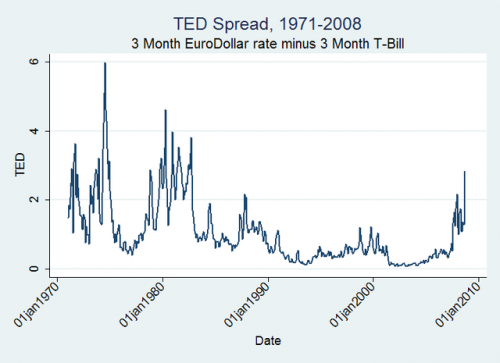
Not surprisingly, the TED spread has shot up over the last few weeks, and it tends to be the #1 metric cited in declaring impending doom for the US economy.  But Alex Tabarrok looked at a longer view of the TED spread, and found this:

ted-spread

Now, the period from 1970-1983 were not by any means an economic glory period, but on the other hand its clear that TED spreads of the order of magnitude we have seen in the past weeks are not unprecedented by any means.

The problem I have with the TED spread is that higher recent spreads are being used as an indicator that credit has "dried up" and lending is at a standstill.  Why do I resist this conclusion?  Because of this chart:

real_gas_prices

So, gasoline prices rocketed from $1.50 a gallon to over $4.00 a gallon.  Does this mean that gasoline purchases have stopped?  Has the gasoline market closed up shop?  Of course not.  It just means the price went up.  It is absurd to show me a price chart, which is what the TED spread graph is, and infer from it changes in the underlying transaction volume.

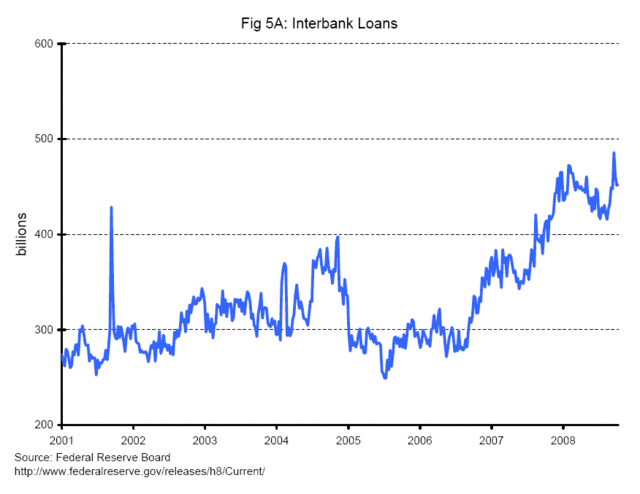
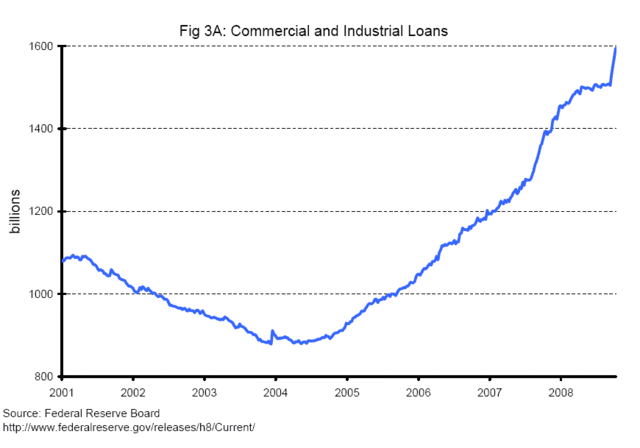
In fact, when one looks at actual volume, of inter-bank loans or new commercial lending, there is not (at least yet) any of the drop-off everyone seems to assume exists.  For example:

Interbank_4

Defending Speech With Which I Don't Agree

Yeah, I think the title is worded awkwardly, but I am trying to curb my enthusiasm for ending sentences with prepositions  (I will continue to boldly split infinitives that no man has split before).

Anyway, in the spirit of this post and this one, I try from time to time to reinforce my support for free speech as an absolute right by publicly supporting the speech rights of those with whom I disagree.  Today's case is the public University of Nebraska-Lincoln deciding to un-invite former terrorist William Ayers to speak on campus.  The reason given was the current weak-ass excuse often used to reverse the invitation of controversial speakers, "we can't gaurantee security." 

Though I would never have hired the guy, Ayers is a professor at a real public university, and what he has to say is particularly relevant given his ties to Barack Obama.  I find the behavior of Nebraska's conservative politicians to be especially absurd here -- after months of calling for more discussion and disclusore of Ayers and his ties to Obama, they want to prevent Ayers from speaking publicly?

Update:  In an odd coincidence, at about the same time I was writing this post, the NY Times blog was posting on split infinitives.

No Thanks, We're Waiting on Our Bailout

Via a reader:

An auction that netted $7.5 million in bids on 56 distressed Utah properties fell through last week after the owners -- three banks and two private lenders -- decided they may get a better deal by holding out for the government's bailout plan.

"There were buyers, but we couldn't sell the homes because free enterprise has gone out of the market," said Eric Nelson, founder of Las Vegas-based Eric Nelson Auctioneering.

His company on Sept. 30 put up for sale 56 foreclosed properties and lots, most of which are in Utah County.

The auction, held in Salt Lake City, attracted thousands, including 200 bidders who bid between $275,000 and $615,000 for 10 luxury homes in Midway and Murray that were appraised at between $525,000 and $652,000. They bid between $26,000 and $100,000 for 44 custom lots in Mapleton, Elk Ridge, Lehi, Alpine, Ogden, West Haven and Willard that were valued between $112,000 and $290,000 a piece.

The most-expensive properties on the auction block included a $1.2 million unfinished home in Draper, which attracted the highest bid at $615,000, while a 62-acre parcel in Park City that's valued at $3.5 million, snagged the highest bid at $1.125 million, said Eric Taylor Nelson, the company founder's nephew.

But all those bids were rejected late last week...

"This has never happened before. In the 25 years we've conducted lender-owned auctions, we've consistently closed over 95 percent of all high bids," Nelson said.

"The stock market's historic drop last week and the bailout plan are some of the main reasons why the lenders rejected the bids," he said. "They're thinking, 'Why sell the properties for 50 cents on the dollar when they may get 75 cents or 80 cents through the bailout?' "

Aaaarrrrggghhh- Typepad Put This Blog on New Editor, Which Sucks

The new Typepad editor is not at all ready for prime time.  I cannot find a single new feature in it, but it is rife with bugs.  Ones I have found so far:

  • Certain images will not upload correctly into a post.  The Typepad folks do not know why
  • Twice I had a crazy error when all of the text and buttons in the "add link" popup window suddenly were inserted into the post
  • All my category setup was overwritten and I had to redo it all
  • The spell checker is awful.  There is no "skip all" button.  I used "IPCC" 50+ times in one post at my other blog, and had to hit skip 50 times over and over
  • The eliminated the blockquote editor option.  Good job on a blog editor!
  • It is slow, slow, slow.

This is one of those enforced beta situations where all of use users are forced to do the beta testing they should have done.  This is the one downside to web-based applications, because there is no way I can do a rollback to the old version.

Update:  Also, publish is way slowed down.  Sometimes it take several minutes to be able to see new posts on my blog. This one still has not appeared after hitting shift-refresh now for 3 minutes.

Update #2:  They sent me an article to trumpet all the new features, but I could find not a single new feature listed.  And it is probably a bad sign they felt the need to put this up front in the article:

If you are seeing the new compose, please be aware that it is not a beta version, it's an upgraded editor that you should be seeing.

LOL

Update #3:  Getting good comments about WordPress.  I may have to check it out.

You Heard It Here First

I said it a couple of weeks ago:

Economists will be poking through this situation years from now, and may well find the bunkers
empty of WMD's.  Another trillion dollar commitment and unprecedented
expansion of executive power ramrodded on the back of fear mongering
and chicken-little crisis declaration.

And even before that on October 1

Well, they're picking through the bunkers now, and its not at all clear the threat was what it was portrayed to be.  The Fed of Minneapolis debunks four myths (pdf)

Myth 1. Bank lending to non…nancial corporations and individuals has declined sharply.
Myth 2. Interbank lending is essentially nonexistent.
Myth 3. Commercial paper issuance by non…nancial corporations has declined sharply and rates have risen to unprecedented levels.
Myth 4. Banks play a large role in channeling funds from savers to borrowers.

Apparently, others are starting to make the WMD comparison.

A couple of examples below.  First, sure looks like all the inter-bank lending has dried up:

Interbank_4

Yep, and no one is lending to Main Street businesses either, so we better do something!

Commercial_2

Just to avoid confusion, that upward spike began in September, well before the Lehman bankruptcy.  Similar stories in commercial paper, consumer lending, leases, etc.  See the whole thing.

New Typepad Editor Bugged

For some reason, Typepad put one of my blogs (but not my
others) on a new editor, probably as an involuntary beta.  The new
editor is much, much slower, and has fatal bugs that make use of images
in posts virtually impossible.  I have wasted a lot of time today.

This is actually a problem with online applications I had not
considered before.  When I heard iTunes 8 was initially bugged or
learned to hate Vista, I would just avoid making the "upgrade."  But
with online services, I have no choice but to accept the new version,
even if I consider it worse (as is so often the case nowadays in
software).

Students Make $100 Financial Mistake: Very Alarming!

This story comes from the Arizona Republic as part of the general effort to maintain the ban on payday loan companies passed earlier this year (their is a proposition on the ballot in November to overturn the ban).

At least 5 percent of last year's freshmen at the University of Arizona obtained a payday loan, a figure the surveyor described as "very alarming."

Arizona's Norton School of Family and Consumer Sciences conducted
the survey, which measured the financial habits of 2,172 freshmen -
about a third of the class - who enrolled in fall 2007.

Student use of payday loans
more than doubled based on a survey taken a year ago that included
freshmen through seniors, said professor Soyeon Shim, the group's
director.

"As consumers, students shouldn't be using payday loans as a resort to deal with financial stress," Shim said.

I wouldn't really recommend that students use this expensive form of ready cash, but I can't say I am particularly alarmed.  How can any of us know what pressures they are under.  In most circumstances, paying a 30% interest rate seems too high.  But I know, from personal experience, there are times when short term liquidity is so valuable you might pay anything for it  (just look - the American taxpayers are paying about a trillion dollars this year just for short-term liquidity).

In fact, if students have a bad experience, it's probably better to learn a $100 life lesson in college rather than a $500,000 life lesson later flipping condos on interest-only loans.  I personally had my own caveat emptor eye-opener with Columbia House Records in college.  Nothing like getting stuck with a couple of over-priced America albums to teach financial horse sense.  Muskrat Love... aaaarrrggghhh!

Anyway, the effort to ban payday loans altogether is one of those elitist, snobby, holier-than-thou, we're smarter than you unwashed masses issues.  Middle class homeowners who are upside down in their mortgages are not calling for inexpensive mortgages to be banned, they just want a government bailout.  The government may spend a trillion dollars in the end supporting the mortgage market.  But if poor people pay a high fee for a $100 loan, we have to ban the whole industry. 

The fact is that there is always a demand for ready cash at high interest rates, and if you drive it under ground, people just go to Tony Soprano instead. 

Oh, but you are not for banning payday loans, you just think the interest rates are too high, and that what is needed is government regulation of the rates?  Uh, OK, I'm sure that will go well.  Past government efforts to reduce the interest rate premium for risk have worked out really well *cough* mortgages *cough*. 

But, if you are still thinking that you are much smarter in money management than people who go to payday loan stores and you really want to use the coercive power of government to force poor people to make the same decisions you would, here's this:

However, for those who think they are ever so much smarter than payday
loan customers, who are charged a lot of money for small liquidity
boosts, consider this:  Let's say you take out $40 each week from an
ATM to keep you liquid and that the ATM fee is $1.50.  You are
therefore spending $1.50 or 3.75% for a one week liquidity boost of
$40, which you must again refresh next week.  Annualized, you are
effectively paying 195% to get liquid with your own money.  For this kind of vig, at least payday loan customers are getting the use of someone else's money.

First Democratic Agenda Item: Grow Union Membership

Because they have done such a good job helping workers in the auto and airline industries.

auto_jobs

From the WSJ here.  Its all part and parcel of the "stagnant middle class income" fib, discussed here.

Another Bubble! We Need More Regulation!

From the WSJ:

Despite recent declines, prices are still higher than they were a
year ago. But the recriminations over what went wrong have begun,
complete with calls for more government involvement, efforts to make
the industry more transparent and reforms to restore market confidence....

"[the market] is out of control," says H. Djusdil Akrim, director of a
factory in Makassar, Sulawesi's biggest city.... "It's a wild, wild market
-- and no one is running it," he says. "I think we need more
regulation."...

No one knows when the market will hit bottom. Some
traders are sitting on stockpiles they bought when the market was hot,
and if global growth slows further, as expected, demand could weaken.

Whatever happens, the latest volatility is a wake-up call for the ... industry, which has been growing steadily for years.

I blame George Bush.  Oh, by the way, the industry is seaweed.

Another State-Run Oil Company Fiasco

And it couldn't happen to a nicer guy (hat tip to a reader):

Venezuela's daily oil production has fallen by a quarter since President Hugo
  Chavez won power, depriving his "Bolivarian Revolution" of much of
  the benefit of the global boom in oil prices...

The state oil company, PDVSA, produced 3.2 million barrels per day
in 1998, the year before Mr Chavez won the presidency. After a decade
of rising corruption and inefficiency, daily output has now fallen to
2.4 million barrels, according to OPEC figures. About half of this oil
is now delivered at a discount to Mr Chavez's friends around Latin
America. The 18 nations in his "Petrocaribe" club, founded in 2005, pay
Venezuela only 30 per cent of the market price within 90 days, with
rest in instalments spread over 25 years.

The other half - 1.2 million barrels per day - goes to America, Venezuela's only genuinely paying customer.

Meanwhile,
Mr Chavez has given PDVSA countless new tasks. "The new PDVSA is
central to the social battle for the advance of our country," said
Rafael Ramirez, the company's president and the minister for petroleum.
"We have worked to convert PDVSA into a key element for the social
battle."

The company now grows food after Mr Chavez's price
controls emptied supermarket shelves of products like milk and eggs.
Another branch produces furniture and domestic appliances in an effort
to stem the flow of imports. What PDVSA seems unable to do is produce
more oil.

Venezuela has proven reserves of 80 billion barrels,
but estimates suggest that it may possess 142 billion barrels - more
than anywhere else except Saudi Arabia....

All
this means that Venezuela has missed much of the benefit from the oil
boom and, now that prices are falling, Mr Chavez faces huge financial
problems. Nobody is sure at what point his government would be unable
to pay its bills, but most sources consulted believe this would
probably happen if oil falls to $80 a barrel. Yesterday, oil was
trading at $79.80.

More on "peak oil" being at least partially a function of state mis-management of promising oil reserves here.  Jim Kingsdale estimated last year, when prices were over $100 for oil, that oil prices would probably trade under $50 if the reserves were controlled by private companies rather than government buffoons.

Security Theater

Anyone who flies regularly and has not thought of at least five ways they could easily beat airport security isn't really trying.  Jeffrey Goldberg actually tries a few:

Suspicious that the measures put in place after the attacks of September 11 to prevent further such attacks are almost entirely for show"”security theater is the term of art"”I have for some time now been testing, in modest ways, their effectiveness. Because the TSA's security regimen seems to be mainly thing-based"”most of its 44,500 airport officers are assigned to truffle through carry-on bags for things like guns, bombs, three-ounce tubes of anthrax, Crest toothpaste, nail clippers, Snapple, and so on"”I focused my efforts on bringing bad things through security in many different airports, primarily my home airport, Washington's Reagan National, the one situated approximately 17 feet from the Pentagon, but also in Los Angeles, New York, Miami, Chicago, and at the Wilkes-Barre/Scranton International Airport...

Schnei­er and I walked to the security checkpoint. "Counter­terrorism in the airport is a show designed to make people feel better," he said. "Only two things have made flying safer: the reinforcement of cockpit doors, and the fact that passengers know now to resist hijackers." This assumes, of course, that al-Qaeda will target airplanes for hijacking, or target aviation at all. "We defend against what the terrorists did last week," Schnei­er said. He believes that the country would be just as safe as it is today if airport security were rolled back to pre-9/11
levels. "Spend the rest of your money on intelligence, investigations, and emergency response."

Though I have to give props to the TSA for supporting first Amendment rights, I am not sure their concern over free speech and privacy was driving this encounter:

On another occasion, at LaGuardia, in New York, the
transportation-security officer in charge of my secondary screening
emptied my carry-on bag of nearly everything it contained, including a
yellow, three-foot-by-four-foot Hezbollah flag, purchased at a
Hezbollah gift shop in south Lebanon. The flag features, as its
charming main image, an upraised fist clutching an AK-47 automatic
rifle. Atop the rifle is a line of Arabic writing that reads Then surely the party of God are they who will be triumphant.
The officer took the flag and spread it out on the inspection table.
She finished her inspection, gave me back my flag, and told me I could
go. I said, "That's a Hezbollah flag." She said, "Uh-huh." Not "Uh-huh,
I've been trained to recognize the symbols of anti-American terror
groups, but after careful inspection of your physical person, your
behavior, and your last name, I've come to the conclusion that you are
not a Bekaa Valley"“trained threat to the United States commercial
aviation system," but "Uh-huh, I'm going on break, why are you talking
to me?"

It turns out, incredibly, that most airport employees are not screened.  Because, you know, it would be grossly unfair to subject airport staff to the same sort of time-wasting indignities to which we all must acquiesce.  Also, many commercial flights have a belly-full of US mail which I am pretty sure is not inspected in any way.