Posts tagged ‘US’

The Feeding Frenzy Can Begin

The feeding frenzy that the media has been salivating over for days can begin, now that Exxon-Mobil (XOM) as announced quarterly profits.  They reported net income of $8.4 billion on $88.98 billion in sales, for a net income margin of 9.4%.  Previously I observed that 9.4% for a peak profit in a cyclical industry is pretty average, and that over the last decade oil company profits have been below average for the whole of US industry.

In fact, most investors found these profits to be disappointing.  You know you have a fun CEO job when half the country is pounding on you for profits being too high and the other half are pounding on you for profits being too low.  The fact is that XOM and other large US oil companies don't get the benefit of rising oil prices that they did, say, 40 years ago.  US oil companies no longer own most of their overseas reserves since many of their foreign operations were nationalized by countries in the 1960s  (with the US government refusing to lift a finger to protect these US assets, one of the early instances of the no-blood-for-Exxon argument).  Today, XOM must pay near market rate for much of this crude, either in arms-length purchases or through royalty agreements stacked in the favor of local governments.

So what can you folks who are screaming about high gas prices and obscene oil company profits do?  Well, you could tax all these "windfall" profits away, like Ford and Carter did in the late 1970s.  Of course, you would still be paying $3 for gas, but the profits would go to the US Congress to spend, who I am sure will do an excellent job.  Probably could pay for another bridge in Alaska.  Or, you could somehow ban oil companies from making a profit, and drop gas prices by that 9.4%, or about 28 cents.  This would get you $2.72 gas instead of $3.00 gas.  Feel better?  Of course, in either scenario, oil companies would stop making any investments in refining or oil exploration.  Supplies would quickly begin to fall (I won't go into it now, but take my word for it that refineries and oil wells require constant reinvestment just to keep running at current capacity) and I would bet it would take less than a year for that 28 cents to be right back in gas prices due to shrinking supply.

OK, what else could we do?  Well, we could cap gas prices.  Which is a fabulous idea, as long as no one who drives a car has anything better to do than sit in lines all day.  Or, we could regulate oil like we do telephones and electric utilities.  Highly regulated electric utilities make a net income margin of 7.1%.  If we regulated oil companies down to 7.1%, then this would reduce gas prices from $3.00 to $2.93.  So a huge and inflexible and costly national regulatory structure would save about 7 cents a gallon.  Oh, and since for most of 10 years oil company profits have been less than 7.1%, then, a utility type regulatory environment would likely raise gas prices and profits in most years. And of course you would get all the business flexibility, creativity, and customer service currently demonstrated by your local electric and phone company.

So what government action should a irate gasoline customer demand?  Well, I know this answer goes against years of education that the role of government is to step in and take over when any little aspect of life is not quite what citizens want it to be, but the correct answer is "none".  Its like the line from Wargames:  "A strange game. The only winning move is not to play."

More on why gas prices are still well below their historic peaks here.

Disturbing Trade News From China

The following is from our Chinese sister publication called Panda Blog:

Our Chinese government continues to pursue a policy of export promotion, patting itself on the back for its trade surplus in manufactured goods with the United States.  The Chinese government does so through a number of avenues, including:

  • Limiting yuan convertibility, and keeping the yuan's value artificially low
  • Imposing strict capital controls that limit dollar reinvestment to low-yield securities like US government T-bills
  • Selling exports below cost and well below domestic prices (what the Americans call "dumping") and subsidizing products for export

It is important to note that each and every one of these government interventions subsidizes US citizens and consumers at the expense of Chinese citizens and consumers.  A low yuan makes Chinese products cheap for Americans but makes imports relatively dear for Chinese.  So-called "dumping" represents an even clearer direct subsidy of American consumers over their Chinese counterparts.  And limiting foreign exchange re-investments to low-yield government bonds has acted as a direct subsidy of American taxpayers and the American government, saddling China with extraordinarily low yields on our nearly $1 trillion in foreign exchange.   Every single step China takes to promote exports is in effect a subsidy of American consumers by Chinese citizens.

This policy of raping the domestic market in pursuit of exports and trade surpluses was one that Japan followed in the seventies and eighties.  It sacrificed its own consumers, protecting local producers in the domestic market while subsidizing exports.  Japanese consumers had to live with some of the highest prices in the world, so that Americans could get some of the lowest prices on those same goods.  Japanese customers endured limited product choices and a horrendously outdated retail sector that were all protected by government regulation, all in the name of creating trade surpluses.  And surpluses they did create.  Japan achieved massive trade surpluses with the US, and built the largest accumulation of foreign exchange (mostly dollars) in the world.  And what did this get them?  Fifteen years of recession, from which the country is only now emerging, while the US economy happily continued to grow and create wealth in astonishing proportions, seemingly unaware that is was supposed to have been "defeated" by Japan.

We at Panda Blog believe it is insane for our Chinese government to continue to chase the chimera of ever-growing foreign exchange and trade surpluses.  These achieved nothing lasting for Japan and they will achieve nothing for China.  In fact, the only thing that amazes us more than China's subsidize-Americans strategy is that the Americans seem to complain about it so much.  They complain about their trade deficits, which are nothing more than a reflection of their incredible wealth.  They complain about the yuan exchange rate, which is set today to give discounts to Americans and price premiums to Chinese.  They complain about China buying their government bonds, which does nothing more than reduce the costs of their Congress's insane deficit spending.  They even complain about dumping, which is nothing more than a direct subsidy by China of lower prices for American consumers.

And, incredibly, the Americans complain that it is they that run a security risk with their current trade deficit with China!  This claim is so crazy, we at Panda Blog have come to the conclusion that it must be the result of a misdirection campaign by CIA-controlled American media.  After all, the fact that China exports more to the US than the US does to China means that by definition, more of China's economic production is dependent on the well-being of the American economy than vice-versa.  And, with nearly a trillion dollars in foreign exchange invested heavily in US government bonds, it is China that has the most riding on the continued stability of the American government, rather than the reverse.  American commentators invent scenarios where the Chinese could hurt the American economy, which we could, but only at the cost of hurting ourselves worse.  Mutual Assured Destruction is alive and well, but today it is not just a feature of nuclear strategy but a fact of the global economy.

Panda Blog goes on to ask that their government end these distorting policies, for the sake of China's future.  I for one kindof hope that they keep subsidizing the stuff I buy over at Wal-mart...

I'll Try Again -- Why The Trade Deficit is Not a Debt

After spending gobs of electrons on this post about the US trade deficit explaining why it is not a debt, and is not even necessarily bad, I got a depressing number of comments and emails like this one:

The trade deficit is a debt. We cannot get the dollars back we have
spendt unless we export to get them back. It is called an external debt
for a reason. It is called a current account debto for a reason.

Aaaaargh.  It is depressing that we can get such economic ignorance, particularly in a self-righteous way.  The crappy media coverage of these issues has people convinced that it just has to be this big old debt out there someone is going to have to repay someday. 

OK, I will try again.  But in response to this specific post, it is only called "external debt" or "current account debt" rather than "deficit" by really, really sloppy media people who have no idea what they are talking about (unfortunately, there are a lot of these).  And a deficit is not a debt, though it can sometimes create a debt.

I try to be very respectful of my readers.  I never delete a comment, unless it is spam/bot stuff or in a few cases where commenters have asked me to.  So it is only with the deepest respect that I say the following:  Please do not bother to comment on this post if a) you do not understand the difference between the federal government deficit and the trade deficit and/or b) you do not understand the difference between an account deficit and a debt.  Seriously.  Just take my word for it that you need to educate yourself a bit first, and then feel free to leap into the debate.  (Update:  This was a poor tone to adopt, see here).

First, A Thought Experiment

This is not meant to constitute proof, but for those who are concerned that the trade deficit is potentially disastrous for our economy, I can only ask, When?  Because we have been running a substantial trade deficit as a nation for over a quarter of a century, and by all accounts, over that same time period, we have had just about the strongest economy in the world.  In fact, I would propose that the causation is more likely just the reverse.  Because we have had a strong economy, with extraordinary wealth creation, we have taken some of that wealth and spent it on goods from other nations.  And because we have the safest nation in the world in which to invest, demand for our local investments tends to shift exchange rates in a way that increase the trade deficit.

In the late 80's and early 90's, everyone was in a panic about Japan.  We were running a massive trade imbalance with Japan.  They were going to buy all of our real estate.  Their government was tipping the scales in their own favor.  They were purposefully depressing the yen to encourage exports.  Blah, blah, etc, etc.  And you know what happened?  They subsequently went into a decade and a half long recession they are only just now climbing out of, and we had one of the strongest economies in history. 

How do the Dollars Get Back?

With a couple of exceptions that don't really change our conclusions, dollars do follow a closed loop.  In other words, if we send them to China or India, they generally eventually come back.   The question is how.  To understand this, it is first important to understand that the balance of trade deficit only measures some monetary flows.  In particular, it looks at the balance between manufactured goods traveling between two countries.  If the US has a $20 billion trade deficit with China, it means that they shipped $20 billion more of manufactured goods to us than we shipped back to them.  It includes some but not all services.  It does not include goods or securities or investments purchased by foreigners that remain on US soil.

To understand how the dollars come back from China in a closed loop is to, in a sense, ask the question of what monetary flows are not included in the trade deficit.  If we have a trade deficit with China, there are a number of things it can do with its extra dollars:

  1. It can do nothing with them - just hold them in a big pile
  2. It can lend the money to people buying their products
  3. It can buy certain US services
  4. It can buy US goods, but not take them out of the US
  5. It can buy US public and private securities and real estate

Lets look at each in turn

1.  China can do nothing with them - just hold them in a big pile

Two words:  In-Sane.  By just holding them, they would effectively be sticking them in a mattress and foregoing any interest or investment income.  It's just not going to happen.  And don't say, well they could just put the dollars in a Chinese bank.  Fine, but the only way the Chinese bank is going to pay interest on dollars in the bank is if they turn around and invest the dollars in dollar-denominated investments.  One way or the other, the money, if it does not buy anything else, will get invested, which we will deal with in point 5.

I know there are paranoiacs that worry that the Chinese, despite the financial disincentives, will hold these dollars anyway in a big vault or something out of spite.  Gee, hurt me, hurt me.  Holding our dollars in a big mattress in Peking does nothing to hurt us.  And dumping them all on the market simultaneously may sound scary to conspiracy theorists, but in practice it would hurt them worse than it would hurt us, and the pain would be relatively short-lived  (just ask the Hunt brothers about this strategy).

2.  China can lend the money to people buying their products

I suppose that for those who don't get the federal deficit and the trade deficit mixed up, this is what they assume is happening, that Americans are borrowing from the Chinese to finance manufactured goods purchases.  The only problem is that it is not happening, at least to a greater extent than any normal purchase-financing arrangements.  Take corporations such as Wal-mart, a huge buyer of Chinese stuff.  Is Wal-Mart going into debt to buy Chinese stuff?  No, and certainly not to the Chinese. 

Well, are individual Americans going into debt to buy Chinese.  Maybe, but the key point is that they are not going into debt because what they are buying is Chinese.  They are going into debt because Americans, for whatever reason good or bad, are saving less and choosing to buy more on credit.  This would be happening if what they were buying was Chinese or American made.  In other words, American consumers may have debt, but that debt would exist even if we had no trade deficit with China.  It is a personal choice people are making that has no relation to the source of goods.

3.  China can buy certain US services

Note that many US services are not included in the trade deficit calculations.  If Chinese companies engage McKinsey & Co. consultants in the US to figure out how to sell more stuff to Wal-mart, those payments for services are probably bringing dollars back to the US from China, but aren't included in the trade calculations.  This really is just a subset of point four:

4.  China can buy US goods, but not take them out of the US

Many, many of the dollars the Chinese end up with come back to us in this way.  As did many of the dollars the Japanese had in the eighties.  If a Chinese company uses dollars not to buy US goods and take them back to China, but buy them and consume them in the US, then this does not show up in the trade numbers.  Chinese and Japanese companies bring their US dollars to the US to build factories and infrastructure.  This is sometimes why it is said that the trade deficit is not a measure of differences in cash flows, but of a difference in where goods are consumed. 

If you flip the equation around, the Chinese have a wicked balance of stuff deficit.  They are sending a lot more manufactured goods to the US than they get back.  I could argue that Chinese workers are getting hosed, since they only get to enjoy a fraction of the goods they produce for themselves, since a large portion of the product of their labor is sent overseas for others to enjoy.  Hmmm, doesn't sound so bad that way.

5.  China can buy US public and private securities and real estate

Of course, what happens with a lot of the US dollars the Chinese find themselves with is that these dollars get invested in US investment vehicles, from real estate to government bonds to private equities.  There are several points that need to be made here:

a.  Just Because Chinese invest in US Government Bonds does not make them or the balance of trade responsible for this debt

As I intimated above, a lot of people get the US federal budget deficit confused with the trade deficit.  Making this confusion worse, the Chinese use a lot of the dollars they earn in trade to buy US Government Bonds that help finance the federal budget deficit.  Now, by buying a lot of government bonds, one might argue that the Chinese lower interest rates and make government borrowing easier, thus making the federal budget deficit worse since there is a ready source of debt financing. 

While there may be a link here, it is tenuous at best.  If the government was a private company, then its borrowing level might rationally fluctuate up and down based on interest rates and capital availability.  But the US Government is not this rational.  It runs a budget deficit primarily because legislators and bureaucrats alike have the incentive to spend other people's money to protect their jobs and power base.  This happens equally at 3% interest rates and 9% interest rates.  It happens equally if guys from Peking or Omaha are buying government bonds.  In fact, one could argue that Chinese reinvestment of their trade dollars in US securities actually marginally reduces the government debt by reducing interest costs.

This same argument holds equally true for Chinese investments in private debt.  Chinese dollars may increase borrowing slightly, but only because the influx of their cash reduces borrowing costs.

b.  Chinese Ownership of US Assets is GOOD

In the Japanese scare of the 1980's, everyone was freaked out that the Japanese were buying up American assets and real estate.  During that time, while I almost never play the race card, it was almost impossible not to come to the conclusion that some racism had to be involved in this fear.  America had welcomed, in fact, had prospered, via foreign investment for years.  For a century, the US has been the safest place for foreigners to put their money,something we should be proud of  -- A sign of strength, not weakness.

But suddenly, everything was different because the new buyers were Japanese.  Note the following:

Despite the notoriety of
Japanese investors, the British have the largest U.S. direct investment
holding"”with the Dutch not far behind"”as has been the case since
colonial times. In 1990 the United Kingdom held about 27 percent of
foreign direct investment in the United States, significantly greater
than Japan's 21 percent. The European Economic Community (EC)
collectively holds about 57 percent. Moreover, according to research by
Eric Rosengren, between 1978 and 1987, Japanese investors acquired only
94 U.S. companies, putting them fifth behind the British (640),
Canadians (435), Germans (150), and French (113).

But no one was complaining about the British, Canadians, Germans, or French.  Only the Japanese.  I have to come to the conclusion that there was some racism involved, with the same primal fears at work that caused us to ship US citizens of Japanese decent off to concentration camps in WWII but we did not do the same of citizens of German or Italian decent.  And in this case, it could not have been security concerns.  Since 1945, Japan is one of the most pacifistic nations in the world- we probably face a bigger security threat from Belgium than we do from Japan.

I get the same feeling today with the China panic that I did twenty years ago with Japan.  Its a race and a culture we don't understand well, so we get xenophobic.  People lament that China is a real security threat, and that certainly is true to an extent.  But ask yourself this - Is China more or less of a threat to hurt us if their economy, their financial prosperity, and most of their assets are tied to the US?  Is China more or less stable now that their people are not starving and they are rapidly developing the largest middle class in the world?

Conclusion

If you are still having trouble understanding, the problem may be that you insist on thinking of economics as zero-sum.  This is the fallacy of 18th century mercantilists, who saw the economy as a big fixed tank, and if more flowed overseas than flowed back, the tank level would fall until the country was bankrupt.  There are at least two key fallacies here:

  1. Wealth is not zero-sum.  It is created.  It is expanded.  Some can even be spent frivolously on big ass plasma TV's from China and we are still wealthier than we were decades ago.
  2. Trading has value in both directions.  As mentioned above, looking at only the currency side of trading misses a lot.  By definition, in a free trade, both sides believe the trade increases the value to themselves, or they would not have made the trade.  So trading per se, no matter what the currency flows, can only lead to wealth creation, not its destruction.

Postscript - New Mercantilism

Lamenting the trade deficit is always a precursor to interfering with free trade.  It is important to note that free trade has always led to prosperity, while protectionism has always led to stagnation. 

Several protectionists today are trying to make the argument that OK, that might have been true in the past, but today is different, and today, free trade is uniquely bad.  Economist Paul Craig Roberts made this argument, that, as Don Boudreaux summarizes it:

the American standard of living is threatened by the world's growing
prosperity, improved education, better governance, and greater fluidity
of capital and resources to move in search of higher returns

Boudreaux, a writer at the fabulous Cafe Hayek, does a good fisking of this argument, but I think I can demolish it even faster.  By this logic, California would be better off if the eastern part of the US was suddenly impoverished and made educationally backwards.  This is absurd.   Sure, the industrial east suffered some temporary dislocations as the south modernized and competed for factories.  But this was only temporarily.  As the south got richer, it wasn't a contest between regions for a fixed number of factories, the number of factories and jobs grew, so that all parts of the country had more. 

Is there anyone who thinks that half of the US would be better off
economically if the other half were turned into a third world nation?  Is there any company executive that thinks they could survive if half their market went away?  So why is half the world better off if the other half is impoverished?  If you are saying, gee, the only reason I can come up with is that zero-sum fallacy Coyote keeps talking about, go to the head of the class.

Update:  In comments and emails, my readership educates me that citizens of German and Italian decent were interned in WWII as well.  While I knew that Germans and Italian POW's were interned in large numbers in the US in WWII, I was not aware of internship of US citizens with German or Italian blood, though the programs for these nationals do seem more limited than the west coast movement of Americans of Japanese decent.   My first and second generation German immigrant family members never reported being harassed in any way, either publicly or privately, during the war and most all served either in the US military or war production industries.  I will still stick by my core point that investment in the US by Asian nationals is not treated the same as investment by European or Canadian nationals.

I have also gotten a number of emails and comments on the differences between various trade and current account deficit indicators.  I tried to avoid getting into all that, assuming, I think rightly, that it would just clutter up the argument and would not substantially affect the conclusion.  Just for the record, though, there are many different metrics, that range from narrow measures of manufactured goods flows to much broader measures of capital and services flow.  You can assume that 90% of the time, the media article you are reading about the deficit probably does not correctly describe the metric it is using.
 

The Peak Whale Theory

After reading this article on the earth running out of resources,  I discovered another article from the archives of the Coyote Broadsheet, a predecessor of this blog written by one of my distant relatives, dated April 17, 1870:

As the US Population reaches toward the astronomical total of 40 million persons, we are reaching the limits of the number of people this earth can support.    If one were to extrapolate current population growth rates, this country in a hundred years could have over 250 million people in it!  Now of course, that figure is impossible - the farmland of this country couldn't possibly support even half this number.  But it is interesting to consider the environmental consequences.

Take the issue of transportation.  Currently there are over 11 million horses in this country, the feeding and care of which constitute a significant part of our economy.  A population of 250 million would imply the need for nearly 70 million horses in this country, and this is even before one considers the fact that "horse intensity", or the average number of horses per family, has been increasing steadily over the last several decades.  It is not unreasonable, therefore, to assume that so many people might need 100 million horses to fulfill all their transportation needs.  There is just no way this admittedly bountiful nation could support 100 million horses.  The disposal of their manure alone would create an environmental problem of unprecedented magnitude.

Or, take the case of illuminant.  As the population grows, the demand for illuminant should grow at least as quickly.  However, whale catches and therefore whale oil supply has leveled off of late, such that many are talking about the "peak whale" phenomena, which refers to the theory that whale oil production may have already passed its peak.  250 million people would use up the entire supply of the world's whales four or five times over, leaving none for poorer nations of the world.

Too bad Julian Simon wasn't around to make a bet on whale oil prices.

Great Example of Zero-Sum Thinking

In perhaps the best example I have seen since Paul Ehrlich of zero-sum thinking, junkscience.com links to this article at the BBC:

A study by the New Economics Foundation (Nef) and the
Open University says 16 April is the day when the nation goes into
"ecological debt" this year.

It warns if annual global consumption levels matched the UK's, it would take 3.1 Earths to meet the demand.

How many times does this sort of stuff have to be wrong before it stops getting printed by "science writers" in the media.  Malthus made the same argument over a century ago, and Ehrlich has been making one bad prediction after another along these lines since the late 60's  The report relies on this concept:

The findings are based on the concept of "ecological
footprints", a system of measuring how much land and water a human
population needs to produce the resources it consumes and absorb the
resulting waste.

Of course, no one mentions that this "ecological footprint" number has changed dramatically with technology, not only in the last 200 years but even in the last 30.  For example, total US Farm acreage has fallen for the last fifty years, while agricultural production has grown between two and five times in the same period.   Its a stupid, meaningless analysis that says that if nothing else changed, and suddenly consumption went up, there would be a crisis.  It relies on the lack of imagination of both the authors (and to an extent, the audience), arguing that since they can't think of any way to grow production any further, it must not be possible.  I can just picture these guys as prehistoric man sitting in a cave making the same pronouncements of disaster for the species, all while their peers are busy outside playing with bone tools under the big black monolith.

More on the zero-sum fallacy here.


Maybe It's Just Too Complicated

The US Congress is considering a federal licensing requirement for all paid tax preparers.  Apparently, even most paid preparers can't get the returns correct:

The senators heard from investigators at the Government Accountability
Office, who found mistakes in virtually every tax return filled out by
commercial chain preparers. The investigators said they looked at a
tiny number of tax returns, and that their conclusions could not be
generalized to the rest of the tax preparation industry.

You know why?  Because I would bet you that the same amount of scrutiny could find errors in every single return submitted.  There is just no way to get it all right.  How about, you know, actually spending some time in Congress making the return easy enough that individuals don't feel the need to seek out paid preparers.  Of course, the real reason for this initiative is that higher-dollar CPA firms and large accounting firms would like Congress to sit on its low-price competition  (note that only chain-type firms were investigated).  As Milton Freedman pointed out long ago about licensing:

The justification offered is always the same: to protect the consumer. However, the reason
is demonstrated by observing who lobbies at the state legislature for
the imposition or strengthening of licensure. The lobbyists are
invariably representatives of the occupation in question rather than of
the customers. True enough, plumbers presumably know better than anyone
else what their customers need to be protected against. However, it is
hard to regard altruistic concern for their customers as the primary
motive behind their determined efforts to get legal power to decide who
may be a plumber.

Of course, the last paragraph of the article demonstrates there is already a solution in place for poor tax preparer service:

Had the IRS found these problems on real returns, many preparers would
have been subject to penalties for negligence and willful or reckless
disregard of tax rules

So why is licensing needed at all?

Immigration and the "Legality" Issue

I know some may be bored with my immigration posts, so if you are, that's cool, you can ignore the rest.  I have done something of late I normally don't do:  I have tuned into conservative talk radio for bits and pieces of time over the last several days to get the gist of their arguments to limit immigration.  The main arguments I have heard are:

  1. Illegal immigrants are breaking the law
  2. We should not reward law-breaking with amnesty.  We need to round these folks up that are breaking the law and teach them a lesson.  Or put them in concentration camps if that were logistically feasible
  3. We don't like first generation Mexican immigrants carrying the Mexican flag in parades. (though we love it when 4th generation Irish carry Irish flags in parades)

A recent commenter on my post defending open immigration, which is superseded by this pro-immigration post I like better, had this related insight:

1.  YOUARE ILLEGAL
2. YOU ARE ILLEGAL
3. YOU ARE ILLEGAL
4. YOU ARE ILLEGAL
5. YOU ARE ILLEGAL
6-10000000 YOU ARE ILLEGAL

DO I NEED TO WRITE THIS IN SPANISH SO THAT THE ILLEGALS CAN
UNDERSTAND. IF YOU CAN READ THIS THEN YOU DID PASS THE BASIC ENGLISH
TEST THAT IS RREQUIRED OF ALL LEAGAL MIGRANTS !!!

OH, BTW,  I HAVE THE RIGHT TO SAY THIS, BECAUSE I AM LEGAL!!

It sure is comforting that us "leagal migrants" have to pass a basic English test, or we might come off as idiots when we post comments online.  But you get the gist.  My first thought is that this is certainly a circular argument.  To answer my premise that "immigration should be legal for everyone" with the statement that "it is illegal" certainly seems to miss the point (it kind of reminds me of the king of swamp castle giving instructions to his guards in Monty Python and the Holy Grail) The marginally more sophisticated statement that "it is illegal and making it legal would only reward lawbreakers" would seem to preclude any future relaxation of any government regulation.

Many people writing on this topic today lapse into pragmatic arguments ala "well, how would we pick the lettuce without them?"  Frequent readers of this site will notice I seldom if ever resort to this type argument (except perhaps when I argued that immigration might be a solution to the demographic bomb in medicare and social security).  My argument is simpler but I hear it discussed much less frequently:  By what right are these folks "illegal"?

What does it mean to be living in this country?  Well, immigrants have to live somewhere, which presupposes they rent or buy living space from me or one of my neighbors.  Does the government have the right to tell me who I can and can't transact with?  Most conservatives would (rightly) say "no,"  except what they really seem to mean is "no, as long as that person you are leasing a room to was born within some arbitrary lines on the map.  The same argument goes for immigrants contracting their labor (ie getting a job).  Normally, most conservatives would (rightly again) say that the government can't tell you who you can and can't hire.   And by the way, note exactly what is being criminalized here - the illegal activity these folks are guilty of is making a life for their family and looking for work.  Do you really want to go down the path of making these activities illegal?  Or check out the comment again above.  She/he implies that immigrants without the proper government papers don't even have speech rights, rights that even convicted felons have in this country. 

By the way, I understand that voting and welfare type handouts complicate this and can't be given day 1 to everyone who crosses the border -- I dealt in particular with the issue of New Deal social services killing immigration here.

Our rights to association and commerce and free movement and speech flow from our humanity, not from the government.  As I wrote before:

Like the founders of this country, I believe that our individual
rights exist by the very fact of our existance as thinking human
beings, and that these rights are not the gift of kings or
congressmen.  Rights do not flow to us from government, but in fact
governments are formed by men as an artificial construct to help us
protect those rights, and well-constructed governments, like ours, are
carefully limited in their powers to avoid stifling the rights we have
inherently as human beings.

Do you see where this is going?  The individual rights we hold dear
are our rights as human beings, NOT as citizens.  They flow from our
very existence, not from our government. As human beings, we have the
right to assemble with whomever we want and to speak our minds.  We
have the right to live free of force or physical coercion from other
men.  We have the right to make mutually beneficial arrangements with
other men, arrangements that might involve exchanging goods, purchasing
shelter, or paying another man an agreed upon rate for his work.  We
have these rights and more in nature, and have therefore chosen to form
governments not to be the source of these rights (for they already
existed in advance of governments) but to provide protection of these
rights against other men who might try to violate these rights through
force or fraud.

These
rights of speech and assembly and commerce and property shouldn't,
therefore, be contingent on "citizenship".  I should be able, equally,
to contract for service from David in New Jersey or Lars in Sweden.
David or Lars, who are equally human beings,  have the equal right to
buy my property, if we can agree to terms.  If he wants to get away
from cold winters in Sweden, Lars can contract with a private airline
to fly here, contract with another person to rent an apartment or buy
housing, contract with a third person to provide his services in
exchange for wages.  But Lars can't do all these things today, and is
excluded from these transactions just because he was born over some
geographic line?  To say that Lars or any other "foreign" resident has
less of a right to engage in these decisions, behaviors, and
transactions than a person born in the US is to imply that the US
government is somehow the source of the right to pursue these
activities, WHICH IT IS NOT.

Disclosure:  A number of my great-grandparents were immigrants from Germany.  When they came over, most were poor, uneducated, unskilled and could not speak English.  Several never learned to speak English.  Many came over and initially took agricultural jobs and other low-skilled work.  Because the new country was intimidating to them, they tended to gather together in heavily German neighborhoods and small towns.  Now, of course, this description makes them totally different from most immigrants today that we want to shut the door on because...um, because, uh... Help me out, because why?

PS - And please don't give me the "government's job is defend the borders" argument.  Government's job is to defend its people, which only occasionally in cases of direct attack involves defending the borders.  I am sick of the rhetorical trick of taking people like the "minutemen" and describing them as patriots defending the border, when this nomenclature just serves to hide the fact that these folks are bravely stopping unarmed human beings from seeking employment or reuniting with their families.  And I will absolutely guarantee that the borders will be easier to patrol against real criminals and terrorists sneaking in when the background noise of millions of peaceful and non-threatening people are removed from the picture and routed through legal border crossings.

More Trouble Than I Thought at GM

Today's announcement that GM will sell 51% of their GMAC financing arm really brought home to me how bad things are at GM.  I haven't really followed the situation, but I had assumed that GM was facing the same type demographic bomb as the airlines, fat and underfunded pensions and retiree health care benefits promised when times were good and US auto makers didn't face much troubling competition.

Here is what I found interesting:  GMAC is reported to make about $2.5 - 3 billion a year in profits.  This might tend to imply a value of at least $25 to $30 billion, which is confirmed by the fact that GM just sold half for $14 billion.  But GM as a whole has a market cap of just under twelve billion.  This means that their entire manufacturing business is valued in the market at roughtly -$16 Billion.  Yes, negative sixteen billion.  Another way to look at this is that if instead of selling GMAC yesterday, GM had instead sold all of their automotive manufacturing, brands, designs, etc. to someone for $1, and became a pure financing business, GM shareholders would be richer by $16 billion, the equivilent of raising the current stock price from about $21 to about $49.

Politics Negates Belief

One of the advantages of not being a partisan of either the Democrats or Republicans is that I have more flexibility to actually say what I believe, without worrying that something I am saying might actually give aid and comfort to my political enemies.  I have always felt that it is really, really difficult and rare to become actively political without sacrificing consistency in your deeply held beliefs, particularly since both parties represent such an inconsistent hodge-podge of positions.  The irony of this has been, at least until the advent of blogging, that I could be smug about maintaining my philosophic virginity but I left myself no avenue to make any impact with my strongly held beliefs.

Given this, I was therefore struck by this, from Cathy Young at Reason, writing about Yale's future Taliban student:

One striking aspect of this controversy is the reaction from Yale's liberal
community. Della Sentilles, a Yale senior, recently
wrote a
piece

for the Yale Herald denouncing such manifestations of rampant
misogyny at Yale as the shortage of tenured female professors and poor
childcare options. On her blog, a reader asked Sentilles about the presence
at Yale of a former spokesman for one of the world's most misogynistic
regimes.
Her reply:
"As a white American feminist, I do not feel comfortable making statements
or judgments about other cultures, especially statements that suggest one
culture is more sexist and repressive than another. American feminism is
often linked to and manipulated by the state in order to further its own
imperialist ends."

It appears Ms. Sentilles, beyond having a lot of multi-cultural baggage, is terrified that if she actually criticizes Afghanistan in any way, she is somehow giving aid and comfort to the Bush administration, which feminists have declared enemy #1.  The politics of US presidential elections, in this case, trump criticizing a regime that treated women worse (by far) than the US has at any time in its history.  Which of course is one of the reasons* that women's groups in this country are sliding into irrelevance, putting their support of a broad range of leftish causes above speaking out on what is essentially apartheid-for-women in the Middle East  (I say essentially, because women are actually far worse off in much of the Middle East than blacks ever were in South Africa).  Whereas a decade ago the left was marching in the street to better the lot of blacks in South Africa, they are strangely mum on women in the Middle East. 

As a result, I can lament the condition of women in the Middle East, acknowledge that Saddam was a blight on humanity, but still oppose the war in Iraq as not worth the cost (when "cost" is defined broadly enough to include not must money and men but also opportunity cost).  I can adopt this position because I am not required to put on the Republican happy face or Democratic America-always-sucks face.

* Another reason is that it may be time for women to declare victory.

Free Speech Rights Should Not Depend on the Content of the Speech

From the Washington Square News, campus paper of NYU:

American media outlets did not utilize their freedom of speech rights
after they chose not to reprint the George Bush cartoons that negatively
depicted the US President, panelists said last night at a
discussion held at the Kimmel Center.

The event, titled "Free Speech and the Bush Cartoons," displayed
easels with blank panels instead of the cartoons after NYU demanded
that the cartoons be removed from display if the public was admitted....

"Realistically, one can have a discussion on smallpox without actually
handing out the the live virus to the audience," university spokesman
John Beckman said. "Any institution has a responsibility that events on
its grounds go smoothly and without disruption."

The panelists expressed concern that all American publications, with
the exception of three, were unwilling to reprint the Bush cartoons....

Bostom said it is healthy to question a politicians, and Republicans should be
able to handle the publication of cartoons that parody them.

"The cartoons were a healthy dose of direct criticism [toward conservatives]," Bostom said.

Schwartz said fear was behind the media's motivation not to reprint the images.

"The New York Times claims not to run the pictures because of the
matter of taste," Schwartz said. "But, in fact, everyone knows they're
perfectly willing to offend people who they don't fear will have the NSA wiretap them."

NYU's decision to bar the public from seeing the cartoons illustrated
an apprehension towards free speech, and its actions were chilling and
absurd, Lukianoff said.

"If you want to talk about an image, you might want to show them," said
Lukianoff, who later pointed behind him at the blank easels and yelled,
"This is censorship!"

Lukianoff said people easily feel harassed by ideas contrary to their own.

"Nobody has a right not to be offended," Lukianoff said.

Midway through the discussion, Republican students who had gathered outside
to protest, unfurled a white banner with red letters that said,
"Freedom of Speech Does Not Equal Freedom to Hate."

Leaf said it is unhealthy for the academic community to avoid discussing sensitive issues.

"Part of being in a modern world and part of being in a university
means being able to talk about these subjects seriously," Leaf said.

People are afraid to talk and publish the cartoons, and we shouldn't
have to worry about dancing around sensitive issues, Leaf said.

During the discussion, Schwartz criticized conservatism, saying
that it forces its followers to imprison themselves in dogmatic
traditions.

"The philosophy I subscribe to is objectivism, which believes reason is man's only knowledge," he said.

Schwartz said that the violent uprisings were motivated by partisanship and not reason.

"Partisanship is blind obedience in rejection of reason," Schwartz said. "If
you base your arguments on partisanship, then it leaves no room for your
argument. It leaves you with no other option but force."

Schwartz said the attacks were not just in defense of Conservatism. 

"This is an attack on the free, rational mind," he said.

CAS junior James Ferguson said it was unfair that so much time was spent on attacking conservatism.

"To demonize a political party is not going to help anything," Ferguson said.
"When did free speech turn into a hateful generalization of conservatism?"

CAS junior Muniba Hassan said the panel will provoke hatred of conservatives,
which has caused many of her Republican friends to be afraid to walk home
at night.

"They used free speech as a way to hide their partisan agenda," Hassan said.

OK, I may have substituted a few words to make a point about the bankruptcy of NYU's censorship, and the double standards they hold since they clearly would not have made the same decision with the alternate facts I have inserted.  Real article here.  Here is a hint to prospective college students:  Distrust any college whose administrators equate exercising first amendment rights to spreading a deadly virus.  More here at FIRE, which continues to do great work.

PS-  If you have not seen the Danish cartoons, spend 10 seconds clicking here.  You will not believe how bland they are.

Longing for Concentration Camps

Of the more partisan blogs I read, I have always enjoyed Captains Quarters for being thoughtful and well-written.  Ed Morrissy is clearly as skeptical about open immigration as I am supportive of it, which  I am generally willing to put into the "intelligent people will disagree" category, until I found this bit a little frightening (emphasis added):

As I have written repeatedly over the past two years, we simply cannot
throw out 12 million people overnight, so some sort of guest-worker
program is inevitable, if for no other reason than to get an accurate
accounting of the aliens in our nation. Either that, or we will have to
herd people into concentration camps, a solution that will never pass
political muster even if were remotely possible logistically
. That
program could form a basis of a comprehensive immigration "reform", if
properly written.

Is the implication that his only real problems with American concentration camps for people born in Mexico are logistical?  When one typically says that an idea can't pass political muster, they generally are referring (with a wistful sigh) to what they consider a good idea that for whatever reason could not survive the legislative process.  Let's be clear: herding people into concentration camps based arbitrarily on their birth location is abhorrent, not logistically difficult. 

I haven't called myself conservative for over 20 years, but I thought that most good conservatives would agree with the following statement:

"Our fundamental rights, from speech to association to property, are not granted to us by any government, but belong to us as a fact of our human existence."

Do conservatives still believe this?  I know liberals gave up on it a while back - that is why I pay a transaction "privilege" tax in Arizona, which presumes that the ability to conduct commerce is a privilege that is granted by the government.  But I thought conservatives stood by this statement.  But if they still do, then on what basis can they argue that people not born within the US border somehow have lesser (or no) right to conduct commerce in this country, to buy and live in a home in this country, to sell their labor in this country, etc.?   The only rights or activities or privileges a country should be able to deny non-citizens are those rights and privileges that flow from the government and not from our basic humanity.  Which are.... none (update: OK, maybe one: Voting, since this is inherently tied up with government.  I have written before about why I think voting is one of our less important rights).

I understand there are good and valid concerns about government handouts and taxpayer-paid services flowing to recent immigrants, but to solve this narrow concern, "reform" discussion should be about setting minimum qualification standards for such services or handouts, and not about putting Mexicans in concentration camps.

Update:  A number of readers have scolded me for overreacting to the Morrissey quote, arguing that the quote is just dry understatement rather than any revelation of sinister plans.  Fine.  I have friends who are both legal and illegal immigrants her in Phoenix, as well as several who are in-between (i.e. are constantly battling to hang on to their visa status by their fingernails) so I have personal emotions in the game here that may make me overly sensitive.

I will admit to a huge blind spot:  I just cannot comprehend why Americans, none of whose families are native to this land, get so upset about high levels of immigration, beyond the public services issue.  And the more I think about this latter, the more I am convinced making everyone legal combined with some eligibility waiting periods (for voting, welfare, etc) would generate more tax revenue than it would consume.  In fact, high levels of immigration may be the only viable solution to the demographic bomb we have with social security and medicare.  (By the way, the public services issue is one reason the Democrats have, if possible, an even less viable position than Republicans.  Our Democratic governor has publicly supported continuing free government services to illegal immigrants but opposed allowing them to work.  This makes sense, how?)

I do understand there is "law and order" argument that goes "well, those folks are breaking the law, and we have got to have respect for the law."  Here's a proposal.  Everyone who has never knowingly violated the speed limit, never done a rolling stop at a stop sign, and never tried illegal narcotics in college are all welcome to make the argument to me about the need to strictly enforce every law on the books.  This same logic is used to send refugees escaping Cuba back to Cuba, and it sucks. 

Bush: The Worst Communicator

ABCNews is running a series on some interesting documents found among released Hussein-era Iraqi government docs.  I am not going to react to them in terms of how they affect the decision to go to war, in part because we have no idea how representative 6 or 7 damning documents are out of thousands that we have not yet been shown (a similar problem the Enron jury will soon face).  Also, for reasons below in the footnote**.

My main reaction to these revelations was "wow, how badly does the Bush administration suck at communication?"  After taking three years of criticism over exactly some of the issues addressed in these documents, and presumably others we have not yet seen, the administration just sat on this stuff and refused to release it?  Clinton's folks would have had one of these presented each morning of every day for a year to the press with a little bow around it.  I am flabbergasted that there are so many conspiracy theorists who think this administration has some special Karl-Rovian-mad-science to orchestrating events.  To me, their PR successes look more like Peter Sellers accidentally avoiding numerous assassins in The Pink Panther Strikes Again.

** In the end, I think the Iraq invasion will be looked at as "worth it" historically if its effects resonate beyond Iraq, e.g. it provides a beacon of democracy around which other democratic elements in the middle east coalesce and grow stronger.  If Iraq turns out to be just about Iraq, the world will be well-rid of a nasty dictator but the US will have spent a great deal of its available armed forces and treasure and influence and prestige on a single screwed-up dictatorship, while ignoring tens of others who also brutalize their people and who also support terrorism.  Against this definition of success, the recently revealed documents don't do much for me one way or the other.  They do, however, strongly effect my opinion of Russia.  Why Bush continues to give Putin a pass is beyond me.

Rising Economic Nationalism

A pair of news stories has me spooked tonight.  This first is via Instapundit, and is a story of human pettiness that would be funny if the stakes were not so high:

President Chirac and three of his ministers walked out of the room
when Ernest-Antoine Seillière, the leader of the European business
lobby UNICE, punctured Gallic pride by insisting on speaking the
language of Shakespeare rather than that of Molière.

When M Seillière, who is an English-educated steel baron,
started a presentation to all 25 EU leaders, President Chirac
interrupted to ask why he was speaking in English. M Seillière
explained: "I'm going to speak in English because that is the language
of business."

Without saying another word, President Chirac, who lived in
the US as a student and speaks fluent English, walked out, followed by
his Foreign, Finance and Europe ministers, leaving the 24 other
European leaders stunned. They returned only after M Seilière had
finished speaking.

That's the silly part, but the underlying issue that was being discussed is not so silly:

In the absence of his President, M Seillière gave warning about the
dangers of the "economic nationalism" being pursued by the French
Government. The summit, aimed at restoring confidence in the future of
the EU, has been overshadowed by a row over the tide of protectionism
sweeping the continent, with Tony Blair and Angela Merkel, the German
Chancellor, cautioning about the danger of raising barriers to foreign
competition.

What has me really worried is that the US, the only vaguely consistent defender of free trade in the world for the last 60 years, is having the same discussion, initiated not so much by the economic problems in Europe but by security issues.  As I warned earlier, Congress seems ready to use the events of the Dubai ports mess and the fear of 9/11 to clamp down on foreign investment (sorry, $ required I think):

Building on their win in the Dubai ports deal, U.S.
lawmakers are moving to gain leverage over a swath of foreign
investments in the U.S., an effort that business leaders and President
Bush's aides warn could harm the U.S. economy.

In the first serious legislative move, Senate Banking
Chairman Richard Shelby (R., Ala.) released the summary of a bill
Friday that would greatly expand the array of foreign acquisitions
subject to automatic scrutiny and would require the administration to
notify lawmakers as soon as it begins to review any foreign
transaction. The bill also would require the administration to rank all
countries according to their relations with the U.S. and their support
for weapons-control deals. Approvals would then depend in part on the
ranking of a company's home country.

The administration would have to report to Congress on
why it approved or rejected any transaction, but the bill wouldn't give
lawmakers the power to veto a deal, as many critics feared.

Business groups and Bush administration officials
expressed immediate alarm over several provisions in the bill, which
Shelby aides claim has the support of other members of the Banking
Committee. In a letter to Sen. Shelby this week, seven groups
representing the nation's top banks and finance companies warned that
legislative proposals making the rounds of Congress "would threaten
job-creation prospects for the U.S. economy" and "reduce U.S. economic
growth."

Building on their win in the Dubai ports deal, U.S.
lawmakers are moving to gain leverage over a swath of foreign
investments in the U.S., an effort that business leaders and President
Bush's aides warn could harm the U.S. economy.

In the first serious legislative move, Senate Banking
Chairman Richard Shelby (R., Ala.) released the summary of a bill
Friday that would greatly expand the array of foreign acquisitions
subject to automatic scrutiny and would require the administration to
notify lawmakers as soon as it begins to review any foreign
transaction. The bill also would require the administration to rank all
countries according to their relations with the U.S. and their support
for weapons-control deals. Approvals would then depend in part on the
ranking of a company's home country....

The administration would have to report to Congress on
why it approved or rejected any transaction, but the bill wouldn't give
lawmakers the power to veto a deal, as many critics feared.

Business groups and Bush administration officials
expressed immediate alarm over several provisions in the bill, which
Shelby aides claim has the support of other members of the Banking
Committee. In a letter to Sen. Shelby this week, seven groups
representing the nation's top banks and finance companies warned that
legislative proposals making the rounds of Congress "would threaten
job-creation prospects for the U.S. economy" and "reduce U.S. economic
growth."

This sucks, particularly in the light of a president who has at best been only a luke-warm defender of free trade and who seems to have entirely misplaced his veto pen.  It is an interesting statement on how far this president has wandered from his party's traditional roots that I would greatly prefer to have his predecessor Bill Clinton in office for this fight.  Clinton was certainly a mixed blessing for us anarcho-capitalists, but he was always a strong and articulate defender of free trade, even to the extent of opposing the strong protectionist wing of his party.

In addition to the security issues involved, I have also tackled the overblown fears about trade deficits here, among other places.  For those of you in Arizona concerned about free trade, I know that Congressman Jeff Flake, one of the few remaining folks in Congress who understands free markets and small governments, shares some of these same concerns about rising protectionism.  I hope those of you in his district will continue to send him to Washington to serve us, and I would like to see where our other AZ Congresspersons stand on free trade.  I don't want to pre-judge, but this is one of those issues where I have no trust that McCain (for example) will land on the correct side of the issue.  I fear that conservatives are going to feel the need to flog the security horse right through the November elections, no matter what other principles get trampled in the process.

As a final note, I could add the current backlash against immigrants as
the third leg of this story on rising economic nationalism.  One of the
things that has surprised me the most in getting comments to this blog
is how many people who accept global free trade as right and beneficial
in turn support strong restrictions on immigration (Cafe Hayek comments on economist Robert Samuelson as one such person).
I see free trade and free immigration as having exactly the same
philosophic roots, based in the fact that our rights to trade,
associate, etc. stem from our humanity, not our citizenship.  I won't repeat my argument but you can read it here;
if you are pro-free-trade but anti-immigration, I ask that you give me
five minutes to make the case that no one else seems to want to make
today.  And even if you don't accept the philosophic similarities,
economicly open immigration and free trade are nearly identical issues,
each involving the free flow of labor, capital, and goods across
borders.  If you still can't see the similarity, here is a quick
example:  If I decide that my best sourcing decision is to subcontract
my tech support to Claude in France, I can do this equally well by
either straight outsourcing to Claude where he lives today (global
trade) or by encouraging Claude to move to the US to do the work for me
here (immigration).


Rising Tide of Protectionism

As a followup to this post on security as a Trojan horse for protectionism, I wanted to link this article in the WSJ($) called The Perils of Protectionism:

Fifty-six percent of the economists polled in the latest WSJ.com
forecasting survey -- conducted in the aftermath of a flap over foreign
management of U.S. ports -- say protectionism will lead to some
slowdown in U.S. growth over the next several years, and 8% predict
that the slowdown will be significant....

The ports controversy came at a time of growing concern about
protectionism around the world. It followed the blocked bid by China's
Cnooc Ltd. to acquire Unocal Corp. last year and emerged as European
governments angle to prevent high-profile utility deals within their
borders. The fear is that if governments take steps to shield their
countries' businesses, international trade and investment flows could
be reduced. Corporations will find it more difficult to reach new
markets.

Protectionism is unambiguously bad," said David Berson, chief economist
at Fannie Mae. Indeed, the free flow of capital across national borders
is conventionally looked upon by economists as a long-term good, and
69% of those surveyed say foreign ownership of U.S. assets is positive
for the economy in the long run.

One example of why the protectionist arguments are short-sighted is demonstrated by this passage from the same WSJ article:

While the ports row has receded, the U.S.'s large bilateral trade
deficit with China, which was $17.91 billion in January, remains a
flashpoint. Some lawmakers complain the imbalance has been inflamed by
an artifically low exchange rate for China's yuan against the dollar.
Though Beijing modestly revalued the yuan last summer, allowing it to
float in a narrow range against a basket of foreign currencies, critics
have continued to lash China's currency policy and call for further
revaluation.

So the Chinese government is artificially subsidizing the US economy through reduced prices of Chinese goods via a low valuation for the yuan vs. the dollar.  And that's a bad thing?  If the Chinese government is holding down the exchange rate, then they are in fact taking their money and the money of their citizens and pumping it into lower prices for US consumers and lower interest rates on US government debt.  Ooooh, color me really concerned.

As far as the "well, we're going into debt to pay for our consumerism" argument, I and others have tried and tried to educate the world that the trade deficit is not a debt, and running a trade deficit is not bad.

The Source of Wealth

I was stuck in the airport at Salt Lake City on Sunday for a bit due to a large snowstorm** and I was trapped watching the CNN airport channel (which certain airports make unavoidable -- you can't get away from the TV's in a way reminiscent of a variety of distopian novels).  Anyway, I heard some discussion about differences between poor and rich nations, and all the usual easy-to-prove-false memes came out to explain the differences.  Natural Resources:  So why do resource-rich Russia and sub-Saharan Africa do so poorly?   Colonialism:  How do you explain Hong Kong, Australia, and Canada?  Exploiting labor:  So why aren't the most populous countries the richest?  Luck:  How do countries like Haiti have so consistently bad luck for over 200 years?

So here is Coyote's First Theorem of Wealth Creation, first expounded in this post on the zero-sum economics fallacy:

Groups of people create wealth faster in direct proportion to the degree that:

  1. Their philosophical and intellectual
    culture values ordinary men (not just "the elite", however defined) questioning established beliefs and social patterns.  This is as opposed to having a rigid orthodoxy which treats independent thinking as heresy.
  2. Individuals, again not just the elite, have the ability through scholarship or entrepreneurship to pursue the implications of their ideas and retain the monetary and other rewards for themselves.  This is as opposed to being locked into a rigid social and economic hierarchy that would prevent an individual from acting on a good idea.   

China, for example, just by cracking open the spigot on #2, however inadequately, has gone from a country with mass starvation in three or four decades to one where the worry-warts of the world are scared of juvenile obesity.  To a large extent, this theorem is really just a poor restatement of Julian Simon's work.  Simon's key point was that the only relevant resource was the human mind, from which all wealth flows.  All I have done is break this into two parts, saying that to create wealth a society has to value the individual's use of his mind and has to allow that individual free reign to pursue the products of his thinking.

One of the applications where I think this is useful is to explain the great millennial hockey-stick curve.  No, not the temperature hockey stick, which purports to show acceleration of global warming, but the wealth curve.  The world's growth of per capita wealth was virtually flat for a thousand plus years, and then took off in the 19th and 20th centuries.  I previously explained this hockey stick using my wealth creation theorem:

Since 1700, the GDP per capita in places like the US has
risen, in real
terms, over 40 fold.  This is a real increase in total wealth, created
by the human mind.  And it was unleashed because the world began to
change in some fundamental ways around 1700 that allowed the human mind
to truly flourish.  Among these changes, I will focus on two:

  1. There was a philosophical and intellectual
    change where questioning established beliefs and social patterns went
    from being heresy and unthinkable to being acceptable, and even in
    vogue.  In other words, men, at first just the elite but soon everyone,
    were urged to use their mind rather than just relying on established
    beliefs
  2. There were social and political changes that greatly increased
    the number of people capable of entrepreneurship.  Before this time,
    the vast vast majority of people were locked into social positions that
    allowed them no flexibility to act on a good idea, even if they had
    one.  By starting to create a large and free middle class, first in the
    Netherlands and England and then in the US, more people had the ability
    to use their mind to create new wealth.  Whereas before, perhaps 1% or
    less of any population really had the freedom to truly act on their
    ideas, after 1700 many more people began to have this freedom. 

So today's wealth, and everything that goes with it (from shorter
work hours to longer life spans) is the result of more people using
their minds more freely.

The problem (and the ultimate potential) comes from the fact that in
many, many nations of the world, these two changes have not yet been
allowed to occur.  Look around the world - for any country, ask
yourself if the average
person in that country has the open intellectual climate that
encourages people to think for themselves, and the open political and
economic climate that allows people to act on the insights their minds
provide and to keep the fruits of their effort.  Where you can answer
yes to both, you will find wealth and growth.  Where you answer no to
both, you will find poverty and misery.

Update:  This article from Frank Moss, linked at Instapundit, takes these same concepts forward into the future.

What role will startups play in the future?

I see tremendous economic growth from startups from 10 years ago.
Entrepreneurs will go from the 1,000 startup ventures funded in the
last 10 to 20 years to ideas coming from people working together in
network-based environments, using computers to dream up innovations in
a way they never did before. It could be people in developing countries
with low-cost computers.

You talk about education and the bottom-up effect that millions
more people will play in societal advances. How do you see this
unfolding?

We will undergo another revolution when we give 100 million kids a
smart cell phone or a low-cost laptop, and bootstrap the way they learn
outside of school. We think of games as a way to kill time, but in the
future I think it will be a major vehicle for learning.

Creative expression (is another area). No longer will just a few
write or create music. We will see 100 million people creating the
content and art shared among them. Easy-to-use programs allow kids to
compose everything form ringtones to full-fledged operas. It will
change the meaning of creative art in our society.

We are already seeing early signs of it in blogs. The source of
creative content is coming from the world. That revolution will go well
outside of the written word to all forms of visual and performing arts.


** Kudos by the way to the SLC airport - when I drove in, I couldn't see 10 feet in front of me on the road due to the snow, and I was sure that I would be trapped for the day.  Living in Phoenix, where air traffic is backed up if someone sneezes on the runway, I didn't think any planes would be landing and taking off for hours.  In fact, operations continued right through the blizzard, and my flight was delayed less than an hour, including de-icing time.  Amazing.  Now if only the SLC airport could increase their security capacity - its only been, what, 4.5 years since 9/11 and most airports seem to have licked this problem.

Follow-up on Health Care

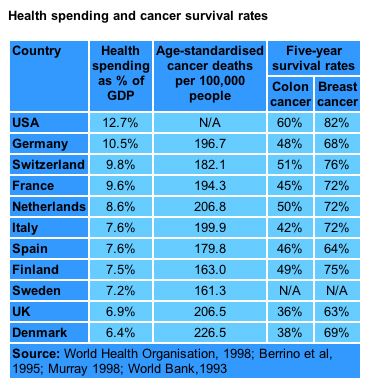
As a follow-up to this post, I wanted to take on the argument that people use against the US's health care system, arguing that it must be worse than other countries socialized approach because it costs so much more.  Well, I am the first to agree that reduced regulation and a better matching of who is paying the cash to who is receiving the services would result in huge cost savings.  However, it may also be true that you get what you pay for, as discussed in Cafe Hayek.  The key chart is shown below:

Survivalrates

One thing I forgot to mention in the previous post was a bit of background of exactly why we have a model where health care is payed for by the employer.  This structure of company-paid health care was not a natural market evolution, but was in fact a direct result of several very distorting government regulations.

Company funded health care plans began in the 1930's and 1940's as a way for companies to try to get around government controls and freezes on wage rates, first instituted with the NRA and later during WWII.  In particular, during the incredibly tight domestic labor markets in WWII, employers struggled with government-mandated wage controls, and used the promise of employer-paid health care as a way to provide higher effective compensation to attract employees, since these non-cash benefits were not counted in the wage freeze calculation.  After the war, the government locked in this practice when the IRS and Congress agreed that company-paid health care was not taxable as regular income, meaning that such health plans were given a strong tax-preference over cash wages.

Finally, if you are not familiar with the appalling experiment in fascism that was the NRA, I wrote about it here.

Time for Patent Reform

Its clearly time for patent reform as it applied to software.  In the last ten years, software engineers have apparently have been able to convince hardware-centric patent examiners that some pretty basic software concepts are "non-obvious" and patentable.  Guestblogging at Overlawyered last week, I mentioned one such patent, the Amazon "1-click ordering" patent, which to me is clearly copyrightable, but not patentable.

Rob Pegoraro makes a similar point in the Washington Post, editorializing on the Blackberry suit:

No, the problem here is simpler. There are too many bogus patents getting handed out.

One
solution would be to make more things unpatentable. Just as you can't
-- or shouldn't -- be able to patent a mathematical equation, in this
scenario you wouldn't be able to claim ownership of things like the
general workings of software (any individual program is already
protected by copyright) or business methods. The U.S. has been a
pioneer in turning those things into new types of intellectual
property; perhaps it's time to declare this experiment a failure.

Another,
somewhat overlapping solution would make it harder to get any patent.
The patent office would apply a higher standard of "non-obviousness" --
the idea that a patent shouldn't reward "inventions" any competent
individual could have thought up. And any outside party could submit
evidence against a patent before it became final.

I am generally sympathetic to Blackberry's plight, in part because I went to school with Jim Balsillie, the CEO of RIM.  One thing Pegoraro missed in his editorial:  The US Patent Office has already said it made a mistake in issuing the original patent that RIM was found to be violating.  The nullification of this patent is working through the system, and RIM is pleading that the injunction against them wait until this process is complete, sort of like a victim on death row begging not to be put to death because the prosecutor has admitted that based on new evidence, he shouldn't have pursued the case in the first place.  RIM has offered to settle with NTP (the patent holder)if there is a give-back if the patent is invalidated in the future, but NTP has refused this.  This all makes for an interesting drama, with a lot of brinksmanship.

By the way, though I am sympathetic to RIM to some extent, that sympathy is diminished by this:

In 2002, RIM sued software developer Good Technology for its wireless
mail-transfer technology and "smart phone" maker Handspring over its
miniaturized keyboard design. Both wound up forking over licensing fees.

As I wrote before, what goes around, comes around when you use the legal system and the long hand of the government to step on competitors.

TV Regulation Mess

If my blog was a satellite TV station, the following would be illegal:  Investigators Slam Katrina Response.  (hint - answer is NOT in the attached article, which is random)
.
.
.
I'm sorry, did you miss it?  What did I do that was so wrong?  What I did was let you view content directly from a national content provider.  In the past, Reuters traditionally distributed its content through local distribution arms called newspapers.  This distribution model was required based on old technologies, where printing was a local not a national business.  Now that new technologies allow content providers to distribute their material nationally without these intermediaries, many have chosen to do so, as does Reuters at their web site.  This is one of the many reasons why newspapers today are struggling.

The TV business has historically had the same business model for roughly the same technological reasons.  National content providers (e.g. NBC, CBS) distributed content through local affiliates because broadcasting technologies were very local.  Today, with Satellite and cable, it is perfectly easy for anyone to access the national feeds, like you did in reading the Reuters site above.  EXCEPT, the US Congress has outlawed this practice.  Satellite providers, with a few exceptions for rural viewers, cannot provide viewers with the national feed -- it is illegal.  Unlike with print media, Congress has succumbed to powerful interest groups in the local TV market to protect their dying business model. 

As a result, DirectTV has satellites in space using up bandwidth by broadcasting 50 or more nearly identical copies of the same national feed, because it is forced to use the local affiliate's feed for each local market.   One of many adverse results is that while the price of print content has fallen to nearly zero, the price of broadcast content goes up.  And, from a personal standpoint, I nearly killed myself adjusting an old fashioned TV aerial on my roof last night because that is the only way I can get NBC's Olympics HDTV content, since my satellite provider can't afford to duplicated hundreds of local stations to get the networks on satellite in HDTV under the current asinine rules.  And I refuse to get cable because it was in large part for exactly this reason, to force customers away from satellite to cable, that the must-carry and related rules were passed, and I refuse to give them the satisfaction.

Postscript:  By the way, the Reuters article linked is worth reading too.  Take this snippet:

Richard Skinner, the inspector general of the Department of Homeland
Security, told the committee that FEMA purchased 24,967 manufactured
homes at a cost of $857.8 million to temporarily house Katrina victims.
But most of those homes are unused and the government is paying to
store them, he said.

Nearly 11,000 are sitting are sitting at a
government site in Hope, Arkansas, and are deteriorating because they
were improperly stored, he said.

A Few Other Thoughts on Danish Cartoons

I am running a three-day off-site for my managers this week, so I am pretty tied up.  I do, however,  want to take a second to observe that the NY Times should be embarrassed by their stance on these cartoons.  Their lame-ass explanation that the immediate cause for a wave of world-wide violence and rioting is not really newsworthy is so transparently bullshit as to be unbelievable. 

And to argue that the cartoons are somehow too inflammatory is just pathetic.  As I posted earlier, these cartoons are nothing.  Hell, check out stuff like this, syndicated by the NY Times.  Clearly the cartoon shown is inflammatory against the US military (as is their right under the 1st amendment), so the issue of being inflammatory is a dodge too.  Hell, the NY Times has run multi-part series designed specifically to inflame people against the rich and successful, or more recently to inflame people against oil companies.  To to say they avoid being inflammatory as a policy is a bald-faced lie.  The fact is that there is an unwritten code today among the intelligentsia as to who it is "OK" to be inflammatory against and who it is not.  It is OK under the code accepted by the NY Times to be inflammatory against rich and successful people, white males, women and minorities who are not Democrats, Christians, the military, and the US in general.  It is not OK to be inflammatory against Muslims, suicide bombers, women's groups, most academics, advocacy groups, or the leader of the NAACP.  In the case of the cartoons above, it is OK to blame Islamic terrorism on the US military, but not OK to blame Islamic terrorism on the teachings of Islam.

This is a symptom of the same disease that inhabits politically correct speech codes at universities.  Specifically, institutions are increasingly banning speech that is "insulting" or "degrading" or "offensive", and then allowing some (but not all groups) of listeners to set the definition of when they consider themselves offended.  Muslims argue that these cartoons are hateful - so the Times reaction is "oh, we are so sorry, we won't publish them."   Can you imagine the NY Times giving executives at Exxon the same ability to define certain speech as insulting to them and therefore out of bounds of publication?  Sure.

I got several emails to my first post that boiled down to the following, "Coyote, what you don't understand is that we in America may not think there is anything out of bounds with those cartoons, but Muslims really are offended by them."  This is exactly my point - what other groups do we allow to effectively get a veto on the press coverage they receive?  Do we give the military the right to say "gee, that cartoon is hurtful to us, don't publish it".  No, and in fact this was just proved recently with the Tom Toles cartoon.  We give military leaders the right to say the first part, that they think is wrong for such and such reason, but we don't give them a veto over publication.  Nor, of course, should we give such a veto to anyone.  So why do we make an exception for people whose idea of political discourse is to burn down some embassies, kill a few priests, and set off a few bombs?  I would love to see the WaPo explain why it published (I think rightly) the Toles cartoon in the face of vociferous objects from the Pentagon and American veterans, but won't publish the Danish cartoons in the face of vociferous objections from violent Islamic totalitarian extremists.  Especially when the Muslim reaction to the cartoons is only serving to demonstrate exactly those qualities of Islam that the cartoons were meant to highlight.

At the end of the day, this whole episode I think will be very useful, in finally putting to the forefront the bizarre speech code many of America's intelligentsia have explicitly adopted, a code that absurdly defines exactly the same speech as alternately "healthy" or "offensive" depending on what specific groups are the target of such criticism. 

Earth to Muslims:  Grow up.
Earth to the NY Times:  The time is long overdue for a serious self-awareness episode.

Postscript: Another bit of irony:  The media often criticizes the administration as being the enemy of free speech, when the very fact of the frequent publication of this criticism without any government intervention tends to blunt the force of the argument.  On the other hand, when the group being criticized actually does respond with violence meant to suppress publication, the media decides that the targeted group is not really worthy of criticism.

Update: Here is a compiled excuse page from major US newspapers as to why they are not publishing.  Read it to enjoy the spectacle of supposedly smart and principled people twisting themselves into ethical pretzels.

Update #2:  Those of you who mainly rely on the TV and print media for news probably haven't seen the actual cartoons.  Here they are.  Internet to the rescue again, printing the news that the NY Times deems not fit to print.

Big Bone Lick

Kentucky, the state that made me get an egg license, is in the news again because it is complaining that it is not getting its fair share of the tobacco settlement funds, and so needs to increase cigarette taxes even more. 

Don't feel guilty if you can't actually remember what the settlement was about other than just more tax money.  The settlement was the result of a series of lawsuits from state AG's against cigarette companies arguing that use of their product is costing the states money in the form of higher medical costs (the health care as Trojan horse for total government control argument I have discussed before).  The substantially increased taxes on cigarettes was supposed to both deter use and to raise money for state health care.

Well, check out this statement form the Kentucky governor as to why he wants to raise the cigarette taxes, and notice what justifications for the taxes are NOT there:

The additional revenue from the tobacco settlement,
according to [governor] Fletcher, would increase the state's debt capacity and
allow for more spending on more projects, such as an information
technology research center and expanding the Big Bone Lick State Park.
He also says the added revenue would allow the state "to ease the tax
burden on small businesses."

I do have to admit that "Big Bone Lick" state park seems the perfect monument to government taxation.

This is a great example of the perverse incentives "sin" taxes put on government.  First put in place to reduce some behavior, once government officials become addicted to the spending the tax allows, the government tends to shift posture to supporting, rather than reducing, the "sin" since its continued existence is required to maintain tax revenues.  This is happening all over with the tobacco settlement, as government has suddenly become the tobacco companies' partner in maintaining revenues and market share.  And here I wrote about a similar occurrence.

Postscript:  By the way, not accounted for by the governor in his "fair share" of settlement funds are the large subsidies that flow to Kentucky tobacco growers.  In surely one of the best examples of how most government programs are all about rent-seeking rather than whatever their stated purpose is, the US is vigorously taxing tobacco, ostensibly to reduce its use, while at the same time aggressively subsidizing the production of tobacco.

More on Surveillance & Detention

I've gotten mail and comments on some of my surveillance- and detention-related posts, particularly this one here, that boil down to "but warrant-less national security eavesdropping is legal". John Hinderaker at Powerline makes this argument fairly compellingly.  To which I can answer, fine, but whether it is narrowly legal or illegal is a topic for partisan blogs who want to score points for or against Bush.  As one of those weird libertarian guys, my intention was to stand aside from the question of legality and instead pose the question of "yes, but is it right?"

Foreigners are People Too

It is interesting that I have to make this point more and more nowadays: Foreignors are human beings too.  For example, this idea that non-US citizens have (or should have) the same rights we do was one I highlighted in my defense of open immigration:

The individual rights we hold dear are our rights as human beings, NOT
as citizens.  They flow from our very existence, not from our
government. As human beings, we have the right to assemble with
whomever we want and to speak our minds.  We have the right to live
free of force or physical coercion from other men.  We have the right
to make mutually beneficial arrangements with other men, arrangements
that might involve exchanging goods, purchasing shelter, or paying
another man an agreed upon rate for his work.  We have these rights and
more in nature, and have therefore chosen to form governments not to be
the source of these rights (for they already existed in advance of
governments) but to provide protection of these rights against other
men who might try to violate these rights through force or fraud

Speech, commerce, property, association, and yes, privacy -- these are all rights we have as human beings, so that the fact of citizenship in the US should not have any bearing on whether our government should respect these rights (except in the case of war, which we get into in a while).

These issues are oh-so-much clearer when we flip our perspective.  For Americans reading this, ask yourself:

  • Does the government of Great Britain (or Russia, or Iran) have the right to wiretap your phone calls at will without warrant or review just because you are not a citizen of their country?
  • Does the government of Great Britain (or Russia, or Iran) have the right to detain you indefinitely without access to a lawyer or embassy if a powerful person in their government declares you an enemy combatant?

If you answered "yes", then recognize that the 1979 capture of the US embassy staff in Iran was probably legal by your rules, as was nearly every other detention of American citizens by another country.  If you answered "no", then you need to be worried about what the US is doing in the name of national security, for certainly both Bush and Clinton, among others, claim(ed) these rights.  And if you answered "no" for all other countries but "yes" for us, presumably because you trust our guys but not theirs, I will admit you have some historical precedent, since the US for all its faults has generally acted more honorably than 99% of the other nations of the world over the last 100 years.  But you do need to think about the meaning of the rule of law, and why its always a bad idea to give good men power that you don't want bad men to have.

By saying this, I realize that am I not only out of step with the US appellate courts (as Hinderaker points out) and with the Supreme Court (at least on the detention issue, since they haven't ruled on the warrant-less search powers) but also perhaps with the founding fathers.  While most of the folks who wrote the Constitution understood the notion of rights that are derived from nature rather than from the state, the Constitution is mute on the laws of the US vis a vis foreign citizens (excepts where it comes to war).  It is interesting to note that the Bill of Rights doesn't make any distinctions between citizens and non-citizens - there is nothing, for example, that modifies the prescriptions of the fourth amendment to apply only to searches of US citizens.  One could easily interpret the Bill of Rights as proscribing the actions of the US government against any person of any nationality.  Anyway, if I am in conflict with the founding fathers, so be it -- the Constitution is a fabulous document as totally ahead of its time as would be having 19th century India put a man on the moon, but it was not perfect.

The Magic Words: National Security

You may notice that defenders of these presidential powers tend to play a little verbal slight of hand (in addition to the one discussed here):  They translate the president's powers as CinC to mean "carte blanch for national security issues".  You hear this slight-of-hand so often, one starts to think its written that way in the Constitution, so it is probably good to remind ourselves what that document actually says:

The President shall be commander in chief of the Army and Navy of the
United States, and of the militia of the several states, when called
into the actual service of the United States

That's it.  The president can give orders to the military  -- whether that means he can do anything he wants in the name of national security is a whole other issue.  Folks also seem to want to argue that this CinC power cannot be modified or limited in any way, but that's silly.  The third amendment is aimed solely at the limiting the power of the military.   And certainly the folks who first adopted the constitution and the Bill of Rights believed that the 4th amendment applied to the military as well.  In fact, they would have said especially the military.

The Right Way to do Searches

Here is how we have generally interpreted the 4th amendment:  The legislative branch sets the ground rules, as followed by the Administration.  The administrations selection of targets is reviewed by the Judiciary (warrants) and is also subject to later review at trial (via the admissibility of evidence).  What we try to avoid is allowing the same person to set the rules, choose the target, and perform the surveillance, all in secret and without outside review.  The problems with the NSA wiretapping program is not that it is wrong per se, but that it may violate this process.  The administration is claiming the right to choose the target and perform the surveillance under the own rules and in secret with no possibility of review.   

Declaration of War Needs to Mean Something Again

If there is any part of the constitution that has really gone by the wayside in the last 50 years it is the provisions around declaration of war.  Over the past decades, president's have claimed the power to move forces into action, not just defensively but offensively, without a Congressional declaration of war.  And Hinderaker sees the declaration of war, or the Authorization to Use Military Force
(AUMF) as irrelevant to the legality of warrant-less national security
searches.  He is arguing that the President in his CinC power may search without warrant if it is substantially to fight an enemy.  And, absent an AUMF or a declaration of war, who decides if a group or nation or person is an enemy?  why, the President does.  And, who determines if a surveillance is necessary to fight this enemy? Why, yes, the President does as well.  And who reviews these decisions to make sure the President hasn't chosen to search or wiretap, under the pretext of national security, communists in Hollywood, Martin Luther King, or a self-generated "enemies list" -- no one, I mean, no Administration official in this country would ever do those things, would they?

I have increasingly come to the belief that the AUMF, or declaration of war, is supposed to mean something. (I am not a Constitutional scholar, and don't want to hear about how I don't understand such and such precedent* -- this is my own interpretation).  If one goes back to my first argument above, that all people, not just citizens, are constitutionally protected from our government searching or detaining them without warrant, then the declaration of war is that formal step that is necessary to free the CinC from these restrictions vis a vis a certain named and defined enemy.  The declaration of war, or AUMF, is effectively then the mass warrant, that gives the president the right in his role as CinC to attack those folks with our troops and detain them and spy on them, etc.  And even then, this is not without limit, since none of us are very happy with the Japanese detention precedent in WWII.  This view of the declaration of war is more consistent with the original notion of separation of powers than is the "administration can do anything to protect national security" view.  It allows the President pretty free reign to fight an enemy, including the types of tactics under dispute, but only after the body the founders considered the most sober had approved the war and the enemy (by sober I mean as envisioned by the founding fathers, and not as demonstrated in recent supreme court nomination hearings).

This obviously makes a declaration of war a BIG DEAL, which it should be, rather than just a set piece vote ratifying what the president seems hellbent to do anyway or a statement of moral support, along the lines of a "we support the troops" resolution.  It means that the Congress, god forbid, actually needs to treat the vote with some responsibility and understand the implications of what they are voting for, or else modify the AUMF or articles of war with specific limitations of scope.  And it means Congress needs to think twice and maybe three times before authorizing war against something as nebulous as "A Qaeda" or "terrorism".  And it means that GWB probably is doing nothing illegal, at least in the programs as discovered, but it doesn't mean that the courts or Congress can't change that in the future.

* Constitutional scholars live and die by the great god "precedent", and certainly the legal system would be thrown into disarray if court decisions did not provide precedents for later decisions.  All predictability in the system would vanish.  However, it is more than OK from time to time to go back to the original words of the Constitution to see if the march of serial precedent has somehow taken us off course.  I often liken this to a copier machine.  If you take a plain piece of paper, and copy it, and then copy the copy, and then copy that copy, etc. through twenty or thirty generations, you will end up with a paper that is supposed to be a copy of the original, but in fact is covered with spots and other artifacts that were not on the original.  A series of court precedents can also create such artifacts that can only really be identified not from looking at the last precedent it was built on, but going all the way back to the original Constitution.

Cooler but Poorer

Its probably time for another once-every-six-months update on global warming.  In this post I will address the current leading climate intervention position, which is:  Even if we don't understand global warming fully, the time to take massive action is now, before the process builds momentum (similar to the notion that it is easier to deflect a meteor away from earth when it is millions of miles away, rather than right on top of us).  The potential downside of global warming, it is argued, is too high to justify waiting until we are sure.   

While I find arguments that attempt to challenge the current global warming orthodoxy in any way tends to get one labeled a Luddite not worth listening to, giving one the feeling of being a southern Baptist advocating creationism in a room full of Massachusetts Democrats, I will once again try to refute this need to immediate and massive intervention.

The shorthand I use for my argument against intervention is "creating a cooler but poorer world".  In a nutshell, given current technology and likely government intervention approaches, slowing global warming almost certainly entails slowing world growth.  And while the true cost of warming is poorly understood, the true cost of reduced world economic growth is very well understood and is very high.  The real question, then, is do we understand global warming and its potential downsides enough to believe that curbing them outweighs the almost certain negative impact from a poorer world.

I will begin by conceding some warming

Typically when making this argument, I will concede some man-made global warming.  It is hard to refute the fact from various CO2 concentration estimates that man has increased the amount of CO2 in the atmosphere over the last 50 years, and that this CO2 likely has had and will have some impact on global temperatures.  As a result, I am willing to concede a degree or two of warming from man-made effects over the next century.  This is lower than most of the warming estimates that you see in the press, but scientists will have to nail down a lot more issues before they can convince me these higher numbers are correct.  Some of these issues include:

  • World temperatures rose by a half degree in the first half of the 20th century through mostly natural phenomena.  No one knows why (though solar activity may help explain it), but even global warming's strongest supporters agree that it was probably not due to man.  No one can therefore with any accuracy separate warming in the late 20th century due to this natural effect and warming due to man's impact.  Check out Mann's now-famous hockey stick below:

Hockeystick

Global warming advocates love this chart - I mean this is their chart, not the skeptics' - and it probably plays well with non-scientific editors who are believers themselves, but I sure wouldn't want to defend this in a board room.  What if this were a sales chart, and I wanted to claim that the sales increase after I started work in 1950 was all due to my effort.  I can just see my old boss Chuck Knight at Emerson, or maybe Larry Bossidy at AlliedSignal, saying - "well Warren, it sure looks like things changed in 1900, not 1950.  And whatever was driving things up from 1900 to 1950, why do you think that that effect, which you can't explain, suddenly stopped and your influence took over.  And by the way, why did you end your chart with 1998 - I seem to remember 1998 was the peak.  Isn't it kind of disingenuous to leave off the last 6 years when the numbers came back down some?" (update:  Even in the arctic, where the media writes with so much confidence that global warming is having a measurable impact, the difference between cyclical variations and man-made effects is hard to unravel.)

  • No one really understands the cyclical variations in world temperatures and climate.  I think it is large, and certainly there are historical records of the last 800 years that seem to point to climactic extremes.  Mann, et. al. claim to have shown that man's effects dwarf these natural variations with their 1000-year hockey stick, but there are a lot of problems with Mann, not the least of which is his unbelievably suspicious refusal to release his data and methodology to the scientific community, behavior that would not be tolerated of any other scientist except one who supported the global warming consensus view.
  • It is still not clear that the urban heat island effect has been fixed in the ground data, so satellite data tends to show less warming (but some none-the-less).
  • The climate models are absurd in ways even a non-climatologist can figure out.  For example, economies in energy inefficient undeveloped nations are assumed to grow like crazy in the IPCC scenarios, such that "then the average income of South Africans will have overtaken that of
    Americans by a very wide margin by the end of the century. Because of
    this economic error, the IPCC scenarios of the future also suggest that
    relatively poor developing countries such as Algeria, Argentina, Libya,
    Turkey, and North Korea will all surpass the United States."
  • I no longer trust the scientific community on global warming.  This quote from National Center for Atmospheric Research (NOAA) researcher and global warming action promoter, Steven Schneidersays it all:

We have to offer up scary scenarios, make simplified, dramatic
statements, and make little mention of any doubts we have. Each of us
has to decide what the right balance is between being effective and
being honest.

While many serious scientists are working on the issue, 100% of the anti-growth, anti-technology, anti-America, and anti-man folks have jumped strongly on the global warming bandwagon, and many of these folks have in fact grabbed the reins, leading major efforts and groups.  It is important to note that these folks do not care about scientific accuracy or facts.  Their agenda is completely and absolutely to use global warming as their lead issue to push their anti-growth agenda.  As such, none of these folks are going to tolerate any fact, study, or scientific voice that in any way questions the global warming orthodoxy.  And can any scientist be considered serious who uttered the following statement (from the UN's IPCC Conference Summary, page 2):

"It is
likely that, in the Northern Hemisphere, ... 1998 [was] the warmest year during the past thousand years."

My physics instructors in college used to criticize us students constantly for not understanding the error range in our lab work.  I wonder what they would think of a group of scientists that stated with confidence that 1998 was the warmest year in the last one thousand, when they only have direct measurement for the last 100 years or so and even then over only a small percentage of the planet and the other 900 years are estimated from tree rings and ice cores.  I am tired of being criticized as a Luddite for challenging "scientists" who think they know with confidence the exact world temperature since Charlemagne. 

Anyway, to avoid getting bogged down in this mess, I am willing to posit some man-made warming, say 1-2 degrees over the next 100 years.  For most who argue the subject, this is the end of the discussion.  For me, it is just the beginning.

What impact, warming?

Beyond bad cinema and Sunday supplement hyperbole, its difficult to find the good science aimed at quantifying the impacts, positive and negative, from global warming.  In fact, it is impossible in any venue at any level of quality to find any mention of the positive impacts of warming, though anyone with half a brain can imagine any number of positive impacts (e.g. longer growing seasons in cold climates) that will at least partially offset warming negatives.

Now, I am sure many scientists would respond that climate is complicated, and its hard to judge what will happen.  Which I believe is true.  But surely the same scientists that can cay that the world will warm by x degrees with enough certainty to demand that billions or even trillions of dollars be spent to change energy use should be able to come to some conclusions about the net effects, both positive and negative, from warming.

Certainly sea levels will probably rise, as some ice caps melt, by maybe a foot in the consensus view.  And storms and hurricanes may get worse, though its hard to separate the warming effect from the natural cyclical variation in hurricane strength, at least in the Atlantic.  What does seem to be clear is that the warming disproportionately will occur in colder, drier climates.  For example, a large part of the world's warming will occur in Siberia. 

When I hear this, I immediately think longer growing seasons in cold climates plus less impact in already warm climates = more food worldwide.  It strikes me that since the climate models tend to spit out warming not only world wide but by area of the world, it would be fairly easy to translate this into an estimate of net impact on food production.  This seems to be such an obvious area of study that I can only assume it has been done, and, since we have not heard about it, that the answer from global warming was "increased food production".  Since this conclusion neither supports scary headlines, increased grant money, or the anti-growth agenda, no one really talks about it or studies it much.  I would bet that if I took all the studies and grants today aimed at quantifying the impact of global warming, more than 95% of the work, maybe 100% of the work, would be aimed solely at negative impacts, studiously ignoring any positive counter-veiling effects.

I often get looks from global warming advocates like I am from Mars when I suggest work needs to be done to figure out how bad warming is, or even if it is really that bad at all.  I have learned that there are typically two reasons for this reaction:

  1. I am talking to one of the anti-growth types, for whom the global warming issue is but a means to the end of growth limitation.  These folks need global warming to be BAD as a fundamental premise, not as something that can be fact-checked.  They cannot have people questioning that global warming is the ultimate bad thing that trumps everything else anymore than the Catholic Church can have folks start to question the fallibility of the Pope.
  2. I am talking to an environmentalists who considers man's impact impact on earth as bad, period.  It is almost an aesthetic point of view, that it is fundamentally upsetting to see man changing the earth in such a measurable way, irregardless of whether the change affects man negatively.  These are the same folks with whom you cannot argue about caribou in ANWR.  They don't oppose ANWR drilling because they honestly think the caribou will be hurt, but because they like the notion that there is a bunch of land somewhere that man is not touching

By the way, though I know this will really mark me as an environmental Luddite, does anyone really believe that in 100 years, if we've really screwed ourselves by making things too hot, that we couldn't find a drastic way to cool the place off?  Krakatoa's eruption put enough dust in the air to cool the world for a decade.  The world, unfortunately, has a lot of devices that go bang laying around that I bet we could employ to good effect if we needed to put some dust in the stratosphere to cool ourselves off.  Yeah, I am sure that there are hidden problems here but isn't it interesting that NO ONE in global warming, inc. ever discusses any option for solving warming except shutting down the world's economies?

What impact, Intervention?

While the Kyoto treaty was a massively-flawed document, with current technologies a Kyoto type cap and trade approach is about the only way we have available to slow or halt CO2 emissions.  And, unlike the impact of warming on the world, the impact of such a intervention is very well understood by the world's economists and seldom in fact disputed by global warming advocates.  Capping world CO2 production would by definition cap world economic growth at the rate of energy efficiency growth, a number at least two points below projected real economic growth.  In addition, investment would shift from microprocessors and consumer products and new drug research and even other types of pollution control to energy. The effects of two points or more lower economic growth over 50-100 years can be devastating:

  • Currently, there are perhaps a billion people, mostly in Asia, poised to exit millenia of subsistence poverty and reach the middle class.  Global warming intervention will likely consign these folks to continued poverty.  Does anyone remember that old ethics problem, the one about having a button that every time you pushed it, you got a thousand dollars but someone in China died.  Global warming intervention strikes me as a similar issue - intellectuals in the west feel better about man being in harmony with the earth but a billion Asians get locked into poverty.
  • Lower world economic growth will in turn considerably shorten the lives of billions of the world's poor
  • A poorer world is more vulnerable to natural disasters
  • The unprecedented progress the world is experiencing in slowing birth rates, due entirely to rising wealth, will likely be reversed.  A cooler world will not only be poorer, but likely more populous as well.  It will also be a hungrier world, particularly if a cooler world does indeed result in lower food production than a warmer world
  • A transformation to a prosperous middle class in Asia will make the world a much safer and more stable place, particularly vs. a cooler world with a billion Asian poor people who know that their march to progress was halted by western meddling.
  • A cooler world would ironically likely be an environmentally messier world.  While anti-growth folks blame all environmental messes on progress, the fact is that environmental impact is a sort of inverted parabola when plotted against growth.  Early industrial growth tends to pollute things up, but further growth and wealth provides the resources and technology to clean things up.  The US was a cleaner place in 1970 than in 1900, and a cleaner place today than in 1970.  Stopping or drastically slowing worldwide growth would lock much of the developing world, countries like Brazil and China and Indonesia, into the top end of the parabola.  Is Brazil, for example, more likely to burn up its rain forest if it is poor or rich?

The Commons Blog links to this study by Indur Goklany on just this topic:

If global warming is real and its effects will one day be as devastating as
some believe is likely, then greater economic growth would, by increasing
greenhouse gas (GHG) emissions, sooner or later lead to greater damages from
climate change. On the other hand, by increasing wealth, technological
development and human capital, economic growth would broadly increase human
well-being, and society's capacity to reduce climate change damages via
adaptation or mitigation. Hence, the conundrum: at what point in the future
would the benefits of a richer and more technologically advanced world be
canceled out by the costs of a warmer world?

Indur Goklany attempted to shed light on this conundrum in a recent paper
presented at the 25th Annual North American Conference of the US Association for
Energy Economics, in Denver (Sept. 21, 2005). His paper "” "Is a
richer-but-warmer world better than poorer-but-cooler worlds?"
"” which can
be found here, draws
upon the results of a series of UK Government-sponsored studies which employed
the IPCC's emissions scenarios to project future climate change between 1990 and
2100 and its global impacts on various climate-sensitive determinants of human
and environmental well-being (such as malaria, hunger, water shortage, coastal
flooding, and habitat loss). The results indicate that notwithstanding climate
change, through much of this century, human well-being is likely to be highest
in the richest-but-warmest world and lower in poorer-but-cooler worlds. With
respect to environmental well-being, matters may be best under the former world
for some critical environmental indicators through 2085-2100, but not
necessarily for others.

This conclusion casts doubt on a key premise implicit in all calls to take
actions now that would go beyond "no-regret" policies in order to reduce GHG
emissions in the near term, namely, a richer-but-warmer world will, before too
long, necessarily be worse for the globe than a poorer-but-cooler world. But the
above analysis suggests this is unlikely to happen, at least until after the
2085-2100 period.

Policy Alternatives

Above, we looked at the effect of a cap and trade scheme, which would have about the same effect as some type of carbon tax.  This is the best possible approach, if an interventionist approach is taken.  Any other is worse.

The primary other alternative bandied about by scientists is some type of alternative energy Manhattan project.  This can only be a disaster.   Many scientists are technocratic fascists at heart, and are convinced that if only they could run the economy or some part of it, instead of relying on this messy bottom-up spontaneous order we call the marketplace, things, well, would be better.  The problem is that scientists, no matter how smart they are, miss with their bets because the economy, and thus the lowest cost approach to less CO2 production, is too complicated for anyone to understand or manage.  And even if the scientists stumbled on the right approaches, the political process would just screw the solution up.  Probably the number one alternative energy program in the US is ethanol subsidies, which are scientifically insane since ethanol actually increases rather than reduces fossil fuel consumption.  Political subsidies almost always lead to investments tailored just to capture the subsidy, that do little to solve the underlying problem.  In Arizona, we have thousands of cars with subsidized conversions to engines that burn multiple fuels but never burn anything but gasoline.  In California, there are hundreds of massive windmills that never turn, having already served their purpose to capture a subsidy.  In California, the state bent over backwards to encourage electric cars, but in fact a different technology, the hybrid, has taken off.

Besides, when has this government led technology revolution approach ever worked?  I would say twice - once for the Atomic bomb and the second time to get to the moon.  And what did either get us?  The first got us something I am not sure we even should want, with very little carryover into the civilian world.  The second got us a big scientific dead end, and probably set back our space efforts by getting us to the moon 30 years or so before we were really ready to do something about it or follow up the efforts.

If we must intervene to limit CO2, we should jack up the price of fossil fuels with taxes, or institute a cap and trade scheme which will result in about the same price increase, and the market through millions of individual efforts will find the lowest cost net way to reach whatever energy consumption level you want with the least possible cost.  (The only real current alternative that is rapidly deploy-able to reduce CO2 emissions anyway is nuclear power, which could be a solution but was killed by...the very people now wailing about global warming.)

Conclusion

I would like to see some real quality discussion as to the relative merits of the path the world is on today vs. an interventionist world that is cooler but poorer, more populous, hungrier, and less politically stable.  If anyone knows of some thoughtful work in this area, please leave a link in the comment area or in my email.

By the way, I got through this whole post without mentioning or quoting Bjorn Lomborg, which really is not fair since he has been very eloquent about just this cooler but poorer argument, but since he is treated like the anti-Christ by global warming believers, it generally only causes people to stop listening when you mention him.

Note finally that other past articles in this series can be found here and here and here.

Disclosure:   I am not funded in any way by the automobile or electric power industry. In fact, my personal business
actually benefits from higher oil prices, since our recreation sites
tend to be near-to-home alternatives for those who can't afford to
drive across country, so global warming intervention would probably help me in the near term.  However, I do own a fair amount of Exxon-Mobil stock, so you may assume that all my opinions are tainted, following the tried and true Global Warming formula that any money from the energy industry is automatically tainting, but incentives that tie grant money, recognition, or press exposure to the magnitude of warming a scientist predicts never carry a taint.  My opinions carry with them an honest concern for the well-being of non-Americans, like the Chinese, which I'm told used to be considered a liberal value until liberals and progressives decided more recently that they actually fear and oppose economic growth in places like China.

Fake but Accurate, Early 20th Century Style

Were Sacco and Venzetti really guilty?  I you are like me, you hear those names and say - boy, those names sound familiar.  I am sure they came up some time in my US history class in high school...

Sacco and Vanzetti were early 19th century anarchists executed in Massachusetts for robbery and murder.  Fellow communist, anarchist and author Upton Sinclair helped to generate a lot of sympathy for the two, raising a storm of protest that the two were innocent of the crime and were being tried and executed for their political beliefs.  They have been heroes of the left and the progressive movement ever since.

Asymmetrical Information points to this article, which describes new papers that apparently belonged to Upton Sinclair that make it clear that Sinclair actually discovered that Sacco and Venzetti were indeed guilty:

Soon Sinclair would learn something that filled him with doubt. During his
research for "Boston," Sinclair met with Fred Moore, the men's attorney, in a
Denver motel room. Moore "sent me into a panic," Sinclair wrote in the typed
letter that Hegness found at the auction a decade ago.

"Alone in a hotel
room with Fred, I begged him to tell me the full truth," Sinclair wrote. " "¦ He
then told me that the men were guilty, and he told me in every detail how he had
framed a set of alibis for them."

Sinclair decided that, for the benefit of the "movement", as well as his sales, not to reveal the truth

"My wife is absolutely certain that if I tell what I believe, I will be called a
traitor to the movement and may not live to finish the book," Sinclair wrote
Robert Minor, a confidant at the Socialist Daily Worker in New York, in
1927.

"Of course," he added, "the next big case may be a frame-up, and my
telling the truth about the Sacco-Vanzetti case will make things harder for the
victims."

He also worried that revealing what he had been told would cost
him readers. "It is much better copy as a naïve defense of Sacco and Vanzetti
because this is what all my foreign readers expect, and they are 90% of my
public," he wrote to Minor.

This all resonated with me because I recently had an email exchange with a reader who reminded me of this quote:

We
have to offer up scary scenarios, make simplified, dramatic statements,
and make little mention of any doubts we have. Each of us has to decide
what the right balance is between being effective and being honest.

- National Center for Atmospheric Research (NOAA) researcher and global warming action promoter, Steven Schneider

No one knows better than a blogger that everyone picks and chooses the news they want to notice and the facts they promote and don't promote.  But at some point on the slippery slope you hit a transition to outright dishonesty.  It seems that this temptation to support your cause with a fake story was not invented by Mary Mapes.

A Trade Deficit is Not a Debt (Nor is it Bad)

After you finish this post, I have an updated post on the same topic here.

Well, the US trade deficit is up again, and you can be sure the news was accompanied by a lot of moaning and groaning and soul-searching.  The main reason that all the media and the majority of Americans freak out over large trade deficit numbers is that they look at the American economy as a large bank vault with a fixed supply of money on the shelves.  They reason that if more money is going out of the vault to buy things than is going back in from sales, then eventually the vault will go empty and we will be bankrupt.  Either implicitly or explicitly, those who fear trade deficits perceive the trade imbalance to be red ink, something bleeding out of a fixed supply.

This view of the trade deficit as a being a growing and unsustainable debt is wrong.  I will try to explain in a couple of ways.

The micro view

Lets first look at it from the perspective on one individual.  Lets say Fred made $50,000 this year, and lives in a US where, before he makes his spending decisions, trade is exactly in balance with China.  Fred spends some of his income on rent, and invests some in some nice US equities.  And he takes $1000 of what he just made that he might have saved and buys himself a nice Chinese-made plasma TV so he can really enjoy the Superbowl next year.

So, where's the debt?  One can argue that net savings is lower (perhaps - we haven't gotten yet to where the Chinese are spending their extra US dollars), but Fred seems to have increased the trade deficit without incurring any debt.  In fact, Fred is actually better off, since in a free society no one engages in a transaction that doesn't return more value than one spends.  In this case, the plasma TV provides more than $1000 of value back to Fred, or else he would not have engaged in the transaction. 

Yes, many people are buying Chinese TV's with consumer debt, but these same people are buying much more American stuff with consumer debt as well.  To the extent that there is or is not a "problem" with people taking on too much consumer debt, this problem is absolutely unrelated to the country of origin of the goods they are buying.  You can max out your Visa card on American stuff just as easily as on Chinese stuff.

But wait, you say.  The reason the debt is not obvious is from the way I structured the problem.  I assumed the rest of the economy was static while Fred was making his decision.  But if Fred had bought American, somewhere in the US economy there must have been less debt.  So we will tackle this next.

The Economy is Not Zero Sum

Repeat please:  The economy is not zero-sum.  Never has it been so hard to convince people of a concept that should be so obvious.  I used up bushels of electrons explaining why the economy is not zero sum here, but the short proof is easy:  Look at the world in 1900.  Look at it today.  The world as a whole and most every individual is far richer.  The fact is that economies create wealth every day, and free economies create a LOT of wealth.

At the heart of every argument that the trade deficit is bad is the mercantilist notion that the US economy is a bank vault leaking funds.  But this analogy that seems to be in everyone's head is flawed.  The supply of money or wealth in the US, in the vault, is constantly growing.  If you really have to think of it as a vault, then think of what's inside as rabbits rather than gold bars.  Does anyone doubt that if you start with a hundred rabbits and every year sent a few to China that you might still have more rabbits than you started with in the vault?  A free economy is like a group of rabbits on Viagra.  Even if the Chinese took billions of dollars they got from selling goods to the US each year and burned the money in a big bonfire, the US still would be growing in wealth.

Of course, the vault analogy sucks for a larger reason, that the US economy is deeply integrated with that of the rest of the world.  In fact, much of the wealth creation comes from this very integration, providing a more robust division of labor and a deeper well of creativity and entrepreneurship than any one country could achieve on its own.  And the dollars we send overseas don't stay there, they come back.  But we will address this next.

So What do the Chinese do with Those Dollars?

OK, so we are all short-sitedly (at least according the the "progressive" intelligentsia) sending dollars to China to satisfy our consumerism.  So what do those Chinese do with those dollars?  They can't spend them domestically, because stores and vendors in China don't accept dollars any more than the Wal-mart down the street from me accepts Yuan.

Most all the dollars have to come back to the US, or the person in China holding them gets no value.  You could say, well that person can take them to the bank and exchange them for Yuan, and that is true.  But that bank would not accept the dollars for exchange unless it knew it could get them back to the US, or had another client that needed them to make a purchase in the US.  So, the dollars will have to come back to the US to purchase something.

Some of the dollars come back to purchase US goods and raw materials, but of course this is less than the total dollars the Chinese have to spend, or else there would be no trade deficit.  In fact, this all that the words "trade deficit" really means.  It means that of the dollars the Chinese receive from sales to the US, only a portion is used to buy American goods that are shipped back to China.  The rest goes to buy American .. something else.

What?

Well, some of it goes to purchase American goods that stay in the US.  Lets shamelessly steal an analogy from Don Beadreaux and Jack Wenders.  If Chinese companies buy American steel and lumber and ship it to China, it shows up in the trade balance.  If they buy the same products and build a factory in the US, it does not.  The Chinese use a lot of their dollars to invest in buildings, real estate, capital assets, factories, production facilities, etc. in the US.  And this is bad, how?  I know that since the Japanese investment boom of the eighties, there are lots of folks who call themselves "liberal" who suddenly got very upset about foreigners owning US-based assets.  It is impossible for me to see this concern as anything but xenophobia and racism, since hundreds of years of Dutch, Canadian, and British investment never worried a soul but Japanese and Chinese investment has everyone in a lather

By the way, if you worry about China as a security threat, wouldn't you rather see them invested in the US economy, and therefore have a strong interest in our continued prosperity?  One could easily wonder why Saudi Arabia does not use their power over oil reserves to screw with the US like they tried to do in the early 70's.  The reason is that all of their wealth is invested in dollar and euro-denomitated assets.   People worry about the power the Saudis may have to mess with our economy, but their reinvestment of dollars back in our economy has made this a game of mutual assured destruction.  The same thing is occuring with China.

The other thing the Chinese do with the money is invest in dollar-denominated financial assets, which in many ways is just an indirect way of investing in the same capital assets listed above.  They will invest dollars in equities and, yes, debt securities.  But the fact that the Chinese choose to spend their dollars on debt securities does not mean that the trade deficit is causing the debt.  If the Chinese had a predilection for debt securities, more so than say an American holder of dollars, one might argue that this predilection drives down interest rates a bit and therefore might increase total debt, but this is a fairly tenuous chain of causation and not, I think, what seems to be bothering folks who panic over the trade deficit.  In fact, one can argue that the causation runs more strongly the other direction, that the large US budget deficit keeps the dollar higher than it might otherwise be, increasing the trade deficit.

So when people lament that "we now consume much more than we produce", they are making a meaningless statement because the we in the first part are not the same as the we in the second part.  The US and the Chinese are sending equal amounts of money back and forth - its has to be, over the medium to long term, or exchange rates would crash.  All the trade deficit means is that there is a difference in WHERE Chinese and Americans consume the goods.  Americans consume Chinese goods in the US.  The Chinese consume some of the US goods it buys in China, and then consumes the rest in the US.  The trade deficit represents the net amount of American goods and services the Chinese buy in the US and choose not to haul back to China.  Instead, they take ownership of the American goods here, in the form of capital assets or financial securities that represent ownership or calls on the cash flow of these capital assets. 

Anyway, you can find more here at Cafe Hayek.

Postscript:  By the way, the US has run a trade deficit of a magnitude that panics people for over two decades.  If this is bad, surely we would be able to find the damage somewhere.  But the US over the last two decades has had the strongest economy in the world.  I suspect that a lot of people would answer "we have run up a huge debt".  But any increase in total debt in the US is not relevant to the trade deficit, or only tangentially related as discussed above.  The Federal debt is run up because the politicians are all spending whores who support their reelection with "good works" paid for with our money.  Consumer debt, which may or may not be "too high", is based on individual spending and saving choices, and is unaffected by whether a person buys an American or Chinese TV.

Update on the Health Care Trojan Horse

On several occasions, I have warned that government funded health care is becoming a Trojan horse for increasing government micro-management of your life.  The logic is that by paying for your health care, the government can argue it has a financial interest in your not eating fatty foods, not smoking, wearing a bike helmet, exercising, etc, decisions that would otherwise only affect the individual themself.*

For those who often accuse me of exaggerated paranoia when it comes to government intervention, check out this from the UK:

People who are grossly overweight, who smoke heavily
or drink excessively could be denied surgery or drugs following a
decision by a Government agency yesterday.  The National Institute for Health and Clinical Excellence (Nice) which
advises on the clinical and cost effectiveness of treatments for the
NHS, said that in some cases the "self-inflicted" nature of an illness
should be taken into account.

Sorry, but I told you so.  What's next?  Is an unwanted pregnancy "self-inflicted"?  How about an STD from unprotected sex?  The rulers of this process in England might argue that "Oh, we would never include those things" but technocrats in the US have seen parallel things happen as they have lost political control of their similar institutions in the US.

It gets me to wondering whether the Solomon Amendment may be the new template for government control of individual lives.  In both Universities and state governments, the Feds use the threat of withdrawal of federal funds to coerce actions (think 55 mile speed limit, title IX, military recruiting on campus) that the Constitution nominally does not see to give them authority over.  Now, there is the distinct possibility that federal funds to individuals (Social Security, Medicare, unemployment) could be used to increase federal authority and coercive micro-management at the individual level.

*Update: Yes, I do know that "themself" is probably not correct grammar.  I sometimes use they, them, themself as a grammatically frowned-upon but I think less awkward substitute for he/she, his/her, and his-or-herself when trying to be gender-neutral.  Sometimes I just use the traditional male pronoun, sometimes I use the female pronoun generically since women will complain about "he" used generically but men will not complain about "she", and sometimes I mix them up.  There is still some consensus building to do in coming up with gender neutral pronouns, though this person defends the singular "they".