Posts tagged ‘US’

Be Afraid

Per the BBC News:

More than 5% of the net's most popular domains have been registered using "patently false" data, research shows.

A US congressional report into who owns .com, .net and .org domains found that many owners were hiding their true identity.

Congress has just discovered that people, knock me over with a feather, do not always include all their correct personal private  and personal confidential information in online web databases that can be read by everyone:

The report found that owner data for 5.14% of the
domains it looked at was clearly fake as it used phone numbers such as
(999) 999-9999; listed nonsense addresses such as "asdasdasd" or used
invalid zip codes such as "XXXXX".

In a further 3.65% of domain owner records data was missing or incomplete in one or more fields.

I personally am a fan of (555) 555-5555 in filling out web forms.  For years, I never, ever put my correct phone number in the WHOIS registry, and only correctly filled in enough blanks to get my credit card authorized.

As is usual with every privacy reduction effort, it starts with an honest desire for better law enforcement:

Increasingly whois data is being used by law enforcement
and security companies to find out who is running a website involved in
spamming or some other scam....

The GAO recommended that more effort be made to verify
the information by domain owners and that greater use be made of
commercial software tools to check who runs a website.


I get the law enforcement issue, but I think it is dwarfed by the privacy and free speech issues.  There are a lot of really good non-illegal reasons not to want the detailed personal and private information of web site owners plastered all over public data bases, and there are particularly good reasons that web site owners might not like the government to know who they are.  Like every blogger in China, for example.  I don't think that US Government bodies (or major corporations, or political groups, or fringe groups like the KKK) are above seeking some type of retribution (e.g. audits) against folks online who criticize them, and I am sure China and Saudi Arabia are not above it.  If you start a web site criticizing your current employer, do you really want to reveal your name?  I for one thought for a long time about whether to blog as myself or anonymously.

As for hunting down phishing and other such scams, liscencing web owners in a way similar to say gun owners is not necesary.  Scams are illegal because somewhat is defrauded of money, and that money leaves an easier trail to follow than any electronic trail, even with better ICAHN data.  You can use zombie computers and other techniques to defeat most electronic tracing, but the money WILL end up in the bad guys hands and can be found.

Next up:  Requiring background checks before you can register for a web site.

Technocrats and GM

Frequent readers of this blog know that I have a particular disdain for technocrats and the damage they do via government coercion.  Just to make sure that I am not subject to the Princess Bride accusation of "You keep using that word -- I do not think it means what you think it does", I will define my terms.

In my parlance, a technocrat is someone who believes that individuals, either acting alone or in groups, are making the wrong decisions and that a few very smart people can make things better for everyone by overriding everyone else's decision-making. 

Technocrats sometimes have a "macro" flavor, focusing on the broad sweep of the economy, seeing market failures everywhere that they feel they could override if only someone would follow their "plan".  This hubris was of course one of the foundations for that juggernaut Soviet Russian economy, and was in fact the thinking behind America's closest brush with fascism, Roosevelt's NRA, which was modeled on Mussolini's economic work.  My college roommate Brink Lindsey has a lot of background on the early 20th century roots of technocratic opposition to capitalism in his book Against the Dead Hand: The Uncertain Struggle for Global Capitalism.

Technocrats also can have a "micro" flavor, focusing on individuals who they feel are making bad decisions for their own selves.  Classic examples are helmet and seat belt laws, where "smarter" people use government coercion for your own good.  We typically call these micro technocrats nannies.  I discussed governments overriding individual decision-making here.

Just the other day I mentioned in this post that I had had a conversation with a technocrat who was:

lamenting that allowing a company like GM to die is dumb, and that a
little bit of intelligent management would save all those GM jobs and
assets.  Though we did not discuss specifics, I presume in his model
the government would have some role in this new intelligent design (I
guess like it had in Amtrak?)

I went on to describe why it was OK to let GM fail.  In particular I noted that it was bad for everyone to artificially force quality assets (people and facilities) to remain in an under-performing corporate structure, which is what the government in effect does when it tries to override the market's decision that a corporation needs to die.

I bring this all up because I saw this classic example of technocratic statism from David Ignatius in the Washington Post

Economist Philip Verleger was traveling in Asia last month when the news
broke that General Motors was slashing 30,000 jobs to try to reverse its death
spiral. A Japanese economist he had known for many years asked him a stark
question: "What great nation will allow its major manufacturing company to
fail?"

The convulsions wracking GM are scary, but they're getting surprisingly
little attention amid America's sea of other troubles. Certainly, we've heard
barely a peep out of the Bush administration, which evidently worries more about
keeping energy companies happy than Rust Belt manufacturers. Commentators have
blamed GM management for being too shortsighted and its workers for being too
greedy. But few people seem to appreciate that the nation as a whole has a stake
in maintaining a dynamic industrial base, or that government policies could help
reverse our industrial decline....

But suppose we took GM's near-death experience as a national wake-up call and
decided to get serious about reviving the long-term health of the U.S.
manufacturing sector. What if political leaders treated this as a fundamental
national mission, equivalent to President John F. Kennedy's call to put a man on
the moon? Could government make any difference?

Try this thought exercise: Suppose a government plan could revitalize the
automobile industry and the rest of the transportation sector, encouraging it to
leapfrog several generations of technology; suppose this same plan could cut
U.S. dependence on foreign oil to zero; and suppose, finally, that the plan
could develop new technologies that would bump our economy to a higher growth
path and foster U.S. economic leadership in the 21st century. Would that idea be
worth exploring?

Yes, good idea, lets hand over the automobile industry to the same folks who built and maintained the levees in New Orleans.  It is interesting he quotes a Japanese economist chiding the US for letting its major companies fail.  The author is basically advocating the Japanese MITI approach, making technology choices and managing industries and preventing large organizations in which national pride is somehow tied up from failing.  Which, of course, has resulted in a 15 year recession in Japan.  And Europe.  Don Boudreaux at Cafe Hayek responds further:

I'm tempted to do a long riff here on all the details that Ignatius misses "“
such as, for example, the fact that it's simply not true that as goes GM so goes
America; such as the fact that there is
nothing at all special or inherently better about manufacturing
and
manufacturing jobs over service-sector production; such as the fact that
infecting decisions about investment and production with politics will reward
political appeal at the expense of genuinely economically sound uses of
resources.

But it's late, so I'll just point you to Ignatius's closing paragraph:

I'm no technologist, so I can't evaluate the technical details of Lovins's
proposal. What I like is that it's big, bold and visionary. It would shake an
America that is sitting on its duff as foreign competitors clobber our
industrial giants, and it would send a new message: Get moving, start
innovating, turn this ship around before it really hits the
rocks.

This paragraph reflects an attitude that is rich soil for totalitarianism to
take root. It ignores individual freedom; it ignores the possibility that the
admired Big Plan might be flawed, either technologically or economically or
both. Ignatius is all orgasmic simply because The Plan is centralized and Big
and (allegedly) will compel or inspire the masses once again to behave in ways
that promote national greatness.

Heaven help us.

If you think he is exaggerating, as many people do, by invoking the threat of fascism, go back and read what the fascists of the 1930's were writing.  It is nearly identical to Ignatius's words.

There are two lessons technocrats never learn:  1) Their grand plans never work and 2) The statist machinery they create via their grand plans is always taken over from the well-meaning by the power-hungry and corrupt.  As I stated before:

Technocratic idealists ALWAYS lose control of the game.  It may feel
good at first when the trains start running on time, but the
technocrats are soon swept away by the thugs, and the patina of
idealism is swept away, and only fascism is left.  Interestingly, the
technocrats always cry "our only mistake was letting those other guys
take control".  No, the mistake was accepting the right to use force on
another man.  Everything after that was inevitable

And, in fact, you are seeing just this today, as technocrats on the left lament that the machinery of state control they created, from the FDA to public schools, is being taken over by their political enemies.  Unfortunately, they lament the loss of control, not creating the all-powerful state in the first place.  Much more on this topic here and here.

Postscript:  I tossed off the statement above about letting the same organization that built the New Orleans levees fix the automobile industry.  That quick joke makes a valid point, but I should mention that Ignatious does try to preempt this argument:

But then, who can expect individuals to act responsibly when we have an
administration that asserts, in apparent sincerity, that the proper response to
our massive deficits is more tax cuts that plunge us even deeper into debt?
We've become so inured to public-sector mismanagement that the idea of
government solving problems is almost laughable.

In effect, he is arguing that yes, the government has mismanaged things, but this is only because they did not let the really smart people run things.  This is a particularly seductive argument for the left, where most technocrats reside, since it lets them say that government is inefficient only because that idiot Bush is in charge. 

But this ignores the fact that the stupid and corrupt always take over the machinery of state.  Technocrats love railroads, and think America is stupid for not riding the train, like those brilliant Europeans are.  Many supposedly smart people, both Democrats and Republicans, have had their shot at Amtrak, and it still sucks and loses money.  One reason among many for this failure is that incentives matter.  The government has the incentive to patronize powerful voting blocks, not to run an efficient operation or serve customers well.  That's why we get half-billion dollar bridges in Alaska to islands with populations of fifty people.  That's why scientific decisions at the FDA get politicized.  That is why have the government backing a technology ostensibly to reduce fossil fuel use (ethanol) that has been proven to actually increase fossil fuel use.  In effect, government always turns smart people stupid.  More on the specific dangers of government industry building here.

Another Postscript: By the way, people smarter than me do change industries all the time.  The are called "entrepeneurs" and they raise capital from people voluntarily and they succeed or fail only if individuals choose to do business with them.  I find it fascinating to compare Sam Walton with Mr. Ignatius.  Sam Walton raised money voluntarily to support a different vision of retailing, and was successful because many, many people have chosen voluntarily to shop at his stores.  Mr. Ignatius wants to change the automobile industry at the point of a gun, using government's coercive power to force companies to adopt certain technologies and build cars in certain ways, funding the effort with tax dollars taken unwillingly from productive Americans.  Isn't it amazing that "progressives" will want to rally around Mr. Ignatius's vision while excoriating Wal-mart at every turn? 

OK, another Postscript:  At the heart of many of Mr. Ignatius's concerns, and of many people on the left, is that America is "losing" to other countries.  Could someone on the planet please provide maybe just one single fact to support what they mean by this.  I mean, I hear this all the time, but what is it referring to?  Other than, of course, the lamentable fact that 43-year-old Ivy League educated men still can't stop ending sentences with a preposition.

Since 1990, the US economic growth rate has dusted that in most of Europe and Japan.  Only developing nations like China have growth rates that outpace us, and I guess that is what these folks are worried about.  But this is what is never said:  If you don't want countries like China to "catch up" with the US in technology and economy, then you have to be willing to consign billions of people to eternal poverty.  It is amazing to me that "progressives"  who ostensibly care about the poor get so upset when countries like China develop real capabilities that can finally pull themselves out of poverty.  Inevitably, as they do this, they will do some things better than we do.  Over time, our economies will shift, as we do the things we are good at and vice versa.  I know this is kind of novel for some - its an idea that has only been around for 200 years or so.  Having other people get wealthier is only a threat if you believe economics are zero-sum, another urban legend popular on the left that can be demolished with about 5 seconds thought.

One of the virtues of being a bit older is that you can start personally observing history repeating itself.  In the late 80's and early 90's everyone was running around screaming that we were "losing" to Japan and we had to imitate their statist technocratic approach.  Fortunately we did not.  Only in politics could you hear people like Mr. Ignatius being taken seriously when they scream "our economy is losing - lets go out and imitate the people losing even worse"

Update: Sorry this is getting so long, but I can't ignore Virginia Postrel on the same topic of technocrats:

Competition provides not only useful criticism but a continuous
source of experiments. It gives people...the ideas with which to create still
more progress and encourages them, too, to come up with incremental
improvements. By picking winners, stasist protectionism eliminates this learning
process, which includes learning what does not work.

"Premature choice," warns the physicist Freeman Dyson, "means betting all
your money on one horse before you have found out whether she is lame."
Protecting established interests from new challengers is one form of premature
choice. But technocratic planners also sometimes kill existing alternatives to
force their new ideas to "succeed." To protect the space shuttle, NASA not only
blocked competition from private space launch companies, it also eliminated its
own expendable launchers. Such pre-emptive verdicts often mark public works
projects. Planners pick an all-purpose winner, squeeze out alternatives, and
eliminate any real chance of experiment and learning.

Consider the infamous Denver International Airport. Aviation officials touted
the $4.9 billion project as essential to keep up with the region's growth. They
promised it would be a vast improvement over the old Stapleton Airport, which
was often socked in by bad weather. But its sponsors foisted DIA on unwilling
customers. The airport is 25 miles outside Denver, pretty much in the middle of
nowhere, while Stapleton was just 15 minutes from downtown. To make matters
worse, there are no hotels near DIA. And the new airport's cost per passenger is
somewhere between $11.75 and $18.14, depending on how you count--substantially
more than either the $4.59 at Stapleton or the $9.91 promised by former Mayor
Federico Pena. Frequent travelers resent the inconvenience and the generally
higher ticket prices. "I liked Stapleton better," one told The Denver Post. "You
could literally leave about 45 minutes before your plane departed. With DIA, you
have to leave an hour and a half before." A flight attendant expressed a common
sentiment: "It's a beautiful airport. But we hate it."

On the airport's first anniversary, journalists had trouble reaching a simple
verdict on DIA. There were complaints all right--lots of them. But some
passengers liked the spiffy new airport, with its marble floors and inviting
shops. And flight delays had in fact dropped dramatically. The first-anniversary
stories were confused, lacking a central theme.

The reporters had missed the main problem: The city had eliminated the most
obvious source of feedback--competition from the old airport. It had made DIA a
protected monopoly rather than an experiment subject to competitive trial. By
shutting down Stapleton, DIA's political sponsors had made it impossible to rule
the new airport a definite error. No matter how many complaints passengers
lodge, officials can always point to other advantages. At the same time,
however, DIA's monopoly keeps it from becoming an accepted success. Without a
genuine trial, we simply have no way to tell whether travelers (or airlines)
would rather trade a convenient location for fewer weather-related delays. One
airport must fit all: Love it or hate it, if you're flying from Denver you don't
have a choice.

Technocrats often decry competition as wasteful, and always use examples of failed companies and poor private technology choices (e.g. dot com bust companies) as an example of inefficiency of a competitive marketplace that technocrats could avoid.  As Postrel points out, though, these individual failures are not failures of the system, but rather are triumphs.  In the immortal words of the Microsoft tech center, they are a feature, not a bug, and a critical feature at that.

Back from Hawaii

Well, I am nursing some jet-lag but am working on a post for later this week on the alleged CIA secret overseas prisons.  This is one of those issues where my pragmatic frequent-flying persona is all over Jenifer Garner violating the crap out of terrorist civil rights to protect me, but my intellectual-libertarian persona knows better.  If you want a preview of where I am going with this, you can see this post on immigration, noting the argument that our individual rights pre-date, rather than flow from, the government, and therefore citizenship shouldn't matter in assessing what rights a person has vis-a-vis Uncle Sam.

I had the opportunity to look at some land while I was in Hawaii, thinking about maybe having a retirement home in the future, at least to escape the Phoenix summers.  My wife and I would like to be on a coast.  I don't like the Northeast, and neither of us like the Gulf coast or Northwest coast.  That leaves SoCal and Hawaii (if you limit it to the US).  What worries us is that though we expect some appreciation in our real earnings over the next decade, we fear that waterfront property in these areas may appreciate even faster, leading us to the conclusion that we may be able to afford a nicer piece of land now than when we retire.  We worry about bubble pricing but being willing to hold an asset for 20-30 years alleviates some of that problem.  The Big Island seems to be a better value than the other islands, but even there, its freaking expensive.  Sigh.  Maybe if it was a big enough lake, that would do?

Socialist Casinos

OK, I confess, I enjoy Las Vegas.  I mean, after a while, the smoke and the noise and the weirdness make me ready to go home, but I do enjoy an evening walking up and down the strip, checking out the sites and the people, followed by a long night of blackjack and free drinks.

Vedran Vuk looks at the government run casinos in Canada in comparison with their US counterparts, and is unimpressed.

A policy so offensive resides in Niagara Falls' casinos that I shiver at the
thought of it. Of course, I speak of the policy of no "free" alcoholic
beverages. Free drinks in casinos is something that we have come to take for
granted in our free-market-driven casino industry.

Many people go to casinos exclusively for the free drinks. But of course we
can't have anything enjoyable in socialism. One beer is US$7. Furthermore, the
classic cheap and delicious casino buffet was nowhere to be seen. The buffet had
few choices, tasted like roasted nutria, and cost about US$12....

This can be most seen at the Texas Hold 'Em Poker tables at which I had the
pleasure of waiting an hour and a half before being permitted to play. There are
ten tables, seven dealers, and four people managing the waiting list.

An inefficiency such as this would never go on long in a real casino. What is
the purpose of the four managers when all the casino needs is dealers?! Is there
even a need for one manager of the waiting list? God forbid that the
commie casino would do anything that might be efficient and profit
maximizing.

With no shareholders to answer to and no real competition, there is no
incentive to get more dealers instead of waiting-list managers. The bloated
staff of Canada's commie casinos is typical of the kind of patronage schemes
that infect all government enterprises. The end result is me waiting for ninety
minutes, during which time the casino is making no money from me.

Immigration, Individual Rights, and the New Deal

Until recently, I have never really been a passionate participant in the immigration debate;  however, living here in Arizona, it is virtually impossible to avoid this discussion.  One observation I can make with some confidence is that, like most political debates, few of the participants seem to have opinions that are grounded in a consistent philosophy (rather than just a pragmatic collection of political points of view, as discussed here).  As a result, rather than quoting stats on illegal border crossings or the number of Al Qaeda operatives supposedly running around the Arizona desert, I thought I would try to lay out the philosophical argument for immigration.

Individual Rights Don't Come From the Government
Like the founders of this country, I believe that our individual rights exist by the very fact of our existance as thinking human beings, and that these rights are not the gift of kings or congressmen.  Rights do not flow to us from government, but in fact governments are formed by men as an artificial construct to help us protect those rights, and well-constructed governments, like ours, are carefully limited in their powers to avoid stifling the rights we have inherently as human beings.

Do you see where this is going?  The individual rights we hold dear are our rights as human beings, NOT as citizens.  They flow from our very existence, not from our government. As human beings, we have the right to assemble with whomever we want and to speak our minds.  We have the right to live free of force or physical coercion from other men.  We have the right to make mutually beneficial arrangements with other men, arrangements that might involve exchanging goods, purchasing shelter, or paying another man an agreed upon rate for his work.  We have these rights and more in nature, and have therefore chosen to form governments not to be the source of these rights (for they already existed in advance of governments) but to provide protection of these rights against other men who might try to violate these rights through force or fraud.

So Citizenship Shouldn't Determine What Rights You Have
These rights of speech and assembly and commerce and property shouldn't, therefore, be contingent on "citizenship".  I should be able, equally, to contract for service from David in New Jersey or Lars in Sweden.  David or Lars, who are equally human beings,  have the equal right to buy my property, if we can agree to terms.  If he wants to get away from cold winters in Sweden, Lars can contract with a private airline to fly here, contract with another person to rent an apartment or buy housing, contract with a third person to provide his services in exchange for wages.  But Lars can't do all these things today, and is excluded from these transactions just because he was born over some geographic line?  To say that Lars or any other "foreign" resident has less of a right to engage in these decisions, behaviors, and transactions than a person born in the US is to imply that the US government is somehow the source of the right to pursue these activities, WHICH IT IS NOT.

In fact, when the US government was first formed, there was no differentiation between a "citizen" and "someone who dwells within our borders" - they were basically one in the same.  It is only since then that we have made a distinction.  I can accept that there can be some minimum residence requirements to vote in elections and perform certain government duties, but again these are functions associated with this artificial construct called "government".  There should not be, nor is there any particular philosophical basis for, limiting the rights of association, speech, or commerce based on residency or citizenship, since these rights pre-date the government and the formation of border.

New "Non-Right Rights" Are Killing Immigration
In fact, until the 1930's, the US was generally (though not perfectly) open to immigration, because we accepted the premise that someone who was born beyond our borders had no less right to find their fortune in this country than someone born in Boston or New York.  I won't rehash the history of immigration nor its importance to the building of this country, because I don't want to slip from the philosophical to the pragmatic in my arguments for immigration.

In the 1930's, and continuing to this day, something changed radically in the theory of government in this country that would cause immigration to be severely limited and that would lead to much of the current immigration debate.  With the New Deal, and later with the Great Society and many other intervening pieces of legislation, we began creating what I call non-right rights.  These newly described "rights" were different from the ones I enumerated above.  Rather than existing prior to government, and requiring at most the protection of government, these new rights sprang forth from the government itself and could only exist in the context of having a government.  These non-right rights have multiplied throughout the years, and include things like the "right" to a minimum wage, to health care, to a pension, to education, to leisure time, to paid family leave, to affordable housing, to public transportation, to cheap gasoline, etc. etc. ad infinitum.

Here is a great test to see if something is really a right, vs. one of these fake rights.  Ask yourself, "can I have this right on a desert island".  Speech?  Have at it.  Assembly?  Sure, if there is anyone or things to assemble with?  Property?  Absolutely -- if you convert some palm trees with your mind and labor into a shelter, that's your home.  Health care?  Uh, how?  Who is going to provide it?  And if someone could provide it, who is going to force them to provide it if they don't want to.  Ditto education.  Ditto a pension.

These non-right rights all share one thing in common:  They require the coercive power of the government to work.  They require that the government take the product of one person's labor and give it to someone else.  They require that the government force individuals to make decisions in certain ways that they might not have of their own free will. 

And since these non-right rights spring form and depend on government, suddenly citizenship matters in the provision of these rights.  The government already bankrupts itself trying to provide all these non-right rights to its citizens  -- just as a practical matter, it can't afford to provide them to an unlimited number of new entrants.  It was as if for 150 years we had been running a very successful party, attracting more and more guests each year.  The party had a cash bar, so everyone had to pay their own way, and some people had to go home thirsty but most had a good time.  Then, suddenly, for whatever reasons, the long-time party guests decided they didn't like the cash bar and banned it, making all drinks free.  But they quickly learned that they had to lock the front doors, because they couldn't afford to give free drinks to everyone who showed up.  After a while, with the door locked and all the same people at the party, the whole thing suddenly got kind of dull.

Today, we find ourselves in political gridlock over immigration.  The left, which generally supports immigration, has a lot at stake in not admitting that the new non-right rights are somehow subordinate to fundamental individual rights, and so insist new immigrants receive the full range of government services, thus making immigration prohibitively expensive.  The right, whether through xenophobia or just poor civics, tends to assume that non-citizens have no rights whatsoever, whether it be the "right" to health care or the more fundamental right, say, to habeas corpus.

A Not-so-Modest Proposal
So what would I do?  Well, this is blogging, so I am not really obligated to come up with a plan, I can just complain.  After all, Howard Dean said "Right now it's not our job to give out specifics", so why should I have to?  But, I will take a shot at it anyway:

  1. Anyone may enter or reside in the US. The government may prevent entry of a very short list of terrorists and criminals at the border, but everyone else is welcome to come and stay as long as they want for whatever reason.  Anyone may buy property in the US, regardless or citizenship or residency.  Anyone in the US may trade with anyone in the world on the same terms they trade with their next door neighbor.
  2. The US government is obligated to protect the individual rights, particularly those in the Bill of Rights, of all people physically present in our borders, citizen or not.  The government may also define a certain number of core emergency services (e.g. fire, police, trauma care) to which all residents, citizens or not, have equal access.
  3. Certain government functions, including voting and holding office, may require formal "citizenship".  Citizenship should be easier to achieve, based mainly on some minimum residency period, and can be denied after this residency only for a few limited reasons (e.g. convicted of a felony).  The government may set no quotas or numerical limits on new citizenships.
  4. All people present in the US pay the same taxes in the same way.  A non-citizen or even a short term visitor pays sales taxes on purchases and income taxes on income earned while present in the US just like anyone else.  Note that this is not radical - I am a citizen and resident of Arizona but other states like California tax me on income earned in that state and purchases made in that state.
  5. While I would like to eliminate much of the welfare state altogether, I won't address that today (Don't underestimate, though, how damaging the welfare state and the
    highly regulated economy can be to immigrants, and the problem that can
    cause, as demonstrated today in France)  For purposes of this plan I will merely state that the non-right right type government services should be divided into two pools:  Services only available to citizens and services available to those who are paying into the system. 

    • The first category might include pure handouts, like Welfare, farm subsidies, and public housing.  This category can even include public policy decision like "allowing squatters or vagrancy on public lands", since this is an effective subsidy as well in the form of public housing. 
    • The second include services like public transportation or unemployment insurance -- if the individual is paying the fair (for example, the employer is paying her unemployment premiums) then they should have access to the service.  Social Security is a tough beast to classify - I would put it in the "Citizen" category as currently structured, but would gladly put it in the "available to everyone" category if SS could be restructured to better match contributions with benefits, as in a private account system.

That's enough for now.  I wrote more on immigration here.

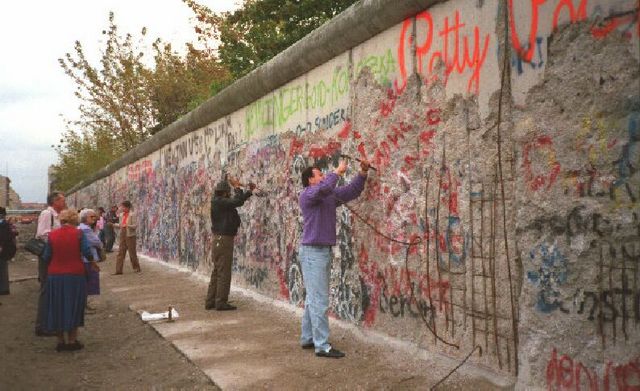
Postscript-  And please don't tell me that a government's job is to "defend its borders".  Its not.  A government's job is to defend its citizens and residents.  There are times that this job may literally require defending the borders (e.g. France in 1940) but that clever misrepresentation of the role of government is the linguistic trick immigration opponents use to justify all sorts of semi-fascist actions, like building this happy little wall in Nogales:

Nogaleswall_1

Which seems awfully reminiscent of this wall in Berlin:

 Berlinwall

Compare Berlin and Nogales.  What is the fundamental principle that makes preventing the movement of people one-way across a border one of the worst human rights violations in the last century, but preventing them from moving the other way across a border is a fine policy with bi-partisan support here in Arizona?

Technorati Tags:  , ,
,

More Arizona Cotton Subsidies

A while back, I wrote the Porkbusters post on Arizona farm subsidies, which are mainly cotton subsidies.  Cotton gets subsidized both with direct farm subsidies as well as price-subsidized water (this is a desert, after all, and unlike Egypt we don't have the Nile running through it).

Porkopolis is on the case with a further potential subsidy, as the US Government is apparently transferring a valuable piece of Phoenix commercial real estate to Arizona cotton growers:

A review of the final bill passed by both the House and the Senate shows that Senators DeWine and Voinovich, along with 97 other Senators,
voted for a provision that transfers a federal facility and surrounding
land to the Arizona Cotton Growers Association and Supima:

SEC.
783. As soon as practicable after the Agricultural Research Service
Operations at the Western Cotton Research Laboratory located at 4135
East Broadway Road in Phoenix, Arizona, have ceased, the Secretary of
Agriculture shall convey, without consideration, to the Arizona Cotton Growers Association and Supima all right, title, and interest of the United States in and to the real property at that location, including improvements.

They've got a very deep investigative report. 

Intifada or Welfare State Fallout?

Rioting in the immigrant-heavy, Muslim-heavy quarters of France continues

The unrest started last Thursday when angry
youths protested the accidental deaths of two teenagers in
Clichy-sous-Bois, who were electrocuted when they jumped a wall
surrounding a high-voltage electrical transformer while fleeing police. The
anger spread across the housing projects that dominate many of Paris'
northern and northeastern suburbs, which are marked by soaring
unemployment, delinquency and a sense of despair.

The
rioting has grown into a broader challenge for the French state. It has
laid bare discontent simmering in suburbs where immigrants "” many of
them African Muslims "” and their French-born children are trapped by
poverty, unemployment, discrimination, crime and poor education and
housing.

There are those who want to call this the beginning of a new European Intifada, a war of Muslims against non-Muslims.  They want to portray these riots in the same context as Islamic terrorism and Al Qaeda. 

Call me slow, but I just haven't seen evidence that the recent violence in Paris has religious overtones.  Maybe it is under-reported, but I haven't seen any targeting of Christians or Jews or Jewish Temples and such that one might expect in intifada-type violence. 

So far, a better explanation seems to be that these neighborhoods have been the victim of of the current form of Euro-socialism.  In this economic model, a whole collection of laws make it very expensive for companies to hire anyone.  If you do hire anyone, you have to pay them a very high salary, give them a fat package of benefits, weeks and weeks of paid vacation, and they only have to work 36 hours a week for you.  And, if the person doesn't do a good job, too bad because it is nearly impossible to fire them.  This may appear to be a great system for those who already have a job, but for the unemployed, the young, and the unskilled, it is a disaster.  Who in their right mind is going to take a chance on a young, unskilled employee who you have to pay a fortune and who you can't fire if they aren't any good.  And in particular, who is ever going to hire a young, unskilled immigrant for a job in France?

The answer is no one, which is possibly another reason for the rioting.  France has an unemployment rate that has hovered around 10% for years, but the unemployment rate for those under 25 years old is a truly shocking 23% and I would bet the unemployment rate for young immigrants may be as high as 40-50%. 

In the US, we have gone through phases of this same type of economic thinking.  A big part of motivation behind the original passage of minimum wage law, including the recently famous Davis-Bacon law, was to protect skilled white laborers against wage competition from blacks and immigrants.  Fortunately, the US has always stopped short of the radically distorting labor market laws they have in Europe, but new efforts in this country to raise minimum wages and generally make it harder for immigrants to enter the labor market should worry all of us, particularly those of us in immigrant heavy states like Arizona.

"I Never Forgot I Was Lying"

Via Overlawyered, comes this fascinating confession of one of the young "accusers" in the McMartin pre-school sex abuse prosecutions, one of several witch-hunts from a mercifully brief era of a national day care sex-abuse panic.  While certainly abuse occurs, as is made clear from recent Catholic Church revelations, prosecutors used the excuse of "protecting the children" to justify all kinds of abuses of the fact-finding process (something we should remember in the Patriot Act era).

The lawyers had all my stories written down and knew exactly what I had said
before. So I knew I would have to say those exact things again and not have
anything be different, otherwise they would know I was lying. I put a lot of
pressure on myself. At night in bed, I would think hard about things I had said
in the past and try to repeat only the things I knew I'd said before.

I
remember describing going to an airport and Ray taking us somewhere on an
airplane. Then I realized the parents would have known the kids were gone from
the school. I felt I'd screwed up and my lie had been caught"”I was busted! I was
so upset with myself! I remember breaking down and crying. I felt everyone knew
I was lying. But my parents said, "You're doing fine. Don't worry." And everyone
was saying how proud they were of me, not to worry.

I'm not saying
nothing happened to anyone else at the McMartin Pre-School. I can't say that"”I
can only speak for myself. Maybe some things did happen. Maybe some kids made up
stories about things that didn't really happen, and eventually started believing
they were telling the truth. Maybe some got scared that the teachers would get
their families because they were lying. But I never forgot I was lying.

There is much more in the article, demonstrating how prosecutors manipulated children to get prosecutions. 

This topic has resonance with me because I sat on the jury of such a case around 1992.  Earlier sex-abuse prosecutions were starting to look suspicious, but there was still a lot of incentive for prosecutors to push high-profile cases (after all, Janet Reno would soon become AG for the US, largely on the strength of a number of well publicized and in retrospect very questionable such prosecutions).  By 1992, though, defense lawyers had caught up and were better at highlighting the egregious tactics used by prosecutors to coax stories out of children.  Many of the tactics we saw in our trial were identical to those recounted in this article.  There was even an eerie parallel to this recent Vioxx case, as the initial (3rd party) accuser who first reported that the victim was being abused seemed more motivated by getting on Oprah than getting her facts correct.

Update:  Neo-Libertarian has the details on the Janet Reno prosecutions I mentioned in passing.  Here is the PBS story on "the Miami method" and several of Reno's unethical abuse prosecutions.

Press Getting Upgraded to Elite-level Citizenship

Congress is again on the verge of conferring new Constitutional rights to a narrow subset of American citizenry.  Already the recipient of speech rights that the rest of us don't enjoy, the major media organizations are also about to receive a special pass from cooperating with law enforcement and criminal investigations.  The reason for granting these new rights is in part because the media, with their business model in tatters, has learned a lesson from the steel and airline industry about running to Congress for help.

First there were special speech rights for the Press:  McCain-Feingold

This special treatment began with the McCain-Feingold Campaign Finance Act, which gave journalists unique speech rights during elections by taking away the speech rights of every other non-media-credentialed American in the 30-90 days prior to an election.  Of course, those of us who don't work for the NY Times or CBS were kind of confused about how we had somehow lost our constitutional right to political speech.  Reasonably, many of us in the blogosphere wanted our speech rights back, and campaigned to be called journalists (i.e. to get the media exemption from campaign speech restrictions).  As I wrote back in June:

These past few weeks, we have been debating whether this media
exemption from speech restrictions should be extended to bloggers.  At
first, I was in favorThen I was torn.
Now, I am pissed.  The more I think of it, it is insane that we are
creating a 2-tiered system of first amendment rights at all, and I
really don't care any more who is in which tier.  Given the wording of
the Constitution, how do I decide who gets speech and who doesn't - it
sounds like everyone is supposed to...

I
have come to the conclusion that arguing over who gets the media
exemption is like arguing about whether a Native American in 1960's
Alabama should use the white or the colored-only bathroom:  It is an
obscene discussion and is missing the whole point, that the facilities
shouldn't be segregated in the first place.

Now, Congress is Considering Enhanced "Shield" Laws

Now Congress is ready to take another step in the same direction of giving the media special enhanced platinum-level Constitutional rights with the proposed Federal Shield Law.  No doubt inspired by the whole Valerie Plame / Judith Miller mess, this is yet another example of Congress feeling like it has to "do something" with a half-assed solution to a non-problem that no one at this point, except perhaps Ms. Miller, even really understands.  The Federal Shield Law, named in typical Orwellian fashion the "Free Flow of Information Act", would make reporters the only citizens of the United States who can evade subpoenas and legally stand in contempt of court, a right we have determined that not even presidents have.

These shield laws, which I have criticized before, are often justified as necessary supports for the First Amendment.  Beyond the fact that the press in this country has functioned for centuries quite nicely without such shield laws, and have toppled President's without these extra rights, they are somehow now "necessary to help the United States regain its status as an 'exemplar' of press freedom", according to bill sponsor Richard Luger  (a statement made without explaining either why this was true or even how or when the US stopped being an 'exemplar' of press freedom).

Luger is not even shy about admitting that this law effectively creates two classes of citizen in the United States:

Lugar acknowledged that the legislation could amount to a "privilege" for reporters over other Americans.

"I think, very frankly, you can make a case that this is a special
boon for reporters, and certainly for their role in freedom of the
press," he said. "At the end of the day what we will come out with says
there is something privileged about being a reporter, and being able to
report on something without being thrown into jail."

Um, reporters can already report things without being thrown in jail.  Judith Miller, the explicit reason for the bill's existence, according to Luger, was thrown in jail not for her reporting, but her refusing to participate in an investigation.  An investigation that her employer the NY Times cheer-led the government into starting.  She was put in jail for refusing to testify about a source who had in fact already given her verbal permission before she went to jail to reveal his name.

Glenn Reynolds has a nice quote about the proposal:

ONE CHARACTERISTIC OF THE TITLED NOBILITY was its immunity from some
legal rules laid on the commoners; that's why such titles were an
important boon that the King could bestow on favorites. Reading this statement by Richard Lugar on the proposed journalists' shield law, which probably won't cover bloggers, I wonder if we're getting into the same territory

The Licensing Issue:  Who is a Journalist?

This new special privilege afforded to journalists, when combined with the special speech rights conferred in McCain-Feingold, increases the importance of the question "So who is a journalist and who qualifies for these unique privileges?" I predicted way back in February that I thought some type of official licensing program was going to be proposed for journalists.  Well, here it is in black and white in the aforementioned article on the new shield law:

A key reason some journalists oppose the popular federal shield
proposal is fear that giving Congress the power to define who is and
isn't a journalist could lead effectively to the licensing of
journalists.

Back in February, I predicted that the effort at licensing would fail, but now I have changed my mind.  After all, you can't have all of us unwashed folks who actually got good grades in math so we didn't have to default back to a journalism degree in college getting hold of these special privileges.  Only elite people who have proved themselves worth of being beyond legal accountability, folks like Dan Rather or the Katrina reporters, can be trusted with these extra rights and privileges.

Whenever the government by legislation gives a group of people special powers, it always leads to licensing.  It HAS to, else the courts would forever be bogged down with fights over who is in and who is out.  It is much easier to say "the only people who have the right to evade subpoenas are people with this piece of paper."  Using medicine as a parallel example, once you decide the average person can't be trusted to educate themselves enough to make their own medication decisions, you end up with a process where only licensed MD's can issue prescriptions.  The same will be true in journalism.

What is Really Going On Here

To understand what is really going on here, think "steel industry" or "airline industry".  When technology or markets or customers or competition changed in industries like steel, the last desperate defense of the US steel industry was to run to the government begging for import restrictions and price supports and subsidies and pension bailouts and god-knows what else.  Boy-oh-boy wouldn't the steel industry in the US love to have a law that says only licensed steel makers can sell steel in the US, and by the way, the current steel industry participants will control the licensing board.

Think that is a ridiculous exaggeration?  It can't be any more stupid than this form of licensing (or this one;  or this one).  Here are the various trade-specific licenses
you need here in Scottsdale - I would hate to see the list for some
place like Santa Monica.  My favorite is the one that says "An
additional license is required for those firms which are going out of
business."  Or for an exact parallel to my steel industry hypothetical, try this law from Ohio to liscence new auctioneers:

Besides costing $200 and posting a $50,000 bond,
the license requires a one-year apprenticeship to a licensed auctioneer, acting
as a bid-caller in 12 auctions, attending an approved auction school, passing a
written and oral exam. Failure to get a license could result in the seller being
fined up to $1,000 and jailed for a maximum of 90 days.

And my commentary on it:

Note that under this system, auctioneers
have an automatic veto over new competition, since all potential
competitors must find an existing auctioneer to take them on as an
apprentice.  Imagine the consumer electronics business - "I'm sorry,
you can't make or sell any DVD players until Sony or Toshiba have
agreed to take you on as an intern for a year".  Yeah, I bet we'd see a
lot of new electronics firms in that system - not.

This is exactly what is going on with the media.  The world, at least for the US media, is changing.  Subscriptions and ad revenues have been falling year after year after year.  People either giving up this media all-together or switching to new competitors, such as online media, in large numbers and there is no indication that this trend will stop.  As a result, the traditional media finds itself with its back against the wall.

What to do?  What every other industry has done - run to Congress!  Major media groups were extraordinarily strong supporters of McCain-Feingold, knowing that by limiting speech of everyone else, it added to its own influence and power come election time.  Over time, Congress will continue to add new privileges for the media, like the shield law, in part because it knows that it needs to stay in good with the only group of people who have full speech rights come election time.

The one thing I disagree with in the quote above about licensing is the notion that many in the press oppose it.  They are right to see the prospect as scary (see unintended consequences below) but once a licensing system is in place, I GUARANTEE that the licensed press will be huge supporters of licensing.  Just like lawyers and doctors, the press will find a way to take control of their own licensing and use it to keep out competitors they don't like.  Those pajama-clad bloggers irritating you - well, just make sure that they don't get licensed.  Come election time, they will all have to shut up, because only licensed journalists will have the media exemption in McC-F.  Milton Freedman described this process years ago:

The justification offered [for licensing] is always the same: to protect the consumer. However, the reason
is demonstrated by observing who lobbies at the state legislature for
the imposition or strengthening of licensure. The lobbyists are
invariably representatives of the occupation in question rather than of
the customers. True enough, plumbers presumably know better than anyone
else what their customers need to be protected against. However, it is
hard to regard altruistic concern for their customers as the primary
motive behind their determined efforts to get legal power to decide who
may be a plumber.

And as I said here:

Such credentialing can provide a powerful comeback for industry insiders under attack.  Teachers, for example, use it every chance they get to attack home schooling and private schools,
despite the fact that uncertified teachers in both these latter
environments do better than the average certified teacher (for example,
kids home schooled by moms who dropped out of high school performed at
the 83rd percentile).  So, next time the MSM is under attack from the blogosphere, rather than address the issues, they can say that that guy in Tennessee is just a college professor and isn't even a licensed journalist.

Hit and Run described how doctors use the licensing process, and even hazing of interns, to keep their numbers down and therefore their salaries (and their fees to us) up:

When Kevin Drum commented on the New England Journal
article, he said that the system's defenders "sound like nothing so
much as a bunch of 50s frat boys defending hazing after some freshman
has been found dead in an arroyo somewhere."

Hazing is the right metaphor. The system serves the same
purpose: It's a brutal initiation to a privileged club. Medical hazing
is part of the set of barriers that limit entry to the profession;
whatever other reasons there are for it, it's ultimately a byproduct of
occupational licensing.
Those long shifts don't just undermine public health. They drive away
qualified men and women, reducing the supply of doctors and allowing
those who survive the trial to charge more for their services.

Unintended consequences

Of course, all this has unintended consequences, as does any government meddling in individual decisions, limitations of rights, or attempts to pick industry winners. 

The first unintended consequence, or more accurately I guess I should call it the first irony because I am not sure that it is unintended, is that laws meant to keep the elite from having undue influence vs. the little guy in politics (via spending limits) have done just the opposite - concentrated political speech in a few elites in the media and squashed the one medium, blogging and the Internet, that hold the promise of giving individuals like myself new, inexpensive ways of influencing politics.

The second unintended and really scary consequence is that in attempting to remove a lever of government control over media - the subpoena power - Congress is potentially creating a larger one - that of licensing.  Of all the news-oriented media in the world, which is the most bland?  I would answer local TV and radio (by this I mean their local programming, not the syndicated stuff they air).  Why?  Because they are already subject to government licensing that to this point other media, such as newspapers, have not.  Local broadcast outlets are VERY self-conscious about protecting their license, and tend to keep their programming bland to avoid irritating some government bureaucrat.  Just look at how many rolled over immediately and dropped Howard Stern when the government started looking cross-eyed at Stern's raunchiness.  Do we really want all the media subject to this kind of pressure?

Technorati Tags: 

Jet-Setting Entrepreneur

Sometimes entrepreneurs are successful enough to buy themselves sexy toys:  It may just be a nice pool table for the office, or it might be that new Gulfstream jet bought with the IPO proceeds.  But little did I know that entrepreneurial success would allow me to buy this beauty (click to enlarge):

Pic00003b

This septic tank truck can really haul a load, carrying over 3800 gallons of, uh, poop.

We have a new facility at Pyramid Lake  we run in LA County, where, due to its location, all the bathrooms run into series of underground holding tanks.  At some point in the past, someone converted all the bathrooms into flush toilets, which in this area makes for a real waste of water and creates a lot of liquid waste we have to pump out and dispose of, at the cost of over $80,000 a year.  This truck is the intermediate solution, letting us cut our pumpong costs in half.  The long-term solution we are working with the US Forest Service on is to replace the bathrooms with a great composting technology from Bio-Sun, which will cut the waste and water use both to near zero.

Richer and Warmer vs. Poorer and Cooler

For quite a while, I have wanted to see that someone address the question of comparing a richer and warmer world with a poorer and cooler world, and not just assuming that the latter is superior.  As I wrote here, this is one of the most important questions ignored to date by Kyoto supporters.  Supporters of immediate climate change action shout warnings about the dangers of raising the earth's temperature a degree or two.  But what if that comes at the cost of reducing world economic growth a percentage or two?  There is still a lot of work to be done to understand the impacts of a 1-2 degree temperature rise, but it is very, very well understood what 1-2 extra points of economic growth can do, especially in developing countries.  Economic growth reduces starvation, increases life expectancy, improves health care and sanitation, and increases the ability to survive natural disasters.

The Commons Blog links to this study by Indur Goklany on just this topic.  I have not had time to get through it all -- I am just happy someone is even asking the question -- but the Commons Blog folks have:

If global warming is real and its effects will one day be as devastating as
some believe is likely, then greater economic growth would, by increasing
greenhouse gas (GHG) emissions, sooner or later lead to greater damages from
climate change. On the other hand, by increasing wealth, technological
development and human capital, economic growth would broadly increase human
well-being, and society's capacity to reduce climate change damages via
adaptation or mitigation. Hence, the conundrum: at what point in the future
would the benefits of a richer and more technologically advanced world be
canceled out by the costs of a warmer world?

Indur Goklany attempted to shed light on this conundrum in a recent paper
presented at the 25th Annual North American Conference of the US Association for
Energy Economics, in Denver (Sept. 21, 2005). His paper "” "Is a
richer-but-warmer world better than poorer-but-cooler worlds?"
"” which can
be found here, draws
upon the results of a series of UK Government-sponsored studies which employed
the IPCC's emissions scenarios to project future climate change between 1990 and
2100 and its global impacts on various climate-sensitive determinants of human
and environmental well-being (such as malaria, hunger, water shortage, coastal
flooding, and habitat loss). The results indicate that notwithstanding climate
change, through much of this century, human well-being is likely to be highest
in the richest-but-warmest world and lower in poorer-but-cooler worlds. With
respect to environmental well-being, matters may be best under the former world
for some critical environmental indicators through 2085-2100, but not
necessarily for others.

This conclusion casts doubt on a key premise implicit in all calls to take
actions now that would go beyond "no-regret" policies in order to reduce GHG
emissions in the near term, namely, a richer-but-warmer world will, before too
long, necessarily be worse for the globe than a poorer-but-cooler world. But the
above analysis suggests this is unlikely to happen, at least until after the
2085-2100 period.

It is particularly important to do the economic work using the same assumptions that the climatologists use. As I posted before, climate studies tilt the playing field in the favor of warming by assuming huge economic growth rates in developing nations.  This ups CO2 emissions estimates, because it is also assumed that these countries remain inefficient energy consumers.  I have criticized this approach in the past, since it yields ridiculous outcomes (many of these smaller nations end up with economies larger than the US in 2050).  However, if they are going to insist on these assumptions, that should also be the backdrop for estimating economic impact of reductions. Presumably, since in their model CO2 comes disproportionately from developing country growth, then the costs will be seen disproportionately in terms of reduced developing country growth.  Which will have predictable results in terms of malnutrition, starvation, disease, and shorter lifespans.

Technorati Tags:  ,

Maybe He Should Have Worn a Cardigan

Truck and Barter is not very impressed with Bush's call for us all to drive less. 

I'd like to know just why I should conserve. We supposedly live in a
capitalist society based on property-rights and free-trade; why, all of a
sudden, do you ask that I not trust that the price of fuel incorporates all the
scarcities at every level of production? What economic lever broke in the past
month? Why do you think the price system is failing so bad that we need to
"conserve" more than the price signal warrants?

I won't pretend that market prices don't exist, or that markets have suddenly
stopped working; I won't pretend that prices are inefficient allocators of
resources; I won't pretend that I cannot buy as much gasoline as I can afford at
current prices.

Furthermore, Mr. President, I will not pretend that you have legal or moral
authority to tell me how much gasoline I may purchase. I will not pretend that
your feeble call to use less has any impact whatsoever on my psyche. I will not
pretend that the Federal Government knows better than me how much gasoline I
should purchase.

Awesome, well said.  Maybe if Bush had worn a cardigan, like Jimmy Carter did when he asked the same thing, he might have been more successful.  Or then again, maybe Bush should have thought twice about channeling Jimmy Carter on any energy or economics related issue.

By the way, there is much more to the post - make sure to read it all.

Update: This one attracted a number of comments fast.  Here are some additional thoughts

Doesn't it make sense to conserve gas?  Isn't what Bush said correct?

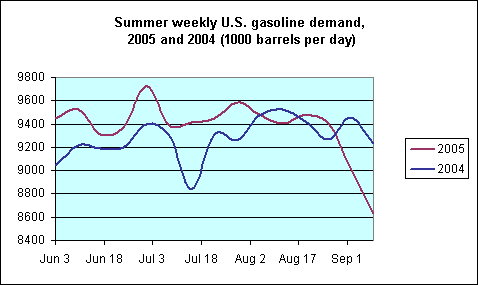
Sure it makes sense, but I didn't need Bush to tell me.  Seeing my average 15 gallon fillup go from $30 to $45 nearly overnight told me everything I needed to know.   I adjusted my driving behavior based on how I value various types of trips.  And so, apparently, did everyone else, as gas consumption in this country dropped almost 10%.  Bush doesn't have to tell you to refinance your home when mortgage rates drop, or to buy less OJ when the orange crop failed -- prices signal these things quite nicely.

By the way, I limited my driving years ago (e.g. I live 1 mile from my office) but not because of gas prices.  Lets say 1 hour of driving gets me 30 miles in the city, and requires 1.5 gallons of gas.  The recent increase in gas prices has increased the cost of that 1 hour of driving by about $1.50.  That is NOTHING compared to how I have increased how I value my free time as I have grown older.  That hour may use up five bucks of gas but hundreds of dollars of my leisure time.  I have often told people that the biggest change you go through getting older is how much your internal valuation of your own free time goes up.  In college, I would wait for 8 hours in a line to get concert tickets at face value.  Today, I buy them market up at eBay, because that 8 hours is now worth far, far more to me than the markup.

Wouldn't voluntary conservation beyond what you have already cut back help reduce gas prices in the US?

Sure, if everyone cut back some percentage more than what they would have already done due to the price increase, then yes that might help push prices down.  Of course every person who did this would lose from doing so.  When the price increases, everyone eliminates their marginal use of gasoline, ie every use or trip that is worth less to them than the cost in fuel.  That means that the trips that remain are worth more to them than the gas (and other)  costs.  Therefore, remaining trips are a net increase to their well-being.  If a remaining trip is then eliminated voluntarily, or the cost of that trip is increased due to the increased hassle of carpooling or using public transit, then their well-being is reduced. 

However, this is the great thing about America:  If you personally value voluntarily reducing your gas consumption to help reduce prices for others, in a free society, no one is going to stop you.

By the way, here is the reason I don't worry about it:  I am old enough to have been driving in the late 1970's.  And I know from experience that allowing prices to shoot up for a period of time, without government price caps or windfall profit confiscation silliness, is going to lead to more supply and lower prices in the future.

Don't you think its unethical not to conserve in times like this?

No.  I don't associate consumption and ethics.  If it is sold legally at a certain price, and I can afford and wish to pay that price, then I don't see that morality or ethics come into play.  While there certainly can be ethical problems spending money unwisely (e.g. blowing money on coke or gambling that was needed to feed your kids), that is a different situation.  I don't feel guilty about consuming gas.

Isn't it a security issue?  Shouldn't we be asked or forced to conserve more to make the US independent of foreign oil?

There is only one time this argument makes any sense - if the world is in a full scale shooting war and all foreign trade and international markets are halted, and then we would have much bigger problems.

Short of the breakdown of world trade and markets, being "independent of foreign oil" is a mirage, an impossible non-goal.  Lets say that the world energy supply and demand was exactly the same as it was today, except that the US produced domestically exactly enough oil to satisfy domestic demand.  But in this case there is still a world market for oil.  The price of oil and gas in this country would not be more or less than it is today, except maybe for a few cents of transportation cost differences.  And if there is an oil supply shock, the pricing in the US will be virtually the same in this hypothetical situation as it would be in today's structure.

Shouldn't the President be doing something?

Sure.  Get the hell out of the way of the people who can fix the problem.  Rethink the regulatory regime that is preventing refinery construction.  Revamp the licensing approach for nuclear power.  Open up oil drilling in proscribed areas.  And find his lost veto pen and ax any dumbshit regulation out of Congress managing energy prices, taxing windfall profits, or attempting to pick winners via subsidies.

Technorati Tags:  ,

Agenda for UN Internet Conference

COYOTE BLOG EXCLUSIVE!!  We have obtained the preliminary agenda for the upcoming UN Internet Conference in Tunisia.

AGENDA

Day 1

Dinner
Benon Sevan has generously offered to supply dinner from a selection of
the food provided to the Iraqi people under the UN Oil-for-food program.
Unfortunately, it was found at the last minute that no one in the
oil-for-food department has any contacts with companies that actually sell food.
The French delegation has generously stepped in the last minute with
chicken and Vichy water for everyone.

After-Dinner Keynote Address:  Fighting Hate Speech
Wen Jaibao
Premier, China

All of us are concerned with the growth of hate speech on the web.  Spread by foreign anarchists and CIA operatives called "bloggers", these lies present a constant danger to all of our governments..  Premier Wen, whose country under Chairman Mao broke Germany's and Russia's records for the most people sent to government-sponsored sensitivity training, outlines some of the technologies China is using to protect Chinese citizens from foreign deception.  He also will discuss how he got US companies like Cisco and Microsoft to abandon their public principles in exchange for promises of large contracts

Day 2

Pricing for Domain Names
Kojo Annan

Kojo will discuss a number of technical issues associated with domain name pricing.  Among the topics discussed will be "how large a kickback should be demanded of large US companies renewing their domain name registrations", "how should kickback money be distributed between general assembly members", "how can sub-contracts be funneled to key family members", and "how Paypal can be used to facilitate 'courtesy' payments".  Kojo will also discuss the mechanics of Swiss banking as it applies to government Internet supervision.

Pornography on the Web
Hassan al Saud
Saudi Arabian Security Service

Director al Saud will discuss approaches for limiting pornography on the web, such as photos showing NFL Cheerleaders, hot protest babes, or any woman with tattoos, body piercings, or a bare midriff, including nearly the entire UC-Santa Barbara female population.  Al Saud will review his groundbreaking work filtering news service web pages for the names of women and women authors and replacing them with men's names.  Afterwards, al Saud will be signing copies of his bestseller "Gone with the Wind".

Lunch
Robert Mugabe has generously offered to supply lunch from the fine
farms of Zimbabwe.  Unfortunately, unforeseen...technical problems will
make that impossible.  We ask that all delegates go outside the meeting hall and fend for themselves for lunch.

Future of email scams
Dr. Hamzu Kalo
Lagos Nigeria

Many of us are concerned with the growth of email scams.  In this important discussion, Dr. Kalu will discuss topics including "How can other countries get a piece of Nigeria's lucrative email scam business", "how can UN imprimatur be used to increase email scam returns", and "how should government's tax email scam revenue".  Working papers from Dr. Kalo's last conference can be found here.

Shortsighted Nationalization
Hugo Chavez
President, Venezuela

Mr. Chavez will argue his controversial hypothesis that it is shortsighted to immediately nationalize US corporate assets when taking office.  His premise is that it is better to wait 6-12 months, after companies have become complacent, before seizing their operations.  Mr. Chavez will also address the difficult issue of how to attract new foreign investment when every successful foreign enterprise in the history of your country has been nationalized.

Snack Break
Sponsored by Cisco and Microsoft to introduce their joint Internet initiative with the United Nations entitled "We are for freedom and democracy, except when we're not."

Promise of the Internet for Managing elections
Jimmy Carter
ex-President, United States of America

Everyone should be familiar with President Carter's outstanding work courageously certifying the election in Venezuela while challenging corrupt elections in Florida and Ohio.  President Carter will address the topic of using Internet technology for elections.  He will show that paper ballot technology can still leave a potentially dangerous paper trail, while Internet voting allows for nearly total ability to manage elections to make sure that the will of the people is not thwarted by CIA-financed lying upstarts.

Farewell Dinner
Dinner was to be provided by the United States delegation, but US authorities could not provide documentation that no genetically modified foods were used to prepare the meal.  It has been decided that it is better for the meeting delegates to go hungry than risk eating any GM crops.

Transportation
No transportation has been arranged, but officials are encouraged to nationalize any assets they need to reach the conference.

Email
In the spirit of promoting the
Internet and Tunisia's leading role in it, all participants will be
allowed full access to email while in the conference.  All email will
be downloaded by our WIFI (Working-group Investigating Foreign-corruption via the Internet)
and printed out for our guests.  Conference participants should note
that emails with language directly threatening the state** will not be
passed on.

**Note that this includes any references derogatory to the Tunisian government, its officials, and its ruling party, as well as any comments defaming the governments of Libya, Syria, Iran, Venezuela, Cuba, North Korea, or any ally of Tunisia or in fact any other country that is not the United States.  It also includes any references to women without clothes, women working, women driving a car, or women doing anything outside of the house or their male family members' control.  It also includes mentions of provocative terminology and hate speech, including the words freedom, free press, free speech, democracy, property, capitalism, non-Muslim religions, George Bush, the state of Texas, Shiner Bock Beer, or the Dallas Cowboys.  Making fun of the Arizona Cardinals, however, is always OK.

Update:  This column is obviously a failed parody, because to be ironic you have to exaggerate reality at least somewhat.  I may have actually fallen short of reality:

As Tunisia prepares to host the controversial
World Summit for the Information Society in November, Tunisian opposition activist Neila
Charchour Hachicha
informs Global Voices that the online freedom of speech protest site launched by
Tunisians on Monday, www.yezzi.org has
already been blocked by the Tunisian authorities.

The online protest, called "Freedom
of Expression in Mourning
," is organized by The Tunisian Association for the Promotion
and Defense of Cyberspace
(Association Tunisienne pour la Promotion et la
Défense du Cyberespace).

More on the UN Internet conference here as well.


Technorati Tags:  , ,

Thank Goodness

The US has refused to turn control of the Internet over to the UN.  Thank Goodness. (via Instapundit)

A senior U.S. official rejected calls on Thursday for a
U.N. body to take over control of the main computers that direct
traffic on the Internet, reiterating U.S. intentions to keep its
historical role as the medium's principal overseer.

"We will not agree to the U.N. taking over the management of the
Internet," said Ambassador David Gross, the U.S. coordinator for
international communications and information policy at the State
Department. "Some countries want that. We think that's unacceptable."

Beyond the potential fortunes UN officials could make in bribes and kickbacks with such control,

Many countries, particularly developing ones, have become increasingly
concerned about the U.S. control, which stems from the country's role
in creating the Internet as a Pentagon project and funding much of its
early development.

Too bad.  If you don't like it, band together and create your own.  This is classic socialist thinking - don't bother to invest or try to compete, just confiscate the assets of whoever is already successful.

Meryl Yourish, by the way, brings us this delicious irony:  Tunisia, whose government actively censors the web and restricts its people's access to the web, will be hosting the next UN Internet summit:

Facing heated protest, the United Nations on Wednesday defended
Tunisia's hosting of a U.N. summit about Internet access in the
developing world, even though the north African nation has been
repeatedly accused of rights abuses that include blocking Web sites it
dislikes....

the government has blocked access to Web sites belonging
to Reporters Without Borders, other human rights watchdogs, and the
independent press, while police monitor e-mails and Internet cafes.

"It
does question to some extent the U.N.'s credibility that a world summit
on the information society is taking place in a society where access to
some Web sites is restricted," said Alexis Krikorian, of the
International Publishers' Association. "It's amazing that such a summit
would take place in a country like this."

No kidding.  When you think of turning tasks over to the UN, remember that over half the membership and the bureaucracy is dominated by officials from dictatorships.  Turning the Internet over to the UN means turning it over to Robert Mugabe and Hugo Chavez and Fidel Castro and Kim Il Sung.  And to Syria and Saudi Arabia and Iran.  And don't forget China, currently in the middle of the largest and most aggressive government Internet censorship project in the world.

New Chinese regulations governing Internet
news content tighten the noose on freewheeling bloggers and aim to rein
in the medium that is a growing source of information for the
mainland's more than 100 million users.

The day we hand the Internet over to the UN is the day we should start building a new one.

In Case You Don't Understand Louisiana

Whether it is the French influence or the long shadow of Huey Long's patronage driven socialist experiment, Louisiana has a tradition of bad government.  I remember several years ago the governor's race featured a Nazi running against a convicted felon (convicted in office of bribery and influence peddling, if I remember right).

So one of the problems with the management of Katrina problems is that Katrina hit Louisiana, the US's own version of Haiti.  Don't believe me?  This is already coming out, and you can be sure there is more:

Police found cases of food, clothes and tools intended for hurricane
victims in the backyard, shed and rooms throughout the home of a chief
administrative officer of a New Orleans suburb, officials said
Wednesday.

Police in Kenner searched Cedric Floyd's home Tuesday because of
complaints that city workers were helping themselves to donations for
hurricane victims. Floyd, who runs the day-to-day operations in Kenner,
was in charge of distributing the donations.

The donations, including lanterns, vacuums and clothes with price
tags attached, had to be removed in four loads in a big pickup truck,
Kenner police Capt. Steve Caraway said.

"It was an awful lot of stuff," he said.

Technorati Tags: 

Supply and Demand in Gasoline

Via Lynne Keisling of the Knowledge Problem comes two good articles on supply and demand in the gasoline markets. 

The first is from James Hamilton, who analyzes the effect of gasoline price increase on demand and finds, amazingly to some I guess, that demand has fallen substantially.

Gas_demand_1

We have certainly seen this in the camping and travel business, as visitation has fallen off the map of late, though fortunately it comes right at the end of the season.  It appears that demand has fallen about 10% with the increase to circa $3 gas, about matching the shortfall in US refining capacity post-Katrina.  Does anyone doubt that we would have seen gas lines had prices not risen?

The second article is from Steve Chapman. Apparently, Democratic senators are separately working to make sure that higher oil prices are not allowed to spur either lower demand or higher supply.   First he takes on serial-stupid-statement-making Maria Cantwell who is working the demand-side with her desire to have the US President set retail gasoline prices:

This week, as gasoline prices remained above $3 a
gallon, [Maria Cantwell] proposed giving the president the power to tell retailers
what they can charge at the pump.

A lot of people grew anxious
seeing long lines forming last week, as motorists rushed to fill their
tanks in the aftermath of Hurricane Katrina. But Cantwell apparently
enjoyed the sight well enough that she'd like to make those lines a
permanent feature of the landscape. If so, she has the right approach.
The government does many things badly, but one thing it knows how to do
is create shortages through the vigorous use of price controls.

That's what it did in the oil market in 1979-80, under President Jimmy
Carter. He was replaced by Ronald Reagan, who lifted price caps on gas
and thus not only banished shortages but brought about an era of low
prices.

Cantwell thinks oil companies have manipulated the
energy market to gouge consumers, though she is awaiting evidence to
support that theory. "I just don't have the document to prove it," she
declared. Her suspicions were roused when she noticed that prices
climbed in Seattle--though most of its oil comes from Alaska, which was
not hit by a hurricane.

Maybe no one has told Cantwell that oil
trades in an international market, and that when companies and
consumers in the South can't get fuel from their usual sources, they
will buy it from other ones, even if they have to go as far as Prudhoe
Bay.

If prices rose in Dallas and didn't rise in Seattle, oil
producers would have a big incentive to ship all their supplies to
Texas--leaving Washingtonians to pay nothing for nothing. When a freeze
damages Florida's orange juice crop, does Cantwell think only
Floridians feel the pain?

Then, he turns his attention to Senator Dorgan, who wants to make sure we get no new oil supplies by having the government confiscate "windfall profits"

Sen. Byron Dorgan (D-N.D.), meanwhile, was outraged by
the thought of giant oil companies making money merely for supplying
the nation's energy needs. He claimed they will reap $80 billion in
"windfall profits" and wants the government to confiscate a large share
of that sum through a special federal tax.

But the prospect of
occasional "windfall" profits is one reason corporations are willing to
risk their money drilling wells that may turn out to be drier than Alan
Greenspan's reading list. Take them away, and investors may decide
they'd rather speculate in real estate.

Speaking of real
estate, Americans seem to feel no moral compunction about getting rich
from unforeseen increases in the price of another vital necessity. You
think home sellers in Baton Rouge haven't raised their asking prices in
the last 10 days? You think Dorgan wants to tax their windfall?

It's hard to see why oil companies shouldn't make a lot of money when
the commodity they provide is suddenly in short supply. After all, they
are vulnerable to weak profits or even losses during times of glut.
Back when Americans were enjoying abundant cheap gasoline, the joke was
that the surest way to make a small fortune in the oil industry was to
start with a large fortune.

Oil companies are also subject to
the whims of nature. No one is holding a charity fundraiser for the
businesspeople whose rigs and refineries were smashed by Katrina. No
one will come to their aid if prices drop by half.

Maybe Senator Dorgan can go back and confiscate the windfall profits that Maria Cantwell made in the Internet Bubble, where she made a fortune cashing out to later investors who took a bath.  At least oil companies are creating value with new oil production with their windfall profits:

Calgary"” Penn West Energy Trust is holding
a huge land sale -- looking to sell exploration rights to more than
500,000 hectares of undeveloped territory in Western Canada -- and the
offering has stirred a frenzy among many oil and natural gas companies
hungry for new drilling options.

"Demand is phenomenal," said Moya Little, president of Western
Divestments Inc., the firm brokering the sale. "It's a wide spectrum of
companies, startups, majors, any company that needs to drill."

And more here:

The world's biggest oil producers have significantly
boosted investment in oil exploration for the first time in nearly two
decades.

The Organisation of the Petroleum Exporting Countries,
the cartel controlling 75 per cent of the world's oil reserves, on
Monday revealed its most important members had drilled 7.5 per cent
more wells last year than in 2003 in response to the oil price boom.
Opec's annual statistical bulletin also showed that the number of rigs
in operation within the 11-member cartel rose 18.8 per cent last year
after dropping by almost 6 per cent a year earlier.

What useful purpose is Cantwell using her windfall Internet stock profits for, other than financing her own run for the Senate?  Could the Democratic Party be any more clueless about economics?  Jeez, why is it that our opposition party in this country has to be such a joke?

Technorati Tags:  ,

Top Down vs. Bottom Up

Government bureaucrats tend to resist bottom-up solutions to problems -- after all,their jobs depend on the primacy of central planning and solving problems top-down.  It is interesting to read this email posted at Vodka Pundit in this light:

Fed is dropping the ball on basic necessities such as water, portolets, you
name it. Woefully unprepared and nobody seems to be in charge or have the
gumption to get it done.

Louisiana politicians should be absolutely raising hell right now. Lots of
people including yours truly have volunteered to bring (including food,
generators, food, etc., to be self sufficient for a week or so) the most
important thing which is a boat but have been told NO under no uncertain terms.
"My" town is under water, people are in critical condition, and I have skill
sets and assets - including a boat which will come out of the hole in 14 incles
of water - and we are being denied the opportunity to help. And quite frankly,
that REALLY PISSES ME OFF.

Military is stepping up and bringing considerable skills and assets to the
table. Had they been listened to earlier, lots of logistical issues would have
been resolved. IOW's, the bureaucrats are getting moved to the sidelines but
"turf issues" are not going quietly into the night.

You can see the bureaucratic mindset at work hear:  An emphasis on being in control vs. solving the damn problem.  Don't want a lot of citizens running around on their own bringing in supplies of helping people, do we?

If we are going to insist on a 100% top-down approach, then its good the military is coming in to take over.   Only the military has the large-scale logistical experience and resources to take-on something of this scope top-down  (and even they have struggled with what may be a smaller rebuilding task in Iraq).  The US military did more good than any single organization during the Asian Tsunami, so I hope for the same here.  I would hope there are a few aircraft carriers heading to the area.

Postscript:  I know everyone is having fun blaming the feds, but what about the locals here?  If my town was below sea level with only a single dike between me and being 30 feet under a lake, I might insist that my local politicians have a contingency plan for breaches.  I have wondered why a few ships couldn't have been scuttled in the breach early in the crisis.

Update:  Much more on top-down vs. bottom-up response to Katrina here.

Technorati Tags: 

Please, Let There Be Gas Price Gouging

Katrina comes at a very bad time for US gasoline markets.  Supplies are already tight, and now a substantial amount of US oil production and refining capacity are shut in, for an unknown period of time.  Long ago, I worked as an engineer in a refinery and it can take days to get everything restarted from a cold start.  The result will almost certainly be near-term gas shortages.

There are two ways this can play out:  1)  a short term spike in prices, as much as a dollar or more a gallon or 2) long and irritating gas lines.  Lets hope that prices are allowed to reach their level and gas lines can be avoided, but who knows what political stupidities (ala Hawaii) will be proposed. 

I really, really hate gas lines.  I hate the uncertainty of whether or not I can find a station open.  I hate refilling my tank every day to make sure I am not caught short.  And for those of you who say I am arrogant since I can afford higher prices but the poor cannot, I assure you that folks who are paid by the hour are hurt much worse waiting around for hours in gas lines than the mere irritation I encounter.  More on gas line expectations as a semi-self-fulfilling prophecy here.

PS-  Expect to see news of a refinery fire or explosion over the next week.  The risk of accidents is very high when these complex plants have to start up -- they weren't really meant to be turned on and off.

Update:  First signs of a gas shortage?
Update #2:  The Mises Blog has a roundup of economics posts supporting price spikes during spot shortages (popularly known as gouging).
Update #3:  Jane Galt has more in praise of price gouging

Severe Hurricane Frequency in New Orleans

OK, I warned you, editorials are already blaming the damage in New Orleans on Global Warming in general and George Bush in specific.  Here is what you need to know about this meme:

  • Katrina is the 5th category four or five hurricane to hit within 100 miles of New Orleans since 1899.  This includes the hurricanes in 1948, 1965, and Camille in 1969.  Camille was the real whopper up to this point, one of only 3 class 5 hurricanes to ever hit the US before Katrina.  Note however, after three major (class 4 or 5) hurricanes in 21 years in the area from 1948-1969, there has not been another one to hit this area for 36 years.   It is difficult to figure out how you get an increasing frequency argument from this data.

A more detailed study of hurricane frequency is here and nice graphs here.  It turns out that increasing $ damages from hurricanes have more to do with expensive houses near the coast than increasing hurricane severity.  More on cycles of hurricane activity here

If there is a government failing here, it has more to do with local infrastructure than CO2This blog blames the lack of infrastructure on Bush (of course).  I have no particular problem bash Bush for anything, but my question is,if the locals knew this, as the blog implies, why didn't the locals spend their own damn money on their own infrastructure to protect their own selves.  If New Orleans chooses to build their city below sea level, why should the rest of us bear the cost of their higher-than-average infrastructure costs?

Update on Iraq

Here is my update on Iraq:  We are still there, and will be there for a while.  And we are still spending nearly every available financial and human resource, not to mention all of our national attention and available goodwill, on the effort to make Iraq a prosperous and successful free and independent nation, to the exclusion of being able to bring much change about anywhere else in the world.

I can't tell you whether the effort in Iraq is going well or poorly.  Certainly if I pay attention to the major media alone I would assume it's a disaster, but we all know the media has a bias toward negativity that trumps any political biases it might have (after all, your local news station learned long ago that "your kids are happy and healthy, story at 11" is not a very good way to tease the evening news).  Being familiar with alternate sources on the Internet, I know that there are successes as well as failures on the ground.  In fact, you can even sort of deduce the successes from the major media coverage.  When the NY Times stops writing about blackouts in Iraq, you know that the electrical system is fixed.  When the WaPo stops writing stories about shortfalls in re-enlistment rates, you can infer that the rates are back up.

But to me, all this back and forth over success and failure in Iraq is only peripheral to my main problem with the war.  Let's for the sake of argument posit that things are going swimmingly, and we are able to start removing assets and support from Iraq next year.  That will mean that for four or five years, the entire attention and resources of the only country in the world that is able to substantially influence the behavior of other countries will be focused on just one country. 

During the Iraq war and occupation, we have not had the "bandwidth", either in attention or moral authority or resources, to help stave off Sudanese genocide, to steer Zimbabwe off its destructive path, to influence the course of events in Iran or North Korea, to change the behavior of terrorist sponsors like Saudi Arabia, or even to head off Russia's apparent slide back toward totalitarianism. 

Now, one could easily argue that its not our job to fix these things.  And I go through phases of agreeing with this.  However, our invasion of Iraq is predicated on the assumption that it should be our foreign policy to try to fix the worst of these problems.  And if it is, does it really make sense to invest everything we have and more on one country for four or five years (or more?)  From the first days of the war, I have called this my "cleaning of the Augean stables argument".  There are just too many messes in the world to head them all off by military invasion.  Afghanistan probably justified such a military effort, given its direct connections to 9/11, but I am still confused as to why Iraq justified this attention more than 20 or so other nations I could name.  Afghanistan  convinced the world that the US was ready to use the military if it had to, and helped to reverse the perception of weakness left by Carter's response to the Iranian hostage takers, Reagan's bailing out of Lebanon, and Clinton's running form Somalia and refusing to respond to the Cole attacks.  9/11, for all its horors, gave us a certain moral authority in the world to try to clean things up.  This credibility and authority could have given new life to non-military efforts, but we chose not to use them.

Now that we are there in Iraq, I tend to be in the stay the course camp.  There are too many recent examples, such as those cited above, where bailing out has created a perception of weakness that have encouraged our enemies to more boldness.  The situation we are in with the Iraqi people is much like the obligation the police have to a mafia informant that the police have convinced to turn state's evidence with the promise of protection against retribution.  If you suddenly throw the guy back out on the street to be killed publicly, its going to be really hard to get anyone else to trust you in the future.

I will confess that there are two things that from time to time cause me to have some doubts about my  stance.

The first was the seeming cascade of good news from surrounding countries in the middle east last January, as a successful Iraqi election emboldened opposition forces in a number of countries, including Lebanon, Egypt, and Iran.  If the neocons are right, and successful democracy in Iraq leads to a cascade effect in the surrounding nations, then my argument about spending too much time and effort on one country loses some of its power.

The second and perhaps more powerful input that sometimes causes me to rethink my opposition to the Iraq war is the insanity that tends to emerge from others who are anti-war, and with whom I do not want to be associated.  Take Cindy Sheehan and her beliefs, since she seems to have been adopted as a spokesperson and mascot by much of the vocal anti-war left. (I promised myself I would never mention Cindy Sheehan in this blog, but if she can meet with the president once and later claim that the president won't meet with her, then I guess I can write about her once and then claim I won't ever mention her).

Ms Sheehan has stated, as have many others in the anti-war movement including Michael Moore, at least five reasons for their being anti-war that drive me nuts:

Insurgents are Freedom Fighters:  Sorry, but no.  Most of the insurgents are ex-Baathists or Muslim extremists who want to reinstate a fascist state in the mold either of Saddam's more secular version or Iran's more fundamentalist version.  The insurgency is the equivalent of what Germany would have been like had the SS followed through on its promise to continue fighting a guerrilla war from the Bavarian Alps.  The world is a better place without the Baathists in power, and the insurgents do not have good aims for the Iraqi people.  Period.

Its all a Jewish plot:  Everything old is new again, and this particular brand of anti-Semitism, seeing Jewish cabals everywhere pulling strings of the government, seems to be back in vogue.  However, is there any particular reason Israel would want to shake the tree in Iraq?  After all, the last and only time they were attacked by Iraq directly was the last time the US went to war with Saddam.  Israel is still surrounded by enemies, with or without Saddam in power in Iraq.  In fact, one could argue that what Israel should really want is for Iraq and Iran go back to beating the crap out of each other in war after war.

It was all for oil:  How?  People always say this, but they can never explain to me the mechanism.  If it was to put US companies into ownership positions over Iraqi oil, we did a damn bad job since the Iraqi's seem to still own all their own oil (though we did head off the French from grabbing the oil).

War is never justified:  I don't think war was justified in this case, but never?  If you make this statement, then it means you have to be willing to live with anything, from genocide to totalitarianism, up to and including in your home country.  As long as there are people who only know how to live by force and wish to rule me, war always has to be an option.

Iraqis were better off under fascism when they had security:  I am not an Iraqi, so I won't try to make this trade-off for them.  However, I would like to point out a huge irony about the folks, mainly on the left, who make this argument.  The very same folks who make this argument for the Iraqis have been faced with the same choice themselves over the last few years:  Would you rather an increased risk of domestic terrorist attack, or greater security at the cost of reduced freedoms via the Patriot Act, more random searches, profiling, surveillance, etc. etc.  Most on the anti-war left have shouted that they will take the extra risk of violent attack in order to retain their individual liberties.  I agree with them.  The difference is that I don't project exactly the opposite choice onto the Iraqi people.

Update:  Professor Bainbridge seems to be in roughly the same boat.

The Danger of Government-Owned Commercial Enterprises

I am always flabbergasted by folks who support government ownership of commercial assets based on the idea that the government is somehow more accountable than private enterprise.  This argument is, frankly, insane.  Commercial entities are held accountable by two things:  1) the ability of a customer not to purchase their product or service and 2) the ability of new competitors to enter the market and take away their customers with a better price-product package.

All enterprises naturally try to resist these pressures.  In the long run, there is not much a private company can do to evade these pressures.  Even bald attempts to monopolize the market have always failed (at least without the support of the government for that monopoly, as in certain utilities).

But government enterprises are entirely different.  The government has the legislative and regulatory power** to stifle competitors to themselves and to compel consumers to use only their product or service.  In other words, the government, uniquely, has the power to totally void the two sources of accountability in the market.

And the government uses this power all the time.  They use it to protect favored airports, to protect cigarette makers who pay them loads of settlement money, to protect wi-fi revenue, and of course to protect the good-old US Post Office. Via Reason, comes this story of the government even making life worse for drivers in order to protect their toll revenues:

When E-470 opened in 2002, some people thought it was a strange
coincidence that, about the same time, the speed limit on nearby Tower Road, a
paved, 2-lane, rural highway, dropped from 55 MPH to 40 MPH. Several apparently
unnecessary traffic signals also appeared. This, in spite of the fact that after
the toll road opened, Tower Road would have even less traffic than it did
before.

Well, it was no coincidence.

The lower speed limit and extra traffic signals, which make Tower Road slower
and less convenient to use, are required by a "non-compete" clause in an
agreement between the E-470 Public Highway Authority and nearby Commerce
City.

The goal is to impede traffic on Tower Road so drivers will decide they are
better off using the toll road. This protects the revenue stream from the tolls,
thereby protecting the interests of the toll road's investors.

Once government gets into a particular sphere, they are never ever going to voluntarily let anyone in, no matter how bad their product or service becomes.

** This power is not really constitutional, and has only emerged post-1930's, but that is another topic.

Update:  Just to anticipate the argument, observant readers will note that several of these examples represent "public-private" partnerships that split returns between private investors and the state.  The wi-fi example and the toll road example are of this type.  The fact that these government endeavors include private money does not change the problem one bit.  The problem is the government using its unique legislative authority to intervene in an industry to protect its own rents, which can occur with the government as a 100% investor or as a minority investor.

Worlds Most Expensive Printer Ink

Today I bought what may be the most expensive consumer printer ink available.  We have a small Pitney-Bowes postage meter that has a little built in ink-jet printer to print out the metered postage symbol (that sort of red looking stuff that replaces the stamp).  One of their little print cartridges doesn't last more than at most a thousand envelopes, which represents at most the equivalent of 50 pages of text for a normal printer.  For this little cartridge with its smidgen of ink, I paid $39.99.  At the same time, I bought two-paks of the HP cartridges I needed (no bargain themselves) for $25 per cartridge, and these cartridges last for hundreds of pages.  I can't directly compare the volume of ink, but my sense is that the P-B cartridge is priced such that it would be over $500 with an equivalent amount of ink to an HP cartridge.  Insane.  And its worse because the P-B postage meter has this annoying tendency to announce the cartridge is almost out of ink before it is even half empty.  We have gone weeks with the meter telling us the cartridge had to be replaced soon.

I am not sure I fully understand the relationship Pitney-Bowes has to the US Postal Service, but to all appearances, they have been handed a virtual monopoly for decades.  For years business have been forced to pay egregious rental rates for P-B equipment with long, long minimum lease periods because the USPS does not seem to be comfortable with competition.  Only the advent of Internet postage in the late 1990's forced P-B to come out with a small business postage meter that you could purchase at relatively low cost.  I am flabbergasted that the US government continues to give them this monopoly.  It is ironic to me that several of the abusive monopolistic practices used by Pitney-Bowes and encouraged by the US government are the same practices Xerox got busted (under anti-trust litigation) years ago by... the US Government.

Great Moments in Labor Relations

My previous post joking about potential union opposition to unmanned military aircraft reminded me of one of my favorite labor relations stories.   Until just the last few years, most railroads continued to pay a "fireman" to ride in the cab of their diesel locomotives, despite the fact that the role of the fireman to shovel coal into a steam boiler was totally obviated fifty years ago by diesel technology.  How this came about is an interesting story.

Railroads were the first heavy or large industry in this country.  For years, if you were to talk about "big business", you were really talking about railroads.  So it is not surprising that when the government succumbed to the pressure of interfering legislatively into the relationship between employer and employee, their first target was the railroad industry.  In a sense, the US has two bodies of labor law.  The first body of law is railroad labor law, and the second is the law that applies to every other industry. 

As much as we can complain about the labor law most of us operate under, it is nothing compared to the hash that the government made of railroad labor law.  From an early stage, details about work days and work rules that would normally be part of a private labor contract between a company and their union or employees were actually embodied in the law.  For example, back in the steam-engine era when trains moved fairly slowly, a full "day" for a train crew was defined by statute as 100 miles (about the distance a steam engine could go without taking on more water).  Once a train crew had traveled that distance, they were owed a days pay.  Other portions of the law gave the unions incredible power, such that the bargaining table at every negotiation with management was always tilted, by statute, in their favor.

Beginning in the late 1930's, but really gaining momentum in the late 1940's, railroads began to replace steam locomotives with diesel engines.  Diesel locomotives were more reliable, easier to maintain, easier to operate (no coal to shovel) and could go much longer distances without service (steam engines stopped frequently for more water).  As this transition occurred, railroad companies very reasonably sought to eliminate the position of "fireman" on diesel trains.  After all, without a boiler and coal to shovel, the fireman role was totally redundant on a diesel engine.  Railroad unions were nothing if not gutsy, and in response they argued that not only would they not accept elimination of the fireman position, but they campaigned for an addition of a second fireman on diesel engines.  Railroads found themselves in the position of actually having to fight a nearly successful effort to increase the number of firemen on crews.  As a result, they ended up accepting the fireman role, and generations of railroad men cruised about the country on engines for the next 40 years, doing virtually nothing for their pay.  Railroads were still fighting to eliminate the fireman in the 1990's.  In some cases, railroads were actually forced to pay "lonesome pay" to some engineers when the firemen were removed from their crew.  LOL.

Other labor statutes and work rules prevented full use of the diesel's capabilities.  For example, the 100 mile rule was now absurd - an inter-modal or other long-distance freight train could cover this in less than two hours.  But US law still insisted that railroad workers be paid a full days pay for 100 miles.  By 1990, after four decades of lobbying and negotiation, the 100 miles had been increased all the way to ... 108 miles.

This article from Regulation is a bit dated, but it still gives a good overview of some of the historical insanities in railroad labor.  An excerpt:

The rail unions deserve the labor equivalent of an Oscar for best sustained performance in reducing industrial efficiency. Restrictive work practices are legendary from firemen on diesel locomotives to train-limit laws. During the 1980s the railroads made minor progress against these practices, but they still have a long way to go. Some crews receive an extra day's pay every time they turn a locomotive around (yard and line haul crews have rigid separations of duties despite identical skills). Carriers are forced to employ three- to five-person crews, while nonunion carriers (Florida East Coast Railway and regional and short-line carriers) use two people. Crew members receive a full day's pay after a train moves 108 miles, even if the trip requires only a few hours. (The current three-member board appointed by Congress may impose a 130-mile rule by 1995.) Some union members have guaranteed lifetime incomes and must only work a few days per month. Some engineers receive "lonesome pay" for giving up the full-time company of a fireman. Until 1987, some Burlington Northern crews received "hazardous pay" for traveling through Indian territory in Montana. Management studies show that work forces could be cut in half, and according to some estimates, labor restrictions cost the industry some $4 billion a year. Despite union concessions on work rules, shippers continue to complain about the carriers' inability to achieve efficient and economical labor contracts. Overall, the RLA and its government-backed unions combine to double labor costs and therefore drive up freight rates from 20 to 25 percent, a very serious handicap in the competition with trucks and barges.

One railroad stood up to the union, and eventually won, but had to withstand a violent 11-year strike, all the while the taking continuous grief in the union-friendly press:

The Florida East Coast Railways, a line long known as "America's most efficient railroad," highlights the woeful labor inefficiencies of the major carriers. Its primary operation is transporting freight from Jacksonville to Miami. When Edward Ball took over the operation in 1961, the unions required the use of three five-man crews-each receiving a day's pay for each 100 miles traveled on the 366-mile trip. Ball failed to see the sense of this scheme and decided to try th change it. Union officials could not see the sense in any change and called a strike in 1963. The violence and vandalism that continued for eleven years demonstrated to other carriers the cost of defying the unions. The railway won, however. The company used two-man crews who were "cross-trained" and paid them a day's pay for eight hours' work rather than for 100 miles traveled. During the 1970s, the railroad's labor costs were 40 percent of total costs compared with 64 percent for all class I railroads, and Florida East Coast Railway earned the highest return of any class I railroad. In addition, the railway consistently won safety awards that fended off another pretext for government control and continues to retain customers while other railroads lose out to trucks.

Read the whole article.  If you have ever read Atlas Shrugged, you will find that a lot of the outrageous legislation in that story that seemed too stupid to be true actually have a basis in the history of US railroad law.  Even the "railroad unification act" that seems totally over-the-top toward the end of the book is based on actual railroad law after WWI:

The Transportation Act of 1920 gave the Interstate Commerce Commission complete control over pricing, issuance of securities, expenditure of proceeds, consolidations, and the construction, use, and abandonment of facilities. The act set up a Railway Labor Board to mediate disputes. Its "recapture" provision required a portion of a company's earnings in excess of an allowable "fair return" to be diverted to railroads with relatively low earnings. Except for the most routine administration, almost everything owners might do was subject to federal regulation or dictation.

More on the transition of steam to diesel here.  I am not very well versed on the subject, but apparently this specialized railroad labor law was later applied to airline pilots, with predictable results.  It is interesting that the two industries covered by the RLA (railroads and airlines) have both seen every major carrier in their industry bankrupted over the last 50 years.

Update:  I have been a fan of railroads for years.  One of my frustrations with my current house is a don't have room for a model railroad layout.  I had one back in St. Louis, where I had a basement, but there are not very many basements in Phoenix.  Here are some photos of that old layout, which was still under construction when I had to tear it down and move.

More on Bureaucratic Hell Mono County

I have written a number of times about bureaucratic hellhole and most bureaucratic county Mono County, California.

Today, they confirmed by mail that my 11 campgrounds, all within 3 miles of each other and managed under a single contract as a single complex with the US Forest Service, now need to be registered separately with 11 tax ID's and 11 separate sales tax reports.  I must fill in the same detailed application 11 times, and each application has 3 pages plus 3 carbons for a total of 66 pages of information.  So, in order to collect exactly the same amount of tax that I have been collecting on exactly the same campgrounds for the last several years, Mono County needs 66 pages of paperwork, and apparently needs these same 66 pages filled out again each year.  Also, instead of filing a single consolidated sales tax report each quarter, I now must file 11 separate reports for a total of 44 a year. 

Can you imagine the insanity if the whole state adopted this approach?  That McDonalds in California or Unocal would have to file thousands of reports a month instead of one?  This is what happens when you let bureaucrats run amok.

A (Partial) Defense of Larry Krueger

Larry Krueger, a radio personality for the San Francisco (baseball) Giants, recently ignited a firestorm by saying that he was frustrated by the Giants'

brain-dead Caribbean hitters hacking at slop nightly.

In response, Giants manager Felipe Alou has demanded Krueger's firing, asserting that this statement represents the worst sort of racism, and that he refused to accept Krueger's apology because "There's no way to
apologize for such a sin."

OK, at the risk that Krueger turns out to be a serial idiot with a long history of racism, I will deal with this statement solely on its face.  And in context, the reaction to his statement strikes me as extremely exaggerated.

Some background:  Typically, hitters can be thought of in two classes:

  1. Picky hitters, that sort through pitches like my wife shopping for vegetables, carefully picking out only the best to swing at, and gladly accepting walks when they come.  These hitters are often considered more "thoughtful" hitters
  2. Aggressive hitters, who swing more indiscriminately at pitches, and who often consider a walk to be a failed at-bat.  These hitters often described as "intuitive" or "natural" hitters, rather than thoughtful.

Some managers prefer the first type, some the second (for example, Miguel Tejada's being indiscriminate at the plate drove A's GM Billy Beane crazy, while other managers are happy to let him hack away for their team, given his huge numbers).  Which brings us back to the Caribbean.  What's interesting to me is that the Caribbean is not actually a race, but a location.  And in that location, it is very clear that hitters are schooled to be type #2 aggressive hitters.  Players in the Dominican Republic, Filipe Alou's home country by the way, have a saying:  "You don't walk off the island".  In other words, to get the attention of the US scouts and come to the majors from the Caribbean, a hitter is trained to be an aggressive type 2 player. They are taught that going down hacking is better than a walk.

In a sense, the Caribbean is a big (and very very successful) baseball school for training players to play in the US.  And it turns out that this "school" tends to teach players be more indiscriminate hackers at the plate.  Ask any manager in the majors if Caribbean hitters on average are less picky, more aggressive hitters at the plate and they will say "of course".

So, to some extent, Krueger is getting flamed for saying what everyone already knows.  Saying that Caribbean hitters can be indiscriminate hackers is like saying that PAC 10 quarterbacks tend to be more NFL-ready and polished than Big 12 quarterbacks -- its just a fact that is not always true, but is true on average given how they were trained.  Krueger's real mistake was probably using the term "brain dead", which can be a dangerous term when it has racial overtones, but in context probably refers to hitting style rather than absolute IQ.  I think Alou is reaching to say that Krueger was referring to Caribbean hitters poor English skills, but I will admit that he has more history with Krueger and may have reason to make this interpretation from past events.