Posts tagged ‘US’

Entertaining Libertarian Voice

One of the problems with us libertarians is that we all sound like a bunch of academic dweebs when we talk.  Well, thanks to YouTube and Human Advancement, I saw Mike Lee, who I found unpolished but curiously entertaining as a defender of individual rights (though he's bit hawkish internationally for my tastes).  Anyone who can, in about 2 minutes, shift from Duke Lacrosse to North Korea to jury nullifaction has got to be interesting to listen to.

By the way, it is increasingly clear that Google and YouTube don't really want to be a free speech outlet, as they seem to be banning stuff as fast as it can be posted.  They are private concerns, and so can do whatever they like, and I can understand from their perspective why they want to avoid controversy  (though if they ban everything the RIAA wants banned and political groups of every stripe want banned and end up with just home videos of pet tricks, I am not sure it will remain as popular).  This in turn got me thinking about Neal Stephenson  (and I accused Mike Lee of rambling?)

In Cryptonomicon, one of the plot lines is a group of guys trying to create an offshore data haven free from threats by government censors, tax inspectors, and, I presume, copyright enforcers from the RIAA and the NFL.  While such a comprehensive haven may be out of reach, I do think there could be a great role for an offshore blogging/podcasting/video haven that would protect identities and be immune or out of reach from third party censorship.  The problem is that as an officer of such an endeavor, you would likely be subject to immediate arrest in many countries once you landed there.  Oh, that would never happen in a free country like the US would it?  Yeah, right.

Mississippi Considering Directive 10-289

First, Mississippi regulated flood insurance rates down to a level that it was impossible to make money, so State Farm's property coverage on the coast did not cover flood/storm damage.  Then, after Katrina, Dickie Scruggs and company sued State Farm, and others, forcing them to cover storm damage from Katrina that their policies explicitly did not cover and were not priced to cover.  So, facing a state government that, by fiat, forces their fees lower and their coverage higher, State Farm is trying to exit the property insurance business in Mississippi, and the state legislature is considering legislation to prevent them from leaving.

Mississippi Attorney General Jim Hood said Friday he will seek
legislation aimed at blocking State Farm Insurance Cos. from refusing
to write new homeowners and commercial policies in the
hurricane-battered state.

Hood's plan would require any company
that writes automobile insurance in Mississippi and also writes
homeowners policies in other states to offer homeowners and commercial
properties throughout Mississippi....

Hood also said he his urging Gov. Haley Barbour to issue an executive
order that would force the insurer to continue writing new policies
until the Mississippi Legislature can deal with the issue.

Quoting from directive 10-289 (Atlas Shrugged):

Point Two: All industrial, commercial, manufacturing, and business
establishments of any nature whatsoever shall henceforth remain in
operation, and the owners of such establishments shall not quit, nor
leave, nor retire, nor close, sell or transfer their business, under
penalty of the nationalization of their establishment and of any or all
their property.

So I ask you, is the following statement ridiculous  over-the-top regulator-speak from Atlas Shrugged, or was it actually made by a US state AG?

"We're looking at a robber baron in the face that is trying to make an example of Mississippi," Hood said of State Farm.

OK, so lets see:  The state government decides what rates you can charge.  The state government decides what your policy has to cover.  The state government decides if you will be allowed to go out of business.  But State Farm is the robber baron.  LOL.

Hat tip:  Tom Kirkendall

Blame It On The Profits

Steven Pearlstein has a column on the American health care system based on a recent study by the McKinsey Global Institute.  As Mr. Pearlstein reads it, the problem with the American medical system is all about the profit - it's all about the doctor profit stacked on the drug profit stacked on the insurance profit.  If the government would just take over and get rid of all that profit, the system would run smoothly and be much cheaper.  I am flabbergasted that anyone at Cato would remark on such an article with approval.

First, while I worked at McKinsey & Co, I never worked for the global institute.  However, though I have not yet read the study, it would be unusual to the point of uniqueness if their recommendation for the industry was more government control and less profit motive, but I guess it is possible.  More likely, Mr. Pearlstein is reading the study through his own progressive lens.  Anyway, let me deal with a few parts of the article:

Even after adjusting for wealth, population mix and higher levels of
some diseases, McKinsey calculated that we spend $477 billion a year
more on health care than would be expected if the United States fit the
spending pattern of 13 other advanced countries. That staggering waste
of money works out to 3.6 percent of the nation's entire economic
output, or $1,645 per person, every year.

I will agree that for a variety of reasons, there is a lot of waste in the medical system.  We will get to "why" in a minute.  However, note that the author is taking a leap from "we spend more per capita than Europeans" to "staggering waste."  The US spends more per capita on a lot of things than the Europeans, in large part because we are wealthier (by a lot, and more every day).  One man's waste is another man's preference.  However, I would agree that health care is unique, in that it is the one industry where the decision maker(s) on whether to purchase a service is not the same person who is paying the bills.  I think we will find, though, that I and Mr. Pearlstein differ on who the person should be who should do both simultaneously (I say each person for himself, he says Nancy Pelosi and George Bush for everyone).

But let's get into all that money-grubbing.  Mr. Pearlstein reads the study as saying the problem is all that profit.  Because we have layers of profit in the distribution channel, our health care costs more than it does in Europe, where you have the efficiency [sic!] of government management.  Before we get into detail, I would observe that this fails a pretty basic smell test right off:  Nearly every single product and service we Americans buy, all of which are rife with layers of nasty profits in the supply chain, are cheaper than their counterpart services and products in Europe.  If this layering of profit without government management is a problem, why is it only a problem in health care but not a problem in thousands of other industries.  But anyway, to details:

Let's start with one the American Medical Association hopes no one
will notice, which is that American doctors make a lot more money than
doctors elsewhere -- roughly twice as much. The average incomes of
$274,000 for specialists and $173,000 for general practitioners are,
respectively, 6.6 and 4.2 times those of the average patient. The rate
in the other countries is 4 and 3.2.

According to McKinsey, the
difference works out to $58 billion a year. What drives it is not how
much doctors charge per procedure, but how many procedures they perform
and how many patients they see -- a volume of business 60 percent
higher here than elsewhere.

Ooh, those greedy doctors.  They are the problem!  But read carefully, especially the last sentence.  He makes clear doctors in the US are not making more because they charge more, they make more because they see more patients --- ie, they work harder than their European counterparts.  Where have I heard this before?  Again, in every other industry you can name, the fact that our workers work harder than their European counterparts is a good thing, leading to lower costs and higher productivity.  So why is it suddenly bad in medicine?  For this I would instead draw the conclusion that their are perhaps too many procedures (an expected outcome of the screwy incentives in the system) and thus too many doctors.  Doctors, whom Mr. Pearlstein paints as enemy number one in the health care system, are actually its greatest asset, being 60% more productive than their European counterparts, certainly something to build on.

Don't be distracted by arguments that American doctors need to make
more because they have to pay $20 billion a year in malpractice
insurance premiums forced on them by a hostile legal system, or an
equal amount for all the paperwork required by our private insurance
system. The $58 billion in what the study defines as excess physician
income is calculated after those expenses are paid.

Walter Olson, are you listening?  Since Walter is not here, I will say it for him.  Malpractice insurance premiums themselves are only a part of the cost of runaway malpractice.  Defensive medicine, including the overuse of tests, is another big cost.  Malpractice is one big reason doctors prescribe so many more tests and procedures than their European peers.

Proponents of a government-run "single-payer" system will certainly
home in on the $84 billion a year that McKinsey found that Americans
spend to administer the private sector portion of its health system --
a cost that national health plans largely avoid. But as long as
Americans continue to reject a government-run health system, a private
system will require something close to the $30 billion a year in
after-tax profits earned by health insurance companies. What may not be
necessary, McKinsey suggests, is the $32 billion that the industry
spends each year on marketing and figuring out the premium for each
individual or group customer in each state. Insurance-market reform
could eliminate much of that expense.

What freaking planet does this guy live on?  Does he really think administrative costs are going to go down in a single payer system?  That's insane.  I am willing to believe that the number of procedures will go way down, as Congress starts to ration care in favor of building bridges for their constituents  (a savings likely offset as America's world-leading doctor productivity discussed above takes a nosedive).  Does he really think that administrative costs will go down?  Most administrative costs today are for satisfying government paperwork requirements - how is having the government run everything going to reduce these?   I would argue exactly the opposite -- that eliminating government from the equation would reduce private administrative costs substantially.

I won't bore you with any more, but he doesn't miss the chance to blame health care costs on drug and hospital company profits as well.  Just for entertainment value, I urge the reader to look up a few P&L's of some of these companies.  The profit as a percent of sales for Humana is 2.3% of sales.  So if you wiped out all that egregious profit at Humana, you would save all its customers a whopping 2.3% (before, of course, the incentives problems take over and costs bloat for the lack of a profit incentive to manage them). Insurer CIGNA's profit is a bit under 10%.   Merck's profit is a more comfortable 19% of sales, which means that by cutting their profit to zero we could get nearly a 20% discount on drugs.  Of course, new drug development would cease, but the AARP doesn't care about drugs that won't be on the market after their current constituency is dead.

Isn't it more reasonable, as I am sure the McKinsey study actually concludes, that the problem is not in companies making profits or doctors working hard, it is in having a health care system, built the way it is through distortive tax law, that gives neither patient nor doctor any reason to consider costs when deciding on care?  Can you imagine such a screwed up system in any other industry?  How inefficient would retail be in the US, for example, if we all had a "shopping policy" that paid for all our purchases.  Would you give a crap about the price of anything?  Would you hesitate one second buying something you may not need but is covered by your "policy"?

Mr. Pearlstein sortof agrees, but its hard to find this incentives point in the middle of all his blame-it-on-the-profits progressive rhetoric.  Here is our one hint that Mr. Pearlstein understands that the true problem is this mismatch between payer and decision-maker.  Unfortunately (emphasis added) he has a really destructive perspective on the issue:

What we have here is pretty good circumstantial evidence of
Pearlstein's First Law of Health Economics, which holds that if you pay
doctors on the basis of how many procedures they do, and you leave it
to doctors and their insured patients to decide how much health care
they get
, consumption of health services will rise to whatever level is
necessary for doctors to earn as much as the lawyers who sue them.

Mr. medico-fascist Pearlstein thinks the big system problem is leaving it to you, the patient, to decide what health care you get.  The solution for him is to have the person spending the money, preferably the US Congress, decide how much health care you get.  I think a much saner solution, and the only one consistent with a free society, is to get back to a system where the same person who gets the care, pays for the care.  If its a good enough system for 9,999 things we purchase each year, its good enough for health care too.
State-Run Companies and Investment

Kevin Drum is concerned that projected drops in Mexican oil production are a leading indicator that the "Peak Oil" theory is coming true.  I would argue that, in fact, it is a trailing indicator of what happens when you let governments run producing assets.  Drum says:

The issue here isn't that Cantarell is declining. That began a couple
of years ago and had been widely anticipated. What's news is that, just
as many peak oil theorists have been warning, when big fields start to
decline they decline faster than anyone expects. So far, Cantarell
appears to be evidence that they're right.

Actually, fields in the US do not tend to decline "all of a sudden" like that.  Why?  Because unlike about any other place in the world, oil fields in the US are owned by private companies with capital to make long-term investments that are not subject to the vagaries of political opportunism and populism.  There are a lot of things you can do to an aging oil field, particularly with $60 prices to justify the effort, to increase or maintain production.  In accordance with the laws of diminishing returns, all of them require increasing amounts of capital and intelligent management.

Unfortunately, state owned oil companies like Pemex (whose assets, by the way, were stolen years ago from US owners) are run terribly, like every other state-owned company in the world.  And, when politicians in Mexico are faced with a choice between making capital available for long-term investment in the fields or dropping it into yet another silly government program or transfer payment scheme, they do the latter.  And when politicians have a choice between running an employment meritocracy or creating a huge bureaucracy of jobs for life for their cronies they choose the latter. 

I am not arguing that US politicians are any different from their Mexican counterparts, because they are not -- they make these same stupid choices in the same stupid ways.  The only difference is that we have been smart enough, Mr. Drum's and Nancy Pelosi's heartfelt wishes notwithstanding, not to put politicians in charge of the oil fields.

By the way, I wrote on Peak Oil here.  A while back I dug into the 1870 archives of our predecesor publication, the Coyote Broadsheet, to find an article on the "Peak Whale" theory:

[April 17, 1870]  As the US Population reaches toward the astronomical
total of 40 million persons, we are reaching the limits of the number
of people this earth can support.    If one were to extrapolate current
population growth rates, this country in a hundred years could have
over 250 million people in it!  Now of course, that figure is
impossible - the farmland of this country couldn't possibly support
even half this number.  But it is interesting to consider the
environmental consequences.

Take the issue of transportation.  Currently there are over 11
million horses in this country, the feeding and care of which
constitute a significant part of our economy.  A population of 250
million would imply the need for nearly 70 million horses in this
country, and this is even before one considers the fact that "horse
intensity", or the average number of horses per family, has been
increasing steadily over the last several decades.  It is not
unreasonable, therefore, to assume that so many people might need 100
million horses to fulfill all their transportation needs.  There is
just no way this admittedly bountiful nation could support 100 million
horses.  The disposal of their manure alone would create an
environmental problem of unprecedented magnitude.

Or, take the case of illuminant.  As the population grows, the
demand for illuminant should grow at least as quickly.  However, whale
catches and therefore whale oil supply has leveled off of late, such
that many are talking about the "peak whale" phenomena, which refers to
the theory that whale oil production may have already passed its peak.
250 million people would use up the entire supply of the world's whales
four or five times over, leaving none for poorer nations of the world.

Its Official: Europe Gives Up on Free Speech

As a strong libertarian, I have all kinds of problems with the government in this country.  However, I always scratch my head when people try to make the case that certain European countries are more free and open than the US.  The facts just don't bear this out.  First, the US at least has a written Constitution that make some attempt to define government's purpose as the protection of individual rights.  Now, our government fails at this all the time, but at least there is something there in writing we can try to hang on to;  European countries have nothing like it.

In particular, Europe has never had the strong tradition of free speech that we have in the US.  Often folks in the US, particularly on the left, confuse Europe's receptiveness to leftish comments by Americans with general openness to free speech.  In fact, just the opposite is true:

People who question the official history of recent
conflicts in Africa and the Balkans could be jailed for up to three
years for "genocide denial", under proposed EU legislation.

Germany,
current holder of the EU's rotating presidency, will table new
legislation to outlaw "racism and xenophobia" this spring.

Included in the draft EU directive are plans to outlaw Holocaust denial, creating an offence that does not exist in British law.

But
the proposals, seen by The Daily Telegraph, go much further and would
criminalise those who question the extent of war crimes that have taken
place in the past 20 years.

For years, I and most free speech advocates in this country have criticized the holocaust-denial laws as the mother of all slippery slopes.  Holocaust deniers should have the same speech rights as any other moonbat out there.  Now, you can see the EU starting to slide down this slope, as more speech is criminalized.  The article goes on:

If agreed by EU member states, the legislation is likely to declare
open season for human rights activists and organisations seeking to
establish a body of genocide denial law in Europe's courts.

Who needs jackbooted government dictators when we have "human rights activists" available to muzzle our speech. 

More Useless Government Information Gathering

Apparently I am required by law to fill out an "annual accommodation report" from the US Census.  Just what I needed.  The IRS, state sales tax authorities, and the Department of Commerce all gather this same information, but for some reason the Census Bureau needs me to repackage it for them  ("estimate time only 34 minutes -- thanks alot").  In fact, they need the data so bad that I am required by law to respond to their request. 

Here is the weird part.  First they ask for revenues including both lodging revenues and sales of merchandise, all as one single number.  Then, they ask for "operating expenses" in which they want me to exclude the cost of any merchandise sold.  What is the point of gathering a revenue number that includes merchandise sales but a cost number that excludes the cost of goods purchased for resale?  Bizarre.  My only guess is that this is so they can stack industries up without double counting, but that makes no sense either.  If this were the case, they would ask me to eliminate all product purchases (e.g. toilet paper for the bathrooms, cleaning supplies).  Also, wouldn't they in that case also ask me to leave out services purchased from other companies?

Postscript: The form has this notice:  "Your report to the Census Bureau is confidential by law.  It may be seen only by persons sworn to uphold the confidentiality of Census Bureau information and may be used only for statistical purposes.  The law also provides that copies retained in your files are immune from legal process."

Does anyone above the age of eight really believe this?  Ask major league baseball players what they think about promises of confidentiality and immunity from legal process.  (emphasis added)

With Barry Bonds still in their sights,
federal investigators probing steroids in sports can now use the
names and urine samples of about 100 Major League Baseball players
who tested positive for performance enhancing drugs, following a
ruling Wednesday from a federal appeals court.

The 2-1 decision by the 9th U.S. Circuit Court of Appeals
overturned three lower court decisions and could help authorities
pinpoint the source of steroids in baseball. It could also bolster
the perjury case against the star outfielder, who is under
investigation for telling a grand jury he never knowingly used
performance-enhancing drugs.

Investigators seized computer files containing the test results
in 2004 during raids of labs involved in MLB's testing program. The
samples were collected at baseball's direction the previous year as
part of a survey to gauge the prevalence of steroid use. Players
and owners agreed in their labor contract that the results would be
confidential, and each player was assigned a code number to be
matched with his nam
e.

Manufacturing Jobs Myth

From TJIC:

"America cannot be great if most of its workers are in the service
sector"¦" Senator Byron Dorgan (D-North Dakota) declares in his book
"Take This Job and Ship It,""¦

This typical reading of historic manufacturing and service jobs stats is ignorant.  My first rule of quoting a statistic, which I admit I sometimes violate, is to make sure you understand how it is calculated.  Nothing could be truer than with manufacturing jobs statistics.

The best way to illustrate this is by example.  Let's takean automobile assembly plant circa 1955.  Typically, a large manufacturing plant would have a staff to do everything the factory needed.  They had people on staff to clean the bathrooms, to paint the walls, and to perform equipment maintenance.  The people who did these jobs were all classified as manufacturing workers, because they worked in a manufacturing plant.  Since 1955, this plant has likely changed the way it staffs these type jobs.  It still cleans the bathrooms, but it has a contract with an outside janitorial firm who comes in each night to do so.  It still paints the walls, but has a contract with a painting contractor to do so.  And it still needs the equipment to be maintained, but probably has contracts with many of the equipment suppliers to do the maintenance.

So, today, there might be the exact same number of people in the factory cleaning bathrooms and maintaining equipment, but now the government classifies them as "service workers" because they work for a service company, rather than manufacturing workers.  Nothing has really changed in the work that people do, but government stats will show a large shift from manufacturing to service employment.

Is this kind of statistical shift really worth complaining about?  By complaining about the shift of jobs from manufacturing to services, you are first and foremost complaining about a chimera that is an artifact of how the statistics are compiled.  So if we were to correct for this, would manufacturing jobs be up or down?  I don't know, but given on the wailing about "shrinkage" of manufacturing in the US, I bet you would not have guessed this:

Considering total goods production (including things like mining and
agriculture in addition to manufacturing), real goods production as a
share of real (inflation-adjusted) Gross Domestic Product (GDP) is
close to its all-time high.

  • In the second quarter of 2003, real goods
    production was 39.2 percent of real GDP; the highest annual figure ever
    recorded was 40 percent in 2000. See the Figure.

  • By
    contrast, in the "good old days" of the 1940s, 1950s and 1960s, the
    United States actually produced far fewer goods as a share of total
    output, reaching 35.5 percent in the midst of World War II.

So manufacturing is close to an all time high as a percentage of the economy.  There is absolutely no way anyone who looks at this graph can, with a straight face, talk about the "shrinking" of America's manufacturing sector.   If manufacturing employment is somehow down vs. some historical "norm", then that means that manufacturing productivity has gone up faster than service productivity.  So what?  And to the extent there has been a shift, as TJIC writes, who cares?

Yeah, we hates the service sector.

Who needs lawn care, child care, food preparation, legal
services, stockbrokers, professors, blogs, actors, and contract
software engineers ?

Let's get everyone involved in good 19th century atoms-and-mortar activities like raising corn and smelting iron.

Sure, some flakes argue "those are jobs for machines", but we
aim to recapture the glory of our national greatness, when men were
men, women were women, America was strong, and the average life lasted
50 years and ended with pneumonia, a threshing accident, or a crushing
injury.

The same populists who complain today about the shift from manufacturing to services complained a hundred years ago about the shift from agriculture to manufacturing.  And I am sure all of us would much rather be waking up with the sun each day to push a plow.

The Flip Side of the Trade Deficit

I originally got to this post at Carls Talk because of the cool map I put in this post.  However, I was really struck by his lament that foreign companies won't sell into Norway because it is too small.  Given that Norway has a trade surplus, you would think that given all the whining in the US about trade deficits that everything would be hunky-dory in Norway and that they would be thrilled that foreign companies wouldn't sell there.  But check this out:

When seeing Norway's GDP in the context of this map, one realizes
why Norway often is one of the last countries U.S. companies consider when
expanding to Europe.

Norway might be an unattractive market when considering expansion
because the market is so small and as a result there is little domestic
competition.  This  has enabled local players to
build monopolies or duopolies with substantial  entry-barriers in many
industries.  Furthermore, the government has sheltered the domestic
market against international competition by adding a hefty import tax
and inconvenient delivery methods on goods purchased outside the
country, rendering international online merchants at a disadvantage
when competing on price and convenience.

On the flip side, if you manage to establish your business here, you
can overcharge your customers and get away with horrendous customer
service.  The average Norwegian customer is not used to good service
and competitive prices.  Online merchants are slow.  Recently it took
four weeks before I received a book shipped to me from a local
merchant.  On a recent trip I recently purchased shoes for our kids in
the U.S.  The selection was superior, and the price:  1/4th of what the
local Norwegian merchant was charging. 

Gee, you mean there is a price consumers pay for protectionism that might offset a few job gains in sugar growing and textiles?

US Government Kidnapping

Growing up, my dad was a corporate executive in an industry where family members were routinely kidnapped and held for ransom in various countries.  As a result, I had a no-travel list of countries I could not visit, which included unsurprising entries like certain third world nations but also included countries like Italy and Germany, which we forget were plagued with Red Brigade kidnappings in the 1970's.

Foreign executives may have to add the United States to their no-travel list, as the US steps up its campaign of arresting people for activities they engaged in outside our country and which were legal in their home countries:

The founders of the online payment service Neteller have apparently been arrested  at airports in New York and Los Angeles.

It's
not yet clear why they were arrested. But it's worth noting that
Neteller, which is based in the Isle of Man, is the only offshore
online payment service that decided to continue to allow its U.S.
customers to do business with online gambling sites after the new bill
banning such transactions passed at the end of the last Congress.

And of course, U.S. officials have made a habit of late  of arresting high-profile offshore gambling executives when they pass through the U.S. to switch planes.

If an American, changing planes in Saudi Arabia, was arrested for being gay, or not wearing a burka, we would be outraged.  Brits should similarly be outraged that their subjects are being thrown in US jails for activities that are perfectly legal in their home country.

What Does "Negotiate" Mean in this Context?

Via Hit and Run:

As part of their 100 hours, the House plans to pass legislation that
would enable the federal government to negotiate Medicare Part D drug
prices.

My experience is that when the government "negotiates" prices via their standard procurement processes, they end up paying higher prices than a private firm might (see "$6000 hammer").  I am not a very experienced political observer who understands all the insider-speak, so maybe someone out there can tell me.  In this context, does "negotiate" actually mean "use the government's fiat power to demand that prices be set at whatever hell level they want?"

If it is the latter, then does anyone really believe that with populist political pressures, prices are going to be set anywhere near high enough to continue to justify intense drug R&D?  Already most of the world pays just above marginal cost for drugs, such that we in America pay for most all the drug R&D that occurs  (a form of charity we never get credit for).  If the US government "negotiates" US drug prices down to marginal cost, who will be funding the new life extension therapies I will be needing in about 20 years?

Update: One clarification based on the comments.  There is nothing wrong per se with American drug companies selling pharmaceuticals outside the US near marginal cost.  Profit is where you find it.  However, the issue is that US politicians tend to use these international drug prices as a benchmark, as in "US customers should get the same low price foreigners are getting."  The result is all the drug re-importation battles we have from time to time.  (By the way, its funny that politicians who support drug re-importation to reduce the US drug price differential vs. other countries never seem to apply the same solution to the entirely parallel situation of other countries having much lower labor costs than ours -- in fact in these cases they actively resist labor re-importation, which we also call immigration or outsourcing.)

A second point I want to make is that we cannot say for certain whether US customers are getting a good value or a bad value at current drug prices, though both supporters and opponents of the current health care system try to draw conclusions about the "fairness" of drug prices.  This is an odd situation to be in.  In other situations when people challenge the "fairness" of pricing, say gasoline prices, we libertarians can always retort "Well, buyers and suppliers both agreed to the transaction at X price, so X price was fair for both."   

But we can't do this with drug prices.  The reason we can't determine whether individuals are getting a good value is that, as I wrote at length in this post, our health care system is not structured in a way where individuals make cost-benefit tradeoffs for themselves.  Our employer's insurance company, via their coverage policies, or the US Government, via its rule-making and tort law, make these trade-offs for us.  Some drugs you might never pay for yourself, but you take because your insurance company pays for them.  Some drugs (e.g. Vioxx) you might dearly love to take, but the American litigation mess effectively precludes your access to it.  My suspicion is that, given the value I put on my life, prices for many US drugs are still a bargain for me, but who knows what trade-offs other people would make in a free society?  At the end of the day, we don't know what the real market price for pharmaceuticals is.  All we can say with confidence is that whatever price the government "negotiates," it will most likely be wrong.

Our Bodies, Ourselves

Perhaps the central touchstone of the women's movement has been the ownership and decision-making for one's own body, starting of course with the freedom to choose an abortion, but extending into a number of other health and sex-related issues. 

What amazes me, though, is how quickly all this is chucked out the window when it comes to having the government take over health care.  Because many of the exact same people who have campaigned for the primacy of a person's decision-making for their own body are also strong supporters of government funded universal health care.  And I can't think of anything less compatible with individual decision-making for one's own body than having the government run health care. 

The demands for universal health care general come from two complaints:

  1. Health care is too expensive and is more than I can afford
  2. Health care quality is low.  In this category, by far the most common complaint is that "my insurance won't pay for X procedure that I want, or Y level of care, etc."

Neither is a surprising complaint, given how our health care system is currently set up, and both are highly related to one another.  The key problem in the US health care system is that, unlike just about any other product or service you and I purchase, the typical individual is not presented with a cost-quality tradeoff.   Since most of us have a fixed price insurance plan, we couldn't care less how much anything costs, and in fact, like an all-you-can-eat buffet, our incentive is to use as much as possible. 

This puts the insurance companies in the odd position of having to make cost-quality tradeoffs for us, via their coverage and treatment rules.  But when they try to cut costs by narrowing or limiting certain treatments, consumers tend to get the government involved to remove these limitations.  They either do this though legislation (many states now have onerous requirements on what procedures insurance companies must pay for in that state) or through litigation (the threat of lawsuits pushing doctors into expensive defensive medicine, asking that every conceivable test be conducted).  In other words, people take their dissatisfaction with #2 above to the government, who acts, pushing up costs and making problem #1 worse.

Until we find ourselves in a Strossian post-scarcity world, someone is going to have to make this cost-quality tradeoff for our health care.  Even if it is never discussed, this is the most important design factor in any health care system.  There are only three choices:

  • Individuals make these choices for themselves, paying for their health care and making their own decisions about whether certain procedures are "worth it".  - OR -
  • Insurance companies make these choices for us.  (I am not sure this is even a choice any more, as government micro-management seems to be pushing this de facto into the next choice). - OR -
  • The government makes these choices for everyone

So, folks that are pushing for government-funded universal health care are in fact saying "I want the government to take over decision-making for my body."  Yuk!  Where are the feminists when we need them?

Beyond just ceding to the government decisions such as whether its really worth it for dad to get his new hip joint, there is another chilling factor, which I have written about a number of times.  Government health care will act as a Trojan Horse for nanny fascism.  Because, you see, if the government is paying to fix your body, then you can't be trusted to do whatever you want with your body.  By paying for your health care, the government has acquired an ownership interest in your body.  You want that Wendy's cheeseburger?  Sorry, but the government can't allow that if it is paying for your health care.  Likewise, it is not going to allow your kid to play dodge ball at all or to play soccer without a helmet -- can't afford to fix all those broken bones.   And no swing sets or monkey bars either!

Already, when its only affects us as individuals, the government is poking its nose into micro-managing our lives.  Just think what will happen when the government has a financial incentive, in the form of health care costs, to do so!  Eek! In fact, it is already happening:

People who are grossly overweight, who smoke heavily
or drink excessively could be denied surgery or drugs following a
decision by a Government agency yesterday.  The National Institute for Health and Clinical Excellence (Nice) which
advises on the clinical and cost effectiveness of treatments for the
NHS, said that in some cases the "self-inflicted" nature of an illness
should be taken into account.

Or here in the US:

New York City is at the forefront of this new public health movement. In
January, city health officials began
requiring
that medical testing labs report the results of blood sugar tests for all
the city's diabetics directly to the health department. This is first time
that any government has begun tracking people who have a chronic disease.
The New York City Department of Health will analyze the data to identify
those patients who are not adequately controlling their diabetes. They will
then receive letters or phone calls urging them to be more vigilant about
their medications, have more frequent checkups, or change their diet....

So what could be wrong with merely monitoring and reminding people to take
better care of themselves?  New York City Health Commissioner Thomas Friedan
has made it clear that it won't necessarily end there. If nagging is not
sufficient to reduce the health consequences of the disease, other steps
will be taken. Friedan
argues
that "modifications of the physical environment to promote physical
activity, or of the food environment to address obesity, are essential for
chronic disease prevention and control." Friedan envisions regulations for
chronic disease control including "local requirements on food pricing,
advertising, content, and labeling; regulations to facilitate physical
activity, including point-of-service reminders at elevators and safe,
accessible stairwells; tobacco and alcohol taxation and advertising and
sales restrictions; and regulations to ensure a minimal level of clinical
preventive services."

Read that last paragraph.  That's just the starting point for where the government will go when it starts paying for all our health care.

Postscript:   This is a very hard topic to discuss with people, because they are so ingrained with the way the market is set up today.  When I started working for myself, I told my wife that we needed a high-deductible medical plan, to protect us from a health disaster, but we would just self-pay for dental costs.  "What?"  She said.  "You can't pay for your own dental - you need insurance.  We can't go without insurance.  That's all you hear on TV, the problem of not having insurance.  We'll be one of those people!"  I patiently explained that it was almost impossible for us to face a dental problem that would bankrupt us, and that for any conceivable level of dental care, it was cheaper to just pay the bills than get dental insurance.  Eventually, she relented.

We have been paying our own dental bills for years now, and have saved thousands vs. the quotes I got for insurance.  The other day we had an issue that perfectly highlights why 3rd party payer systems cause problems.  My wife chipped a tooth.  She was presented with two choices:  To file it down for nominal cost, or to do a major repair which would cost $500.  She asked me my advice on which to do, and I said "its your mouth.  You know what else we might use $500.  You make the tradeoff."  I am not even sure what decision she made.  It is simply impossible to make this kind of decision for someone else.  Everyone will make it differently.  A government-payer system would only have two options:  1)  don't allow anyone to get the expensive fix or 2)  force taxpayers to pay for everyone to get the expensive fix.  Both solutions are wrong.  Such is the problem with all single-payer systems.


Oh My God, We're All Going to Die

Headline from the Canadian, via Hit and Run:

"Over 4.5 Billion people could die from Global Warming-related causes by 2012"

In case you are struggling with the math, that means that they believe Global Warming could kill three quarters of the world's population in the next five years.  And the media treats these people with total respect, and we skeptics are considered loony?  It appears that the editors of the Canadian have taken NOAA climate research Steven Schneider at his word:

We have to offer up scary scenarios, make simplified, dramatic statements,
and make little mention of any doubts we have. Each of us has to decide what
the right balance is between being effective and being honest.

However, this example is a very good one to again raise the issue of the skeptical middle ground on climate. 

The methane hydrate disaster case in this article may be extreme, but it is consistent in certain ways with the current climate theories of those who advocate various extreme warming scenarios that require massive government intervention (i.e. every climate study that the media chooses to report on).  To oversimplify a bit, their warming models work in two parts:

  1. Man-made CO2 builds up in the atmosphere and acts to absorb more solar energy in the atmosphere than a similar atmospheric gas mix with less CO2 would.  Most climate scientists agree that since CO2 only absorbs selected wavelengths, this a diminishing-return type effect.  In other words, the second 10% increase in CO2 concentrations in the atmosphere has a smaller impact on global temperatures than the first 10%, and so on.  Eventually, this effect becomes "saturated" such that all the wavelengths of sunlight that are going to be absorbed are absorbed, and further increases in CO2 concentration will have no further effect on world temperatures.  No one knows where this saturation point is, but it might be as low as plus 2 degrees C, meaning the most we could raise global temperatures (without effects in part 2 below) is less than 2 degrees (assuming we have already seen some of this rise).  By the way, though I think what I have just said fits the climate scientists' current "consensus,"  nothing in the italics part ever seems to get printed in the media.
  2. As temperatures rise worldwide due to warming from man-made CO2, other things in the climate will change.  Hotter weather may cause more humidity from vaporized water, or more cloud cover, from the same effect.  As posited in the article linked above, some methane hydrates in ice or in the ocean might vaporize due to higher temperatures.  More plants or algae might grow in certain areas, less in others.  All of these secondary effects might in turn further effect the global temperature.  For example, more cloud cover might act to counter-act warming and cool things off.  In turn, vaporizing methane hydrates would put more greenhouse gasses in the air that could accelerate warming.

    Scientists typically call these secondary reactions feedback loops.  Feedbacks that tend to counteract the initial direction of the process (e.g. warming creates clouds which then reduce warming) are called negative feedbacks.  Feedbacks that tend to accelerate the process (warming vaporizes methane which causes more warming) are positive feedbacks.  Negative feedback is a ball at the bottom of a valley that rolls back to its starting point when you nudge it; positive feedback is a ball perched on top of a mountain, where one slight nudge causes it to roll downhill faster and faster.   Most natural processes are negative feedbacks -- otherwise nothing would be stable.  In fact, while positive feedback processes are not unknown in nature, they are rare enough that most non-scientists would be hard-pressed to name one.  The best one I can think of is nuclear fission and fusion, which should give you an idea of what happens when nature gets rolling on a positive feedback loop and why we wouldn't be around if there were many such processes.

    So it is interesting that nearly every climate model that you hear of in the press assumes that the secondary effects from CO2-based warming are almost all positive, rather than negative feedbacks.  Scientists, in a competition to see who can come up with the most dire model, have dreamed up numerous positive feedback effects and have mostly ignored any possible negative feedbacks.  In other words, most climate scientists are currently hypothesizing that the world's climate is different from nearly every other natural process we know of and is one of the very very few runaway positive feedback processes in nature.

I want to offer up a couple of observations based on this state of affairs:

  • Climate science is very hard and very chaotic, so there is nothing we really know with certainty.  However, we have a far, far, far better understanding of #1 above than #2.  In fact, models based just on effect #1 (without any feedbacks) do a decent job of explaining history (though they still overestimate actual warming some).  However, models based on adding the positive feedback processes in #2 fail miserably at modeling history.  (Several scientists have claimed to have "fixed" this by incorporating fudge factors, a practice many model-based financial market speculators have been bankrupted by).  We have no real evidence yet to support any of the positive feedbacks, or even to support the hypothesis that the feedback is in fact positive rather than negative.  I had a professor once who liked to make the lame joke that it was a bad "sign" if you did not even know if an effect was positive or negative.
  • Because global warming advocates are much more comfortable arguing #1 than #2, they like to paint skeptics as all denying #1.  This makes for a great straw man that is easy to beat, and is aided by the fact that there is a true minority who doesn't believe #1  (and who, despite everything that is written, have every right to continue to express that opinion without fear of reprisal).  Actually, even better, they like to avoid defending their position at all and just argue that all skeptics are funded by Exxon.
  • However, it is step #2 that is the key, and that we should be arguing about.  Though the most extreme enviro-socialists just want to shut down growth and take over the world economy at any cost, most folks recognize that slowing warming with current technology represents a real trade-off between economic growth and CO2 output.  And, most people recognize that reducing economic growth might be survivable in the rich countries like the US, but for countries like India and China, which are just starting to develop, slowing growth means locking hundreds of millions into poverty they finally have a chance to escape.

    I am going to simplify this, but I think the following statement is pretty close:  The warming from #1 alone (CO2 without positive feedbacks) will not be enough to justify the really harsh actions that would slow CO2 output enough to have any effect at all;  only with substantial positive feedbacks from #2, such that the warming from CO2 alone is tripled, quadrupled or more (e.g. 8 degrees rather than 2) are warming forecasts dire enough to warrant substantial activity today.

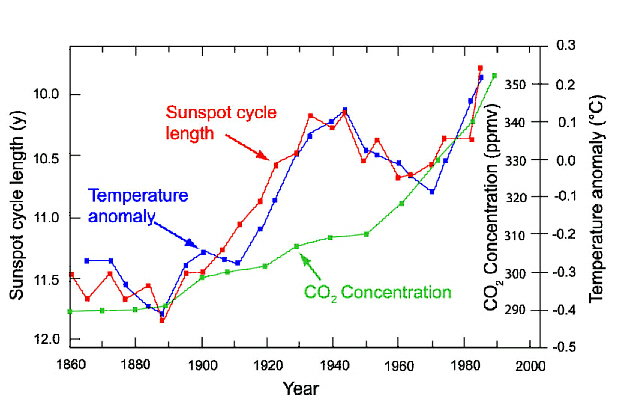
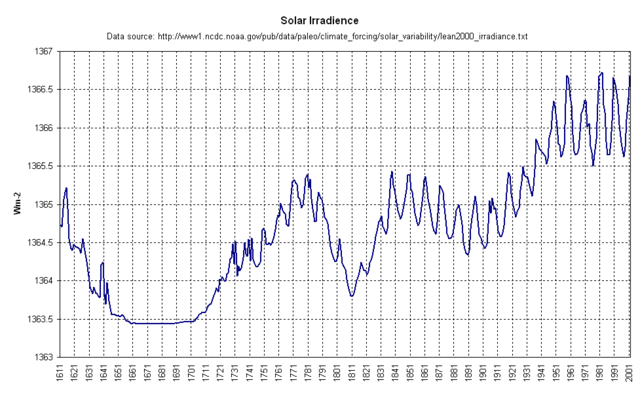
So that is why I am a skeptic.  I believe #1, though I know there are also things other than manmade CO2 causing some of the current warming (e.g. the sun's output is higher today than it has been in centuries).  I do not think anyone has completed any really convincing work on #2, and Occam's razor tends to make me suspicious of hypothesizing positive feedback loops without evidence (since they are so much more rare than negative ones).

More on the skeptical middle ground hereDiscussion of things like the "hockey stick" is here.  For a small insight into how global warming advocates are knowingly exaggerating their case, see the footnote to this post.

Update:  Increasingly, folks seem to want to equate "skeptic" with "denier."  If so, I will have to change my terminology.  However, that would be sad, as "skeptic" is a pretty good word.  I accept there is some CO2 caused warming, but I am skeptical that the warming and its effects are as bad as folks like Al Gore make it out to be, and I am skeptical that the costs of an immediate lock-down on CO2 production will outweigh the benefits.  That is why I call myself a skeptic.  If that is now a bad term, someone needs to suggest a new one.

So Much For Another Conspiracy Theory

Remember all those media reports about the possible "political motivation" behind falling gas prices ahead of the election?  Supposedly oil companies were somehow manipulating gas prices ahead of the election to help Republicans win the election.  This was not a wacky Internet fringe thing -- network news anchors and newspapers like the WaPo and the NYT speculated about it, and not just on their editorial pages.

Well, you and I may remember, but apparently no major media outlet who ran this story remembers what they said.  Because I have not seen a single follow-up story after the election.  Surely, if gas and oil prices were being manipulated down before the election, they would quickly spike back up to their "natural" levels after the election.  But of course, the whole theory was insane to begin with.  To suppose that a few US oil companies, who for all their size are still small players in the world oil markets, could manipulate US commodity prices for any sustained period of time is absurd.  And even if they were successful, the cost would be astronomical (just ask the Hunt family who bankrupted themselves trying to manipulate the silver market).

So I will do the follow-up story.  It turns out that oil and gas prices were falling before the election because ... oil and gas prices are falling.  From the WSJ on Jan 9:

Oil prices dropped $1.69 to $54.40 a barrel early Tuesday as warm
weather in the Northeast continued to hurt demand for heating fuel. The
slide comes on top of last week's 7.8% pullback in crude, which briefly
took prices below $55 a barrel, their lowest level since June 2005.

From Business Week on Jan 8:

Wholesale gasoline prices have been falling for the past few weeks,
noted Jason Schenker, an economist with Wachovia Corp. He expects
retail gasoline prices to fall further; he forecasts a dime-sized
decline this week compared to last, with the per-gallon price dipping
to $2.25 from $2.35.

People often wonder why so many wild and weird conspiracy theories seem to thrive nowadays.  I am sure there are many social and psychological reasons.  But surely one reason is that the media seems incredibly willing to go front page with credulous stories of the most ridiculous conspiracy theories, and then never revisit them when they are proved absurd.  Its telling to me that it was left to Popular Mechanics, rather than the WaPo or the NYTimes, to publish to one authoritative debunking of 9/11 conspiracy silliness.

Immigration and Statism

Dale Franks at QandO, quoting some from John Derbyshire, raise a key question that certainly has always concerned me as a pro-immigration libertarian:

As to why I think libertarians are nuts to favor mass uncontrolled
immigration from the third world: I think they are nuts because their
enthusiasm on this matter is suicidal to their cause. Their ideological
passion is blinding them to a rather obvious fact: that libertarianism
is a peculiarly American doctrine, with very little appeal to the
huddled masses of the third world. If libertarianism implies mass
third-world immigration, then it is self-destroying. Libertarianism is
simply not attractive either to illiterate peasants from mercantilist
Latin American states, or to East Asians with traditions of
imperial-bureaucratic paternalism, or to the products of Middle Eastern
Muslim theocracies.

In other words, by open immigration, are we letting in waves of people from statist traditions that will drive the US further away from an open, liberal society.  This worries me from time to time, enough that I don't have a fully crafted response that I consider definitive.  However, I want to offer some initial thoughts.  Before I do, here are two background points:

  1. I think the freedom to move to another country, take a job there, buy property, live there, etc. is a basic individual right that should not be limited to the accident of not having been born originally in that country.  Freedom of association is a right of all human beings, not merely a result of citizenship.  I go into these arguments in much more detail here.
  2. Note that immigrant status and citizen status are two different things.  Immigrant means that you are present in a country but not a citizen.  As an immigrant, I believe you should be able to own property, accept employment, and most of the other things you and I do every day.  However, immigrants don't vote.  Only the narrow class of people called citizens may vote, and there is some process where over time immigrants can meet some hurdles and become citizens.  The key problem for a libertarian, which I think Dale Franks would agree with, is "which status must you be to get government handouts?"  My view is that only citizens should get most handouts, like welfare and food stamps and such, though immigrants should have access to things like infrastructure (highways) and emergency services.  It is when one argues that any immigrant should have access to all this stuff that the whole immigration picture becomes a total mess.

With those couple of things in mind, here are my thoughts on the issue Franks raises:

  • The US is not made up primarily of Scots and Dutch, two areas that can legitimately claim to have strong liberal traditions.  Most of our past immigration has come from Ireland and Germany and Scandinavia and Eastern Europe.  None of these areas particularly have a liberal tradition, and many were nationalistic-militaristic-paternalistic governments.  Also, we may forget it today, but when countries like Ireland where a large source of our immigration in the 19th century, they were a third world country at the time.  Just look at Vietnam -- it has one of the worst traditions I can think of, but as a class Vietnamese immigrants tend to be capitalist tigers.
  • Depending on how one counts it, US citizens are already 65%-85% statist anyway, so I am not sure immigration is going to change the mix negatively.  In other words, the statist train has already sailed.  In fact, statism has flourished in this country from 1930-1980 during exactly the same period of time we were most restrictionist in immigration.  Sure, correlation is not causation, but certainly you can't prove to me that restrictionist immigration slows statism in any way. 
  • Much of the statist economic policies in this country were launched by Wilson and Roosevelt, from two of the more blue-blooded families in America.  Now this may not mean much.  What I don't know, because I don't know enough history of the period, is this:  Did support for New Deal (and more extreme socialist NRA-type policies) come disproportionately from new immigrants?  My sense is exactly the opposite, that in fact some New Deal policies like the minimum wage were aimed by nativists at circumscribing the opportunities of immigrants.
  • In effect, the author is advocating that we limit the freedom of movement and property ownership of people not born in the US because we are afraid that these new entrants into our country will bring political pressure to undermine individual rights.  I think that is a legitimate fear, but if I accept that argument, I don't know why I would not also have to accept the argument that we should take away the freedom of speech from people who argue for limitations of individual rights.  In both cases, we are giving political access to people who want to undermine our basic liberties.  My conclusion:  I can't go there in either case.  I refuse to put a political test on the exercise of individual rights, even for people with really bad politics.
  • A well-crafted welfare regime would make the problem a lot better.  I am not so unrealistic to expect the welfare state to go away tomorrow, but I do think that the political will can be mustered to deny substantial benefits to new non-citizen immigrants.  Which way we go on this will decide whether we can open up immigration.  If welfare handouts to immigrants are limited, then new immigrants will tend to self-select towards those looking to work hard and take risks to make it on their own.  This will mitigate the author's concern, and is in fact how we have maintained our culture of liberality through a history that was dominated mostly by open rather than closed immigration.  If welfare handouts are generous to new immigrants, then immigrants will self-select to people looking to live off the state.  If we insist on the latter, then I guess I will agree that immigration needs to be limited (though there is an even better reason for doing so in that we will, in that case, surely bankrupt ourselves.)

Good for Oprah

I usually don't have much to say about Oprah.  I guess my perception of her has always been vaguely negative -- she's given a big leg up to some junk science causes in the past, and some of her recent attempts at charity have seemed to be more about self-promotion than about really helping people (the car giveaway comes to mind).  My real beef with her is probably more petty:  She once inspired my wife, in that way only Oprah seems to be able to do with women, to organize her closets just like Oprah.  What this meant in practice was that I had to go out and buy about 400 matching wooden hangers, and then we had to get rid of all the stuff on our shelves.  Yes, you heard that right:

Wife:  All that stuff cluttering up the shelves in our closet has to go
Me:  Why?  I mean, it's a closet.  It's for storing stuff
W:  It has to go somewhere else
M:  There is no place else
W:  Oprah's closet is beautiful - it has just clothes and nothing else in it.  That's the way our closet should be
M:  But we have no where else to store this stuff.  Why should that shelf sit empty when we have a use for it?
W:  Because it will look great
M:  Who cares?  It's a closet.  Besides, are we really going to take home decorating advice from a woman who has enough money to build a dedicated closet for each pair of shoes she owns?

Anyway, guys out there, you probably know the drill.

But I must say my opinion is changing a bit.  I was deprecating about her book club, because of some of the specific book choices, until I saw the stat that something like half the adults in this country never read a book again after they leave school.  If Oprah can get women as fired up about reading as my wife is about having a zen closet, power to her.

And, I have to defend her in her current endeavor, where she is giving $40 million to start a school for girls in Africa.  Good.  I don't know if it will work, but it is worth a try.  We know that giving direct aid into kleptocratic totalitarian African governments is worse than useless, so maybe education is an answer.

Amazingly, she is under fire for this program, as people across the political spectrum ask why she is giving this money to Africa when everything is not perfect in this country.  This argument strikes me as more Lou Dobbs-type nationalistic xenophobia.  Sure inner city schools in this country suck, but they are better than what is in Africa (nothing) and its not clear that money alone is going to fix government-run schools (besides, Bill Gates and Warren Buffet are already taking a swing at that).  I personally would love to contribute to inner-city education, but until there is a framework such that someone other than the government controls the schools, I am not going to do it. 

There is no reason why Africans are less deserving of charity than Americans, and several reasons why they may be more deserving.  Recognize that most blacks in this country, even those in the inner-city, would be in the top quintile of wealth in Africa.  So good for Oprah.

Update:  Andrew Coulson of Cato argues that Oprah misdiagnoses the inner city education problem - its not the kids, its the schools.  I would argue its both.  School choice gives kids a chance to attend a better, more stimulating school.  But it also acts as a sorting process, separating kids and parents who want a good education and getting them away from the cancer of kids that don't.  I think Oprah (and Bill Cosby before her) correctly diagnoses that there is certainly a depressing number in the latter category.  However, all that is peripheral.  Oprah does not owe her charity to the US.  Africa is a perfectly reasonable target for her charity (and why does Oprah catch crap for focusing on Africa when no one gives Bono similar grief?)

Smaller Government, The Final Frontier

I am with TJIC when he says that while colonizing space is a cool thing to do, it doesn't justify government coercion.

For a while now, I have been wanting to post on some of my positions that have changed since I was 18, as I have morphed from a secular conservative to a full fledged libertarian anarcho-capitalist.   One such issue is on space.  I used to be a supporter of government space programs (it was hard not to be such, watching moon landings and Tang commercials in my formative years).  My logic was that the government wastes trillions on all kind of stupid stuff, and the space program was kind of interesting.  I supported it as one of the government's least-bad things.

Unfortunately, I have realized that if you add up every person in the United States's list of least-bad government programs you get ... the totality of the US budget.  Each program has a supporter that thinks that program is a kind of cool exception in the morass of government waste.  I have also, by the way, come to the conclusion that the space program is a direction-less mess, and is not really as interesting as I once thought it was.  The planetary probes are still cool (and probably have the most bang for the buck) but the ISS just seems like a UN building in space and the current plans for Moon and Mars missions appear to be NASA full-employment programs rather than realistic missions.

BMOC Online Reviews

I am a little behind on my email, so I am late in posting some of the reviews coming in on my book BMOC.  My habit is to post every review I can find, positive or negative.  Let me know by email if you have a review and I will link it as well.  Some of the reviewers below seem to like the book a lot, while some are more lukewarm, but I thank everyone for reading it and taking the time to post a thoughtful review.

After years of practice with non-fiction, I am still refining my fiction voice and style.  It is hard to over-emphasize how important it is to get critical feedback from people who are not a) paid by me, i.e. editors or b) friends and family, who make up most everyone's first readers.  I am already learning a lot from reviews about what works and doesn't work, what is interesting, and what comes off as a cliche.   And of course I continue to be proud that I have some of the smartest readers in the blogosphere.  Thanks.  [Of course I am going to quote the good stuff, but click through to see everything]

Human Advancement (what a beautiful web design he has)

I picked it up Christmas morning, with the intention of reading a
chapter or two in that little lull that always comes after the presents
are opened. You've heard the cliche "I couldn't put it down"? Well,
next thing I knew dinner was ready, and after eating I picked it right
back up and finished it.

I had kind of assumed it would be another one of those libertarian
fantasy novels. You know the kind, Montana secedes from the US; or a
small band of people decide they won't take it any more and go off
somewhere to found their own government; or a lone rebel plots to take
down the system by finding and eliminating the few key people who keep
it going, etc. I've taken to calling it "LibFic". So I thought this
would be more of the same: a book from a fellow libertarian blogger
whom I've had on my blogroll almost since I started this, and a book
that was in a niche - a very narrow niche - that I like.

Turns out that it was a pretty mainstream corporate espionage novel,
complete with a murder to be solved, a young, attractive and competent
protagonist, and more than one opening for a sequel. It fits the genre
that is popular today, (with dramatic but generic names like "Malice of
Intent"), and as such is entertainment, not great literature. But it is
a good story, and while it is not overtly libertarian (seems that
Warren forgot to include the 70-page speech painfully "integrated" into
the plot that outlines his entire philosphical edifice), it does have a
refreshing libertarian sensibility that is usually absent from books in
that genre....

In the process, the book paints a picture of the media/legal/government
complex that is as damning as the portrayals of the
military/industrial complex, or the profit/oppression complex that is
usual the root of all evil. Warren pulls this off without lengthy
digressions to explain to us that this cabal exists, and why it is so
bad. Instead, he just shows it in action, and each example serves not
to "interrupt our plot for this important message", but to further the
plot and to draw the characters.

The Unrepentant Individual  (great blog name)

Pagan Vigil  (does everyone have a better blog name than mine?)

Dispatches from TJICistan (I wish he would stop making me feel guilty with his workout synopses)


There is also a nice 5-star review on Amazon.   You can also get a low-cost pdf version here.  And I have posted the first 8 chapters starting here.

Climate "Consensus"

Please stop tell me that I have no right to question Al Gore when he wants to take over the world economy to his own ends.  And please stop telling me that catastrophic man-made global warming is now beyond question:

One of the many disturbing aspects of global warming hysteria is the
way moonbats who use it to promote their ominous political agenda
insist on a consensus that simply does not exist. A recent survey
of more than 12,000 environmental scientists and practitioners by the
National Registry of Environmental Professionals shows that despite the
hysteria and considerable pressure to conform to the "correct" view,
many scientists are choosing skepticism over the safety of the herd.

The survey found that:

  • 34% disagree that global warming is a serious problem;
  • 41% disagree that warming trends "can be, in large part, attributed to human activity";
  • 71% disagree that human activity has significantly contributed to hurricanes;
  • 33% disagree that the US government is not doing enough about global warming;
  • 47% disagree that international agreements such as the preposterous
    Kyoto Protocol provide a useful framework for addressing global climate
    change.

There are good reasons to believe in some man-made global warming, but there are very good reasons to doubt it will be as catastrophic as portrayed in the media, and very, very good reasons not to hand over the throttle of the world economy to environmental groups in anticipation of such uncertain events.  My position on the skeptical middle ground on climate change is here.

The Obesity Non-Epidemic

It seems of late that obesity is the new sky-is-falling health care issue I see in papers all the time.  One of the easiest ways to create a "trend" is to steadily change the standards**, which is in fact what has been happening with obesity in the US.  Every year or two, government officials or whoever does this stuff expand the range of weights that constitute "obese".  By doing this, even if the average weights are not changing (and I don't know if they are or are not) you can create a trend in increasing obesity just from changing the standards.  In fact, I argued here:

By the way, I am willing to make a bet with anyone that no where near
40% of our healthcare charges in Arizona are due to obesity.  I am
positive some advocate made up this number, or created it using some
ridiculously broad assumptions, and it has now been swallowed by the
credulous and scientifically-illiterate press. 

Sandy Szwarc who runs the new Junkfood Science blog, writes of a similar effect in hospital statistics.

The HCUP report
is not actually reporting hospital stays of obese people. It is a tally
of the numbers of times "obesity" was checked off on the billing codes
on the hospital records. These codes are currently known as ICD-9
codes, taken from the International Classification of Diseases, Ninth Revision.
This is an enormous, complicated and continually changing system which
gives a number to every disease and medical procedure, and currently
has about 12,000 codes. The medical literature is filled with
documentations of their inaccuracies in reflecting actual patient
disease rates. But over recent years, healthcare providers are being
increasingly educated on using these codes in order to receive
reimbursements ... including coding for obesity. The weight loss and
bariatric industry has been especially intense in marketing the usage of the obesity code, in particular.     

Not surprisingly, more providers are.    

So that 112% increase in hospitalizations for "obesity"since 1996 actually reflects increased usage of
the coding, but whether or not it means there are actually more obese
patients is arguable. But with the heightened stringency and
surveillance by third party payers in compelling providers to
accurately note ICD-9 codes in order to receive reimbursements, the
current figures are certainly more complete than in past years.

She concludes by questioning whether there really is an epidemic of hospital admissions for obesity.  Remember that this is important because it is this obesity epidemic that is used as justification for nanny-state interventions like the NY trans-fat bans as well as potential tobacco-clone litigations against fast food companies. 

This report is being
presented as proof that ""˜obesity' has become a major public health
problem." That was even its opening sentence. But the media's failure
to give us the full story is demonstrated in the most significant fact
in the report: 94.3% of all hospitalizations made no mention of obesity!    

Fat people are not flooding into hospitals with health problems more than anyone else.   

"Obesity" is the primary diagnosis in only 0.4% of all hospitalizations and
virtually all of those (95%) were for bariatric surgery! Not the result
of fat people succumbing to life-threatening health problems, but a
profit-making elective surgery targeting them.

My sense is that the obesity issue is the next phase of what I call the health care trojan horse (and here and here).  This is the practice of using government funded health care expenditures as an excuse to micro-regulate our eating and other personal practices.  As I said then:

When health care is paid for by public funds, politicians only need to
argue that some behavior affects health, and therefore increases the
state's health care costs, to justify regulating the crap out of that
behavior.  Already, states have essentially nationalized the cigarette
industry based on this argument.

** As an aside, a fantastic example of this game is in the movie "An Inconvenient Truth."  The filmmakers try to make the argument that global warming is making weather more volatile.  As "proof", they show the number of reported tornadoes in the US rising dramatically since the 1950's.  But here is the rub:  In the 1950's, we had no good way of detecting smaller class 1 and 2 tornadoes that we now detect using Doppler radar and the like.  This means that we do not necessarily experience more tornadoes, we just can detect more.  In fact, if you look only at larger class 3-5 tornadoes that we could detect through the whole period, the tornado frequency has NOT gone up.  I leave it to the reader to decide if the filmmakers are terrible at interpreting scientific data, or if they are disingenuous.  Neither reflects well on the rest of the film.

Arizona Snow Play

Arizona has always lacked a managed snow play area.  In the past, when the snow first flies in Flagstaff, everyone in Phoenix would hop in the car and sled any place they could find, even some downright dangerous spots on Interstate overpasses. 

After a year of work, we have opened the Wing Mountain Snow Play Area, just north of Flagstaff, Arizona.  We have a huge, managed parking lot, portable bathrooms, and concessions which include hot chocolate and sled sales.  If you live in Arizona, come and visit us this winter.

Update:  I think the season is going well, and we have good snow.  We had an enormous number of visitors on Christmas day, more than we could ever have predicted, and I apologize if anyone was not able to get in and play.  However, that day was an anomaly, and most days we have plenty of space to park and play.

To the bathroom question, we only just got the permit to run this facility from the US Forest Service a few weeks ago, so yes the bathrooms are just porta-john types.  Once we have a little time with the facility, we will work for a more permanent solution.   However, last year before we took over the facility there was only Mother Nature.

Counting Coup for CO2

New numbers for US vs. European CO2 growth have been making the rounds, based on a Wall Street Journal article today.  Jonathon Adler at Volokh has the key numbers for CO2 growth rates:

U.S. E.U.
1990-1995 6.4% -2.2%
1995-2000 10.1% 2.2%
2000-2004 2.1% 4.5%

The Wall Street Journal tries to make the point that maybe the US somehow has a better approach to CO2 reduction.  Here is the reality:  Neither the US or the EU has done anything of substance to really reduce CO2 production, because at the end of the day no one can tolerate the political and economic costs associated with severe reduction using current technology.

But there is a story in these numbers.  That story goes back to the crafting of the Kyoto treaty, and  sheds an interesting light on what EU negotiators were really trying to achieve.

The Kyoto Treaty called for signatories to roll back CO2 emissions to 1990 levels.  Since Kyoto was signed in the late nineties, one was immediately led to wonder, why 1990?  Why not just freeze levels in place as they were currently?

The reason for the 1990 date was all about counting coup on the United States.  The date was selected by the European negotiators who dominated the treaty process specifically to minimize the burden on Europe and maximize the burden on the US.  Look at the numbers above.  The negotiators had the 1990-1995 numbers in hand when they crafted the treaty and had a good sense of what the 1995-2000 numbers would look like.  They knew that at that point in time, getting to 1990 levels for the EU was no work -- they were already there -- and that it would be a tremendous burden for the US.  Many holier-than-thou folks in this country have criticized the US for not signing Kyoto.  But look at what we were handed to sign - a document that at the point of signing put no burden on the EU, little burden on Japan, no burden on the developing world, and tremendous burden on the US.  We were handed a loaded gun and asked to shoot ourselves with it.  Long before Bush drew jeers for walking away from the treaty, the Senate voted 99-0 not to touch the thing until it was changed.

But shouldn't the European's get some credit for the 1990-1995 reduction?  Not really.  The reduction came from several fronts unrelated to actions to reduce CO2:

  • The European and Japanese economies were absolutely on their backs, reducing economic growth which drives CO2 growth.  I have not looked up the numbers, but the 1990s are probably the time of the biggest negative differential for the European vs. US economy in my lifetime.
  • The British were phasing out the use of carbon-heavy domestic coals for a variety of reasons unrelated to carbon dioxide production.
  • German reunification had just occurred, so tons of outdated Soviet inefficient and polluting industrial plant had just entered the EU, and was expected to be shut down and modernized for economic reasons over the 1990's.  The negotiators went out of their way to make sure they picked a date when all this mess was in their base number, making it easier to hit their target.
  • The 1990 also puts Russia in the base.  Since 1990, as the negotiators knew, the Russian economy had contracted significantly.
  • At the same time the American economy was going gangbusters, causing great envy among Europeans.

Kyoto was carefully crafted to make America look like the bad guy.  The European's goal was to craft treaty responsibilities that would require no real effort in Europe, with most of the burden carried by the US.  But times change, and the game is catching up with them.

The Stagnating Wage Myth

Prior to the election, folks on the left were pushing the idea that US wages had been stagnating.  Often this argument was a subset of a zero-sum class warfare rant, complaining that though the economy has grown, the "rich" have taken all the gains.

There were always two problems with the hypothesis that real wages were stagnating:

  1. "Wages" are only a part of total compensation.  In fact, I don't think anyone denies that real compensation (wages plus benefits) has been growing, and it would not surprise me that non-wage compensation, like health care, has grown much faster than wages.  A discussion about only one component of total compensation is nearly irrelevant.
  2. Even if the average is stagnating, that does not mean that the wages for individuals is stagnating.  What is actually going on is that everyone's real wages are improving, but new low-skill low-wage immigrants and teenagers move in behind them and bring the average down.  If you showed real wages for people who were in the work force in 1980 without any entrants after that, average wages would be way up.  The average is less important, from a general well-being standpoint, than what is happening to individuals.

The New York Sun (Hat tip: Most all the libertarian blogosphere) that also takes on these issues.  The author makes the further distinction between individual and family income, and argues you also need to correct for changing family sizes.

The American family has
shrunk due to changes in society, such as more divorces, longer
life-expectancy for women, and fewer children. So family income in 2004
cannot correctly be compared to family income in 1964 "” today's family
income is spread around fewer people.

Adjusting for decreasing family size, real median family income is
13% higher than in 1994, 22% higher than in 1984, 37% higher than in
1974, and 88% higher than in 1964. That's a significant increase.

Indefinite Detentions

Conservative pundits often observe that "this is a new type of war -- shouldn't the president have new powers to fight it?"  Well, maybe.  But I think there is a question that is at least as valid:  "Given that enemy combatants don't wear uniforms any more, shouldn't we exercise more care than in the past in how we designate people as combatants?"  The much greater ambiguity in naming combatants would seem to demand extra layers of process protection and appeal rights for such persons.

Unfortunately, this Administration, with the aid and comfort of the US Congress, has gone exactly in the opposite direction.  As Jim Bovard writes, via Cato-at-Liberty:

The MCA awarded Bush the power to label anyone on earth an enemy
combatant and lock then up in perpetuity, nullifying the habeas corpus
provision of the Constitution and "turning back the clock 800 years,"
as Sen. Arlen Specter (R-PA) said. While only foreigners can be tried
before military tribunals, Americans accused of being enemy combatants
can be detained indefinitely without charges and without appeal. Even
though the Pentagon has effectively admitted that many of the people
detained at Guantanamo were wrongfully seized and held, the MCA
presumes that the president of the United States is both omniscient and
always fair.

Sixty years ago, when the military hauled in a guy dressed in a gray Wermacht uniform captured in the Ardennes Forest, you kindof gave them the benefit of the doubt that he was an enemy combatant.  How long until merely exercising free speech rights in favor of a terrorist group gets one labeled a "combatant."

Here We Go Again

It looks like my local and state governments are gearing up to take money from my business and give it to US Airways.  Because, you see, politicians don't have problems in elections if they lose a few anonymous small businesses, but they do feel vulnerable if their city loses a major corporate headquarters:

Metropolitan Phoenix has not faced losing such a significant hometown
company since America West Airlines went bankrupt in 1991.

"The decision will be driven by what's in the best interest of
the stakeholders, which includes the creditors, the shareholders and
our employees," said C.A. Howlett, US Airways' senior vice president of
public affairs.

Tempe may have the hometown advantage, but Atlanta will no doubt vigorously and publicly fight to capture the headquarters....

Valley lawmakers, business leaders and economic development officials,
who have been largely silent in public, are having informal, quiet
discussions with the airline. They say they want to keep the
headquarters local but disagree about how to accomplish that goal and
when to move forward with a plan.

"I don't think we're at a phase where we should be panicking," said
Darcy Renfro, Gov. Janet Napolitano's policy adviser on higher
education and economic development. "The governor is very engaged.
We've jumped on this as soon as we could to make sure that we are
ready."

Even as Napolitano and Phoenix Mayor Phil Gordon plan to meet with US
Airways CEO Doug Parker, possibly this week, some maintain it is too
early to devise a strategy.

Just great.  If they don't want to stay, let them go.  They can have Atlanta.  I have lived both places and wouldn't move from Arizona to Atlanta for any reason.  By the way, the Arizona politicians are downright subdued in their response vs. this craziness from Atlanta:

Atlanta Mayor Shirley Franklin opposes the merger and recently blasted US Airways' customer service in a column in the Atlanta Journal-Constitution.

What theory of government could possibly make it Ms. Franklin's job to opine about the relative merits of various private company's products in her official capacity as mayor?  Why does the Atlanta city government need to have an official position on a merger of two private companies?  The last time I remember public authorities vociferously opposing a merger, it was the Pennsylvania government trying to stop (successfully, in the end) the buyout of local company Amp by AlliedSignal.  And what did this achieve?  It allowed Amp to be bought by Tyco, which has been rocked by scandal.  Pennsylvania stockholders who ended up with Tyco rather than AlliedSignal (now Honeywell) stock were much worse off several years later, as were Amp employees who traded AlliedSignal for Tyco as their boss.

One of the reasons I like Arizona is that we actually have a pretty strong libertarian streak here, going back to Barry Goldwater and extending today with Congressman Jeff Flake.  So I must admit that this made me feel better, and is something you would hear from a politician in very few states:

"We would like to have that company here, but it will not make or break
Arizona. We have companies that are moving all the time," said Barrett
Marson, director of communications for the Arizona House of
Representatives. "We're growing by leaps and bounds. Arizona does not
have many headquarters, but it does just fine, thank you very much."

I have written about government subsidies of corporate relocations here and here, among many other places.

Proposal: No New Federal Funds to Louisiana

We have a federal system in this country, so Louisianans are welcome, I guess, to run their state any way they please.  However, in light of recent events, I propose that the US Government stop sending any of our federal tax money to the state.  Maybe we could send the money instead to a country with a better government that is more likely not to use it corruptly, like maybe Haiti.

All of this is in light of recent events.  I guess most will consider the 1991 gubernatorial election between a convicted felon and a Klansman old history (the felon won).  More recently I think anyone who isn't just looking to blame every problem in the world on GWB would come to the conclusion that local Louisiana government had more to do with the worst aspects of Katrina (both before, in the corrupt levee districts and after, in the pathetic disaster response) than any other public entity.  The final straw comes today as the Congressman who was found with $90,000 in bribe money in Tupperware in his freezer (and god knows whatever he carried off with the aid of the National Guard during Katrina) was apparently reelected. 

Maybe we can find a better investment than sending our money to Louisiana.  Anyone have any Enron stock for sale?